The transition to a circular and biobased built environment offers major potential to reduce embodied greenhouse gas emissions, yet the extent to which environmental assessment research addresses practitioner needs remains unclear. This study examines the alignment and divergence between academic work and industry priorities in circular biobased construction.
We combined two approaches: (1) four workshops with architecture, engineering, and construction stakeholders to identify key questions and concerns, and (2) a scoping review of 189 academic papers, categorized with a multi-dimensional taxonomy and clustered using k-medoids.
The workshops highlighted six overarching themes: material availability, land use, supply chains, design, environmental impacts, and political and cultural shifts. The literature clustered mainly around four scales: (1) materials and products, (2) buildings, (3) building stock, and (4) regional planning. While strong alignment emerged around material availability and environmental impacts, major gaps remain in supply chains, design, land use, and societal dimensions. Addressing these gaps can guide more actionable assessments for policy and industry. These findings inform a research agenda that advances theoretical understanding of how environmental assessment research engages with circular biobased construction, while also identifying priority areas where further work is needed to support decision-making in practice.
This study systematically compares environmental assessment research on circular biobased construction with practitioner concerns. By translating research–practice misalignments into a structured research agenda, it provides an evidence-based foundation for more actionable assessments that better support policy and industry decision-making.
Introduction
The built environment is a major contributor to global greenhouse gas emissions, not only through operational emissions generated during a building's use phase, but also through embodied emissions from producing the materials used in construction and renovation (Ibn-Mohammed et al., 2013; Röck et al., 2020). Embodied emissions are significant, accounting for 20–50% of total building-related emissions over a typical life cycle (Röck et al., 2020). Their relative importance is expected to grow as energy grids decarbonize and operational emissions decline, making the environmental impacts of material production an increasingly critical focus for climate mitigation in the construction sector (Ibn-Mohammed et al., 2013).
One potential approach to reducing embodied emissions is to transition towards a circular and biobased built environment (Le et al., 2023). We define the circular biobased built environment as the integration of two key concepts: the biobased built environment and circular built environment. The biobased built environment refers to buildings and infrastructure made with materials derived from renewable biological sources, such as plants or biomass (Yadav and Agarwal, 2021). This includes natural fiber insulation, timber structures, and engineered wood products (Cosentino et al., 2023), as well as entire buildings made largely from biobased materials (Ilgın, 2024; Tupenaite et al., 2023) and regional systems where these materials are produced and used at scale (Amiri et al., 2020; Churkina et al., 2020; Elustondo et al., 2023). Beyond carbon storage, biobased materials can contribute to broader regenerative outcomes, including soil restoration, ecosystem services, and reduced reliance on fossil-based inputs, depending on how they are sourced and managed. The circular built environment, meanwhile, applies circular economy principles to slow, close, and narrow material loops (Joensuu et al., 2020; Pomponi and Moncaster, 2017), and can also encompass regenerative strategies aimed at restoring natural systems alongside material efficiency. These principles are operationalized through strategies such as material recycling (Vefago and Avellaneda, 2013), product reuse and repair (Jansen, 2024), renovation and design for longevity (Hamida et al., 2022; Kanters, 2020; Sáez-de-Guinoa et al., 2022), and regional systems that support secondary material use through circular hubs and coordinated planning (Mendez Alva et al., 2021; Tsui et al., 2023; Bucci Ancapi et al., 2022; Campbell-Johnston et al., 2019; Williams, 2019).
One key motivation for circular biobased construction is its potential to reduce embodied greenhouse gas emissions. Biobased materials such as timber and natural fibres absorb carbon dioxide during growth, storing carbon in products until it is released at end of life. Extending product lifetimes through circular strategies delays this release, effectively increasing the duration of carbon storage (Jarre et al., 2020; Mair and Stern, 2017). Buildings, with their relatively long service lives, are therefore often framed as particularly suitable for long-term carbon storage (Amiri et al., 2020; Arehart et al., 2021; Churkina et al., 2020). This carbon storage potential has become a compelling narrative driving governments and companies to invest in scaling circular biobased construction (Abanades et al., 2005; ASB Bank and Climate Cleanup, 2021). Yet decision-making in the built environment is far more complex, requiring practitioners to assess trade-offs between materials, processing routes, supply chains, land use, and broader environmental impacts when determining whether biobased solutions are truly sustainable in a given context. Crucially, these benefits depend on combining biobased materials with circular strategies, as circular design, reuse, and longevity are what allow biogenic carbon to remain stored over longer time horizons.
Over the past decade, environmental assessment research on circular biobased construction has grown rapidly. Yet it remains unclear whether this expanding body of work addresses the questions that most constrain decision-making in practice. While there has been a literature review on the topic, it did not address the research-practice gap (Le et al., 2023). Circular biobased construction is being implemented by architects, engineers, developers, and policymakers who must make concrete choices about materials, supply chains, land use, and long-term environmental performance. If research priorities are misaligned with practitioner concerns, there is a risk that substantial academic effort is directed toward problems of limited practical relevance, while key barriers to implementation and scaling remain insufficiently addressed. At the same time, practitioners may lack robust evidence on the issues most critical to evaluating the feasibility and sustainability of circular biobased solutions. With more than a decade of publications now available—and major investments and policy targets expected in the coming years (Built by Nature, 2023; Carbon Neutral Cities Alliance et al., 2024; Programme and Architecture, 2023)—a systematic examination of research–practice alignment is therefore both timely and necessary.
This study maps the overlaps and gaps between academic research and practitioner priorities in circular biobased construction by combining stakeholder workshops with practitioners in the architecture, engineering, and construction (AEC) sector and a review of existing environmental assessment literature. To our knowledge, it is the first to systematically compare practitioner priorities with academic research in this field. The resulting thematic map helps academics identify research gaps and understand industry needs, while providing practitioners with insight into existing assessment methods and a broad overview of current work on circular biobased construction.
Methodology
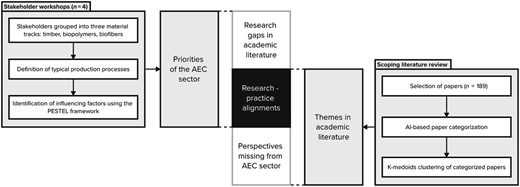
Our study followed a three-step approach. First, we conducted four workshops with architecture, engineering, and construction (AEC) stakeholders to identify key industry concerns. Second, we carried out a scoping review of the academic literature, using AI to co-create a taxonomy for categorizing papers and applying k-medoids clustering to identify major themes. Finally, we compared the themes emerging from practice and research to highlight alignments and gaps. See Figure 1 for a summary of our methodology.
Step 1 – stakeholder workshops
We organised four stakeholder workshops to explore questions and concerns in the architecture, engineering, and construction (AEC) sector related to environmental impact assessment of a circular biobased built environment. Workshops were chosen as an exploratory method because they enable discussion and identification of influencing factors, which is well suited to early-stage mapping of complex, multi-scalar issues such as circular biobased construction. The workshops were organised around material-specific tracks—timber, biopolymers, and biofibers—reflecting the structure of the broader research project from which this study emerged. One workshop was conducted for each material track, with an additional workshop held for timber due to higher stakeholder interest and participation in that track.
Participants were selected based on their expertise in the relevant material track and included both researchers and practitioners actively working on biobased construction products. They comprised architects, digital fabricators, wood engineers, environmental consultants, and members of start-up companies developing biobased materials and building components. Participant recruitment was conducted through targeted invitations within the project network and supplemented by referrals from invited participants to ensure relevant expertise. Each workshop focused on a single material track: two on reclaimed timber, one on biopolymers derived from bio-waste, and one on natural fibres, with a focus on hemp. An overview of workshop participants is provided in Table 1, with additional documentation and intermediate processing of results included in the supplementary material. Across the four workshops, recurring themes and influencing factors emerged consistently, and no substantially new categories were identified in the final session, indicating sufficient coverage of key issues for the purposes of this exploratory analysis.
To structure the workshops, we drew on the SIMPL method (Scenario-based Inventory Modelling for Prospective LCA), a stepwise approach for integrating scenario thinking into prospective life cycle assessment (Langkau et al., 2023). SIMPL includes three stages—identifying key parameters and external factors (Step A), formulating future assumptions (Step B), and combining them into consistent scenarios (Step C). We applied only Step A, which systematically identifies factors relevant for environmental assessment more broadly. Each workshop began with a 10-min exercise where participants co-created a process flow diagram for a typical product in their material track.
For the rest of the workshop, participants identified influencing factors for their material track across four scales—material, product, building, and region—using the PESTEL framework (political, economic, social, technological, environmental, and legal) (Yüksel, 2012). PESTEL was selected because it provides a comprehensive yet intuitive structure for capturing contextual drivers that shape the environmental performance of construction systems. The focus was on environmental assessment, highlighting factors to be included in future assessment methods rather than general drivers of circular biobased construction (see Figure 1 for an overview of the workshop steps and their place within the overall methodology).
All workshops were conducted online, with a shared MURAL board, an online whiteboarding tool. After participants populated the board, each group discussed the identified factors in a plenary session, during which clarifications were provided. Following the workshops, all notes were compiled into a single document, documenting both the written inputs and the associated discussions. We reviewed the collected factors and discussions, and manually grouped recurring questions into overarching themes. These themes reflect repeated patterns observed across material tracks and form the basis for the practitioner priorities presented in the Results section.
Step 2 – scoping review
We conducted a scoping review to identify methods in academic literature for assessing environmental impacts of a circular biobased built environment. A scoping rather than systematic review was chosen because this is an emerging, poorly defined field where an exploratory approach better maps existing studies, gaps, and future directions (Pham et al., 2014). The review involved four steps: (1) selecting relevant papers, (2) developing a taxonomy, (3) classifying papers, and (4) clustering them into main themes. See supplementary document section 2 for details on each step.
Paper selection and categorization
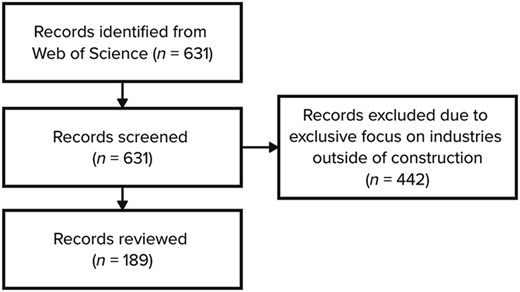
We conducted the scoping review using the Web of Science database, which provides broad coverage of peer-reviewed literature across environmental science, engineering, and construction research, and offers consistent metadata suitable for large-scale literature mapping. Given the aim of this study to identify dominant research themes and gaps rather than to achieve exhaustive coverage, the use of a single, well-established database was considered sufficient for this scoping review. We searched using tailored search strings, yielding 631 records. The search strategy drew on four keyword categories: future, environmental impact, biobased, and built environment. We ultimately used the first three to capture studies on biobased products broadly, including those relevant to construction, while excluding papers focused solely on other industries—such as biofuels, biochemicals, biopackaging, automotive, paper, diets, agriculture, or purely economic analyses. This screening resulted in 189 papers for review. The full search strings and selection procedure are provided in the supplementary material and Figure 2.
Paper categorization involved two steps: co-creating a taxonomy and applying it to the selected papers. The taxonomy was developed collaboratively using NotebookLM (Google, 2023), a language model tool that analyzes user-provided documents while citing sources for traceability. We defined six dimensions—methods, environmental indicators, scale, material type, future perspectives, and circular economy—and uploaded paper titles and abstracts to NotebookLM. For each dimension, it generated 20 categories, which we manually consolidated into a concise final set. The co-authors jointly reviewed and refined the taxonomy.
The final categories are listed out in the bullet points below, with dimensions in bold and associated categories in regular text. For a definition of each category, refer to the supplementary document section 2.2.
Methods: LCA, carbon flow modelling, material flow modelling, simulation and optimization modelling, socioeconomic and policy analysis, spatial analysis, review, product performance assessment
Environmental indicators: climate change, material use, energy use, land, pollution, ecosystems
Scale: material, product, building, regional, global
Material type: woody biomass, agricultural and plant biomass, biogenic residues and by-products, unspecified biomass, biochemical feedstocks, animal-based biomass, marine biomass
Future perspectives: carbon futures, material futures, socioeconomic futures, climate futures, technology futures
Circular economy: closing loops, slowing loops, narrowing loops
After finalizing the taxonomy, we used the ChatGPT API (OpenAI, 2023) to automatically label each paper abstract by category. The API enabled programmatic interaction with the model, using a prompt that instructed it to read an abstract and assign a “True” or “False” label for each taxonomy category based on its presence in the text. To ensure accuracy, we manually labelled 10% of the papers (n = 19) and compared results with ChatGPT's output, refining the prompt until all categories achieved at least 80% accuracy. Further tuning yielded no improvement, indicating performance had plateaued. The final output was a table with papers as rows, categories as columns (e.g. methods_LCA), and “True” or “False” entries in each cell.
Clustering papers into main themes
We used k-medoids clustering to group papers into main themes based on their category labels (Kaur et al., 2014). K-medoids was chosen over k-means because it better handles binary data and selects actual data points as cluster centers, providing a representative paper for each cluster (Madhulatha, 2011).
Given the large number of categories (34 across six dimensions), we tested clustering using subsets of dimensions to identify the most suitable combination. We evaluated results both quantitatively—using total within-cluster difference (lower values indicate tighter clusters) and silhouette score (higher values indicate clearer separation)—and qualitatively by reviewing the papers within each cluster to define their main themes. Although the quantitative performance was limited, we ultimately included all categories, as this produced the most coherent and meaningful themes.
Step 3 – theme comparison
The final step compared priorities from the stakeholder workshops with existing studies on circular biobased construction to identify alignments and gaps. The workshops produced research questions grouped into six themes. For each question, we checked for corresponding themes in the literature, noting matches and discussing missing areas and needed studies when none were found. This analysis produced a matrix comparing research and practice, summarizing their overlaps and gaps, which we then used to further elaborate these findings.
Results
Stakeholder workshop results
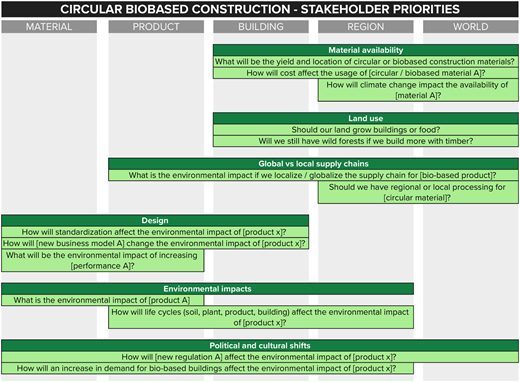
We identified six overarching themes from the stakeholder workshops, see Figure 3 below. The following paragraphs explain in more detail the main themes that emerged from the workshop discussions. These are: material availability, land use, supply chains, design, and environmental impacts.
Material availability
Participants raised two main concerns about material availability: the future supply of circular and biobased construction materials, and the effects of climate change on that supply. They suggested mapping Europe's annual yields (e.g. tons/year) for biobased materials, tailored to construction needs, to visualize material flows. They also emphasized the influence of cost fluctuations, future demand, and climate change, which could shift production locations, alter yields, and change building requirements such as insulation or fire and water resistance.
Land use
Discussions on land use centered on two issues: competition with other industries and land use policy. Expanding biobased materials in construction will increase land demand, creating trade-offs between sectors such as construction and food, fibers and textiles, or forests for ecosystem services and timber. Participants called for studies to optimize land use across sectors and noted that growing demand for biobased materials could shift regional land use patterns, requiring policy adaptation.
Global vs local supply chains
Participants noted that transitioning to bio-based and circular construction will require new supply chains for material production, processing, and distribution. Some supported expanding local manufacturing within the EU, but the environmental trade-offs between local and global supply remain unclear—raising questions about whether to import materials or produce them domestically, and whether to develop EU-based processing hubs or rely on global systems.
Design
Discussions on design focused on how choices affect the environmental impact of circular biobased construction, emphasizing standardization versus customization, performance optimization, and new business models.
For reused materials like reclaimed timber, performance varies. Standardization treats all elements as weakest, simplifying design but increasing material use. Customization, enabled by digital fabrication, tailors use based on tested strength, saving materials but requiring more processing. The key trade-off is between material and machinery use, raising questions about overall environmental performance.
Performance optimization involves balancing environmental impact with properties like strength or fire resistance—for instance, adding resin to biofibers improves strength but greatly increases impact. New business models, such as subscription-based services, could further extend product lifetimes and reduce environmental burdens.
Environmental impacts
Discussions about the environmental impacts of bio-based construction spanned three main areas: carbon storage, life cycles, and ecological effects. Carbon storage by different plant species influences a product's environmental performance and could affect a product's score on carbon credit schemes. Life cycles—covering soil recovery, plant growth, and product lifespan—shape carbon storage duration and refurbishment practices, especially for biopolymers and bio-fibers, which have shorter life-cycles. Ecological impacts arise from cultivation, as some crops are less land-intensive, require fewer pesticides, or improve soil quality. Trade-offs can occur between scaling up material production and ecosystem services, biodiversity, and soil health.
Political and cultural shifts
Political and cultural shifts also affect the environmental impact of circular biobased building products, with discussions focusing on safety and environmental policy. Strict safety regulations require extensive testing—such as full-scale prototypes—to meet structural, fire, and water resistance standards, increasing costs and slowing market adoption. Relaxing some rules could cut material use and energy demand but risk reduced durability and more frequent replacements. Participants also highlighted the need for clearer regulations and foresight on evolving policies, especially as impact accounting expands beyond carbon to broader sustainability metrics.
Scoping review results
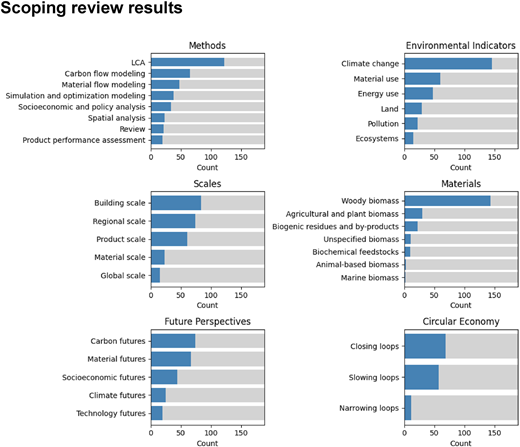
The scoping review and categorization of papers (Figure 4) revealed clear imbalances in research attention: categories such as LCA, timber, and climate change impacts dominated the literature, while higher-order circular strategies like narrowing loops received little focus compared to closing and slowing loops. Several topics emphasized in the AEC workshops were underrepresented, including “product performance assessment,” which links product functionality to environmental impact—a key concern for practitioners facing trade-offs in structural, thermal, or water resistance performance. Environmental indicators such as land use, pollution, and ecosystems were also rarely addressed, despite strong workshop emphasis on land competition. Similarly, few studies considered “climate futures” or “technology futures,” referring respectively to how climate change and technological scaling affect material availability. Finally, materials beyond timber, such as biopolymers and biofibers, received limited attention even though they were of strong interest to practitioners.
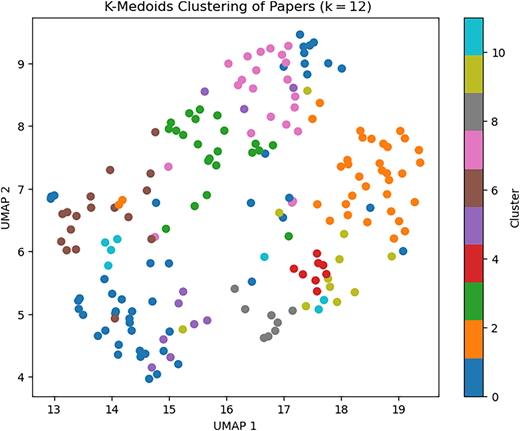
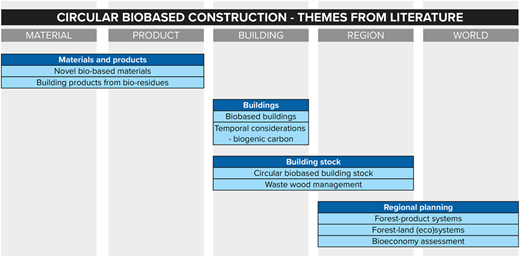
The k-medoids clustering of papers based on their category labels resulted in 12 clusters. After examining the papers in each cluster, we manually grouped some similar clusters, resulting in 9 clusters. The clusters fell into four main scales: materials and products, buildings, building stock, and regional planning. See Figure 5 for the k-medoids clustering results, and Figure 6 for an overview of the clusters. In the following paragraphs, we present the nine themes that emerged from the scoping review.
Materials and products
Novel bio-based materials
This cluster covers environmental assessments of emerging bio-based materials beyond timber, including insulation panels from giant reed, cork, or sunflower straw (Barreca et al., 2019; Gomez-Campos et al., 2023), fiberboards from coconut residues (Freire et al., 2017), and laminated bamboo (Zeng et al., 2024). Studies often use advanced LCA methods—prospective approaches (Ayala et al., 2024; Sander-Titgemeyer et al., 2023), modular modeling (Steubing et al., 2016), and end-of-life analyses (Gomez-Campos et al., 2023; Luthin et al., 2024)—and compare results with conventional materials, revealing both environmental gains and trade-offs such as higher costs (Luthin et al., 2024).
Building products from bio-residues
This cluster examines LCA studies on construction products made from agricultural waste (Llorach-Massana et al., 2023; Müller-Carneiro et al., 2023), recycled plastics (Sánchez-Burgos et al., 2024), wood residues (Hildebrandt et al., 2019; Wang et al., 2023), and reclaimed wood (Alanya-Rosenbaum et al., 2022; Risse et al., 2019). Key methodological points include accounting for biogenic carbon flows (Llorach-Massana et al., 2023), evaluating end-of-life options such as incineration, recycling, or landfill (Morris et al., 2021; Nebel et al., 2006), and integrating eco-efficiency by combining LCA with life cycle costing (Risse et al., 2019).
Buildings
Biobased buildings
This cluster consists mainly of LCAs comparing bio-based and conventional buildings or structural systems, with a strong focus on timber. Most studies find lower environmental impacts for bio-based options (Ahmad et al., 2023; Allan and Phillips, 2021; Gerilla et al., 2007) while highlighting the importance of service life, maintenance, and end-of-life choices (Grant et al., 2014; Cusenza et al., 2021; Napolano et al., 2015; Zimmermann et al., 2023; Dodoo et al., 2022; Junda and Málaga-Chuquitaype, 2025; Tighnavard Balasbaneh et al., 2025). Decision-support approaches such as MCDM (Ahmad et al., 2023; Caruso et al., 2024), parametric and stochastic LCAs for moisture and durability risks (Al-Obaidy et al., 2022; Fufa et al., 2018), and the integration of LCCA (Hassan and Johansson, 2018; Thinley and Hengrasmee, 2023) are increasingly used to balance environmental, economic, and social trade-offs.
Temporal considerations for biogenic carbon
This cluster includes studies reviewing and advancing temporal aspects of biogenic carbon accounting in construction. Dynamic LCA (dLCA) is central, addressing the timing of carbon uptake, storage, and emissions (Andersen et al., 2024; De Rosa et al., 2018; Fouquet et al., 2015; Pittau et al., 2018) and the implications of long time horizons (Arehart et al., 2021; Norouzi et al., 2025). Researchers call for more flexible dLCA frameworks integrating spatial and temporal variability (Slavkovic and Stephan, 2025). Other key discussions concern carbon sequestration in wood products and buildings (Amiri et al., 2020; Perez-Garcia et al., 2005; Shen et al., 2023; Zea Escamilla et al., 2016), the influence of end-of-life scenarios (Duan, 2023; Greene et al., 2023; Piccardo and Gustavsson, 2021), and the inclusion of forest carbon opportunity costs (Maierhofer et al., 2024). Overall, the carbon benefits of biobased construction are shown to depend strongly on methodological assumptions about timing, end-of-life, and forest dynamics.
Building stock
Circular biobased building stock
This cluster applies material flow analysis (MFA), often dynamically, to assess the environmental and economic implications of wood and other bio-based materials in construction. Most studies focus on wood flows in buildings (Džubur and Laner, 2018; Cordier et al., 2020; Kalcher et al., 2017), with fewer extending to fast-growing fibers (Pittau et al., 2018). Broader analyses of building materials still largely center on wood (Arehart et al., 2022; Bergsdal et al., 2007; Hingorani et al., 2023; van Oorschot et al., 2023; Wiprächtiger et al., 2020), while some examine single bio-based materials across industries, often nationally (Cote et al., 2015; Kayo et al., 2019; Malinverno et al., 2024; Wang and Haller, 2024b). A core aim is to evaluate environmental impacts, especially climate mitigation through carbon storage in wood products and in-use stocks (Kayo et al., 2019; Suter et al., 2017) and substitution of energy-intensive materials (Cote et al., 2015; Hingorani et al., 2023; Pauliuk and Heeren, 2021). Many integrate circular economy strategies, maximizing secondary raw materials like recovered wood (Džubur and Laner, 2018; Kalcher et al., 2017; Wiprächtiger et al., 2020) or valorizing by-products from forestry or milling (Comino et al., 2021; Marques et al., 2020; Zargar et al., 2022). Dynamic modeling frequently forecasts future material stocks, waste streams, and secondary resource potential (Arehart et al., 2022; Bergsdal et al., 2007; Hingorani et al., 2023; Stephan and Athanassiadis, 2018).
Waste wood management
This cluster focuses on waste wood management and circularity, largely using material flow analysis (MFA) to model wood and waste wood metabolism over long time horizons, often up to a century. Studies mainly assess the long-term greenhouse gas (GHG) reduction potential of treatment pathways (Bergeron, 2016; Wang and Haller, 2024a), comparing reuse, recycling, and energy valorization (Bergeron, 2014; Goldaraz-Salamero et al., 2024; Toller et al., 2009). Several highlight resource competition when biomass is diverted to energy production, conflicting with traditional forest product supply chains (Malmsheimer et al., 2011). Beyond technical outcomes, this literature examines policy coherence and trade-offs between cascading use, recycling, and thermal recovery, offering recommendations for optimizing waste wood systems to enhance circularity and climate mitigation (Bergeron, 2014, 2016; Malmsheimer et al., 2011).
Regional planning
Forest-product systems
This cluster examines optimization of climate mitigation strategies in the forest sector by analyzing carbon dynamics between forests and harvested wood products (HWPs). Central themes include quantifying carbon sequestration and storage in forest biomass and HWPs (Bozzolan et al., 2024; Iordan et al., 2018; Vallet et al., 2009; Yamashita et al., 2024) and evaluating how management practices—such as rotation length, thinning, and harvest intensity—affect ecosystem productivity and carbon stocks (Smyth et al., 2014; Wang et al., 2013, 2024). Studies also highlight the influence of HWP lifetime on storage capacity and climate impact (Helin et al., 2016; Kouamé and Ghannadzadeh, 2023) and model management and utilization scenarios, including cascading use, to maximize long-term carbon storage (Chen et al., 2018; Duan, 2023; Hennigar et al., 2008; Mehr et al., 2018; Wang et al., 2024). Methodological challenges include defining system boundaries (national to plot level), establishing land-use baselines, and accounting for temporal aspects such as carbon uptake timing (Garcia et al., 2020; Mehr et al., 2018). Several studies emphasize integrating climate forcings and process-based forest models for robust assessments (Härkönen et al., 2019; Jourdan et al., 2021; Wang et al., 2013).
Forest-land (eco)systems
This cluster addresses environmental assessment and strategic management of land-based resources, especially forests and agricultural lands. It evaluates how land-use scenarios affect sustainability objectives, emphasizing trade-offs and synergies. Key topics include biomass and timber production for bioenergy (Kiefer et al., 2023; Pang et al., 2017a) and harvested wood products (HWPs) (Hansen et al., 2024; Kärkkäinen et al., 2021; Xue et al., 2024), along with carbon sequestration and GHG reduction. Many studies also stress biodiversity and habitat conservation (Bugmann et al., 2017; Geneletti, 2013; Kiefer et al., 2023; Pang et al., 2017a, b) and related ecosystem services such as recreation, hazard protection, and water or soil regulation (Ahtikoski et al., 2011; Bugmann et al., 2017; Geneletti, 2013). Methodologically, the cluster features territorial LCA (Ding et al., 2023), landscape simulators (Pang et al., 2017a, b), and system dynamics with GIS-based optimization (Blumberga et al., 2018; Ding et al., 2023). Studies explore impacts of land-use zoning (Geneletti, 2013; Kärkkäinen et al., 2021) and forest management regimes (Bösch et al., 2017; Pang et al., 2017b), providing policy-relevant insights on trade-offs, synergies, and recommendations (Bennich et al., 2021; Pang et al., 2017b).
Bioeconomy assessment
This cluster examines macroeconomic and systemic assessments of bioeconomy transitions, focusing on the shift from fossil-to bio-based systems. Studies use Input-Output (IO) and Multi-Regional Input-Output (MRIO) analysis to map sectoral linkages and supply chain dynamics, integrating economic and environmental outcomes (Asada et al., 2020a; b; Lazorcakova et al., 2022). Assessments span multiple indicators, including value added, employment, and economic output (Asada et al., 2020a; Jin et al., 2023; Lazorcakova et al., 2022), as well as GHG emissions, land use change, and raw material consumption (Asada et al., 2020b). A central theme is substituting fossil-based inputs with bio-based alternatives under future scenarios to 2050. The studies highlight that greater biomass use does not necessarily reduce fossil dependence if broader economic drivers persist (Asada et al., 2020b) and that large-scale bio-based transitions, such as bioplastics, can significantly increase land use (Jin et al., 2023). The cluster also stresses expanding system boundaries to capture indirect effects and systemic implications of bio-based production (Nicolaidis Lindqvist et al., 2019).
Discussion
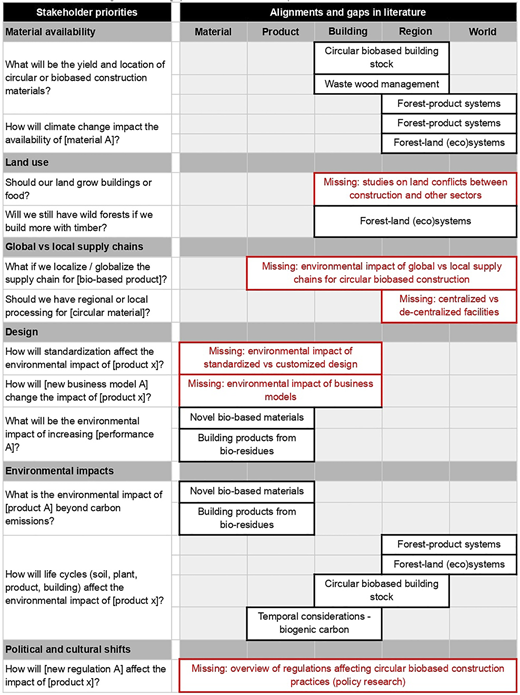
In this section, we outline a research agenda that highlights the gaps between academic work and industry practice, see Figure 7 for an overview.
Alignments and gaps between research and practice
Building on the main themes identified from the AEC sector workshops and the scoping literature review, the next step is to compare these perspectives to identify alignments and divergences between industry priorities and environmental research.
Good matches between workshops and scoping review
We first examine areas of strong alignment, focusing on questions raised by the AEC sector that are already well addressed within the environmental science literature.
Under material availability, both workshop subtopics—material supply and climate change—are well represented in the literature. Material supply is widely examined in building stock MFA studies estimating future circular and biobased material availability, and in forest optimization studies linking land-constrained biobased supply to projected wood demand. However, research on non-timber biobased materials remains limited. Climate impacts on material availability are well covered in land-use optimization and forestry studies addressing climate-driven shifts in forest growth, productivity, and disturbance risks such as drought and pests (Härkönen et al., 2019; Jourdan et al., 2021; Loustau et al., 2005; Malmsheimer et al., 2011; Wang et al., 2024; Yousefpour et al., 2019). Additional work explores how climate change affects building performance, including heating, cooling, and water-related resilience (De Serres-Lafontaine et al., 2024; Duan, 2023; Fufa et al., 2018).
The literature extensively covers environmental impacts. Life cycle aspects appear across multiple clusters: forest and wood product optimization studies integrate forest management and product life cycles (Bozzolan et al., 2024; Iordan et al., 2018; Vallet et al., 2009; Yamashita et al., 2024); building stock MFA studies model construction, demolition, and renovation cycles (Arehart et al., 2022; Bergsdal et al., 2007; Hingorani et al., 2023); and LCA studies address biobased building maintenance and service life under deterioration, hazards, or retrofits (Cusenza et al., 2021; Dodoo et al., 2022; Grant et al., 2014; Junda and Málaga-Chuquitaype, 2025; Napolano et al., 2015; Tighnavard Balasbaneh et al., 2025; Zimmermann et al., 2023). Yet, LCAs on non-timber biobased materials remain scarce. Ecological impacts are also well represented, with LCAs addressing toxicity and pollution, and forest and land-use studies evaluating ecosystem impacts and service trade-offs (Bugmann et al., 2017; Geneletti, 2013; Kiefer et al., 2023; Pang et al., 2017a). Carbon storage receives major attention in LCA research, particularly regarding biogenic carbon accounting, where methodological choices strongly affect reported environmental performance (Andersen et al., 2024; Arehart et al., 2021; De Rosa et al., 2018; Fouquet et al., 2015; Norouzi et al., 2025; Pittau et al., 2018; Slavkovic and Stephan, 2025).
Gaps between workshops and scoping review
We now turn to the research gaps, where themes raised in the workshops are not well represented in the existing literature.
Environmental assessment of supply chains is weakly represented. Some studies discuss developing local supply chains for wood and waste wood in Japan, France, and Germany (Egenolf et al., 2021; Fuchigami et al., 2015; Lenglet et al., 2017) or emphasize local waste wood processing (Bergeron, 2016), but mostly from economic rather than environmental perspectives. Only recently have environmental implications of decentralized production been examined, such as biopolymer facilities (Riese et al., 2024), with comparable analyses for other biobased materials still lacking. Future research could assess environmental performance and infrastructure needs for decentralized systems. Additional supply chain studies may exist but were excluded for not addressing environmental impacts.
Environmental assessment of design is only partly covered. While some studies link product performance with environmental impact through analyses of biobased material performance, other design aspects remain underexplored. No research compares standardized, potentially over-dimensioned products with customized, material-efficient alternatives, though some address design optimization for cost and environmental impact (Dodoo et al., 2022; Santos et al., 2021). Likewise, the influence of business models for circular biobased products on environmental outcomes is largely unexamined.
The theme of land use is only partially addressed in the literature. Land-use policy is relatively well covered by the forest management and land-use zoning scenarios cluster—studies assess how zoning decisions influence future material availability (Kärkkäinen et al., 2021) and explore trade-offs between land allocated for biobased material production and alternative uses such as nature-based tourism (Ahtikoski et al., 2011) or broader ecosystem services (Pang et al., 2017b). However, there is limited research on direct competition for land between the biobased construction sector and other industries, with the exception of (Bousfield et al., 2024), which examines competition between agriculture and timber production. Broader cross-sectoral analyses of land competition remain largely absent.
The theme of political and cultural change is largely absent from the literature, in part because these topics are typically addressed within policy, governance, or social science domains rather than environmental impact research. While many of the reviewed papers provide policy recommendations or use national policy targets as a basis for modeling feasibility, there is no comprehensive overview of the policy landscape for circular biobased materials or its implications for designers and engineers—a gap likely filled by consultancy or policy-focused work outside the scope of this review. Similarly, societal acceptance of biobased products falls primarily within design and social science research and was not captured in the paper selection. Safety and regulatory aspects are partially addressed, appearing mainly in LCA studies on the technical and environmental performance of alternative biobased materials, where performance metrics such as structural strength are incorporated to assess trade-offs between technical limitations and environmental benefits.
One notable omission from the workshops, despite being well covered in the literature, is the influence of future urbanization patterns on demand for biobased materials. While participants concentrated heavily on future supply and availability, studies—particularly in the building stock MFA literature—demonstrate that shifts in population distribution, urban density, and building typologies will substantially shape future material demand. This imbalance suggests that industry discussions may be overlooking a critical driver of biobased material use.
Limitations
This study has several limitations related to both the workshops and the scoping review. The workshops primarily involved designers and architects already experienced with biobased materials and digital fabrication, meaning their perspectives may not reflect those of the broader construction industry. Moreover, discussions were organized around three material tracks—timber, biopolymers, and biofibers—corresponding to our project's research focus. As a result, other relevant biobased materials may have received less attention.
A further limitation relates to the geographical context of the study. The stakeholder workshops primarily involved participants based in Northwestern Europe, a region with strong policy support for circular economy strategies and established experience with biobased construction, particularly timber-based systems. This regional focus likely influenced both the prominence of timber in workshop discussions and the types of challenges emphasized, and may limit the transferability of findings to regions with different material availability, climatic conditions, or regulatory contexts. A similar geographical bias may also be present in the academic literature reviewed, which appears to draw heavily on European case studies. While this focus provides depth for regions currently leading circular biobased construction, future research could extend this work to other contexts to capture a broader range of materials, practices, and constraints.
For the scoping review, the AI-assisted paper labeling reached approximately 80% accuracy. This introduces a margin of error that could affect how papers were clustered and, consequently, how themes were identified. We verified the coherence of the final clusters and found that papers grouped together were conceptually consistent, supporting the adequacy of this accuracy level for our objectives. Nonetheless, we advise readers to double-check individual paper labels when examining specific clusters or examples.
Research agenda
Building on the comparison between research and practice, we developed a research agenda that addresses the key gaps and alignments identified across both domains.
Future research should broaden its scope beyond timber, both at the product and regional scales. At the product scale, life cycle assessments remain heavily focused on wood-based materials, with the exception of studies on biofibers for wall insulation. Expanding environmental assessments to a wider range of biobased materials would support manufacturers and product developers in evaluating alternative feedstocks, understanding performance–impact trade-offs, and reducing reliance on a single material category. At the regional scale, material flow analyses should assess the future availability of diverse biobased resources, not just timber, to inform policymakers and planners responsible for construction, land-use, and bioeconomy strategies. Such analyses can help anticipate resource constraints, avoid overdependence on specific biomass streams, and support more resilient and diversified pathways for circular biobased construction.
Further work is also needed on the environmental implications of emerging business models for circular biobased construction. Different ownership, leasing, or service-based models may influence material lifetimes, reuse rates, and overall environmental impact in ways not yet well understood for biobased construction products. Comparative environmental assessments of these models would support manufacturers, product developers, and construction firms in selecting business strategies that not only enable circularity but also deliver tangible environmental benefits. Such insights could help companies evaluate trade-offs between durability, recoverability, and service provision when bringing circular biobased products to market.
Similarly, the organization of supply chains warrants closer examination. Comparative assessments of centralized and decentralized production systems, logistics networks, and material recovery hubs could clarify the trade-offs between local and global production in terms of emissions, energy use, resilience, and infrastructure requirements. This knowledge is particularly relevant for large material producers, processors, and logistics operators responsible for managing high-volume biobased material flows, as well as for urban and regional planners tasked with allocating industrial space and designing transport and recovery infrastructure. Environmental assessments at this scale can inform strategic decisions about where production and processing facilities are located and how emerging biobased supply chains are integrated into existing urban systems.
Finally, as the biobased construction industry scales up, land-use competition will intensify. Research should explore how increased demand for biobased materials affects regional land allocation and which sectors—such as agriculture, forestry, or textiles—are most vulnerable to displacement. Such analyses are particularly relevant for regional and spatial policymakers responsible for long-term land-use planning, as well as for landowners and producers who must decide how to allocate land between food, fiber, energy, and construction markets. Integrating climate change projections into these assessments will be essential to anticipate how shifting growing conditions and productivity may further shape land-use trade-offs over time.
Conclusions
We aimed to bridge environmental science research on circular biobased construction with the perspectives of architects and engineers in the AEC sector. We conducted stakeholder workshops to identify sector concerns, followed by a scoping literature review to get an overview of existing research on the topic. This approach enabled us to identify main themes, alignments, and gaps between industry priorities and existing research.
We found strong alignment between AEC sector priorities and environmental research on material availability and environmental impacts. Material availability is well covered in building stock MFA and forest management studies, while environmental impacts—across soils, plants, products, and buildings—are addressed through LCAs, MFAs, and forest management, including broader ecological effects of biobased production. Key gaps remain in assessing the environmental implications of global versus local supply chains, design strategies like digital fabrication for material-efficient components, and land-use impacts of growing demand for non-timber biobased materials competing with agriculture and textiles. Together, these findings suggest that while environmental assessment methods are well developed for evaluating material quantities and impacts, they are less equipped to support the strategic and cross-sectoral decisions increasingly required to scale circular biobased construction.
Looking ahead, this study offers several implications for research and practice. For sustainability researchers, we highlight gaps around the environmental assessment of circular biobased construction—including supply chains, design strategies, and land-use competition. For practice, we summarize current concerns of decision-makers. This includes questions on material availability, land-use trade-offs, supply chain choices, design implications, broader environmental impacts, and political and cultural shifts. By making these concerns explicit and mapping them against existing research, the framework developed in this study can support more structured dialogue between researchers, practitioners, and policymakers, helping stakeholders identify which questions are already well supported by evidence and where targeted assessment efforts are still needed.
Rather than presenting a synthesis of environmental impact assessment results, this paper is a map of the research themes and methods for assessing the environmental impacts of circular biobased construction. An accompanying dataset of the reviewed papers—tagged by methodology, environmental indicators, scale, material type, future perspective, and thematic cluster—supports exploration and further reading by both researchers and practitioners. This mapping approach can be applied across different building lifecycle phases—from material development and product design to building projects and regional planning—and adapted to different geographical contexts by incorporating locally relevant materials, policies, and land-use constraints.
This study has several limitations. The workshops drew participants from within the same research project, encompassing multiple disciplines but skewed toward individuals already engaged with biobased construction and, in many cases, familiar with digital fabrication in architecture. As such, the group was not fully representative of the broader AEC sector. In the scoping review, paper classification was assisted by the ChatGPT API, with prompts iteratively refined to improve accuracy. While we achieved at least 80% accuracy for each label, perfect classification was not possible, and some mislabeling may remain.
By bringing together sector perspectives and environmental research, this study provides a foundation for more integrated, evidence-based approaches to circular biobased construction. Addressing the identified gaps will be essential for aligning industry practice, research priorities, and policy frameworks in support of a sustainable, low-carbon built environment, as circular biobased construction moves from niche applications toward broader adoption.
Ethics and consent statement
This study involved voluntary workshop participation by professionals in the built environment sector. Participants provided informed consent. According to the guidelines of Leiden University, ethical approval was not required for this type of research.
Declaration of generative AI use in writing
During the preparation of this work, the authors used ChatGPT (OpenAI) to improve readability and language. After using this tool, the authors reviewed and edited the content as needed and take full responsibility for the content of the published article.
We thank the workshop participants for their time and enthusiasm during the workshops. No experimental or clinical research involving human participants or animals was conducted as part of this study.