


Construction professionals encounter a range of psychosocial hazards that can significantly impact their health, well-being, and work performance. This systematic review examines and categorises psychosocial hazards affecting construction professionals, the associated risks and consequences, and how these risks vary across different demographics. It also identifies several research gaps and future research directions.
Following the PRISMA guidelines, the review systematically identified and assessed 75 relevant peer-reviewed journal articles. The literature search, guided by keywords shaped by the CoCoPop framework, encompassed five databases: Scopus, Web of Science, ProQuest Central, PubMed, and PsycINFO, along with the Google Scholar search, to ensure comprehensive coverage of articles published from 1989 to 2025. Scientometric and content analyses were conducted to identify underlying patterns, followed by an in-depth discussion.
Five levels at which psychosocial hazards affecting construction professionals manifest are: (1) task, (2) organisational, (3) interpersonal, (4) personal, and (5) environmental. These hazards culminate in three primary risk domains: (1) stress, (2) mental health impacts, and (3) physical health impacts, particularly when exposure is prolonged and coping mechanisms are inadequate. The review also highlighted unique hazards across various demographics based on gender, age, experience, and work settings. Additionally, it identified theoretical frameworks or models underpinning psychosocial research on construction professionals.
The paper reveals both patterns in the existing literature and gaps for future research, thereby contributing to the theory and practice concerning psychosocial risk management in the construction industry.
1. Introduction
The construction industry is one of the largest sectors, serving as a fundamental engine of growth and a critical pillar of the global economy and employment (International Labour Office, 2015). However, despite significant economic and societal contributions, the industry has a poor reputation for occupational health and safety (OHS), mainly due to the prevalence of incidents, physical injuries, diseases, and mental illnesses (Duckworth et al., 2024). Still, challenging psychosocial work environments, characterised by the presence of several psychosocial hazards, have received less attention in construction OHS literature compared to physical safety hazards, particularly regarding construction professionals who often work excessively long hours and under extreme external pressure (Naji et al., 2021).
Abrahamsson and Johansson (2013) characterised the psychosocial work environment as the interaction between individuals and their surroundings, which encompasses not only how individuals are influenced by their work environment but also how they shape it, and conversely, how they contribute to its evolution. Consequently, psychosocial factors play a pivotal role in shaping workers' health, behaviour, and overall performance, especially in high-pressure industries like construction (Derdowski and Mathisen, 2023). Nieuwenhuijsen et al. (2010) found that psychosocial factors can provoke worker stress reactions, influence attitudes, and affect behaviours, stemming from social, organisational, and management aspects. Similarly, Pikhart and Pikhartova (2015) emphasised that these factors can lead to chronic and acute hazards characterised by a mix of psychological, social, cultural, and environmental hazards, all of which adversely impact health and behaviour.
The construction workforce comprises trade or manual workers and construction professionals who undertake separate duties and perform different tasks in different work settings, exposing themselves to unique psychosocial hazards. Construction professionals refer to built environment practitioners whose roles and occupations are directly related to design, planning, execution and management of construction projects, primarily in engineering, supervision and managerial capacities. Additionally, they operate at the crossroads of sustainable construction, requiring the need for stable, healthy, and robust professional workforces that can provide sustainable communities (Häkkinen and Belloni, 2011). They are also sometimes referred to as white-collar workers, distinct from manual and trade workers who are identified as blue-collar workers (Deep et al., 2024). Examples of construction professionals include quantity surveyors, cost estimators, architects, engineers, OHS management professionals, construction managers, and project managers.
Despite their unique work and job profiles, most existing reviews on psychosocial hazards have concentrated on manual or trades workers (Duckworth et al., 2024), treated both manual workers and professionals as a single cohort, avoiding group-specific nuances (Rahman et al., 2024; Li et al., 2022), examined specific cohorts of workers, such as young workers (Frimpong et al., 2023) or focused on specific outcomes, such as linking psychosocial stressors to musculoskeletal disorders (Bezzina et al., 2023; Anwer et al., 2021) and stress outcomes (Tijani et al., 2021). However, Boschman et al. (2013) cautioned that examining psychosocial factors for manual workers and professionals at an aggregated level overlooks the extensive range of professions within the industry, each characterised by unique requirements, expectations and diverse work conditions.
Empirical data on construction professionals' mental health further support the need for a more targeted review of psychosocial hazards. For instance, Bowen et al. (2014c) identified high levels of weekly alcohol abuse among construction professionals. A 2019 survey of over 2,000 construction industry professionals found high rates of anxiety (87%), stress (97%), fatigue (96%), poor concentration (95%), depression (70%) and other mental health symptoms, including 26% reporting suicidal thoughts (Rees-Evans, 2020).
Therefore, while existing reviews advance the understanding of psychosocial hazards in the construction industry, an in-depth literature review focusing on psychosocial hazards affecting construction professionals is highly warranted. The accomplishment of smart, sustainable built environments is not only dependent on adopting and advancing technology but is also dependent on the psychosocial well-being of the people responsible for executing projects and making important decisions (Sarhan et al., 2025). Moreover, it is essential to identify the different functional or operational levels at which psychosocial hazards manifest and to offer a demographically nuanced approach to synthesising outcomes.
Against this background, the review will investigate the following research questions (RQs):
At which levels do psychosocial hazards manifest among construction professionals?
How does demographic variability influence psychosocial hazards experienced by construction professionals?
What research gaps exist that need to be addressed to enhance understanding and mitigation of psychosocial hazards for construction professionals?
The paper is organised into the following sections. Section 2 defines the key psychosocial terms used in the review. Section 3 outlines the systematic review approach, detailing the search strategy and protocol, as well as inclusion and exclusion criteria. In Section 4, the research trends and content analyses are presented, answering RQ1 and RQ2. Section 5 discusses the findings and the research gaps, offering suggestions for future research, responding to RQ3. The last section summarises the main conclusions and highlights the limitations and implications.
2. Definitions: psychosocial hazards and psychosocial risks
Since definitions play a critical role in reducing ambiguity, improving precision, and preventing term proliferation (Raheemy et al., 2025), it is imperative to clarify two key terms, psychosocial hazards and psychosocial risks, to enhance understanding of the influence of psychosocial factors. These terms are often used interchangeably, leading to a lack of conceptual distinction. Naji et al. (2021) also assert that understanding the dynamics of the interplay between psychosocial hazards and risks is crucial for comprehending the psychosocial work environment and improving health outcomes.
The conceptualisation of psychosocial terms within occupational contexts has evolved into an exposure-outcome association (Niedhammer et al., 2021). Kowalczuk et al. (2018) defined psychosocial hazards as aspects of management and work organisation that may negatively impact an employee's mental and physical health. Chirico et al. (2019) defined them as any threat to workers' psychological well-being or their capacity to work together productively on the job, whether that threat is direct or indirect. Conversely, McDonnell and McAllister (2024) described psychosocial risk as a potential source of psychological harm arising from the work environment, management practices, and other organisational factors. Additionally, Mathisen et al. (2017) considered them threats that may adversely affect employee engagement, well-being, and health.
In addition to academic literature, grey literature was reviewed to gain valuable insights into the usage of these terms and to establish effective and coherent definitions. Table 1 summarises definitions used by some prominent organisations globally.
Definitions of psychosocial hazard and psychosocial risk
| Term | Reference | Definition |
|---|---|---|
| Psychosocial hazards | Australian Institute of Health and Safety (2020) | Psychosocial hazards describe aspects of work design and management which have the potential to cause stress-mediated harm |
| International Organisation for Standardisation (2021) | Psychosocial hazards relate to how work is organised, social factors at work and aspects of the work environment, equipment and hazardous tasks | |
| National Institute for Occupational Safety and Health (2022) | Psychosocial hazards are factors in the work environment that can cause stress, strain, or interpersonal problems for the worker | |
| Safe Work Australia (2022) | Psychosocial hazards are hazards that: (1) arise from or in relation to: the design or management of work, the working environment, plant at a workplace, or workplace interactions or behaviours; and (2) may cause psychological and physical harm | |
| WorkSafe Victoria (2022) | Psychosocial hazard means: work design; or systems of work; or management of work; or carrying out the work; or personal or work-related interactions that may arise in the working environment and may cause an employee to experience one or more negative psychological responses that create a risk to their health and safety | |
| Psychosocial risks | European Agency for Safety and Health at Work (2014) | Psychosocial risks are linked to the way work is designed, organised and managed, as well as to the economic and social context of work, result in an increased level of stress and can lead to serious deterioration of mental and physical health |
| Health and Safety Executive (n.d.) | Psychosocial risks are things that may affect workers' psychological response to their work and workplace conditions (including working relationships with supervisors and colleagues) | |
| International Organisation for Standardisation (2021) | Psychosocial risk relates to the potential of these types of hazards to cause several types of outcomes on individual health, safety and well-being and on organisational performance and sustainability. OR A combination of the likelihood of occurrence of exposure to work-related hazard(s) of a psychosocial nature and the severity of injury and ill-health that these hazards can cause | |
| Mental Health Commission of Canada (2013) | Psychosocial risk factors refer to hazards, including elements of the work environment, management practices, and/or organisational dimensions that increase the risk to health |
As can be seen in Table 1, the International Organisation for Standardisation (2021), Australian Institute of Health and Safety (2020) and Safe Work Australia (2022) emphasise that psychosocial hazards are described as part of the structural design of the job, i.e. the way the workplace is organised and the order of tasks. Meanwhile, the National Institute for Occupational Safety and Health (2022) and WorkSafe Victoria (2022) contribute to this understanding by noting that interpersonal relationships, which involve how people interact with one another, also form part of the hazard landscape and, when unmanaged, can affect both mental and physical health.
Furthermore, definitions of psychosocial risks emphasise potential outcomes by assessing the likelihood and intensity of harm rather than causative factors. The International Organisation for Standardisation (2021), European Agency for Safety and Health at Work (2014), Health and Safety Executive (n.d.), and the Mental Health Commission of Canada (2013) characterise psychosocial risks by their impact on employee health, safety, and overall organisational performance. The identified risks are generally associated with inadequate work organisation, management approaches, and unfavourable social environments within the workplace. Therefore, psychosocial risk encompasses not only the presence of a hazard but also the degree to which that hazard can result in adverse outcomes such as stress, physical health impacts, or deterioration of mental health. Drawing on these different perspectives, the review considers the following definitions:
Psychosocial hazards are sources, causes or precursors to potential harm derived from aspects of an individual's work settings, personal and organisational circumstances and social surroundings.
Psychosocial risk refers to the impact of prolonged exposure to unaddressed psychosocial hazards, resulting in harm that includes physical and psychological health impacts, as well as negative performance and social outcomes.
3. Systematic review approach
The systematic review method was selected for its stringent and reproducible methodology, reducing bias through established criteria (Newman and Gough, 2020). Using the CoCoPop framework, search strings were formulated by combining keyword terms in conjunction with the “AND” and “OR” Boolean operators. Again, the authors introduced specific examples of psychosocial hazards and risks, identified from grey literature sources, such as Safe Work Australia (2022) and International Organisation for Standardisation (2021), to enlarge the search pool. The choice of these standards stems from their comprehensive and research-based classification of psychosocial hazards. This approach is consistent with studies such as Chirico et al. (2019). The keywords are listed below:
Condition: “psychosocial factors”, “psychosocial hazards”, “psychosocial risk”, “stress”, “mental health”, “psychological health”, “well-being”, “job demands”, “job control”, “job support”, “role clarity”, “organisational change management”, “reward”, “organisational justice”, “workplace violence”, “workplace bullying”, “harassment”.
Context: “construction”, “construction industry”, “built environment”.
Population: “construction professionals”, “construction management professionals”, “project professionals”, “building expert”.
The Scopus and Web of Science databases were searched first due to their comprehensive coverage of quality, reliable, well-known citation and impact metrics, as well as their advanced searching ability (Jin et al., 2024; Pranckutė, 2021; Zhang et al., 2020). Subsequently, a literature search was performed in ProQuest Central, PubMed and PsycINFO databases due to their widespread coverage in health science and ergonomic publications. Lastly, Google Scholar was combed to locate other relevant studies (Halevi et al., 2017).
The search and extraction of relevant articles were conducted in April 2025. The search was not limited to any region or period. Conference papers, research reports, books, and book chapters were excluded. Only peer-reviewed journal articles were considered as they undergo a rigorous peer review process and offer credible research information (Paul et al., 2021). Additionally, other reviews were excluded to encourage the inclusion of original research to offer new insights. Furthermore, the search was limited to publications in the English language only.
The PRISMA (Preferred Reporting Items for Systematic Reviews and Meta-Analyses) framework, as shown in Figure 1, was adopted for transparent and clear reporting of the systematic review process (Agrawal et al., 2024; Page et al., 2021).
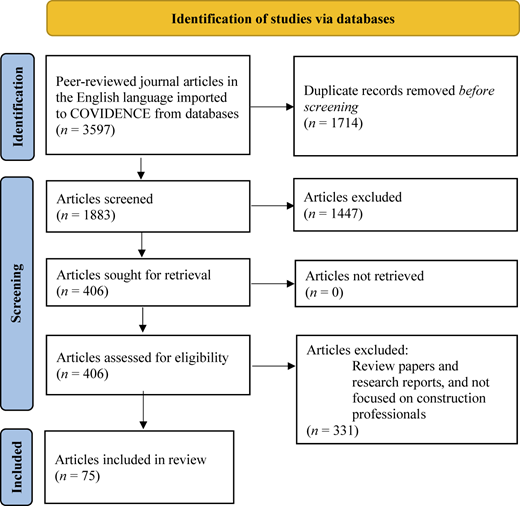
PRISMA flow diagram for systematic review on psychosocial hazards affecting construction professionals. Source: Adapted from Page et al. (2021), licensed under CC BY 4.0
PRISMA flow diagram for systematic review on psychosocial hazards affecting construction professionals. Source: Adapted from Page et al. (2021), licensed under CC BY 4.0
A total of 3,589 articles were identified and imported into Covidence to facilitate the process of viewing the articles extracted from the databases, removing duplicates, and reading the titles and abstracts to identify relevant articles, enabling a more efficient and higher quality review. The software identified 1714 duplicates, leaving 1875 articles for the title and abstract screening. After an initial scan of each article to determine its relevance to the review, 406 articles were shortlisted for full-text evaluation. Finally, studies (n = 331) that focused on the analysis of construction workers or exclusively targeted trade or manual workers without a distinct emphasis on construction professionals were excluded.
Although a detailed quality or bias assessment was not undertaken, strategies including checking the SCImago listing of the journal and cross-study triangulation of recurring hazards across multiple studies were used to assess the quality of the studies and increase confidence in the robustness of the identified hazards. Moreover, two authors independently verified the relevance and appropriateness of the shortlisted articles. After carefully examining each article at this stage, 75 articles were found to be relevant for the review. The final studies were then exported to Microsoft Excel for bibliometric data extraction. The extracted data included the title, author, year of publication, research methodology, target study population and the country where the study was conducted. VoSviewer was used for keyword network mapping. Finally, the findings from individual studies were summarised depending on the types of evidence pertinent to the research questions of this review using content analysis.
4. Review findings
Appendix provides an overview of the country, the construction professionals studied, and the research methods employed in the reviewed articles. All papers in Appendix were assessed for specific mentions of psychosocial hazards and contextual conditions using content analysis, which subsequently led to multilevel classification of psychosocial hazards, their associated risks and consequences, along with demographic variation analysis.
4.1 Research trends
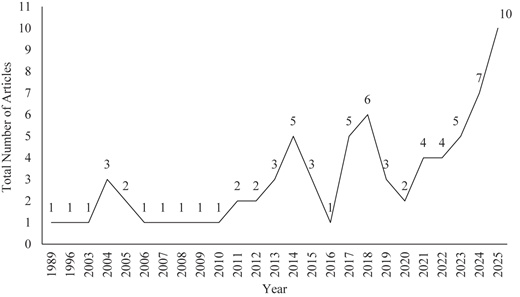
Figure 2 illustrates the yearly distribution of reviewed articles. It reveals that research on this topic showed minimal activity between 1989 and the early 2000s, perhaps because the topic was relatively unknown or unexplored in the industry. Research publications began increasing gradually after 2010, except in 2016, and after declines in 2019 and 2020, publication numbers surged again from 2021 to 2025. The latest spike in publication correlates with rising awareness of mental health and stress worldwide, along with the impact of the COVID-19 pandemic, which revealed the extent of prevalence of psychosocial risks within the construction industry (Zhang et al., 2025). Nonetheless, based on the number of publications since 1989, the topics related to psychosocial hazards affecting construction professionals remain an under-researched area.
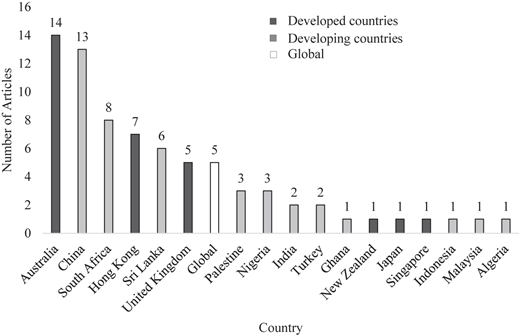
The reviewed articles were from both developed (advanced economies) and developing countries (emerging economies), as shown in Figure 3. The identification of countries as developing or developed countries is based on the country classification data from the International Monetary Fund, which aligns with high- or low-income country classification published by the World Bank (International Monetary Fund, 2023; World Bank Group, 2026). Based on the number of articles, Australia (n = 14) and China (n = 13) were at the forefront of research on psychosocial hazards affecting construction professionals, followed by South Africa (n = 8) and Hong Kong (n = 7). In total, 29 studies were from developed countries, while 41 focused on developing economies. The remaining five studies were based on data collected from multiple countries and, therefore, classified as global in Figure 3 and Appendix (Abdalla et al., 2025; Nwaogu et al., 2022; Perera et al., 2022; Liang et al., 2021; Leung et al., 2015). A surprising finding is the lack of research on this important topic in countries such as the United States, the Gulf Cooperation Council countries, and European Union nations.
The study participants included quantity surveyors, estimators, cost engineers, architects, project managers, construction managers, designers, and engineers (civil, structural, and services). Specifically, 10 studies focused on construction project managers, followed by 4 on quantity surveyors/estimators/cost engineers, 3 on architects, and 2 studies each on civil engineers and site managers. The remaining studies collected data or focused on a mix of construction professionals without focusing on a specific profession. Appendix shows that a few roles have either not been studied or received less research attention from the perspective of psychosocial hazards and risk management, including senior management and leadership roles, such as directors and chief operating officers, as well as contract administrators and planning professionals. Moreover, different roles have been studied in different contexts, lacking a holistic understanding of which psychosocial hazards affect construction professionals in different roles in a particular country.
The reviewed articles employed quantitative, qualitative, and mixed methods approaches, presenting multifaceted investigations into psychosocial hazards and risk factors. Data were collected through questionnaires, interviews, case studies, and observations, as well as industry reports, policy, and historical workplace records, examining psychosocial factors in different contexts and from various perspectives. However, the predominant research method used to collect data was questionnaire surveys. It shows a lack of mixed methods research, qualitative case studies and multidisciplinary research designs despite the topic of psychosocial factors spanning across the disciplines of psychology, management and organisational studies.
VOSviewer (version 1.6.20) was used to create a keyword network map for a bibliometric analysis that looked at the conceptual structure of keyword occurrences to identify thematic clustering via a threshold minimum occurrence of two (Figure 4). Although the initial focus was on identifying psychosocial hazard indicators, emerging patterns revealed underlying multilevel hazard source distributions in relation to work design and management spread at different levels of individual, organisation and other contextual factors.
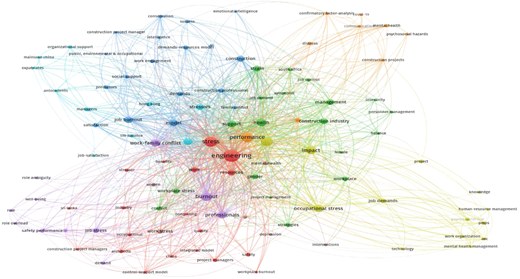
Keyword network visualisation in VoSviewer for reviewed articles. Source: Authors' own work
Keyword network visualisation in VoSviewer for reviewed articles. Source: Authors' own work
The following observation can be drawn from Figure 4.
The red and purple clusters overlap and are associated with keywords such as professionals, engineering, stress, and burnout and connect specific groups of professionals, such as project managers, architects and women and countries like China, Hong Kong and Sri Lanka. The presence of work-family conflict suggests the spillover effect of job stress on the personal lives of professionals. The proximity of stress to the performance node further confirms stress as a critical risk through which psychosocial hazards are linked to individual and organisational outcomes. The Job Demand-Control-Support (JDCS) model also sits within these clusters, highlighting a mismatch between work demands, control or autonomy and resources. These clusters suggest task and organisational level classifications of psychosocial hazards.
The blue and cyan clusters reflect task, organisational, personal and interpersonal level psychosocial factors such as job demand, organisational support, emotional intelligence and social support, with the underlying model of Job Demands-Resources (JD-R), highlighting a misalignment between them. It connects specific groups of construction professionals, such as project managers and expatriates and countries like China and Hong Kong.
The green cluster is associated with workplace and management factors connecting strain resulting from job control, job insecurity and job imbalance with occupational stress and health. It further highlights gender as a key variable and the context of South Africa. These clusters connect organisational and environmental hazards with stress and health outcomes.
The yellow cluster further highlights task and organisational factors, including job demands, work organisation, mental health management, interventions and human resource management. The presence of the technology node linked with job demand and stress suggests an increase in technostress resulting from increased digitalisation.
The orange cluster links distress and mental health with performance and highlights communication as an important psychosocial factor. The presence of the COVID-19 node indicates direct and indirect effects of the pandemic on construction professionals' health and well-being.
4.2 Theoretical frameworks
Theoretical models such as the JD-R and JDCS models, adopted from other disciplines like occupational health psychology, helped assess psychosocial hazards at the task and organisation levels, focusing on the imbalance between high job demand and various resources and support mechanisms as a major source of stress. The conservation of resources (COR) theory was used to explain how construction professionals retain and value resources such as energy, time, and social support to prevent stress and burnout. Similarly, the effort-reward imbalance (ERI) posits that when high work effort is not balanced by adequate rewards, it creates a stressful psychosocial work environment. Table 2 presents a summary of the identified theoretical frameworks and their operationalisation in the reviewed studies.
Theoretical frameworks used in the reviewed articles
| Theoretical frameworks or models | Contextual use | Reference(s) |
|---|---|---|
| Conservation of Resources (COR) | It explains how the balance between personal life and professional responsibility is an essential resource in preventing burnout and low productivity | Zhang et al. (2020) |
| Effort-Reward Imbalance (ERI) | It highlighted the perceived imbalance when construction professionals exert high efforts but often receive inadequate rewards, such as low salaries and a lack of recognition | Liang et al. (2021) |
| Institutional theory, Agency theory, and Resource-based theory | They collectively emphasised the necessity of understanding the interactions among organisational elements (structure, culture, resources) and external issues (political, economic, social, technological, environmental, and legal) to adapt and remain flexible in managing changing work conditions | Tijani et al. (2024, 2025) |
| Job Demands-Resources (JD-R) | It outlined the interplay between high work demands, workload, role ambiguity, pressure, task complexity and inadequate job resources, managerial support, autonomy, training, and career development | Jin et al. (2024), Wu et al. (2019), Yang et al. (2018) |
| Job Demand-Control-Support (JDCS) | It highlighted that the tasks that are high in demand, low in control and low in workplace social support are experienced as the most stressful and produce the most damaging health impacts. That is when, if employees perceive an imbalance between work demands and their personal or environmental resources, a range of stress responses can occur | Liang et al. (2021), Cattel et al. (2016), Bowen et al. (2014a) |
| Lazarus and Folkman's transactional theory of stress and coping | It highlights the professional's functioning in terms of goals and aspirations, as well as the courses of action to be executed to achieve attainment, i.e. support, work engagement, and motivation, and their ability to cope with the circumstances surrounding their personal work-life | Enshassi et al. (2018), Chan et al. (2014) |
| Person-Environment Fit (PE Fit) | It explains that a mismatch between work demands and individual capabilities triggers a stress reaction | Liang et al. (2021) |
These theoretical frameworks further provide insights into the interrelationship between psychosocial hazards and outcomes. For instance, failure to address an imbalance in job demands and resource requirements can accelerate human resource depletion through turnover or job dissatisfaction, especially if accompanying benefits or opportunities for professional advancement do not correlate with increased investments of time and effort, creating effort reward imbalance. The person-environment (PE) fit construct explains work-related stress linked to an imbalance in existing professional capabilities and the work environment, such as increasingly digitalised systems.
The theoretical frameworks listed in Table 2 highlight the relationships between psychosocial hazards, individual and organisational factors, environment and consequences of inadequate psychosocial risk management for individuals and organisations. While some focus more on task level (e.g. job demands, autonomy, and effort), others focus on hazards at organisational (e.g. policies, reward, and support) and broader levels (e.g. legal, environmental, and technology). Models such as JD-R and JDCS mainly focus on the job stressors at the task level to demonstrate the mechanism of job burnout. However, job burnout is also induced by individual, organisational and social factors (Yang et al., 2018) and thus needs to be examined through the lens of the multilevel origin of psychosocial hazards.
4.3 Multilevel classification of psychosocial hazards
Informed by keyword analysis and theoretical frameworks, the content analysis performed by the first two authors revealed a stratified or multilevel conceptualisation of diverse psychosocial factors that collectively shape exposure, challenges and outcomes of psychosocial hazards, thereby mapping these hazards more holistically at five levels: (1) task, (2) organisational, (3) interpersonal, (4) personal, and (5) environmental. The following paragraphs present the key findings under each of these five levels of psychosocial hazards affecting construction professionals.
To begin with, task factors refer to the nature of job-specific demands and responsibilities that construction professionals must complete in a time-driven manner. Every construction project is task-oriented with a mission to meet the requirements of cost, time and quality. The complexity, intensity, and volume of work tasks, characterised by tight deadlines, inadequate job resources, a high-pressure environment, and coupled with work overload or underload, unclear roles, and long working hours, are commonly reported psychosocial hazards for construction professionals (Zhang et al., 2023; Wu et al., 2019; Leung et al., 2005). Similarly, the technological advancements involving the use of digital technologies and automation may exacerbate psychosocial challenges due to the need for continuous upskilling and technostress. Utilising the JD-R model, Wu et al. (2019) found that role conflict and role ambiguity cause job burnout among construction professionals who deal with several cognitive tasks and severe deadlines. Their study further revealed a negative and significant relationship between job burnout and job performance.
The organisational factors are influenced by institutional policies, hierarchical structures, and leadership practices that impact the well-being of construction professionals. The collective culture of beliefs, behaviours, and performance standards to which construction professionals must adhere can influence stress levels and commitment to the organisation (Yang et al., 2018). It is characterised by job insecurity, limited avenues for career growth, unfair remuneration and pay disparities, poor recognition systems and juggling multiple responsibilities regarded as role ambiguity (Kamardeen and Sunindijo, 2017; Leung and Chan, 2012). During the COVID-19 pandemic, these circumstances were exacerbated in the construction industry, leading to heightened workloads and diminished job security (Zhang et al., 2025; Miyanda et al., 2024). Bowen et al. (2014a), while testing the applicability of the job demand control support model in the South African construction industry, found that working long hours was strongly associated with stress and mediated through an imbalance experienced between work-life commitments. Based on the JD-R model, Yang et al. (2018) found that the lack of organisational justice results in chronic stress and job burnout of construction project managers.
The dynamics of interpersonal relationships among construction professionals serve as another source of psychosocial hazards, classified as interpersonal factors. It relates to relationships at work, quality of communication lines and social support systems, notably identified in the form of discrimination and harassment, particularly along gender and racial lines, especially against female and minority professionals (Kamardeen and Sunindijo, 2017). Additionally, bullying and exclusionary behaviour characterised by verbal abuse and intimidation contribute to isolation, psychological distress, and a decline in job satisfaction (Yokouchi et al., 2024). The presence of limited social support from colleagues and supervisors, poor teamwork, and workplace conflict intensifies in high-pressure roles, resulting in fewer social interactions (Lingard and Francis, 2006).
The personal factors lingered around the construction professionals' individual life (self and family) outside of workplace life. This level emerged prominently in relation to work-family conflict, work-life imbalance, and self-imposed high-performance pressure (Dodanwala and Shrestha, 2021; Zheng et al., 2021). An imbalance in work and family or personal time was identified as one of the influential factors affecting marital satisfaction, resulting in high turnover intention (Lingard and Francis, 2005). Moreover, it led to less work engagement and low productivity, affecting organisational commitment (Oyewobi et al., 2019).
Finally, working in the construction industry is characterised by both physically demanding and hazardous environments, of which construction professionals are not exempt. Hence, the environmental factors include the physical workplace conditions that construction professionals interact with and are exposed to. It includes the job setting, including the design and layout of the office or site conditions that can result in poor working conditions, such as extreme temperatures, excessive noise, inadequate safety measures and equipment, inadequate lighting and on-site facilities (Senaratne and Rasagopalasingam, 2017; Leung et al., 2010). The constant PE interaction on construction sites is characterised by poor and demanding working environments, which can lead to stress, causing anxiety, headaches, and difficulty concentrating at work (Lian et al., 2021).
4.4 Psychosocial risks
Considering that the five levels of psychosocial factors are inextricably interconnected, all collectively contribute to distinct psychosocial hazards leading to psychosocial risk, which can manifest in three primary forms: stress, physical health impact, and mental health impact. Stress is related to the processes of perceiving, evaluating, and responding to events that are detrimental to the attainment of goal-oriented performances (Kogler et al., 2015; Sinha, 2008). The physical health impacts relate to repetitive strain injuries, musculoskeletal disorders, cardiovascular risks, recurring headaches, sleep disturbances, increased blood pressure, gastrointestinal symptoms, and compromised immune function (Howe et al., 2024; Bowen et al., 2018). Lastly, the mental health impacts refer to the state in which an individual is unable to handle typical stressors, perceive competencies, work productively and contribute to the community (Herrman and Jané-Llopis, 2012). These three risk dimensions are characterised by various behavioural, emotional, cognitive and physiological signs and symptoms (Rees-Evans, 2020; Bowen et al., 2014b). Since these symptoms are not unidimensional, it is difficult to segregate them under each risk dimension. For example, some studies relate anxiety and depression to stress while others attribute it to a mental health issue (Wang et al., 2017). Additionally, when hazards from the five levels converge, they not only deteriorate an individual's overall health but also impair their working performance outcomes, such as job productivity, operational efficiency and social outcomes, resulting in reduced motivation, a higher propensity for errors, lower work quality, and increased absenteeism (Leung et al., 2011).
4.5 Moderating effects of demographic characteristics
The review found that the harm caused by exposure to psychosocial hazards depends on the duration, severity, and frequency of exposure and is influenced by construction professionals' coping mechanisms and demographic characteristics, which act as moderators. Risk pathways are reduced by positive coping strategies, whereas negative coping strategies worsen these pathways (Mireku et al., 2025; Bowen et al., 2021). Similarly, demographic characteristics, including gender, age and experience, job location (site or office), organisation type, expatriate status, and country, can influence the key psychosocial hazards experienced by construction professionals, as summarised in Table 3 and discussed below.
Demographic variability in psychosocial hazard exposure
| Category | Variable | Examples of main psychosocial hazards |
|---|---|---|
| Gender | Male | high work pressure, extreme supervisory criticism, financial insecurity, and harassment |
| Female | Underpromotion, discrimination, harassment, work-life conflict, and poor recognition or reward | |
| Age | Young | Job uncertainty, limited autonomy, and bullying |
| Older | Technostress, physical strain, and marginalisation | |
| Job type | Site-based | Long work hours, health and safety risks, physical strain, and exposure to weather extremes |
| Office-based | Poor communication, feelings of isolation, and repetitive tasks | |
| Organisation type | Contractor | Tight deadlines, resource constraints, and operational pressures |
| Consultant | Ethical dilemmas, low work autonomy, and pressure from managing diverse expectations | |
| Country of Origin | Expatriate | Cultural and language barriers, job insecurity, and the strain of being away from family and familiar support systems |
| Countries | Developing | Lack of flexibility, intense workloads, job insecurity, and environmental hazards |
| Developed | Discrimination, harassment (gender and race-based), and excessive working hours |
4.5.1 Gender
Loosemore and Waters (2004) found that female professionals generally faced more stressors related to job and career advancement than their male counterparts. Women experienced sexual harassment, discrimination, underpromotion, bullying, exclusion from business and social events, lower pay grades, and fewer opportunities for personal or professional development (Sunindijo and Kamardeen, 2017; Bowen et al., 2013a). On the other hand, excessive criticisms from supervisors, low income leading to financial insecurity, and workplace harassment were major risk factors for depression or anxiety, affecting male construction supervisors more than female ones (Nwaogu et al., 2023).
Work-life balance issues emerged as high-ranking stressors for women professionals (Cattell et al., 2016). Oyewobi et al. (2019) suggest that there exists a propensity among females to select occupations characterised by reduced demands and work pressures, thereby facilitating a more favourable family life balance. Adequate work-life balance also allows them to fulfil their domestic and childcare responsibilities. As a result, females experience heightened levels of stress compared to males in the event of family-work imbalance (Sang et al., 2007). They also experience significant role conflict and report disparate treatment attributable to their gender because of gender-based discriminatory practices in the construction industry.
4.5.2 Age and experience
Age can influence the risk of psychosocial stressors in the construction industry. There is no universally accepted age or definition for classifying professionals as young or older. In general, construction professionals can be identified as young if they are 35 years or below, aligning with the younger adults range outlined by the Organisation for Economic Co-operation and Development (2018). Other studies have also classified project professionals below 35 as young (Lechler and Huemann, 2023).
Younger professionals in construction tend to express a discordance between their academic preparation and the reality of workplace expectations, leading to stress in early careers and high levels of turnover (Naoum et al., 2018). Due to their relatively less experience, they also face hazards like limited autonomy, unrealistic performance expectations, and difficulties in securing long-term positions, all of which can take a toll on their mental well-being. Those just starting in their careers frequently worry about job security, career advancement, and achieving a healthy work-life balance (Yang et al., 2025). Dodanwala and Shrestha (2021) found that younger professionals in the construction industry deal with higher levels of stress compared to their older colleagues, primarily due to their struggle to balance work and family life, along with a lack of effective coping mechanisms. Additionally, younger professionals are more susceptible to workplace bullying and harassment compared to their older counterparts (Yokouchi et al., 2024).
Conversely, those in the later stages of their professional journeys grapple with physical demands, the need to adjust to new technology and feelings of marginalisation at work. Older professionals, especially those in physically demanding roles, deal with ongoing fatigue, a greater risk of injury, and longer recovery times. There is concern about job security due to the faster career progression in their organisational hierarchies, which favours younger, technologically skilled peers. Additionally, resistance to digital innovations and modern construction technologies can create stress among older professionals, particularly engineers and project managers (Haynes and Love, 2004). Moreover, it was identified that older professionals tend to be more experienced, which generally correlates with increased responsibilities and higher-level positions, which might influence the nature and magnitude of psychosocial risks encountered. They bear the burden of organising workflow, maintaining stakeholder relationships and coordinating communication lines, and are faced with high contract or stakeholder pressure and complex decision-making (Deep et al., 2024). Ling and Goh (2018) found that professionals in middle management roles experienced significantly more work-home conflict than the junior staff, perhaps because they had more work and family responsibilities.
4.5.3 Site- and office-based professionals
The work environment can profoundly affect the psychosocial stressors encountered by professionals in the construction industry. Construction professionals in office settings endure considerable mental stress and a feeling of professional isolation (Leung and Chan, 2012). They also face pressures arising from inadequate involvement in field activities, misunderstandings with site teams, and the tedium of repetitive duties (Dodanwala et al., 2022).
On-site professionals often experience prolonged working hours, poor work-life balance, high-pressure environment, stress related to safety compliance, and interpersonal confrontations with other stakeholders, all of which contribute to increased burnout rates (Sarhan et al., 2025; Liang et al., 2021). Likewise, Lingard and Francis (2004) observed that they engaged in extended work hours and experienced higher burnout levels compared to their office-based colleagues. Construction professionals involved in site labour supervision, construction management, and engineering also face significant physical challenges, unfavourable weather conditions, and inherent safety hazards in their work environments (Ayalp, 2022).
4.5.4 Organisation type
Poon et al. (2013) report that construction professionals working for contractor organisations are typically more stressed, as they are the parties directly involved in project execution, having to deal with deviations, complexities, and adverse weather conditions. They are mostly faced with tight deadlines, budget constraints, stakeholder pressure, and minimal resources, especially in low-bid contracts (Yang et al., 2017). At the expense of tight project deadlines, resource shortages and supply delays, they engage in long work hours to ensure the project is on track and objectives are met (Dodanwala et al., 2023). As a result, they are often at risk of increased stress and exhaustion. Enshassi et al. (2018) pointed out that the conflict of adhering to safety regulations, enforcing compliance and meeting project deadlines brings about psychosocial risks when management prioritises speed and cost efficiency, as against construction professionals' well-being, resulting in a productivity conflict.
On the other hand, construction professionals working for consultants often face the challenge of managing the expectations of clients, contractors, and regulatory bodies. They are pressured to reduce project costs at the expense of quality and ethical concerns, resulting in significant stressful impacts (Ibem et al., 2011). This, due to their professional nature, requires them to perform work at high standards to reduce liabilities. As such, they employ their cognitive abilities to reduce the design issues and meet unrealistic client expectations (Çivici and Ayalp, 2025). Thus, when their recommendations are not implemented, they face frustration over project inefficiencies, which can result in low self-esteem, anger, and disconnection from their work.
4.5.5 Expatriates
Expatriate construction professionals also face unique psychosocial hazards, such as cultural and language barriers, job insecurities due to only fixed-term contracts and work-life imbalance from extended periods away from family and social support systems. This aligns with studies such as Abdalla et al. (2025), Leung and Chan (2012) and Chan et al. (2012), who report anger or irritability, frustration, anxiety and depression as common amongst expatriate construction professionals because of different cultures, work contexts and being far from families.
4.5.6 Countries
The prevalence of psychosocial factors faced by construction professionals can differ significantly across countries. For instance, countries that fell under the emerging economies class, such as China, characterised by high production levels, industrialisation and rapid urbanisation, had professionals face stress due to high project demands, unclear work roles, unrealistic client demands, and pressure to meet tight deadlines (Zhang et al., 2023; Wu et al., 2018). The constant stress is exacerbated by limited flexibility in workplace policies. As a result, these professionals work overtime and on weekends, making it challenging to strike a balance between their work and family life (Zhang et al., 2023). Additionally, in Palestine, organisational factors such as inadequate policies and resources, as well as safety and job instability issues, highlighted organisational negligence regarding the well-being of construction professionals (Enshassi et al., 2015). On the other hand, a significant problem for construction professionals working under short-term contracts, which are the norm in Sri Lankan employment culture, is that their commitment to work is not reciprocated at the expense of their family lives, unlike in tenured employment (Firose et al., 2025; Dodanwala et al., 2023). Environmental factors such as extreme temperatures, noise, and inadequate on-site facilities were common in countries like Turkey, Nigeria and Sri Lanka, with additional burdens from limited safety training and unstable job security (Ayalp, 2022; Senaratne and Rasagopalasingma, 2017; Ibem et al., 2011).
Discrimination and harassment, especially gender- and race-based, were particularly impactful in South Africa and New Zealand, mostly affecting the mental well-being of female professionals (van Heerden et al., 2024; Bowen et al., 2013a; Leung et al., 2008). It was also noted that long working hours and burnout among project managers were prevalent in Australia (Sun et al., 2023; Tijani et al., 2024). Leung et al. (2011) reported that Hong Kong construction project managers facing work-related stress, such as deadlines and heavy workloads, were prone to burnout, which subsequently led to physical symptoms, including headaches, migraines, back pain, and loss of appetite. Also, workplace bullying and harassment in Japan, particularly among engineers, were associated with negative health and workplace outcomes, exacerbated by cultural norms tolerating power imbalances (Yokouchi et al., 2024). In Singapore, cost engineers faced significant stress due to work overload and organisational inefficiencies (Ling and Goh, 2018). Sang et al. (2007) also reported that self-employed male and female architects in the United Kingdom construction industry worked longer hours, faced greater work-life conflict, and expressed more concern about job security compared to their organisationally employed counterparts.
5. Discussion and future research directions
The present systematic review provides valuable insights into the psychosocial hazards specific to construction professionals, offering a holistic view of psychosocial hazards resulting in their multilevel classification, moderating factors and the overarching process of translation of psychosocial hazards into psychosocial risks and overall health and performance outcomes. It consolidates evidence on theoretical frameworks used by previous researchers and how demographic variables influence the psychosocial hazards and risks experienced by construction professionals. Therefore, it extends the findings of earlier reviews on this topic in terms of both scope (i.e. focus on construction professionals) and analytical approach (i.e. multilevel classification and demographic variability), making important contributions to both theory and practice.
Figure 5 depicts the key findings from the synthesised literature, primarily displaying the five levels at which psychosocial hazards occur: task, organisational, interpersonal, personal, and environmental. A transition from psychosocial hazards to the psychosocial risk is characterised by a dynamic interaction zone where prolonged exposure and overlapping of these hazards are shaped by construction professionals' coping mechanisms as well as demographic characteristics. When the coping behaviour is inadequate, the three main forms of psychosocial risk pathways - stress, mental health and physical health impacts manifest. On the other hand, when exposure is mitigated by positive coping behaviour, risk pathways may not emerge. Lastly, it is observed that performance is stifled upon encountering the three risk dimensions, leading to outcomes such as low productivity, turnover intention and absenteeism.
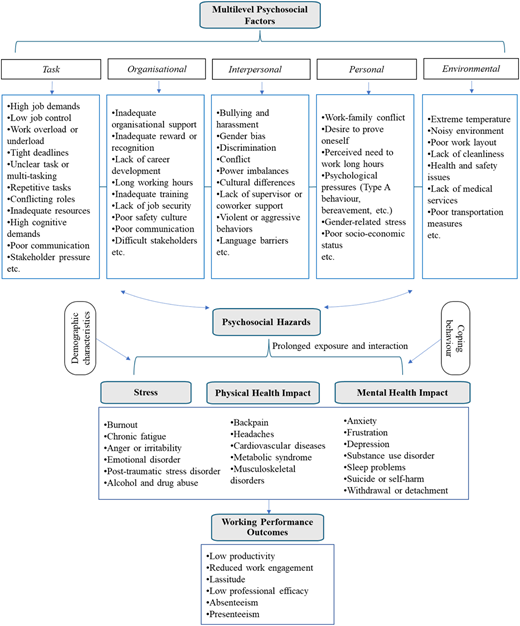
Psychosocial factors, hazards, impacts and outcomes interactions. Source: Authors' own work
Psychosocial factors, hazards, impacts and outcomes interactions. Source: Authors' own work
The review found that research efforts on psychosocial hazards concerning construction professionals have historically not been given the same precedence as construction safety in broader OHS research in construction, despite high rates of poor mental health and suicides in many countries (Aurelius et al., 2024). Moreover, the review found that Australia, China, South Africa, and Hong Kong together contribute to over 50% of the total reviewed papers. As a result, significant knowledge gaps exist in the context of many other countries, underscoring the need for further research. Similarly, more research is required for specific construction professions engaged in different types of design and construction work, recognising the task-and context-dependent nature of psychosocial hazards. Furthermore, the research methods need to move beyond questionnaire surveys by employing qualitative methods and multidisciplinary inquiries to advance the theory on psychosocial hazards.
The review found that studies such as Nwaogu et al. (2023) and Sun et al. (2023) integrated an approach that enabled the simulation of interactional relationships between psychosocial factors using techniques such as Bayesian networks and system dynamics. This hybrid framework mapped interdependencies and linkages, supported by empirical findings. Notwithstanding, these studies provide generalisations that require further testing to capture various demographic variabilities. In contrast, most studies have investigated the psychosocial hazards in isolation, as shown through their classification across task, organisation, interpersonal, personal, and environmental multilevel factors, failing to consider the cross-relationships between them. Broader healthcare research indicates that psychosocial factors interact with one another, and interventions that target one or a few determinants of mental ill health will likely have a short-term impact (World Health Organisation, 2023).
Additionally, the Centers for Disease Control and Prevention (2007) necessitates that in sustaining prevention efforts, an ecological perspective on health offers an effective approach that captures overlapping, reciprocal and non-linear relationships between contributing factors at multiple levels. For instance, applying the ecological model of Bronfenbrenner (1994) offers a five-layered systemic and intersectional understanding of the differing systems of influence. This review revealed that existing studies have primarily focused on micro, meso and exo layers with limited consideration of the macro and chrono-systems, such as economic, cultural and external environment, over which construction professionals or organisations might have little or no control. Events like the COVID-19 pandemic, geopolitical conflicts, digital transformation, supply chain and procurement disruptions, and innovations, as well as evolving cultural perspectives and economic conditions, can affect urban and organisational sustainability and resilience and thus, exert severe stress on construction organisations and professionals (Omotayo et al., 2024; Schulte et al., 2020). Therefore, there is a need for more research on the impact of external environmental factors, such as political, economic, social, technological and legal, on the mental health of construction professionals, like Tijani et al. (2023)'s study.
While some studies, such as Abdalla et al. (2025) and Deep et al. (2024), utilised cross-sectional designs to provide insights into the psychosocial factors affecting construction professionals during the COVID-19 pandemic, further research is needed to identify the emerging or new psychosocial hazards arising from significant workplace changes in the post-COVID era. For instance, the emergence of new work arrangements, such as remote working or a hybrid mode of work, in the post-COVID era may further blur temporal and spatial boundaries, leading to increased stress and exhaustion (European Agency for Safety and Health at Work, 2024; Hasan et al., 2021). Lingard et al. (2021) also concluded that new work arrangements are likely to have a long-lasting impact on construction professionals, who may experience increased fatigue due to less downtime. This is particularly concerning as many construction professionals typically work for more than 5 days a week or 46 to over 55 h per week (Loosemore and Alkilani, 2026).
Furthermore, an exploration into how the macro and chrono layers can be integrated systematically with the five identified levels is an important area of research. For instance, supply chain disruptions can lead to resource shortages in organisations, while adding deadline pressure at the task level and affecting interpersonal relationships. Furthermore, as psychosocial hazards do not operate in silos but engage dynamically, more research is needed to capture the complexities of exposure interpretation. Future studies can develop a psychosocial hazard matrix to test the exposure levels across the three psychosocial risk dimensions identified in this review.
The construction industry seeks to adopt innovative and digital approaches to enhance productivity (Elghaish et al., 2021) and improve OHS (Purushothaman et al., 2025). Particularly during the pandemic, the use of technology increased as online meeting platforms, video recordings, and building information modelling allowed construction professionals to collaborate and manage work while following social distancing rules (Jallow et al., 2021). Tijani et al. (2023) found that technological advancements can contribute positively to the mental health of project professionals. In contrast, many studies caution that the increased use of digital technologies and remote or hybrid work resulting from it can lead to technostress and isolation (European Agency for Safety and Health at Work, 2024; Pal et al., 2024; Agyekum et al., 2022). While new technologies offer flexibility in communication and information management, they could also result in a constant need for upskilling, work overload and intrusion into family time (Yitmen et al., 2024; Hasan et al., 2021). A recent report from European Agency for Safety and Health at Work (2024) has found that technologies such as robotics, artificial intelligence, and smart digital systems can lead to psychosocial risk factors, including cognitive overload, job insecurity, and increased workload. Moreover, the privacy and security risks can affect the well-being and quality of life of the users (Purushothaman et al., 2025).
As the delivery of smart and digitalised construction relies on digital technology platforms to drive sustainability, technostress can reduce construction professionals' capacity to effectively deliver sustainability targets and compliance (Larbi et al., 2025). Therefore, future research could investigate how digital innovations and their integration into construction projects might reduce or exacerbate stress and mental health illnesses among construction professionals. Additionally, the application of digital platforms and emerging technologies in identifying and managing psychosocial hazards in real-time can be an interesting area of research. For instance, Uronen et al. (2020) demonstrated that text mining of health check reports can be utilised for the automated detection of psychosocial risk factors.
The review also found that studies employing a gender-based approach often included female construction professionals as a small sample or minority group, thereby limiting the specific insights and the generalisability of the results. As countries and construction organisations worldwide are scaling up policies to improve gender diversity, more research on psychosocial hazards affecting female professionals is warranted. Previous studies have shown that psychosocial hazards, such as bullying, harassment, limited career advancement, poor work-life balance, low decision-making power, and inadequate remuneration, can have a more pronounced impact on female construction professionals (Oyewobi et al., 2019; Sunindijo and Kamardeen, 2017). Future research can examine the adequacy of current theoretical frameworks in capturing gender-sensitive variations and shaping the understanding of how the task, organisational, interpersonal, personal, and environmental levels intersect to form the psychosocial realities of female construction professionals.
6. Conclusions
This systematic literature review draws insights from 75 peer-reviewed articles published between 1989 and 2025 to examine the psychosocial hazards faced by construction professionals, which remains a critical and understudied research area. The findings reveal various factors leading to a high rate of suicides and mental illnesses in the construction industry globally, while also providing directions for future research. In response to RQ1, the review identified psychosocial hazards affecting construction professionals at five distinct yet interconnected levels, as discussed in section 4 and shown in Figure 5. The multilevel classification can aid in understanding the origin and key actors concerning various psychosocial hazards. Responding to RQ2, the review revealed the demographic variations, as explained in section 4.5 and shown in Table 3, that must be considered for tailored interventions and effective psychosocial risk management. The prevalence of mental illnesses in the construction industry shows that a one-size-fits-all approach has had limited effect on improving the mental health of construction professionals. Finally, addressing RQ3, section 5.0 highlights research gaps and offers several future research directions to advance the research on psychosocial risk management for construction professionals.
6.1 Research limitations
The study has a few limitations. It is essential to acknowledge that due to search criteria and limitations of the databases, some relevant studies may still have been missed, although various strategies were implemented to reduce this risk of omission. The review focused solely on English-language sources, potentially omitting findings from non-English sources. Moreover, it excluded books, book chapters and conference papers. It did not prioritise an appraisal of the included studies in terms of authorship, co-citation, journal of publication and methodology to suggest the quality of various studies. Lastly, while the study explored the influence of coping, it was not examined in depth as it was not the primary focus of this study. Despite these limitations, the present review offers comprehensive and useful insights into psychosocial hazards and risk factors specific to construction professionals that stakeholders, including construction organisations, practitioners, regulators, and researchers, can utilise to develop evidence-based policies and practices, as discussed below.
6.2 Implications for theory and practice
The review findings suggest that addressing psychosocial risk must move from segregated approaches to integrated and targeted intervention strategies that align with demographic features, task characteristics, organisational factors, interpersonal relationships, personal factors, and the work settings, as well as broader factors outside the work. Without a multilevel recognition of psychosocial hazards and demographic variability, as revealed in this review, it is difficult to interpret their origin sources, identify concerned stakeholders and implement targeted preventive or corrective measures. Moreover, there is a need for new theoretical frameworks and practical guidelines that account for the multilevel nature of psychosocial hazards and their interrelationships, and thus, allow for their more holistic examination from multiple perspectives. Additionally, these frameworks and guidelines should capture the significant effect of external factors such as digitalisation, supply chain disruptions, and new workplace arrangements that can affect construction professionals.
With the rising adoption rates of digital tools and changes associated with the external environment, including post-COVID changes, known psychosocial hazards may evolve, while new hazards may emerge, reshaping the psychosocial landscape for construction professionals. Longitudinal studies can help identify the evolving patterns of psychosocial hazards while also examining the exposure over construction professionals' career trajectories. Psychosocial risk management regulations and guidelines must be regularly updated to capture the changing or emerging nature of psychosocial hazards and the associated risks. In other words, the review suggests a dynamic and targeted approach rather than a one-size-fits-all approach to psychosocial risk management.
With the deadline for the 2030 SDG goals fast approaching, improving the mental health and well-being of construction professionals is crucial for achieving SDG 8 (decent work and economic growth), which positively underpins other SDGs, including SDG 1 (no poverty), SDG 3 (good health and well-being), SDG 5 (gender equality) and SDG 10 (reduced inequalities). This review further positions psychosocial hazards affecting construction professionals as constraints to achieving smart, digitalised, innovative and value-creating built environment critical for meeting SDG 9 (industry, innovation and infrastructure) and SDG 11 (sustainable cities and communities). Consequently, greater attention from researchers, policymakers and practitioners is needed for ensuring health, well-being and productivity of construction professionals. It is important to recognise that mental health is as important as physical health and should be a key and integral part of the OHS research, policy and practice. Additionally, given the rising rate of mental health disorders in the construction industry worldwide, more education and training on psychosocial risk management should be provided to construction professionals to improve their awareness and coping skills (Table A1).
The research was supported by the Deakin University Postgraduate Research Scholarship Scheme. The authors acknowledge that no ethical approval was sought for this systematic review paper, as it is based on published literature and does not involve primary or human data collection. Concerning the use of AI-based tools, the authors disclose that Grammarly was used to fix minor spelling or grammatical mistakes.
Appendix
Overview of country, research methodology and construction professionals studied in the reviewed articles
| S.No. | Reference | Country | Research methodology | Professionals |
|---|---|---|---|---|
| 1 | Abdalla et al. (2025) | Global | Questionnaire | Chinese expatriate construction professionals |
| 2 | Agarwal et al. (2025) | India | Questionnaire | Architects, engineers and quality engineers |
| 3 | Ajayi et al. (2019) | United Kingdom | Questionnaire and semi-structured interview | Unspecified |
| 4 | Ayalp (2022) | Turkey | Questionnaire | Civil engineers |
| 5 | Bowen et al. (2013a) | South Africa | Questionnaire | Architects, civil engineers, construction managers, quantity surveyors, and project managers |
| 6 | Bowen et al. (2013b) | South Africa | Questionnaire | Architects, civil engineers, construction managers, quantity surveyors, and project managers |
| 7 | Bowen et al. (2014a) | South Africa | Questionnaire | Architects, civil engineers, construction managers, quantity surveyors, and project managers |
| 8 | Bowen et al. (2014b) | South Africa | Questionnaire | Architects, civil engineers, construction managers, quantity surveyors, and project managers |
| 9 | Bowen et al. (2014c) | South Africa | Questionnaire | Architects, civil engineers, construction managers, quantity surveyors, and project managers |
| 10 | Bowen et al. (2018) | South Africa | Questionnaire | Architects, engineers, quantity surveyors, and project managers |
| 11 | Bowen et al. (2021) | South Africa | Questionnaire | Architects, civil engineers, construction managers, quantity surveyors, and project managers |
| 12 | Cattell et al. (2016) | South Africa | Questionnaire | Architects, engineers, quantity surveyors, and project construction managers |
| 13 | Chan et al. (2012) | China | Focus group | Expatriate construction professionals |
| 14 | Chan et al. (2014) | Hong Kong | Questionnaire | Unspecified |
| 15 | Çivici and Ayalp (2025) | Turkey | Questionnaire | Architects |
| 16 | De Silva et al. (2017) | Sri Lanka | Questionnaire | Engineers, quantity surveyors, and project managers |
| 17 | Deep et al. (2024) | India | Questionnaire | Architect, assistant engineer, chief engineer, executive engineer, quality manager, quantity surveyor, project manager, senior management, site engineer, and sole proprietor |
| 18 | Djebarni (1996) | Algeria | Semi-structured interviews | Site managers |
| 19 | Dodanwala and Shrestha (2021) | Sri Lanka | Questionnaire | Project-level construction professionals |
| 20 | Dondanwala et al. (2022) | Sri Lanka | Questionnaire | Engineers and professionals working in the site office |
| 21 | Dondanwala et al. (2023) | Sri Lanka | Questionnaire | Engineers (project, design, civil, planning, electrical, site, material), quantity surveyors, and safety officers |
| 22 | Enshassi and Al Swaity (2015) | Palestine | Questionnaire | Architects, project managers, structural engineers, and supervisors |
| 23 | Enshassi et al. (2015) | Palestine | Questionnaire | Project coordinators, project managers, and site engineers |
| 24 | Enshassi et al. (2018) | Palestine | Questionnaire | Architects, civil engineers, project coordinators, project managers, and supervisors |
| 25 | Firose et al. (2025) | Sri Lanka | Questionnaire | Project manager, engineer, quantity surveyor and technical officer |
| 26 | Haynes and Love (2004) | Australia | Questionnaire | Male construction project managers |
| 27 | Ibem et al. (2011) | Nigeria | Questionnaire | Architects, engineers, and quantity surveyors |
| 28 | Jin et al. (2024) | Australia | Questionnaire | Architects, construction managers, engineers, estimating managers, project managers, safety managers, and site managers |
| 29 | Kamardeen and Sunindijo (2017) | Australia | Questionnaire | Project managers, engineers, and quantity surveyors |
| 30 | Leung and Chan (2012) | China | Focus group | Expatriate construction managers and professionals |
| 31 | Leung et al. (2005) | Hong Kong | Questionnaire | Cost estimators |
| 32 | Leung et al. (2008) | Hong Kong | Questionnaire | Construction estimators |
| 33 | Leung et al. (2009) | Hong Kong | Questionnaire | Construction project managers |
| 34 | Leung et al. (2010) | Hong Kong | Questionnaire | Architects, engineers, project managers, and surveyors |
| 35 | Leung et al. (2011) | Hong Kong | Questionnaire | Construction project managers |
| 36 | Leung et al. (2015) | Global | Questionnaire | Professions in architecture, engineering, project management, and surveying |
| 37 | Liang et al. (2021) | Global | Questionnaire | Architects, engineers, quantity surveyors, and project managers |
| 38 | Ling and Goh (2018) | Singapore | Questionnaire | Cost engineers |
| 39 | Lingard (2003) | Australia | Questionnaire | Civil engineers |
| 40 | Lingard and Francis (2004) | Australia | Questionnaire | Construction or site managers, engineers, and project managers |
| 41 | Lingard and Francis (2005) | Australia | Questionnaire | Unspecified |
| 42 | Lingard and Francis (2006) | Australia | Questionnaire | Construction professionals and managers |
| 43 | Loosemore and Waters (2004) | Australia | Questionnaire | Unspecified |
| 44 | Mireku et al. (2025) | Ghana | Questionnaire | Architects, engineers, construction managers, quantity surveyors, and project managers |
| 45 | Miyanda et al. (2024) | Indonesia | Questionnaire and interview | Managers and supervisors |
| 46 | Naoum et al. (2018) | United Kingdom | Questionnaire | Construction project managers |
| 47 | Nwaogu et al. (2022) | Global | Questionnaire and interview | Architects, civil engineers, construction managers, and quantity surveyors |
| 48 | Nwaogu et al. (2023) | Nigeria | Questionnaire and expert panel discussion | Construction supervisors and project managers |
| 49 | Oyewobi et al. (2019) | Nigeria | Questionnaire | Unspecified |
| 50 | Perera et al. (2022) | Global | Questionnaire and semi-structured interview | Quantity surveyors working at construction sites |
| 51 | Poon et al. (2013) | Hong Kong | Semi-structured interview | Construction managers and safety managers |
| 52 | Sang et al. (2007) | United Kingdom | Questionnaire | Architects |
| 53 | Sarhan et al. (2025) | United Kingdom | Interview and focus group | Building services manager, construction manager, design coordinator, environmental manager, quantity surveyor, mechanical engineer, and project manager |
| 54 | Senaratne and Rasagopalasingam (2017) | Sri Lanka | Questionnaire | Construction project managers |
| 55 | Sun et al. (2020) | China | Questionnaire and semi-structured interview | Designers, engineers, and project managers |
| 56 | Sun et al. (2023) | Australia | Questionnaire | Contract administrator, health and safety manager, quantity surveyor, project manager, site engineer, and site supervisor |
| 57 | Sun et al. (2024) | Australia | Questionnaire | Engineers, site managers, and supervisors |
| 58 | Sunindijo and Kamardeen (2017) | Australia | Questionnaire | Engineers, quantity surveyors, and project managers |
| 59 | Sutherland and Davidson (1989) | United Kingdom | Questionnaire | Construction site managers |
| 60 | Tijani et al. (2023) | Australia | Questionnaire | Project management practitioners |
| 61 | Tijani et al. (2024) | Australia | Questionnaire | Project managers and engineers |
| 62 | Tijani et al. (2025) | Australia | Questionnaire | Project management practitioners |
| 63 | van Heerden et al. (2024) | New Zealand | Questionnaire | Unspecified |
| 64 | Wu et al. (2018) | China | Questionnaire | Construction managers and professionals |
| 65 | Wu et al. (2019) | China | Questionnaire | Construction project managers |
| 66 | Wu et al. (2024) | China | Questionnaire | Engineers and project managers |
| 67 | Yadollahi et al. (2014) | Malaysia | Questionnaire | Architects as project managers |
| 68 | Yang et al. (2017) | China | Questionnaire and interview | Construction project managers |
| 69 | Yang et al. (2018) | China | Questionnaire | Construction project managers |
| 70 | Yang et al. (2025) | China | Experiment | Young construction project management practitioners |
| 71 | Yokouchi et al. (2024) | Japan | Questionnaire | Engineers |
| 72 | Zhang et al. (2020) | China | Questionnaire | Construction project managers |
| 73 | Zhang et al. (2023) | China | Questionnaire and interview | Design professionals |
| 74 | Zhang et al. (2025) | China | Questionnaire | Unspecified |
| 75 | Zheng et al. (2021) | China | Questionnaire | Construction project managers |

