This paper systematically reviews and consolidates the latest empirical evidence on responsible leadership (RL) to provide an interdisciplinary and comprehensive synthesis. The purpose of this study is to address the fragmented and ambiguous nature of the existing literature, offering a clearer understanding of the mechanisms linking RL to its antecedents, boundary conditions and outcomes, and identifying critical areas for future research.
This paper uses a systematic review methodology, analyzing and synthesizing empirical evidence from various disciplines. This study focuses on studies across micro, meso and macro levels to provide a holistic perspective of RL, exploring the determinants, boundary conditions and outcomes of RL.
The review reveals five critical research gaps in the RL literature: the complex layering of RL, the boundary conditions affecting RL, a processual understanding of RL, the spatial dimensions of RL and the role of RL in the digital world. These gaps highlight the need for further research and offer multiple directions for advancing the field of RL.
This paper highlights the need for more research on the boundary conditions and contextual factors influencing RL across different organizational settings and cultural environments.
The findings of this study provide practical insights for leaders seeking to implement RL strategies in their organizations, especially in addressing complex and evolving challenges in the current contexts.
By advancing the understanding of RL, this study has implications for promoting better leadership practice, emphasizing social responsibility at multiple levels.
This paper offers a unique interdisciplinary synthesis of RL literature, consolidating fragmented research across multiple levels of analysis. By identifying key research gaps and providing a roadmap for future investigation, this study contributes to the ongoing development of this rapidly growing field.
1. Introduction
The 21st century has been marked by global crises, such as the 2008 financial crisis and the 2020 COVID-19 pandemic, which exposed flaws in traditional leadership models and underscored the need for a more responsible, sustainable approach focused on long-term goals (Maak et al., 2016; Pless et al., 2021). These crises, compounded by challenges such as climate change and social inequalities, have prompted a reassessment of business practices (Zhao et al., 2023). In response, international frameworks, such as the UN Sustainable Development Goals, advocate for a more sustainable and responsible model of development that aligns economic goals with broader social and environmental imperatives (Fallah Shayan et al., 2022).
This shift is reflected in leadership research, with increasing attention given to ethics, sustainability and corporate social responsibility (CSR) (Elembilassery, 2023). Leadership now extends beyond financial concerns to broader social and environmental responsibilities (Haque et al., 2020). Responsible leadership (RL), in particular, has gained traction as an interdisciplinary approach emphasizing the ethical, social and environmental impacts of business decisions and prioritizing stakeholder well-being (Voegtlin, 2016). RL goes beyond legal compliance, promoting proactive stakeholder engagement and a commitment to sustainable development (Waldman and Balven, 2014).
RL is viewed as an interdisciplinary and multifaceted leadership approach that prioritizes the ethical, social and environmental consequences of business decisions, emphasizing the well-being of stakeholders, including employees, service receivers, communities and the ecosystem (Voegtlin, 2016). The multifaceted perspective of RL can be seen as a result of interaction with the inherent nature of the fast-changing global environment and broad expectations for CSR, in which leaders currently operate (Mendenhall et al., 2012).
RL differs from other leadership models, such as ethical or transformational leadership, by managing complex relationships and balancing conflicting interests (Marques et al., 2018). For example, ethical leadership focuses primarily on moral conduct between leaders and followers (Brown and Treviño, 2006). Conversely, RL adopts a broader scope encompassing ethical decision-making and the long-term impacts of business actions on societal and environmental well-being (Doh and Quigley, 2014). Unlike ethical leadership, which is centered on preventing unethical behaviors and promoting fairness within the organization, RL extends related practices to CSR, sustainability and stakeholder engagement (Maak, 2007). Thus, RL is characterized by its holistic approach, considering the interdependence between business operations and the broader social and environmental systems in which organizations are situated (Waldman et al., 2020), a distinction crucial in understanding its role in the contemporary business landscape. As such, scholars suggest that RL is a complex, multilevel process (Stahl and De Luque, 2014; Miska and Mendenhall, 2018).
Positioning RL within the complex networks of the organizational environment connects the micro perspective of leadership with the meso- and macro-perspectives of CSR, corporate legitimacy and stakeholder engagement to address internal and external business challenges. This highlights the interdependency between the elements of the networks. It also offers a framework to interrogate how the philosophical foundation of RL is translated into a practically relevant theory (Voegtlin et al., 2012). A multilevel approach in leadership research is crucial, as it facilitates a better understanding of RL as a concept and practice, its contributing factors and subsequent outcomes across different levels (Molina-Azorín et al., 2019).
The expansion of RL scholarship over the past two decades has prompted an increasing number of reviews that seek to clarify its contours, scope and implications. Some reviews have focused on the conceptual foundations of the field, exploring definitional boundaries and overlapping constructs. For example, de Klerk and Jooste (2023) conduct a systematic literature review (SLR) to compare RL with other forms of moral leadership, such as ethical or authentic leadership. Similarly, Javed et al. (2025) contribute to the conceptual clarity of RL and comparisons with other moral leadership constructs. In addition, while not a review, Tsui’s (2021) guidepost on responsible research is an important piece of rigor, relevance and practice applied to RL research.
Other reviews have offered domain-specific or outcome-targeted syntheses, such as Foldøy et al. (2021), who review RL research within the private sector; Haque et al. (2021), who focus on employee outcomes; or Frangieh and Yaacoub (2017), who explore challenges and practices in RL adoption in the Middle East context. While these reviews surface useful empirical patterns, they are delimited in scope and do not provide a comprehensive overview of RL across domains or levels of analysis. In opposition, some reviews have adopted descriptive and bibliometric mapping approaches (Marques et al., 2018; Saeed et al., 2023). While these contributions illustrate the field’s intellectual structure, they remain at the level of broad-descriptive synthesis and do not theorize or model the dynamics of RL mechanisms or multilevel pathways.
Miska and Mendenhall (2018) advocate for a multilevel, stakeholder-based approach to RL and propose a conceptual structure yet stop short of empirical evidence of how RL has been operationalized in research. More closely aligned with our focus are the reviews that attempt to scope empirical research across antecedents, outcomes and levels of analysis. Javed et al. (2025) present a broad review of RL’s empirical landscape, highlighting dominant theories, stakeholder foci and outcome domains. Pathak and Jha (2024) also propose a valuable micro–meso–macro classification and call for more multilevel theorization. Yet, these reviews remain primarily thematic and categorical and do neither engage with the internal structuring of relationships, such as mediation or moderation across levels, nor propose a full multilevel framework examining how constructs interact across levels of analysis.
Therefore, the field still lacks a comprehensive, empirically grounded and theoretically structured synthesis that organizes RL constructs according to their role (as antecedents, mediators, moderators or outcomes) and their level of analysis (micro, meso and macro) and that identifies how these elements interact. In this study, we adopt the SLR approach to consolidate the latest empirical evidence and offer a more inclusive, up-to-date, interdisciplinary and in-depth thematic analysis of the antecedents, boundary conditions and outcomes associated with RL. Analyzing 162 articles published between 2005 and 2023, this review aims to construct a framework of the RL process that considers micro-, meso- and macro-level mechanisms to better inform contemporary organizational commitment to driving changes and initiatives supporting the Sustainable Development Goals.
2. Research methodology
This paper adopts an SLR approach to examine RL mechanisms, including antecedents, moderators, mediators and outcomes at the micro, meso and macro levels. Following a structured, transparent and replicable procedure (Paul et al., 2021), this method enhances the credibility of findings and supports theory development in RL research.
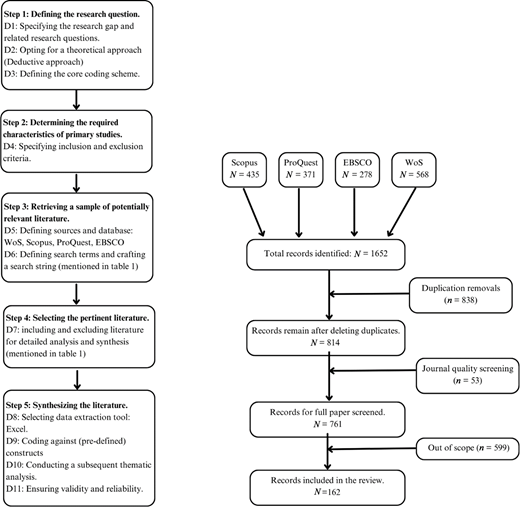
This paper follows the five steps of the SLR procedure (Sauer and Seuring, 2023) (Figure 1). Step 1 defines the objective of constructing an RL process across different levels. Step 2 follows the Preferred Reporting Items for Systematic Reviews and Meta-Analyses (PRISMA) method (Moher et al., 2009) to guide the data analysis and presentation of findings, ensuring methodological rigor and relevance (Page et al., 2021). Step 3 involves selecting search terms and databases. The keywords “responsible leader*” are used for the topic search, including the title, abstract and keywords across ScienceDirect, Scopus, Web of Science, ProQuest and EBSCO, up to December 31st, 2023. These databases, which are chosen for their coverage of high-ranking journals, enhance search precision (Ancillai et al., 2023).
Step 4 sets inclusion/exclusion criteria, focuses on peer-reviewed English-language business management research and excludes non-business topics such as pedagogy and environmental science. Initially, 1,652 articles were found, with 838 duplicates removed. Quality assessments of articles are crucial screening criteria for quality SLRs (Sharma and Bansal, 2023). Notably, the SCImago Journal and Country Rank is widely used to assess journal quality, focusing on prestige by considering citations and the citing journals (Butler, 2008). Journals are ranked in four quartiles (Q1–Q4), with Q1 being the most prestigious. Additionally, the ABDC list is a compilation of business journals by the Australian Business Deans Council. For this review, the authors select articles published in journals ranked from Q1 to Q3 or listed in the ABDC list to ensure a certain level of journal quality in which the reviewed articles were published.
This process narrowed the sample to 761 articles. The full-text papers of the remaining sample were then screened to eliminate articles that were out of scope and irrelevant focus despite appearing in the initial keyword search. Papers were also excluded for the following reasons: they were out of management scope, for example, the sample consisted of student populations lacking work experience; they did not present empirical evidence; and they focused on broad leadership or CSR without a specific focus on RL. Following this step, 599 are judged out of scope. The final sample of this review was composed of 162 articles published between 2005 and 2023.
In the final step, full-text articles are screened for manual coding in terms of the level of analysis (micro, meso or macro), methodology (qualitative, quantitative or mixed approach), geographical distribution and analysis focus (antecedents, mediators, moderators or outcomes). The input-moderator-mediator-output model (Mohammed et al., 2010) was used to explain RL mechanisms. This model delineates how antecedents lead to outcomes, with mediators clarifying the causal links and moderators influencing their direction/strength. One variable can be set in different groups because of the variability in research focus. For example, “CSR” can be categorized as either an outcome of RL (Wang et al., 2023) or a mediator mediating the relationship between RL and organizational sustainability (Amir et al., 2022). Appendix presents a detailed review protocol of the research.
3. Findings
3.1 Descriptive analysis
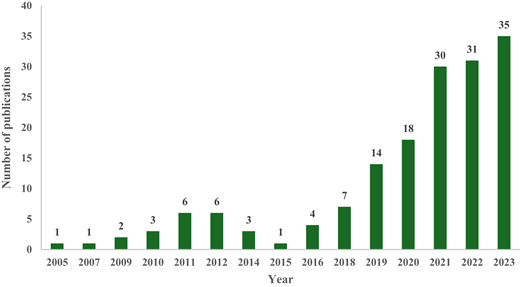
The first article in our sample was published in 2005 (Maak and Pless, 2005), followed by slow development (ranging from 1 to 7 publications annually) until 2019. The number of publications doubled from the previous year in 2019–2021, reflecting a growing recognition of the importance of RL (Figure 2). RL research has been conducted in different disciplinary academic outlets (88 journals; Table 1), reflecting its interdisciplinary nature. Over three-fourths of the articles on RL appear in second-tier leadership journals or lower, which are seen as less prestigious than top-tier journals. This suggests that the quality of RL research has not yet reached the level required for publication in top-tier journals.
Previous reviews have shown that the USA leads in publication volume, followed by European nations such as Switzerland, Austria and Spain (Marques et al., 2018; Frangieh and Yaacoub, 2017). However, our analysis reveals a significant geographical shift, with a growing concentration of empirical studies conducted in Asian contexts (Table 2) – notably China (38 articles) and Pakistan (24 articles). This trend, also noted in Saeed et al. (2023), reflects the increasing institutional and scholarly interest in CSR and sustainability in rapidly industrializing economies, where RL is often explored as a mechanism for navigating stakeholder demands, legitimacy pressures and ethical tensions.
Although many studies use internationally established frameworks, they are primarily grounded in local contexts, reflecting both the adaptation of RL concepts to regional settings and the influence of national research agendas. However, 12 studies adopt a broader international scope, featuring cross-national comparisons. Overall, this evolving geographical diversification suggests a gradual de-Westernization of the RL literature and a widening engagement with contextual variety.
3.2 Antecedents, boundary conditions, outcomes of responsible leadership
This subsection presents a theme-based analysis of categorized articles, examining the determinants, boundary conditions and outcomes of RL. The studies are clustered into three levels: micro level, concentrating on individuals and business leaders; meso level, focusing on organizational contexts and strategies; and macro level, addressing institutions, culture and society. Table 3 shows the highlights of the findings and the represented articles for each theme. We also consider cross-level analysis to explore interactions and linkages among these levels.
3.2.1 Antecedents.
The antecedents of RL generally encompass social, cultural and institutional context factors at the macro level, organizational culture, policies and environment at the meso level and the personalities and demographics of leaders at the micro level. Although there has been some promising conceptual work on the antecedents of RL by Maak and Pless (2006) and Stahl and De Luque (2014), relatively few empirical studies (21 articles) have examined those variables.
The review reveals that most variables identified as antecedents of RL are individual-level characteristics. They include personality characteristics, such as virtuousness, courage, care, justice, conscientiousness, responsibility and honesty (Cameron, 2011); perception and orientation (Maak et al., 2016); intelligence, including cultural and emotional intelligence (Miska et al., 2013); and motivation (Pless, 2007). Studies on other micro-level characteristics include self-regulation (Pless, 2007) and abilities, skills and behavioral dispositions, such as learning flexibility (Pless et al., 2011) and global leadership skills (Miska et al., 2013). Only two papers explore the impacts of dark-triad personalities (Üzüm and Özkan, 2023) and gender (Sharr, 2023) on the formation of responsible behaviors.
At the meso level, several factors, such as organizational culture, ethical climate and green human resource management, are discussed as the key drivers influencing RL (Pingali, 2016). Organizational strategy, a core element of a firm’s identity, significantly influences how responsible leaders address the needs of various stakeholders locally and globally (Miska et al., 2013). Conversely, business goal difficulty, managerial persona and shadow pressures lead to irresponsible leadership behaviors (Ketola, 2012; Veetikazhi et al., 2022).
At the macro level, social, cultural and institutional contexts significantly influence leaders’ tendencies toward responsible or irresponsible behaviors. Factors such as the ethos of the nation, power distance and community pressure shape the values and actions of responsible leaders (Koh et al., 2018). Furthermore, researchers (Witt and Stahl, 2016; Sharr, 2023; and Tirmizi, 2023) highlight the significance of varying laws, regulations, institutional cultures, customs and social backgrounds in shaping leaders’ behaviors and priorities toward different stakeholders. Finally, the development and influence of mass media are crucial in promoting RL, encouraging leaders to minimize unethical behaviors and decisions (Zhang et al., 2022).
3.2.2 Outcomes.
The current RL literature reveals a dearth of research investigating the underlying mechanisms linking RL and its multilevel outcomes, except for the research of Javed et al. (2020a). They examine the impacts of RL on relational social capital, a firm’s social performance and employees’ community citizenship behaviors through the moderating effect of authenticity. Empirical research predominantly concentrates on understanding how leaders influence individual and organizational outcomes and the mechanisms underlying these dynamics.
At the micro level, RL positively contributes to various employee behavioral outcomes. Notably, the relationships between RL and organizational citizenship behaviors oriented toward the community (Rao et al., 2022) and the environment (Abbas et al., 2022) are frequently studied. RL is also a significant determinant of a range of employee attitudinal outcomes, including employee engagement (Ali et al., 2023), whistleblowing intentions (Akhtar et al., 2020) and a lower level of turnover intention (Marques et al., 2023). Additionally, an increasing number of studies connect RL with performance aspects such as career success (Li et al., 2022) and employee sustainable performance (Chin et al., 2023).
At the meso level, a substantial amount of research focuses on the impact of RL on firm performance metrics, including triple-bottom-line performance, financial performance and safety performance (Wang et al., 2023). The findings indicate a positive relationship between RL and organizational triple-bottom-line performance, suggesting that RL does not necessarily lead to trade-offs between financial and environmental performance. When framing within stakeholder theory, RL is also crucial in talent management (Doh et al., 2011). Additionally, the responses of responsible leaders to business crises can mitigate organizational instability and contribute to reestablishing stability, which is achievable through responsible management practices (Coldwell et al., 2012). More recent studies have explored the role of RL in fostering an inclusive and ethical organizational climate, furthering organizational sustainability (Wang et al., 2023).
At the macro level, few studies have examined the role of RL in community engagement (Mehta et al., 2022), industry innovation (Yildiz et al., 2023) and crisis management (Pounder, 2021) during turbulent times (three qualitative papers).
Finally, RL also plays a role as a mediator or moderator across different levels, highlighting its multifaceted functions. For example, RL mediates the relationships between the perceived impacts of climate change and employee commitment (Mousa et al., 2019) or culture and knowledge sharing (Rao et al., 2022). Additionally, both the positive and negative moderating effects of RL are discussed in 12 articles. For example, RL positively moderates the relationship between employee engagement and commitment (Bouichou et al., 2022) but negatively moderates the relationship between socially responsible human resource practices and employee CSR engagement (Luu, 2022).
3.2.3 Mediators and moderators in the responsible leadership mechanism.
This section delves into empirical research on the mediators and moderators involved in the RL process. The mediators and moderators affect the process of the antecedents – RL and RL outcomes (Mohammed et al., 2010)). Few studies have examined factors mediating or moderating antecedents, such as RL. Only Veetikazhi et al. (2022) discussed focalism as a mediator in the positive relationship between business goal difficulty and socially irresponsible leaders’ behaviors. Conversely, empirical studies have been more prolific in investigating mediators and moderators in the RL–outcome relationship.
With respect to micro-level factors, research has underscored the multifaceted mediating and moderating roles of leaders and employees (e.g. gender, competence, values, social distance and conscientiousness), attitudes, beliefs (e.g. goal orientation, motivations, trust, commitment and individualism) in affecting RL–employee behavior (Abbas et al., 2022), attitudes (Ali et al., 2023) or performance outcomes (Afshari et al., 2023). The trickle-down effects of RL on employee behaviors are also examined through the moderating effects of the perceived role of ethics and social responsibility (Tian and Suo, 2021) and leader–follower value congruence (Cheng et al., 2019). Additionally, several studies use moderated-mediation models to investigate the mediating and moderating effects on the RL–employee outcome relationships. For example, conscientiousness has been examined as a moderator and felt obligations and job stress have been examined as mediators influencing the RL–employee cyberloafing relationship (Zhu et al., 2021).
Moreover, research has tested factors that mediate/moderate the relationship between RL and firm performance (such as sustainable development or innovation performance). For example, the relationship between RL and sustainable business performance is mediated by knowledge-sharing behaviors (Xuecheng et al., 2022) or moderated by CEO founder status (Wang et al., 2023). Concerning organizational-related factors, there has been limited research focusing solely on either their moderating or mediating role in RL–outcome relationships, with a few exceptions (Javed et al., 2020b; Mousa, 2019; Wang et al., 2015). Finally, several papers use moderated-mediation models to investigate the conditional indirect effects on RL outcomes through various mediators and moderators across levels of analysis (Zhu et al., 2021; Huo et al., 2023).
4. Discussion
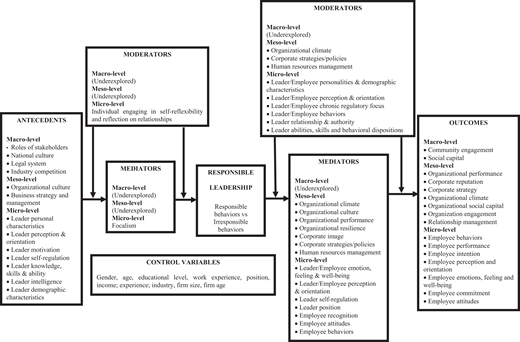
This study aimed to review the existing empirical literature and synthesize the determinants, mechanisms, boundary conditions and outcomes of RL to construct a framework for the RL process observed at the micro, meso and macro levels. These interconnected themes are essential for understanding and managing the complex mechanisms under which RL operates. Our analysis offers detailed insight into the complex, multilevel input-moderator-mediator-output mechanism governing RL, as shown in Figure 3.
We identify several factors that can promote the behaviors of responsible leaders in terms of antecedents. At the micro level, different characteristics and traits of leaders influencing RL are identified in this review. A more comprehensive understanding of RL necessitates systematic methodologies to investigate antecedents beyond virtues, moral values, competencies and skills. This approach should encompass an analysis of the interplay among reasoning, intuition and emotion to understand the underlying foundations of RL practice (Miska and Mendenhall, 2018). Additionally, little is known about how the abovementioned micro-level antecedents can explain different RL behaviors.
Moreover, to date, few studies have explored the interactions of multiple types of traits to clarify the conditions under which a specific leader trait influences leaders to behave proactively. At the meso level, while studies have examined the connections between RL and organizational variables such as responsible management, corporate governance and HR, an integrative perspective on these factors remains limited. Another challenge multinational companies face is adapting business strategies to different regions without jeopardizing RL development, which requires an improved understanding of the macroenvironment in which they are situated. At the macro level, initial steps have been taken to comprehend the institutional and cultural antecedents of RL, yet significant gaps persist in identifying relevant antecedents at this level.
Turning to the outcomes at the micro level, we confirm that the current research has identified several effects on employee attitudes, behaviors and cognitions, including job satisfaction, motivation and task performance. This perspective corresponds only to traditional leadership tasks with limited scope. The effects on stakeholders beyond employees, particularly those external to the organization, remain largely underexplored. At the meso level, organizational performance has been examined predominantly. Nevertheless, questions about trade-offs among economic, social and environmental factors in organizational performance to understand the actual value of sustainable development remain unaddressed. Moreover, little research has focused on outcomes at the macro level, especially in quantitative studies.
With respect to the moderators and mediators in the model, this review offers insights into the boundary conditions in the antecedent–RL and RL–outcome relationships. More fruitful findings regarding the mediating and moderating factors affecting RL outcomes across levels of analysis are available. Individual-related factors such as employee commitment play multifaceted roles in the RL–outcome relationship at the micro and meso levels. On the other hand, organizational-related factors are primarily examined in the complex moderated-mediation model of the relationship between RL and organizational performance outcomes. However, the findings still depict traditional leadership performance without macro-level considerations in the mechanism.
Our comprehensive multilevel model of RL offers a structured representation of how RL unfolds within and across organizational contexts. Unlike prior reviews that remained thematic or classificatory, this model articulates the dynamic linkages between levels, capturing structural differentiation and interdependence. It serves as a not only field map but also conceptual scaffold for future research aiming to deepen understanding of the mechanisms through which RL operates and influences individual, organizational and societal outcomes. We now turn to future research avenues.
5. Moving forward: Future directions for responsible leadership research
5.1 Research Avenue 1: Complex layering of responsible leadership
This review highlights that the exploration of RL at multiple levels of analysis, from micro level to macro level, remains limited. Some scholars (Doh and Quigley, 2014; Miska and Mendenhall, 2018) advocate for a cross-level framework that examines how a stakeholder-oriented RL approach can yield positive outcomes at all these levels, integrating various RL perspectives. Moreover, considering the macroenvironment without simultaneously managing the microenvironment, and vice versa, may lead to conflicts with different stakeholders (Pingali, 2016). Therefore, RL research should strategically work from the microenvironment to the macroenvironment to effectively fulfil the requirements of RL operation.
This review highlights the need for future research to explore how RL interacts with various factors across different levels to influence work. At the micro level, the insights from Miska and Mendenhall (2018) remain pertinent. Research should expand to include a broader stakeholder perspective in RL, focusing on sustainable value creation and positive change. This involves examining the impacts of RL on various external stakeholders. At the meso level, understanding RL within broader business systems is crucial, incorporating a multistakeholder viewpoint and exploring how RL balances economic, social and environmental outcomes.
Empirical research on the outcomes of RL at the macro level is notably sparse. Future studies should empirically demonstrate how RL influences macro-level outcomes. Furthermore, cross-level studies, which are underexplored both empirically and theoretically, could significantly advance RL research. Investigating connections between RL antecedents and outcomes across levels will deepen our understanding of RL as a process. Some researchers suggest research directions at the intersection of responsible business leaders (micro level) and the UN Global Compact (macro level), highlighting the value of cross-level research in progressing the RL field (Voegtlin and Pless, 2014).
5.2 Research Avenue 2: Further exploration of the boundary conditions of responsible leadership
This review reveals a limited understanding of the boundary conditions that determine the effectiveness of RL. Current studies have focused on boundary conditions such as employees’ self-efficacy (Li et al., 2022) or task interdependence (He et al., 2021). The importance of traits such as authenticity, virtuousness and charisma has been highlighted (Cameron, 2011; Muff et al., 2020), underscoring a gap in our understanding of RL, particularly concerning leaders’ virtues, values, competencies and skills.
Additionally, there is a notable lack of research on individual contingent conditions, including subordinates’ demographics (gender and age), psychological traits (moral predispositions, personality and locus of control) and social factors (education, occupation and employment status). Further studies are needed to investigate the conducive conditions for RL, covering internal factors (organizational culture, justice and politics) and external elements (industry sectors, stakeholder behaviors and national culture) to understand how those factors can form responsible leaders, as suggested by Witt and Stahl (2016) and Berger et al. (2011).
Similar to prevalent leadership theories, RL research should address its gender-blind spots. A more nuanced understanding of how RL intersects with gender dynamics is crucial, especially as only one paper has considered this aspect (Sharr, 2023). This gap highlights the need for more comprehensive research to fully grasp the multifaceted nature of RL across different contexts and conditions.
5.3 Research Avenue 3: Reconnecting responsible leadership with time
George and Jones (2000) argued that time can reshape theoretical constructs and relationships, but most RL studies overlook this dimension. RL drivers require time to manifest outcomes, and the relationships between inputs and outcomes may shift over time (Shamir, 2011). RL is a dynamic process involving reciprocal interactions between leaders and stakeholders (Pless, 2007), and leader–member exchanges evolve over time (Martin et al., 2016).
Current RL research, predominantly cross-sectional and longitudinal studies (usually with no more than three waves), adheres to the a-temporal nature of RL, assuming that the studied constructs and their relationships are static (Shamir, 2011). This is problematic because these studies assume that the antecedents, mediators, moderators and outcomes of RL, along with their relationships, remain stable over time (Fischer et al., 2017). These methods fail to capture the dynamic process of RL development. For example, leaders’ personalities or behaviors might change with experience or advancement within an organization. Only one article uses a biographical analysis to explore the role of changing identities and motivational drivers of responsible leaders (Pless, 2007).
Moreover, various leadership traits, including dark-triad personalities, are currently under-researched. For example, dark personality traits can positively or negatively affect leadership effectiveness outcomes depending on context and time (Mackey et al., 2021). To date, only a few studies have explored the interactions and development of multiple types of traits to clarify the conditions under which a specific leader trait can gradually influence responsible leaders over time. Thus, researchers may use different approaches, such as biographical studies or historiometric research, to comprehend the progress of RL development (Mumford, 2006).
Furthermore, researchers may use methods such as ethnographic studies, longitudinal and comparative case studies, diaries and other approaches that track RL relationships as they evolve to gain a deeper understanding of RL processes. Future RL research could enhance multi-wave longitudinal studies through frequent measurements, incorporating mediators and sophisticated statistical analyses to account for reciprocal relationships. These studies should aim to cover meaningful periods, concentrating on the dynamic nature of the RL process. Additionally, the interaction between time and other contextual variables warrants consideration in future studies.
5.4 Research Avenue 4: Reconnecting responsible leadership with space
Recent RL research has expanded to developing countries such as China and Pakistan, alongside significant work from Western, Educated, Industrial, Rich and Democratic (WEIRD) nations, reflecting a broader effort to understand RL globally. However, most studies remain limited to specific national contexts, with findings often not transferable between different institutional environments, mainly Eastern and Western nations (Witt and Stahl, 2016). Comparative cross-national studies are scarce, prompting a call for more research in diverse geographical contexts, including developed Asian countries and developing Western nations, to explore the institutional and cultural antecedents of RL.
Furthermore, given the crucial role of RL in connecting stakeholders for sustainable development, there is an urgent need to understand better how RL can support the achievement of sustainable development goals for different sectors across various nations, especially in the service sector in different contexts (Amir et al., 2022). For example, the tourism and hospitality industry, often referred to as “the smokeless industry,” still has notable environmental and social impacts. However, research using tourism as a context for RL analysis is scarce. Another setting that could be a focus of RL research is the impact of RL on private–public partnerships.
5.5 Research Avenue 5: Responsible leadership in the digital world
The shift toward digital workplaces is a widespread and transformative trend across diverse sectors and organizational sizes (Cortellazzo et al., 2019). Digitalization is a double-edged phenomenon that drives job creation and destruction, significantly altering role requirements and blurring traditional organizational boundaries (Pless et al., 2021). Thus, leadership becomes vital in harnessing the advantages of digitalization, especially in talent management, and enhancing employee engagement and connectivity.
However, this transformation creates new ethical challenges for leaders, necessitating a re-evaluation of conventional leadership theories, especially in the context of RL. Some researchers pose an unaddressed question regarding the sufficiency of current leadership theories to explain the nuances of digitalization (Cortellazzo et al., 2019). We require new theoretical frameworks to understand how responsible leaders adapt to these changes. Future research should explore how responsible leaders manage increased transparency demands in ICT-mediated relationships, balance followers’ autonomy and privacy needs and build trust in highly virtual environments.
6. Limitations and directions for future systematic reviews
While our review is methodologically rigorous and analytically grounded, it is important to acknowledge several limitations that stem from deliberate choices regarding scope and focus. First, this study is confined to peer-reviewed journal articles published in English. As a result, we may have excluded valuable studies published in other languages, particularly in regions where RL has gained traction. At the same time, the significant representation of Asian studies – especially from China and Pakistan – suggests that non-Western perspectives are increasingly being published in international, English-language outlets. We, therefore, believe that our sample reflects this evolving scholarly landscape and remains sufficiently inclusive to support the validity of our synthesis.
Second, our search strategy focused exclusively on the term “responsible leader*.” This relatively simple query may have missed empirical work operating under adjacent or overlapping constructs. However, we viewed this as a necessary boundary to maintain conceptual clarity. Broader or more expansive search strategies risk conflating related but theoretically distinct constructs, thereby undermining the coherence of the synthesis. Our focused approach enables us to trace with greater precision how RL has been empirically studied, operationalized and theorized.
Third, our review is organized around a multilevel analytical logic – mapping constructs and relationships at micro, meso and macro levels – rather than focusing on specific industries, sectors or institutional contexts. This choice was intended to produce a transferable model of RL dynamics that could inform research across contexts. Readers interested in sector-specific insights or regionally bounded analyses may refer to reviews such as Foldøy et al. (2021) or Frangieh and Yaacoub (2017), which engage more directly with contextual particularities.
Finally, we take the construct of RL as conceptually defined and do not revisit foundational definitional debates or the contestation between RL and related leadership approaches. Our objective was not to refine the concept itself but to examine its empirical configuration and the mechanisms through which it operates. Readers seeking greater engagement with conceptual boundaries and definitional tensions may refer to de Klerk and Jooste (2023) or Javed et al. (2025).
7. Conclusion
This SLR offers a comprehensive synthesis of 162 empirical studies on RL published between 2005 and 2023. The review consolidates nearly two decades of research into an integrated multilevel process model through a structured mapping of antecedents, mediators, moderators and outcomes across micro, meso and macro levels. This model advances the field by clarifying the empirical configuration of RL and by enabling a more coherent understanding of how it operates across individual, organizational and societal domains. By delineating the internal architecture of RL research, this review provides scholars and practitioners with a clear analytical framework for situating existing findings and designing future inquiries. In doing so, it contributes to the maturing of RL as a field of study and supports its continued development as a meaningful concept for theory and practice.
Author contributions
It is a part of Giang’s PhD project. Giang NT Nguyen performed data collection and analysis. Giang NT Nguyen and Heidi Wechtler wrote the first draft of the manuscript, and all authors commented on previous versions of the manuscript. All authors read and approved the final manuscript.
Data availability
Data is available upon request.