Skip to article sections
Purpose

The purpose of this study is to advance understanding of how PSCs can re-imagined, re-designed and strengthened by leveraging industry 4.0 (I4.0) technologies. Building resilience in Pharmaceutical Supply Chains (PSCs) has become imperative in the wake of COVID-19 and other global disruptions.

Design/methodology/approach

This study adopted a qualitative approach using thematic analysis and the Gioia method on a corpus of data from 114 articles published in 84 peer-reviewed academic journals. The authors conducted a problematising review to critically analyse the contributions of I4.0 technologies to PSCs and demonstrate the distinctiveness of PSC resilience.

Findings

The thematic analysis revealed the advantages and barriers to I4.0 implementation in PSCs, emphasising on how these technologies support sensing, seizing and reconfiguring capabilities. Drawing on dynamic capability theory, this study proposes the pharmaceutical supply chain resilient capabilities (PSCRC) model, which conceptualises the capability building required to withstand and adapt to disruption.

Originality/value

The authors argue that the PSCRC model provides i) a theoretical contribution by clarifying the micro foundations of resilience, and ii) a practical roadmap for supply chain leaders seeking to deploy I4.0 technologies to coordinate processes, secure materials and build sustainable and adaptive PSCs. The paper also outlines future research avenues to advance scholarly and managerial understanding of PSC resilience.

The necessity of a digital future, amplified by the COVID-19 disruption and more recently by the “black swan” crisis (Enz et al., 2024), has spurred the implementation of Industry 4.0 technologies (I4.0) (Frederico et al., 2023; Kumar et al., 2021). Manufacturing and service organisations adopt digital technologies to reshape entire business models, create value, facilitate real-time informed decision-making, save time and money (Cranmer et al., 2022). I4.0 technologies, such as big data analytics (BDA), Internet of Things (IoT), artificial intelligence (AI) and blockchain enhance sensing capabilities by improving real-time visibility; seizing capabilities by enabling data-driven decision-making; and transforming capabilities by facilitating agile reconfiguration of supply chains in response to disruptions. These capabilities are valuable assets that support organisations and supply chains in responding quickly and efficiently to a crisis (Cadden et al., 2022).

In the healthcare sector, the adoption of technologies to analyse large amounts of data to extract pertinent knowledge and valuable insights has also increased. The healthcare data analytics market was valued at $43.1bn in 2023 and is expected to grow by 21.1% from 2024 to 2030 (Grand View Research, 2023). Implementing technologies in the healthcare sector contributes toward more accurate medical diagnoses, precise prescriptions, drug and vaccine development (Chen et al., 2023) as well as great advances in managing pharmaceutical supply chains (PSCs). However, PSCs must deal with financial, communication, waste and complexity challenges (Papalexi et al., 2020; Papalexi et al., 2022). Recent global events, such as the pandemic, wars and natural disasters have highlighted the severity of these pre-existing challenges.

Although scholarly articles have highlighted the positive impact of deploying I4.0 technologies on optimising organisational performance (Alharthi et al., 2020; Ali et al., 2022; Cadden et al., 2022; Kandasamy et al., 2025), there remains a gap in understanding how these technologies collectively foster resilience by shaping dynamic capabilities (Bapatla et al., 2023). In addition, Yaroson et al. (2021) highlighted that although resilience has been extensively discussed in supply chain literature, there is a limited focus on resilience strategies in PSCs. In the healthcare sector and PSCs, the resilience and sustainability agendas driven by CEOs and senior managers have accelerated the pace of I4.0 technology adoptions (Raj et al., 2022), which supports the rationale and significance of this study. Successful development of a resilient supply chain system requires orchestrating resources and developing integrated trusted systems to enable increased data sharing and enhanced communication (Aslam et al., 2023; Babu et al., 2022). This is a more complex process than might have been assumed but developing supply chain capabilities by combining tangible (e.g. investing in I4.0 technologies), intangible (e.g. organisational learning and cultural capability development) and human resources (e.g. management capability development) could potentially ease this complexity and create robust PSCs (Cadden et al., 2022).

Therefore, this research investigates the role of I4.0 technologies in shaping the dynamic capabilities that underpin pharmaceutical supply chain resilient capabilities (PSCRC), enabling PSCs to anticipate, adapt to, and transform in response to future disruptions. Specifically, in this study, we define pharmaceutical supply chain resilience as the capability of PSCs to anticipate, withstand, and recover from disruptions such as active pharmaceutical ingredient (API) shortages, regulatory interventions, counterfeit drug infiltration and cold chain failures, while safeguarding patient safety and maintaining trust. To achieve the study’s objectives, we adopt dynamic capability theory (DCT) as a lens to conceptualise how PSCs sense, seize and reconfigure resources to develop resilient capabilities. DCT provides a structured framework to investigate how PSCs can leverage I4.0 technologies for long-term adaptability and resilience (Malakar et al., 2025). Although DCT has been widely adopted across supply chain studies, its operationalisation has often remained abstract, with limited attempts to specify how sensing, seizing and reconfiguring happen in practice (Roh et al., 2022; Mikalef et al., 2020). This is observed in the pharmaceutical sector, where resilience involves unique dynamics as previously mentioned. By explicitly mapping I4.0 technologies onto Teece’s (2007) micro foundations (the distinct skills, processes, procedures, organisational structures, decision rules and disciplines, which undergird enterprise-level sensing, seizing and reconfiguring capacities), our study offers a sector-specific operationalisation of DCT, moving beyond the traditional primary data analysis that can be found in the literature (Yaroson et al., 2023, 2024).

Therefore, we have developed the following research question to structure the study:

RQ1.

How do Industry 4.0 technologies shape the development of sensing, seizing and reconfiguring capabilities that enhance pharmaceutical supply chain resilience?

Existing research on Industry 4.0 in PSCs reveals relevant aspects. First, many studies adopt a fragmented, single-technology perspective (e.g. blockchain for traceability), overlooking interoperability across I4.0 systems (Wu et al., 2023; Nguyen et al., 2022; Uddin et al., 2021). Moreover, resilience and sustainability are frequently treated as separate goals, despite evidence that I4.0 technologies can simultaneously enhance recovery and reduce waste (Jraisat et al., 2023; Ma et al., 2023). These issues highlight the need for a holistic framework that integrates I4.0 technologies, operationalises DCT micro foundations, and addresses the unique vulnerabilities of PSCs in a post-pandemic context.

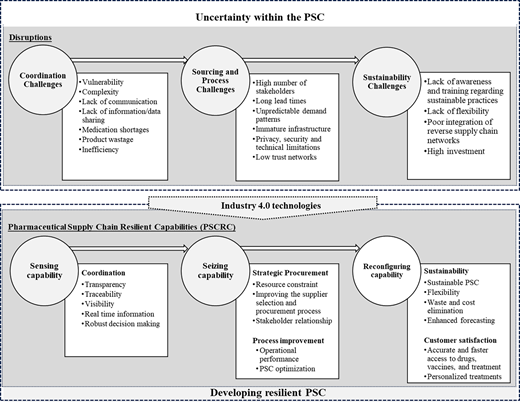
The proposed PSCRC conceptual model (Figure 1) can be used to guide researchers and practitioners in assessing PSC resilience capabilities. The outputs of the structured literature review (SLR) and inductive qualitative research approach helped us develop the PSCRC model. It represents the contribution of I4.0 technologies to the PSC dynamic capability-building process that allows resilient PSC creation while extending the dynamic capability view. The conceptualisation of the model is discussed throughout the paper and specifically in the findings section.

The contributions of this study are threefold:

  1. Our review is the first to holistically assess the contribution of I4.0 technologies within the PSC to achieve resilience and critically evaluates, conceptualises, and problematises existing knowledge by thematically analysing the selected articles. This approach aims to generate new ways of understanding a given area of concern (Gruner and Minunno, 2024; Breslin and Gatrell, 2020). A handful of previous studies on the implementation of I4.0 technologies within the PSC (Chen et al., 2023; Khan et al., 2023b) took a narrow view of single I4.0 technology adoption (e.g. the adoption of AI) to achieve the overall performance (Cadden et al., 2022).

  2. This study adopts a DCT lens to review the PSC literature to explore the effect of applying I4.0 technologies within it, particularly the contribution of those technologies to develop a resilient PSC capable of dealing with future challenges. This is achieved through juxta-positioning of the literature referring to the adoption of I4.0 within the PSC. Our review is among the first to operationalise Teece’s (2007) DCs micro foundations within the PSC by developing the PSCRC model. This provides clarity regarding the construct of capabilities, which is an element that is missing in the DCT literature (Bruyaka et al., 2024 Pitelis,2022).

  3. The emergent PSCRC model and the discussed future research avenues provide potential constructs for laying the groundwork for case studies and empirical research, resulting in future theoretical developments. DCT literature highlights that quantitative studies that operationalise and measure organisational capabilities are underdeveloped (Cronin and George, 2023; Schilke et al., 2018).

The remainder of this paper is organised as follows. The next section outlines the background and motivation for this study. Section 3 discusses the methodology of the research, with details about how the data are collected and analysed in the exploratory study. In Section 4, the results and thematic map are discussed by theorising the literature related to PSCs and the use of technology within it. This section provides insights into the existing relevant knowledge and presents the PSCRC model. Section 5 discusses the results, and Section 6 concludes the paper by presenting a research agenda and key avenues for future research.

According to Pettit et al. (2019), resilience is often defined as the ability to recover in a timely and cost-effective manner and return to its initial state after a crisis. However, recently, resilience has been associated with the capacity to bounce back further by adapting and growing as a result. Flexibility, visibility and collaborative practices contribute towards resilience (Kamalahmadi et al., 2022; Yaroson et al., 2024). The COVID-19 pandemic has exposed vulnerabilities in global PSCs, causing disruptions that affect access to critical medicines and lead to shortages of drugs, active pharmaceutical ingredients (APIs) and medical supplies (Khan et al., 2023a). In fact, from the perspective of the collective society, the pandemic has more significantly highlighted the need for building resilience capabilities (Paul et al., 2023).

Developing resilience capabilities may be challenging for the PSC due to its unique nature, characterised by high complexity, lack of transparency, inefficiencies in the production process, long lead times, cost intensity, limited suppliers and difficulties in tracking and tracing products, as Papalexi et al. (2020) and Yaroson et al. (2023) explained. In addition, the industry needs to adhere to strict regulations and compliance and manage the risks of counterfeit drugs (Bapatla et al., 2023). PSCs are also vulnerable to geopolitical events and natural disasters (Enz et al., 2024). Therefore, in this uncertain global context, rethinking and redesigning PSC has become a key priority. Multiple strategies have been adopted to achieve supply chain resilience, including inventory and capacity buffers (Wong et al., 2020); multi-sourcing strategies; and near-shoring approaches (Kano and Oh, 2020). Naz et al. (2022) explained that PSCs can build resilience capabilities by managing risk proactively, enhancing their level of preparedness, diversifying sourcing for raw materials and APIs, reshoring manufacturing plants, and investing in digital technologies. Indeed, Yaroson et al. (2023) categorised the capabilities required to build PSC resilience into two types: proactive capabilities, which anticipate disruptions, and reactive capabilities, which are employed after disruptions occur (Kamalahmadi et al., 2022). Key enablers of resilience within the PSC include flexibility, visibility, and collaboration (Yaroson et al., 2021; Ozdemir et al., 2022). However, as highlighted by Yaroson et al. (2021, 2023, 2024) the development of resilience within PSCs remains limited and fragmented. Table 1 presents a summary of PSC related studies that have adopted I4.0 technologies, along with the specific resilience capabilities they targeted.

Technologies such as AI, BDA, IoT, blockchain, robotics and virtual and augmented reality offer huge benefits to the healthcare and pharmaceutical sectors to achieve more accurate and faster diagnoses and treatments, development of new drugs and vaccines, as well as enhanced access to clinicians and medicines (Trenfield et al., 2022). Moreover, the adoption of I4.0 technologies has emerged as a solution for enhancing PSC traceability, visibility, flexibility, responsiveness, and adaptability within these complex and global networks (Chen et al., 2023). In the literature, we observe different levels of adoption and advancement. Some companies invest in blockchain and the Internet of Things (IoT) to improve product visibility and traceability across the supply chain in real time, whereas others use smart sensors and AI to predict equipment failures, optimise maintenance, and improve inventory management and demand forecasting during disruptive events (Nguyen et al., 2022). Qader et al. (2022) examined the impact of I4.0 technologies on supply chain performance and collected data from food, beverage, and pharmaceutical companies, and Saha et al. (2022) empirically studied how emerging technologies impact PSCs. Benazzouz and Auhmani (2023) developed a digitalisation maturity model to help PSC partners assess their adoption levels in terms of digitalisation.

Yaroson et al. (2024), Jraisat et al. (2023), Alharthi et al. (2020) and Thakuriya et al. (2023) proposed conceptual models for the adoption of blockchain technology to enhance sustainability and effectiveness within the PSC. However, these studies tend to focus on siloed applications, such as hospital operations (Alharthi et al., 2020), counterfeit drugs management (Thakuriya et al., 2023), sustainability initiatives (Jraisat et al., 2023) and addressing medicine shortages (Yaroson et al., 2024). Table 1 provides a summary of key studies that examine the adoption of I4.0 technologies to enhance resilience. As evidenced by the table, the adoption of I4.0 technologies in the PSC literature remains fragmented, with a predominantly static focus on DCT. Therefore, a holistic I4.0 implementation across the entire PSC is needed to support the development of resilient capabilities; an objective that this research aims to address. The uptake of I4.0 technologies is inevitable, and this phenomenon must be studied academically (Chen et al., 2023; Khan et al., 2023b).

The supply chain literature suggests that the DCT has been adopted to examine the effect of dynamic capabilities on organisational performance in uncertain environments (El Baz and Ruel, 2021). According to Teece (2007), the skills and competencies of sensing, seizing, and reconfiguring are considered the micro foundations that are fundamental determinants of firm performance. These organisational capabilities assist firms in responding to potential risks quickly by identifying changes in the environment (sensing), interpreting the required resources and actions to overcome uncertainties, enacting flexible operations (seizing) and rearranging resources to recover and regain the continuation of operations (reconfiguring). This theory enables the analysis of companies and their SC’s ability to reshape structures and systems in response to changes in uncertain business environments and create opportunities (Bruyaka et al., 2024).

The disruptions generated by COVID-19 and their impact on PSCs and, most importantly, the difficulties in responding to this crisis, highlight the importance of utilising supply chain capabilities to rethink existing PSC resilience capabilities and develop new ones (Mikalef et al., 2020). We believe that the pandemic coupled with the rise of digital technologies marked the beginning of a paradigm shift in the management of supply chains and added to our motivation to study the future of resilience capabilities. By adopting a DCT lens, we can shed light on how PSCs can deploy I4.0 technologies to reconfigure their resources to develop resilience capabilities. We expect the adoption of I4.0 technologies to enable the development of integrative capabilities by enhancing the communication and coordination of PSCs.

Specifically, I4.0 technologies operationalise the micro foundations of DCT: the distinct skills, processes, procedures, organisational structures, decision rules and disciplines, which undergird enterprise-level sensing, seizing and reconfiguring capacities, by enabling data-driven, agile and collaborative responses to disruption. First, I4.0 technologies extend and accelerate sensing capabilities by transforming vast volumes of data into actionable insights, a critical requirement for PSCs where patient safety and regulatory compliance are non-negotiable (Uddin et al., 2021; Musamih et al., 2021). For example, big data analytics (BDA, artificial intelligence (AI) and Internet of Things (IoT) sensors enhance visibility across supply networks, enabling early detection of issues, shortages, and other risks (Bag et al., 2023; Bassiouni et al., 2023). Second, the technologies enhance decision-making speed, trust, and precision, strengthening the seizing capability. For example, blockchain platforms and smart contracts can provide secure, real-time information flows that improve trust among PSC partners, while digital twins and AI-based decision can support systems allow scenario testing and rapid mobilisation of resources during crises (Aloini et al., 2023; Joseph Jerome et al., 2022). Finally, I4.0 technologies enable PSCs to rapidly reconfigure its manufacturing and logistics networks. Additive manufacturing facilitates localised production of critical medicines, robotics and automation enable rapid capacity adjustments, and cloud-based collaboration platforms support flexible supplier switching and process redesign. Collectively, these linkages clarify how I4.0 technologies enact dynamic capabilities in PSCs, bridging the gap between abstract theoretical constructs and actionable resilience-building mechanisms.

Research has underlined the importance of building dynamic capabilities by adopting innovative approaches to respond to risks generated in volatile environments (Cadden et al., 2022), but there is limited information regarding this process within the PSC in the current literature. Although Yaroson et al. (2024) adopted the DCT to build resilience within the PSC by enhancing decision-making capabilities to manage medicine shortages, they emphasise the need to move beyond a static application of the DCT and explore its holistic adoption – an approach this research addresses. In addition, our study addresses the call for further research by Roh et al. (2022) and Cadden et al. (2022) regarding the limited focus on the role of intangible capabilities in creating resilience. Therefore, we have developed a PSCRC model (Figure 1) inspired by the dynamic capability view to explore how I4.0 can support the PSC in employing its capabilities to mitigate future disruptions.

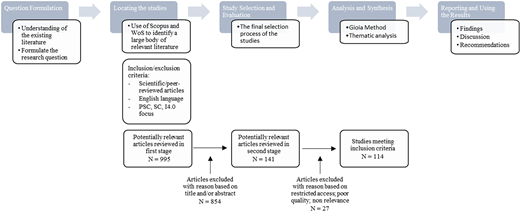
This study adopted an evidence-informed SLR approach to collate the required data for qualitative thematic analysis, following the guidelines suggested by Denyer and Tranfield (2009). The systematic review employed five refinement stages and was conducted in August 2023. A PRISMA-style flow diagram is presented to document the screening process as shown in Figure 2. The screening process is documented in a PRISMA-style flow diagram, which details the identification, screening, eligibility and inclusion stages, ensuring a transparent and replicable process.

First, the SLR aims to identify relevant literature that leads to the formation of a data corpus for further thematic analysis (Wang et al., 2024). Second, a keyword search was conducted using Scopus and Web of Science (WoS), two common databases that provide broad access to a multitude of peer-reviewed studies (Heinis et al., 2022). The search string used for Scopus is as follows: (({Logistics 4.0} OR {Industry 4.0} OR {Supply Chain 4.0} OR {I4.0} OR {ArtificialIntelligence} OR {AI} OR blockchain OR iot OR {InternetofThings} OR cloud OR {CloudComputing} OR {Robots} OR {cobots} OR drones OR {AdditiveManufacturing} OR am OR 3d OR {3Dprinting} OR {CyberPhysicalSystems} OR cps OR bda OR {BigData} OR {Machine Learning} OR ml OR vr OR ar OR {VirtualReality} OR {AugmentedReality} OR {AutonomousVehicles} OR sensors) AND (pharma* OR psc OR drugs OR medicines) AND ({supplychain} OR sc OR scm OR logistics)) AND (LIMITTO (DOCTYPE, “ar”)) AND (LIMITTO (LANGUAGE, “English”)) AND (EXCLUDE (SUBJAREA, “MEDI”) OR EXCLUDE (SUBJAREA, “BIOC”) OR EXCLUDE (SUBJAREA, “PHAR”) OR EXCLUDE (SUBJAREA, “IMMU”)).

The search string utilised for the WoS is as follows: ((“Logistics 4.0” OR “Industry 4.0” OR “Supply Chain 4.0” OR “I4.0” OR “Artificial Intelligence” OR “AI” OR blockchain OR iot OR “Internet of Things” OR cloud OR “Cloud Computing” OR “Robots” OR “cobots” OR drones OR “Additive Manufacturing” OR am OR 3d OR “3D printing” OR “Cyber Physical Systems” OR cps OR bda OR “Big Data” OR “Machine Learning” OR ml OR vr OR ar OR “Virtual Reality” OR “Augmented Reality” OR “Autonomous Vehicles” OR sensors) AND (pharma* OR PSC OR drugs OR medicines) AND (“supply chain” OR SC OR SCM OR logistics)).

Furthermore, the inclusion and exclusion search criteria were specified as follows: academic scientific/peer-reviewed articles that focus on PSCs and I4.0 technologies were targeted, and only articles written in English were considered. A total of 1,324 and 505 contributions were identified from Scopus and WoS, respectively. The inclusion/exclusion criteria were gradually applied and studies with noncoherent abstracts and duplicates were removed, leaving 995 unique sources in the data set. To achieve an acceptable level of accuracy when applying the selection criteria, we conducted an additional round of reviews that reduced the total number to 141. Finally, the study selection process was conducted. The authors reviewed the titles and abstracts of the 141 articles identified in the previous stage and used colour coding to categorise the articles into three groups: “accepted”, “borderline” and “rejected” (Heinis et al., 2022). Based on this process, 27 articles were excluded because of non-relevance (e.g. focus on healthcare and not PSCs), poor quality or restricted access. Finally, 114 articles were included in the SLR (Table 2).

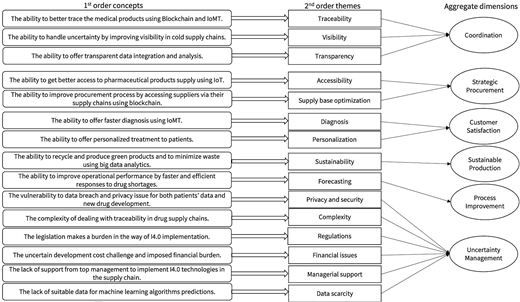
Fourth, the 114 articles were analysed. The analysis consisted of two parts: thematic analysis (Sodhi et al., 2022) and the Gioia method (Williams and Shepherd, 2017) for conceptual development and proposing an emergent model. The thematic analysis aimed to examine articles to identify enablers and challenges in implementing I4.0 technologies in PSCs. We adopted the six steps suggested by Sodhi and Tang (2018) to conduct the thematic analysis: We (1) familiarised ourselves with the corpus of “data”; (2) generated initial codes; (3) searched for themes; (4) reviewed these themes; (5) defined and named these themes, and (6) produced the report. To ensure the reliability of the thematic analysis, we adopted a multi-step approach to enhance rigor. This approach consists of the following three steps: (1) inter-coder reliability: two researchers independently coded a subset of articles to generate initial codes. Disagreements were resolved through discussion and consensus among the research team. (2) peer debriefing: a third researcher, not involved in the initial coding, reviewed the coding framework and emergent themes to ensure consistency and reduce bias. (3) iterative theme refinement: themes were iteratively refined during team meetings, where all authors discussed and validated the themes against the data corpus to ensure thematic saturation. The next part of the analysis involved applying the Gioia method to develop an emergent model. Building on grounded theory principles, the Gioia method employs a central research question to direct qualitative data collection and the subsequent theory development. Applying inductive data structuring methods, such as the Gioia method, enables researchers to uncover the dimensions and their interactions for further empirical and quantitative studies (Williams and Shepherd, 2017).

The Gioia method, traditionally used for primary qualitative data, was adapted to analyse secondary data from 114 peer-reviewed articles following its usage for secondary data has been effectively evidenced in domains such as social network analysis (SNA) (Williams and Shepherd, 2017) and tourism (Jiménez-Partearroyo et al., 2024). Unlike interview-based applications, we coded textual data from article findings to identify first-order concepts, second-order themes and aggregate dimensions. To mitigate bias, we used a structured coding protocol, and triangulated findings across multiple sources to address potential biases during team discussions.

Finally, the SLR outputs were reported. The findings constitute the following: (1) thematic analysis discovers enablers and challenges for implementing I4.0 within PSCs (Section 5.1) and (2) the Gioia method enabled to develop the PSCRC model and identifies the dimensions of implementing I4.0 within PSCs to guide future research agendas.

A thematic analysis was carried out to establish a thematic map aiming to provide information on the implementation of I4.0 within the PSC and its contribution to restructuring its resilient strategy. The Gioia Method was then applied to structure the data inductively. The identified data structure and results of the thematic analysis were consolidated to produce a model to develop an overarching framework to inform and guide future research (Figure 3). We present the data structure by emphasising second-order themes and overarching dimensions (see  Appendix A). The supporting data and codes for the data structure in the Gioia method is presented in  Appendix. The data structure was developed through iterative coding, where first-order concepts (e.g. personalisation, traceability) were extracted from the article findings and grouped into second-order themes based on conceptual similarity. For example, personalisation identified in Ding (2018) (reference #107), enhances customer satisfaction by enabling tailored treatments, contributing to reconfiguring capabilities. Traceability as noted in Nanda et al. (2023) (reference #34), supports coordination capabilities by improving supply chain transparency, contributing to sensing capabilities. To further clarify how the themes were inductively derived and how conflicting interpretations (e.g. whether AI enhances or complicates decision-making) were resolved, we provide detailed discussion in section 4.1, 4.2 and 4.3. For instance, we argue that I4.0 technologies, including AI, blockchain and data analytics can facilitate the development of a transparent PSC system. These technologies enhance data, information and knowledge sharing, thereby contributing to more robust decision-making. However, challenges related to security and safety must still be addressed. Mapping of the process by which I4.0 tools translated into resilience (e.g. how real-time visibility (IoT) → proactive risk sensing → faster disruption recovery) can be understood via the PSCRC framework and the rich description provided, ensuring a clear chain of evidence from data to model.

The aggregate dimensions presented in Figure 3 are related to the I4.0-enabled capabilities for developing sensing, seizing and reconfiguring capabilities, which will eventually lead to resilient PSCs. The thematic analysis suggests that the implementation of I4.0 technologies can contribute to developing coordination capabilities, which can be considered as sensing capabilities according to DCT. I4.0 technologies support the development of a transparent supply chain system where the availability of rich data sources and the power of data analytics enhances information/knowledge sharing and communication (Musamih et al., 2021). The collection and analysis of insightful data builds the coordination capability that can simplify and foster PSC robustness, improve decision-making, and lead to a timely and efficient response to disruptions. Bag et al. (2023) studied absorptive capacity in healthcare organisations, which inherently rely on coordination, by implementing BDA and an AI collaborative platform.

Subsequently, data collection and analysis achieved through the coordination of capabilities enabled the development of important strategic procurement and process improvement capabilities. These ensure upstream and downstream PSC optimisation by improving the supplier selection and procurement process, while simultaneously enhancing accessibility to healthcare services. Nevertheless, implementing I4.0 technologies within the PSC leverages these seizing capabilities as they enhance information sharing, visibility, and stakeholder relationships, which are elements that contribute to the development of a resilient PSC.

Finally, the findings indicate that I4.0-based PSCs can offer not only accurate and faster diagnosis but also personalised treatments and, therefore, enable healthcare systems to effectively deal with patients’ needs. I4.0 technologies support the PSC to achieve more sustainable production, which eliminates waste and cost, enhances forecasting, and increases flexibility that supports quicker responses to changes. Consequently, this environment supports PSCs to build reconfiguring capabilities, mainly supported by the dimensions of customer satisfaction and sustainable production.

The PSCRC model (Figure 1) conceptualises and presents the sensing, seizing, and reconfiguring capabilities. The contribution of I4.0 technologies to the PSC dynamic capability-building process that allows the development of resilient PSCs is discussed below.

Coordination is required across PSC networks to ease complex global supply chains and develop resilient PSCs. Traceability, visibility and transparency have emerged as crucial elements that contribute to sensing capabilities and enabling proactive risk management within a transparent supply chain environment. Joseph Jerome et al. (2022) and Erol et al. (2021) highlighted the need to adopt innovative approaches (e.g. Procurement 4.0) to build transparent PSCs. Table 3 presents the sub-themes related to this capability.

4.1.1 Complexity

To simplify highly complex PSCs, researchers have suggested the adoption of blockchain technology to improve transparency and traceability by providing a secure and decentralised platform for tracking the movement of pharmaceutical products from manufacturers to patients (Alharthi et al., 2020; Aloini et al., 2023; Uddin et al., 2021; Yazdinejad et al., 2023). This technology can also improve coordination among healthcare stakeholders by providing a shared platform for data exchange and collaboration, which is one of the several challenges facing PSCs (Alharthi et al., 2020; Alles and Gray, 2020). However, Benevento et al. (2023) empirically identified seven barriers to supply chain integration (SCI) using technologies in 30 case studies of the healthcare sector in Italy. Lack of motivation, unwillingness to change and lack of support from healthcare authorities were among the impediments, illustrating the low importance of financial resources in the studied cases.

4.1.2 Privacy, security, and technical limitations

Ding (2018) posits that I4.0 technologies in PSCs enhance coordination, efficiency and patient-centric flexibility. However, disparate IT systems among PSC stakeholders can hinder interoperability, compatibility and visibility, making PSCs vulnerable to data breaches and impeding traceability and transparency (Ali et al., 2022; Bapatla et al., 2023; Hendrik Haan et al., 2013). Uddin et al. (2021) emphasised the lack of full interoperability in the current drug traceability solutions such as bar codes, blockchain systems and radio frequency identification (RFID) tags. Chatterjee (2020) and Singh et al. (2020) emphasised the need for data security and integrity in digital supply chains, particularly PSCs, owing to privacy concerns in advanced therapies. Regulatory compliance with patient security and privacy is a potential barrier to innovation in PSCs (Bandhu et al., 2023; Paul and Venkateswaran, 2020). Abdallah and Nizamuddin (2023) proposed blockchain-based smart contracts to enhance stakeholder trust, transparency and data security.

4.1.3 Decision-making

Paul and Venkateswaran (2020) used machine learning (ML) algorithms to identify plausible crisis behaviours under deep uncertainty, aiding decision-making through improved supply chain policies (e.g. Kumar Detwal et al., 2023). Chatterjee (2020) promoted Pharma 4.0 for performance enhancement through data-driven decision-making. Specifically, IoT generates integrated systems to gather data, and AI makes decisions based on these data, which leads to faster early diagnosis and offers personalised treatment (Goodarzian et al., 2023). Nguyen et al. (2023) proposed AI for disruption-resilient demand forecasting, and Bassiouni et al. (2023) suggested deep learning (DL) for shipment risk mitigation. Cloud-based information sharing improves PSC visibility, and reduces costs and shortages (Gonul Kochan et al., 2018). Erokhin et al. (2020), Aloini et al. (2023) and Srivastava et al. (2019) also focused on enhancing PSCs by analysing data to facilitate the decision-making process and advocate blockchain implementation for transparent, secure, and efficient PSC transactions (Abdallah and Nizamuddin, 2023; Chiacchio et al., 2022; Havaeji et al., 2023).

4.2.1 Operational performance

Erokhin et al. (2020) proposed distributed ledger technology as an innovative means of tracking pharmaceutical products throughout their life cycle, facilitating PSC management and addressing trust and confidentiality concerns. Chatterjee (2020) recommended the development of zero-trust networks to mitigate risks related to data integrity and network security. Big data predictive analytics (BDPA) and RFID technologies can also be implemented to improve supply chain performance, as stated by Shafique et al. (2019a, 2019b), enabling real-time product tracking and reducing misplacements. Nguyen et al. (2023) discussed the benefits of using linear programming (LP) to leverage news data to enhance performance and, more crucially, mitigate the risk of visibility loss during disruptions.

4.2.2 Resource constraint

I4.0 implementation necessitates the convergence of relevant stakeholders through standardised and integrated systems, an arduous endeavour for PSCs (Alharthi et al., 2020), which contributes to immature infrastructure and scalability challenges (Paul and Venkateswaran, 2020). Integrated systems advance demand forecasting, which is particularly crucial for PSCs, as pandemics, such as COVID-19, can precipitate a surge in demand for certain emergency services, including pharmaceuticals (Zhu et al., 2021). However, the low adoption of innovation within PSCs could stem from an inability or unwillingness to support long-term investments (Uddin et al., 2021); lack of senior leadership support, attributed to PSC professionals’ lack of knowledge about I4.0 implementation, and reluctance toward new technology training or change, often impedes progress (Papalexi et al., 2022).

Table 4 presents the sub-themes related to strategic procurement and process improvement capabilities.

4.3.1 Sustainability

Alharthi et al. (2020) explored the sustainability and effectiveness of PSCs in Saudi Arabia, identifying product shortages, waste, lack of coordination among healthcare stakeholders, and inadequate medication demand information as key issues. Blockchain technology has been recommended as a solution, echoed by Liu et al. (2023) and Bankuoru Egala et al. (2023), who highlighted its potential to contribute to sustainability by improving transparency and accountability, and reducing waste and inefficiencies that harm patients and the environment. Indeed, Ding (2018) and Djunaedi (2019) found that Pharma Industry 4.0 can contribute to sustainable PSCs by improving flexibility, enhancing communication, reducing waste/pollution, and enabling autonomous decision-making. Al-Khatib (2023b) evaluated the impact of the industrial IoT on sustainability in Jordan’s pharmaceutical manufacturing sector and identified a positive effect on sustainability performance and supply chain visibility.

In addition, blockchain facilitates the integration of reverse supply chain networks, thereby increasing the PSC sustainability performance (Jraisat et al., 2023). Gerrans et al. (2023) proposed the adoption of a circular pharmaceutical supply chain (CPSC) model to facilitate reverse logistics and reduce unnecessary medicine waste, with significant quantities wasted globally, including an estimated £300m annually by the UK National Health Service (NHS) (Trueman et al., 2010). Although Seddigh et al. (2023a, 2023b) revealed a strong relationship between business intelligence and sustainability, developing a sustainable PSC pathway is challenging because of obstacles such as lack of awareness and training on sustainable practices, high investment and time-consuming processes, poor leadership support, lack of regulations promoting sustainable development, and ineffective sustainable initiatives (Debnath et al., 2023; Ding, 2018).

4.3.2 Customer satisfaction

The advancements in genomic research have facilitated the manufacturing of personalised pharmaceuticals. Patient-centred or personalised medicines are imperative as the elderly population with chronic diseases increases and reducing data density can enhance productivity and create added value by focusing on individualised medicine therapy rather than the “one-size-fits-all” approach (Bankuoru Egala et al., 2023; Li et al., 2021). Furthermore, failing to meet the two critical capabilities of PSCs, verifying authentic drugs and monitoring temperature conditions, can adversely affect customer satisfaction (Erokhin et al., 2020; Faheem and Dutta, 2023). Although Trenfield et al. (2022) highlighted the significant benefits of virtual digital health technologies for patient care, challenges persist, ranging from data security to acceptance in the healthcare sector. Sharma et al. (2023) identified lack of customer awareness and satisfaction as impediments to sustainable implementations through the adoption of I4.0.

Table 5 presents the sub-themes related to sustainability and customer satisfaction capabilities.

The COVID-19 pandemic and the more recent “black swan” crisis have precipitated significant uncertainty across supply chains (Ali et al., 2022), severely impacting globalised and complex PSCs (Papalexi et al., 2020). This disruption has induced a pre-paradigm shift in PSC research. The present study aimed to explore the implementation of I4.0 within the PSC to foster resilience and develop capabilities to mitigate future disruptive events. Ali et al. (2022) underscored the significance of cultivating organisational capabilities to address external risks and enhance performance during crises. Joseph Jerome et al. (2022) examined how I4.0 technologies could be integrated into supplier evaluation and procurement processes, emphasising mutual growth, supplier capacity, willingness to implement I4.0, and the importance of collaboration for long-term procurement success.

The supply chain literature illustrates a range of strategies used by firms to establish a resilient supply network (Chopra et al., 2021): (1) tailored sourcing or having multiple channels on the sourcing side; (2) omni-channel retailing or having multiple channels on the sales side; (3) investing in flexible capacity and its applicability through enhanced information sharing; (4) investing in caution, and (5) investing in risk mitigation inventory or reserve capacity. We discuss how these resilience-building strategies map onto our proposed model in the PSC through the lens of capabilities, and how I4.0 plays a role in each dimension of the theoretical framework.

In this context, Yaroson et al. (2021, 2023, 2024) decentralised blockchain-AI model management framework offers a novel mechanism for enhancing resilience through secure, distributed coordination and data governance. By integrating blockchain with federated AI learning, the framework enables real-time traceability, privacy-preserving data sharing and immutable audit trails, features that are particularly valuable in pharmaceutical environments where regulatory compliance and trust are paramount. The use of smart contracts and zero-knowledge proofs further supports automated decision-making and secure collaboration across stakeholders, aligning with the tailored sourcing and omni-channel strategies outlined above. Moreover, the framework’s decentralised architecture facilitates scalable and transparent model training, which strengthens sensing and seizing capabilities by enabling predictive analytics and adaptive planning without compromising data confidentiality.

This integration of blockchain-AI technologies into I4.0 implementations represents a shift from centralised control to distributed intelligence, empowering PSCs to respond proactively to disruptions while maintaining operational integrity and patient safety. As such, Yaroson et al.’s framework complements existing resilience strategies and provides a technological foundation for dynamic capability development in the pharmaceutical sector.

5.1.1 Coordination capability

This capability is associated with all resilience strategies, taking advantage of I4.0. As emphasised in the literature, information sharing and coordination are pivotal for timely decision-making in a volatile, uncertain, complex, and ambiguous (VUCA) business environment. Cultivating coordination capabilities will enable the PSC to implement standardised confidential data collection practices across networks and develop the currently immature infrastructure to support suitable I4.0 implementations across the supply chain within the pharmaceutical sector, such as integrated IT systems throughout. This will foster transparent PSC systems capable of robust decision-making. Yaroson et al. extend this view with their proposed decentralised blockchain–AI model management framework that enables secure, traceable and privacy preserving coordination across distributed pharmaceutical nodes. We therefore present: Research Avenue (RA) 1: I4.0 technologies facilitate end-to-end coordination in pharmaceutical supply chains by enabling real-time traceability, systemwide visibility and secure data transparency – capabilities that reinforce the sensing capability and empower proactive risk mitigation, regulatory adherence and continuity of patient care.

5.1.2 Strategic procurement and process improvement capability

Strategic procurement capability can contribute to tailored sourcing and omni-channel retail strategies to make PSCs resilient using I4.0. Similarly, the process improvement capabilities enabled by I4.0 enhance operational performance, product traceability, trust and confidentiality in PSCs (Chatterjee, 2020; Erokhin et al., 2020). Bag et al. (2023) explained that the omni-channel healthcare business has been defined in the literature (Cordon et al., 2016) as an extension of conventional healthcare supply chains in which patients can connect with healthcare providers for consultations using virtual platforms such as telemedicine. Yaroson et al.’s framework compliments the strategies by enabling decentralised model training and secure stakeholder collaboration through smart contracts and zero knowledge proofs. This allows pharmaceutical firms to evaluate supplier performance and process improvements without compromising data privacy, while maintaining auditability and compliance. Consequently, we propose: RA 2: I4.0 technologies enhance strategic procurement efficiency in the pharmaceutical supply chain by enabling precision sourcing and integrated digital healthcare channels, thereby strengthening supply chain resilience, regulatory compliance, and patient-centric service delivery.

5.1.3 Sustainability and customer satisfaction capability

I4.0 technologies and innovations contribute to sustainability by improving flexibility, transparency, accountability, resource management, waste reduction and reverse supply chain integration (Alharthi et al., 2020; Bankuoru Egala et al., 2023; Ding, 2018; Jraisat et al., 2023; Liu et al., 2023; Paul and Venkateswaran, 2020; Uddin et al., 2021). Yaroson et al. (2023, 2024) further demonstrate how blockchain–AI integration can support sustainable practices by enabling transparent life-cycle tracking, incentivising responsible data sharing and reducing energy consumption through decentralised processing. Thus, we suggest:

RA 3: I4.0 technologies enable pharmaceutical supply chains to implement sustainable production that contributes to configuring capability by developing flexibility and enabling them to proactively respond to external risks.

In addition, customer capabilities contribute to establishing an omni-channel retail strategy, leading to customer satisfaction through resilience. The restricted distribution channel previously seen during the COVID-19 period can be overcome using a wide variety of technologies to open new sales channels, thereby improving resilience within PSCs and contributing to customer satisfaction, particularly during disruptions. However, this approach introduces greater complexity and sophistication into the supply chain (Chen et al., 2023). One proposition is to invest in the implementation of appropriate industry commons in PSCs (Chopra et al., 2021). Enabling standardised, interoperable data exchange across platforms to reduce integration costs and enhance customer facing transparency is highlighted by Yaroson et al. (2021, 2023, 2024). Accordingly, we offer:

RA 4: The use of appropriate industry standards can lower the cost of using multiple channels via I4.0 technologies, leading to customer satisfaction capability in pharmaceutical supply chains.

Uncertainty and disruptions within the PSC can lead to Coordination Challenges, according to the PSCRC model, including: Vulnerability and Complexity – I4.0 technologies, such as the IoT and advanced analytics, improve coordination by providing real-time data and insights, reducing vulnerability and complexity (Kandasamy et al., 2025); Lack of Communication and Information/Data Sharing – Enhanced communication tools and integrated IT systems foster better information sharing, mitigating inefficiencies and medication shortages (Frederico et al., 2023); Product Wastage and Inefficiency – Automation and predictive analytics support inventory management optimisation, reducing product wastage and inefficiency (Singh et al., 2024). By developing Sensing Capability regarding Coordination, managers can develop strategies to manage this complexity effectively through I4.0 adoption, ensuring the seamless coordination and integration of diverse systems and data sources. This includes integrating clinical, regulatory and logistics data across global networks to support timely and compliant decision-making. Establishing robust governance frameworks and cross-functional teams can facilitate effective decision-making and streamline operations. Fostering a data-driven culture and investing in analytical capabilities are essential for effective decision-making. Yaroson et al. (2021, 2023, 2024) decentralised blockchain–AI model management framework further supports these efforts by enabling secure, traceable and privacy preserving coordination across distributed PSC notes, enhancing trust and transparency in real time decision-making.

In addition, there are Sourcing and Process Challenges regarding: High Number of Stakeholders and Long Lead Times – I4.0 facilitates better stakeholder coordination and reduces lead times through improved process visibility and automation (Kandasamy et al., 2025); Unpredictable Demand Patterns – Advanced forecasting and demand planning tools enable more accurate predictions, addressing unpredictable demand patterns (Frederico et al., 2023) and Immature Infrastructure and Low Trust Networks – Implementing blockchain and secure data-sharing platforms enhances trust and infrastructure maturity (Singh et al., 2024). Developing the Strategic procurement and process improvement (seizing) capabilities, managers are able to evaluate resource constraints and develop comprehensive cost-benefit analyses to prioritise investments and ensure a sustainable return on investment. They can explore the adoption of advanced manufacturing techniques, such as additive manufacturing (3D printing) and continuous manufacturing processes, to enhance efficiency, reduce costs and improve product quality. In addition, leveraging predictive maintenance and real-time monitoring can optimise asset utilisation and minimise unplanned downtime. Yaroson et al.’s framework (2021, 2023, 2024) provides a decentralised infrastructure for managing AI model updates and data provenance, which is particularly valuable in multi- stakeholder pharmaceutical environments where trust, auditability and compliance are critical.

Furthermore, the Sustainability Challenges concerning Lack of Awareness and Training Regarding Sustainable Practices can be addressed by I4.0 technologies, which support training and awareness programs through digital platforms, promoting sustainable practices (Kandasamy et al., 2025); Lack of Flexibility and Poor Integration of Reverse Supply Chain Networks – Enhanced flexibility and integration of reverse logistics are achieved through IoT and advanced analytics (Frederico et al., 2023), and High Investment – While initial investments are high, the long-term benefits of I4.0, such as cost savings and efficiency gains, justify the expenditure (Singh et al., 2024).

By developing the Sustainability and Customer Satisfaction (Reconfiguring) Capabilities, managers explore opportunities to reduce waste, optimise energy consumption and minimise environmental impacts through intelligent resource management and circular economic principles. In addition, leveraging digital twins and simulation tools can aid in sustainable product design and process optimisation. I4.0 supports sustainable supply chain practices by improving flexibility, reducing waste, and enhancing forecasting (Kandasamy et al., 2025). In the pharmaceutical context, this includes optimising cold chain logistics, reducing expired product returns, and improving packaging sustainability. They can also focus on leveraging advanced analytics and real-time data to anticipate customer needs, personalise offerings and provide transparent and timely information throughout a product’s lifecycle. Yaroson et al.’s model contributes to sustainability by enabling decentralised, transparent life-cycle tracking and incentivising responsible data sharing, supporting circular economy principles and long-term value creation in PSCs.

The uncertainty generated by disruptions underscores the importance of reimagining and building resilient PSCs by leveraging the capabilities of I4.0 technologies, presented by the PSCRC model (Figure 1). Consequently, this study advances the extant literature by investigating how the vast opportunities and capabilities afforded by I4.0 can be implemented to construct robust PSCs capable of reducing vulnerability to disruptions. The successful implementation of I4.0 in PSCs necessitates a holistic approach that addresses various management implications. By proactively managing complexity, ensuring data privacy and security, fostering data-driven decision-making, optimising operational performance, addressing resource constraints, promoting sustainability and enhancing customer satisfaction, organisations can effectively navigate the challenges and capitalise on the opportunities presented in I4.0. We believe in the importance and timeliness of our research by emphasising the need for developing innovative solutions to strengthen PSCs and highlighting the paucity of research on I4.0 technologies’ adoption in this context (Bapatla et al., 2023; Yaroson et al., 2023; Raj et al., 2022).

The proposed PSCRC model elucidated the critical capabilities required to bolster the resilience of PSCs in the face of unforeseen events and disturbances, which contributes to the call for digital-sustainable business models identified by Palmié et al. (2024). By proposing the synergistic interplay between I4.0 technologies and DCT, the PSCRC model offers a comprehensive framework to augment the adaptability, responsiveness and robustness of PSCs, thereby mitigating the adverse impacts of supply chain disruptions on pharmaceutical operations and ensuring a continuous and uninterrupted flow of essential medical supplies. This contributes to the lack of the operationalisation of the construct of capabilities reported by Bruyaka et al. (2024) and Yaroson et al. (2023). This research has a few limitations such as taking a holistic approach for I4.0 technologies in PSCs and using secondary data relying on limited published scholarly studies which can be overcome by adopting specific I4.0 technologies and empirically studying their implementation in PSCs. The limitations call for future research as are reflected on four overarching research directions based on a viewpoint that guides research agendas, which we believe will inspire scholars to contribute to this topical research area and help practitioners better manage future disruptions. The set of future avenues developed from these insights provide a basis for further empirical studies in this emerging research domain.
Abbas
,
K.
,
Afaq
,
M.
,
Ahmed Khan
,
T.
and
Song
,
W.-C.
(
2020
), “
A blockchain and machine learning-based drug supply chain management and recommendation system for smart pharmaceutical industry
”,
Electronics
, Vol.
9
No.
5
, p.
852
, doi: .
Abdallah
,
S.
and
Nizamuddin
,
N.
(
2023
), “
Blockchain-based solution for pharma supply chain industry
”,
Computers & Industrial Engineering
, Vol.
177
, p.
108997
, doi: .
Abideen
,
A.
and
Mohamad
,
F.B.
(
2021
), “
Improving the performance of a Malaysian pharmaceutical warehouse supply chain by integrating value stream mapping and discrete event simulation
”,
Journal of Modelling in Management
, Vol.
16
No.
1
, pp.
70
-
102
, doi: .
Alharthi
,
S.
,
Cerotti
,
P.R.C.
and
Maleki Far
,
S.
(
2020
), “
An exploration of the role of blockchain in the sustainability and effectiveness of the pharmaceutical supply chain
”,
Journal of Supply Chain and Customer Relationship Management
, pp.
1
-
29
, doi: .
Ali
,
I.
,
Arslan
,
A.
,
Chowdhury
,
M.
,
Khan
,
Z.
and
Tarba
,
S.Y.
(
2022
), “
Reimagining global food value chains through effective resilience to COVID-19 shocks and similar future events: a dynamic capability perspective
”,
Journal of Business Research
, Vol.
141
, pp.
1
-
12
, doi: .
Al-Khatib
,
A.W.
(
2023a
), “
Internet of Things, big data analytics and operational performance: the mediating effect of supply chain visibility
”,
Journal of Manufacturing Technology Management
, Vol.
34
No.
1
, pp.
1
-
24
, doi: .
Al-Khatib
,
A.W.
(
2023b
), “
The impact of industrial internet of things on sustainable performance: the indirect effect of supply chain visibility
”,
Business Process Management Journal
, Vol.
29
No.
5
, pp.
1607
-
1629
, doi: .
Alkhoori
,
O.
,
Hassan
,
A.
,
Almansoori
,
O.
,
Debe
,
M.
,
Salah
,
K.
,
Jayaraman
,
R.
,
Arshad
,
J.
and
Rehman
,
M.H.U.
(
2021
), “
Design and implementation of CryptoCargo: a blockchain-powered smart shipping container for vaccine distribution
”,
IEEE Access
, Vol.
9
, pp.
53786
-
53803
, doi: .
Alles
,
M.
and
Gray
,
G.L.
(
2020
), “‘
The first mile problem’: deriving an endogenous demand for auditing in blockchain-based business processes
”,
International Journal of Accounting Information Systems
, Vol.
38
, p.
100465
, doi: .
Aloini
,
D.
,
Benevento
,
E.
,
Stefanini
,
A.
and
Zerbino
,
P.
(
2023
), “
Transforming healthcare ecosystems through blockchain: opportunities and capabilities for business process innovation
”,
Technovation
, Vol.
119
, p.
102557
, doi: .
Álvarez López
,
Y.
et al. (
2018
), “
RFID technology for management and tracking: E-health applications
”,
Sensors
, Vol.
18
No.
8
, p.
2663
, doi: .
Amoozad Mahdiraji
,
H.
,
Yaftiyan
,
F.
,
Abbasi Kamardi
,
A.A.
,
Garza-Reyes
,
J.A.
and
Razavi Hajiagha
,
S.H.
(
2023
), “
The role of industry 4.0 technologies on performance measurement systems of supply chains during global pandemics: an interval-valued intuitionistic hesitant fuzzy approach
”,
International Journal of Quality & Reliability Management
, Vol.
40
No.
5
, pp.
1147
-
1171
, doi: .
Aslam
,
M.
,
Jabbar
,
S.
,
Abbas
,
Q.
,
Albathan
,
M.
,
Hussain
,
A.
and
Raza
,
U.
(
2023
), “
Leveraging ethereum platform for development of efficient tractability system in pharmaceutical supply chain
”,
Systems
, Vol.
11
No.
4
, p.
202
, doi: .
Asrini
,
M.
,
Setyawati
,
Y.
,
Kumalawati
,
L.
and
Fajariyah
,
N.A.
(
2020
), “
Predictors of firm performance and supply chain: evidence from Indonesian pharmaceuticals industry
”,
Int. J. Supply Chain Manag
, Vol.
9
.
Babu
,
E.S.
,
Kavati
,
I.
,
Nayak
,
S.R.
,
Ghosh
,
U.
and
Al Numay
,
W.
(
2022
), “
Secure and transparent pharmaceutical supply chain using permissioned blockchain network
”,
International Journal of Logistics Research and Applications
, Vol.
27
No.
12
, pp.
1
-
28
, doi: .
Bag
,
S.
,
Dhamija
,
P.
,
Singh
,
R.K.
,
Rahman
,
M.S.
and
Sreedharan
,
V.R.
(
2023
), “
Big data analytics and artificial intelligence technologies based collaborative platform empowering absorptive capacity in health care supply chain: an empirical study
”,
Journal of Business Research
, Vol.
154
, p.
113315
, doi: .
Bandhu
,
K.C.
,
Litoriya
,
R.
,
Lowanshi
,
P.
,
Jindal
,
M.
,
Chouhan
,
L.
and
Jain
,
S.
(
2023
), “
Making drug supply chain secure traceable and efficient: a blockchain and smart contract based implementation
”,
Multimed. Tools Appl
, Vol.
82
No.
15
, pp.
23541
-
23568
, doi: .
Banik
,
D.
,
Ibne Hossain
,
N.U.
,
Govindan
,
K.
,
Nur
,
F.
and
Babski-Reeves
,
K.
(
2023
), “
A decision support model for selecting unmanned aerial vehicle for medical supplies: context of COVID-19 pandemic
”,
The International Journal of Logistics Management
, Vol.
34
No.
2
, pp.
473
-
496
, doi: .
Bankuoru Egala
,
S.
,
Liang
,
D.
,
Peter Darko
,
A.
,
Boateng
,
D.
and
Yahaya
,
H.
(
2023
), “
Determinants of blockchain technology application in primary healthcare delivery: an integrated best-worst approach
”,
Cogent Engineering
, Vol.
10
No.
1
, p.
2202032
, doi: .
Bapatla
,
A.K.
,
Mohanty
,
S.P.
,
Kougianos
,
E.
,
Puthal
,
D.
and
Bapatla
,
A.
(
2023
), “
PharmaChain: a blockchain to ensure counterfeit‐free pharmaceutical supply chain
”,
IET Netw
, p.
12041
, doi: .
Bassiouni
,
M.M.
,
Chakrabortty
,
R.K.
,
Hussain
,
O.K.
and
Rahman
,
H.F.
(
2023
), “
Advanced deep learning approaches to predict supply chain risks under COVID-19 restrictions
”,
Expert Systems with Applications
, Vol.
211
, p.
118604
, doi: .
Benazzouz
,
T.
and
Auhmani
,
K.
(
2023
), “
Digital maturity assessment model for pharmaceutical supply chain: a patient and hospital-centred development
”,
International Journal of Healthcare Management
, Vol.
17
No.
2
, pp.
1
-
24
, doi: .
Benevento
,
E.
,
Stefanini
,
A.
,
Aloini
,
D.
,
Dulmin
,
R.
and
Mininno
,
V.
(
2023
), “
Beyond digital technologies: investigating the barriers to supply chain integration of healthcare organizations
”,
IEEE Transactions on Engineering Management
, Vol.
71
, pp.
1
-
13
, doi: .
Benita
,
R.
,
Kumar
,
G.
,
Murugamantham
,
B.
and
Murugan
,
A.
(
2020
),
Authentic Drug Usage and Tracking with Blockchain Using Mobile Apps
,
International Association of Engineers
.
Breslin
,
D.
and
Gatrell
,
C.
(
2020
), “
Theorizing through literature reviews: the miner-prospector continuum
”,
Organizational Research Methods
, Vol.
26
No.
1
, pp.
139
-
167
, doi: .
Bruyaka
,
O.
,
Prange
,
C.
and
Li
,
H.A.
(
2024
), “
Dynamic capabilities measurement safari: a roadmap
”,
International Journal of Management Reviews
, Vol.
26
No.
4
, pp.
495
-
517
, doi: .
Cadden
,
T.
,
McIvor
,
R.
,
Cao
,
G.
,
Treacy
,
R.
,
Yang
,
Y.
,
Gupta
,
M.
and
Onofrei
,
G.
(
2022
), “
Unlocking supply chain agility and supply chain performance through the development of intangible supply chain analytical capabilities
”,
International Journal of Operations & Production Management
, Vol.
42
No.
9
, pp.
1329
-
1355
, doi: .
Chatterjee
,
B.
(
2020
), “
Pharma 4.0 supply chain: security and data integrity for advanced therapies
”,
Chem. Today
, Vol.
38
Chen
,
X.
,
He
,
C.
,
Chen
,
Y.
and
Xie
,
Z.
(
2023
), “
Internet of things (IoT)—blockchain-enabled pharmaceutical supply chain resilience in the post-pandemic era
”,
Front. Eng. Manag
, Vol.
10
No.
1
, pp.
82
-
95
, doi: .
Chiacchio
,
F.
,
D’Urso
,
D.
,
Oliveri
,
L.M.
,
Spitaleri
,
A.
,
Spampinato
,
C.
and
Giordano
,
D.
(
2022
), “
A Non-Fungible token solution for the track and trace of pharmaceutical supply chain
”,
Applied Sciences
, Vol.
12
No.
8
, p.
4019
, doi: .
Chopra
,
S.
,
Sodhi
,
M.
and
Lücker
,
F.
(
2021
), “
Achieving supply chain efficiency and resilience by using multi‐level commons
”,
Decision Sciences
, Vol.
52
No.
4
, pp.
817
-
832
, doi: .
Cordon
,
C.
,
Garcia-Milà
,
P.
,
Ferreiro Vilarino
,
T.
and
Caballero
,
P.
(
2016
), “The customer chain: the omnichannel and the omnichain”,
Strategy Is Digital, Management for Professionals
,
Springer International Publishing
,
Cham
, pp.
65
83
, doi: .
Cranmer
,
E.E.
,
Papalexi
,
M.
,
Tom Dieck
,
M.C.
and
Bamford
,
D.
(
2022
), “
Internet of things: aspiration, implementation and contribution
”,
Journal of Business Research
, Vol.
139
, pp.
69
-
80
, doi: .
Cronin
,
M.A.
and
George
,
E.
(
2023
), “
The why and how of the integrative review
”,
Organizational Research Methods
, Vol.
26
No.
1
, pp.
168
-
192
.
Debnath
,
B.
,
Shakur
,
M.S.
,
Bari
,
A.B.M.M.
,
Saha
,
J.
,
Porna
,
W.A.
,
Mishu
,
M.J.
,
Islam
,
A.
and
Rahman
,
M.A.
(
2023
), “
Assessing the critical success factors for implementing industry 4.0 in the pharmaceutical industry: implications for supply chain sustainability in emerging economies
”,
Plos One
, Vol.
18
No.
6
, p.
e0287149
, doi: .
Denyer
,
D.
and
Tranfield
,
D.
(
2009
), “Producing a systematic review”,
The Sage Handbook of Organizational Research Methods
,
Sage Publications
,
Thousand Oaks, CA
, pp.
671
-
689
.
Ding
,
B.
(
2018
), “
Pharma industry 4.0: literature review and research opportunities in sustainable pharmaceutical supply chains
”,
Process Safety and Environmental Protection
, Vol.
119
, pp.
115
-
130
, doi: .
Djunaedi
,
D.
(
2019
), “
Building social sustainability of pharmaceutical industry through industry 4.0 implementation
”,
Polish Journal of Management Studies
, Vol.
20
No.
1
, pp.
149
-
158
, doi: .
Dwivedi
,
S.K.
,
Amin
,
R.
and
Vollala
,
S.
(
2020
), “
Blockchain based secured information sharing protocol in supply chain management system with key distribution mechanism
”,
Journal of Information Security and Applications
, Vol.
54
, p.
102554
, doi: .
Edussuriya
,
C.
,
Vithanage
,
K.
,
Bandara
,
N.
,
Alawatugoda
,
J.
,
Sandirigama
,
M.
,
Jayasinghe
,
U.
,
Shone
,
N.
and
Lee
,
G.M.
(
2020
), “
BAT—block analytics tool integrated with blockchain based IoT platform
”,
Electronics
, Vol.
9
No.
9
, p.
1525
, doi: .
El Baz
,
J.
and
Ruel
,
S.
(
2021
), “
Can supply chain risk management practices mitigate the disruption impacts on supply chains’ resilience and robustness? Evidence from an empirical survey in a COVID-19 outbreak era. Int. J. Prod. Econ
”,
International Journal of Production Economics
, Vol.
233
, p.
107972
, doi: .
Emmanuel
,
G.
,
Ramadhan
,
A.
,
Zarlis
,
M.
,
Abdurachman
,
E.
and
Trisetyarso
,
A.
(
2023
), “
Machine learning in drug supply chain management during disease outbreaks: a systematic review
”,
Int. J. Electr. Comput. Eng. IJECE
, Vol.
13
No.
5
, p.
5517
, doi: .
Enz
,
M.G.
,
Ruel
,
S.
,
Zsidisin
,
G.A.
,
Penagos
,
P.
,
Bernard Bracy
,
J.
and
Jarzębowski
,
S.
(
2024
), “
Supply chain strategies in response to a black-swan event: a comparison of USA, French and Polish firms
”,
The International Journal of Logistics Management
, Vol.
35
No.
7
, pp.
1
-
32
, doi: .
Erokhin
,
A.
,
Koshechkin
,
K.
and
Ryabkov
,
I.
(
2020
), “
The distributed ledger technology as a measure to minimize risks of poor-quality pharmaceuticals circulation
”,
PeerJ Computer Science
, Vol.
6
, p.
e292
, doi: .
Erol
,
I.
,
Ar
,
I.M.
,
Ozdemir
,
A.I.
,
Peker
,
I.
,
Asgary
,
A.
,
Medeni
,
I.T.
and
Medeni
,
T.
(
2021
), “
Assessing the feasibility of blockchain technology in industries: evidence from Turkey
”,
Journal of Enterprise Information Management
, Vol.
34
No.
3
, pp.
746
-
769
, doi: .
Erol
,
I.
,
Oztel
,
A.
,
Searcy
,
C.
and
Medeni
,
İT.
(
2023
), “
Selecting the most suitable blockchain platform: a case study on the healthcare industry using a novel rough MCDM framework
”,
Technological Forecasting and Social Change
, Vol.
186
, p.
122132
, doi: .
Faheem
,
H.
and
Dutta
,
S.
(
2023
), “
mPharma: health-tech start-up makes medicines affordable and accessible to patients in Africa
”,
Emerald Emerging Markets Case Studies
, Vol.
13
No.
1
, pp.
1
-
34
, doi: .
Fasterholdt
,
I.
,
Knudsen
,
M.P.
,
From
,
N.
and
Frederiksen
,
M.H.
(
2023
), “
Future healthcare logistics: a survey of the public opinion on drones in Denmark
”,
Drone Systems and Applications
, Vol.
11
, pp.
1
-
8
, doi: .
Festa
,
G.
,
Safraou
,
I.
,
Cuomo
,
M.T.
and
Solima
,
L.
(
2018
), “
Big data for big pharma: harmonizing business process management to enhance ambidexterity
”,
Business Process Management Journal
, Vol.
24
No.
5
, pp.
1110
-
1123
, doi: .
Frederico
,
G.F.
,
Kumar
,
V.
,
Garza-Reyes
,
J.A.
,
Kumar
,
A.
and
Agrawal
,
R.
(
2023
), “
Impact of I4. 0 technologies and their interoperability on performance: future pathways for supply chain resilience post-COVID-19
”,
The International Journal of Logistics Management
, Vol.
34
No.
4
, pp.
1020
-
1049
.
Gerrans
,
J.
,
Donyai
,
P.
,
Finlay
,
K.
and
Sherratt
,
R.S.
(
2023
), “
An efficient smart pharmaceutical packaging technology framework to assess the quality of returned medication through Non-Intrusively recording storage conditions after dispensation
”,
Technologies
, Vol.
11
No.
3
, p.
75
, doi: .
Ghelichi
,
Z.
,
Gentili
,
M.
and
Mirchandani
,
P.B.
(
2021
), “
Logistics for a fleet of drones for medical item delivery: a case study for louisville, KY
”,
Computers & Operations Research
, Vol.
135
, p.
105443
, doi: .
Gomasta
,
S.S.
,
Dhali
,
A.
,
Tahlil
,
T.
,
Anwar
,
M.
and
Ali
,
A.B.M.S.
(
2023
), “
PharmaChain: blockchain-based drug supply chain provenance verification system
”,
Heliyon
, Vol.
9
No.
7
, p.
e17957
, doi: .
Gonul Kochan
,
C.
,
Nowicki
,
D.R.
,
Sauser
,
B.
and
Randall
,
W.S.
(
2018
), “
Impact of cloud-based information sharing on hospital supply chain performance: a system dynamics framework
”,
Int. J. Prod. Econ
, Vol.
195
, pp.
168
-
185
, doi: .
Goodarzian
,
F.
,
Navaei
,
A.
,
Ehsani
,
B.
,
Ghasemi
,
P.
and
Muñuzuri
,
J.
(
2023
), “
Designing an integrated responsive-green-cold vaccine supply chain network using Internet-of-Things: artificial intelligence-based solutions
”,
Annals of Operations Research
, Vol.
328
No.
1
, pp.
531
-
575
, doi: .
Grand View Research
(
2023
), “
Healthcare analytics market to reach $167.0 billion by 2030
”,
available at:
Healthcare analytics market to reach $167.0 billion by 2030Link to the cited article.
Gruner
,
R.L.
and
Minunno
,
R.
(
2024
), “
Theorizing across boundaries: how to conduct a ‘breakout’ literature review
”,
International Journal of Management Reviews
, Vol.
26
No.
3
, pp.
331
-
343
, doi: .
Hastig
,
G.M.
and
Sodhi
,
M.S.
(
2020
), “
Blockchain for supply chain traceability: business requirements and critical success factors
”,
Prod. Oper. Manag.
, Vol.
29
No.
4
, p.
13147
, doi: .
Havaeji
,
H.
,
Dao
,
T.-M.
and
Wong
,
T.
(
2023
), “
Supervised learning by evolutionary computation tuning: an application to blockchain-based pharmaceutical supply chain cost model
”,
Mathematics
, Vol.
11
No.
9
, p.
2021
, doi: .
He
,
M.
and
Shi
,
J.
(
2021
), “
Circulation traceability system of Chinese herbal medicine supply chain based on Internet of Things agricultural sensor
”,
Sustain. Comput. Inform. Syst
, Vol.
30
, p.
100518
, doi: .
Heinis
,
S.
,
Bamford
,
D.
,
Papalexi
,
M.
and
Vafadarnikjoo
,
A.
(
2022
), “
Services procurement: a systematic literature review of practices and challenges
”,
International Journal of Management Reviews
, Vol.
24
No.
3
, pp.
352
-
372
, doi: .
Hendrik Haan
,
G.
,
van Hillegersberg
,
J.
,
de Jong
,
E.
and
Sikkel
,
K.
(
2013
), “
Adoption of wireless sensors in supply chains: a process view analysis of a pharmaceutical cold chain
”,
Journal of Theoretical and Applied Electronic Commerce Research
, Vol.
8
No.
2
, pp.
21
-
22
, doi: .
Hii
,
M.
,
Courtney
,
P.
and
Royall
,
P.
(
2019
), “
An evaluation of the delivery of medicines using drones
”,
Drones
, Vol.
3
No.
3
, p.
52
, doi: .
Hosseini Bamakan
,
S.M.
,
Ghasemzadeh Moghaddam
,
S.
and
Dehghan Manshadi
,
S.
(
2021
), “
Blockchain-enabled pharmaceutical cold chain: applications, key challenges, and future trends
”,
Journal of Cleaner Production
, Vol.
302
, p.
127021
, doi: .
Humayun
,
M.
,
Jhanjhi
,
N.Z.
,
Niazi
,
M.
,
Amsaad
,
F.
and
Masood
,
I.
(
2022
), “
Securing drug distribution systems from tampering using blockchain
”,
Electronics
, Vol.
11
No.
8
, p.
1195
, doi: .
Jamil
,
F.
,
Hang
,
L.
,
Kim
,
K.
and
Kim
,
D.
(
2019
), “
A novel medical blockchain model for drug supply chain integrity management in a smart hospital
”,
Electronics
, Vol.
8
No.
5
, p.
505
, doi: .
Jiménez-Partearroyo
,
M.
,
Medina-López
,
A.
and
Rana
,
S.
(
2024
), “
Business intelligence and business analytics in tourism: insights through Gioia methodology
”,
International Entrepreneurship and Management Journal
, Vol.
20
No.
3
, pp.
2287
-
2321
, doi: .
Joseph Jerome
,
J.J.
,
Saxena
,
D.
,
Sonwaney
,
V.
and
Foropon
,
C.
(
2022
), “
Procurement 4.0 to the rescue: catalysing its adoption by modelling the challenges
”,
Benchmarking: An International Journal
, Vol.
29
No.
1
, pp.
217
-
254
, doi: .
Jraisat
,
L.
,
Jreissat
,
M.
,
Upadhyay
,
A.
and
Kumar
,
A.
(
2023
), “
Blockchain technology: the role of integrated reverse supply chain networks in sustainability
”,
Supply Chain Forum: An International Journal
, Vol.
24
No.
1
, pp.
17
-
30
, doi: .
Kamalahmadi
,
M.
,
Shekarian
,
M.
and
Mellat Parast
,
M.
(
2022
), “
The impact of flexibility and redundancy on improving supply chain resilience to disruptions
”,
International Journal of Production Research
, Vol.
60
No.
6
, pp.
1992
-
2020
.
Kandasamy
,
J.
,
K.E.K.
,
V.
,
Ethirajan
,
M.
and
Murali
,
N.
(
2025
), “Role of industry 4.0 in the future circular supply chain management”,
Circular Supply Chain Management. Circular Economy and Sustainability
,
Springer
,
Cham
.
Kano
,
L.
and
Oh
,
C.H.
(
2020
), “
Global value chains in the post‐COVID world: governance for reliability
”,
Journal of Management Studies
, Vol.
57
No.
8
, pp.
1773
-
1777
, doi: .
Khan
,
S.A.R.
,
Piprani
,
A.Z.
and
Yu
,
Z.
(
2023a
), “
Supply chain analytics and post-pandemic performance: mediating role of triple-A supply chain strategies
”,
International Journal of Emerging Markets
, Vol.
18
No.
6
, pp.
1330
-
1354
, doi: .
Khan
,
M.M.
,
Bashar
,
I.
,
Minhaj
,
G.M.
,
Wasi
,
A.I.
and
Hossain
,
N.U.I.
(
2023b
), “
Resilient and sustainable supplier selection: an integration of SCOR 4.0 and machine learning approach
”,
Sustain. Resilient Infrastruct
, Vol.
8
No.
5
, pp.
453
-
469
, doi: .
Konovalenko
,
I.
and
Ludwig
,
A.
(
2021
), “
Comparison of machine learning classifiers: a case study of temperature alarms in a pharmaceutical supply chain
”,
Information Systems
, Vol.
100
, p.
101759
, doi: .
Konovalenko
,
I.
,
Ludwig
,
A.
and
Leopold
,
H.
(
2021
), “
Real-time temperature prediction in a cold supply chain based on newton’s law of cooling
”,
Decision Support Systems
, Vol.
141
, p.
113451
, doi: .
Kordestani
,
A.
,
Oghazi
,
P.
and
Mostaghel
,
R.
(
2023
), “
Smart contract diffusion in the pharmaceutical blockchain: the battle of counterfeit drugs
”,
J. Bus. Res
, Vol.
158
, p.
113646
, doi: .
Koshta
,
N.
,
Devi
,
Y.
and
Patra
,
S.
(
2021
), “
Aerial bots in the supply chain: a new ally to combat COVID-19
”,
Technology in Society
, Vol.
66
, p.
101646
, doi: .
Kumar Detwal
,
P.
,
Soni
,
G.
,
Kumar Jakhar
,
S.
,
Kumar Srivastava
,
D.
,
Madaan
,
J.
and
Kayikci
,
Y.
(
2023
), “
Machine learning-based technique for predicting vendor incoterm (contract) in global omnichannel pharmaceutical supply chain
”,
Journal of Business Research
, Vol.
158
, p.
113688
, doi: .
Kumar
,
V.
,
Ramachandran
,
D.
and
Kumar
,
B.
(
2021
), “
Influence of new-age technologies on marketing: a research agenda
”,
Journal of Business Research
, Vol.
125
, pp.
864
-
877
, doi: .
Lamprou
,
D.A.
(
2020
), “
Emerging technologies for diagnostics and drug delivery in the fight against COVID-19 and other pandemics
”,
Expert Review of Medical Devices
, Vol.
17
No.
10
, pp.
1007
-
1012
, doi: .
Li
,
X.
,
Tao
,
B.
,
Dai
,
H.-N.
,
Imran
,
M.
,
Wan
,
D.
and
Li
,
D.
(
2021
), “
Is blockchain for internet of medical things a panacea for COVID-19 pandemic?
”,
Pervasive and Mobile Computing
, Vol.
75
, p.
101434
, doi: .
Liu
,
S.
,
Zhang
,
R.
,
Liu
,
C.
and
Shi
,
D.
(
2023
), “
P-PBFT: an improved blockchain algorithm to support large-scale pharmaceutical traceability
”,
Computers in Biology and Medicine
, Vol.
154
, p.
106590
, doi: .
Liu
,
X.
,
Barenji
,
A.V.
,
Li
,
Z.
,
Montreuil
,
B.
and
Huang
,
G.Q.
(
2021
), “
Blockchain-based smart tracking and tracing platform for drug supply chain
”,
Computers & Industrial Engineering
, Vol.
161
, p.
107669
, doi: .
Ma
,
J.-Y.
,
Shi
,
L.
and
Kang
,
T.-W.
(
2023
), “
The effect of digital transformation on the pharmaceutical sustainable supply chain performance: the mediating role of information sharing and traceability using structural equation modeling
”,
Sustainability
, Vol.
15
No.
1
, p.
649
, doi: .
Mahdiraji
,
H.A.
,
Kamardi
,
A.A.
,
Beheshti
,
M.
,
Hajiagha
,
S.H.R.
and
Rocha-Lona
,
L.
(
2022
), “
Analysing supply chain coordination mechanisms dealing with repurposing challenges during covid-19 pandemic in an emerging economy: a multi-layer decision making approach
”,
Operations Management Research
, Vol.
15
Nos
3-4
, doi: .
Malakar
,
P.
,
Khan
,
S.A.
,
Gunasekaran
,
A.
and
Mubarik
,
M.S.
(
2025
), “
Digital technologies for social supply chain sustainability: an empirical analysis through the lens of dynamic capabilities and complexity theory
”,
IEEE Transactions on Engineering Management
, Vol.
72
Mariappan
,
M.B.
,
Devi
,
K.
,
Venkataraman
,
Y.
and
Fosso Wamba
,
S.
(
2022
), “
A large-scale real-world comparative study using pre-COVID lockdown and post-COVID lockdown data on predicting shipment times of therapeutics in e-pharmacy supply chains
”,
International Journal of Physical Distribution & Logistics Management
, Vol.
52
No.
7
, doi: .
Mariappan
,
M.B.
,
Devi
,
K.
,
Venkataraman
,
Y.
,
Lim
,
M.K.
and
Theivendren
,
P.
(
2023
), “
Using AI and ML to predict shipment times of therapeutics, diagnostics and vaccines in e-pharmacy supply chains during COVID-19 pandemic
”,
The International Journal of Logistics Management
, Vol.
34
No.
2
, pp.
390
-
416
, doi: .
Mezquita
,
Y.
,
Podgorelec
,
B.
,
Gil-González
,
A.B.
and
Corchado
,
J.M.
(
2023
), “
Blockchain-based supply chain systems, interoperability model in a pharmaceutical case study
”,
Sensors
, Vol.
23
No.
4
, p.
1962
, doi: .
Mikalef
,
P.
,
Krogstie
,
J.
,
Pappas
,
I.O.
and
Pavlou
,
P.
(
2020
), “
Exploring the relationship between big data analytics capability and competitive performance: the mediating roles of dynamic and operational capabilities
”,
Information & Management
, Vol.
57
No.
2
, p.
103169
, doi: .
Musamih
,
A.
,
Salah
,
K.
,
Jayaraman
,
R.
,
Arshad
,
J.
,
Debe
,
M.
,
Al-Hammadi
,
Y.
and
Ellahham
,
S.
(
2021
), “
A blockchain-based approach for drug traceability in healthcare supply chain
”,
IEEE Access
, Vol.
9
, pp.
9728
-
9743
, doi: .
Nanda
,
S.
and
Nanda
,
S.
(
2022
), “
Blockchain adoption in health market: a systems thinking and modelling approach
”,
Journal of Asia Business Studies
, Vol.
16
No.
2
, pp.
396
-
405
, doi: .
Nanda
,
S.K.
,
Panda
,
S.K.
and
Dash
,
M.
(
2023
), “
Medical supply chain integrated with blockchain and IoT to track the logistics of medical products
”,
Multimedia Tools and Applications
, Vol.
82
No.
21
, pp.
32917
-
32939
, doi: .
Naz
,
F.
,
Kumar
,
A.
,
Majumdar
,
A.
and
Agrawal
,
R.
(
2022
), “
Is artificial intelligence an enabler of supply chain resiliency post COVID-19? An exploratory state-of-the-art review for future research
”,
Operations Management Research
, Vol.
15
Nos
1-2
, pp.
378
-
398
, doi: .
Nguyen
,
A.
,
Pellerin
,
R.
,
Lamouri
,
S.
and
Lekens
,
B.
(
2023
), “
Managing demand volatility of pharmaceutical products in times of disruption through news sentiment analysis
”,
International Journal of Production Research
, Vol.
61
No.
9
, pp.
2829
-
2840
, doi: .
Nguyen
,
A.
,
Lamouri
,
S.
,
Pellerin
,
R.
,
Tamayo
,
S.
and
Lekens
,
B.
(
2022
), “
Data analytics in pharmaceutical supply chains: state of the art, opportunities, and challenges
”,
International Journal of Production Research
, Vol.
60
No.
22
, pp.
6888
-
6907
, doi: .
Niu
,
B.
,
Dong
,
J.
and
Liu
,
Y.
(
2021
), “
Incentive alignment for blockchain adoption in medicine supply chains
”,
Transportation Research Part E: Logistics and Transportation Review
, Vol.
152
, p.
102276
, doi: .
Ozdemir
,
D.
,
Sharma
,
M.
,
Dhir
,
A.
and
Daim
,
T.
(
2022
), “
Supply chain resilience during the COVID-19 pandemic
”,
Technology in Society
, Vol.
68
, p.
101847
.
Palmié
,
M.
,
Aebersold
,
A.
,
Oghazi
,
P.
,
Pashkevich
,
N.
and
Gassmann
,
O.
(
2024
), “
Digital‐sustainable business models: definition, systematic literature review, integrative framework and research agenda from a strategic management perspective
”,
International Journal of Management Reviews
, Vol.
27
No.
3
, p.
12380
, doi: .
Panda
,
S.K.
and
Satapathy
,
S.C.
(
2024
), “
Drug traceability and transparency in medical supply chain using blockchain for easing the process and creating trust between stakeholders and consumers
”,
Pers. Ubiquitous Comput.
, Vol.
28
No.
1
, doi: .
Pandey
,
P.
and
Litoriya
,
R.
(
2021
), “
Securing E-health networks from counterfeit medicine penetration using blockchain
”,
Wireless Personal Communications
, Vol.
117
No.
1
, pp.
7
-
25
, doi: .
Papalexi
,
M.
,
Bamford
,
D.
and
Breen
,
L.
(
2020
), “
Key sources of operational inefficiency in the pharmaceutical supply chain
”,
Supply Chain Management: An International Journal
, Vol.
25
No.
6
, pp.
617
-
635
, doi: .
Papalexi
,
M.
,
Bamford
,
D.
,
Nikitas
,
A.
,
Breen
,
L.
and
Tipi
,
N.
(
2022
), “
Pharmaceutical supply chains and management innovation?
”,
Supply Chain Management: An International Journal
, Vol.
27
No.
4
, pp.
485
-
508
, doi: .
Papert
,
M.
,
Rimpler
,
P.
and
Pflaum
,
A.
(
2016
), “
Enhancing supply chain visibility in a pharmaceutical supply chain: solutions based on automatic identification technology
”,
International Journal of Physical Distribution & Logistics Management
, Vol.
46
No.
9
, pp.
859
-
884
, doi: .
Paul
,
S.
and
Venkateswaran
,
J.
(
2020
), “
Designing robust policies under deep uncertainty for mitigating epidemics
”,
Computers & Industrial Engineering
, Vol.
140
, p.
106221
, doi: .
Paul
,
S.K.
,
Chowdhury
,
P.
,
Chowdhury
,
M.T.
,
Chakraborty
,
R.K.
and
Moktadir
,
M.A.
(
2023
), “
Operational challenges during a pandemic: an investigation in the electronics industry
”,
The International Journal of Logistics Management
, Vol.
34
No.
2
, pp.
336
-
362
.
Pence
,
H.E.
(
2020
), “
Blockchain and the pharmaceutical industry
”,
Chem. Today
, Vol.
38
, pp.
14
-
16
.
Pettit
,
T.J.
,
Croxton
,
K.L.
and
Fiksel
,
J.
(
2019
), “
The evolution of resilience in supply chain management: a retrospective on ensuring supply chain resilience
”,
Journal of Business Logistics
, Vol.
40
No.
1
, pp.
56
-
65
, doi: .
Pitelis
,
C.N.
(
2022
), “
Dynamic capabilities, the new multinational enterprise and business model innovation: a de/re-constructive commentary
”,
Journal of International Business Studies
, Vol.
53
No.
4
, pp.
741
-
753
.
Qader
,
G.
,
Junaid
,
M.
,
Abbas
,
Q.
and
Mubarik
,
M.S.
(
2022
), “
Industry 4.0 enables supply chain resilience and supply chain performance
”,
Technological Forecasting and Social Change
, Vol.
185
, p.
122026
, doi: .
Quintanilla García
,
I.
,
Vera Vélez
,
N.
,
Alcaraz Martínez
,
P.
,
Vidal Ull
,
J.
and
Fernández Gallo
,
B.
(
2021
), “
A quickly deployed and UAS-based logistics network for delivery of critical medical goods during healthcare system stress periods: a real use case in Valencia (Spain)
”,
Drones
, Vol.
5
No.
1
, p.
13
, doi: .
Raj
,
A.
,
Mukherjee
,
A.A.
,
De Sousa Jabbour
,
A.B.L.
and
Srivastava
,
S.K.
(
2022
), “
Supply chain management during and post-COVID-19 pandemic: mitigation strategies and practical lessons learned
”,
Journal of Business Research
, Vol.
142
, pp.
1125
-
1139
, doi: .
Ramos
,
T.R.P.
and
Vigo
,
D.
(
2023
), “
A new hybrid distribution paradigm: integrating drones in medicines delivery
”,
Expert Systems with Applications
, Vol.
234
, p.
120992
, doi: .
Roh
,
J.
,
Swink
,
M.
and
Kovach
,
J.
(
2022
), “
Linking organization design to supply chain responsiveness: the role of dynamic managerial capabilities
”,
International Journal of Operations & Production Management
, Vol.
42
No.
6
, pp.
826
-
851
, doi: .
Sabbagh
,
P.
,
Pourmohamad
,
R.
,
Elveny
,
M.
,
Beheshti
,
M.
,
Davarpanah
,
A.
,
Metwally
,
A.S.M.
,
Ali
,
S.
and
Mohammed
,
A.S.
(
2021
), “
Evaluation and classification risks of implementing blockchain in the drug supply chain with a new hybrid sorting method
”,
Sustainability
, Vol.
13
No.
20
, p.
11466
, doi: .
Safkhani
,
M.
,
Rostampour
,
S.
,
Bendavid
,
Y.
and
Bagheri
,
N.
(
2020
), “
IoT in medical & pharmaceutical: designing lightweight RFID security protocols for ensuring supply chain integrity
”,
Computer Networks
, Vol.
181
, p.
107558
, doi: .
Saha
,
E.
,
Rathore
,
P.
,
Parida
,
R.
and
Rana
,
N.P.
(
2022
), “
The interplay of emerging technologies in pharmaceutical supply chain performance: an empirical investigation for the rise of pharma 4.0
”,
Technological Forecasting and Social Change
, Vol.
181
, p.
121768
, doi: .
Sahoo
,
S.
,
Kumar
,
A.
,
Mani
,
V.
,
Venkatesh
,
V.G.
and
Kamble
,
S.
(
2022
), “
Big data management activities for sustainable business performance during the COVID-19 pandemic: evidence from the Indian pharmaceutical sector
”,
IEEE Trans. Eng. Manag
, pp.
1
-
15
, doi: .
Sathiya
,
V.
,
Nagalakshmi
,
K.
,
Jeevamalar
,
J.
,
Anand Babu
,
R.
,
Karthi
,
R.
,
Acevedo-Duque
,
Á.
,
Lavanya
,
R.
and
Ramabalan
,
S.
(
2023
), “
Reshaping healthcare supply chain using chain-of-things technology and key lessons experienced from COVID-19 pandemic
”,
Socio-Economic Planning Sciences
, Vol.
85
, p.
101510
, doi: .
Saxena
,
N.
,
Thomas
,
I.
,
Gope
,
P.
,
Burnap
,
P.
and
Kumar
,
N.
(
2020
), “
PharmaCrypt: blockchain for critical pharmaceutical industry to counterfeit drugs
”,
Computer
, Vol.
53
No.
7
, pp.
29
-
44
, doi: .
Schilke
,
O.
,
Hu
,
S.
and
Helfat
,
C.E.
(
2018
), “
Quo vadis, dynamic capabilities? A content-analytic review of the current state of knowledge and recommendations for future research
”,
Academy of Management Annals
, Vol.
12
No.
1
, pp.
390
-
439
.
Schneikart
,
G.
,
Mayrhofer
,
W.
,
Frysak
,
J.
and
Löffler
,
C.
(
2023
), “
A returnable transport item to integrate logistics 4.0 and circular economy in pharma supply chains
”,
Teh. Glas
, Vol.
17
, pp.
375
-
382
, doi: .
Seddigh
,
M.R.
,
Shokouhyar
,
S.
and
Loghmani
,
F.
(
2023a
), “
Approaching towards sustainable supply chain under the spotlight of business intelligence
”,
Annals of Operations Research
, Vol.
324
Nos
1-2
, pp.
937
-
970
, doi: .
Seddigh
,
M.R.
,
Targholizadeh
,
A.
,
Shokouhyar
,
S.
and
Shokoohyar
,
S.
(
2023b
), “
Social media and expert analysis cast light on the mechanisms of underlying problems in pharmaceutical supply chain: an exploratory approach
”,
Technological Forecasting and Social Change
, Vol.
191
, p.
122533
, doi: .
Shafique
,
M.N.
,
Khurshid
,
M.M.
,
Rahman
,
H.
,
Khanna
,
A.
and
Gupta
,
D.
(
2019a
), “
The role of big data predictive analytics and radio frequency identification in the pharmaceutical industry
”,
IEEE Access
, Vol.
7
, pp.
9013
-
9021
, doi: .
Shafique
,
M.N.
,
Khurshid
,
M.M.
,
Rahman
,
H.
,
Khanna
,
A.
,
Gupta
,
D.
and
Rodrigues
,
J.J.P.C.
(
2019b
), “
The role of wearable technologies in supply chain collaboration: a case of pharmaceutical industry
”,
IEEE Access
, Vol.
7
, pp.
49014
-
49026
, doi: .
Sharma
,
R.
,
Jain
,
G.
and
Paul
,
J.
(
2023
), “
Does the world need to change its vaccine distribution strategy for COVID-19?
”,
Technovation
, Vol.
126
, p.
102819
, doi: .
Sharma
,
M.
,
Sehrawat
,
R.
,
Giannakis
,
M.
and
Dwivedi
,
Y.K.
(
2023
), “
Learnings from industry 4.0 for transitioning towards industry 4.0+: challenges and solutions for indian pharmaceutical sector
”,
Annals of Operations Research
, Vol.
337
No.
Suppl 1
, doi: .
Singh
,
D.
and
Chaddah
,
J.K.
(
2021
), “
A study on application of blockchain technology to control counterfeit drugs, enhance data privacy and improve distribution in online pharmacy
”,
Asia Pacific Journal of Health Management
, Vol.
16
No.
3
, pp.
59
-
66
.
Singh
,
R.
,
Dwivedi
,
A.D.
and
Srivastava
,
G.
(
2020
), “
Internet of things based blockchain for temperature monitoring and counterfeit pharmaceutical prevention
”,
Sensors
, Vol.
20
No.
14
, p.
3951
, doi: .
Singh
,
V.
,
Sanghavi
,
P.
and
Agrawal
,
N.
(
2024
), “Impact of industry 4.0 on supply chain sustainability: Moderating role of value chain”, In
Impact of Industry 4.0 on Supply Chain Sustainability
,
Emerald Publishing Limited
, pp.
171
-
185
.
Sodhi
,
M.S.
and
Tang
,
C.S.
(
2018
), “
Corporate social sustainability in supply chains: a thematic analysis of the literature
”,
International Journal of Production Research
, Vol.
56
Nos
1-2
, pp.
882
-
901
, doi: .
Sodhi
,
M.S.
,
Seyedghorban
,
Z.
,
Tahernejad
,
H.
and
Samson
,
D.
(
2022
), “
Why emerging supply chain technologies initially disappoint: blockchain, IoT, and AI
”,
Production and Operations Management
, Vol.
31
No.
6
, pp.
2517
-
2537
, doi: .
Spyrou
,
O.
,
Hurst
,
W.
and
Verdouw
,
C.
(
2023
), “
Virtual Reality-Based digital twins: a case study on pharmaceutical cannabis
”,
Big Data and Cognitive Computing
, Vol.
7
No.
2
, p.
95
, doi: .
Srivastava
,
S.
,
Bhadauria
,
A.
,
Dhaneshwar
,
S.
and
Gupta
,
S.
(
2019
), “
Traceability and transparency in supply chain management system of pharmaceutical goods through block chain
”,
Int. J. Sci. Technol. Res
, Vol.
8
.
Sylim
,
P.
,
Liu
,
F.
,
Marcelo
,
A.
and
Fontelo
,
P.
(
2018
), “
Blockchain technology for detecting falsified and substandard drugs in distribution: pharmaceutical supply chain intervention
”,
JMIR Research Protocols
, Vol.
7
No.
9
, p.
e10163
, doi: .
Teece
,
D.J.
(
2007
), “
Explicating dynamic capabilities: the nature and microfoundations of (sustainable) enterprise performance
”,
Strategic Management Journal
, Vol.
28
No.
13
, pp.
1319
-
1350
, doi: .
Thakuriya
,
P.
,
Kaur
,
S.
and
Mishra
,
V.
(
2023
), “
Assessment of blockchain technology as remedy to counterfeit drugs problem in pharmaceutical supply chain and implementation approach
”,
Operations Research Forum
, Vol.
4
No.
2
, p.
39
, doi: .
Trenfield
,
S.J.
,
Awad
,
A.
,
McCoubrey
,
L.E.
,
Elbadawi
,
M.
,
Goyanes
,
A.
,
Gaisford
,
S.
and
Basit
,
A.W.
(
2022
), “
Advancing pharmacy and healthcare with virtual digital technologies
”,
Advanced Drug Delivery Reviews
, Vol.
182
, p.
114098
, doi: .
Trueman
,
P.
,
Taylor
,
D.
,
Lowson
,
K.
,
Bligh
,
A.
,
Meszaros
,
A.
,
Wright
,
D.
,
Glanville
,
J.
,
Newbould
,
J.
,
Bury
,
M.
,
Barber
,
N.
and
Jani
,
Y.
(
2010
), “
Evaluation of the scale, causes and costs of waste medicines
”,
YHEC/School of Pharmacy
,
University of London
,
available at:
Evaluation of the scale, causes and costs of waste medicinesLink to the cited article.
Tsolakis
,
N.
,
Goldsmith
,
A.T.
,
Aivazidou
,
E.
and
Kumar
,
M.
(
2023
), “
Microalgae-based circular supply chain configurations using industry 4.0 technologies for pharmaceuticals
”,
Journal of Cleaner Production
, Vol.
395
, p.
136397
, doi: .
Turki
,
M.
,
Cheikhrouhou
,
S.
,
Dammak
,
B.
,
Baklouti
,
M.
,
Mars
,
R.
and
Dhahbi
,
A.
(
2023
), “
NFT-IoT pharma chain: IoT drug traceability system based on blockchain and non fungible tokens (NFTs)
”,
Journal of King Saud University – Computer and Information Sciences
, Vol.
35
No.
2
, pp.
527
-
543
, doi: .
Uddin
,
M.
,
Salah
,
K.
,
Jayaraman
,
R.
,
Pesic
,
S.
and
Ellahham
,
S.
(
2021
), “
Blockchain for drug traceability: architectures and open challenges
”,
Health Informatics Journal
, Vol.
27
No.
2
, p.
146045822110112
, doi: .
Wang
,
S.
,
Ghadge
,
A.
and
Aktas
,
E.
(
2024
), “
Digital transformation in food supply chains: an implementation framework
”,
Supply Chain Management: An International Journal
, Vol.
29
No.
2
, pp.
328
-
350
, doi: .
Williams
,
T.A.
and
Shepherd
,
D.A.
(
2017
), “
Mixed method social network analysis: combining inductive concept development, content analysis, and secondary data for quantitative analysis
”,
Organizational Research Methods
, Vol.
20
No.
2
, pp.
268
-
298
, doi: .
Wong
,
C.W.Y.
,
Lirn
,
T.-C.
,
Yang
,
C.-C.
and
Shang
,
K.-C.
(
2020
), “
Supply chain and external conditions under which supply chain resilience pays: an organizational information processing theorization
”,
International Journal of Production Economics
, Vol.
226
, p.
107610
, doi: .
Wu
,
D.
and
Mao
,
H.
(
2017
), “
Research on optimization of pooling system and its application in drug supply chain based on big data analysis
”,
International Journal of Telemedicine and Applications
, Vol.
2017
, pp.
1
-
15
, doi: .
Wu
,
C.H.
,
Ng
,
C.K.
,
Wang
,
L.
,
Ho
,
G.T.S.
,
Ip
,
W.H.
and
Zhang
,
J.
(
2015
), “
Design of a wireless sensor network monitoring system for biological and pharmaceutical products
”,
International Journal of Distributed Sensor Networks
, Vol.
11
No.
4
, p.
760242
, doi: .
Wu
,
W.
,
Shen
,
L.
,
Zhao
,
Z.
,
Harish
,
A.R.
,
Zhong
,
R.Y.
and
Huang
,
G.Q.
(
2023
), “
Internet of everything and digital twin enabled service platform for cold chain logistics
”,
Journal of Industrial Information Integration
, Vol.
33
, p.
100443
, doi: .
Yadav
,
A.K.
,
Shweta
and
Kumar
,
D.
(
2023
), “
Blockchain technology and vaccine supply chain: exploration and analysis of the adoption barriers in the Indian context
”,
International Journal of Production Economics
, Vol.
255
, p.
108716
, doi: .
Yang
,
C.
,
Lan
,
S.
,
Zhao
,
Z.
,
Zhang
,
M.
,
Wu
,
W.
and
Huang
,
G.Q.
(
2023
), “
Edge-cloud blockchain and IoE enabled quality management platform for perishable supply chain logistics
”,
IEEE Internet of Things Journal
, Vol.
10
No.
4
, pp.
3264
-
3275
, doi: .
Yani
,
L.P.E.
and
Aamer
,
A.
(
2023
), “
Demand forecasting accuracy in the pharmaceutical supply chain: a machine learning approach
”,
International Journal of Pharmaceutical and Healthcare Marketing
, Vol.
17
No.
1
, pp.
1
-
23
, doi: .
V. Yaroson
,
E.
,
Breen
,
L.
,
Hou
,
J.
and
Sowter
,
J.
, (
2024
), “
Examining the impact of resilience strategies in mitigating medicine shortages in the United Kingdom’s (UK) pharmaceutical supply chain (PSC). benchmarking
”,
An International Journal
, Vol.
31
No.
3
, pp.
683
-
706
.
Yaroson
,
E.V.
,
Breen
,
L.
,
Hou
,
J.
and
Sowter
,
J.
(
2021
), “
Advancing the understanding of pharmaceutical supply chain resilience using complex adaptive system (CAS) theory
”,
Supply Chain Management: An International Journal
, Vol.
26
No.
3
, pp.
323
-
340
, doi: .
Yaroson
,
E.V.
,
Breen
,
L.
,
Hou
,
J.
and
Sowter
,
J.
(
2023
), “
The role of power-based behaviours on pharmaceutical supply chain resilience
”,
Supply Chain Management: An International Journal
, doi: .
Yazdinejad
,
A.
,
Rabieinejad
,
E.
,
Hasani
,
T.
and
Srivastava
,
G.
(
2023
), “
A BERT-based recommender system for secure blockchain-based cyber physical drug supply chain management
”,
Clust. Comput
, doi: .
Zhan
,
Y.
,
Han
,
R.
,
Tse
,
M.
,
Ali
,
M.H.
and
Hu
,
J.
(
2021
), “
A social media analytic framework for improving operations and service management: a study of the retail pharmacy industry
”,
Technological Forecasting and Social Change
, Vol.
163
, p.
120504
, doi: .
Zhang
,
L.
,
Lu
,
S.
,
Luo
,
M.
and
Dong
,
B.
(
2023
), “
Optimization of the storage spaces and the storing route of the pharmaceutical logistics robot
”,
Actuators
, Vol.
12
No.
3
, p.
133
, doi: .
Zhu
,
X.
,
Ninh
,
A.
,
Zhao
,
H.
and
Liu
,
Z.
(
2021
), “
Demand forecasting with supply‐chain information and machine learning: evidence in the pharmaceutical industry
”,
Production and Operations Management
, Vol.
30
No.
9
, pp.
3231
-
3252
, doi: .
Ziaee
,
M.
,
Shee
,
H.K.
and
Sohal
,
A.
(
2023
), “
Big data analytics in Australian pharmaceutical supply chain
”,
Industrial Management & Data Systems
, Vol.
123
No.
5
, pp.
1310
-
1335
, doi: .
Published by Emerald Publishing Limited. This article is published under the Creative Commons Attribution (CC BY 4.0) licence. Anyone may reproduce, distribute, translate and create derivative works of this article (for both commercial and non-commercial purposes), subject to full attribution to the original publication and authors. The full terms of this licence maybe seen at Link to the terms of the CC BY 4.0 licenceLink to the terms of the CC BY 4.0 licence.

Data & Figures

Figure 1
A diagram illustrating uncertainties and challenges in pharmaceutical supply chains, alongside resilient capabilities and Industry 4.0 technologies necessary for improvement.The diagram presents a structured overview of uncertainties in pharmaceutical supply chains. It is divided into sections under headings such as Disruptions, Industry 4.0 technologies, and Pharmaceutical Supply Chain Resilient Capabilities. The top section outlines various challenges including coordination issues, sourcing and process challenges, and sustainability concerns, each accompanied by specific key points. The lower section indicates the capabilities necessary for resilience, focusing on sensing, seizing, and reconfiguring capabilities. Each capability is further elaborated with sub points addressing coordination, strategic procurement, process improvement, and customer satisfaction aspects relevant to modern supply chain management. Each section is visually linked, suggesting a progression of ideas from challenges to capabilities, with a cohesive layout that emphasises interconnected themes.

The pharmaceutical supply chain resilient capabilities (PSCRC) model

Figure 1
A diagram illustrating uncertainties and challenges in pharmaceutical supply chains, alongside resilient capabilities and Industry 4.0 technologies necessary for improvement.The diagram presents a structured overview of uncertainties in pharmaceutical supply chains. It is divided into sections under headings such as Disruptions, Industry 4.0 technologies, and Pharmaceutical Supply Chain Resilient Capabilities. The top section outlines various challenges including coordination issues, sourcing and process challenges, and sustainability concerns, each accompanied by specific key points. The lower section indicates the capabilities necessary for resilience, focusing on sensing, seizing, and reconfiguring capabilities. Each capability is further elaborated with sub points addressing coordination, strategic procurement, process improvement, and customer satisfaction aspects relevant to modern supply chain management. Each section is visually linked, suggesting a progression of ideas from challenges to capabilities, with a cohesive layout that emphasises interconnected themes.

The pharmaceutical supply chain resilient capabilities (PSCRC) model

Close modal
Figure 2
Flowchart illustrating the research process from question formulation to reporting, detailing the stages and criteria for study selection.This flowchart outlines the research process in a structured sequence. It begins with Question Formulation, emphasising understanding the existing literature and formulating the research question. The next step, Locating the Studies, describes the use of Scopus and W o S for identifying relevant literature, including specific inclusion and exclusion criteria. Following this, Study Selection and Evaluation addresses the two stage review process, with the number of potentially relevant articles stated for both stages, first stage with nine hundred ninety five articles and second stage with one hundred forty one. A clear indication of excluded articles and their reasons is provided at each stage. Analysis and Synthesis employs the Gioia Method and thematic analysis, leading to Reporting and Using the Results, which includes findings, discussions, and recommendations. The visual layout uses arrows to show the flow of steps and boxes for each phase, ensuring clarity in the process.

PRISMA flow diagram illustrating the SLR process; including identification (1,829 articles from Scopus and WoS) screening (995 articles; removal of duplicates and non-coherent abstracts), eligibility (review of 141 articles) and inclusion (114 articles for thematic and Gioia analyses)

Figure 2
Flowchart illustrating the research process from question formulation to reporting, detailing the stages and criteria for study selection.This flowchart outlines the research process in a structured sequence. It begins with Question Formulation, emphasising understanding the existing literature and formulating the research question. The next step, Locating the Studies, describes the use of Scopus and W o S for identifying relevant literature, including specific inclusion and exclusion criteria. Following this, Study Selection and Evaluation addresses the two stage review process, with the number of potentially relevant articles stated for both stages, first stage with nine hundred ninety five articles and second stage with one hundred forty one. A clear indication of excluded articles and their reasons is provided at each stage. Analysis and Synthesis employs the Gioia Method and thematic analysis, leading to Reporting and Using the Results, which includes findings, discussions, and recommendations. The visual layout uses arrows to show the flow of steps and boxes for each phase, ensuring clarity in the process.

PRISMA flow diagram illustrating the SLR process; including identification (1,829 articles from Scopus and WoS) screening (995 articles; removal of duplicates and non-coherent abstracts), eligibility (review of 141 articles) and inclusion (114 articles for thematic and Gioia analyses)

Close modal
Figure 3
A conceptual framework linking first order concepts to second order themes and aggregate dimensions for healthcare supply chains using digital technologies.The image presents a multi-level conceptual framework organised into three vertical columns. On the left are first order concepts describing capabilities and challenges in healthcare and pharmaceutical supply chains, including improved tracing of medical products using blockchain and I o M T, improved visibility in cold supply chains, transparent data integration, access to pharmaceutical supplies using I o T, procurement improvement through blockchain, faster diagnosis using I o M T, personalised treatment, green production using big data analytics, improved responses to drug shortages, data privacy risks, traceability complexity, regulatory burden for Industry 4.0 implementation, financial burden, lack of top management support, and data scarcity for machine learning predictions. The middle column presents second order themes derived from these concepts, including traceability, visibility, transparency, accessibility, supply base optimisation, diagnosis, personalisation, sustainability, forecasting, privacy and security, complexity, regulations, financial issues, managerial support, and data scarcity. The right column shows aggregate dimensions that group these themes into broader outcomes labelled coordination, strategic procurement, customer satisfaction, sustainable production, process improvement, and uncertainty management, with arrows indicating how first order concepts feed into themes and then into aggregate dimensions.

Data structure

Figure 3
A conceptual framework linking first order concepts to second order themes and aggregate dimensions for healthcare supply chains using digital technologies.The image presents a multi-level conceptual framework organised into three vertical columns. On the left are first order concepts describing capabilities and challenges in healthcare and pharmaceutical supply chains, including improved tracing of medical products using blockchain and I o M T, improved visibility in cold supply chains, transparent data integration, access to pharmaceutical supplies using I o T, procurement improvement through blockchain, faster diagnosis using I o M T, personalised treatment, green production using big data analytics, improved responses to drug shortages, data privacy risks, traceability complexity, regulatory burden for Industry 4.0 implementation, financial burden, lack of top management support, and data scarcity for machine learning predictions. The middle column presents second order themes derived from these concepts, including traceability, visibility, transparency, accessibility, supply base optimisation, diagnosis, personalisation, sustainability, forecasting, privacy and security, complexity, regulations, financial issues, managerial support, and data scarcity. The right column shows aggregate dimensions that group these themes into broader outcomes labelled coordination, strategic procurement, customer satisfaction, sustainable production, process improvement, and uncertainty management, with arrows indicating how first order concepts feed into themes and then into aggregate dimensions.

Data structure

Close modal
Table 1

A summary of key studies examining the adoption of I4.0 technologies to enhance resilience

I4.0 implementation (Corpus references)PSC studies focusResilience capabilities building
Blockchain technology (1,3, 4, 5, 6, 7, 9, 12, 29, 34, 33, 35, 40, 46, 48, 49, 50, 51, 54, 55, 56, 57, 58, 59, 60, 61, 62, 66, 74, 77, 81, 83, 86, 92, 93, 99, 105, 106, 107, 109, 112 104)Information flow redesign trusted process interoperability sustainability and effectiveness handling complexity poor-quality pharmaceuticals prevention prevent counterfeit, stolen, or contaminated drugsTransparency visibility traceability collaboration and coordination flexibility and agility accessibility robustness sustainability supply base optimisation privacy and security
Big data analytics Artificial Intelligence Machine learning (4,10, 13, 17, 18, 21, 32, 35, 39, 41, 43, 49, 57, 58, 61, 63, 82, 87, 95, 100, 107, 111)Organisational performance prediction of disease outbreaks demand forecasts during disruptive eventsSustainability transparency traceability visibility collaboration optimising decision making
Internet-of-Things digital twin (DT) (7, 47, 73, 99, 106)Increase automation information data scarcityTransparency collaboration and coordination flexibility accessibility
Additive manufacturing (AM) technologies (52, 94)Personalised medical devices or drug delivery systems quality improvementFlexibility sustainability transparency personalisation
Drone (36, 99)Medicine delivery quality of medicinesSupply base optimisation accessibility
Table 2

Sources for thematic analysis identified through SLR

No.References
1Panda and Satapathy (2024) 
2Abdallah and Nizamuddin (2023) 
3Al-Khatib (2023a)
4Al-Khatib (2023b)
5Aloini et al. (2023) 
6Amoozad Mahdiraji et al. (2023) 
7Aslam et al. (2023) 
8Bag et al. (2023) 
9Bandhu et al. (2023) 
10Banik et al. (2023) 
11Bankuoru Egala et al. (2023) 
12Bapatla et al. (2023) 
13Bassiouni et al. (2023) 
14Benazzouz and Auhmani (2023) 
15Benevento et al. (2023) 
16Chen et al. (2023) 
17Debnath et al. (2023) 
18Emmanuel et al. (2023) 
19Erol et al. (2023) 
20Faheem and Dutta (2023) 
21Fasterholdt et al. (2023) 
22Gerrans et al. (2023) 
23Gomasta et al. (2023) 
24Goodarzian et al. (2023) 
25Havaeji et al. (2023) 
26Jraisat et al. (2023) 
27Khan et al. (2023a)
28Kordestani et al. (2023) 
29Kumar Detwal et al. (2023) 
30Liu et al. (2023) 
31Ma et al. (2023) 
32Mariappan et al. (2023) 
33Mezquita et al. (2023) 
34Nanda et al. (2023) 
35Nguyen et al. (2023) 
36Ramos and Vigo (2023) 
37Sathiya et al. (2023) 
38Schneikart et al. (2023) 
39Seddigh et al. (2023a)
40Seddigh et al. (2023b) 
41Sharma M. et al. (2023) 
42Sharma R. et al. (2023)
43Spyrou et al. (2023) 
44Thakuriya et al. (2023) 
45Tsolakis et al. (2023) 
46Turki et al. (2023) 
47Wu et al. (2023) 
48Yadav et al. (2023) 
49Yang et al. (2023) 
50Yani and Aamer (2023) 
51Yazdinejad et al. (2023) 
52Zhang et al. (2023) 
53Ziaee et al. (2023) 
54Babu et al. (2022) 
55Chiacchio et al. (2022) 
56Humayun et al. (2022) 
57Joseph Jerome et al. (2022) 
58Mahdiraji et al. (2022) 
59Mariappan et al. (2022) 
60Nanda and Nanda (2022) 
61Nguyen et al. (2022) 
62Saha et al. (2022) 
63Sahoo et al. (2022) 
64Abideen and Mohamad (2021) 
65Alkhoori et al. (2021) 
66Erol et al. (2021) 
67Ghelichi et al. (2021) 
68He and Shi (2021) 
69Hosseini Bamakan et al. (2021) 
70Konovalenko and Ludwig (2021) 
71Konovalenko et al. (2021) 
72Koshta et al. (2021) 
73Li et al. (2021) 
74Liu et al. (2021) 
75Musamih et al. (2021) 
76Niu et al. (2021) 
77Pandey and Litoriya (2021) 
78Quintanilla García et al. (2021) 
79Sabbagh et al. (2021) 
80Singh and Chaddah (2021) 
81Uddin et al. (2021) 
82Zhan et al. (2021) 
83Zhu et al. (2021) 
84Abbas et al. (2020) 
85Alharthi et al. (2020) 
86Alles and Gray (2020) 
87Asrini et al. (2020) 
88Benita et al. (2020) 
89Chatterjee (2020) 
90Dwivedi et al. (2020) 
91Edussuriya et al. (2020) 
92Erokhin et al. (2020) 
93Hastig and Sodhi (2020) 
94Lamprou (2020) 
95Paul and Venkateswaran (2020) 
96Pence (2020) 
97Safkhani et al. (2020) 
98Saxena et al. (2020) 
99Singh et al. (2020) 
100Djunaedi (2019) 
101Hii et al. (2019) 
102Jamil et al. (2019) 
103Shafique et al. (2019a)
104Shafique et al. (2019b)
105Srivastava et al. (2019) 
106Álvarez López et al. (2018)
107Ding (2018) 
108Festa et al. (2018) 
109Gonul Kochan et al. (2018) 
110Sylim et al. (2018) 
111Wu and Mao (2017) 
112Papert et al. (2016) 
113Wu et al. (2015) 
114Hendrik Haan et al. (2013) 
Table 3

Coordination capabilities

Sub-themeUnderlying codesIndustry 4.0 toolsCorpus references
ComplexityAiding in complex decision-making; data gathering for medicinal products; improving interoperability issue; traceability; data transparency; integration; counterfeit medicines; supply chain visibility; resilience and flexibilityProcurement 4.0; AI; blockchain; IoMT; machine learning1, 5, 6, 7, 8, 9, 15, 33, 37, 40, 43, 46, 48, 55, 56, 57, 59, 60, 62, 66, 68, 73, 74, 81, 84, 85, 86, 90, 92, 94, 95, 96, 97, 99, 100, 104, 105, 106, 107, 109, 112
Privacy, security and technical limitationsVulnerability; transparency; security and privacy; storage capacity; traceability; complexity; interoperability issue; inventories optimisation challenge; visibility and coordination improvement challenge; digitalisation; collaboration; technological readiness; privacy-preserving issue; cyberattacksBlockchain; AI; IoMT; data analytics; IoE;9, 12, 29, 33, 40, 49, 51, 54, 56, 57, 58, 61, 62, 67, 68, 69, 71, 73, 74, 75, 76, 79, 81, 85, 89, 91, 93, 94, 96, 99, 101, 107, 109, 112, 114
Decision-makingAiding in complex decision-making; improving stakeholder management; improving traceability; innovative procurement; creating data transparency; data analysis - integrationProcurement 4.0; ML-based solutions; BDA; blockchain; AI5, 10, 24, 27, 29, 32, 35, 50, 53, 54, 55, 56, 57, 59, 60, 62, 64, 65, 67, 70, 73, 81, 87, 89, 90, 92, 93, 95, 99, 104, 105, 106, 107, 109, 112
Table 4

Strategic procurement and process improvement capabilities

Sub-themeUnderlying codesIndustry 4.0 toolsCorpus references
Operational performanceTime-sensitive medical supplies; early diagnosis; clinical and operational performance; process efficiency; traceability; demand forecasting; competitive advantageIoMT; Pharma 4.0; blockchain; IoT3, 10, 18, 24, 29, 35, 50, 53, 57, 62, 64, 66, 67, 72, 73, 78, 89, 90, 92, 99, 100, 103, 106, 107, 108, 109, 111
Resource constraintDevelopment cost; drug shortage; capabilities; high and unclear investments; technological readiness; inaccurate informationBlockchain; data analytics; Pharma 4.010, 12, 19, 49, 56, 57, 58, 59, 61, 62, 69, 73, 81, 83, 93, 95, 99, 101, 107, 109, 112
Table 5

Sustainability and customer satisfaction capabilities

Sub-themeUnderlying codesIndustry 4.0 toolsCorpus references
SustainabilityGreen manufacturing; waste management; integrated reverse supply chain networks; circular pharmaceutical supply chainBig data; blockchain; Pharma Industry 4.0; RFID; smart packaging system4, 17, 21, 23, 39, 41, 63, 68, 81, 85, 95, 97, 98, 99, 100, 107
Customer satisfactionEarly diagnosis; personalised treatmentIoT, blockchain11, 20, 41, 56, 73, 92, 99, 107
Table A1

Representative supporting data and codes for the data structure in the Gioia method

Second-order themesRepresentative first-order dataRepresentative codesCorpus references
TraceabilityThe ability to better trace the medical products using blockchain and IoMTTraceability; collaboration; governance of traceability efforts; traceability in drug supply chains; implementing traceability; improving traceability9, 34, 46, 48, 54, 57, 66, 74, 86, 93
VisibilityThe ability to handle uncertainty by improving visibility in cold supply chainsVisibility; supply chain visibility; coordination3, 4, 99, 107, 109, 112
TransparencyThe ability to offer transparent data integration and analysisTransparency; data transparency; improving transparency1, 5, 6, 7, 55, 56, 59, 60, 81, 92, 104, 105, 106, 107, 109, 112
AccessibilityThe ability to get better access to vaccines and medicines supply using IoTVaccine offering3, 4, 16, 24, 46, 48, 67, 68, 89, 97, 104, 112, 114
Supply base optimisationThe ability to improve procurement processes by accessing suppliers via their supply chains using blockchainProcurement; Innovative procurement; Procurement 4.057, 73, 74, 90, 92
DiagnosisThe ability to offer faster diagnosis using IoMTEarly diagnosis7, 73
PersonalisationThe ability to offer personalised treatment to patientsPersonalised treatment11, 20, 41, 56, 99, 107
SustainabilityThe ability to recycle and produce green products and to minimise waste using big data analyticsSustainability; green manufacturing; improved sustainability4, 17, 21, 23, 39, 41, 63, 68, 81, 85, 95, 97, 98, 99, 100, 107
ForecastingThe ability to improve operational performance by faster and efficient responses to drug shortagesDemand forecasting4, 29, 35, 50, 77, 83
Privacy and securityThe vulnerability to data breach and privacy issue for both patients’ data and new drug developmentPrivacy; privacy-preserving issue; protecting privacy9, 12, 29, 33, 40, 49, 51, 54, 56, 57, 58, 61, 62, 67, 68, 69, 71, 73, 74, 75, 76, 79, 81, 85, 89, 91, 93, 94, 96, 99, 101, 107, 109, 112, 114
ComplexityThe complexity of dealing with traceability in drug supply chainsComplexity; handling complexity1, 5, 6, 7, 8, 9, 15, 33, 37, 40, 43, 46, 48, 55, 56, 57, 59, 60, 62, 66, 68, 73, 74, 81, 84, 85, 86, 90, 92, 94, 95, 96, 97, 99, 100, 104, 105, 106, 107, 109, 112
RegulationsThe legislation creates a burden for I4.0 implementationLegislation issues81, 92, 99, 107, 109
Financial issuesThe uncertain development cost challenge and imposed financial burdenFinancial issues; development cost; financial cost62, 85, 86, 95
Managerial supportThe lack of support from top management to implement I4.0 technologies in the supply chainTop management support; collaboration; management support32, 57, 61
Data scarcityThe lack of suitable data for machine learning algorithms predictionsLimited data access18, 29, 32, 49, 50, 58

Supplements

References

Abbas
,
K.
,
Afaq
,
M.
,
Ahmed Khan
,
T.
and
Song
,
W.-C.
(
2020
), “
A blockchain and machine learning-based drug supply chain management and recommendation system for smart pharmaceutical industry
”,
Electronics
, Vol.
9
No.
5
, p.
852
, doi: .
Abdallah
,
S.
and
Nizamuddin
,
N.
(
2023
), “
Blockchain-based solution for pharma supply chain industry
”,
Computers & Industrial Engineering
, Vol.
177
, p.
108997
, doi: .
Abideen
,
A.
and
Mohamad
,
F.B.
(
2021
), “
Improving the performance of a Malaysian pharmaceutical warehouse supply chain by integrating value stream mapping and discrete event simulation
”,
Journal of Modelling in Management
, Vol.
16
No.
1
, pp.
70
-
102
, doi: .
Alharthi
,
S.
,
Cerotti
,
P.R.C.
and
Maleki Far
,
S.
(
2020
), “
An exploration of the role of blockchain in the sustainability and effectiveness of the pharmaceutical supply chain
”,
Journal of Supply Chain and Customer Relationship Management
, pp.
1
-
29
, doi: .
Ali
,
I.
,
Arslan
,
A.
,
Chowdhury
,
M.
,
Khan
,
Z.
and
Tarba
,
S.Y.
(
2022
), “
Reimagining global food value chains through effective resilience to COVID-19 shocks and similar future events: a dynamic capability perspective
”,
Journal of Business Research
, Vol.
141
, pp.
1
-
12
, doi: .
Al-Khatib
,
A.W.
(
2023a
), “
Internet of Things, big data analytics and operational performance: the mediating effect of supply chain visibility
”,
Journal of Manufacturing Technology Management
, Vol.
34
No.
1
, pp.
1
-
24
, doi: .
Al-Khatib
,
A.W.
(
2023b
), “
The impact of industrial internet of things on sustainable performance: the indirect effect of supply chain visibility
”,
Business Process Management Journal
, Vol.
29
No.
5
, pp.
1607
-
1629
, doi: .
Alkhoori
,
O.
,
Hassan
,
A.
,
Almansoori
,
O.
,
Debe
,
M.
,
Salah
,
K.
,
Jayaraman
,
R.
,
Arshad
,
J.
and
Rehman
,
M.H.U.
(
2021
), “
Design and implementation of CryptoCargo: a blockchain-powered smart shipping container for vaccine distribution
”,
IEEE Access
, Vol.
9
, pp.
53786
-
53803
, doi: .
Alles
,
M.
and
Gray
,
G.L.
(
2020
), “‘
The first mile problem’: deriving an endogenous demand for auditing in blockchain-based business processes
”,
International Journal of Accounting Information Systems
, Vol.
38
, p.
100465
, doi: .
Aloini
,
D.
,
Benevento
,
E.
,
Stefanini
,
A.
and
Zerbino
,
P.
(
2023
), “
Transforming healthcare ecosystems through blockchain: opportunities and capabilities for business process innovation
”,
Technovation
, Vol.
119
, p.
102557
, doi: .
Álvarez López
,
Y.
et al. (
2018
), “
RFID technology for management and tracking: E-health applications
”,
Sensors
, Vol.
18
No.
8
, p.
2663
, doi: .
Amoozad Mahdiraji
,
H.
,
Yaftiyan
,
F.
,
Abbasi Kamardi
,
A.A.
,
Garza-Reyes
,
J.A.
and
Razavi Hajiagha
,
S.H.
(
2023
), “
The role of industry 4.0 technologies on performance measurement systems of supply chains during global pandemics: an interval-valued intuitionistic hesitant fuzzy approach
”,
International Journal of Quality & Reliability Management
, Vol.
40
No.
5
, pp.
1147
-
1171
, doi: .
Aslam
,
M.
,
Jabbar
,
S.
,
Abbas
,
Q.
,
Albathan
,
M.
,
Hussain
,
A.
and
Raza
,
U.
(
2023
), “
Leveraging ethereum platform for development of efficient tractability system in pharmaceutical supply chain
”,
Systems
, Vol.
11
No.
4
, p.
202
, doi: .
Asrini
,
M.
,
Setyawati
,
Y.
,
Kumalawati
,
L.
and
Fajariyah
,
N.A.
(
2020
), “
Predictors of firm performance and supply chain: evidence from Indonesian pharmaceuticals industry
”,
Int. J. Supply Chain Manag
, Vol.
9
.
Babu
,
E.S.
,
Kavati
,
I.
,
Nayak
,
S.R.
,
Ghosh
,
U.
and
Al Numay
,
W.
(
2022
), “
Secure and transparent pharmaceutical supply chain using permissioned blockchain network
”,
International Journal of Logistics Research and Applications
, Vol.
27
No.
12
, pp.
1
-
28
, doi: .
Bag
,
S.
,
Dhamija
,
P.
,
Singh
,
R.K.
,
Rahman
,
M.S.
and
Sreedharan
,
V.R.
(
2023
), “
Big data analytics and artificial intelligence technologies based collaborative platform empowering absorptive capacity in health care supply chain: an empirical study
”,
Journal of Business Research
, Vol.
154
, p.
113315
, doi: .
Bandhu
,
K.C.
,
Litoriya
,
R.
,
Lowanshi
,
P.
,
Jindal
,
M.
,
Chouhan
,
L.
and
Jain
,
S.
(
2023
), “
Making drug supply chain secure traceable and efficient: a blockchain and smart contract based implementation
”,
Multimed. Tools Appl
, Vol.
82
No.
15
, pp.
23541
-
23568
, doi: .
Banik
,
D.
,
Ibne Hossain
,
N.U.
,
Govindan
,
K.
,
Nur
,
F.
and
Babski-Reeves
,
K.
(
2023
), “
A decision support model for selecting unmanned aerial vehicle for medical supplies: context of COVID-19 pandemic
”,
The International Journal of Logistics Management
, Vol.
34
No.
2
, pp.
473
-
496
, doi: .
Bankuoru Egala
,
S.
,
Liang
,
D.
,
Peter Darko
,
A.
,
Boateng
,
D.
and
Yahaya
,
H.
(
2023
), “
Determinants of blockchain technology application in primary healthcare delivery: an integrated best-worst approach
”,
Cogent Engineering
, Vol.
10
No.
1
, p.
2202032
, doi: .
Bapatla
,
A.K.
,
Mohanty
,
S.P.
,
Kougianos
,
E.
,
Puthal
,
D.
and
Bapatla
,
A.
(
2023
), “
PharmaChain: a blockchain to ensure counterfeit‐free pharmaceutical supply chain
”,
IET Netw
, p.
12041
, doi: .
Bassiouni
,
M.M.
,
Chakrabortty
,
R.K.
,
Hussain
,
O.K.
and
Rahman
,
H.F.
(
2023
), “
Advanced deep learning approaches to predict supply chain risks under COVID-19 restrictions
”,
Expert Systems with Applications
, Vol.
211
, p.
118604
, doi: .
Benazzouz
,
T.
and
Auhmani
,
K.
(
2023
), “
Digital maturity assessment model for pharmaceutical supply chain: a patient and hospital-centred development
”,
International Journal of Healthcare Management
, Vol.
17
No.
2
, pp.
1
-
24
, doi: .
Benevento
,
E.
,
Stefanini
,
A.
,
Aloini
,
D.
,
Dulmin
,
R.
and
Mininno
,
V.
(
2023
), “
Beyond digital technologies: investigating the barriers to supply chain integration of healthcare organizations
”,
IEEE Transactions on Engineering Management
, Vol.
71
, pp.
1
-
13
, doi: .
Benita
,
R.
,
Kumar
,
G.
,
Murugamantham
,
B.
and
Murugan
,
A.
(
2020
),
Authentic Drug Usage and Tracking with Blockchain Using Mobile Apps
,
International Association of Engineers
.
Breslin
,
D.
and
Gatrell
,
C.
(
2020
), “
Theorizing through literature reviews: the miner-prospector continuum
”,
Organizational Research Methods
, Vol.
26
No.
1
, pp.
139
-
167
, doi: .
Bruyaka
,
O.
,
Prange
,
C.
and
Li
,
H.A.
(
2024
), “
Dynamic capabilities measurement safari: a roadmap
”,
International Journal of Management Reviews
, Vol.
26
No.
4
, pp.
495
-
517
, doi: .
Cadden
,
T.
,
McIvor
,
R.
,
Cao
,
G.
,
Treacy
,
R.
,
Yang
,
Y.
,
Gupta
,
M.
and
Onofrei
,
G.
(
2022
), “
Unlocking supply chain agility and supply chain performance through the development of intangible supply chain analytical capabilities
”,
International Journal of Operations & Production Management
, Vol.
42
No.
9
, pp.
1329
-
1355
, doi: .
Chatterjee
,
B.
(
2020
), “
Pharma 4.0 supply chain: security and data integrity for advanced therapies
”,
Chem. Today
, Vol.
38
Chen
,
X.
,
He
,
C.
,
Chen
,
Y.
and
Xie
,
Z.
(
2023
), “
Internet of things (IoT)—blockchain-enabled pharmaceutical supply chain resilience in the post-pandemic era
”,
Front. Eng. Manag
, Vol.
10
No.
1
, pp.
82
-
95
, doi: .
Chiacchio
,
F.
,
D’Urso
,
D.
,
Oliveri
,
L.M.
,
Spitaleri
,
A.
,
Spampinato
,
C.
and
Giordano
,
D.
(
2022
), “
A Non-Fungible token solution for the track and trace of pharmaceutical supply chain
”,
Applied Sciences
, Vol.
12
No.
8
, p.
4019
, doi: .
Chopra
,
S.
,
Sodhi
,
M.
and
Lücker
,
F.
(
2021
), “
Achieving supply chain efficiency and resilience by using multi‐level commons
”,
Decision Sciences
, Vol.
52
No.
4
, pp.
817
-
832
, doi: .
Cordon
,
C.
,
Garcia-Milà
,
P.
,
Ferreiro Vilarino
,
T.
and
Caballero
,
P.
(
2016
), “The customer chain: the omnichannel and the omnichain”,
Strategy Is Digital, Management for Professionals
,
Springer International Publishing
,
Cham
, pp.
65
83
, doi: .
Cranmer
,
E.E.
,
Papalexi
,
M.
,
Tom Dieck
,
M.C.
and
Bamford
,
D.
(
2022
), “
Internet of things: aspiration, implementation and contribution
”,
Journal of Business Research
, Vol.
139
, pp.
69
-
80
, doi: .
Cronin
,
M.A.
and
George
,
E.
(
2023
), “
The why and how of the integrative review
”,
Organizational Research Methods
, Vol.
26
No.
1
, pp.
168
-
192
.
Debnath
,
B.
,
Shakur
,
M.S.
,
Bari
,
A.B.M.M.
,
Saha
,
J.
,
Porna
,
W.A.
,
Mishu
,
M.J.
,
Islam
,
A.
and
Rahman
,
M.A.
(
2023
), “
Assessing the critical success factors for implementing industry 4.0 in the pharmaceutical industry: implications for supply chain sustainability in emerging economies
”,
Plos One
, Vol.
18
No.
6
, p.
e0287149
, doi: .
Denyer
,
D.
and
Tranfield
,
D.
(
2009
), “Producing a systematic review”,
The Sage Handbook of Organizational Research Methods
,
Sage Publications
,
Thousand Oaks, CA
, pp.
671
-
689
.
Ding
,
B.
(
2018
), “
Pharma industry 4.0: literature review and research opportunities in sustainable pharmaceutical supply chains
”,
Process Safety and Environmental Protection
, Vol.
119
, pp.
115
-
130
, doi: .
Djunaedi
,
D.
(
2019
), “
Building social sustainability of pharmaceutical industry through industry 4.0 implementation
”,
Polish Journal of Management Studies
, Vol.
20
No.
1
, pp.
149
-
158
, doi: .
Dwivedi
,
S.K.
,
Amin
,
R.
and
Vollala
,
S.
(
2020
), “
Blockchain based secured information sharing protocol in supply chain management system with key distribution mechanism
”,
Journal of Information Security and Applications
, Vol.
54
, p.
102554
, doi: .
Edussuriya
,
C.
,
Vithanage
,
K.
,
Bandara
,
N.
,
Alawatugoda
,
J.
,
Sandirigama
,
M.
,
Jayasinghe
,
U.
,
Shone
,
N.
and
Lee
,
G.M.
(
2020
), “
BAT—block analytics tool integrated with blockchain based IoT platform
”,
Electronics
, Vol.
9
No.
9
, p.
1525
, doi: .
El Baz
,
J.
and
Ruel
,
S.
(
2021
), “
Can supply chain risk management practices mitigate the disruption impacts on supply chains’ resilience and robustness? Evidence from an empirical survey in a COVID-19 outbreak era. Int. J. Prod. Econ
”,
International Journal of Production Economics
, Vol.
233
, p.
107972
, doi: .
Emmanuel
,
G.
,
Ramadhan
,
A.
,
Zarlis
,
M.
,
Abdurachman
,
E.
and
Trisetyarso
,
A.
(
2023
), “
Machine learning in drug supply chain management during disease outbreaks: a systematic review
”,
Int. J. Electr. Comput. Eng. IJECE
, Vol.
13
No.
5
, p.
5517
, doi: .
Enz
,
M.G.
,
Ruel
,
S.
,
Zsidisin
,
G.A.
,
Penagos
,
P.
,
Bernard Bracy
,
J.
and
Jarzębowski
,
S.
(
2024
), “
Supply chain strategies in response to a black-swan event: a comparison of USA, French and Polish firms
”,
The International Journal of Logistics Management
, Vol.
35
No.
7
, pp.
1
-
32
, doi: .
Erokhin
,
A.
,
Koshechkin
,
K.
and
Ryabkov
,
I.
(
2020
), “
The distributed ledger technology as a measure to minimize risks of poor-quality pharmaceuticals circulation
”,
PeerJ Computer Science
, Vol.
6
, p.
e292
, doi: .
Erol
,
I.
,
Ar
,
I.M.
,
Ozdemir
,
A.I.
,
Peker
,
I.
,
Asgary
,
A.
,
Medeni
,
I.T.
and
Medeni
,
T.
(
2021
), “
Assessing the feasibility of blockchain technology in industries: evidence from Turkey
”,
Journal of Enterprise Information Management
, Vol.
34
No.
3
, pp.
746
-
769
, doi: .
Erol
,
I.
,
Oztel
,
A.
,
Searcy
,
C.
and
Medeni
,
İT.
(
2023
), “
Selecting the most suitable blockchain platform: a case study on the healthcare industry using a novel rough MCDM framework
”,
Technological Forecasting and Social Change
, Vol.
186
, p.
122132
, doi: .
Faheem
,
H.
and
Dutta
,
S.
(
2023
), “
mPharma: health-tech start-up makes medicines affordable and accessible to patients in Africa
”,
Emerald Emerging Markets Case Studies
, Vol.
13
No.
1
, pp.
1
-
34
, doi: .
Fasterholdt
,
I.
,
Knudsen
,
M.P.
,
From
,
N.
and
Frederiksen
,
M.H.
(
2023
), “
Future healthcare logistics: a survey of the public opinion on drones in Denmark
”,
Drone Systems and Applications
, Vol.
11
, pp.
1
-
8
, doi: .
Festa
,
G.
,
Safraou
,
I.
,
Cuomo
,
M.T.
and
Solima
,
L.
(
2018
), “
Big data for big pharma: harmonizing business process management to enhance ambidexterity
”,
Business Process Management Journal
, Vol.
24
No.
5
, pp.
1110
-
1123
, doi: .
Frederico
,
G.F.
,
Kumar
,
V.
,
Garza-Reyes
,
J.A.
,
Kumar
,
A.
and
Agrawal
,
R.
(
2023
), “
Impact of I4. 0 technologies and their interoperability on performance: future pathways for supply chain resilience post-COVID-19
”,
The International Journal of Logistics Management
, Vol.
34
No.
4
, pp.
1020
-
1049
.
Gerrans
,
J.
,
Donyai
,
P.
,
Finlay
,
K.
and
Sherratt
,
R.S.
(
2023
), “
An efficient smart pharmaceutical packaging technology framework to assess the quality of returned medication through Non-Intrusively recording storage conditions after dispensation
”,
Technologies
, Vol.
11
No.
3
, p.
75
, doi: .
Ghelichi
,
Z.
,
Gentili
,
M.
and
Mirchandani
,
P.B.
(
2021
), “
Logistics for a fleet of drones for medical item delivery: a case study for louisville, KY
”,
Computers & Operations Research
, Vol.
135
, p.
105443
, doi: .
Gomasta
,
S.S.
,
Dhali
,
A.
,
Tahlil
,
T.
,
Anwar
,
M.
and
Ali
,
A.B.M.S.
(
2023
), “
PharmaChain: blockchain-based drug supply chain provenance verification system
”,
Heliyon
, Vol.
9
No.
7
, p.
e17957
, doi: .
Gonul Kochan
,
C.
,
Nowicki
,
D.R.
,
Sauser
,
B.
and
Randall
,
W.S.
(
2018
), “
Impact of cloud-based information sharing on hospital supply chain performance: a system dynamics framework
”,
Int. J. Prod. Econ
, Vol.
195
, pp.
168
-
185
, doi: .
Goodarzian
,
F.
,
Navaei
,
A.
,
Ehsani
,
B.
,
Ghasemi
,
P.
and
Muñuzuri
,
J.
(
2023
), “
Designing an integrated responsive-green-cold vaccine supply chain network using Internet-of-Things: artificial intelligence-based solutions
”,
Annals of Operations Research
, Vol.
328
No.
1
, pp.
531
-
575
, doi: .
Grand View Research
(
2023
), “
Healthcare analytics market to reach $167.0 billion by 2030
”,
available at:
Healthcare analytics market to reach $167.0 billion by 2030Link to the cited article.
Gruner
,
R.L.
and
Minunno
,
R.
(
2024
), “
Theorizing across boundaries: how to conduct a ‘breakout’ literature review
”,
International Journal of Management Reviews
, Vol.
26
No.
3
, pp.
331
-
343
, doi: .
Hastig
,
G.M.
and
Sodhi
,
M.S.
(
2020
), “
Blockchain for supply chain traceability: business requirements and critical success factors
”,
Prod. Oper. Manag.
, Vol.
29
No.
4
, p.
13147
, doi: .
Havaeji
,
H.
,
Dao
,
T.-M.
and
Wong
,
T.
(
2023
), “
Supervised learning by evolutionary computation tuning: an application to blockchain-based pharmaceutical supply chain cost model
”,
Mathematics
, Vol.
11
No.
9
, p.
2021
, doi: .
He
,
M.
and
Shi
,
J.
(
2021
), “
Circulation traceability system of Chinese herbal medicine supply chain based on Internet of Things agricultural sensor
”,
Sustain. Comput. Inform. Syst
, Vol.
30
, p.
100518
, doi: .
Heinis
,
S.
,
Bamford
,
D.
,
Papalexi
,
M.
and
Vafadarnikjoo
,
A.
(
2022
), “
Services procurement: a systematic literature review of practices and challenges
”,
International Journal of Management Reviews
, Vol.
24
No.
3
, pp.
352
-
372
, doi: .
Hendrik Haan
,
G.
,
van Hillegersberg
,
J.
,
de Jong
,
E.
and
Sikkel
,
K.
(
2013
), “
Adoption of wireless sensors in supply chains: a process view analysis of a pharmaceutical cold chain
”,
Journal of Theoretical and Applied Electronic Commerce Research
, Vol.
8
No.
2
, pp.
21
-
22
, doi: .
Hii
,
M.
,
Courtney
,
P.
and
Royall
,
P.
(
2019
), “
An evaluation of the delivery of medicines using drones
”,
Drones
, Vol.
3
No.
3
, p.
52
, doi: .
Hosseini Bamakan
,
S.M.
,
Ghasemzadeh Moghaddam
,
S.
and
Dehghan Manshadi
,
S.
(
2021
), “
Blockchain-enabled pharmaceutical cold chain: applications, key challenges, and future trends
”,
Journal of Cleaner Production
, Vol.
302
, p.
127021
, doi: .
Humayun
,
M.
,
Jhanjhi
,
N.Z.
,
Niazi
,
M.
,
Amsaad
,
F.
and
Masood
,
I.
(
2022
), “
Securing drug distribution systems from tampering using blockchain
”,
Electronics
, Vol.
11
No.
8
, p.
1195
, doi: .
Jamil
,
F.
,
Hang
,
L.
,
Kim
,
K.
and
Kim
,
D.
(
2019
), “
A novel medical blockchain model for drug supply chain integrity management in a smart hospital
”,
Electronics
, Vol.
8
No.
5
, p.
505
, doi: .
Jiménez-Partearroyo
,
M.
,
Medina-López
,
A.
and
Rana
,
S.
(
2024
), “
Business intelligence and business analytics in tourism: insights through Gioia methodology
”,
International Entrepreneurship and Management Journal
, Vol.
20
No.
3
, pp.
2287
-
2321
, doi: .
Joseph Jerome
,
J.J.
,
Saxena
,
D.
,
Sonwaney
,
V.
and
Foropon
,
C.
(
2022
), “
Procurement 4.0 to the rescue: catalysing its adoption by modelling the challenges
”,
Benchmarking: An International Journal
, Vol.
29
No.
1
, pp.
217
-
254
, doi: .
Jraisat
,
L.
,
Jreissat
,
M.
,
Upadhyay
,
A.
and
Kumar
,
A.
(
2023
), “
Blockchain technology: the role of integrated reverse supply chain networks in sustainability
”,
Supply Chain Forum: An International Journal
, Vol.
24
No.
1
, pp.
17
-
30
, doi: .
Kamalahmadi
,
M.
,
Shekarian
,
M.
and
Mellat Parast
,
M.
(
2022
), “
The impact of flexibility and redundancy on improving supply chain resilience to disruptions
”,
International Journal of Production Research
, Vol.
60
No.
6
, pp.
1992
-
2020
.
Kandasamy
,
J.
,
K.E.K.
,
V.
,
Ethirajan
,
M.
and
Murali
,
N.
(
2025
), “Role of industry 4.0 in the future circular supply chain management”,
Circular Supply Chain Management. Circular Economy and Sustainability
,
Springer
,
Cham
.
Kano
,
L.
and
Oh
,
C.H.
(
2020
), “
Global value chains in the post‐COVID world: governance for reliability
”,
Journal of Management Studies
, Vol.
57
No.
8
, pp.
1773
-
1777
, doi: .
Khan
,
S.A.R.
,
Piprani
,
A.Z.
and
Yu
,
Z.
(
2023a
), “
Supply chain analytics and post-pandemic performance: mediating role of triple-A supply chain strategies
”,
International Journal of Emerging Markets
, Vol.
18
No.
6
, pp.
1330
-
1354
, doi: .
Khan
,
M.M.
,
Bashar
,
I.
,
Minhaj
,
G.M.
,
Wasi
,
A.I.
and
Hossain
,
N.U.I.
(
2023b
), “
Resilient and sustainable supplier selection: an integration of SCOR 4.0 and machine learning approach
”,
Sustain. Resilient Infrastruct
, Vol.
8
No.
5
, pp.
453
-
469
, doi: .
Konovalenko
,
I.
and
Ludwig
,
A.
(
2021
), “
Comparison of machine learning classifiers: a case study of temperature alarms in a pharmaceutical supply chain
”,
Information Systems
, Vol.
100
, p.
101759
, doi: .
Konovalenko
,
I.
,
Ludwig
,
A.
and
Leopold
,
H.
(
2021
), “
Real-time temperature prediction in a cold supply chain based on newton’s law of cooling
”,
Decision Support Systems
, Vol.
141
, p.
113451
, doi: .
Kordestani
,
A.
,
Oghazi
,
P.
and
Mostaghel
,
R.
(
2023
), “
Smart contract diffusion in the pharmaceutical blockchain: the battle of counterfeit drugs
”,
J. Bus. Res
, Vol.
158
, p.
113646
, doi: .
Koshta
,
N.
,
Devi
,
Y.
and
Patra
,
S.
(
2021
), “
Aerial bots in the supply chain: a new ally to combat COVID-19
”,
Technology in Society
, Vol.
66
, p.
101646
, doi: .
Kumar Detwal
,
P.
,
Soni
,
G.
,
Kumar Jakhar
,
S.
,
Kumar Srivastava
,
D.
,
Madaan
,
J.
and
Kayikci
,
Y.
(
2023
), “
Machine learning-based technique for predicting vendor incoterm (contract) in global omnichannel pharmaceutical supply chain
”,
Journal of Business Research
, Vol.
158
, p.
113688
, doi: .
Kumar
,
V.
,
Ramachandran
,
D.
and
Kumar
,
B.
(
2021
), “
Influence of new-age technologies on marketing: a research agenda
”,
Journal of Business Research
, Vol.
125
, pp.
864
-
877
, doi: .
Lamprou
,
D.A.
(
2020
), “
Emerging technologies for diagnostics and drug delivery in the fight against COVID-19 and other pandemics
”,
Expert Review of Medical Devices
, Vol.
17
No.
10
, pp.
1007
-
1012
, doi: .
Li
,
X.
,
Tao
,
B.
,
Dai
,
H.-N.
,
Imran
,
M.
,
Wan
,
D.
and
Li
,
D.
(
2021
), “
Is blockchain for internet of medical things a panacea for COVID-19 pandemic?
”,
Pervasive and Mobile Computing
, Vol.
75
, p.
101434
, doi: .
Liu
,
S.
,
Zhang
,
R.
,
Liu
,
C.
and
Shi
,
D.
(
2023
), “
P-PBFT: an improved blockchain algorithm to support large-scale pharmaceutical traceability
”,
Computers in Biology and Medicine
, Vol.
154
, p.
106590
, doi: .
Liu
,
X.
,
Barenji
,
A.V.
,
Li
,
Z.
,
Montreuil
,
B.
and
Huang
,
G.Q.
(
2021
), “
Blockchain-based smart tracking and tracing platform for drug supply chain
”,
Computers & Industrial Engineering
, Vol.
161
, p.
107669
, doi: .
Ma
,
J.-Y.
,
Shi
,
L.
and
Kang
,
T.-W.
(
2023
), “
The effect of digital transformation on the pharmaceutical sustainable supply chain performance: the mediating role of information sharing and traceability using structural equation modeling
”,
Sustainability
, Vol.
15
No.
1
, p.
649
, doi: .
Mahdiraji
,
H.A.
,
Kamardi
,
A.A.
,
Beheshti
,
M.
,
Hajiagha
,
S.H.R.
and
Rocha-Lona
,
L.
(
2022
), “
Analysing supply chain coordination mechanisms dealing with repurposing challenges during covid-19 pandemic in an emerging economy: a multi-layer decision making approach
”,
Operations Management Research
, Vol.
15
Nos
3-4
, doi: .
Malakar
,
P.
,
Khan
,
S.A.
,
Gunasekaran
,
A.
and
Mubarik
,
M.S.
(
2025
), “
Digital technologies for social supply chain sustainability: an empirical analysis through the lens of dynamic capabilities and complexity theory
”,
IEEE Transactions on Engineering Management
, Vol.
72
Mariappan
,
M.B.
,
Devi
,
K.
,
Venkataraman
,
Y.
and
Fosso Wamba
,
S.
(
2022
), “
A large-scale real-world comparative study using pre-COVID lockdown and post-COVID lockdown data on predicting shipment times of therapeutics in e-pharmacy supply chains
”,
International Journal of Physical Distribution & Logistics Management
, Vol.
52
No.
7
, doi: .
Mariappan
,
M.B.
,
Devi
,
K.
,
Venkataraman
,
Y.
,
Lim
,
M.K.
and
Theivendren
,
P.
(
2023
), “
Using AI and ML to predict shipment times of therapeutics, diagnostics and vaccines in e-pharmacy supply chains during COVID-19 pandemic
”,
The International Journal of Logistics Management
, Vol.
34
No.
2
, pp.
390
-
416
, doi: .
Mezquita
,
Y.
,
Podgorelec
,
B.
,
Gil-González
,
A.B.
and
Corchado
,
J.M.
(
2023
), “
Blockchain-based supply chain systems, interoperability model in a pharmaceutical case study
”,
Sensors
, Vol.
23
No.
4
, p.
1962
, doi: .
Mikalef
,
P.
,
Krogstie
,
J.
,
Pappas
,
I.O.
and
Pavlou
,
P.
(
2020
), “
Exploring the relationship between big data analytics capability and competitive performance: the mediating roles of dynamic and operational capabilities
”,
Information & Management
, Vol.
57
No.
2
, p.
103169
, doi: .
Musamih
,
A.
,
Salah
,
K.
,
Jayaraman
,
R.
,
Arshad
,
J.
,
Debe
,
M.
,
Al-Hammadi
,
Y.
and
Ellahham
,
S.
(
2021
), “
A blockchain-based approach for drug traceability in healthcare supply chain
”,
IEEE Access
, Vol.
9
, pp.
9728
-
9743
, doi: .
Nanda
,
S.
and
Nanda
,
S.
(
2022
), “
Blockchain adoption in health market: a systems thinking and modelling approach
”,
Journal of Asia Business Studies
, Vol.
16
No.
2
, pp.
396
-
405
, doi: .
Nanda
,
S.K.
,
Panda
,
S.K.
and
Dash
,
M.
(
2023
), “
Medical supply chain integrated with blockchain and IoT to track the logistics of medical products
”,
Multimedia Tools and Applications
, Vol.
82
No.
21
, pp.
32917
-
32939
, doi: .
Naz
,
F.
,
Kumar
,
A.
,
Majumdar
,
A.
and
Agrawal
,
R.
(
2022
), “
Is artificial intelligence an enabler of supply chain resiliency post COVID-19? An exploratory state-of-the-art review for future research
”,
Operations Management Research
, Vol.
15
Nos
1-2
, pp.
378
-
398
, doi: .
Nguyen
,
A.
,
Pellerin
,
R.
,
Lamouri
,
S.
and
Lekens
,
B.
(
2023
), “
Managing demand volatility of pharmaceutical products in times of disruption through news sentiment analysis
”,
International Journal of Production Research
, Vol.
61
No.
9
, pp.
2829
-
2840
, doi: .
Nguyen
,
A.
,
Lamouri
,
S.
,
Pellerin
,
R.
,
Tamayo
,
S.
and
Lekens
,
B.
(
2022
), “
Data analytics in pharmaceutical supply chains: state of the art, opportunities, and challenges
”,
International Journal of Production Research
, Vol.
60
No.
22
, pp.
6888
-
6907
, doi: .
Niu
,
B.
,
Dong
,
J.
and
Liu
,
Y.
(
2021
), “
Incentive alignment for blockchain adoption in medicine supply chains
”,
Transportation Research Part E: Logistics and Transportation Review
, Vol.
152
, p.
102276
, doi: .
Ozdemir
,
D.
,
Sharma
,
M.
,
Dhir
,
A.
and
Daim
,
T.
(
2022
), “
Supply chain resilience during the COVID-19 pandemic
”,
Technology in Society
, Vol.
68
, p.
101847
.
Palmié
,
M.
,
Aebersold
,
A.
,
Oghazi
,
P.
,
Pashkevich
,
N.
and
Gassmann
,
O.
(
2024
), “
Digital‐sustainable business models: definition, systematic literature review, integrative framework and research agenda from a strategic management perspective
”,
International Journal of Management Reviews
, Vol.
27
No.
3
, p.
12380
, doi: .
Panda
,
S.K.
and
Satapathy
,
S.C.
(
2024
), “
Drug traceability and transparency in medical supply chain using blockchain for easing the process and creating trust between stakeholders and consumers
”,
Pers. Ubiquitous Comput.
, Vol.
28
No.
1
, doi: .
Pandey
,
P.
and
Litoriya
,
R.
(
2021
), “
Securing E-health networks from counterfeit medicine penetration using blockchain
”,
Wireless Personal Communications
, Vol.
117
No.
1
, pp.
7
-
25
, doi: .
Papalexi
,
M.
,
Bamford
,
D.
and
Breen
,
L.
(
2020
), “
Key sources of operational inefficiency in the pharmaceutical supply chain
”,
Supply Chain Management: An International Journal
, Vol.
25
No.
6
, pp.
617
-
635
, doi: .
Papalexi
,
M.
,
Bamford
,
D.
,
Nikitas
,
A.
,
Breen
,
L.
and
Tipi
,
N.
(
2022
), “
Pharmaceutical supply chains and management innovation?
”,
Supply Chain Management: An International Journal
, Vol.
27
No.
4
, pp.
485
-
508
, doi: .
Papert
,
M.
,
Rimpler
,
P.
and
Pflaum
,
A.
(
2016
), “
Enhancing supply chain visibility in a pharmaceutical supply chain: solutions based on automatic identification technology
”,
International Journal of Physical Distribution & Logistics Management
, Vol.
46
No.
9
, pp.
859
-
884
, doi: .
Paul
,
S.
and
Venkateswaran
,
J.
(
2020
), “
Designing robust policies under deep uncertainty for mitigating epidemics
”,
Computers & Industrial Engineering
, Vol.
140
, p.
106221
, doi: .
Paul
,
S.K.
,
Chowdhury
,
P.
,
Chowdhury
,
M.T.
,
Chakraborty
,
R.K.
and
Moktadir
,
M.A.
(
2023
), “
Operational challenges during a pandemic: an investigation in the electronics industry
”,
The International Journal of Logistics Management
, Vol.
34
No.
2
, pp.
336
-
362
.
Pence
,
H.E.
(
2020
), “
Blockchain and the pharmaceutical industry
”,
Chem. Today
, Vol.
38
, pp.
14
-
16
.
Pettit
,
T.J.
,
Croxton
,
K.L.
and
Fiksel
,
J.
(
2019
), “
The evolution of resilience in supply chain management: a retrospective on ensuring supply chain resilience
”,
Journal of Business Logistics
, Vol.
40
No.
1
, pp.
56
-
65
, doi: .
Pitelis
,
C.N.
(
2022
), “
Dynamic capabilities, the new multinational enterprise and business model innovation: a de/re-constructive commentary
”,
Journal of International Business Studies
, Vol.
53
No.
4
, pp.
741
-
753
.
Qader
,
G.
,
Junaid
,
M.
,
Abbas
,
Q.
and
Mubarik
,
M.S.
(
2022
), “
Industry 4.0 enables supply chain resilience and supply chain performance
”,
Technological Forecasting and Social Change
, Vol.
185
, p.
122026
, doi: .
Quintanilla García
,
I.
,
Vera Vélez
,
N.
,
Alcaraz Martínez
,
P.
,
Vidal Ull
,
J.
and
Fernández Gallo
,
B.
(
2021
), “
A quickly deployed and UAS-based logistics network for delivery of critical medical goods during healthcare system stress periods: a real use case in Valencia (Spain)
”,
Drones
, Vol.
5
No.
1
, p.
13
, doi: .
Raj
,
A.
,
Mukherjee
,
A.A.
,
De Sousa Jabbour
,
A.B.L.
and
Srivastava
,
S.K.
(
2022
), “
Supply chain management during and post-COVID-19 pandemic: mitigation strategies and practical lessons learned
”,
Journal of Business Research
, Vol.
142
, pp.
1125
-
1139
, doi: .
Ramos
,
T.R.P.
and
Vigo
,
D.
(
2023
), “
A new hybrid distribution paradigm: integrating drones in medicines delivery
”,
Expert Systems with Applications
, Vol.
234
, p.
120992
, doi: .
Roh
,
J.
,
Swink
,
M.
and
Kovach
,
J.
(
2022
), “
Linking organization design to supply chain responsiveness: the role of dynamic managerial capabilities
”,
International Journal of Operations & Production Management
, Vol.
42
No.
6
, pp.
826
-
851
, doi: .
Sabbagh
,
P.
,
Pourmohamad
,
R.
,
Elveny
,
M.
,
Beheshti
,
M.
,
Davarpanah
,
A.
,
Metwally
,
A.S.M.
,
Ali
,
S.
and
Mohammed
,
A.S.
(
2021
), “
Evaluation and classification risks of implementing blockchain in the drug supply chain with a new hybrid sorting method
”,
Sustainability
, Vol.
13
No.
20
, p.
11466
, doi: .
Safkhani
,
M.
,
Rostampour
,
S.
,
Bendavid
,
Y.
and
Bagheri
,
N.
(
2020
), “
IoT in medical & pharmaceutical: designing lightweight RFID security protocols for ensuring supply chain integrity
”,
Computer Networks
, Vol.
181
, p.
107558
, doi: .
Saha
,
E.
,
Rathore
,
P.
,
Parida
,
R.
and
Rana
,
N.P.
(
2022
), “
The interplay of emerging technologies in pharmaceutical supply chain performance: an empirical investigation for the rise of pharma 4.0
”,
Technological Forecasting and Social Change
, Vol.
181
, p.
121768
, doi: .
Sahoo
,
S.
,
Kumar
,
A.
,
Mani
,
V.
,
Venkatesh
,
V.G.
and
Kamble
,
S.
(
2022
), “
Big data management activities for sustainable business performance during the COVID-19 pandemic: evidence from the Indian pharmaceutical sector
”,
IEEE Trans. Eng. Manag
, pp.
1
-
15
, doi: .
Sathiya
,
V.
,
Nagalakshmi
,
K.
,
Jeevamalar
,
J.
,
Anand Babu
,
R.
,
Karthi
,
R.
,
Acevedo-Duque
,
Á.
,
Lavanya
,
R.
and
Ramabalan
,
S.
(
2023
), “
Reshaping healthcare supply chain using chain-of-things technology and key lessons experienced from COVID-19 pandemic
”,
Socio-Economic Planning Sciences
, Vol.
85
, p.
101510
, doi: .
Saxena
,
N.
,
Thomas
,
I.
,
Gope
,
P.
,
Burnap
,
P.
and
Kumar
,
N.
(
2020
), “
PharmaCrypt: blockchain for critical pharmaceutical industry to counterfeit drugs
”,
Computer
, Vol.
53
No.
7
, pp.
29
-
44
, doi: .
Schilke
,
O.
,
Hu
,
S.
and
Helfat
,
C.E.
(
2018
), “
Quo vadis, dynamic capabilities? A content-analytic review of the current state of knowledge and recommendations for future research
”,
Academy of Management Annals
, Vol.
12
No.
1
, pp.
390
-
439
.
Schneikart
,
G.
,
Mayrhofer
,
W.
,
Frysak
,
J.
and
Löffler
,
C.
(
2023
), “
A returnable transport item to integrate logistics 4.0 and circular economy in pharma supply chains
”,
Teh. Glas
, Vol.
17
, pp.
375
-
382
, doi: .
Seddigh
,
M.R.
,
Shokouhyar
,
S.
and
Loghmani
,
F.
(
2023a
), “
Approaching towards sustainable supply chain under the spotlight of business intelligence
”,
Annals of Operations Research
, Vol.
324
Nos
1-2
, pp.
937
-
970
, doi: .
Seddigh
,
M.R.
,
Targholizadeh
,
A.
,
Shokouhyar
,
S.
and
Shokoohyar
,
S.
(
2023b
), “
Social media and expert analysis cast light on the mechanisms of underlying problems in pharmaceutical supply chain: an exploratory approach
”,
Technological Forecasting and Social Change
, Vol.
191
, p.
122533
, doi: .
Shafique
,
M.N.
,
Khurshid
,
M.M.
,
Rahman
,
H.
,
Khanna
,
A.
and
Gupta
,
D.
(
2019a
), “
The role of big data predictive analytics and radio frequency identification in the pharmaceutical industry
”,
IEEE Access
, Vol.
7
, pp.
9013
-
9021
, doi: .
Shafique
,
M.N.
,
Khurshid
,
M.M.
,
Rahman
,
H.
,
Khanna
,
A.
,
Gupta
,
D.
and
Rodrigues
,
J.J.P.C.
(
2019b
), “
The role of wearable technologies in supply chain collaboration: a case of pharmaceutical industry
”,
IEEE Access
, Vol.
7
, pp.
49014
-
49026
, doi: .
Sharma
,
R.
,
Jain
,
G.
and
Paul
,
J.
(
2023
), “
Does the world need to change its vaccine distribution strategy for COVID-19?
”,
Technovation
, Vol.
126
, p.
102819
, doi: .
Sharma
,
M.
,
Sehrawat
,
R.
,
Giannakis
,
M.
and
Dwivedi
,
Y.K.
(
2023
), “
Learnings from industry 4.0 for transitioning towards industry 4.0+: challenges and solutions for indian pharmaceutical sector
”,
Annals of Operations Research
, Vol.
337
No.
Suppl 1
, doi: .
Singh
,
D.
and
Chaddah
,
J.K.
(
2021
), “
A study on application of blockchain technology to control counterfeit drugs, enhance data privacy and improve distribution in online pharmacy
”,
Asia Pacific Journal of Health Management
, Vol.
16
No.
3
, pp.
59
-
66
.
Singh
,
R.
,
Dwivedi
,
A.D.
and
Srivastava
,
G.
(
2020
), “
Internet of things based blockchain for temperature monitoring and counterfeit pharmaceutical prevention
”,
Sensors
, Vol.
20
No.
14
, p.
3951
, doi: .
Singh
,
V.
,
Sanghavi
,
P.
and
Agrawal
,
N.
(
2024
), “Impact of industry 4.0 on supply chain sustainability: Moderating role of value chain”, In
Impact of Industry 4.0 on Supply Chain Sustainability
,
Emerald Publishing Limited
, pp.
171
-
185
.
Sodhi
,
M.S.
and
Tang
,
C.S.
(
2018
), “
Corporate social sustainability in supply chains: a thematic analysis of the literature
”,
International Journal of Production Research
, Vol.
56
Nos
1-2
, pp.
882
-
901
, doi: .
Sodhi
,
M.S.
,
Seyedghorban
,
Z.
,
Tahernejad
,
H.
and
Samson
,
D.
(
2022
), “
Why emerging supply chain technologies initially disappoint: blockchain, IoT, and AI
”,
Production and Operations Management
, Vol.
31
No.
6
, pp.
2517
-
2537
, doi: .
Spyrou
,
O.
,
Hurst
,
W.
and
Verdouw
,
C.
(
2023
), “
Virtual Reality-Based digital twins: a case study on pharmaceutical cannabis
”,
Big Data and Cognitive Computing
, Vol.
7
No.
2
, p.
95
, doi: .
Srivastava
,
S.
,
Bhadauria
,
A.
,
Dhaneshwar
,
S.
and
Gupta
,
S.
(
2019
), “
Traceability and transparency in supply chain management system of pharmaceutical goods through block chain
”,
Int. J. Sci. Technol. Res
, Vol.
8
.
Sylim
,
P.
,
Liu
,
F.
,
Marcelo
,
A.
and
Fontelo
,
P.
(
2018
), “
Blockchain technology for detecting falsified and substandard drugs in distribution: pharmaceutical supply chain intervention
”,
JMIR Research Protocols
, Vol.
7
No.
9
, p.
e10163
, doi: .
Teece
,
D.J.
(
2007
), “
Explicating dynamic capabilities: the nature and microfoundations of (sustainable) enterprise performance
”,
Strategic Management Journal
, Vol.
28
No.
13
, pp.
1319
-
1350
, doi: .
Thakuriya
,
P.
,
Kaur
,
S.
and
Mishra
,
V.
(
2023
), “
Assessment of blockchain technology as remedy to counterfeit drugs problem in pharmaceutical supply chain and implementation approach
”,
Operations Research Forum
, Vol.
4
No.
2
, p.
39
, doi: .
Trenfield
,
S.J.
,
Awad
,
A.
,
McCoubrey
,
L.E.
,
Elbadawi
,
M.
,
Goyanes
,
A.
,
Gaisford
,
S.
and
Basit
,
A.W.
(
2022
), “
Advancing pharmacy and healthcare with virtual digital technologies
”,
Advanced Drug Delivery Reviews
, Vol.
182
, p.
114098
, doi: .
Trueman
,
P.
,
Taylor
,
D.
,
Lowson
,
K.
,
Bligh
,
A.
,
Meszaros
,
A.
,
Wright
,
D.
,
Glanville
,
J.
,
Newbould
,
J.
,
Bury
,
M.
,
Barber
,
N.
and
Jani
,
Y.
(
2010
), “
Evaluation of the scale, causes and costs of waste medicines
”,
YHEC/School of Pharmacy
,
University of London
,
available at:
Evaluation of the scale, causes and costs of waste medicinesLink to the cited article.
Tsolakis
,
N.
,
Goldsmith
,
A.T.
,
Aivazidou
,
E.
and
Kumar
,
M.
(
2023
), “
Microalgae-based circular supply chain configurations using industry 4.0 technologies for pharmaceuticals
”,
Journal of Cleaner Production
, Vol.
395
, p.
136397
, doi: .
Turki
,
M.
,
Cheikhrouhou
,
S.
,
Dammak
,
B.
,
Baklouti
,
M.
,
Mars
,
R.
and
Dhahbi
,
A.
(
2023
), “
NFT-IoT pharma chain: IoT drug traceability system based on blockchain and non fungible tokens (NFTs)
”,
Journal of King Saud University – Computer and Information Sciences
, Vol.
35
No.
2
, pp.
527
-
543
, doi: .
Uddin
,
M.
,
Salah
,
K.
,
Jayaraman
,
R.
,
Pesic
,
S.
and
Ellahham
,
S.
(
2021
), “
Blockchain for drug traceability: architectures and open challenges
”,
Health Informatics Journal
, Vol.
27
No.
2
, p.
146045822110112
, doi: .
Wang
,
S.
,
Ghadge
,
A.
and
Aktas
,
E.
(
2024
), “
Digital transformation in food supply chains: an implementation framework
”,
Supply Chain Management: An International Journal
, Vol.
29
No.
2
, pp.
328
-
350
, doi: .
Williams
,
T.A.
and
Shepherd
,
D.A.
(
2017
), “
Mixed method social network analysis: combining inductive concept development, content analysis, and secondary data for quantitative analysis
”,
Organizational Research Methods
, Vol.
20
No.
2
, pp.
268
-
298
, doi: .
Wong
,
C.W.Y.
,
Lirn
,
T.-C.
,
Yang
,
C.-C.
and
Shang
,
K.-C.
(
2020
), “
Supply chain and external conditions under which supply chain resilience pays: an organizational information processing theorization
”,
International Journal of Production Economics
, Vol.
226
, p.
107610
, doi: .
Wu
,
D.
and
Mao
,
H.
(
2017
), “
Research on optimization of pooling system and its application in drug supply chain based on big data analysis
”,
International Journal of Telemedicine and Applications
, Vol.
2017
, pp.
1
-
15
, doi: .
Wu
,
C.H.
,
Ng
,
C.K.
,
Wang
,
L.
,
Ho
,
G.T.S.
,
Ip
,
W.H.
and
Zhang
,
J.
(
2015
), “
Design of a wireless sensor network monitoring system for biological and pharmaceutical products
”,
International Journal of Distributed Sensor Networks
, Vol.
11
No.
4
, p.
760242
, doi: .
Wu
,
W.
,
Shen
,
L.
,
Zhao
,
Z.
,
Harish
,
A.R.
,
Zhong
,
R.Y.
and
Huang
,
G.Q.
(
2023
), “
Internet of everything and digital twin enabled service platform for cold chain logistics
”,
Journal of Industrial Information Integration
, Vol.
33
, p.
100443
, doi: .
Yadav
,
A.K.
,
Shweta
and
Kumar
,
D.
(
2023
), “
Blockchain technology and vaccine supply chain: exploration and analysis of the adoption barriers in the Indian context
”,
International Journal of Production Economics
, Vol.
255
, p.
108716
, doi: .
Yang
,
C.
,
Lan
,
S.
,
Zhao
,
Z.
,
Zhang
,
M.
,
Wu
,
W.
and
Huang
,
G.Q.
(
2023
), “
Edge-cloud blockchain and IoE enabled quality management platform for perishable supply chain logistics
”,
IEEE Internet of Things Journal
, Vol.
10
No.
4
, pp.
3264
-
3275
, doi: .
Yani
,
L.P.E.
and
Aamer
,
A.
(
2023
), “
Demand forecasting accuracy in the pharmaceutical supply chain: a machine learning approach
”,
International Journal of Pharmaceutical and Healthcare Marketing
, Vol.
17
No.
1
, pp.
1
-
23
, doi: .
V. Yaroson
,
E.
,
Breen
,
L.
,
Hou
,
J.
and
Sowter
,
J.
, (
2024
), “
Examining the impact of resilience strategies in mitigating medicine shortages in the United Kingdom’s (UK) pharmaceutical supply chain (PSC). benchmarking
”,
An International Journal
, Vol.
31
No.
3
, pp.
683
-
706
.
Yaroson
,
E.V.
,
Breen
,
L.
,
Hou
,
J.
and
Sowter
,
J.
(
2021
), “
Advancing the understanding of pharmaceutical supply chain resilience using complex adaptive system (CAS) theory
”,
Supply Chain Management: An International Journal
, Vol.
26
No.
3
, pp.
323
-
340
, doi: .
Yaroson
,
E.V.
,
Breen
,
L.
,
Hou
,
J.
and
Sowter
,
J.
(
2023
), “
The role of power-based behaviours on pharmaceutical supply chain resilience
”,
Supply Chain Management: An International Journal
, doi: .
Yazdinejad
,
A.
,
Rabieinejad
,
E.
,
Hasani
,
T.
and
Srivastava
,
G.
(
2023
), “
A BERT-based recommender system for secure blockchain-based cyber physical drug supply chain management
”,
Clust. Comput
, doi: .
Zhan
,
Y.
,
Han
,
R.
,
Tse
,
M.
,
Ali
,
M.H.
and
Hu
,
J.
(
2021
), “
A social media analytic framework for improving operations and service management: a study of the retail pharmacy industry
”,
Technological Forecasting and Social Change
, Vol.
163
, p.
120504
, doi: .
Zhang
,
L.
,
Lu
,
S.
,
Luo
,
M.
and
Dong
,
B.
(
2023
), “
Optimization of the storage spaces and the storing route of the pharmaceutical logistics robot
”,
Actuators
, Vol.
12
No.
3
, p.
133
, doi: .
Zhu
,
X.
,
Ninh
,
A.
,
Zhao
,
H.
and
Liu
,
Z.
(
2021
), “
Demand forecasting with supply‐chain information and machine learning: evidence in the pharmaceutical industry
”,
Production and Operations Management
, Vol.
30
No.
9
, pp.
3231
-
3252
, doi: .
Ziaee
,
M.
,
Shee
,
H.K.
and
Sohal
,
A.
(
2023
), “
Big data analytics in Australian pharmaceutical supply chain
”,
Industrial Management & Data Systems
, Vol.
123
No.
5
, pp.
1310
-
1335
, doi: .

Languages

or Create an Account

Close Modal
Close Modal