Skip to article sections
Purpose

This study aims to examine how artificial intelligence (AI)-driven advancements may enhance supply chain management (SCM) performance across SCOR-DS processes by 2040, addressing the lack of systematic, long-horizon, cross-process evidence on AI-related performance effects.

Design/methodology/approach

A foresight-oriented real-time Delphi study assessed 13 projections developed from desk research and 12 semi-structured expert interviews, then refined in internal and expert workshops. Seventy experts rated each projection’s expected probability, impact and desirability, providing qualitative rationales. Results were analyzed using descriptive and consensus statistics, stakeholder comparisons, dissent diagnostics, qualitative coding and fuzzy c-means clustering, discussed through a complex adaptive systems lens.

Findings

Experts expect substantial AI-enabled SCM performance gains by 2040. Results indicate layered AI integration. Integrated intelligence emerges as the most plausible and impactful pathway, reflecting deeply embedded, predominantly assistive AI across planning, sourcing, fulfillment and returns. The autonomous operations pathway captures more selective, contested moves toward AI-led training, shared AI infrastructures, unmanned production and autonomous mass customization. Trusted autonomy is less directly impactful yet enables adoption by stabilizing data protection, contractual delegation and safety-related AI use. Assessments vary across SCOR-DS stakeholder groups, while country-based differences are negligible.

Originality/value

This study offers a SCOR-DS-wide, Delphi-based analysis of how AI-driven SCM performance enhancement is expected to unfold by 2040 as a layered, process-uneven configuration rather than a single linear trend. Through a complex adaptive systems lens, it shows that these trajectories operate through distinct mechanisms: schema and network-connectivity changes, shifts in agent composition and self-organization and governance-based boundary setting, thereby advancing theorizing on AI as an adaptive agent in supply networks.

Companies face growing challenges in supply chain management (SCM) (Rolf et al., 2025), including operational, geopolitical, market, sustainability, labor and competition pressures (Budhwar et al., 2023). Supply chains (SCs) must be agile, adaptable and resilient (Rolf et al., 2025), as disruptions can cause major losses in performance, service, customer satisfaction and productivity (Toorajipour et al., 2021).

Accordingly, SCM is being reshaped through the integration of digital technologies (Sharma et al., 2022). These technologies redesign business models and SC structures, and must maintain competitiveness (Rolf et al., 2025). Firms must decide how to embed them into existing SC processes (Sharma and Rathore, 2024), while managers need guidance on positioning their SCs and on the long-term consequences of these decisions (Ali et al., 2024a).

Artificial intelligence (AI) is a potential driver of this transformation due to its interoperability and its analytical and data-handling capabilities (Sharma et al., 2022). “AI and its impact on Supply Chains […] has […] become a popular topic of discussion prone to hype, hope and fear.” (Xu et al., 2021, p. 1). Since the launch of ChatGPT in 2022, AI-related investment, attention and research in SCM have increased (Sharma and Rathore, 2024), identifying application areas and potential long-term benefits (Jackson et al., 2024; Cannas et al., 2024). Yet concerns about data quality, workforce resistance and output reliability and validity indicate that practical implementations may not fully meet expectations (Brynjolfsson et al., 2023; Dubey et al., 2024).

Despite the growing literature on AI in SCM (Sharma and Rathore, 2024), future-oriented insights into performance impacts remain scarce. Analyses of AI’s impact on SCM performance by 2040 are limited, with research often focusing on sectors (van Dyck et al., 2023), specific SCM processes (Ali et al., 2024b) or shorter foresight horizons (Rajput, 2024). Firms therefore lack guidance on how to position SCM and how AI-driven developments could affect performance across SCs.

To address this gap, this study adopts a foresight-oriented approach to examine AI applications in 2040 and their performance implications in SCM across the SCOR-DS model (Cannas et al., 2024). The following research question (RQ) guides the study:

RQ.

How can AI-driven advancements enhance performance in SCM across the SCOR-DS model’s processes by 2040?

To answer the RQ, a Real-time Delphi study (RTDS), a proven method in SCM foresight literature, was used to assess future projections, especially spanning a period of over a decade (Steiner et al., 2024). The projections were derived from 12 semi-structured expert interviews and desk research, then refined in internal and expert workshops to generate 13 final projections. The RTDS consolidates these expert judgments into structured insights to support companies in positioning their SCM for 2040. This year provides a sufficiently long horizon for expert estimation and to address the research gap on long-term performance implications (Steiner et al., 2024). Moreover, experts can meaningfully envision conditions in 2040 (Schmalz et al., 2021). Rather than anticipating the next generation of AI tools, this study aims to assess how AI-driven changes may become embedded across SCOR-DS processes and supply networks (SNs) over time, as strategic decisions on AI integration must be made by SC managers in the near future to be competitive in 2040 (Peppel et al., 2022).

To examine future-oriented insights through a theoretical lens, the complex adaptive systems (CAS) theory (Holland (1995), which describes agents (e.g. firms) that self-organize, learn and adapt without central control. SNs are complex and difficult to predict, making this theory a natural approach (Choi et al., 2001). This perspective emphasizes co-evolution between agents and their environment through schemas, self-organization, emergence and connectivity (Choi et al., 2001). In SCs, organizations, individuals and machines interact without a single actor controlling the system. Therefore, even small changes, such as AI use, can spread and have major effects (Richey et al., 2023), increasing the need for future-oriented insights for managers.

This study extends SCM research in three ways. First, it moves beyond the prevailing practice-oriented discussion of isolated AI use cases by showing that expected AI integration in SCM is best understood as a layered and process-uneven transformation pattern composed of integrated intelligence, autonomous operations and trusted autonomy, rather than a single linear diffusion trend. Second, it adds nuance to current assumptions about AI-driven SCM by showing that experts do not primarily expect generalized full autonomy by 2040. Rather, they expect high AI integration with predominantly embedded and assistive roles across most SCOR-DS processes, with more far-reaching forms of autonomy remaining selective and conditional. Third, by interpreting these findings through a CAS lens, the study explains why these trajectories differ across processes while remaining systemically interconnected: integrated intelligence primarily reshapes schemas and network connectivity; autonomous operations selectively alter agent composition and self-organization and trusted autonomy provides the governance and boundary-setting conditions that enable broader system adaptation.

The remainder of this manuscript is structured as follows: Section 2 provides essential background on AI, CAS theory and the 13 projections. Section 3 explains the methodological approach. Section 4 presents the RTDS results, followed by the discussion in Section 5. Section 6 concludes, detailing the study’s theoretical contribution, practical implications and limitations and outlining directions for future research.

The term AI was first introduced in 1955 by McCarthy in a research project that examined machines’ potential to use language and solve problems – capabilities historically attributed to human intelligence (McCarthy et al., 1955). Since then, particularly over the past two decades, AI research and business interest have accelerated (Walter et al., 2025) as advances in computational power (Duan et al., 2019), data availability from digital technologies (e.g. Internet of Things devices) and learning algorithms increased AI’s applicability (Al-Jarrah et al., 2015). The rising academic interest in AI is reflected by the definitions in use (Walter et al., 2025). Yet, a commonly accepted definition of AI has not yet been established (Condé and Münch, 2025).

The integration of AI into SCM fundamentally reshapes how firms can manage information exchange (Lyngstadaas, 2019), decision synchronization (Morgan et al., 2018) and logistics efficiency (Fugate et al., 2010), significantly influencing performance (Garg et al., 2025). AI combines and leverages analytics, automation and decision support to process large-scale data in real time, optimize complex processes and enable adaptive, predictive decision-making (Riad et al., 2024). It plays a critical strategic role by aligning SC activities with broader organizational objectives, enhancing responsiveness to disruptions and contributing to long-term performance (Singh et al., 2024). Consequently, AI is a pivotal driver of both tactical and strategic value creation within contemporary SCs (Garg et al., 2025).

Given the wide-ranging implications of AI on SCM performance and the complex structure of SCs (Choi et al., 2001), this study applies CAS theory as a theoretical lens.

CAS theory established by Holland in 1995 describes systems as complex, self-organizing arrangements composed of several interacting components, such as SC actors within SCs, called “agents” (Choi et al., 2001, p. 353). It emphasizes adaptive dynamics such as adaptation and learning. In such systems, embedded agents alter their behavior in response to changes in the environment and to behavioral changes of other agents (Pathak et al., 2007). In 2001, Choi et al. proposed recognizing SNs as CAS, which managers have to recognize and manage as such. SCs are “dynamic, complex, and difficult to predict and control” (Carter et al., 2015b, p. 90). Nilsson and Gammelgaard (2012), backed by several scholars (Carter et al., 2015a; Nilsson, 2019), suggest that meaningful progress in understanding areas such as innovation and learning in SCM can only be achieved by adopting a CAS approach:

The term “complex adaptive system” refers to a system that emerges over time into a coherent form, and adapts and organizes itself without any singular entity deliberately managing or controlling it. (Choi et al., 2001, p. 352)

CAS theory, drawing from fields such as evolutionary biology, emphasizes the interdependence between a system and its environment as well as their co-evolution (Choi et al., 2001). According to Choi et al. (2001), the theory identifies three key foci of CAS: Internal mechanisms refer to the decision rules or schemas of socially embedded agents (entities), shaped by factors such as self-organization, emergence and network structure. The external environment drives system dynamism, as agents adapt to both environmental changes and one another’s actions (Pathak et al., 2007). Co-evolution captures the nonlinear interaction between agents and their environment, where mutual adaptation leads to continuous transformations in patterns, network connectivity and environmental conditions (Nair and Reed‐Tsochas, 2019).

Within SNs, agents may take the form of organizations, subunits, teams or individuals, all of which make decisions in response to environmental changes and the actions of others. Schemas represent the decision rules guiding organizational behavior, while self-organization and emergence arise from the collective outcomes of individual decisions (Pathak et al., 2007). Network connectivity reflects the extent and nature of interorganizational links, such as communication and data exchange systems, which increase overall system complexity as they intensify (Gyarmathy et al., 2025). CAS can be described as networks of interconnected entities (agents) that adjust their behavior in response to changes arising both within the system and from the external environment (Pathak et al., 2007). In the SCM context, agents may encompass processes and activities, but at a more granular level, they can include operational roles, as well as physical artifacts such as machines (Nilsson and Gammelgaard, 2012). Moreover, control over the whole system does not reside with a single agent (Nilsson and Gammelgaard, 2012).

AI, viewed as an agent in the context of CAS, has the potential to revolutionize SCM (Richey et al., 2023). Given the nonlinear nature of CAS, even small modifications in AI – such as introducing or adjusting applications or algorithms – can generate significant effects on the overall behavior of the SCM of CAS (Choi et al., 2001).

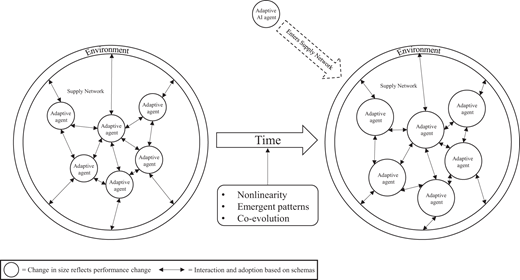
Figure 1 serves as a high-level conceptual visualization of the SN as a CAS. Here, AI acts as an additional agent that influences schemas, connectivity and coevolutionary dynamics and, through these mechanisms, affects SCM performance over time.

To understand AI-driven performance improvement in SCM in 2040, we developed and examined 13 projections (P1–P13) across the SCOR-DS model. The SCOR-DS model has been used for reference across the core SCM processes, as this approach has been previously applied (Chehbi-Gamoura et al., 2020). The SCOR-DS processes provide a structured basis for SCM performance assessment: Orchestrate, Plan, Order, Source, Transform, Fulfill and Return (ASCM, 2022). Together, these processes offer a standardized framework for evaluating key dimensions of SC performance and for identifying strengths, weaknesses and improvement priorities.

Within this framework, Orchestrate describes the alignment of SC strategy; Plan addresses strategic and tactical planning; Order covers supplier-related activities such as selection, contracting, performance monitoring and quality control; Source concerns the procurement of materials and physical resources; Transform includes manufacturing and conversion processes; Fulfill focuses on delivery, distribution and logistics; and Return addresses reverse flows such as returns, recycling and related customer processes (Kayhan et al., 2024).

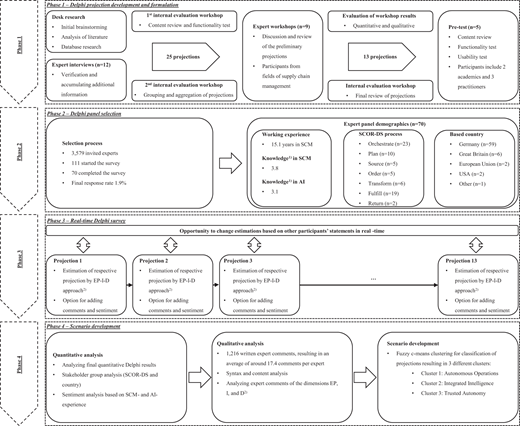
To address the RQ, this study applied a Delphi-based scenario analysis – a forward-looking, cross-disciplinary technique for developing interpretative consensus among experts (Prasad and Prasad, 2002). This method is used to examine how technologies might influence one another and shape future application contexts (Popper, 2008). Its core characteristics are participant anonymity, repeated rounds of inquiry, statistical aggregation of responses and structured feedback (Rowe and Wright, 2011). Iterative surveys on future-oriented projections allow participants to reconsider their evaluations in light of controlled feedback, fostering collective learning and increasing confidence in the results (Rowe and Wright, 2011). Scenario development in this study comprised four stages: (1) projection formulation, (2) expert panel selection, (3) RTDS execution and (4) survey analysis and scenario construction (Figure 2).

Projection development is critical, as “the clarity of the statements directly influences the reliability of the results” (Warth et al., 2013, p. 569). Following Saritas and Oner (2004), three complementary steps were combined: a literature review, expert interviews and an expert workshop. This triangulated design, established in foresight and SCM research, ensured that the topic was addressed from multiple perspectives and that no key issues relevant to the RQ were omitted (Wehrle et al., 2020). Based on the literature review and interviews, projections were structured across the processes of the SCOR-DS model to provide a comprehensive overview of future AI developments in SCM. SCOR-DS is a widely used cross-industry standard for analyzing and optimizing SC activities and performance (Guo and Mantravadi, 2025).

A bibliographic analysis in the Scopus database was conducted, complemented by searches of media releases, trend reports and news platforms (Steiner et al., 2024). This review provided an overview of academic debates and industry developments concerning AI in SCM and formed the basis for the empirical design and the interview guidelines (Steiner et al., 2024).

Semi-structured expert interviews were then conducted using a literature-based guide that allowed for individual probing while maintaining comparability across cases (Küffner et al., 2022). Potential interviewees were identified primarily via LinkedIn. Profiles were screened using the search terms “supply chain manager” and “AI,” which were expected to appear in job titles. The identified profiles were then assessed for their fit with the SCOR-DS process steps to achieve a balanced representation of the model across the interview sample. The search focused primarily on industry practitioners, with variation in company size considered to include both smaller and larger firms. No country-based restrictions were applied. Professional experience of more than 10 years was preferred but not strictly enforced. In total, 54 experts were contacted, and 12 participated in the interviews (response rate 22%). The final interview sample (Table 1) was exclusively male, had on average 17.1 years of professional experience and represented companies ranging from 51 to 200 employees to more than 10,000 employees and from approximately €10m to €45bn in revenue. Eleven interviewees were from Germany, and one was from The Netherlands. The interviews were recorded, transcribed, anonymized and systematically analyzed and linked to the findings of the desk research.

Sixty-six projections were initially formulated for the SCOR-DS management processes: 40 derived primarily from interviews, 22 from the literature and 4 from both sources. The time horizon of 2040 was chosen because it exceeds 10 years, encourages creative and strategic assessments and aligns with prior Delphi studies in related fields (Roßmann et al., 2018; Küffner et al., 2022).

In two evaluation stages, the 66 projections were assessed for redundancy and clarity, reducing the set to 25 projections that together cover all seven SCOR-DS processes (Orchestrate, Plan, Source, Transform, Order, Fulfill, Return). These projections formed the basis of an expert workshop. For this workshop, 121 experts from associations, universities and companies were invited via LinkedIn and email. Nine participated, bringing substantial academic and industry experience in SCM and AI. An overview of the workshop participants is provided in Table 2.

The 90-minute workshop was held in March 2025 via Zoom, with anonymity ensured. Moderated discussion and the visualization of rating results were used to mitigate potential group biases, such as halo and bandwagon effects, and to increase the reliability of outcomes (Steiner et al., 2024). After an introduction to the study, the moderator divided experts into two groups (five and four participants) to ensure sufficient discussion time for all 25 projections. Each projection was first evaluated in a live survey on Menti.com using a five-point Likert scale (1 = Strongly disagree, 2 = Disagree, 3 = Neutral, 4 = Agree, 5 = Strongly agree) with respect to three questions: “Is this projection conceivable by 2040?” “Is this projection formulated in an understandable way?” and “Is this projection formulated provocatively enough?” (Markmann et al., 2021). The results guided the subsequent moderated discussion. The quantitative workshop results were used to calculate the mean and interquartile range (IQR) for each projection and question (Küffner et al., 2022).

Following the expert workshop, an internal workshop with three research associates was held to triangulate the findings from the literature review, expert interviews and expert workshop, and refine the projection set (Kopyto et al., 2020). Projections were merged or removed if their thematic content was similar, resulting in 13 projections, and wording was adjusted for conciseness and clarity. Reducing the number of projections aligned the cognitive demands of the Delphi survey with experts’ processing capacities and safeguarded the response quality and quantity (von der Gracht and Darkow, 2010).

The following projections (Ps) are briefly introduced across the SCOR-DS processes, showing how SCM performance is expected to increase by 2040.

Orchestrate (P1–P4) includes activities that connect external and internal SC stakeholders (Katsaliaki et al., 2024). These processes act as enablers for the reliability and efficiency of the remaining SCOR-DS processes (Srhir et al., 2023). All following projections begin with “In 2040, AI will increase performance in the processes of the SCOR-DS model because […].”

The workforce must be able to accept and work with AI technologies to fully leverage their potential (Cannas et al., 2024; Durach and Gutierrez, 2024). Building on this foundation:

[…] AI is adapted and accepted by employees and management, and is fully incorporated in daily operations. (P1)

Training the workforce is costly and time-intensive (Richey et al., 2023). AI applications can autonomously plan and execute organizational training activities (Xu et al., 2021):

[…] organizational training of employees is planned, created, and executed exclusively by AI. (P2)

AI technology and its impact on SCM processes have evolved enormously over the past two decades (Garg et al., 2025; Xu et al., 2021). The absence of AI in SCM will therefore constitute a major competitive disadvantage (Hasija and Esper, 2022):

[…] only those companies using shared AI solutions for collaboration, cooperation, and transparency in the SC network will survive. (P3)

Current data protection requirements already influence AI implementation, so viable solutions for data protection and security are needed for the successful deployment of AI technologies (Durach and Gutierrez, 2024):

[…] data protection and data security of AI applications are ensured. (P4)

In Plan (P5), processes analyze and synchronize supply and demand with procurement, production and delivery to meet SC objectives (Srhir et al., 2023). Demand planning is a central element of SCM, covering forecasting for component procurement and finished-goods sales and thus acting as a key driver of value creation and performance (Cannas et al., 2024):

[…] self-optimized planning processes and automated decision-making are done by AI. (P5)

Order (P6, P7) processes comprise activities that consider prices, delivery dates and locations, fulfillment status and related data, triggered by customer purchases (ASCM, 2022).

Fulfill refers to transportation and distribution to the customer, including picking and packaging, distribution, last-mile delivery and logistics management (Dubey et al., 2024). By examining traffic flows and weather conditions, AI can identify optimal transportation routes, reducing logistics costs and improving delivery efficiency (Garg et al., 2025):

[…] delivery routes are optimized (costs, time, security, safety, and service levels). (P6)

Warehousing is a critical component of SCM and typically accounts for around 20% of a firm’s overall logistics expenditure (Perotti and Colicchia, 2023). AI can enhance warehouse management practices (Toorajipour et al., 2021):

[…] AI is the key technology for completely unmanned factories, including automated maintenance. (P7)

Source (P8, P9) processes include all activities related to procuring physical resources and services to meet planned or existing demand (Kayhan et al., 2024). For example, processes may aim to identify a suitable supplier that meets certain quality and ethical standards (Dubey et al., 2024). Furthermore, “Source contains the purchase, reception, inspection, stocking, issuing and payment authorization for raw materials and finished goods” (Long, 2014, p. 6904). These processes directly affect transformation activities (Kayhan et al., 2024).

Managing supplier performance is crucial for SCM (Nilsson and Gammelgaard, 2012). AI can forecast supplier performance trends, supporting procurement strategy and reducing disruption risk (Garg et al., 2025):

[…] AI enables companies to automatically identify and verify suppliers that best meet their requirements for collaboration. (P8)

The use of AI for supplier evaluation and selection introduces an alternative to traditional approaches, which often rely on manual analysis and decision-making. Using historical data and anticipated supplier behavior, AI supports the development of negotiation strategies and contractual arrangements (Richey et al., 2023):

[…] AI automatically negotiates contracts with suppliers. (P9)

Transform (P10, P11) processes include manufacturing and transforming finished products and services, such as maintenance, quality control, packaging, storage, waste recycling and release of finished products (Dubey et al., 2024). AI contributes to operator safety by enabling process optimization and real-time monitoring of machinery (Cannas et al., 2024):

[…] AI improves employee safety by preventively eliminating all sources of hazards. (P10)

AI also supports customization by identifying patterns in customer preferences and production constraints. In manufacturing, mass customization aims to reconcile individualized product design with efficient large-scale production (Xu et al., 2021):

[…] AI is enabling mass customization through autonomous production processes. (P11)

Return (P12, P13) processes concern returning products to suppliers and receiving returned products from customers (Long, 2014). They include reverse logistics, product return management, defect resolution, recycling processes and environmentally friendly packaging (Cannas et al., 2024). AI enhances demand forecasting by integrating real-time market trends, enabling firms to align inventory with customer needs. Reliable availability and personalized recommendations enable customers make informed purchasing decisions and reduce return rates (Sharma and Rathore, 2024):

[…] AI can make recommendations based on customers’ purchasing patterns, which prevents returns (almost) completely. (P12)

AI use in the returns process is linked to circular-economy principles, particularly reverse logistics. Recent research has focused on AI models that optimize environmental performance, positioning AI as a key tool for advancing circular-economy initiatives (Cannas et al., 2024):

[…] AI can assess the condition of goods/products throughout their lifecycle, contributing to a circular economy. (P13)

The methodological rigor of Delphi studies depends on careful selection and composition of the expert panel (Landeta, 2006). Because the SCOR-DS model is interdisciplinary, heterogeneous backgrounds were sought to increase accuracy and limit cognitive biases (Ecken et al., 2011; Rowe and Wright, 2011). Experts were identified by multiple techniques that targeted both SC and AI specialists (Mauksch et al., 2020). Desk research on relevant positions in diverse companies yielded 3,579 potential candidates, who were invited via personalized email and asked to self-assess their expertise in SCs and AI on a five-point Likert scale from 1 (Very low) to 5 (Very high) (Landeta, 2006). In total, 110 experts confirmed participation in the RTDS, and 70 completed the survey in full.

To elicit expert judgments over a long-term horizon, the study employed an RTDS approach implemented via the online platform durvey.org (durvey.org, 2026), which allows digital surveys with real-time feedback comparable to the traditional Delphi method (Gnatzy et al., 2011). Aggregated group evaluations were displayed as box plots, allowing participants to revise their initial ratings within the same survey, effectively constituting a second round. The questionnaire comprised three sections:

  1. an introduction with data protection information and instructions;

  2. demographic and professional questions, personality-related items, and self-assessments of AI and SCM expertise on a five-point Likert scale (Spickermann et al., 2014); and

  3. the evaluation of 13 projections of the performance impact of AI on SCOR-DS processes in 2040.

For each projection, experts rated expected probability (EP in percent), potential impact (I) and desirability (D) on five-point Likert scales and could justify their judgments in open comment fields, enabling the integration of quantitative and qualitative evidence (Münch et al., 2023). The order of projections was randomized to avoid bias from experts concentrating on the first presented projections and their accompanying questions during the evaluation (Beiderbeck et al., 2021).

After the RTDS, descriptive statistics for EP, I and D were calculated (Steiner et al., 2024), including mean values, IQR, standard deviation (SD) and convergence rates (Küffner et al., 2022). The IQR indicated the consensus within the expert group, while convergence rates, derived from differences between SDs of RTDS rounds, captured shifts in ratings across iterations (Kopyto et al., 2020). To support interpretation, the results for EP, I and D were visualized in a scatter plot and clustered using a fuzzy c-means (FCM) algorithm (Steiner et al., 2024), a widely used procedure in Delphi-based foresight and SCM studies (Wehrle et al., 2020). In addition, qualitative statements were examined following the approach proposed by Förster and von der Gracht (2014), which considers both the content and syntax of the comments on EP, I and D. Statements for each projection were grouped into content categories, from which argument codes were derived. Two researchers conducted the coding to detect discrepancies, ensure reliability and integrate the qualitative findings into the overall interpretation of the RTDS results (Wehrle et al., 2020).

As part of the RTDS, 13 projections were systematically assessed across three evaluation dimensions: EP, I and D. This section provides a detailed analysis of the results, focusing on projections that received particularly high or low ratings, as well as cases with exceptionally strong consensus or pronounced disagreement.

The estimated probabilities of the projections ranged from 45.80% for P4 to 86.86% for P6, with P6 rated as the most likely, followed by P5 and P1 (Table 3). Across all projections, the mean I score exceeded 3.00, indicating that each would have significant consequences if realized. P6 had the highest mean I score (4.31), followed by P1 (4.19) and P5 (4.16), whereas P9 and P10 had the lowest scores (3.30 and 3.27). All mean D scores exceeded 3.00, with six exceeding 4.00. The highest D was observed for P6 (4.56), followed by P12 (4.17) and P13 (4.13); experts would like to see these projections realized, irrespective of their perceived likelihood. Consensus was achieved for I across all projections (IQR ≤ 1.25), underpinning the experts’ strong belief that the projections will have an impact in 2040. Consensus was achieved for D in 10 scenarios (all except P2, P4 and P9) and for EP in three projections (P5, P6 and P13), indicated by IQR ≤ 25%.

The next step focused on the analysis of the qualitative results obtained during the RTDS, focusing on the written contributions from the expert panel. In total, 1,216 free-text entries were documented, an average of 17.4 per participant, indicating high expert engagement. This corpus was examined via a structured two-stage procedure – syntactic profiling and content coding – following the methodology in Förster and von der Gracht (2014) (Table 4).

How technological transitions are perceived often depends on the stakeholder groups involved and the interests they represent (Steiner et al., 2024). Accordingly, two distinct stakeholder analyses were carried out: 1) for SCOR-DS process-based groups and 2) for country-based groups. Group comparisons (only including groups with n ≥ 5) were performed in accordance with the overall panel analysis. For the SCOR-DS expert groups, expectations were compared across six categories: Orchestrate (n = 23), Fulfill (n = 19), Plan (n = 10), Transform (n = 6), Order (n = 5) and Source (n = 5). The country-based stakeholder comparison involved Germany (n = 59) and Great Britain (n = 6). The Mann–Whitney U-test revealed 33 significantly differing assessments (p < 0.05) among the five SCOR-DS groups but no significant differences between the two country groups. Subsequently, each stakeholder group was analyzed individually to assess internal consensus formation. The intragroup evaluations (SCOR-DS and country) led to updated IQR scores, indicating consensus for certain projections. These results demonstrate that stakeholder affiliations, by both SCOR-DS role and country, influence how future projections are assessed in this RTDS.

4.3.1 Knowledge of supply chain management

Participants were categorized into two groups based on their self-assessed knowledge of SCM, one rating below the mean (3.81) and the other at or above it. This division was used to examine whether perceived SCM expertise influenced consensus across projections. For both groups, consensus was achieved for 12 projections (all projections except P9) for the I dimension and for 10 projections (all projections except P2, P4 and P9) for D. In contrast, only 6 projections achieved consensus for EP.

4.3.2 Knowledge of artificial intelligence

Participants were similarly categorized into two groups based on their self-assessed knowledge of AI (mean = 3.07). This division was used to explore whether perceived AI expertise affected consensus among projections. For both groups, consensus was observed in 12 projections for I (all projections excluding P9), in 10 projections for D (all except P2, P4 and P9) and in 5 projections for EP.

4.4.1 Desirability bias analysis

Desirability bias refers to the tendency for the perceived attractiveness of an outcome to influence judgments regarding its likelihood of occurrence (Ecken et al., 2011). To assess this effect, Pearson’s correlation coefficients were computed between desirability ratings and estimated probabilities for each projection. A statistically significant positive correlation was observed for 5 projections (p < 0.001). Excluding the bias from the data resulted in a shift to consensus for P11.

4.4.2 Outlier analysis

Since extreme values in projection assessments can distort results and contribute to observed dissent, an outlier analysis was performed. Standardized z-scores were calculated for all estimated probability values, with potential outliers defined as cases exceeding a z-score of 2.58. Thirty-one outliers in 9 projections were identified. These outliers were excluded, n was adjusted and then the mean and IQR were recalculated. In all projections, the mean increased slightly, and changes in IQR led to a change to consensus for EP in P1.

4.4.3 Bipolarity analysis

Next, a bipolarity analysis was conducted to determine whether any projections exhibited distinctly opposing assessments. A quantitative examination was performed to identify potential bimodal distributions across the projections. Histograms were also created for each projection to visually assess possible bipolar patterns. Three bipolarities (bimodality coefficient > 0.55) were observed in the EP ratings for projections P7, P12 and P13, indicating strong polarization.

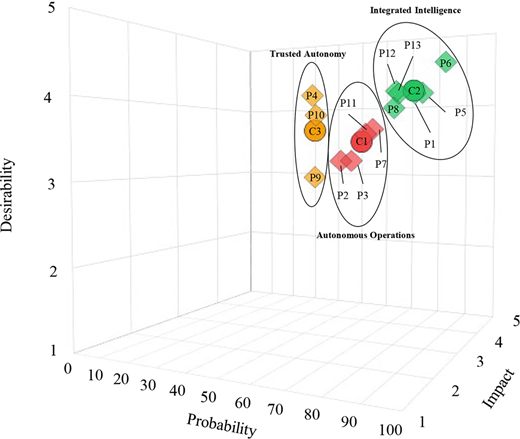
Using FCM clustering, three distinct clusters of projections were identified, based primarily on their assessed EP and I. Figure 3 provides a 3D representation illustrating the classification of all projections according to I, D and EP.

Cluster 1, referred to as autonomous operations, comprises P2 (organizational training of employees is planned, created and executed exclusively by AI), P3 (only those companies using shared AI solutions for collaboration, cooperation and transparency in the SC network will survive), P7 (AI is the key technology\/ for completely unmanned factories, including automated maintenance) and P11 (AI is enabling mass customization through autonomous production processes). These projections, with moderate EP and I, illustrate a scenario in which AI independently governs key organizational and operational processes, fosters seamless collaboration across the SC and supports flexible manufacturing.

Cluster 2, labeled integrated intelligence, includes P1 (AI is adapted and embraced by employees and management, becoming fully integrated into daily operations), P5 (AI performs self-optimized planning and automated decision-making), P6 (delivery routes are optimized for cost, time, security, safety and service levels), P8 (AI automatically identifies and verifies suppliers that best meet collaboration requirements), P12 (AI provides recommendations based on customers’ purchasing patterns, nearly eliminating returns) and P13 (AI monitors the condition of goods throughout their lifecycle, supporting a circular economy). Rated with the highest EP, these projections depict deeply embedded AI systems driving autonomous decisions, enhancing logistics and supplier management and improving customer engagement, thereby maximizing efficiency and enabling sustainable, data-driven practices.

Cluster 3, referred to as trusted autonomy, includes three projections: P4 (data protection and security of AI applications are guaranteed), P9 (AI autonomously negotiates contracts with suppliers) and P10 (AI enhances employee safety by proactively eliminating potential hazards). With the lowest EP and I, this cluster emphasizes secure, responsible and trustworthy AI deployment, highlighting its role in safeguarding data, managing supplier interactions and promoting workplace safety while fostering organizational reliability and trust.

A final overview of projections, their description and placement across the SCOR-Modell is presented in Table 5.

The results reveal three broader patterns that clarify how AI-driven advancements may enhance SCM performance across SCOR-DS processes by 2040. First, experts agree much more strongly on I and D than on EP. This indicates broad consensus that AI-related developments will markedly affect SCM performance, but less consensus regarding which developments are likely to materialize by 2040. Second, expectations vary more across SCOR-DS-related stakeholder groups than across countries, suggesting that future assessments of AI in SCM will be shaped primarily by process-specific roles rather than national contexts. Third, the dissent analysis indicates that projections associated with stronger autonomy and more far-reaching organizational transformation also attract greater uncertainty, desirability bias and polarization. These findings point to a differentiated transformation pattern in which embedded and assistive forms of AI are regarded as the most plausible, while more far-reaching forms of autonomy remain conditional, contested and unevenly distributed across SCOR-DS processes. This overall pattern is reflected in the three clusters discussed below.

The contribution of this study is not to argue that AI-supported planning, routing, supplier screening or circularity applications will become more common – these trajectories are already visible in both practice and the literature (Cannas et al., 2024) – but to show that experts expect them to consolidate into a layered architecture of SCM transformation, in which embedded assistive intelligence becomes the baseline, high-autonomy applications remain selective and governance-based trust mechanisms determine whether broader system adaptation becomes feasible.

Cluster 1, comprising P2, P3, P7 and P11, is characterized by moderate EP and I. This cluster captures the more selective pathway of AI-driven SCM transformation rather than representing the dominant baseline pathway. The broader RTDS findings suggest that experts see these developments as not only relevant to performance but also contingent on organizational acceptance, technological maturity and context-specific economic conditions.

P2 envisions organizational training being planned, created and executed exclusively by AI. The expert panel regarded fully AI-led training as technologically plausible, yet conditional on acceptance and on the continued need for human-led training in at least some contexts. The experts’ comments highlight performance implications, backed by literature, such as faster skill development and reskilling through highly personalized, adaptive training content that can be scaled across the SN (Yanytska, 2025). However, both the panel and the literature point to risks such as narrow or biased skill formation when AI systems reflect limited viewpoints or misaligned objectives (Nyberg et al., 2025). Accordingly, the expected performance contribution of AI in Orchestrate-related capability-building lies less in full human replacement than in augmentation, speed and scale. In CAS terms, this is important because training shapes the schemas of human agents (Espinosa et al., 2019). If training itself becomes an output of algorithmic agents, feedback loops may emerge in which AI reinforces behaviors that fit its own optimization logic. This helps explain why the experts emphasized the need for human oversight and quality assurance.

P3 extends the idea of autonomy beyond intra-firm automation by suggesting that firms relying on shared AI solutions for collaboration, cooperation and transparency will be best positioned to survive in future SNs. The core implication is that autonomous operations depend on shared digital infrastructures across organizational boundaries. The expected performance gains derive from end-to-end visibility, lower coordination frictions, faster joint decision-making and economies of scale in AI development (Lamees and Ramayah, 2025). The stakeholder analysis results reinforce this interpretation: since assessments differ more across SCOR-DS roles than across countries, the key differentiator is not national context but where actors sit in the SC and how directly they depend on shared data and coordinated decision-making. From a CAS perspective, this points to a SN that adapts through increasingly dense interdependencies among human and algorithmic agents to ensure its survival (Espinosa et al., 2019).

P7 and P11 represent the most far-reaching autonomous futures in the Transform process: completely unmanned factories and mass customization through autonomous production. These projections are associated with performance opportunities such as reduced downtime through predictive maintenance, greater production flexibility and individualized output at near mass-production cost (Gyarmathy et al., 2025). Yet they also exemplify the broader dissent pattern of the study: the more radical the autonomy envisioned, the greater the uncertainty surrounding its diffusion. Experts appear to regard such futures as transformative but also dependent on high investment levels, major organizational redesign and highly reliable technical infrastructures. In CAS terms, these projections imply a shift in agent composition, with AI-controlled machines and robots handling the majority of physical production while human actors move toward design, oversight and governance roles (Yanytska, 2025). Because CAS dynamics are nonlinear, even modest changes in AI capability or cost may produce disproportionate shifts in how and where value is created (Holland, 2014). The moderate EP and I values assigned to this cluster indicate that such autonomous operations are expected to remain selective rather than universal. Across the cluster, expert comments repeatedly qualified these futures by reference to company size, human involvement and international operating scope.

In SCOR-DS terms, Cluster 1 is concentrated mainly in Orchestrate- and Transform-related activities. This cluster suggests that AI-related performance enhancement in SCM is expected to include autonomous operations, but predominantly in domains where the gains from automation outweigh the accompanying organizational and governance complexity involved.

The second cluster comprises P1, P5, P6, P8, P12 and P13 and is characterized by the highest EP and I among the clusters. It represents the most plausible and performance-relevant baseline of AI-driven SCM transformation by 2040. Its defining feature is not full autonomy but the deep embedding of AI into routine SCM processes. This explains why consensus is strongest here: the projections grouped in this cluster refer primarily to embedded, process-integrated and predominantly assistive AI applications rather than to radical substitutions of human actors. In other words, the most robust 2040 outlook emerging from this study is the normalization of AI as an embedded layer of intelligence across multiple SCOR-DS processes.

P1, which loads almost exclusively on this cluster (99.95%), clarifies that employee and management acceptance of AI is foundational. The key implication is that performance gains are expected to arise not from autonomy per se but from the successful embedding of AI into established routines and decision-making. Because stakeholder assessments vary across SCOR-DS roles, acceptance appears to depend more on process-specific work contexts than on national settings. This interpretation aligns closely with the CAS view of SNs as systems of interdependent agents governed by evolving schemas (Choi et al., 2001). As AI becomes embedded in everyday routines, it reshapes the decision rules of both human and algorithmic agents and supports new patterns of self-organization across the SN. This resonates with the theoretical framework, which emphasizes that AI reshapes information exchange, decision synchronization and logistics efficiency, thereby influencing performance at both the tactical and strategic levels, as outlined in Section 2 (Choi et al., 2001). By 2040, AI-enabled orchestration is expected to operate through the normalization of AI-supported decision-making as an organizational default, and less through the replacement of human judgment (Lu et al., 2020).

P5, P6 and P8 form the performance core of this cluster. Together, they indicate that experts expect the strongest performance gains where AI improves sensing, coordination and decision quality across interconnected SC activities. In Plan (P5), AI is expected to continuously recalibrate demand and supply decisions based on real-time data, thereby improving responsiveness, reliability and cost efficiency (Abdulameer and Ibrahim, 2025; Gyarmathy et al., 2025). In fulfillment (P6), AI-driven route optimization is expected to improve asset utilization, service reliability and safety through dynamic adjustment to disruptions and demand fluctuations (Preil and Krapp, 2022). In sourcing (P8), AI-based supplier identification and verification are expected to improve cost, quality, resilience and sustainability performance through a more systematic assessment of supplier risks and capabilities (Pal et al., 2024; Monfort et al., 2025). Viewed through the SCOR-DS model, these three projections show that the baseline trajectory of AI in SCM is concentrated in processes where data-rich decision support can improve coordination without requiring full human replacement.

From a CAS perspective, Cluster 2 operates primarily through changes in schemas and network connectivity. AI acts as a high-speed learning agent that detects signals, updates expectations and synchronizes responses across the SN (Mankowitz et al., 2023). Greater connectivity also deepens interdependence and thus increases systemic sensitivity to failures in data or AI infrastructures (Richey et al., 2023). Integrated intelligence therefore extends beyond efficiency gains by reshaping the coordination architecture.

P12 and P13 extend this pattern to return processes. Their inclusion in the same cluster as planning, routing, and sourcing is theoretically significant because it shows that integrated intelligence is not confined to upstream planning or midstream execution. It also reaches downstream and post-purchase processes, particularly where customer-matching, lifecycle visibility and circularity become relevant. The expected performance implications include fewer returns, lower reverse logistics costs, improved customer satisfaction and stronger sustainability outcomes through smarter reuse, repair and recycling decisions (Mukherjee et al., 2024; Kumar et al., 2021). The bipolarity analysis for P12 and P13 indicates that experts are less uniformly convinced about the degree to which returns can be nearly eliminated or circularity can be broadly optimized by AI. These developments are seen as promising extensions of integrated intelligence but without the same degree of straightforward plausibility as planning or routing.

Cluster 2 has the broadest SCOR-DS footprint, spanning Orchestrate, Plan, Fulfill, Source and Return. This breadth helps explain why it received the highest EP and I. More importantly, it captures the central empirical message of the study: by 2040, AI-driven SCM performance is expected to be enhanced primarily through embedded, cross-process intelligence that supports and augments decisions across the SN.

The trusted autonomy cluster comprises P4, P9 and P10 and is associated with the lowest EP and I of the three clusters. These lower values should not be interpreted as indicating low relevance. Rather, Cluster 3 functions as an enabling and constraining layer: it does not generate the strongest direct performance gains on its own, but it shapes whether the gains associated with the other two clusters can be realized at scale. In this sense, trusted autonomy captures the institutional and governance conditions of AI-enabled SCM transformation.

P4 focuses on data protection and data security and is strongly linked to this cluster (94.97%). The experts emphasized that existing data protection challenges remain a major obstacle to broader AI adoption in SCM. From a performance perspective, data protection is a prerequisite for reliable data-sharing across SC partners and, therefore, for projections such as shared AI solutions, automated planning, route optimization and supplier identification (Morgan et al., 2023; Richey et al., 2023). It affects the willingness of customers and stakeholders to share data and accept AI-enabled services (Budhwar et al., 2023). The low EP and I assigned to this projection mask its systemic importance: without secure data-sharing and trusted infrastructures, neither the embedded intelligence of Cluster 2 nor the autonomy of Cluster 1 can scale reliably. In SCOR-DS terms, data protection is rooted in Orchestrate, but its effects extend across Plan, Source, Fulfill and Return.

P9, AI-based contract negotiation, is perhaps the clearest indicator that AI integration in SCM is bounded by trust, fairness and accountability (99%). The experts recognized potential gains of reduced negotiation time and more systematic use of market and risk data. However, they became more cautious once AI was framed as assuming legally and relationally sensitive decision authority. This distinction is analytically important. The panel appeared substantially more comfortable with AI improving analysis and coordination than with it committing organizations to binding supplier relationships. This helps explain why consensus remains weaker around P9 and why trusted autonomy emerges as a distinct cluster rather than being absorbed into integrated intelligence. These concerns are echoed in the literature (Hasija and Esper, 2022) and connect to broader questions of governance in CAS involving algorithmic agents.

P10 addresses proactive employee safety. Although both the literature and the experts recognize safety-related AI as performance-relevant, particularly in production settings, the experts were more cautious about whether safety can be fully ensured through AI-driven mechanisms (Li et al., 2024). Safety-related AI is therefore framed primarily as a stabilizing condition that makes more extensive autonomy feasible. Within a CAS perspective, safety functions as a boundary-setting mechanism that constrains harmful emergent behaviors and helps keep systems within operationally acceptable limits. This is particularly relevant for the feasibility of the more autonomous production futures represented by P7 and P11.

In SCOR-DS terms, Cluster 3 spans Orchestrate, Source and Transform, and therefore acts as a cross-cutting governance layer that both supports and constrains more expansive forms of AI integration. Overall, this cluster shows that AI-driven SCM performance in 2040 will depend not only on stronger analytics and higher autonomy, but also on whether organizations can institutionalize trustworthy forms of AI use (Richey et al., 2023). This explains why the cluster is rated as less directly impactful on performance yet remains indispensable for the broader architecture of AI-enabled SNs.

A cross-analysis of the three clusters with the SCOR-DS model integrates the findings into a coherent explanation of how AI may enhance SCM performance by 2040. The clusters are unevenly distributed across SCOR-DS processes and reveal distinct transformation logics.

Integrated intelligence has the broadest SCOR-DS footprint, spanning Orchestrate, Plan, Fulfill, Source, and Return. This indicates that the most plausible and impactful AI trajectory is one of broad process embedding, in which AI improves coordination, decision support and adaptive responsiveness across multiple interconnected activities. It is therefore best understood as the baseline architecture of AI-enabled SCM performance.

The autonomous operations cluster is more selective and is concentrated mainly in Orchestrate- and Transform-related domains, along with an additional network-oriented collaboration dimension. This suggests that greater autonomy is most likely to be found in areas where automation leads to significant productivity gains and where AI can play a more direct operational role. However, the dissent analysis indicates that these trajectories remain more contested, confirming that full or near-full autonomy is not expected to diffuse uniformly across the SCOR-DS model.

Trusted autonomy cuts across Orchestrate, Source and Transform and functions primarily as a governance infrastructure. Its role is to secure legitimacy, safety and accountability, thereby enabling the other two clusters. The lower direct impact attributed to this cluster must be interpreted carefully, as it reflects indirect rather than negligible performance relevance.

This cross-analysis sharpens the answer to the RQ. AI-driven performance enhancement in SCM by 2040 is expected to arise primarily through a broad layer of integrated intelligence, selectively through autonomous operations in suitable domains, and conditionally through trusted autonomy as a governance and stabilization layer. The SCOR-DS model reveals where different forms of AI integration are expected to concentrate and how they interact systemically across the SN.

This layered interpretation also offers a concrete managerial implication. Rather than pursuing AI-enabled SCM transformation as a broad push toward full autonomy, managers should develop a SCOR-DS-based staged AI roadmap. This roadmap should prioritize embedded, assistive AI applications in high-probability and high-impact areas, particularly planning, route optimization, supplier identification and returns or lifecycle management. More autonomous applications should then be evaluated selectively, where expected performance gains justify the required organizational redesign, while data protection, safety and accountability mechanisms should be established as governance preconditions before scaling AI across the SN. This staged approach will enable managers to allocate AI investments according to the differentiated performance potential identified in the three clusters.

In summary, the strongest consensus in the study concerns the performance relevance of AI, whereas the main uncertainty relates to the depth, speed and governance conditions of AI adoption across different SCOR-DS processes. The cluster solution translates this pattern into three distinct but interdependent pathways of SCM transformation by 2040.

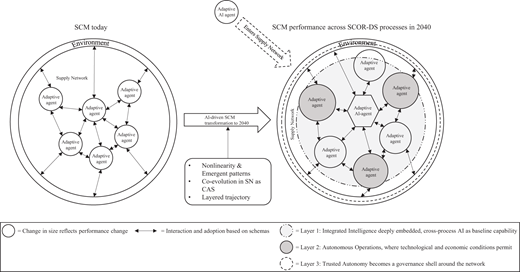
This study set out to answer the RQ of how AI-driven advancements can enhance performance in SCM across the SCOR-DS model’s processes by 2040, using an RTDS to systematically evaluate 13 projections. Discussed through the lens of CAS theory, the clustering of projections into integrated intelligence, autonomous operations, and trusted autonomy suggests that AI-driven SCM transformation does not follow a single linear path (Choi et al., 2001) but rather a layered trajectory, characterized by overlapping and interdependent transformation logics that reinforce each other within the SN. Together, the results indicate that SCM performance by 2040 is expected to be driven primarily by the following layers:

  • Deeply embedded, cross-process integrated intelligence (Cluster 2) as a baseline capability. This layer operates primarily on internal mechanisms by altering agents’ schemas and increasing network connectivity. AI-enhanced sensing, planning and coordination embed new decision rules into operational routines, enabling finer-grained adaptation to environmental signals.

  • Selective adoption of highly autonomous operations (Cluster 1) where technological and economic conditions permit. The autonomous operations layer changes the composition and relative influence of agents by shifting decision-making capacity from humans to AI-driven systems in selected processes (e.g. training and production), thereby amplifying nonlinear performance effects and creating new patterns of self-organization.

  • An enabling layer of trusted autonomy (Cluster 3) focused on data protection, safety and responsible AI governance.

This layer sets the boundary conditions within which these adaptations unfold. Data protection, safety mechanisms and governance structures stabilize certain emergent behaviors while constraining others. These structures shape how the SN coevolves with its technological and institutional environment. These three layers interact within SNs conceived as CAS (Nilsson and Gammelgaard, 2012), where AI acts as an additional agent reshaping information flow, decision rules and network structures (Hendriksen, 2023). A visual depiction is presented in Figure 4.

Theoretically, this study extends SCM research in three ways. First, the Delphi results indicate a layered configuration of AI-enabled transformation composed of integrated intelligence, autonomous operations and trusted autonomy. Second, the study explains this configuration through distinct CAS mechanisms. Integrated intelligence operates primarily through changes in decision schemas and network connectivity, as AI becomes embedded in routine coordination and planning routines. Autonomous operations reflect selective shifts in agent composition and self-organization, as decision authority in specific domains moves from human actors toward AI-driven systems. Trusted autonomy captures the governance and boundary-setting mechanisms that govern system adaptation by shaping the legitimacy, safety and scalability of AI-enabled decisions. Third, the study adds a future-oriented and process-spanning perspective by demonstrating that AI-related performance effects are expected to emerge unevenly across SCOR-DS processes while remaining systemically interdependent. The contribution of the paper therefore lies in showing how known and emerging applications are expected to consolidate into a structured, layered architecture of SN transformation by 2040.

Practically, the three-layer framework offers SCM decision-makers a structured basis for aligning AI-related investments, capability development and governance. Integrated intelligence should be treated as the baseline capability set, particularly in SCOR-DS processes where embedded AI can improve coordination, responsiveness and decision quality without requiring full human substitution. Autonomous operations should be approached more selectively, especially where higher autonomy creates sufficient value to justify organizational redesign and governance complexity. Trusted autonomy highlights that sustained performance gains depend on robust data protection, contractual accountability, safety mechanisms and governance arrangements that maintain trust among employees and SC partners. In this way, the framework helps managers move from undifferentiated AI adoption toward a staged transformation logic across SCOR-DS processes.

Although this RTDS provides an extensive quantitative evaluation in addition to the qualitative evaluation, unlike other RTDSs, some limitations remain. First, most participants were German. Further studies could be conducted in other countries or include a larger number of panelists from different countries to provide a more balanced view. Second, the number of panelists connected to each SCOR-DS process varied. Researchers could include equal numbers of participants in each process step. Third, the number of projections was limited to 13 following the projection refinement phase. Other influential AI factors could improve performance in SCOR-DS processes and would enrich discussion in this field. Fourth, further research could focus on industry-specific SCs to reveal the patterns of performance improvements within SC contexts in 2040.

During the preparation of this work, the authors used ChatGPT and DeepL Write to check grammar, spelling and expressions. After using this tool/service, the authors reviewed and edited the content as needed, and take(s) full responsibility for the content of the published article.
Abdulameer
,
S.S.
and
Ibrahim
,
Y.M.
(
2025
), “
Leveraging industry 4.0 technologies, AI-based supply chain analytics and circular economy practices for net-zero and sustainable supply chain performance: a moderated mediation model
”,
Supply Chain Management: An International Journal
, Vol.
30
No.
6
, pp.
701
-
718
.
Ali
,
I.
,
Gligor
,
D.
,
Balta
,
M.
,
Bozkurt
,
S.
and
Papadopoulos
,
T.
(
2024a
), “
From disruption to innovation: the importance of the supply chain leadership style for driving logistics innovation in the face of geopolitical disruptions
”,
Transportation Research Part E: Logistics and Transportation Review
, Vol.
187
, p.
103583
.
Ali
,
S.S.
,
Torğul
,
B.
,
Paksoy
,
T.
,
Luthra
,
S.
and
Kayikci
,
Y.
(
2024b
), “
A novel hybrid decision‐making framework for measuring industry 4.0‐driven circular economy performance for textile industry
”,
Business Strategy and the Environment
, Vol.
33
No.
8
, pp.
7825
-
7854
.
Al-Jarrah
,
O.Y.
,
Yoo
,
P.D.
,
Muhaidat
,
S.
,
Karagiannidis
,
G.K.
and
Taha
,
K.
(
2015
), “
Efficient machine learning for big data: a review
”,
Big Data Research
, Vol.
2
No.
3
, pp.
87
-
93
.
ASCM
(
2022
),
SCOR Digital Standard - Quick Reference Guide
,
Association for Supply Chain Management
,
Chicago, IL
.
Beiderbeck
,
D.
,
Frevel
,
N.
,
Gracht
,
H.A.
,
von der
,
Schmidt
,
S.L.
and
Schweitzer
,
V.M.
(
2021
), “
Preparing, conducting, and analyzing Delphi surveys: cross-disciplinary practices, new directions, and advancements
”,
MethodsX
, Vol.
8
, p.
101401
.
Brynjolfsson
,
E.
,
Li
,
D.
and
Raymond
,
L.
(
2023
),
Generative AI at Work
,
National Bureau of Economic Research
,
Cambridge, MA
.
Budhwar
,
P.
,
Chowdhury
,
S.
,
Wood
,
G.
,
Aguinis
,
H.
,
Bamber
,
G.J.
,
Beltran
,
J.R.
,
Boselie
,
P.
,
Lee Cooke
,
F.
,
Decker
,
S.
,
DeNisi
,
A.
,
Dey
,
P.K.
,
Guest
,
D.
,
Knoblich
,
A.J.
,
Malik
,
A.
,
Paauwe
,
J.
,
Papagiannidis
,
S.
,
Patel
,
C.
,
Pereira
,
V.
,
Ren
,
S.
,
Rogelberg
,
S.
,
Saunders
,
M.N.K.
,
Tung
,
R.L.
and
Varma
,
A.
(
2023
), “
Human resource management in the age of generative artificial intelligence: perspectives and research directions on ChatGPT
”,
Human Resource Management Journal
, Vol.
33
No.
3
, pp.
606
-
659
.
Cannas
,
V.G.
,
Ciano
,
M.P.
,
Saltalamacchia
,
M.
and
Secchi
,
R.
(
2024
), “
Artificial intelligence in supply chain and operations management: a multiple case study research
”,
International Journal of Production Research
, Vol.
62
No.
9
, pp.
3333
-
3360
.
Carter
,
C.R.
,
Meschnig
,
G.
and
Kaufmann
,
L.
(
2015a
), “
Moving to the next level: why our discipline needs more multilevel theorization
”,
Journal of Supply Chain Management
, Vol.
51
No.
4
, pp.
94
-
102
.
Carter
,
C.R.
,
Rogers
,
D.S.
and
Choi
,
T.Y.
(
2015b
), “
Toward the theory of the supply chain
”,
Journal of Supply Chain Management
, Vol.
51
No.
2
, pp.
89
-
97
.
Chehbi-Gamoura
,
S.
,
Derrouiche
,
R.
,
Damand
,
D.
and
Barth
,
M.
(
2020
), “
Insights from big data analytics in supply chain management: an all-inclusive literature review using the SCOR model
”,
Production Planning & Control
, Vol.
31
No.
5
, pp.
355
-
382
.
Choi
,
T.Y.
,
Dooley
,
K.J.
and
Rungtusanatham
,
M.
(
2001
), “
Supply networks and complex adaptive systems: control versus emergence
”,
Journal of Operations Management
, Vol.
19
No.
3
, pp.
351
-
366
.
Condé
,
L.
and
Münch
,
C.
(
2025
), “
Resilient by design: exploring the social abilities and actor‐network roles of artificial intelligence in supply chain management
”,
Journal of Business Logistics
, Vol.
46
No.
4
.
Duan
,
Y.
,
Edwards
,
J.S.
and
Dwivedi
,
Y.K.
(
2019
), “
Artificial intelligence for decision making in the era of big data – evolution, challenges and research agenda
”,
International Journal of Information Management
, Vol.
48
, pp.
63
-
71
.
Dubey
,
R.
,
Gunasekaran
,
A.
and
Papadopoulos
,
T.
(
2024
), “
Benchmarking operations and supply chain management practices using generative AI: towards a theoretical framework
”,
Transportation Research Part E: Logistics and Transportation Review
, Vol.
189
, p.
103689
.
Durach
,
C.F.
and
Gutierrez
,
L.
(
2024
), “
Hello, this is your AI co-pilot” – operational implications of artificial intelligence chatbots
”,
International Journal of Physical Distribution & Logistics Management
, Vol.
54
No.
3
, pp.
229
-
246
.
Durvey.org
(
2026
), “
Durvey: a real-time Delphi tool for expert-based futures research and decision support
”,
available at:
Link to Durvey: a real-time Delphi tool for expert-based futures research and decision supportLink to the cited article (
accessed
25 January 2026).
Ecken
,
P.
,
Gnatzy
,
T.
,
Gracht
,
H.A.
,
von der
(
2011
), “
Desirability bias in foresight: consequences for decision quality based on delphi results
”,
Technological Forecasting and Social Change
, Vol.
78
No.
9
, pp.
1654
-
1670
.
Espinosa
,
J.A.
,
Davis
,
D.
,
Stock
,
J. and
and
Monahan
,
L.
(
2019
), “
Exploring the processing of product returns from a complex adaptive system perspective
”,
The International Journal of Logistics Management
, Vol.
30
No.
3
, pp.
699
-
722
.
Förster
,
B.
and
von der Gracht
,
H.
(
2014
), “
Assessing delphi panel composition for strategic foresight — a comparison of panels based on company-internal and external participants
”,
Technological Forecasting and Social Change
, Vol.
84
, pp.
215
-
229
.
Fugate
,
B.S.
,
Mentzer
,
J.T.
and
Stank
,
T.P.
(
2010
), “
Logistics performance: efficiency, effectiveness, and differentiation
”,
Journal of Business Logistics
, Vol.
31
No.
1
, pp.
43
-
62
.
Garg
,
V.
,
Gabaldon
,
J.
,
Niranjan
,
S.
and
Hawkins
,
T.G.
(
2025
), “
Impact of strategic performance measures on performance: the role of artificial intelligence and machine learning
”,
Transportation Research Part E: Logistics and Transportation Review
, Vol.
198
, p.
104073
.
Gnatzy
,
T.
,
Warth
,
J.
,
von der
,
Gracht
,
H.
and
Darkow
,
I.-L.
(
2011
), “
Validating an innovative real-time delphi approach - A methodological comparison between real-time and conventional delphi studies
”,
Technological Forecasting and Social Change
, Vol.
78
No.
9
, pp.
1681
-
1694
.
Guida
,
M.
,
Caniato
,
F.
,
Moretto
,
A.
and
Ronchi
,
S.
(
2023
), “
The role of artificial intelligence in the procurement process: state of the art and research agenda
”,
Journal of Purchasing and Supply Management
, Vol.
29
No.
2
, p.
100823
.
Guo
,
D.
and
Mantravadi
,
S.
(
2025
), “
The role of digital twins in lean supply chain management: review and research directions
”,
International Journal of Production Research
, Vol.
63
No.
5
, pp.
1851
-
1872
.
Gyarmathy
,
A.
,
Perényi
,
Á.
and
Mesek
,
M.
(
2025
), “
Examining the use of industry 4.0 technologies in e-commerce supply chains: a model of antecedents and outcomes of data-sharing platform applications
”,
Supply Chain Management: An International Journal
, Vol.
30
No.
3
, pp.
383
-
407
.
Hasija
,
A.
and
Esper
,
T.L.
(
2022
), “
In artificial intelligence (AI) we trust: a qualitative investigation of AI technology acceptance
”,
Journal of Business Logistics
, Vol.
43
No.
3
, pp.
388
-
412
.
Hendriksen
,
C.
(
2023
), “
Artificial intelligence for supply chain management: disruptive innovation or innovative disruption?
”,
Journal of Supply Chain Management
, Vol.
59
No.
3
, pp.
65
-
76
.
Holland
,
J.H.
(
1995
),
Hidden Order
, Vol.
21
Business Week-Domestic
,
Reading, MA
.
Holland
,
J.H.
(
2014
),
Complexity: A Very Short Introduction
,
Oxford University Press
,
Oxford
.
Jackson
,
I.
,
Ivanov
,
D.
,
Dolgui
,
A.
and
Namdar
,
J.
(
2024
), “
Generative artificial intelligence in supply chain and operations management: a capability-based framework for analysis and implementation
”,
International Journal of Production Research
, Vol.
62
No.
17
, pp.
6120
-
6145
.
Jarrar
,
A.
,
Ait Wakrime
,
A.
and
Balouki
,
Y.
(
2020
), “
Formal approach to model complex adaptive computing systems
”,
Complex Adaptive Systems Modeling
, Vol.
8
No.
1
, p.
3
.
Katsaliaki
,
K.
,
Kumar
,
S.
and
Loulos
,
V.
(
2024
), “
Supply chain coopetition: a review of structures, mechanisms and dynamics
”,
International Journal of Production Economics
, Vol.
267
, p.
109057
.
Kayhan
,
B.M.
,
Yeni
,
F.B.
,
Ozcelik
,
G.
and
Ayyildiz
,
E.
(
2024
), “
A fuzzy optimization-oriented decision support model to examine key industry 4.0 strategies for building resilience against disruptions in a healthcare supply chain
”,
Annals of Operations Research
, Vol.
361
No.
3
, pp.
1619
-
1660
.
Kopyto
,
M.
,
Lechler
,
S.
,
von der
,
Gracht
,
H.A.
and
Hartmann
,
E.
(
2020
), “
Potentials of blockchain technology in supply chain management: long-term judgments of an international expert panel
”,
Technological Forecasting and Social Change
, Vol.
161
, p.
120330
.
Küffner
,
C.
,
Kopyto
,
M.
,
Wohlleber
,
A.J.
and
Hartmann
,
E.
(
2022
), “
The interplay between relationships, technologies and organizational structures in enhancing supply chain resilience: empirical evidence from a Delphi study
”,
International Journal of Physical Distribution & Logistics Management
, Vol.
52
No.
8
, pp.
673
-
699
.
Kumar
,
N.M.
,
Mohammed
,
M.A.
,
Abdulkareem
,
K.H.
,
Damasevicius
,
R.
,
Mostafa
,
S.A.
,
Maashi
,
M.S.
and
Chopra
,
S.S.
(
2021
), “
Artificial intelligence-based solution for sorting COVID related medical waste streams and supporting data-driven decisions for smart circular economy practice
”,
Process Safety and Environmental Protection
, Vol.
152
, pp.
482
-
494
.
Lamees
,
A.-Z.
and
Ramayah
,
T.
(
2025
), “
How artificial intelligence-based supply chain analytics enable supply chain agility and innovation? An intellectual capital perspective
”,
Supply Chain Management: An International Journal
, Vol.
30
No.
2
, pp.
233
-
249
.
Landeta
,
J.
(
2006
), “
Current validity of the delphi method in social sciences
”,
Technological Forecasting and Social Change
, Vol.
73
No.
5
, pp.
467
-
482
.
Li
,
L.
,
Zhu
,
W.
,
Chen
,
L.
and
Liu
,
Y.
(
2024
), “
Generative AI usage and sustainable supply chain performance: a practice-based view
”,
Transportation Research Part E: Logistics and Transportation Review
, Vol.
192
, p.
103761
.
Long
,
Q.
(
2014
), “
Distributed supply chain network modelling and simulation: integration of agent-based distributed simulation and improved SCOR model
”,
International Journal of Production Research
, Vol.
52
No.
23
, pp.
6899
-
6917
.
Lu
,
Y.
,
Liu
,
C.
,
Wang
,
K.I.-K.
,
Huang
,
H.
and
Xu
,
X.
(
2020
), “
Digital twin-driven smart manufacturing: connotation, reference model, applications and research issues
”,
Robotics and Computer-Integrated Manufacturing
, Vol.
61
, p.
101837
.
Lyngstadaas
,
H.
(
2019
), “
An empirical investigation of how information sharing affects cash flow performance through competitive capability
”,
Supply Chain Management: An International Journal
, Vol.
24
No.
6
, pp.
710
-
728
.
McCarthy
,
J.
,
Minsky
,
M.L.
,
Rochester
,
N.
and
Shannon
,
C.E.
(
1955
), “A proposal for the Dartmouth summer research project on artificial intelligence”
Dartmouth College
,
Hanover, NH
.
Mankowitz
,
D.J.
,
Michi
,
A.
,
Zhernov
,
A.
,
Gelmi
,
M.
,
Selvi
,
M.
,
Paduraru
,
C.
,
Leurent
,
E.
,
Iqbal
,
S.
,
Lespiau
,
J.-B.
,
Ahern
,
A.
,
Köppe
,
T.
,
Millikin
,
K.
,
Gaffney
,
S.
,
Elster
,
S.
,
Broshear
,
J.
,
Gamble
,
C.
,
Milan
,
K.
,
Tung
,
R.
,
Hwang
,
M.
,
Cemgil
,
T.
,
Barekatain
,
M.
,
Li
,
Y.
,
Mandhane
,
A.
,
Hubert
,
T.
,
Schrittwieser
,
J.
,
Hassabis
,
D.
,
Kohli
,
P.
,
Riedmiller
,
M.
,
Vinyals
,
O.
and
Silver
,
D.
(
2023
), “
Faster sorting algorithms discovered using deep reinforcement learning
”,
Nature
, Vol.
618
No.
7964
, pp.
257
-
263
.
Markmann
,
C.
,
Spickermann
,
A.
,
von der Gracht
,
H.A.
and
Brem
,
A.
(
2021
), “
Improving the question formulation in delphi‐like surveys: analysis of the effects of abstract language and amount of information on response behavior
”,
Futures & Foresight Science
, Vol.
3
No.
1
, p.
e56
.
Mauksch
,
S.
,
von der Gracht
,
H.A.
and
Gordon
,
T.J.
(
2020
), “
Who is an expert for foresight? A review of identification methods
”,
Technological Forecasting and Social Change
, Vol.
154
, p.
119982
.
Monfort
,
A.
,
Méndez-Suárez
,
M.
and
Villagra
,
N.
(
2025
), “
Artificial intelligence misconduct and ESG risk ratings
”,
Review of Managerial Science
, Vol.
20
No.
2
, doi: .
Morgan
,
T.R.
,
Gabler
,
C.B.
and
Manhart
,
P.S.
(
2023
), “
Supply chain transparency: theoretical perspectives for future research
”,
The International Journal of Logistics Management
, Vol.
34
No.
5
, pp.
1422
-
1445
.
Morgan
,
T.R.
,
Richey Jr
,
R.G.
and
Ellinger
,
A.E.
(
2018
), “
Supplier transparency: scale development and validation
”,
The International Journal of Logistics Management
, Vol.
29
No.
3
, pp.
959
-
984
.
Mukherjee
,
S.
,
Nagariya
,
R.
,
Mathiyazhagan
,
K.
,
Baral
,
M.M.
,
Pavithra
,
M.R.
and
Appolloni
,
A.
(
2024
), “
Artificial intelligence-based reverse logistics for improving circular economy performance: a developing country perspective
”,
The International Journal of Logistics Management
, Vol.
35
No.
6
, pp.
1779
-
1806
.
Münch
,
C.
,
von der Gracht
,
H.A.
and
Hartmann
,
E.
(
2023
), “
The future role of reverse logistics as a tool for sustainability in food supply chains: a delphi-based scenario study
”,
Supply Chain Management: An International Journal
, Vol.
28
No.
2
, pp.
262
-
283
.
Nair
,
A.
and
Reed‐Tsochas
,
F.
(
2019
), “
Revisiting the complex adaptive systems paradigm: leading perspectives for researching operations and supply chain management issues
”,
Journal of Operations Management
, Vol.
65
No.
2
, pp.
80
-
92
.
Nilsson
,
F.R.
(
2019
), “
A complexity perspective on logistics management
”,
The International Journal of Logistics Management
, Vol.
30
No.
3
, pp.
681
-
698
.
Nilsson
,
F.
and
Gammelgaard
,
B.
(
2012
), “
Moving beyond the systems approach in SCM and logistics research
”,
International Journal of Physical Distribution & Logistics Management
, Vol.
42
Nos
8-9
, pp.
764
-
783
.
Nyberg
,
A.J.
,
Schleicher
,
D.J.
,
Bell
,
B.S.
,
Boon
,
C.
,
Cappelli
,
P.
,
Collings
,
D.G.
,
Dalle Molle
,
J.E.
,
Feuerriegel
,
S.
,
Gerhart
,
B.
,
Jeong
,
Y.
,
Korsgaard
,
M.A.
,
Minbaeva
,
D.
,
Ployhart
,
R.E.
,
Tambe
,
P.
,
Weller
,
I.
,
Wright
,
P.M.
and
Yakubovich
,
V.
(
2025
), “
A brave new world of human resources research: navigating perils and identifying grand challenges of the GenAI revolution
”,
Journal of Management
, Vol.
51
No.
6
, pp.
2677
-
2718
.
Pal
,
T.
,
Ganguly
,
K.
and
Chaudhuri
,
A.
(
2024
), “
Digitalisation in food supply chains to build resilience from disruptive events: a combined dynamic capabilities and knowledge-based view
”,
Supply Chain Management: An International Journal
, Vol.
29
No.
6
, pp.
1042
-
1062
.
Pathak
,
S.D.
,
Day
,
J.M.
,
Nair
,
A.
,
Sawaya
,
W.J.
and
Kristal
,
M.M.
(
2007
), “
Complexity and adaptivity in supply networks: building supply network theory using a complex adaptive systems perspective*
”,
Decision Sciences
, Vol.
38
No.
4
, pp.
547
-
580
.
Peppel
,
M.
,
Ringbeck
,
J.
and
Spinler
,
S.
(
2022
), “
How will last-mile delivery be shaped in 2040? A delphi-based scenario study
”,
Technological Forecasting and Social Change
, Vol.
177
, p.
121493
.
Perotti
,
S.
and
Colicchia
,
C.
(
2023
), “
Greening warehouses through energy efficiency and environmental impact reduction: a conceptual framework based on a systematic literature review
”,
The International Journal of Logistics Management
, Vol.
34
No.
7
, pp.
199
-
234
.
Popper
,
R.
(
2008
), “
How are foresight methods selected?
”,
Foresight
, Vol.
10
No.
6
, pp.
62
-
89
.
Prasad
,
A.
and
Prasad
,
P.
(
2002
), “
The coming of age of interpretive organizational research
”,
Organizational Research Methods
, Vol.
5
No.
1
, pp.
4
-
11
.
Preil
,
D.
and
Krapp
,
M.
(
2022
), “
Artificial intelligence-based inventory management: a Monte Carlo tree search approach
”,
Annals of Operations Research
, Vol.
308
Nos
1-2
, pp.
415
-
439
.
Rad
,
F.F.
,
Oghazi
,
P.
,
Onur
,
İ.
and
Kordestani
,
A.
(
2025
), “
Adoption of AI-based order picking in warehouse: benefits, challenges, and critical success factors
”,
Review of Managerial Science
, Vol.
19
No.
11
, doi: .
Rajput
,
S.
(
2024
), “
Analysis of industry 4.0 technological enablers for sustainable supply chain transparency in a fuzzy environment
”,
Business Strategy and the Environment
, Vol.
33
No.
8
, pp.
8616
-
8636
.
Riad
,
M.
,
Naimi
,
M.
and
Okar
,
C.
(
2024
), “
Enhancing supply chain resilience through artificial intelligence: developing a comprehensive conceptual framework for AI implementation and supply chain optimization
”,
Logistics
, Vol.
8
No.
4
, p.
111
.
Richey
,
R.G.
,
Chowdhury
,
S.
,
Davis‐Sramek
,
B.
,
Giannakis
,
M.
and
Dwivedi
,
Y.K.
(
2023
), “
Artificial intelligence in logistics and supply chain management: a primer and roadmap for research
”,
Journal of Business Logistics
, Vol.
44
No.
4
, pp.
532
-
549
.
Rolf
,
B.
,
Beier
,
A.
,
Jackson
,
I.
,
Müller
,
M.
,
Reggelin
,
T.
,
Stuckenschmidt
,
H.
and
Lang
,
S.
(
2025
), “
A review on unsupervised learning algorithms and applications in supply chain management
”,
International Journal of Production Research
, Vol.
63
No.
5
, pp.
1933
-
1983
.
Roßmann
,
B.
,
Canzaniello
,
A.
,
von der Gracht
,
H.
and
Hartmann
,
E.
(
2018
), “
The future and social impact of big data analytics in supply chain management: results from a Delphi study
”,
Technological Forecasting and Social Change
, Vol.
130
, pp.
135
-
149
.
Rowe
,
G.
and
Wright
,
G.
(
2011
), “
The Delphi technique: past, present, and future prospects — introduction to the special issue
”,
Technological Forecasting and Social Change
, Vol.
78
No.
9
, pp.
1487
-
1490
.
Saritas
,
O.
and
Oner
,
M.
(
2004
), “
Systemic analysis of UK foresight results
”,
Technological Forecasting and Social Change
, Vol.
71
Nos
1-2
, pp.
27
-
65
.
Schmalz
,
U.
,
Spinler
,
S.
and
Ringbeck
,
J.
(
2021
), “
Lessons learned from a Two-Round delphi-based scenario study
”,
MethodsX
, Vol.
8
, p.
101179
.
Sharma
,
A.J.
and
Rathore
,
B.
(
2024
), “
Examine the enablers of generative artificial intelligence adoption in supply chain: a mixed method study
”,
Journal of Decision Systems
, pp.
1
-
33
.
Sharma
,
R.
,
Shishodia
,
A.
,
Gunasekaran
,
A.
,
Min
,
H.
and
Munim
,
Z.H.
(
2022
), “
The role of artificial intelligence in supply chain management: mapping the territory
”,
International Journal of Production Research
, Vol.
60
No.
24
, pp.
7527
-
7550
.
Singh
,
R.K.
,
Modgil
,
S.
and
Shore
,
A.
(
2024
), “
Building artificial intelligence enabled resilient supply chain: a multi-method approach
”,
Journal of Enterprise Information Management
, Vol.
37
No.
2
, pp.
414
-
436
.
Spickermann
,
A.
,
Zimmermann
,
M.
,
Gracht
. and
H.A.
,
von der
. (
2014
), “
Surface- and deep-level diversity in panel selection — exploring diversity effects on response behaviour in foresight
”,
Technological Forecasting and Social Change
, Vol.
85
, pp.
105
-
120
.
Srhir
,
S.
,
Jaegler
,
A.
and
Montoya-Torres
,
J.R.
(
2023
), “
Introducing a framework toward sustainability goals in a supply chain 4.0 ecosystem
”,
Journal of Cleaner Production
, Vol.
418
, p.
138111
.
Steiner
,
B.
,
Münch
,
C.
,
Beckmann
,
M.
and
von der Gracht
,
H.
(
2024
), “
Developing net-zero carbon supply chains in the European manufacturing industry – a multilevel perspective
”,
Supply Chain Management: An International Journal
, Vol.
29
No.
7
, pp.
164
-
181
.
Toorajipour
,
R.
,
Sohrabpour
,
V.
,
Nazarpour
,
A.
,
Oghazi
,
P.
and
Fischl
,
M.
(
2021
), “
Artificial intelligence in supply chain management: a systematic literature review
”,
Journal of Business Research
, Vol.
122
, pp.
502
-
517
.
van Dyck
,
M.
,
Lüttgens
,
D.
,
Piller
,
F.T.
and
Brenk
,
S.
(
2023
), “
Interconnected digital twins and the future of digital manufacturing: insights from a Delphi study
”,
Journal of Product Innovation Management
, Vol.
40
No.
4
, pp.
475
-
505
.
von der Gracht
,
H.A.
and
Darkow
,
I.-L.
(
2010
), “
Scenarios for the logistics services industry: a delphi-based analysis for 2025
”,
International Journal of Production Economics
, Vol.
127
No.
1
, pp.
46
-
59
.
Walter
,
A.
,
Ahsan
,
K.
and
Rahman
,
S.
(
2025
), “
Application of artificial intelligence in demand planning for supply chains: a systematic literature review
”,
The International Journal of Logistics Management
, Vol.
36
No.
3
, pp.
672
-
719
.
Warth
,
J.
,
von der
,
Gracht
,
H.A.
and
Darkow
,
I.-L.
(
2013
), “
A dissent-based approach for multi-stakeholder scenario development — the future of electric drive vehicles
”,
Technological Forecasting and Social Change
, Vol.
80
No.
4
, pp.
566
-
583
.
Wehrle
,
M.
,
Lechler
,
S.
,
von der Gracht
,
H.A.
and
Hartmann
,
E.
(
2020
), “
Digitalization and its impact on the future role of SCM executives in talent management – an international cross‐industry delphi study
”,
Journal of Business Logistics
, Vol.
41
No.
4
, pp.
356
-
383
.
Xu
,
L.
,
Mak
,
S.
and
Brintrup
,
A.
(
2021
), “
Will bots take over the supply chain? Revisiting agent-based supply chain automation
”,
International Journal of Production Economics
, Vol.
241
, p.
108279
.
Yanytska
,
L.
(
2025
), “
The rise of human-centric manufacturing in the industry 5.0 era
”,
The International Journal of Advanced Manufacturing Technology
, Vol.
139
Nos
9-10
, pp.
5067
-
5077
.
Published by Emerald Publishing Limited. This article is published under the Creative Commons Attribution (CC BY 4.0) licence. Anyone may reproduce, distribute, translate and create derivative works of this article (for both commercial and non-commercial purposes), subject to full attribution to the original publication and authors. The full terms of this licence may be seen at Link to the terms of the CC BY 4.0 licenceLink to the terms of the CC BY 4.0 license.

Data & Figures

Figure 1
Two supply networks compare changes among adaptive agents over time, including interactions, performance changes, and entry by another adaptive A I agent.The two circular supply networks are enclosed by an Environment boundary. Each network contains 6 adaptive agents connected to one another and to the environment by two-way arrows. The agent circles differ in size. A note states that a change in circle size reflects performance change. Another note states that two-way arrows represent interaction and adoption based on schemas. A large arrow labelled Time leads from the left network to the right network. A box beneath the arrow lists Nonlinearity, Emergent patterns, and Co-evolution. Above the right network, an Adaptive A I agent enters through a dashed arrow labelled Enters Supply Network. The positions, sizes, and connections of the adaptive agents differ between the 2 networks.

CAS-based framework of SCM performance improvement in 2040 through AI application in SN

Source: Adapted from Jarrar et al. (2020) 

Figure 1
Two supply networks compare changes among adaptive agents over time, including interactions, performance changes, and entry by another adaptive A I agent.The two circular supply networks are enclosed by an Environment boundary. Each network contains 6 adaptive agents connected to one another and to the environment by two-way arrows. The agent circles differ in size. A note states that a change in circle size reflects performance change. Another note states that two-way arrows represent interaction and adoption based on schemas. A large arrow labelled Time leads from the left network to the right network. A box beneath the arrow lists Nonlinearity, Emergent patterns, and Co-evolution. Above the right network, an Adaptive A I agent enters through a dashed arrow labelled Enters Supply Network. The positions, sizes, and connections of the adaptive agents differ between the 2 networks.

CAS-based framework of SCM performance improvement in 2040 through AI application in SN

Source: Adapted from Jarrar et al. (2020) 

Close modal
Figure 2
A four-phase Delphi study workflow outlines projection development, panel selection, survey execution, and scenario development.The workflow is divided into Phase one, Phase two, Phase three, and Phase four. Phase one, Delphi projection development and formulation, begins with desk research including initial brainstorming, analysis of literature, and database research, alongside expert interviews with n equals 12 for verification and additional information. A first internal evaluation workshop conducts content review and functionality testing, producing 25 projections. Expert workshops with n equals 9 discuss and review the preliminary projections with participants from supply chain management. Evaluation of workshop results uses quantitative and qualitative assessment and reduces the set to 13 projections. An internal evaluation workshop performs the final review, followed by a pre-test with n equals 5, including content review, functionality test, usability test, and participants comprising two academics and three practitioners. Phase two, Delphi panel selection, includes a selection process with 3,579 invited experts, 111 survey starters, 70 completed surveys, and a final response rate of 1.9 per cent. Expert panel demographics for n equals 70 include 15.1 years of working experience in S C M, knowledge in S C M of 3.8, and knowledge in A I of 3.1. The S C O R-D S process includes Orchestrate n equals 23, Plan n equals 10, Source n equals 5, Order n equals 5, Transform n equals 6, Fulfil n equals 19, and Return n equals 2. Countries include Germany n equals 59, Great Britain n equals 6, European Union n equals 2, U S A n equals 2, and Other n equals 1. Phase three, Real-time Delphi survey, provides an opportunity to change estimations based on other participants' statements in real time. Projection one, Projection two, Projection three, and Projection 13 each include estimation by the E P-I-D approach and an option for adding comments and sentiment, with intermediate projections indicated by ellipsis. Phase four, Scenario development, begins with quantitative analysis of final Delphi results, stakeholder group analysis using S C O R-D S and country, and sentiment analysis based on S C M and A I experience. It continues with qualitative analysis of 1,216 written expert comments averaging about 17.4 comments per expert, syntax and content analysis, and analysis of expert comments for the dimensions E P, I, and D. The final scenario development applies fuzzy c-means clustering to classify projections into three clusters named Autonomous Operations, Integrated Intelligence, and Trusted Autonomy.

Detailed process of the RTDS

Note(s): Five-point Likert scale; 1: Very low, 5: Very high, EP: expected probability of occurrence in percent; I: impact in case of occurrence (5-point Likert scale; 1: Very low, 5: Very high); D: desirability of occurrence (5-point Likert scale; 1: Very low, 5: Very high)

Source: Adapted from Steiner et al. (2024) 

Figure 2
A four-phase Delphi study workflow outlines projection development, panel selection, survey execution, and scenario development.The workflow is divided into Phase one, Phase two, Phase three, and Phase four. Phase one, Delphi projection development and formulation, begins with desk research including initial brainstorming, analysis of literature, and database research, alongside expert interviews with n equals 12 for verification and additional information. A first internal evaluation workshop conducts content review and functionality testing, producing 25 projections. Expert workshops with n equals 9 discuss and review the preliminary projections with participants from supply chain management. Evaluation of workshop results uses quantitative and qualitative assessment and reduces the set to 13 projections. An internal evaluation workshop performs the final review, followed by a pre-test with n equals 5, including content review, functionality test, usability test, and participants comprising two academics and three practitioners. Phase two, Delphi panel selection, includes a selection process with 3,579 invited experts, 111 survey starters, 70 completed surveys, and a final response rate of 1.9 per cent. Expert panel demographics for n equals 70 include 15.1 years of working experience in S C M, knowledge in S C M of 3.8, and knowledge in A I of 3.1. The S C O R-D S process includes Orchestrate n equals 23, Plan n equals 10, Source n equals 5, Order n equals 5, Transform n equals 6, Fulfil n equals 19, and Return n equals 2. Countries include Germany n equals 59, Great Britain n equals 6, European Union n equals 2, U S A n equals 2, and Other n equals 1. Phase three, Real-time Delphi survey, provides an opportunity to change estimations based on other participants' statements in real time. Projection one, Projection two, Projection three, and Projection 13 each include estimation by the E P-I-D approach and an option for adding comments and sentiment, with intermediate projections indicated by ellipsis. Phase four, Scenario development, begins with quantitative analysis of final Delphi results, stakeholder group analysis using S C O R-D S and country, and sentiment analysis based on S C M and A I experience. It continues with qualitative analysis of 1,216 written expert comments averaging about 17.4 comments per expert, syntax and content analysis, and analysis of expert comments for the dimensions E P, I, and D. The final scenario development applies fuzzy c-means clustering to classify projections into three clusters named Autonomous Operations, Integrated Intelligence, and Trusted Autonomy.

Detailed process of the RTDS

Note(s): Five-point Likert scale; 1: Very low, 5: Very high, EP: expected probability of occurrence in percent; I: impact in case of occurrence (5-point Likert scale; 1: Very low, 5: Very high); D: desirability of occurrence (5-point Likert scale; 1: Very low, 5: Very high)

Source: Adapted from Steiner et al. (2024) 

Close modal
Figure 3
A three-dimensional scatter plot groups 13 projections into Trusted Autonomy, Autonomous Operations, and Integrated Intelligence by probability, impact, and desirability.The three-dimensional scatter plot places Probability on the horizontal axis from 0 to 100, Impact on a second axis from one to five, and Desirability on the vertical axis from one to five. Three outlined groups contain labelled projections and central cluster markers. Trusted Autonomy contains P 4, P 10, and P 9 around C 3. Autonomous Operations contains P 11, P 2, P 3, and P 7 around C 1. Integrated Intelligence contains P 12, P 13, P 8, P 6, P 5, and P 1 around C 2. Trusted Autonomy occupies lower probability values than the other groups. Integrated Intelligence occupies the highest probability and desirability region. Autonomous Operations lies between the other groups.

Clustered projections

Note(s): P: Projection, C: Cluster

Source: Authors’ own work

Figure 3
A three-dimensional scatter plot groups 13 projections into Trusted Autonomy, Autonomous Operations, and Integrated Intelligence by probability, impact, and desirability.The three-dimensional scatter plot places Probability on the horizontal axis from 0 to 100, Impact on a second axis from one to five, and Desirability on the vertical axis from one to five. Three outlined groups contain labelled projections and central cluster markers. Trusted Autonomy contains P 4, P 10, and P 9 around C 3. Autonomous Operations contains P 11, P 2, P 3, and P 7 around C 1. Integrated Intelligence contains P 12, P 13, P 8, P 6, P 5, and P 1 around C 2. Trusted Autonomy occupies lower probability values than the other groups. Integrated Intelligence occupies the highest probability and desirability region. Autonomous Operations lies between the other groups.

Clustered projections

Note(s): P: Projection, C: Cluster

Source: Authors’ own work

Close modal
Figure 4
A framework compares current S C M with its A I driven transformation to 2040, showing adaptive agents, layered capabilities, interactions, and performance changes.The left section is labelled S C M today. A circular supply network sits within an Environment boundary. It contains 6 adaptive agents connected to one another and the environment by two-way arrows. The agent circles vary in size. A central arrow labelled A I driven S C M transformation to 2040 leads to the right section. A box below lists Nonlinearity and emergent patterns, Co-evolution in S N as C A S, and Layered trajectory. An Adaptive A I agent enters the right supply network through a dashed arrow. The right section is labelled S C M performance across S C O R D S processes in 2040. It contains 6 adaptive agents around a central Adaptive A I agent. The agents connect to one another, the central agent, and the environment. Three circular boundary styles represent layered capabilities. Layer one is Integrated Intelligence deeply embedded, cross-process A I as baseline capability. Layer two is Autonomous Operations, where technological and economic conditions permit. Layer three is Trusted Autonomy, which becomes a governance shell around the network. The legend states that changes in circle size reflect performance change and that two-way arrows represent interaction and adoption based on schemas.

CAS-based framework of SCM performance increase in 2040 through AI application in SN

Source: Adapted from Jarrar et al. (2020) 

Figure 4
A framework compares current S C M with its A I driven transformation to 2040, showing adaptive agents, layered capabilities, interactions, and performance changes.The left section is labelled S C M today. A circular supply network sits within an Environment boundary. It contains 6 adaptive agents connected to one another and the environment by two-way arrows. The agent circles vary in size. A central arrow labelled A I driven S C M transformation to 2040 leads to the right section. A box below lists Nonlinearity and emergent patterns, Co-evolution in S N as C A S, and Layered trajectory. An Adaptive A I agent enters the right supply network through a dashed arrow. The right section is labelled S C M performance across S C O R D S processes in 2040. It contains 6 adaptive agents around a central Adaptive A I agent. The agents connect to one another, the central agent, and the environment. Three circular boundary styles represent layered capabilities. Layer one is Integrated Intelligence deeply embedded, cross-process A I as baseline capability. Layer two is Autonomous Operations, where technological and economic conditions permit. Layer three is Trusted Autonomy, which becomes a governance shell around the network. The legend states that changes in circle size reflect performance change and that two-way arrows represent interaction and adoption based on schemas.

CAS-based framework of SCM performance increase in 2040 through AI application in SN

Source: Adapted from Jarrar et al. (2020) 

Close modal
Table 1

Information about the experts involved in the interviews

Projection formulation phaseAbbreviationPositionType of industrySize of organization (employees)Working experience (years)
Expert interviewI1Program managerSoftware5,001–10,000> 15
Expert interviewI2Digital transformation and computer engineering internContract logistics provider10,001+< 5
Expert interviewI3Senior account ExecutiveSoftware201–500> 15
Expert interviewI4AI engineerMechanical engineering10,001+> 20
Expert interviewI5Senior managerSoftware51–200> 10
Expert interviewI6Head of SC automationPackaging10,001+> 5
Expert interviewI7Vice president digital SC consumer industriesSoftware10,001+> 25
Expert interviewI8Associate partnerManagement and IT consulting1,001–5,000> 25
Expert interviewI9Entrepreneurial management and SC consultantManagement and IT consulting51–200> 5
Expert interviewI10SC consultantSoftware51–200> 20
Expert interviewI11Managing director and partnerManagement and IT consulting10,001+> 20
Expert interviewI12SC managerOriginal equipment manufacturer10,001+> 20
Note(s):

I: Interview partner, Experience ranges (in years): ≤5; > 5; >10; > 15; >20; > 25

Source(s): Authors’ own work
Table 2

Information about the workshop participants

GroupPositionType of industrySize of organization (employees)Working experience (years)
1Habilitation candidateAcademica5,001–10,000> 15
2AI engineerMechanical engineering sector10,001+> 20
2SC consultantManagement and IT consulting1> 25
1SC consultantManagement and IT consulting1> 25
2Research assistantAcademica1,001–5,000> 10
1Research assistantAcademica1,001–5,000> 10
1SC specialistSoftware company and IT consulting501–1,000> 15
1Tool executiveSoftware company201–500> 20
2Vice president logisticsEnergy sector1,001–5,000> 15
Note(s):

Experience ranges (in years): ≤5; >5; >10; >15; >20; >25

Source(s): Authors’ own work
Table 3

Quantitative RTDS results

EP statisticsI statisticsD statistics
ProjectionMean (%)IQRSDMeanIQRSDMeanIQRSD
P1: AI is adapted and accepted by employees and management, and is fully incorporated in daily operations77.2126.7518.904.191.000.694.141.000.69
P2: Organizational training of employees is planned, created and executed exclusively by AI58.2142.0027.643.411.000.733.232.000.98
P3: Only those companies using shared AI solutions for collaboration, cooperation and transparency in the supply chain network will survive59.7339.0025.223.631.000.803.231.000.87
P4: Data protection and data security of AI applications are ensured45.8034.2525.313.591.000.884.112.000.88
P5: Self-optimized planning processes and automated decision-making are done by AI80.0615.0015.994.161.000.654.140.750.69
P6: Delivery routes are optimized (costs, time, security, safety and service levels)86.8620.7513.274.311.000.634.561.000.53
P7: AI is the key technology for completely unmanned factories, including automated maintenance64.2940.5028.103.940.000.763.661.000.95
P8: AI enables companies to automatically identify and verify suppliers that best meet their requirements for collaboration72.9930.0020.283.810.000.753.930.000.71
P9: AI automatically negotiates contracts with suppliers50.2040.0024.043.301.001.033.012.000.99
P10: AI improves employee safety by preventively eliminating all sources of hazards50.8636.5022.703.271.000.903.831.000.82
P11: AI is enabling mass customization through autonomous production processes64.9430.0021.183.611.000.643.591.000.77
P12: AI can make recommendations based on customers’ purchasing patterns, which prevents returns (almost) completely71.5026.5023.204.070.750.714.171.000.80
P13: AI can assess the condition of goods/products throughout their lifecycle, contributing to a circular economy73.3713.0017.523.960.000.694.131.000.85

Note(s): Projections with consensus among panelists are marked in italics; EP: expected probability of occurrence in percent (0–100); I: impact in case of occurrence (five-point Likert scale; 1: Very low, 5: Very high); D: desirability of occurrence (five-point Likert scale; 1: Very low, 5: Very high); IQR: interquartile range; SD: standard deviation

Source(s): Authors’ own work
Table 4

Syntax and content analysis of qualitative statements

Argument typeTotal no.Share (%)
Syntax analysis
Whole sentences1,09390
Phrases1099
Catchwords141
1,216100
Content analysis
Beliefs47539
Cause–effect relationship15112
Developments18916
Experiences12610
Differentiations23619
Particular cases19016
Misunderstandings10
Lack of information252
Trends34128
Figures111
(Historical) analogies151
1,760*
Note(s):

*An argument can embody characteristics of multiple types, justifying its classification into more than One type

Source(s): Authors’ own work
Table 5

Projections overview and descriptions

No.Projection In 2040, AI will increase performance in the processes of the SCOR-DS model because …SCOR-DSDescriptionSources
1… AI is adapted and accepted by employees and management, and is fully incorporated in daily operationsOrchestrateThe workforce must accept and work with AI technologies to fully leverage their potentialCannas et al. (2024); Durach and Gutierrez (2024); I1; I5; I6; I7; I10
2… organizational training of employees is planned, created, and executed exclusively by AIOrchestrateTraining the workforce is costly and time-intensive. AI applications can autonomously plan and execute organizational training activitiesRichey et al. (2023); Xu et al. (2021); I2; I10
3… only those companies using shared AI solutions for collaboration, cooperation and transparency in the supply chain network will surviveOrchestrateAI technology and its impact on SCM processes have evolved enormously over the past Two decades. The absence of AI in SCM will therefore be a major competitive disadvantageDurach and Gutierrez (2024); Garg et al. (2025); Hasija and Esper (2022); Xu et al. (2021); I3; I7; I8; I9; I11
4… data protection and data security of AI applications are ensuredOrchestrateCurrent data protection requirements already influence AI implementation, so viable solutions for data protection and security are required for the successful deployment of AI technologiesDurach and Gutierrez (2024); Richey et al. (2023); I7; I9; I12
5… self-optimized planning processes and automated decision-making are done by AIPlanDemand planning is a Central element of SCM, covering forecasting for component procurement and finished-goods sales, and thus acts as a key driver of value creation and performanceCannas et al. (2024); Walter et al. (2025); I1; I3; I5; I6; I8; I9; I10
6… delivery routes are optimized (costs, time, security, safety and service levels)OrderBy examining traffic flows and weather conditions, AI can identify optimal transportation routes, reducing logistics costs and improving delivery efficiencyGarg et al. (2025); Hasija and Esper (2022); I5; I8
7… AI is the key technology for completely unmanned factories, including automated maintenanceOrderWarehousing is a critical component of SCM, typically accounting for around 20% of a firm’s overall logistics expenditure. AI is pivotal for enhancing warehouse management practicesPerotti and Colicchia (2023); Toorajipour et al. (2021); Rad et al. (2025); I4; I6
8… AI enables companies to automatically identify and verify suppliers that best meet their requirements for collaborationSourceManaging supplier performance is crucial for SCM. AI allows forecasting of supplier performance trends, supporting procurement strategy refinement and mitigation of SC disruptionsNilsson and Gammelgaard (2012); Cannas et al. (2024); Garg et al. (2025); Guida et al. (2023) 
9… AI automatically negotiates contracts with suppliersSourceThe use of AI for supplier evaluation and selection is an alternative to traditional approaches relying on manual analysis and decision-making. Using historical data and anticipated supplier behavior, AI supports the development of negotiation strategies and contractual arrangementsRichey et al. (2023) 
10… AI improves employee safety by preventively eliminating all sources of hazardsTransformAI contributes to operator safety by enabling process optimization and real-time monitoring of machinery, thereby reducing risks and fostering safer working environmentsCannas et al. (2024) 
11… AI is enabling mass customization through autonomous production processesTransformAI supports planning of customization requirements by identifying patterns in customer preferences and production constraints. In manufacturing, mass customization aims to reconcile individualized product design with efficient large-scale productionSharma and Rathore (2024); Xu et al. (2021) 
12… AI can make recommendations based on customers’ purchasing patterns, which prevents returns (almost) completelyReturnAI enhances demand forecasting by integrating real-time market trends, enabling firms to align inventory with customer needs. Reliable availability and personalized recommendations help customers make informed purchasing decisions and reduce return ratesSharma and Rathore (2024); I8
13… AI can assess the condition of goods/products throughout their lifecycle, contributing to a circular economyReturnAI use in the returns process is linked to circular-economy principles, particularly reverse logistics. Recent research has focused on AI models that optimize environmental performance, positioning AI as a tool for advancing circular- economy initiativesCannas et al. (2024); I9
Note(s):

I: Interview partner

Source(s): Authors’ own work

Supplements

References

Abdulameer
,
S.S.
and
Ibrahim
,
Y.M.
(
2025
), “
Leveraging industry 4.0 technologies, AI-based supply chain analytics and circular economy practices for net-zero and sustainable supply chain performance: a moderated mediation model
”,
Supply Chain Management: An International Journal
, Vol.
30
No.
6
, pp.
701
-
718
.
Ali
,
I.
,
Gligor
,
D.
,
Balta
,
M.
,
Bozkurt
,
S.
and
Papadopoulos
,
T.
(
2024a
), “
From disruption to innovation: the importance of the supply chain leadership style for driving logistics innovation in the face of geopolitical disruptions
”,
Transportation Research Part E: Logistics and Transportation Review
, Vol.
187
, p.
103583
.
Ali
,
S.S.
,
Torğul
,
B.
,
Paksoy
,
T.
,
Luthra
,
S.
and
Kayikci
,
Y.
(
2024b
), “
A novel hybrid decision‐making framework for measuring industry 4.0‐driven circular economy performance for textile industry
”,
Business Strategy and the Environment
, Vol.
33
No.
8
, pp.
7825
-
7854
.
Al-Jarrah
,
O.Y.
,
Yoo
,
P.D.
,
Muhaidat
,
S.
,
Karagiannidis
,
G.K.
and
Taha
,
K.
(
2015
), “
Efficient machine learning for big data: a review
”,
Big Data Research
, Vol.
2
No.
3
, pp.
87
-
93
.
ASCM
(
2022
),
SCOR Digital Standard - Quick Reference Guide
,
Association for Supply Chain Management
,
Chicago, IL
.
Beiderbeck
,
D.
,
Frevel
,
N.
,
Gracht
,
H.A.
,
von der
,
Schmidt
,
S.L.
and
Schweitzer
,
V.M.
(
2021
), “
Preparing, conducting, and analyzing Delphi surveys: cross-disciplinary practices, new directions, and advancements
”,
MethodsX
, Vol.
8
, p.
101401
.
Brynjolfsson
,
E.
,
Li
,
D.
and
Raymond
,
L.
(
2023
),
Generative AI at Work
,
National Bureau of Economic Research
,
Cambridge, MA
.
Budhwar
,
P.
,
Chowdhury
,
S.
,
Wood
,
G.
,
Aguinis
,
H.
,
Bamber
,
G.J.
,
Beltran
,
J.R.
,
Boselie
,
P.
,
Lee Cooke
,
F.
,
Decker
,
S.
,
DeNisi
,
A.
,
Dey
,
P.K.
,
Guest
,
D.
,
Knoblich
,
A.J.
,
Malik
,
A.
,
Paauwe
,
J.
,
Papagiannidis
,
S.
,
Patel
,
C.
,
Pereira
,
V.
,
Ren
,
S.
,
Rogelberg
,
S.
,
Saunders
,
M.N.K.
,
Tung
,
R.L.
and
Varma
,
A.
(
2023
), “
Human resource management in the age of generative artificial intelligence: perspectives and research directions on ChatGPT
”,
Human Resource Management Journal
, Vol.
33
No.
3
, pp.
606
-
659
.
Cannas
,
V.G.
,
Ciano
,
M.P.
,
Saltalamacchia
,
M.
and
Secchi
,
R.
(
2024
), “
Artificial intelligence in supply chain and operations management: a multiple case study research
”,
International Journal of Production Research
, Vol.
62
No.
9
, pp.
3333
-
3360
.
Carter
,
C.R.
,
Meschnig
,
G.
and
Kaufmann
,
L.
(
2015a
), “
Moving to the next level: why our discipline needs more multilevel theorization
”,
Journal of Supply Chain Management
, Vol.
51
No.
4
, pp.
94
-
102
.
Carter
,
C.R.
,
Rogers
,
D.S.
and
Choi
,
T.Y.
(
2015b
), “
Toward the theory of the supply chain
”,
Journal of Supply Chain Management
, Vol.
51
No.
2
, pp.
89
-
97
.
Chehbi-Gamoura
,
S.
,
Derrouiche
,
R.
,
Damand
,
D.
and
Barth
,
M.
(
2020
), “
Insights from big data analytics in supply chain management: an all-inclusive literature review using the SCOR model
”,
Production Planning & Control
, Vol.
31
No.
5
, pp.
355
-
382
.
Choi
,
T.Y.
,
Dooley
,
K.J.
and
Rungtusanatham
,
M.
(
2001
), “
Supply networks and complex adaptive systems: control versus emergence
”,
Journal of Operations Management
, Vol.
19
No.
3
, pp.
351
-
366
.
Condé
,
L.
and
Münch
,
C.
(
2025
), “
Resilient by design: exploring the social abilities and actor‐network roles of artificial intelligence in supply chain management
”,
Journal of Business Logistics
, Vol.
46
No.
4
.
Duan
,
Y.
,
Edwards
,
J.S.
and
Dwivedi
,
Y.K.
(
2019
), “
Artificial intelligence for decision making in the era of big data – evolution, challenges and research agenda
”,
International Journal of Information Management
, Vol.
48
, pp.
63
-
71
.
Dubey
,
R.
,
Gunasekaran
,
A.
and
Papadopoulos
,
T.
(
2024
), “
Benchmarking operations and supply chain management practices using generative AI: towards a theoretical framework
”,
Transportation Research Part E: Logistics and Transportation Review
, Vol.
189
, p.
103689
.
Durach
,
C.F.
and
Gutierrez
,
L.
(
2024
), “
Hello, this is your AI co-pilot” – operational implications of artificial intelligence chatbots
”,
International Journal of Physical Distribution & Logistics Management
, Vol.
54
No.
3
, pp.
229
-
246
.
Durvey.org
(
2026
), “
Durvey: a real-time Delphi tool for expert-based futures research and decision support
”,
available at:
Link to Durvey: a real-time Delphi tool for expert-based futures research and decision supportLink to the cited article (
accessed
25 January 2026).
Ecken
,
P.
,
Gnatzy
,
T.
,
Gracht
,
H.A.
,
von der
(
2011
), “
Desirability bias in foresight: consequences for decision quality based on delphi results
”,
Technological Forecasting and Social Change
, Vol.
78
No.
9
, pp.
1654
-
1670
.
Espinosa
,
J.A.
,
Davis
,
D.
,
Stock
,
J. and
and
Monahan
,
L.
(
2019
), “
Exploring the processing of product returns from a complex adaptive system perspective
”,
The International Journal of Logistics Management
, Vol.
30
No.
3
, pp.
699
-
722
.
Förster
,
B.
and
von der Gracht
,
H.
(
2014
), “
Assessing delphi panel composition for strategic foresight — a comparison of panels based on company-internal and external participants
”,
Technological Forecasting and Social Change
, Vol.
84
, pp.
215
-
229
.
Fugate
,
B.S.
,
Mentzer
,
J.T.
and
Stank
,
T.P.
(
2010
), “
Logistics performance: efficiency, effectiveness, and differentiation
”,
Journal of Business Logistics
, Vol.
31
No.
1
, pp.
43
-
62
.
Garg
,
V.
,
Gabaldon
,
J.
,
Niranjan
,
S.
and
Hawkins
,
T.G.
(
2025
), “
Impact of strategic performance measures on performance: the role of artificial intelligence and machine learning
”,
Transportation Research Part E: Logistics and Transportation Review
, Vol.
198
, p.
104073
.
Gnatzy
,
T.
,
Warth
,
J.
,
von der
,
Gracht
,
H.
and
Darkow
,
I.-L.
(
2011
), “
Validating an innovative real-time delphi approach - A methodological comparison between real-time and conventional delphi studies
”,
Technological Forecasting and Social Change
, Vol.
78
No.
9
, pp.
1681
-
1694
.
Guida
,
M.
,
Caniato
,
F.
,
Moretto
,
A.
and
Ronchi
,
S.
(
2023
), “
The role of artificial intelligence in the procurement process: state of the art and research agenda
”,
Journal of Purchasing and Supply Management
, Vol.
29
No.
2
, p.
100823
.
Guo
,
D.
and
Mantravadi
,
S.
(
2025
), “
The role of digital twins in lean supply chain management: review and research directions
”,
International Journal of Production Research
, Vol.
63
No.
5
, pp.
1851
-
1872
.
Gyarmathy
,
A.
,
Perényi
,
Á.
and
Mesek
,
M.
(
2025
), “
Examining the use of industry 4.0 technologies in e-commerce supply chains: a model of antecedents and outcomes of data-sharing platform applications
”,
Supply Chain Management: An International Journal
, Vol.
30
No.
3
, pp.
383
-
407
.
Hasija
,
A.
and
Esper
,
T.L.
(
2022
), “
In artificial intelligence (AI) we trust: a qualitative investigation of AI technology acceptance
”,
Journal of Business Logistics
, Vol.
43
No.
3
, pp.
388
-
412
.
Hendriksen
,
C.
(
2023
), “
Artificial intelligence for supply chain management: disruptive innovation or innovative disruption?
”,
Journal of Supply Chain Management
, Vol.
59
No.
3
, pp.
65
-
76
.
Holland
,
J.H.
(
1995
),
Hidden Order
, Vol.
21
Business Week-Domestic
,
Reading, MA
.
Holland
,
J.H.
(
2014
),
Complexity: A Very Short Introduction
,
Oxford University Press
,
Oxford
.
Jackson
,
I.
,
Ivanov
,
D.
,
Dolgui
,
A.
and
Namdar
,
J.
(
2024
), “
Generative artificial intelligence in supply chain and operations management: a capability-based framework for analysis and implementation
”,
International Journal of Production Research
, Vol.
62
No.
17
, pp.
6120
-
6145
.
Jarrar
,
A.
,
Ait Wakrime
,
A.
and
Balouki
,
Y.
(
2020
), “
Formal approach to model complex adaptive computing systems
”,
Complex Adaptive Systems Modeling
, Vol.
8
No.
1
, p.
3
.
Katsaliaki
,
K.
,
Kumar
,
S.
and
Loulos
,
V.
(
2024
), “
Supply chain coopetition: a review of structures, mechanisms and dynamics
”,
International Journal of Production Economics
, Vol.
267
, p.
109057
.
Kayhan
,
B.M.
,
Yeni
,
F.B.
,
Ozcelik
,
G.
and
Ayyildiz
,
E.
(
2024
), “
A fuzzy optimization-oriented decision support model to examine key industry 4.0 strategies for building resilience against disruptions in a healthcare supply chain
”,
Annals of Operations Research
, Vol.
361
No.
3
, pp.
1619
-
1660
.
Kopyto
,
M.
,
Lechler
,
S.
,
von der
,
Gracht
,
H.A.
and
Hartmann
,
E.
(
2020
), “
Potentials of blockchain technology in supply chain management: long-term judgments of an international expert panel
”,
Technological Forecasting and Social Change
, Vol.
161
, p.
120330
.
Küffner
,
C.
,
Kopyto
,
M.
,
Wohlleber
,
A.J.
and
Hartmann
,
E.
(
2022
), “
The interplay between relationships, technologies and organizational structures in enhancing supply chain resilience: empirical evidence from a Delphi study
”,
International Journal of Physical Distribution & Logistics Management
, Vol.
52
No.
8
, pp.
673
-
699
.
Kumar
,
N.M.
,
Mohammed
,
M.A.
,
Abdulkareem
,
K.H.
,
Damasevicius
,
R.
,
Mostafa
,
S.A.
,
Maashi
,
M.S.
and
Chopra
,
S.S.
(
2021
), “
Artificial intelligence-based solution for sorting COVID related medical waste streams and supporting data-driven decisions for smart circular economy practice
”,
Process Safety and Environmental Protection
, Vol.
152
, pp.
482
-
494
.
Lamees
,
A.-Z.
and
Ramayah
,
T.
(
2025
), “
How artificial intelligence-based supply chain analytics enable supply chain agility and innovation? An intellectual capital perspective
”,
Supply Chain Management: An International Journal
, Vol.
30
No.
2
, pp.
233
-
249
.
Landeta
,
J.
(
2006
), “
Current validity of the delphi method in social sciences
”,
Technological Forecasting and Social Change
, Vol.
73
No.
5
, pp.
467
-
482
.
Li
,
L.
,
Zhu
,
W.
,
Chen
,
L.
and
Liu
,
Y.
(
2024
), “
Generative AI usage and sustainable supply chain performance: a practice-based view
”,
Transportation Research Part E: Logistics and Transportation Review
, Vol.
192
, p.
103761
.
Long
,
Q.
(
2014
), “
Distributed supply chain network modelling and simulation: integration of agent-based distributed simulation and improved SCOR model
”,
International Journal of Production Research
, Vol.
52
No.
23
, pp.
6899
-
6917
.
Lu
,
Y.
,
Liu
,
C.
,
Wang
,
K.I.-K.
,
Huang
,
H.
and
Xu
,
X.
(
2020
), “
Digital twin-driven smart manufacturing: connotation, reference model, applications and research issues
”,
Robotics and Computer-Integrated Manufacturing
, Vol.
61
, p.
101837
.
Lyngstadaas
,
H.
(
2019
), “
An empirical investigation of how information sharing affects cash flow performance through competitive capability
”,
Supply Chain Management: An International Journal
, Vol.
24
No.
6
, pp.
710
-
728
.
McCarthy
,
J.
,
Minsky
,
M.L.
,
Rochester
,
N.
and
Shannon
,
C.E.
(
1955
), “A proposal for the Dartmouth summer research project on artificial intelligence”
Dartmouth College
,
Hanover, NH
.
Mankowitz
,
D.J.
,
Michi
,
A.
,
Zhernov
,
A.
,
Gelmi
,
M.
,
Selvi
,
M.
,
Paduraru
,
C.
,
Leurent
,
E.
,
Iqbal
,
S.
,
Lespiau
,
J.-B.
,
Ahern
,
A.
,
Köppe
,
T.
,
Millikin
,
K.
,
Gaffney
,
S.
,
Elster
,
S.
,
Broshear
,
J.
,
Gamble
,
C.
,
Milan
,
K.
,
Tung
,
R.
,
Hwang
,
M.
,
Cemgil
,
T.
,
Barekatain
,
M.
,
Li
,
Y.
,
Mandhane
,
A.
,
Hubert
,
T.
,
Schrittwieser
,
J.
,
Hassabis
,
D.
,
Kohli
,
P.
,
Riedmiller
,
M.
,
Vinyals
,
O.
and
Silver
,
D.
(
2023
), “
Faster sorting algorithms discovered using deep reinforcement learning
”,
Nature
, Vol.
618
No.
7964
, pp.
257
-
263
.
Markmann
,
C.
,
Spickermann
,
A.
,
von der Gracht
,
H.A.
and
Brem
,
A.
(
2021
), “
Improving the question formulation in delphi‐like surveys: analysis of the effects of abstract language and amount of information on response behavior
”,
Futures & Foresight Science
, Vol.
3
No.
1
, p.
e56
.
Mauksch
,
S.
,
von der Gracht
,
H.A.
and
Gordon
,
T.J.
(
2020
), “
Who is an expert for foresight? A review of identification methods
”,
Technological Forecasting and Social Change
, Vol.
154
, p.
119982
.
Monfort
,
A.
,
Méndez-Suárez
,
M.
and
Villagra
,
N.
(
2025
), “
Artificial intelligence misconduct and ESG risk ratings
”,
Review of Managerial Science
, Vol.
20
No.
2
, doi: .
Morgan
,
T.R.
,
Gabler
,
C.B.
and
Manhart
,
P.S.
(
2023
), “
Supply chain transparency: theoretical perspectives for future research
”,
The International Journal of Logistics Management
, Vol.
34
No.
5
, pp.
1422
-
1445
.
Morgan
,
T.R.
,
Richey Jr
,
R.G.
and
Ellinger
,
A.E.
(
2018
), “
Supplier transparency: scale development and validation
”,
The International Journal of Logistics Management
, Vol.
29
No.
3
, pp.
959
-
984
.
Mukherjee
,
S.
,
Nagariya
,
R.
,
Mathiyazhagan
,
K.
,
Baral
,
M.M.
,
Pavithra
,
M.R.
and
Appolloni
,
A.
(
2024
), “
Artificial intelligence-based reverse logistics for improving circular economy performance: a developing country perspective
”,
The International Journal of Logistics Management
, Vol.
35
No.
6
, pp.
1779
-
1806
.
Münch
,
C.
,
von der Gracht
,
H.A.
and
Hartmann
,
E.
(
2023
), “
The future role of reverse logistics as a tool for sustainability in food supply chains: a delphi-based scenario study
”,
Supply Chain Management: An International Journal
, Vol.
28
No.
2
, pp.
262
-
283
.
Nair
,
A.
and
Reed‐Tsochas
,
F.
(
2019
), “
Revisiting the complex adaptive systems paradigm: leading perspectives for researching operations and supply chain management issues
”,
Journal of Operations Management
, Vol.
65
No.
2
, pp.
80
-
92
.
Nilsson
,
F.R.
(
2019
), “
A complexity perspective on logistics management
”,
The International Journal of Logistics Management
, Vol.
30
No.
3
, pp.
681
-
698
.
Nilsson
,
F.
and
Gammelgaard
,
B.
(
2012
), “
Moving beyond the systems approach in SCM and logistics research
”,
International Journal of Physical Distribution & Logistics Management
, Vol.
42
Nos
8-9
, pp.
764
-
783
.
Nyberg
,
A.J.
,
Schleicher
,
D.J.
,
Bell
,
B.S.
,
Boon
,
C.
,
Cappelli
,
P.
,
Collings
,
D.G.
,
Dalle Molle
,
J.E.
,
Feuerriegel
,
S.
,
Gerhart
,
B.
,
Jeong
,
Y.
,
Korsgaard
,
M.A.
,
Minbaeva
,
D.
,
Ployhart
,
R.E.
,
Tambe
,
P.
,
Weller
,
I.
,
Wright
,
P.M.
and
Yakubovich
,
V.
(
2025
), “
A brave new world of human resources research: navigating perils and identifying grand challenges of the GenAI revolution
”,
Journal of Management
, Vol.
51
No.
6
, pp.
2677
-
2718
.
Pal
,
T.
,
Ganguly
,
K.
and
Chaudhuri
,
A.
(
2024
), “
Digitalisation in food supply chains to build resilience from disruptive events: a combined dynamic capabilities and knowledge-based view
”,
Supply Chain Management: An International Journal
, Vol.
29
No.
6
, pp.
1042
-
1062
.
Pathak
,
S.D.
,
Day
,
J.M.
,
Nair
,
A.
,
Sawaya
,
W.J.
and
Kristal
,
M.M.
(
2007
), “
Complexity and adaptivity in supply networks: building supply network theory using a complex adaptive systems perspective*
”,
Decision Sciences
, Vol.
38
No.
4
, pp.
547
-
580
.
Peppel
,
M.
,
Ringbeck
,
J.
and
Spinler
,
S.
(
2022
), “
How will last-mile delivery be shaped in 2040? A delphi-based scenario study
”,
Technological Forecasting and Social Change
, Vol.
177
, p.
121493
.
Perotti
,
S.
and
Colicchia
,
C.
(
2023
), “
Greening warehouses through energy efficiency and environmental impact reduction: a conceptual framework based on a systematic literature review
”,
The International Journal of Logistics Management
, Vol.
34
No.
7
, pp.
199
-
234
.
Popper
,
R.
(
2008
), “
How are foresight methods selected?
”,
Foresight
, Vol.
10
No.
6
, pp.
62
-
89
.
Prasad
,
A.
and
Prasad
,
P.
(
2002
), “
The coming of age of interpretive organizational research
”,
Organizational Research Methods
, Vol.
5
No.
1
, pp.
4
-
11
.
Preil
,
D.
and
Krapp
,
M.
(
2022
), “
Artificial intelligence-based inventory management: a Monte Carlo tree search approach
”,
Annals of Operations Research
, Vol.
308
Nos
1-2
, pp.
415
-
439
.
Rad
,
F.F.
,
Oghazi
,
P.
,
Onur
,
İ.
and
Kordestani
,
A.
(
2025
), “
Adoption of AI-based order picking in warehouse: benefits, challenges, and critical success factors
”,
Review of Managerial Science
, Vol.
19
No.
11
, doi: .
Rajput
,
S.
(
2024
), “
Analysis of industry 4.0 technological enablers for sustainable supply chain transparency in a fuzzy environment
”,
Business Strategy and the Environment
, Vol.
33
No.
8
, pp.
8616
-
8636
.
Riad
,
M.
,
Naimi
,
M.
and
Okar
,
C.
(
2024
), “
Enhancing supply chain resilience through artificial intelligence: developing a comprehensive conceptual framework for AI implementation and supply chain optimization
”,
Logistics
, Vol.
8
No.
4
, p.
111
.
Richey
,
R.G.
,
Chowdhury
,
S.
,
Davis‐Sramek
,
B.
,
Giannakis
,
M.
and
Dwivedi
,
Y.K.
(
2023
), “
Artificial intelligence in logistics and supply chain management: a primer and roadmap for research
”,
Journal of Business Logistics
, Vol.
44
No.
4
, pp.
532
-
549
.
Rolf
,
B.
,
Beier
,
A.
,
Jackson
,
I.
,
Müller
,
M.
,
Reggelin
,
T.
,
Stuckenschmidt
,
H.
and
Lang
,
S.
(
2025
), “
A review on unsupervised learning algorithms and applications in supply chain management
”,
International Journal of Production Research
, Vol.
63
No.
5
, pp.
1933
-
1983
.
Roßmann
,
B.
,
Canzaniello
,
A.
,
von der Gracht
,
H.
and
Hartmann
,
E.
(
2018
), “
The future and social impact of big data analytics in supply chain management: results from a Delphi study
”,
Technological Forecasting and Social Change
, Vol.
130
, pp.
135
-
149
.
Rowe
,
G.
and
Wright
,
G.
(
2011
), “
The Delphi technique: past, present, and future prospects — introduction to the special issue
”,
Technological Forecasting and Social Change
, Vol.
78
No.
9
, pp.
1487
-
1490
.
Saritas
,
O.
and
Oner
,
M.
(
2004
), “
Systemic analysis of UK foresight results
”,
Technological Forecasting and Social Change
, Vol.
71
Nos
1-2
, pp.
27
-
65
.
Schmalz
,
U.
,
Spinler
,
S.
and
Ringbeck
,
J.
(
2021
), “
Lessons learned from a Two-Round delphi-based scenario study
”,
MethodsX
, Vol.
8
, p.
101179
.
Sharma
,
A.J.
and
Rathore
,
B.
(
2024
), “
Examine the enablers of generative artificial intelligence adoption in supply chain: a mixed method study
”,
Journal of Decision Systems
, pp.
1
-
33
.
Sharma
,
R.
,
Shishodia
,
A.
,
Gunasekaran
,
A.
,
Min
,
H.
and
Munim
,
Z.H.
(
2022
), “
The role of artificial intelligence in supply chain management: mapping the territory
”,
International Journal of Production Research
, Vol.
60
No.
24
, pp.
7527
-
7550
.
Singh
,
R.K.
,
Modgil
,
S.
and
Shore
,
A.
(
2024
), “
Building artificial intelligence enabled resilient supply chain: a multi-method approach
”,
Journal of Enterprise Information Management
, Vol.
37
No.
2
, pp.
414
-
436
.
Spickermann
,
A.
,
Zimmermann
,
M.
,
Gracht
. and
H.A.
,
von der
. (
2014
), “
Surface- and deep-level diversity in panel selection — exploring diversity effects on response behaviour in foresight
”,
Technological Forecasting and Social Change
, Vol.
85
, pp.
105
-
120
.
Srhir
,
S.
,
Jaegler
,
A.
and
Montoya-Torres
,
J.R.
(
2023
), “
Introducing a framework toward sustainability goals in a supply chain 4.0 ecosystem
”,
Journal of Cleaner Production
, Vol.
418
, p.
138111
.
Steiner
,
B.
,
Münch
,
C.
,
Beckmann
,
M.
and
von der Gracht
,
H.
(
2024
), “
Developing net-zero carbon supply chains in the European manufacturing industry – a multilevel perspective
”,
Supply Chain Management: An International Journal
, Vol.
29
No.
7
, pp.
164
-
181
.
Toorajipour
,
R.
,
Sohrabpour
,
V.
,
Nazarpour
,
A.
,
Oghazi
,
P.
and
Fischl
,
M.
(
2021
), “
Artificial intelligence in supply chain management: a systematic literature review
”,
Journal of Business Research
, Vol.
122
, pp.
502
-
517
.
van Dyck
,
M.
,
Lüttgens
,
D.
,
Piller
,
F.T.
and
Brenk
,
S.
(
2023
), “
Interconnected digital twins and the future of digital manufacturing: insights from a Delphi study
”,
Journal of Product Innovation Management
, Vol.
40
No.
4
, pp.
475
-
505
.
von der Gracht
,
H.A.
and
Darkow
,
I.-L.
(
2010
), “
Scenarios for the logistics services industry: a delphi-based analysis for 2025
”,
International Journal of Production Economics
, Vol.
127
No.
1
, pp.
46
-
59
.
Walter
,
A.
,
Ahsan
,
K.
and
Rahman
,
S.
(
2025
), “
Application of artificial intelligence in demand planning for supply chains: a systematic literature review
”,
The International Journal of Logistics Management
, Vol.
36
No.
3
, pp.
672
-
719
.
Warth
,
J.
,
von der
,
Gracht
,
H.A.
and
Darkow
,
I.-L.
(
2013
), “
A dissent-based approach for multi-stakeholder scenario development — the future of electric drive vehicles
”,
Technological Forecasting and Social Change
, Vol.
80
No.
4
, pp.
566
-
583
.
Wehrle
,
M.
,
Lechler
,
S.
,
von der Gracht
,
H.A.
and
Hartmann
,
E.
(
2020
), “
Digitalization and its impact on the future role of SCM executives in talent management – an international cross‐industry delphi study
”,
Journal of Business Logistics
, Vol.
41
No.
4
, pp.
356
-
383
.
Xu
,
L.
,
Mak
,
S.
and
Brintrup
,
A.
(
2021
), “
Will bots take over the supply chain? Revisiting agent-based supply chain automation
”,
International Journal of Production Economics
, Vol.
241
, p.
108279
.
Yanytska
,
L.
(
2025
), “
The rise of human-centric manufacturing in the industry 5.0 era
”,
The International Journal of Advanced Manufacturing Technology
, Vol.
139
Nos
9-10
, pp.
5067
-
5077
.

Languages

or Create an Account

Close Modal
Close Modal