Scholarship highlights doctoral writing as a site of intense personal struggle, which is hard to articulate and inadequately supported. This study aims to make visible this pedagogical challenge by exploring the micro level of one example through autoethnography. This reveals the idiosyncratic complexity that shapes doctoral writing, where subjectivity, individual circumstance, research topic and contingent external influences entangle. As a humanities example, this offers insights into doctoral writing experiences in this field.
This autoethnography combines evocative vignettes narrating autobiographical experience with scholarly analysis. This approach encourages readers to connect themselves to the example. Analysis explores the example’s significance by comparing it to scholarship about the affective intensity of doctoral writing and the humanities.
Doctoral writers face a huge challenge: undertaking text and identity work simultaneously while negotiating conflicting messages about how they should write. This causes confusion and disempowerment. This autoethnography finds that experimenting with self-reflective and creative writing supports doctoral scholars to make sense of this.
This autoethnography centres a White, British, humanities experience. This limitation is somewhat mitigated by critically reflecting on the Northern/Western knowledge that this position represents. Yet the myriad experiences of doctoral writing extend far beyond this paper. It argues that doctoral writers must reflect deeply to make sense of their complex experiences, and that further work is especially needed to support this in the humanities.
Doctoral writing poses a pedagogical challenge because it is a highly individualised and largely hidden process. This paper contributes to making this visible by exploring one individual experience.
Introduction
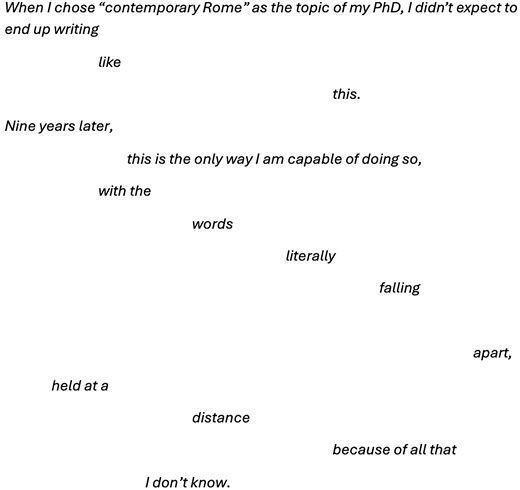
I wrote the text above in February 2024 (Figure 1). I was six months into a postdoctoral fellowship. I was at a breaking point, giving up on a long-held expectation that I would publish my doctoral thesis as a monograph. The night before I had been unable to sleep. My head was swirling with imaginary feedback about my book proposal: not comprehensive enough, not academic enough, a waste of time. Suddenly something clicked: I needed to write in a different way to the standard third-person voice of scholarship. I had to fill my text with gaps acknowledging my incomplete knowledge. I wrote this down, fell asleep, and the next morning, dissembled sentences poured out.
This disintegration of my writing occurred as part of what felt like an existential breakdown. I had started my PhD when I was 24, a young adult who had done well academically but otherwise felt lost in the world. I took refuge in a vision of my future as an academic with the Dr title and a monograph. The breakdown was a moment in the gradual crumbling of this vision. I continued writing, developing a narrative of memories from my PhD (2016–2020), using the broken style represented above (Figure 1). This excerpt expresses doubt in the complete expert knowledge conveyed by standard third-person writing. This sense had grown gradually during my PhD, but I had struggled to recognise and respond. I prioritised successfully completing within my funding. Writing my memories, I traced the progression of my feelings about academic writing and started to grasp factors behind my breakdown. This was therapeutic memory writing by which I sought to reconstruct the data of my life to live “with them in relatively non-contradictory ways” (Lee and Williams, 1999, p. 11). Once this personal urgency had eased, I shared my narrative with friends and audiences of doctoral scholars and realised that others could identify. I decided to develop it as an autoethnography.
Autoethnography requires comparing the researcher’s experience to existing scholarship (Ellis and Bochner, 2000). This paper begins by overviewing scholarly perspectives about the affective intensity of doctoral writing. Since my narrative is set in the humanities, its insights are pertinent to this field. The overview delineates what distinguishes humanities doctoral writing and the limited scholarship about this. After outlining methodological considerations, I present my autoethnography, structured into vignettes from my memory narrative. These chronologically recount three stages: developing my literature review, negotiating my methodology, and my anticlimactic graduation. The vignettes develop a vivid narrative about the conflicting pressures that generate affectively intense doctoral writing experiences, like those described in existing scholarship. This autoethnography’s original contribution arises from the depiction of these pressures as they interact at the micro level, in complex entanglement with subjectivity, individual life circumstance, research topic and contingent external influences. The Discussion interprets how this entanglement is made visible in each vignette. The Conclusion highlights implications for scholarship and practice.
The affective intensity of doctoral writing
It is well recognised that doctoral writing is a site of intense personal struggle for many candidates, and that this is hard to articulate and inadequately supported. Academic writing is not simply a skill employed to communicate findings but a method of inquiry: a process through which researchers come to understand their topic and their relation to it (Richardson, 2000). This underpins the challenge that doctoral writing poses to candidates who undertake text-based inquiry while negotiating emerging scholarly identities (Kamler and Thomson, 2007). This is impounded by their hesitancy to talk openly about how difficult they find writing because they interpret this as personal failing rather than an inherent part of the process (Kamler and Thomson, 2007). The precarious and competitive conditions that characterise research roles today give strong reason to conceal personal difficulty with writing.
Several studies further explore the complex power relations shaping doctoral writing, and their affective impact. Those deemed experts in the candidate’s field – supervisors and examiners – hold sway in the evaluation of writing, and this asymmetrical power relation makes candidates reluctant to challenge superiors (Cotterall, 2011). Academic identities are forged through the interaction of conflicting political forces as doctoral scholars are required to position themselves in relation to powerful scholarly norms (Xu and Grant, 2020). Academic identity development, which evolves through writing, is not linear but a chaotic, irrational and unpredictable process that may generate thrill, confusion and a sense of inadequacy (Xu and Grant, 2020). This requires more time and energy than many candidates or researchers have available. Doctoral creativity is impeded by internally and externally controlled scholarship (Brodin, 2018). The former includes the grip of scholarly traditions which mean that candidates are encouraged to think creatively but only within paradigms already supplied. The latter includes time limitations, and supervisors and funders curtailing candidates’ choice of topic. “Stifling conditions” shroud doctoral creativity in silence (Brodin, 2018, p. 668).
Manathunga highlights the normalised fast timescapes governing doctoral education: institutions and funders pressurise timely thesis completions and, while developing theses, candidates are also expected to publish, present and submit applications (2019). This encourages pedagogies that promote assimilation. Supervisors focus on candidates getting through doctorates by safely reproducing established knowledge practices, which are those representative of Northern/Western culture (Manathunga, 2019). This poses epistemic and practical difficulties especially for Indigenous, migrant, refugee and international students. Their backgrounds are devalued and they are pressured to assimilate to Northern/Western norms (Manathunga, 2019). The fast timescapes of doctoral education today therefore aggravate the asymmetrical power relationship between candidates and those deemed experts in their field. Thesen considers such conditions while honing in on dilemmas when doctoral writers make compromising decisions about what to include and erase (2013). They assess the risks at stake in writing: while supervisors prioritise successful assessment, candidates balance complex issues including past allegiances, communities, class position and the sense of having sold out (Thesen, 2013).
Humanities doctoral writing
This autoethnography offers a personal example that makes visible the affective and political intensity of doctoral writing described in the scholarship discussed above. This example arose in the humanities and its insights are pertinent to understanding the particular conditions shaping writing in this field. This paper follows Gibson and Bengsten’s delineation of the humanities as a specific mode of inquiry and form of knowledge (2024). Humanities scholars are “in the middle of things, in a specific realm”, and the strength of their knowledge practice emerges from their situated lenses (Gibson and Bengsten, 2024, p. 16). The humanities are less concerned with the generalisability that preoccupies other fields, and are “most compelling when asking questions rather than providing solutions to predefined problems” (Gibson and Bengsten, 2024, p. 16). The knowledge generated is inherently “unfinished”, which explains why the same texts may be read again and again as they are put into relation with various situated contexts (Gibson and Bengsten, 2024, p. 17). This delineation does not align neatly with university departments. Scholars who identify with it will come from those traditionally associated with the humanities, such as English, History and Languages, but also elsewhere. It may also be familiar to qualitative researchers. This paper therefore defines the humanities inclusively, and its insights may speak to scholars from various disciplines.
There is a need to understand what is unique about humanities doctoral experiences. Humanities candidates represent a minority of the total doctoral population. As common in doctoral education scholarship, the studies about writing cited include humanities participants but analysis and argument subsume their experiences with other fields. While this has benefits for understanding what is shared across disciplines, scholarship is less equipped to reveal what is distinct about disciplinary fields. Gibson and Bengsten argue that humanities experiences are set apart ontologically (2024): this carries practical, emotional, economic and political implications. Studies examining humanities doctorates are limited but indicate that they generate affective and political intensity which is even more consuming and hard to articulate than that experienced elsewhere. There is a troublesome tension between candidates’ passionate doctoral endeavours and how they are evaluated by institutions (Owler, 2010; Nuriler and Bengsten, 2024). Studying humanities doctorates in which there is close affinity between knowledge sought and the researcher’s sense of self reveals the existential dimension entangled within doctoral journeys (Nuriler and Bengsten, 2024). The existential, epistemological and practical entanglements of these candidates are poorly understood and their wellbeing inadequately supported (Nuriler and Bengsten, 2024). Globally, humanities doctoral education is undergoing significant change following drastic funding reductions and STEM-led standardisation. This is exemplified in the UK by the Arts and Humanities Research Council (AHRC)’s 2025 announcement to reduce funding for doctoral projects chosen by the candidate, and increase funding for “challenge-led” projects set by funders and supervisors (Grove, 2025). Against this backdrop, articulating what is unique about humanities doctoral education is crucial to support decision-making about the future of research education in the field.
This study
It is unsurprising that autoethnographies of “crisis-stricken PhDs” are rare (Ridgway, 2023, p. 231). Doctoral writing’s existential and political entanglements are confusing and stifling. Scholarship about doctoral education argues for the need to develop tools to make sense its dark and hidden pedagogies (Wisker et al., 2017; Elliot et al., 2020). It is hard to make visible many doctoral pedagogies because they are highly individualised, particularly in the humanities. Doctoral learning and writing evolve at the micro level where subjectivity, individual life circumstance, research topic and contingent external influences entangle. This paper contributes to making visible this hidden level by employing autoethnography to explore one experience of this entanglement.
Methodology
Autoethnography is an interpretivist qualitative research method. Its goal is not to portray facts accurately but to understand the meaningfulness of experiences in relation to their contexts (Ellis and Bochner, 2000). The researcher moves between a wide-angle lens that unpicks the social and cultural aspects of their experience and an inward lens on their vulnerable self, which refracts and resists interpretation (Ellis, 2008). This paper weaves these lenses by considering my experience in relation to scholarship about the affective intensity of doctoral writing. This develops a moderate autoethnography which combines evocative autobiographical account with scholarly analysis (Wall, 2016). My narrative intends to induce an evocative effect by including idiosyncratic details to make the story lifelike and encourage readers to respond emotionally (Ellis and Bochner, 2000). Settling on the moderate mode, I balance the ethical implications of my autoethnography (Sparkes, 2024). My vulnerable experience is framed in evocative vignettes: their constructed nature is foregrounded and, evidently, much of my lived experience eludes representation and interpretation. Autoethnography poses risks to the writer and others directly impacted (Sparkes, 2024). I consider these outweighed by the method’s significant potential to deepen appreciation of the complex, individualised and largely hidden pressures on doctoral writing.
As recounted above, my autobiographical writing was developed to fulfil a personal need. While not created with autoethnography in mind, self-generated memory writing is typical for autoethnographers (Ellis and Bochner, 2000). I selected three vignettes from the original narrative: developing my literature review, negotiating my methodology, and my anticlimactic graduation. Developing these autoethnographically required editing to create a succinct and evocative narrative. I revised the format of the original text. This reflected the broken writing above, unsuitable to the online journal article form. Starting this paper with original broken text represents a compromise: I wish for readers to interpret this autoethnography with these visualised gaps in mind. They represent the textual/epistemic uncertainty and existential breakdown from which it emerged. This autoethnography exemplifies the messy, non-linear processes described in the literature (Xu and Grant, 2020). It took two years. There were dead-ends as I worked out how to communicate my narrative. I tested autotheory, life writing and various autoethnographic modes. I discussed my narrative with audiences of emerging scholars, and heard about their experiences. I submitted and withdrew a draft from another journal after receiving revisions that suggested I was not ready. I am grateful for the feedback and encouragement of four anonymous reviewers. Without this, I could not have articulated the relevance of my narrative as I do here.
The contribution of this paper emerges from its individual context yet this brings limitations. There are myriad ways through which scholars experience writing. I am White and British, and completed my PhD at a prestigious British institution. I was in the Italian Studies department of a school of Modern Languages, and my thesis was based on the study of literature and art [1]. My experience emerges from the centre of Northern/Western knowledge. I am not at odds with this in the same way as Indigenous, migrant, refugee and international scholars (Manathunga, 2019). Others’ personal narratives make visible the distinct pressures shaping doctoral writing for those with these backgrounds (Yan and Poole, 2024; Keleş, 2023; Morsi, 2022). I identify as queer and non-binary. While this is not my focus, it feels important: my doctorate was entangled with struggling to position myself in relation to heterosexual and cisgendered norms. I identify with a queer relation to normative doctoral success (Burford, 2017). This autoethnography presents the doctoral writing torment of someone who, in some ways, was expected to have an easier ride. Sharing this aims to strengthen the case against the thoroughly harmful norms of Northern/Western knowledge and how these are reproduced by doctoral education cultures.
Making sense of complexity: an autoethnography of humanities doctoral writing
Occupied territory: developing my literature review
At the start of my PhD, my supervisor encouraged me to develop a review of texts relevant to my research question:
How do transnational creative practitioners participate in a re-inscription of Rome in the (post)colonial present?
The method of a literature review originates in the social sciences where it is defined as a systematic method for “identifying, evaluating, and synthesising the existing body of completed and recorded work by researchers, scholars and practitioners” (Fink, 2005, p. 3). It is a common method for doctoral candidates to demonstrate the comprehensive knowledge expected of them. While a valuable process, the assumption that a researcher is able to comprehensively review a finite existing body of work implicates the idealised concept of “specialism”.
Specialism might be imagined, from the critic’s perspective, as a gradual honing in on an object of study: a progressive, discursively and epistemologically monolinear approximation that is ultimately rewarded by complete and definite understanding (Mussgnug et al., 2021, p. 5).
Looking back to the first year of my PhD, I took it for granted that I was on the way to “complete and definite understanding”. This aligned with the style of writing in which I had been trained. During my taught degrees, assessments were based on writing essays with linear arguments about cultural works. I took lecturers’ advice about avoiding the first-person. I wrote in the third-person, seeking to imitate critical texts by established scholars. This style of writing served me well, helping me to achieve top grades and PhD funding. An online study guide sums up the approach I was taught:
The main emphasis should be on the information that you want to give and the arguments you want to make, rather than you. This is related to the basic nature of academic study and academic writing, in particular. Nobody really wants to know what you “think” or “believe”. […] In general, avoid words like “I”, “me”, “myself” (Gillett, 2025).
I expected that the experience of writing my thesis would lead me to hone this style to reach the level of the lecturers and professors I admired. My literature review would be a step towards this, enabling me to demonstrate a comprehensive response to my research question. This meant I needed to understand the Rome being re-inscribed with something different, so I searched the British Library catalogue for texts with “Rome” in the title: 15,106 results, published between 1069 and 2016, in 17 different languages of which I could read two, English and Italian. There was no way I could read all these and no one told me that I had to. Yet I sensed that I should have done.
The overwhelming library search was just the start. I started noticing relevant data everywhere. In my university town there was a monument commemorating the Reformation. It is crowned by an obelisk, a monolithic form originally designed by ancient Egyptians but which is strongly associated with Rome thanks to the imperialist transportation of obelisks to the city. Its form was instantly familiar to me. I knew it from ancient obelisks in Rome but also from those in other British cities, such as Cleopatra’s Needle in London where I grew up.
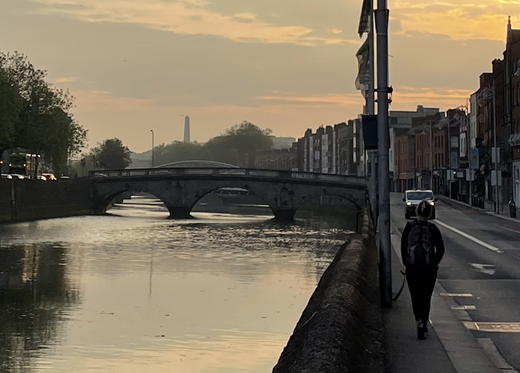
I’m writing this now while living Dublin. Every day I walk home along the River Liffey. The huge nineteenth-century Wellington Memorial obelisk peeks out on the horizon (Plate 1).
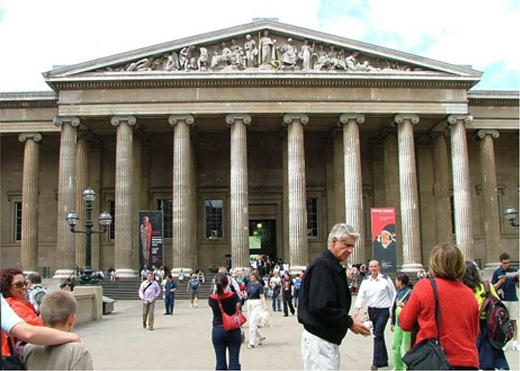
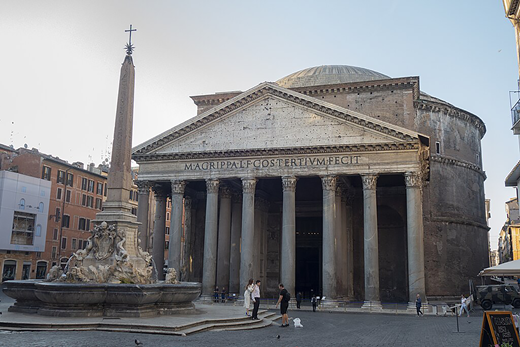
It was not just obelisks. I could detect Rome in other familiar architectural forms. The neoclassical columns and domes of churches, museums and university buildings that structure the public spaces I have always known have ancient versions in Rome. Plate 2 shows the example of the British Museum which I visited as a child. I’m not an expert in architectural history, but to me it looks suspiciously similar to the Pantheon (Plate 3).
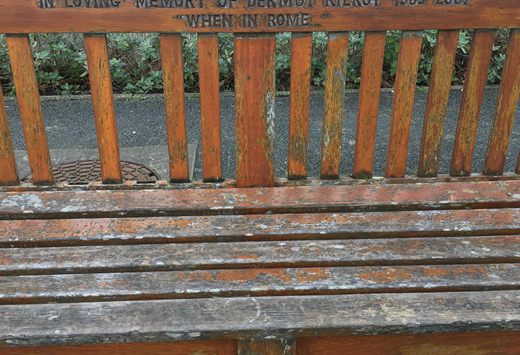
Many idioms in English refer to Rome. I have a memory of my dad telling me while on holiday as a child “When in Rome, do as the Romans”. I was confused because we were in Germany and he was drinking beer. At some point after this, I learnt that it makes sense to say that you’re in Rome even when you’re not. All roads lead to Rome. Rome wasn’t built in a day. This week, eating my lunch on the Trinity campus, I read When in Rome (Plate 4).
Data like this was just as relevant to my research question as to what I found in the library. This was also telling me about Rome in the (post)colonial present, and revealing that this spreads far beyond the city. Why do all of these references to Rome fit in and make sense even when so far away?
I had heard of the concept of “eurocentrism”. Grappling with the feeling of overwhelm at my literature review, I read Shohat and Stam’s seminal text. They delineate eurocentrism as a set of assumptions and tropes that remain endemic to the popular culture, philosophy, history, literature and education that propagate what is known as Western culture (Shohat and Stam, 1994). These reiterate the falsity that the best that has ever been said and written has been that said and written by Europeans, a falsity that is so embedded in everyday life that it tends to go unnoticed. A core concept validating this account of the world is the “normal” view of history that most learn from school and the media:
[…] a linear historical trajectory leading from classical Greece (constructed as “pure”, “Western” and “democratic”) to imperial Rome and then to the metropolitan capitals of Europe and the US (Shohat and Stam, 1994, p. 2).
My overwhelm at “Rome” data far away from Rome was part of this account of the world. This is built into the archives, the architecture, and the language that make up my world, reiterating its “normality” and naturalising as “common sense” the superiority of everything European (Shohat and Stam, 1994, p. 1).
The literature review process revealed to me that (post)colonial Rome had something to do with me, someone born in the 1990s in London. “Rome” was part of the built environment I had always known, and the view of history I knew as “normal”. Yet the academic writing style that I expected to use to write my PhD didn’t include methodological tools or analytical lenses that would help to unpick this personal implication. I also didn’t have the time to experiment with alternatives. What concerned me as a first-year doctoral researcher was writing a literature review to hand into my supervisor on time and completing within my three years of funding.
I put together a review using reasonable criteria to narrow down the corpus – texts closer to my disciplinary area of cultural studies, and those published since the 1980s. While these criteria made the review manageable, they felt arbitrary. I had indiscriminately discarded tens of thousands of texts, plus loads of other relevant data. I didn’t open the review document again until writing these recollections. I felt ashamed: it was evidence of my failure to achieve the complete and definite understanding I thought I was pursuing. I was afraid to admit this to myself, let alone to my supervisor or future examiners.
Conflicting messages: negotiating my methodology
My supervisor was satisfied with my review and enthusiastic at my articulation of the transnational eurocentric significance of Rome. I began to explore this idea in my writing while analysing my corpus: contemporary literature and visual art set in Rome.
The first thesis text I wrote explores William Kentridge’s Triumphs and Laments. This is a public installation of drawings stencilled onto the walls of the Tiber. While writing this, I drew on my memory of a recent visit, developing an analysis of the situated figure of the viewer, stood between the wall and the river, at the centre of Rome. Now, I grimace as I read my former self’s invocation of an authoritative third-person voice. The text imagines a figure assumed to represent something universal. It makes invisible that the prototype is me: a White British academic researcher with funding to visit Rome.
My writing about Triumphs and Laments conceals its roots in the personal in a similar way to my research question. I had formulated this through my eyes as someone from the UK, following the footsteps of many other Anglophone scholars. I was curious about similarities and differences between my home country and Rome, which felt foreign yet also familiar. My research question about transnational contemporary creative practitioners enabled me to follow up on this curiosity while keeping myself at a distance. As my academic training had inculcated, creative practitioner and academic writer are binary positions that do not overlap or interact.
Yet I was becoming aware of a connection between myself and the creative practitioners I was studying. We all explore Rome through critical transnational and (post)colonial lenses. By writing my thesis, I sought to amplify what I analysed in their work: ways of imagining the city beyond its eurocentric associations. Like them, I was an active, creative agent, seeking to delineate their re-inscription of the city as a phenomenon in which I was also a participant.
I was excited that my personal experience was at the centre of my ideas. Despondent after the literature review, I found intellectual companionship in feminist and queer theoretical writing. This gave me concepts which helped to understand my world and and who I am in it (White, British, queer, non-binary). I wanted this to be part of my writing about Rome. I drew criss-crossing mind-maps across A3 pages, guided by colourful lines and arrows to look for emerging connections between creative depictions of Rome, and the theories helping me to understand my relation to the world. These writers also told me that this subjective approach was legitimate. Academic writing could be different from how I had been trained – in fact, it should be! Ahmed’s words stick in my mind: “Theory itself is often assumed to be abstract: something is more theoretical the more abstract it is […] We might then have to drag theory back, to bring theory back to life” (2017, p. 10).
Since submitting my thesis at the end of 2019, I have found it unbearable to read. An awkward tension runs through the chapters. In the introduction, I cite Fournier to define my approach as autotheoretical, i.e. drawing on personal experience to enrich analysis (2018). Yet I don’t integrate this into analysis within chapters. It is contained within anecdotes that frame them, and the main analysis takes place in the third-person, carrying the assumption that my conclusions are impartial and definite.
I had supporters encouraging me to be more experimental with my writing, including my supervisor. But I did not have the confidence in my capabilities to craft a writing style other than the one that had served my pursuit of “academic success” so well so far. And the bottom line: three years of funding, and unable to face the financial insecurity of a fourth year. I needed to produce a thesis that would be safely acceptable to my examiners. Knowing them better now, I did not need to be so hesitant. Yet as a PhD candidate, the risk felt too great.
Even though I satisfied my examiners and passed my viva, afterwards the thought of my thesis filled my body with tension. I wanted to block it from my mind. I hid the paper copy under my bed. I had achieved what I thought I had wanted to: a PhD within my funding. Yet personal satisfaction and pride never came.
The tensions return: my anticlimactic graduation
Dissatisfaction lingered over the months and then years following my viva, accentuated by the onset of Covid and the sudden realisation that the world I thought I would graduate into had changed. This sense of anticlimax was underlined by the deferral of my graduation ceremony expected in 2020, then 2021, and finally in 2022 after the easing of lockdown. Final institutional recognition of my academic credentials held the promise of anointing my PhD success. Instead, it brought me face to face with another underlying tension.
The stated aim of my thesis is to deconstruct the eurocentric assumptions that stick to Rome by analysing the work of contemporary transnational creative practitioners in the city. However, at the graduation ceremony, for which I had to at least register to officially complete my PhD, becoming a successful academic was associated with being a bit “Roman”.
As I stepped across the stage, the Principal of the university pronounced words in a Church Latin hybrid:
Te ad gradum doctoris filosofii promovio.
Cuis re in simbolum super te hope beretum impono[2].
I knelt at the centre of the stage, in front of her and the university senate as she tapped my head with the beret, a ritual enacted for all graduands of my university.
Until writing these recollections, I had not thought about the semantic meaning of these words. During the ceremony, I was not concerned about this, like I assume most people present. Their significance was symbolic, intended not to communicate specific information but to reiterate the university’s association with an ancient academic tradition. These words were pronounced again and again as graduands stepped across the stage. It was 2022, in a north-western corner of Europe. Yet Rome was in the air. Without thinking about it, we all breathed it in. The overwhelming data on Rome that I had repressed at the literature review was back.
The entanglement between “Rome” and “academia” is established by the word’s etymology. “Academia” has its origins in the Ancient Greek Akadēmeia to refer to the gardens where Plato taught, belonging to someone called Academos. Yet, according to online etymology dictionaries, we use it today because it comes via Latin, the language of ancient Rome.
The ritual at my university appears harmless, even normal. It follows the classical conventions of graduations at other prestigious universities in the UK. At Oxford, ceremonies are conducted entirely in Latin. By accentuating the association between “Rome” and “academia”, it reproduces a eurocentric interpretation of what “academia” signifies. The ritual conjures the faulty logic that the best that has ever been said and written is that said and written by Europeans and those who draw on their prestigious classical inheritance. It implies that being academic is an intrinsically European quality, and that it ought to be celebrated as such. This reiterates the association between “academic” and the characteristics of human bodies idealised by the world-defining political, religious and cultural powers that have emerged from Rome and been spread by Western states and individuals: White, Christian, masculine, not disabled, heterosexual and in line with binary gender roles.
The literature review had revealed to me that the eurocentric association of Rome was built into my material world. My graduation showed me that this was also connected to the ideal academic identity for which I had longed. I had sought in my thesis to disentangle the taken-for-granted overlaps between Rome and eurocentrism. Yet I could not achieve institutional recognition as an academic PhD graduate without being in association with these tropes. Institutionally, I had achieved doctoral completion. Personally, any sense of completion was withheld.
Discussion
At the end of this narrative, I am at an anticlimax, disillusioned and alienated by the knowledge practices which I thought would enable me to explore my topic and become the academic which I aspired to be. At the start of my postdoctoral fellowship, I attempted to resolve this by developing my thesis into a monograph. Books and blogs about impressing publishers became a new source of pressure to assimilate to the standard style. This culminated with the breakdown represented in the Introduction. The vignettes’ narrative arc follows the accumulation of tensions leading to this. My story offers a vivid example of the pressures upon doctoral writers, which include asymmetrical power relations with supervisors and examiners (Cotterall, 2011), the fast timelines into which they must condense significant tasks (Manathunga, 2019), and the hesitancy to admit struggles openly (Kamler and Thomson, 2007). The original contribution of this autoethnography arises from its depiction of these pressures at the micro level, in complex entanglement with subjectivity, individual life circumstance, research topic and contingent external influences.
The first vignette represents my experience of developing a literature review: “the quintessential site of identity work – where the novice researcher enters what we call occupied territory [patrolled by] academics” (Kamler and Thomson, 2007, p. 170). I intensely sensed the imminent danger and quiet dread implied by this metaphor. I assumed that my goal was to achieve “complete and definite understanding” (Mussgnug et al., 2021, p. 5), a reasonable assumption given the third-person writing in which I had been trained. The suitability of this style to the distinct mode of humanities scholarship – the strength of which emerges from scholars’ situated lenses (Gibson and Bengsten, 2024) – cannot be taken as given. As a first-year doctoral candidate, this tense uncertainty was insurmountable. Ironically, making progress with my research and thinking deeply about the topic of Rome made this tension glaring. Brodin highlights a paradox that reflects this: doctoral candidates’ creativity ought to be at the heart of their pursuit of original knowledge but conditions inhibit this (2018). My creative curiosity to explore all the data about Rome and my situated connection to this felt impossible to pursue. This rendered my search for complete understanding impossible. I experienced this as a personal failing. Like the emerging scholars disclosing writing struggles in private (Kamler and Thomson, 2007), it seemed in my interest to conceal this.
Failure was not all I felt: the Rome data and its connection to my identity kindled passion for my topic. I was convinced that this was really significant: studying contemporary representations of Rome was a way of understanding something about my social-cultural world in the UK which was normalised yet problematic. Passionate attachments are significant factors in doctoral journeys, and – reflecting Nuriler and Bengsten’s participants – for me it arose through the close affinity between knowledge sought and sense of self that characterises humanities methods (2024). However, because this passion was to do with my relation to my topic, the writing tools I had available felt inadequate to pursue this. In the words of the writing guide, nobody wanted to know what I thought (Gillett, 2025). I perceived the third-person style as the only option for my doctoral writing. My decision to write a literature review in this style while erasing much of the data reflects the dilemmas of doctoral writers (Thesen, 2013). This leads to a frustrating compromise when I erased what was meaningful to me (Thesen, 2013). I met the progression marker of a completed literature review but my agency was diminished. Already in my first year I sensed the constriction of three years of funding. Reflecting Manathunga’s description, this led me to assimilate to the standard, which leaves me feeling ashamed, isolated and disempowered (2019).
The second vignette elaborates on my confusing negotiation of messages about my writing style. This highlights the ambiguous and often mysterious practices of humanities writers. As a doctoral scholar, I sensed that my research practice represented the distinct situated quality of humanities scholarship described by Gibson and Bengsten (2024). I knew I was writing about Rome through British eyes but I lacked methodological tools to explore this. The epistemological underpinnings and rationale behind the third-person mode of scholarship that had characterised my education had not been made clear to me. I was drawn to writers representing alternatives to this. In this vignette, I highlight the impact of feminist and queer writing, such as that by Ahmed (2017) and Fournier (2018). They validated my doubts, and strengthened my conviction that academic writing should include alternatives to what I had been taught. Other influences sit outside this vignette. After starting my PhD, I began to hear about creative-critical scholars questioning the traditional third-person voice. They do not comprise a cohesive movement. Creative-critical writers may be unaware of others embarking on relevant experiments (Mikkilä, 2024) and they face accusations about lack of rigour (Chamarette, 2021). Despite validation and conviction from these writers, I still lacked the confidence to commit to this approach. Repeating the dilemma of my literature review, I compromised and assimilated (Manathunga, 2019). Thesen describes how the sense of loss following such compromises come back to “haunt” the process (2013, p. 106). I thought successfully passing my PhD would make everything better. Instead, the diminishment of my agency – in which I had been complicit – haunted me long after I officially completed.
The third vignette represents the moment when I officially complete my PhD at my graduation ceremony. My earlier decisions to assimilate supported me to complete successfully within funding: this was necessary because I did not have resources to continue unfunded. These conditions made me complicit in my assimilation. Yet these decisions embedded tensions that reappeared at graduation, curtailing any sense of personal pride. The vignettes present my identity as a confusing split: my graduation positioned me as the successful academic which I had aspired to become while also making apparent that this ideal was no longer who I wanted to be. The Northern/Western practices that govern doctoral education norms are exhibited in the hierarchical Latin ritual that marked my completion. Academic identities can be tense because of deep incongruence between individuals’ values and those of institutions (Barrow et al., 2022). For me, a doctorate deepened my understanding of academia while making me lose interest in becoming part of it. The emotional difficulties that doctoral scholars face when they become disillusioned with academic careers are well known. Their attachment to academia is conceptualised as cruel optimistic binds: aspirations are formed by deeply embedded psycho-social fantasies about the academic good life, and they struggle to let go of these visions even when untenable (Burford, 2018). The anticlimax of my graduation is a moment when my fantasy-fuelled aspiration is deeply troubled. My subsequent breakdown is when this aspiration – and the view of the world it represents – falters beyond repair.
Conclusion
The purpose of this conclusion is to highlight this autoethnography’s implications for future scholarship and practice. Burford recommends doctoral scholars cultivate a disinterested stance to disaggregate their self from normative presumptions of academic success, although recognising this is somewhat impossible (2018). My autoethnography presents the acuteness of attachments to academia in the humanities, where the advice to disaggregate is particularly hard to follow. The vignettes make visible how conflicting pressures on my doctoral writing interact at the micro level, in entanglement with subjectivity, circumstances, research topic and contingent external influences – my supervisor, writers I read, and imagined future examiners. This entanglement arises in the context of the close affinity between knowledge sought and the researcher’s sense of self associated with humanities scholarship (Nuriler and Bengsten, 2024). This is the source of passion but also tension and breakdown. Each vignette shows lines blurring between my sense of self, my doctoral success (and feared failure) and my topic of Rome. These blurred lines generate insurmountable uncertainty. Once my academic aspirations had faltered beyond repair, I resolved this by cultivating a form of disinterestedness. Reflective memory writing enabled me to gain oversight of the complex entanglement shaping my doctorate.
Writing this autoethnography, I have gained clarity about my relation to academic research in a way that felt impossible using the third-person mode in which I had been trained. This reiterates the importance of self-reflective and metacognitive strategies for doctoral scholars (Elliot et al., 2020). This paper argues that such advice is particularly necessary for humanities scholars while calling for deeper consideration of how to advocate for these practices within the field. Humanities scholarship is distinguished by its situated lens, but what this means in practice and its potential impacts may not be clear to emerging scholars. Ongoing discussions by creative-critical writers about what humanities rigour entails will offer guidance to some (Mikkilä, 2024; Mussgnug et al., 2021). My experience gave me the strong conviction that elaborating language and concepts to articulate the methodological underpinnings of the humanities is crucial for supporting emerging scholars and for communicating wider societal impact. Currently, drastic decisions are being made about the future of humanities researcher education (Grove, 2025) even though the hidden processes shaping this are poorly understood and inadequately articulated. These decisions should be informed by methodological reflection about the humanities, including expanding the scholarship about the existentially transformative yet often difficult writing experiences of emerging scholars. This paper joins with creative-critical writers and others to advocate for the development of writing styles alternative to the third-person voice established by Northern/Western knowledge practices. These should integrate the intellectual, emotional and embodied dimensions of research (Elizabeth and Grant, 2013; Gibson, 2022). While advocating for this, this autoethnography highlights the challenge posed by these ongoing methodological discussions amongst doctoral scholars, especially those whose earlier degrees centred on the traditional third-person style.
This paper’s message is that this challenge is not impossible. Neenan, who completed an education studies PhD, offers a compelling example of why scholars need to make personal, intentional choices about their writing (2022). Their ADHD meant that standard styles felt impossible so they wrote their thesis using a creative epistolary format. “Look at the requirements you have been given, and then consider space available for you” (Neenan, 2022). I wish I had done this during my PhD but I no longer blame myself for not being able to. For me, the pressure to assimilate was too much. Experimenting with self-reflective and creative writing that integrates the emotional and embodied dimensions of research, I have finally made sense of my complexity. This autoethnography has recounted and enacted this. It has explored one experience of doctoral writing to make visible the highly individualised micro level, where personal, political and epistemological threads entangle. I hope this autoethnography supports other doctoral writers and graduates to make sense of their own entanglements.
The hidden agents supporting my writing are too numerous to acknowledge in entirety. I highlight those crucial to this paper. Firstly, my PhD supervisor, whose question-asking and discipline-pushing writing inspired me to keep finding my own path. Secondly, my incredible friend Dr Darya Tsymbalyuk: without our conversations, I would have given up making sense of my complex entanglements long ago. Thirdly, my PhD examiner and postdoctoral mentor, whose patience, encouragement and open-mindedness kept me going when I was stuck. Lastly, I thank audiences of emerging scholars at Trinity College Dublin, University College Dublin and students of the “Writing ‘I’” course at the University of Chicago. They generously responded to my experience, and helped me to understand its wider relevance.
Ethics statement
Ethical implications related to autoethnography are considered in the text. Institutional approval was not required.
Notes
At universities in the UK and elsewhere, Modern Languages bring together researchers focusing on a range of contexts. The traditional focus is the study of texts written in western European languages, but the field increasingly encompasses critical transnational perspectives and various research methods.
“I promote you to the degree of Doctor of Philosophy/For which reason I place a beret of hope upon you as a symbol”. Translation is author’s own.