


Consumer well-being (CWB) is a flourishing area of research. It is an important field of study for the Sustainable Development Goals (SDGs), particularly SDG-3 (Good Health and Well-Being). However, despite some recent reviews, there is a lack of a comprehensive overview of the broad themes emerging in the CWB literature. The study aims to thoroughly integrate and organize the fragmented existing literature on CWB by uncovering its emergent themes and their impact.
To address this gap, this study presents a systematic literature review (SLR) of 166 peer-reviewed journal articles from 2013–2023 following the Scientific Procedures and Rationales for Systematic Literature Reviews protocol from the Scopus and Web of Science databases.
This study’s SLR uncovered seven themes: subjective well-being; psychological well-being; food well-being; financial well-being; environmental well-being; social well-being; and societal well-being. Further, this study identifies that these themes impact consumers on three levels: micro, meso and macro. Thus, this study provides a comprehensive overview of the emergent themes along the levels of impact.
This paper anticipates that the study, which is a thorough overview of the CWB literature, will provide managers, academics and students with an introduction to the topic.
To the best of the authors’ knowledge, this is one of the first articles that shows the themes of the CWB literature along the respective levels of impact and draws avenues for future research.
1. Introduction
In our current evolving social, technological and economic landscape, scholars are confronted with emerging challenges that require immediate research attention. Among these, the concept of consumer well-being (CWB) has garnered significant traction because of its relevance to achieving the Sustainable Development Goals (SDGs), which aim to ensure good health and well-being for all. CWB refers to the satisfaction derived from the process of acquiring, owning, using, maintaining and disposing of consumer products (Lee et al., 2002). Recognizing the importance of this concept, Kotler (1986) contended that businesses should take consumers’ well-being into account while making decisions, especially those pertaining to marketing. This emphasis on well-being in marketing is particularly important because marketing activities have the power to influence consumer behavior, perceptions and overall societal values. Consequently, CWB has been the subject of scholarly discussion for about 30 years now. Researchers from a range of disciplines, including business, public policy, psychology and marketing, have investigated the idea of CWB, and some of the major advances in the stream of CWB include subjective well-being, positive psychology, transformative consumer research, transformative service research and quality of life.
Several scholars have attempted to compile the existing body of knowledge on CWB in their literature reviews. For instance, Pancer and Handelman (2012) provide an account of the historical origins and factors that shaped the evolution of the field of CWB. Taking a different route, Khatri and Duggal (2022) focus on the well-being of students, examining the antecedents, decisions and outcomes of CWB as well as the theories, contexts and methods specifically related to “students-as-consumers” (p. 1564). Further, Eshaghi et al. (2023) explore the antecedents [consumer-related factors (e.g. attitude and loyalty), context-related factors (e.g. brand-related and societal) and object-related factors (e.g. perceived value)] and consequences of well-being, various theories (for example, positive psychology and psychological life space theory), the temporal states of well-being in marketing and the connotations of “well-being, well-doing, well-having, and well-becoming” (p. 627). Finally, Bhardwaj and Kalro (2024) use the TCCM framework to summarize the theoretical perspectives (e.g. the usage of self-determination theory and attribution theory) research contexts (e.g. the country origin of the sample), constructs (the various IVs, mediating and moderating variables and DVs) and methods (e.g. interviews and ethnography) used in CWB research.
Despite these efforts to unify the existing literature on CWB, a comprehensive overview that highlights the overarching themes in current research is still lacking. This gap necessitates an in-depth synthesis and thematic understanding of the state of the art in CWB research. While the aforementioned reviews contribute significantly to the literature, our paper offers a distinct perspective. Our systematic literature review (SLR) identifies and discusses seven thematic areas along which CWB research has evolved, including:
subjective well-being;
psychological well-being;
food well-being;
financial well-being;
environmental well-being;
social well-being; and
societal well-being.
Unlike Eshaghi et al.’s framework, which focuses on temporal states, our analysis delves into various dimensions of well-being, as they relate to consumers at the individual, interpersonal and societal levels.
Accordingly, the present study’s primary aim is to provide a comprehensive, state-of-the-art overview of the past, present and future of CWB research by unearthing its themes and levels of impact and exploring the major contexts of CWB research. In addition, this inquiry also offers an evaluation of the corpus performance using descriptive and bibliometric analysis. To assure the quality of our review, we conducted an SLR of peer-reviewed, empirical journal papers published between 2013 and 2023. As Tranfield et al. (2003, p. 219) emphasize, we adhere to accepted standards and strive to maintain both rigor and relevance.
Following previous literature works published in leading journals (Baker et al., 2020; Donthu et al., 2021; Kumar et al., 2021; Lim et al., 2021a), this study begins by developing the research questions (RQs) it intends to address:
What is the corpus performance of CWB literature?
What are the major contexts of CWB articles?
What are the emergent themes and their impact as seen in CWB research?
What are the future research directions for CWB research?
RQ1 and RQ2 are straightforward and are addressed in Sections 4.1 and 4.2, respectively. In response to RQ3, in Section 4.3, we offer a synthesized overview of the state-of-the-art literature on CWB through its constituent themes. In addition, to address RQ4 (Section 4.4), we identify and discuss directions for future research that could encourage academic investigation in this field. Overall, this study aims to thoroughly integrate and organize the fragmented existing literature on CWB by addressing these research questions. This research enhances the comprehension of the current state-of-the-art and future directions of research on CWB.
2. Background
Consumer well-being is based on the notion that consumers satisfy their needs via various important activities spread across various life domains and sub-domains (Pancer and Handelman, 2012). According to one of the most well-accepted definitions of CWB, it is:
A state in which consumers’ experiences with goods and services—experiences related to acquisition, preparation, consumption, ownership, maintenance, and disposal of specific categories of goods and services in the context of their local environment—are judged to be beneficial to both consumers and society at large (Sirgy and Lee, 2006, p. 43).
CWB research investigates how consumption habits and lifestyle choices influence individuals’ overall happiness and satisfaction (Shafqat et al., 2023). Employing a similar perspective, Lee et al. (2002) describe CWB as satisfaction in various sub-domains of a consumer’s life, while Schimmack et al. (2002) contend that life satisfaction is the cognitive component of CWB, whereas the affective component is about the balance between positive and negative affect. As a result, CWB is a desired state of subjective (Su et al., 2021) and objective well-being. It includes various aspects of consumption (Sirgy and Lee, 2008) and broadly refers to the physical, psychological, social or economic situations of individuals or groups (Diener and Ryan, 2009; Lee and Ahn, 2016; Oral and Thurner, 2019). In other words, CWB is an inclusive state where consumer experiences with goods and services are beneficial to individuals at the micro-level (Losada-Otálora and Alkire, 2019) and society at the macro-level (Sirgy and Lee, 2006). Adopting a nuanced and prudent perspective, Sirgy (2001) highlights the considerable influence that marketing can have on consumers’ quality of life and argues that organizations must deliver consumer wants, needs and satisfaction in a way that enhances or at least preserves CWB.
From an economics viewpoint, CWB refers to the satisfaction of needs, i.e. the satisfaction derived from the consumption of a product or service, which implies that the degree of satisfaction is based on the degree to which a consumer’s needs are being catered to Mick (2008). As a matter of fact, CWB was once thought of as an economics-based concept of consumer sovereignty; however, later consumer well-being literature advanced to the understanding of cognitive and affective aspects (Schimmack et al., 2002), then to various facets of human development and life satisfaction (Diener et al., 2010a, 2010b) and then to societal aspects of consumer well-being (Sirgy, 2008; Sirgy and Lee, 2006). Consumption ultimately has a significant impact on society, and Daskalopoulou (2014) underlines the significance of societal concepts in CWB.
3. Method
SLRs are evidence-based, scientific, replicable and transparent methods of secondary research that are used in reviewing existing research work through the identification of themes, topics and trends of the field under review (Denyer and Tranfield, 2009). We used the Scientific Procedures and Rationales for Systematic Literature Reviews (abbreviated as SPAR-4-SLR) for our review (Paul et al., 2021). Adopting such a review protocol is crucial because it produces findings that are transparent and replicable (Lim et al., 2021b). There are three stages in the SPAR-4-SLR protocol, each of which is further divided into two steps (Paul et al., 2021). The three stages of SPAR-4-SLR include assembling, arranging and assessing (Table 1).
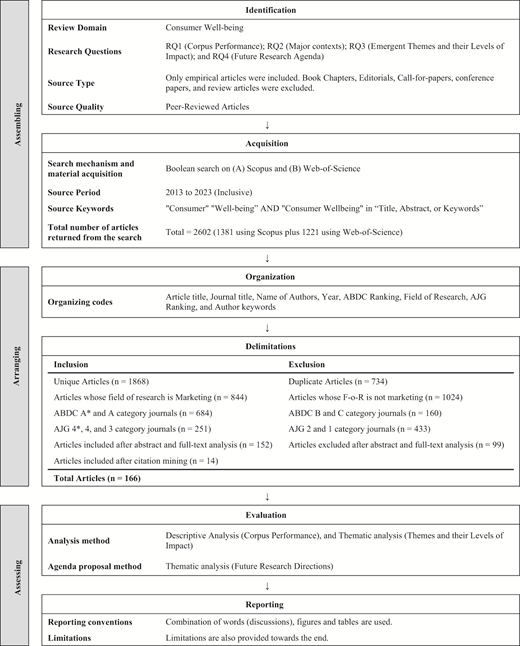
The two sub-stages under assembly include the identification and acquisition of research articles. The identification stage starts with the selection of a review domain, which in our case is consumer well-being. The present investigation addresses four research questions (RQ1, RQ2, RQ3 and RQ4). For source type, we used empirical articles from journals because such articles are peer-reviewed sources of academic literature (Lim et al., 2021b; Paul et al., 2021). Books, book chapters, editorials, call-for-papers, conference papers and commentaries were not included because their peer-review status was not clear. Review articles were also excluded to avoid repeated reporting of insights (Lim et al., 2021b). Therefore, we ensure source quality with the use of peer-reviewed journal articles. The acquisition stage includes a Boolean search mechanism and material acquisition using two of the most comprehensive databases – Scopus and Web of Science – so that no relevant article is left outside the purview. The source period is between 2013 and 2023 (inclusive). The search keywords used were “Consumer” “Well-being” and “Consumer” “Wellbeing” in the “Title, Abstract, or Keywords” of articles. In total, we retrieved 2,602 articles on consumer well-being.
The second stage is arranging, which includes two sub-stages of organizing and delimitation of the retrieved articles. We organized the retrieved articles based on organizing codes such as article title, journal title, name of the authors, year, ABDC ranking, AJG ranking, field of research and author keywords. To achieve data purification, we used delimitations (inclusion and exclusion criteria) to arrive at a relevant and manageable number of articles for the review (the Delimitation Section of Table 1). We began by removing 734 duplicate articles, which left us with 1,868 unique articles. Out of these 1,868 articles, we only included 844 articles whose field of research is “marketing.” Out of these 844 articles, we only included 684A* and A category articles based on ABDC journal rankings by eliminating B and C category journal articles. Out of these 684 articles, we only included 251 articles from 4*, 4 and 3 category journals based on AJG journal rankings and excluded 2 and 1 category journal articles.
After this, we performed abstract and full-text analysis, where we included a total of 152 articles (please refer to Web Appendix 1 for the complete list). At this step, we excluded articles that did not use consumer well-being as a central concept and just used the term in the title, abstract or keywords, for example, De Vries et al. (2018).
In addition, we conducted citation mining (also referred to as bread crumbing or pearl growing) on these 152 articles (Nanda et al., 2023) and found 14 additional articles that met the criteria for inclusion in our review (the mined articles had to be cited in at least two of the 152 articles and more than ten times; please refer to Web Appendix 2 for the complete list of these 14 articles). So, in the end, we have a total of 166 articles that became part of the present review.
The third stage of the protocol is assessing, which includes two sub-stages of evaluation and reporting. In evaluation, we assessed empirical articles using descriptive and bibliometric analysis for corpus performance and thematic analysis for themes and future research directions. In the thematic analysis, we systematically extract qualitative data such as themes, sub-themes, levels of impact and implications from the retrieved articles to identify, analyze and report on them (Braun and Clarke, 2006; Lim et al., 2021b; Vaismoradi et al., 2013). In reporting, our reporting conventions include texts, figures and tables. We also discuss limitations toward the end of this study.
4. Findings and discussions
As reported earlier, this review paper organizes its findings into four different sections. First, Section 4.1 discusses the CWB corpus performance (RQ1). Second, Section 4.2 delves into the major contexts found within the articles on CWB (RQ2). Third, Section 4.3 elucidates the emergent themes and their associated levels of impact (RQ3). Finally, Section 6 focuses on outlining the future research directions in the field of CWB (RQ4). This way, we aim to present the findings and discussions in a clear and organized fashion.
4.1 Corpus performance
In this section, we look at how the CWB corpus is performing, and to do so, we use descriptive analysis. Descriptive analysis (Table 2) includes components such as:
year-wise distribution of the corpus;
journal-wise distribution; and
the top three countries with the most articles.
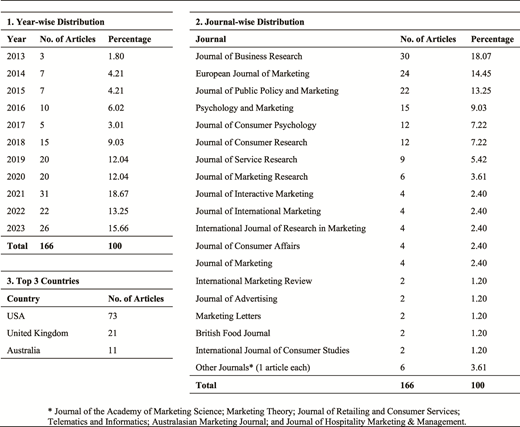
In the year-wise distribution (Part 1 of Table 2) of CWB literature, we see a growing interest in the field. The year 2021 marks the highest number of articles (n = 31) in our corpus. Followed by the years 2023 with 26 publications and 2022 with 22 publications. The year-wise distribution shows an upward growth of the CWB literature from the initial year 2013 until 2023, with a significant spike in 2016. The reason for the spike in 2016 seems to be the adoption of the SDGs, including SDG-3 (Good Health and Well-Being) from January 1, 2016.
Further, the COVID-19 pandemic disrupted the world in 2020; during this phase, we saw exponential growth in CWB research (along with other scholarly publications) (Lim et al., 2021b; Sloane and Zimmerman, 2021). This spike in the number of CWB articles in 2020–2021 is potentially attributable to the COVID-19 pandemic, as evidenced by several notable studies such as Vecchi et al. (2022) and Zheng et al. (2021).
The journal-wise distribution (Part 2 of Table 2) indicates that CWB research is published in a variety of journals, but mainly in marketing (the top three being the Journal of Business Research, European Journal of Marketing and Journal of Public Policy and Marketing) and consumer behavior research (the top three being the Psychology and Marketing, Journal of Consumer Psychology and Journal of Consumer Research).
4.2 Major contexts and corresponding significant literature
In this section, we highlight a few contemporary and major contexts in which CWB has been studied. To do so, we provide the corresponding significant literature from the retrieved corpus in tabular format (see Table 3). The present review identified four major contexts:
Major contexts of CWB articles
| Major context | Significant literature |
|---|---|
| Technology and social media | Adoption of smart wearable technologies for well-being (Tikkanen et al., 2023); Use of social networking services by older consumers to avoid social isolation (Wilson-Nash et al., 2023); Social Media Usage for psychological well-being (Cleveland et al., 2023); Reality-enhancing technology and its impact on consumer experiences and well-being (Pala et al., 2022); Effects of time spent on Instagram, a visual-based social media tool, on the gratitude, altruism, and willingness to donate (Mendini et al., 2022); Time-spent on social media and the prevalence of depression (Griffith et al., 2022); Impact of intentional sounds embedded within mobile applications (Poupis et al., 2021); Effects of augmented reality on consumer perception of the self, specifically the gap between actual and ideal attractiveness, and how this change affects psychological well-being and product choice (Javornik et al., 2021); Effects on users’ self-improvement goals and well-being when using technologies such as wearables or mobile apps (Wolf et al., 2021); Use of self-tracking technologies (STTs) in the context of professional services such as healthcare and fitness training, and how it affects consumers’ compliance with expert advice to improve their well-being (Wittkowski et al., 2020); the well-being of male Instagram users in the context of their exposure to fitness hashtags, where users’ perceptions of body image and behavior are affected by the exposure to fitness hashtags (Chatzopoulou et al., 2020); Virtual reality (VR) tourism (M. J. Kim et al., 2020); Techno-stress and subjective well-being (Singh et al., 2022). Some other articles from our corpus which focusses on the contexts of technology and social media includes Bartikowski et al. (2018); Chang (2020); Parth et al. (2021); Kang and Shao (2023); Pera et al. (2020); Raggiotto et al. (2023); Stornelli et al. (2020); Yu et al. (2023); and Zheng et al. (2019) |
| Mindfulness | Mindfulness can reduce buy-now-pay-later (BNPL) usage by increasing consumers’ financial self-control and decreasing their impulse buying tendency (Schomburgk and Hoffmann, 2023); When consumers self-create a product, they appreciate it more, consume it more mindfully and experience greater domain-specific and general well-being (Brunneder and Dholakia, 2018); Mindful consumption (Milne et al., 2020); Mindfulness in social media use (Chan et al., 2022); Promoting and teaching mindful consumption can empower consumers to make more conscious choices and support personal, societal and environmental well-being (Bahl et al., 2016) |
| Health | The role of personal values in healthy food choices can help food managers and health authorities reduce dietary stress and improve mental well-being (Cronin et al., 2015); The digital discourse of health is clustered around four F’s, namely, food, fitness, fashion and feelings, which can be categorized with respect to their degrees of representation on a commodification/communification versus bodily/spiritual well-being map (Cavusoglu and Demirbag-Kaplan, 2017); Color elements of food packaging affect consumers’ perceptions of food well-being (Mead and Richerson, 2018); Visual perspectives have impact on maintaining a healthy diet and achieving health-related goals (Stornelli et al., 2020); Insurance coverage and options can impact consumers’ Perceived Access to Health Services and ultimately, their well-being (Tanner et al., 2020) and the Impact of wine consumption on health and well-being (Fiore et al., 2020); Work stress and the pandemic’s effect on health and well-being (Yu et al., 2021). Some other articles discussing similar ideas includes Bogomolova et al. (2020); Dahl et al. (2021); Nath et al. (2022) and Silchenko and Askegaard (2020) |
| Minimalism and anti-consumption | Voluntary simplifiers refuse to consume items that do not add to their happiness and satisfaction levels (Pangarkar et al., 2021); The potential negative side-effects of the sustainability movement on the well-being of consumers with materialistic values is related to a reduced clarity of consumers’ self-concept (Furchheim et al., 2020); Materialistic values and voluntary simplicity (Kuanr et al., 2020); Anti-consumption and well-being theory (Maseeh et al., 2022); Various anti-consumption constructs and consumer empowerment for well-being (Balderjahn et al., 2020). In addition to it, there are other articles that correspond to this context, including Ashraf et al. (2019); Farah and Shahzad (2020) and Oral and Thurner |
Technology and social media: Understanding the intersection of technology and social media with consumer well-being is crucial for addressing the increasingly significant role these platforms play in shaping individuals’ mental health, behaviors and overall satisfaction with life.
Mindfulness: This context is important because it explores how mindfulness practices can enhance consumer well-being by promoting conscious decision-making, reducing impulsive behaviors and fostering appreciation for products and their societal and environmental impacts.
Health: This context explores the intricate interplay between consumer behaviors, environmental factors and personal choices in shaping health outcomes, crucial for informing strategies to enhance public well-being and mitigate health-related challenges.
Minimalism and anti-consumption: The context of minimalism and anti-consumption explores the relationship between consumer behaviors, materialistic values and well-being, highlighting the impact of voluntary simplification and anti-consumption movements on individuals’ happiness and satisfaction levels amidst societal pressure for consumption-driven lifestyles.
4.3 Emergent themes and levels of impact
This section provides an overview of the emergent themes in the CWB literature. Our thematic analysis, which follows the recommendations of Braun and Clarke (2006), has unearthed seven themes in the extant CWB literature, namely, subjective well-being, psychological well-being, food well-being, financial well-being, environmental well-being, social well-being and societal well-being. To offer a better understanding of the CWB landscape, we map the selected CWB literature in a two-dimensional matrix with all the emergent themes on one dimension and their levels of impact on the other (Table 4). The corresponding cells between these rows and columns show the areas of CWB research. We describe each of these themes in the subsections below.
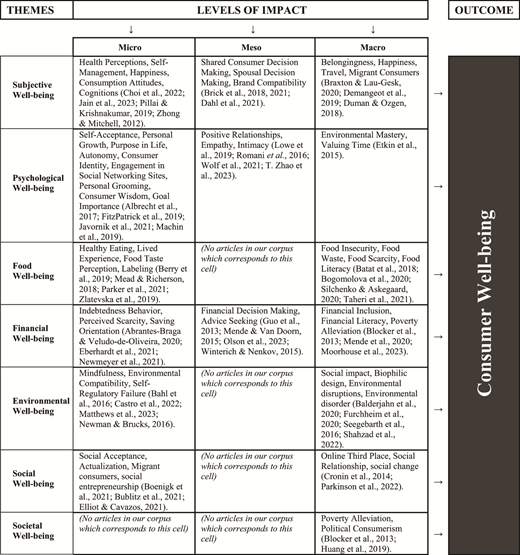
Snapshot of the consumer well-being (CWB) literature on two dimensions: themes and the levels of impact
Snapshot of the consumer well-being (CWB) literature on two dimensions: themes and the levels of impact
4.3.1 Subjective well-being.
Subjective well-being (SWB) is people’s cognitive and affective evaluation of their lives (Diener et al., 2002); in other words, it is a composite of one’s happiness and life satisfaction (Deci and Ryan, 2008; Kuanr et al., 2022). SWB as a construct includes three components: high positive affect (e.g. high energy and high pleasure), low negative affect (e.g. low energy and sadness) and life satisfaction (Veeck et al., 2018). An elaborate review of the corpus literature informs us that subjective well-being impacts consumers at all three levels: micro, meso and macro. Researchers have examined the impact of societal well-being on individual consumers, as evidenced by several notable studies such as Kuanr et al. (2020); Song et al. (2021); and Tanner et al. (2020). Furthermore, the impact of subjective well-being extends to interpersonal relationships, such as those between couples or parents and children, as highlighted in previous research (Brick et al., 2018). Finally, at a broader societal level, studies such as those by Garner et al. (2022) and Hasan et al. (2019) have examined the welfare of consumers in communities and society at large.
At the micro level, consumers feel happiness as a result of their SWB, for instance when an individual performs intentional activities or goal-directed behaviors such as gift-giving (Pillai and Krishnakumar, 2019), which makes them feel satisfied or fulfilled (Zhong and Mitchell, 2013). Consumers feel satisfied when their basic needs are fulfilled within their given income; however, if they go outside their income sources and consume, that may not increase their well-being (Choi et al., 2022). Consumers who use their income effectively have increased quality of life and happiness; for instance, minimalist consumers prefer simplicity and have reduced consumption, therefore providing possibilities for effective use of their incomes (Pangarkar et al., 2021). Similarly, digital inequalities (like unequal access or ability to engage with digital technologies) and type of internet access can affect the life satisfaction of other individuals (Bartikowski et al., 2018).
At the meso level, SWB articles explore concepts of shared decision-making (Dahl et al., 2021) and relationship satisfaction (Brick et al., 2021; Brick et al., 2018).
At a macro level, SWB researchers have explored concepts such as multi-cultural engagement (Demangeot et al., 2019), political consumerism and religious commitment (Duman and Ozgen, 2018), the life satisfaction of subsistence migrant consumers (Huang et al., 2019) and collective brand personification (Braxton and Lau-Gesk, 2020).
4.3.2 Psychological well-being.
Psychological well-being is a broader construct than SWB. While SWB focuses on pleasure, pain avoidance and satisfaction, psychological well-being includes identity, meaning and relatedness (Ryff and Singer, 1996). Psychological well-being captures aspects of the positive or optimal functioning of an individual that are not seen in subjective well-being (Deci and Ryan, 2008; Ryan and Deci, 2001). Psychological well-being also includes diverse aspects of human life such as the purpose of life, autonomy, personal growth, positive relations, self-acceptance and mastery (Kim, 2021; Ryff and Keyes, 1995). Psychological well-being impacts consumers on all levels, be it micro, meso or macro.
At the micro level, it includes components such as self-acceptance, which is about a positive attitude toward oneself and various self-concepts (FitzPatrick et al., 2019; Javornik et al., 2021; Machin et al., 2019); personal growth, which refers to the need for development or improvement in an individual’s self and behavior over time; purpose of life, which is related to a strong orientation toward life goals and conviction toward the meanings of life; and autonomy, referring to the freedom to regulate behavior without social pressure; in other words, it is a sense of independence to regulate behavior without any social pressure. For example, a socially prescribed form of perfectionism, which means a form of pressure or influence from society to be perfect or to meet unrealistic standards, can lead to anxiety (Kemp et al., 2020). Another critical issue in psychological well-being is stress, which can impact an individual’s psychological well-being. For example, brand deprivation stress may influence consumers’ brand purchase intentions and their psychosomatic illnesses (Albrecht et al., 2017).
At the meso level, psychological well-being includes the concept of positive relationships, which is related to interpersonal relationships based on empathy, intimacy and affection, for example, the idea of getting envied in a consumption context (Romani et al., 2016). Similarly, Lowe et al. (2019) and Wolf et al. (2021) also add to this discourse.
At the macro level, psychological well-being includes components such as environmental mastery, which is about mastering environmental factors in a way that benefits personal needs, for example, spending and valuing time (Etkin et al., 2015).
4.3.3 Food well-being.
Food well-being is defined as a consumer’s positive relationship with food over time; such relationships can be personal or societal (Block et al., 2011). The five domains of food well-being include socialization aspects of food, food literacy, marketing aspects, policy aspects and availability of food (Batat et al., 2018). In our corpus, we identify that food well-being has an impact on the micro and macro levels.
At the micro level, a consumer’s perception of food healthfulness and food well-being can be affected by the package coloring because vivid packaging is seen as an unhealthful heuristic (Mead and Richerson, 2018). Another aspect of packaging that can influence consumers’ food evaluations is labeling; for example, Parker et al. (2021) explore the influence of organic label structure along with the product type on consumers’ evaluations of organic foods. A similar study on labeling was conducted by Zlatevska et al. (2019), which examined the effects of providing both positive and negative information on the label. In another study on the effects of labeling, Berry et al. (2019) examine that calorie labeling might not affect average ordered calories because consumers can have varied food-value orientations such as quantity value or taste value orientations.
At the macro level, the dominant discourse on food well-being is related to food marketing and healthism (Silchenko and Askegaard, 2020). In line with this discourse, Bogomolova et al. (2020) used design-thinking concepts to co-create healthier food choices in supermarkets to encourage healthier food choices and well-being for consumers. Another study that focuses on a similar idea of co-design and co-creation looks at the interactive experiences of consumers when they co-design (Taheri et al., 2021). On a slightly different note, Batat et al. (2018) introduce the concept of experiential pleasure of food, which people gain by savoring a multi-sensory, communal and cultural meaning in their food consumption experience.
4.3.4 Financial well-being.
Financial well-being means “the perceived ability to sustain current and anticipated desires of the living standards and the financial freedom” (Brüggen et al., 2017, p. 7). Our analysis of the articles on this theme reveals that financial well-being impacts consumers on all three levels: micro, meso and macro.
At the micro level, for an individual to increase long-term financial well-being, it is important to engage with financial information, such as information related to pensions (Eberhardt et al., 2021). Newmeyer et al. (2021) shed light on the impact of saving habits on consumers’ financial well-being, which increases their ability to absorb some financial shocks. On the other hand, financial well-being can be jeopardized by the consumer’s risky indebtedness behavior (Abrantes-Braga and Veludo-de-Oliveira, 2020).
At a meso level, financial counseling and the consumer’s involvement foster co-production, which enhances the consumer’s financial well-being (Mende and Van Doorn, 2015). Similarly, Guo et al. (2013) examined several ways of engaging consumers in behavior-changing counseling services to enhance their financial well-being. Winterich and Nenkov (2015) highlight the importance of informational influence (by financial advisors) and eliciting a deliberative mindset (using financial brochures or educational programs) for saving that can enhance consumers’ financial well-being.
At the macro level, financial well-being includes concepts such as financial inclusivity. Financial inclusivity with financial service providers such as banks is significant for financial well-being (Mende et al., 2020). Other notable contributions here include poverty alleviation by Blocker et al. (2013).
4.3.5 Environmental well-being.
Environmental well-being indicates the awareness and impact of one’s behavior on the environment and vice versa. For example, the awareness and impact of material consumption on the environment (Bahl et al., 2016). An extensive review of the corpus literature informs us that environmental well-being impacts consumers broadly on two levels: micro and macro.
At the micro level, mindful consumption can enhance environmental well-being, unlike mindless consumption, which can adversely impact environmental well-being (Bahl et al., 2016). A positive connection with the environment that can elicit drive and contentment is called a “friluftsliv” response. Such responses can enhance environmental well-being and can be created by adding green elements such as plants to consumer environments (Castro et al., 2022). Similarly, neuroticism can impact a consumer’s compatibility with their environment, be it natural or urban (Newman and Brucks, 2016).
At the macro level, environmental well-being focuses on the ideas of sustainability (Balderjahn et al., 2020; Seegebarth et al., 2016), green consumption and anti-consumption (Ashraf et al., 2019; Maseeh et al., 2022; Shahzad et al., 2022) and voluntary simplicity and minimalism (Furchheim et al., 2020; Kuanr et al., 2020; Pangarkar et al., 2021).
4.3.6 Social well-being.
Social well-being has been defined as “the appraisal of one’s circumstances and functioning in society” (Keyes, 1998, p. 122), which consists of five dimensions: social acceptance, social actualization, social coherence, social contribution and social integration (Gallagher and Lopez, 2007). Thus, social well-being refers to developing, sharing and maintaining healthy and fulfilling relationships with others. A thorough review of our corpus of literature informs us that social well-being impacts consumers at two levels: micro and the broader, macro level.[1]
At the micro level, notable contributions to social well-being include the life satisfaction of migrant consumers (Huang et al., 2019), refugee crises and refugee service experiences (Boenigk et al., 2021), multi-cultural marketplaces (Demangeot et al., 2019), multi-cultural collaborations (Elliot and Cavazos, 2021) and social entrepreneurship (Bublitz et al., 2021).
At the macro level, Parkinson et al. (2022) highlight how online service communities become a third place where consumers socialize and form relationships. Cronin et al. (2014) shed light on social change in the context of obesity-related lived experiences of consumers.
4.3.7 Societal well-being.
Despite their apparent similarities, social and societal well-being refer to different ideas. While societal well-being is concerned with the health of society as a whole, including its economic, environmental and cultural components, social well-being is focused on the well-being of individuals and their social relationships (Moldes and Ku, 2020; Sirgy et al., 2012). The literature analysis indicates that consumers are only impacted by societal well-being at the macro level.
Notable contributions to societal well-being include poverty alleviation (Blocker et al., 2013) and political consumerism (Duman and Ozgen, 2018). Societal well-being is important because it takes the larger societal discourses into consideration; for example, Blocker et al. (2013) propose a framework focusing on the power and deprivation felt by consumers in poverty. In another example, Huang et al. (2019) investigate the well-being of subsistence consumers migrating from rural to urban settings.
5. Conclusion
The systematic literature review on consumer well-being reveals a multifaceted and evolving field that intersects various disciplines, including business, psychology, marketing and public policy. This review highlights that consumer well-being has been studied majorly in the contexts of Technology and Social Media, Mindfulness, Health and Minimalism and Anti-consumption. The present review uncovers seven themes:
subjective well-being;
psychological well-being;
food well-being;
financial well-being;
environmental well-being;
social well-being; and
societal well-being.
The theoretical implication of this review suggests that consumer well-being is not only important for individuals at micro-level but also for interpersonal relationships between consumers at meso-level and societies or communities at macro-level. This challenges traditional economic models that prioritize material wealth as a primary indicator of well-being. Studies show that consumers derive greater satisfaction from experiences rather than material goods, suggesting that a shift toward an experiential economy can be beneficial for well-being. Additionally, the role of digital platforms in shaping consumer well-being is increasingly significant, offering both opportunities and challenges. While digital engagement can provide social support and convenience, it also poses risks such as information overload and reduced face-to-face interactions.
Future research should continue to explore the dynamic nature of consumer well-being, especially in the context of technological advancements and global economic shifts. There is a need for longitudinal studies to understand the long-term impacts of various consumption patterns on well-being. Moreover, incorporating diverse cultural perspectives can enrich the understanding of how well-being is perceived and achieved across different societies.
6. Limitations and future research directions
This section includes the primary limitations of the present article (Subsection 6.1) and future research directions (Subsection 6.2) for the field of consumer well-being to grow.
6.1 Limitations
While using a rigorous technique for conducting a systematic literature review, it is crucial to recognize the study’s limits to facilitate the advancement of future research.
First, to enhance the comprehensiveness of forthcoming review studies, future researchers may consider examining more expanding databases in addition to Scopus and Web of Science. The inclusion of supplementary databases can potentially uncover new research, hence expanding the breadth and significance of the study. Therefore, we encourage subsequent researchers to consider using several databases to ensure a more comprehensive search strategy in future systematic literature reviews.
Second, the present review primarily focuses on identifying emergent themes and levels of impact in the literature related to CWB. While this approach provides valuable insights into the current state of the field, it does not cover the theories and methods that underpin CWB research. Therefore, future review articles in the CWB domain could benefit from focusing on these aspects. Such reviews could explore the various theoretical frameworks and research methods used in CWB research, offering a more comprehensive understanding of the field.
6.2 Future research directions
Our systematic literature review helps us propose important future research directions for the continued growth of the CWB domain.
First, a significant part of the research on CWB has focused on exploring the theme of subjective well-being (SWB). While this has produced some valuable insights, it has also resulted in tapered literature that has yet to shine the spotlight on the other themes of CWB. To produce richer literature, authors can undertake studies that focus on more than one theme, for example, a study that explores the implication of food waste on CWB using the lenses of food well-being as well as environmental well-being. By adopting such a comprehensive approach, researchers can provide a more holistic understanding of CWB.
Second, in SWB, the cognitive (life satisfaction and various life domains) and affective (positive or negative) aspects are mostly studied in relation to material consumption, hedonic consumption, social media consumption, and a few other studies focus on luxury customization, brand avoidance and materialistic values versus green values. An in-depth analysis of articles on this theme has revealed that recent studies have focused on topics such as anti-consumption, non-hedonic consumption and impulsive and compulsive buying. Future researchers can explore the effects of minimalism, voluntary simplicity and the consumption of technology such as augmented reality, virtual reality and the metaverse. For example, future scholars can investigate how adopting minimalist consumption behaviors, characterized by intentional simplicity and reduced material possessions, can influence SWB and the long-term happiness levels of consumers. Another potential research stream is the investigation of the long-term effects of immersive technologies, such as virtual reality and augmented reality, to find out how prolonged exposure influences social interactions and overall life satisfaction (Kumar et al., 2021; Moriuchi, 2019). Furthermore, future researchers can explore the impact of levels of social media engagements or similar app engagements on consumer well-being (She et al., 2021).
Third, psychological well-being, unlike SWB, focuses on long-lasting happiness; thus, the literature on this theme focuses mostly on the effects of negative emotions such as stress, anxiety and depression (Kemp et al., 2020). Based on extant literature, future investigations can look at the effects of emotion regulation strategies, for example, situation modification and distraction. In addition, as some consumers experience higher levels of stress than others, future research can focus on the role of self-efficacy and capabilities in this relationship. A few psychological well-being articles also focused on the effect of technology, such as AR technology and mobile usage, on well-being. Researchers have also encouraged the exploration of the negative aspects of AR technology and the impact of culture and gender identity on the augmented self (Javornik et al., 2021). Future scholars can also study the impact of technology such as mobile apps, changes in behavior, app engagements or levels of engagement on psychological well-being (Ho and Ito, 2019; Poupis et al., 2021; Trivedi et al., 2022). Importantly, future research can investigate how body art, tattoos, contact lenses, hearing aids, body mutilation and body modifications can impact the ideas of self through such consumptions. Additionally, researchers can investigate how temporal change brought about by things such as aging or accidents affects psychological well-being (Liu, 2019; Song et al., 2021).
Fourth, the food well-being articles in our collection center around topics such as packaging, labeling, perceived health benefits and the security of food. Underexplored dimensions of food well-being encompass waste management, food accessibility, poverty and co-creation (Baron et al., 2018). Researchers have demonstrated a strong interest in food-related policies. By examining the long-term objectives of these policies, we can enhance the well-being of food. One specific long-term objective is to improve public health (Silchenko and Askegaard, 2020). Subsequent researchers may direct their attention toward investigating the effects of unconventional objectives, such as diets. Furthermore, an examination can be conducted on the influence of social class and religion on the state of food well-being, perhaps leading to insights into the availability of food (Voola et al., 2018). Furthermore, research on food well-being has primarily concentrated on individual health objectives. However, future investigations could shift their attention toward examining the influence of consumption disorders, such as drug misuse, on these health goals. Further research could investigate the efficacy of customized food labeling approaches, such as tailored nutritional suggestions derived from genetic or health information, in impacting customer welfare (Zlatevska et al., 2019).
Fifth, financial well-being articles focused mostly on various aspects of savings and saving automation, with a few articles concentrating on financial counseling and the co-production of financial well-being by the counselor, firm and consumer. As an important aspect of financial well-being is financial inclusion, future studies can examine the impact of communal financial orientation and the use of technology on financial inclusion (Mende et al., 2020). Future studies can focus on the effect of behavior change on savings, the impact of self-knowledge and self-control on financial preparedness and the impact of message personalization on engagement behavior in financial services (Eberhardt et al., 2021). Future scholars can also examine the impact of widespread adoption of digital payment methods (such as mobile wallets and cryptocurrencies) on consumers’ financial well-being, investigating how these technologies influence spending habits (Newmeyer et al., 2021), financial management and overall financial satisfaction, considering potential benefits and risks (Yu et al., 2023).
Sixth, the theme of environmental well-being, though of paramount importance as far as SDG 3 is concerned, is the least probed theme. Notable research on this theme is related to environmental compatibility, environmental disruption and environmental orderliness. Further, scholars have delved into the concept of mindfulness, and future researchers can study the impact of mindful consumption on environmental well-being (Bahl et al., 2016). Another study focuses on the impact of visual biophilic design elements to enhance consumer experience. Subsequent investigations may incorporate elements such as smell, sound and touch to assess the impact of non-visual biophilic[2] design elements on consumer experience. Further research should also prioritize investigating the impact of biophilic designs on consumer decision-making (Castro et al., 2022).
Seventh, social well-being articles, on the other hand, focus on aspects important for consumers’ well-being, such as poverty alleviation, social change, refugees and migrants. Future research can include examining the impact on other social groups, such as minorities and consumers with disabilities. Marketplace experiences can also be an interesting avenue for future studies (Demangeot et al., 2019). Future research work should aim to understand the metaverse’s role in fostering social connections and alleviating isolation, providing insights into the significance of virtual communities for consumer social well-being (Kumar et al., 2021; Parkinson et al., 2022).
Eighth, an in-depth study of societal well-being articles suggests that future research can focus on the impact of technology growth, developmental goals, sustainability and environmental factors on societal well-being (Zheng et al., 2019). Future studies can also examine the implications of collaborative consumption platforms (e.g. sharing, renting and swapping) on consumer well-being and societal well-being.
Ninth, there are two dimensions vis-à-vis the meso levels of food well-being and environmental well-being which have not received attention yet. The present study proposes the following future research directions for each:
Meso-level food well-being: Future research directions in food well-being should delve into understanding the impact of family dynamics, food culture, social norms and peer influences on individuals’ dietary behaviors and overall well-being. Exploring these factors collectively can offer valuable insights into the social context of food consumption and inform the development of targeted interventions aimed at fostering supportive environments and promoting positive food-related behaviors at the interpersonal level.
Meso-level environmental well-being: Future research in environmental well-being at the meso level should focus on understanding the dynamics of social networks in promoting sustainable consumption, exploring effective interpersonal communication strategies for encouraging eco-friendly practices within social circles and investigating the impact of community empowerment initiatives on fostering grassroots environmental stewardship and resilience.
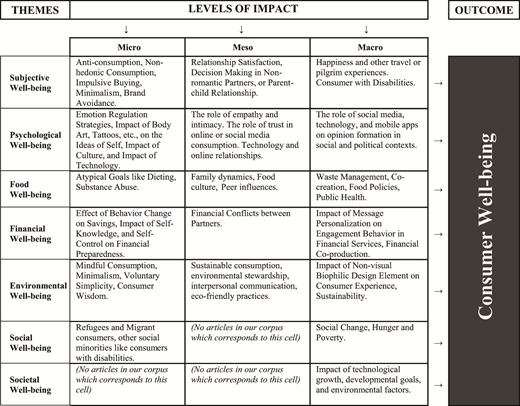
Finally, we use the two-dimensional CWB matrix to highlight the future research directions of the corresponding cells (Table 5).
Notes
Please note that social well-being and societal well-being (discussed below) are two different themes of CWB research, while the societal level refers to the broadest level at which CWB impacts, that is, at the level of a person’s society.
Biophilia refers to the human tendency to interact with or be closely associated with other forms of life in nature.
References
Supplementary material
The supplementary material for this article can be found online.

