

1-20 of 689
Keywords: Modelo SOR
Close
Follow your search
Access your saved searches in your account
Would you like to receive an alert when new items match your search?
Journal

Spanish Journal of Marketing - ESIC covers all international markets not necessarily just the Spanish market.
Journal Articles
Journal:
Spanish Journal of Marketing - ESIC
Spanish Journal of Marketing - ESIC 1–19.
Published: 03 July 2026
in Exploring how creative advertising and financial well-being shape online impulse buying: new insights from consumer psychology in emerging markets
> Spanish Journal of Marketing - ESIC
Published: 03 July 2026
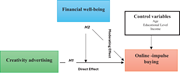
Figure 1. Research model A conceptual model shows relationships among creativity advertising, financial well-being, online impulse buying, and control variables. The model links creativity advertising to online impulse buying through a direct effect labelled H 1. Financial well-being appears a... More about this image found in Research model A conceptual model shows relationships among creativity a...
in Exploring how creative advertising and financial well-being shape online impulse buying: new insights from consumer psychology in emerging markets
> Spanish Journal of Marketing - ESIC
Published: 03 July 2026
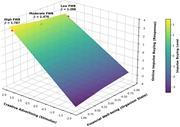
Figure 2. Interaction effect of creative advertising and financial well-being ( FWB ) on online impulse buying Note(s): Slopes are plotted at three levels of FWB: low (−1 SD ), moderate (Mean) and high (+1 SD ). All slopes are statistically significant at p < 0.001. The steeper gradient at high FWB indicates a stronger stimulus–response relationship, supporting the S–O–R framework, where β represents the standardized regression coefficient. The effect of financial well-being is cumulative and continuous; as the consumer’s financial situation improves, their responsiveness to creative advertisements increases gradually and steadily A three-dimensional surface plot shows online impulse buying across creativity advertising and financial well-being. The plot presents creativity advertising on the horizontal axis, financial well-being on the depth axis, and online impulse buying on the vertical axis. A colour scale ranges from about negative 3.5 to positive 3.5. The surface rises as creativity advertising increases and declines as creativity advertising decreases. Three annotated points indicate low F W B, beta 1.298, moderate F W B, beta 1.476, and high F W B, beta 1.787. The highest response occurs at high creativity advertising and high financial well-being, while the lowest response occurs at low creativity advertising and low financial well-being. More about this image found in Interaction effect of creative advertising and financial well-being ( FWB )...
Journal Articles
Journal:
Spanish Journal of Marketing - ESIC
Spanish Journal of Marketing - ESIC 1–23.
Published: 10 June 2026
in Playing to win: the impact of gamified loyalty programs in grocery retail
> Spanish Journal of Marketing - ESIC
Published: 10 June 2026
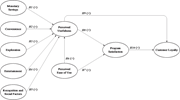
Figure 1. Conceptual model Conceptual model showing factors influencing perceived usefulness, programme satisfaction, and customer loyalty. The conceptual model illustrates relationships among factors affecting customer loyalty through perceived usefulness and programme satisfaction. Monetary ... More about this image found in Conceptual model Conceptual model showing factors influencing perceived ...
in Smart vs traditional hotels: a sentiment analysis investigation
> Spanish Journal of Marketing - ESIC
Published: 09 June 2026
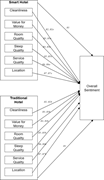
Figure 1. Conceptual framework A hotel sentiment model links smart and traditional hotel features to overall sentiment through hypotheses H 1 to H 7. The model compares smart hotel and traditional hotel features linked to overall sentiment. Each hotel type includes cleanliness, value for money... More about this image found in Conceptual framework A hotel sentiment model links smart and traditional...
in Smart vs traditional hotels: a sentiment analysis investigation
> Spanish Journal of Marketing - ESIC
Published: 09 June 2026
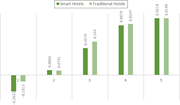
Figure 2. Average sentiment scores by review rating (ranging from 1-star to 5-star) between smart hotels and traditional hotels A bar chart compares smart hotels and traditional hotels across ratings 1 to 5, with values rising from negative scores to about 0.92. The bar chart compares smart ho... More about this image found in Average sentiment scores by review rating (ranging from 1-star to 5-star) b...
in Smart vs traditional hotels: a sentiment analysis investigation
> Spanish Journal of Marketing - ESIC
Published: 09 June 2026
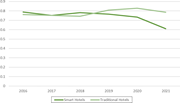
Figure 3. Overall sentiment scores of smart and traditional hotels from 2016 to 2021 A line chart compares smart hotels and traditional hotels from 2016 to 2021, with smart hotels falling to 0.61 and traditional hotels ending near 0.79. The line chart compares smart hotels and traditional hote... More about this image found in Overall sentiment scores of smart and traditional hotels from 2016 to 2021 ...
in Smart vs traditional hotels: a sentiment analysis investigation
> Spanish Journal of Marketing - ESIC
Published: 09 June 2026
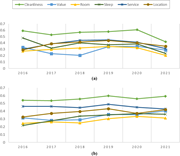
Figure 4. Average sentiments by category from 2016 to 2021 for (a) smart hotels and (b) traditional hotels Two line charts compare hotel feature scores from 2016 to 2021 for cleanliness, value, room, sleep, service and location. The two-line charts are labelled panel a and panel b. Both charts... More about this image found in Average sentiments by category from 2016 to 2021 for (a) smart hotels and (...
Journal Articles
Journal:
Spanish Journal of Marketing - ESIC
Spanish Journal of Marketing - ESIC 1–21.
Published: 09 June 2026
Journal Articles
Journal:
Spanish Journal of Marketing - ESIC
Spanish Journal of Marketing - ESIC 1–22.
Published: 03 June 2026
in The roles of Instagram travel influencers’ expertise and destination brand content aesthetics in fostering positive WOM: a comprehensive model
> Spanish Journal of Marketing - ESIC
Published: 03 June 2026
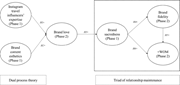
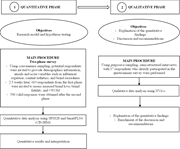
Figure 1. Research model Note(s): Phase 1 captured demographics and responses on influencer expertise, content aesthetics and brand sacredness (n = 619). Phase 2, conducted 2.5 weeks later, assessed brand love, brand fidelity and +WOM (n = 536) Conceptual model linking influencer expertise, content aesthetics, brand love, brand sacredness, brand fidelity, and positive word of mouth. The conceptual model illustrates relationships among Instagram travel influencers’ expertise, brand content aesthetics, brand love, brand sacredness, brand fidelity, and positive word of mouth across 2 research phases. Instagram travel influencers’ expertise and brand content aesthetics are linked to brand love through hypotheses H 1 positive and H 2 positive. Brand love is connected to brand sacredness through hypothesis H 3 positive. Brand sacredness then influences brand fidelity and positive word of mouth through hypotheses H 4 positive and H 6 positive. Brand fidelity also influences positive word of mouth through hypothesis H 5 positive. The framework is divided into sections labelled dual process theory and triad of relationship maintenance. More about this image found in Research model Note(s): Phase 1 captured demographics and responses on i...
in The roles of Instagram travel influencers’ expertise and destination brand content aesthetics in fostering positive WOM: a comprehensive model
> Spanish Journal of Marketing - ESIC
Published: 03 June 2026
Figure 2. Research design Mixed-method research design showing quantitative and qualitative phases, survey procedures, interviews, and data analysis workflow. The workflow diagram presents a mixed-method research design divided into 2 phases: quantitative phase and qualitative phase. The quant... More about this image found in Research design Mixed-method research design showing quantitative and qu...
Journal Articles
Journal:
Spanish Journal of Marketing - ESIC
Spanish Journal of Marketing - ESIC 1–21.
Published: 29 May 2026
in How can C2C secondhand platforms increase sellers’ willingness to pay a membership fee? A uses and gratifications approach
> Spanish Journal of Marketing - ESIC
Published: 29 May 2026
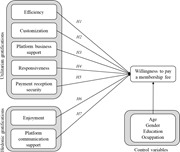
Figure 1. Theoretical model Conceptual framework showing utilitarian and hedonic gratifications influencing willingness to pay a membership fee with demographic control variables. The conceptual framework illustrates factors influencing willingness to pay a membership fee. On the left, Utilita... More about this image found in Theoretical model Conceptual framework showing utilitarian and hedonic g...
in How can C2C secondhand platforms increase sellers’ willingness to pay a membership fee? A uses and gratifications approach
> Spanish Journal of Marketing - ESIC
Published: 29 May 2026
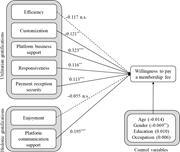
Figure 2. Results of the structural model Note(s): **p < 0.05; ***p < 0.01; n.s: non-significant Empirical model displays significant and non-significant effects of utilitarian and hedonic gratifications on willingness to pay a membership fee. The empirical model presents statistical relationships between utilitarian and hedonic gratifications and willingness to pay a membership fee. Utilitarian gratifications on the left include Efficiency, Customization, Platform business support, Responsiveness, and Payment reception security. Hedonic gratifications include Enjoyment and Platform communication support. Dashed arrows indicate non-significant relationships, while solid arrows indicate significant relationships with coefficient values and significance markers. Efficiency shows a coefficient of minus 0.117, marked as non-significant. Customization shows minus 0.121 with 2 significance markers. Platform business support shows 0.323 with 3 significance markers. Responsiveness shows 0.116 with 2 significance markers. Payment reception security shows 0.113 with 3 significance markers. Enjoyment shows minus 0.055, marked non-significant, while Platform communication support shows 0.195 with 3 significance markers. On the lower right, a Control variables box lists Age, minus 0.014; Gender, minus 0.069 with 2 significance markers; Education, 0.010; and Occupation, 0.006. All variables connect to the central outcome variable, Willingness to pay a membership fee. More about this image found in Results of the structural model Note(s): **p < 0.05;...
Journal Articles
Journal:
Spanish Journal of Marketing - ESIC
Spanish Journal of Marketing - ESIC 1–23.
Published: 26 May 2026
in Wow! you’re so cool! Does anthropomorphism affect brand coolness perceptions?
> Spanish Journal of Marketing - ESIC
Published: 26 May 2026
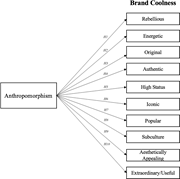
Figure 1. Research framework A diagram showing Anthropomorphism linked by 10 arrows H 1 to H 10 to brand coolness traits such as rebellious, energetic, original, and authentic. The diagram presents a central box labelled Anthropomorphism. Ten arrows extend from this box. Each arrow is labelled... More about this image found in Research framework A diagram showing Anthropomorphism linked by 10 arrow...
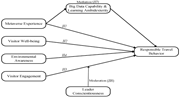
in Sustainable tourism in the age of digitalization: how metaverse, engagement and well-being influence responsible travel choices
> Spanish Journal of Marketing - ESIC
Published: 22 May 2026
Figure 1. Conceptual framework A conceptual framework diagram shows relationships among metaverse experience, visitor well being, environmental awareness, visitor engagement, and responsible travel behavior, with mediation and moderation effects. A conceptual framework diagram presents directi... More about this image found in Conceptual framework A conceptual framework diagram shows relationships ...

