This conceptual article examines how military principles of mission command can be translated to civilian leadership contexts, and how these principles conceptualize intention-based leadership and structured flexibility as a response to VUCA conditions.
Through comparative analysis of six Western military doctrines and a narrative review of contemporary leadership theory, the study develops intention-based leadership as a civilian framework grounded in military mission command principles.
The analysis reveals three conceptual contributions. First, intention-based leadership specifies intent as the active coordination mechanism, not trust alone, but articulated purpose, boundaries, priorities, decision rights, and success criteria. Second, normal accountability is preserved through intent alignment as the evaluative basis, shifting assessment from plan compliance to judgment quality. Third, a dual architecture of centralized strategic intent with decentralized tactical execution operationalizes structured flexibility as a hybrid model bridging heroic and post-heroic paradigms.
The article addresses what Schweiger et al. (2020) identify as a persistent gap; a processual approach to leadership that maintains necessary accountability structures. By specifying the coordination mechanism, accountability basis, and architectural logic of structured flexibility, the framework provides conceptual clarity for implementing post-heroic leadership within formal organizations. A set of propositions are developed for further empirical investigation.
Introduction
The environments in which organizations operate have become markedly more volatile, uncertain, complex, and ambiguous (VUCA), driven by technological disruption, geopolitical instability, climate change, and the aftermath of global crises such as the COVID-19 pandemic (Bennett & Lemoine, 2014; Schoemaker, Heaton, & Teece, 2018). In response, leadership scholarship has increasingly questioned whether conventional leadership approaches remain adequate. While leader-centred, heroic theories have long dominated both research and practice (Khan, Williams, Williams, & French, 2022), scholars argue that the heroic model, premised on the decisive all-knowing individual at the top, is poorly suited to the distributed, fast-moving complexity of contemporary organizations (Schweiger, Müller, & Güttel, 2020). In its place, post-heroic and systemic perspectives conceptualize leadership as a collective, processual phenomenon, emerging from the interactions of multiple actors rather than residing in a single individual (Clifton, Larsson, & Schnurr, 2020; Ryömä, 2020; Uhl-Bien, 2021).
Yet post-heroic leadership theory faces a persistent implementation challenge. Schweiger et al. (2020) identify a critical gap saying that existing processual frameworks struggle to specify how distributed initiative can coexist with the accountability structures that formal organizations require. How can leaders genuinely delegate decision-making authority without abandoning responsibility? How can adaptability be enabled without losing strategic coherence? These questions remain underspecified.
This article proposes that an answer may come from an unexpected source looking to military leadership philosophy. Armed forces have always operated in conditions that closely resemble what we now call VUCA, what Clausewitz (Howard & Paret, 1984) termed the “fog and friction” of war, the irreducible uncertainty and accumulated difficulty that make even simple plans fail on contact with reality. Over two centuries of military thinking, and particularly through the development of mission command as a formal leadership philosophy, Western armed forces have developed a rigorous approach to the problem that post-heroic leadership theory has not resolved when describing how to enable decentralized, adaptive initiative while preserving clear lines of command, intent, and accountability.
Mission command is a philosophy that rests on a fundamental distinction between what must be achieved (the commander’s intent) and how it is achieved (tactical execution, delegated to those closest to the situation). Rather than issuing detailed orders that quickly become irrelevant in fluid conditions, commanders articulate purpose, boundaries, priorities, and desired end state, and then trust trained subordinates to exercise disciplined initiative within that framework. This philosophy, we argue, can be translated into civilian organizational contexts as intention-based leadership, a hybrid model that bridges heroic accountability with post-heroic distribution of initiative.
This translation is not straightforward, and it has not been systematically undertaken. While mission command has attracted some attention outside military settings in business (Yardley & Kakabadse, 2007), software development (Harvie & Agah, 2016), and crisis management (Glomseth & Boe, 2023), a systematic framework connecting its principles to contemporary civilian leadership theory remains underdeveloped. This article addresses that gap through the following two research questions:
How can the leadership principles of mission command be translated to contribute to leadership development in civilian contexts?
How do the principles of mission command conceptualize intention-based leadership and structured flexibility as a response to VUCA conditions?
To address these questions, we conduct a comparative analysis of six Western military doctrines alongside a narrative review of post-heroic and systemic leadership theory. We develop intention-based leadership as a civilian framework grounded in mission command principles and develop four propositions for future empirical testing.
The article is structured as follows. We first examine VUCA as the environmental context for leadership, then review post-heroic and systemic leadership theories to identify and specify the accountability gap that motivates the study. We then trace the historical development of military leadership philosophy, from Clausewitz to contemporary mission command doctrine, before presenting our analytical method and findings. The discussion synthesizes these into intention-based leadership as a model of structured flexibility, before we end with proposing a set of theoretical propositions and implications for practice.
A VUCA world
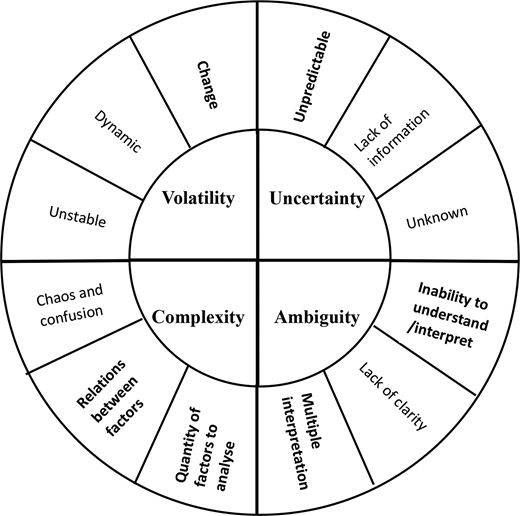
The acronym VUCA was first coined by the US Army War College in the late 1980s (Codreanu, 2016) to refocus from the bilateral conflict of the Cold War to a multilateral global perspective (Whiteman, 1998). It was based on leadership theory (Bennis & Nanus, 1985) and quickly adopted into the business world (Taskan, Junça-Silva, & Caetano, 2022). Although VUCA theoretically represents four distinct types of challenges (Bennett & Lemoine, 2014), Taskan et al. (2022) revealed several overlaps and relationships between the four constructs. Thus, when researchers discuss one of the challenges or constructs of VUCA, it is not always clear what they are referring to. Superficial use of VUCA as a catchphrase undermines its conceptual accuracy (Winkler, Kretschmer, & Wamprechtsamer, 2024). As organizations over the last decades have faced major unexpected, impactful global events, these are fueling the growth and use of the VUCA concept (Millar, Groth, & Mahon, 2018). To enable a precise discussion of VUCA as a context for leadership, we need an unambiguous definition of the concept. We rely on the conceptual map developed by Taskan et al. (2022) that clarifies the content of each sub-element in VUCA (Figure 1 below).
Volatility is about the constant changes in the world.
Uncertainty refers to unpredictability and hence, the inability to foresee situations and events. Complexity relates to the number of interconnected systems, actors, and events within the organization and its external environment.
Ambiguity includes lack of clarity, as well as the inability to understand and interpret conditions or situations.
VUCA – Implications for leadership
Schoemaker et al. (2018, p. 16) argue that “top managers must take a longer view that includes VUCA awareness, or else they may not be prepared when surprising events call for change”. However, how leaders can or should engage with the VUCA challenges is debated. According to Winkler et al. (2024), there are two prominent propositions in this debate. One is the leadership-centered, “one best way” approach. Among the most referred proponents of this approach is Johansen (2012) who argue that the solution to VUCA is what he refers to as “VUCA prime” described in the following way (Johansen, 2012, p. 6): “The negative VUCA can be turned around with effective leadership that follows these principles: Volatility yields vision. Uncertainty yields understanding. Complexity yields clarity. Ambiguity yields agility”. Johansen argues that leaders i) need a daring, future-oriented vision, ii) should use as many information sources as possible to ensure their understanding, iii) should streamline internal structures toward shared visions, and finally iv) foster agility and efficient collaboration between networks of teams, accompanied by a shared entrepreneurial spirit.
In contrast to the leadership-oriented, best-practice recommendations there is the contingency theory approach, which argues that each VUCA challenge requires a situational adapted strategic response that best fits with the prevailing external conditions (Bennett & Lemoine, 2014). In the contingency theoretical based approach, the recommendations for leadership differ markedly from those from the leadership-centered approach:
to tackle volatility, organizations should selectively stack up expertise to be prepared for changes;
uncertainty requires critical analytical skills to recognize significant information and design accountable responses;
to match increased environmental complexity, organizations should increase the organizational complexity; and finally.
increased ambiguity requires more agility through permitting more problem-centered experimentation.
Across both approaches, we see that executives are recommended to emphasize agility, flexibility, and resilience to navigate VUCA environments. According to Millar et al. (2018, p. 12), a big part of leadership in the VUCA world is “the ability to provide ecosystem and network entrepreneurship that is, leading from the front, rather than just reacting to change”.
Leadership theories
Egerton (2025) argues that successful mission command is fundamentally grounded in leadership, making leadership theory essential for understanding the philosophy. The following sections therefore examine heroic and post-heroic leadership theory alongside mission command philosophy to identify parallels enabling a systematic translation to civilian contexts.
Post-heroic leadership theory
Heroic leadership theory perspectives are based on the idea of the leader as “the great man” (Spector, 2016) in the sense that leadership is personified in the individual, and leadership is linked to the leader’s ′power over′ the followers (Kelan & Wratil, 2018). Spector (2016) points to the origins of the heroic leadership perspective through Thomas Carlyle’s (1840) series of six public lectures on the role played by heroes in shaping the arc of history. In contrast, post-heroic approaches conceptualize leadership as a collective, distributed, or ‘power-with’ process (Ryömä, 2020).
Heroic leadership models dominate both theory and today’s practice (Khan et al., 2022). However, it is argued that heroic thinking of the leadership function is increasingly inadequate facing the complexities of modern organizations (Schweiger et al., 2020). Uhl-Bien (2021) contrasts heroic models with complexity leadership theory, arguing that post-heroic approaches are better suited to enable adaptability in complex environments. She emphasizes the need for ‘adaptive space’ and emergence, concepts absent in heroic models. Uhl-Bien (2021, p. 1403) states that a lesson from COVID-19 is that “[…] we must do better in understanding that leadership and followership are a complex social phenomenon of leaders and followers relating together in ways that co-produce leadership and its outcomes”.
A key theme across post-heroic research is the shift from a leader-centered perspective to a social and processual view of leadership (Clifton et al., 2020; Schweiger et al., 2020). This approach emphasizes leadership as an ongoing interaction process involving multiple organizational actors, focusing on adaptability, emergence, and the co-creation of leadership. Post-heroic leadership theories recognize the critical role of followers in co-creating leadership, rather than viewing them as passive recipients of a leader’s influence.
Schweiger et al. (2020) discusses how the development of a more processual understanding of leadership so far is limited. In the need to maintain a self-perception as a clear and decisive leader, one seeks control through an idealized ′heroic image′ of leadership. In contrast, effective leadership in a complex, unpredictable, and ambiguous world becomes possible when we accept that no one can have complexity under control (Schweiger et al., 2020).
While post-heroic leadership is positioned as the antithesis of heroic leadership (Khan et al., 2022), some argue that in practice there is much overlap between the two, with leaders demonstrating both individualistic and shared characteristics (Kelan & Wratil, 2018). Ryömä (2020) explores how these forms of leadership interplay in different contexts, suggesting that both approaches may be relevant depending on the situation.
Cohen (2013) challenges what he claims is a common misconception, that ‘command and control’ necessarily means heroic, order-giving leadership, while post-heroic leadership means surrendering control to those being led. This framing, he argues, is misleading and counterproductive. If post-heroic leadership is understood as surrendering control, it becomes incompatible with the responsibility and accountability that formal organizations require. Cohen’s (2013) corrective is that both heroic and post-heroic leaders can operate within formal authority structures; the distinction lies not in organizational formal structure but in leadership method.
Research indicates that leaders struggle to the challenge of balancing processual leadership ideals with persistent heroic expectations (Clifton et al., 2020; Schweiger et al., 2020). This tension reflects the complex interplay between emerging leadership paradigms and traditional notions of leadership, highlighting the need for a nuanced understanding of leadership in hybrid models in modern organizational contexts.
Systemic leadership
Systemic leadership theories offer particularly relevant insights for understanding leadership as a distributed phenomenon within complex interconnected systems. The literature reveals three distinct streams of research using the notion of systemic leadership, which demonstrates the multidisciplinary nature and varied conceptualizations of systemic leadership. These are systemic leadership 1) at the international system level, 2) in educational systems, and 3) as managing complex business organizations.
The conceptualization and operationalization of systemic leadership diverge significantly in business and organization research literature, while both perspectives have a systemic approach. According to Collier & Esteban (2000, pp. 207–208), post-industrial organizations can be described as “complex adaptive systems”. The pace and complexity of change is characterized by frequent structural changes, new technologies, changing market conditions, environmental challenges, and changes in the social, economic and political environment, often at the same time. The systemic nature of organizations is based on a view of organizations as open systems (Scott, 1998) that recognize their dependence on and influence from their environment, as well as the organizations’ influence on their environment.
When organizations are seen as complex adaptive systems, traditional top-down management struggles to contain complexity, and behavior becomes difficult to control. In such systems, all members of an organization should be seen as accountable to another, and “creating and sustaining relationships of trust has to be a systematic capacity of the entire organization” (Painter-Morland, 2008, p. 510). This systemic trust encompasses what Edmondson (1999) terms psychological safety, a condition that enables members across all levels to exercise judgment, voice concerns, and take initiative without fear of sanction. In literature on systemic leadership, the leadership function is not limited to formal authority structures. Leadership is seen as a collective process, where members are given and take responsibility, and initiative from all participants is valued (Senge & Käufer, 2000). In summary, systemic leadership represents a shift from individualistic, hierarchical models of leadership to more collaborative, relational approaches for addressing complex systemic challenges. It emphasizes developing leader capabilities across entire systems to enable effective collaboration and problem-solving (Collier & Esteban, 2000; Hazy & Uhl-Bien, 2015; Rigg, 2011; Uhl-Bien, Marion, & McKelvey, 2007).
Despite their divergent disciplinary origins and applications, the different conceptualizations of systemic leadership share fundamental characteristics that illuminate its relevance for addressing complexity in contemporary organizations. Systemic leadership consistently emphasizes interconnectedness and mutual influence rather than unidirectional control. This convergence reveals that systemic leadership represents not merely a scaling up of traditional leadership but a qualitative transformation in how we conceptualize influence and agency within complex systems. The commonalities identified suggest that systemic leadership may offer a meta-framework for understanding how leadership functions when complexity, interdependence, and emergent properties become defining characteristics of the operational environment. Yet for all its explanatory power, systemic leadership theory stops short of specifying how distributed initiative can coexist with the accountability structures that formal organizations require – the precise gap that mission command is positioned to fill.
Military leadership philosophies
A historical perspective
War is inherently chaotic and demanding. Military leaders have always had to deal with a complex landscape characterized by uncertainty, unpredictability, rapid change, and continuous adaptation by all participants. Consequently, modern western armed forces have adopted Mission Command as the approach to command and control, that empowers subordinate decision making and decentralized execution appropriate to the situation (AJP-01,01, 2022).
Mission command leadership theory has historical roots in more than 200 years of military philosophy and thinking. The Prussian officer Carl von Clausewitz is known as an influential military thinker, as his seminal treatise Vom Kriege (1816–1823) lies at the heart of modern military doctrines (Huges & Koutsoukis, 2019). Clausewitz understood the conditions of war as fundamentally demanding, leaders are compelled to make consequential decisions under conditions of fog and friction, where information is incomplete and even simple plans encounter significant difficulty in execution (Huges & Koutsoukis, 2019; Karp, 2022). Clausewitz describes the fog of war as the uncertainty inherent in warfare. Fog refers to the lack of clear, accurate information about the enemy, their intentions, and even the situation of one’s own forces (Howard & Paret, 1984). According to Howard & Paret (1984, p.101) Clausewitz noted that “War is the realm of uncertainty; three quarters of the factors on which action is based are wrapped in a fog of greater or lesser uncertainty”.
Friction is the accumulation of difficulties that make even simple tasks in war challenging to execute. Clausewitz states: “Everything in war is very simple, but the simplest thing is difficult. The difficulties accumulate and end by producing a kind of friction that is inconceivable unless one has experienced war” (Howard & Paret, 1984, p. 119). Friction can arise from various sources and describes the myriad small, often unpredictable factors that can impede military operations. Friction can also arise from physical factors (like weather or terrain), human factors such as fear, exhaustion and confusion, or organizational issues like miscommunication or logistical problems. (Howard & Paret, 1984).
Clausewitz argues that fog and friction together make war inherently unpredictable and resistant to rigid theoretical approaches (Howard & Paret, 1984). Clausewitz used the ideas to argue the importance of flexibility and adaptability. He believed that military leaders needed to understand and account for these factors in their planning and execution of military operations. As a response, Clausewitz emphasized the need to view the organization as both a strategic planning level and a tactical execution level (ADP 6–0,0, 2019).
Helmuth von Moltke, Chief of the Prussian General Staff from 1857 to 1888, is known as a significant contributor to the development of theory of leadership in military context. Moltke’s ′Verordnungen für die höhere truppenführer′ (1869) and subsequent writings offered the foundation for Prussian and later German military policies and practice (Hughes, 1993). Moltke expanded upon Clausewitz’s ideas and stated about strategy “[…] all strategic planning hinges solely on tactical success, as only tactical successes could yield favorable outcome” (Hughes, 1993, p. 13). He introduced Auftragstaktik (mission command) as a concept and leadership philosophy in the Prussian army. Moltke understood that detailed operational plans had limited value in the face of mobile warfare, and he emphasized the importance of mission orders as guiding principles for tactical decisions based on situational developments (ADP 6–0,0, 2019). Moltke placed his faith in the ability of Prussian officers to use their education and judgment to adjust to concrete situations as they came up. Auftragstaktik was the basis of German Army practice throughout both the First and Second World Wars. Storr (2003) states that “The Wehrmacht’s ability to generate ad hoc battlegroups from fragments of units, to counterattack strongly even before the precise nature of a threat had been identified, and the tempo its units often demonstrated all indicate a loose, flexible and decentralized”.
Mission command as a military leadership philosophy today
Mission Command philosophy was adopted by the British Army in 1987 and subsequently became a cornerstone of British Joint Doctrine (Storr, 2003). Mission Command as leadership philosophy has been further developed by western armed forces (ADP 6–0,0, 2019; AFDP 1–1,1, 2023; FFOD, 2019), over the past decades, based on experiences from conflicts such as the Falkland Islands, Balkans, Afghanistan, and the Middle East (Maciejewski, 2019; Grant, 2017).
Allied Joint Doctrine (AJP-01,01, 2022) is the NATO overarching doctrine. The doctrine states that: “Mission Command is NATO’s command philosophy; it shapes the command styles, attitudes and behaviors of commanders and subordinates. Mission command offers a significant advantage when applied correctly, enabling the joint force to overcome a rival in the most chaotic and demanding circumstances by maximizing initiative to seize opportunities. (AJP-01,01, 2022, p. 84)
Mission command in leadership research
Civilian research explicitly engaging with mission command or intention-based leadership remains limited. Studies examining autonomy-supportive approaches in education (Fernandez-Salvador, Oney, Song, & Camacho, 2017; Butler, 2022) and adaptive leadership during crises (Glomseth & Boe, 2023; Steen, Haakonsen, & Steiro, 2023) draw on mission command thinking, as do applications in business (Yardley & Kakabadse, 2007), software development (Harvie & Agah, 2016), and policing (Drummond-Smith, 2017). Across these contributions, a consistent theme emerges – decentralized initiative governed by clear intent improves organizational responsiveness in complex, rapidly changing environments.
The concept of intention-based leadership originates primarily from the military philosophy of mission command, particularly in Scandinavian contexts. Steiro & Torgersen (2020) and Antonacopoulou, Moldjord, Steiro, & Stokkeland (2018) describe it as a decentralized philosophy in which personnel understand the why of a mission and exercise independent judgment about the how, within the boundaries of the commander’s intent. Steen et al. (2023) observe that this approach resonates with Scandinavian norms of autonomy and egalitarianism. Despite these contributions, existing civilian engagements with mission command remain partial. They draw selectively on its principles without grounding them in the full body of current doctrine, and they have not explicitly positioned intention-based leadership within the post-heroic and systemic leadership debates where its accountability logic has the most to offer. This article addresses both limitations.
Methodological approaches
This is a conceptual study. Conceptual articles “bridge existing theories in interesting ways, link work across disciplines, provide multi-level insights, and broaden the scope of our thinking” (Gilson & Goldberg, 2015, p.128). Following guidance on conceptual scholarship (Gilson & Goldberg, 2015; Jaakkola, 2020), we used contemporary military doctrines as method-theory to address a domain-theory gap in leadership under VUCA conditions; how to retain accountability while enabling distributed action. Specifically, we linked post-heroic and systemic leadership literatures with mission command principles to develop a civilian translation.
Sources and selection
We combined a narrative review of contemporary leadership theory with a comparative analysis of six current Western mission command doctrines. We chose a narrative review because it is well suited to identifying research gaps and synthesizing literature holistically (Baumeister & Leary, 1997; Ferrari, 2015). The doctrines analyzed are listed in Table 1.
The selected doctrines reflect a historically consistent tradition of mission command thinking across multiple Western nations within NATO, representing a coherent corpus from which to derive principles and preconditions with potential transferability to civilian context. Furthermore, a scoping scan of Web of Science and Google Scholar revealed limited civilian research explicitly labeled “intention/intent-based leadership,” which further justified the doctrinal focus.
Analytical strategy
We used a reflexive thematic analysis approach (Braun, Clarke, Hayfield, & Terry, 2019; Braun & Clarke, 2022) suited for conceptual synthesis rather than frequency-based coding. The steps included:
familiarization with all sources;
targeted extraction and coding of statements on (a) mission-command principles and (b) organizational/individual preconditions;
independent sense-checking by a second author with adjudication of interpretive differences; and
thematic synthesis into aggregate dimensions that inform the proposed structured flexibility model (centralized intent, decentralized execution).
In line with the reflexive analysis method, we emphasized analytical transparency, iterative comparison, and reasoned judgment.
Conceptual plausibility.
Credibility rests on source convergence across multiple doctrines, conceptual fit with established leadership literature (post-heroic, systemic, complexity), and explicit boundary setting. Across the doctrines we find stable agreement on clear intent, delegated decision rights, disciplined initiative, command and control and accountability elements we translate as centralized strategic intent paired with decentralized execution (our structured flexibility). We position the body of doctrines as method theory (Jaakkola, 2020), not as empirical proof, and use leadership theory as domain theory to assess conceptual plausibility and completeness.
Analysis of military doctrines and revealed themes
The analyses of military doctrines outlined three themes summarized in Table 2 below: principles of mission command, organizational conditions and individual conditions for successfully implementing the leadership philosophy. In line with the structure of thematic analysis, these themes coalesced into aggregate dimensions, which “clarify shared aspects of the values or highlight common underlying assumptions” (Wæraas, 2022, p. 164).
Mission command is NATO’s philosophy and framework for commanding military operations, (AJP-01,01, 2022). The purpose is to empower leaders at all levels to accomplish objectives in chaotic and demanding environments where decision-making autonomy is crucial for exploiting opportunities that arise during operations (AJP-01,01, 2022; FGL, 2020). Mission command is not a technique for delegating work but a philosophical commitment to placing decision-making authority where situational understanding is greatest and accepting the risks that come with it (AJP-01,01, 2022; ADP 6–0,0, 2019; AFDP 1–1,1, 2023; ADP Land Operations, 2017; FFOD, 2019).
A clear convergence lies in the relationship between commander’s intent and disciplined initiative. All doctrine treats clear intent as the prerequisite that makes initiative possible, and frames initiative as an obligation rather than merely a privilege.
The Norwegian doctrine states that the philosophy of mission command can encompass detailed orders and control when missions demand it, while emphasizing that such alternation between directive control and decentralized freedom requires training and trust (FFOD, 2019). US Army (ADP 6–0,0, 2019) notes that operations requiring close synchronization may demand more centralized control.
Commander’s intent
Commander’s intent is the foundation for decentralized execution. ADP 6–0 defines it as “a clear and concise expression of the purpose of the operation and the desired military end state” that enables subordinates to “act to achieve the commander’s desired results without further orders, even when the operation does not unfold as planned” (ADP 6–0,0, 2019, pp. 1–10). AFDP 1–1,1 (2023, p. 8) emphasizes conciseness calibrated to trust; “Greater competence and trust enable more concise commander’s intent”. Commander’s intent typically includes three components: the operation’s purpose in relationship to higher commander’s intent, key tasks the force must perform as a whole, and the desired end state (ADP 6–0,0, 2019). AFDP 1–1 stresses that intent should not include what the subordinate can figure out on their own (AFDP 1–1,1, 2023). Understanding commander’s intent at multiple levels enhances unity of effort and supports effective decision-making across the organization (ADP 6–0,0, 2019).
Delegated authority
Delegation of authority is essential for enabling flexibility and responsiveness in complex environments. While commanders can delegate authority, they cannot delegate responsibility. Commanders remain accountable for subordinates’ actions (ADP 6–0,0, 2019). AFDP 1–1,1 (2023, p. 1) identifies decentralized execution through delegated authority as “the hallmark of mission command” that enables “flexibility, initiative, and responsiveness in the accomplishment of commander’s intent”. Effective delegation requires matching authority with responsibility. The approach relies on clear communication, risk acceptance, trust, and well-prepared subordinates capable of adapting to swiftly changing situations (ADP 6–0,0, 2019; ADP Land Operations, 2017). Training and education are necessary at all levels to develop the competence and shared leadership culture required for effective mission command (ADP 6–0,0, 2019).
System of control and command
Mission command encompasses distinct but complementary functions of command and control. Command is “the authority that a commander lawfully exercises over subordinates by virtue of rank or assignment” and involves responsibility, decision-making, and leadership (ADP 6–0,0, 2019, pp. 1–17). Control involves “the regulation of forces and warfighting functions to accomplish the mission” through direction, feedback, information, and communication (ADP 6–0,0, 2019, pp. 1–17). AFDP 1–1 articulates the framework of Centralized Command - Distributed Control – Decentralized Execution (CC-DC-DE) as “the method by which Airmen execute mission command” (AFDP 1–1,1, 2023, p. 1). Centralized command provides responsibility and authority for planning and coordinating operations, promoting effectiveness while supporting unity of command. Distributed control enables delegating authorities to dispersed locations to maintain effective span of control, particularly in contested environments (AFDP 1–1,1, 2023, p. 4). Decentralized execution stems from the premise that “decisions regarding tactical employment are optimized when made by those closest to the fight” (AFDP 1–1,1, 2023, p. 4–5). The Norwegian doctrine emphasizes that decentralized authority does not imply absence of the commander’s overarching responsibility for the mission (FFOD, 2019).
Disciplined initiative
Disciplined initiative requires subordinates to exercise initiative within the boundaries of commander’s intent. ADP 6–0,0 (2019, pp. 1–11) defines it as “the duty individual subordinates have to exercise initiative within the constraints of the commander’s intent to achieve the desired end state”. Critically, subordinates are “required, not just permitted” to exercise initiative when orders no longer apply or when opportunities arise (ADP 6–0,0, 2019).
AFDP 1–1,1 (2023, p. 9) describes this as “the proactive application of inventiveness and creativity when existing orders no longer fit the situation or when unforeseen threats or opportunities arise”. This initiative must be informed by a shared understanding of mission objectives and the broader operational context. The philosophy fosters a culture of creativity throughout the organization, crucial for responding to unforeseen events in complex and dynamic situations (ADP 6–0,0, 2019; FFOD, 2019). Exercising disciplined initiative “provides rigidity within commander’s intent, yet retains flexibility and responsiveness required to gain operational and tactical advantage” (AFDP 1–1,1, 2023, p. 9).
United effort
Understanding commander’s intent at multiple levels enhances unity of effort and supports decision-making across the organization (ADP 6–0,0, 2019). By centralizing strategic planning while decentralizing decision-making authority, mission command enables forces to react rapidly to changing circumstances while maintaining coherence with overarching strategic objectives (AJP-01,01, 2022). AFDP 1–1,1 (2023, p. 8) emphasizes that “shared understanding equips commanders at all levels with the insight and foresight needed to make effective decisions and manage associated risks”. This includes common awareness of the operational environment, organizational competence, and ability to accomplish the mission. The Norwegian Chief of Defense identifies situational awareness, situational adaptability, credibility, resilience, unity, and trustful leadership culture as fundamental prerequisites for effective military leadership (FGL, 2020, p. 14). Mission command relies on mutual understanding of values, attitudes, and shared responsibilities among commanders and subordinates to facilitate effective decentralized execution (AJP-01,01, 2022).
Adaptability
Mission command is fundamentally designed to enable adaptability in uncertain, complex, and rapidly changing environments (AJP-01,01, 2022; ADP 6–0,0, 2019; FFOD, 2019). ADP 6–0 (pp. 1–3) grounds the philosophy in the recognition that “War is inherently chaotic and uncertain. No plan can account for every possibility, and most plans must change rapidly during execution”. The approach does not attempt to impose perfect order but “accepts uncertainty and makes allowances for unpredictability” (ADP 6–0,0, 2019, pp. 1–3). By decentralizing decision-making authority, mission command increases tempo and improves subordinates’ abilities to act quickly in fluid and chaotic situations (ADP 6–0,0, 2019). The nature of the operational context determines the level of detailed orders and control required, necessitating a balance between directive control and decentralized execution (FFOD, 2019; AFDP 1–1,1, 2023). This enables rapid and effective responses to unforeseen events and exploiting opportunities (ADP Land Operations, 2017).
Discussion
The following discussion proceeds in three steps. First, we establish conceptual parallels between military fog and friction and the VUCA framework to investigate similarities between the two. Second, we show how the six principles of mission command operationalize intention-based leadership in civilian contexts. Third, we synthesize these into structured flexibility as a hybrid model and position it against related leadership theories.
From fog and friction to VUCA – Establishing conceptual parallels
The evolution from Clausewitz’s fog and friction to today’s VUCA framework reveals a continuous line in understanding organizational complexity, and share several core characteristics. Both emphasize unpredictability and the absence of clear information, and both recognize that decision-making must account for conditions that cannot be fully anticipated. More specifically, fog corresponds to the uncertainty dimension of VUCA, while friction, the accumulation of difficulties that complicate execution, aligns closely with VUCA’s complexity component.
There are also notable differences. Fog and friction were primarily concerned with immediate operational challenges at the individual and unit level, whereas VUCA encompasses longer-term strategic perspectives and places greater emphasis on organizational and systemic dynamics. VUCA can be understood as a broader and more contemporary framework that builds on the foundational insights of Clausewitz while extending their scope to the organizational contexts in which leaders operate today. Both frameworks converge on the same diagnostic conclusion: conditions of irreducible uncertainty and complexity make rigid, plan-dependent leadership inadequate, and call for adaptive, intent-driven responses.
Mission command as Intention-Based leadership: Bridging heroic and Post-Heroic paradigms
Our analysis reveals that the six principles of mission command provide a framework for operationalizing post-heroic and systemic leadership while maintaining necessary organizational structures. The principle of commander’s intent aligns with both approaches. Subordinates act with the freedom and obligation to interpret and execute within the commander’s articulated vision, enabling decentralized decision-making while preserving unity and collective action.
Delegated authority is a cornerstone of post-heroic leadership. By empowering subordinates to decide and take initiative within the commander’s intent, mission command supports systemic leadership’s emphasis on collaboration and trust, enabling organizations to respond effectively to complex, rapidly changing environments.
The principle of disciplined initiative, grounded in shared understanding across complex systems, reinforces both theories’ emphasis on adaptability and emergence within overall strategic direction. Subordinates are expected to demonstrate creativity and disciplined initiative to maintain operational tempo, fostering the innovation necessary to handle unforeseen events and shifting conditions.
Unified effort ensures that decentralized actions still contribute to overarching organizational goals. This aligns with systemic leadership’s focus on coherence across organizational subsystems and post-heroic leadership’s emphasis on collective action and shared responsibility. Trust and shared understanding of objectives are central to both, resonating with the relational dimensions of post-heroic leadership and the systemic focus on organizational interconnectedness.
Mission command views the organization as an interconnected system spanning strategic and tactical levels, offering a framework for balancing planning and execution. This provides insight into how systemic and post-heroic approaches can maintain coherence while allowing for distributed leadership and adaptability.
Intention-Based leadership: Structured flexibility as a hybrid model
The principles of mission command in military practice bridge perspectives of systemic, post-heroic, as well as heroic leadership theory in a hybrid model of leadership practice. Grounded in systemic and post-heroic thinking of collective, distributed, relational, and process-oriented leadership practice, it simultaneously upholds heroic perspectives of the leader’s responsibility of command and control within the formal structure of the hierarchy of the organization, fulfilling the expectations of authority and accountability implemented through the framework of centralized command-distributed control-decentralized execution. The centralized element of structured flexibility, strategic intent, should not be conflated with heroic centralization of decision-making authority and control. Intent functions as an enabling boundary, not a directive prescription. The leader does not retain authority over method and judgment, but the ongoing obligation to articulate purpose, receive situational feedback, and refine intent as conditions evolve (ADP 6–0,0, 2019; FFOD, 2019). Subordinates are not executors of a leader’s plan, but autonomous sense-makers whose local judgment is institutionally valued and formally authorized, and whose situational experience continuously informs strategic understanding across organizational levels (AJP-01,01, 2022).
Taken together, these findings reveal that effective leadership in VUCA environments requires neither pure hierarchy nor complete distribution, but the structured flexibility that intention-based leadership provides. Compared to the established two perspectives on leadership in VUCA conditions presented earlier, the “best practice” approach and the contingency approach, we find that the structured flexibility bridges the two. Mission command balance between centralized intent and decentralized execution offers a model for maintaining strategic coherence while enabling local adaptation. This addresses the persistent challenge identified by Schweiger et al. (2020) of balancing processual leadership ideas with enduring heroic expectations, and Cohen’s (2013) argument that both heroic and post-heroic leaders can lead within formal structures. The difference lies not in organizational structure but in leadership methods. By reframing mission command as intention-based leadership for civilian contexts, organizations can leverage these military-derived principles to develop more adaptive, collective leadership practices suited to today’s challenging business landscape.
What Intention-Based leadership adds to existing leadership theories
Intention-based leadership shares characteristics with several contemporary leadership theories that address the challenges of complexity and distributed action, yet offers distinct contributions to each. Table 3 provides a structured comparison across four related frameworks, followed by a discussion of what intention-based leadership adds to each.
Distributed leadership
Gronn (2002) reconceptualizes leadership as a group property rather than an individual attribute, proposing distributed leadership as the unit of analysis that best captures “new patterns of interdependence and coordination which have given rise to distributed practice” (p. 423). His central concept “concertive action” describes leadership emerging from conjoint activity when actors develop shared identity and interdependent working forms. Pearce & Conger (2003) extend this by demonstrating how shared leadership improves team effectiveness through mutual influence.
A tension Gronn acknowledges is “leadership is but one part of the total accountability being discharged” by managers (Jaques & Clement, 1995, as cited in Gronn, 2002, p. 424). When leadership is distributed, questions of responsibility and evaluation become diffuse. Structured flexibility resolves this tension by maintaining formal accountability while distributing initiative through explicit intent, specifying purpose, boundaries, priorities, and decision rights that enable decentralized action without dissolving clear lines of command responsibility.
Complexity leadership
Uhl-Bien et al. (2007, p. 305) argue that leadership must shift from bureaucratic control to enabling adaptive capacity, distinguishing administrative, adaptive, and enabling leadership, the latter creating “the adaptive space necessary for the emergence of bottom-up creative solutions”. Revisiting this during COVID-19, Uhl-Bien (2021, p. 1401) observes that effective leadership required balancing “enabling conditions for complex adaptive systems dynamics” with sufficient structure to coordinate responses.
The framework’s emphasis on emergence creates accountability tensions that Schweiger et al. (2020) identify as a persistent adoption barrier. The framework responds to this barrier directly. Rather than leaving the accountability question open, it specifies a dual architecture in which strategic intent is centralized and explicit, while tactical execution is genuinely decentralized. Intent alignment, rather than plan compliance, becomes the basis for evaluation, making distributed adaptive action compatible with institutional accountability.
Adaptive leadership
Heifetz (1994) distinguishes technical challenges, resolved by existing expertise, from adaptive ones requiring new learning and value adjustments. Adaptive leadership involves mobilizing stakeholders to confront difficult realities, “getting people to do adaptive work” (Heifetz & Laurie, 1997, p. 124), by creating holding environments that enable learning and experimentation rather than prescribing solutions.
Adaptive leadership, however, leaves underspecified what leaders should communicate and how autonomous action should be coordinated when solutions are unknown. Intention-based leadership complements this by specifying components of strategic intent, purpose, boundaries, priorities, decision rights, and success criteria that provide a shared cognitive framework for sense-making. This without limiting adaptive responses. Intent articulation supports the holding environment by clarifying why adaptive work matters and within what constraints it should occur.
Psychological empowerment
Spreitzer (1995) identifies four cognitive dimensions; meaning, competence, self-determination, and impact through which employees experience intrinsic motivation. Empowerment is “increased intrinsic task motivation manifested in a set of four cognitions reflecting an individual’s orientation to his or her work role” (Spreitzer, 1995, p. 1443). The model operates at the individual level, assuming organizations increase empowerment primarily by expanding autonomy and improving structural conditions.
The limitation in multi-actor settings is the model’s silence on coordination. How do empowered individuals maintain strategic coherence autonomously? Intention-based leadership retains autonomy and intrinsic motivation while adding the coordination mechanism. Intent functions as both boundary and enabler, specifying which decisions are delegated, on what basis, and toward what purpose. This addresses Schweiger et al.'s (2020) accountability concern. Empowerment without intent specification creates organizational risk; empowerment governed by explicit intent preserves both adaptability and responsibility.
Across all four theories a common pattern emerges. Existing frameworks either distribute initiative without specifying coordination (distributed leadership, empowerment) or enable adaptive capacity without preserving formal accountability (complexity leadership, adaptive leadership). Intention-based leadership addresses both gaps simultaneously through intent as an explicit coordination device and intent alignment as the evaluative basis. This is what distinguishes structured flexibility from related approaches. It does not choose between accountability and adaptability, but specifies the architecture that holds both together.
Practical implications
This article offers principles for navigating the tension between distributed leadership ideals and organizational accountability (Schweiger et al., 2020; Clifton et al., 2020). Our contribution translates mission command into a pragmatic stance for civilian organizations: treating intent as the primary coordination mechanism. In practice, this means centralizing what must be achieved and why, while decentralizing how it is achieved (methods, local adaptation, and day-to-day prioritization). The result is structured flexibility, strategic alignment without procedural overload, a workable bridge between the heroic expectations of accountability and the post-heroic, systemic realities of distributed action.
Linked to VUCA conditions, the implications are direct. Volatility (rapid, frequent change) requires a stable reference point; crisp intent and a short set of non-negotiable boundaries keep teams moving in the same direction as circumstances shift. Uncertainty (unknown outcomes) calls for an informed initiative; leaders evaluate judgment under intent rather than plan adherence, protecting thoughtful action when information is incomplete. Complexity (many interdependencies) benefits more from shared visibility than from additional approvals; when goals, dependencies, and outcomes are legible across teams, coordination can rely on interpretation instead of gatekeeping, reducing delay and rework while maintaining coherence. Ambiguity (unclear meaning) elevates sense-making; clarifying purpose and boundaries and helping teams interpret trade-offs, so local decisions converge on the same strategic intent.
In leadership teaching, development and practice, the emphasis shifts from instruction to intent-articulation and interpretation. Leaders move from “do this” to “achieve this purpose within these boundaries,” making explicit components of strategic intent, purpose, boundaries, priorities, decision rights, and success criteria, and using them to frame performance as a judgment under intent, not mere plan compliance.
At the organizational level, decision allocation should be explicit, documented, and matched to the capability. Some decisions remain centralized (overall strategy, resource allocation, core values, major risks, and cross-functional coherence), while others are decentralized (implementation methods, situational/customer responses, daily prioritization, process improvements, and local innovations). Premature decentralization without sufficient competence creates chaos, regardless of the clarity of intent.
Coordination follows intent rather than control. Instead of approval chains and detailed supervision, intention-based coordination relies on the regular reinforcement of intent (are we aligned?), lateral visibility (what are other teams doing?) and clear escalation rules (when to consult versus deciding locally). This shifts leadership efforts from directing tasks to enabling sense-making and clarifying boundaries.
Finally, boundary conditions are important to keep in mind. Intention-based leadership fits best when work is dynamic, expertise is distributed, and timing is critical. In tightly regulated or low readiness settings, organizations may first need to raise prerequisites – competence, shared mental models, and trust – or keep more decisions centralized until readiness improves.
Theoretical development, limitations and future research
In evaluating intention-based leadership against Whetten’s (1989) framework, the What and Why criteria are well addressed. The framework specifies a concise yet comprehensive set of mechanisms and grounds its logic in the organizational demands of VUCA environments. The Who, Where, When criterion, boundary conditions and the applicability of the concept, requires fuller specification.
Intention-based leadership fits best where work is dynamic and non-routine; expertise is distributed, and timing makes sequential approval chains costly. In knowledge-intensive, project-based, or crisis-response organizations, structured flexibility enables coherent decentralized action that neither pure hierarchy nor emergent distribution achieves alone.
The approach carries risks in tightly regulated settings where procedural compliance leaves limited room for interpretive discretion, in low-competence environments where delegated initiative produces fragmentation rather than coordination, and where incentive structures reward individual over collective performance. Three minimum conditions must be present; sufficient distributed competence to exercise judgment within intent, shared mental models of purpose and priorities, and clear escalation norms specifying when local initiative must give way to upward referral.
From these arguments, we propose four propositions for empirical investigation:
Organizations explicitly articulating strategic intent will demonstrate greater adaptive capacity in VUCA environments than those relying on hierarchical control or rule-based coordination.
The effectiveness of intention-based leadership will be moderated by organizational readiness, specifically shared mental models, distributed competence, and psychological safety.
Evaluating subordinates on intent alignment, rather than plan compliance, will increase leaders’ willingness to delegate initiative.
Structured flexibility will mediate the relationship between VUCA conditions and performance, such that centralized intent with decentralized execution outperforms purely hierarchical or purely emergent configurations under high volatility and complexity.
Future empirical work should investigate the four propositions, examining whether and how structured flexibility outperforms alternative configurations across organizational types, industries, and cultural contexts.
Conclusion
This article set out to answer two questions:
How can leadership principles of mission command be translated to contribute to leadership development in civilian contexts; and
How do these principles conceptualize intention-based leadership and structured flexibility as a response to VUCA conditions?
This article has addressed both questions through three conceptual contributions. First, intent functions as the active coordination mechanism in structured flexibility, not a vague appeal to trust or autonomy, but a specified architecture of purpose, boundaries, priorities, decision rights, and success criteria that enables disciplined initiative. Second, this architecture preserves accountability without defaulting to plan compliance: when judgment under intent becomes the evaluative basis, distributed action and institutional responsibility become compatible rather than contradictory. Third, the dual logic of centralized strategic intent paired with decentralized tactical execution offers organizations an implementable operating model, one that neither pure hierarchy nor emergent distribution can provide on its own.
Together, these distinctions constitute structured flexibility, a conceptual bridge between heroic expectations of authority and accountability and the post-heroic, systemic realities of distributed action in VUCA environments. The framework addresses what Schweiger et al. (2020) identify as a persistent gap: a processual approach to leadership that maintains necessary accountability structures.