This paper investigates how participation of internal actors influences financial performance. We analyze how various combinations of strategic activities shape financial performance when involving respectively top management, middle management, and the whole workforce.
We develop a theoretical model using a combinatorial view of the strategy process and practices as entities to examine how specific strategic activities influence financial performance. We have completed a quantitative study with more than 2,100 respondents from private companies located in Denmark. We asked top managers, middle managers and employees about strategy work and financial performance of their companies.
The findings show that combining top management, middle management and workforce participation driven approaches to strategy work have a positive effect on financial performance. The effect grows the more the internal strategy actors participate – just a little when middle managers participate but a lot when also the employees participate in the strategy work. Participation is embedded within the three strategy activities: (1) communicating the strategy across all organizational levels, (2) translating the strategy into action plans at each level, and (3) allocating resources in alignment with strategic priorities.
The study goes beyond the traditional strategy entity or process approach, and uses a combinatory approach of process and practice on strategy work combined with an entity approach. Normally, questionnaires are distributed to top managers when investigating strategy. We included middle managers and employees as respondents, meaning that the questionnaire encompasses all types of actors (strategy champions) that can be part of or influence the strategic work of the organization.
Introduction
Strategy work is about analyzing, formulating and implementing prudent strategic choices made to achieve short and long-term goals, and the overall intention of strategy work is to create sustainable competitive advantages and better performance, especially financially. Strategy work is an iterative process influenced by both past and present activities. It is complex and normally involves many different actors, such as top managers, middle managers, and employees (Mantere, 2005; Friis & Mathiasen, 2025). Traditionally, strategy work has been carried out as a top management process, driven exclusively by the company’s upper echelon (Ansoff, 1965; Chakravarthy & Doz, 1992). The literature has primarily examined the top management approach from both theoretical and empirical perspectives, focusing on how it can best achieve this intention. Strategy research has traditionally been viewed through two perspectives: the content perspective (Ansoff, 1965; Porter, 1985) and the process perspective (Burgelman, 1983; Mintzberg & Waters, 1985). The content perspective places particular emphasis on the role of top management and assumes a high level of confidence in their ability to determine strategic direction making competitive advantage. Research on strategy processes emphasize decision-making and event sequences as the organization (primarily top management) engage in the strategy content over time (Pettigrew, 1992). These two lines of inquiry addresses the WHAT of strategy – focusing on the organization’s scope and positioning within markets – rather than the HOW of strategy formulation and implementation. The process perspective is extended with an approach, where the upper echelon invites the middle management to active participate in the strategy work (Floyd & Wooldridge, 1996) and a third approach is a broader participation where the whole workforce is invited to active participate in the strategy work (Friis, 2012; Mantere, 2005). Involving middle managers and employees in strategy work makes them more likely to develop a sense of ownership and commitment to the proposed initiatives. Empirical findings point to several benefits of participation, including enhanced strategy implementation through stronger commitment (Guth & Macmillan, 1986; Kim & Mauborgne, 2004), improved alignment of sub-unit objectives (Ketokivi & Castañer, 2004), and the facilitation of collective sensemaking (Gioia & Chittipeddi, 1991). At the same time, participation also entails various risks and costs often discussed in the literature as dilemmas (Hautz, Seidl, & Whittington, 2017). This indicates that the organizational benefits are primarily reflected in various qualitative outcomes, yet they have not been directly linked to improvements in financial performance. We address this gap in the strategy literature by incorporating the three approaches to strategy work outlined above and investigating whether a relationship exists between strategic approach and financial performance.
Thus, we examine three approaches to strategy work and how each may contribute to a company’s financial performance:
The traditional top-management approach, focusing on different antecedents and other factors that the top management focus on.
The middle management approach, where middle managers participate actively.
The workforce approach where also employees participate in strategy work.
Based on an extensive empirical study the paper investigates whether significant differences can be observed among the three approaches, and explores the interplay between these approaches by examining three core strategy activities:
communicating the strategy across all organizational levels;
translating the strategy into action plans at each level; and
allocating resources in alignment with strategic priorities.
To assess these dynamics, data were collected from internal strategy actors – top managers, middle managers, and employees – in Danish companies, focusing on their engagement in strategic practices and the perceived impact on financial performance.
We have developed a theoretical model that shows the three different approaches to strategy work: top management, middle management, and workforce approach, where each of the three approaches leads to better financial performance.
Our findings show that combining the approaches have a positive effect on financial performance. The effect grows the more the internal strategy actors participated – just a little when middle managers participate but a lot when also involving the employees in the strategy work. Especially the top management approach and the workforce approach are important as predictors for better financial performance compared to the middle management approach. If the organization combines all three participation approaches, it will predict better financial performance.
This paper is organized as follows: First, we develop the theoretical model of the analysis and describe the statistical methods used in the empirical work. Next, we present the results of the quantitative study and finally, we discuss the findings and make some concluding remarks regarding the impact of strategy work on financial performance.
The model of strategy work
We argue that strategy is evolutionary and temporally recursive, as past realized strategies continually inform and shape present strategy work. At the same time, we recognize that strategy involves deliberate efforts, whether through formal processes, informal interactions, or ad hoc encounters among strategic actors (Hendry & Seidl, 2003; Johnson, Balogun, & Beech, 2010).
Approaches to strategy work
Recent developments in strategy research have shifted attention toward the role of strategy actors and the actual practices involved in strategy work – a perspective commonly referred to as Strategy-as-Practice (SAP) (Whittington, 2006). SAP emphasizes the situated actions of various organizational members engaged in strategy work, moving beyond traditional process perspectives to explore the concrete doings of strategy work and their resultant outcomes (Jarzabkowski & Spee, 2009; Whittington, 2006, 2007). Insights into how top management teams can steer strategic initiatives within organizations highlight the significance of leadership in strategy implementation (Kreutzer, Walter, & Cardinal, 2014; Lovas & Ghoshal, 2000). At the same time, the research in strategic issue management systems provide useful categorization for classifying and responding to various threats and opportunities (Dutton & Jackson, 1987; Scott & Ofori-Dankwa, 2008). Central to the SAP perspective is the recognition of a broader range of actors, who contribute to strategy formulation and implementation (Balogun & Johnson, 2004; Floyd & Wooldridge, 1996; Friis, 2012; Hautz et al., 2017; Mantere, 2005). Organizations are becoming increasingly transparent, which is transforming strategy work by involving a broader range of actors, calling for greater participation and enhanced communication (Whittington, Cailluet, & Yakis-Douglas, 2011). Participation of middle managers and employees in the strategy work has shown to improve both the quality of the strategy itself and its implementation (Balogun & Johnson, 2004; Floyd & Wooldridge, 1996; Friis, 2012; Hautz et al., 2017; Mantere, 2005; Whittington et al., 2011). Research on sense-making, discourses, and narratives underscores the vital role of language and communication in shaping strategic understanding and alignment (Balogun & Johnson, 2004). Expanding the number of actors involved in strategy work enhances the visibility of the strategy and facilitates the internal (and sometimes external) exchange of ideas and knowledge. This involves identifying which internal stakeholders such as middle managers (Balogun & Johnson, 2004) and employees (Mantere, 2005; Friis, 2012) are actively engaged in the process (Whittington et al., 2011). However, broader participation in strategy work does not equate to democratic strategy-making (Stieger, Matzler, Chatterjee, & Ladstaetter-Fussenegger, 2012), as it does not necessarily imply a redistribution of decision-making authority (Whittington et al., 2011). Instead, it represents an alternative approach to strategy work, one that offers potential benefits but also introduces certain risks and costs (Birkinshaw, 2017). These risks and costs primarily highlight different organizational outcomes and challenges associated with participation in strategy processes, rather than being directly linked to financial performance (Jarzabkowski & Spee, 2009; Hautz et al., 2017).
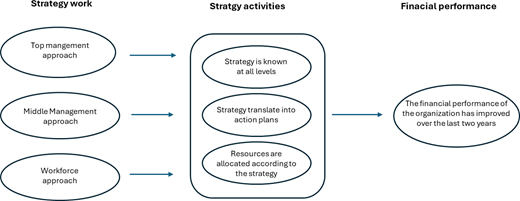
In our model, we draw inspiration from Friis, Holmgren, & Eskildsen (2016) model, where we conceptualize strategy work involving top management, middle management, and workforce each acting as strategy actors, engaging in various strategy practices and activities that ultimately shape realized strategy. We base our model on three strategy approaches:
A top management approach.
A middle management approach.
A workforce approach.
The first approach is the traditional strategy work done by the top management team. The second strategy approach is where top management and middle management participate in the strategy work, and in the third strategy approach the workforce participates alongside the top management and the middle management.
Although strategy work does not always lead to outcomes in a strictly intended manner, it represents a significant investment in managerial attention and carries important symbolic and regulatory functions (Burgelman et al., 2018). According to Burgelman et al. (2018), the purpose of strategy work is “to guide managers in the design of appropriate administrative mechanisms” (p. 539) by focusing on “the practice inside the process” to explain realized strategy. This perspective emphasizes that “activities and processes are closely intertwined,” offering an integrated understanding of how strategy is shaped.
Activities in strategy work
In Burgelman et al. (2018) strategy work is activities such as visualizing a strategic vision, setting objectives and goals, creating action plans, executing those plans, and monitoring both long-term initiatives and day-to-day operations. Numerous activities have been studied, and our model has built upon these previous findings and results. Strategy content research theorizes strategic positions that enable organizations to achieve optimal performance in varying competitive environments (Chakravarthy & Doz, 1992). These positions are commonly referred to as sustainable competitive advantages (Sminia & de Rond, 2012), which may stem from control over critical resources (Finkelstein, 1997) or structural power within organizational networks (Zhu & Westphal, 2021). The importance of strategic planning and control systems has long been recognized (Ansoff, 1965), though their role has been challenged by perspectives on emergent strategy (Mintzberg and Waters, 1958). While these systems have evolved over time, they continue to play a central role in strategy processes (Grant, 2003). Research has shown that effective strategic planning, coupled with strong execution, positively influences financial performance (Joyce, Nohria, & Roberson, 2003). In our model strategic planning is the translation of the strategy into action plans and further prioritizing relevant resources. Effective communication of strategy to stakeholders is critically important, as poor or insufficient communication is a well-documented cause of failure in implementing strategic changes (Alexander, 1991; Giles, 1991; Hrebiniak, 2006). Building on Mintzberg & Waters (1985), we view realized strategy as both a product and a driver of ongoing strategy work. This includes deliberate strategy-making efforts and acknowledges the evolutionary and temporally recursive nature of strategy. As Burgelman et al. (2018:541) note, “the realized strategies of the past feed into the [activities] in the present.” These efforts are carried out through a combination of activities, including data gathering, analysis, and the preparation of reports and presentations, and activities involving more visible interactions such as project meetings, board meetings, workshops, retreats, conferences and ad hoc interactions between decision-makers (Hendry & Seidl, 2003; Jarzabkowski & Spee, 2009; Whittington, 2006). To carry out these activities different strategy practices are used by the actors, and the interplay between actors, practices and activities producing varied organizational outcomes (Jarzabkowski & Spee, 2009), including impact on financial performance (Friis et al., 2016). Burgelman et al. (2018) describe this as a combinatory view in which strategy process and practice are integrated. However, this perspective still needs to be connected to financial performance. We address this by incorporating the entity view, which focuses on identifying “antecedent factors that cause or correlate with strategy and to assess the measurable consequences of strategy” (Tavakolia, Schlagweinb, & Schodera, 2017: 165). We assume that the strategy is formulated by the involved strategy actors and occurs in all three strategy approaches. Having made the content of the strategy, the following strategy activities involve communicating the strategy, prioritizing the needed resources, and making action plans to implement the strategy. Thus, we base our model on three strategy activities:
Communication: the extent to which the strategy is well known at all levels across the organization.
Planning: the degree to which the strategy is translated into action plans.
Resource allocation: the alignment of resource distribution with strategic priorities.
These activities are essential elements of strategy work done by top managers, and with the participation of middle managers, and employees.
Our study explores how these three activities are linked to financial performance. An overview of the model is presented in Figure 1.
As illustrated in Figure 1, strategy work is represented as a process involving the formulation of strategic themes and goals, which are then translated into concrete action plans. The next step is to communicate the strategy and implement it through the execution of the activities outlined in these plans by allocating resources to the organization. Together, these activities form what we consider to be the core of strategy work. These activities can be handled by the top management, and the top management can invite the middle management to participate and lastly the top management can invite both the middle management and workforce to participate. We focus on communication, prioritizing resources and making actions plans, and we investigate how the participation of the three different levels of organizational actors affects financial performance.
Methodology
The data originates from a questionnaire on strategy work in private companies in Denmark. The questionnaire is based on the strategy model developed by Friis et al. (2016) where more strategy perspectives are combined to investigate how organizations work with strategy. The model combines the strategy content and strategy process and strategy as practice perspectives of strategy to explain how organizations perform. The model focuses on two generic tasks:
“WHAT” is related to the strategy content? And
“HOW” the strategy process influences the strategy content?
Based on that model a questionnaire was developed and was pilot tested on 70 respondents and subsequently modified according to the test. The data were collected in a nonstratified and snowballing manner, targeting a very wide array of Danish companies. The respondents were found through a variety of sources comprising a database with almost 50,000 email addresses of top managers, our own personal networks, contacts with different industry organizations, managers among university business classes and university alumni. The questionnaire targeted companies with more than five employees, thus omitting micro-organizations in order to make sure that the size of the organizations would not make it irrelevant to focus on the strategy work of the organization. More than 5,000 questionnaires from approximately 1,700 organizations were returned, yielding a sample of 3,498 questionnaires that were fully completed. While 2,161 responses came from private organizations, public organizations accounted for 1,337 responses. Normally, questionnaires are distributed to specific respondents in organizations, for example, the top managers or the middle managers. Especially, when the research topic is strategy, this is the way it is usually done. In our questionnaire, we have, however, also included employees as respondents, meaning that the questionnaire has been applied to top managers, middle managers and employees. Thus, the questionnaire was sent to respondents at all levels of the organizations in order to encompass all types of actors that can be part of or influence the strategic work of the organization. We understand the respondents in the organization as being strategic champions. Championing activities have been discussed in the strategic management literature and have been seen as a functional role for individuals. This view downplays the individuals who are willing, but unable, to champion issues they find strategically important (Mantere, 2005). We see strategic champions as a social position (Giddens, 1984) where actors interact with social structures (strategy practices) being enabled or thwarted in strategy work. To identify the different strategy champions, the respondents were asked to report on their position at the organization, i.e. top managers, middle managers and employees. Due to a priori bias in the databases and other sources that we used for sending out the questionnaire, the share of top managers and private organizations dominated the set of fully completed questionnaires.
The respondents were asked to form an opinion on the 25 assertions (Friis et al., 2016), indicating on a five-point Likert scale the extent to which they agreed or disagreed (1 = strongly disagree …. 5 = strongly agree, 0=don’t know). These assertions covered a wide array of phenomena reflecting strategy work, comprising five themes from the model (productivity, costumer focus, innovation, execution and culture). As we are interested in the financial performance of organizations (Question 7) following a top management approach, a middle management approach or a workforce participation approach we lensed in on the strategy process questions, especially the questions regarding execution and culture (Question 1 to 6).
In the following, we analyzed the association between the respondents’ impression of the financial performance of their organization and the extent to which they agree or disagree with the following assertions:
Top management is involved in development of the strategy of the organization.
Middle management is involved in development of the strategy of the organization.
Employees are involved in development of the strategy of the organization.
The strategy is generally known at all levels of the organization.
The strategy has been translated into action plans at all levels of the organization.
Resources (competencies, time, IT etc.) have been allocated according to the strategy.
Financial performance is covered by the following assertion:
The financial performance of the organization has improved over the last two years.
Besides that, we also control company size and age, and organizational position in all our statistical models.
Research design
We want to explore the theoretical model we proposed in figure 1 above. In doing so, we rely on regression models and structural equation modeling path analysis. This provides us with some interesting insight into actors at different levels of the organization and connected strategy activities. We parceled the three strategic activities into one construct and calculated the average score per observation, and the construct’s Cronbach’s alpha was measured at .73, which indicates acceptable internal reliability as alpha >0.70 (Cortina, 1993). First, we measured the correlation between our variables of interest. We use pairwise correlation analysis, which is a descriptive statistical technique used to assess the linear association between two variables at a time (StataCorp, 2023). In Stata, this is commonly performed using the pwcorr command, which calculates Pearson correlation coefficients for all specified variable pairs. The method uses pairwise deletion of missing values, meaning that each correlation is computed using all available observations for that specific pair, rather than excluding cases with missing data on any variable as in listwise deletion. This approach can maximize data usage when missingness is not uniform across variables, but it may lead to varying sample sizes across pairs and complicate interpretation (StataCorp, 2023). While pairwise correlations are useful for preliminary analysis – such as detecting multicollinearity among predictors or exploring bivariate relationships, they do not imply causality and should be complemented by multivariate techniques for inferential purposes (Irfan, 2023). Table 1 below shows the correlations between our variables of interest. Table 2 showcases the means and standard deviations for the chosen variables.
Next, we decided to test the relationship between our outcome variable and all of our independent variables using a multiple regression. We used the items and variables from the pairwise correlation analysis. This regression indicates that two key predictors of financial performance, besides firm size (control), are the strategy activities and the top management’s involvement in strategy work. We also explored these regressions regarding the organizational level of the actor. See table 3 below.
Lastly, this study employed structural equation modeling (SEM) to examine the relationships between different strategy approaches on financial performance through the defined set of strategy activities. SEM integrates factor analysis and path analysis, allowing simultaneous estimation of measurement (strategy activities) and structural models (the balanced model) (Kline, 2023; Hair, Black, Babin, & Anderson, 2010). We chose this research design because it enables testing of latent constructs (strategy activities) and their direct and indirect effects on observed outcomes. We conducted our SEM models and postestimation fit scores using the Stata 18 SEM module.
A simple structural equation model refers to a basic application of structural equation modeling that includes a limited number of constructs and relationships. Typically, it involves one latent variable measured by a small set of observed indicators and a few direct paths to an outcome variable. Unlike complex SEM, which may incorporate multiple latent constructs, mediating and moderating effects, or hierarchical structures, a simple SEM focuses on testing a clear and parsimonious conceptual model. The primary advantage of using SEM, even in its simplest form, is that it accounts for measurement errors in latent constructs and estimates both the measurement and structural components simultaneously. This approach provides more accurate parameter estimates compared to traditional regression and allows researchers to evaluate overall model fit using indices such as RMSEA, CFI, TLI, and SRMR. These features make simple SEM particularly suitable when the research objective is to validate a latent construct and assess its direct effect on an outcome while maintaining model simplicity (Hu & Bentler, 1999).
For the SEM path analysis, we used the following variables and constructs. Firstly, the dependent variable was ‘The financial performance of the organization has improved over the last two years. Two observed firm-level characteristics – company size & age, organizational position – were included as control variables.
The key latent construct, strategy activities, was operationalized through three indicators:
Knowledge of strategy across organizational levels.
Translation of strategy into actions at all organizational levels.
Resource allocation aligned with strategy.
The latent construct of strategy activities is our primary predictor of financial performance. Additionally, the structural model included three observed indicators of approaches these are top management, middle management, and workforce.
Measurement model
The measurement model specified strategy activities as a latent factor with three reflective indicators. Factor loadings were estimated using maximum likelihood, with one loading constrained to 1 for identification. The estimated loadings were substantial (e.g., .93 and .90), indicating strong convergent validity (Hair et al., 2010). Reliability and validity were assessed through factor loadings and model fit indices.
Structural model
The structural model tested the theoretical paths from strategy activities to financial performance, controlling for company size & age. The estimated path coefficient from the latent construct of strategy activities to financial performance was positive and significant (β = 0.53, p < 0.001), suggesting that greater strategic participation is associated with improved financial outcomes. Additional paths linked strategy approaches, indicators on the different levels, with strong effects on top management and workforce (β = .44 & .27) and smaller effects on middle management approaches (β = .08). Lastly, we also controlled the actors’ current organizational position.
Estimation and model fit
The model was estimated using maximum likelihood in Stata SEM. The likelihood ratio test indicated a significant difference from the saturated model (χ2(17) = 252.83, p < .001). Model fit was evaluated using multiple indices: RMSEA = 0.077 (90% CI: 0.069–0.086), pclose = 0.000, suggesting a reasonable but not perfect fit. Comparative fit indices were CFI = 0.927 and TLI = 0.870. While CFI exceeds the 0.90 threshold for acceptable fit, TLI falls slightly below, indicating the model may be less parsimonious and could benefit from refinement. SRMR = 0.036, well below the 0.08 threshold, reflects low residuals and a strong fit on this criterion. Information criteria values were AIC = 67837.13 and BIC = 67957.82, which serve as benchmarks for comparing alternative models. Overall, these values indicate an adequate model fit according to conventional criteria (Hu & Bentler, 1999). RMSEA is within the acceptable range (≤ 0.08), CFI suggests good comparative fit, and SRMR indicates excellent residual fit. Finally, the Coefficient of Determination (CD) was 0.573, meaning the model explains approximately 57.3% of the variance in the observed variables. In summary, RMSEA, CFI, and SRMR indicate good overall fit, while TLI suggests some complexity or specification issues. CD confirms that the model captures a substantial portion of variance, supporting its adequacy. Table 4 provides a comprehensive overview of the fit statistics.
Results of our primary theoretical model
Our SEM path analysis was used to explore our proposed theoretical model (Figure 1). The results are depicted in Table 5 below here. The analysis clearly suggests that the three different strategy approaches inform the defined strategy activities differently at each organizational level. Interestingly, the top management and workforce approaches are the strongest predictors of strategy activities. Middle management is also significant for strategy activities; however, this group predicts strategy activities with less statistical power, making the two other groups more vital for them to unfold. Yet, all groups are predicting the strategy activities that then predict a firm’s financial performance. We therefore show that for companies to obtain strong financial performance, it can be done through a strategic configuration of the three strategy activities of knowledge of strategy across organizational levels, translation of strategy into actions at all organizational levels, and resource allocation aligned with strategy, which is strongly affected by top management and workforce approaches. Implications for theory will be discussed below.
Discussion and concluding remarks
The present study argued that the effect of strategy work on financial performance is especially strong when strategy activities occur in combination and that involvement of all the three approaches to strategy work leads to enhanced financial performance. Moreover, our study is one of the few investigating the effects of the theoretically proposed strategy approaches and strategy activities on financial performance. In doing this, our SEM analysis identified three types of strategic work combinations: A top management approach, a middle management approach, and a workforce participation approach, where the strategy activities are communication of strategy throughout the organization, backed by action plans and the allocation of resources. So, following Burgelman et al. (2018) using the combinatory view, we identified three strategy approaches encompassing the three different sets of strategy actors using specific strategy activities, and where the three approaches result in better financial performance. As asked by Tavakolia et al. (2017) we have “zoom out” from the open strategy’s individual component to open strategy as a practice and “zoomed in” on the process focusing on practitioners and practices.
Our analysis implies that each of the three strategy work approaches positively affects the strategy activities, which positively affects the organization’s financial performance. The correlation is strongest for the top management approach, but the middle management approach also leads to better setup of strategy activities, with a much lower coefficient, and lastly, the workforce approach also positively affects the strategy activities with high statistical significance. But especially the top management approach and workforce approach are important as predictors for better financial performance compared to the middle management approach. Of more interest, if organizations combine all three strategy work approaches, it leads to a better set of strategy activities, which in turn leads to better financial performance. So, the best performance happens when middle managers and especially the workforce are included to participate in the strategy work, where they take part in the three strategy activities: communicating the strategy, making the action plans, and allocating the resources according to the strategy. Thus, participation through the three above strategy activities is profitable, and it creates further conceptual clarity in Open strategy research by focusing on strategy activities and actors, not looking at the underlying characteristics of inclusion and transparency (Brielmaier & Friesl, 2023).
We can only speculate how these activities are done, but what matters is how strategy work occurs through combinations of strategy work activities with participation of all three strategy approaches. What we can say is that when considering these three strategy activities as an aggregate dimension, we find that with increasing scores in this combined view, organizations experience better financial performance. Accordingly, our findings extend the findings by Friis (2012), Guth & Macmillan (1986), and Kim & Mauborgne (2004) that participation improves implementation of strategic plans through commitment and collective sense making (Gioia & Chittipeddi, 1991) and, as our analysis shows, also leads to better financial performance. Further, Friis et al. (2016) show that execution is of high importance in relation to the five strategy areas. We extend this finding by showing that execution can have a top management approach, a middle management approach, or a workforce participation approach. Our analysis confirms the existing findings that a top management approach predicts better performance if the strategy activities include communication of strategy throughout the organization, backed by action plans and the allocation of resources. More interestingly, we found that the workforce approach also predicts improved financial performance through stronger strategy activities; the strategy activities combining all three strategy work approaches predict even better financial performance, as it leads to a better understanding of the strategy activities.
Our findings suggest that managers should incorporate participatory practices when designing strategy processes, although we cannot specify exactly which activities should be implemented or how they should be carried out. Such changes are likely to reshape strategy processes in many organizations by involving a broader range of actors in strategic conversations and planning. At the same time, this may generate various dilemmas in the strategy process (Hautz et al., 2017) and increase the need for participatory competencies among managers.
In sum, rather than relying on single case studies or conceptual arguments to suggest that participation is “a good idea,” we draw on a large-scale sample to demonstrate that it is associated with improved profitability.
Future research and limitations
This paper has examined how top management, middle-management, and workforce participative approaches to strategy work relate to financial performance. The findings demonstrate that all three approaches have important implications for the performance and even growing the more internal actors are involved.
The study relies on self-reported perceptions of i.e. financial performance, which, while commonly used in organizational research, may introduce some degree of subjectivity and potential bias. However, the use of confirmatory factor analysis (CFA) and structural equation modeling (SEM) helps to strengthen the measurement and analytical rigor by assessing construct validity and accounting for measurement error. This enhances confidence in the internal consistency and relationships between constructs, even when perceptual data are used. Additionally, the cross-sectional design captures relationships at a single point in time, which limits the ability to draw strong causal conclusions. As such, the findings are best interpreted as indicative of associations rather than definitive causal effects, In this light, while the conclusions are aligned with the empirical results, they should be understood as providing supportive rather than conclusive evidence, and the contribution is therefore more appropriately framed as incremental, offering a basis for further validation through longitudinal or multimethod research designs.
Building on Floyd & Wooldridge (1996) findings, we have added the employees, and given them voice, and following Balogun & Johnson (2004) it will be of interest to extend the research and study the importance of the interplay between middle managers and employee’s participation in the strategy work and the relation to financial performance.
The findings in this study have been built on general questions to our respondents that do not account for the context in which our respondents find themselves. Consequently, our study reflects general tendencies that may appear across a variety of contexts. How strategy activities affect financial performance will, of course, be affected by the context in which they are deployed because contextual factors serve as limitations or enablers for the relationship between strategy activities and financial performance.
For instance, as argued by Vasquez-Bustelo & Avella (2019), positive operational and financial outcomes of high-involvement work activities depend on contingencies such as the extent to which decentralization and teamwork is deployed, the role of job enlargement, how knowledge is shared across the organization and the organization of performance-based compensation. These high-involvement work activities seem to be positively affected by company size and the degree of unionization. Furthermore, the effect of participation is sensitive to how processes of participation are institutionalized. Besides the role of unionization, the layout of performance appraisal systems plays a mediating role, especially if it is transparent, promotes a sense of fairness among employees and is based on clear communication and a high degree of trust across organizational levels (Baird, Tung, & Su, 2020).
Building on these insights, several avenues for future research can advance our understanding of participatory strategy work:
Studies could explore contextual moderators – such as different industries, industry turbulence, or digital maturity to assess under which conditions each approach is most effective.
Longitudinal research designs would allow scholars to investigate how changes in strategy work participation over time shape performance trajectories.
Examining hybrid models that combine elements of top management approach with workforce participation approach may reveal whether such configurations outperform “pure” approaches.
Further research could also broaden the scope of outcomes beyond financial measures by investigating how participatory approaches influence innovation capability, strategic agility, or employee engagement. Another promising line of inquiry concerns the microlevel mechanisms that link participation to performance, including communication patterns, psychological ownership, and learning processes. Additionally, comparative international studies could shed light on how cultural and institutional differences affect the viability of different strategy work approaches. Finally, as digital tools and AI become increasingly embedded in strategic activities, researchers could examine how technology reshapes participation and potentially shifts the balance among top, middle, and frontline actors.
Taken together, these directions underscore the importance of continued research into the dynamics of strategy work. A deeper understanding of when and how different forms of participation enhance organizational performance can help both scholars and practitioners design more effective strategic processes.