Anchored in Self-Determination Theory, this study examines whether and how female entrepreneurs leverage Fintech to build financial resilience and enhance their well-being. Specifically, it argues that autonomy, competence, and relatedness facilitated through Fintech usage strengthen financial resilience, which in turn improves overall well-being.
The study adopts a quantitative research design based on cross-sectional survey data collected from 409 women entrepreneurs in Ghana. Ordinary Least Squares (OLS) regression was used as the primary estimation technique to test the hypothesized relationships. To account for the bounded nature of the dependent variable and strengthen robustness, Tobit regression was conducted as a supplementary analysis. In addition, conditional process analysis (PROCESS macro) was employed to further validate the mediating effect.
The results show that Fintech usage significantly enhances financial resilience among female entrepreneurs, and financial resilience, in turn, positively influences their overall well-being. The findings confirm the mediating role of financial resilience in the Fintech–well-being relationship.
By integrating Self-Determination Theory with inclusive Fintech research, this study contributes theoretically and empirically by demonstrating how access to inclusive financial resources influences entrepreneur well-being through financial resilience. However, the cross-sectional design limits causal inference.
Fintech adoption represents an important policy lever for alleviating financial constraints faced by female entrepreneurs and improving their well-being. Policymakers should promote supportive measures such as enhancing digital infrastructure, improving interoperability, strengthening cybersecurity, and expanding digital literacy. Female entrepreneurs are also encouraged to deepen their engagement with mobile financial tools to better manage risk and enhance resilience.
This study advances the literature by linking Self-Determination Theory with Fintech research to explain how financial inclusion fosters female empowerment and entrepreneur well-being through financial resilience. Drawing on evidence from women entrepreneurs in Ghana, it enriches scholarship at the intersection of gender, Fintech, and entrepreneurship.
1. Introduction
In recent years, the rise of financial technology (fintech) has revolutionized the global financial landscape, offering innovative digital solutions that promise to democratize access to financial resources. Through mobile money platforms, peer-to-peer lending, digital credit scoring, crowdfunding, and InsurTech services, fintech has expanded the reach of financial services beyond the constraints of traditional banking systems. Particularly in developing economies where institutional voids, geographic barriers, and bureaucratic inefficiencies limit access to formal finance, fintech-based inclusive financial resources are increasingly viewed as powerful tools for promoting financial inclusion and economic participation (Bank of Ghana, 2022; GSMA, 2022). By minimizing reliance on traditional banks, reducing transaction costs, saving time, and enhancing financial safety, inclusive financial technologies offer flexible alternatives for underserved populations (Bångens & Söderberg, 2011). Mobile money services have been associated with lower salary administration costs (Blumenstock, Callen, Ghani, & Koepke, 2015), improved access to financing such as trade credit (Beck, Pamuk, Ramrattan, & Uras, 2018), and increased profits for microenterprises, which in turn enhance entrepreneur well-being (Frederick, 2014; Samuel, Shah, & Hadingham, 2005).
While fintech holds transformative potential, its promise of inclusion is especially significant for female entrepreneurs. Entrepreneurship is widely recognized as a key driver of economic growth and innovation, particularly in developing economies. Research increasingly emphasizes female entrepreneurship due to women’s critical role in fostering inclusive development. Female entrepreneurs contribute substantially to household well-being, poverty reduction, and gender equality, serving as role models and helping close the gender gap (Hadizatou, Gueyie, & Chrysostome, 2023; Friedson-Ridenour & Pierotti, 2019; Sequeira, Gibbs, & Juma, 2016). Entrepreneurship also enhances women’s self-esteem, emotional well-being, and professional satisfaction (Mordi, Simpson, Singh, & Okafor, 2010; Constantinidis, Lebègue, El Abboubi, & Salman, 2019).
In Africa, female entrepreneurship is particularly prominent, with women constituting the majority of entrepreneurs (World Bank, 2019). Countries such as Ghana, Botswana, and Nigeria report high rates of women entrepreneurs contributing significantly to economic and social development (Mastercard, 2022). In Ghana, women own 36.5% of businesses, primarily within the Micro, Small and Medium Enterprises (MSMEs) sector, employing about 44% of the total MSMEs workforce and contributing meaningfully to social welfare initiatives (World Bank, 2019; Dzisi & Obeng, 2013). Beyond economic contributions, women generate important social spillovers, investing disproportionately in health, education, and community development (Lepeley, 2017).
Despite these contributions, female entrepreneurs continue to face systemic constraints that undermine both business growth and personal well-being. Financial exclusion remains one of the most persistent barriers. Traditional financial institutions often require collateral, formal credit histories, and established banking relationships-requirements that disproportionately disadvantage women (Ghana Statistical Service, 2021; World Bank, 2019). Female entrepreneurs also confront work-life balance pressures, limited support networks, and institutional constraints that negatively affect their well-being (Panda & Dash, 2016). These challenges are particularly critical because entrepreneur well-being is closely linked to business sustainability and performance (Rauch, Jasny, Schmidt, & Petsch, 2018; Wiklund, Nikolaev, Shir, Foo, & Bradley, 2019). Entrepreneurs prioritize well-being as an indicator of success (Wach, Stephan, Weinberger, & Wegge, 2021), and it shapes entrepreneurial action, decision-making, and motivation (Shepherd & Patzelt, 2015).
Recent scholarship underscores the importance of entrepreneur well-being for business survival and societal stability, especially for female entrepreneurs facing gender-specific barriers (Stephan, 2018; Wiklund et al., 2019; Nikolova-Alexieva, Alexieva, Valeva, & Petrova, 2022). However, women often report lower well-being than their male counterparts due to structural inequalities, resource constraints, work-life imbalance, and cultural norms (Global Entrepreneurship Monitor, 2019; De Neve, Krekel, & Ward, 2018; World Bank, 2019; Brush et al., 2022). Despite its importance, the well-being of female entrepreneurs remains under-researched, particularly in developing economies characterized by institutional voids and limited financial access (Rahman, Taghizadeh, Ramayah, & Alam, 2017b; Murray & Southey, 2017).
Fintech-based inclusive financial resources are increasingly presented as a solution to these structural challenges. Empirical studies suggest that fintech adoption can improve entrepreneurs’ well-being (Arslan, Buchanan, Kamara, & Al Nabulsi, 2022a, Arslan, Golgeci, Khan, Al-Tabbaa, & Hurmelinna-Laukkanen, 2022b; Rahman, Didarul Alam, & Taghizadeh, 2020; Rahman, Khanam, & Nghiem, 2017a). By expanding access to credit, facilitating savings, and enhancing liquidity management, fintech has the potential to strengthen financial stability and entrepreneurial confidence (Kedir & Kouame, 2022; Salampasis & Mention, 2018).
However, evidence regarding the well-being effects of fintech adoption remains inconclusive and theoretically fragmented. While fintech is widely promoted as a tool for empowerment and inclusion, empirical findings do not consistently support its positive impact on entrepreneurs’ well-being. Some studies report that access to financial resources does not significantly improve the well-being of microcredit entrepreneurs (Karlan & Zinman, 2011; Bateman & Loubere, 2019). In certain contexts, fintech adoption may even contribute to over-indebtedness, increased financial stress, cost burdens, and security risks, thereby reducing well-being (Bateman, Duvendack, & Loubere, 2019; Kedir & Kouame, 2022).
These mixed findings reveal three important gaps in the literature. First, existing studies predominantly examine fintech outcomes in terms of financial performance or access, rather than entrepreneur well-being as a multidimensional psychological and socio-economic construct. Second, prior research often assumes a direct relationship between financial access and well-being, overlooking the possibility that access alone may be insufficient to generate sustained psychological benefits. Third, there is limited understanding of how and under what conditions fintech-based inclusive financial resources translate into improved well-being, particularly among female entrepreneurs operating within resource-constrained and institutionally weak environments (Shir, Nikolaev, & Wincent, 2019; Welter, 2011).
These gaps suggest that the relationship between fintech-based inclusive financial resources and well-being is unlikely to be purely direct; instead, it may operate through an intervening mechanism that transforms financial access into adaptive capacity. This study argues that financial resilience, the capacity to absorb, adapt to, and recover from financial shocks, serves as the critical mechanism linking fintech-based inclusive financial resources to the well-being of female entrepreneurs. Drawing on Self-Determination Theory (Ryan & Deci, 2000), we propose that external financial tools enhance well-being only when they are internalized into personal capabilities that foster autonomy and competence. Access to fintech may provide opportunities, but without the development of resilience-building behaviors such as digital savings practices, emergency preparedness, financial confidence, and supportive networks, these opportunities may not translate into enhanced well-being. Financial resilience, therefore, represents the internalized adaptive capacity through which fintech becomes psychologically and economically empowering rather than merely transactional.
By introducing financial resilience as a mediating mechanism, this study addresses the theoretical underspecification and empirical inconsistency that characterize the fintech–well-being literature. It shifts the focus from whether fintech works to how it works, particularly for female entrepreneurs navigating structural constraints in developing economies. In other words, it examines the impact of fintech-based inclusive financial resources on the well-being of female entrepreneurs and investigates the mediating role of financial resilience in this relationship. By unpacking this mechanism, the study contributes to the fintech, gender, and entrepreneurship literature and provides insights into how inclusive financial ecosystems can foster sustainable well-being, equitable economic growth, and poverty reduction in developing economies.
The remainder of the paper is structured as follows. The next section develops the theoretical framework by integrating insights from Self-Determination Theory with the fintech and entrepreneurship literature, leading to the formulation of the study’s hypotheses. This is followed by a description of the research methodology, including the study context, data collection procedures, measurement of variables, and analytical approach. The subsequent section presents the empirical results, after which we discuss the findings in relation to existing literature and theoretical implications. The paper concludes with practical and policy implications, limitations of the study, and directions for future research.
2. Theoretical framework and hypothesis development
Self-Determination Theory (SDT) provides a useful framework for explaining how external resources influence well-being. SDT posits that the satisfaction of three basic psychological needs (autonomy, competence and relatedness) enhances well-being by fostering growth, engagement, and effectiveness (Ryan & Deci, 2000; Deci & Ryan, 2017). When individuals experience control over their decisions (autonomy), confidence in their abilities (competence), and meaningful social connections (relatedness), they are more likely to experience life satisfaction and psychological vitality.
Inclusive financial resources, such as mobile money services, can contribute to the satisfaction of these psychological needs by reducing financial constraints and expanding decision-making capacity (Demirgüç-Kunt & Singer, 2017). Access to digital financial tools enables female entrepreneurs to manage transactions independently, smooth consumption, access credit, and respond to financial demands in a timely manner. This increased financial control may enhance perceived autonomy, while improved access to savings and credit can strengthen competence in managing business and household finances. Furthermore, digital financial platforms may reinforce social connectedness through financial networks and peer-based transactions.
Empirical evidence suggests that inclusive financial resources positively influence psychological and motivational outcomes. Access to financial services has been linked to greater well-being and stronger motivation to invest in businesses, education, and health (Islam, Muzi, & Rodriguez Meza, 2018). Studies by Arslan et al. (2022a, 2022b) and Rahman et al. (2020) show that financial access is associated with increased life satisfaction and reduced stress among entrepreneurs. However, the impact of financial inclusion on psychological well-being is not universally positive and may vary across contexts (Karlan & Zinman, 2011). These variations indicate that access to financial resources alone may not be sufficient to guarantee improved well-being outcomes.
Accordingly, this study proposes that fintech-based inclusive financial resources positively influence entrepreneur well-being by enhancing autonomy, competence, and relatedness:
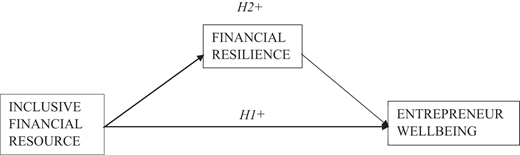
Inclusive financial resource has a positive and significant influence on entrepreneur well-being.
Beyond direct effects, the literature suggests that inclusive financial resources may influence well-being through intermediate pathways. Prior studies indicate that the use of inclusive financial resources, such as mobile money services, affects well-being through multiple channels, including the development of innovative financial products and services that strengthen users’ financial resilience (Cook & McKay, 2015; Francis, Blumenstock, & Robinson, 2017; Koomson, Martey, & Etwire, 2023). Financial resilience refers to an individual’s ability to access and mobilize internal capabilities as well as appropriate, accessible external resources during periods of financial adversity (Salignac, Marjolin, Reeve, & Muir, 2019). It encompasses not only the capacity to recover from shocks (Manyena, 2006; Cutter et al., 2008) but also the ability to adapt and leverage new opportunities created by disruptive technologies such as fintech (Folke, 2006).
Through fintech-based inclusive financial resources, entrepreneurs may build financial resilience in the form of digital savings accumulation, access to digital credit and insurance, the capacity to meet emergency expenses, enhanced financial knowledge, increased confidence, and support from social networks. These resilience-building capabilities strengthen entrepreneurs’ ability to manage uncertainty and financial volatility, which are common in developing economy contexts.
Financial resilience is therefore expected to mediate the relationship between inclusive financial resources and entrepreneur well-being. From an SDT perspective, this mediating process can be explained through internalization, whereby entrepreneurs transform external financial tools into internalized competencies (Ryan & Deci, 2000). As financial resilience develops, entrepreneurs gain greater autonomy in financial decision-making and enhanced competence in managing financial challenges, both central determinants of well-being (Jhamb and Ryan, 2021). For example, the ability to save and access credit digitally enhances financial control, while improved emergency preparedness reduces vulnerability and anxiety (Suri & Jack, 2016). In this way, fintech-based inclusive financial resources become psychologically empowering when they strengthen financial resilience.
Accordingly, this study posits that financial resilience transmits the positive effects of inclusive financial resources onto entrepreneur well-being:
Financial resilience positively mediates the relationship between inclusive financial resource and entrepreneur well-being (Figure 1).
3. Data and method
3.1 Data collection and measures
This study employs primary survey data to test the proposed hypotheses. Data were collected using structured, self-administered questionnaires distributed to female entrepreneurs operating small and medium-sized enterprises (SMEs) in Ghana. The questionnaire captured information on the key constructs as well as respondents’ demographic and business profiles.
The focus on Ghana is appropriate given the central role of SMEs in national economic development, particularly within the informal sector, which provides substantial employment and income opportunities for women (Osei-Boateng & Ampratwum, 2011). Both registered and unregistered SMEs were included to reflect the diversity of the entrepreneurial landscape. Unregistered SMEs, which often lack access to traditional banking services, rely heavily on mobile money for transactions and financial management, highlighting the relevance of financial inclusion and resilience in this context (Aker, Boumnijel, McClelland, & Tierney, 2016). To ensure consistency, SMEs were defined in accordance with the Ghana Enterprise Agency and the Ghana Statistical Service as firms employing at least five individuals and possessing assets not exceeding 10 million Ghanaian cedis. The unit of analysis was the owner-manager, as these individuals are directly involved in financial decision-making and are best positioned to provide insights into the use of mobile money services and the implications of financial inclusion for business operations.
Data were collected between March and July 2023 in selected regional capitals of Ghana. Measurement items were adapted from validated instruments to ensure construct validity. Inclusive Financial Resource (IFR) and Financial Resilience (FR) were measured using 7-item and 5-item scales, respectively, sourced from the World Bank’s Enterprise Survey Questionnaire (Enterprise Survey Questionnaire, 2012). The Enterprise Survey Questionnaire (2012) assesses business conditions and growth constraints in developing economies, including access to finance and business operations. Within this framework, IFR is operationalized as the extent to which entrepreneurs utilize technology-enabled financial tools, particularly mobile money, for business transactions. The adapted 7-item scale captures the frequency of mobile money usage for paying suppliers and employees, covering business expenses, receiving customer payments, making investments, and transferring funds. Financial Resilience (FR) is conceptualized as the entrepreneur’s capacity to withstand and respond to financial shocks. It is reflected in the ability to access emergency financing, accumulate digital savings, obtain digital credit, use digital insurance to mitigate business risks, and maintain revenue stability (Salignac et al., 2019; Manyena, 2006; Cutter et al., 2008; Folke, 2006). Entrepreneur well-being was measured using a 12-item scale adapted from Cummins (1996) and Ryan & Frederick (1997), capturing dimensions of life satisfaction and subjective vitality. Table 1 presents a summary of the study’s constructs, the measurement indicators used to operationalize each construct, and their corresponding sources.
3.2 Sample size
The sample size was determined using Cochran’s (1963) formula for large populations:
where represents the required sample size, corresponds to the 95% confidence level (1.96), denotes the estimated population proportion (0.5 to maximize variability), , and represents the margin of error (0.05). Substituting these values yields:
Thus, a minimum of 384 respondents was required. To account for nonresponse and incomplete questionnaires, 600 questionnaires were distributed. Survey-based research in developing economy contexts, particularly among female entrepreneurs, often experiences nonresponse rates of 30% to 40% due to time constraints, literacy limitations, and reluctance to participate in formal research instruments (Hair, Black, Babin, & Anderson, 2019; Sekaran, & Bougie, 2016). Inflating the distributed sample size is therefore standard practice to ensure adequate statistical power after data cleaning (Creswell, 2014). A total of 409 valid responses were retained, representing a response rate of 68.17%. This exceeds the minimum required sample and provides sufficient statistical power for mediation analysis, supporting the reliability and representativeness of the findings.
3.3 Empirical strategy
This study adopts a two-stage empirical strategy to examine the relationships between inclusive financial resources (mobile money services), financial resilience, and entrepreneur wellbeing among female entrepreneurs in SMEs in Ghana.
In the first stage, Confirmatory Factor Analysis (CFA) was employed to validate the measurement model. CFA was used to assess the reliability and validity of the latent constructs, namely inclusive financial resources, financial resilience, and entrepreneur wellbeing. Specifically, the analysis evaluated factor loadings, composite reliability, and convergent and discriminant validity to ensure that the observed indicators adequately capture their respective theoretical constructs. The use of CFA is appropriate given that the core variables of interest are multidimensional latent constructs measured through multiple survey items. Factor scores derived from the validated measurement model were subsequently computed and used in the regression analysis.
In the second stage, regression techniques were applied to examine the relationships among the validated constructs. Ordinary Least Squares (OLS) regression was used as the baseline estimation method. The use of OLS is justified because the dependent variable, entrepreneur wellbeing, was constructed as a composite index from multiple Likert-scale items and exhibits approximately continuous properties after aggregation. Moreover, the CFA-derived factor scores are treated as continuous variables, making OLS suitable for estimating the magnitude and direction of associations between inclusive financial resources, financial resilience, and wellbeing outcomes.
Finally, to account for the bounded nature of the wellbeing index, a Tobit regression model was additionally estimated as a robustness check. The wellbeing index has defined lower and upper limits, and a proportion of respondents cluster near the upper bound, suggesting potential ceiling effects. In such circumstances, standard linear regression may not fully account for limited dependent variable characteristics. The Tobit specification therefore allows us to test whether the estimated relationships remain consistent when the bounded structure of the dependent variable is explicitly considered.
Formally, the following regression models are used to test the study hypotheses. Three control variables are included across all specifications: AGE (age of the entrepreneur), EDU (educational level), and EXP (managerial experience). These controls were consistently included across all model specifications to account for potential confounding effects that may influence financial resilience and wellbeing outcomes.
To test Hypothesis 1 (Direct effect), the following baseline model is estimated:
where denotes entrepreneur wellbeing for firm; represents inclusive financial resources (measured through mobile money services); captures the age of the entrepreneur; denotes the entrepreneur’s educational attainment; and reflects managerial experience. The term represents the idiosyncratic error term.
To examine the mediating role of financial resilience (Hypothesis 2), a two-step regression procedure is implemented.
Effect of Inclusive Financial Resources on Financial Resilience:
where represents financial resilience and the remaining variables are defined as above.
This equation tests whether inclusive financial resources significantly predict financial resilience.
Joint Effect of Inclusive Financial Resources and Financial Resilience on Well-Being:
This specification evaluates whether financial resilience contributes to entrepreneur well-being when inclusive financial resources are simultaneously included. Evidence of mediation is evaluated sequentially. First, inclusive financial resources must significantly predict financial resilience in Equation (4). Second, financial resilience must significantly predict entrepreneur well-being in Equation (5). Third, the coefficient of inclusive financial resources in Equation (5) is compared with its counterpart in Equation (3). A reduction in magnitude indicates partial mediation, while a loss of statistical significance suggests full mediation.
4. Empirical results and discussion
4.1 Construct validity and reliability
The empirical analysis began with Confirmatory Factor Analysis (CFA) to validate the measurement model (Table 2). CFA was conducted using SPSS AMOS version 23, employing maximum likelihood estimation based on the covariance matrix, in line with recommended procedures (Hair et al., 2019). During model refinement, items with high cross-loadings were removed to improve overall model fit while ensuring that the key domains of each construct were adequately represented. All standardized factor loadings exceeded 0.5, indicating adequate item reliability. Cronbach’s alpha values for all constructs were above 0.7, demonstrating strong internal consistency. Composite reliability (CR ≥ 0.7) and average variance extracted (AVE ≥ 0.5) met recommended thresholds, confirming convergent validity (Fornell & Larcker, 1981).
Model fit was evaluated using established benchmarks (Hair, Black, Babin, & Anderson, 2010), and all indices satisfied recommended criteria (CMIN/DF ≤ 3, GFI ≥ 0.8, PClose > 0.05, TLI ≥ 0.9, CFI ≥ 0.9, RMSEA ≤ 0.08, RMR ≤ 0.08), indicating that the measurement model adequately fits the data.
Content, convergent, and discriminant validity were assessed to ensure measurement rigor. Content validity was established through expert review and pilot testing, following a two-step approach that involved adapting items from established literature (Hong, Lu, & Wang, 2020) and peer evaluation (Hair et al., 2019). Convergent validity was supported by significant factor loadings and AVE and composite reliability values exceeding recommended thresholds of 0.5 and 0.7, respectively (Boso, Story, & Cadogan, 2013; Hong et al., 2020). Discriminant validity was examined using the Fornell-Larcker criterion, whereby the square root of each construct’s AVE exceeded its correlations with other constructs, confirming construct distinctiveness (Fornell & Larcker, 1981; Boso et al., 2013). These procedures collectively enhance the robustness and credibility of the measurement model.
4.2 Common method bias
To address potential common method bias, which can distort relationships between variables when data is collected using a single method (Chen et al., 2019), this study employed both procedural and statistical remedies. Procedural measures included ensuring respondent anonymity, emphasizing that there were no right or wrong answers, and refining questionnaire items to remove ambiguity (Podsakoff, MacKenzie, & Podsakoff, 2012). Statistically, Harman’s one-factor test was conducted through exploratory factor analysis, revealing multiple factors with the first factor accounting for only 18.21% of the variance, well below the 50% threshold, indicating minimal common method bias. Additionally, the Cote & Buckley (1987) CFA-based approach was used, specifying three models: trait-only, method-only, and combined. The results in Table 3 showed that the trait-only and combined models had better fit indices than the method-only model, and the combined model did not significantly outperform the trait-only model, suggesting that common method bias is not a significant concern in this study (Adomako, Danso, Boso, & Narteh, 2018; Lisi et al., 2020). Specifically, the trait-only model (Model 1) yields a χ2/df value of 2.167, which is below the recommended threshold of 3, indicating an acceptable fit. The TLI (0.950) and CFI (0.954) both meet the recommended threshold of 0.95, while the NNFI (0.918) exceeds the minimum acceptable value of 0.90. Additionally, the RMSEA (0.053) and SRMR (0.0524) are below their respective thresholds of 0.08, further confirming the adequacy of the measurement model. In contrast, the method-only model (Model 2) exhibits a very poor fit to the data. The χ2/df ratio is 13.229, which is far above the acceptable threshold. Similarly, the fit indices are substantially below acceptable levels (TLI = 0.439, CFI = 0.493, NNFI = 0.475), while the RMSEA (0.173) and SRMR (0.2014) greatly exceed recommended limits. These results indicate that a single latent factor cannot adequately explain the covariance among the observed variables, suggesting that common method variance is unlikely to account for the observed relationships. Finally, the combined model (Model 3), which includes both the theoretical constructs and a potential method factor, shows a marginal improvement in fit relative to the five-factor model, with χ2/df = 2.021, TLI = 0.953, CFI = 0.960, NNFI = 0.924, and RMSEA = 0.050. However, the improvement in fit is relatively small and does not substantially outperform the five-factor model. Therefore, the five-factor model provides a substantially better fit than the single-factor model, and the inclusion of a common method factor does not significantly improve model fit. This suggests that common method bias is unlikely to be a serious concern in this study.
4.3 Preliminary analysis
Table 4 presents the summary statistics and pairwise correlations among the study variables. Descriptive statistics show relatively high mean scores for EWB (M = 6.089, SD = 0.560), IFR (M = 5.723, SD = 0.933), and FR (M = 5.987, SD = 0.817), indicating generally favorable perceptions among respondents with moderate variability. Among the control variables, experience shows small positive associations with IFR and FR, while age and education exhibit limited relationships with the main constructs. The pairwise correlations indicate that Inclusive Financial Resources (IFR) and Financial Resilience (FR) are both positively and significantly associated with Entrepreneur Well-Being (EWB). Specifically, EWB is moderately correlated with IFR () and FR (), suggesting that greater access to mobile financial services and stronger financial resilience are linked to higher well-being among female entrepreneurs. IFR is also positively related to FR (), providing preliminary support for the proposed mediation relationship. The shared variances among the main constructs are moderate (ranging from approximately 6% to 13%), indicating meaningful but not excessive overlap. Furthermore, the square roots of the AVEs exceed the interconstruct correlations, satisfying the Fornell–Larcker criterion and confirming discriminant validity. Among the control variables, experience shows small positive associations with IFR and FR, while age and education demonstrate limited relationships with the main constructs. Overall, the results suggest that the key variables are positively related yet empirically distinct, supporting further hypothesis testing.
4.4 Regression analysis and hypothesis testing
First, Hypothesis 1 predicts a direct positive effect of Inclusive Financial Resources (IFR) on Entrepreneur Well-Being (EW), controlling for age, education, and managerial experience. The results in Table 5 show that IFR has a positive and statistically significant effect on well-being (β = 0.351, t = 7.448, p < 0.001). The model explains 12.3% of the variance in entrepreneur well-being (R2 = 0.123). These findings provide strong empirical support for Hypothesis 1, indicating that greater use of inclusive financial resources is associated with higher levels of well-being among female entrepreneurs.
Hypothesis 2 proposes that Financial Resilience (FR) mediates the relationship between IFR and EW. When FR is introduced into the model, the explanatory power increases to R2 = 0.209, indicating that 20.9% of the variance in well-being is explained – an increase of 8.6 percentage points relative to the baseline model. In this specification, both IFR (β = 0.281, t = 6.100, p < 0.001) and FR (β = 0.308, t = 6.606, p < 0.001) remain positive and statistically significant predictors of entrepreneur well-being.
Consistent with mediation, the coefficient for IFR decreases from 0.351 to 0.281 following the inclusion of financial resilience, suggesting that part of the effect of inclusive financial resources operates indirectly through financial resilience. To formally test the mediation effect, bias-corrected bootstrapping with 5,000 resamples was conducted using Hayes PROCESS (Model 4). The indirect effect of IFR on EW through FR was positive and statistically significant (indirect effect = [insert value]), with a 95% bootstrapped confidence interval that did not include zero ([LLCI = insert value, ULCI = insert value]). The exclusion of zero from the confidence interval confirms the presence of a statistically significant indirect effect. These results provide robust evidence of partial mediation. Inclusive financial resources enhance entrepreneur well-being both directly and indirectly by strengthening financial resilience. This finding supports Hypothesis 2 and highlights financial resilience as a key psychological and capability-based mechanism linking fintech-enabled financial inclusion to improved well-being outcomes.
4.5 Robustness test results
Both Financial Resilience (FR) and Entrepreneur Wellbeing (EW) were measured using multi-item Likert scales with bounded response options. Consequently, the aggregated scores are constrained by the minimum and maximum possible values of the instrument. This boundedness effectively imposes censoring: the underlying latent construct (e.g., “true” financial resilience or wellbeing) may theoretically extend beyond the observable scale, but all responses are restricted to the scale limits. Observations that would exceed the upper bound are “piled up” at the maximum, creating a right-censoring pattern, while those at the minimum exhibit left-censoring. Tobit regression explicitly models this censoring process, estimating the relationship between predictors and the latent continuous dependent variable while accounting for the probability of boundary censoring (Tobin, 1958; Greene, 2018). This method has been widely applied to bounded welfare indices and Likert-scale outcomes in entrepreneurship and development economics (Muthén, 1989).
The Tobit regression results, presented in Table 6, closely correspond with the baseline OLS estimates obtained using the PROCESS macro (Tables 4), providing additional confidence in the robustness of the findings. In Model 1, the analysis of Inclusive Financial Resources (IFR) on Financial Resilience (FR) reveals a strong positive association, with a coefficient of 0.222 and a t-value of 4.90. Model 2 examines the effect of IFR on Entrepreneur Wellbeing (EW) and demonstrates a continued positive influence, with a coefficient of 0.210 and a t-value of 4.07.
In Model 3, Financial Resilience (FR) is introduced as a mediator alongside IFR, with EW as the dependent variable. Both IFR and FR remain positive and statistically significant predictors of EW. Notably, the coefficient of IFR decreases relative to Model 2 (0.164, t-value: 3.01), while FR exhibits a stronger effect (0.210, t-value: 6.67), suggesting that financial resilience partially mediates the relationship between IFR and EW. The convergence of the Tobit results with the OLS-based estimates reinforces the reliability and credibility of the study’s conclusions, highlighting the complementary roles of inclusive financial resources and financial resilience in promoting entrepreneur wellbeing.
The findings provide robust evidence of a positive relationship between Inclusive Financial Resources (IFR), specifically mobile money services, and Entrepreneur Well-Being (EW) among female SME owner-managers in Ghana. This result both aligns with and extends the literature on financial inclusion and individual well-being. Thus, access to and use of mobile money services appear to satisfy core psychological needs, autonomy, competence, and relatedness, which are foundational to well-being. By increasing control over financial transactions and reducing dependence on informal financial channels, IFR strengthens entrepreneurs’ sense of autonomy and financial agency. This is consistent with Suri & Jack (2016), who show that mobile money adoption (M-PESA) in Kenya enhanced economic well-being among female-headed households by increasing financial independence and decision-making power.
The results are further supported by Aron (2018), who argues that mobile money reduces structural barriers to formal financial services for marginalized populations, including women entrepreneurs. Greater financial inclusion has been consistently associated with improved life satisfaction and subjective well-being (Swamy, 2014; Rahman et al., 2017a). The present findings reinforce this link within the context of female-led SMEs in a developing economy.
Importantly, the results also highlight the psychological benefits of mobile money usage. Participants reported enhanced financial security and reduced financial stress, echoing Jack & Suri (2014), who find that M-PESA users in Kenya were better able to manage financial shocks. The capacity to access, transfer, and store funds quickly strengthens entrepreneurs’ ability to navigate uncertainty, thereby reducing anxiety and enhancing peace of mind. For female entrepreneurs, who often face liquidity constraints and limited access to formal credit, this capability is particularly transformative.
The positive association between IFR and well-being is also consistent with broader research linking technology adoption to life satisfaction. Veenhoven (2010) suggests that technologies that increase efficiency and simplify everyday tasks contribute to improved well-being. As a financial technology innovation, mobile money reduces transaction costs, enhances financial management, and increases operational flexibility, thereby supporting both business performance and personal well-being. Overall, the findings underscore that inclusive financial technologies serve not merely as transactional tools, but as capability-enhancing instruments that promote psychological and economic empowerment among female entrepreneurs.
4.6 Theoretical contributions
This study makes several important theoretical contributions to the literature on financial inclusion, entrepreneurship, and well-being.
First, it extends the financial inclusion literature beyond traditional economic performance metrics by demonstrating that Inclusive Financial Resources (IFR), particularly mobile money services, have meaningful psychological consequences. While prior research has established that mobile money improves income stability and consumption smoothing (Suri & Jack, 2016; Jack & Suri, 2014), less attention has been given to how these financial tools shape entrepreneurs’ subjective well-being. By empirically linking mobile money usage to entrepreneur well-being, this study shifts the focus from financial access as an economic outcome to financial access as a capability-enhancing mechanism that improves lived experiences.
Second, the study advances Self-Determination Theory (SDT) (Deci & Ryan, 2017) within the context of entrepreneurship in developing economies. SDT posits that autonomy, competence, and relatedness are fundamental psychological needs. Our findings suggest that mobile money services support autonomy by increasing financial control, strengthen competence by enhancing entrepreneurs’ ability to manage transactions and shocks, and indirectly reinforce relatedness by facilitating participation in broader economic networks. In doing so, the study situates financial technology as not merely an infrastructural innovation but as a psychological resource that shapes how entrepreneurs experience their work and lives. This deepens theoretical understanding of how economic tools intersect with motivational processes.
Third, and most importantly, this research identifies financial resilience as the mechanism through which inclusive financial resources translate into well-being gains. While previous studies document that mobile money users are better able to manage shocks (Jack & Suri, 2014), the mediating role of financial resilience in explaining well-being outcomes has remained underexplored. By empirically establishing partial mediation, this study clarifies that the benefits of financial inclusion operate not only directly but through strengthened coping capacity – digital savings, emergency liquidity, credit access, and revenue stability. This positions financial resilience as a central explanatory bridge between fintech adoption and psychological outcomes.
Importantly, this contribution humanizes financial inclusion. For female entrepreneurs operating in resource-constrained environments, mobile money is not simply a payment mechanism; it represents security in moments of uncertainty, flexibility in times of opportunity, and dignity in financial decision-making. The ability to respond to shocks without external dependence reshapes how entrepreneurs perceive their agency and stability. In this sense, financial inclusion becomes a source of psychological empowerment, not just transactional efficiency.
Finally, the study contributes to the broader technology and well-being literature (Veenhoven, 2010; Aron, 2018) by demonstrating that digital financial technologies can enhance well-being when they reduce structural barriers faced by marginalized groups. By focusing specifically on female SME owner-managers in Ghana, the study foregrounds gendered dimensions of financial capability and extends entrepreneurship research into contexts where informal constraints remain salient (Swamy, 2014; Rahman et al., 2017a). These contributions reposition inclusive financial technology as a multidimensional development tool, one that enhances economic participation, strengthens resilience, and supports psychological flourishing among women entrepreneurs in emerging economies.
4.7 Policy implications
The findings carry significant implications for policymakers aiming to promote inclusive growth, women’s economic empowerment, and SME sustainability. Financial inclusion strategies should move beyond simple access indicators, such as the number of accounts opened, toward capability-oriented outcomes, particularly financial resilience. The evidence indicates that mobile money enhances entrepreneur well-being not only directly but also by strengthening emergency liquidity, digital savings, and credit access. Accordingly, regulatory and financial frameworks should promote integrated digital financial ecosystems combining payments, savings, microcredit, and microinsurance, rather than standalone transaction platforms. Gender-responsive policies are equally critical, as female entrepreneurs frequently face structural constraints including limited collateral, mobility restrictions, and informal sector exclusion; expanding mobile-based financial infrastructure can reduce these barriers and strengthen financial autonomy. Governments and central banks should therefore incentivize fintech providers to develop tailored products for women-led SMEs, such as low-collateral digital credit, flexible repayment schemes, and embedded financial literacy tools. At the same time, sustained investment in digital infrastructure (reliable mobile networks, affordable data access, and cybersecurity safeguards) is essential to maintain trust and ensure impact. Finally, SME development initiatives should embed fintech adoption within broader entrepreneurship support systems by linking mobile money platforms to tax systems, supplier networks, and public procurement channels, thereby enhancing both business stability and psychological well-being. Inclusive fintech policy should thus be understood not merely as financial sector reform, but as a strategic instrument for resilience-building and human development.
4.8 Practical implications
The study also offers actionable insights for practitioners, including fintech providers, SME support organizations, development agencies, and female entrepreneurs themselves. For fintech providers, the results highlight the importance of designing services that go beyond payment functionality. Entrepreneurs benefit most when mobile money platforms incorporate savings tools, emergency credit lines, revenue tracking, and insurance features. User-centered design that accounts for the realities of female SME owners, cash flow volatility, time constraints, and risk exposure, can deepen both adoption and impact.
For SME support institutions and NGOs, integrating digital financial training into entrepreneurship development programs is critical. Training should focus not only on how to use mobile money, but on how to leverage it strategically for liquidity management, shock preparedness, and business reinvestment. Strengthening digital financial literacy enhances the resilience pathway identified in this study. For financial institutions and impact investors, the findings suggest that mobile transaction histories can serve as alternative credit-scoring mechanisms. Leveraging digital footprints may expand credit access to women entrepreneurs who lack traditional collateral, thereby reinforcing resilience and well-being outcomes. Finally, for female entrepreneurs, the evidence underscores the strategic value of using mobile money as a resilience-building tool rather than solely a transaction medium. Proactive use of digital savings, structured reinvestment, and emergency fund accumulation can buffer shocks and reduce financial stress, contributing to both business continuity and personal well-being.
5. Conclusion
This study examined the relationship between Inclusive Financial Resources (IFR), financial resilience, and entrepreneur well-being among female SME owner-managers in Ghana. The findings demonstrate that mobile money services significantly enhance entrepreneur well-being, both directly and indirectly through strengthened financial resilience. By improving access to digital savings, credit, emergency liquidity, and revenue stability, inclusive financial resources enable women entrepreneurs to better manage financial shocks and reduce uncertainty, thereby improving both business sustainability and psychological well-being.
The study contributes to the literature by moving beyond traditional performance-based assessments of financial inclusion and showing that fintech adoption also has meaningful well-being implications. Drawing on Self-Determination Theory, the findings suggest that mobile money enhances autonomy and competence by increasing financial control and coping capacity. The identification of financial resilience as a mediating mechanism further clarifies how and why inclusive financial technologies translate into improved well-being outcomes.
These findings highlight that inclusive financial technologies function not only as transactional platforms, but as capability-enhancing resources that strengthen resilience, expand agency, and promote the overall flourishing of female entrepreneurs in emerging economies. Strengthening access to and effective use of mobile money services therefore represents a critical pathway toward sustainable SME development and inclusive economic growth.
Despite its contributions, this study has several limitations. First, the cross-sectional design restricts causal inference and limits our ability to fully address potential endogeneity and reverse causality concerns. Although the model is theory-driven and includes relevant controls (age, education, and managerial experience), unobserved factors may still influence the relationships examined. Longitudinal, experimental, or instrumental variable approaches would strengthen causal claims in future research. Second, the focus on female SME owner-managers within a single developing economy context may limit generalizability, suggesting the need for comparative and cross-country studies. Third, inclusive financial resources were operationalized primarily through mobile money usage, leaving other fintech innovations unexplored. Finally, while financial resilience was identified as a key mediating mechanism, additional pathways such as entrepreneurial self-efficacy, social capital, or business performance, may further explain how fintech adoption shapes entrepreneur well-being.
During the preparation of this work, the authors used Scopus AI to screen the relevant literature and ChatGpt 5 for improving language clarity, checking grammar and coding assistance. After using this tool, the authors reviewed and edited the content as needed and take full responsibility for the final version of the manuscript.
Funding
This research received external funding from the National Research Foundation, South Africa.