The study explores the social impacts of a relatively nascent vocational education and training (VET) sector in the European Union microstate of Malta, from a Deweyan econstructionist philosophical position. It explores VET-social inequality complicity theory, or the idea that through a combination of employercentered curricula and systematic convocation of students from low socioeconomic backgrounds, VET acts as a mechanism for the reproduction of social inequality. Publicly available secondary data were collected on socioeconomic markers as well as student body distributions from the 2 largest vocational and academic statesponsored further and higher educational institutions on the Maltese islands. Two main research hypotheses were formulated to test, first, for statistically significant variations in socioeconomic status (SES) across the 6 main national districts, and second, for an association between residence in those districts and propensity to graduate from either a vocational or academic institution. The results showed overrepresentation of VET graduates from low SES districts, supporting the basic tenets of VET-social inequality complicity theory by way of a systematic channeling effect. The results also suggest that further and higher educational outcomes in Malta may be particularly sensitive to property wealth, a disconcerting finding given the tendency for property prices to inflate, potentially causing an ever-widening rift of social inequality. The article goes on to argue that VET institutions in Malta as well as further afield, are falling prey to a surreptitious form of curricular brood parasitism, engendering the need for radical curricular reform
Introduction
Vocational Education in Malta
Malta is a small Mediterranean archipelago with a population of around half a million people. It is classified as a European microstate, having been an official member of the European Union since 2004. Colonization by foreign powers including, among others, the Phoenicians, Romans, Arabs, Normans, and British, meant that Malta operated a fortress economy throughout most of its history. The islands consequently lacked a strong historical guilds tradition, and no significant modern industrial base by the time independence was gained in the 1960s. Organized, large-scale vocational education and training (VET) provision on the islands in its current form can therefore be considered a relatively nascent project.
The newly sovereign Maltese state finally set about constructing an independent industrial base under a socialist government throughout the 1970s, for which a redesigned technical and vocational educational system in state secondary schools would play a key supporting role. Technical and vocational tracks were added to an educational system that had been set up along mainly British/Anglophone lines. The tracked system eventually did not, however, accomplish the lofty goals set out for it (see Sultana, 1997), and vocational tracks were eliminated altogether from compulsory education throughout the 1990s under a conservative/nationalist government. Sultana (1995a, 1995b, 1997) and Baldacchino (1999) have presented detailed and insightful sociological and historical accounts of this period of early VET development on the islands.
In 1999, Malta joined the Bologna process which was dedicated toward increasing standardization among European Union countries in the higher education sector, and VET finally reemerged in its current postsecondary guise in 2001. Since 2015, VET subjects have also started to reemerge in state secondary schools as, according to Cedefop (2017), a response to evolving labor market needs. Malta has been engaged in a steady transition toward a predominantly service-based economy, with food and other essential needs met largely by foreign imports, resulting in a changing employment landscape to which local VET has endeavored to remain responsive. The largest state-sponsored VET provider on the islands is the Malta College of Arts, Science, and Technology (MCAST), and in its capacity as the main embodiment of further and higher vocational education in Malta, constituted the main focal point of this case study.
MCAST has taken the form of a “new,” “modern,” or “technical” university. By offering programs up to European Qualifications Framework level seven, it has challenged the long-standing status of the University of Malta (UM) as the traditional and sole higher education provider on the islands. While Malta’s VET tradition dates back mere decades, UM can trace its roots as far back as the enlightenment era, originally established via papal decree in the late 16th century during the islands’ occupation by the Knights of St John. The two entities have since manifested what could be conceptualized as distinctive vocational and academic tracks in the Maltese further and higher educational sector. It could be said that, in Deweyan terms, the institutions have come to embody and juxtapose in the public consciousness, a series of classic dualisms of vocational and academic, practical and theoretical, or technical and intellectual (Dewey, 2011). The partitioning of vocational and academic tracks into precisely two distinctive, contrasting state-sponsored entities in Malta, combined with their close geographic proximity, represented an enticing opportunity to study the broader effects of VET on society in a clearly delineated and relatively controlled environment.
Given the foregoing general developments in Maltese VET and the broader further and higher education sector, this paper accordingly sets out from a Deweyan reconstructionist position, to explore some of the wider effects of VET on Maltese society, and ultimately contribute toward broader conversations about vocational-general tracking in higher education further afield. Dewey’s reconstructionism, as elaborated specifically in his keystone work Democracy and Education, holds that education has a key role in challenging the socioeconomic status quo, and reconstructing a more just, equitable and truly democratic society (Dewey, 1916/2011). The present study, therefore, was more specifically impelled by a particular interest in the theorized association between VET, and the reproduction of social inequity, using Malta as a case study.
Vocational Education and Social Inequality
While academic prestige is more typically a distinguishing virtue reserved for the traditional or “old” universities, VET institutions are often praised on different grounds. Among their more commonly assigned virtues are generally more inclusive approaches to admissions. In its mission statement, MCAST embraces this type of inclusion, by pledging “universally accessible” VET provision (MCAST, 2021). VET scholars have theorized, however, that championing this particular form of inclusion may constitute tacit complicity in a broader, more pernicious design. It has been argued that VET constitutes an efficient “channeling” system (Wheelahan, 2015), funneling students into a division of labor that reinforces the status quo of inequitable social and economic structures (Clarke & Winch, 2007).
Protsch and Solga (2015) note that in Germany, an oft cited exemplar of good VET organization and relative vocational prestige, vocational institutions have had the effect of “diverting” students from lower socioeconomic backgrounds, away from academic higher education. Protsch and Solga posited that parental attitudes help drive this process, making VET a vehicle for the transmission of socioeconomic status across generations. According to Claus (1990), parents socialize their children according to their own attitudes toward work. Many working class parents tend to have dismissive attitudes toward university education, portraying it as overly theoretical and impractical, or unlikely to pay off in the long run given the investment of time and financial resources required. They instead tend to favor safer, more efficient and direct routes to employment. So as parents dissuade their children from pursuing a university education in favor of more “practical” vocational routes, extant attitudes toward education and work, as well as socioeconomic status (SES) are reproduced, resulting in “recycled” social inequality (Reay, 2012).
In the words of Dewey, VET runs the risk of becoming “an instrument of perpetuating unchanged the existing industrial order of society,” when, under the reconstructionist strands of his philosophy, it could instead be operating as a “means for its transformation” (2011, p. 173). Dewey’s reconstructionism thereby illuminates the central tenets of VET-social inequality complicity theory. The “second chance” concept associated with VET institutions would only genuinely serve the idea and fundamental principles of inclusion, if VET students actually encountered a curriculum that was truly emancipatory and socially transformative. Instead, upon entering the programs into which they have been conveniently channeled, VET students will instead typically encounter “technical” and “practical” training, designed to serve employers’ needs and, according to Claus (1990), foster compliant work attitudes and acceptance of low status employment. “Practical,” “technical,” “hands-on,” “applied,” “professional,” or “workbased” learning all, from this perspective, appear to be euphemisms for what could more aptly be described simply as, employer-centered learning.
Wheelahan (2015) further argued that the “experiential” and applied learning taking place in VET institutions denies students access to the kind of theoretical knowledge that would enable their participation in the important conversations and debates in society, as well as in their own occupational fields. If VET institutions continue to differentiate themselves on the basis of practical application, then access to knowledge is unevenly distributed, and VET institutions perpetuate their role as mechanisms for social inequality. VET institutions appear, in this sense, to have become barnacled by employers in a situation resembling brood parasitism in the wild. Brood parasites are organisms that manipulate others into raising their young, by disguising their eggs as those of the host. In the context of social justice and the systemic internalization of value systems favoring the interests of oppressors, educational institutions have become parasitized into reproducing outcomes that disproportionately serve the interests of employers, via their hijacked curricula. Favorable reports on the positive effects of VET on national economies (Cedefop, 2014), meanwhile, provide additional cursory endorsement of such learning among VET stakeholders (including students themselves), ultimately providing further tacit reinforcement of an inequitable and unjust socioeconomic status quo.
VET-social inequality complicity theory, in short, posits that the reproduction of social inequality can in part be explained by the systematic convocation of students from lower socioeconomic backgrounds, into curricula that promote indenture to employers and the existing industrial order. Under VET-social inequality complicity theory, therefore, we would essentially expect to find two main conditions fulfilled in given VET institutions. We would expect to see, first, a distinctly employer-centered curriculum in place, and second, evidence that students from socially disadvantaged backgrounds are being systematically “channeled” there.
Substantive Approach to the Case Study
In the official MCAST (2019, p. 29) annual report, courses at European Qualifications Framework levels one to three were explicitly described as “second chance programs,” level four as “technical programs,” and levels five to seven as “professional programs.” In its choice of nomenclature, the main VET provider on the Maltese islands clearly celebrates the inclusive notion of “second chances,” as well as the practical/technical sides of Dewey’s dualisms. A distinctive drive toward closer integration with industry and employers is also a prominent theme throughout the latest draft of the college’s new strategic plan for 2022 to 2027 (MCAST, 2021). It is explicitly stated that programs should be guided not by “academic standards”, but instead by responsiveness to the “changing labor market” (p. 11). Work-based learning is to be positioned “at the heart” of all professional and vocational programs (p. 21). When applying VET-social inequality complicity theory to the present case study, therefore, evidence for the first condition of an employer-centered curriculum appears to be a relatively clear and overt feature in official college literature. Evidence for a systematic channeling effect, however, is less conspicuous, and cannot be ascertained without a more careful analysis of empirical data.
According to Cedefop (2017, p. 22), the vocational and academic tracks in Maltese further and higher education have become “compartmentalized,” with little evidence of any significant amount of flexibility or transferability between them. In other words, schoolleavers who attend academic preparatory “sixth-form” colleges will typically progress to higher education pathways at UM, while school-leavers who attend further education programs at MCAST will typically progress to higher education pathways within MCAST itself. Combined with the reintroduction of VET subjects in state secondary schools, a surreptitious channeling structure does indeed appear to be emerging, however, exactly who is being set on each of these pathways, and how these lead to wider socioeconomic outcomes, are as yet unclear.
By comparing and contrasting the main state-sponsored VET provider in further and higher education in Malta, and its main (similarly state-sponsored) non-VET/academic alternative, the present study was designed to test VET-social inequality complicity theory in Malta, with a particular focus on its second condition of a channeling effect. Given that MCAST and UM are the two primary institutional embodiments of VET and non-VET approaches in further and higher education, and act within a relatively small and demarcated community, the Maltese setting represented an opportune case study in its own right, with additional potentially valuable insights for the wider general theoretical land scape of research on VET and society. The small size of the islands, combined with close physical proximity of the institutions in question, also added an element of control. In other words, the key factors influencing whether students attended one institution or the other, in this sense, were more likely to be sociological (rather than geographical) in nature. The substantive basis for the study was further rooted in the convenient segmentation of the Maltese islands into discrete sociogeographical districts used for national statistics purposes.
The Maltese National Statistics Office (NSO) collect important demographic and socioeconomic data which, based on European Union nomenclature and classification convention (NSO, 2020), are organized according to six main districts, comprised by 68 localities (seeTable 1). Since the NSO regularly publishes reports on socioeconomic metrics by district, and the two main further and higher educational institutions also independently publish data on student body distributions by locality in their official annual reports (MCAST, 2019; UM, 2019), it became possible to explore the interactions between SES and MCAST-UM graduation ratios across the six districts. In other words, the compilation of national statistics based around the six official districts in Malta made it possible to compare, in each of those districts, the relationship between high or low SES, and the number of graduations from each institution.
These publicly available data provided the empirical basis for an exploration of the prospective channeling effects implied by VET-social inequality complicity theory. Specifically, they facilitated, first, a clarification of context by testing for significant variations in SES across districts, and second, a means of testing for statistically significant association between district and graduation rates from either MCAST or UM. The study posits that support for the two main research hypotheses would imply VET-social inequality complicity theory is indeed manifesting in Maltese society. More formally stated, the two main research hypotheses were:
H1: There is agreement among independent markers of SES across the six districts.
H2: There is an association between graduates’ district of residence, and their propensity to graduate from MCAST or UM.
Materials and Method
Data Collection
Secondary data for this study were purposively extrapolated from various public sources, namely, the Regional Statistics Malta 2020 Edition (NSO, 2020), L-Universita ta’ Malta 2019 Annual Report (UM, 2019), MCAST Annual Report 2018-2019 (MCAST, 2019), MCAST Tracer Study 2018-2019 (MCAST, 2020), CrimeMalta Observatory (CrimeMalta, 2021) and Property Malta (PropertyMalta, 2021). The resulting variables were operationalized for each district (see Table 2). For all the variables of interest, 2019 was the most recent year for which complete data were available.
Data Analysis
The basic descriptive and test statistics were compiled and calculated manually using LibreOffice Calc (v6.1.6.3) open-source software, on a Linux open-source operating system. The main inferential statistical procedures used in the analysis were Kendall’s W (Field, 2005) and Pearson’s chi-square (McHugh, 2013) for testing concordance and independence in H1 and H2, respectively. In a final round of post hoc testing, Spearman’s ρ (Glasser & Winter, 1961) was also used as a test of rank correlation together with basic interpretations of the descriptive statistics.
For H1, the districts were arranged in ranked lists according to each of the SES markers, namely, mean gross income, mean disposable income, mean property price, unemployment, risk of poverty and crime. The ranked lists for each SES marker were then tested for concordance using Kendall’s W, to see if there was a statistically significant agreement between the various individual SES markers. This would indicate systematic differences in SES by district, establishing context for H2. Kendall’s W was derived using the following equations (Field, 2005).
District d was given rank rd, s according to SES metric s, with n districts and m SES metrics. The total rank given to d was:
With the mean value of total ranks:
And S defined as:
Kendall’s W was calculated as:
For significance testing, χ2 was calculated as follows:
A final overall ranked list for district SES (according to mean ranks for each metric) was also compiled for the purpose of post hoc testing. As constructs, unemployment, risk of poverty, and crime had a negative valence, so the ranking polarity was reversed in these cases to maintain a valid overall ranking.
For H2, the total graduations from MCAST and UM within each district were calculated based on the overall reported graduations (MCAST = 4,415, UM = 3,748), and student body distributions from each institution. The counts were then cross-tabulated by district and institution. A chi-square test of independence was finally run to see if graduations from either MCAST or UM were dependent on district. Pearson’s chi-square statistic (McHugh, 2013) was derived using Equation 6, where O and E were the observed and expected cross-tabulated values, respectively, the former being derived by total reported graduations from each institution, adjusted according to reported student body distributions by district.
For significance testing, a confidence level of 95% (α = .05) was used for the main hypotheses. By ranking the districts according to graduation rates from each of the institutions, comparisons could also be made in a final post hoc analysis, between any two ranked lists, including those sorted by individual SES markers. Spearman’s ρ(Glasser & Winter, 1961) was selected to test correlation between the ranked lists, and was derived using the following equation, (where n was the number of districts, and d the sum of squared differences in ranks):
Given the small post hoc sample size (N = 6), significance for the final rank correlations was assessed according to approximate uppertail critical values of rs (1961, p. 447).
Results of Statistical Analysis
Socioeconomic Conditions by District
Table 3 shows how the six districts ranked according to each of the six individual SES markers, as well as by the mean ranks for all markers combined. Given their derivation from all the markers combined, the mean ranks were taken as indicators of overall SES by district.
Kendall’s W, which was derived using Equations 1 to 5, was used to test the H0 of no agreement among independent markers of SES across the six districts. The evidence was sufficient to reject the null hypothesis that no such agreement exists (W = .52, df = 5, χ2 = 16.61, p < .01). In other words, the SES markers used in this study show significant systematic differences in SES across the six districts. The Western and Southern Harbour districts, respectively, occupied the extreme polarities of the SES spectrum.
The Western district ranked first on every marker except property price, which was highest in the Northern Harbour district. The Southern Harbour district, meanwhile, consistently ranked in the bottom tier on every marker, and lowest overall. The lowest gross income and highest risk of poverty were specifically noted in this area. The findings support traditional conceptions in Malta of a sociocultural North-South divide. In their study of attention deficit hyperactivity disorder (ADHD) incidence across the same Maltese districts, for instance, Role et al. (2019) based their hypotheses on a conceptualized “classical association” between low SES and the Southern Harbour district. Indeed, the authors found an association between residence in the Southern Harbour district, and increased prevalence of attention deficit hyperactivity disorder. In an older study, Camilleri et al. (2010) similarly found increased prevalence of general psychosis in the Harbour regions combined.
The results for H1 basically show that significant differences in SES do exist across the six districts of Malta, with the Southern Harbour district representing the center of low SES overall. In the overall ranking, the Western, Northern, and Northern Harbour districts comprised the upper tier, while the South Eastern, Gozo and Comino, and Southern Harbour districts comprised the lower tier. With the exception of Gozo and Comino, which are separate islands located to the North of the mainland, the situation on the mainland itself would appear to resemble the traditional (though rarely empirically substantiated) notion of a North-South divide. The systematic difference in SES implies a degree of social inequality across the six districts, thereby establishing important context for the interpretation of the results that followed in H2.
Educational Institution Graduations by District
Pearson’s chi-square, which was derived using Equation 6, was used to test the H0 of no association between graduates’ district of residence, and their propensity to graduate from either MCAST or UM. Table 4 shows the cross-tabulation of MCAST and UM graduations by district. The estimated counts are based on total reported graduations in 2019, adjusted according to the student body distributions cited in each institutions annual reports in the same year (operationalized as shown in Table 2). Apart from the main estimates themselves, Table 4 includes the original reported distributions from each institution as percentages (rounded), expected values under the null hypothesis (assuming no systematic effects), as well as the standard residuals. Each standard residual (SR) indicates the magnitude and direction of the difference between estimated and expected values, as well as the degree of contribution toward the overall significant test statistic.
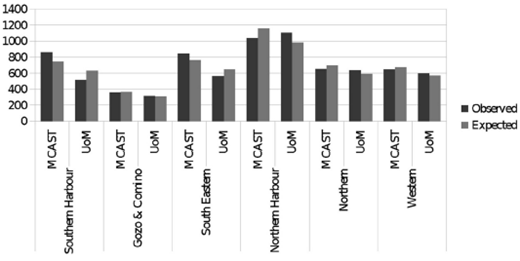
The evidence was sufficient to reject the null hypothesis of no association (χ2= 92.39, df = 5, p < .01). In other words, there was a statistically significant difference in the ratio of graduations from MCAST and UM across districts. Further inspection of the SRs enabled a more meaningful evaluation of the discrepancies in context of the systematic differences in SES previously established in H1. In other words, discrepancies in specific districts became meaningful only when also taking into account their variations in SES, as per the findings of H1.
It was interesting to note, therefore, that the largest variations occurred in the Southern Harbour district, where SES was lowest. The largest effects were underrepresentation of UM graduates (SR = -4.42), and overrepresentation of MCAST graduates (SR = 4.07) in that district. Prior to the launch of MCAST in 2001, Baldacchino (1999) reported an underrepresentation of UM graduates from the traditional working class localities of the Southern Harbour region. The present study therefore indicates that the Southern Harbour UM underrepresentation phenomenon persists to this day, with the difference that MCAST has arrived to “take up the slack” in a prototypical application of the “second chance” function of VET. In short, youths in Malta’s poorest socioeconomic region are significantly more likely to pursue the VET pathway offered by MCAST, than they are to engage in academia at UM.
The discrepancies in representation from the two institutions were therefore interpreted as a substantiation of the hypothesized existence of a channeling effect in Maltese further and higher education. In other words, the situation in Malta would appear to fulfill both conditions of VET-social inequality complicity theory, given that employer-centered curricula are overtly celebrated by the leading VET institution on the islands, and students from the district with lowest SES are overrepresented in such programs. Figure 1 provides a visual representation of the differences between estimated graduation rates and those expected under the null hypothesis (assuming no significant effects).
Post Hoc Analyses
Using Spearman’s Rho rank correlation (as derived using Equation 7), it was possible to further explore the relationship between graduation rates from each institution and individual SES markers. Table 3 originally showed the districts ranked according to each SES marker, while Table 5 shows the districts similarly ranked according to representation of graduates from MCAST and UM, based on the SR values from the chi-square statistics used in H2. These are shown alongside the overall SES ranks for comparison.
An initial visual inspection of Table 5 shows that the majority of MCAST graduations correspond to the districts in the bottom half of the table, while UM graduations correspond to the top half, further reinforcing the hypothesized association between VET and low SES. The post hoc analysis also showed that the factors with the strongest correlation with institution graduation rates (rs = ±.77) were gross income and property price. In other words, the higher the gross income or property price, the lower the propensity to graduate from MCAST, and the higher the propensity to graduate from UM. The sample size by district was very small (N = 6); however, and the results of the rank correlations only provided statistical significance up to the 90% confidence level (rs >.66) according to Glasser and Winter’s (1961) critical values. Closer inspection of graduations by district in H2 according to the SR values, meanwhile, show that UM graduates were overrepresented (SR = 3.91) specifically in the district with highest property prices (Northern Harbour), while MCAST graduates were underrepresented there (SR = -3.60). This suggests that apart from gross income alone, the effects of SES on further and higher educational outcomes in Malta may be particularly sensitive to property wealth.
Disparities in gross income and property price denote income and wealth inequality, respectively. A significant effect of property price on propensity to graduate from either MCAST or UM, would be particularly disconcerting given the general tendency of property values to inflate. Indeed, Adkins et al. (2019) showed how residential property has steadily inflated as a financial asset since the 1990s, grossly out of pace with real wages. Combined with the tendency for “housing wealth” to also facilitate the transmission of SES across generations (Galster & Wessel, 2018), the interaction between property prices and further and higher education outcomes would likely further exacerbate social inequality over time (Fuller et al., 2019).
Discussion of Results and Conclusions
Future studies might investigate the specific link between property wealth and further and higher education outcomes in Malta in some more detail. A more fine-grained study of a sufficiently large sample of individual graduates from each institution would also enable more rigorous exploration of the relationship between VET and low SES independently of district. In other words, we can assume that there are students in every district who will come from either lower or higher socioeconomic backgrounds; the present study cannot resolve this level of detail. What it does show, however, is that despite expected socioeconomic heterogeneity within each district, a trend nonetheless emerges, showing a statistically significant predisposition toward VET among those living in localities with lower average SES.
In the context of existing theory, this trend was taken as evidence of a channeling effect in Maltese further and higher education, whereby students from lower socioeconomic backgrounds are being systematically routed toward vocational education. While this would, at face value, appear to support the idea and general principles of a more inclusive further and higher educational system (the “second chance” concept), the Deweyan reconstructionist position meanwhile calls into question the precise nature of the particular brand of vocational curricula students are being channeled into. Under VET-social inequality complicity theory, current vocational curricula are thought to “recycle” social inequality (Clarke & Winch, 2007; Reay, 2012; Wheelahan, 2015), via “technical” and “practical” training that coaxes learners into pleasing employers and boosting profits. Ultimately, according to Claus (1990), such curricula foster compliant work attitudes in service of employers’ needs. Common VET buzzwords like practical, technical, hands-on, and applied learning appear to have become euphemisms for what can be more accurately termed, employer-centered learning.
Upbeat reports on the healthy effects of VET on national economies (Cedefop, 2014), meanwhile, tend to further bolster public enthusiasm and faith in vocational institutions, reinforcing widespread favorable attitudes toward the employer-centered approaches they commonly adopt and overtly publicize. VET-social inequality complicity theory steps in at this juncture in the interests of social justice, to urge restraint among policymakers in VET, and careful examination of the long-term implications of current curricular approaches on society. In a contemporary global context of widening social inequality, VET becomes an increasingly appealing lifeline for low SES segments of the population captivated by the internalized neoliberal tendency to blame working-class underachievement on the powerless rather than the powerful (Reay, 2012). The practical, safe, and efficient routes to employment promised by VET, in this sense, pose as the best strategy for effective excision of one’s “personal responsibility”. The notion of internalized oppression is particularly pertinent here, as VET institutions have the effect of expediting misguided and unwitting submission to an inequitable and unjust socioeconomic status quo.
David and Derthick (2020) poignantly discuss the comparable “mercury problem” among non-European women suffering the adverse health effects of high mercury content in skin-whitening products. Focusing on the far simpler issue of high mercury content diverts attention away from the real problem of internalized oppression, or in other words, why someone would feel the need to look Whiter in the first place. The apparently acceptable desire to look Whiter, in this sense, is conveniently reduced to the personal choice and responsibility of individuals, negating any need for what would be a far less convenient examination of broader historic and sociopolitical factors well outside the scope of the individual. In a Maltese study of VET students’ own perceptions of vocational learning, Said (2018) showed an apparently clear disapproval among vocational students themselves, of overly theoretical or bookish learning, combined with a preference for practical job-related learning as an efficient gateway to employment. The overriding desire to conform to the existing industrial order, or to be more “employable,” just like the desire to look Whiter, is conveniently omitted from conversations about VET. Curriculum development in VET can thereby become easily misdirected and consumed by relatively superficial reforms, akin to simply adjusting the chemical composition of skin-whitening products.
By directly catering for supplanted and “recycled” attitudes toward education and work, VET institutions become comparable to wild birds victimized by brood parasitism. Just as the common cuckoo bird hijacks the nests, time and resources of warblers to raise their young, VET institutions would appear to be similarly hijacked by the existing industrial order, incubating a parasitic brand of employer-centered learning masquerading as an in vogue and apparently innocuous form of student-centered learning. The reconstructionist roots of VET-social inequality complicity theory, meanwhile, nominate radical curricular reform as a viable antidote to the dominant socioeconomic paradigm, with a view to empowering vocational students to explore alternative, more cooperative socioeconomic models (Guttmann, 2020; Jossa, 2020).
In the context of additional recent developments in Malta, including the reintroduction of VET subjects in state secondary schools in 2015, and the introduction of new legislation in 2014 incentivizing employers to take on more apprentices and interns in return for tax breaks, the main findings of this study render VET-social inequality complicity theory an ominous specter for the long-term socioeconomic health and general well-being of Maltese society. Small states like Malta are known to be particularly susceptible to economic vulnerability and income inequality, according to Brito (2015), due largely to restricted access by a privileged few to external sources of wealth. Socially divisive practices like the systematic channeling effect shown in this study, in this sense, can be considered particularly threatening to economic growth in small countries. Given the current transition toward a service-based economy in Malta, and increasing reliance on foreign imports (Cedefop, 2017), access and control over external sources of wealth can be expected to become limited to an ever-smaller division of privileged elites. Curricular brood parasitism and widening wealth inequality due to inflating property prices, meanwhile, provide added impetus toward a Deweyan remedy of radical curricular reform in local VET, away from employer-centered learning, toward alternative pedagogical approaches that are more socially just, emancipatory, and genuinely student-centered.