

The purpose of this study is to investigate the simultaneous effect of ethical leadership (EL) and corporate social responsibility (CSR) on employees’ turnover intention and examine the mediating mechanism in these relationships.
The authors conducted a field study of 851 employees across a variety of industries. This study applied partial least squares structural equation modelling for hypothesis testing.
The results show that employees’ perceptions of CSR as well as EL are both uniquely and negatively related to turnover intention. The authors also found that employees’ job satisfaction but not commitment, mediates these relationships.
This study answers the recent call (Schminke and Sheridan, 2017) for ethics researchers to put competing explanations to the test to determine their relative importance. Research limitations have been discussed in the paper.
Through providing empirical support for the positive impact of CSR and EL on employee-related outcomes and creating a decent and empowering work environment, this study provides further support for CSR and EL. As CSR and EL require accountability, responsible management and addressing societal well-being of stakeholders, this study can contribute to the United Nations sustainable development goals.
Previous research has found that both employees’ perceptions of supervisory EL and CSR are negatively related to employees’ turnover intentions. Yet, researchers know little about their relative importance because these relationships have not been adequately examined simultaneously.
Introduction
Ethical leadership (EL) and corporate social responsibility (CSR) have been linked to a variety of meaningful outcomes for individuals and organisations (Glavas, 2016a; Ng and Feldman, 2015). What role do EL and CSR play in employee retention? This question is important because of the costs associated with employee turnover including lost human capital, the need to recruit and train new employees and lowered service quality (Allen et al., 2010; Hancock et al., 2013). Previous research has found that CSR (Du et al., 2011; Carnahan et al., 2017; Stewart et al., 2011) and EL (Demirtas and Akdogan, 2015; Palanski et al., 2014) are associated with lower employee turnover, so this might seem like a settled question. However, these studies have not adequately examined both influences simultaneously. Writing about the proliferation of research on ethics-related constructs and their antecedents and consequences, Schminke and Sheridan (2017, p. 244) observed “[…] we know a lot about the many constructs that matter in isolation but very little about which are really most important”. Furthermore:
In some literatures, scholarly interest is so great that scholars tend to explore, then re-explore, then re-explore again the antecedents (or consequences) of particular phenomena […] Each of these factors in isolation can be shown to exert a significant impact. However, when the massing of explanatory constructs reaches a tipping point, we are left in a fog with respect to which antecedents really matter. (pp. 253-254)
To advance our social scientific understanding of whether and how the ethical elements of organisations impact employees, it is essential for ethics researchers to address “isolation proliferation” by putting competing constructs to the test. The proliferation problem occurs not only with antecedents but also extends to the mediators that explain why an antecedent is related to a particular outcome. If EL and CSR are associated with lower employee turnover, what explains these relationships? The literature on EL, CSR and employee turnover suggests a variety of potential mechanisms. Among the many possible personal and work-related factors that contribute to an employee’s intention to leave, job attitudes in general and job satisfaction and employee commitment in particular, are most important across the employee turnover (Brunetto et al., 2012; Stanley et al., 2013), EL (Schwepker and Ingram, 2016) and CSR literatures (Lee et al., 2013). While these factors operate at different levels (CSR at the organisational level and EL at the individual level), both have the potential to positively influence employees’ commitment. In addition, working for an organisation with a strong reputation for CSR and a leader who demonstrates strong EL can create a positive work environment that enhances job satisfaction.
While a recent research has shown that EL has a positive impact on employees’ CSR engagement (Nejati et al., 2019), to the best of our knowledge, only one study has tested the relative importance of EL and CSR on turnover intention (TI) (Lin and Liu, 2017); however, this research study did not look at job satisfaction and commitment as mediating mechanisms. In our research, we set out to answer this question: What is the relative importance of CSR and EL, both directly and indirectly (through job satisfaction, commitment to the organisation and commitment to the leader) in lowering TI of employees? Our proposed model, which is informed by social exchange theory (Blau, 1964) is depicted in Figure 1.
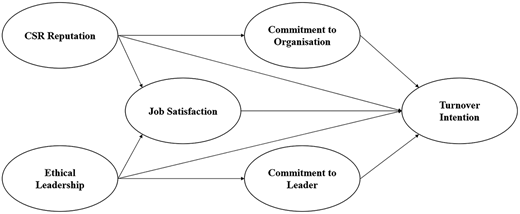
Our study contributes to the EL, CSR and employee turnover literatures in four important ways. First, as noted previously, to the best of our knowledge, previous research has not considered the relationships between EL, CSR, job satisfaction and commitment, and TI within the same study. Although previous research has found that both EL and CSR are important, it is necessary to examine them simultaneously to establish whether each one has unique effects. Second, unlike many other studies on CSR and employee engagement, we focus on employees’ perceptions of their organisations’ CSR efforts, not their personal engagement in CSR activities. This is an important distinction because employees who engage in CSR activities (e.g. participation in company-sponsored volunteering and outreach programs) are more likely to receive benefits from this engagement that boost satisfaction and commitment. Our study considers if simply working for a socially responsible company is tied to higher levels of satisfaction and commitment, and ultimately lower levels of TI. Third, our study can provide additional evidence to the argument that “doing good” can help organisation “do well” in that EL and CSR are not only the right things to do from a normative standpoint but are also smart investments if they maximise employees’ satisfaction, commitment and retention. Fourth, we examine two different mediating mechanisms, employee commitment and job satisfaction. The results of our study will shed light on their relative power to explain the relationship between EL, CSR and employee TI.
Corporate social responsibility and employee turnover intention
CSR is related to a number of institutional, organisational and individual outcomes (for review, Aguinis and Glavas, 2012; Glavas, 2016a). At the institutional level, CSR strengthens a firm’s reputation (Waddock and Graves, 1997) and relationships with external stakeholders (e.g. customers; Maignan et al., 1999). At the organisational level, numerous studies have looked at the connection between CSR and financial performance with most finding a positive, albeit modest, effect. Non-financial consequences of CSR on organisations, such as increased demographic diversity in the workforce (Johnson and Greening, 1999) have also been recognised.
Relatively less is known about how and why CSR affects individuals (Aguinis and Glavas, 2012); however, the available evidence suggests that CSR positively affects employees (Glavas, 2016a). Socially responsible companies are seen as attractive places to work (Turban and Greening, 1997). CSR is positively related to employee identification (Carmeli et al., 2007), commitment (Maignan et al., 1999), engagement (Glavas and Piderit, 2009) and retention (Jones, 2010). Socially responsible companies possess intangible resources such innovation, commitment-based HR practices, reputation and humanistic culture (Surroca et al., 2010) that make them desirable places to work.
In terms of employee turnover, research has shown that specific elements of CSR impact employees’ intention to quit. Both diversity climate and ethical climate (which are often considered elements of socially responsible firms) are associated with decreased TI (Stewart et al., 2011). Furthermore, Stewart et al. (2011) found that these climates interact such that employee TI are lowest when employees perceive that their organisations are both strongly ethical and supportive of diversity.
Other research has looked at employee participation in CSR programs and turnover intention. For example, employee-volunteering programs have a positive effect on employees’ desire to remain with their organisation (Jones, 2010). Stress and other job demands often take a toll on employees; however, volunteering at work provides compensatory motivation which revitalises and reengages employees (Grant, 2012). Employee involvement with other aspects of CSR (e.g. sustainability initiatives) is also related to employee retention (Bode et al., 2015). It is not surprising that CSR reduces TI when employees are engaged in CSR initiatives but what about employees’ general perceptions of CSR? Is belonging to a company that is seen as socially responsible related to reduced TI? Some studies have found a direct negative relationship between employees’ perceptions of their organisations CSR and TI (Hansen et al., 2011).
Overall, although there are some exceptions (Carnahan et al., 2017), many people want to work for companies that are socially responsible (Turban and Greening, 1997) because they are positive places to work. This positive environment helps attract and retain employees. Consistent with previous research, we predict the following:
CSR is negatively related to employee TI.
Ethical leadership and turnover intention
ELproduces many positive outcomes for individuals and organisations (for a recent meta-analysis, Ng and Feldman, 2015). Many studies have demonstrated that EL has a direct negative effect on employee turnover (Demirtas and Akdogan, 2015; Elçi et al., 2012; Kim et al., 2015). There are many reasons why EL reduces employee turnover.
First, ethical leaders create positive ethical environments for their employees (Schaubroeck et al., 2012). These climates provide a clear normative order that helps employees to do their jobs ethically and effectively. A strong ethical climate is attractive to employees because it allows employees to flourish, which ultimately reduces their desire to leave the organisation (Demirtas and Akdogan, 2015). Second, working for an ethical leader is less stressful for employees. Ethical leaders set clear expectations, care for employees, and manage in a fair and just manner (Brown et al., 2005). This reduces potential triggers of work-related stress. Employees are more likely to remain in work environments when they are less stressful and more pleasant places to work (Elçi et al., 2015). Third, ethical leaders are moral managers who communicate ethical values to their employees (Trevino et al., 2000). EL promotes leader–follower value congruence. These shared values forge a strong bond between ethical leaders and followers, which leads to reduced TI among employees (Kim and Brymer, 2011).
Overall, ethical leaders are considerate and supportive of their employees (Brown et al., 2005). They create an ethically positive work environment (Trevino et al., 2000) and are seen as trustworthy and fair by their followers (Ng and Feldman, 2015). The positive experience that comes from working for an ethical leader makes it less likely that employees will want to quit their job and seek employment elsewhere:
EL is negatively related to employee TI.
The mediating role of job satisfaction and commitment
As noted above, there is ample evidence to suggest that socially responsible organisations are good places to work and ethical leaders are good leaders to work for. CSR is related to employee pride (Jones, 2010), meaningfulness at work (Glavas and Kelley, 2014), better quality management and more humanistic management practices (Surroca et al., 2010), as well as other positive outcomes (Glavas, 2016b for a review). Ethical leaders are seen as caring, fair and trustworthy (Brown et al., 2005; Treviño et al., 2003).
One way to explain the impacts of CSR and EL on employee turnover is based on social exchange theory (Blau, 1964; Cropanzano and Mitchell, 2005). According to Blau (1964), social exchange relationships are governed by a norm of reciprocity such that positive (negative) treatment will invite positive (negative) treatment from others. Socially responsible organisations and ethical leaders provide positive work experiences for their employees. In return, employees are likely to reciprocate by demonstrating positive attitudes about work. Even if employees do not directly experience positive (or negative) treatment within their organisation (e.g. they have not been engaged in CSR initiatives), an exchange is still possible through vicarious learning (Bandura, 1986). For example, observing how co-worker transgressions are dealt with by leaders (e.g. punishment; Trevino, 1986) as well as how external stakeholders are treated by the organisation (Rupp, Ganapathi, Aguilera, and Williams, 2006) will affect employees’ evaluations of their leaders and organisations. This will ultimately impact subsequent attitudes and behaviors (Does my organisation or boss deserve a positive or negative response from me?). For example, employees do not need to break rules and be subsequently punished to determine that their leader is an ethical leader who sets high ethical standards and disciplines employees who fail to live up to them. What matters is that employees see the leader treating employees positively to initiate a favorable response from the employee based on the norm of reciprocity. Similarly, employees do not need to personally engage in their organisation’s CSR initiatives to believe that their organisation is socially responsible. Rather, simply knowing that the organisation they work for is a good corporate citizen is enough to make them feel more satisfied and committed, and ultimately less likely to leave.
According to the tenets of social exchange theory, we predict that working for a company that is socially responsible and for a supervisor that is an ethical leader will make employees more satisfied with their job and committed to their supervisor and organisation. In terms of social responsibility, previous research has firmly established positive relationships between CSR and commitment (Brammer et al., 2007; Glavas and Kelley, 2014) and job satisfaction (Glavas and Kelley, 2014; Valentine and Fleischman, 2008). Similarly, the relationship between EL, satisfaction and commitment is well documented (Brown et al., 2005; Neubert et al., 2009; Ng and Feldman, 2015; Palanski et al., 2014). Commitment and satisfaction are very important attitudes because they strongly predict employee engagement and withdrawal (Firth et al., 2004).
Overall, we propose that CSR and EL initiate a social exchange relationship with employees. Employees will respond to the positive treatment they receive from ethical leaders and socially responsible companies by being more positive in their work-related attitudes; specifically, with greater commitment and satisfaction. These attitudes will mediate the relationship between CSR and TI. Specifically, we measure employee commitment in terms of commitment to their organisation and commitment to their leader. Following Kanter (1972) and Buchanan (1974), commitment refers to employee’s willingness to give loyalty to the leader/organisation:
The relationship between CSR and TI will be partially mediated by commitment to the organisation.
The relationship between CSR and TI will be partially mediated by satisfaction.
The relationship between EL and TI will be partially mediated by commitment to the leader.
The relationship between EL and TI will be partially mediated by satisfaction.
The relative influence of CSR and ethical leadership on turnover intention
The primary question in this research is determining the relative influence of CSR compared to EL on TI. We have predicted that both are important, but which one has a greater impact? We expect that EL will have a stronger effect on employee TI for two reasons. First, CSR efforts are often criticised for being narrowly focused on executive decision-making (Agle et al., 1999; Marquis et al., 2007) such as decisions about which causes a company will support, which are far removed from the daily work experiences of rank and file employees (Bhattacharya et al., 2008). In other words, some employees might not know much about the distant CSR efforts of their employer. In fact, internal factors such as the organisation’s internal ethical environment are more influential on employees’ evaluations of their firm’s morality, compared to external factors such as CSR initiatives focused on the community or natural environment (Ellemers et al., 2011). In contrast, supervisors have a great deal of significance in the work lives of their employees. Compared to their awareness of and personal experiences with organisational CSR efforts, most employees are likely to be aware of and have firsthand experience with their supervisor’s (un)EL.
Second, much of the research touting the benefits of CSR to employees is focused on employee participation in social initiatives. CSR is a tool for engaging employees off the job (volunteering) or as part of the job, such as helping the company implement sustainability projects (Mirvis, 2012). However, CSR might not have uniform effects across all employees, especially those that are involved with, or do not care about their employers CSR efforts (Carnahan et al., 2017). Participation in CSR activities is voluntary but an employee cannot choose to “opt out” of being supervised. The decisions and actions of (un)ethical supervisor will impact all employees whether or not those employees care about EL. As such, we hypothesise that:
EL will have a greater total effect (direct and indirect through satisfaction and commitment) than CSR on employee TI.
Methods
Sample
Employees from companies in Malaysia are the population of this study. Employees were sampled from Penang and Kuala Lumpur, as two of the major and most populated regions in Malaysia. Questionnaires were self-administered with the help of several research assistants. Out of the 1,200 questionnaires distributed, 852 completed and usable surveys (71 per cent) were compiled and used in this study. Respondents were from various sectors including telecommunication (39 per cent), medical (27 per cent), industrial (20 per cent) and electronic (13 per cent); mainly aged between 26 to 30 years (39 per cent) and 31 to 35 years (21 per cent), and mostly female (52 per cent). Responses were collected anonymously and participants were assured about the confidentiality of the collected data.
To verify the adequacy of the collected sample, we followed the more restrictive minimum sample size recommended based on statistical power (Hair et al., 2016; Roldán and Sánchez-Franco, 2012). Using the G*Power to calculate the sample size based on statistical power (Faul et al., 2009), a minimum sample size of 138 was recommended for the proposed model to achieve a statistical power of 0.95 for model testing. As our sample size exceeded 138, the power value in this study would exceed 0.95. Therefore, it is reasonable to conclude that our sample size of 852 is sufficient to test the model.
Measures
All latent constructs in this study were measured with reflective indicators adapted from earlier studies on five-point Likert scales (one = strongly disagree to five = strongly agree) to suit the purpose of this study. This is a common practice in studies of employee-related outcomes (Mohammad et al., 2019; Riaz et al., 2019). A complete list of measurement indicators is presented in Table I.
List of measurement items
| Construct | Loading | VIF |
|---|---|---|
| CSR reputation | ||
| My organisation is socially responsible | 0.90 | 2.37 |
| My organisation has put in substantial resources to various social initiatives | 0.91 | 3.03 |
| My organisation is really committed to its social initiatives | 0.92 | 3.18 |
| Ethical leadership | ||
| My direct supervisor/leader listens to what department employees have to say | 0.71 | 1.69 |
| My direct supervisor/leader has the best interests of employees in mind | 0.75 | 1.84 |
| My direct supervisor/leader makes fair and balanced decisions | 0.80 | 2.23 |
| My direct supervisor/leader can be trusted | 0.80 | 2.16 |
| My direct supervisor/leader discusses business ethics or values with employees | 0.70 | 1.73 |
| My direct supervisor/leader sets an example of how to do things the right way in terms of ethics | 0.78 | 2.13 |
| My direct supervisor/leader defines success not just by results but also the way they are obtained | 0.74 | 1.97 |
| My direct supervisor/leader asks “what is the right thing to do?” when making decisions | 0.76 | 1.94 |
| Job satisfaction | ||
| Overall, I am satisfied with my present job | 1.00 | 1.00 |
| Commitment to organisation | ||
| This organisation has a great deal of personal meaning for me | 0.86 | 1.41 |
| I enjoy discussing this organisation with people outside of it | 0.89 | 1.41 |
| Commitment to leader | ||
| I talk about my manager favourably to others | 0.88 | 1.50 |
| I go out of my way to defend my manager if someone says something negative about him/her | 0.90 | 1.50 |
| Turnover intention | ||
| I do not plan to work in this organisation much longer | 0.92 | 1.92 |
| If given the opportunity, I would seek employment with another organisation | 0.92 | 1.92 |
EL. This construct had ten items adopted from the study by Brown et al. (2005). Two of the items (i.e. “disciplines employees who violate ethical standards” and “conducts hihe/sher personal life in an ethical manner”) were discarded in the analysis becuase of poor item loading. We followed the guidelines by Hair et al. (2016) in deleting these items as they created measurement error in the independent variable, which could in turn lead to lowering the statistical power and threatening the validity of research conclusions. The construct demonstrated a high reliability (composite reliability: 0.91, Cronbach’s alpha: 0.89).
CSR reputation. This construct was measured using three items adapted from Du et al. (2015). All three items loaded strongly onto a single dimension. The construct demonstrated a high reliability (composite reliability: 0.94, Cronbach’s alpha: 0.90).
Employee commitment. Commitment to organisation and commitment to leader were each measured using two items adapted from the study of Meyer et al. (1993), which has been widely cited in the literature. Both constructs demonstrated high reliability with composite reliability greater than 0.87 and cronbach’s alpha greater than 0.70.
Job satisfaction. A single indicator measurement (i.e. Overall, I am satisfied with my present job) was used to assess the overall satisfaction of employees with their job. The use of a single item to measure job satisfaction is a common practice (for example, Williams and Smith, 2016) and Scarpello and Campbell (1983) have suggested that a single item measure of overall job satisfaction is preferable to a scale that is based on a sum of specific job facet satisfactions. There is also evidence that single item reliability is often estimated within the boundaries of satisfactory reliability (Wanous and Hudy, 2001).
TI. This construct was measured using two items adapted from Tett and Meyer (1993) which has derived measurement of TI in other studies (de Oliveira and da Costa Rocha, 2017). The construct demonstrated a high reliability (composite reliability: 0.92, Cronbach’s alpha: 0.82).
Common method bias
The current study used a single source to provide responses for all constructs. This is a common practice in other employee-related studies (Eva et al., 2018; Jawahar and Schreurs, 2018; Nguyen and Teo, 2018; Piccoli et al., 2017). However, because of the cross-sectional nature of this study, common method bias (CMB) could be a threat to the research. Following the suggestions provided by Schwarz et al. (2017), this study used an a priori approach during the research design (e.g. not using any ambiguous or complex items, ensuring none of the constructs in the survey might be affected by external factors at the time of data collection, separating the items for each variable in the questionnaire) to minimise the threat of CMB. Moreover, we used the measured latent marker variable (MLMV) approach (Chin et al., 2013), as the statistical remedy to detect and control for different sources of CMB. This is the only effective method to date suggested for handling CMB in partial least squares (PLS) models, used in analyzing the data in the current study. The results show that:
all paths from the MLMV to the rest of constructs of the research model are nonsignificant;
the model with the MLMV has a worse fit than the original model; and
the path coefficients are consistent with the original estimates and there are not significant differences between them.
Hence, while CMB is a concern given our study design, our analysis did not show any statistical evidence that the threat has tainted the results.
Data analysis and results
This study applied partial least squares structural equation modelling (PLS-SEM), which is the variance-based SEM method that has recently gained increasing attention by researchers as a suitable and, to some extent, favorable alternative to the more restrictive traditionally used covariance-based structural equation modelling. It has been used across a range of disciplines and fields such as marketing (Hair et al., 2012), education (Shafaei et al., 2018; Shafaei and Razak, 2016), accounting (Nitzl, 2016), human resource management (Nejati et al., 2017) and sustainability (Svensson et al., 2018).
Our study seeks to explore the simultaneous effect of EL and CSR reputation on employees. PLS uses the ordinary least squares algorithm, designed to reflect the theoretical and empirical qualities of social sciences and behavior with insufficiently supported theories and little available information (Wold, 1980). PLS-SEM has better predictive accuracy than factor-based SEM across a broad range of conditions seen in applied research (Evermann and Tate, 2016) and offers a balance between explanation and prediction (Shmueli, 2010). The current study focused on the prediction of the dependent variable through a complex model according to the type of hypothesised relationships, which justifies the use of PLS-SEM. This research used SmartPLS software version 3.2.4 (Ringle et al., 2015).
Following the conventional two-step approach in analysis of SEM models (Hair et al., 2016), we first evaluated the measurement model by assessing the individual item reliability, construct reliability, average variance extracted (AVE) and discriminant validity of the indicators. This was followed by assessing the structural model in the second step to test the hypotheses.
Following the suggestions by Hair et al. (2016), the measurement model of the current study demonstrated sufficient validity (convergent and discriminant validity) and reliability as reported in the following tables. As shown in Table I, the measurement model demonstrated sufficient individual indicator reliability through having item loadings greater than 0.5. Besides, as shown in Table II, all constructs have AVE value of more than 0.5. As such, the measurement model demonstrated convergent validity. Reliability of constructs was also confirmed using composite reliability and Cronbach’s alpha values greater than 0.7.
AVE, composite reliability and cronbach’s alpha assessment
| Construct scale | AVE | Composite reliability | Cronbach’s alpha |
|---|---|---|---|
| CSR reputation (CSR) | 0.83 | 0.94 | 0.90 |
| Ethical leadership (EL) | 0.57 | 0.91 | 0.89 |
| Commitment to organisation (CMO) | 0.77 | 0.87 | 0.70 |
| Commitment to leader (CML) | 0.79 | 0.88 | 0.73 |
| Turnover intention (TI) | 0.85 | 0.92 | 0.82 |
| Job satisfaction (SAT) | 1 | 1 | 1 |
Notes:
Satisfaction was a single-item measure. Therefore, it’s loading, AVE, composite reliability and Cronbach’s alpha were all equal to one
We evaluated discriminant validity by assessing the heterotrait–monotrait ratio (HTMT) of the correlations as proposed by (Henseler et al., 2015) to ensure constructs are actually distinct from each other. Since all measurement constructs had HTMT ratio lower than the threshold value of 0.85 (Henseler et al., 2015), we infer adequate discriminant validity (Table III).
Discriminant validity of constructs using HTMT ratio
| CSR | CMO | CML | EL | SAT | TI | |
|---|---|---|---|---|---|---|
| CSR | ||||||
| CMO | 0.512 | |||||
| CML | 0.351 | 0.64 | ||||
| EL | 0.408 | 0.586 | 0.637 | |||
| SAT | 0.445 | 0.595 | 0.447 | 0.495 | ||
| TI | 0.322 | 0.37 | 0.244 | 0.358 | 0.462 |
Upon successful evaluation of the measurement model, we tested the proposed hypotheses through PLS Bootstrapping approach using Bias-corrected and Accelerated Bootstrap (5,000 resamples, no sign changes and one-tailed). Bootstrapping is a process for significance testing of PLS-SEM estimates and involves randomly drawing subsamples with replacement from the original set of data (Hair et al., 2016). Figure 2 shows a summary of the path analysis results.
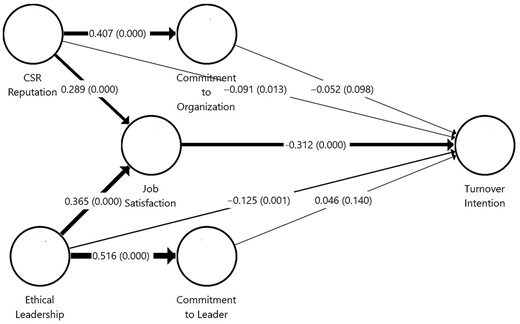
Results of the hypothesis testing are reported in Table IV. The analysis revealed that CSR reputation is negatively associated with employee TI (95 per cent confidence level) supporting H1. In addition, EL was found to have a negative association with TI (99 per cent confidence level), supporting H2.
Results of hypothesis testing
| Hypothesis | Path coefficient | t-statistics | p value | Decision |
|---|---|---|---|---|
| Direct effect | ||||
| H1: CSR → TI | −0.09 | 2.22 | 0.01* | Supported |
| H2: EL → TI | −0.13 | 2.94 | 0.00** | Supported |
| Mediating effect | ||||
| H3a: CSR → CMO → TI | −0.02 | 1.28 | 0.10 | Not supported |
| H3b: CSR → SAT → TI | −0.09 | 5.65 | 0.00** | Supported |
| H4a: EL → CML → TI | 0.02 | 1.09 | 0.14 | Not supported |
| H4b: EL → SAT → TI | −0.11 | 5.74 | 0.00** | Supported |
| Total effect | ||||
| H5: Total effect of EL → TI > Total effect of CSR → TI | NA | 0.354 | 0.724 | Not supported |
Notes:
One-tailed.
*p value < 0.05 significant at 95% confidence level; and
**p value < 0.01 significant at 99% confidence level
To test the mediation hypotheses, we evaluated the indirect effects and found that only satisfaction could partially mediate the link between CSR reputation and TI (99 per cent confidence level, supporting H3b) and the link between EL and TI (99 per cent confidence, supporting H4b). However, neither commitment to organisation nor commitment to leader show any mediation effect. As such, H3a and H4a could not be supported.
Results of the study show that total effect of EL on TI is −0.22 (t-statistics = 4.99), whereas the total effect of CSR on TI is −0.20 (t-statistics = 4.83). Therefore, EL has been found to have a greater impact on TI compared to CSR reputation. However, this difference was not found to be significant (t-statistic: 0.354), failing to support H5.
Discussion
In this research, we investigated the relationship between CSR, EL and employee TI. We found that both EL and CSR were directly (negatively) related to employee TI. In addition, both EL and CSR were indirectly (negatively) related to TI through employee job satisfaction; however, neither employee commitment to the leader nor employee commitment to the organisation mediated the relationship between EL, CSR and TI. Finally, there was no statistically significant difference between the total effects of EL and CSR on TI, leading us to conclude that both are equally important.
Implications
This research has a number of implications for research on EL, CSR and employee turnover. First, previous research has shown that both EL and CSR are related to employee turnover; however, previous research has not adequately examined these relationships simultaneously. As research on ethics-related topics proliferates, researchers must put competing explanations to the test to establish the uniqueness of their predictive validity (Schminke and Sheridan, 2017). Our results show that both CSR and EL are significantly and negatively related to TI when tested together; however, there was no statistically significant difference between their total effects on TI. In other words, both CSR and EL are equally important for understanding employee turnover. To the best of our knowledge only one other study (Lin and Liu, 2017) has looked at the relationships between CSR, EL, employee TI simultaneously. Our study differs from the work of Lin and Liu (2017) in that our mediating mechanisms, job satisfaction and commitment, have been more widely studied and supported by previous research than the mediators used in their research (burnout and engagement). Additionally, we found that EL was both directly and indirectly related to TI, while Lin and Liu (2017), perhaps becuase of a smaller sample size, did not find a direct relationship between EL and TI.
Second, we found that satisfaction, not commitment, partially mediated the relationships between EL, CSR and employee TI. In other words, employees who work for socially responsible companies and ethical leaders are more satisfied, and ultimately have fewer TI. This lack of a significant mediating effect for commitment was unexpected, given the link between commitment and turnover is well established. Previous research indicates that job satisfaction has stronger effects on TI than commitment (Tett and Meyer, 1993), so it could be that the unique contribution of commitment in our sample was too small to be detected. Furthermore, we looked at two different types of commitment; commitment to the organisation and commitment to the leader. It is possible that having both types of commitment was redundant, and contributed to the non-significant results. To explore this possibility, we conducted a post hoc analysis by re-running the analysis twice with each type of commitment separately included in the model. The results did not cause any of the mediation paths through commitment to be significant and only resulted in lowering the overall R-square for the TI. Also, differences in the cultural context between our study and previous studies may explain the lack of finding significant results for commitment. The relationship between affective commitment (which we measured in this study) and turnover is weaker in the non-US cultures (Meyer et al., 2002), while the relationship between normative commitment and turnover is more important in non-Western cultures. Future research ought to consider different types of commitment as well as the cultural contexts in which the research is conducted to better understand these relationships.
Our research also has practical implications for managers and organisations. Many businesses have a difficult time retaining good employees. Our study suggests that organisations should consider both EL and CSR as potential sources to reduce employee turnover. Although there are many factors that contribute to turnover, we found that “doing the right thing” in the normative sense is compatible with employee retention efforts. EL and CSR are important even if they do not reduce employee turnover. Our findings provide managers with a business case that investing in programs to develop strong EL and social responsibility initiatives are also good for business.
Second, our findings are particularly relevant for smaller companies. Supporting a comprehensive CSR program is often financially impractical for small organisations, which have limited resources to invest in social initiatives. EL, however, is something that all organisations of any size can cultivate with relatively minimal expense.
Third, we found that employees’ perceptions of CSR are related to lower TI. This is important because most previous research has looked at the relationship between employees’ participation in specific CSR initiatives (e.g. taking part in company-sponsored volunteer programs) and employee turnover. An important takeaway for managers is that employee engagement in CSR initiatives might not be necessary to reduce turnover; rather, simply working for a company that is seen as socially responsible might be sufficient to improve employee retention. As such, it is crucial for organisations to clearly communicate their CSR initiatives to ensure employees are aware of them.
Limitations and future directions
Our research has a number of limitations. First, our data come from a single source (employee self-reports). Given that our focus was on understanding the relationships between employees’ perceptions and their work attitudes, collecting self-reported data from employees was reasonable; nevertheless, a cross sectional design does not allow us to determine causality. In spite of this limitation, our findings are consistent with those from other research – that is, EL and CSR predict employee work attitudes (and not vice versa); also, employee job attitudes predict employee TI and not the other way around. Furthermore, the strength of the relationships we found in this study are on par with those from previous research (Demirtas and Akdogan, 2015; Elçi et al., 2012); thus, the limitations of our study design are somewhat diminished. Nevertheless, future research should employ longitudinal and multi-source designs to confirm our findings.
Second, our sample was drawn from a single country, Malaysia. Differences in national culture can be an important moderator in organisational behaviour research (Gelfand et al., 2007). Although we do not know if our results generalise to other cultures, our sample is diverse (52 per cent female employees; 39 per cent aged 26-30 years and 21 per cent aged 31-35 years; from various sectors) and we expect that our results are generalisable to many other cultures. Nevertheless, future research ought to explore potential cross-cultural variations in our findings.
Third, our focus was on supervisory EL. Would we get different results if we examined executive EL? Previous research has found that the foci of EL (supervisory or executive) is relevant to understanding a variety of phenomena, including employees’ ethical cognitions and behaviours (Schaubroeck et al., 2012) as well as the type of employee commitment to supervisor or organisation (Hansen et al., 2013). We believe it is possible that different levels of EL might have different impacts on employee work attitudes and TI. Future research should explore EL at multiple levels of management.
Fourth, we focused on the relative influence of CSR and EL on employee TI both directly and through the mediating mechanisms of employee commitment and satisfaction. There are other ethics-related influences on employee work attitudes and TI that should be examined. For example, an organisation’s ethical climate and culture have been linked to many employee behaviours and attitudes including employee TI (Mulki et al., 2008; Schwepker, 2001). There are also non-ethics related factors (e.g. leadership style and organisational policies) that contribute to employee commitment (Jackson et al., 2013), satisfaction (Boamah et al., 2018), and TI (Lin and Liu, 2017) that should be considered to better understand the contribution of EL and CSR to reducing employee turnover. Moreover, future studies can explore other leadership styles such as inclusive leadership along with CSR to examine employee outcomes.
We focused on employee satisfaction and commitment as mediating mechanisms because they have been associated with CSR, EL and employee turnover in many previous studies (Boamah et al., 2018; Jackson et al., 2013; Lin and Liu, 2017); however, there are other potential mediating and moderating mechanisms that were not included in our study. For example, working for an ethical leader as well as a company that is socially responsible might trigger positive moral emotions (Eisenbeiss and van Knippenberg, 2015) such as elevation, gratitude, meaning and pride that make it less likely an employee will want to leave. Also, employee moral identity might moderate the relationships we found, such that an employee who has a weak moral identity might not be more satisfied, committed and more willing to stay with their organisation simply because they work for a company with strong CSR and EL.
Fifth, we only looked at a single stakeholder group (employees) and a single outcome (employee IT). What is the relative influence of EL and CSR on ethics-related employee behaviours such as workplace deviance and employee citizenship behaviour? Furthermore, how does the influence of EL and CSR extend to other stakeholder groups? Information about a company’s CSR efforts are likely to be more accessible and relevant for consumers and other external stakeholders, while information about EL would be more important for employees; therefore, perhaps EL is most relevant for employee-related outcomes, while CSR will also have a great impact on the cognitions and actions of external stakeholders (e.g. firm reputation and consumer purchasing decisions). Future research should look at the relative influence of CSR and EL on different stakeholder groups.
Conclusion
Empirical work on EL and social responsibility has generated many important findings. It is unlikely, however, that everything is truly important; therefore, researchers must establish the relative impact of ethics-related phenomena on important outcomes in organisations. In this study, we examined the relationships between employees’ perceptions of CSR and EL on their TI. We found that EL was both directly and indirectly related to TI but CSR was only indirectly related. Both are important, but EL more so. Certainly managers and organisations should do the right thing because it is the right thing to do. However, this study advances our social scientific understanding of the benefits of EL and CSR and also provides evidence for the business case for EL and CSR. The larger takeaway from our research is that doing the right thing (as expressed in both CSR and EL) can help organisations do well by fostering satisfaction and ultimately employees’ desires to remain with their employer.

