This paper aims to discuss the learning mechanisms used in an inter-organisational project, i.e. transportation project in a developing country. This paper studies the ability of a project to disseminate learning to organisations and across organisations.
An interview-based case study was conducted to examine the Islamabad–Rawalpindi Metro project in Pakistan. Thematic analysis was used for data analysis.
This paper identified four learning mechanisms, which are dissected into organisational and inter-organisational levels. Additionally, the learning mechanisms are interplayed with different types of learning.
This paper develops insights concerning mechanisms to disseminate learning at the organisational and inter-organisational levels.
Introduction
Organisational learning is the process through which knowledge is created, distributed across the organisation, communicated among organisation members and integrated into the strategies and management of the organisation (Duncan & Weiss, 1978). Contemporary views on project learning are ambivalent. According to Ayas & Zeniuk (2011), a substantial amount of learning takes place within a project. However, it is difficult to capture and share learning across projects (i.e. from one project to another) or within the project and to the wider organisation (Prencipe & Tell, 2001). The temporary nature of projects limits opportunities for learning, as when the project has been completed, the organisation is disbanded and its members are assigned to other projects or duties within the parent organisation (Lundin & Söderholm, 1995). Consequently, opportunities for learning are often limited (Keegan & Turner, 2001; Cacciatori, 2008).
Organisations have always been affected by learning, and the role of different mechanisms in learning processes has been an evolving topic throughout history (Garud, Dunbar, & Bartel, 2011). Learning generated within projects does not directly transfer to other projects or to the organisation. It is possible for organisations to assimilate the learning accumulated from projects in a both formal and informal ways (Hong, Easterby-Smith, & Snell, 2006). Organisations need to adopt learning mechanisms to facilitate the dissemination of learning from the project to the organisation and across organisations. If such mechanisms are not deployed, project knowledge is lost as soon as the project would be completed (Schmitt, Borzillo, & Probst, 2012). Prior studies have mainly focused on learning in a single organisation (DeFillipi & Arthur, 1998; Prencipe & Tell, 2001), considering organisational learning mechanisms (Fang & Chen, 2016), comparison of intra and inter-organisational learning processes (Iftikhar & Wiewiora, 2022; Iftikhar, Ahola, & Butt, 2022), innovation (Tolsby, 2018), sustainability (Battistella, Cicero, & Preghenella, 2021) and challenges and opportunities for learning (Rupčić, 2018). Less attention has been given to the learning mechanisms (how learning can be diffused) in inter-organisational projects, which could provide rich insights into learning mechanisms useful for projects, organisations and networks. In this sense, learning mechanisms in an inter-organisational project are critical, as they can make learning available across organisational boundaries of multiple organisations (Pareliussen, Giskeødegård, & Æsøy, 2022; Lukic, 2023). Many organisations are rather effective in identifying lessons learned, but struggle with the dissemination and application of these lessons in their practices (Keegan & Turner, 2001; Schindler & Eppler, 2003; Williams, 2008).
Recent research on inter-organisational projects in which multiple organisations are working together on a complex task over a limited period (Manning, 2017) mostly focuses on inter-organisational network learning (Gibb, Sune, & Albers, 2017), inter-organisational collaborations (Van Marrewijk, Ybema, Smits, Clegg, & Pitsis, 2016) in a service network context (Peronard & Brix, 2019) and inter-organisational tensions (Marcandella & Guèye, 2018). According to Jones & Macpherson (2006), inter-organisational learning concerns knowledge that is:
created in collaboration by the organisations in network; and
transferred from one organisation to another.
While knowledge and learning are oftentimes used interchangeably, they are different concepts. Knowledge consists of both what we know and what we can do – indicating a state and, therefore, the potential for action and decision making. In contrast, learning refers to any change in knowledge. Thus, knowledge can be seen as a “stock” and learning as the “flow” of knowledge (Terra & Angeloni, 2003). In other words, we can say that learning leads to knowledge (Rowley, 2000) as stocking knowledge without any flow is not valuable. In this paper, we focus on learning. As little is published on learning mechanisms through which knowledge is disseminated in inter-organisational projects, which is a complex, temporary and multi-organisational setting. The paper focuses on learning mechanisms which deal with the dissemination of learning, which can be used by organisations and project practitioners to effectively plan and organise future inter-organisational projects. We do so by examining the context of the Islamabad–Rawalpindi metro project. In this paper, we address the following research question:
What are the learning mechanisms through which organisations disseminate learning in an inter-organisational project?
The unit of analysis is an inter-organisational project which allows multiple organisations to work together to complete a unique and complex task and to achieve organisational and project goals. Our study on an inter-organisational project (metro project) provided us with access to multiple heterogeneous organisations, which made it a fruitful context to study the dissemination of learning through different learning mechanisms. The primary purpose of this paper is to explore the learning mechanisms in an inter-organisational project, to develop an insight into how to disseminate “learning” i.e. to discuss how learning can be transferred to organisation/s. The learning is generated from projects and transferred to organisations and networks of organisations. Our study makes two contributions: the first is to identify several learning mechanisms from an inter-organisational project, by considering learning at the micro-level (organisation) and macro-level (inter-organisational); the second is to provide the interaction and interplay between different learning mechanisms and types of learning. Following the introduction, the article presents a literature review, followed by the methodology; providing evidence in findings, a discussion is presented and conclusions are drawn.
Literature review
Organisational learning
The concept of organisational learning describes how organisations develop their activities, capabilities and knowledge in a rapidly changing environment (Örtenblad, 2018; Chou & Ramser, 2019). Organisational learning can be described as the process of seeking out, selecting and adapting new routines and incorporating them into new processes specific to the organisation. It is “a problem-solving process” (Boerner, 2016, p. 4) to bridge gaps between a de facto state and a desired state (Allenbacher & Berg, 2023). It is a process that enables collaboration between organisational actors to improve the organisation’s overall performance (Brix, 2017).
The process of organisational learning involves the processes of intuition, interpretation, integration and institutionalisation (Crossan, Lane, & White, 1999; Iftikhar & Wiewiora, 2022) in an interplay between the individual, team and organisational levels (Martin, Ellström, Wallo, & Elg, 2025). It is through intuition that individuals learn, recognising familiar patterns from past experiences, situations and events that they can recognise new patterns. It is through interpretation and reshaping new knowledge that individuals and teams work together to create new knowledge. The process of learning at the team level occurs through the process of integration and through the development of shared understanding through collective actions and shared practices. It is through institutionalisation that organisations learn, where learning becomes ingrained in their systems, structures, routines and practices for the benefit of all (Crossan et al., 1999).
Research has highlighted the challenges that organisations face when it comes to capturing and disseminating the learning gained through projects (e.g., Middleton, 1967; Keegan & Turner, 2001). The termination of the project poses a risk that the knowledge that has been gained is lost when the project organisation is discontinued (DeFillipi & Arthur, 1998; Cacciatori, 2008). In case the knowledge obtained from the project cannot be effectively transmitted to subsequent projects and used, the same mistakes are likely to be repeated (Middleton, 1967).
Inter-organisational learning
Inter-organisational learning takes place between groups of organisations that are proactively cooperating with each other (Lane & Lubatkin, 1998; Larsson, Bengtsson, Henriksson, & Sparks, 1998; Holmqvist, 2003). A process of inter-organisational learning involves the transfer of existing knowledge from one organisation to another and the creation of entirely new knowledge through interaction between organisations (Larsson et al., 1998). It is important to note, however, that learning from external organisations not only expands an organisation’s knowledge base and facilitates innovation through the integration of external and internal knowledge (Rezaei-Zadeh & Darwish, 2016; Hartley & Rashman, 2018) but also improves the organisations’ ability to adapt to changing environments (Cui, Wang, Xue, & Liang, 2021).
There have been two approaches used in research to conceptualise inter-organisational learning: learning-as-a-capability and learning-as-a-process. Rajala (2018) argues that studies based on the learning-as-capability perspective conceptualise inter-organisational learning as the organisation’s ability to capture the value of networked knowledge, assimilate and apply it commercially. A learning-as-process, on the other hand, emphasises the learning progress of sharing, integrating and generating knowledge across the organisation (Seo & Park, 2022). Moreover, inter-organisational learning involves an exploitative, transformative and exploratory learning process. Exploitative learning process entails the utilisation and refinement of existing knowledge and technology to strengthen the excellence of present operations. The transformative learning process influences the interpretation and integration of learning by refining and combining external knowledge with existing organisational knowledge. Exploratory learning process involves the search for new knowledge, the use of unfamiliar technologies and the creation of products with unknown demand (Levinthal & March, 1993; Rezaei-Zadeh & Darwish, 2016). According to Miotti & Sachwald (2003), organisations’ existing products can be improved by collaborating with vertical organisations (customers, suppliers and distributors), whereas collaborating with lateral organisations such as universities and research institutes may facilitate the exploration of advanced technologies.
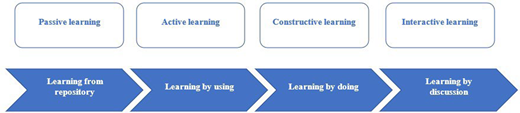
The growing interest in inter-organisational learning has resulted in a better understanding of how organisations leverage and involve other organisations in their learning process and how knowledge is cocreated by interacting organisations (Anand, Brøns Kringelum, Øland Madsen, & Selivanovskikh, 2021; Easterby-Smith, Lyles, & Tsang, 2008). According to Pitterson, Brown, Pascoe, & Fisher (2016) and Magana, Vieira, and Boutin (2018), inter-organisational learning may develop through four types of learning:
Passive learning process involves the acquisition of knowledge through books, seminars and journals in which learners are receivers of knowledge, without engaging in the process of their own learning, so they do not act visibly other than watching, listening, or reading.
Active learning involves some form of physical action. It takes place in collaboration with external actors and involves the adoption of new software or hardware applications in organisational routines, although they do not need to create anything additional to the learning.
Constructive learning process involves learners inferring meaning from the information presented and interpreting it according to their own experience and knowledge.
Interactive learning refers to actions through which complex knowledge is co-created and co-implemented in collaboration with external parties. Thus, interactive learning involves more than one actor,and the interactions benefit the learning process (Lane & Lubatkin, 1998; Schulz & Geithner, 2010; Pitterson et al., 2016; Magana et al., 2018).
Inter-organisational projects
Interorganizational projects consist of multiple organisations working together on shared activities over a defined period to coordinate the supply of complex products, subsystems and services (Roehrich, Kalra, Squire, & Davies, 2023). According to Manning (2017), they can be characterised as a unique organisational form with strong temporal boundaries and collaborations among different organisations for a highly customised goal that may benefit society at large (Fernandes, Wegner, & Möllering, 2023). To complete the project successfully, a constellation of different organisations must collaborate to pool resources and expertise (Oliveira & Lumineau, 2017). The inter-organisational project focuses on a network between organisations (Larsson et al., 1998; Schulz & Geithner, 2010), where organisations collaborate and constitute interactions and interdependencies with other partner organisations to reach common goals, establishing inter-organisational networks (Braun & Sydow, 2019; Donati, Zappalà, & González-Romá, 2020). It is a network of interdependent organisations (Marcandella & Guèye, 2018), resulting in outcomes that could not have been achieved by organisation alone (Schulz & Geithner, 2010).
Methodology
Research design
Critical realism was taken as an underlying philosophical perspective, which assumes a mind-independent reality to exist (Bhaskar, 2016). Our research draws on a single case study that aims towards a detailed understanding of the learning mechanisms in an inter-organisational project. Given the explorative nature of our research and the need to access and collect rich data describing the focal phenomena in detail, a case study approach can be considered warranted (Hartley, 2004). Pakistan’s Islamabad–Rawalpindi metro project is the subject of our empirical study. This project was chosen as an example of an inter-organisational setting, as it involves multiple organisations coordinating temporarily to deliver a complex product or service (e.g. a metro line). Moreover, the interesting element of Islamabad–Rawalpindi metro project is that it was executed in a developing country (Pakistan), whereas a plethora of research is available on inter-organisational projects among developed countries, such as tube-tunnel project (Witz, Stingl, Wied, & Oehmen, 2021); and (ii) railway and highway projects in Europe (Rietveld, 2012).
Thus, a single case study of the Islamabad Rawalpindi metro project is “a revelatory case” (Yin, 2018, p. 50). We selected this case to explore how organisations learn through learning mechanisms with a view to sharing and retaining learning. Through an inductive and comprehensive analysis of the data from several organisations, we were able to address our research question.
The case: Islamabad–Rawalpindi metro bus project.
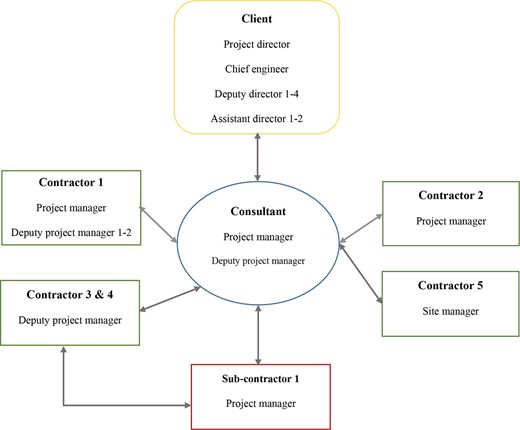
The Murree Road is one of the busiest and most popular routes between Islamabad and Rawalpindi. In recent years, traffic on this route has increased, resulting in traffic congestion. Travellers are adversely affected by this congestion, which causes excessive delays, pollution and socioeconomic problems. There was no organised urban bus transport service within and between the cities of Islamabad and Rawalpindi. There was a requirement for decent and economical public transport service in these cities. The length of the Metro Bus corridor is 23 km, of which 8.6 km is in the Rawalpindi area, whereas there is about 14 km in Islamabad. The track is signal-free and dedicated to bus services. It contains 24 stations in total, of which 10 stations are in Rawalpindi and 14 stations are in Islamabad. The project consisted of different organisations, including a client, a designer, a consultant, an executing agency and eight different contractors with several sub-contractors. Figure 1 highlights the organisations that were interviewed with informants. The project became operational in June 2015.
Data collection
We collected data using semi-structured interviews. The primary data collection method for this study is semi-structured interviews, which support the collection of rich data (Yin, 2018). Primary data were collected through face-to-face interviews with 18 participants (details provided in Table 1), ranging in length from 35 min to 90 min. Initially, we used the snowball sampling, asking each informant for additional contacts who they thought would be able to assist us in understanding the learning process. Our interview protocol was wide-ranging, as we first sought to gain a high-level understanding of the studied project and learning within it. During the subsequent interviews, we more strongly prioritised focused questions as we observed that themes began to emerge from the data. Interviews were tape recorded and transcribed later.
For example, the initial coding “bigger stations are of no use” and “extra efforts for dedicated corridor” represents the sub-theme of “learning from mistakes”.
I feel that stations of that project are bigger in size. There is no need for that. Another thing which increases project cost was we made it signal free, and it had its own dedicated corridor […] We can minimise these efforts. (Director general, Client)
Data analysis
Thematic analysis was used for the analysis of the data. There are a few reasons for using thematic analysis. First is usefulness in answering the research questions, second, it used an inductive approach, and third, it is suitable for an exploratory study, where there is little research on the topic. It is a method of identifying, organising and providing insight into meaningful patterns (themes) systematically (Braun & Clarke, 2012). Braun and Clarke’s (2012) practical guide to thematic analysis was adopting which includes five steps:
reading the transcripts to familiarise with the data collected;
coding: identify related and intriguing text that can assist in answering the research questions;
within the data set, search for themes through the identification of salient features of meaningful patterns; sub-themes of learning from archival, learning from documents, learning from experience, learning from experienced people, learning from visits, learning from mistakes, learning from fieldwork, learning on the job, learning from meetings, learning from coordination and learning from training and workshops were developed;
review themes to determine whether they are compatible with the coded data; and
define and name themes (Braun & Clarke, 2012), the main themes were defined in the following learning mechanisms:
learning from the repository;
learning by using;
learning by doing; and
learning by discussion.
Table 2 illustrates the analysis process of deriving the sub-themes from interview transcriptions and then leading to themes.
Findings
In this section, we describe the learning mechanisms in an inter-organisational project, emerged from the data. Under each of the themes, the subthemes that emerged in the analysis are presented. In the following section, we describe these elements and emergent theoretical dimensions in more detail, with illustrative quotations supporting the participants’ arguments.
Learning mechanisms
Regarding learning mechanisms, stakeholders described several different ways of learning, and we categorised them as learning from repository, learning by using, learning by doing and learning by discussion.
Learning from repository.
Writing project experiences are valuable because they help project practitioners to think critically about the project while encouraging them to grasp, organise and integrate prior experience in new projects. It also helps to build archival and keep a record of projects for organisations. We find archival and documents come under the category of learning from repository.
Learning from archival.
Movies, documentaries and photos are the sources of learning, looking at them we can understand how activities are done during the project, which is a learning opportunity; we can visualise everything in advance. In this case, learning is disseminated both at the organisational (intra-project and inter-project) and inter-organisational (across an organisational network) level. As illustrated below:
We have made a detailed documentary on the metro […] It has everything from step 1 to the end. We have everything in the form of video and is documented as well. (Deputy Director 1, Client).
In the context of the metro bus project, organisational learning was created by capturing distilled knowledge from the project in the form of visual data such as documentaries, movies and photos, which were stored to provide useful learning for future projects.
Learning from documents.
There are shortcomings reports, completion reports, booklets and documents, which were prepared after completion of a project and most of the time placed in the organisation’s library so anyone can consult them. These reports and documents are useful for newcomers and team members working on different projects. As illustrated below:
We maintain a report which contain our project experiences and learning, this report is maintained by our organisation which is a guideline for others. (Deputy Project Manager 2, Contractor 1).
Learning can be disseminated from the organisation by accessing repositories such as documents, organisational manuals and guidelines on lessons learned from past projects. These repositories of knowledge provided useful learning to help solve project issues or to avoid repeating the same mistakes.
Learning by using.
Learning by using is about using already available resources. It could be one own personnel experience which would be helpful to apply to the upcoming projects; using experienced people and visiting similar kinds of projects so the prior experience can be used there.
Learning from experience.
During the project, several stakeholders placed their teams for execution, so team members who were working on the project gained experience. Some people carry experience from old projects, they get benefit from their experience by using it in this project and enhance their experience by learning new things. For some, it is an altogether new experience; they learn new things. Experience can be gained from members of the organisation and other organisations, including clients, consultants, contractors, subcontractors, etc. As illustrated below:
Long lead items like lifts, etc. were imported. Since the chief engineer had done Lahore project, he knew that these items got delayed sometimes […] So, when he asked about them, I used to think, “Why is he talking about all this at this point? There are many things to be done before.” Then I realised, when the structure got ready, those items were marginally reaching at a time, even we had ordered them earlier […] This was a learning experience for me that long lead item approvals procedure should be done in advance. (Deputy Director 1, Client).
There are certain things that people learn from experience. The metro bus project provides a good illustration for people to experience several activities a larger scale. As the metro bus is the first project in Pakistan, so people were not trained for handling such a project. However, while working on the project, they experienced certain activities and learn through the process.
Learning from experienced people.
This theme highlights the participants’ description that they can learn from experienced people, irrespective of being junior or senior. So, in the project context, it is important to interact and discuss with experienced people to learn from them. Experienced people could be part of the organisation or the network, so this learning mechanism is useful for both organisational and inter-organisational levels. As illustrated below:
When someone has done engineering, he has concepts. He might face problems for a day or two, but he will ultimately learn. However, the fact remains that he is not yet experienced, he is learning but might not be able to forecast things or foresee what problems he is going to encounter, so it is necessary to have interaction and discussions with experienced people. (Deputy Director 4, Client).
This type of learning occurred very frequently, perhaps even daily. It was often unintentional, as the act of learning was not the main purpose of the interaction with others. Individuals learned from others by listening to their stories or talking about issues encountered in a project and reflecting on these insights.
Learning from visits.
Learning can also be done by visiting a similar kind of projects. Informants describe that it is pivotal to visit other countries to learn different ways of working, the latest technology and organise us accordingly. As illustrated below:
We can get benefit from each other experience by visiting different projects. At Islamabad, a different activity was going on […] Design is also different; the environment is different… By going there, I understand those things. So, we can get more experience by visiting. (Deputy Project Manager 2, Contractor 1).
Short site visits, within different and similar kinds of projects, can also enhance learning. Inter-project visits from teams belonging to different organisations (inter-organisational) are also an imperative source of learning. As illustrated below:
Multan team visited us. They paid several visits. Similarly, when we started here, our people went to Lahore, visited the project, and noted down the problems. (Deputy Director 1, Client).
It is pivotal to learn from visiting projects that are already been executed. This way, the upcoming projects would be better planned and executed. The base project is always a good source for learning.
Learning by doing.
Learning by doing refers to learning from experiences resulting directly from actions, meaning people interact with their project environment to perform a task and learn. Data demonstrated that learning by doing occurred mainly by making mistakes, doing fieldwork and train people on the job.
Learning from mistakes.
Stakeholders can learn from mistakes; they did in a project and try not to repeat them in future projects. So, a mistake is also one of the learning mechanisms. As illustrated below:
If I will design or plan this project, I will not make it underground […] Why are we doing it underground? When can we do it at the surface level? (Assistant Director 1, Client).
Organisations are often not interested in discussing mistakes openly and brushing them under the carpet; projects are no exception. However, owing to the inter-organisational project temporality and impact, it is important to reinforce learning from mistakes. Moreover, learning from mistakes can lead to better decision-making and break the cycle of repeating the same mistakes in future projects.
Learning from fieldwork.
When a person is in the field, even just standing there, it makes a difference. Most of the time textbook knowledge is available but practical experience is only obtained when a person does work with his hands, executing the project. As illustrated in the following quotes:
My experience is that until and unless you do not go to the field, you do not learn. We gain theoretical knowledge […] when we get degrees […] but unless that knowledge is not applied on the ground, one cannot understand what he is doing. For learning, you simply have to go to the field, do things with your hands, and see with your eyes how things are being done. (Project manager, Contractor 1).
Theoretical knowledge has its own importance; fieldworks help to truly embed the knowledge and understand its practical applicability. By working in the field, people interact with other project team members and organisations and learn how to do things.
Learning on the job.
The projects introduce the internship programmes. These programmes are for fresh graduates and job rotation to train people to have diversified and comprehensive knowledge and on-ground training by keeping newcomers with an expert to train them. As illustrated below:
There should be such routines and schedules that people employed in office should go to the field and similarly the ones working in the field should get an opportunity to come to the office. There should be 3-6 months’ tenure on rotation so that the manpower should be trained and the people who take administrative decisions sitting in the office should come to know what the actual problems of the field are. (Project Manager, Contractor 1).
This provides an opportunity for an employee to closely observe another employee’s performance and learning from them. In other words, this is a form of work experience in which you observe someone in their role to gain a better understanding of what they do. In projects, a junior is attached to a senior, observing what is being done by the senior and learning how things are being done.
Learning by discussion.
Discussion promotes creativity and generates meaningful interaction and understanding for the learner. We find meetings, coordination, training sessions and workshops provide a platform for project team members to discuss their progress and issues and come up with solutions.
Learning from meetings.
Project stakeholders usually learn from meetings. The meeting is a medium to create awareness, for example, if a team member is not aware of a certain issue, they will get awareness through meetings. Meetings are useful to discuss the problem and come up with a solution. As illustrated below:
In this project we face many of the problems so for that we call meetings and find its solution […] these meetings held on every level. Through that, people get to learn. (Chief Engineer, Client).
Meetings are typical medium to discuss the issues and to find out the solutions in a project. There could be different types of meetings, internal meetings where just team members from one organisation are discussing the project tasks. There are meetings with other stakeholders, which also help project members to discuss their concerns and get suggestions for solutions.
Learning from coordination.
It is possible that a specialised person can be transferred to other projects within an organisation and sometimes be deputed within government institutes. With coordination, it is possible to share experience with others. Moreover, inter-project and inter-department coordination are also sources of learning. As illustrated in a quote:
I have worked here, and my friends are working in Multan metro […] They are experienced but the metro project was new for them so they would ask me that we are facing certain issues how did you resolve them? So, we explained to them what to do, there were discussions. (Deputy Director 4, Client).
The metro bus project involved multiple organisations: the consultant, five different contractors, the subcontractor and the client. These organisations worked in close coordination to complete the complex, inter-disciplinary tasks required to accomplish the project, which could not be achieved by a single organisation. These organisations learned through coordinating with each other to complete the project.
Learning from training sessions and workshops.
There are training sessions, workshops, courses and conferences that are useful tools for learning through projects. In these kinds of sessions experienced people from the same or from other organisations, give lectures and training which are a useful source of learning. As illustrated below:
The engineering council starts arranging seminars and they bound people to attend these seminars then they will get the next renewal. People come there and give lectures on different topics. Share their experiences […] We can learn something new. (Project Manager, Sub-Contractor 1).
In an organisation or project, training and workshops are educational activities designed to improve performance both individually and as a team. Typically, these programmes focus on enhancing an employee’s knowledge and skills and motivating him or her to perform better.
Learning mechanisms in inter-organisational projects
Our findings are summarised in Table 3, outline the learning mechanisms in inter-organisational projects. It represents different learning mechanisms, which are learning from repository: archival and documents; learning by using: experience, experienced people and visits; learning by doing: mistakes, fieldwork and on the job; learning by discussion: meetings, coordination and training sessions and workshops.
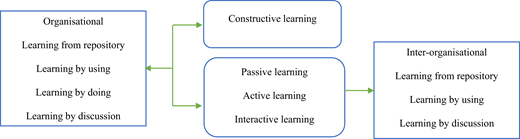
However, an interesting finding is that learning is transferred to different levels: organisational level (including project level) and inter-organisational level. Organisational learning refers to processes of learning within organisations (Easterby-Smith & Lyles, 2003, p. 9), which improve the capability of the whole organisation. Therefore, organisations can learn from and act on lessons for more successful implementation and completion of projects (Akgün, Lynn, & Byrne, 2003). Inter-organisational learning involved learning where multiple organisations are involved. We find a few distinct and overlapping learning mechanisms between organisational and inter-organisational levels.
The organisational level used all learning mechanisms to share lessons. For instances, learning from repository (documents and archival), learning by using (experience, experienced people and visits), learning by doing (mistakes, field and on the job) and learning by discussion (meetings, coordination and training sessions and workshops) can disseminate learning at an organisational level. Organisational learning mechanisms describe the way learning is disseminated within the organisation, considering both within and across projects. These mechanisms provide information on how learning is disseminated at different levels within an organisation, from project to project and from the project to the organisation. Learning mechanisms are the tools and techniques from a project which can be used to transfer learning both within a project and to other projects within the organisation.
At the inter-organisational level, we find that learning from repository (archival), learning by using (experience, experienced people and visits) and learning by discussion (meetings, coordination and training sessions and workshops) are the learning mechanisms. This describes several different ways of learning across organisations. We find that learning from repository, learning by using and learning by discussion are the overlapping learning mechanisms in organisational and inter-organisational levels. Thereby, we find a few distinct and overlapping learning mechanisms for each level. However, we did not find a separate set of inter-organisational learning mechanisms. So, the organisations are using the same mechanisms for themselves and to share learning with other organisations. There is not a dedicated learning mechanism across organisations.
Discussion
Williams argues on the need for research on “how lessons (from projects) can be disseminated throughout an organisation and incorporated into organisational practice” (2008, p. 262). However, prior research has demonstrated that inter-organisational projects are prone to problems related to learning (Newell, Bresnen, Edelman, Scarbrough, & Swan, 2006), learning transfer from one project to another and the wider organisation (Prusak, 1997). Our discussion unpacks the learning mechanisms for inter-organisational projects, in which we have identified the learning mechanisms for organisational (intra-project and inter-project) and inter-organisational levels. Learning not only occurs at the organisational level but at the inter-organisational level as well. This allows for a conceptualisation of how an organisation may learn from a project and disseminate learning in an inter-organisational project. Accordingly, the learning base of inter-organisational projects is rooted in network ties rather than in individual organisations (Schüßler, Wessel, & Gersch, 2012).
Learning mechanisms in inter-organisational projects
“People learn in different ways,” “everybody learns differently” and “different mediums are needed to learn” (Duffield & Whitty, 2015). There are several learning mechanisms through which learning is disseminated. The four learning mechanisms align with the four types of inter-organisational learning used by Pitterson et al. (2016) and Magana et al. (2018) presented in Figure 2.
Learning from a repository is aligned with passive learning as it refers to a process by which an organisation may acquire, improve and safeguard knowledge which is needed to function efficiently. Specifically, learning by using relates to active learning in which learning occurs when the observable portion of an organisation’s experience can be acquired (Lane & Lubatkin, 1998). Learning by doing is related to constructive learning where individual use the existing experience and learn new things by doing things practically. Moreover, learning by discussion is related to interactive learning in which the creation and implementation of complex knowledge takes place in continuous collaboration with other organisations (Lane & Lubatkin, 1998; Schulz & Geithner, 2010). The basic level of understanding (passive learning) is obtained through repository which will leads to use hands on experience (active learning) through learning by using. This triggers the constructive learning through learning by doing mechanisms where project members build new knowledge and skills by performing tasks and activities. Once the knowledge has been gained, there are discussions which initiate the interactive learning. Figure 3 demonstrates the learning mechanisms at organisational and inter-organisational levels.
Learning from repository.
Repository is a handbook, a collection of tools, resources and methods, helping guide to inspire the practice (Schindler & Eppler, 2003). Learning from documents and archival sources usually offers a simplified but durable record and texts from which to draw insights from experience for wider audiences (Phillips, Lawrence, & Hardy, 2004) and to serve as memory devices others can access and use over time (Walsh & Ungson, 1991; Subramani, Wagle, Ray, & Gupta, 2021). Moreover, the internet and digital technology, coupled with the impact of mobile devices and videos as well as libraries, portals and intranets, are having a positive impact on organisational learning (Duffield & Whitty, 2015). The purpose is to codify the learning and make this available to other members of the organisation. When a project is completed, project team members are responsible for developing lessons learned and feeding these into databases that others can access. In this way, learning on projects can be “retained” by the organisation and shared by organisational members (Keegan & Turner, 2001).
Organisational learning mechanisms develop nested learning. It “occurs at several different but interrelated levels at the same time” (Levinthal & March, 1993, p. 100) and can be analysed in terms of the interplay between project and organisational learning (Scarbrough et al., 2004). Organisational learning mechanisms are for retaining learning and disseminating that learning throughout the organisation (Keegan & Turner, 2001) as well as within and across projects. However, the surprising finding is that we did not find a separate set of inter-organisational learning mechanisms. Organisations are using the same mechanisms that they use for themselves to share learning with other organisations. There is no dedicated learning mechanism across organisations. There could be several reasons for this. One possible reason could be that they deliberately do not want to have a dedicated mechanism so that there would not be any bottleneck when the project is not inter-organisational. They do not feel reluctance or over-reliance on a specific learning mechanism. Another possible reason is that organisations are unaware of the fact that it is important to have learning mechanisms for the inter-organisational level as well. A third reason could be that due to the team’s busy schedules it is hard to share learning within organisations so learning across organisations is something minimal that they can think of. The evidence from the metro bus project is consistent with contemporary literature, learning from the repository is a passive form of learning that occur at organisation and inter-organisational levels.
Learning by using.
Learning by using is about the utilisation of experience of the workers (Rosenberg, 1982), which reduces the uncertainty of current operation and future decisions (Argote & Miron-Spektor, 2011). An experience is bound to the people who are personally involved in the project. Project team members were worked alongside others representing different departmental, technical as well as professional backgrounds, and thus were able to develop a holistic understanding concerning task requirements at different stages in the project (Nguyen & Hong, 2013), and they usually take their new experiences with them (Schindler & Eppler, 2003). Experienced people’s personal experiences can only be effectively shared with other co-workers through storytelling and face-to-face interactions (Orlikowski, 2002). Moreover, visiting comparable sites of other projects helps people to positively seek learning from others who have done similar jobs (Scarbrough et al., 2004). The findings section is aligned with the above-stated discussion, learning by using is an active learning type occurs at organisational and inter-organisational levels.
Learning by doing.
The process of learning by doing refers to the way in which people make sense of their experiences and participate in production (Longauer, Vasvári, & Hauck, 2023). Learning from direct experience is “learning by doing” (Ryu, McCann, & Wan, 2022). We find learning by doing consist of learning from mistakes, fieldwork and on the job. We might not like making mistakes but there can be a lot of learning from them (Dawes, 2007). Mistakes transfer learning within the team (Schindler & Eppler, 2003), thereby avoiding the mistakes of the past and improving the performance of projects and the organisation. It is human nature to learn from mistakes (Scarbrough et al., 2004). Organisations which are able to learn from their mistakes have the opportunity to save costs resulting from work that is redundant or poor in quality (Schindler & Eppler, 2003). Fieldwork also helps workers to learn from the field and to gather experience naturally by working on certain activities. There are several ways to learn on the job. The most important is job rotation and on the job training (involves intentional learning). Job rotation is the transfer of employees between jobs in an organisation. Job rotation among the various projects and the rest of the organisation fosters learning and increases human capital accumulation (Campion, Cheraskin, & Stevens, 1994). A person moves from one field to a very different or wholly unrelated field, seeking variety and independence (El-Saba, 2001). Job training allows newcomers to acquire valuable skills and transfer learning from the more experienced members of the organisation (Nguyen & Hong, 2013). Our findings are consistent with the literature and learning by doing is form of constructive learning which is an organisational learning mechanism.
Learning by discussion.
Learning is articulated through collective discussions, through sharing individual experiences and comparing opinions with colleagues. Therefore, members of the organisation can achieve an improved level of understanding (Zollo & Winter, 2002). When an experience has not been encountered before, it is an opportunity for an organisation to learn from it (Garud et al., 2011). To enable organisations to learn from past project experiences, willingness to share and learn from each other (Duffield & Whitty, 2015) will disseminate learning from one person to another (Fernie, Green, Weller, & Newcombe, 2003). According to Rogelberg, Shanock, & Scott (2012), meetings are one of the most commonly occurring organisational events in which employees from different organisational levels are brought together, to facilitate interactions, information sharing, communication, problem-solving, decision-making and sense-making. Meetings usually help to generate share ideas, develop common understanding and joint action (Schindler & Eppler, 2003; Nguyen & Hong, 2013). Hill, Offermann, & Thomas (2018) considered face-to-face meetings as face-to-face communication by a team during the project. A project team is made up of different organisational units with different backgrounds which exchange ideas and observations in meetings (Garud et al., 2011). Coordination is valuable as it provides opportunities for learning and disseminating new and re-usable practices and solutions (Hossain & Kuti, 2008). Lyer & Jha (2006) also focus on coordination between project participants, while Olabisi & Lewis (2018) argue that coordination can be facilitated by knowledge exchange within and between teams. A coordination process relies heavily on expertise, which ensures that certain skills and knowledge are required. It is useful to develop a common interpretation, based on team members’ ability to:
make sense of challenges they face; and
uphold this common-sense during the project.
Training and workshops can be used to retain the learning within the organisation for all relevant members (Keegan & Turner, 2001; Schindler & Eppler, 2003). Training effects performance (Buljac-Samardzic, Dekker-van, & Maynard, 2018) when team members see the relevance of training to the demands of their work when there is a good match, they are motivated to learn from training programmes and workshops (Hicks & Klimoski, 1987; Acosta-Prado, López-Montoya, & Tafur-Mendoza, 2024). Our findings are compatible with the literature and learning by discussion is an interactive learning process which happens at organisational and inter-organisational levels.
Conclusion
There are several challenges that relate particularly to the dissemination of project learning. Learning dissemination is dependent on the willingness of project team members to report and codify the learning. When the project ends, the team is disbanded and members are reabsorbed into the organisation and later allocated to new projects. Moreover, under time pressure, the quality of efforts to nurture learning within project teams, and to ensure the transfer of learning to the broader organisations, may be reduced (Keegan & Turner, 2001). Furthermore, individual-level learning within an organisation strongly depends on what is already known to co-workers within the organisation and on the types of information that are available (Duffield & Whitty, 2015). Keeping these challenges in view, we studied learning mechanisms for inter-organisational projects in a transportation project in Pakistan. However, the research reveals organisational and inter-organisational learning mechanisms. An inter-organisational project is a complex, providing a rich context for investigation, as several organisations are involved in the project, so investigating learning mechanisms is pivotal. This research brings out four key learning mechanisms that operate in inter-organisational projects; these learning mechanisms are categorised as:
learning from repository;
learning by using;
learning by doing; and
learning by discussion.
Our findings contribute to organisational learning theory and literature on inter-organisational projects. Organisational learning is the process of creating, retaining and transferring learning, focusing on both organisational and inter-organisational learning processes (Holmqvist, 2003). However, our study focuses on the transfer of learning. This study makes several contributions. First, it identifies several learning mechanisms from an inter-organisational project, providing an opportunity for project team members and organisations to disseminate learning from the inter-organisational project. Second, our study provides important insights and establishes a roadmap for learning by considering learning at the micro-level (organisation) and macro-level (inter-organisational), as suggested by Elliot & Macpherson (2010). Third, there are no exclusive and dedicated learning mechanisms that exist at the inter-organisational level. Moreover, the novel finding relates to learning mechanisms interaction with each other and interplay with different learning types as shown in Figures 2 and 3.
Practitioners will benefit from insights into organisational and inter-organisational learning mechanisms that help them to disseminate learning, which will be useful for preparing and managing future projects. Using Table 3, one could select a set of learning mechanisms that are appropriate for different levels of dissemination of learning, i.e.:
organizational; and
inter-organisational (network).
It provides the opportunity for practitioners to have brainstorming sessions, to develop an understanding of different possible ways of learning which could improve performance drastically. In addition, learning mechanisms may be incorporated into training programmes to make it a central part of the organisation so that they can develop an awareness of the organisational and inter-organisational levels of learning mechanisms. Furthermore, managers can establish formal and informal communication channels, such as regular meetings, workshops and shared digital platforms, can facilitate learning process. It is essential to develop a culture of continuous learning and feedback which enable organisations to be more responsive and proactive in their approach. Moreover, we believe this study could lead influence societies and communities particularly infrastructural development and economic development.
It is essential to acknowledge the limitation. First, from an internal validity point of view (Miles, Huberman, & Saldaña, 2014), we analysed interview data and provided details about data analysis. It has been challenging to combine different views from interviews and display in finding. This approach helped to validate the findings but there are personal biases involved in qualitative research. Second, from an external validity point of view (Miles et al., 2014; Yin, 2018), our study can be replicated in other contexts with some similarities and differences.
Our study opens several avenues for further research. First, the unit of analysis was an inter-organisational project in which multiple organisations engage simultaneously. Future research could direct attention on stakeholders, considering how different learning mechanisms are used by key stakeholders (client, contractors, sub-contractors and consultants) in inter-organisational projects. Furthermore, each stakeholders have different interest, so this conflict of interest might influence the learning process, which is not considered in this study and can be a good candidate for future research. Second, our study explored an inter-organisational project using a single case study. However, it raises questions about the transferability of our theory. While caution is necessary with single-case studies, we believe that our findings are transferable beyond inter-organisational projects since data is collected from a heterogeneous set of organisations. Third, there is a potential to do cross-comparison with similar inter-organisational projects, and this would address the issue of applicability of research. Fourth, the study is cross-sectional, and future research should consider conducting longitudinal studies to observe the evolution of learning mechanisms over time within and across projects. Fifth, contemporary technology can influence the learning mechanisms, but we did not have any evidence to support it. Hence, this could be a good topic for future research. Last but not least, this study is based on interviews. Future research could scrutinise learning mechanisms by applying different methodological approaches such as experimental and survey-based techniques to validate the findings drawn from this study.