This paper aims to consider how knowledge leakage occurs, as well as how that knowledge can be protected, particularly when it pertains to interorganizational projects. This is a case study on the Green Line Metrobus in Karachi, Pakistan.
This paper uses a single case study approach. Data was collected through semistructured interviews and archival documents. Data analysis was conducted using thematic analysis.
The findings present the determinants of knowledge leakage, employee mobility, information disorder, misuse of knowledge-sharing tools and diverse stakeholders’ involvement. For knowledge protection, the findings provide evidence of nondisclosure agreements, standard operating procedures, education and training and sharing relevant knowledge.
By examining knowledge leakage and protection in interorganizational projects, this study contributes to the literature on protection motivation theory. Furthermore, it offers practical insights for practitioners to better understand and mitigate knowledge leakage through effective knowledge protection mechanisms.
Introduction
Knowledge resides not just within organizational boundaries but also outside of them (Silva, Howell, & Meyer, 2018), specifically in internal networks and external networks (Iftikhar & Ahola, 2022). Organizations use outside sources to get meaningful knowledge; in particular, they require complementary external skills to assist them in solving novel issues. External knowledge can be integrated with internal knowledge to generate new ideas and capabilities that can boost an organization’s competitive advantage (Argote, McEvily, & Reagans, 2003). In interorganizational projects, numerous organizations aim to assimilate useful knowledge and gain competence from one another (Hamel, 1991), as well as to acquire valuable external knowledge across fields (Love, Roper, & Vahter, 2014; Magni, Chierici, Fait, & Lefebvre, 2022). An organization faces an inherent risk if it shares too much project-specific knowledge with other organizations. When valuable organizational knowledge leaks, it can erode competitive advantages (Spender, 1996; Ritala, Olander, Michailova, & Husted, 2015).
In an interorganizational project, organizations collaborate to produce a desired product or service that cannot be achieved by individual organizations (Iftikhar & Ahola, 2022), which facilitates knowledge sharing (Estrada, Faems, & de Faria, 2016) but can also lead to knowledge leakages (Ritala, Kenneth, Heidi, & Snejina, 2018). Knowledge leakage occurs when an organization loses vital knowledge to others, resulting in lower organizational performance (Easterby-Smith, Lyles, & Tsang, 2008). Some organizations use knowledge protection measures, particularly in the context of coopetition (Balle, Steffen, Curado, & Oliveira, 2019; Estrada et al., 2016), such as interorganizational initiatives. An organization’s ability to protect its knowledge enhances its competitive advantage through both formal and informal protection mechanisms (Balle et al., 2019). The coopetition perspective posits that cooperation and competition function simultaneously in interorganizational projects (Lado, Boyd, & Hanlon, 1997; Li, Liu, & Liu, 2011), which gives access to resources and knowledge (Enberg, 2012; Gast, Gundolf, Harms, & Collado, 2019). Organizations collaborating with different heterogeneous partners may also face the risk of losing their innovative knowledge during collaboration (Chen, Yao, Zan, & Carayannis, 2021; Wang, Chin, Chiew, & Capalbo, 2024). Consequently, organizations may be prone to knowledge leakage if their partners have incentives to appropriate their proprietary knowledge (Heiman & Nickerson, 2004; Jiang, Li, Gao, Bao, & Jiang, 2013). Knowledge protection, however, presents a paradox: organizations may be underprotected by sharing too much knowledge, thereby losing their competitive advantage, or they may be overprotected by sharing too little knowledge, weakening the positive effects of knowledge sharing (Frishammar, Ericsson, & Patel, 2015).
Moreover, knowledge is classified into explicit and tacit knowledge (Shujahat et al., 2017). Explicit knowledge may easily be formalized, reproduced and replicated across an organization. Tacit knowledge is embedded in an organization’s culture, making it difficult to codify (i.e. to duplicate, replicate or transfer from one organization to another). It is outside the scope of this study to engage with knowledge categories; however, current research suggests that tacit knowledge is less susceptible to leakages than explicit knowledge (Nonaka & Von Krogh, 2009; Wu & Lin, 2013). While both explicit and tacit knowledge are valuable to organizations involved in interorganizational projects, explicit knowledge is a critical source of competitive advantage since it can be sold to other organizations and easily transferred from one to another. Therefore, sharing tacit knowledge assets is very helpful, and partnering organizations must have access to tacit knowledge to add value to their collaboration. However, providing such access raises the possibility of opportunism (Ritala et al., 2015; Solli-Sæther, Karlsen, & van Oorschot, 2015). To avoid confusion, we will use the general term knowledge throughout the study.
Knowledge leakage can be positive or negative, depending on whether it benefits or harms the organization (Grillitsch & Nilsson, 2017; Jiang, Bao, Xie, & Gao, 2016). Prior research has predominantly emphasized its negative consequences, including damage to innovation, performance, reputation and financial outcomes (Frishammar et al., 2015; Flammer & Kacperczyk, 2019; Ritala et al., 2015, 2018). Existing studies identify sources such as social media and mobile technologies (Durst, Aggestam, & Ferenhof, 2015; Yahav, Schwartz, & Silverman, 2014), as well as organizational change, retirement and turnover (Carmel, Pak, & Patel, 2013; Chalkiti & Sigala, 2010; Treleaven & Sykes, 2005). Knowledge protection is critical to preserving the interests, creativity, legal rights and patents of knowledge owners (Balle et al., 2019). Knowledge protection mechanisms – such as contracts, social governance and trust – are therefore essential, particularly in interorganizational contexts where employees play a central role in preventing knowledge leakage (Ritala et al., 2015; Charterina, Basterretxea, & Landeta, 2017). Knowledge leakage and protection have been studied in the context of multinational companies (de Faria & Sofka, 2010), high technical organizations (Solli-Sæther et al., 2015), the construction industry and defense organizations (Hernandez, Sanders, & Tuschke, 2015; Sharif, Naiding, Xu, & Rehman, 2020).
The study of knowledge leakage and protection in interorganizational projects appears to be underdeveloped, as stated earlier. In particular, for infrastructural projects, design information, technical and financial ideas have been found to be the most prone to leakage. As a result, organizations must protect their collaborative projects from the danger of knowledge leaking (Sharif et al., 2020). However, contemporary research has not explained how concrete leakage mechanisms and protection practices interact in interorganizational infrastructure projects; this study addresses this gap by empirically linking leakage sources and protection mechanisms to threat and coping responses through the lens of protection motivation theory (PMT). Hence, this research unpacks knowledge leakage and protection in an interorganizational project by answering the following research questions:
How does knowledge leakage occur in an interorganizational project?
How do organizations protect knowledge in an interorganizational project?
From a learning-organization perspective, interorganizational projects function as distributed learning systems where multiple organizations jointly create and apply knowledge. Consequently, examining knowledge leakage and protection is essential for understanding how learning organizations (interorganizational projects) balance openness for learning with the need to retain and institutionalize critical knowledge. An interorganizational project is analyzed as a unit of analysis because it allows multiple organizations to work together toward the same objective. The Green Line (GL) Metrobus in Pakistan, which is an interorganizational project, was examined. This study makes two contributions. The first contribution is to provide insights into knowledge leakage in an interorganizational project. The second contribution is to provide knowledge protection strategies.
Literature review
Knowledge leakage
Knowledge leakage is defined as “the extent to which the focal organization’s private knowledge is intentionally appropriated by or unintentionally transferred to partners beyond the scope of the alliance agreement” (Jiang et al., 2013: p. 984). It refers to the flow of knowledge beyond organizational boundaries, resulting in the deterioration of competitiveness and of the organization’s industrial position (Frishammar et al., 2015; Flammer & Kacperczyk, 2019; Ritala et al., 2018). To understand knowledge leakage, it is essential to distinguish between public and private knowledge. Public knowledge exists in the public domain and is accessible to multiple organizations, whereas private knowledge is organization-specific and intended to remain within organizational boundaries (Matusik & Hill, 1998; Frishammar et al., 2015). In the interorganizational setting, public knowledge is not exclusive; organizations can access and apply it. In contrast, the focal organization only holds private knowledge, which provides the possessor with a competitive advantage (Tiwana, 2008), but it also presents a high risk of knowledge leakage.
Intentional knowledge leakage involves deliberate actions by individuals or organizations that expose proprietary knowledge to external parties (Ritala et al., 2015), often driven by opportunistic behavior such as unauthorized imitation or private learning. In such cases, partners may seek appropriate valuable knowledge to outperform collaborators or pursue hidden agendas (Das & Teng, 2001; Jiang et al., 2013). Unintentional knowledge leakage, by contrast, occurs when organizations unknowingly transfer knowledge beyond agreed boundaries, typically through frequent interactions and communication across project networks (Kale, Singh, & Perlmutter, 2000; Mohr & Sengupta, 2002). This form of leakage often arises when employees are unclear about what information can be shared, leading to accidental disclosures, particularly through informal contacts and communication channels (Arias-Pérez, Lozada, & Henao-García, 2020; Jiang et al., 2013).
Interorganizational projects provide a fertile context for knowledge leakage. These projects are complex and time-bound collaborations in which organizations pool specialized skills, technologies and knowledge to achieve shared goals that cannot be accomplished independently (Jiang et al., 2016). While such collaboration facilitates learning and knowledge exchange, it also creates opportunities for opportunistic behavior (Walter, Walter, & Müller, 2015). Knowledge leakage occurs when partners gain access to economically valuable knowledge beyond contractual agreements, thereby threatening project autonomy and organizational advantage (Jiang et al., 2013; Chen et al., 2021; Shi, Zhang, & Zheng, 2019). The disclosure of such commercial secrets jeopardizes a project’s autonomy (Shi et al., 2019). Because certain capabilities retain their value only when they remain exclusive (Ahlfänger, Gemünden, & Leker, 2022; Frishammar et al., 2015), organizations seek to control external disclosure of critical knowledge resources. Organizations are particularly cautious about sharing knowledge that underpins competitive advantage or could be leveraged by competitors (Bloodgood & Chen, 2022). Consequently, knowledge protection plays a vital role in preventing imitation and sustaining long-term competitive advantage (Frishammar et al., 2015).
Knowledge protection
Knowledge protection refers to the strategies and actions organizations use to safeguard valuable knowledge assets and to prevent knowledge leakage to unauthorized individuals or entities (Manhart & Thalmann, 2015). Organizations are especially sensitive to knowledge leakage in contexts involving intensive knowledge exchange, such as interorganizational projects (Ahlfänger et al., 2022; Ritala & Hurmelinna-Laukkanen, 2013). In such settings, organizations may gain privileged access to shared knowledge bases and acquire new knowledge from partners without their consent or adequate compensation (Jaffe, Trajtenberg, & Henderson, 1993). To benefit from interorganizational relationships, organizations must therefore carefully decide what knowledge to share, with whom and how to protect knowledge they wish to retain (Gast et al., 2019). In interorganizational projects, organizations often safeguard their resources (Andersén, 2012; Hamel, Doz, & Prahalad, 1989) and “protect information from bleeding through to a partner” (Hamel, 1991: 96) to prevent the leakage of knowledge. Knowledge protection generally focuses on two objectives: preventing unauthorized access to knowledge (Manhart & Thalmann, 2015); and reducing knowledge visibility, that is, the extent to which external parties can observe and appropriate knowledge (Lee, Chang, Liu, & Yang, 2007). However, knowledge protection is challenging for two main reasons. First, protecting explicit knowledge through property rights is costly and difficult to enforce (Chan & Lee, 2011). Second, tacit knowledge is complex, context-specific and embedded in individuals, making it difficult to codify or legally protect (DeSouza, 2006; Nelson & Winter, 1982). As a result, organizations rely on a combination of formal and informal mechanisms to retain proprietary knowledge within organizational boundaries (Ritala, Kianto, Vanhala, & Hussinki, 2023; Thomä & Bizer, 2013), particularly in interorganizational settings (Estrada et al., 2016; Fernandez & Chiambaretto, 2016).
Formal knowledge protection mechanisms include intellectual property rights and contracts, such as patents, trademarks, copyrights, trade secrets and confidentiality agreements (Olander, Vanhala, & Hurmelinna-Laukkanen, 2014). These mechanisms allow organizations to protect innovations and delay imitation, but have notable limitations. Acquiring formal protection is often resource-intensive, time-consuming and costly, frequently requiring legal expertise (de Faria & Sofka, 2010; Leiponen & Byma, 2009). Moreover, formal protection may require disclosure of information, for example, patent filings make knowledge publicly accessible, enabling competitors to imitate or build upon it (Somaya, 2003; Olander et al., 2014). Excessive reliance on contracts may also signal distrust and negatively affect interorganizational relationships (Malhotra & Murnighan, 2002). Despite these drawbacks, formal mechanisms are particularly effective for protecting codified knowledge embedded in products or services (Estrada et al., 2016; James, Leiblein, & Lu, 2013).
Since formal protection measures cannot entirely protect knowledge, as knowledge leakage beyond formal bounds may continue, informal protection supplements formal protection (Gast et al., 2019). Informal mechanisms emphasize relational governance, including trust, shared norms, reputation and human resource management practices (Fernandez & Chiambaretto, 2016; Jiang et al., 2013). Personal ties and relational standards can discourage opportunistic behavior and reduce the likelihood of imitation (Solli-Sæther et al., 2015). Although tacit knowledge is difficult to legally protect, its inherent complexity and limited transferability provide a natural form of protection (Olander et al., 2014). Together, formal and informal mechanisms enable organizations to balance knowledge sharing and protection in interorganizational projects.
Interorganizational projects
Interorganizational projects involve numerous organizations working together on common tasks over a certain time to coordinate the provision of complex products, subsystems and services (Roehrich, Kalra, Squire, & Davies, 2023). They have a distinct organizational structure with strong temporal bounds, involving collaborations among multiple organizations for a highly tailored goal that may benefit society as a whole (Fernandes, Wegner, & Möllering, 2023; Manning, 2017). An interorganizational network achieves outcomes that would not have been possible if each organization operated independently. A project requires the collaboration and pooling of resources and the expertise of various organizations (Oliveira & Lumineau, 2017). In an integrated effort to produce a product or service, each organization focuses on its own distinctive competencies, while the others focus on complementary activities (Barringer & Harrison, 2000). By virtue of its complementarities, an interorganizational project thus entails an interaction between organizations (Braun & Sydow, 2019). Interorganizational projects involve the collaboration of several legally independent but functionally interdependent organizations to accomplish a complex product or service (Lumineau & Oliveira, 2018).
Protection motivation theory
PMT assists individuals and organizations in responding, when faced with a threat, to protect themselves (Anderson & Agarwal, 2010). According to PMT, individuals and organizations protect themselves by assessing the threat and their coping capacities. The threat appraisal evaluates the severity of the situation and determines how serious it is. A threat appraisal is based on the perceived severity of a threatening event and its probability of occurrence. The coping appraisal examines how the individual and the organization respond to the situation. It produces the expectation that a recommended action will remove or reduce a threat, based on the perception of reaction efficacy (Rogers, 1975). Threat appraisals motivate individuals and organizations to respond to situations to minimize the threat (Rippetoe & Rogers, 1987). The lens of PMT is used (Anderson & Agarwal, 2010; Rogers, 1975) to rethink knowledge leakage as a threat and knowledge protection as a coping behavior.
Methodology
Research design
This study adopts a single case study approach to develop an in-depth understanding of knowledge leakage and protection in an interorganizational project. The case study method is well suited to addressing research questions that require rich, contextual insight (Hartley, 2004). The GL Metrobus project in Karachi involves multiple organizations and intensive cross-boundary knowledge exchange, making it a suitable case for examining how knowledge leakage occurs and how it is addressed through protection mechanisms. The research questions are addressed through an inductive approach.
Case context
Karachi: green line metrobus.
The GL commences in Karachi. GL is about 23.2 km long and includes 10.5 km of elevated track and 9.3 km at grade, with a total of 25 stations. GL is designed to carry up to 30,000 passengers per hour in each direction. Each day, approximately 300,000 passengers are supposed to travel on GL. The project cost Rs. 35bn (US$250m). The project’s execution commenced in February 2016. Approximately half of Karachi’s population relies excessively on private transportation, leading to traffic jams and severe environmental pollution. Traffic congestion is primarily caused by inadequate transportation infrastructure. Consequently, accessibility, health, well-being and financial services are adversely affected. However, GL has improved the quality of travel by providing a decent, comfortable, environmentally friendly and affordable bus service.
The project is comprised of different organizations consisting of a client, a design consultant, an engineering consultant, an operating consultant, a sponsoring agency (a foreign-based organization), an executing agency, contractors and a digital marketing agency. GL was initially divided into 20 packages (subprojects); however, 2 packages were cancelled. The civil work is divided into nine packages (subprojects), the electronic and mechanical works into six packages (subprojects) and the road works into three packages (subprojects), all assigned to different contractors. The project became operational in December 2021 (archival data).
Data collection
This study used two methods of data collection. First, semistructured interviews provided the primary method of data collection, as they were able to gather rich information on relatively unexplored topics. Second, archival data was used to construct the background for the case (Yin, 2018).
Semistructured interviews are considered (see Appendix for the interview guide). Eleven interviews with 11 participants were conducted through MS Teams, ranging from 45 min to 107 min in length (details are provided in Table 1). The interviewees included project managers, the senior manager, the communication manager, the technical director and other team members (planning engineer, assistant planning engineer, digital marketing manager and transport manager). They included members of the client team, the design consultant, the operating consultant, contractors and the digital marketing agency. The interviewees were asked a series of structured and open-ended questions. Throughout the interview, interviewees were encouraged to use their own terminology and to steer the conversation toward topics and concepts they felt best reflected their own experiences. The snowball sampling technique was used, in which each interviewee was asked to nominate other potential informants, those who they believed would be able to assist in understanding knowledge leakage and protection. We recorded the interviews and transcribed them.
The study also relied on archival sources of data that were provided by interviewees. A total of 218 internal and publicly accessible data are included in the archive, consisting of bid evaluation reports, environmental impact assessments, feasibility reports, topography study reports, design details (layouts and drawings) and planning commission documents. Documents were requested from the client, the contractors and the consultants. As a result of the analysis of archival data, a more detailed understanding of the case context was developed.
Data analysis
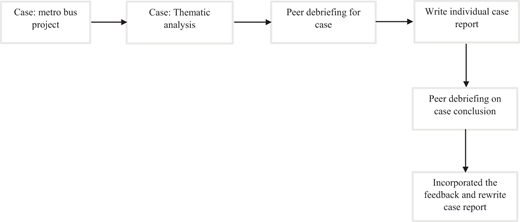
Thematic analysis was used for the analysis of the data. In thematic analysis, patterns (themes) are systematically identified and organized, and insights are provided (Braun & Clarke, 2012). In this study, the thematic analysis was highly inductive (Howitt & Cramer, 2007), and the themes identified were derived from the data itself (Braun & Clarke, 2012). In this study, Braun & Clarke (2012) practical guide for applying thematic analysis was adopted. The transcriptions were first read and explored inductively to identify different methods of knowledge leakage and protection. Second, subthemes were developed, including employee mobility, information disorder, misuse of knowledge-sharing tools, diverse stakeholders’ involvement, nondisclosure agreements, standard operating procedures (SOPs), education and training and sharing relevant knowledge. In the third step, the main themes were determined by reviewing the subthemes. Table 2 below illustrates the analysis process of deriving the subthemes from interview transcriptions and then leading to themes.
Figure 1 below will provide a step-wise analysis approach adopted for the analysis.
Findings
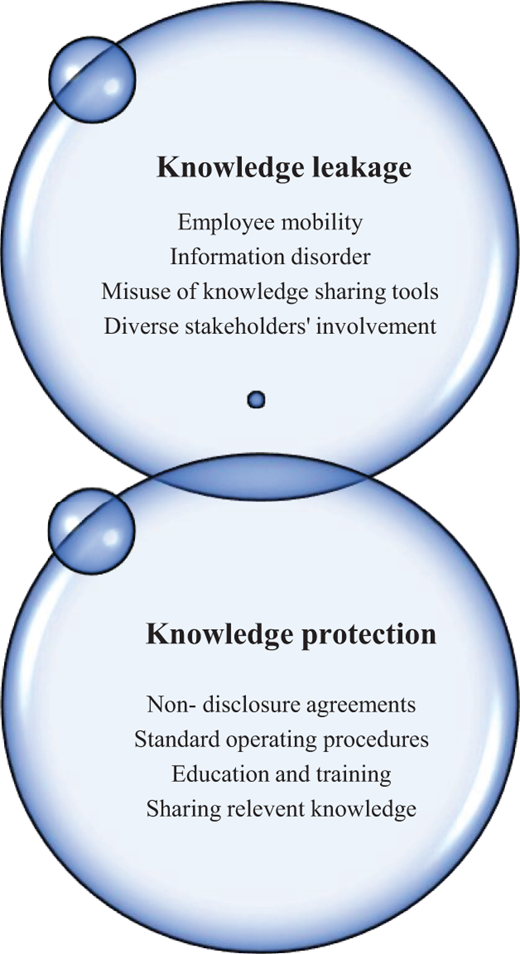
The findings provide evidence of knowledge leakage and protection practices from an interorganizational project. For knowledge leakage, the subthemes of employee mobility, information disorder, misuse of knowledge-sharing tools and diverse stakeholders’ involvement were found. For knowledge protection, the subthemes of nondisclosure agreements, SOPs, education and training and sharing relevant knowledge.
Knowledge leakage
Employee mobility.
Knowledge leakage occurs when an employee leaves an organization and joins another organization. Sometimes competitors try to hire employees from other organizations with the intention to benefit from knowledge leakage. As illustrated below:
During the bidding the quantity surveyor (QS) was involved, suddenly, he moved to the other organization, we didn’t stop him. The other organization was also in the bidding process for the same project, as soon as he was shifted, the organization won the bid, and they were awarded with the project. Our prices were very economical […] Upon investigation, we came to know that the bid price we had quoted was told to the other organization by our own ex-QS. (Project Manager, Contractor 3)
Moreover, there is no practice of handing over documents. If an employee is leaving, they can take documents with them and later use those documents for their own benefit. As stated below:
I left the organization, and nobody even asked me if the documents you have, do you return them to the company? Is there something in your laptop that is related to our organization, then you should delete it, or have you emailed some information to yourself, and if I’m exchanging information on my private platforms, that is very important. (Communication Manager, Client)
Information disorder.
The media, including print, electronic and social media, is a big source of information disorder. People working on projects sometimes leak information. These may later be presented by the media in such a way as to have a negative impact on the project. General public perception can also be distorted by such actions. As illustrated below:
As I mentioned, impediments were not considered in the design phase. Now obviously, the construction team, client, consultant and contractor should have kept it between them only, but these things got leaked in media and they made NEWS that design for this project has neglected the presence of gas lines and sewerage lines. The public starts observing the project negatively, that the project is not good. (Project Manager, Contractor 3)
The media provides information without credibility. Most of the news provided is wrong, but it could cause damage to the project:
Recently you have seen in [Newspaper name], it was published that [project’s name of project] has removed hundreds of trees, but the question is that media does not know about the technicality. We have a policy that if we remove 1 tree, we plant 3 trees. However, the media depicts a very different picture. (Senior Manager, Client)
Misuse of knowledge-sharing tools.
The misuse of both formal and informal knowledge-sharing tools is the main reason for knowledge leakage. As stated below:
One of our contactors shared information on LinkedIn. His company gave him an appreciation letter saying that you are working fine on this project. However, in that LinkedIn post he leaked some information which he should not have. (Transport Manager, Client)
Moreover, people involved in the project also leak information on social and electronic media. Sometimes, informal knowledge-sharing tools such as WhatsApp groups are used for knowledge leakage:
Before the project even started, the WhatsApp groups were made among the stakeholders then information sharing starts in that, so anyone can leak information. This was the case in [project’s name], there was a progress review meeting and in that there were 40-50 people present, and when the meeting ended, the next day it is on Facebook, Media, Twitter or TV shows. (Technical Director, Operating Consultant)
Diverse stakeholders’ involvement.
There are different points in knowledge sharing, such that knowledge could get leaked from any one point. Letters, as the official mode of communication, are delivered by a mail carrier. They can get lost, or the carrier can open it and read the letter. As illustrated below:
We have a rider in all our offices, or we have a courier service, with whom we have a contract for monthly payments. A mail carrier comes to your office, picks up your courier and takes it away. You have made an envelope, it can be lost on the way, it could be misused. There are very few cases. But it happens sometimes. (Transport Manager, Client)
Moreover, sometimes there are wrong SOPs, which can lead to practices that are harmful and lead to knowledge leakage. As illustrated below:
There is a document called PC1. When the PC1 is approved by the [institute’s name], they share your PC1 with every department […] They ask you to print 50 copies of the PC1 and they share them with everyone, so it means they are sharing the knowledge with the contractors, they can easily get the copy and know the estimates, which is very dangerous. (Senior Manager, Client)
Knowledge protection
Nondisclosure agreements.
Knowledge protection can occur through nondisclosure agreements, which will clearly state that if an employee leaves the organization, he/she cannot disclose any information. As illustrated below:
We sign the non-disclosure agreement (NDA) with every employee. We sign 2 papers; one is contract and the other is NDA […] by doing this our employees are legally covered with NDAs and the terms for that are that if you leave a project, you cannot share information for another one year. (Digital Marketing Manager, Digital Marketing Agency)
Moreover, organizations take certain steps to reduce knowledge leakage. For example, employees have to get approval from their department heads before leaving the organization; a condition can be imposed that an employee involved in a bidding process cannot leave the organization for a certain period of time. As stated below:
We deployed a strategy that any employee who is involved in the bidding process will first take permission of their department’s head otherwise he can’t leave the organization. The second is that when the bidding is in process, for six months. So, we imposed a condition on the employees’ contract that till six months any employee who was involved in the bidding can’t leave the organization. (Project Manager, Contractor 3)
NDAs are one way of preventing knowledge leakage from happening due to employee mobility.
Standard operating procedures.
To protect knowledge from leakage, there are SOPs. These SOPs are implemented in different settings, for example, in the surveillance room. As illustrated below:
We have set up the SOP, the person watching the cameras will not use his personal phone. The company has given him a phone that is in the control room […] their personal phones are submitted to our security office. The reason for that is that there are more than 600 cameras’ feed playing on the screen and if there is something sensitive and they record it on their mobile, after that it can go anywhere. Now we do create SOPs you cannot plugin mouse, keyboard or USB, you can only view. (Transport Manager, Client)
In addition, encryption could also be used. Password encryption would also reduce knowledge leakage. However, there is a need to revisit SOPs. As stated below:
When the consultant makes any bill of quantity (BOQ), nowadays I ask them to give me in Excel but with a password. So, it is a password encrypted, and I am the only one who can see the document by putting the password […] We should revisit our SOPs, starting with the email address, you should have a bar code card, QR-code card and your email should be of your company name not of Gmail. It should all be systematic and encrypted. (Senior Manager, Client)
Implementing SOPs could minimize knowledge leakage by avoiding information disorder and the misuse of knowledge-sharing tools.
Education and training.
Organizations should provide training to protect knowledge. These training sessions contain information about what knowledge they could share and what they could not. As illustrated below:
Organizations hold regular training sessions. In general, there are circular advisories to all the people about the proper use of knowledge and when they are appointed, they are given this guideline that how do they handle these things and what is the proper professional, ethical behavior in this respect. (Senior Project Manager, Design Consultant)
Moreover, educating people who are using social media is very important. Anyone can use social media, but it is important to verify the source of information, not just to follow the trends. As stated below:
In my view, there is only one way that is to improve education, meaning we cannot shut down social media, and we cannot enforce it more than a certain level, it’s just that who has the power of social media and he comes from an educational background […] What I’m trying to say is if we do not mature the education system, the person posting on social media would not know that I should do research and get to know its pros and cons, its negatives, positives or its rights and wrongs. (Technical Director, Operating Consultant)
Education and training would reduce information disorder and the misuse of knowledge-sharing tools; as a result, knowledge leakage would be reduced.
Sharing relevant knowledge.
Sharing relevant knowledge protects knowledge. In projects, all team members know their roles and responsibilities. The knowledge is shared with them that is relevant to performing their task. As illustrated below:
If there is a site engineer or a construction manager or a site supervisor, they know about their roles. They are only told about the directions and instructions which are related to their work. So, only concerned information is given out, only that is required. No extra information is given out ever. (Planning Engineer, Contractor 2)
Moreover, knowledge is shared in a controlled environment, with very few people having this knowledge. Through this approach, the knowledge could not be leaked. As stated below:
Information is shared in a very controlled environment like only 2-3 senior officers know about it and it is not spread forward in detail, we don’t give it to the lower level and then you have to give controlled instructions. (Transport Manager, Client)
Sharing relevant knowledge would help to reduce knowledge leakage, particularly when diverse stakeholders are involved.
Discussion
In interorganizational projects, coopetition – simultaneous cooperation and competition – emerges as organizations pursue shared goals while protecting their competitive interests (Bengtsson & Kock, 2014). Although such collaboration provides access to complementary resources and knowledge (Enberg, 2012; Gast et al., 2019), it also increases the risk of knowledge leakage, particularly among heterogeneous partners (Wang et al., 2024). Accordingly, organizations must protect their knowledge to sustain collaboration. This study examines knowledge leakage and protection (shown in Figure 2) using PMT, which conceptualizes leakage as a threat and protection as a coping response (Anderson & Agarwal, 2010; Rogers, 1975).
Interorganizational knowledge leakage and protection
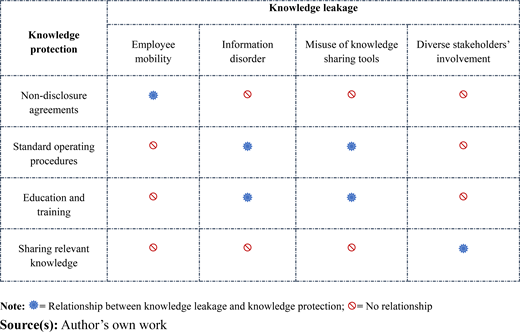
The interorganizational knowledge leakage and protection matrix in Table 3 is based on the evidence from the findings.
Employee mobility is “the movement of employees into, within, and out of an organization” (Bibi, 2024: 4). There is an increase in employee mobility due to ongoing technological, societal and economic changes (Mawdsley & Somaya, 2016). Employee mobility is essential to take into account with regard to knowledge leakage. Through employee mobility, organizations are able to access the critical knowledge that employees bring with them (Bibi, 2024; Franzoni, Scellato, & Stephan, 2018), which could lead to knowledge leakage, as shown in the findings. Moreover, the findings showed that nondisclosure agreements can protect knowledge leakages that occur due to employee mobility. A nondisclosure agreement is an “agreement restricting the use of information by prohibiting a contracting party from divulging data” (Beyer, 2001). A nondisclosure agreement is essentially a contractual incentive to ensure confidentiality and promote trust (Roth, 2023).
Media, including electronic, print and social media, has become a powerful tool to disseminate fake news. Fake news can have a significant impact on society as it has become easier to generate and harder to detect (Aïmeur, Amri, & Brassard, 2023), which leads to information disorder. There are three types of information disorder: (i) misinformation is information that is false but not deliberately created to cause harm; (ii) disinformation is information that is false and intentionally created to harm individuals, social groups and organizations; and (iii) mal-information is based on reality and used to harm individuals and organizations (Wardle & Derakhshan, 2017). Moreover, interorganizational projects are multidisciplinary and interdependent on knowledge and skills. Hence, such projects make use of several tools, such as e-mail, WhatsApp, letters and meetings, to share knowledge (Iftikhar & Ahola, 2022). However, there are instances when these tools are used to share knowledge which should not be shared (Santos, Soares, & Carvalho, 2012). This is mainly due to an individual’s deliberate misuse of knowledge-sharing tools. The findings presented evidence that knowledge leakage could happen due to information disorder and the misuse of knowledge-sharing tools. However, the findings also highlighted that SOPs and education and training could reduce information disorder and the misuse of knowledge-sharing tools. Standard operating procedures are defined “as written documents that indicate how to perform a routine or a task” (Freeman, Cook, & Hooijberg, 2021: 477). The provision of education and training develops or deepens and upgrades employees’ skills (Klimplová, 2012).
A multi-stakeholder approach is used to execute and deliver interorganizational projects. Each stakeholder has their own responsibilities, requirements and objectives. Stakeholders can be members of a project’s team, and depending on how they get engaged and what their roles are, they may have different interests, impacts and objectives for the project (Storvang & Clarke, 2014). The findings are consistent with those of Heravi, Coffey, & Trigunarsyah (2015), namely, that only certain groups may need to get fully involved in all phases of a project, otherwise the risk of knowledge leakage significantly increases. Moreover, in projects, team members assess the knowledge requirements and then deliver relevant knowledge or unique skills and know-how for performing tasks (Yoon, Kim, & Yun, 2024), which could also reduce knowledge leakage occurring due to multiple stakeholder involvement.
Conclusion
This paper addresses the following research questions: How does knowledge leakage occur in an interorganizational project? and How do organizations protect knowledge in an interorganizational project? It provides a comprehensive understanding of the leakage and protection of knowledge within an interorganizational context. The study identifies key causes of knowledge leakage – such as employee mobility, information disorder, misuse of knowledge-sharing tools and diverse stakeholder involvement – and explores protection mechanisms including nondisclosure agreements, SOPs, education and training and selective knowledge sharing.
Theoretical implications
This study makes significant theoretical contributions. First, it deepens understanding of how knowledge leakage and protection operate in complex interorganizational environments where multiple organizations collaborate. Second, drawing on PMT, it clarifies the relationship between threat and coping mechanisms: knowledge leakage, such as employee mobility, acts as a threat, while protective practices – such as nondisclosure agreements – serve as coping responses to the project and the organization. Third, the interplay between knowledge leakage and knowledge protection practices is the focus of critical findings, as delineated in Table 3. This interplay not only elucidates the causes of knowledge leakage but also offers evidence regarding the potential for knowledge protection in initiatives to address knowledge leakage. Finally, the proposed framework (Figure 2) offers a foundation for future research on the unique dynamics of knowledge leakage and protection in interorganizational projects.
Practical implications
There are certain practical implications. First, this study will assist managers and organizations in thinking through the reasons behind knowledge leakage, allowing them to avoid conditions and events that increase knowledge leakage by introducing systems such as digital governance. Second, knowledge protection is appealing to managers and organizations because they can implement policies and foster a trust culture and environment in which relevant knowledge can be shared and valued. Third, the matrix (Table 3) advises project participants and organizations on how to safeguard knowledge and reduce knowledge leakage; this enables project practitioners to have a better understanding of knowledge leakage and protection.
Limitations and future research areas
It is essential to acknowledge the limitations. First, from an internal validity point of view, we analyzed interview data and provided details about data analysis. It has been challenging to combine different views from interviews and display them in the findings. This approach helped to validate the findings, but there are personal biases involved in qualitative research. Second, from an external validity point of view (Miles, Huberman, & Saldaña, 2014; Yin, 2018), the study can be replicated in other contexts with some similarities and differences.
This study opens several avenues for further research. First, a single case study is considered; we believe that our findings are transferable beyond interorganizational projects since data is collected from a heterogeneous set of organizations. Future research may undertake a comparative study to explore knowledge hiding in different types of infrastructural projects and industries. Second, the evidence from the data did not identify the different levels (individual, team and organization) at which knowledge leakage and protection occur. Future research should provide a dedicated examination of knowledge leakage and protection at different levels. Third, the study was conducted in Pakistan. Research in the context of other national backgrounds is required to verify the findings. Fourth, the study is cross-sectional. Longitudinal studies should also be used in future research. Fifth, the analysis is done solely by the lead author with debriefings; however, qualitative research is subjective in nature, and the researcher’s interests might have an impact on the study. Finally, due to the travel restrictions associated with COVID-19, interviews were conducted on MS Teams. Hence, there is a possibility that some good potential interviewees may have been missing.
References
Appendix. Interview guide
Background information:
• Could you please tell me about your role and responsibilities in this project?
• How long have you been working on this project or with this organization?
Knowledge leakage:
• Have you experienced knowledge leakage?
• How does knowledge leakage occur?
• Does your organization have any formal or informal routines for dealing with (potential) knowledge leakage? Please explain
Knowledge protection:
• How do you currently share sensitive knowledge among employees, partners and clients?
• How do you decide this knowledge should be shared? And how much should be shared?
• What current mechanisms do you use to protect Knowledge?
• How to facilitate knowledge protection within individuals, teams, organizations and across organizations?
• Would you like to add anything further?