

This paper aims to enrich the scholarly discourse on learning within small social entrepreneurial organisations by examining how leadership can facilitate conditions conducive to collective learning during crises.
A longitudinal single-case study was conducted on a social entrepreneurial organisation in Sweden, operating within the integration field. The study involved comprehensive interviews and observations. Using a longitudinal approach facilitated an in-depth analysis of the organisation’s development over time.
The findings underscore that shifts in leadership can significantly influence collective learning. Specifically, the results suggest that establishing trust between the CEO and team members is a pivotal factor in cultivating conditions for collective learning and fostering the related processes, which persisted even during the pandemic. This trust catalysed inclusive and interactive actions that encouraged team members’ participation in day-to-day decision-making and strategic planning. Consequently, the organisation successfully leveraged its diverse knowledge resources, promoting knowledge sharing and experience exchange, crucial components of successful collective learning.
This paper advocates for a departure from conventional leadership perspectives, proposing that a focus on team–leader relationships – a form of leadership in practice – can offer valuable insights into cultivating collective learning. This approach underscores the significance of collaboration and engagement among team members in promoting collective learning and accentuates the role of leadership in creating these conditions.
The examples provided on structuring, organising and leading virtual meetings could offer valuable insights for leaders. With the increasing adoption of hybrid workplaces combining remote and office environments, communication challenges within teams may arise. Therefore, these examples can aid leaders in formulating effective communication strategies that bridge the gap between remote and in-person team members, ensuring that everyone stays informed and engaged.
This study seized a unique opportunity to explore how leadership can create favourable conditions for collective learning during crises by collecting data both before and during the Covid-19 pandemic.
Introduction
This paper offers a case study that scrutinises the role of leadership in crafting conditions conducive to collective learning amid crisis scenarios focusing on a small social entrepreneurial organisation, “Sweden for Everyone” (henceforth referred to as SFE, a pseudonym), which operates within Sweden’s social integration sector. The profound understanding and insights into a particular phenomenon that case study research affords (Gerring, 2007) can highlight the social intricacies within a specific organisation (Stake, 1995) during a distinct time (in our case, the Covid-19 pandemic).
Social entrepreneurial organisations are typically small enterprises that stand apart from large-scale businesses, organisations and industries. Characterised by financial fragility, SFE, as a small social entrepreneurial organisation, is often reliant on external funding (Lyons & Kickul, 2013). The Covid-19 pandemic has accentuated the pre-existing uncertainty for organisations like SFE, thereby underscoring the criticality of collective learning as a tool to adapt and buffer against the pandemic’s repercussions (Eslahchi, 2023).
In crisis situations, effective leadership becomes a lifeline for any organisation, regardless of its size. However, smaller organisations often face heightened vulnerability to crises, given their limited human and economic resources, in comparison to their larger counterparts (Borch et al., 2008; Swaim & Roebuck, 2021). Conversely, small organisations often benefit from less complex, less hierarchical organisational structures. This facilitates a closer relationship between those executing daily tasks and those making strategic decisions, creating unique leader–team dynamics (Leitch & Harrison, 2018) that could potentially foster collective learning.
The connection between leadership and learning has been extensively probed within large-scale organisations, but remains less explored within the context of small social entrepreneurial organisations (Ranville & Barros, 2021). Newman et al.’s (2022) literature review on the Covid-19 pandemic found that the majority of empirical works were predominantly individual-focused, with scarce research considering teams, particularly leader–team relations. Consequently, the pandemic has opened a timely avenue for us to contribute to the scholarship by exploring the nexus between leadership and learning in times of crisis within the context of a small social entrepreneurial organisation.
Although the significance of leadership and learning in crisis management is widely acknowledged (Wu et al., 2021; Islam et al., 2022), there is a notable research gap concerning the interplay between leadership and learning in small social entrepreneurial organisations during crises. Therefore, this case study aims to fill this void by exploring the following research question:
How can leadership within small social entrepreneurial organisations foster conditions conducive to collective learning during times of crisis?
Literature review
The pivotal role of learning within small social entrepreneurial organisations is well recognised in the literature, particularly in terms of nurturing and scaling novel ventures that present innovative opportunities (Dabić et al., 2023). Supplementing this view, Lusiantoro, Purwanto & Rostiani (2021) assert that small organisations must adapt their resource structures and cultivate a culture that learns, a fundamental survival mechanism during crisis periods such as the Covid-19 pandemic.
While numerous studies have underscored the importance of leadership in facilitating both individual and collective learning within organisations (Amy, 2008; Shao et al., 2017; Xie, 2018), this aspect has been somewhat overlooked in the context of small social entrepreneurial organisations (Leitch & Harrison, 2018). Typically, the formalisation of rules, procedures and structures increases with organisational size (Jensen & Luthans, 2006), leading to a perception of smaller organisations as being more flexible than their larger counterparts (Hmieleski & Ensley, 2007). If these organisations embrace relational and/or ethical empowering leadership (Cope, 2011; Swaim & Roebuck, 2021), they could potentially weather crises more effectively. Kamaludin, Xavier & Amin (2021) suggest that leaders of small social enterprises with robust intra-organisational connections are better poised to maintain their ventures through skilful resource management. Furthering this, Oduro, Alharthi Rami Hashem & Alsharif (2022) advocate for such leaders to boost employee engagement via enhanced social awareness and proficient relationship management, which nurtures a mutual understanding of balancing innovation with utilisation.
The Covid-19 pandemic posed substantial leadership and managerial challenges for organisations (Dirani et al., 2020), with small social entrepreneurial organisations particularly impacted. Relative to other forms of organisations, these smaller entities are thought to be more susceptible to extinction during crises (Forum et al., 2020; Maher et al., 2020). Thus, examining the relationship between leadership and learning within small social entrepreneurial organisations takes on added importance, given recent indications that numerous organisations failed to cultivate environments that encourage learning processes during the pandemic (Saide & Sheng, 2021).
Laitinen & Ihalainen (2022) viewed the pandemic as an opportunity for a shift from autocratic leadership towards a more interactive model, suggesting that the Covid-19 crisis could catalyse profound learning within organisations, spurring the emergence of new practices to supersede outdated ones. Nevertheless, many leaders remained firmly embedded in a centralised control model throughout the pandemic (Kars-Unluoglu et al., 2022).
This inability to foster conditions for learning can be linked to the disparate experiences of leaders and employees during the pandemic, as illustrated in a study by Kirchner, Ipsen & Hansen (2021). This research indicated that managers and leaders found their work more taxing compared to their employees. As a result, as observed by Lee (2021) in an exploration of workplace practices shifts during the pandemic, many managers and leaders opted for a command-and-control style, using remote monitoring, time-tracking systems and other surveillance tools to ensure effective performance by their subordinates.
This leadership trend during the pandemic ran counter to employee expectations of goal-setting autonomy and the opportunity to participate in decision-making to enhance pandemic-era efficacy (Lee, 2021). Stoker et al. (2022) also pinpointed this discord between managerial and employee perceptions, noting that managers felt less control during the pandemic and perceived that they delegated more responsibilities to their home-based employees. However, these employees did not perceive or report significant changes in terms of work delegation or increased autonomy during the pandemic (Stoker et al., 2022).
The divergent experiences of leaders and employees during the pandemic can be attributed to the complexities of remote work. Green et al. (2020) posit that teleworking presents numerous drawbacks for teams, primarily a decline in collaboration, communication and interaction. Furthermore, communication was identified as the principal challenge for leaders amidst the pandemic (Dirani et al., 2020). This communication conundrum arose because, although crisis-related communication was deemed an effective strategy for combatting other crises, it proved to be less effective for virtual teams (Qin et al., 2021), constrained as they were by work-from-home stipulations during the pandemic.
Collectively, these studies underscore the necessity for effective communication strategies and collaborative tools to offset the detrimental impact of remote work on team dynamics during the pandemic. Hence, prior research suggests that managers and team leaders should be cognisant of the difficulties posed by virtual work and should proactively confront these issues through innovative solutions that facilitate efficient communication and collaboration among team members.
While research indicates that leadership plays a pivotal role in developing structures and processes that enable organisations to adapt to the pandemic (Kaul et al., 2022; Mai et al., 2022), actualising this can be challenging due to the disruption of conventional organisational communication channels, which in turn affects trust between leaders and team members (Zainab et al., 2022). This breakdown in communication and interaction, coupled with the diminished trust between leaders and employees during the pandemic, may in part be attributable to a propensity among many leaders to prioritise short-term solutions over longer-term ones, thereby limiting the team members’ capacity to cope with the crisis (Förster et al., 2022).
This situation created a paradox: numerous leaders were hyper-focused on work tasks, giving scant attention to how their subordinates were emotionally processing and responding to the pandemic. On the other hand, employees yearned for their leaders to demonstrate greater empathy and consideration (Caringal-Go et al., 2021), rather than maintaining pre-pandemic performance expectations. In a parallel vein, a study by Eichenauer et al. (2022) demonstrated that, during the pandemic, employees valued relationship-oriented leadership more than achievement-oriented leadership. Prioritising the relationship between leaders and team members is critical for organisational resilience in the face of unforeseen circumstances (Bhaduri, 2019; Thakur and Hale, 2022). Oberoi, Halsall and Snowden (2021) explored the concept of self-guided learning as a synergistic process that aligns with mentoring leadership. This approach is grounded in reality, leveraging team members’ perceptions and intuition to conceptualise swiftly in our rapidly evolving world. It necessitates a style of leadership that appreciates holistic approaches, self-worth and capability, spurring innovative ideas while identifying new patterns and opportunities – a sentiment echoed by Snowden, Oberoi & Halsall (2021).
Although research specifically investigating the relationship between leadership and learning within the context of small social entrepreneurial organisations during a pandemic is sparse, our literature review offers valuable insights. It underscores that communication and trust are vital for team learning, as also posited by established theories from Dixon (1998), Edmondson (1999) and Senge (1994). However, these key factors were undermined by the pandemic, emphasising the need for deeper exploration of how leadership can stimulate learning and development within small social entrepreneurial organisations amidst crisis situations.
Analytical concepts
Leadership
While those who perceive leadership as a function separate from its context may not fully appreciate the significance of the relationship between leadership and learning, it is imperative not to undervalue this relationship, particularly in the realm of small social entrepreneurial organisations (Bass, 1990; Bhaduri, 2019; Bowers et al., 2017; Hasel, 2013; Khan, 2015; Spears, 1998). This paper underscores the notion that leadership and learning are substantially moulded by the specific attributes of the organisation and its teams. Small social entrepreneurial organisations present unique scenarios where leadership unfolds within a distinct setting (Vecchio, 2003). Hence, in studying leadership within such organisations, it is essential to focus on the context rather than the individual and on relational dynamics over the inherent characteristics of individuals (Kempster et al., 2018). Consequently, leadership in small organisations is best viewed as a social process that transpires through daily interactive experiences (Leitch et al., 2013, p. 349).
This paper deviates from mainstream leadership perspectives and shifts the analytical lens onto leader-team relationships as they occur in practice (Raelin et al., 2018). By adopting a “leadership in practice” approach, this paper transitions from viewing leadership as an individual trait and instead emphasises its collective nature (Sergi, 2016). This method recognises that leadership arises from everyday activities and interpersonal interactions, and it highlights the vital role of relationships between leaders and team members (Lehtonen & Seeck, 2022).
Collective learning
The relational perspective of leadership suggests that learning transpires through opportunities for social participation within what is referred to as “communities of practice.” These communities, are groups of people who share a common interest or a goal and learn from one another and together through regular interaction, communication and collaboration (Lave & Wenger, 1991; Smith et al., 2019; Wenger, 2000).
In this context, leadership plays a pivotal role in shaping the modalities of participation, interaction and communication within these communities of practice. Understanding the processes, conditions and outcomes of learning, thus, requires an in-depth examination of how leadership in practice influences these communities in specific situations (Gherardi & Strati, 2013; Wenger, 2000).
Furthermore, this paper conceptualises collective learning as interactive and communicative processes that can take place within these communities of practice, culminating in knowledge sharing, the exchange of experiences and the formation of shared understanding. These processes often lead to a collective capacity for action within teams (Döös and Wilhelmson, 2011). In essence, continuous dialogue, discussion and interaction in teams become the lifeblood for collective learning (Ohlsson, 2013; Rupčić, 2022; Smith et al., 2019).
Collective learning requires that members of the organisation have the opportunity to participate in organisational activities, collaboratively creating and transforming organisational realities. Through this participation, they assimilate information into their collective knowledge, thereby improving the effectiveness of their collective actions (Dixon, 1999; Wiese & Burke, 2019). Accordingly, organisational activities are incessantly produced and reproduced through participants’ involvement in contingent organisational practices (Gherardi, 2009; Wenger, 1998).
Methods
Data collection
This paper delineates a comprehensive case study of a Swedish social entrepreneurial organisation that operates within the integration sector. The data, amassed over time, were procured through semi-structured interviews and observational studies conducted in three distinct phases, both pre- and amidst the Covid-19 pandemic. For privacy and ethical considerations, all names mentioned in this study are pseudonyms:
In Phase 1, which took place in January 2019, in-depth interviews were conducted with the organisation’s two co-founders.
Phase 2 spanned from January to June 2020. During this period, the researcher immersed themselves within the organisation, conducting interviews with its staff and observing its operations. A total of 13 interviews were carried out, with the CEO being interviewed on four separate occasions, and other members of SFE were interviewed once in June. Additionally, the researcher executed 37 observational studies, equivalent to 43.5 h of analytical observation, while taking notes. With the exception of January and February 2020, when in-person observations were possible, the remainder of the observational studies was conducted virtually due to the shift to remote working and online meetings within the organisation in response to the pandemic.
Phase 3 was a follow-up stage conducted one year later in May and June 2021, aimed at gauging the organisation’s progress and transformations since the initial data collection in Phase 2. This phase comprised of 14 virtual meetings, cumulatively spanning 17 h, during which the researcher took notes.
This paper is an integral component of a PhD project that concentrates on the concept of learning within the framework of social entrepreneurial organisations. In an antecedent study (Eslahchi & Osman, 2021), the founders of five such organisations were interviewed to gain insights into their journey of learning to become social entrepreneurs and establish social entrepreneurial organisations. SFE, whose two co-founders were the subjects of the interview for this study, subsequently consented to be part of a detailed case study.
Using an organisational ethnographic approach and considering “learning” as a general phenomenon, the fieldwork commenced in January 2020. The initial two months saw the observation of both formal meetings, and informal settings such as lunch breaks, coffee intervals and social gatherings beyond the workplace.
However, with the onset of the Covid-19 pandemic in Sweden in March 2020, and the consequent transition of the organisation to remote work, the fieldwork was confined predominantly to the observation of online meetings. The unprecedented pandemic reshaped the research trajectory, as it posed a serious threat to SFE, compelling it to adapt to the new circumstances. Given the pandemic’s prominence as a discussion topic in virtually all meetings, it was a logical pivot for the focus of the study.
Coding and analysis
Given the volume of collected material, a robust coding and analysis method was imperative. Consequently, an abductive approach was used, which facilitates the derivation of reasoned conclusions by identifying emerging patterns in the data (Johnstone, 2007; Saetre & Van De Ven, 2021; Tavory & Timmermans, 2014). This abductive method was realised through a tripartite coding procedure that encompassed descriptive coding, thematic coding and analytical coding, designed to codify and analyse the data systematically (Gibbs, 2007; Saldana, 2015):
Step 1, descriptive coding: This initial phase entailed a comprehensive review of interview transcripts and observational notes. Relevant text passages were pinpointed and assigned codes, representing the content within those passages. This method facilitated the establishment of a preliminary set of descriptive codes, encapsulating the critical themes and topics discussed in the data.
Step 2, thematic coding: During this stage, the first-order codes were meticulously evaluated through an iterative process, seeking codes with thematic similarity to construct overarching themes. Consequently, two themes related to leadership – “Founders’ Leadership” and “CEO’s Leadership” – and two themes related to learning – “Conditions for Collective Learning” and “Processes of Collective Learning” – emerged.
Step 3, analytical coding: This final stage aimed at developing a nuanced analytical comprehension of the themes identified in the preceding step, exploring how leadership could cultivate conditions conducive to collective learning processes. As a result, “Trust” emerged as an interconnecting theme between leadership and collective learning, underscoring its vital role in fostering an environment wherein team members feel at ease sharing their ideas and knowledge.
Both interview transcripts and fieldnotes were equally subjected to this uniform coding and analysis approach, grounding the data presentation in a comprehensive analysis that synthesises these components. Hence, the findings are firmly anchored in a robust bedrock of empirical evidence, enriched with key insights from the interviews quoted throughout the manuscript to fortify the argument. With few exceptions that the fieldnotes were cited, they primarily underpinned the narrative structure. Therefore, when specific meetings are referenced within the text, the data stems from these observational notes.
Case background
SFE is a small social entrepreneurial organisation that was established in 2013 by two young women who jointly led the organisation until 2018. At the time of data collection, SFE consisted eight full-time staff members, two interns, over 20 volunteers and a board of directors. Beginning as a part-time endeavour, SFE has grown into a highly regarded organisation with a potent voice in Sweden’s social integration discourse.
Recognising the necessity for a leadership shift to propel continuous growth and sustainability, the co-founders enlisted a new chief executive officer (CEO) in mid-2018. While both co-founders maintain their involvement as board members, one has not participated operationally since December 2019, and the other focuses on fundraising and project development without assuming any formal managerial or leadership responsibilities.
Findings
Insights gleaned from interviews with the co-founders suggest that their decision to appoint a CEO was catalysed by a fervent commitment to organisational success and a readiness to adapt to evolving circumstances. This progressive approach has been instrumental in SFE’s ongoing expansion, with the organisation consistently at the cutting edge of innovation within Sweden’s social integration sector.
Focusing on the transformations in leadership within SFE, this case study subsequently explores how efficacious leadership can cultivate collective learning amidst crises. In addressing the research question, the findings are bifurcated into two sections. The first delves into how SFE’s leadership metamorphosed following the appointment of the CEO, leading to heightened levels of trust within the organisation and establishing an environment conducive to collective learning. The second portion accentuates how SFE’s leadership in practice, engendered opportunities for team members to partake in interactive and communicative routines, thereby facilitating knowledge sharing and experience exchange during the pandemic.
Trust-based leadership: ground condition for collective learning
An analysis of various discussions about leadership, extracted from observed meetings and interviews with team members, consistently brought to light a notable theme: the leadership under the new CEO deviated substantially from that of the co-founders. The uniqueness of this fresh leadership approach, along with its profound impact on the organisation’s culture and operations, was frequently underscored by team members.
The co-founders’ leadership, as conveyed by team members, was principally aimed at enhancing organisational efficacy. However, some divergence of opinions occasionally arose between the team members and the co-founders regarding the means to attain this effectiveness. As a result, certain decisions and actions taken by the co-founders gradually eroded the trust between them and the team members.
A case in point is a meeting I observed in person in February 2020, right before the pandemic’s onset, where a contentious debate revolved around a time-reporting system instituted by the co-founders in 2017. Team members interpreted this system as a sign of leadership’s mistrust. The co-founders implemented this system intending to streamline work, requiring team members to log their daily working hours and the tasks they accomplished. As explained by the co-founders, the rationale behind this measure was to gain a more in-depth understanding of the staff’s work distribution. However, the team perceived this system as a means of control, vocalising their dissatisfaction to the co-founders. Despite acknowledging these concerns, the co-founders elected to enforce the time-reporting system, an action that subsequently undermined the organisational trust. This policy was discontinued in 2018, following the new CEO’s induction into the organisation, yet it still provoked discussion in numerous other meetings observed two years later.
This illustrative instance underscores how leadership actions can detrimentally affect employees’ trust in their leaders. Based on the interviews with several team members and observations from numerous meetings, it became apparent that a prevailing perception within the organisation was the lack of a common understanding between the co-founders and team members about what constituted effective and ineffective practices. This led to a feeling among team members that the leadership was sceptical of their competence. To quote an example, Sofia remarked during an interview:
Sometimes they [the co-founders] together with the consultants developed ideas about project proposals that we said would not work but they did it anyway and we were the ones who had to carry it out and had to take the blame if it did not work. But from the beginning, we said that this one wouldn’t work.
Through both observations and interviews, team members voiced their sentiment that the co-founders placed greater importance on external consultants’ advice over their own insights. The new CEO corroborated this concern, acknowledging his early recognition of it as a “problem”. This predilection for heavily leaning on consultants in decision-making processes deterred team members from sharing their own unique ideas and experiences. He remarked:
A challenge was [the consultants’] role in the organisation. I would say when I started, I got a feeling that Petra and Natalie [the co-founders] were not leading the organisation, but it was [the consultants] via them. It often happened that the staff asked Petra and Natalie whether it was [the consultants] that came up with an idea. It has to do with the fact that if you want to bring a message to the team and they notice it is not really your words and thoughts then it immediately becomes a credibility problem. It was something we needed to solve internally and inform [the consultants] that your role must change.
The aforementioned citation demonstrates a deliberate effort to underscore the significance of trust within the organisation following the CEO’s arrival at SFE. Observations from meetings further substantiate this focus. For example, during a meeting where the CEO showcased a PowerPoint presentation on the organisation’s work culture, he took a moment to stress the importance of trust:
It is important to trust the person who is responsible for a project and support them in the implementation based on the needs that the person in charge identifies.
In numerous interviews, team members explicitly voiced that the leadership transition following the CEO’s induction led to a heightened sense of trust – they felt more trusted and their trust in the leadership grew correspondingly. Jenny underscored this sentiment, stating:
[…] It helps a lot to have a boss that you trust. He [the CEO] is very good at coaching and making you feel as an important part of the team and good at giving feedback when needed.
Emelie, similarly pointed to “being listened to” as a sign of trust:
Researcher: Do you feel that you are being listened to?
Emelie: Yes, now I think so.
Researcher: Does it mean that it wasn’t like this before?
Emelie: Not always. For example, [the consultants’] voice was stronger [before].
This trust-rich atmosphere has empowered the team to experiment with novel ideas, learn from their errors and openly discuss their experiences with others. During the interviews, several team members affirmed the presence of reciprocal trust between the CEO and team members, which has fostered a more collaborative and innovative work setting:
Emelie: it didn’t always feel safe to make mistakes [before the CEO]. It’s not like that with X [the CEO], you can make mistakes now.
Agnes: it feels nice that he has an eye on things that I myself don’t have. That makes me very confident in him as a leader.
Jenny: for me it’s important to have a boss who trusts that I do my best. [the CEO] is very good at that. I don’t feel he doubts what I or others in the team do […] as a leader, it becomes easy to want to be in control and to want to go in and poke at what everyone is doing. I don’t feel that way with [the CEO]. He trusts us to be experts in what we do, and we think he is an expert in what he does:
Johanna: […] we push each other and help each other which I think is because of a good leadership.
As evidenced by the findings, the leadership practices implemented from mid-2018 onwards, coinciding with the CEO’s arrival, were integral in fostering a sense of belief within the organisation. Team members felt empowered to contribute their ideas, experiences, knowledge and insights, as they were acknowledged as experts equipped with the necessary competencies to thrive in their roles. This environment of trust and collaboration cultivated an open communication culture, leading to the sharing of valuable insights and the creation of innovative solutions.
Collective learning during the pandemic
The emergence of the Covid-19 pandemic posed a formidable challenge to SFE, as the consequent restrictions significantly impacted the organisation’s operations. Before the pandemic, SFE’s programmes necessitated physical attendance in public spaces, which was rendered unfeasible by the restrictions. As a result, all activities were temporarily halted, creating a wave of considerable stress among team members. Given that the organisation’s finances were project-based, the inability to conduct activities placed SFE’s contracts in jeopardy. During observed meetings and interviews, many team members voiced feelings of helplessness and uncertainty about their roles. The CEO acknowledged these concerns and attempted to comfort staff by expressing faith in their abilities. In an interview, he expounded on the situation:
I told people not to sit and think that they had little to do. No one can change this situation. I noticed quite quickly that some of the staff became stressed that they did not have much to do and felt that they aren’t performing or producing anything. I cannot tell them that they should sit and stare at the mailbox and hope that something will come up or make up tasks. For me, it was important to signal that you should not feel stressed that you have little to do. It is not the individual’s responsibility in this situation to make things work; it is my responsibility.
The dynamics under a crisis are markedly different, as highlighted in the literature review, where it was noted that trust was eroded in many organisations during the pandemic. Consequently, having a trusting environment within a team does not necessarily equip it to navigate its way through a crisis. Trust needs to be continuously maintained and fostered. Based on the analysis of the data gathered during the pandemic, it is evident that SFE seized the situation as a learning opportunity. To facilitate the sharing of knowledge and exchange of experiences, leadership implemented practices aimed at promoting collective learning. One significant strategy involved providing all employees with opportunities previously exclusive to leadership. By empowering all team members to contribute to the organisation’s decision-making processes and fostering active participation, SFE nurtured a culture of ongoing learning and collaboration.
For instance, before the pandemic, the CEO and co-founder Natalie had been responsible for evaluating and developing the organisation’s activities and generating new project ideas. However, during the pandemic, they acknowledged the benefit of involving other team members in these processes to leverage their knowledge and experience.
In a bid to facilitate collective learning, SFE introduced changes to its organisational structure and working practices. In the spring of 2020, employees were divided into two smaller working groups, each tasked with identifying a niche or problem area and proposing a future project to address it. The CEO appointed two team members to spearhead these groups, granting the team full ownership and autonomy over the process. Natalie, the co-founder, expressed enthusiasm for this initiative, which signified a commitment to including team members in the organisation’s decision-making processes and cultivating a culture of collective learning:
Normally, it is [the CEO] and me that have it in our job description to think about what we want to develop next and take action on it. But now an opportunity has arisen to invite the rest of the team to do this. I hope that by involving more people to think about it, we develop more.
The two team members who spearheaded the working groups also acknowledged the merits of this initiative. It allowed them to bring their knowledge and experience to the fore and take on leadership roles within the organisation:
Agnes: I think it’s good and useful and good timing. We have many years of experience in the team so we can use it.
Sofia: If we [the team] create a project that we have come up with, there can be extra passion. It’s also a way to get some togetherness and work with the group. It’s a bit like team-building, I think.
During my observations of the smaller working groups, I found that team members were enthusiastically sharing their knowledge and experiences to generate fresh ideas. They initiated this process by critically examining a prior project, using it as a reference point to discover innovative solutions for similar issues. The ongoing dialogue and discussions created a communicative platform for collective learning. Here, they drew from their implicit knowledge and previous experiences to develop novel ideas and approaches. Based on notes from these observations, it is clear that this collaborative process effectively nurtured creativity and knowledge sharing among team members.
Another pivotal decision that encouraged collective learning was the adoption of new communication and interaction modes during the pandemic as the team worked remotely. A new routine was instituted for virtual meetings; Mondays were dedicated to discussing practical matters, Wednesdays were set aside for strategic issues related to organisational development; and Fridays were reserved for virtual after-work meetings to converse about personal feelings and experiences amid the pandemic. The Wednesday meetings, in particular, proved to be a fertile platform for collective learning within the organisation. Team members, irrespective of their roles, were given the opportunity to participate and engage in discussions about various topics and share their experiences and knowledge. During one such meeting, the CEO highlighted the importance of employee participation in these discussions, emphasising:
I think we need to have this forum to discuss these questions more frequently. Some people have more experience and they can share it with others. These questions are not things that we can decide based on abstract ideas. Previous experiences are important for what we do in the future.
These scheduled and structured meetings, aimed at sharing knowledge and experiences, were particularly critical during the pandemic as a means to mitigate its possible impact. The potential of someone contracting Covid-19 and being absent from work for an extended period was high. Through knowledge sharing, team members could cross-train, ensuring they were equipped to cover each other’s duties in case of illness, thus allowing work to proceed smoothly and efficiently. As Anders emphasised:
If one gets sick, someone else should know the knowledge to do that job […] The knowledge shouldn’t stay with people.
The findings illustrate how leadership in practice can reinforce the relationships between leaders and their teams, thereby enhancing trust within the organisation and establishing inclusive, engaging communication processes that foster knowledge sharing and the exchange of experiences. By welcoming ideas from team members and implementing diverse actions, the organisation created opportunities for collective learning. In other words, leadership in practice installed a mechanism that released the potential of everyone in the organisation to contribute without fear of adverse consequences, whether their involvement was challenging or not fully aligned with the organisation’s objectives. By organising the meetings in a certain way, leadership in practice enabled members to reflect and exchange experiences to confront the challenges faced during the pandemic and collectively learn how to tackle current and future obstacles. The data analysis, therefore, demonstrates that the leader–team relationships encompassed actions, structures and attitudes that fostered conditions for collective learning processes in SFE, all based on trust.
Discussion
The study distinctly identifies the deployment of well-defined routines, structures, communication modes and interpersonal interactions as crucial elements in bolstering trust, as well as facilitating the exchange of knowledge and experiences among team members. Prioritising these factors enables leaders to foster collective learning, equipping their organisation to adapt and flourish amidst crises. The capacity for collective learning during crises is critical, particularly for smaller organisations, which inherently bear more vulnerability (Levie & Lichtenstein, 2010). As such, the aptitude for collective learning is integral to these organisations’ ability to manage internal changes and adjust to present and anticipated shifts in the external environment (Eslahchi, 2023).
This indicates a necessary shift in leadership practices towards recognising individuals as a form of social capital (Leitch et al., 2013). The knowledge and experiences these individuals carry are valuable assets for organisations. By adopting this viewpoint, leadership can cultivate an environment, or a community of practice, that promotes collective learning and empowers teams to operate as social learning systems (Wenger, 2000). As a result, leadership and learning in these organisations become inherently intertwined and socially situated processes. The study findings are concisely summarised in Figure 1.
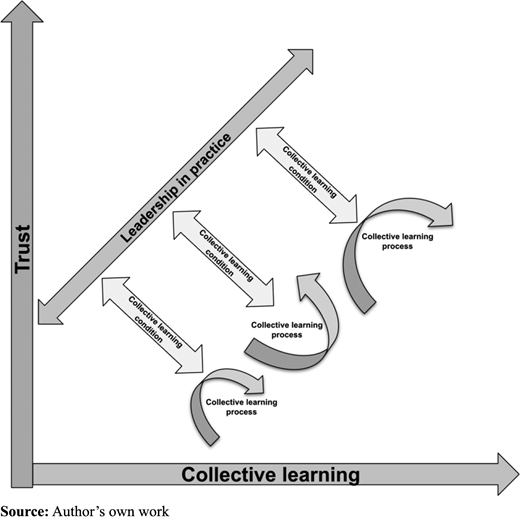
The relationship between leadership and collective learning conditions and processes
The relationship between leadership and collective learning conditions and processes
The figure presented draws upon an analysis that underlines how shifts in leadership can profoundly influence trust levels within an organisation. Trust forms the foundation of collective learning, and any variation in trust can either amplify or impede this process. An organisational environment or situation steeped in trust encourages the establishment of various routines and mechanisms, enabling team members to participate in a broad spectrum of activities within the organisation’s practice. This provision equips them with the resources necessary to contribute towards achieving the organisation’s shared goals. Consequently, a social situation that challenges the traditional managerial approach of command and control is created (Crevani, 2018; Oreg & Berson, 2019; Wilson & Cunliffe, 2021). Hence, the findings presented underline the clear notion that leader–team relationships fostering a trustworthy work environment catalyse a collective sense of direction among team members, resulting in heightened productivity and engagement (Denis et al., 2012).
In this paper, like leadership, trust is viewed as a relational concept, characterised as being interaction-based and developed over time through communication and interaction in practices (Bachmann, 2011; Bulatova, 2015). The findings of this study, therefore, reinforce the proposition that creating an environment conducive to collective learning necessitates that leaders and team members establish and sustain a trust-filled atmosphere, acting as the bedrock for collective learning (Brower et al., 2000; Edmondson, 1999).
Trustworthy relationships enhance the prospect of cooperation and knowledge sharing, realised when team members are actively involved in decision-making processes. Consequently, such meaningful engagement strengthens the bond between team members and the organisation, especially considering the asymmetrical distribution of knowledge among team members. A trustworthy environment fosters team members’ willingness to share knowledge, thus escalating innovativeness, as corroborated by studies such as Jena, Pradhan & Panigrahy (2018), Rulinawaty & Madhakomala (2022), Sarvestani, Biranvand & Shojaeifard (2022) and von Behr, Cleaver, Minshall & Clarkson (2022).
Drawing from studies on work situations during the pandemic, many organisations have relied on command-and-control leadership actions to guarantee efficient remote work, as highlighted by Lee (2021). This strategy was necessitated by the reduced levels of interaction and communication during the pandemic, which directly affected trust between leaders and team members (Zainab et al., 2022). The results of the study underscore that trust between the CEO and team members was entrenched within the organisation pre-pandemic, and leadership in practice sustained the trust during the crisis. This was particularly vital given the sense of uncertainty the pandemic instilled among SFE’s employees regarding their organisational future. Restrictions compelled the halt of all operations, necessitating the swift conceptualisation and development of alternative projects. Hence, the findings imply that simply having a trustful environment is insufficient for surviving a crisis; it is equally important that leadership ensures trust is upheld throughout such events.
Moreover, as highlighted in this study, knowledge sharing and the exchange of experiences hinge upon the active participation of team members in diverse practices within the organisation. For instance, the leadership in this study included members of the organisation in decision-making processes. This inclusivity allowed them to exchange ideas and experiences and assume leadership roles in team management and meetings. This strategic move by leadership was pivotal in making employees feel valued as integral members of the organisation having central roles in its practices. Following this, tangible measures were initiated to stimulate and facilitate participation to exchange ideas and experiences within the organisation, fostering a mutual understanding of each other’s work, intentions and expectations.
The conditions and processes conducive to collective learning are thus contingent upon leadership in practice that paves the way for team members’ participation in practices to effect changes in the organisation’s operational methodology, reassess fundamental organisational assumptions and seek novel consensus in how tasks are accomplished to meet current and future challenges (Carmeli & Paulus, 2014; Koeslag-Kreunen et al., 2018; Sankowska, 2013). This is realised by augmenting conditions favourable for collective learning, such as interaction routines and communication modes that foster knowledge sharing and the exchange of experiences – the fundamental pillars of collective learning processes (Ohlsson, 2013, 2014).
Conclusion
This study underscores the pivotal role of leadership in building trust and fostering open communication as essential catalysts for collective learning, particularly in times of crisis. By emphasising the significance of leadership in practice, we can posit that alterations in the nature of leader–team relationships that prioritise trust and communication empower organisations to foster conditions conducive to collective learning, such as effective structures and interaction routines for knowledge sharing.
The empirical findings of this study enrich the academic discourse on leadership and learning in small social entrepreneurial organisations by shifting the focus from the leaders’ individual attributes to an examination of leadership in practice (Raelin et al., 2018). In doing so, the study perceives the leader as an integral component of the community of practice (Wenger, 1998), rather than a figure solely tasked with issuing directives from above. This viewpoint stresses the importance of nurturing collaborative relationships and incorporating team members in decision-making processes to facilitate collective learning. For instance, the results can illuminate our understanding of how leadership can devise diverse participatory approaches for team members, encouraging a transition from peripheral roles to more central positions in communities of practice. This is especially relevant as non-profit social entrepreneurial organisations typically exhibit a more participatory leadership style compared to their for-profit counterparts, which usually lean towards more command-and-control modes of leadership.
The insights gleaned from this case study have practical implications for organisations seeking to fortify their leadership and nurture learning and resilience amidst unexpected challenges. It provides managers and leaders with tangible examples of how leadership can establish routines and mechanisms to enhance trust and generate conditions favourable for collective learning. The recommendations provided for structuring, organising and leading virtual meetings can be particularly beneficial for leaders, given that future organisations may likely have to amalgamate remote work and office environments into hybrid workplaces, potentially presenting numerous communicative challenges for teams.
While the study provides insights into leadership and learning during a crisis, it is essential to acknowledge that data collection occurred partially pre-pandemic and mainly during the pandemic. Therefore, a potential limitation of this study is its inability to consider how lessons learned from the pandemic will be applied in organisations once restrictions are lifted, and life returns to a “normal” state. Future research could delve into how these lessons inform organisational practices in the post-pandemic world.

