Skip to Main Content
Purpose

Extreme teams are found in a great variety of contexts, from firefighting to space exploration. The number of extreme teams (alongside research on them) has exponentially increased in the last two decades. Thus, the purpose of this study is to examine the internal team dynamics of extreme teams, identify key team configurations and finally, to explore methodological insights for studying these teams with the use of innovative methods.

Design/methodology/approach

Using Hollenbeck et al.’s (2012) three-dimensional typology, the authors conducted a systematic review and coded 195 articles according to their skill differentiation, authority differentiation and temporal stability.

Findings

Three profiles of extreme teams emerged: (1) agile experts, (2) cohesive mainstays, and (3) structured flex crews. The authors provide specific lessons for each profile as well as methodological guidance to aid researchers and practitioners working with extreme teams.

Originality/value

We focus on teams’ dynamics to offer more precision in capturing the relevant sources of stress and uncertainty that shape these teams based on their distinct characteristics, such as leadership structures, skill differentiation and temporal stability, to overcome challenges – regardless of their general extreme context. These new profiles will allow future researchers to understand extreme teams far and wide, from space teams to surgical teams and beyond.

The five highly qualified members of the Mars crew are in the second year of their mission. They have one more month on Mars until their return to Earth. Thus far, they have gone 522 days without seeing anyone except one another, and they have had to perform a variety of highly complex tasks, requiring both teamwork and technical skills years in the making. Now, this team is in the preparation stages for their nine-month journey home, which ideally, will end in loving reunions with family and friends and a temporary escape from the isolated, confined and challenging conditions they have endured as a team.

This has not happened yet. Nobody has made it to Mars and back. However, if a Mars mission is to succeed, teams manning these missions must be resilient, or in other words, have the ability to overcome adversity (Alliger et al., 2015; Stoverink et al., 2020). Working in an extreme context like space, teams must overcome constant dangers and difficult working conditions through an optimization of leadership, team cohesion and skill specialization, as they attempt to cover uncharted territory (Landon et al., 2018). However, these conditions are not unique to space teams. Several teams experience extremeness, from surgical to analog teams, with uncertainty of politics, economy and ecology introducing complexity and challenges into their work (Hällgren et al., 2018). These teams are known as “extreme teams.”

Extreme teams can be defined as:

[…] teams (a) that complete their tasks in performance environments with one or more contextual features that are atypical in level (e.g., extreme time pressure) or kind (e.g., confinement, danger) and (b) for which ineffective performance has serious consequences (Bell et al., 2018, p. 2741).

The emerging literature on these teams is only starting to grow in consensus through recent reviews and frameworks (e.g. Hällgren et al., 2018; Ployhart et al., 2022; Schmutz et al., 2023). While existing research has established the critical importance of contextual factors – such as isolation, confinement and exposure to danger (Ployhart et al., 2022) – in defining extremeness, there is also a growing recognition that understanding the internal team dynamics that unfold within these contexts is essential.

Rather than shifting focus away from context, we argue that team dynamics, defined as working (and sometimes living) well together (Roma and Bedwell, 2017), must be explored in conjunction with contextual conditions to understand how teams adapt, endure and succeed under “extremeness.” Yet, despite the centrality of both these characteristics: context and team dynamics, their interplay is seldom the primary focus of empirical work (Bell et al., 2018). At large, the lack of focus on extreme team dynamics is explainable, as context provides the boundaries and demands that give meaning to the processes that follow (e.g. leadership, situational awareness, shared understanding, Buchanan and Hällgren, 2019). For example, in an era where circumstances shift frequently and often without notice (Christian et al., 2017), context is inextricably intertwined with team dynamics through a team’s reaction and adaption to the given context (Abankwa et al., 2019). Moreover, focusing on combinations of contextual attributes (e.g. isolation, danger) rather than team types (e.g. SWAT teams, surgical teams) may offer more precision in capturing the relevant sources of stress and uncertainty that shapes these teams; though scholars have cautioned against comparing teams that experience the same contextual factor (e.g. isolation) in different settings (e.g. surgery vs space teams; see Schmutz et al., 2023).

Yet, despite extreme teams’ ever-changing nature, prior research in extant areas supports the development of stable profiles rooted in continuous variables. For instance, although personality traits such as conscientiousness or openness are continuous variables, these traits tend to stabilize within specific ranges (Specht et al., 2014). This pattern of convergence is not limited to individual traits. In the context of extreme teams, it is the dynamic progression within the boundaries set by context that allows researchers to investigate these internal team dynamics and best support their resilience. Consequently, to fully understand how extreme teams function, we must examine not only the contextual conditions they operate within, but also the patterns of interaction that emerge in response, much like studying personality requires both situational triggers and stable traits to grasp behavioral outcomes. This dual focus is essential for capturing the complexity that characterize extreme teams. To advance both theory and practice, the field must begin to conceptualize and empirically map the internal dynamic configurations that enable extreme teams to persist, learn and thrive. Without these profiles, our ability to support, train and design extreme teams for sustained success remains limited.

The purpose of this article is threefold. First, we seek to review prior literature on extreme teams and discuss two theoretical and methodological challenges: heterogeneity in the use of the term “extreme teams” and a disproportionate focus on extreme teams’ context to the exclusion of their internal team dynamics. Then, through a systematic literature review, we introduce the most common extreme team configurations categorized along three dimensions: authority differentiation, skill differentiation and temporal stability (Hollenbeck et al., 2012). Here, we discuss the variability within extreme team contexts – such as how some extreme teams have members who specialize in highly different skills (e.g. surgical teams; Pasarakonda et al., 2021) and others have overlapping skillsets (see Boermans et al., 2014) – and the related effects on team dynamics. By doing so, we provide specific insights into the most common extreme team dynamic configurations and actionable recommendations based on their profile. We aim these recommendations toward improving extreme team resilience. Finally, we identify novel methodological advancements to study these teams according to their dynamics, addressing existing empirical challenges.

Bell and colleagues’ (2018) definition of extreme teams highlight how they operate within atypical contexts and face high consequences of underperformance. Although this definition has been widely accepted (e.g. Driskell et al., 2018; Johns, 2017; Kozlowski and Chao, 2018; Oc, 2018), some heterogeneity in terminology exists. For example, Hannah et al. (2009) highlight that teams with extreme characteristics – including high stress, significant consequences and dynamic environmental pressures – appear in related literature under various labels, such as “teams in extreme environments” (Driskell et al., 2018), “mission-critical teams” (Burke et al., 2019) or “action teams” (Goodwin et al., 2008). These distinctions are often based on disciplinary focus or operational context rather than fundamentally different team phenomena. Rather than arguing for a new conceptualization, we aim to synthesize and clarify the boundaries of the interdisciplinary term – as study relevant phenomena without explicitly using “extreme teams” language (e.g. health-care research, such as Vaulont et al., 2021). This synthesis helps identify the underlying team characteristics that occur across these varied contexts, supporting integration and clearer identification of gaps in the literature. Based on this literature, common characteristics (see Table 1 for details) identified across this literature include:

Other characteristics are mentioned in the literature but with less frequency, including limited communication and interaction with outside entities, high levels of discomfort and diversity in team members’ occupations. Although these other characteristics can also be useful, no one characteristic listed is unique in describing extreme teams. Consequently, traditional teams may experience one or many of these descriptors in specific moments but otherwise would and should not be considered extreme. To build on these insights without adding heterogeneity to the literature, we highlight the importance of mission criticality – whether a team’s work is essential and failure has disproportionate consequences – as a cross-cutting indicator that separates persistent extremeness from temporary pressure (DeChurch et al., 2011; Burke et al., 2018).

Researchers have begun to reconsider what defines an “extreme team.” For example, Schmutz et al. (2023) describe team extremeness as a multidimensional concept, emphasizing environmental and task-related factors, while Hällgren et al. (2018) proposed operating in RED (i.e. risky, emergency, disruptive) contexts as a defining characteristic of extreme teams. Moreover, most researchers recognize the influence of these external, context-related factors to team processes and emergent states (Ployhart et al., 2022; Schmutz et al., 2023). To date, researchers have fully addressed the interplay between context and internal team dynamics, such as a team’s authority structure, within extreme team definitions.

Rather than categorizing teams by type, a more precise approach involves examining how specific contextual features shape team dynamics. For instance, astronaut teams may face prolonged isolation, monotony and confinement whereas medical trauma teams can be under short bursts of stress with high rotation of team membership. Both conditions will meaningfully shape their functioning even if a specific team type changes the specific processes needed as they perform. This raises an important distinction: extreme conditions may differ not just in intensity but in kind, and team dynamics may vary accordingly. Yet, up until this point, we have little insight on how extreme teams structure themselves to respond to these contextual characteristics, or if commonalities arise across the plethora of teams that exist. Therefore, we focus our synthesis on how internal team dynamics configure under extreme demands, drawing on prior conceptual frameworks to build a profile-based approach for comparing extreme teams.

Extreme teams are complex and dynamic. They are rarely confined to a single category (e.g. some scenarios combine risky, emergency and disruption elements). However, all teams, regardless of their context, can be described using three characteristics (Hollenbeck et al., 2012). These three dimensions included authority differentiation (AD), skill differentiation (SD) and temporal stability (TS).

Authority differentiation (AD) is the extent to which decisions are unilaterally made by a designated leader. Teams that score low on AD reflect more of a shared governance structure, whereas teams with high AD reflect more hierarchical structure. AD is particularly important to extreme teams, as the degree of leadership influences conflict management, decision-making and cohesiveness processes (e.g. Hannah et al., 2009; Marcinkowski et al., 2021).

Skill differentiation (SD) refers to whether a team is composed of individual members with specialized skills that take time to develop (i.e. high SD) or many members with overlapping skills (i.e. low SD). SD dictates the degree to which members of the team may be substituted. In extreme teams, SD relates to authority differentiation as some teams with high SD use consensus rather than unilateral decision-making, whereas teams with low SD tend to be led by a stable leader who remains in an authoritative role.

Finally, temporal stability (TS) is the degree to which the team has stable membership (Hollenbeck et al., 2012). Teams characterized by high TS have stable team membership compared to those low in TS. Importantly, teams with high TS tend to have higher levels of cohesion (Driskell et al., 2018) but might be subject to groupthink. Finally, in low skill differentiation contexts, substitution of team members can occur at higher rates, as members usually do not require extensive training to fill other team member’s roles and responsibilities (i.e. low TS). Moreover, TS considers whether a team has a future together. For this reason, TS reflects both time spent together and the consistent repetition of team tasks within the same intact group.

Cited in over 700 articles, Hollenbeck et al. (2012)’s dimensions can be applied across team types, from virtual teams (e.g. Morrison-Smith and Ruiz, 2020) to health-care teams (e.g. Hughes et al., 2016). AD, SD and TS provide quantifiable and measurable constructs that allow for nuanced analysis of how teams operate in extreme environments, enabling researchers to systematically examine extreme teams under a common umbrella and explore how their team dynamics differ from traditional teams. For this reason, we introduce a profile approach based on Hollenbeck et al. (2012)’s framework. This profile approach depicts how distinct configurations of the three dimensions within extreme team contexts result in different dynamics and challenges. For example, medical emergency teams are required to form and respond to emergencies within 1 to 2 minutes of a patient being brought in to mitigate the risk of death. However, the team dissolves as soon as the patient is stabilized, displaying low temporal stability (Schmutz et al., 2015). Yet, health-care teams are usually recognized for higher authority differentiation. In contrast, space crews display high temporal stability, often experiencing long periods together that still require rapid responses in the case of emergencies, whilst displaying patterns of moderate-to-low authority differentiation (Basner et al., 2014). While their context might be described in a similar matter, it is evident these teams’ internal processes are distinct.

By introducing this profile approach, we integrate the literature to answer three questions:

Q1.

What are the most prominent profiles of extreme teams?

Q2.

Based on their internal dynamics, what are actionable recommendations to drive their success?

Q3.

What are the methodological considerations for these types of teams?

Literature searches and inclusion criteria. Searches were first conducted using APA’s PsycINFO as it gives access to a wide variety of journals in which psychological research on extreme teams is published, including industry-specific publications (e.g. Acta Astronautica) and frequently-used organizational publications (e.g. Journal of Applied Psychology). Searches were also conducted through the Defense Center’s Defense Technical Information Center (DTIC) database to locate technical reports from government-funded research on extreme teams. Finally, studies were cross-checked against reference lists of key relevant special issues and reviews to identify studies that may have been omitted in the previous searches to reduce the risk of the “file drawer problem.” An overview of search results and inclusion criteria is included in Figure 1. Keywords included extreme, disaster relief, disaster response, recovery, health care, emergency trauma, emergency trauma center, provincial reconstruction, special operations, astronaut, military, expedition, space exploration, steel mills, health care, community building (similar to provincial reconstruction), mining operations, polar exploration, polar science, winter-over, ocean racing sailboat, around the world sailboat racing, Rolex Sydney Hobart Yacht Race, Volvo Ocean Race, Clipper Round the World Race, America’s Cup Race, firefighter, police SWAT, long-distance and long-duration in combination with either team or crew. These terms were generated by examining terms commonly used in previous literature on extreme teams. In addition, 10 subject-matter experts (i.e. psychologists who study extreme teams) rated our original list of keywords and suggested additional terms. The complete set of searches resulted in approximately 8,861 results. An additional targeted search for military teams produced an additional 86 articles.

Inclusion criteria included the following: the articles must:

  • have been written in English;

  • focus on teams;

  • have been empirical; and

  • focus on extreme teams as defined by Bell et al. (2018).

Simulation, scenario, and training studies were included if they focused on teams that are considered extreme (e.g. isolation studies preparing for long-duration space missions to Mars). Ultimately, the final set of articles for coding consisted of 195 articles with a total of 197 studies. Table S1 shows a list of these articles.

Coding procedure. The final set of articles was coded concerning study design, team demographics, sample information (e.g. gender), type of extreme team, degree of SD, AD and TS present in each team, challenges faced by the team, variables examined and methodologies used (see Table S2 for complete coding scheme). First, all authors coded an initial subset of nine articles to clarify terminology and ensure consensus. Next, different two-person combinations of the researchers coded a subset of articles. These pairs coded independently and then met to discuss. Discrepancies were resolved through discussion or by a third researcher. Consensus was generally high across all coders. The remaining articles were double coded, then all final studies were checked by a third coder. Themes were generated to identify the significant opportunities and tradeoffs for extreme teams across dimensions, as well as methodological challenges encountered. A list of all included articles and coding schema are available in the supplementary materials.

Once coding was completed, the research team took a qualitative approach to investigating the nature of extreme teams, identifying lessons learned and determining general guidance for methodological challenges. From the 197 studies, 133 had enough information on the three dimensions and could be then categorized as high, moderate or low in regard to Hollenbeck et al.’s (2012) dimensions. Finally, we engaged in a series of discussions to identify frequently studied topics, most-cited challenges and common themes. After these were identified, they were grouped into thematic clusters, resulting in six lessons learned about extreme teams.

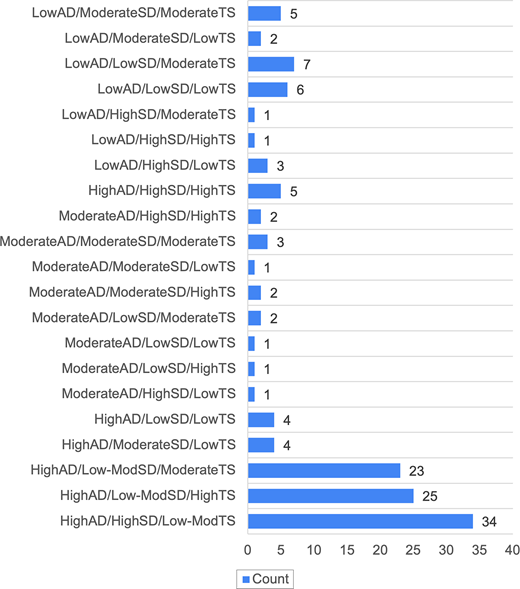
The reviewed studies typically featured a limited sample size, with nearly half focusing solely on a single team. These studies tended to be comprised of primarily male samples, although many featured diversity across occupational and cultural characteristics. The most frequently studied extreme teams were those high on authority differentiation (62%). Within this category, teams showed considerable variation in the levels of skill differentiation (SD) and temporal stability (TS; see Figure 2 for all frequencies). Based on these insights, we shift to understand how extreme teams high on authority differentiation vary across skill differentiation and temporal stability, introducing the most recurrent extreme team profiles.

By examining extreme teams experiencing contexts such as isolation, confinement and extreme tasks, across these three dynamic characteristics, the sections below offer specific insights for three of the most prominent extreme team profiles:

  1. agile experts;

  2. cohesive mainstays; and

  3. structured flex crews.

Table S3 shows the breakdown of all the studies included in each one of those profiles. We provide lessons rooted in the literature to aid both with the management of these profiles and the methodological challenges of studying them.

Profile 1 extreme teams have a highly hierarchical authority structure, high levels of skill differentiation and less stable team membership and longevity. Extreme teams of this profile are often subteams quickly formed to solve a problem (e.g. trauma medical team); hence, we call them agile experts. Given their low-moderate temporal stability and high skill differentiation, to improve their performance, agile experts should focus on properly transitioning from one action cycle to the next, supported by a common understanding of the mission at hand and everyone’s roles within it (i.e. a shared mental model; Marks et al., 2001). For example, Michailovs et al. (2024) found that when team members had high levels of information integration they developed better situational awareness and more adequate workload. Overall, these shared understandings better equip agile experts to handle challenges, potentially increasing their resilience. Of our sample, 21.1% shared the characteristics of agile experts, with nearly 80% of the studies within this profile published from 2015 to 2025.

Given that one of the hallmarks of a resilient team are strong shared mental models (Stoverink et al., 2020), performance for Profile 1 teams might be hindered if shared mental models are underdeveloped or inaccurate (Santos et al., 2021). Profile 1 teams could be especially susceptible to these mistakes given their high skill differentiation, as team members might come from different occupational, educational and cultural backgrounds. To address uncertainty, institutional anomalizing can be used. Institutional anomalizing involves the creation of breaks to look for anomalies and updating sensemaking during the action phases of teaming (Barton et al., 2015). Profile 1 teams require a quick development of collective sensemaking, and many tools can be used for this, e.g. concept mapping (Son et al., 2020). Additional organizational tools to aid Profile 1 teams include debriefing tools, such as DebriefNow. Debriefing has been found to mitigate decrements in team processes across all types of teams by 30%, and is considered an important tool for developing and maintaining team resilience (Tannenbaum and Cerasoli, 2013; Alliger et al., 2015). Debriefings are effective for all kinds of teams (e.g. Keiser and Arthur Jr, 2022; Keiser, 2024), but could be crucial when teams are in the extreme context with low temporal stability. An illustration of how thinking through these transitions matter is the finding that pre-operative team briefing can lead to higher levels of patient safety, but more so when the surgical teams actually follow a protocol and paying attention to the roles of those leading the briefings (Forsyth, 2021).

Contrary to traditional teams, the shift from stable to extreme situations can call for temporarily changing critical roles and drawing from shared knowledge without explicit communication. These agile teams require quick assessment of the context (Uitdewilligen and Waller, 2018) as well as proper integration of information to build accurate schemas (Michailovs et al., 2024). Having been set properly, processes such as anomalizing and debriefing can serve as a foundation for action in a pressing situation, by allowing team members to learn from their mistakes and be better prepared for upcoming missions and/or events during transitions. Accordingly, many studies within this profile have focused on simulating emergency situations so team members can respond using guides and standardized tools (e.g. Joseph et al., 2022; Yule et al., 2023), an effort made to balance the high cognitive load and amount of information they must process (Michailovs et al., 2024).

As team resilience is an emergent state (Stoverink et al., 2020), extreme teams with low temporal stability may suffer from low resilience, simply due to the fact that they do not stay together for long enough for resilience to emerge (Jeong and Korsgaard, 2022; King et al., 2016; Luthans et al., 2015; Morgan et al., 2013; Stuart and Moore, 2017). Moreover, high AD may be associated with lower team resilience (Klein, 2025). These effects may compound for Profile 1 teams, who exhibit both characteristics. Given their susceptibility to these processes, Profile 1’s agile experts must cultivate resilience quickly and efficiently. Teams must “minimize,” or plan for challenges and contingencies by conducting training drills and practicing approaches to addressing emergencies (Alliger et al., 2015, p. 179). Therefore, for extreme teams, such tools are especially crucial in maintaining effective functioning, particularly, shared mental models:

Lesson Learned #1: Agile experts must develop a shared mental model quickly and effectively to support team resilience. To do this, Profile 1 teams should use organizational and team-level tools (e.g. drills, scheduled debriefing sessions) to improve team processes.

Agile experts can also leverage their skill differentiation. Research has shown that prosperous extreme teams will often report high levels of camaraderie (Leon et al., 2004) and a participative leader that can help teams navigate unfamiliar situations (Post et al., 2022). On the other hand, in several studies of medical and multidisciplinary crisis management, subgroup challenges emerged when leadership was shared or too directive, leading to either coordination process loss or effectiveness over quality of decision-making (e.g. Pasarakonda et al., 2021; Post et al., 2022). Drawing from the optimal distinctiveness theory (Brewer, 2003), diverse teams will often struggle to find their sense of belongingness and uniqueness simultaneously. Accordingly, intrapersonal disagreements can emerge and harm team cohesion for agile teams (Cole and Crichton, 2006) Overall, skill-diverse teams provide access to unique information helpful in completing team tasks, but when information-sharing processes are ineffective, performance can suffer (Michailovs et al., 2024; Uitdewilligen and Waller, 2018). Hence, skill differentiation can provide access to unique and necessary information for extreme teams, but team members need to share this unique information in a timely and effective manner, so this diversity does not go untapped.

To mitigate these negative effects, agile expert teams can leverage their high authority differentiation to establish a positive rapport and an environment of fairness in the team (Stewart and Johnson, 2009). Accordingly, strong and effective leadership structures can facilitate the development of positive team processes. Moreover, Pasarakonda et al. (2021) found that in surgical teams, centralizing leadership around the strategic role holder (e.g. the surgeon) during the operation’s critical phase can be key to success. Altogether, clear leadership will also aid in the fostering of a strong mental model, aiding resilience capacity.

Leadership development techniques can aid agile experts. Burke et al. (2018) investigated techniques for implementing effective leadership in extreme teams, finding that team leader coaching was an important predictor of cohesion and high performances. Coaching was also highlighted as an effective leadership technique to support extreme team performance, such as in surgical teams (Maynard et al., 2021). Additionally, Crew Resource Management (CRM) strategies such as communication and team decision-making are also prevalent in the literature (Guzzo and Dickson, 1996). Wu and colleagues (2016) found that the implementation of CRM strategies greatly improved reactions, learning and potential for transfer in emergency and critical care teams. Therefore, extreme teams within Profile 1 can leverage the positive leadership implications of high AD in combination with high SD to help encourage the development of positive team states:

Lesson Learned #2: Agile expert teams should leverage their hierarchical structure to support team performance. Profile 1 teams can implement effective leadership strategies such as coaching and CRM to increase congruence between uniqueness (e.g., different skills) and shared information (e.g., sharing a subgoal) through effective communication and cohesion processes.

Methodological consideration. To advance the study of resilience in these agile expert teams, innovative methodologies must capture their dynamic, fast-paced nature. Methods must be dynamic and capable of accounting for frequent team membership changes. For instance, studies have used technology such as Noldus Observer XT to convert time-based data of the task, communication and flow disruptions into an index that can be quantified and analyzed (Joseph et al., 2022). However, while trying to study these teams, ethical and practical considerations come to the forefront. For instance, HIPAA regulations may pose challenges to how much data the researcher can collect. Moving forward, the study of Profile 1 May be most suitable with naturalistic observations that include live annotations automated through artificial intelligence (AI). Though not included in our review, Echeverria et al. (2025) identified AI-powered multimodal learning analytics systems as a way to capture communication, transcribe and more importantly, offer immediate debriefing – particularly beneficial for agile experts, who necessitate a strong shared mental model.

Similarly to Profile 1, Profile 2 has high levels of authority differentiation. Unlike Profile 1, Profile 2 teams have low-moderate skill differentiation and high temporal stability, highlighting overlapping skill sets and a long, shared history. Here, communication may flow easier as team members have more familiarity with one another, the task and their roles and responsibilities. Yet, the unpredictability or need for rapid response remains, and Profile 2 teams need to be adaptable even without the presence of a diverse skill set. Therefore, we deem Profile 2 teams cohesive mainstays, reflecting their bonded team past and relatively similar skill sets. Of our sample, 18% shared the characteristics of cohesive mainstays, with most of the studies within this profile published before 2015 and characterized as military, police and firefighter teams.

A strong suit of Profile 2 teams is their temporal stability. Unlike Profile 1 teams, Profile 2 teams can leverage their extended time together to ensure clear designation of tasks, structured roles and the presence of team guidelines, all key for resilience and performance. Marques-Quinteiro et al. (2013) researched police tactical teams with around 6 years of shared work experience. They found that teams with more developed transactive memory systems (e.g. a shared understanding of team members’ knowledge) could perform more adaptively. Similarly, Lim and Klein (2006) found teams with more similar mental models performed better. Altogether, what this data suggests is making use of the team’s familiarity with each other to practice, discuss and ensure everyone is on the same page.

Though tools like debriefing can improve team performance across all teams (Tannenbaum and Cerasoli, 2013) – Profile 2’s cohesive mainstays have the luxury of incorporating longer and more consistent training sessions toward improving their performance – even if their skill differentiation heightens. One example are SWAT teams. Beckhy and Okhuysen (2011) emphasize the importance of building cross-member expertise, noting this added familiarity with each other’s task gave them perspective of the team’s overarching purpose. Ultimately, cohesive mainstay teams will require extensive training, but the investment pays off in the long run. However, as humanity progresses toward continued space exploration, it is likely these teams will begin to resemble Earth’s low SD construction context, a context where training has been key in preventing accidents and ensuring success (see Peiró et al., 2020). Altogether, cohesive mainstays should leverage their time together and train as a team:

Lesson Learned #3: Profile 2’s cohesive mainstays should take advantage of their high temporal stability and familiarity by taking the time to train together to enhance team performance.

A potential weakness for Profile 2 teams is the possibility of problematic group dynamics, made possible by their prolonged time together. While this stability fosters cohesion, it can also lead to rigidity if team members do not feel empowered to contribute beyond their designated roles. An illustrative example of these teams can be some military teams. Boermans et al. (2014) highlight how whether team members report more fatigue symptoms after deployment was strongly linked to the level of team engagement, such that those with high team work engagement reported feeling less fatigued than the other less engaged teams. Relatedly, in the same context, perceptions of respect were associated with more inclusion and value of self for the team (Ellemers et al., 2013). Consequently, it is easy to see how the social component in these types of teams is extremely impactful, influencing their morale, self-view and likely willingness to go above and beyond for their teammates.

Profile 2’s leaders need to prioritize a positive team climate and psychological safety (i.e. the ability to speak up without fear of reprimand; Edmondson, 1999). Establishing a culture of trust and psychological safety enables leaders to share constructive feedback, and moreover, it allows team members to share their insights and concerns. Moreover, psychological safety is also considered a key resource for team resilience (Stoverink et al., 2020). To foster this climate, many tools are available. For instance, transformational leadership has been shown to be positively related to team performance of military teams but especially because of the focus on the affective, cognitive and behavioral components (Boies and Howell, 2009). Furthermore, when teams had higher positive affect, they also had higher team viability. A simpler strategy that can increase the morale of the cohesive mainstays is the organizational support toward intentional interactions. For example, Kniffin et al. (2015) highlight the importance of commensality among firefighters, showing that spending time together has a strong impact on performance. Moreover, special attention should be given to affective components (e.g. trust, self-value) to generate team effectiveness under extreme conditions, suggesting the importance of others’ feelings and overall climate when dealing with a large stressor:

Lesson Learned #4: Cohesive mainstays should prioritize fostering a long-term psychologically safe climate to keep members engaged. Cohesive mainstay leaders need to prioritize affective components in addition to cognitive and behavioral team to balance their familiarity and sustain high levels of trust without sacrificing performance.

Methodological consideration. Profile 2 teams, as cohesive mainstays, have the power to shape positive team climates. Given their high temporal stability and familiarity, verbal task-related communication may be lower as members develop shared mental models and transactive memory systems. In such contexts, AI-powered tools for coding interactions may overlook crucial nuances, particularly the implicit coordination and nonverbal cues that drive team effectiveness. However, the passage of time alone does not ensure that team members maintain strong collaborative relationships. Therefore, studying the network structure of Profile 2 teams (i.e. those with high AD, low-mod SD and high TS) is essential. Recent work with space crews reinforces how team members are embedded within complex social environments, where leadership is distributed dynamically rather than following a static hierarchy (Lungeanu et al., 2022). Later, Lungeanu et al. (2023) highlight the significance of interpersonal networks in long-term isolated environments, revealing how information networks evolve and how teams navigate relational shifts over time.

Network analysis methodologies go beyond measuring density or connectedness, offering insights into how leadership is distributed, how silos emerge based on decision-making processes and how whether communication patterns are prone to subgroups formation. It is a good way to understand the relationships from advice network centralization to density (Wang et al., 2014). Honing in on these mechanisms is particularly crucial for cohesive mainstay teams, where entrenched communication habits may require intentional guidance or intervention to prevent inefficiencies. Future research should explore how these teams respond to disruptions, particularly examining the resilience of different communication structures and the challenges of bouncing back after critical incidents.

Profile 3 extreme teams are characterized as having high levels of authority differentiation, low-moderate levels of skill differentiation and moderate levels of temporal stability. These teams have a hierarchical structure, and their team members tend to fill a range of roles with some overlap, with missions greatly ranging in time periods. The shift from stable to extreme and back is one of the key characteristics of this profile. Although some may work under more temporally stable situations for a long time (Tafforin, 2013; Kanas et al., 2006), others may have to shift back and forth more often depending on mission timing, external events or leadership transitions (Vinokhodova et al., 2012). Thus, these teams may experience temporal barriers to the development of emergent states, as discussed in Profile 1 (i.e. shared mental models). Of the sample, 19% shared the characteristics of structured flex crews, with 84% published before 2015. In this profile, teams come from space, analog and military samples.

By highlighting similarities across team members and providing opportunities to coordinate from the inception of the team, it may be possible to speed up the emergence high-quality communication through the proper leadership. For example, Bartone et al. (2002) found that the shared experience of stressful and extreme scenarios influenced the emergence of cohesion, and strong leadership increased this effect. Given the high AD of Profile 3 teams, leaders play an important role in supporting effective intra-team interactions and purposeful collaboration. One way to support the emergence of positive states includes providing structured opportunities for socialization (Driskell et al., 2018). Repeated interactions can also foster what is even more important for these types of teams: high-quality communication, such as closed-loop communication.

The ability of extreme teams within Profile 3 to leverage their role overlap and relatively stable team membership to quickly develop positive and shared affective states and understanding of roles may have important implications for extreme team performance (Leon et al., 1994). This is because the environment of extreme teams may exacerbate the extent to which emergent states influence team functioning. Although there are meta-analytic claims that emergent states do not vary as a function of the team process (LePine et al., 2008), less research has examined whether emergent states work simultaneously and/or in a reciprocal manner throughout a team’s lifespan, especially in extreme teams. Some evidence is starting to accumulate regarding the dynamic relationship between emergent states and team outcomes, such as the demonstration of a reciprocal relationship between cohesion and team performance (e.g. Mathieu et al., 2015). Others suggest a cyclical relationship between team trust and performance (e.g. Grossman and Feitosa, 2018) as performance can then influence the emergence or reconsideration of team trust after the action process is completed:

Lesson Learned #5: Profile 3’s leaders can play a positive role in team functioning by providing opportunities for clearly defining roles and responsibilities and general socialization among team members. These processes can support the efficient emergence of positive team states (e.g., team trust, cohesion), which in turn will influence extreme teams’ communication clarity in a reciprocal manner.

In addition to the affective emergent states, the fluidity of these teams calls for more team adaptation. There are more practical concerns that emerge from moderate temporal stability, such as the variability in performance cycles and the inclusion of random, sometimes infrequent but impactful stressors that face extreme teams. For instance, interruptions may happen often or seldom, but they can shift teams’ prioritizations of the tasks at hand. Accordingly, task handoffs and routine disruptions can be stressful but the leader can ease the ambiguity faced and help team members engage with the different perspectives (Bhargava et al., 2000). Many of the successful teams with Profile 3 had guided transitions to recalibrate during some of the high-stress episodes (Kahn and Leon, 1994; Leon et al., 1994). Given research indicating low AD extreme teams with less centralized and structured leadership teams may be more susceptible to differences in personality variables which can then affect team processes such as trust and self-efficacy (Eatough et al., 2015), this suggests that effective, structured leadership, characteristic of Profile 3 teams, is vital to ensure that individual differences do not interrupt important emergent states during shifts.

Research has identified effective ways that Profile 3 leaders can support teams’ effective navigation of task interruptions. Quick increases in workload and large team sizes with a variety of specializations such as in moderate SD teams, may cause teams to struggle to transition as they progress through extreme action phases. To address this issue teams require a proper reflection, especially in transition phases (between action phases), to make sure everyone is on the same page. Drawing from the multiphasic perspective of team processes (i.e. action and transition phases, Marks et al., 2001), extreme teams will fluctuate from action (e.g. coordination) to transition (e.g. strategy formulation) processes, requiring different ways to interact with one another to achieve positive results. Profile 3 team leaders can take advantage of high AD leadership structures and their knowledge of team members’ roles and responsibilities to guide a process of collective reflection engaging all team members during transitions and moments of temporal stability, uplifting a variety of perspectives on team functioning and processes in service of improving action phases. For example, task reflexivity in action, or effective processing and response to events, was shown to promote information sharing and sense-making in extreme teams with these characteristics (Schmutz et al., 2018). Similarly, Profile 3 military teams with moderate temporal stability benefited from leaders demonstrating and encouraging within the team a promotion focus, highlighting progress and understanding growth needs to achieve the team’s goals (Avolio et al., 2022). Thus, leadership supported reflection during transition becomes paramount for teams in Profile 3 to help navigate interruptions and shifts:

Lesson Learned #6: Structured flex crew leaders can facilitate effective transition to action phases during shifts and interruptions by guiding teams through reflective processes that benefit from team members’ differentiated roles and perspectives on the task, team interactions, and team goals.

Methodological consideration. To understand and enhance the functioning of Profile 3 teams, a combination of continuous biomedical monitoring to capture physiological responses and sociomapping to analyze social interactions and cognitive workload is needed. As such, researchers have started to investigate unobtrusive measures to analyze behavioral patterns and speech in extreme teams, such as sociometric badges (Kim et al., 2012). Unobtrusive measures can overcome some of the challenges characteristic of this Profile, hierarchical structure but with team members that are somewhat familiar with each other, more so than Profile 1, but less so than Profile 2. Given their moderate levels of SD and TS, a methodological approach that captures both physiological responses and social interactions in real time is crucial for understanding and enhancing resilience of the structured flex crews. Consequently, studies should use novel, unobtrusive methods for studying Profile 3, such as physiological measures like heart rate monitoring (i.e. Kanas et al., 2006, 2007b, 2013). The moderate SD and TS, makes these teams more reliant on effective coordination and shared understanding while also having to be more intentional to establish cohesion and trust. With biomedical monitoring and sociomapping, early signs of stress, misalignment or social fragmentation can be flagged.

Many of these teams operate in isolated and confined environments (e.g. Espevik et al., 2006; Hedlund et al., 2015; Tafforin, 2013), making the integration of technological tools essential for maintaining team effectiveness. For instance, although on a different type of team profile (i.e. emergency medical team), Perry et al. (2022) demonstrated how dynamic communication quantification models can be used to visualize information flow and detect breakdowns in communication, providing a critical diagnostic tool for teams (Perry, 2024). With growing attention to extreme team science, researchers have documented various physiological and psychological concerns relevant to these contexts, such as neurocognitive changes, fatigue symptoms, misalignment of circadian rhythm, sleep disorders and stress levels. Teams that align with Profile 3 have used a range of unobtrusive measures (e.g. heart rate, cortisol, behavioral monitoring, communication patterns) to monitor team dynamics and performance without interruption (Baranski et al., 2007; Corneliussen et al., 2017; Kanas et al., 2006, 2007b). In addition to physiological measures, researchers have begun to develop and validate taxonomies to better understand team interactions. For example, Tafforin’s (2013) ethnographic observations highlight how proximity patterns, communication style and interaction dynamics shift as teams cope with isolation. These findings emphasize the potential for systematically observing patterns, where both verbal and nonverbal behaviors (e.g. postures, gestures and expressions) are coded using predefined criteria, to track, interpret and support team functioning in real time. Consequently, continuous biomedical monitoring and sociomapping offer a complementary and unobtrusive means of analyzing the dynamic processes that underpin effective performance under pressure.

Extreme teams exhibit a plethora of characteristics that make them distinct from traditional teams. Their dynamic context and criticality of their missions necessitates tools that reflect these characteristics. For this reason, effective methodologies for studying traditional teams will not necessarily translate to an extreme context. For example, self-report questionnaires are a common measurement tool for traditional teams. However, for extreme team members, they can be time-consuming, with their validity greatly affected by the context the teams are nested within (Rivolier, 1981). Moreover, self-report questionnaires tend to interrupt ongoing interactions between team members (Feitosa et al., 2018; Golden et al., 2018; Kozlowski and Chao, 2018). Another challenge facing the study of extreme teams are the small sample sizes, which reduces the likelihood of achieving sufficient power to detect complex effects or use rigorous statistics such as latent growth models (Shi et al., 2021). To counter these challenges of limited time for reflection and taxing nature in addition to small sample sizes, an emergent best practice within the extreme teams literature is to draw from mixed methods (cf., Bell et al., 2018). Accordingly, several studies reviewed for this paper used both quantitative and qualitative methods (e.g. Baker et al., 2021; Endsley, 2016; Hoschlova et al., 2024; Käosaar and Burke, 2024; Solcova et al., 2014), ranging from interviews to daily diaries (see Table 2 for a sample of methods). Although the use of mixed methods can be time-consuming for the researcher, it is an adequate way to tackle the challenges of small sample size and unpredictable performance episodes, while reducing disruptions to the work tasks of extreme teams. These measures are more conducive for data collection in teams where workload, time pressure and imminent danger are high (Orasanu and Lieberman, 2011; Paris et al., 2000). Therefore, extreme teams researchers must step outside of the methodological box to make a greater contribution to this literature.

One way to avoid interrupting these extreme teams is to look at their team dynamics. Team researchers can use the extreme team profiles identified in the present article to organize and guide approaches to research design and methodology, analysis and dissemination efforts to researchers and practitioners. Instead of remaining in a constant state of flux, extreme teams form stable, identifiable profiles that emerge from the interplay of continuous variables (i.e. temporal stability, skill variety and authority differentiation) and reflect consistent team dynamics. These profiles offer a clearer framework for understanding how extreme teams function, even as they transition through dynamic stages. This shift from fluid dynamics to stable patterns provides valuable insights into how teams behave, and therefore how they should be assessed. By pinpointing the stable profiles that emerge at the convergence of these variables, we can more effectively describe and categorize team behaviors, offering a deeper understanding of what makes extreme teams successful or challenging.

Up to now, it has been hard to analyze extreme team dynamics with rigorous statistical approaches such as latent growth models when data is not normal, missing or come from a very small sample (Shi et al., 2021). These authors compared different models testing various samples of less than 100 cases to see if they would yield accurate standard error estimates and robust results. Findings suggest that when the sample size was smaller than 60, nearly all fit indices suggest a poor model fit, regardless of true fit. A common technique to help address the statistical issues presented by small sample sizes is bootstrap resampling. Bootstrapping is a resampling technique where data is repeatedly sampled with replacement from the original small sample to estimate confidence intervals and variability more accurately. This resampling technique can help estimate confidence intervals and variability even with a small sample size by repeatedly drawing samples from your existing data.

Another technique to overcome the limitations of small sample sizes on traditional significance testing is Bayesian analytic approaches. Bell et al. (2018) delineated how Bayesian analysis incorporates prior knowledge about the population into the analysis, which can be particularly useful in providing more robust inferences when dealing with limited data of small samples in extreme teams. Our profile approach can build upon these analyses by informing the nature of weighted average distributions. For example, each profile can be treated as prior distributions with consistent expectations of extreme team behavior and outcomes. However, since then, the literature and, more importantly, methodological arena has greatly advanced to include AI-powered multimodal learning analytics as in Profile 1, advanced social network analysis as in Profile 2, biomedical monitoring and sociomapping as in Profile 3 or multilevel latent profile analysis (MLPA). We will describe the latter, which can be applicable to profiles of extreme teams.

MLPA is often applied when analyzing hierarchical data such as team members nested in a team as in this study (Asparouhov and Muthén, 2008). The MLPA includes two steps: LPA at the individual level and a latent class analysis (LCA) at the team level based on the results of LPA. Latent profile analysis is a human-centric approach to determine the type of people in a sample using criteria variables measured as continuous variables. It is important to note that this analytical approach requires a larger sample size than many of the other robust techniques discussed. The second step is to determine the number of team latent classes based on the results of LPA, in an exploratory manner, and the BIC value can be used as the model comparison criterion (see Mäkikangas et al., 2018). First setting the number of classes to one and then comparing each model by increasing the number of classes one by one.

For illustrative purposes, consider daily recovery profiles (e.g. Chawla et al., 2020). In general, employees tend to fall into one of five types of daily recovery profiles based on their psychological detachment, relaxation, mastery and control over the recovery process. These profiles represent distinct ways in which individuals recover from daily work experiences, and each profile is shaped by both individual traits and external conditions such as job demands, social support and work environment. Adding a team level analysis to daily recovery profiles will allow for more complex understanding of variance accounted for at the team level and provide more tailored interventions, as recovery in extreme teams can be collective (e.g. shared meals in polar expedition teams).

Extreme teams researchers have the opportunity to implement effective methodologies that (1) reduce the invasiveness of traditional teams research methodology; (2) increase the validity of measurements; (3) improve statistical approaches within the limitations of the extreme teams context; and (4) increase generalizability of findings. When implemented effectively, the recommendations above have the ability to expand the capacity of researchers to contribute to the literature and inform practice in the extreme team context.

Scholars have long emphasized the importance of context in understanding team dynamics, and this insight is just as vital, if not more so, when examining extreme teams (Palinkas et al., 2004; John Paul et al., 2010; van Thielen et al., 2018). Building on this foundation, our review adds a new layer of insight by offering a systematic profiling framework for interpreting the diverse and often high-stakes dynamics of extreme teams. Drawing on Hollenbeck et al.’s (2012) dimensions, we identify and analyze three recurring profiles in the existing literature – (1) Agile Experts, (2) Cohesive Mainstays and (3) Structured Flex Crews. Each of these profiles’ sheds light on how extreme teams operate under pressure and how they can leverage their dynamics to improve performance. In doing so, we extend the contextual understanding by previous work (e.g. Ployhart et al., 2022; Schmutz et al., 2023) and highlight essential methodological considerations for future research. Ultimately, our profiles offer a more holistic and actionable lengths to navigate the complexities of extreme team performance.

Overall, we found high authority differentiation was a key feature of most extreme teams, with only 33% of studies showing low authority differentiation. As we explore in this paper, high authority differentiation can be leveraged for positive effects, such as using coaching to aid cohesion processes. Furthermore, the methodological insights for studying extreme teams using noninvasive methods based on their corresponding profiles, such as increasing the use of AI, social network analysis and the use of biomarkers, match the specific team dynamics of these extreme teams. We also reiterate the importance of mixed methods (Bell et al., 2018) and elaborate on particular methods untouched by the extreme teams literature, such as bootstrapping and MLPA. While many powerful techniques can model uncertainty and capture complex relationships, it is not a remedy for inadequate or non-representative data. Applying such methods must be coupled with rigorous interpretation and a transparent acknowledgment of their methodological constraints. Consequently, we urge researchers to consider these more nuanced methodologies and look for a match between extreme team Profiles and the recommendations above. Once again, these methods provide an avenue to overcome the limited in-situation reflection opportunities, potential missing data and small sample sizes characteristic of extreme teams while carefully matching them to the research goals.

This research offer a number of important theoretical implications. Rather than siding against, we side with the recent efforts to make the extreme teams literature more parsimonious and integrated (e.g. Hällgren et al., 2018; Ployhart et al., 2022; Schmutz et al., 2023). In line with this goal, by synthesizing prior research through a new lens, we offer a holistic approach to examining extreme teams and propose specific profiles, specific guidelines for the profiles (i.e. six lessons learned) and methodological guidance for each type of team (i.e. both broad and specific). While other researchers’ efforts have provided different ways to examine the extreme teams context to understand the events, riskiness and task dynamics, we focus on how the team is functioning in relation to leadership, skill sets and temporal elements. Specifically, we incorporated a very well-known framework from the teams science (Hollenbeck et al., 2012) within this context to complement the efforts to understand extremeness and help provide organization and guidance within extreme teams research.

Although this team profile-centric approach could have yielded up to 27 different configurations, three emerged as the most representative of extreme team dynamics, covering approximately 60% of the extreme teams studied. First, when team members have specialized expertise and little time working together, the focus is on team cognition. Drawing from a wealth of literature on immersive simulations (e.g. Brown and Benson, 2020), leaders of these teams can use such context to train and develop more shared awareness, mental models and transactive memory systems within their teams. These agile experts need to draw from organizational tools and effective leadership strategies to make these teams even more resilient. Second, when teams have the opposite levels of skill differentiation and temporal stability, they can maximize performance by effectively using their time spent together and their overlapping skills. However, these teams can fall into subgroup formation (e.g. ingroup-outgroup team member categorizations) that can hinder not just the team-member exchange but also the leader-member exchange dynamics. These cohesive mainstays have a social challenge to remain connected and aligned as the team evolves. Third, when teams have moderate levels in both skill differentiation and temporal stability, the focus is on the transitions to ensure the fluctuation in any of team characteristics does not affect the task and team processes. Many of the in-action reflection tactics can come handy here (e.g. Schmutz et al., 2018), particularly when the authority figures of these teams participate in such activities. These structured flex crew leaders can guide the team to the same page and make resilience needs clearer throughout. These insights into the specific, common extreme team profiles present implications for extreme team management, practice and research.

Furthermore, our approach of looking at the team profiles in terms of Hollenbeck et al.’s dimensions provide a common language that can be used to ensure researchers and practitioners are not comparing apples to oranges or putting “new labels on old wines.” As other researchers categorized the extreme team context and showed that context will influence team dynamics (Ployhart et al., 2022), our profiles show how the three dimensions function in relationship to each other for different types of teams.

Finally, we offer approaches that minimize the intrusiveness of traditional research methods to better capture team dynamics without disrupting performance. A significant methodological challenge in studying extreme teams is the difficulty of obtaining data from all team members at multiple points in time. For instance, Kjaergaard et al. (2015) noted that at least one team member was always on duty and unable to complete surveys in their military team study. Similarly, Kanas (2013) found that some team members were more vocal in reporting critical incidents, leading to imbalances in data representation. These challenges create aggregation and analysis issues that future research must address. One possible solution is the increased use of trace data and automated data collection methods guided by the realities of extreme team dynamics reflected in the identified Profiles, which can provide a more comprehensive and unbiased view of team dynamics. In addition, utilization of advanced statistical techniques tailored to small sample sizes and high-variability contexts will further strengthens the reliability of insights. Ultimately, these methodological innovations enhance the generalizability of findings, allowing researchers to make more meaningful contributions to both the academic literature and practical applications in extreme team settings.

While extreme team profiles are a viable and practical way to understand team dynamics of extreme teams within the snapshot of the research study, future research should dive deeper into extreme team functioning over time and the interplay between context, profiles and team dynamics. First, it is important to investigate the fluidity of these profiles. Some teams may shift from one profile to another more frequently than others, and understanding the conditions that drive these transitions is critical as it may help us to understand how to support teams and mitigate barriers to effective functioning during these shifts. For example, the discrepancies in research on the “third quarter” phenomenon, a pattern observed in long-duration, high-stress missions where psychological symptoms peak within the mission duration, highlight the need for more longitudinal studies that capture how team dynamics evolve over time (Basner et al., 2014; Décamps and Rosnet, 2005; Kanas et al., 2007a; Leon et al., 2002). Investigating the temporal stability of extreme team profiles can clarify whether these changes follow predictable patterns or emerge in response to specific contextual pressures, and the associated implications of profile shifting for team functioning.

Given the rapid growth of research on extreme teams, it is essential to avoid “disjunctivitis” (Antonakis, 2017), where studies become overly fragmented and fail to build cumulative knowledge. A limitation of this work is that we could not include every journal in the field (see Table S4 for a list of the journals included); thus, we recognize the potential for missing critical literature. To advance the field, scholars should continue to focus on integrating findings across different types of extreme teams. Our review highlights the predominance of studies on teams with high authority differentiation (62%), underscoring the need for more research on the interplay between leadership and followership in dynamic environments (e.g. Lim and Ployhart, 2004; Kanas et al., 2007a; Johnson et al., 2003). Accordingly, ample opportunity remains to explore the effects of a shared leadership structure within the extreme context (Burke et al., 2018). More specifically, future research can focus on how leadership transitions occur in response to unpredictable events and can provide valuable insights into team adaptability. Our profile analyses highlight that the modern era of extreme teams (i.e. teams from the past decade) most frequently fit within the agile experts profile – one that is marked by frequent change. This indicates that extreme teams and extreme teams research is also a trend toward team structures and dynamics that promote and support adaptability by necessity. This trend demonstrates that the structures and dynamics of teams in this profile are more frequent, common and may reflect the current needs of extreme teams for effective functioning.

As adaptability becomes a key focus for the teams literature in response to a frequently shifting world, extreme teams research can expand our knowledge on the implications of this trend by examining the interplay between extreme team profile and change. While frequent change may be a hallmark of extreme teams given the contexts within which extreme teams function, its effect on team dynamics may lead to different team dynamics within the extreme team depending on the profile. For example, unexpected team membership change, which may occur in low or high temporal stability extreme teams, is a challenge may be addressed in different ways by agile experts (e.g. rely on the defined leadership structure to guide adjustment to changing personnel) compared to cohesive mainstays (e.g. rely on the highly stable contingent of existing team members to maintain effective team processes) to maintain effective functioning. As we see more teams and organizations address the realities of a workplaces that experience significant change (Trainer et al., 2020), it becomes even more critical to examine the differentiated effects of change on team dynamics (see Feitosa et al., 2023).

Relatedly, one of the major implications from dissecting teams’ dynamics is the need to continue examining emergent states and team processes in a more fluid and intertwined manner. Ignoring the vital role of emergent states is a missed opportunity, as they influence the performance of extreme teams (Leon et al., 1994; Pfaff, 2012). For example, for Profile 2’s cohesive mainstays, affective and cognitive forces play a major role in determining performance outcomes. Yet, as it stands, we have little research exploring the role of emergent states past superficial measures of their existence. An area of opportunity could be to explore the cognitive workload literature (e.g. Berggren et al., 2013), but work is needed to translate this to extreme teams. Thus, the study of emergent states such as trust and cohesion needs to be taken seriously, but within the appropriate nomological network.

Finally, a critical yet underexplored area is the distinction between factors that facilitate team performance versus those that enhance resilience. Resilience is essential for extreme teams, and we highlight mechanisms that can enhance this state across different profiles. However, the interplay between emergent states and team processes in fostering resilience remains unclear. Some scholars have begun conceptualizing resilience within this context, including the extraction of behaviors that they need to minimize, manage and mend (Alliger et al., 2015). Future research should examine how resilience develops over time and whether different profiles of extreme teams are more or less prone to resilience-building processes. Investigating resilience as a dynamic construct with affective, cognitive and behavioral components will be crucial for developing strategies to sustain high-functioning extreme teams.

As the world continues to push the boundaries of science, technology and exploration, the work on extreme teams will continue to grow, calling for creative methodologies and fresh ways of thinking to understand how they function and function best. Through our profile approach to understanding extreme teams, we bridge a gap in the literature, take steps toward integrating the extreme teams literature for increased parsimony and provide insight into the way extreme teams work. We anticipate these insights will empower extreme teams researchers and practitioners by demonstrating that there are actionable ways to leverage their Profile-based strong suits and bridge their weaknesses to enhance performance and team resilience and support effective research, regardless of the challenges they face.

The authors would like to thank Athena Gabriella Dontas, Martina Soledad Awad, Aaliyah Almeida, Quan Nguyen and Jordan Nguyen for their engagement with the preparation of this manuscript.

Abankwa
,
D.
,
Rowlinson
,
S.
and
Adinyira
,
E.
(
2019
), “
Conceptualizing team adaptability and project complexity: a literature review
”,
International Journal of Innovation, Management and Technology
, Vol.
10
No.
1
, pp.
1
-
7
, doi: .
Alliger
,
G.M.
,
Cerasoli
,
C.P.
,
Tannenbaum
,
S.I.
and
Vessey
,
W.B.
(
2015
), “
Team resilience: how teams flourish under pressure
”,
Organizational Dynamics
, Vol.
44
No.
3
, pp.
1
-
84
, doi: .
Ancona
,
D.
,
Bresman
,
H.
and
Kaeufer
,
K.
(
2002
), “
The comparative advantage of X-teams
”,
MIT Sloan Management Review
.
Antonakis
,
J.
(
2017
), “
On doing better science: from thrill of discovery to policy implications
”,
The Leadership Quarterly
, Vol.
28
No.
1
, pp.
5
-
21
.
Asparouhov
,
T.
, and
Muthén
,
B.
(
2008
), “Multilevel mixture models”, in
Hancock
,
G.R.
and
Samuelsen
,
K.M.
(Eds),
Advances in Latent Variable Mixture Models
,
Information Age Publishing
,
Charlotte, NC
.
Avolio
,
B.J.
,
Keng-Highberger
,
F.T.
,
Lord
,
R.G.
,
Hannah
,
S.T.
,
Schaubroeck
,
J.M.
and
Kozlowski
,
S.W.
(
2022
), “
How leader and follower prototypical and antitypical attributes influence ratings of transformational leadership in an extreme context
”,
Human Relations
, Vol.
75
No.
3
, pp.
441
-
474
, doi: .
Baker
,
A.L.
,
Keebler
,
J.R.
,
Anania
,
E.C.
,
Schuster
,
D.
and
Plummer
,
J.P.
(
2021
), “
Team combat identification: effects of gender, spatial visualization, and disagreement
”,
Human Factors: The Journal of the Human Factors and Ergonomics Society
, Vol.
63
No.
4
, pp.
684
-
695
.
Baranski
,
J.V.
,
Thompson
,
M.M.
,
Lichacz
,
F.M.
,
McCann
,
C.
,
Gil
,
V.
,
Pastò
,
L.
and
Pigeau
,
R.A.
(
2007
), “
Effects of sleep loss on team decision making: motivational loss or motivational gain?
”,
Human Factors: The Journal of the Human Factors and Ergonomics Society
, Vol.
49
No.
4
, pp.
646
-
660
.
Barton
,
M.A.
,
Sutcliffe
,
K.M.
,
Vogus
,
T.J.
and
DeWitt
,
T.
(
2015
), “
Performing under uncertainty: Contextualized engagement in wildland firefighting
”,
Journal of Contingencies and Crisis Management
, Vol.
23
No.
2
, pp.
74
-
83
.
Bartone
,
P.T.
,
Johnsen
,
B.H.
,
Eid
,
J.
,
Brun
,
W.
and
Laberg
,
J.C.
(
2002
), “
Factors influencing Small-Unit cohesion in Norwegian navy officer cadets
”,
Military Psychology
, Vol.
14
No.
1
, pp.
1
-
22
, doi: .
Basner
,
M.
,
Dinges
,
D.F.
,
Mollicone
,
D.J.
,
Savelev
,
I.
,
Ecker
,
A.J.
,
Di Antonio
,
A.
,
Jones
,
C.W.
,
Hyder
,
E.C.
,
Kan
,
K.
,
Morukov
,
B.V.
and
Sutton
,
J.P.
(
2014
), “
Psychological and behavioral changes during confinement in a 520-day simulated interplanetary mission to mars
”,
PLoS ONE
, Vol.
9
No.
3
, p.
e93298
, doi: .
Beckhy
,
B.A.
and
Okhuysen
,
G.A.
(
2011
), “
Expecting the unexpected? How SWAT officers and film crews handle surprises
”,
Academy of Management Journal
, Vol.
54
No.
2
, pp.
239
-
261
.
Bell
,
S.T.
,
Fisher
,
D.M.
,
Brown
,
S.G.
and
Mann
,
K.E.
(
2018
), “
An approach for conducting actionable research with extreme teams
”,
Journal of Management
, Vol.
42
No.
5
, pp.
1
-
26
.
Berggren
,
G.
,
Adamska
,
A.
,
Lambertz
,
C.
,
Simmons
,
T.R.
,
Esselborn
,
J.
,
Atta
,
M.
,
Gambarelli
,
S.
,
Mouesca
,
J.M.
,
Reijerse
,
E.
,
Lubitz
,
W.
and
Happe
,
T.
(
2013
), “
Biomimetic assembly and activation of [FeFe]-hydrogenases
”,
Nature
, Vol.
499
No.
7456
, pp.
66
-
69
.
Bhargava
,
R.
,
Mukerji
,
S.
and
Sachdeva
,
U.
(
2000
), “
Psychological impact of the Antarctic winter on Indian expeditioners
”,
Environment and Behavior
, Vol.
32
No.
1
, pp.
111
-
127
.
Boermans
,
S.M.
,
Kamphuis
,
W.
,
Delahaij
,
R.
,
van den Berg
,
C.
and
Euwema
,
M.C.
(
2014
), “
Team spirit makes the difference: the interactive effects of team work engagement and organizational constraints during a military operation on psychological outcomes afterwards
”,
Stress and Health
, Vol.
30
No.
5
, pp.
386
-
396
.
Boies
,
K.
and
Howell
,
J.M.
(
2009
), “
Leading military teams to think and feel: exploring the relations between leadership, soldiers’ cognitive and affective processes, and team effectiveness
”,
Military Psychology
, Vol.
21
No.
2
, pp.
216
-
232
.
Brewer
,
M.B.
(
2003
), “Optimal Distinctiveness, Social Identity, and the Self”, In
Leary
,
M.R.
and
Tangney
,
J.P.
(Eds),
Handbook of Self and Identity
,
The Guilford Press
, pp.
480
-
491
.
Brown
,
D.K.
and
Benson
,
S.N.K.
(
2020
), “
Does time in team training matter? Evaluation of team-level attitudes with interprofessional education
”,
Clinical Simulation in Nursing
, Vol.
48
, pp.
38
-
45
.
Buchanan
,
D.A.
and
Hällgren
,
M.
(
2019
), “
Surviving a zombie apocalypse: leadership configurations in extreme contexts
”,
Management Learning
, Vol.
50
No.
2
, pp.
152
-
170
, doi: .
Burke
,
C.S.
,
Georganta
,
E.
and
Marlow
,
S.
(
2019
), “
A bottom up perspective to understanding the dynamics of team roles in mission critical teams
”,
Frontiers in Psychology
, Vol.
10
, p.
1322
.
Burke
,
C.S.
,
Shuffler
,
M.L.
and
Wiese
,
C.W.
(
2018
), “
Examining the behavioral and structural characteristics of team leadership in extreme environments
”,
Journal of Organizational Behavior
, Vol.
39
No.
6
, pp.
716
-
730
.
Chawla
,
N.
,
MacGowan
,
R.L.
,
Gabriel
,
A.S.
and
Podsakoff
,
N.P.
(
2020
), “
Unplugging or staying connected? Examining the nature, antecedents, and consequences of profiles of daily recovery experiences
”,
Journal of Applied Psychology
, Vol.
105
No.
1
, p.
19
.
Christian
,
J.S.
,
Christian
,
M.S.
,
Pearsall
,
M.J.
and
Long
,
E.C.
(
2017
), “
Team adaptation in context: an integrated conceptual model and meta-analytic review
”,
Organizational Behavior and Human Decision Processes
, Vol.
140
, pp.
62
-
89
, doi: .
Cole
,
E.
and
Crichton
,
N.
(
2006
), “
The culture of a trauma team in relation to human factors
”,
Journal of Clinical Nursing
, Vol.
15
No.
10
, pp.
1257
-
1266
.
Cooke
,
N.J.
,
Gorman
,
J.C.
,
Duran
,
J.L.
and
Taylor
,
A.R.
(
2007
), “
Team cognition in experienced command-and-control teams
”,
Journal of Experimental Psychology: Applied
, Vol.
13
No.
3
, p.
146
.
Corneliussen
,
J.G.
,
Leon
,
G.R.
,
Kjærgaard
,
A.
,
Fink
,
B.A.
and
Venables
,
N.C.
(
2017
), “
Individual traits, personal values, and conflict resolution in an isolated, confined, extreme environment
”,
Aerospace Medicine and Human Performance
, Vol.
88
No.
6
, pp.
535
-
543
, doi: .
Décamps
,
G.
and
Rosnet
,
E.
(
2005
), “
A longitudinal assessment of psychological adaptation during a winter-over in Antarctica
”,
Environment and Behavior
, Vol.
37
No.
3
, pp.
418
-
435
.
DeChurch
,
L.A.
,
Burke
,
C.S.
,
Shuffler
,
M.L.
,
Lyons
,
R.
,
Doty
,
D.
and
Salas
,
E.
(
2011
), “
A historiometric analysis of leadership in mission critical multiteam environments
”,
The Leadership Quarterly
, Vol.
22
No.
1
, pp.
152
-
169
.
Driskell
,
T.
,
Salas
,
E.
and
Driskell
,
J.E.
(
2018
), “
Teams in extreme environments: alterations in team development and teamwork
”,
Human Resource Management Review
, Vol.
28
No.
4
, pp.
434
-
449
, doi: .
Eatough
,
E.
,
Chang
,
C.-H.
and
Hall
,
N.
(
2015
), “
Getting roped In: group cohesion, trust, and efficacy following a ropes course intervention
”,
Performance Improvement Quarterly
, Vol.
28
No.
2
, pp.
65
-
89
, doi: .
Echeverria
,
V.
,
Zhao
,
L.
,
Alfredo
,
R.
,
Milesi
,
M.E.
,
Jin
,
Y.
,
Abel
,
S.
, …
Martinez-Maldonado
,
R.
(
2025
), ““
TeamVision: an AI-powered learning analytics system for supporting reflection in team-based healthcare simulation
”, In
Proceedings of the 2025 CHI Conference on Human Factors in Computing Systems
, pp.
1
-
22
.
Edmondson
,
A.
(
1999
), “
Psychological safety and learning behavior in work teams
”,
Administrative Science Quarterly
, Vol.
44
No.
2
, pp.
350
-
383
, doi: .
Edmondson
,
A.C.
(
2003
), “
Speaking up in the operating room: how team leaders promote learning in interdisciplinary action teams
”,
Journal of Management Studies
, Vol.
40
No.
6
, pp.
1419
-
1452
.
Ellemers
,
N.
,
Sleebos
,
E.
,
Stam
,
D.
and
de Gilder
,
D.
(
2013
), “
Feeling included and valued: how perceived respect affects positive team identity and willingness to invest in the team
”,
British Journal of Management
, Vol.
24
No.
1
, pp.
21
-
37
.
Endsley
,
T.C.
(
2016
), “
An examination of cultural influences on team cognition and information sharing in emergency crisis management domains: a mixed methodological approach
”, (Unpublished doctoral dissertation).
Pennsylvania State University
,
USA
.
Espevik
,
R.
,
Johnsen
,
B.H.
,
Eid
,
J.
and
Thayer
,
J.F.
(
2006
), “
Shared mental models and operational effectiveness: effects on performance and team processes in submarine attack teams
”,
Military Psychology
, Vol.
18(sup1)
, pp.
S23
-
S36
.
Feitosa
,
J.
,
Davis
,
A.S.
,
Romain
,
R.
and
Delice
,
F.
(
2023
), “
Team membership change events: processes that support gender diverse teams
”,
Small Group Research
, Vol.
55
No.
3
, pp.
375
-
416
, doi: .
Feitosa
,
J.
,
Grossman
,
R.
and
Salazar
,
M.
(
2018
), “
Debunking key assumptions about teams: the role of culture
”,
American Psychologist
, Vol.
73
No.
4
, pp.
376
-
389
.
Forsyth
,
D.R.
(
2021
), “
Recent advances in the study of group cohesion
”,
Group Dynamics: Theory, Research, and Practice
, Vol.
25
No.
3
, p.
213
.
Gardner
,
A.K.
and
Ahmed
,
R.A.
(
2014
), “
Transforming trauma teams through transactive memory/can simulation enhance performance?
”,
Simulation and Gaming
, Vol.
45
No.
3
, pp.
356
-
370
.
Golden
,
S.J.
,
Chang
,
C.H.D.
and
Kozlowski
,
S.W.J.
(
2018
), “
Teams in isolated, confined, and extreme (ICE) environments: review and integration
”,
Journal of Organizational Behavior
, Vol.
39
No.
6
, pp.
701
-
715
.
Goodwin
,
G.F.
,
Burke
,
C.S.
,
Wildman
,
J.L.
, and
Salas
,
E.
(
2008
), “Team effectiveness in complex organizations: an overview”, in
Salas
,
E
,
Goodwin
,
G.E.
and
Burke
,
C.S.
(Eds),
Team Effectiveness in Complex Organizations
,
Psychology Press
,
New York, NY
.
Grossman
,
R.
and
Feitosa
,
J.
(
2018
), “
Team trust: modeling dynamic, multilevel, and reciprocal influences
”,
Human Resource Management Review
, Vol.
28
No.
4
, pp.
395
-
410
.
Guzzo
,
R.A.
and
Dickson
,
M.W.
(
1996
), “
Teams in organizations: recent research on performance and effectiveness
”,
Annual Review of Psychology
, Vol.
47
No.
1
, pp.
307
-
338
.
Hale-Lopez
,
K.L.
,
Goldstein
,
M.H.
and
Wooldridge
,
A.R.
(
2023
), “
Sociotechnical system design to support disaster intervention development teams
”,
Applied Ergonomics
, Vol.
108
, p.
103948
, doi: .
Hällgren
,
M.
,
Rouleau
,
L.
and
De Rond
,
M.
(
2018
), “
A matter of life or death: how extreme context research matters for management and organization studies
”,
Academy of Management Annals
, Vol.
12
No.
1
, pp.
111
-
153
.
Hannah
,
S.T.
,
Uhl-Bien
,
M.
,
Avolio
,
B.
and
Cavarretta
,
F.L.
(
2009
), “
A framework for examining leadership in extreme contexts
”,
The Leadership Quarterly
, Vol.
20
No.
6
, pp.
897
-
919
.
Hedlund
,
E.
,
Börjesson
,
M.
and
Österberg
,
J.
(
2015
), “
Team learning in a multinational military staff exercise
”,
Small Group Research
, Vol.
46
No.
2
, pp.
179
-
203
, doi: .
Hollenbeck
,
J.R.
,
Beersma
,
B.
and
Schouten
,
M.E.
(
2012
), “
Beyond team types and taxonomies: a dimensional scaling conceptualization for team description
”,
Academy of Management Review
, Vol.
37
No.
1
, pp.
82
-
106
, doi: .
Hoschlova
,
E.
,
Bahbouh
,
R.
,
Huzva
,
M.
,
Chroustova
,
E.
and
Sykorova
,
K.B.
(
2024
), “
Structure and dynamics of crew communication in three stages of the SIRIUS experiment
”,
Acta Astronautica
, Vol.
225
, pp.
467
-
476
.
Hughes
,
A.M.
,
Gregory
,
M.E.
,
Joseph
,
D.L.
,
Sonesh
,
S.C.
,
Marlow
,
S.L.
,
Lacerenza
,
C.N.
,
Benishek
,
L.E.
,
King
,
H.B.
and
Salas
,
E.
(
2016
), “
Saving lives: a meta-analysis of team training in healthcare
”,
Journal of Applied Psychology
, Vol.
101
No.
9
, pp.
1266
-
1304
, doi: .
Jeong
,
S.S.
and
Korsgaard
,
M.A.
(
2022
), “
Individual-and group-level consequences of divergence in perceived group affect
”,
Human Relations
, Vol.
75
No.
12
, pp.
2218
-
2245
.
Johns
,
G.
(
2017
), “
Reflections on the 2016 decade award: incorporating context in organizational research
”,
Academy of Management Review
, Vol.
42
No.
4
, pp.
577
-
595
, doi: .
Johnson
,
J.C.
,
Boster
,
J.S.
and
Palinkas
,
L.
(
2003
), “
Social roles and the evolution of networks in extreme and isolated environments
”,
The Journal of Mathematical Sociology
, Vol.
27
Nos
2-3
, pp.
89
-
121
.
Joseph
,
A.
,
Neyens
,
D.
,
Taaffe
,
K.
,
Bayramzadeh
,
S.
,
Catchpole
,
K.
,
Ripchd
,
O.R.
and
Study
,
G.
(
2022
), “
Understanding “work as done”: using a structured video-based observational method to understand and model the role of the physical environment in complex clinical work systems
”,
HERD: Health Environments Research and Design Journal
, Vol.
15
No.
3
, pp.
13
-
27
.
Kahn
,
P.M.
and
Leon
,
G.R.
(
1994
), “
Group climate and individual functioning in an all-women Antarctic expedition team
”,
Environment and Behavior
, Vol.
26
No.
5
, pp.
669
-
697
.
Kanas
,
N.A.
(
2013
), “Human interactions on-orbit”, in
Vakoch
,
D.A.
(Ed.),
On Orbit and Beyond: Psychological Perspectives on Human Spaceflight
,
Springer-Verlag
,
Berlin Heidelberg
, pp.
93
-
106
.
Kanas
,
N.A.
,
Salnitskiy
,
V.P.
,
Ritsher
,
J.B.
,
Gushin
,
V.I.
,
Weiss
,
D.S.
,
Saylor
,
S.A.
,
Kozerenko
,
O.P.
and
Marmar
,
C.R.
(
2006
), “
Human interactions in space: ISS vs. Shuttle/Mir
”,
Acta Astronautica
, Vol.
59
Nos
1-5
, pp.
413
-
419
.
Kanas
,
N.A.
,
Salnitskiy
,
V.P.
,
Ritsher
,
J.B.
,
Gushin
,
V.I.
,
Weiss
,
D.S.
,
Saylor
,
S.A.
,
Kozerenko
,
O.P.
and
Marmar
,
C.R.
(
2007
a), “
Psychosocial interactions during ISS missions
”,
Acta Astronautica
, Vol.
60
Nos
4-7
, pp.
329
-
335
.
Kanas
,
N.A.
,
Salnitskiy
,
V.P.
,
Ritsher
,
J.B.
,
Gushin
,
V.I.
,
Weiss
,
D.S.
,
Saylor
,
S.A.
,
Kozerenko
,
O.P.
and
Marmar
,
C.R.
(
2007
b), “
Crewmember and mission control personnel interactions during international space station missions
”,
Aviation, Space, and Environmental Medicine
, Vol.
78
No.
6
, pp.
601
-
607
.
Käosaar
,
A.
and
Burke
,
C.S.
(
2024
), “
The effect of challenge characteristics on teamwork and affective states in ICE
”,
Group and Organization Management
, p.
10596011241304132
.
Keiser
,
N.L.
(
2024
), “
A systematic review of technology in the after-action review (or debrief)
”,
Organizational Psychology Review
, Vol.
14
No.
3
, p.
20413866241245314
.
Keiser
,
N.L.
and
Arthur
Jr,
W.
(
2022
), “
A meta-analysis of task and training characteristics that contribute to or attenuate the effectiveness of the after-action review (or debrief)
”,
Journal of Business and Psychology
, Vol.
37
No.
5
, pp.
953
-
976
.
Kim
,
T.
,
McFee
,
E.
,
Olguin
,
D.O.
,
Waber
,
B.
and
Pentland
,
A.S.
(
2012
), “
Sociometric badges: using sensor technology to capture new forms of collaboration
”,
Journal of Organizational Behavior
, Vol.
33
No.
3
, pp.
412
-
427
.
King
,
D.A.
,
Hume
,
P.A.
,
Gissane
,
C.
and
Clark
,
T.N.
(
2016
), “
Similar head impact acceleration measured using instrumented ear patches in a junior rugby union team during matches in comparison with other sports
”,
Journal of Neurosurgery: Pediatrics
, Vol.
18
No.
1
, pp.
65
-
72
.
Kjaergaard
,
A.
,
Leon
,
G.R.
and
Fink
,
B.A.
(
2015
), “
Personal challenges, communication processes, and team effectiveness in military special patrol teams operating in a polar environment
”,
Environment and Behavior
, Vol.
47
No.
6
, pp.
644
-
666
.
Klein
,
A.
(
2025
), “
Team structural control and team resilience: an empirical study of creative project-based teams
”,
Journal of Business Research
, Vol.
186
, No.
115002
, pp.
1
-
14
, doi: .
Klein
,
K.J.
,
Ziegert
,
J.C.
,
Knight
,
A.P.
and
Xiao
,
Y.
(
2006
), “
Dynamic delegation: shared, hierarchical, and deindividualized leadership in extreme action teams
”,
Administrative Science Quarterly
, Vol.
51
No.
4
, pp.
590
-
621
.
Kniffin
,
K.M.
,
Wansink
,
B.
,
Devine
,
C.M.
and
Sobal
,
J.
(
2015
), “
Eating together at the firehouse: how workplace commensality relates to the performance of firefighters
”,
Human Performance
, Vol.
28
No.
4
, pp.
281
-
306
.
Koscheyev
,
V.S.
,
Roschina
,
N.A.
and
Makhov
,
V.V.
(
1994
), “
Psychophysiological characteristics related to the functional state of the members of the Soviet-American arctic bering bridge expedition
”,
Environment and Behavior
, Vol.
26
No.
2
, pp.
166
-
178
.
Kozlowski
,
S.W.J.
and
Chao
,
G.T.
(
2018
), “
Unpacking team process dynamics and emergent phenomena: challenges, conceptual advances, and innovative methods
”,
American Psychologist
, Vol.
73
No.
4
, pp.
576
-
592
.
Krins
,
P.W.
(
2009
), “
Beyond the ‘right stuff’: the role of group processes in isolated confined extreme environments
”, (Unpublished doctoral dissertation).
The Australian National University
,
Australia
.
Landon
,
L.B.
,
Slack
,
K.J.
and
Barrett
,
J.D.
(
2018
), “
Teamwork and collaboration in long-duration space missions: going to extremes
”,
American Psychologist
, Vol.
73
No.
4
, p.
563
, doi: .
Leon
,
G.R.
(
1991
), “
Individual and group process characteristics of polar expedition teams
”,
Environment and Behavior
, Vol.
23
No.
6
, pp.
723
-
748
, doi: .
Leon
,
G.R.
and
Venables
,
N.C.
(
2015
), “
Fearless temperament and overconfidence in an unsuccessful special forces polar expedition
”,
Aerospace Medicine and Human Performance
, Vol.
86
No.
6
, pp.
567
-
570
, doi: .
Leon
,
G.R.
,
List
,
N.
and
Magor
,
G.
(
2004
), “
Personal experiences and team effectiveness during a commemorative trek in the high arctic
”,
Environment and Behavior
, Vol.
36
No.
3
, pp.
386
-
401
.
Leon
,
G.R.
,
McNally
,
C.
and
Ben-Porath
,
Y.S.
(
1989
), “
Personality characteristics, mood, and coping patterns in a successful North pole expedition team
”,
Journal of Research in Personality
, Vol.
23
No.
2
, pp.
162
-
179
.
Leon
,
G.R.
,
Atlis
,
M.M.
,
Ones
,
D.S.
and
Magor
,
G.
(
2002
), “
A 1-Year, Three-Couple expedition as a crew analog for a mars mission
”,
Environment and Behavior
, Vol.
34
No.
5
, pp.
672
-
700
, doi: .
Leon
,
G.R.
,
Fulkerson
,
J.A.
,
Perry
,
C.L.
and
Early-Zald
,
M.B.
(
1995
), “
Prospective analysis of personality and behavioral vulnerabilities and gender influences in the later development of disordered eating
”,
Journal of Abnormal Psychology
, Vol.
104
No.
1
, pp.
140
-
149
, doi: .
Leon
,
G.R.
,
Kanfer
,
R.
,
Hoffman
,
R.G.
and
Dupre
,
L.
(
1994
), “
Group processes and task effectiveness in a Soviet-American expedition team
”,
Environment and Behavior
, Vol.
26
No.
2
, pp.
149
-
165
.
Leon
,
G.R.
,
Sandal
,
G.M.
,
Fink
,
B.A.
and
Ciofani
,
P.
(
2011
), “
Positive experiences and personal growth in a two-man North pole expedition team
”,
Environment and Behavior
, Vol.
43
No.
5
, pp.
710
-
731
.
LePine
,
J.
,
Piccolo
,
R.F.
,
Jackson
,
C.L.
,
Mathieu
J.E.
and
Saul
,
J. R.
(
2008
), “
A meta-analysis of teamwork processes
”,
Personnel Psychology
, Vol.
61
No.
2
, pp.
273
-
307
.
Lim
,
B.C.
and
Klein
,
K.J.
(
2006
), “
Team mental models and team performance: a field study of the effects of team mental model similarity and accuracy
”,
Journal of Organizational Behavior
, Vol.
27
No.
4
, pp.
403
-
418
.
Lim
,
B.C.
and
Ployhart
,
R.E.
(
2004
), “
Transformational leadership: relations to the Five-Factor model and team performance in typical and maximum contexts
”,
Journal of Applied Psychology
, Vol.
98
No.
4
, pp.
610
-
621
.
Lungeanu
,
A.
,
DeChurch
,
L.A.
and
Contractor
,
N.S.
(
2022
), “
Leading teams over time through space: computational experiments on leadership network archetypes
”,
The Leadership Quarterly
, Vol.
33
No.
5
, p.
101595
, doi: .
Lungeanu
,
A.
,
Mesmer-Magnus
,
J.R.
,
Niler
,
A.A.
,
DeChurch
,
L.A.
and
Contractor
,
N.S.
(
2023
), “
Organizing for mars: a task management perspective on work within spaceflight multiteam systems
”,
Human Factors: The Journal of the Human Factors and Ergonomics Society
, Vol.
65
No.
6
, pp.
1199
-
1220
.
Luthans
,
F.
,
Youssef-Morgan
,
C.M.
, and
Avolio
,
B.J.
(
2015
),
Psychological Capital and beyond
,
Oxford University Press
,
New York, NY
.
Mäkikangas
,
A.
,
Tolvanen
,
A.
,
Aunola
,
K.
,
Feldt
,
T.
,
Mauno
,
S.
and
Kinnunen
,
U.
(
2018
), “
Multilevel latent profile analysis with covariates: identifying job characteristics profiles in hierarchical data as an example
”,
Organizational Research Methods
, Vol.
21
No.
4
, pp.
931
-
954
.
Manzey
,
D.
and
Lorenz
,
B.
(
1998
), “
Mental performance during short-term and long-term spaceflight
”,
Brain Research Reviews
, Vol.
28
Nos
1-2
, pp.
215
-
221
, doi: .
Manzey
,
D.
,
Lorenz
,
B.
and
Poljakov
,
V.
(
1998
), “
Mental performance in extreme environments: results from a performance monitoring study during a 438-day spaceflight
”,
Ergonomics
, Vol.
41
No.
4
, pp.
537
-
559
.
Marcinkowski
,
M.A.
,
Bell
,
S.T.
and
Roma
,
P.G.
(
2021
), “
The nature of conflict for teams in isolated, confined, and extreme environments
”,
Acta Astronautica
, Vol.
181
, pp.
81
-
91
.
Marks
,
M.A.
,
Mathieu
,
J.E.
and
Zaccaro
,
S.J.
(
2001
), “
A temporally based framework and taxonomy of team processes
”,
Academy of Management
, Vol.
26
No.
3
, pp.
356
-
376
.
Marques-Quinteiro
,
P.
,
Curral
,
L.
,
Passos
,
A.M.
and
Lewis
,
K.
(
2013
), “
And now what do we do the role of transactive memory systems and task coordination in action teams
”,
Group Dynamics, Theory, Research, and Practice
, Vol.
17
No.
3
, pp.
194
-
206
.
Mathieu
,
J.E.
,
Kukenberger
,
M.R.
,
D’Innocenzo
,
L.
and
Reilly
,
G.
(
2015
), “
Modeling reciprocal team cohesion–performance relationships, as impacted by shared leadership and members’ competence
”,
Journal of Applied Psychology
, Vol.
100
No.
3
, pp.
713
-
734
, doi: .
Maynard
,
M.T.
,
Mathieu
,
J.E.
,
Rapp
,
T.L.
,
Gilson
,
L.L.
and
Kleiner
,
C.
(
2021
), “
Team leader coaching intervention: an investigation of the impact on team processes and performance within a surgical context
”,
Journal of Applied Psychology
, Vol.
106
No.
7
, p.
1080
.
Michailovs
,
S.
,
Howard
,
Z.
,
Pond
,
S.
,
Fitzgerald
,
M.
,
Visser
,
T.A.
,
Bell
,
J.
,
Pinniger
,
G.
,
Irons
,
J.
,
Schmitt
,
M.
,
Stoker
,
M.
and
Huf
,
S.
(
2024
), “
Sharing imagery and analysis tools in a simulated submarine control room
”,
Applied Ergonomics
, Vol.
114
, p.
104125
.
Morgan
,
P.B.
,
Fletcher
,
D.
and
Sarkar
,
M.
(
2013
), “
Defining and characterizing team resilience in elite sport
”,
Psychology of Sport and Exercise
, Vol.
14
No.
4
, pp.
549
-
559
.
Morrison-Smith
,
S.
and
Ruiz
,
J.
(
2020
), “
Challenges and barriers in virtual teams: a literature review
”,
SN Applied Sciences
, Vol.
2
No.
6
, p.
1096
.
Mullin
,
C.S.
Jr
(
1960
), “
Some psychological aspects of isolated Antarctic living
”,
The American Journal of Psychiatry
, Vol.
117
, pp.
323
-
325
, doi: .
Natani
,
K.
and
Shurley
,
J.T.
(
1974
), “
Sociopsychological aspects of a winter vigil at South pole station
”,
Human Adaptability to Antarctic Conditions
, Vol.
22
, pp.
89
-
114
.
Oc
,
B.
(
2018
), “
Contextual leadership: a systematic review of how contextual factors shape leadership and its outcomes
”,
The Leadership Quarterly
, Vol.
29
No.
1
, pp.
218
-
235
, doi: .
Orasanu
,
J.
, and
Lieberman
,
P.
(
2011
), “NDM issues in extreme environments”, in
Mosier
,
K. L.
&.
Fischer
,
U.
(Eds),
Informed by Knowledge: Expert Performance in Complex Situations
,
Psychology Press
, pp.
3
-
21
. doi: .
Palinkas
,
L.A.
(
1992
), “
Going to extremes: the cultural context of stress, illness and coping in Antarctica
”,
Social Science and Medicine
, Vol.
35
No.
5
, pp.
651
-
664
.
Palinkas
,
L.A.
,
Johnson
,
J.C.
,
Boster
,
J.S.
,
Rakusa-Suszczewski
,
S.
,
Klopov
,
V.P.
,
Fu
,
Q.X.
and
Sachdeva
,
U.
(
2004
), “
Cross-cultural differences in psychosocial adaptation to isolated and confined environments
”,
Aviation and Space Environment Medicine
, Vol.
75
No.
11
, pp.
973
-
980
.
Paris
,
C.R.
,
Salas
,
E.
and
Cannon-Bowers
,
J.A.
(
2000
), “
Teamwork in multi-person systems: a review and analysis
”,
Ergonomics
, Vol.
43
No.
8
, pp.
1052
-
1075
, doi: .
Pasarakonda
,
S.
,
Grote
,
G.
,
Schmutz
,
J.B.
,
Bogdanovic
,
J.
,
Guggenheim
,
M.
and
Manser
,
T.
(
2021
), “
A strategic core role perspective on team coordination: benefits of centralized leadership for managing task complexity in the operating room
”,
Human Factors: The Journal of the Human Factors and Ergonomics Society
, Vol.
63
No.
5
, pp.
910
-
925
, doi: .
Paul
,
F.J.
,
Mandal
,
M.K.
,
Ramachandran
,
K.
and
Panwar
,
M.R.
(
2010
), “
Cognitive performance during long-term residence in a polar environment
”,
Journal of Environmental Psychology
, Vol.
30
No.
1
, pp.
129
-
132
.
Peiró
,
J.M.
,
Bayona
,
J.A.
,
Caballer
,
A.
and
Di Fabio
,
A.
(
2020
), “
Importance of work characteristics affects job performance: the mediating role of individual dispositions on the work design-performance relationships
”,
Personality and Individual Differences
, Vol.
157
, p.
109808
.
Perry
,
E.J.
(
2024
), “
Blurring the boundaries of governance: China’s work teams in comparative perspective
”,
Comparative Political Studies
, p.
00104140241283205
.
Perry
,
O.
,
Jaffe
,
E.
and
Bitan
,
Y.
(
2022
), “
Dynamic communication quantification model for measuring information management during mass-casualty incident simulations
”,
Human Factors: The Journal of the Human Factors and Ergonomics Society
, Vol.
64
No.
1
, pp.
228
-
249
, doi: .
Pfaff
,
M.S.
(
2012
), “
Negative affect reduces team awareness: the effects of mood and stress on computer-mediated team communication
”,
Human Factors
,
available at:
Link to Negative affect reduces team awareness: the effects of mood and stress on computer-mediated team communicationLink to the cited article.
Ployhart
,
R.E.
,
Schepker
,
D
and
McFarland
,
L.A.
(
2022
), “
A review and theoretical framework for understanding external team contexts
”,
Journal of Applied Psychology
, Vol.
107
No.
7
, pp.
1052
-
1069
, doi: .
Post
,
C.
,
Lokshin
,
B.
and
Boone
,
C.
(
2022
), “
What changes after women enter top management teams? A gender-based model of strategic renewal
”,
Academy of Management Journal
, Vol.
65
No.
1
, pp.
273
-
303
.
Rivolier
,
J.
(
1981
), “
Problems with psychological screening
”,
Antarctic Bibliography
, Vol.
11
, p.
238
.
Roma
,
P.G.
and
Bedwell
,
W.L.
(
2017
), “Key factors and threats to team dynamics in long-duration extreme environments”, In
Team Dynamics Over Time
,
Emerald Publishing Limited
, pp.
155
-
187
.
Roma
,
P.G.
,
Hursh
,
S.R.
,
Hienz
,
R.D.
,
Brinson
,
Z.S.
,
Gasior
,
E.D.
, and
Brady
,
J.V.
(
2013
), “Effects of autonomous mission management on crew performance, behavior, and physiology: Insights from ground-based experiments”, in
Vakoch
,
D.A.
(Ed.),
On Orbit and Beyond: Psychological Perspectives on Human Spaceflight
,
Springer-Verlag
,
Berlin Heidelberg
, pp.
245
-
266
.
Salas
,
E.
,
Cooke
,
N.J.
and
Rosen
,
M.A.
(
2008
), “
On teams, teamwork, and team performance: Discoveries and developments
”,
Human Factors: The Journal of the Human Factors and Ergonomics Society
, Vol.
50
No.
3
, pp.
540
-
547
.
Santos
,
C.M.
,
Uitdewilligen
,
S.
,
Passos
,
A.M.
,
Marques-Quinteiro
,
P.
and
Maynard
,
M.T.
(
2021
), “
The effect of a concept mapping intervention on shared cognition and adaptive team performance over time
”,
Group and Organization Management
, Vol.
46
No.
6
, pp.
984
-
1026
.
Schmutz
,
J.B.
,
Bienefeld
,
N.
,
Maynard
,
M.T.
and
Rico
,
R.
(
2023
), “
Exceeding the ordinary: a framework for examining teams across the extremeness continuum and its impact on future research
”,
Group and Organization Management
, Vol.
48
No.
2
, pp.
581
-
628
.
Schmutz
,
J.B.
,
Lei
,
Z.
,
Eppich
,
W.J.
and
Manser
,
T.
(
2018
), “
Reflection in the heat of the moment: the role of in‐action team reflexivity in health care emergency teams
”,
Journal of Organizational Behavior
, Vol.
39
No.
6
, pp.
749
-
765
.
Schmutz
,
J.
,
Hoffmann
,
F.
,
Heimberg
,
E.
and
Manser
,
T.
(
2015
), “
Effective coordination in medical emergency teams: the moderating role of task type
”,
European Journal of Work and Organizational Psychology
, Vol.
24
No.
5
, pp.
761
-
776
.
Shi
,
X.
,
Kavussanu
,
M.
,
Cooke
,
A.
,
McIntyre
,
D.
and
Ring
,
C.
(
2021
), “
I’m worth more than you! effects of reward interdependence on performance, cohesion, emotion and effort during team competition
”,
Psychology of Sport and Exercise
, Vol.
55
, p.
101953
.
Solcova
,
I.P.
,
Lacev
,
A.
and
Solcova
,
I.
(
2014
), “
Study of individual and group affective processes in the crew of a simulated mission to mars: positive affectivity as a valuable indicator of changes in the crew affectivity
”,
Acta Astronautica
, Vol.
100
, pp.
57
-
67
.
Son
,
C.
,
Sasangohar
,
F.
,
Neville
,
T.J.
,
Peres
,
S.C.
and
Moon
,
J.
(
2020
), “
Evaluation of work-as-done in information management of multidisciplinary incident management teams via interaction episode analysis
”,
Applied Ergonomics
, Vol.
84
, p.
103031
.
Specht
,
J.
,
Bleidorn
,
W.
,
Denissen
,
J.J.
,
Hennecke
,
M.
,
Hutteman
,
R.
,
Kandler
,
C.
, …
Zimmermann
,
J.
(
2014
), “
What drives adult personality development? A comparison of theoretical perspectives and empirical evidence
”,
European Journal of Personality
, Vol.
28
No.
3
, pp.
216
-
230
.
Stewart
,
M.M.
and
Johnson
,
O.E.
(
2009
), “
Leader—member exchange as a moderator of the relationship between work group diversity and team performance
”,
Group and Organization Management
, Vol.
34
No.
5
, pp.
507
-
535
.
Stoverink
,
A.C.
,
Kirkman
,
B.L.
,
Mistry
,
S.
and
Rosen
,
B.
(
2020
), “
Bouncing back together: toward a theoretical model of work team resilience
”,
Academy of Management Review
, Vol.
45
No.
2
, pp.
395
-
422
.
Stuart
,
H.C.
and
Moore
,
C.
(
2017
), “
Shady characters: the implications of illicit organizational roles for resilient team performance
”,
Academy of Management Journal
, Vol.
60
No.
5
, pp.
1963
-
1985
.
Sundstrom
,
E.
,
McIntyre
,
M.
,
Halfhill
,
T.
and
Richards
,
H.
(
2000
), “
Work groups: from the hawthorne studies to work teams of the 1990s and beyond
”,
Group Dynamics: Theory, Research, and Practice
, Vol.
4
No.
1
, pp.
44
-
67
, doi: .
Tafforin
,
C.
(
2013
), “
The mars-500 crew in daily life activities: an ethological study
”,
Acta Astronautica
, Vol.
91
, pp.
69
-
76
.
Tannenbaum
,
S.I.
and
Cerasoli
,
C.P.
(
2013
), “
Do team and individual debriefs enhance performance? A meta-analysis
”,
Human Factors: The Journal of the Human Factors and Ergonomics Society
, Vol.
55
No.
1
, pp.
231
-
245
.
Taylor
,
J.
(
1969
), “
The effects of population density upon correlates of emotionality and learning efficiency
”,
The Journal of General Psychology
, Vol.
80
No.
2
, pp.
205
-
218
, doi: .
Tracy
,
S.
(
2006
), “
How cumulative stress affected the lived experience of emergency medical service workers after a horrific natural disaster: implications for professional counsellors
”, (Unpublished doctoral dissertation).
Duquesne University
,
PA
.
Trainer
,
H.M.
,
Jones
,
J.M.
,
Pendergraft
,
J.G.
,
Maupin
,
C.K.
and
Carter
,
D.R.
(
2020
), “
Team membership change ‘events’: a review and reconceptualization
”,
Group and Organization Management
, Vol.
45
No.
2
, pp.
219
-
251
, doi: .
Uitdewilligen
,
S.
and
Waller
,
M.J.
(
2018
), “
Information sharing and decision‐making in multidisciplinary crisis management teams
”,
Journal of Organizational Behavior
, Vol.
39
No.
6
, pp.
731
-
748
.
van Thielen
,
T.
,
Decramer
,
A.
,
Vanderstraeten
,
A.
and
Audenaert
,
M.
(
2018
), “
When does performance management foster team effectiveness? A mixed‐method field study on the influence of environmental extremity
”,
Journal of Organizational Behavior
, Vol.
39
, pp.
766
-
782
.
Vashdi
,
D.R.
,
Bamberger
,
P.A.
and
Erez
,
M.
(
2013
), “
Can surgical teams ever learn? The role of coordination, complexity, and transitivity in action team learning
”,
Academy of Management Journal
, Vol.
56
No.
4
, pp.
945
-
971
.
Vaulont
,
M.J.
,
Nahrgang
,
J.D.
,
Luciano
,
M.M.
,
D’Innocenzo
,
L.
and
Lofgren
,
C.T.
(
2021
), The “
Room where it happens: the impact of core and non-core roles on surgical team performance
”,
Journal of Applied Psychology
, Vol.
106
No.
11
, pp.
1767
-
1783
, doi: .
Vinokhodova
,
A.G.
,
Gushchin
,
V.I.
,
Eskov
,
K.N.
and
Khananashvili
,
M.M.
(
2012
), “
Psychological selection and optimization of interpersonal relationships in an experiment with 105-days isolation
”,
Human Physiology
, Vol.
38
No.
7
, pp.
677
-
682
.
Walter
,
S.
,
Schmutz
,
J.B.
and
Grote
,
G.
(
2024
), “
Train one and get a crew: a multilevel evaluation of team-centric leadership training for airport security screening crew leaders
”,
Team Performance Management: An International Journal
, Vol.
30
Nos
7-8
, pp.
195
-
215
.
Wang
,
D.
,
Waldman
,
D.A.
and
Zhang
,
Z.
(
2014
), “
A meta-analysis of shared leadership and team effectiveness
”,
Journal of Applied Psychology
, Vol.
99
No.
2
, p.
181
.
Yule
,
S.
,
Robertson
,
J.M.
,
Mormann
,
B.
,
Smink
,
D.S.
,
Lipsitz
,
S.
,
Abahuje
,
E.
, …
Dias
,
R.D.
(
2023
), “
Crew autonomy during simulated medical event management on long duration space exploration missions
”,
Human Factors: The Journal of the Human Factors and Ergonomics Society
, Vol.
65
No.
6
, pp.
1221
-
1234
.
Bell
,
S.T.
,
Brown
,
S.G.
and
Mitchell
,
T.D.
(
2016
), “
Data mining review of team benchmar studies related to long duration space exploration missions
”,
NASA/TM-2016-219280
.
Käosaar
,
A.
,
Marques-Quinteiro
,
P.
and
Burke
,
S.
(
2021
), “
Fantastic teams and where to find them: understanding team processes in space and analog environments through the IMOI framework
”,
Team Performance Management: An International Journal
, Vol.
28
No.
34
, pp.
109
-
124
, doi: .
Tremblay
,
S.
,
Vachon
,
F.
,
Lafond
,
D.
and
Kramer
,
C.
(
2012
), “
Dealing with task interruptions in complex dynamic environments: are two heads better than one?
”,
Human Factors: The Journal of the Human Factors and Ergonomics Society
, Vol.
54
No.
1
, pp.
70
-
83
, doi: .

Supplementary material for this can be found online.
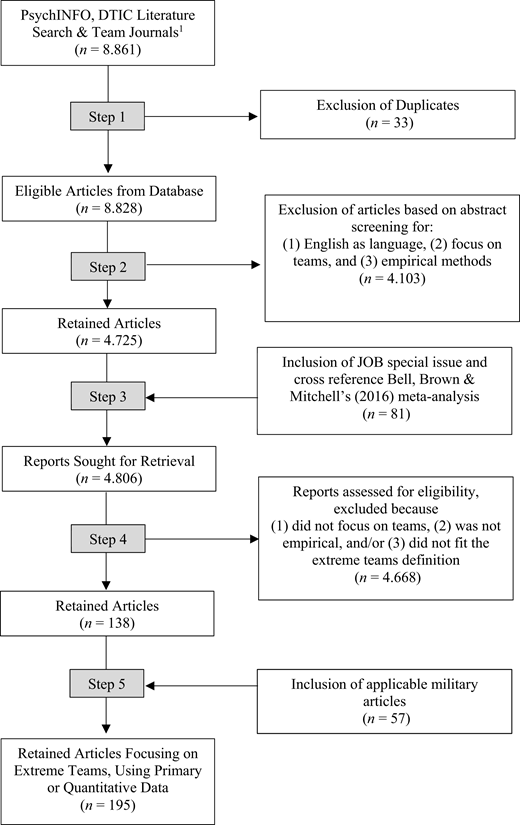
Published by Emerald Publishing Limited. This article is published under the Creative Commons Attribution (CC BY 4.0) licence. Anyone may reproduce, distribute, translate and create derivative works of this article (for both commercial and non-commercial purposes), subject to full attribution to the original publication and authors. The full terms of this licence may be seen at Link to the terms of the CC BY 4.0 licenceLink to the terms of the CC BY 4.0 licence.

Supplementary data

Data & Figures

Figure 1.
A flowchart outlines the screening and selection process of research articles from initial search to final inclusion.The flowchart illustrates the article selection process across five steps. Step one starts with 8,861 records identified through Psych I N F O, D T I C Literature Search, and team journals, followed by the exclusion of 33 duplicates. Step two involves screening 8,828 eligible articles, where 4,103 are excluded for not meeting language, focus, or empirical criteria, retaining 4,725 articles. Step three adds 81 articles from cross-referenced sources, bringing the total to 4,806. Step four excludes 4,668 non-relevant studies, resulting in 138 retained articles. Finally, step five includes 57 applicable military-related studies, culminating in 195 retained articles focusing on extreme teams using primary or quantitative data.

Overview of literature search and inclusion criteria

Source: Authors’ own work

Figure 1.
A flowchart outlines the screening and selection process of research articles from initial search to final inclusion.The flowchart illustrates the article selection process across five steps. Step one starts with 8,861 records identified through Psych I N F O, D T I C Literature Search, and team journals, followed by the exclusion of 33 duplicates. Step two involves screening 8,828 eligible articles, where 4,103 are excluded for not meeting language, focus, or empirical criteria, retaining 4,725 articles. Step three adds 81 articles from cross-referenced sources, bringing the total to 4,806. Step four excludes 4,668 non-relevant studies, resulting in 138 retained articles. Finally, step five includes 57 applicable military-related studies, culminating in 195 retained articles focusing on extreme teams using primary or quantitative data.

Overview of literature search and inclusion criteria

Source: Authors’ own work

Close modal
Figure 2.
A horizontal bar chart displays the distribution of studies classified by combinations of adaptability, structure, and team stability.The chart categorises studies based on combinations of adaptability (A D), structure (S D), and team stability (T S), showing varying frequencies for each configuration. The most frequent combination, high adaptability, low to moderate structure, and moderate stability, appears in 23 studies. Other common configurations include low adaptability, low structure, and moderate stability in 7 studies, and low adaptability with low stability in 6 studies. Fewer studies fall under combinations such as high adaptability with moderate structure or high stability. The data highlight that most studies focus on teams with moderate stability and lower structural rigidity, reflecting an emphasis on adaptive team dynamics in research.

Frequency of teams profiles

Note(s):N = 133; AD = authority differentiation, sd = skill differentiation, ts = temporal stability

Source: Authors’ own work

Figure 2.
A horizontal bar chart displays the distribution of studies classified by combinations of adaptability, structure, and team stability.The chart categorises studies based on combinations of adaptability (A D), structure (S D), and team stability (T S), showing varying frequencies for each configuration. The most frequent combination, high adaptability, low to moderate structure, and moderate stability, appears in 23 studies. Other common configurations include low adaptability, low structure, and moderate stability in 7 studies, and low adaptability with low stability in 6 studies. Fewer studies fall under combinations such as high adaptability with moderate structure or high stability. The data highlight that most studies focus on teams with moderate stability and lower structural rigidity, reflecting an emphasis on adaptive team dynamics in research.

Frequency of teams profiles

Note(s):N = 133; AD = authority differentiation, sd = skill differentiation, ts = temporal stability

Source: Authors’ own work

Close modal
Table 1.

Sample of definitions of extreme teams included in this review

DefinitionAuthor
Teams (a) that complete their tasks in performance environments with one or more contextual features that are atypical in level (e.g. extreme time pressure) or kind (e.g. confinement, danger) and (b) for which ineffective performance has serious consequences (e.g. compromised health or well-being of the team or the team’s clients)Bell et al. (2018) 
These new, externally oriented, adaptive teams, which we call X-teams … are set apart from traditional teams by five hallmarks: external activity, extensive ties, expandable structures, flexible membership and internal mechanisms for executionAncona et al. (2002) 
Teams performing in complex environments; such teams work under the most extreme, dangerous and stressful task environments, in which they often encounter unexpected events that force them to perform adaptivelyBeckhy and Okhuysen (2011) 
Extreme teams operate in environments that are complex, dynamic and often unpredictableBurke et al. (2018) 
Required to provide dynamic responses within a complex environment, as well as interact with diverse groups and populations to effectively and efficiently respond to a crisis event. Crisis events present uniquely complex situations, which require teams, or teams of teams to effectively manage and respond to the events as they unfold, as they can overwhelm individualsCooke et al. (2007); Salas et al. (2008) 
People with different backgrounds, skills and roles come together only for a specific task and must immediately be able to coordinate their actions in intense and unpredictable situationsEdmondson (2003) 
Caring for patients in trauma situations is often characterized by high-stakes outcomes, elevated stress and intense time constraintsGardner and Ahmed (2014) 
Disaster intervention development team as two or more interdisciplinary experts developing an intervention to aid in response to a disasterHale-Lopez et al., 2023 
A context-specific typology into risky contexts, emergency contexts and disrupted contextsHällgren et al. (2018) 
Teams working in stressful environments for long periods of time with physical and psychological consequencesKanas et al. (2007b)
Teams whose highly skilled members cooperate to perform urgent, unpredictable, interdependent and highly consequential tasks while simultaneously coping with frequent changes in team composition and training their teams’ novice membersKlein et al. (2006) 
Small teams performing in other isolated and extreme environments, including planetary explorationLeon and Venables (2015) 
A group of people work together on a highly task-focused and time-limited mission, functioning in conditions of potential and actual danger and often experiencing states of intense discomfort due to extreme cold, blizzards, unstable ice, fatigue and sometimes limited food rationsLeon (1991) 
Highly task-focused and time-limited situation marked by intense and physical exertion and discomfort, periods of monotony and boredom and conditions of potential and actual dangerLeon et al. (1995) 
Any environment to which humans are not naturally suited, and which demands complex processes of physiological and psychological adaptationManzey et al. (1998) 
The ICE teams work in isolation from the outside world with little to no contact with those outside their crew, confined to a small space where crew members both live and work together, and under extreme circumstances, such that there are serious consequences associated with failureMarcinkowski et al., 2021 
Reduced gratification of basic needs like sex is some of the potent stressorsMullin (1960) 
Monotony of the social environment in winter because of the lack of environmental stimulation and interaction with a limited number of individualsNatani and Shurley (1974); Taylor (1969) 
Characterized by the ambient environment, the social environment and the nature of the taskOrasanu and Lieberman (2011 
Prolonged confinement and isolation because of severe weather conditions, limited communication with family and friends, limited private spacePalinkas (1992) 
Defined by both an external and internal dimension, namely, environmental extremeness and task extremenessSchmutz et al. (2023) 
Groups of experts who conduct interlinked tasks during complex, time‐limited performance events involving audiences, adversaries or challenging environmentsSundstrom et al. (2000) 
Teams encounter extremely physical and emotional traumatic situations and are often the first to respond. Typically involves a harsh environment. The harshness can be defined as the weather conditions, travel distance of the rescue teams and the number of victimsTracy (2006) 
Teams that must rapidly share information and make numerous decisions to address the situationUitdewilligen and Waller (2018) 
Those in extreme, stressful and unpredictable situations that are more unstable in regard to team membership than most traditional work teams, yet often facing life and death consequencesVashdi et al. (2013) 
Action teams engage in complex, time-limited engagements with audiences, adversaries or challenging environments in events that often require time-bound performance and improvised coordination in response to unpredictable behaviorsWalter et al., 2024 
Source(s): Authors’ own work
Table 2.

Novel methods being used to study extreme teams

MeasuresConstructSample article
Physiological measures
Skin conductancePsychophysiological self-regulation and stress resistanceVinokhodova et al. (2012) 
Saliva samplingStressRoma et al. (2013) 
Reaction time measuresExpedition functioningKoscheyev et al. (1994) 
Blood pressureExpedition functioningKoscheyev et al. (1994) 
Wrist-worn actigraphsRest-activity cyclesBasner et al. (2014) 
Thymic reactionsMood and anxietyDécamps and Rosnet (2005) 
Somatic Measures
amount of sleepStressDécamps and Rosnet (2005) 
HeadachesStressDécamps and Rosnet (2005) 
Homeostat testsEfficiency of interpersonal interactions among crewVinokhodova et al. (2012) 
Ethnographic Methods
diary and logbook analysis (linguistic inquiry and word count programs)Emotions, achievement, social processesRoma et al. (2013) 
Social network analysisSocial structures social structuresJohnson et al. (2003) Krins (2009) 
Leadership network archetypesLungeanu et al. (2022) 
Interpersonal networksLungeanu et al. (2023) 
Coding videosCoordination behaviors (e.g. CLC) Information sharingSchmutz et al. (2015) Uitdewilligen and Waller (2018) 
Noldus observer XTJoseph et al., 2022 
AI-powered multimodal learning analytics systemEcheverria et al. (2025) 
Post-mission/expedition interviewsStress, coping, motivationsKahn and Leon (1994) 
Coping, general experienceLeon et al. (1989) 
Changes since expedition*Leon et al. (2011) 
Note(s):

*6 months out

Source(s): Authors’ own work

Supplements

Supplementary data

References

Abankwa
,
D.
,
Rowlinson
,
S.
and
Adinyira
,
E.
(
2019
), “
Conceptualizing team adaptability and project complexity: a literature review
”,
International Journal of Innovation, Management and Technology
, Vol.
10
No.
1
, pp.
1
-
7
, doi: .
Alliger
,
G.M.
,
Cerasoli
,
C.P.
,
Tannenbaum
,
S.I.
and
Vessey
,
W.B.
(
2015
), “
Team resilience: how teams flourish under pressure
”,
Organizational Dynamics
, Vol.
44
No.
3
, pp.
1
-
84
, doi: .
Ancona
,
D.
,
Bresman
,
H.
and
Kaeufer
,
K.
(
2002
), “
The comparative advantage of X-teams
”,
MIT Sloan Management Review
.
Antonakis
,
J.
(
2017
), “
On doing better science: from thrill of discovery to policy implications
”,
The Leadership Quarterly
, Vol.
28
No.
1
, pp.
5
-
21
.
Asparouhov
,
T.
, and
Muthén
,
B.
(
2008
), “Multilevel mixture models”, in
Hancock
,
G.R.
and
Samuelsen
,
K.M.
(Eds),
Advances in Latent Variable Mixture Models
,
Information Age Publishing
,
Charlotte, NC
.
Avolio
,
B.J.
,
Keng-Highberger
,
F.T.
,
Lord
,
R.G.
,
Hannah
,
S.T.
,
Schaubroeck
,
J.M.
and
Kozlowski
,
S.W.
(
2022
), “
How leader and follower prototypical and antitypical attributes influence ratings of transformational leadership in an extreme context
”,
Human Relations
, Vol.
75
No.
3
, pp.
441
-
474
, doi: .
Baker
,
A.L.
,
Keebler
,
J.R.
,
Anania
,
E.C.
,
Schuster
,
D.
and
Plummer
,
J.P.
(
2021
), “
Team combat identification: effects of gender, spatial visualization, and disagreement
”,
Human Factors: The Journal of the Human Factors and Ergonomics Society
, Vol.
63
No.
4
, pp.
684
-
695
.
Baranski
,
J.V.
,
Thompson
,
M.M.
,
Lichacz
,
F.M.
,
McCann
,
C.
,
Gil
,
V.
,
Pastò
,
L.
and
Pigeau
,
R.A.
(
2007
), “
Effects of sleep loss on team decision making: motivational loss or motivational gain?
”,
Human Factors: The Journal of the Human Factors and Ergonomics Society
, Vol.
49
No.
4
, pp.
646
-
660
.
Barton
,
M.A.
,
Sutcliffe
,
K.M.
,
Vogus
,
T.J.
and
DeWitt
,
T.
(
2015
), “
Performing under uncertainty: Contextualized engagement in wildland firefighting
”,
Journal of Contingencies and Crisis Management
, Vol.
23
No.
2
, pp.
74
-
83
.
Bartone
,
P.T.
,
Johnsen
,
B.H.
,
Eid
,
J.
,
Brun
,
W.
and
Laberg
,
J.C.
(
2002
), “
Factors influencing Small-Unit cohesion in Norwegian navy officer cadets
”,
Military Psychology
, Vol.
14
No.
1
, pp.
1
-
22
, doi: .
Basner
,
M.
,
Dinges
,
D.F.
,
Mollicone
,
D.J.
,
Savelev
,
I.
,
Ecker
,
A.J.
,
Di Antonio
,
A.
,
Jones
,
C.W.
,
Hyder
,
E.C.
,
Kan
,
K.
,
Morukov
,
B.V.
and
Sutton
,
J.P.
(
2014
), “
Psychological and behavioral changes during confinement in a 520-day simulated interplanetary mission to mars
”,
PLoS ONE
, Vol.
9
No.
3
, p.
e93298
, doi: .
Beckhy
,
B.A.
and
Okhuysen
,
G.A.
(
2011
), “
Expecting the unexpected? How SWAT officers and film crews handle surprises
”,
Academy of Management Journal
, Vol.
54
No.
2
, pp.
239
-
261
.
Bell
,
S.T.
,
Fisher
,
D.M.
,
Brown
,
S.G.
and
Mann
,
K.E.
(
2018
), “
An approach for conducting actionable research with extreme teams
”,
Journal of Management
, Vol.
42
No.
5
, pp.
1
-
26
.
Berggren
,
G.
,
Adamska
,
A.
,
Lambertz
,
C.
,
Simmons
,
T.R.
,
Esselborn
,
J.
,
Atta
,
M.
,
Gambarelli
,
S.
,
Mouesca
,
J.M.
,
Reijerse
,
E.
,
Lubitz
,
W.
and
Happe
,
T.
(
2013
), “
Biomimetic assembly and activation of [FeFe]-hydrogenases
”,
Nature
, Vol.
499
No.
7456
, pp.
66
-
69
.
Bhargava
,
R.
,
Mukerji
,
S.
and
Sachdeva
,
U.
(
2000
), “
Psychological impact of the Antarctic winter on Indian expeditioners
”,
Environment and Behavior
, Vol.
32
No.
1
, pp.
111
-
127
.
Boermans
,
S.M.
,
Kamphuis
,
W.
,
Delahaij
,
R.
,
van den Berg
,
C.
and
Euwema
,
M.C.
(
2014
), “
Team spirit makes the difference: the interactive effects of team work engagement and organizational constraints during a military operation on psychological outcomes afterwards
”,
Stress and Health
, Vol.
30
No.
5
, pp.
386
-
396
.
Boies
,
K.
and
Howell
,
J.M.
(
2009
), “
Leading military teams to think and feel: exploring the relations between leadership, soldiers’ cognitive and affective processes, and team effectiveness
”,
Military Psychology
, Vol.
21
No.
2
, pp.
216
-
232
.
Brewer
,
M.B.
(
2003
), “Optimal Distinctiveness, Social Identity, and the Self”, In
Leary
,
M.R.
and
Tangney
,
J.P.
(Eds),
Handbook of Self and Identity
,
The Guilford Press
, pp.
480
-
491
.
Brown
,
D.K.
and
Benson
,
S.N.K.
(
2020
), “
Does time in team training matter? Evaluation of team-level attitudes with interprofessional education
”,
Clinical Simulation in Nursing
, Vol.
48
, pp.
38
-
45
.
Buchanan
,
D.A.
and
Hällgren
,
M.
(
2019
), “
Surviving a zombie apocalypse: leadership configurations in extreme contexts
”,
Management Learning
, Vol.
50
No.
2
, pp.
152
-
170
, doi: .
Burke
,
C.S.
,
Georganta
,
E.
and
Marlow
,
S.
(
2019
), “
A bottom up perspective to understanding the dynamics of team roles in mission critical teams
”,
Frontiers in Psychology
, Vol.
10
, p.
1322
.
Burke
,
C.S.
,
Shuffler
,
M.L.
and
Wiese
,
C.W.
(
2018
), “
Examining the behavioral and structural characteristics of team leadership in extreme environments
”,
Journal of Organizational Behavior
, Vol.
39
No.
6
, pp.
716
-
730
.
Chawla
,
N.
,
MacGowan
,
R.L.
,
Gabriel
,
A.S.
and
Podsakoff
,
N.P.
(
2020
), “
Unplugging or staying connected? Examining the nature, antecedents, and consequences of profiles of daily recovery experiences
”,
Journal of Applied Psychology
, Vol.
105
No.
1
, p.
19
.
Christian
,
J.S.
,
Christian
,
M.S.
,
Pearsall
,
M.J.
and
Long
,
E.C.
(
2017
), “
Team adaptation in context: an integrated conceptual model and meta-analytic review
”,
Organizational Behavior and Human Decision Processes
, Vol.
140
, pp.
62
-
89
, doi: .
Cole
,
E.
and
Crichton
,
N.
(
2006
), “
The culture of a trauma team in relation to human factors
”,
Journal of Clinical Nursing
, Vol.
15
No.
10
, pp.
1257
-
1266
.
Cooke
,
N.J.
,
Gorman
,
J.C.
,
Duran
,
J.L.
and
Taylor
,
A.R.
(
2007
), “
Team cognition in experienced command-and-control teams
”,
Journal of Experimental Psychology: Applied
, Vol.
13
No.
3
, p.
146
.
Corneliussen
,
J.G.
,
Leon
,
G.R.
,
Kjærgaard
,
A.
,
Fink
,
B.A.
and
Venables
,
N.C.
(
2017
), “
Individual traits, personal values, and conflict resolution in an isolated, confined, extreme environment
”,
Aerospace Medicine and Human Performance
, Vol.
88
No.
6
, pp.
535
-
543
, doi: .
Décamps
,
G.
and
Rosnet
,
E.
(
2005
), “
A longitudinal assessment of psychological adaptation during a winter-over in Antarctica
”,
Environment and Behavior
, Vol.
37
No.
3
, pp.
418
-
435
.
DeChurch
,
L.A.
,
Burke
,
C.S.
,
Shuffler
,
M.L.
,
Lyons
,
R.
,
Doty
,
D.
and
Salas
,
E.
(
2011
), “
A historiometric analysis of leadership in mission critical multiteam environments
”,
The Leadership Quarterly
, Vol.
22
No.
1
, pp.
152
-
169
.
Driskell
,
T.
,
Salas
,
E.
and
Driskell
,
J.E.
(
2018
), “
Teams in extreme environments: alterations in team development and teamwork
”,
Human Resource Management Review
, Vol.
28
No.
4
, pp.
434
-
449
, doi: .
Eatough
,
E.
,
Chang
,
C.-H.
and
Hall
,
N.
(
2015
), “
Getting roped In: group cohesion, trust, and efficacy following a ropes course intervention
”,
Performance Improvement Quarterly
, Vol.
28
No.
2
, pp.
65
-
89
, doi: .
Echeverria
,
V.
,
Zhao
,
L.
,
Alfredo
,
R.
,
Milesi
,
M.E.
,
Jin
,
Y.
,
Abel
,
S.
, …
Martinez-Maldonado
,
R.
(
2025
), ““
TeamVision: an AI-powered learning analytics system for supporting reflection in team-based healthcare simulation
”, In
Proceedings of the 2025 CHI Conference on Human Factors in Computing Systems
, pp.
1
-
22
.
Edmondson
,
A.
(
1999
), “
Psychological safety and learning behavior in work teams
”,
Administrative Science Quarterly
, Vol.
44
No.
2
, pp.
350
-
383
, doi: .
Edmondson
,
A.C.
(
2003
), “
Speaking up in the operating room: how team leaders promote learning in interdisciplinary action teams
”,
Journal of Management Studies
, Vol.
40
No.
6
, pp.
1419
-
1452
.
Ellemers
,
N.
,
Sleebos
,
E.
,
Stam
,
D.
and
de Gilder
,
D.
(
2013
), “
Feeling included and valued: how perceived respect affects positive team identity and willingness to invest in the team
”,
British Journal of Management
, Vol.
24
No.
1
, pp.
21
-
37
.
Endsley
,
T.C.
(
2016
), “
An examination of cultural influences on team cognition and information sharing in emergency crisis management domains: a mixed methodological approach
”, (Unpublished doctoral dissertation).
Pennsylvania State University
,
USA
.
Espevik
,
R.
,
Johnsen
,
B.H.
,
Eid
,
J.
and
Thayer
,
J.F.
(
2006
), “
Shared mental models and operational effectiveness: effects on performance and team processes in submarine attack teams
”,
Military Psychology
, Vol.
18(sup1)
, pp.
S23
-
S36
.
Feitosa
,
J.
,
Davis
,
A.S.
,
Romain
,
R.
and
Delice
,
F.
(
2023
), “
Team membership change events: processes that support gender diverse teams
”,
Small Group Research
, Vol.
55
No.
3
, pp.
375
-
416
, doi: .
Feitosa
,
J.
,
Grossman
,
R.
and
Salazar
,
M.
(
2018
), “
Debunking key assumptions about teams: the role of culture
”,
American Psychologist
, Vol.
73
No.
4
, pp.
376
-
389
.
Forsyth
,
D.R.
(
2021
), “
Recent advances in the study of group cohesion
”,
Group Dynamics: Theory, Research, and Practice
, Vol.
25
No.
3
, p.
213
.
Gardner
,
A.K.
and
Ahmed
,
R.A.
(
2014
), “
Transforming trauma teams through transactive memory/can simulation enhance performance?
”,
Simulation and Gaming
, Vol.
45
No.
3
, pp.
356
-
370
.
Golden
,
S.J.
,
Chang
,
C.H.D.
and
Kozlowski
,
S.W.J.
(
2018
), “
Teams in isolated, confined, and extreme (ICE) environments: review and integration
”,
Journal of Organizational Behavior
, Vol.
39
No.
6
, pp.
701
-
715
.
Goodwin
,
G.F.
,
Burke
,
C.S.
,
Wildman
,
J.L.
, and
Salas
,
E.
(
2008
), “Team effectiveness in complex organizations: an overview”, in
Salas
,
E
,
Goodwin
,
G.E.
and
Burke
,
C.S.
(Eds),
Team Effectiveness in Complex Organizations
,
Psychology Press
,
New York, NY
.
Grossman
,
R.
and
Feitosa
,
J.
(
2018
), “
Team trust: modeling dynamic, multilevel, and reciprocal influences
”,
Human Resource Management Review
, Vol.
28
No.
4
, pp.
395
-
410
.
Guzzo
,
R.A.
and
Dickson
,
M.W.
(
1996
), “
Teams in organizations: recent research on performance and effectiveness
”,
Annual Review of Psychology
, Vol.
47
No.
1
, pp.
307
-
338
.
Hale-Lopez
,
K.L.
,
Goldstein
,
M.H.
and
Wooldridge
,
A.R.
(
2023
), “
Sociotechnical system design to support disaster intervention development teams
”,
Applied Ergonomics
, Vol.
108
, p.
103948
, doi: .
Hällgren
,
M.
,
Rouleau
,
L.
and
De Rond
,
M.
(
2018
), “
A matter of life or death: how extreme context research matters for management and organization studies
”,
Academy of Management Annals
, Vol.
12
No.
1
, pp.
111
-
153
.
Hannah
,
S.T.
,
Uhl-Bien
,
M.
,
Avolio
,
B.
and
Cavarretta
,
F.L.
(
2009
), “
A framework for examining leadership in extreme contexts
”,
The Leadership Quarterly
, Vol.
20
No.
6
, pp.
897
-
919
.
Hedlund
,
E.
,
Börjesson
,
M.
and
Österberg
,
J.
(
2015
), “
Team learning in a multinational military staff exercise
”,
Small Group Research
, Vol.
46
No.
2
, pp.
179
-
203
, doi: .
Hollenbeck
,
J.R.
,
Beersma
,
B.
and
Schouten
,
M.E.
(
2012
), “
Beyond team types and taxonomies: a dimensional scaling conceptualization for team description
”,
Academy of Management Review
, Vol.
37
No.
1
, pp.
82
-
106
, doi: .
Hoschlova
,
E.
,
Bahbouh
,
R.
,
Huzva
,
M.
,
Chroustova
,
E.
and
Sykorova
,
K.B.
(
2024
), “
Structure and dynamics of crew communication in three stages of the SIRIUS experiment
”,
Acta Astronautica
, Vol.
225
, pp.
467
-
476
.
Hughes
,
A.M.
,
Gregory
,
M.E.
,
Joseph
,
D.L.
,
Sonesh
,
S.C.
,
Marlow
,
S.L.
,
Lacerenza
,
C.N.
,
Benishek
,
L.E.
,
King
,
H.B.
and
Salas
,
E.
(
2016
), “
Saving lives: a meta-analysis of team training in healthcare
”,
Journal of Applied Psychology
, Vol.
101
No.
9
, pp.
1266
-
1304
, doi: .
Jeong
,
S.S.
and
Korsgaard
,
M.A.
(
2022
), “
Individual-and group-level consequences of divergence in perceived group affect
”,
Human Relations
, Vol.
75
No.
12
, pp.
2218
-
2245
.
Johns
,
G.
(
2017
), “
Reflections on the 2016 decade award: incorporating context in organizational research
”,
Academy of Management Review
, Vol.
42
No.
4
, pp.
577
-
595
, doi: .
Johnson
,
J.C.
,
Boster
,
J.S.
and
Palinkas
,
L.
(
2003
), “
Social roles and the evolution of networks in extreme and isolated environments
”,
The Journal of Mathematical Sociology
, Vol.
27
Nos
2-3
, pp.
89
-
121
.
Joseph
,
A.
,
Neyens
,
D.
,
Taaffe
,
K.
,
Bayramzadeh
,
S.
,
Catchpole
,
K.
,
Ripchd
,
O.R.
and
Study
,
G.
(
2022
), “
Understanding “work as done”: using a structured video-based observational method to understand and model the role of the physical environment in complex clinical work systems
”,
HERD: Health Environments Research and Design Journal
, Vol.
15
No.
3
, pp.
13
-
27
.
Kahn
,
P.M.
and
Leon
,
G.R.
(
1994
), “
Group climate and individual functioning in an all-women Antarctic expedition team
”,
Environment and Behavior
, Vol.
26
No.
5
, pp.
669
-
697
.
Kanas
,
N.A.
(
2013
), “Human interactions on-orbit”, in
Vakoch
,
D.A.
(Ed.),
On Orbit and Beyond: Psychological Perspectives on Human Spaceflight
,
Springer-Verlag
,
Berlin Heidelberg
, pp.
93
-
106
.
Kanas
,
N.A.
,
Salnitskiy
,
V.P.
,
Ritsher
,
J.B.
,
Gushin
,
V.I.
,
Weiss
,
D.S.
,
Saylor
,
S.A.
,
Kozerenko
,
O.P.
and
Marmar
,
C.R.
(
2006
), “
Human interactions in space: ISS vs. Shuttle/Mir
”,
Acta Astronautica
, Vol.
59
Nos
1-5
, pp.
413
-
419
.
Kanas
,
N.A.
,
Salnitskiy
,
V.P.
,
Ritsher
,
J.B.
,
Gushin
,
V.I.
,
Weiss
,
D.S.
,
Saylor
,
S.A.
,
Kozerenko
,
O.P.
and
Marmar
,
C.R.
(
2007
a), “
Psychosocial interactions during ISS missions
”,
Acta Astronautica
, Vol.
60
Nos
4-7
, pp.
329
-
335
.
Kanas
,
N.A.
,
Salnitskiy
,
V.P.
,
Ritsher
,
J.B.
,
Gushin
,
V.I.
,
Weiss
,
D.S.
,
Saylor
,
S.A.
,
Kozerenko
,
O.P.
and
Marmar
,
C.R.
(
2007
b), “
Crewmember and mission control personnel interactions during international space station missions
”,
Aviation, Space, and Environmental Medicine
, Vol.
78
No.
6
, pp.
601
-
607
.
Käosaar
,
A.
and
Burke
,
C.S.
(
2024
), “
The effect of challenge characteristics on teamwork and affective states in ICE
”,
Group and Organization Management
, p.
10596011241304132
.
Keiser
,
N.L.
(
2024
), “
A systematic review of technology in the after-action review (or debrief)
”,
Organizational Psychology Review
, Vol.
14
No.
3
, p.
20413866241245314
.
Keiser
,
N.L.
and
Arthur
Jr,
W.
(
2022
), “
A meta-analysis of task and training characteristics that contribute to or attenuate the effectiveness of the after-action review (or debrief)
”,
Journal of Business and Psychology
, Vol.
37
No.
5
, pp.
953
-
976
.
Kim
,
T.
,
McFee
,
E.
,
Olguin
,
D.O.
,
Waber
,
B.
and
Pentland
,
A.S.
(
2012
), “
Sociometric badges: using sensor technology to capture new forms of collaboration
”,
Journal of Organizational Behavior
, Vol.
33
No.
3
, pp.
412
-
427
.
King
,
D.A.
,
Hume
,
P.A.
,
Gissane
,
C.
and
Clark
,
T.N.
(
2016
), “
Similar head impact acceleration measured using instrumented ear patches in a junior rugby union team during matches in comparison with other sports
”,
Journal of Neurosurgery: Pediatrics
, Vol.
18
No.
1
, pp.
65
-
72
.
Kjaergaard
,
A.
,
Leon
,
G.R.
and
Fink
,
B.A.
(
2015
), “
Personal challenges, communication processes, and team effectiveness in military special patrol teams operating in a polar environment
”,
Environment and Behavior
, Vol.
47
No.
6
, pp.
644
-
666
.
Klein
,
A.
(
2025
), “
Team structural control and team resilience: an empirical study of creative project-based teams
”,
Journal of Business Research
, Vol.
186
, No.
115002
, pp.
1
-
14
, doi: .
Klein
,
K.J.
,
Ziegert
,
J.C.
,
Knight
,
A.P.
and
Xiao
,
Y.
(
2006
), “
Dynamic delegation: shared, hierarchical, and deindividualized leadership in extreme action teams
”,
Administrative Science Quarterly
, Vol.
51
No.
4
, pp.
590
-
621
.
Kniffin
,
K.M.
,
Wansink
,
B.
,
Devine
,
C.M.
and
Sobal
,
J.
(
2015
), “
Eating together at the firehouse: how workplace commensality relates to the performance of firefighters
”,
Human Performance
, Vol.
28
No.
4
, pp.
281
-
306
.
Koscheyev
,
V.S.
,
Roschina
,
N.A.
and
Makhov
,
V.V.
(
1994
), “
Psychophysiological characteristics related to the functional state of the members of the Soviet-American arctic bering bridge expedition
”,
Environment and Behavior
, Vol.
26
No.
2
, pp.
166
-
178
.
Kozlowski
,
S.W.J.
and
Chao
,
G.T.
(
2018
), “
Unpacking team process dynamics and emergent phenomena: challenges, conceptual advances, and innovative methods
”,
American Psychologist
, Vol.
73
No.
4
, pp.
576
-
592
.
Krins
,
P.W.
(
2009
), “
Beyond the ‘right stuff’: the role of group processes in isolated confined extreme environments
”, (Unpublished doctoral dissertation).
The Australian National University
,
Australia
.
Landon
,
L.B.
,
Slack
,
K.J.
and
Barrett
,
J.D.
(
2018
), “
Teamwork and collaboration in long-duration space missions: going to extremes
”,
American Psychologist
, Vol.
73
No.
4
, p.
563
, doi: .
Leon
,
G.R.
(
1991
), “
Individual and group process characteristics of polar expedition teams
”,
Environment and Behavior
, Vol.
23
No.
6
, pp.
723
-
748
, doi: .
Leon
,
G.R.
and
Venables
,
N.C.
(
2015
), “
Fearless temperament and overconfidence in an unsuccessful special forces polar expedition
”,
Aerospace Medicine and Human Performance
, Vol.
86
No.
6
, pp.
567
-
570
, doi: .
Leon
,
G.R.
,
List
,
N.
and
Magor
,
G.
(
2004
), “
Personal experiences and team effectiveness during a commemorative trek in the high arctic
”,
Environment and Behavior
, Vol.
36
No.
3
, pp.
386
-
401
.
Leon
,
G.R.
,
McNally
,
C.
and
Ben-Porath
,
Y.S.
(
1989
), “
Personality characteristics, mood, and coping patterns in a successful North pole expedition team
”,
Journal of Research in Personality
, Vol.
23
No.
2
, pp.
162
-
179
.
Leon
,
G.R.
,
Atlis
,
M.M.
,
Ones
,
D.S.
and
Magor
,
G.
(
2002
), “
A 1-Year, Three-Couple expedition as a crew analog for a mars mission
”,
Environment and Behavior
, Vol.
34
No.
5
, pp.
672
-
700
, doi: .
Leon
,
G.R.
,
Fulkerson
,
J.A.
,
Perry
,
C.L.
and
Early-Zald
,
M.B.
(
1995
), “
Prospective analysis of personality and behavioral vulnerabilities and gender influences in the later development of disordered eating
”,
Journal of Abnormal Psychology
, Vol.
104
No.
1
, pp.
140
-
149
, doi: .
Leon
,
G.R.
,
Kanfer
,
R.
,
Hoffman
,
R.G.
and
Dupre
,
L.
(
1994
), “
Group processes and task effectiveness in a Soviet-American expedition team
”,
Environment and Behavior
, Vol.
26
No.
2
, pp.
149
-
165
.
Leon
,
G.R.
,
Sandal
,
G.M.
,
Fink
,
B.A.
and
Ciofani
,
P.
(
2011
), “
Positive experiences and personal growth in a two-man North pole expedition team
”,
Environment and Behavior
, Vol.
43
No.
5
, pp.
710
-
731
.
LePine
,
J.
,
Piccolo
,
R.F.
,
Jackson
,
C.L.
,
Mathieu
J.E.
and
Saul
,
J. R.
(
2008
), “
A meta-analysis of teamwork processes
”,
Personnel Psychology
, Vol.
61
No.
2
, pp.
273
-
307
.
Lim
,
B.C.
and
Klein
,
K.J.
(
2006
), “
Team mental models and team performance: a field study of the effects of team mental model similarity and accuracy
”,
Journal of Organizational Behavior
, Vol.
27
No.
4
, pp.
403
-
418
.
Lim
,
B.C.
and
Ployhart
,
R.E.
(
2004
), “
Transformational leadership: relations to the Five-Factor model and team performance in typical and maximum contexts
”,
Journal of Applied Psychology
, Vol.
98
No.
4
, pp.
610
-
621
.
Lungeanu
,
A.
,
DeChurch
,
L.A.
and
Contractor
,
N.S.
(
2022
), “
Leading teams over time through space: computational experiments on leadership network archetypes
”,
The Leadership Quarterly
, Vol.
33
No.
5
, p.
101595
, doi: .
Lungeanu
,
A.
,
Mesmer-Magnus
,
J.R.
,
Niler
,
A.A.
,
DeChurch
,
L.A.
and
Contractor
,
N.S.
(
2023
), “
Organizing for mars: a task management perspective on work within spaceflight multiteam systems
”,
Human Factors: The Journal of the Human Factors and Ergonomics Society
, Vol.
65
No.
6
, pp.
1199
-
1220
.
Luthans
,
F.
,
Youssef-Morgan
,
C.M.
, and
Avolio
,
B.J.
(
2015
),
Psychological Capital and beyond
,
Oxford University Press
,
New York, NY
.
Mäkikangas
,
A.
,
Tolvanen
,
A.
,
Aunola
,
K.
,
Feldt
,
T.
,
Mauno
,
S.
and
Kinnunen
,
U.
(
2018
), “
Multilevel latent profile analysis with covariates: identifying job characteristics profiles in hierarchical data as an example
”,
Organizational Research Methods
, Vol.
21
No.
4
, pp.
931
-
954
.
Manzey
,
D.
and
Lorenz
,
B.
(
1998
), “
Mental performance during short-term and long-term spaceflight
”,
Brain Research Reviews
, Vol.
28
Nos
1-2
, pp.
215
-
221
, doi: .
Manzey
,
D.
,
Lorenz
,
B.
and
Poljakov
,
V.
(
1998
), “
Mental performance in extreme environments: results from a performance monitoring study during a 438-day spaceflight
”,
Ergonomics
, Vol.
41
No.
4
, pp.
537
-
559
.
Marcinkowski
,
M.A.
,
Bell
,
S.T.
and
Roma
,
P.G.
(
2021
), “
The nature of conflict for teams in isolated, confined, and extreme environments
”,
Acta Astronautica
, Vol.
181
, pp.
81
-
91
.
Marks
,
M.A.
,
Mathieu
,
J.E.
and
Zaccaro
,
S.J.
(
2001
), “
A temporally based framework and taxonomy of team processes
”,
Academy of Management
, Vol.
26
No.
3
, pp.
356
-
376
.
Marques-Quinteiro
,
P.
,
Curral
,
L.
,
Passos
,
A.M.
and
Lewis
,
K.
(
2013
), “
And now what do we do the role of transactive memory systems and task coordination in action teams
”,
Group Dynamics, Theory, Research, and Practice
, Vol.
17
No.
3
, pp.
194
-
206
.
Mathieu
,
J.E.
,
Kukenberger
,
M.R.
,
D’Innocenzo
,
L.
and
Reilly
,
G.
(
2015
), “
Modeling reciprocal team cohesion–performance relationships, as impacted by shared leadership and members’ competence
”,
Journal of Applied Psychology
, Vol.
100
No.
3
, pp.
713
-
734
, doi: .
Maynard
,
M.T.
,
Mathieu
,
J.E.
,
Rapp
,
T.L.
,
Gilson
,
L.L.
and
Kleiner
,
C.
(
2021
), “
Team leader coaching intervention: an investigation of the impact on team processes and performance within a surgical context
”,
Journal of Applied Psychology
, Vol.
106
No.
7
, p.
1080
.
Michailovs
,
S.
,
Howard
,
Z.
,
Pond
,
S.
,
Fitzgerald
,
M.
,
Visser
,
T.A.
,
Bell
,
J.
,
Pinniger
,
G.
,
Irons
,
J.
,
Schmitt
,
M.
,
Stoker
,
M.
and
Huf
,
S.
(
2024
), “
Sharing imagery and analysis tools in a simulated submarine control room
”,
Applied Ergonomics
, Vol.
114
, p.
104125
.
Morgan
,
P.B.
,
Fletcher
,
D.
and
Sarkar
,
M.
(
2013
), “
Defining and characterizing team resilience in elite sport
”,
Psychology of Sport and Exercise
, Vol.
14
No.
4
, pp.
549
-
559
.
Morrison-Smith
,
S.
and
Ruiz
,
J.
(
2020
), “
Challenges and barriers in virtual teams: a literature review
”,
SN Applied Sciences
, Vol.
2
No.
6
, p.
1096
.
Mullin
,
C.S.
Jr
(
1960
), “
Some psychological aspects of isolated Antarctic living
”,
The American Journal of Psychiatry
, Vol.
117
, pp.
323
-
325
, doi: .
Natani
,
K.
and
Shurley
,
J.T.
(
1974
), “
Sociopsychological aspects of a winter vigil at South pole station
”,
Human Adaptability to Antarctic Conditions
, Vol.
22
, pp.
89
-
114
.
Oc
,
B.
(
2018
), “
Contextual leadership: a systematic review of how contextual factors shape leadership and its outcomes
”,
The Leadership Quarterly
, Vol.
29
No.
1
, pp.
218
-
235
, doi: .
Orasanu
,
J.
, and
Lieberman
,
P.
(
2011
), “NDM issues in extreme environments”, in
Mosier
,
K. L.
&.
Fischer
,
U.
(Eds),
Informed by Knowledge: Expert Performance in Complex Situations
,
Psychology Press
, pp.
3
-
21
. doi: .
Palinkas
,
L.A.
(
1992
), “
Going to extremes: the cultural context of stress, illness and coping in Antarctica
”,
Social Science and Medicine
, Vol.
35
No.
5
, pp.
651
-
664
.
Palinkas
,
L.A.
,
Johnson
,
J.C.
,
Boster
,
J.S.
,
Rakusa-Suszczewski
,
S.
,
Klopov
,
V.P.
,
Fu
,
Q.X.
and
Sachdeva
,
U.
(
2004
), “
Cross-cultural differences in psychosocial adaptation to isolated and confined environments
”,
Aviation and Space Environment Medicine
, Vol.
75
No.
11
, pp.
973
-
980
.
Paris
,
C.R.
,
Salas
,
E.
and
Cannon-Bowers
,
J.A.
(
2000
), “
Teamwork in multi-person systems: a review and analysis
”,
Ergonomics
, Vol.
43
No.
8
, pp.
1052
-
1075
, doi: .
Pasarakonda
,
S.
,
Grote
,
G.
,
Schmutz
,
J.B.
,
Bogdanovic
,
J.
,
Guggenheim
,
M.
and
Manser
,
T.
(
2021
), “
A strategic core role perspective on team coordination: benefits of centralized leadership for managing task complexity in the operating room
”,
Human Factors: The Journal of the Human Factors and Ergonomics Society
, Vol.
63
No.
5
, pp.
910
-
925
, doi: .
Paul
,
F.J.
,
Mandal
,
M.K.
,
Ramachandran
,
K.
and
Panwar
,
M.R.
(
2010
), “
Cognitive performance during long-term residence in a polar environment
”,
Journal of Environmental Psychology
, Vol.
30
No.
1
, pp.
129
-
132
.
Peiró
,
J.M.
,
Bayona
,
J.A.
,
Caballer
,
A.
and
Di Fabio
,
A.
(
2020
), “
Importance of work characteristics affects job performance: the mediating role of individual dispositions on the work design-performance relationships
”,
Personality and Individual Differences
, Vol.
157
, p.
109808
.
Perry
,
E.J.
(
2024
), “
Blurring the boundaries of governance: China’s work teams in comparative perspective
”,
Comparative Political Studies
, p.
00104140241283205
.
Perry
,
O.
,
Jaffe
,
E.
and
Bitan
,
Y.
(
2022
), “
Dynamic communication quantification model for measuring information management during mass-casualty incident simulations
”,
Human Factors: The Journal of the Human Factors and Ergonomics Society
, Vol.
64
No.
1
, pp.
228
-
249
, doi: .
Pfaff
,
M.S.
(
2012
), “
Negative affect reduces team awareness: the effects of mood and stress on computer-mediated team communication
”,
Human Factors
,
available at:
Link to Negative affect reduces team awareness: the effects of mood and stress on computer-mediated team communicationLink to the cited article.
Ployhart
,
R.E.
,
Schepker
,
D
and
McFarland
,
L.A.
(
2022
), “
A review and theoretical framework for understanding external team contexts
”,
Journal of Applied Psychology
, Vol.
107
No.
7
, pp.
1052
-
1069
, doi: .
Post
,
C.
,
Lokshin
,
B.
and
Boone
,
C.
(
2022
), “
What changes after women enter top management teams? A gender-based model of strategic renewal
”,
Academy of Management Journal
, Vol.
65
No.
1
, pp.
273
-
303
.
Rivolier
,
J.
(
1981
), “
Problems with psychological screening
”,
Antarctic Bibliography
, Vol.
11
, p.
238
.
Roma
,
P.G.
and
Bedwell
,
W.L.
(
2017
), “Key factors and threats to team dynamics in long-duration extreme environments”, In
Team Dynamics Over Time
,
Emerald Publishing Limited
, pp.
155
-
187
.
Roma
,
P.G.
,
Hursh
,
S.R.
,
Hienz
,
R.D.
,
Brinson
,
Z.S.
,
Gasior
,
E.D.
, and
Brady
,
J.V.
(
2013
), “Effects of autonomous mission management on crew performance, behavior, and physiology: Insights from ground-based experiments”, in
Vakoch
,
D.A.
(Ed.),
On Orbit and Beyond: Psychological Perspectives on Human Spaceflight
,
Springer-Verlag
,
Berlin Heidelberg
, pp.
245
-
266
.
Salas
,
E.
,
Cooke
,
N.J.
and
Rosen
,
M.A.
(
2008
), “
On teams, teamwork, and team performance: Discoveries and developments
”,
Human Factors: The Journal of the Human Factors and Ergonomics Society
, Vol.
50
No.
3
, pp.
540
-
547
.
Santos
,
C.M.
,
Uitdewilligen
,
S.
,
Passos
,
A.M.
,
Marques-Quinteiro
,
P.
and
Maynard
,
M.T.
(
2021
), “
The effect of a concept mapping intervention on shared cognition and adaptive team performance over time
”,
Group and Organization Management
, Vol.
46
No.
6
, pp.
984
-
1026
.
Schmutz
,
J.B.
,
Bienefeld
,
N.
,
Maynard
,
M.T.
and
Rico
,
R.
(
2023
), “
Exceeding the ordinary: a framework for examining teams across the extremeness continuum and its impact on future research
”,
Group and Organization Management
, Vol.
48
No.
2
, pp.
581
-
628
.
Schmutz
,
J.B.
,
Lei
,
Z.
,
Eppich
,
W.J.
and
Manser
,
T.
(
2018
), “
Reflection in the heat of the moment: the role of in‐action team reflexivity in health care emergency teams
”,
Journal of Organizational Behavior
, Vol.
39
No.
6
, pp.
749
-
765
.
Schmutz
,
J.
,
Hoffmann
,
F.
,
Heimberg
,
E.
and
Manser
,
T.
(
2015
), “
Effective coordination in medical emergency teams: the moderating role of task type
”,
European Journal of Work and Organizational Psychology
, Vol.
24
No.
5
, pp.
761
-
776
.
Shi
,
X.
,
Kavussanu
,
M.
,
Cooke
,
A.
,
McIntyre
,
D.
and
Ring
,
C.
(
2021
), “
I’m worth more than you! effects of reward interdependence on performance, cohesion, emotion and effort during team competition
”,
Psychology of Sport and Exercise
, Vol.
55
, p.
101953
.
Solcova
,
I.P.
,
Lacev
,
A.
and
Solcova
,
I.
(
2014
), “
Study of individual and group affective processes in the crew of a simulated mission to mars: positive affectivity as a valuable indicator of changes in the crew affectivity
”,
Acta Astronautica
, Vol.
100
, pp.
57
-
67
.
Son
,
C.
,
Sasangohar
,
F.
,
Neville
,
T.J.
,
Peres
,
S.C.
and
Moon
,
J.
(
2020
), “
Evaluation of work-as-done in information management of multidisciplinary incident management teams via interaction episode analysis
”,
Applied Ergonomics
, Vol.
84
, p.
103031
.
Specht
,
J.
,
Bleidorn
,
W.
,
Denissen
,
J.J.
,
Hennecke
,
M.
,
Hutteman
,
R.
,
Kandler
,
C.
, …
Zimmermann
,
J.
(
2014
), “
What drives adult personality development? A comparison of theoretical perspectives and empirical evidence
”,
European Journal of Personality
, Vol.
28
No.
3
, pp.
216
-
230
.
Stewart
,
M.M.
and
Johnson
,
O.E.
(
2009
), “
Leader—member exchange as a moderator of the relationship between work group diversity and team performance
”,
Group and Organization Management
, Vol.
34
No.
5
, pp.
507
-
535
.
Stoverink
,
A.C.
,
Kirkman
,
B.L.
,
Mistry
,
S.
and
Rosen
,
B.
(
2020
), “
Bouncing back together: toward a theoretical model of work team resilience
”,
Academy of Management Review
, Vol.
45
No.
2
, pp.
395
-
422
.
Stuart
,
H.C.
and
Moore
,
C.
(
2017
), “
Shady characters: the implications of illicit organizational roles for resilient team performance
”,
Academy of Management Journal
, Vol.
60
No.
5
, pp.
1963
-
1985
.
Sundstrom
,
E.
,
McIntyre
,
M.
,
Halfhill
,
T.
and
Richards
,
H.
(
2000
), “
Work groups: from the hawthorne studies to work teams of the 1990s and beyond
”,
Group Dynamics: Theory, Research, and Practice
, Vol.
4
No.
1
, pp.
44
-
67
, doi: .
Tafforin
,
C.
(
2013
), “
The mars-500 crew in daily life activities: an ethological study
”,
Acta Astronautica
, Vol.
91
, pp.
69
-
76
.
Tannenbaum
,
S.I.
and
Cerasoli
,
C.P.
(
2013
), “
Do team and individual debriefs enhance performance? A meta-analysis
”,
Human Factors: The Journal of the Human Factors and Ergonomics Society
, Vol.
55
No.
1
, pp.
231
-
245
.
Taylor
,
J.
(
1969
), “
The effects of population density upon correlates of emotionality and learning efficiency
”,
The Journal of General Psychology
, Vol.
80
No.
2
, pp.
205
-
218
, doi: .
Tracy
,
S.
(
2006
), “
How cumulative stress affected the lived experience of emergency medical service workers after a horrific natural disaster: implications for professional counsellors
”, (Unpublished doctoral dissertation).
Duquesne University
,
PA
.
Trainer
,
H.M.
,
Jones
,
J.M.
,
Pendergraft
,
J.G.
,
Maupin
,
C.K.
and
Carter
,
D.R.
(
2020
), “
Team membership change ‘events’: a review and reconceptualization
”,
Group and Organization Management
, Vol.
45
No.
2
, pp.
219
-
251
, doi: .
Uitdewilligen
,
S.
and
Waller
,
M.J.
(
2018
), “
Information sharing and decision‐making in multidisciplinary crisis management teams
”,
Journal of Organizational Behavior
, Vol.
39
No.
6
, pp.
731
-
748
.
van Thielen
,
T.
,
Decramer
,
A.
,
Vanderstraeten
,
A.
and
Audenaert
,
M.
(
2018
), “
When does performance management foster team effectiveness? A mixed‐method field study on the influence of environmental extremity
”,
Journal of Organizational Behavior
, Vol.
39
, pp.
766
-
782
.
Vashdi
,
D.R.
,
Bamberger
,
P.A.
and
Erez
,
M.
(
2013
), “
Can surgical teams ever learn? The role of coordination, complexity, and transitivity in action team learning
”,
Academy of Management Journal
, Vol.
56
No.
4
, pp.
945
-
971
.
Vaulont
,
M.J.
,
Nahrgang
,
J.D.
,
Luciano
,
M.M.
,
D’Innocenzo
,
L.
and
Lofgren
,
C.T.
(
2021
), The “
Room where it happens: the impact of core and non-core roles on surgical team performance
”,
Journal of Applied Psychology
, Vol.
106
No.
11
, pp.
1767
-
1783
, doi: .
Vinokhodova
,
A.G.
,
Gushchin
,
V.I.
,
Eskov
,
K.N.
and
Khananashvili
,
M.M.
(
2012
), “
Psychological selection and optimization of interpersonal relationships in an experiment with 105-days isolation
”,
Human Physiology
, Vol.
38
No.
7
, pp.
677
-
682
.
Walter
,
S.
,
Schmutz
,
J.B.
and
Grote
,
G.
(
2024
), “
Train one and get a crew: a multilevel evaluation of team-centric leadership training for airport security screening crew leaders
”,
Team Performance Management: An International Journal
, Vol.
30
Nos
7-8
, pp.
195
-
215
.
Wang
,
D.
,
Waldman
,
D.A.
and
Zhang
,
Z.
(
2014
), “
A meta-analysis of shared leadership and team effectiveness
”,
Journal of Applied Psychology
, Vol.
99
No.
2
, p.
181
.
Yule
,
S.
,
Robertson
,
J.M.
,
Mormann
,
B.
,
Smink
,
D.S.
,
Lipsitz
,
S.
,
Abahuje
,
E.
, …
Dias
,
R.D.
(
2023
), “
Crew autonomy during simulated medical event management on long duration space exploration missions
”,
Human Factors: The Journal of the Human Factors and Ergonomics Society
, Vol.
65
No.
6
, pp.
1221
-
1234
.
Bell
,
S.T.
,
Brown
,
S.G.
and
Mitchell
,
T.D.
(
2016
), “
Data mining review of team benchmar studies related to long duration space exploration missions
”,
NASA/TM-2016-219280
.
Käosaar
,
A.
,
Marques-Quinteiro
,
P.
and
Burke
,
S.
(
2021
), “
Fantastic teams and where to find them: understanding team processes in space and analog environments through the IMOI framework
”,
Team Performance Management: An International Journal
, Vol.
28
No.
34
, pp.
109
-
124
, doi: .
Tremblay
,
S.
,
Vachon
,
F.
,
Lafond
,
D.
and
Kramer
,
C.
(
2012
), “
Dealing with task interruptions in complex dynamic environments: are two heads better than one?
”,
Human Factors: The Journal of the Human Factors and Ergonomics Society
, Vol.
54
No.
1
, pp.
70
-
83
, doi: .

Languages

or Create an Account

Close Modal
Close Modal