


This paper aims to compare existing teamwork competence frameworks across disciplinary boundaries and offer a new deductive method for creating contextual frameworks. This paper gives an overview of differences and similarities between existing teamwork competence frameworks. This paper also offers a synthesis of existing frameworks in a comprehensive framework and a method to deductively derive contextual frameworks from the comprehensive framework.
This study includes a systematic review to compare existing teamwork competence frameworks. A comprehensive framework of teamwork competence is constructed based on the systematic review as well as a literature review on team processes and team emergent states and their related competences. A step-by-step method of how to deductively derive contextual frameworks from the comprehensive framework is suggested.
Existing teamwork competence frameworks share common areas but also differ considerably in which (sub-)competences they include. Often, the reasons for these choices are not clearly explained, making it hard to see how different frameworks relate to each other. A synthesized comprehensive framework is developed, which can be adapted to local contexts. The comprehensive framework can also serve as a basis for comparing contextual frameworks. Using the case of interdisciplinary teamwork competence for higher education students, an example of constructing such a contextual framework is provided.
The new comprehensive framework may yet be incomplete, and the usefulness of the adaptation of the comprehensive framework to local contexts has to be empirically tested.
The comprehensive framework synthesizes teamwork competence frameworks across research fields. This paper offers a method for adapting this framework to specific contexts, which can help standardize the construction of contextual teamwork competence frameworks and improve comparability between them.
Introduction
Teamwork competence is no longer just a desirable competence, but has become an essential competence in today’s world (Riebe et al., 2016). Numerous definitions of teamwork competence exist, ranging from rather broad definitions to definitions in which sub-competences of teamwork are mentioned. For example, Baker et al. (2005) define team competences quite broadly as “the qualities needed by team members” (p. 236). In contrast, Torelles Nadal et al. (2015) already define sub-competences in the second part of their definition: “the set of knowledge, skills and attitudes required to work with others in carrying out tasks and achieving common goals, sharing information, distributing tasks, taking responsibility, solving problems and contributing to improvement and collective development” (p. 355). Building on these definitions, I understand teamwork competence to be “the knowledge, skills, attitudes, beliefs and values required to work with others in a productive way”, which narrows down Baker et al.’s (2005) definition, but does not prioritize certain sub-competences over others. As Beyer et al. (2024) note, teamwork competence is key in the emergence of team performance, and teams need competence at both the individual and team level to function effectively.
Many frameworks of teamwork competence exist, such as the frameworks of Stevens and Campion (1994), Cannon-Bowers et al. (1995) and Baker et al. (2005). While these frameworks show considerable commonalities, they also exhibit notable conceptual differences (Isus et al., 2015). Moreover, the frameworks do not seem to address all (sub-)competences related to the full spectrum of teamwork processes. The diversity in these frameworks may be attributed to their development across various research fields. However, these local and contextual teamwork competence frameworks often lack a clear rationale for the inclusion or exclusion of specific sub-competences of teamwork, resulting in largely unexplained variations. I argue that this is problematic for three reasons. First of all, if frameworks exhibit variation even within a single research field, it becomes challenging to decide which framework to use or to determine which framework is the best fit. Secondly, since frameworks are often developed inductively, it is uncertain whether all possible aspects of teamwork have been considered, potentially leading to the omission of some important aspects. Consequently, the frameworks may be incomplete, and significant elements of teamwork might be overlooked. Finally, comparing frameworks across different research fields is difficult due to the lack of a standardized comparison tool. Such comparisons could be beneficial in identifying which TCAs are universally important, thereby establishing them as core TCAs for all types of teamwork.
A comprehensive framework encompassing all known areas of teamwork competence could serve as a foundation from which localized and contextual frameworks can be deductively derived, supported by explicit, clear and robust argumentation. Building on definitions by Woodruffe (1991) and Le Deist and Winterton (2005), teamwork competence areas (TCAs) can be defined as “aspects of the teamwork which an individual or team can perform with competence”. The comprehensive framework can also be used to compare contextual frameworks across research fields.
The aim of this paper is twofold. Firstly, the aim is to review existing teamwork competence frameworks across different research fields, to identify their differences and similarities. Secondly, I propose a new deductive method for constructing teamwork competence frameworks. This method starts from the construction of a comprehensive framework of all possible TCAs. TCAs are related to specific teamwork processes (e.g., planning competence area) or team emergent states (e.g., trust building competence area). As different types of teams operate in different contexts, a method is suggested for deductively deriving a contextual framework from the comprehensive framework. Given the context of teamwork, prioritization of certain TCAs over others is sensible, as long as it is based on explicit, clear and solid reasoning. The deductive method consists of three steps: (a) analyzing the context, (b) making reasoned decisions on which TCAs from the comprehensive framework are most relevant and salient in that context, (c) further defining and operationalizing specific competences at both individual and team levels. This deductive approach ensures that all frameworks are based on a synthesized and standardized comprehensive framework, which makes them comparable across fields. The approach also ensures that contextual frameworks are developed based on clear and transparent argumentation for their context-specific adaptations. With this purpose in mind the following research question was formulated: how can we design a method for constructing and comparing teamwork competence frameworks across different contexts?
Teamwork
Teamwork is highly dynamic and possesses emergent properties, leading to unique team dynamics in every team. To understand the competences required for teamwork, the concept of teamwork itself first has to be dissected. Many conceptualizations of teamwork are based on Input-Process-Output (I-P-O) or Input-Mediator-Output-Input models (Ilgen et al., 2005; Tannenbaum et al., 1992), which were first introduced by McGrath (1964). Hackman and Morris (1975) provide a more elaborate model. This model illustrates how team outcomes (e.g., quality of the end product) are produced by team processes, which are influenced by team inputs. Inputs can consist of individual-level factors (e.g., personality), team-level factors (e.g., team size) and environmental-level factors (e.g., organizational reward structure). Tannenbaum et al. (1992) expand the I-P-O model to incorporate more interaction and feedback loops between the input, process and output stages. Marks et al. (2001) and Kozlowski and Ilgen (2006) differentiate between team processes (which are interactive actions) and emergent states (which are the cognitive, motivational and affective states in the team). As noted by Rapp et al. (2021), the relationship between team processes and emergent states require further exploration. Team members can take actions to reach certain desired emergent states, or actions to manage undesired emergent states, but they cannot fully control these states due to their emergent nature.
Generally, the I-P-O models described above do not provide a comprehensive inventory of all inputs, teamwork processes, team emergent states and outputs, although some do offer examples for each category (e.g., Kozlowski and Ilgen, 2006; e.g., Tannenbaum et al., 1992) or a taxonomy of teamwork processes (Marks et al., 2001).
Teamwork competence
Competence has been defined in various ways. In their review of the concept, Le Deist and Winterton (2005) describe competence as a “fuzzy concept”, lacking a clear theory or clear definition. However, they discuss three traditions that illuminate the conceptual development of “competence”. In the attribute-based “US tradition” the focus is on the behavioral aspect of competence. In this tradition, competence is conceptualized as personal characteristics that can be trained, as opposed to personality or intelligence. In the “UK tradition”, competence is conceptualized in a functional way as “being competent”, where a person can be trusted to perform well in a specific job. The “German/French tradition” integrates elements from both other traditions by focusing on cognitive, behavioral, and functional competences. It particularly focuses (mainly in the German tradition) on how to acquire competences rather than solely on identifying the required competences for a certain task.
Teamwork consists of many interrelated inputs, processes, emergent states, and outputs. Therefore, teamwork competence is often presented as a multi-dimensional competence with various interrelated sub-competences. In some contexts, certain sub-competences may be more important or more salient than others (Kozlowski and Ilgen, 2006), and many different frameworks of teamwork exist (e.g., Baker et al., 2005; e.g. Chollette et al., 2022; e.g. Hastie et al., 2014; e.g. Loughry et al., 2007; e.g. Rousseau et al., 2006; e.g. Stevens and Campion, 1994). Additionally, teamwork competence is both conceptualized as an individual competence as well as a team-level competence (e.g., Lotrecchiano et al., 2021). The exact interplay between these two levels of competence remains open for debate. Individual competences contribute to team competence, but cannot fully predict whether the team as a whole will be competent, due to the dynamic and emergent nature of teamwork (Kozlowski and Ilgen, 2006). On the other hand, team competence can only exist if the individual team members are also competent.
Research and practice have produced numerous frameworks of teamwork competence, yet previous efforts at systematically exploring the differences and overlaps of TCAs in these frameworks need updating (e.g., Rousseau et al., 2006). More importantly, most comparisons of teamwork competence frameworks are discipline-specific and do not provide a comparison across research fields (e.g., Chollette et al., 2022). Additionally, both the models of teamwork and the literature on teamwork competence lack an exhaustive list of all possible TCAs. This absence makes it difficult to obtain a comprehensive overview of which TCAs could be included in a contextual teamwork competence framework and the rationale behind the choices made in its construction (i.e. which TCAs were included, which were excluded, and why).
In this paper, I will first systematically examine existing (contextual) frameworks across research fields, to understand the overlap and differences between existing frameworks. Secondly, to construct a comprehensive framework of teamwork competence, I will also derive an initial list of TCAs from the analysis of existing frameworks. Then I will systematically review the literature on teamwork processes and team emergent states, to make sure all TCAs are included in the comprehensive framework. This may require adding TCAs to the initial list. Finally, I will suggest a step-by-step method on how to deductively derive a contextual framework from the comprehensive framework, and provide an example.
Method
The research method consists of two parts, aligning with the two aims of this study. The first part, a systematic review, aims to map existing teamwork competence frameworks and analyze how these frameworks overlap or differ. The second part, a literature review, aims to compile a comprehensive list of TCAs to construct a comprehensive teamwork competence framework. Additionally, a deductive method for constructing contextual frameworks is suggested.
The method for the systematic review is based on the fifteen stage systematic quantitative approach developed by Pickering and Byrne (2014) and the PRISMA statement by Moher et al. (2009). The search string used in this review included all possible variations of “team work”, group work” and “collaboration”, paired with all possible variations of “competence”, “skill”, “knowledge”, “ability”, “belief”, “value”, “capability”, “expertise”, “know-how”, “capacity” and “KSA”, so for example “team work skill”. The second part of the search string (using the Boolean operator AND) included “framework”, “model”, “typology”, “schema”, “taxonomy” and all possible variations thereof. The inclusion criteria were that the record should: 1) be academic, peer-reviewed literature, 2) be written in English, 3) include a teamwork competence framework with more than one TCA and 4) include a competence framework for human actors, not robots or organizations. In total, 3812 articles matched the search query in Scopus. To illustrate, Figure 1 further specifies the in- and exclusion of articles. In the final analysis, 40 articles were included, of which nine referred to frameworks by other authors (three were review articles). In such cases, the original framework was included.
 The flowchart illustrates the process of a systematic review through four main stages: identification, screening, eligibility, and inclusion. A total of 3812 records were first identified through database searches. After duplicates were removed, 3774 records remained and were screened by title and abstract. Based on the screening criteria, 3633 records were excluded, leaving 141 full-text articles for eligibility assessment. Of these, 101 were excluded because 47 did not meet the criteria and 54 were already included as original frameworks. Finally, 40 studies were included in the systematic review, reflecting a detailed and selective evaluation process.
Overview of systematic review inclusion process
Source: Author’s own work
The flowchart illustrates the process of a systematic review through four main stages: identification, screening, eligibility, and inclusion. A total of 3812 records were first identified through database searches. After duplicates were removed, 3774 records remained and were screened by title and abstract. Based on the screening criteria, 3633 records were excluded, leaving 141 full-text articles for eligibility assessment. Of these, 101 were excluded because 47 did not meet the criteria and 54 were already included as original frameworks. Finally, 40 studies were included in the systematic review, reflecting a detailed and selective evaluation process.Overview of systematic review inclusion process
Source: Author’s own work
In the 40 articles, 61 frameworks were discussed. Some articles presented an explicit framework, while in others the framework was implicit (e.g., implicit assumptions underlying a measurement tool). If the framework was implicit, I analyzed which underlying TCAs could be identified. If the framework was not originally designed by the author, I incorporated the original framework into the analysis. For the analysis, I coded all the sub-competences in the frameworks and placed the codes into categories (TCAs), in which both individual and team level competences would be placed into one category. The rationale for this was that both individual competences (e.g., “being able to plan your work”) and team competence (e.g., “being able to finish the team task on time”) are often needed to successfully manage a certain team process or emergent state (e.g., “planning”). I compared frameworks to look for overlap and differences. I also used the overview of TCAs identified in the existing frameworks as an initial list of TCAs for the comprehensive framework, but this list was supplemented with the results from the second study.
For the second part, I conducted a literature review (also previously reported on in Dutch, see Van Woerden, 2023). The aim of the literature review was to identify potential additional TCAs which should be included in the comprehensive framework of teamwork competence. The search string included all possible variations of “team work”, group work” and “collaboration”, followed by (the Boolean operator AND was used) all possible variations of “team characteristics”, “team structure”, “team processes”, “team emergent states”, “team output” and “team performance”, based on the I-P-O teamwork framework of Tannenbaum et al. (1992). In total 3655 articles were identified. All articles on teamwork processes were ranked based on citation numbers. I open coded TCAs until saturation was reached. After 500 records were analyzed, full saturation was reached in the sense that analyzing new records did not lead to adding new codes. These codes were grouped into two types of TCAs, “TCAs related to teamwork processes” and “TCAs related to reaching and/or managing certain emergent states”. The distinction was made because team emergent states are influenced not only by individual and team competences and actions, but also by emergent aspects that cannot be controlled or predicted by the team members. Thus, “competences related to reaching and/or managing team emergent states” only partly influence the emergent state.
The comprehensive framework comprises of the exhaustive list of TCAs identified in the two studies. As a final part of the study, a step-by-step method to construct a contextual framework is theorized, and an example provided.
Results
This section consists of three parts: (a) a comparison between existing (contextual) teamwork competence frameworks, (b) the construction of a comprehensive framework, (c) a suggested method for deductively deriving a contextual framework from the comprehensive framework.
Comparison of teamwork competence frameworks
Table 1 provides an overview of all teamwork competence frameworks. Because some research fields have produced significantly more frameworks, I have included nine frameworks per field (full table can be found in Supplementary Material I).
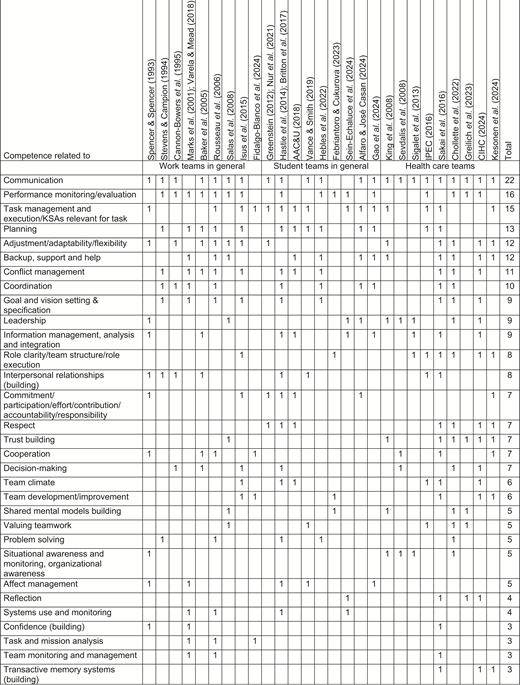
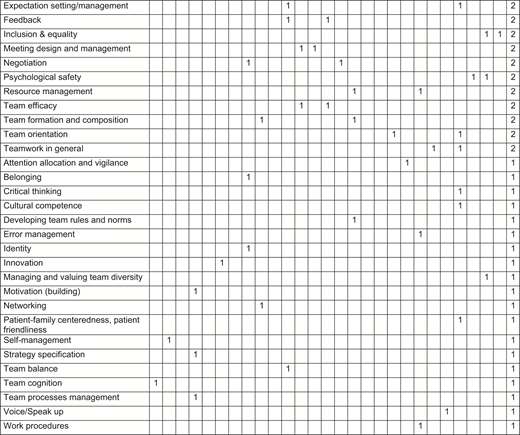
The overview primarily serves to illustrate which TCAs are covered by each framework. By comparing frameworks in this manner, it becomes evident which competence areas overlap and which do not. It is beyond the scope of this paper to compare the exact formulation or operationalization of each sub-competence in each framework, as the main goal is to broadly compare frameworks within and across research fields.
Even without going into detail, the overview reveals considerable overlap as well as significant differences between frameworks, both within and across research fields. Even within a research field, such as health-care teams, where the context may be quite similar, there is no clear pattern or consensus on which TCAs team members or teams should be competent in.
Regarding TCAs, communication competence is present in almost all frameworks. Performance monitoring/evaluation, conflict management, support and backup, coordination, adaptation, planning, and KSA’s relevant for task execution are present in more than ten frameworks. However, many other sub-competences of teamwork competence appear in (much) fewer frameworks. The overview indicates a lack of consensus on which TCAs to include in a framework, possibly due to the different methods used to construct these frameworks and the context in which and for which they conceptualize teamwork competence.
Additionally, some frameworks directly focus on competences (e.g., Stevens and Campion, 1994), while others derive competence from conceptualized desired teamwork behaviors (e.g., Rousseau et al., 2006), team member’s contributions to team effectiveness, team development, or the quality of the team output (e.g., Loughry et al., 2007), team member performance (e.g., Malec et al., 2007), or (ideal) teamwork processes or emergent states (e.g., Marks et al., 2001; Valentine et al., 2015 ; Varela and Mead, 2018). As Varela and Mead (2018) note, some frameworks are theoretically developed based on experience or practice, but their empirical validation has been criticized (e.g., Stevens and Campion, 1994). Some frameworks have been developed for a broad context, such as work teams in general (e.g., Rousseau et al., 2006), while others are conceptualized for a specific context, such as work teams in the petroleum industry (e.g., Skjerve and Holmgren, 2018). In addition, many frameworks make use of a multi-level or multi-dimensional approach to competences and their sub-competences (e.g., Stevens and Campion, 1994), while some simply list competences without ordering sub-competences multidimensionally (e.g., Curran et al., 2011). Frameworks that incorporate multidimensionality often differ in what they conceptualize as higher-order dimensions. For example, Chollette et al. (2022), Hastie et al. (2014) and Curran et al. (2011) consider conflict management a higher-order teamwork competence, while Stevens and Campion (1994) view it as a sub-competence of interpersonal competence. Most of the frameworks discuss individual teamwork competence, although some conceptualize certain teamwork sub-competences at the team level, especially in the field of health-care teams (e.g., Chollette et al., 2022; Lotrecchiano et al., 2021).
To simplify or make frameworks more manageable, existing frameworks have likely consciously or unconsciously tried to limit the teamwork sub-competences list, based on for example context cues, practical considerations, or disciplinary traditions. The different origins and aims of the frameworks may have resulted in varying focusses, emphasizing some TCAs over others. Additionally, they have grouped competences into “core” or higher-order competences, but the decisions made in this ordering differ substantially. Finally, in the ordering and limitation process, some TCAs are present in almost every framework, whereas others appear in only one framework.
In conclusion, the analysis of different frameworks reveals that they include different TCAs, are ordered differently, may be incomplete and lack explicit, clear and solid argumentation for which TCAs are included and which are not. Consequently, teamwork competence frameworks can hardly be compared within and across fields, and the construction of the frameworks remains somewhat of a black box for outsiders.
Constructing a comprehensive framework of teamwork competence
To synthesize teamwork competence frameworks, I propose to construct a comprehensive framework of TCAs, from which contextual frameworks can be deductively derived. This approach ensures that no TCAs are overlooked, and that a clear rationale for the inclusion and exclusion of certain competence areas is provided. Moreover, the approach allows context-specific frameworks to be related back to the comprehensive framework, and thus to each other.
The comprehensive framework comprises of all TCAs identified in both the systematic review of teamwork competence frameworks, as well as the literature review of teamwork processes and emergent states (previously reported in Van Woerden, 2023). The comprehensive framework was constructed by merging the two lists of TCAs from the two studies, the full list of identified TCAs can be found in Table 2. When comparing Table 1 and 2, it is notable that Table 2 contains more TCAs than Table 1, which indicates that the literature review revealed more TCAs than the overview of all existing teamwork competence frameworks. Apparently, some TCAs do not appear in any of the existing frameworks. Secondly, almost all TCAs listed in Table 1 are also present in Table 2, except for “critical thinking”, “cultural competence”, “networking and influence competence” and “perspective-seeking” (presented in italics in Table 2). Some areas in Table 1, such as “teamwork in general” and “team process management”, relate to teamwork in general and are not separately listed in Table 2. One context-specific area “patient-family centeredness” was generalized into “client-centeredness”. The comprehensive framework consists of 94 TCAs, but future literature could identify more areas. These TCAs are not ranked or ordered, as such rankings or orderings into multi-dimensional frameworks may be context-specific.
TCAs – Comprehensive framework of teamwork competence
| TCAs related teamwork processes | Adaptation and adaptability (competence) |
| Administration | |
| Back-up, support and help | |
| Boundary spanning/management | |
| Budgeting | |
| Client-centeredness | |
| Communication | |
| Cooperation | |
| Coordination | |
| Critical thinking | |
| Decision-making | |
| Error management | |
| Evaluation and correction | |
| Experimentation | |
| External influences management | |
| Feedback | |
| Goal-setting and specification | |
| Information and knowledge management | |
| Integration (of knowledge) | |
| Interpersonal interaction | |
| Leadership | |
| Logistical processes | |
| Mission and task analysis | |
| Monitoring (budget, progress, performance, team members, systems) | |
| Negotiation | |
| Networking and influence | |
| Perspective-taking | |
| Planning and time management | |
| Prioritization and sequencing | |
| Problem-solving | |
| Reflection | |
| Regulation | |
| Reporting | |
| Resource management | |
| Role management | |
| Strategy formulation and development | |
| Task division and demarcation of responsibilities | |
| Task execution | |
| Team building | |
| Team change | |
| Team innovation | |
| Team learning management | |
| Team maintenance management | |
| Team performance feedback | |
| Team process improvement and development | |
| Team training (individual or team) | |
| Team’s integration of new team members | |
| Violation management | |
| Workload management | |
| TCAs related to reaching and/or managing certain emergent states | Increasing team balance and mutuality |
| Building a positive team climate and team culture | |
| Establishing team cognition | |
| Building team cohesion | |
| Building commitment | |
| Building confidence | |
| Managing team conflict | |
| Increasing team creativity | |
| Building cultural awareness | |
| Identifying and stopping team degradation/disintegration | |
| Managing team diversity | |
| Increasing drive | |
| Increasing efficacy | |
| Increasing empowerment | |
| Managing team expectations | |
| Building team familiarity and connectivity | |
| Managing team fault lines and team subgrouping | |
| Managing team formality | |
| Building team identity | |
| Managing in- and exclusion processes | |
| Increasing team initiative | |
| Managing team interpersonal risk taking | |
| Creating shared team mental model | |
| Managing mood, affect and emotion | |
| Increasing motivation | |
| Developing and maintaining team rules and norms | |
| Increasing team potency | |
| Managing team power configuration | |
| Increasing team pride | |
| Increasing proficiency | |
| Increasing psychological safety | |
| Building resilience | |
| Increasing respect and tolerance | |
| Developing and maintaining team routines | |
| Increasing self-management | |
| Increasing situational awareness | |
| Building spirit and morale | |
| Increasing team stability | |
| Building team synchronicity (shared patterns of behavior) | |
| Building team transactive memory systems | |
| Building team trust | |
| Increasing team understanding of each other | |
| Developing team values | |
| Increasing voice and speak up | |
| Valuing teamwork and team orientation | |
Constructing a contextual framework of teamwork competence
To construct a contextual framework for a specific type of team operating in a particular context, the comprehensive framework can be used as a starting point to deductively determine which TCAs to include in the contextual framework. The step-by-step method is theorized to consist of three steps: (a) analyzing the team type and the context, (b) making reasoned decisions on which TCAs are most relevant and salient in that context, (c) further defining and operationalizing specific competences at both individual and team levels. To further elaborate what this process could look like, an example is provided below.
Example: Contextual framework of interdisciplinary teamwork competence for higher education students
To illustrate how the comprehensive framework can be used to design a contextually adapted framework of teamwork competence, I will examine the specific context of teaching interdisciplinary teamwork competence in an interdisciplinary bachelor program. In this context, both interdisciplinarity and the student context are relevant to take into account. This contextual framework is intended for student teams (type of team) in higher education (type of work environment and organizational context) who collaboratively work on an interdisciplinary research task (type of task).
Step 1: Analyzing the team type and the context
Identifying the relevant and salient TCAs for this context involves analyzing the student context and the demands of the interdisciplinary research task. In the first column of Table 3, characteristics of interdisciplinary student teamwork are listed, based on literature on both the characteristics of interdisciplinary teamwork as well as student teamwork.
Most relevant and salient TCAs for interdisciplinary student teamwork
| Characteristics of interdisciplinary teamwork | Related TCAs |
|---|---|
| Interdisciplinary tasks typically require teamwork among members with diverse disciplinary backgrounds and knowledge (Klein, 2005). These tasks are highly complex, difficult and necessitate extensive coordination among team members to be able to integrate knowledge (Repko and Szostak, 2021). Team members may also have distinct disciplinary skill sets, and lack interdisciplinary research skills, leading to reduced confidence and efficacy (Lattuca et al., 2013). Team members and especially students may not feel competent with regard to the task (Horn et al., 2023; Van Woerden et al., 2025a) | Coordination; integration of knowledge; task execution; building confidence; creating a shared team mental model |
| Task uncertainty can be high, as interdisciplinary research methods are still evolving, and many outcomes depend on the team’s decisions, making critical reflection on the teams’ research process essential (Repko and Szostak, 2021; Vestal and Mesmer-Magnus, 2020) | Adaptation; decision-making; mission and task analysis; problem-solving; reflection |
| Team members may hold differing beliefs and attitudes toward science, mirrored in different (disciplinary-defined) mental models, perspectives and identities (Miller and Mansilla, 2004; Ming et al., 2023). Team members may struggle to communicate and understand each other across disciplinary boundaries and to know who holds what knowledge (MacLeod, 2018; Miller and Mansilla, 2004; Repko and Szostak, 2021). Misunderstanding and disciplinary differences may lead to frustration, (task) conflict and subgrouping (Jehn et al., 1999; MacLeod, 2018; Miller and Mansilla, 2004) | Boundary spanning/management; communication; information and knowledge management; building team transactive memory systems; managing team conflict; identifying and stopping team degradation/disintegration; managing team fault lines and team subgrouping; increasing team understanding of each other; managing team diversity; creating shared team mental model; developing and maintaining team rules and norms |
| Providing feedback and evaluating each other’s work is challenging when dealing with disciplinary insights, as there is often a lack of shared knowledge (MacLeod, 2018) | Feedback; evaluation and correction; monitoring (progress, budget, team members, systems) |
| Characteristics of student teamwork | |
| Student teams often work together for short periods, typically functioning as a team for the duration of one course. Due to the short-term nature of much student teamwork, students may be less inclined to engage in team development processes, feel less committed to the team and may not invest time in building cohesion, trust and psychological safety (Bacon et al., 1999; Van Woerden, 2023) | Team process improvement; building team cohesion; building commitment; building team psychological safety; building team trust |
| Students vary in their grade ambitions, which can lead to frustration if these do not align. Students may have lower motivation for the task or teamwork, or exhibit free-riding behaviors. Students are highly dependent on each other to complete the (interdisciplinary) task, as they often receive collective grades (Fiore, 2008). This high (outcome) interdependency can lead to stress if grade ambitions do not align or students exhibit free-riding behavior. Team members may rely on the work of others or feel incompetent themselves (Caspersz et al., 2003; Debnath et al., 2007; Hall and Buzwell, 2013; Wageman and Baker, 1997) | Monitoring (progress, budget, team members, systems); increasing team balance and mutuality; increasing team motivation |
| Students struggle with addressing problems and to being open and honest with team members due to fears of social (e.g., conflict, being disliked), personal (e.g., loss of energy, high frustration) or academic consequences (e.g., disintegration of the team, lower grades; Van Woerden et al., 2025a) | Problem-solving; increasing voice and speak up |
| Students face challenges in process management, such as conducting effective meetings, planning and task division (Van Woerden et al., 2025b), which may be connected to the often horizontal and unclear leadership structure in student teams (O’Shea et al., 2013). Students themselves indicate they would want to improve their skills in different teamwork roles (Van Woerden et al., 2025a) | Leadership; planning and time management; task division and demarcation of responsibilities; role management |
Step 2: Making reasoned decisions which TCAs are most relevant and salient.
From the analysis above, certain TCAs are relevant and salient in interdisciplinary student teamwork, which are listed in the second column of Table 3. TCAs in italics mark when a TCA is listed more than once.
This contextual framework includes 35 TCAs, derived from an analysis of the interdisciplinary and the student context. The framework may need further adaption to fit a specific educational program, considering time, budget and staff constraints, or the requirements of a particular work field. Higher education programs could further reduce the number of TCAs they aim to address in their programs, based on explicit, clear and solid argumentation on why these competence areas are the most important for their context. This argumentation can be based on: (a) the requirements of the intended work field (e.g., engineering practice), (b) strategic choices (e.g., what distinguishes the program from others) and (c) practical considerations (e.g., what is feasible within the program). A list of potential guiding questions in this process is provided in Van Woerden (2023) .
Step 3: Further defining and operationalizing specific competences at both individual and team levels.
Once the program has created its contextual teamwork competence framework based on explicit, clear and solid reasoning, it can further define specific teamwork sub-competences within the TCAs and operationalize these into intended learning outcomes. The length of this paper does not allow for a full definition and operationalization of each of the 35 TCAs, so I will provide one example. Following Horn et al. (2023) and Lattuca et al. (2013), “integration of knowledge” can be for example further specified in the individual sub-competences of “ability to offer disciplinary insights from one’s own discipline”, “ability to understand the core elements of other disciplines than one’s own”, “ability to ask relevant questions about other disciplines than one’s own”, “knowledge of interdisciplinary integration methods”. Following Repko and Szostak (2021), team-level sub-competences could be further defined as “ability to understand the relevance of disciplines in relation to the research question”, “ability to analyze and evaluate disciplinary insights in relation to each other”, “ability to create common ground” and “ability to reach a joint more comprehensive understanding”. These sub-competences could for example be operationalized into the intended learning outcome “at the end of the course, the student understands the core elements of their own discipline as well as of other disciplines, can ask relevant cross-disciplinary questions. The student can function in a team which implements the Repko and Szostak (2021) method of integration”.
This example demonstrates that a single TCA can be further subdivided into several sub-competences and operationalized for practical use. Additionally, it illustrates the rationale for prioritizing certain competences in specific contexts, as the list of sub-competences can quickly become extensive. For the sake of transparency and comparability, the reasons behind these prioritization choices should be clearly articulated.
Discussion
In this paper a comprehensive framework of teamwork competence has been constructed by synthesizing literature on teamwork competence, teamwork processes and emergent states across research fields. Analysis of teamwork competence frameworks from different research fields revealed considerable overlap as well as considerable differences between frameworks. Frameworks emphasize certain competence areas of teamwork while omitting others entirely, often without providing a clear rationale for these choices. Additionally, authors make different and sometimes contradictory choices regarding the ordering of teamwork sub-competences into higher-order dimensions, complicating comparison between frameworks.
To address these issues with teamwork competence frameworks, I propose starting with a comprehensive framework that includes all known TCAs. Many I-P-O conceptualizations of teamwork and team performance treat “process” as encompassing both team processes and team emergent states, yet they do not provide an overview of all team processes or team emergent states. For example, Tannenbaum et al. (1992) list some teamwork processes, but caution that it is not an exhaustive list. The comprehensive framework aims to provide such an overview, covering all TCAs related to team processes and team emergent states.
The comprehensive framework can then serve as a foundation for constructing a contextual framework, based on an analysis of which TCAs are salient and relevant for a specific context, and explicit, clear and solid argumentation for the inclusion and exclusion of certain TCAs. Current contextual frameworks vary within and between fields or types of teams, likely due to the different disciplinary or professional backgrounds of their producers and the context in which and for which they conceptualize teamwork competence. A form of standardization can be achieved by using the comprehensive framework, because each contextual framework is derived from the same comprehensive framework, following a clear method.
The comprehensive framework is dynamic in two senses: 1) it can be adapted to local contexts, and 2) it can be expanded and modified based on new insights in teamwork literature. The comprehensive framework is not intended to be static, but should evolve as new teamwork processes are identified in the literature.
The contextual framework for interdisciplinary teamwork competence for higher education students, derived from the comprehensive framework, can be compared to existing frameworks of interdisciplinary student teamwork competence, such as that of Lattuca et al. (2013). Lattuca et al. (2013) define eight competences, and of the 35 TCAs that are salient in and relevant for the interdisciplinary student context according to this paper, they emphasize only 5 in their framework (see Table 4).
Comparison of Lattuca et al. (2013) and TCAs identified in this paper
| Lattuca et al. (2013) | TCA |
|---|---|
| Awareness of disciplinarity | Diversity management/boundary spanning and management |
| Appreciation of disciplinary perspectives | |
| Appreciation of non-disciplinary perspectives | |
| Recognition of disciplinary limitations | |
| Interdisciplinary evaluation | Evaluation and correction |
| Reflexivity | Reflection |
| Ability to find common ground | Integration |
| Integrative skill |
It could be argued that these are the most important sub-competences in their view, but further explicit, clear and solid argumentation would be insightful. A contextual framework derived from the comprehensive framework, based on an analysis of the specific context and further specifications and operationalizations of the TCAs and specific sub-competences, would provide a more substantiated base for teaching and learning. I have tried to provide an example of a contextual framework that is deductively derived from the comprehensive framework, based on clear and solid reasoning.
Limitations and directions for future research
The main limitation of the comprehensive framework in this paper is that it is based on a single systematic review of teamwork literature and an overview of existing teamwork competence frameworks. It is possible that there are more teamwork competences that need to be included in the comprehensive framework. Therefore, the comprehensive framework is dynamic in nature: new competence areas that emerge from the literature can be added. The main limitation of the method of deriving contextual frameworks from the comprehensive framework is that it is theoretically developed, but has not been tested in practice. Sub-competences still need to be further defined and operationalized in the contextual frameworks, which could still lead to somewhat unclearly constructed frameworks if the rationale for those steps is not provided. Some pitfalls of this method may not become apparent until the method is used in practice.
Research and practical implications
This paper introduces a new method of deriving contextual teamwork competence frameworks from a comprehensive framework in which TCAs across different research fields are synthesized. For research, the standardized comprehensive framework can serve as a starting point for understanding teamwork competence in its entirety, and conceptualizing the relationship between contextual frameworks and the comprehensive framework. In practice, explicit, clear, and solid argumentation for contextual frameworks may reduce some of the ambiguity and contingency of the existing frameworks. Within the contextual frameworks, competence areas can be further defined into clearly delineated teamwork sub-competences and operationalized into measurable entities. Contextual frameworks can now be compared based on the comprehensive framework, and discussions about the “best” contextual framework can be structured, as the reasoning for which sub-competences to include and exclude is explicit.

