Recently, many firms have reshored manufacturing activities back to their home countries to increase customer perceptions of product quality. However, there is no evidence that relocating production to the home country improves customer-perceived quality. This study intends to address this gap by assessing the variations between pre- and post-reshoring product quality, as perceived by domestic customers.
Data were collected through a questionnaire, which used the case of an Italian fashion brand that had reshored its manufacturing from Romania to Italy as the stimulus. Two analyses of the collected data (n = 399) were conducted, applying both 2 × 2 × 2 factorial design and partial least squares–structural equation modelling (PLS–SEM) multigroup analysis.
Reshoring increased the level of perceived product quality only for customers that both were aware of the firm's past offshoring decision and had high levels of affective ethnocentrism. For all other customers, no significant variations between pre- and post-reshoring product quality were observed.
This study challenges previous findings, revealing that only a minor share of customers perceived products to be of higher quality after reshoring.
Increasing customer-perceived quality may not be a sufficient motivation to select the reshoring strategy. In addition, when announcing reshoring strategies, producers should appeal to customers' emotions and not use rational arguments about objective product quality.
This is the first study to assess variations between pre- and post-reshoring customer-perceived quality and to identify factors that explain such variations.
Introduction
In recent years, several firms have decided to relocate all or part of their previously offshored manufacturing activities back to their home countries (Barbieri et al., 2018; Dachs et al., 2019). This phenomenon, known as reshoring, is gaining increasing popularity as reflected by the number of media articles referring to reshoring, which has boomed in the last decade (De Backer et al., 2016).
The European Reshoring Monitor (https://reshoring.eurofound.europa.eu) examines all cases of reshoring reported in the national media in each EU member state and identified 250 cases of reshoring from 2014 to 2018. Regarding the home countries of the relocating firms, the United Kingdom ranked first with 44 cases, followed by Italy with 38 and France with 36. In addition, most cases concerned the reshoring of manufacturing activities and apparel was the most represented industry.
The motivations driving firms to reshore their manufacturing activities can be divided into cost-efficiency gains and improvements in customer-perceived value related to customer-perceived quality (Fratocchi et al., 2016). Available evidence emphasises the importance of the country-of-origin or the “made-in” effect, which has emerged as particularly relevant in industries such as fashion, where the place of production may operate as a clue to product quality (Fratocchi et al., 2016; Parkvithee and Miranda, 2012). Therefore, many firms choose to relocate their production to their home countries to leverage this positive “made-in” effect, which can improve customer-perceived quality. The European Reshoring Monitor also reveals that in some countries, such as Italy, the “made-in” effect ranks first among the motivations for reshoring.
Despite these premises, available research has not assessed whether the decision to relocate production back to the home country actually improves the level of customer-perceived quality. Overall, knowledge about the effects of firms’ reshoring decisions on customer attitudes is very limited. Grappi et al. (2015) studied domestic customer reactions to corporate reshoring, drawing on moral and ethical considerations. Overall, the analysis revealed that the reshoring decision arouses gratitude and diminishes anger towards the company, which, in turn, positively influences the willingness to buy the firm's products. In addition, Grappi et al. (2018) developed the multidimensional Customer Reshoring Sentiment scale to grasp customer attitudes to relocation decisions. In their analysis, the authors also showed that the greater the perceptions of superior quality attributed to a reshored product, the higher the intention to buy it.
While valuable, these early studies consider customer reactions only after the decision to reshore; therefore, it is not possible to ascertain whether the post-reshoring customer attitudes are better, worse or the same as the pre-reshoring ones. This study intends to fill this gap by measuring product quality as perceived by domestic customers both before and after the reshoring decision. In addition, the reshoring strategy is necessarily related to a past offshoring decision made by the firm. However, available studies have not considered that all customers were not necessarily aware of the past offshoring decision—that is, customers may assume that the firm has always produced in its home country. This study addresses this gap by examining how perceived product quality differs between those customers who were aware and those who were unaware of the firm's past offshoring decision. Finally, this research intends to assess whether variations in perceived product quality can be explained by the cognitive and emotional ethnocentrism of customers (Sharma, 2015). In other terms, the analysis will clarify whether changes in perceived product quality are based on rational evaluations of the home country's production capabilities and workmanship (cognitive ethnocentrism) or on proudness towards products “made in” the home country (emotional ethnocentrism).
To this purpose, this paper presents the results of two analyses of data collected from a sample of Italian customers. The first relies on a 2 × 2 × 2 factorial design to detect significant changes in the levels of perceived product quality after the announcement of the reshoring decision. The second applies partial least squares–structural equation modelling (PLS–SEM) multigroup analysis to offer a comprehensive view of the relationships among pre- and post-reshoring attitudes and cognitive and affective ethnocentrism. The remainder of the paper is structured as follows. First, the relevant literature is reviewed, focusing on studies of reshoring and ethnocentrism and the research hypothesis is introduced. After this, the methods are described and the results of the two studies are presented. The findings are then discussed and conclusions are drawn about the impacts of reshoring on customer-perceived quality.
Literature review
Reshoring refers to a firm's strategy of moving manufacturing back to its home country, regardless of who was performing and who will perform the manufacturing activity in question—that is, the firm itself or a supplier (Ellram, 2013; Gray et al., 2013). On the basis of in-depth conceptual reasoning, Fratocchi et al. (2014, p. 56) have suggested the use of the more precise term “back-reshoring”, which is defined as “a voluntary corporate strategy regarding the home country's partial or total relocation of (in-sourced or out-sourced) production to serve the local, regional or global demands”. This paper embraces this definition but, as suggested by Fratocchi et al. (2016), adopts the term reshoring (instead of back-reshoring), which is most frequently used in the literature.
A detailed literature review performed by Di Stefano and Fratocchi (2019) found that the first scientific article about reshoring dates back to 2007 and that, since then, 96 papers on this topic have been published. This phenomenon has been investigated drawing on different theories, including Dunning's eclectic paradigm (e.g. Ellram et al., 2013), resource-based theory (e.g. Gray et al., 2017) and the dynamic capabilities framework (Wiesmann et al., 2017). Regardless of their specificities and theoretical backgrounds, all conceptualisations and definitions of this phenomenon highlight that a firm cannot pursue reshoring unless it has previously pursued offshoring (Bals et al., 2016). Hence, reshoring can be basically understood as an update of a firm's past decision to move its manufacturing location (Ellram et al., 2013; Gray et al., 2013). Available analyses have reported multiple and distinct explanations for this phenomenon, including those related to costs, quality, time and flexibility, access to skills and knowledge, risks and customers (for a detailed review of this topic, see Stentoft et al., 2016). Overall, these motivations have been grouped into two main categories respectively related to efficiency and to customers or the market (Fratocchi et al., 2016).
Many studies suggest that the decision to reshore previously offshored manufacturing is motivated by efficiency, either because managers' evaluations of the true total cost of offshoring relative to producing locally were incorrect or because the cost advantages of offshore production decreased or disappeared because of changes in external conditions (Gray et al., 2013). For example, a government can critically favour the cost competitiveness of reshored production through its policies regarding trade regulation, tax advantages and subsidies (Ellram et al., 2013; Wiesmann et al., 2017).
However, an extensive review of the available literature (Barbieri et al., 2018) reveals that the reshoring decision is increasingly related to its expected effects on customer value, which can be even more important than efficiency considerations. From a customer-value perspective, the relocation of manufacturing activities is increasingly driven by the search for higher levels of product quality than those offered by offshore production (Dachs et al., 2019; Kinkel and Maloca, 2009). In particular, it has been suggested that customer perceptions of product quality will be higher after reshoring and that this effect may be also related to the “made-in” or country-of-origin effect (Fratocchi et al., 2016). In other words, customers will show a bias in favour of domestic products, known as domestic country bias (Balabanis and Diamantopoulos, 2004).
Despite the key role of perceived product quality enhancement in driving the choice to reshore, the available research has not examined whether this strategy actually improves perceived quality. In fact, while research has documented the negative impacts of offshoring strategies on customer-perceived quality (Bharadwaj and Roggeveen, 2008; Thelen et al., 2011), the effects of the opposite strategy (i.e. reshoring) are still unclear. The few available studies about customer reactions to a firm's decision to relocate its activities back to the home country focus on the overall attitudes towards the reshoring decision and only consider them after its announcement (Grappi et al., 2015, 2018). Perceived product quality is not measured and compared before and after the reshoring decision.
Hypothesis development
Drawing on the arguments introduced in the previous section and in particular on the effect of domestic country bias (Balabanis and Diamantopoulos, 2004), this paper suggests that the reshoring decision can improve the level of product quality perceived by domestic customers. However, it also argues that this effect is not homogeneous across customers because of the effects of (1) previous knowledge or ignorance of the firm's past offshoring decision(s) and (2) customer levels of cognitive and affective ethnocentrism.
First, customers' previous knowledge or ignorance about the firm's past offshoring decision(s) influences how the customer will elaborate information related to the decision to reshore. In fact, the message about the reshoring decision will be framed differently: it will act as counter-attitudinal information for customers who knew about the past offshoring strategy (i.e. the message challenges the customers' existing idea that the production is carried out in foreign countries) and as pro-attitudinal information for customers who did not know (i.e. the message agrees with the customers' existing idea that the production is located in their home country) (Clark et al., 2008). There is extensive evidence showing that people are likely to invest more effort in and spend more time processing information when its content is counter-attitudinal rather than pro-attitudinal (Edwards and Smith, 1996). This happens because people tend to avoid unnecessary cognitive workload and are motivated to engage in cognitive efforts only when a given event, information or behaviour deviates from expectancies (Pyszczynski and Greenberg, 1981). In fact, when events conform to expectations, people can rely on a heuristic form of analysis, but when events disconfirm expectations, people are more likely to engage in detailed cognitive analysis (Hunt et al., 1985). In other terms, because of the confirmation bias phenomenon, people are more likely to question information conflicting with pre-existing beliefs than information consistent with them (Kahneman, 2011; Nickerson, 1998). Drawing on these arguments, it is expected that the reshoring decision will influence only the attitudes of those who were aware of the previous offshoring decision and who, therefore, will update their pre-existing beliefs. In addition, drawing on the domestic country bias (Balabanis and Diamantopoulos, 2004), this study anticipates that these people's perception of product quality will improve.
Second, variations in pre- and post-reshoring levels of perceived product quality will also be influenced by customers' cognitive and affective ethnocentrism. The concept of ethnocentrism was introduced by Shimp and Sharma (1987, p. 280) to indicate “the beliefs held by American customers about the appropriateness, indeed morality, of purchasing foreign-made products”. As explained by Shimp and Sharma (1987), ethnocentrism acts as a judgement bias against foreign-made products. Hence, this construct is useful to explain why some customers (i.e. those with high levels of ethnocentrism) tend to favour domestic products over foreign ones (Siamagka and Balabanis, 2015). Recently, Sharma (2015) has reconceptualised the construct of customer ethnocentrism, suggesting a distinction between its cognitive and emotional dimensions. The cognitive dimension (cognitive ethnocentrism) refers to the tendency to prefer domestic products because of the rational belief that they are objectively superior to foreign products because domestic producers provide the best workmanship. The affective dimension (affective ethnocentrism) refers to the tendency to prefer domestic products because of customer pride in, admiration for and emotional attachment to domestic products, irrespective of the rational evaluations of their objective quality. Moreover, each person may develop different levels of each of the two components, for example, high levels of cognitive bias and low levels of affective reaction (Sharma, 2015). From the general arguments about ethnocentrism (Shankarmahesh, 2006; Shimp and Sharma, 1987), we could expect that the post-reshoring improvements in perceived product quality will be higher for customers with high levels of ethnocentrism than for those with low levels of ethnocentrism. In addition, this hypothesis is expected to hold only for customers with high levels of affective ethnocentrism, irrespective of their levels of cognitive ethnocentrism. In fact, previous research on brand origin classification and country of origin suggests that for established brands, country of manufacture is of less importance and the brand itself serves to ensure quality (Bharadwaj and Roggeveen, 2008; Phau and Prendergast, 2000). Hence, customers should expect that an established brand's control over its product quality will not change with a change in manufacturing location (Phau and Prendergast, 2000). Consistent with these findings, this study suggests that when the production is reshored to the domestic market, customers will not expect the objective quality of the products to improve because of the domestic producers' workmanship (cognitive ethnocentrism). However, perceived product quality may increase via affective ethnocentrism (i.e. via the pride in having reshored manufacturing activities to the home country). Based on these arguments, the following hypothesis is proposed:
The reshoring decision increases the level of product quality perceived by domestic customers but only for those with both (a) previous knowledge of the firm's past offshoring decision and (b) high levels of affective ethnocentrism.
Method
Two analyses were conducted to obtain rich evidence about the expected effects of reshoring on perceived product quality. The first one applied a 2 × 2 × 2 factorial design (with/without previous knowledge of the firm's past offshoring decision; low/high cognitive ethnocentrism; low/high affective ethnocentrism). The second one applied PLS–SEM multigroup analysis with two groups, including participants with or without previous knowledge of the firm's past offshoring decision.
Data for the two analyses were collected through an online questionnaire distributed among Italian people via the authors' personal networks. Overall, this convenience sampling approach yielded 447 answers, but only 399 questionnaires were retained for this study, following the procedure explained below. The questionnaire focused on one of the 250 cases of reshoring identified by the European Reshoring Monitor in the 2014–2018 period (https://reshoring.eurofound.europa.eu)—the case of an Italian fashion brand that had completely reshored the manufacturing of its products from Romania to Italy. Participants were first asked whether they knew the brand and those who reported no knowledge (n = 41) were excluded from the study. After that, pre-reshoring perceived product quality, cognitive ethnocentrism and affective ethnocentrism were registered. Participants were then asked to indicate the country in which they believed the products of the brand were manufactured: 172 indicated Italy, while 234 indicated other countries. After that, respondents were exposed to the stimulus—a real financial newspaper article describing the fashion brand's reshoring decision—and asked to indicate whether they had already heard about this decision. Only seven people declared previous knowledge and were excluded from the analysis. This limited number is consistent with the fact that the mass media had not given coverage to the brand's reshoring strategy, which was only mentioned in a few managers' interviews with financial newspapers. Therefore, the final sample consisted of 399 people, of which 165 thought that the products were manufactured in their home country Italy (they did not have prior knowledge of the firm's original offshoring decision) and 234 thought that the products were manufactured in other countries (they had previous knowledge of the firm's original offshoring decision). After participants were shown the stimulus, the post-reshoring perceived product quality and the purchase intentions were measured. Participants were required to indicate whether they had ever purchased products from the brand involved in this study, and their answers (yes/no) were used as a control variable.
The pre- and post-reshoring perceived product quality were measured using three items (“the quality of [Brand X] products is high”, “[Brand X] products are well made” and “I think [Brand X] products have far better quality than other brands” products') based on the conceptualisation of Aaker (1992) and the operationalisation of Tingchi Liu et al. (2014) and Bagozzi et al. (2017). Affective ethnocentrism and cognitive ethnocentrism were measured by four and three items respectively, following Sharma (2015). In detail, the items used to grasp affective ethnocentrism were as follows: “I love products from Italy”, “I am proud of the products from Italy”, “I admire products from Italy” and “I feel attached to products from Italy”. The items used to measure cognitive ethnocentrism were as follows: “products from Italy are examples of the best workmanship”, “East or West, the products from Italy are the best” and “Italy has the hardest working people in the manufacturing industry”. Finally, purchase intentions were measured using two items (“I am likely to purchase [Brand X] products” and “I intend to purchase [Brand X] products in the future”), following Hung et al. (2011) and Schlosser et al. (2006). All items were measured using five-point Likert scales with extremes of 1 = totally disagree and 5 = totally agree. The results of the two analyses (the 2 × 2 × 2 factorial design and the PLS–SEM multigroup analysis) are reported separately below. They are then discussed together to draw conclusions.
Results
First analysis: 2 × 2 × 2 factorial design
The first analysis sought to identify statistically significant variations between pre- and post-reshoring perceived product quality using a 2 × 2 × 2 factorial design (with/without previous knowledge of the firm's past offshoring decision; low/high cognitive ethnocentrism; low/high affective ethnocentrism). The respondents were allocated to one of the eight groups according to the following procedure. Regarding the presence or absence of previous knowledge about the firm's past offshoring decision, this study relied on the answers given by participants about the country in which they thought the brand was manufacturing its goods. In relation to affective and cognitive ethnocentrism, the validity of each of the two scales was first checked. For affective ethnocentrism, the values of Cronbach's alpha were respectively 0.81 and 0.83 for respondents with and without knowledge of the firm's past offshoring decision. For cognitive ethnocentrism, the values of Cronbach's alpha were respectively 0.73 and 0.78 for respondents with and without knowledge of the firm's past offshoring decision. The averages of the two sets of items were calculated and used in the analysis. Median splits (Voss et al., 2003) were then used to delineate high and low levels of cognitive and affective ethnocentrism. In detail, respondents with levels of cognitive ethnocentrism above the median value were classified as having “high cognitive ethnocentrism”, while those reporting levels below the median value were classified as having “low cognitive ethnocentrism”. The same procedure was followed for affective ethnocentrism.
For each of the eight resulting groups, a general linear model (GLM) repeated measures analysis of variance was used to identify statistically significant variations between pre- and post-reshoring perceptions of product quality. This statistical technique of analysis was selected because it is appropriate when the same construct is measured two or more times (Thorbjørnsen, 2005).
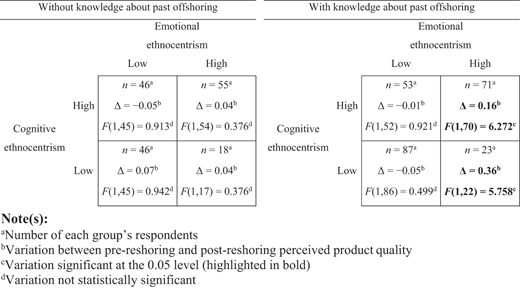
The analysis highlights significant variations between pre- and post-reshoring perceived product quality, but for only two of the eight groups (see Figure 1). In detail, improvements in perceived quality were registered only for customers who had both previous knowledge of the firm's past offshoring decision and high levels of affective ethnocentrism (regardless of their level of cognitive ethnocentrism). For all other customers, the offshoring decision did not significantly affect the perceived quality.
Second analysis: PLS–SEM multigroup analysis
The second analysis was conducted to complement the findings of the first by uncovering the relationships among pre-reshoring perceived product quality, post-reshoring perceived product quality, affective ethnocentrism and cognitive ethnocentrism. In addition, with the intent to increase the predictive validity of the study, the effects of perceived quality were evaluated (Bakator et al., 2017) by modelling purchase intentions as the dependent variable. For this purpose, PLS–SEM multigroup analysis was used with two groups: those with and without previous knowledge of the firm's past offshoring decision. The analysis was conducted using the software SmartPLS 3 (Ringle et al., 2015).
First, given that all constructs were reflective, the measurement model was assessed considering indicator loadings, internal consistency reliability, convergent validity and discriminant validity for each of the two groups (Hair et al., 2019; Hair et al., 2020, see Table 1). All loadings were above 0.70, except for one loading in each group (0.64 was the lowest level). Moreover, the average variance extracted (AVE) for each construct was well above 0.50 and all composite reliability (CR) values were greater than 0.70. Hence, both reliability and convergent validity were assessed (Hair et al., 2019, 2020). Discriminant validity was also met as the AVE for each construct was greater than its maximum and average shared variance (Fornell and Larcker, 1981).
Before assessing the structural model for each of the two groups, measurement invariance had to be confirmed to ensure that the differences in the structural model estimations across groups were not the result of different meanings of the constructs across groups (Henseler et al., 2016). Therefore, the measurement invariance of composite models (MICOM) procedure was used (Hair et al., 2018). The first step of the MICOM procedure is to assess configural invariance. In this study, identical indicators were used for both groups and data were treated similarly. Therefore, configural invariance was established (Henseler et al., 2016). The second step of the MICOM procedure covers compositional invariance. A permutation test was used to confirm that all correlations among the construct scores were higher than the 5% quantile of the distribution of the correlations resulting from 5,000 permutations (Henseler et al., 2016; Table 2).
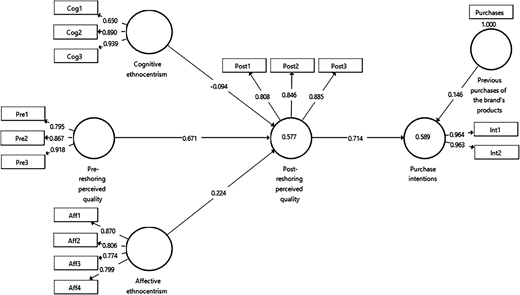
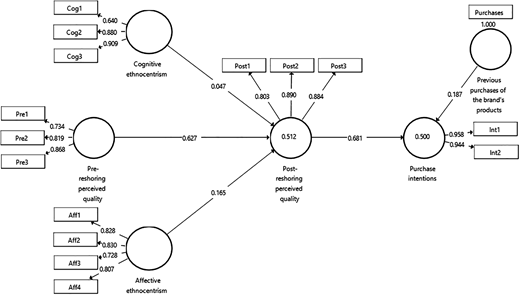
As partial measurement invariance had been met, the authors could then proceed with the evaluation of the measurement models and with the comparison of the path coefficients of the two groups (Hair et al., 2018). Overall, the model's explanatory power was strong for both groups. In fact, the R2 values were equal to or above 0.50 for post-reshoring perceived product quality (0.512 and 0.577 for respondents with and without knowledge of the past offshoring respectively) and for purchase intentions (0.500 and 0.589 for respondents with and without knowledge of the past offshoring respectively) (Hair et al., 2019). The significance of path coefficients was estimated using the bootstrapping procedure (with 5,000 samples). The results are shown in Table 3 and Figure 2 (for the group of respondents without knowledge of past offshoring) and Figure 3 (for the group of respondents with knowledge of past offshoring).
The findings show that the formation of post-reshoring perceived product quality follows the same patterns in both groups. In fact, for customers both with and without previous knowledge of the firm's past offshoring, post-reshoring perceived quality is influenced by the levels of pre-reshoring perceived quality and by affective ethnocentrism, but not by cognitive ethnocentrism. The meaning and implications of these results will be discussed in the next section. This analysis highlights the strong predictive power of post-reshoring perceived product quality to explain purchase intentions.
Discussion
Considered together, the findings of the two analyses carried out in this study reveal that in some specific cases, a reshoring strategy can actually improve the level of customer-perceived quality and they also shed light on the pattern producing this effect. Therefore, this work advances the available knowledge in several ways.
First, distinct from existing research (Grappi et al., 2015, 2018), this is the first study to measure the variations between the product quality perceived by domestic customers before and after the decision to reshore. It is also the first study to suggest that these variations are related to customers' previous knowledge or ignorance of the firm's past offshoring activity and to their levels of affective and cognitive ethnocentrism. By considering all these elements simultaneously, the findings highlight that the reshoring decision increases the level of product quality perceived by domestic customers only for those with previous knowledge of the firm's original offshoring decision and with high levels of affective ethnocentrism. For all other customers (the majority), no significant variations in perceived quality were observed. Therefore, these findings question—at least in part—the validity of the motivations driving firms to reshore their manufacturing activities. In fact, while previous studies (e.g. Fratocchi et al., 2016) have reported that expected improvements related to customer-perceived quality were among the most frequent motivations for reshoring, this study indicates that only a (minor) share of customers show improved perceptions of quality as a consequence of the reshoring decision.
Moreover, this study highlights that the variations in customer-perceived quality are based on affective reactions and not on rational evaluations. In fact, the analyses found no significant effect of cognitive ethnocentrism (i.e. the tendency to prefer products manufactured in the home country on the basis of their objective superiority over foreign products because of better workmanship). On the contrary, affective ethnocentrism (i.e. customer pride, admiration and emotional attachment to products manufactured in the home country) significantly influences variations between pre- and post-reshoring product quality. This result corroborates the findings of a recent study (Stentoft et al., 2018), which revealed that producers did not experience operational performance enhancements in terms of product quality after the production had been back-reshored.
These findings also provide useful insights for producers. First, increasing customer-perceived quality may not be sufficient motivation per se for supporting the reshoring strategy. Producers should also note that the reshoring decision had no effects on customer-perceived quality for those customers who had ignored the firm's past offshoring of manufacturing activity. These consumers believed that the firm had always produced in the home country and the announcement of the reshoring decision provided merely pro-attitudinal information, strengthening their existing attitudes. Finally, when announcing their reshoring strategy, producers should appeal to customers' emotions and affective attitudes because rational arguments about objective improvements in product quality are useless. For example, they could emphasise positive impacts for both local occupations (new jobs creation) and local suppliers.
Conclusion
Despite the growing popularity of reshoring, this phenomenon has been largely understudied. This research has contributed to advancing the available knowledge on this topic by assessing whether reshoring improves customer-perceived product quality. Overall, the analysis indicates that reshoring increases the level of perceived product quality, but only for customers with previous knowledge of firms' past offshoring decisions and high levels of affective ethnocentrism. These findings question the results of previous studies that have reported that expected customer-perceived quality improvement is one of the main motivations driving firms' reshoring. In fact, this research found that only a minor share of customers experienced improved perceptions of quality after the reshoring decision.
These results suggest that new research is needed to gain a more in-depth understanding of reshoring and its impacts. In fact, while this study has provided fresh evidence on this topic, several limitations should be considered. First, only the reactions of domestic customers have been considered. Extending the analysis to a firm's foreign customers represents a valuable avenue for future research, especially when considering firms with a strong presence in foreign markets. Moreover, only one case of reshoring was used as a stimulus in this research. Considering other cases of reshoring may contribute to the identification of other factors (e.g. the hedonic vs the utilitarian positioning of the brand involved in the reshoring; Magno et al., 2017), which may enrich our understanding of the effects of reshoring on customer-perceived quality. The country from which the production is reshored (e.g., mature vs emerging countries) may also play a role in the formation of post-reshoring customer-perceived quality.