Supply chain (SC) innovation (SCI) is vital for improving SC results, but the mechanisms by which it affects SC performance (SCP) have not been empirically examined. Drawing on resources orchestration theory (ROT) and socio-technical systems theory (STST), we posit that, in SC organizational systems, orchestrating the social and the technical subsystems is crucial for understanding how SCI improves SCP. We adopt supply chain collaboration (SCC) and digital transformation (DT) as representative of the social and technical subsystems respectively and hypothesize that they act as core mediators in the relationship between SCI and SCP, and reinforce each other's effect on SCP.
We employ structural equation modeling and regression analysis to test our hypotheses on survey data from 234 Chinese manufacturing firms.
Results show that SCI has a positive impact on SCP through the mediating effects of SCC and DT. The hypothesized synergistic effects of SCC and DT in translating SCI strategic initiatives into superior SCP are also confirmed.
We employ a theoretical framework based on the integration of ROT and STST to shed light on how an innovation-oriented strategic intent shared across the SC affects SCP. We encourage future scholars to employ this framework to deepen our understanding of the (inter)organizational processes by which strategic orientations other than SCI affect performance outcomes. In addition, showing that SCC and DT are complementary in their effect on SCP, our study enriches extant research on the relationships between interorganizational collaboration and the adoption of information technologies in the SC.
1. Introduction
In the current dynamic, uncertain, complex, and ambiguous environments, firms persistently seek innovation to create outstanding value and develop competitive advantages (Malacina and Teplov, 2022; Solaimani and van der Veen, 2022). In particular, with the shift of competition from the firm level to the supply chain (SC) level (Capaldo and Giannoccaro, 2015; Singh, 2025), firms increasingly leverage SC innovation (SCI) to optimize SC management and thus increase SC financial and non-financial performance (Afraz et al., 2021; Gloet and Samson, 2020). SCI consists of the exploration of innovative approaches to SC management practices (Hult et al., 2007; Lee et al., 2011). SCI not only concerns individual SC firms' practices, but also includes their alignment with those of other SC members such as customers, suppliers, and third-party service providers. As SC members adopt new operating procedures and invest in new technologies, their planning, forecasting, supervision, and operational capabilities improve (Afraz et al., 2021), which in turn has the potential to increase SC performance (SCP) by enhancing service effectiveness and operational efficiency (Ojha et al., 2016). Therefore, SCI stands out as a critical driver of SCP. In addition, as SCI spreads across the SC as a shared strategic intent, it becomes a difficult-to-imitate source of competitive advantage (Ojha et al., 2016). For example, by encouraging its SC members to adopt shared innovative solutions, Sony has developed a highly operational SC, laying the foundation for creating higher value for its customers and other stakeholders, with a significant impact on both the company's performance and its ability to compete.
Extant research has revealed the direct and/or indirect effects of SCI on organizational results such as service and operational efficiency (Wong and Ngai, 2019), stakeholder value (Wang et al., 2023), operational agility (Ghouri et al., 2023), and frugal innovation (Al-Omoush et al., 2026). Kusi-Sarpong et al. (2019) have argued that the SCI has the potential to address societal, cultural, and environmental issues. Other scholars have investigated the direct influence of SCI on major SC outcomes, such as SC risk capabilities (Afraz et al., 2021; Kwak et al., 2018), SC resilience (Wong and Ngai, 2024), SC dynamic capabilities (Li et al., 2023), and SC efficiency (Yoon et al., 2016). Interestingly for our purposes, scholars have found that SCI enhances SCP (Abdallah et al., 2021; Bahrami et al., 2022; Wong and Ngai, 2022). Nevertheless, the mechanisms by which SCI exerts its positive effect on financial and non-financial SCP have not been thoroughly examined.
Adopting theoretical constructs similar to, but different from, SCI, prior scholars have found that firm innovativeness, that is, openness to new ideas as a cultural trait of the organization, improves SCP (Panayides and Lun, 2009). Along a similar vein, Seo et al. (2014) have focused on innovativeness at the SC level and tried to open the “black box” of its relationship with SCP, thus revealing the mediating role of supply chain integration. SC innovativeness, however, is conceptually different from SCI. Indeed, SCI refers to “an interconnected set of processes which deal with uncertainties and disruptions in the firm's internal and external environment in order to provide novel and innovative solutions to end users” (Afraz et al., 2021), rather than to a cultural trait of the organization. Therefore, in the present study, we build on the observation that the intermediate pathways through which the strategic practices of SCI improve SC financial and non-financial performance remain underexplored and in need of accurate investigation.
Other studies suggest that SCI may not always exert a positive influence on SCP (Wong and Ngai, 2022). Seeking innovation in the SC may increase complexity and trigger uncertainty in SC operations (Pettit et al., 2010). In addition, despite sharing an innovative intent, SC members typically allocate resources and adjust their commitment to SCI in accordance with their own strategic agendas. Indeed, in typical arm's length SC transactions, SC members pursue self-interested decisions (Claycomb and Frankwick, 2010), and inconsistent goals may lead them to develop divergent perceptions on the SC development trajectories. This makes it challenging to coordinate SCI practices among SC members, which in turn may result in disorganized initiatives that fail to progress in a unified and coherent direction favorable to the SC as a whole. Moreover, incorporating highly complex and innovative processes may increase risks and saturate global SCs with uncertainty (Afraz et al., 2021; Wong and Ngai, 2022). This further raises the need to delve deeper into the relationships between SCI and SCP, and specifically into the mechanisms through which the former influence the latter.
Accordingly, the purpose of the present paper is to unveil whether and how (i.e. the mechanisms by which) SCI affects SCP. To do so, we draw on a recent development of the Resource-based View (RBV), namely the Resource Orchestration Theory (ROT), and on the Socio-Technical System Theory (STST) to conceptualize the SC as a complex socio-technical system and investigate the role of two key social and technical subsystems – Supply Chain Collaboration (SCC) and Digital Transformation (DT), respectively – in the relationships between SCI and SCP.
On the one hand, as effective innovation requires the participation of several SC members (Wong and Ngai, 2022), interorganizational collaboration among supply chain members becomes critical for translating SCI initiatives into superior SCP (Cao and Zhang, 2011; Solaimani and van der Veen, 2022). On the other hand, as modern SCs continuously generate large volumes of data that can be leveraged to improve SC practices, the ultimate success of the SC process and technological innovations depends on the ability to manage a seamless flow of information across the SC through digital technologies (Yang et al., 2025a; Yuan and Pan, 2023). Furthermore, prior scholars have shown that, in socio-technical systems, technical and social subsystems interact to improve system-level outcomes (Adaba and Kebebew, 2018; Liu et al., 2016). In particular, the development of SCC is closely associated with DT (Yu et al., 2024), and successful DT is more likely to occur in the presence of truly collaborative inter-firm relationships (Rocha et al., 2021). Crittenden et al. (2019) have found that DT fundamentally changes the possibilities and solutions for how firms handle and execute inter-firm collaboration, thereby laying the foundation for performance improvement. Furthermore, interorganizational collaboration among SC members has the potential to improve DT by enhancing the capabilities to manage digital technologies and knowledge, which in turn significantly boosts performance (Yu et al., 2024). Therefore, we predict that the interaction between SCC and DT in supply chain contexts positively affects SCP.
Based on the above, we build a theoretical framework wherein SCC and DT act as core mediators in the relationship between SCI and SCP and reinforce each other's effect on SCP. Results confirm our hypotheses and, in particular, show the synergistic effects of SCC and DT in translating SCI strategic initiatives into superior SC financial and non-financial performance. We therefore conclude that translating the value creation potential of SCI into superior SCP requires firms to orchestrate SCC and DT.
The remainder of the article is organized as follows. In section 2 we present the theoretical background of our study, sketch out the theoretical framework on which it is based, and outline the research hypotheses. In section 3 we describe the methodology used for empirical testing. Results are reported in section 4. Section 5 discusses the main findings and outlines the theoretical contribution of our work, its practical implications, and its limitations.
2. Theoretical background
2.1 Innovation and performance in the supply chain
SCI is a set of activities which represent a crucial tool for firms to gain competitive advantages by optimizing SC management (Afraz et al., 2021). Lee et al. (2011) have described SCI as a process that deals with environmental uncertainty with the aim of providing solutions to customer needs and improving organizational processes by means of new technologies. SCI activities are strategic in nature and consists of changes in the SC network, technology, or processes which can take place within or across the boundaries of the SC members (Kwak et al., 2018; Malacina and Teplov, 2022).
Specifically, SCI encompasses technological and process innovation (Kwak et al., 2018). The former is focused on enhancing the integrated information system, real-time tracking technology, and innovative logistics equipment across the SC, with the aim of increasing productivity, guaranteeing scale economies in purchasing and logistics, and streamlining information transfer across the SC so as to improve inventory management and customer satisfaction. The latter is concerned with operational issues and consists of the implementation of new techniques, methods, and procedures to enhance logistics management practices, with the final goal of reducing service costs and/or improving its quality. As organizations participating in the SC have get increasingly involved in SCI practices, SCI and related logics have spread across the SC and become to be shared among SC members (Afraz et al., 2021).SCI has thus evolved into a shared strategic orientation across the SC, integrating the efforts of multiple SC partners to create superior value (Afraz et al., 2021; Ojha et al., 2016).
SCI is a key driver of performance in the SC (Jafari et al., 2023). SCP reflects the SC's capability to deliver valuable products and services to end customers at the right time, in the right quantity, and at the lowest cost (Ruzo-Sanmartín et al., 2023). SCP encompasses financial performance, related to costs and revenues, and non-financial performance, associated with outputs and including operational, innovation, customer service, and marketing performance (Jafari et al., 2023; Zhao et al., 2023). Operational performance measures the SC's delivery, inventory turnover, and operational quality. Innovation performance concerns the SC's performance in new products launches, process improvements, and technology acquisition. Customer service performance gauges whether the expectations and requirements of end customers are being met, the quality of products and services is satisfactory, and user feedback is being valued. Finally, marketing performance is expressed by sales volumes and market share.
Extant research has shown that SCI has a positive direct influence on SCP (Abdallah et al., 2021; Bahrami et al., 2022). However, although Afraz et al. (2021) have researched on the processes by which SCI impacts firm-level competitive advantage, revealing the mediating effects of SC robustness and resilience, and Lee et al. (2011) have investigated the relationships between SCI and organizational performance on a sample of Pakistani hospitals, showing the mediating roles of supplier cooperation, SC efficiency, and quality management practices, the mechanisms by which SCI affects SCP as defined above have not received adequate scholarly attention. Yet, since the adoption of SC innovations across the SC is typically accompanied by difficulties and uncertainties, deepening our understanding of the mechanisms by which SCI can influence SCP has the potential to offer valuable insights for firms in their efforts to create greater value through innovation in the SC. To investigate these mechanisms, we conceptualize SCI as a set of strategic activities aimed at implementing innovation across the SC and we employ a theoretical framework that integrates ROT and STST.
2.2 Theoretical framework
2.2.1 Integrating resource orchestration theory and socio-technical systems theory
Resource-based approaches to strategic management claim that, in order to achieve competitive advantage, organizations should deploy and leverage their tangible and intangible resources (Barney, 1991), including those they are able to activate across their boundaries (Capaldo, 2007). With rare exceptions, however, individual resources cannot be sources of difficult-to-imitate competitive advantages and need to be integrated with other assets across the organization(s) (Grant, 1996). Accordingly, resource orchestration theorists have argued that, in order to implement their strategic initiatives effectively, managers should coordinate and deploy resources in complementary combinations (Chadwick et al., 2015; Malik et al., 2021). While ROT has effectively compounded the Resource-Based View (RBV) by focusing on the role of resource combinations, even at the interorganizational level, and specifically at the SC level (Malik et al., 2021), to produce outstanding performance, the question of which resource combinations are critical for successful strategy implementation remains open.
To answer this question, we move from the assumption that superior performance requires that the entire organization be involved in the implementation of strategy. We thus resort to STST, which depicts organizations, including SCs (Capaldo and Giannoccaro, 2015; Kull et al., 2013), as complex systems composed of a social and a technical subsystem (Liu et al., 2020; Pasmore et al., 2019). The social subsystem encompasses organizational members and their attributes, attitudes, and emotions, as well as the characteristics of the relationships they are involved in and related behaviors (Pasmore, 1988). Therefore, it includes organizational “soft” aspects, among which those of a relational nature play a key role (Kull et al., 2013). The technical subsystem refers to the processes, tasks, and technologies employed by organizations to acquire inputs, transform inputs into outputs, and deliver products and/or services to customers (Adaba and Kebebew, 2018; Kull et al., 2013). It includes the organizational “hard” aspects, with a special emphasis on technology and its developments.
In STST, the social and technical subsystems are interdependent and complementary to each other, so that their interaction has the potential to generate self-reinforcing processes leading to the creation of greater value (Adaba and Kebebew, 2018; Liu et al., 2016). Accordingly, integrating ROT and STST, we purport that, in order to translate their SCI initiatives into increased SCP, organizations should orchestrate their social and technical subsystems as complementary bundles of intangible and tangible resources. Based on previous SC research, we argue that, in SC contexts, critical components of the social and technical subsystems are SCC and DT, respectively.
2.2.2 Supply chain collaboration
SCC refers to the establishment of long-term collaborative relationships characterized by close and repeated interaction among SC partners to plan and execute SC operations (Cao and Zhang, 2011). SCC is a tightly coupled process which consists of the collective deployment of resources and capabilities aimed at the efficient and effective management of activities across the SC. This not only implies coordinated management of otherwise (i.e. in stand-alone firms) independent operations, emphasizing centralized control, contract management and sometimes ownership (Cao and Zhang, 2011; Flynn et al., 2010; Jajja et al., 2018), but also requires resorting to relational contracting (Cao and Zhang, 2011; Nyaga et al., 2010; Qiao et al., 2022). In particular, network governance–i.e. the governance of economic activities, across the boundaries of the SC partners, based on social networks and the associated social control mechanisms such as interpersonal relationships, trust and reciprocity (Capaldo, 2014)–is essential for implementing innovation by means of interorganizational processes wherein the participating organizations agree on coordinated deployment of human assets, information, finances, and technology, make joint decisions, and share resources, responsibilities, and rewards to achieve mutually beneficial outcomes (Capaldo, 2014; Hofer et al., 2014). Cao and Zhang (2011) describe SCC as including process integration, relational communication, and knowledge creation. Based on this framework, they propose seven interrelated and co-varying factors to characterize SCC in a way that also captures the relational contents outlined above ( Appendix 1).
2.2.3 Digital transformation
DT is the transformation of business organizations and their cultures, decision-making, and operating procedures through the extensive use of digital technologies at both the intra- and inter-organizational levels (Holmström et al., 2019; Nasiri et al., 2020). It emphasizes the adoption of disruptive technologies such as blockchain, big data analytics, cloud computing, and 5 g, that go beyond previous information technologies largely employed in the SC, such as ERP and EDI. These digital technologies enhance integration, connectivity, communication, and automation across the SC, facilitating extensive business rethinking, reimagining, and reengineering (Li et al., 2020; Yang et al., 2021; Chang et al., 2025) in ways that transcend functional thinking to encompass and empower cross-functional, horizontal business processes (Pang and Wang, 2023). DT includes the digitization of everything possible, the collection and aggregation of extensive data from multiple sources, the digital exchange of information, and the extensive use of smart technologies to shape a collaborative work environment and a more efficient and effective customer interface (Nasiri et al., 2020).
3. Conceptual model and hypotheses development
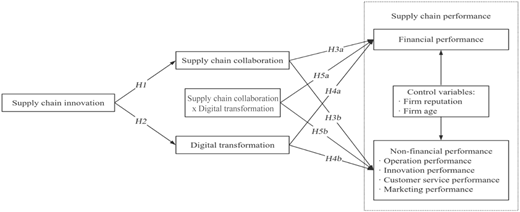
Based on the above, we advance a conceptual model wherein SCC and DT mediate the relationship between SCI and SCP, and the two mediating variables positively moderate each other's effect on SCP (Figure 1).
3.1 Supply chain innovation and supply chain collaboration
Previous studies have shown that, in SC contexts, innovative activities display an interorganizational and distributed nature, necessitating collaborative relationships among SC partners for effective implementation (Solaimani and van der Veen, 2022; Wong and Ngai, 2019). Poorly coordinated processes of technological innovation may easily trigger conflicts in the SC, leading to failure in implementing optimal practices or to the adoption of faulty solutions (Kwak et al., 2018; Wong and Ngai, 2022). SCC is thus crucial for achieving the objectives of SCI by allowing SC firms to work together as a single entity (Cao and Zhang, 2011; Solaimani and van der Veen, 2022). Hence, a strong strategic intent to develop innovative solutions across the SC acts as a powerful incentive for SC partners to develop effective SCC.
Moreover, scholars have noted that SCI requires non-trivial changes to SC processes and routines, including the reallocation of activities across the SC, and the making of significant investments (Bello et al., 2004). Mere arm's length ties are not enough to guarantee proactive responses from SC partners and the investment of core resources (Dyer and Singh, 1998; Qiao et al., 2024); conversely, truly collaborative relationships are required to stimulate SC partners to make relation-specific investments, in such assets as time, finances, materials, and technology (Yang et al., 2024; Ellis et al., 2023) which are vital for the success of SCI initiatives. These investments demonstrate commitment to the relationship, which in turn stimulates acts of reciprocity by the other party, thus laying the groundwork for additional collaborative SCI initiatives, that will further strengthen SCC (Capaldo, 2007).
SCI has a positive impact on SCC.
3.2 Supply chain innovation and digital transformation
DT plays a crucial role in the context of SCI. Afraz et al. (2021) emphasize the importance of investing in advanced technology and equipment for the purposes of SCI. As an intelligent, efficient, and adaptive system, DT employs innovative technologies and analytics to adopt new methods, generate new revenue streams, and create business value, serving as a key instrument for SCI (Lerman et al., 2022; Oubrahim et al., 2022; Al-Omoush et al., 2026).
Moreover, SCI requires the allocation of complex tasks and coordination of resources, providing support for functions such as procurement, forecasting, and monitoring (Afraz et al., 2021; Bello et al., 2004). Digital technologies such as AI, machine learning, and big data analytics can enhance SC visibility and collaboration by improving inter-firm reliability, information sharing, and traceability (Yuan and Pan, 2023). All this facilitates efficient access, integration, and utilization of innovative resources, and ensures the efficient allocation, execution, and optimization of innovation activities, making DT essential to implement effectively a SCI strategy.
SCI also entails (inter)organizational processes fraught with uncertainty (Lee et al., 2011). Integrating new and innovative elements into the SC requires the ability to manage cross-functional horizontal processes and to obtain real-time and accurate feedback, particularly when innovation consists of new processes and technologies that are not yet widely adopted within the industry. In such circumstances, valuable information must be sought out, captured, and utilized in order to embed the new processes into the organization and across different organizations (Kwak et al., 2018). Digital technologies such as big data and cloud computing enable efficient information networks, facilitating extensive data collection, analysis, and application (Guo et al., 2022), thereby reducing the barriers to SCI caused by decision-making errors and blind spots in technology adoption. Therefore, firms pursuing SCI actively invest in DT initiatives.
SCI has a positive impact on DT.
3.3 Supply chain collaboration and supply chain performance
SCC has a positive impact on SC financial and non-financial performance. SCC entails the establishment of shared objectives, which facilitates the undertaking of coordinated actions among SC firms (Cao et al., 2010). Sustained interorganizational coordination, in conjunction with the continuous flow and assimilation of knowledge across the SC, allows SC partners to anticipate market demands, prevent excessive inventory and overcapacity, and reduce resource wastage, ultimately improving capital turnover (Rehman et al., 2022).
Moreover, coordinated actions and information sharing by SC members help them withstand market changes and optimize logistics, production plans, and inventory management through efficient communication and resource utilization, thereby ensuring timely product delivery (Owusu Kwateng et al., 2022). This reduces operational costs, enhances customer satisfaction and brand reputation, and promotes sales growth, so leading to increased financial performance (Jafari et al., 2023).
SCC also facilitates joint planning and problem-solving, enabling SC firms to swiftly overcome challenges in design, development, and production, thereby accelerating product launches (Luzzini et al., 2015; Mishra et al., 2022). In addition, the intrinsic interdependence, dedication, and confidence inherent in close collaborative relationships make SCC essential for generating novel ideas, creating opportunities for joint innovation that can revolutionize SC processes and technologies (Inemek and Matthyssens, 2013), leading to increased innovation performance.
Finally, collaboration enables customers to articulate their needs more clearly, facilitating SC firms in their efforts to customize their services and procedures to align with customers' requirements (Teng et al., 2022), so also improving customer service and marketing performance.
SCC has a positive impact on SC financial (H3a) and non-financial (H3b) performance.
3.4 Digital transformation and supply chain performance
Analogously to SCC, DT has been demonstrated to positively affect SCP for a number of reasons. First, Zhou et al. (2023) contend that DT can assist firms in more effectively navigating the inherent uncertainties of internal production operations. For example, smart IoT technology enables the interconnection of devices and machinery, as well as real-time communication and remote monitoring, thus allowing easier prediction of potential faults. This reduces risks of production interruptions, enhances efficiency, and minimizes resource wastage, resulting in SCP improvement.
Second, the widespread adoption of digital technologies across the SC enables interfirm digital integration, ensuring transparent tracking and management of data at every stage of the SC, with a positive impact on SC visibility (Nasiri et al., 2020). This allows SC stakeholders easier access to valuable resources and information, facilitating communication about how to use them effectively (Yang et al., 2021). In turn, these advantages permit firms to flexibly adjust their production plans and SC layouts in response to changes and unforeseen events, so reducing economic losses caused by market fluctuations and increasing responsiveness to customer demands for product quantity, quality, and functionality (Zhou et al., 2023; Al-Khatib, 2025).
Third, DT provides essential technological support for innovative endeavors (Nasiri et al., 2020; Pang and Wang, 2023). The utilization of data derived from digital technologies and social media affords firms the opportunity to gain a more profound comprehension of the external environment, including the potential opportunities and threats it presents. This enables firms to promptly identify optimal solutions for innovation activities pertaining to products and technologies, thereby enhancing innovation efficiency (Pang and Wang, 2023).
Fourth, DT assists SC firms in acquiring a vast amount of data and establishing robust information networks with diverse partners (Nasiri et al., 2020; Xu et al., 2024), through which firms can gain real-time insights into market demands, disseminate information about new products, reveal details about products and services, and receive customer feedback. This ultimately facilitates the attainment of marketing objectives. Finally, DT can assist firms in their initiatives aimed at both reshaping customer value propositions (i.e. what is being offered) and transforming their operations (i.e. how it is delivered), with an overall positive effect on customer satisfaction (Berman, 2012).
DT has a positive impact on SC financial (H4a) and non-financial (H4b) performance.
3.5 The interaction effect of supply chain collaboration and digital transformation on supply chain performance
Not only do SCC and DT have a positive effect on SCP when considered individually, but they also enhance each other's influence on SCP. On the one hand, SCC gains momentum in a digital environment (Rocha et al., 2021; Yu et al., 2024). Capaldo (2007) warned that repeated interorganizational collaboration characterized by trust, reciprocity, and cooperative norms may over time lead SC members to experiment the liabilities of excessively strong relationships, in terms of reduced creativity and increased blindness toward new technological developments and market opportunities. DT, however, provides SC firms with highly effective tools for data collection, storage, and analysis, that not only offer quick insights into environmental change, but also support the development of innovative solutions to address it effectively, challenging existing operating modes and established market recipes (Nasiri et al., 2020).
Previous research has also shown that inadequate technological support often leads to inefficient and inflexible information flow and utilization in SC relationships, resulting in lengthy and redundant exchange of information (Villena et al., 2011). In fact, firms require time and resources to establish communication channels and develop mutual understanding (Shou et al., 2018), while continuous increase in the volume of information may overwhelm SC members' processing capabilities and delay the identification, transmission, and utilization of critical information (Yang et al., 2023), hindering SC efficiency. Conversely, DT employs technologies like the IoT and AI to create real-time SC visibility platforms (Oubrahim et al., 2022), thus supporting efficient knowledge sharing in SC collaborative relationships. Doing so, DT allows SC members to quickly access data and utilize tools like machine learning for rapid information processing, reducing the need to develop mutual understanding between SC partners and alleviating the burden of information overload, thereby empowering SCC to exert an even greater positive impact on SCP.
On the other hand, collaboration among SC members is crucial for effective DT. The successful introduction and implementation of digital technologies across the SC depends on mutual support and cooperation among SC partners (Liu et al., 2016; Nasiri et al., 2020; Rocha et al., 2021; Badwan, 2025). Indeed, usual arm's length SC ties typically do not ensure adequate resource commitment to DT by SC firms and may lead to uncooperative behaviors such as withholding key information (Yang et al., 2021). In addition, uncoordinated digital practices may result in conflicts that could negatively impact the value creation potential of digital technologies. Conversely, SCC fosters close interorganizational relationships in which risks and rewards are shared and SC members adapt to each other, jointly plan digital initiatives, and provide resources to assist partners overcome technical barriers (Hofer et al., 2014; Rocha et al., 2021). This accelerates the spread of digital practices and their alignment among SC members, reducing conflicts and costs and sustaining the effectiveness of DT and its positive impact on SCP.
Moreover, SCC encourages SC members to proactively reduce information barriers and avoid opportunistic behaviors that could impede the timely flow of critical information in joint digital platforms, thereby minimizing delays and errors. In turn, the real-time and accurate collection, processing, and sharing of data across the SC allows DT to assist collaborating SC firms in gaining deeper insights into customer needs in a more precise and timely manner, identify risks more accurately, and coordinate with each other to optimize resource allocation (Yu et al., 2024).
The interaction effect between SCC and DT has a positive impact on SC financial (H5a) and non-financial (H5b) performance.
4. Methods
4.1 Sample
We conducted a survey in the Chinese manufacturing industry. China is a major powerhouse of the global economy, and Chinese manufacturers have become key stakeholders in the global SC (Cheng et al., 2014). As China transitions towards an era of independent innovation, Chinese manufacturing firms that aim at taking the lead of domestic and international competition are increasingly leveraging SCI to obtain greater profitability (Liefner and Zeng, 2016; Yang et al., 2025b). Accordingly, the “National Supply Chain Innovation and Application Demonstration” initiative, launched by the Chinese Ministry of Commerce, shows that numerous Chinese manufactures have achieved remarkable success by integrating their SC both upstream and downstream to jointly seek SCI, resulting in superior SCP. Therefore, we considered Chinese manufacturing companies as valuable data sources for the purposes of the present study.
We sourced our sample from three main datasets: the “2021–2022 Case Set of National Supply Chain Innovation and Application demonstration”; the “2022 China Manufacturing Top 500 List”; and the “China Manufacturing Company Directory”. Being China a large country with substantial differences across regions, we considered it essential to ensure a balanced geographical distribution of the sample. Therefore, the manufacturing companies included in the above datasets were first pooled into a single list and any duplications were deleted. The remaining companies were then classified as located in Northeast, Southeast, Central, and Western China, and in other Chinese regions. Finally, proportional random sampling was employed to select 600 manufacturing firms.
As this study focuses on SCI and its effects on SCP, the sample firms were required to have actively implemented SCI practices (e.g. by optimizing SC processes or introducing new technology systems) and be willing to assist us in identifying key informants with managerial expertise to complete the questionnaire. We approached the companies by email or telephone to ascertain whether they satisfied these criteria and to invite them to participate in the survey. This process resulted in the inclusion of 482 firms in our sample.
Following the survey methodology outlined by Dillman (2011), we designed an online survey and distributed it via email to the selected companies, together with an introductory letter providing a summary of the research and its context, and a confidentiality commitment. To ensure an adequate response rate, we employed follow-up phone calls, two reminder emails, and a commitment to share the research findings. To ensure accurate survey results, we required that respondents were managers directly involved in SC management, supply management, or operations management (including their direct supervisors), with extensive knowledge of their organizations' SC management practices. A question about working experience in the company was included in the questionnaire to ensure that respondents had a thorough understanding of their organizations and related strategies and practices.
To minimize the impact of common method bias (CMB) (Podsakoff et al., 2012), and in accordance with recent SC management studies (e.g. Zhang et al., 2022), we employed a two-wave research design. Data were collected in two rounds, from January to March and from April to June 2023. The first round was aimed at measuring the independent variables, while the second round served to measure the remaining variables. Initially, we distributed 482 questionnaires, receiving 312 valid responses, resulting in a response rate of 64.73%. We re-administered the questionnaire to the 312 respondents after two weeks, obtaining 246 valid responses, with a response rate of 78.85%. After excluding incomplete questionnaires and questionnaires with missing values, we remained with 234 valid questionnaires. Some basic characteristics of our respondents and their companies are reported in Tables 1 and 2, respectively.
4.2 Questionnaire and measures
To measure the theoretical constructs illustrated above, we employed established and empirically validated scales. Since the scales were drawn from the English-language literature, we followed a strict translation-back-translation process to avoid possible misinterpretation and misunderstanding. Three professional translators were invited to translate the initial English scales into Chinese, and then a bilingual native English speaker back-translated the scales from Chinese to English. This back-translated version was then compared with the initial scales to correct for inconsistencies in the Chinese scales. This process was repeated to eliminate errors due to cultural differences and comprehension biases. The resulting questionnaire was then pre-tested through interviews with managers from 20 manufacturers, to whom we asked to complete the questionnaire and report their understanding of each item according to their firm's context. Based on their feedback, we revised the potentially ambiguous questions and thus obtained a final questionnaire composed of 38 items ( Appendix 1). All the items were scored on a 5-point Likert scale from 1 (not at all) to 5 (significant).
We measured SCI by seven items that we designed based on previous studies by Afraz et al. (2021) and Abdallah et al. (2021). SCC was gauged by the six items employed by Hofer et al. (2014), to which, based on Cao et al. (2010), we added a seventh item concerning resource sharing. DT refers to the extent to which the firm and its SC partners adopt digital technologies, and we measured it by the five-item scale used by Nasiri et al. (2020). Finally, we drew on Zhao et al. (2023), Jafari et al. (2023), and Wong and Ngai (2022) to gauge SCP encompassing financial and non-financial performance. SC financial performance (SCFP) is measured in terms of average profit, return on investment, return on sales, and return on total assets. SC non-financial performance (SCNFP) focuses on the results of four key areas, i.e. operations, innovation, customer service, and marketing. Although these four dimensions are weakly correlated, the measurement items within each dimension are highly correlated and reliable. Therefore, SCNFP was identified as a second-order formative construct composed of four reflective dimensions, conceptualized as a reflective-formative hierarchical structure (Becker et al., 2012). Jafari et al. (2023) note that, although previous scholars have measured SCP as the performance of all the individual SC members or the performance of the SC as a whole, gauging performance based on the perceptions of managers from other SC firms can be misleading. Conversely, focusing on the focal firm helps mitigate managers' biases in perceiving the performance of other SC members. Therefore, we measure SCP as the performance of the focal firm (Jafari et al., 2023).
Firm reputation and size were included as control variables. Firm reputation reflects the overall attractiveness of a firm and is a perceptual manifestation of the company's past behavior and future prospects. Compared to firms with a weak reputation, those with a positive reputation can mitigate the risk of opportunism by SC partners (Claycomb and Frankwick, 2010), thus exerting a positive influence on SC operations and performance. We measured firm reputation by the item “Our firm has a reputation for fair dealing with its SC partners”, scored on a 5-point Likert scale ranging from “not at all” to “significant”. Larger firms may possess a richer resource base that allows them to implement SC practices more effectively and gain higher benefits. We measured firm size by the logarithm of the company's number of employees (Yang and Wang, 2023).
4.3 Non-response and common method bias
After collecting the questionnaires, we checked whether systematic differences existed between respondents and non-respondents in key characteristics, in order to avoid that non-random missing data generate data representativeness issues. Specifically, we test the threat of non-response bias (NRB) by using a paired-sample t-test to compare the difference in means, between early and late respondents, with respect to firm size and firm age. We did not find significant differences, which suggests that NRB is not a major issue in this study.
Additionally, in our study data were collected through a single source, which could lead to inflated or deflated correlations among the variables, thereby compromising data quality. We therefore adopted several procedures to deal with potential common method bias (CMB) and social-desirability bias issues. First, to minimize linguistic ambiguity, we carefully adapted mature scales to the Chinese context (Zhang et al., 2022). Second, respondents were allowed to complete the questionnaire anonymously, and we assured data confidentiality to encourage honest responses (Podsakoff et al., 2012). Third, data were collected in two waves, separating the measurement of the independent variable from that of the mediators and the dependent variable, thus reducing the likelihood that respondents identified the objectives of the study (Zhang et al., 2022). Fourth, we employed Harman's single-factor test (Podsakoff et al., 2012) and found that the eigenvalues of the five factors were greater than 1. The first factor and the five factors explained 17.171% and 67.612% of the total variance respectively, which is acceptable. Fifth, we added the common method factor as a latent variable to the model. In case the model fit, after the addition of the common method factor, is significantly different (i.e. CFI and TLI increase by more than 0.1), a CMB problem exists. The results showed no significant differences in the fitting coefficients of the two models (Table 3). Therefore, we believe that CMB does not represent a relevant issue in the present study.
4.4 Reliability and validity
We used Cronbach's α to test for the reliability of the measurement scales. We found that all α values exceeded the usual threshold of 0.7 ( Appendix 1). This means that all the scales in this study meet the criteria for reliability.
We assessed convergent and discriminant validity through confirmatory factor analysis (CFA) and obtained the following results: χ2/d.f. = 1.298; CFI = 0.939; TLI = 0.930; IFI = 0.940; RMSEA = 0.051. The results also showed that the combined reliability coefficients were all greater than 0.70 and that the average variances extracted (AVE) for each construct consistently exceeded the recommended value of 0.5. This suggests that all the constructs in the present study have high convergent validity. In order to assess discriminant validity, we checked whether the correlation coefficients between each construct and the remaining ones was lower than the square root value of the AVE of the focal construct. Results, reported in Table 4, indicate adequate discriminant validity. Discriminant validity was also assessed through the HTMT (Heterotrait-Monotrait) ratio. All values ranged between 0.231 and 0.774 (Table 5), well below the recommended threshold of 0.850 (Henseler et al., 2015).
Finally, we calculated the tolerance and variance inflation factors (VIF) for each variable. The tolerance values were all greater than 0.2, and the VIF values were all less than 3.0, which suggests that multicollinearity does not affect our findings.
5. Results
We deemed structural equation modeling (SEM) suitable to investigate the relationships among the variables in our conceptual model. Initially, we employed AMOS 24.0 to perform Mardia's multivariate normality test (Mardia, 1970). The results indicate that the multivariate kurtosis is 37.686, with a critical ratio of 3.403, below the commonly accepted threshold of 5. This suggests that the sample data satisfy the multivariate normality assumption required for covariance-based SEM (Kline, 2016).
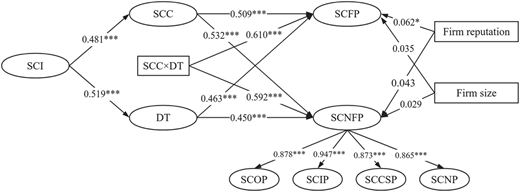
AMOS 24.0 was employed to test the direct effects. In the structural equation model, four first-order reflective latent variables (SCOP, SCIP, SCCSP, and SCMP), each comprising all measurement items, were modeled as formative indicators of the second-order latent construct SCNFP. We fixed the path weight from SCNFP → SCOP to 1 and allowed the other paths to be freely estimated to control for potential multicollinearity effects. Each first-order dimension was connected to SCNFP through a phantom latent variable with a fixed loading of 1 (Becker et al., 2012). Based on maximum likelihood estimation and bootstrapping tests, we obtained the path analysis results shown in Table 6 and Figure 2.
The fit coefficients of the model met the usual standards. All the paths we tested reached the p < 0.001 level of significance, and all the hypotheses were supported. Interestingly, we found that the impacts of SCC × DT on SCFP (β = 0.610) and SCNFP (β = 0.592) are stronger than those of SCC (β = 0.509; β = 0.532) and DT (β = 0.463; β = 0.450), which suggests that SCC and DT have a larger positive influence on SCP when jointly, rather than individually, considered.
We also found that firm reputation significantly affects SCFP (β = 0.062, p = 0.022), while it has no significant effect on SCNFP (β = 0.043, p = 0.144). Firm size has no significant effect on SCFP (β = 0.035, p = 0.296) and SCNFP (β = 0.029, p = 0.240).
We tested the mediating roles of SCC and DT by examining uncorrected and bias-corrected 95% confidence intervals obtained by bootstrapping (n = 5,000) (Preacher and Hayes, 2008). Drawing on Preacher and Hayes (2008), we evaluated the significance of the mediation effects based on whether the upper and lower bounds of the confidence intervals contained zero. Results confirmed that SCC and DT mediate the relationships between SCI and SCFP and between SCI and SCNFP (Table 7).
Finally, we also employed regression analysis with bootstrapping procedures to test the influence that the interaction between SCC and DT exerts on SCFP and SCNFP. The control variables, SCC, DT, and the interaction term SCC × DT were included in the analysis. Results reported in Table 8 indicate that the interaction term SCC × DT has a significant positive effect on SCFP (β = 0.278, p = 0.017, and the 95% confidence interval is [0.024, 0.244], which does not include 0). Analogously, results reported in Table 9 indicate that the interaction term SCC × DT has a significant positive effect on SCNFP (β = 0.259, p = 0.008, and the 95% confidence interval is [0.066, 0.436], which does not include 0).
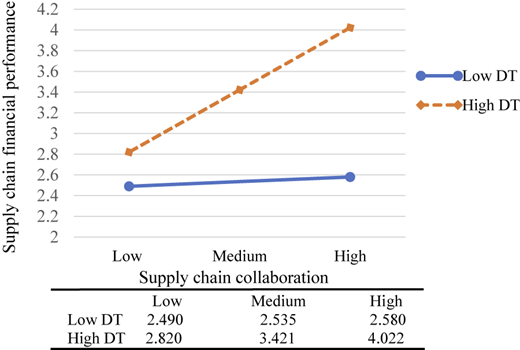
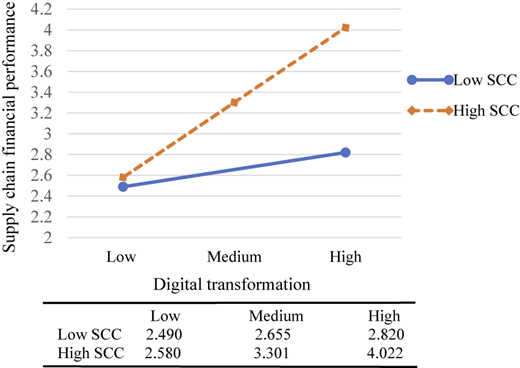
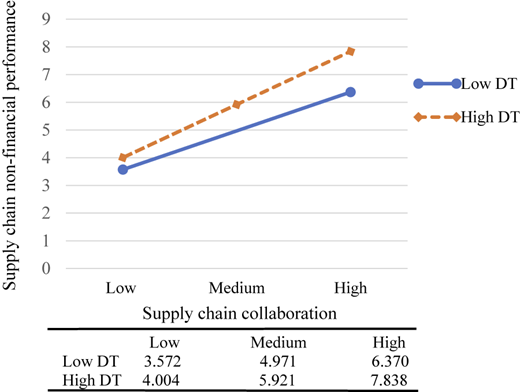
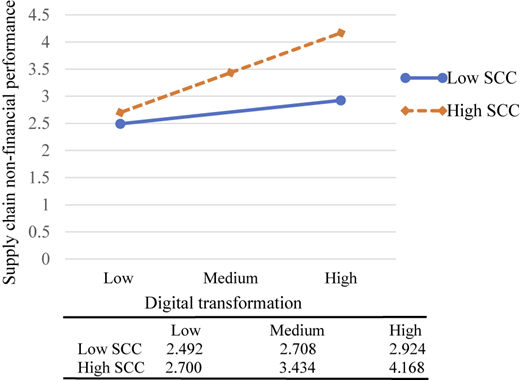
To illustrate the interaction between SCC and DT and its effects on the dependent variables, we conducted a simple slope test (Aiken and West, 1991), estimating the effect of SCC/DT for high (i.e. one standard deviation above the mean) and low (i.e. one standard deviation below the mean) levels of DT/SCC on both SCFP and SCNFP. Results are illustrated in Figures 3–6, confirming that SCC and DT positively moderate each other's positive influence on both SCFP and SCNFP. We therefore conclude that SCC and DT are complementary in their effects on SCFP and on SCNFP.
5.1 Robustness checks
We tested the robustness of our findings as follows. First, following Zhang et al. (2022), we added firm age as an additional control variable. Older firms may be prone to cognitive myopia, core rigidity, and organizational inertia, which reduce the effectiveness of SC management and the ensuing performance (Ardito et al., 2019). We measured firm age by the number of years since the firm had been established until 2022 (Claycomb and Frankwick, 2010). Results, reported in Appendix 2, supported our conclusions. Second, we tested for mediation using Hayes PROCESS model 4 and the Sobel test (Preacher and Hayes, 2008), and found that the results remained in line with those of our original analyses ( Appendix 3).
6. Discussion
The present study offers several key findings. First, we have found that SCI has a positive influence on SCC. While previous scholars such as Solaimani and van der Veen (2022) and Wong and Ngai (2019) have argued that SCI requires interorganizational collaboration across the SC, our research demonstrates that, when SC partners share an innovation intent, SCC is encouraged. This resonates with previous studies showing that innovation emerges from SC collaborative relationships based on social coordination mechanisms (e.g. trust, and reciprocity) that facilitate resource sharing, and characterized by the partners' availability to joint problem solving and mutual adjustment (Capaldo, 2014; Uzzi, 1997). Moreover, SCC can ensure effective interorganizational coordination and a fair distribution of responsibilities and investments, thus encouraging firms involved in SCI initiatives to collaborate.
Second, in line with Afraz et al. (2021), our research shows that SCI positively impacts DT. This finding echoes and extends the view of Oubrahim et al. (2022) and Lerman et al. (2022), highlighting DT as an innovative technological sub-system and a key enabler of SCI. Our study further elaborates that SCI practices stimulate investment in advanced technologies to facilitate digital technologies development. By leveraging digital tools such as artificial intelligence and big data analytics, firms can integrate innovation resources to execute innovation activities effectively through enhancing the seamless flow of information, improving SC visibility and collaboration efficiency, thereby accelerating digitalization (Lee et al., 2011; Yuan and Pan, 2023). Additionally, successful SCI requires digital technologies to establish information networks that capture and analyze data to address uncertainties arising from decision-making errors and technological barriers in innovation practices (Kwak et al., 2018; Guo et al., 2022), thereby significantly promoting DT.
Third, our research is in line with previous studies that have shown the positive influence of SCC on SCP (Cao et al., 2010; Mishra et al., 2022; Rehman Khan et al., 2022). Cao et al. (2010) posited that SCC is characterized by common goals and collaborative actions. By this way, our findings suggest, SCC facilitates SC practices such as production, logistics, inventory management, innovation, and customer service, thus enhancing both SCFP and SCNFP.
Fourth, we have shown that also DT positively affects SCFP and SCNFP. DT employs advanced technologies to change (inter)organizational processes in the SC, integrating data to optimize SC practices (Benitez et al., 2022). Existing research links DT to operational risk management (Zhou et al., 2023), SC visibility (Nasiri et al., 2020), data collection (Pang and Wang, 2023), the establishment of information networks (Berman, 2012), and collaborative innovation (Yu et al., 2024). Our study adds to this literature by looking at the influence of DT on SCP. We argue that DT reduces production uncertainty, optimizes production and SC layout, promotes innovation, and improves customer service, thereby enhancing the two dimensions of SCP.
Finally, the most original finding of the present study is that SCC and DT enhance each other's influence on SCFP and SCNFP. On the one hand, as argued by Rocha et al. (2021) and Yu et al. (2024), SCC gains momentum in a digital environment. Without the support of digital technologies, SCC may over time face the liabilities of excessively strong ties, and experiment low information exchange efficiency and poor information processing (Capaldo, 2007; Inemek and Matthyssens, 2013) Conversely, DT enhances data analysis and utilization, ensuring end-to-end transparent information sharing across the SC. This allows SC members to continuously learn from data, thus improving their collaborative routines; enhances SC visibility through visibility platforms, thereby increasing the flexibility of information exchange in SC relationships; and improves the effectiveness of information processing, so reducing the need to develop common languages and understanding among SC partners. These positive outcomes strengthen SCC and its impact on SCP.
On the other hand, our research also aligns with Nasiri et al. (2020) and Liu et al. (2016), suggesting that collaborative SC relationships unlock and enhance the value creation potential of digitalization. Indeed, SCC provides technical resource support that arm's length SC ties are not able to offer (Rocha et al., 2021; Yang et al., 2021, 2024), stimulates SC members to jointly plan and coordinate digital actions (Yang et al., 2023), and facilitates the flow and utilization of critical information (Yuan and Pan, 2023; Zhao et al., 2023). All this enhances the effectiveness of DT, improving its positive impact on SCP.
6.1 Theoretical contribution
Two aspects of the theoretical contribution of our research are especially worth addressing. First, the present study was aimed at opening the black box of how an innovation-oriented strategic intent shared across the SC affects SCP. To address this issue, we have employed a theoretical framework based on the integration of ROT and STST. ROT purports that translating a strategy into superior outcomes requires the integration of intangible and tangible resources, but it fails to identify which resource combinations are critical for successful strategy implementation. We have filled this gap by resorting to STST, according to which (inter)organizational systems are composed of a social and a technical component, which need to be integrated. This framework represents the main theoretical contribution of the study. Future organizational scholars might adopt it to examine research questions similar to that tackled in the present study, and in particular to shed light on the (inter)organizational processes by which strategic orientations other than SCI affect performance outcomes.
Applying the above theoretical framework at the SC level, we have found that SCI positively affects SCP through the mediating effects of SCC and DT, that we have adopted as critical aspects of, respectively, the social and technical subsystems of the SC system. In particular, we have shown that, in accordance with the STST theory, SCC and DT have a joint positive effect on SCP, that we have found to be stronger than the main effects of the two mediating variables individually considered, or in other words, they exert a complementary effect on SCP. This is another major theoretical contribution of our study, that enriches extant research on the relationships between interorganizational collaboration and the adoption of information technologies in the SC.
Such research has typically focused on the impact of IT on collaboration or vice-versa, without considering their simultaneous influence on one another, paying also scant attention to their impact on performance outcomes. Among the other issues, scholars have examined the role of IT in coordinating interorganizational relationships (Im and Rai, 2014), how collaboration with physically distant partners is supported by IT-enabled interfirm knowledge capabilities (Cui et al., 2020), and how IT-enabled SC information integration supports interorganizational collaboration with suppliers (Khuntia et al., 2021). Other scholars have focused specifically on digital technologies, showing the positive effect of a blockchain-enabled system on SC coordination in off-site construction (Kim et al., 2023), of AI-empowered process mining (Bodendorf et al., 2023) and blockchain technologies (Khan et al., 2022) on SC integration, and of digital technology application on SC collaboration (Yuan and Pan, 2023). Further studies have shown that interorganizational collaboration with customers and suppliers improves technology implementation (Liu et al., 2020) and that interorganizational learning promotes the development of AI (Xue et al., 2021). To this literature, the present paper adds not only that SCC and DT exert a positive effect on one another, but also that they enhance each other's effect on SCP.
6.2 Managerial implications
Our research has major implications for practicing managers. First, it indicates that SCI is a crucial driving force behind SCP. Therefore, in order to increase SCP, SC firms should adopt creative methods for SC management and require that their partners contribute ideas for continuous process and technology improvement. Moreover, they should pursue advanced information systems and real-time tracking technologies to integrate information across the SC. SC firms are also called to adopt innovative vehicles and packaging that can enhance logistics flexibility and efficiency, and to continuously bring innovations in core SC areas. Finally, SC managers should design agile SC processes to adapt to changes and stimulate their SC partners to implement SC innovations consistently.
However, SC managers should recognize that implementing SCI is fraught with uncertainty. To overcome the resulting challenges and achieve their performance goals, SC firms should invest in SCC and DT. We recommend that SC managers acknowledge potential conflicts arising from the implementation of innovation in the SC and encourage SC members to foster mutually beneficial collaborative relationships, to share ideas, information about new technologies, and equipment, to agree on joint KPIs and business processes, to hold regular meetings to review their joint work, and to actively seek opportunities for collaboration on further innovative projects.
Furthermore, SC firms should resort to digital technologies to update their business models, collect data from various sources, exchange information with their SC partners, and establish efficient customer interaction interfaces. In order to facilitate the implementation of innovations across the SC, senior managers should actively drive DT, designing a digital strategy including a clear roadmap, investment plan, and timeline, while providing the necessary resources and support. A digital information technology infrastructure should be implemented, both within the firm and across the SC, and undergo continuous experimentation.
Finally, a crucial message that arises from the present paper is that SCC and DT are complementary in their impact on SCP. On the one hand, SC firms should leverage digital technologies such as the IoT, mobile applications, and website analytics to sustain their information collection and processing capabilities, so enhancing the efficiency and effectiveness of their collaborative actions. On the other hand, we urge SC managers to develop truly collaborative relationships with their SC partners by signing long-term contracts with them, making relationship-specific investments, fostering trust and reciprocity in the relationships, and engaging in joint innovation projects. These efforts will sustain the efficacy of their companies' DT initiatives by bolstering implementation and reducing impediments to information sharing across the SC.
6.3 Limitations and future research
The conventional cross-sectional, single-respondent research design adopted in this study has its own limitations. Since the implementation of innovations in the SC takes time, the cross-sectional nature of the study does not allow us to draw final conclusions about the direction of causality of the relationships among the examined variables. Future research might shed light on this important issue by using longitudinal data. Future scholars might also collect data from respondents belonging to multiple SC members, so as to better gauge the SC-level variables considered in this study. Furthermore, this study employs a sufficiency logic to examine how DT and SCC complementarily affect SC performance, but does not consider their role as necessary conditions. We recommend that future research applies necessary condition analysis (NCA) to identify the minimum thresholds for the effectiveness of DT and SCC, so as to further clarify the underlying mechanisms facilitating performance improvement. Finally, while we employed data form the Chinese manufacturing industry, firm behaviors concerning the implementation of innovation and DT, as well interorganizational collaboration, are significantly different across different countries and cultures. This limits the generalizability of our conclusions. We recommend that future research employs samples from different world regions or cross-country samples to analyze similarities and differences with the findings of our study.
Ethical approval
This article does not contain any studies with human participants or animals performed by any of the authors.
The authors contributed equally to the paper.