This study aims to apply a system dynamics approach to examine and model the interrelated factors affecting whole lifecost estimation for residential buildings within the New Zealand construction context. Accurately estimating the whole life cost (WLC) of residential buildings is critical to achieving long-term economic and environmental sustainability. However, existing WLC frameworks often overlook the dynamic interdependencies among influencing factors, particularly within New Zealand’s unique construction context, characterised by seismic activity, climate variability and supply chain constraints.
This study applies a system dynamics approach to model and analyse these complex relationships, integrating insights from a systematic literature review and 22 semi-structured interviews with industry professionals. The analytic hierarchy process was used to prioritise and weight 80 identified factors based on their relative influence, with consistency of expert judgements confirmed through the consistency ratio. These normalised weights were then combined with directional relationship mapping to construct a linkage matrix that informed the development of causal loop diagrams and stock-and-flow models.
The research highlights key feedback loops and time delays that affect lifecycle cost elements, including construction, operation and maintenance. Findings reveal significant gaps in current international frameworks such as ICMS, particularly their inability to accommodate regional risks and behavioural influences.
The study proposes a context-specific enhancement to WLC methodologies, enabling more accurate and resilient cost estimation. This tailored framework supports informed decision-making by stakeholders and advances sustainable residential construction practices in New Zealand. However, the qualitative nature of the research limits the generalisability of findings beyond New Zealand’s residential construction sector.
This research presents a novel, comprehensive modelling approach that incorporates regional and behavioural factors specific to New Zealand’s residential construction sector, offering enhanced accuracy and practical value beyond existing international standards.
1. Introduction
Whole life cost (WLC) estimation plays a vital role in the planning, execution and maintenance of residential buildings, serving as a cornerstone for achieving long-term sustainability and economic viability in construction projects (Wong, 2010). Practical WLC estimation facilitates effective budget management and supports informed decision-making across a building's lifecycle (Liu and Luo, 2023). Globally, the construction industry is under increasing pressure to provide affordable and sustainable housing solutions amid rapid urbanisation, climate change and resource scarcity. As such, lifecycle cost evaluation has become essential for project-level financial planning and supporting broader policy goals related to resilience, decarbonization and inclusive urban development.
Aligned with the United Nations Sustainable Development Goal 11 (SDG 11) – Sustainable Cities and Communities, which aims to “make cities and human settlements inclusive, safe, resilient, and sustainable,” WLC estimation contributes directly to improving housing affordability, enhancing infrastructure resilience, and promoting sustainable construction practices. Accurate and adaptive cost planning is critical in ensuring that urban development not only meets immediate needs but also remains financially and environmentally viable over the long term (UN, 2015).
Despite growing interest in lifecycle-based approaches, existing WLC frameworks such as the International Construction Measurement Standards (ICMS) are often static and insufficiently adaptable to complex, real-world conditions (Zhao et al., 2019). They rarely reflect the interdependent and time-sensitive nature of decisions made throughout a building’s lifecycle. Furthermore, they assume broad applicability across geographic regions, despite varying construction contexts, risk profiles and socio-environmental constraints. These limitations are particularly evident in the New Zealand residential construction sector, where contextual challenges such as seismic activity, climate variability, supply chain volatility and evolving regulatory environments complicate traditional cost estimation practices (MacGregor et al., 2018), Accurate lifecycle costing in this setting requires a context-aware, systems-based approach capable of modelling how dynamic interactions and feedback loops influence long-term cost outcomes. However, a significant research gap remains, as no prior studies have examined WLC in New Zealand through a comprehensive systems thinking lens that integrates regional risks, behavioural insights and decision interdependencies.
To address this gap, the current study applies a System Dynamics (SD) approach (Sterman, 2001) to investigate the complex interrelationships among factors influencing WLC estimation for residential buildings in New Zealand. A total of 80 influencing factors were identified through a systematic literature review (SLR) and semi-structured interviews (SSIs) with local industry professionals. Building on the foundational review by Samarasekara et al. (2024), the study introduces additional context-specific factors and prioritises them using the analytic hierarchy process (AHP), ensuring a structured and reproducible framework (Boussabaine and Kirkham, 2008).
In doing so, this research makes three core contributions. Firstly, it provides a structured, evidence-based model that maps the reinforcing and balancing feedback loops critical to accurate WLC forecasting in a dynamic environment. Secondly, it advances methodological rigour by combining qualitative and quantitative techniques (SD and AHP). Thirdly, and importantly, about the journal’s themes, this study situates WLC estimation within the broader discourse on urbanisation, sustainability and society, by highlighting how cost planning influences housing affordability, environmental resilience and long-term infrastructure performance. In a rapidly urbanising New Zealand, where housing delivery intersects with seismic risk and sustainability commitments, improving the accuracy and contextual relevance of WLC estimation is timely and essential.
2. Literature review
2.1 Overview of whole life cost estimation
WLC is a technique used to assess and determine all direct and indirect costs associated with the design, construction, facility management, operation, maintenance, support, replacement and disposal of a building throughout its entire service life (El‐Haram, Marenjak, & Horner, 2002). WLC provides a comprehensive approach to evaluating the total cost of ownership over a building's lifecycle, considering not only the initial construction costs but also operational, maintenance and end-of-life costs (Ashworth and Perera, 2015). This method enables stakeholders to make more informed decisions that balance upfront expenditures with long-term economic sustainability, offering a broader financial perspective for better decision-making in the construction industry. WLC's significance lies in its ability to reflect the total financial commitment over a building’s lifespan, helping to identify cost-saving opportunities and enhance long-term value. (Kishk et al., 2003).
Despite the growing recognition of its value in promoting sustainability and cost-efficiency, accurate WLC estimation remains challenging due to the complex interdependencies among the factors that influence costs. Traditional models often overlook interactions among project decisions, stakeholder roles and other dynamic factors, leading to inaccurate predictions of the actual cost of ownership.
New Zealand further amplifies these challenges by raising sustainability expectations, increasing seismic risks, introducing volatile supply chains, and imposing stringent environmental regulations. These factors directly impact construction practices and cost structures, particularly in urban areas where population growth and housing demand pressure affordability and infrastructure resilience. As urbanisation intensifies, accurately estimating lifecycle costs becomes essential for resource optimisation and addressing broader societal outcomes, such as equitable housing access, public health, and environmental impact. WLC, therefore, serves as a critical tool for supporting sustainable urban development and informed policy-making aligned with long-term societal well-being.
2.2 System dynamics in construction projects
SD is an effective tool for modelling complex systems with interconnected variables, feedback loops, and time-dependent behaviours. Its use in construction projects enhances understanding of interactions between project factors, aiding decision-making (Bala et al., 2017). SD provides a framework for grasping these complexities, particularly concerning whole life costing (WLC) (Azar, 2012). Research demonstrates that SD improves estimation accuracy; for example, Yi et al. (2023) applied SD for life cycle cost (LCC) assessments in environmental scenarios, while Liu and Luo (2023) used it for cost estimation in prefabricated construction. Lou and Guo (2020) further leveraged SD techniques to analyse cost-influencing factors in prefabricated buildings. Additionally, Dabirian et al. (2023) used SD to manage cash flow in construction. SD's ability to track changes and incorporate feedback mechanisms (Li and Fan, 2022) allows for effective predictions (Zhang et al., 2017). Despite its potential, the use of SD for WLC in specific contexts like New Zealand’s seismic and climate challenges remains limited.
2.3 Feedback loops and time delays in whole life cost estimation
Feedback loops are crucial for understanding cost-related dynamics. Positive feedback (reinforcing loops) can enhance benefits, such as improved design quality and lower maintenance costs (Wynn and Maier, 2022). Negative feedback (balancing loops) regulates behaviours, exemplified by trade-offs between construction speed and quality (Wynn and Maier, 2022). Time delays complicate WLC predictions; for instance, design decisions might only affect costs years later, especially regarding energy consumption and material durability (Keoleian and Menerey, 1994). Recognising these delays is essential in New Zealand, where seismic activity influences long-term building performance.
2.4 Frameworks and methodologies
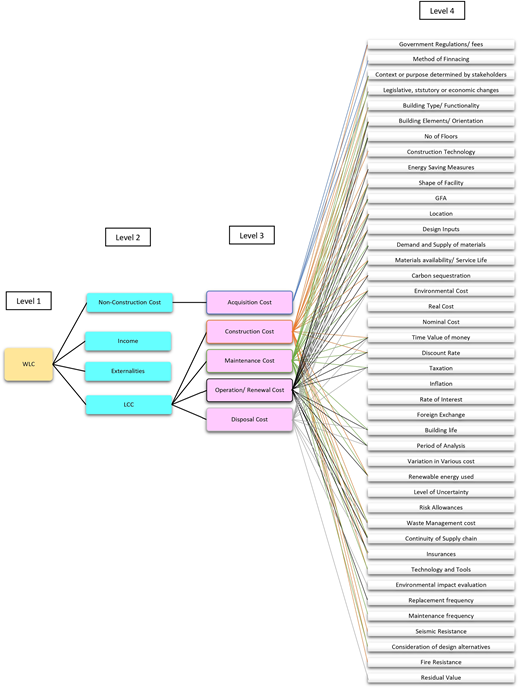
Current WLC frameworks categorise costs into construction, operation, maintenance and disposal, but often fail to address regional complexities (Samarasekara et al., 2024). The International Construction Measurement Standards (ICMS) framework, although widely recognised, has limitations when applied to specific local contexts. Its classification into non-construction costs, LCCs, income and externalities offers a standard structure (ICMS, 2021). However, it lacks adaptability to diverse regional realities. The ICMS’s treatment of LCC categories overlooks critical factors, such as seismic risks and extreme weather, which significantly impact construction costs in sensitive areas like New Zealand. Samarasekara et al. (2024) emphasise that these omissions restrict the framework’s accuracy and utility in specific contexts. Integrating SD with ICMS may help overcome these limitations, offering a more nuanced approach to cost assessment.
2.5 Advancing whole life cost estimation with system dynamics
Recent literature underscores the importance of adaptive models to capture the complexity of WLC. SD is increasingly recognised for its ability to model cost interdependencies, particularly in dynamic environments. For instance, Leon et al. (2018) found SD effective in revealing long-term impacts of design and material choices in modular buildings. Such adaptive modelling is especially relevant in New Zealand, where construction practices must address unique geographic, climatic and regulatory conditions. Integrating SD with WLC allows for a responsive framework that reflects local risks, stakeholder input and evolving policy. This study aims to develop a New Zealand-specific WLC estimation model by synthesising existing literature and applying SD principles. The proposed framework considers local materials, energy standards and sustainability goals to improve estimation accuracy and support long-term planning.
3. Methodology
3.1 Research design
This study adopts a qualitative research design to investigate the complex and interdependent factors influencing whole life cost (WLC) estimation in the New Zealand residential construction context. A combination of SLR, SSI, the AHP and SD modelling was used to identify, prioritise and model these factors.
The methodology follows a three-stage structure:
Factor identification: An SLR was conducted to collect globally reported factors influencing WLC estimation. SSI supplemented this with New Zealand-based construction professionals to capture context-specific insights.
Factor prioritisation using AHP: The combined set of 80 factors (51 from SLR and 29 from SSI) was evaluated using the AHP. AHP was selected for its ability to handle multi-criteria decision problems, enabling structured pairwise comparison of factors to determine their relative importance. This process helped streamline the number of variables for modelling and reduced bias in selecting influential factors.
SD modelling: The prioritised factors were used to construct causal loop diagrams (CLDs), mapping out key feedback mechanisms and interrelationships among cost drivers. This SD approach facilitated understanding of how changes in one factor may influence others over time, especially within dynamic and uncertain project environments.
3.2 Data collection
3.2.1 Systematic literature review.
The SLR was conducted to identify factors influencing WLC estimation for New Zealand residential buildings, with a focus on both primary and secondary data sources. The primary data included scholarly, peer-reviewed research such as academic books, journals and conference papers, accessed via databases like Scopus, ScienceDirect, Emerald Insight, SpringerLink and Google Scholar. Secondary data included industry reports, standards and guidelines published by organisations such as RICS, AIQS, ICMS and NZIQS, which provided insights into industry practices and benchmarks.
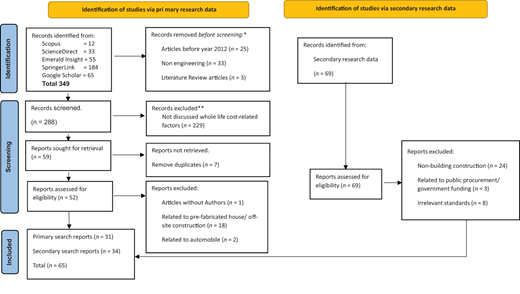
Table 1 presents the search strategy, inclusion and exclusion criteria, and results from each database. This process adhered to PRISMA guidelines, ensuring a systematic and transparent approach to data collection (Figure 1). The insights derived from the SLR established the theoretical and practical dimensions required to inform the SD model. While the SLR generally excluded review articles to prioritise primary studies, Samarasekara et al. (2024), a recent and comprehensive SLR, was included as a key reference due to its thorough synthesis of factors influencing whole life cost estimation. Our study is not an extension of this work but builds upon it by integrating new empirical data collected through SSI with industry experts. These interviews elicited additional factors and enriched the understanding of contextual and practical considerations specific to New Zealand’s residential construction sector. Table 2 distinguishes between factors identified through the SLR, including those from Samarasekara et al. (2024), and novel factors derived from the SSI, thus providing a transparent overview of the factor origins. Furthermore, the decision to limit the literature search to studies published from 2012 onwards was informed by significant regulatory and contextual shifts in New Zealand’s construction environment. Following the Canterbury earthquakes of 2010, the government introduced major reforms to the Building Code and seismic design standards through the 2012 Building Act amendments (MBIE, 2012), which reshaped building practices and lifecycle costing frameworks. Literature prior to 2012 does not adequately reflect these changes or the subsequent adoption of technologies such as BIM and prefabrication. Therefore, setting 2012 as the lower bound ensures the inclusion of research that is both methodologically current and contextually relevant to today’s construction practices in New Zealand.
3.2.2 Semi-structured interviews.
SSIs were conducted with a purposively selected group of 22 participants, comprising both industry professionals (including quantity surveyors, project managers, architects, engineers, facility managers and policymakers) and homeowners who had actively commissioned and managed their residential building projects. Participants were identified through professional networks, referrals from industry contacts and publicly available directories such as LinkedIn and industry association membership lists (e.g. NZIQS and NZIA). This recruitment strategy ensured access to experienced professionals with relevant expertise in residential construction and whole life cost estimation.
Once potential participants were identified, they were contacted via email or LinkedIn messaging with an invitation outlining the study’s purpose, ethical considerations, and interview process. All participants provided informed consent via a formal consent form before the interviews. Interviews were conducted via Microsoft Teams, recorded with permission and transcribed for analysis. SSI were conducted in four parts:
general experience with WLC in residential projects;
identification of key influencing factors;
exploration of interdependencies among factors; and
prioritisation of critical factors.
These interviews informed the identification of additional context-specific factors, validated factor categorisation for the AHP and clarified the nature of relationships used in SD modelling. The interview guide, designed to ensure consistency and comprehensiveness, is provided in supplemental materials (see supplemental materials: Interview Questions).
This selection process ensured a comprehensive range of perspectives on the factors influencing WLC estimation in New Zealand.
3.3 Data analysis
3.3.1 Analytic hierarchy process.
The AHP is a structured technique for organising and analysing complex decisions, based on mathematics and psychology (Milkova et al., 2019). In this study, AHP was applied to prioritise WLC-influencing factors identified through the SLR and SSI, establishing their relative importance for the New Zealand context (Samarasekara et al., 2024). The AHP framework was structured hierarchically, with accurate WLC estimation at the top level, followed by relevant criteria and sub-criteria, and specific factors at the lowest level (de FSM Russo & Camanho, 2015). Figure 2 shows the modified levels of factors using the ICMS framework. This structure allowed for systematic pairwise comparison of factors, using a standard 1–9 scale to capture subjective judgements (Kou et al., 2016).
1: Equal importance
3: Moderate importance
5: Strong importance
7: Very strong importance
9: Absolute importance
To justify the scores applied in the pairwise comparison matrix (supplemental materials), a frequency-based scoring method was adopted for both the SLR and the SSI.
For the SLR (51 factors from 65 sources), importance scores were derived from the frequency with which each factor appeared across the reviewed studies. The scoring thresholds and illustrative examples are summarised in Table 3.
For the SSI (29 factors from 22 participants), factor importance was based on the number of interviewees who identified or discussed each factor. The scoring rationale is summarised in Table 2.
Where a factor was identified in both SLR and SSI, the higher of the two scores was retained in the matrix to ensure that either academic consensus or practical relevance could independently validate the importance level. A pairwise comparison matrix was created to assess the relative influence of each factor. The matrix was then normalised by dividing each cell by the total of its respective column, enabling accurate computation of relative weights (Talukder et al., 2017). The row averages of the normalised matrix were calculated to determine the weights for each factor (Collins et al., 2023).
The normalisation process involves two key steps. First, column-wise normalisation was performed by dividing each element in column j by the sum of all elements in that column, transforming the matrix so that each column sums to 1:
This step results in a normalised matrix in which each column sums to unity. Second, to obtain the final normalised weight vector, the average of each row was calculated across the normalised matrix:
This gives a single scalar value per row, representing the relative priority or weight of each factor. The reason the final output is expressed as a single-column vector is because the primary goal of AHP is to rank the criteria by their relative importance. This single column is not derived from any particular column of the original matrix but rather from the row-wise averages of the column-normalised matrix, thus capturing the overall priorities effectively.
Then, a consistency ratio (CR) was computed to ensure consistency in judgment. A CR value below 0.1 was considered acceptable; otherwise, the matrix was revised to improve logical coherence (Karapetrovic and Rosenbloom, 1999).
After confirming consistency, relationships among factors were further analysed. Positive relationships were marked by proportional effects (i.e. an increase in one factor caused an increase in another), while negative relationships indicated inverse effects. In the final matrix, positive relationships were multiplied by +1, and negative relationships by −1, to reflect their directional influence on WLC estimation (Zhang et al., 2021). Due to the novelty of SD modelling within the local construction sector, polarities between factors were assumed based on logical reasoning and cross-referenced literature, as industry participants lacked familiarity with SD concepts. Finally, these weighted and directional relationships were mapped to establish an interconnected framework, revealing how individual factors influence each other within the WLC estimation system. This approach facilitated a more nuanced and dynamic understanding of factor behaviour, moving beyond static weightings to identify reinforcing and balancing effects across the system (Rush and Roy, 2023).
3.3.2 Thematic analysis and integration with system dynamics.
The data gathered from the SSIs were analysed using thematic analysis following (Braun and Clarke, 2006), This process involved familiarising with the data, coding relevant responses based on research questions and grouping them into broader themes. These themes were then interpreted to identify the most significant factors influencing WLC estimation in New Zealand. The thematic analysis helped identify critical insights regarding the interrelationships between factors and challenges in current WLC estimation practices. Thematic analysis was conducted using NVivo software to code, organise and analyse qualitative data from the SSIs. This allowed for systematic identification of recurring themes, relationships and contextual insights relevant to WLC estimation.
The insights from the interviews were used to enhance the understanding of the interrelationships between the identified WLC factors, which were mapped using SD modelling. This modelling approach was employed to visualise feedback loops and dependencies, which will inform the development of a more accurate, contextually relevant WLC framework for New Zealand. The model incorporated local factors, such as seismic risks and climate conditions, not captured in existing frameworks.
3.4 Ethical considerations
The study was conducted in accordance with the Auckland University of Technology Human Ethics Guidelines and was approved by the AUT Ethics Committee (24/206).
3.5 Limitations of the methodology
This study's methodology is subject to some limitations. While using a purposive sample ensures relevant expertise, the findings may not fully represent the diversity of experiences across New Zealand’s residential construction sector. Furthermore, the qualitative nature of the research means that the findings may not be generalisable to other contexts. However, the in-depth insights from the interviews and the integration of the SLR provide a robust basis for refining WLC estimation frameworks specific to New Zealand.
4. Results and discussion
This section presents the findings from the SLR, SSI, AHP and SD modelling to address the research objectives, particularly establishing the SD of elements affecting the accuracy of WLC estimation for residential buildings in New Zealand. The results highlight key factors, their interactions, critical feedback loops and prioritised factors, culminating in practical implications for stakeholders. The discussion integrates these findings to enhance WLC estimation accuracy, accounting for New Zealand’s seismic and climatic challenges.
4.1 Key factors influencing whole life cost
The SLR, covering 65 sources from 2012 to 2024, identified 51 factors influencing WLC, as detailed in Samarasekara et al. (2024) These factors span the construction, operation, maintenance and disposal phases, with emphasis on sustainability, seismic resilience, energy use and operational costs. Table 4 consolidates these factors.
The SSI, involving 22 participants as detailed in Table 5, identified 29 additional factors summarised in Table 6. Key factors included building automation, renewable energy systems and regional variations. These factors are particularly relevant to New Zealand’s unique context, where seismic risks and adverse weather conditions significantly affect the accuracy of WLC estimation. For example, participants stressed the need to use corrosion-resistant materials in coastal zones and implement seismic bracing in regions near fault lines, which aligns with the post-earthquake reforms outlined by MBIE (2012).
SSIs with 22 construction professionals in New Zealand revealed a range of practical, context-specific factors that influence the accuracy of whole life cost estimation in residential buildings. As detailed in Table 2, these factors extend beyond those commonly discussed in the literature, highlighting unique operational and environmental conditions in the New Zealand context. Among the most frequently cited were material durability, construction quality, installation practices, technology depreciation and regional or geographical conditions. These elements reflect professionals' experiences working across various roles and contribute to more accurate cost projections over a building’s lifespan. Table 6 also identifies occupancy behaviours, Green Star ratings and building orientation as significant influences on long-term performance and operational costs. These factors are often overlooked in standard cost frameworks but were highlighted by practitioners as key drivers that shape building efficiency and user experience over time. Their inclusion underscores the importance of behavioural and environmental variables in developing reliable cost estimations.
Several interviewees also emphasised localised risk factors such as seismic resilience, insurance requirements and the influence of regional hazards on material selection and structural systems. These risks were discussed in greater detail than typically found in the literature, pointing to their relevance in initial decision-making and long-term cost planning. Furthermore, insights in Table 6 reveal that supply chain resilience, availability of skilled labour and the effectiveness of on-site communication play a crucial role in determining project outcomes and associated costs. Rather than isolated technical inputs, these are dynamic and interconnected processes that influence project efficiency, rework frequency and delivery timelines. For example, poor coordination between teams or delays due to labour shortages were cited as causes of unforeseen expenditures and budget overruns. The responses summarised in Table 6 demonstrate that WLC estimation in New Zealand’s residential sector is shaped by an integrated set of behavioural, environmental, technical and managerial factors. These findings suggest that accurate WLC modelling must consider component-based costs and the broader interaction system that evolves throughout the building lifecycle.
Together, 51 SLR factors are shown in Samarasekara et al. (2024) and SSI findings produced a consolidated list of 80 factors, later refined through AHP and SD modelling to highlight only those with significant interdependencies.
4.2 Integration of pairwise comparisons into system dynamics modelling
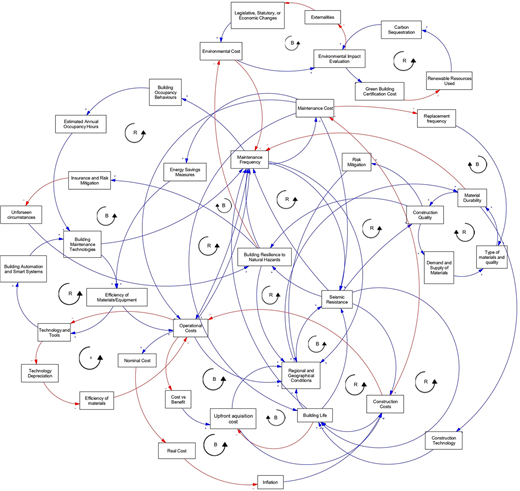
The relationships among the 80 identified factors were mapped using SD modelling to construct the CLD (Figure 3, supplemental materials), which revealed 11 reinforcing (R1–R11) and 12 balancing (B1–B12) feedback loops driving WLC dynamics. Key themes emerging from the updated codebook include cost factor feedback, environmental influences, geographic variations, estimation challenges, factor interactions and systemic interdependencies, as summarised in Table 7.
To quantify the strength of interrelationships, AHP pairwise comparisons were conducted (supplemental materials: Pairwise Comparison Matrix). For each factor, the geometric mean of comparison values was calculated and normalised (supplemental materials: Normalised Weights), resulting in a priority vector with weights summing to one. The consistency of expert judgments was validated using the Consistency Index (CI) and CR, based on the principal eigenvalue (λmax) derived from the weighted sum vector. The resulting CR was effectively zero, indicating excellent consistency in the comparisons.
The directional influence of each factor was determined by integrating the normalised weights with relationship polarity identified through interview data and literature (supplemental materials: Relationship Polarity Table). Positive relationships retained their normalised weights, reflecting direct influence (e.g. increased investment in renewable energy leading to reduced operational costs). In contrast, negative relationships were adjusted to reflect inverse influence (e.g. higher upfront costs leading to long-term savings). This integration of strength and polarity was then used to construct the directional linkage matrix (supplemental materials: Linkage Weight Matrix), enabling the causal structure to reflect real-world feedback behaviour within WLC estimation accurately.
The CLD’s reinforcing loops, such as the link between regional seismic risks, investment in seismic design and increased building life (R1), and energy-saving measures reducing long-term costs (R3), highlight how certain factors amplify WLC dynamics. Conversely, balancing loops such as trade-offs between construction quality, cost, and long-term maintenance stabilise the system and reveal key cost tensions (e.g. B1, Cost Factor Feedback). These interdependencies reflect New Zealand’s seismic and climatic challenges (MBIE, 2012) and emphasise the need for adaptive, long-term planning.
By combining structured weighting, directional mapping and qualitative insights, this approach offers a context-sensitive alternative to static cost frameworks. It supports the development of a responsive WLC estimation model tailored to the complexity and uncertainty of residential construction in New Zealand.
Recognising the reinforcing and balancing loops identified in the CLD (Figure 3) makes it essential to capture the ripple effects of decisions across a building’s lifecycle. For example, the reinforcing loop between innovation and cost efficiency can encourage further technology adoption, strengthening supply chain resilience. As shown in the CLD (supplemental materials) and summarised in Table 7, mapping these relationships supports a strategic, systems-based approach to sustainable construction.
4.3 Identification and impact of factors within system feedback loops
From the 80 factors identified through a comprehensive SLR and stakeholder interviews, the final selection of 37 factors was made based on their involvement in the dynamic causal feedback loops modelled using SD. This refinement process ensures that only factors that substantially influence WLC estimation in New Zealand’s residential construction context are included.
The initial evaluation involved a detailed pairwise scoring and comparison of all 80 factors (see supplemental materials: The Pairwise Score Table), followed by normalisation of the scores to determine relative importance (see supplemental materials: The Normalisation Table). Subsequently, pairwise relationships among factors were analysed to understand their interactions (supplemental materials: The Pairwise Relationships). This process identified factors that actively reinforce and balance the system's feedback loops. The CLD (supplemental materials: The CLD) visualises these interactions, showing how 37 factors consistently interact within the system to drive lifecycle cost behaviour. These factors include critical elements such as seismic resistance, material durability, construction quality, energy efficiency and occupant behaviour, which emerged repeatedly from stakeholder interviews and literature.
Table 8 presents these 37 impactful factors, selected for their embeddedness within the system’s behaviour rather than their isolated effects. Their influence spans multiple lifecycle stages, including design, construction, operation, maintenance and disposal. It captures key New Zealand-specific drivers, including seismic risk, local climate conditions, technology adoption and construction practices. Supplemental materials: The Linkage Table details the further refinement and linkage of these factors, mapping the systemic pathways through which these variables affect WLC. This approach ensures the model’s clarity and practical relevance, avoiding unnecessary complexity while maintaining a robust representation of real-world cost dynamics.
By grounding the WLC estimation model in these 37 interconnected, context-specific factors, the research bridges theoretical cost frameworks with practical construction realities in New Zealand. This selection supports improved accuracy, stakeholder engagement and policy direction to enhance lifecycle cost predictability and performance in residential buildings.
4.4 Practical implications for policymakers and stakeholders
The findings of this study have important implications for policymakers and stakeholders. Developing localised WLC frameworks that incorporate seismic and weather-specific considerations is essential for policymakers. Offering subsidies or tax benefits for projects that integrate energy-efficient and sustainable systems could incentivise the broader adoption of these practices. Additionally, promoting training initiatives to enhance stakeholder knowledge of WLC principles would support the implementation of more robust frameworks.
For stakeholders, fostering early-stage collaboration among architects, engineers and clients can help align expectations and optimise designs, improving cost efficiency. Integrating renewable energy systems and innovative technologies is also crucial for reducing operational costs. Prioritising investments in seismic-resistant designs can mitigate lifecycle repair costs, ensuring long-term value and safety.
Adopting improved WLC frameworks at an industry-wide level could lead to enhanced sustainability practices, better resource allocation and more resilient building systems tailored to New Zealand’s unique challenges. By addressing the interplay of factors identified in this study, stakeholders can make more informed decisions, ultimately contributing to the economic and environmental sustainability of residential construction projects.
5. Conclusion
This study employed a SD approach to investigate the complex and interconnected factors that influence the accuracy of WLC estimation for residential buildings in New Zealand. By integrating findings from a SLR, SSIs with industry professionals and a structured factor prioritisation process, the research identified 80 factors that affect cost estimation across the building lifecycle. From this comprehensive list, 37 factors were ultimately identified as the most impactful, as shown in Table 8. These factors were selected based on their relevance to recurring themes raised by practitioners, their strong presence in practical construction settings and their active roles in influencing other elements within the system. The selection focused on those factors that influenced lifecycle decisions and outcomes, particularly where interrelationships and feedback loops were evident. This refinement process ensured that the final SD model focused on factors with meaningful influence, avoiding dilution of insights from less consequential variables.
The study revealed that conventional WLC frameworks often fail to capture the dynamic, context-specific conditions of residential construction in New Zealand. They do not adequately reflect local risks such as seismic activity, coastal exposure, regional material availability and changing regulatory environments. This study demonstrated how key factors interact over time through CLDs, reinforcing or balancing cost impacts throughout a building’s lifecycle. For example, investment in resilient design can reduce maintenance frequency and operational disruptions, while behavioural choices and technology use can significantly influence long-term cost trajectories.
To enhance the model's analytical depth, AHP pairwise comparisons were used to derive a structured weighting for all 80 factors. Geometric means were calculated and normalised to produce a priority vector, and the CR was assessed to ensure the reliability of expert judgments. The resulting CR value, which was effectively zero, confirmed the internal consistency of the pairwise matrix. These weights were then integrated with directional polarity information derived from interview themes and the literature to construct a quantitatively robust linkage matrix that directly informed the CLD.
The findings have significant implications for both policymakers and stakeholders in the construction industry. For policymakers, there is a need to support the development of locally adapted Whole Life Cost frameworks that reflect New Zealand’s unique environmental and regulatory context. Incentives, such as subsidies or tax benefits, for sustainable and resilient design choices can improve lifecycle performance. Education and training initiatives could also help increase industry-wide awareness and capability in lifecycle planning and cost estimation. For industry professionals, the study highlights the value of early collaboration across disciplines, integrating cost, design and performance considerations from the outset. Innovative systems, durable materials and efficient maintenance technologies were among the most frequently cited strategies for improving lifecycle outcomes. Additionally, addressing regional risks and user behaviours from the early design stage emerged as a critical consideration for achieving more accurate and resilient cost planning.
Although this study did not propose a ready-to-use WLC framework, it identified the essential factors and relationships such a framework must incorporate. The absence of a region-specific model and practitioners' limited familiarity with WLC practices highlight opportunities for further research and development in this area.
In conclusion, this study makes a significant contribution to the practice of Whole Life Cost estimation by uncovering the system-level dynamics that shape cost outcomes over time. By combining qualitative insights with structured expert weighting and validated modelling, the approach presented here provides a replicable pathway for developing more robust, adaptive and evidence-based WLC estimation tools. The findings provide a strong foundation for developing more robust, adaptive and sustainable lifecycle costing approaches in the New Zealand residential construction sector.
Acknowledgements
The authors acknowledge the financial support provided by Auckland University of Technology (AUT), New Zealand.
References
Supplementary material
The supplementary material for this article can be found online.