


The aim of this study is to explore the relationship between smart cities and quality of life, identifying the indicators that can be used to measure these domains. It analyses how residents experience various aspects of urban life, particularly in terms of leisure, culture and tourism. Their attitudes to smart city developments and tools are also measured, considering the implications for managing overtourism and developing special interest tourism.
The research is based on questionnaire data collected from a representative sample of 453 residents in Budapest in 2024. It was distributed online via city district resident forums as well as being distributed face-to-face in various locations throughout the city.
The findings reveal that respondents have a positive image of Budapest and find the city relatively safe. Statements about public transport were ranked highly, including efficiency, reliability and affordability. Respondents had mixed feelings about friendliness and cleanliness. Respondents are very positive about cultural and tourist attractions, sports provision, as well as availability of green spaces. Respondents seem to be mainly positive about the impacts of tourism, but further analysis shows that this depends on the district that people are living in. Respondents want Budapest to become a smarter city and seem curious about using smart tools, particularly for transport, parking and ticketing. Recommendations are subsequently made for developing smarter systems for managing overtourism, developing special interest tourism and improving resident quality of life.
The data provides new insights into under-researched domains of smart cities and their relevance for quality of life, namely leisure, culture and tourism. It captures the perceptions and opinions of residents, whose voices were often not heard in previous top-down studies of smart cities. It focuses on social and quality of life dimensions rather than an economic or technological perspective, filling another gap in smart city research.
Introduction
This research investigates the relationship between smart cities, resident quality of life (QoL) and tourism. The study combines a comprehensive literature review of “smart cities” and “quality of life” (2020–2023) with empirical research based on resident questionnaires designed to capture key indicators of QoL, especially those relating to leisure, culture and tourism. The investigation was conducted in Budapest, Hungary, a city that was traditionally associated with cultural and heritage tourism, but which more recently has been suffering from overtourism connected to nightlife. While much attention has been paid to technological and economic aspects of smart cities, less attention has been given to residents' lived experiences and perceptions. This study rather emphasises the social perspective of smart cities. Many studies have focused on some of the key domains of smart cities like health, security, housing and social cohesion, but relatively few have dealt specifically with leisure, culture and tourism dimensions.
This study therefore has three primary objectives. Firstly, it explores the relationship between smart cities and quality of life, identifying the indicators that have been used to measure these domains in previous studies. This forms the basis of the resident questionnaire design. Secondly, it explores how residents experience various aspects of urban life, particularly in terms of leisure, culture and tourism. Finally, it seeks to provide recommendations for urban planners and managers for future tourism developments that encourage a return to smaller scale cultural and special interest tourism.
Literature review
A close reading of more than 40 academic articles relating to smart cities and quality of life between 2020 and 2023 revealed that a number of domains are commonly used to measure quality of life in smart cities (Chang and Smith, 2023). These are.
Smart economy (e.g. jobs, investment, entrepreneurship, innovation, competitiveness)
Smart governance (e.g. public services, administration, information provision)
Smart mobility (e.g. transport, traffic control, infrastructure)
Smart environment (e.g. energy efficiency, pollution, green spaces)
Smart people (e.g. social networks, community, education)
Smart living (e.g. housing, healthcare, safety, leisure, culture, tourism)
There are clearly overlaps between several of the domains, for example smart governance and smart economy; smart mobility and smart environment; smart people and smart living. This means that smart cities need to be managed somewhat holistically. However, the smart city domain of smart living and quality of life have been described as largely synonymous (Shami et al., 2022; Cantuarias-Villessuzanne et al., 2021). Smart living (originally defined by Giffinger et al., 2010) has been used by numerous subsequent researchers to include the following areas of urban life: health(care), housing quality, education, social cohesion and inclusion, safety and security, tourism, leisure and cultural facilities (Ozkaya and Erdin, 2020; Oh, 2020; Ortega and Malcolm, 2020; Bielinska-Dusza et al., 2021; Cantuarias-Villessuzanne et al., 2021; Csukás and Szabó, 2021; Ji et al., 2021; Pira, 2021; Shami et al., 2022). While acknowledging the importance of all of the domains of smart living, this study will focus mainly on leisure, culture, tourism and transport. Although transport is not usually included in smart living indicators, smart mobility is a major domain of smart cities (Giffinger et al., 2010) and it is an essential facilitator of leisure, cultural and tourism activities.
Research Context: Budapest
This research focuses on the city of Budapest in Hungary. It has been noted that despite more than a decade of smart city developments (Csukás and Szabó, 2021), according to the Smart City Index in 2020, Budapest is still lagging behind the region’s average (Csécsei, 2020). This also includes the quality-of-life rankings in Europe (European Commission, 2023), and there is a lack of data documenting the needs of citizens (Csukás and Szabó, 2018, 2022). It has been suggested that wellbeing has been disrupted by factors such as conflict of interest over land use, gentrification and overtourism (Namaz and Tvergyák, 2023). Fekete’s (2023) research in Budapest revealed that only around 40% of resident respondents were familiar with the concept of “smart city” and even fewer were able to name some smart solutions.
For over two decades, Budapest was primarily promoted as a heritage and cultural tourism destination (Smith and Puczkó, 2012). However, in recent years, the city has gained popularity among tourists due to its vibrant “ruin pub” scene in Districts VI and VII. This area is also the site of the former Jewish ghetto from the second World War. The increasing number of visitors has led to the area being transformed into a “party quarter” with the highest concentration of Airbnb accommodations in the city (Pérez Garrido et al., 2022). One study on overtourism (Pinke-Sziva et al., 2019) identified the primary motivations for visiting Budapest with 43% of respondents citing cultural and heritage attractions, 31% mentioning ruin pubs and 29% highlighting thermal baths and spas. Another study showed that ruin pub tourism constitutes “a unique local feature which made the experience even more authentic, representing a special local lifestyle” (Remenyik et al., 2021:189). It could therefore be said to constitute a form of special interest tourism. However, it has also been suggested that the number one catalyst of the negative impacts of foreign visitors’ behaviour is ruin pub tourism (Pérez Garrido et al., 2022).
The number of tourists in certain areas of the city has become overwhelming and it was estimated in the peak of 2019 that the number of tourists per day was double the optimum level (Pérez Garrido et al., 2022). The concerns of local residents became more pronounced, particularly in relation to the rapid escalation of property prices, resulting in displacement, as well as the disruptive noise levels and inappropriate behaviour exhibited by tourists (Pinke-Sziva et al., 2019). It was noted that 18% of local residents were considering relocating from the “party quarter” at that time (Smith et al., 2019). Residents living close to the airport also complained about increased noise and disturbance from the expansion and proliferation of airline routes (Remenyik et al., 2021).
Budapest is administratively divided into 23 districts, each characterized by distinct economic, social and cultural features. Governance responsibilities are shared between these districts and the Municipality of Budapest, an arrangement that often leads to conflicts over resource allocation and jurisdictional authority. As a result, there are different regulations for different districts, for example, some catering and entertainment establishments have to close at midnight, whereas others are exempt (Remenyik et al., 2021).
More recent findings (Smith et al., 2023) suggest that while cultural motivations remain the primary reason for visiting Budapest, there has been a shift in tourists’ interests compared to a decade ago. Visitors are now more attracted to the city’s atmosphere and gastronomy rather than its built heritage sites or museums. Nonetheless, heritage buildings and historic spas continue to rank higher than most other activities, although nightlife has become a more significant factor than traditional cultural institutions such as museums and galleries. Although the spas are only one motivating factor for visiting Budapest, they also offer a unique form of special interest tourism. Younger tourists like performing arts and events more, whereas older tourists prefer heritage sites and museums. Although tourists demonstrated less interest in interactive and creative activities, they expressed a strong interest in cultural interactions and local lifestyles. The significance of cultural contact has been highlighted in several cultural tourism studies (Chen and Rahman, 2018), encompassing learning about local ways of life, interacting with residents, moving from staged towards more authentic experiences and actively participating in cultural activities (Matoga and Pawłowska, 2018). Many visitors sought novel and distinctive experiences, with 60% rating this aspect above or equal to 5 on a 1–7 scale, particularly among first-time visitors. In contrast, repeat visitors were more likely to report having had an immersive experience of local culture. Additionally, educational experiences have declined in importance across most age groups, with escapism and entertainment emerging as more prominent motivations (Smith et al., 2021). It has also been suggested that urban green spaces like city parks can enhance residents’ wellbeing while forming the foundation for sustainable tourism development (Smith et al., 2023). Since 2015, Budapest’s City Park (Liget) has been part of a major development plan that aimed to regenerate the green spaces and provide new leisure and cultural opportunities for residents and tourists alike.
Overall, solutions need to be found for the overtourism concentration in central districts of the city, as well as diversifying away from “party tourism”. It is proposed that smart initiatives could be used to re-direct tourists towards cultural and special interest tourism. For example, Pérez Garrido et al. (2022) suggest that a centralized system could be used to calculate optimal numbers of visitors, capture data on types of tourists and length of stay, working out capacity in car parks, cultural and entertainment venues, monitoring the places visited and managing visitor flows. Data-driven management could also be used to manage traffic, transport and the housing sector.
Research methods
According to the detailed literature review (2020–2023) of smart cities and QoL, the most common research methods are quantitative, including questionnaires with local residents. This research extends a previous Budapest-focused smart city study (Fekete, 2023), which revealed several critical challenges identified by the majority of respondents, including insufficient green spaces, lack of affordable housing, infrastructure maintenance issues, alongside concerns about public cleanliness and safety. The research design in this study was partly informed by the Smart City Vision of Budapest (Municipality of Budapest, 2017), which incorporates several key areas: economic development (emphasizing creativity, knowledge and innovation); environmental and mobility considerations (focusing on sustainable transport and energy); leisure activities (including green spaces, heritage and tourism) and social regeneration (addressing equal opportunities, community engagement, inclusion of marginalized groups and maintaining diverse residential communities). Our research focuses predominantly on leisure activities. Notably, the Vision prioritizes technology and sustainability as means to enhance liveability and quality of life.
Table 1 shows the domains, indicators and statements that were used in the questionnaire, as well as the questions about the smart tools that residents think are most important in a smart city. It was noted that 83% of citizens in Hungary engage in digital activities (Census, 2022). One question was inspired by, but adapted from Chen and Chan (2023).
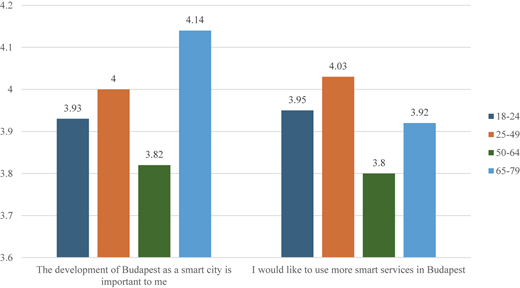
The development of Budapest as a smart city is important to me
I would like to use more smart services in Budapest
Smart living domains, indicators and statements used in the questionnaire
| Domains | Indicators | Statements (1–5 Likert scale) | Smart tools (respondents were asked how far they agreed that a smart city should have the following smart tools) |
|---|---|---|---|
| Environment Oh (2020), Ji et al. (2021), Shami et al. (2022) |
|
| N/A |
| Transport Bielinska-Dusza et al. (2021), Pira (2021), Chen and Chan (2023) |
|
|
|
| Safety Oh (2020), Ortega and Malcolm (2020), Ozkaya and Erdin (2020), Bielinska-Dusza et al. (2021), Cantuarias-Villessuzanne et al. (2021), Pira (2021), Shami et al. (2022) |
|
|
|
| Social Ortega and Malcolm (2020), Ozkaya and Erdin (2020), Bielinska-Dusza et al. (2021), Csukás and Szabó (2021), Ji et al. (2021), Chen and Chan (2023), Shami et al. (2022) |
|
|
|
| Leisure, culture and tourism Bielinska-Dusza et al. (2021), Cantuarias-Villessuzanne et al. (2021), Csukás and Szabó (2021), Ji et al. (2021), Oh (2020), Ortega and Malcolm (2020), Ozkaya and Erdin (2020), Pira (2021), Shami et al. (2022) |
|
|
|
Source(s): Authors’ own work
Some questions were also asked about the environment, as this forms the basis of the infrastructure for both everyday life and tourism, as well as perceptions of safety, which can affect both residents and tourists. The subsequent findings focus on a selection of these domains, indicators and statements.
The questionnaire was developed in English, Hungarian and Mandarin Chinese to accommodate Budapest’s diverse population, including its largest ethnic minority (Chinese) and foreign residents. A pilot study with 30 respondents (ten from each language group) was conducted to ensure relevance and clarity. Previous researchers realized that it was challenging to capture reliable data using online methods only, so they also collected data in public places (e.g. Ji et al., 2021). This questionnaire was posted on as many Budapest district forums as possible (where access was allowed), as well as being snowballed on social media platforms. After more than half of the desired number of completed responses were collected online, the researchers viewed the responses and attempted to redress the imbalances in the sample using a face-to-face paper-based version of the questionnaire. The remaining questionnaires were distributed in public places in different districts of the city with the help of a professional survey-distributing company. They were requested to target more male respondents, especially younger men and more elderly residents (65+) in some of the outlying districts of the city. The European Football Championships were taking place in the city at that time, which represented an opportunity to question more men in outside spaces before and after matches. The researchers attempted as far as possible to employ representative quota sampling in line with the most recent Census data (HCSO, 2022) for demographic characteristics. It should be noted that the sample is quite well balanced in terms of gender, but older people (65+) are under-represented. Every district is represented (23 districts), but not evenly (ranging from 1% in District XXIII to 9% in District VIII). Overall, the central districts are represented better than the suburban or outlying ones. The sample is also relatively over-educated compared to the national average. Figure 1 shows the location of the districts of Budapest.
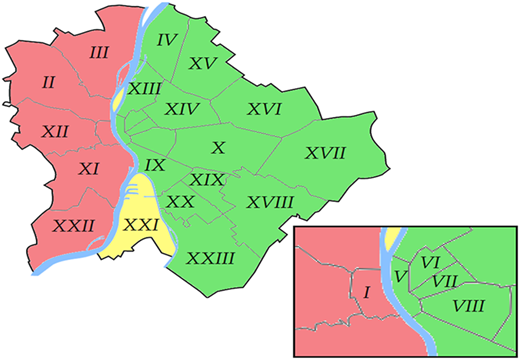
Map of the districts in Budapest (highlighting central districts). Source: Heizler, 2015, https://commons.wikimedia.org/wiki/File:Budapest_colors_numbers2.png
Map of the districts in Budapest (highlighting central districts). Source: Heizler, 2015, https://commons.wikimedia.org/wiki/File:Budapest_colors_numbers2.png
The data collection resulted in a final sample size of 453 from Budapest’s population of approximately 1,685,342 (Census, 2022). Table 2 shows the most important characteristics of the sample.
Profile of the questionnaire sample
| (%) | |
|---|---|
| Gender | |
| Female | 54% |
| Male | 45% |
| Other or prefer not to say | 1% |
| Age | |
| 18–24 | 22% |
| 25–49 | 48% |
| 50–64 | 21% |
| 65–79 | 9% |
| Education | |
| Primary school (basic general level) or less | 9% |
| Secondary school (High school) | 40% |
| University level (Bachelor level) | 23% |
| University level (Master level or PhD) | 28% |
| Profession | |
| Employed | 72% |
| Student | 14% |
| Unemployed | 2% |
| Retired/pensioner | 8% |
| Other (e.g. on maternity leave, unable to work) | 4% |
| Nationality | |
| Hungarian | 85% |
| Foreign | 15% |
Source(s): Authors’ own work
Findings
The data shows that more than 75% of respondents have a positive image of Budapest (ranked 4 or 5) with no significant age variations. 65% of respondents agreed that the city has a good atmosphere and 66% find the city relatively safe (ranked 4 or 5), including the oldest residents (aged 65+), however, females felt less safe than males (3.51 versus 3.91). On the other hand, the findings about whether Budapest seemed open and friendly were rather mixed with equal numbers (around 13%) ranking this statement 5 or 1 and only a third of respondents ranking it 4. There were no strong age variations, but male respondents found it friendlier than females (3.3 versus 2.98). Statements about public transport were ranked quite highly with the majority of respondents finding the system efficient and reliable (74% ranked this statement 4 or 5) and affordable (79% ranked this statement 4 or 5). More than half use electronic tickets. On the other hand, they are not so happy with the parking situation (provision, cost, electronic system) and overall traffic management (two-thirds ranked these statements 3 or below). Less than half consider Budapest to be a clean city. Older residents (50+) and males were less positive about the number of attractive green spaces, and both older residents and females were less satisfied about cleanliness.
Respondents are very positive about cultural and tourist attractions, as well as sports provision (see Figure 2). Older residents were more positive about cultural and tourist attractions, especially those aged 65+. More than 60% ranked the statement about enough attractive green spaces (e.g. parks and gardens) with a 4 or 5. Respondents seem to be mainly positive about the impacts of tourism (see Figure 2), but as further analysis shows later in the article, this depends on the district that people are living in. More than 60% do not find the area they are living in too noisy, but this might also depend on location.
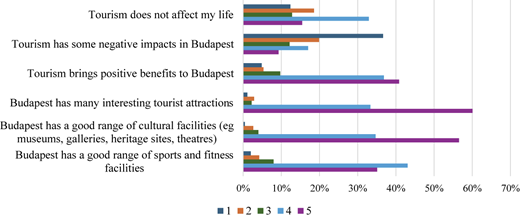
Responses relating to leisure, culture and tourism. Source: Authors’ own work
Responses relating to leisure, culture and tourism. Source: Authors’ own work
Figure 3 shows some of the differences expressed by respondents from different age groups. On average, all groups are positive about cultural and sports facilities, as well as tourist attractions. Reactions to tourism are varied, but they are more neutral or positive than negative.

Variations according to age relating to leisure, culture and tourism. Source: Authors’ own work
Variations according to age relating to leisure, culture and tourism. Source: Authors’ own work
There are not many significant variations according to gender, but similarly to older residents aged 65+, women feel more positive about the facilities and attractions, but slightly more negative about the impacts of tourism.
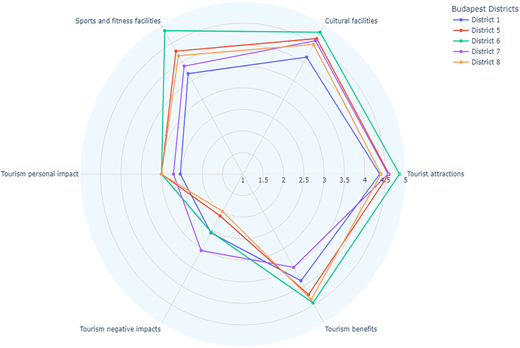
Some of the findings confirm the research of Pérez Garrido et al. (2022) that the impacts of overtourism are mainly concentrated in the centre of Budapest. In the more heavily touristed districts (I, V, VI, VII), residents gave higher scores for tourist attractions and cultural facilities, (above 4.5). but they also expressed stronger concerns about tourism’s negative impacts. This is especially true of District VII (mean = 3.2), reflecting the challenges of overtourism in Budapest’s “party quarter”. Residents in middle-ring districts (e.g. VIII, IX, XIII) demonstrated more moderate attitudes across all dimensions. Their evaluation of sports and fitness facilities was notably higher than inner districts, possibly due to more available space for recreational infrastructure. Residents in outer districts responded that tourism did not affect their life much. However, they consistently rated sports facilities and cultural facilities favourably. Figure 4 illustrates the variations in the responses in the central districts showing clearly that the negative impacts of tourism are felt most in District VII, the heart of the “party quarter” (please note that “tourism personal impact” refers to how far tourism affects their life).
The questionnaire respondents were asked to consider a list of smart tools or systems that could exist in a smart city and to rank their importance. Figure 5 shows the results of this question that relate to transport, security, leisure, culture and information provision. It was thought that these systems could also be important for tourists.
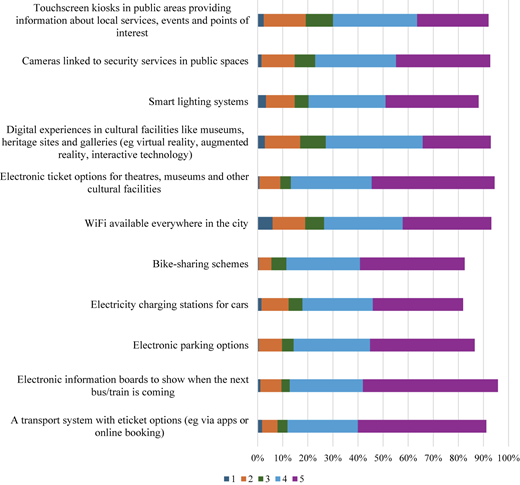
Do you agree that a smart city should have the following? Source: Authors’ own work
Do you agree that a smart city should have the following? Source: Authors’ own work
Respondents were positive about using most of the smart tools listed, particularly tools relating to transport, parking and ticketing, including for cultural attractions. Interestingly, they seem to be slightly less interested in digital experiences in cultural facilities. Surprisingly, the oldest residents in the sample (65+) were the most positive about smart city tools. It should be noted that these residents were in a minority (only 9% of the total sample) and maybe this topic represented more of a novelty for them than for younger respondents (e.g. 18–24 year olds). It is also interesting to note that women ranked every statement higher than men, and employed residents (representing 72% of the sample) also ranked the smart tools higher.
Respondents were subsequently asked about their attitudes to Budapest becoming a smart city and the responses were very positive with more than 73% of respondents ranking these statements 4 or 5. Whereas the results did not differ much for gender, they were significantly different according to age (see Figure 6). It seems slightly contradicatory that older residents (65+) would like the city to become smarter but they do not necessarily want to use more smart services! These responses show a typical gap between perceptions and behaviour, and confirm that older residents are likely to be more inhibited in terms of technology readiness (a result also noted in the case of smart tourism in Budapest by Coronel Padilla and Smith, 2023).
However, city challenges like overtourism in Budapest might need to be addressed by smart systems that are largely invisible to residents and tourists. As stated earlier (e.g. Pérez Garrido et al., 2022), these might relate to managing visitor flows, calculating capacity, traffic management or identifying types of tourists, length of stay or spending. Budapest could start to implement more smart solutions, for example, digital tourism management platforms that incorporate real-time monitoring of tourist flows through IoT sensors strategically placed throughout the city, with particular emphasis on high-pressure areas in Districts VI and VII. The platform could feature sophisticated noise level monitoring capabilities and a user-friendly mobile application enabling residents to provide immediate feedback on tourism impacts in their neighbourhoods. Smart zoning solutions could help to divert tourists away from busy attractions and entertainment venues to avoid overcrowding, highlighting alternative areas and activities. Centralized digital booking systems can also help to manage capacity and flow in cultural and other attractions, while comprehensive mobile applications can help to enhance experiences for residents and tourists alike.
Conclusion
The questionnaire data in this research focused on residents rather than tourists, unlike some previous studies on overtourism (e.g. Remenyik et al., 2021). It also integrates a social perspective into the field of smart cities research, which has been largely dominated by economic and technological studies. It aimed to address a gap in smart city and quality of life research, as well as the Budapest-specific research by Fekete (2023) by capturing data on social as well as leisure, culture and tourism issues. It took into consideration the impacts of overtourism, as well as the possible solutions offered by smart city tools.
The findings reveal that proximity to the city centre correlates with both higher appreciation of tourism-related amenities but also greater concern about tourism’s negative impacts. This spatial differentiation has important implications for urban planning and tourism management, suggesting the need for district-tailored approaches to tourism development and facility provision that consider local contexts and resident needs. The decentralized district management system in Budapest offers opportunities, but also presents challenges for coordinated tourism planning. For example, it may hinder the development of city-wide strategies or those that cross district boundaries.
The research showed that smart city developments in Budapest are viewed positively by local residents and that smart tools and systems could be used to address some of the challenges of overtourism. However, it is important to note that there is always a gap between stated interest and actual behaviour (demonstrated by older residents, e.g.). Both this and previous research (e.g. Pérez Garrido et al., 2022) suggest that overtourism is mainly concentrated in central districts of the city; therefore, solutions are needed that divert tourists away from these central areas geographically and help to diversify forms of tourism away from “party tourism” towards cultural or other forms of special interest tourism. In addition to enjoying ruin pubs, research has shown that tourists are significantly motivated by culture and gastronomy, as well as thermal baths and spas (Pinke-Sziva et al., 2019). Previous studies have also indicated that tourists would be willing to travel outside the centre of Budapest for cultural and gastronomic experiences, including festivals and outdoor experiences (Smith et al., 2023). The transport system in Budapest is viewed as efficient, reliable and affordable by residents with many networks extending to the suburbs and neighbouring towns. Smart transportation systems would be instrumental in facilitating experience creation for tourists outside the centre of the city.
Limitations
The research focused only on the perceptions and experiences of residents. In order to address smart tourism developments more fully, it would be necessary to collect data on tourist opinions of the same issues too. Although one study already researched technology use and attitudes of different generations of tourists in Budapest (Coronel Padilla and Smith, 2023), the focus was on individual use of smart tools rather than wider use of smart systems for planning and management. It would be important to approach this topic from the perspective of stakeholders involved in urban planning and management, as well as technology companies and designers. The sample size was relatively representative compared to the Census (2022), but older residents were under-represented and residents from different districts were not represented proportionally. A notable methodological limitation lies in the study’s reliance on self-reported perceptions through structured questionnaires. While this approach provides valuable insights into resident experiences, it may not fully capture the complex interplay between tourism impacts and quality of life indicators. The use of primarily Likert-scale measurements, while effective for quantitative analysis, may oversimplify residents’ nuanced experiences and fail to account for contextual factors that influence their perceptions of tourism impacts. For this, focus groups could provide a more informative method. More longitudinal research would be needed to monitor residents’ quality of life over time as smart systems are developed and implemented. This could be combined with research on tourists’ experiences of the city and smart technology, as well as their interactions with local residents.
Funding: This work was supported by the National Research, Development and Innovation Office, Hungary (project number: OTKA K134877).

