The purpose of this study was to review the role of self-efficacy in online education with an objective to propose a holistic framework for strengthening participants' self-efficacy, especially in the Asian context.
To investigate the potential role of self-efficacy of the participants of online academic activities, this study followed the conceptual analysis method, which is breaking down concepts into constituent elements to get a superior understanding of a particular philosophy.
The findings revealed that self-efficacy, the level of confidence someone has to perform a particular task, is an important factor among teachers and students operating online platforms, and enhanced efficacy is capable of encouraging online practices. Finally, the study proposed a framework to strengthen self-efficacy among participants with intervention measures to make online education effective and impressive.
The proposed framework will help stakeholders of online education to improve their efficacy and leverage the potential of online education to the fullest. Millions of first-generation online users in many Asian countries who possess low self-confidence in their ability might find the framework easier for better integration, interaction and collaboration in the online learning environment.
A vast literature survey was made before proposing this framework that could open up a new dimension in online education by scaffolding participants' inner thrust.
Introduction
Mahatma Gandhi, the great Asian thinker, said a person often becomes what he believes himself to be, meaning if he keeps on believing that he cannot do a certain thing, he will never succeed; reversely if he keeps on believing that he can do it, he will surely acquire the capacity to do it even if he may not have it at the beginning (Deats, 2005). This “self-belief” which was later extensively researched as “self-efficacy” by Albert Bandura in his “social cognitive theory” refers to beliefs in one's capabilities to organize and implement the courses of action needed to produce given accomplishment and having exclusive power to predict one's behavior (Bandura, 1997, p. 3). Self-efficacy determines and controls people's thoughts and the ways they act or behave (Alqurashi, 2016). Peterson and Arnn (2005) said self-efficacy is the basis of human performance, and it is significant to examine the factors that affect self-efficacy along with the desired behaviors. Self-efficacy beliefs find answer for the question: Can I do this? Hodges (2008) further finds this is situation specific, and individuals may find self-efficacy belief varying from situation to situation.
In an educational setting, understanding self-efficacy with respect to various academic practices is significant because it has a deep impact on the aims, effort and achievement of the participants. A lot of past studies have examined the importance of participants' self-efficacy with respect to their use of online education strongly suggests a link between self-efficacy and technology use potential (Sun and Chen, 2016; Corry and Stella, 2018). Honicke and Broadbent (2016) said using an online platform for education makes sense because today's students are digital natives, and the majority of these students are well adept at using technology that a learner's academic self-efficacy is bravely associated with academic performance. Different from conventional face-to-face classroom lecturing, technology-enhanced learning not only facilitates the showcasing of multimedia teaching materials but also encourages students to take initiatives to research on their own and to share with peers about their personal insights into online forums (Tsai, 2017). Thus, the construct of self-efficacy sounds like a recipe for academic success so far as online education is concerned. Hence, in this literature review the role of self-efficacy in online education, especially in the Asian context, was studied. In total, three main areas of research were identified for this review: (1) role of self-efficacy in online education, especially in the Asian context, (2) factors influencing self-efficacy in online education and (3) a framework for strengthening participants' self-efficacy in online education.
Self-efficacy
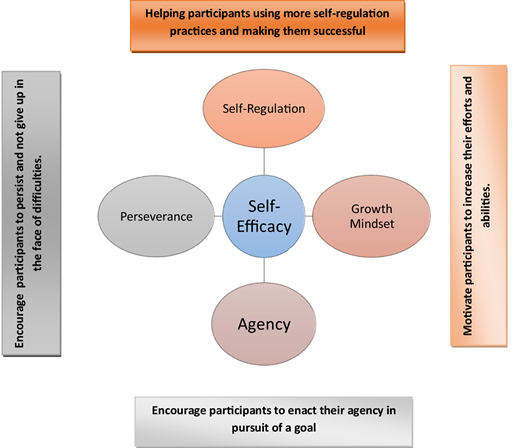
Bandura (1997) found self-efficacy to be important because people with high self-efficacy are more likely to make an effort to change their work environment and persist at their work when facing negative outcome expectations. Conversely, people with low self-efficacy are more likely to have feelings of hopelessness and despondency and less likely to persist in similar situations. The stronger their notion of self-efficacy, the better their effort, perseverance, resilience and elasticity (Bandura, 2001), meaning a strong notion of self-efficacy creates feelings of tranquility and provides power to challenge at the face of difficult tasks. It, in all forms, influences our thoughts, emotions, actions, motivation and operates mainly through the cognitive and affective channels and plays a crucial role in shaping our perception of life experiences (Chowdhury, 2020). The summed up effects of having strong self-efficacy can be framed in the following manner, as presented in Figure 1 below.
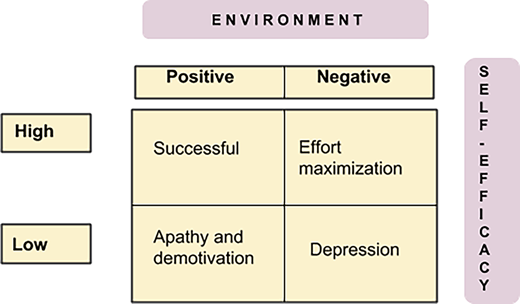
The perceived self-efficacy determines not only the level of effort but also its quality, i.e. how productively that effort is deployed. Therefore, higher perceived self-efficacy brings about various motivated efforts, and it enables individuals to enhance performances (Talsma et al., 2018). In this context, Bandura (2001) said self-efficacy theory is a common theme in relation to motivation, mostly as a result of its power to predict one's behavior. He suggested that the interplay of environmental factors with people having low or high self-efficacy predicts four variables: success, depression, apathy, effort maximizing (Bandura, 1997). They can be interpreted with the help of the following diagram (see Figure 2).
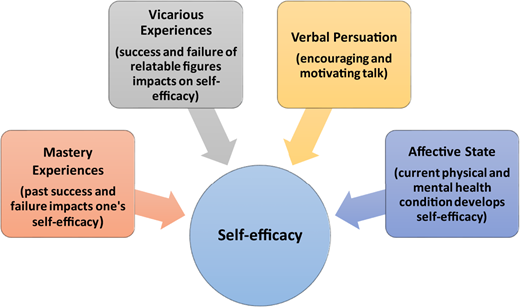
Bandura's (1997) introduction of self-efficacy theory contained the proposition that self-efficacy perceptions depends on environmental, cognitive and behavioral effects that a person experiences in his/her everyday life. Based on this observation, he said that self-efficacy is derived from four major sources: performance accomplishments, verbal persuasion, vicarious experience and physiological-affective states (see Figure 3). These four areas are accepted as the core elements in the development of self-efficacy and by the interplay of these factors that grow significant belief or disbelief in human in general.
Self-efficacy in the academic context
Bandura's social-cognitive theory (2001) recognizes that human learning is based upon a system of three forces: social, personal and behavioral, each of which influences one another to affect human development as what Woolfolk (2011) said triarchic reciprocal causality process. Self-efficacy beliefs, by extension, academic self-efficacy, fall within the personal domain of this process. Honicke and Broadbent (2016) said self-efficacy beliefs influence academic performance of both teachers and students. Students with high self-efficacy have better self-regulation and are more resilient in facing obstacles (Bandura, 2001), demonstrate stronger academic performance and achievement, have increased confidence in their self-regulated learning which affects their engagement and academic achievements thus increases their grades and, eventually, are happier all around (LaRocca, 2017). On the other hand, teachers' with high self-efficacy are more capable in orchestrating teaching–learning activities to bring about “desired changes on student engagement and learning” (Tschannen-Mora et al., 1998, p. 783). This makes the teacher “capable of carrying out good teaching” (Christophersen et al., 2016, p. 241), provides job satisfaction and professional commitment (Joo et al., 2013), diminishes attrition (Pellas, 2014) and even influences his/her attitudes for successful integration of technology (Hatlevik and Hatlevik, 2018).
Purpose of the study
Thus, self-efficacy, the intrinsic self-belief, has a big role in academic activities, including online education (Pumptow and Brahm, 2020). Bandura (1997) himself found that because of the swift progress of technological tools, the pedagogical use of technology may require special and ever-evolving types of teacher self-efficacy.
Since the focus of this study was Asia, it needs a brief analysis of online education scenario in Asian countries here. Asia consists of 49 countries, 36 of which had been specifically classified as developing countries based on World Bank Country Classifications (The World Bank, 2019). During the last ten years, enrollment in education (school level to higher education) in Asia has been observed to increase by over 55% (Paul Glewwe, 2020). This growth in the population and the demand for education are coupled with the projection that “the 21st century will be the Asian Century which is overdue and inevitable” (Bandalaria, 2018, p. 116). This huge learner explosion is beyond capacity of traditional system to cater their academic needs; hence, online education has been gaining traction. There is a huge developing potentiality of online education in Asian countries during coming decades although it has several big challenges to face like uneven development, high cost of establishing a system, uneven teaching quality, cultural bigotry and unfair practice (Kundu and Bej, 2020).
The gap regarding online education between Western and Asian countries is obvious; in this context, Ahmed et al. (2017, p. 102) found “Western online education platforms are undoubtedly valuable but they lack our domestic cultural needs and practices.” This cultural difference can be convincingly illustrated by the four-dimensional model of cultural differences (see Table 1) developed by Hofstede (1986).
Numerous studies that have examined the cultural differences between Western and Eastern educations have provided a consistent picture that describes Eastern education as group-based and teacher-dominated where the students are not encouraged to question or challenge a teacher's knowledge, centrally organized pedagogical culture with examinations as the essential way to define performance. In Western education, to challenge a teacher or tutor is seen as part of the self-development process as dialogue and interaction are encouraged in the learning process that is more commensurate to the online education (Liu et al., 2010). Besides these cultural barriers, digital inclusion in most of the Asian countries to facilitate online learning is uneven which cannot be rooted out overnight. Accepting these limitations, the current study researched how participants' self-efficacy could help them to continue online education amidst these challenges and how their efficacy level could be strengthened. The specific research questions set for this study were as follows:
What is the role of self-efficacy in online education, especially in the Asian context?
What are the factors influencing self-efficacy in online education?
How to strengthen participants' self-efficacy in online education?
Method
This study followed the method of conceptual analysis to study the potential role of the participants' self-efficacy in online education. Conceptual analysis consists primarily in breaking down or analyzing concepts into their constituent parts, in order to gain knowledge or a better understanding of a particular philosophical issue in which the concept is involved (Beaney, 2003). The method of conceptual analysis wants to approach such a problem by breaking down the principle concepts relating to the problem and observing how they interact.
Data collection
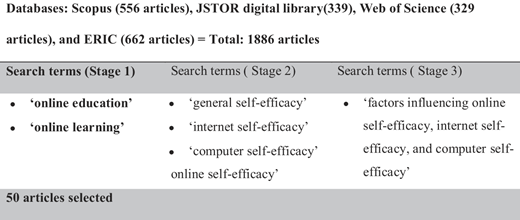
The author used secondary data source for analysis that include past research articles and organizational records (mainly of empirical nature). The articles used for literature survey were selected from the education-specific databases of JSTOR digital library, Web of Science, Eric and SCOPUS. A search criterion was developed to select articles for online education to overcome the nonstandardized nomenclature, as stated by Corry and Stella (2012). The first selection criterion was “online education” or “online learning” published within the last 20 years. The second criteria were “general self-efficacy”, “Internet self-efficacy”, “computer self-efficacy” and “online self-efficacy”. The third criteria were “factors influencing online self-efficacy”, “Internet self-efficacy” and “computer self-efficacy”. General search produced 1886 articles relating self-efficacy in online academic scenario, which were then limited to 50 empirical articles on the basis of particular search of factors influencing participants' self-efficacy for online education. This is especially true for the Asian context that we have searched for developing a framework, the main focus of this study. Then the abstracts of the selected 50 articles (40 made in Asian context) were closely read. The search strategy is presented in Figure 4.
Data analysis
Document analysis was used to classify the research studies by research area/theme. Document analysis is a social research method and is an important research tool in its own right to give voice and meaning around an assessment topic and is an invaluable part of most schemes of triangulation, the combination of methodologies in the study of the same phenomenon (Bowen, 2009). It involves skimming (superficial examination), reading (thorough examination) and interpretation. Here the researcher as an analyst should determine the relevance of documents to the research problem and purpose. Also, the researcher should ascertain whether the content of the documents fits the conceptual framework of the study. It is necessary, as well, to determine the authenticity, credibility, accuracy and representativeness of the selected documents. This study followed the overall recipe of O'Leary (2014) who outlines an eight-step planning process that should take place in document analysis with few changes.
Results
Details of the document analysis of 50 studies are presented in this section in Table 2 along with their respective outcomes in the context of this study.
Discussion
Role of self-efficacy in online education, especially in the Asian context
With regard to the effect of self-efficacy on academic performance in online learning environment, most of the above studies (in Table 2) found that it has a positive correlation with academic performance. In this context, the remark of Hodges (2008) becomes pertinent that the role of self-efficacy in online environments is only in its infancy that needs more studies. To this note, subsequent researchers studied the role of self-efficacy in online education, and the spotlight of these studies mostly was on the technology factor of self-efficacy in online learning, like computer self-efficacy (Pellas, 2014), Internet self-efficacy (Lin et al., 2013; Kuo et al., 2014), digital media self-efficacy (Pumptow and Brahm, 2020), learning management system (LMS), self-efficacy (Prior et al., 2016; Martin et al., 2010) and ICT self-efficacy (Cusso-Calabuig et al., 2018; So et al., 2012). Few studies focused on the role of self-efficacy, task value (Joo et al., 2013) and academic self-efficacy factors (Jan, 2015; Cho and Shen, 2013; Yokoyama, 2019), and few others focused on the general self-efficacy (Gebara, 2010) in online education. Some studies (like Taipjutorus, 2014; Shen et al., 2013) investigated multi-dimension of self-efficacy in online learning. Few contradictory outcomes are also observed when Pellas (2014) and Jan (2015) found that computer self-efficacy and student satisfaction level have no positive or significant relationship conversely, while Kuo et al. (2014) found that learners' self-efficacy and Internet usage have positive correlation. Bates and Khasawneh (2007) found self-efficacy for online technologies to be a good predictor of student performance in online courses and if the students chose to enroll in an online class, it is expected that their technology self-efficacy toward the class was high. Reychav et al. (2016), LaRocca (2017) and Cusso-Calabuig et al. (2018) found that participants' perceived enjoyment in an online course depends on their computer self-efficacy, the root of success in any online course. Taipjutorus (2014) and Hatlevik (2017) demonstrated a positive relationship between self-efficacy and using technology for teaching purposes. Loar (2018) reported that computer self-efficacy in basic and advanced ICT operational and collaborative skills and self-efficacy in using computers for instructional purposes are highly correlated. Few studies found that self-efficacy has a deep impact on the online learning experience and knowledge even the perseverance to complete an online course (i.e. Kim and Park, 2017; Song et al., 2011; Tang et al., 2014; Shen et al., 2013; Prior et al., 2016).
Out of 50 studies, 40 studies were purposively chosen from the Asian context where technology inclusion is very irregular, gender disparity is very popular and skilled teachers are a rarity; here self-efficacy of the participants could be a good instrument amidst impediments, which could provide them an intrinsic motivation to sustain in the teaching–learning activity and continue their fight against the odds (Chiu and Tsai, 2014; Kundu et al., 2020). Hong et al. (2017) mathematically established a positive relationship between Chinese learning intrinsic motivation and online learning self-efficacy. The studies (e.g. Kundu et al., 2020; Lim et al., 2016; Shen, 2015; Kuo et al., 2014; Chiu and Tsai, 2014; Joo et al., 2013; Zhang et al., 2012; Chu, 2010; Song et al., 2011) also found almost in the same tune that self-efficacy has a deep impact on the participants' personal innovativeness, communication climate, holding strong perception toward online infrastructure, motivation, asynchronous communication, learner–learner communication or learner–teachers' communication and knowledge sharing in online mode. Hence, policies to strengthen self-efficacy of the participants could prove effective in the Asian online education context.
Factors influencing self-efficacy in online education
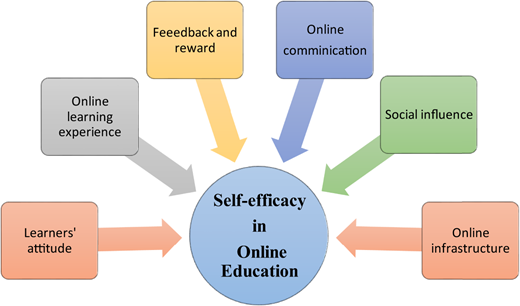
An in-depth analysis found several factors influencing participants' self-efficacy for online education that posit human performance technologists must consider those factors when developing training interventions. Chu (2010) found that emotional family support plays a major role in enhancing Internet self-efficacy, while Chu and Chu (2010) found peer support and e-learning outcomes play as important predictors. Law et al. (2010) found a well-facilitated e-learning setting can enhance self-efficacy for online learning, while Song et al. (2011) found prior knowledge of online system put a direct effect on online efficacy and participants. Jashapara and Tai (2011) found personal innovativeness with information technology (IT) showed a significant effect on e-learning system self-efficacy, and computer playfulness had a significant positive effect on e-learning system self-efficacy. Zhang et al. (2012) found the psychological safety communication climate as a predictor, Shen et al. (2013) found the number of online courses, Wang et al. (2013) found motivation as a palpable predictor and Chiu and Tsai (2014) found the associated social factors influence self-efficacy for online education. Kuo et al. (2014) suggest that the ability to use the Internet has a positive effect, which is further supported by Taipjutorus (2014). Lin et al. (2008) found social presence as a strong predictor of self-efficacy, while Shen (2015) found the trust between participants as a strong predictor, and Lim et al. (2016) found learner–learner interaction and system quality was related to learners' computer self-efficacy. Among other factors influencing self-efficacy for online education are attitude and digital literacy (Prior et al., 2016), perceived enjoyment (Reychav et al., 2016), community involvement (Vayre and Vonthron, 2016), personal innovativeness (Kim and Park, 2017) and particular education system of the country (Gerick et al., 2017). The studies of Liou et al. (2016) and Wang and Wu (2008) have reported the benefits of feedback and incentive are important factors influencing self-efficacy in online education to find out whether they attain their goals in learning. Online communication was claimed as an important factor influencing self-efficacy in online education, as stated in studies of Lim et al. (2016), Cho and Cho (2017), Lin et al. (2015), Reychav et al. (2016), Shen (2015) and Vayre and Vonthron (2016). Considering the significance of self-efficacy in online education, there is a need to identify and understand these factors influencing participants' self-efficacy. A brief diagram of the factors is furnished for easy understanding in Figure 5.
Proposed framework for strengthening participants' self-efficacy
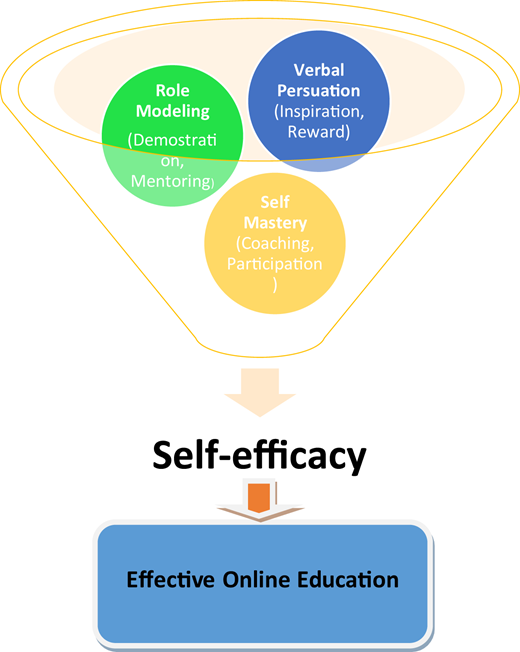
Based on the above analysis, the author proposed a framework for strengthening participants' self-efficacy for online education in the following diagram (see Figure 6) along with few intervention measures presented in Table 3.
Verbal persuasion. The proposed framework presumes that verbal persuasion builds self-efficacy when a respective environment is encouraging and praising individuals with feedbacks for their competence to improve their effectiveness. Empirical evidence behind this proposition is found in a series of studies taken up in this document analysis like Wang and Wu (2008), Chu (2010), Wang et al. (2013), Chiu and Tsai (2014), Tang et al. (2014), Jan (2015), Lin et al. (2015), Shen (2015), Liou et al. (2016) and Hong et al. (2017), etc. Positive self-talks, informal communications, human relationships, etc. can also raise the self-efficacy level of the participants. The author also concerns with the fact that although encouraging messages have the potential to raise self-efficacy, there are chances that it may collapse into bare sermons unless they are supported by efficacy-affirming experiences (i.e. enactive self-mastery with controlled affective domains). Effective verbal persuasion is needed to be reinforced with corresponding actions. For example, telling individuals that they are capable but not assigning them any practical tasks tends to erode both learners' self-efficacy and the teachers' credibility. The corresponding measures for verbal persuasion domain are presented in Table 3 for both students and teachers. Verbal persuasion may not be possible or practical in several online courses, but a possible equivalent may be convincing a feedback mechanism through email notes, WhatsApp messaging or phone calls to manipulate learners' self-efficacy. The interventions involving written communication were also there in Bandura's verbal persuasion category (Bandura, 2001).
Role modeling. Role modeling reinforced through vicarious experiences or social models. It may be difficult to include vicarious experiences in online education, yet the success stories of peers in the field could be helpful in this context. Empirical evidence is also found in the study of Lin et al. (2015) who said social presence is an important predictor of self-efficacy and in the extended expectation confirmation model propounded by Tang et al. (2014). Observation of models has been investigated and shown to be important for formation of self-efficacy beliefs (Jashapara and Tai, 2011). Hodges (2008) found the solitary often asynchronous environment of online courses does not readily promote opportunities for observing peer observation, yet he empirically proved self-efficacy to learn mathematics asynchronously (SELMA) was positively correlated with the academic achievement of the learners. Here, pedagogical agents for learning (PALs) may be a possible alternative for addressing the vicarious learning component of self-efficacy development in the online educational environment. PALs are explained by Kim and Baylor (2006) as “animated life-like characters” (Johnson et al., 2000) that are inserted in instructional applications, and it is the ability to simulate social interaction that makes PALs unique form of conventional computer-based environments (p. 570).
Self-mastery. Self-mastery is the development of skills, like thinking, intuiting, communicating, leading, feeling, doing and being, necessary for any academic achievement and viewed as the ultimate learning goal (Cunanan and Chua, 2015). Self-mastery is most vital in strengthening participants' self-efficacy in online education, which is reinforced through suitable coaching, practice and participation. Enough of empirical evidence is found in this analysis behind this proposition where learners were found to exhibit more online self-efficacy having more online exposure (Song et al., 2011), with the increase in the number of online course adopted (Shen et al., 2013) and with the increase in computer self-efficacy (Kuo et al., 2014). Kuo et al. (2014) point out that increase in teachers' technology self-efficacy might directly increase their acceptance of technology and also indirectly increase their usage of technology. Furthermore, Shen et al. (2013) asserted that technology self-efficacy has come to play a crucial role in the preparation and implementation of educators who can successfully use educational technology to enhance student learning. This suggestion falls in line with the self-efficacy literature in that beginning with lower-level skills creates opportunities for learners to have early successes before tackling more difficult material. Before self-mastery to take place, earlier two stages – verbal persuasion and role modeling – need to be followed. Thus, to make this framework effective, an institutional ecosystem that develops a desirable culture among all stakeholders and that invests in support services and infrastructure, such as reliable Internet connections and technology, is necessary. At the same time, institutional vision, leadership and attitudes have a direct bearing on participants including institutional policies on teacher professional development, and the expectation of technology use within teaching and learning, cognizant of potential digital divide issues including student ownership of devices that are incompatible with institutional devices, student's social background, family income and their capability to afford devices need to be considered, as all these have an effect on their efficacy in one way or the other.
Conclusion
The study reached to this conclusion that self-efficacy is the key to success in online education; hence, a proper understanding is essential. In total, three major sources of self-efficacy – role modeling, verbal persuasion and self-mastery – have been discussed in the context of online education, their roles have been reviewed, especially in the Asian context, and the proposed model is presented along with respective intervention measures. The proposed framework revealed that all stakeholders of online education – students, teachers, institutions, society and parents – have crucial roles for its implementation. The author hopes the framework will prove useful for students, educators and developers operating online, especially for the millions of first-generation and inexperienced participants of online education, who possess low self-confidence in their abilities. However, the proposed model needs to be tested empirically. Hence, this study has a wide scope of future work by conducting empirical studies to test the validity of the model in several socioeconomic contexts.