This study investigates the research landscape concerning online teaching success in higher education.
We utilize bibliometric and content analysis methods on a dataset consisting of 115 documents, indexed in both Scopus and Web of Science, and published between 2008 and 2023.
The findings reveal a notable surge in publication output coinciding with the COVID-19 pandemic, suggesting a rapid expansion of the research community during this period. However, despite this growth, collaborative efforts among researchers remain limited. The United States, Germany and China have emerged as the most influential contributors to this field, although a restricted collaboration network persists. Current sources predominantly focus on scopes related to digital technology, while pedagogical issues remain underrepresented. This study also identifies nine key themes and outlines potential avenues for future research within each.
The research findings map a knowledge base for the success of online teaching in higher education and suggest potential future research directions that balance technological advancement with pedagogical efficacy and the involvement of stakeholders.
Introductıon
Online instruction has its origins in the 1970s when instructors first started exploring the potential of using computer-mediated learning networks for teaching (Moore, 2023). Online instruction now employs a variety of digital tools and platforms, such as Moodle and other learning management systems, to provide student interaction and improve learning (Peramunugamage et al., 2024). When well used, these instruments establish a more interactive and interesting process of learning, which finally translates to better exam success in virtual learning environments.
Online pedagogy has various advantages, including greater flexibility, accessibility and potential for innovative pedagogy. This mode of teaching facilitates students and teachers to engage in teaching activities from nearly any place, thereby providing tremendous scheduling flexibility (Culduz, 2024). Additionally, online platforms offer avenues for different learning needs and preferences, thereby making the learning environment inclusive. There are also some of these websites that incorporate interactive elements in the shape of discussion forums, chat rooms and video conferencing tools, through which students can engage and communicate with other students, thus increasing motivation and engagement (Chen et al., 2018). Additionally, online learning portals promote self-learning based on self-discipline and time management since they compel students to study independently (Artino, 2007).
Despite the advantages of online learning, however, it comes with its share of multifaceted challenges crossing the planes of technology, pedagogy and society. Inadequate technology infrastructure has the potential to be a powerful impediment to success in online learning (Dhawan, 2020). In addition, online pedagogy transformation is accompanied by substantial changes in pedagogical practice that will require further teacher training and investment (Rajaraman et al., 2024). Pedagogical concerns also include instructor resistance to altering their instructional strategies when transitioning from face-to-face to online courses (Barrett, 2011), with instructors’ mindsets toward online instruction being a key determinant of course success (Brooks, 2003). To ensure optimal content delivery, online learning has to include multimedia functionalities such as learning games, videos and simulations to enhance the entire learning and teaching experience (Almala, 2005). Moreover, ensuring assessment integrity in online settings is an ongoing challenge that demands innovative measures and strict monitoring systems to guarantee fairness and prevent academic dishonesty (Rajaraman et al., 2024).
Beyond technological and instructional constraints, online learning also presents severe social challenges. Limited face-to-face interaction can reduce student motivation and inhibit the development of valuable social and communication skills. Inadequate social presence in virtual learning spaces could contribute to loneliness and negatively affect students’ mental well-being (Kim et al., 2016; Rajaraman et al., 2024). In addition, cultural and pragmatic factors can further complicate online learning. For instance, in some regions, having relatives around for online lectures might create a distracting learning environment (Sharma, 2024). Such problems highlight the importance of taking an inclusive approach to online learning – a one that is more than providing remedies for technological limitations to also account for pedagogical and social concerns as well.
Online instruction is a success depending on a thin margin between several variables like technological competence, student engagement and good pedagogical practice. The sudden transition to online instruction, fueled by the COVID-19 pandemic, has highlighted both its inherent strengths and natural limitations. Technological literacy is a key success driver in that good teachers familiar with the use of digital resources are best placed to deliver more effective online teaching (Masry-Herzalah and Dor-Haim, 2022). This skill is particularly important during times of crisis when teachers have to adapt quickly to new modes of teaching. However, change resistance can soften the relationship between technical skill and pedagogical efficiency; teachers open to technological advancements and new teaching strategies are apt to thrive in e-learning (Masry-Herzalah and Dor-Haim, 2022; Hou, 2023). In addition, building strong teacher-student relationships through effective communication and a supportive learning environment is crucial to guaranteeing student satisfaction and performance (Miao et al., 2022). The successful provision of distance learning also demands integrating old rhetorical principles with new technology, ensuring the authenticity of course materials and utilizing digital applications to enhance interactivity and engagement (Reinsch and Turner, 2024).
Initially conceived of as a rapid response to the COVID-19 pandemic, distance learning has, historically, become known and more fully accepted as an established form of pedagogy in the educational system. The growing body of evidence brings online learning to the fore as a legitimate and emerging pedagogical option for the post-pandemic scenario (Sim et al., 2020).
To our knowledge, no systematic synthesis of the existing literature on online teaching success has been conducted previously. Review studies have largely focused on online course delivery and design (see Kebritchi et al., 2017) and teachers’ online professional development (see Bragg et al., 2021). Therefore, the present study offers the first systematic review of Online Teaching Success in Higher Education (OTSHE) aimed at mapping trends in research, characterizing the research community, marking out top publication sources, sketching out prevailing research themes and pointing toward directions for future research.
Methods
This study employed a dual-methodological approach, integrating bibliometric analysis and content analysis to comprehensively examine the landscape of OTSHE. Bibliometric analysis, widely recognized for its effectiveness in identifying research trends and authorship patterns (Sengupta, 1992), was utilized to investigate annual publication trends, international research collaboration networks, characteristics of the research community, leading publication venues and dominant research themes. Complementing this, content analysis was conducted to synthesize recommendations within the OTSHE literature, thereby informing potential future research directions.
In order to guarantee a systematic bibliometric analysis, it is crucial to retrieve bibliographic information from well-documented and legitimate academic databases (Hallinger and Kovačević, 2023). Accordingly, this research used both Scopus and Web of Science (WoS) for data retrieval, as they are widely recognized and in line with bibliometric approaches.
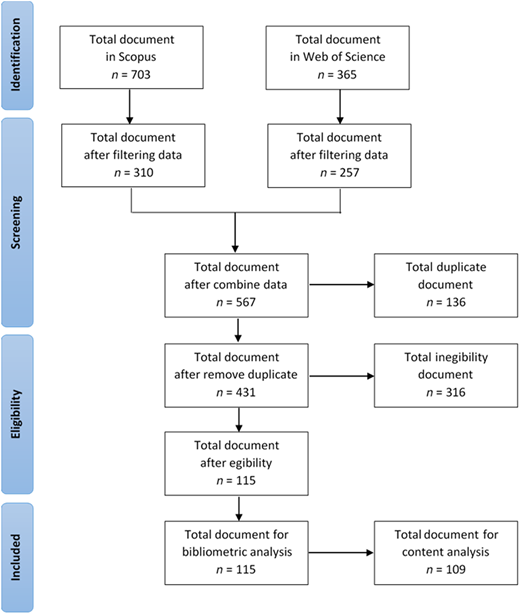
Data analysis was carried out in adherence to the Preferred Reporting Items for Systematic Reviews and Meta-Analyses (PRISMA) guideline (Moher et al., 2009), as seen in Figure 1. At the identification stage, it involved crafting appropriate search questions to be used both in Scopus and WoS. Because online teaching success was the topic of interest in this study in relation to higher education, inclusion criteria required the documents to contain (1) keywords of higher education and (2) keywords of online teaching success. This search strategy yielded 703 records in Scopus and 365 records in WoS. The specific search commands used in each database are given below:
Scopus Query: ((TITLE-ABS-KEY ((“online teaching” OR e-teaching OR “digital teaching”) AND success*)) OR (TITLE-ABS-KEY (“online teaching success” OR “e-teaching success” OR “digital teaching success”))) AND TITLE-ABS-KEY (universit* OR college OR “higher education”).
Web of Science Query: (TS= ((“online teaching” OR e-teaching OR “digital teaching”) AND success*) OR TS= (“online teaching success” OR “e-teaching success” OR “digital teaching success”)) AND TS= (universit* OR college OR “higher education”)
Upon screening, the search results were narrowed to fit the scope of the research study. Inclusion criteria used were year of publication (excluding 2024), type of document (two articles), publication level (published final) and language (English). Scopus publications were also narrowed by subject category encompassing social sciences, arts and humanities, psychology, multidisciplinary, business, management and accounting, health professions, economics, econometrics and finance and decision sciences. WoS articles were limited to those in Emerging Sources Citation Index (ESCI), Social Sciences Citation Index (SSCI) or Arts and Humanities Citation Index (A&HCI). Scopus and WoS datasets were then narrowed down to 310 and 257 articles, respectively, after applying them as filters. After manual merging and exclusion of 136 duplicates, the final dataset stood at 431 unique articles.
At the stage of eligibility, each document was put through a rigorous content analysis to determine its relevance to the research field. Titles and abstracts were thoroughly screened, leading to the exclusion of 316 documents that were incompatible with the OTSHE research framework. Documents were excluded if they failed to meet the following: (1) discussion of teaching practices, (2) focus on instruction in an online setting, (3) examination of student engagement, learning outcomes or satisfaction and (4) relevance to the higher education context. This process yielded 115 documents that proceeded to the bibliometric analysis stage. Full-text retrieval was achieved for 109 of these documents, and an extensive analysis of their contribution to research and the determination of dominant areas of research direction for the discipline was possible.
This study employed three analytical methods: descriptive statistics, bibliometric analysis and content analysis. Descriptive statistics were utilized to examine research trends, identify leading contributing countries, profile prolific authors and highlight key publication sources. Co-authorship analysis was conducted to map patterns of research collaboration among scholars and across countries. Co-word analysis was performed to delineate the thematic landscape of OTSHE research, revealing key areas of scholarly focus. Based on the insights derived from co-word analysis, potential research directions were synthesized for each identified theme. The implementation of these analytical methods was facilitated using Microsoft Excel and VOSviewer software.
Findings and discussions
Annual publication
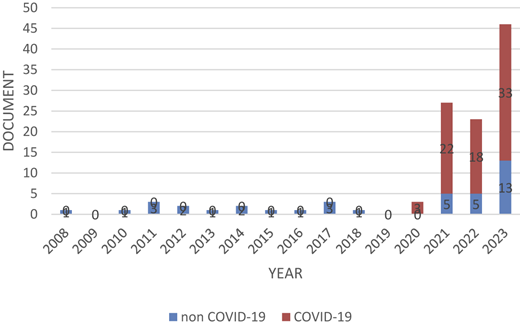
OTSHE’s knowledge stock consists of 115 Scopus-indexed articles from 2008 to 2023 (Figure 2). The initial study in the corpus explores the determinants of online learning, along with its potential advantages and drawbacks (Tehrani, 2008). Two periods are identifiable based on the number of articles published yearly. The initial era, which ran from 2008 to 2020, has 19 papers (approximately 16.52%), with fewer than four papers published yearly. The second era, from the years 2021 to 2023, records an exponential rise in publication numbers, with 96 papers (approximately 83.48%) and more than 20 papers published each year on average.
Our results show that 76 articles (approximately 66.09%) of the articles published between 2020 and 2023 cover the impact of the COVID-19 pandemic on online education. COVID-19-themed articles represented the vast majority of annual publications throughout these years. Meanwhile, there was a consistent increase in non-COVID-19-themed articles from less than four articles per year before 2020 to five articles in 2021 and 2022 and 13 publications in 2023.
This kind of evidence suggests that OTSHE scholarship attracted relatively limited scholarly attention between 2008 and 2020. The major jump in publications since the year 2021 and onward is squarely tied to the expansion of COVID-19-motivated research. Similar trends of publication have been noted across other fields of research, including e-learning (Levidze, 2024), start-ups (Damayanti et al., 2024), technology (Kant and Anjali, 2020) and labor (Enciso-Alfaro et al., 2024). Within the broader scope of digital transformation, online learning has emerged as a topic of increasing academic interest (Lee et al., 2021). Moreover, the continued use of online instruction beyond the pandemic also indicates the potential for continued research in this area.
Countries’ collaborations network
From 2008 to 2023, 59 countries contributed to OTSHE’s research environment. Table 1 shows the top ten countries ranked by the number of publications as well as citations. Seven countries – the United States, Germany, China, Australia, Spain, India and Turkey – also feature among the top ten publications and top ten citations, showing how they heavily contribute to OTSHE research.
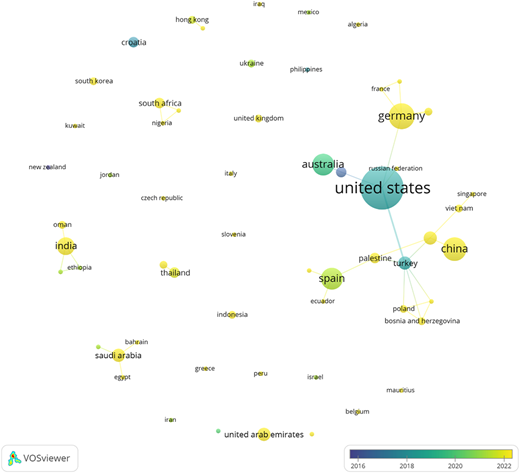
Figure 3 provides a visual representation of the global collaboration network for research in the field of OTSHE, mapping interactions among 59 countries. The collaboration network indicates a large cluster of 20 countries, with central nodes being the United States and Turkey. Smaller clusters also exist, such as one about India (four countries), another about Saudi Arabia (four countries) and a third about South Africa (three countries). Additionally, 24 countries, including Croatia, Italy, Indonesia, South Korea and Iran, undertake independent research undertakings with limited global engagement.
The yellow color coding in Figure 3 suggests that the majority of the countries entered this field of research relatively recently, as indicated by the prevalence of yellow nodes. This is after the significant rise in OTSHE publications between 2021 and 2023 (Figure 2). The United States and Turkey, also being the key collaboration centers, are the first contributors to OTSHE studies, with both of them entering the field from 2008 to 2014, respectively.
Despite the presence of collaborative clusters, Figure 3 detects the rather limited scope of global collaboration in OTSHE. Even the most active collaboration – between the United States and Turkey – has produced only two jointly authored articles. This reveals that OTSHE research is predominantly focused on national-level school environments, with relatively minor attention paid to transnational concerns. For example, only five of the United States’ 20 publications had cross-border collaboration, while Germany had four out of its ten publications and China had one out of nine. These findings indicate a need for increased cross-border collaboration to address global challenges in online teaching success in higher education.
Research community
The OTSHE research community between 2008 and 2023 consists of 344 authors, with 17 having two publications and 327 having a single publication. Table 2 presents the top ten authors ranked by both publication count and citation count.
Notably, all top ten authors in terms of publication count have only two publications each, and these were produced within a relatively short period. Only Baran Evrim and Correia Ana-Paula are present in both the top ten publication and top ten citation lists. These findings suggest a lack of a singularly dominant scholar within this research field at present.
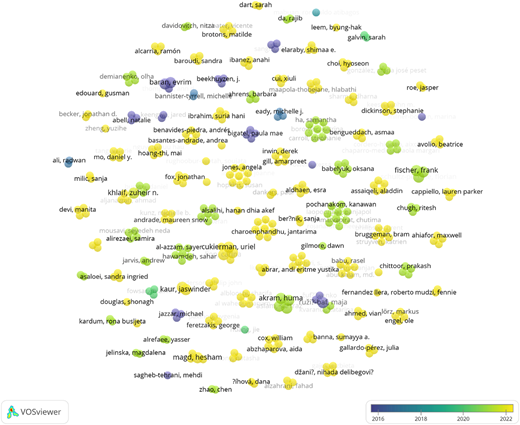
Figure 4 visualizes the evolution of the OTSHE research community from 2008 to 2023, revealing 108 research groups. Pochanakom Hanawan’s group boasts the largest membership with nine authors. About 18 groups comprise five or more members, while 18 authors are engaged in independent research. The node colors indicate that 42 authors (12.21%) joined the field before 2021, whereas 302 authors (87.79%) commenced their participation in 2021 or later. This corresponds to the sharp increase in publications observed between 2021 and 2023.
Collectively, these findings suggest a relatively nascent research community, lacking exceptionally prominent scientists at this juncture. Moreover, the community is characterized by small research groups and limited collaborative endeavors. This landscape presents an opportune environment for researchers seeking to enter and establish themselves within this burgeoning field.
Influence sources
About 86 publication sources have comprised the 115 articles in the OTSHE research domain. Table 3 identifies the top ten sources in terms of publication frequency. Among them, Education and Information Technologies is the most productive with four publications and 255 citations. It is followed by Computers in Human Behavior (three articles and 301 citations), Education Sciences (three articles and 16 citations) and International Journal of Information and Education Technology (three articles and six citations). In total, the top ten sources account for 28 publications (24.48% of the overall corpus). Additionally, 63 sources have issued a single publication under the OTSHE domain.
The scope of the top ten sources (Table 3) is similarly broad across academic disciplines. More specifically, these sources are categorized under education technology (four), e-learning (two), computer sciences (one), education sciences (one), language education (one) and chemical education (one). This distribution suggests that OTSHE researches are primarily in the domains of education technology, e-learning, computer sciences and education sciences, a testament to the field’s natural coupling of technology and pedagogy. In addition, the presence of specialist journals such as the Arab World English Journal and the Journal of Chemical Education indicates that interest in OTSHE extends beyond the usual educational technology and e-learning settings.
The spread of OTSHE literature across a range of sources is indicative of the absence of a large-scale publication outlet within the field. Currently, journals in the field of technology lead the way with the highest number of publications, a trend best explained by the exponential increase of distance learning in the COVID-19 pandemic and the urgent need to integrate new technologies into pedagogy (Jayatilleke et al., 2019; Lee et al., 2021). In the future, it is very important that researchers and publishers accord greater emphasis to the pedagogical dimensions of teaching in cyberspace, balancing the debate of technological progress and good pedagogies in higher education in the cyber age.
Research themes
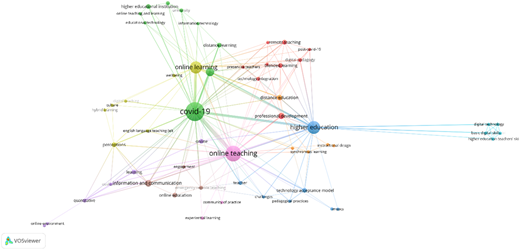
The study of OTSHE has evolved into a rich and multifaceted field, with research spanning nine key themes identified through co-word analysis (see Figure 5 and Appendix 1).
Teachers’ professional development theme examines frameworks for professional growth and evaluations of training programs.
Online teaching in the COVID-19 Context looks at the factors influencing online instruction, teachers’ pedagogical skills and the challenges and psychological impacts of transitioning to digital learning during the pandemic.
Adapting to the digital shift explores how educators and institutions adjusted to online learning, the acceptance of virtual teaching platforms and the broader impact of digital transformation on education.
Teachers’ perceptions theme delves into what makes online teaching successful, the barriers educators face, their level of engagement, pedagogical beliefs and the role of cultural factors.
Online testing and assessment theme explores issues such as grading practices, student achievement and strategies to support student learning in virtual environments.
Teachers’ digital skills theme focuses on how technological competencies impact online teaching effectiveness.
Educational technology is also a focus in teaching online with technology, including a discussion on the need for social presence in the online classroom, synchronous modes of delivery, the utilization of teaching platforms and even how social media can be utilized for teaching.
Online teaching in local contexts theme addresses and examines how online teaching develops in a particular country or region, e.g. India, Sri Lanka, Paraguay and Croatia.
Effective online teaching is a continuing trend that examines online learning assessment, success determinants, teacher pedagogical competence, student learning achievements and teachers’ challenges when teaching in a virtual classroom setting.
Overall, OTSHE research captures a wide range of perspectives, driven in large part by the rapid digital transformation of education during the COVID-19 pandemic. The shift from traditional face-to-face instruction to online learning accelerated research in areas such as digital adaptation, online teaching skills and the role of technology in education. Even though COVID-19 is no longer the driving force behind online learning, digital education continues to expand in higher education institutions worldwide. While some studies have begun to explore the long-term impact of online teaching beyond the pandemic, research on post-COVID-19 online education has yet to fully take shape as a distinct theme (Saleem et al., 2023). This gap in the literature presents an exciting opportunity for future research, suggesting that OTSHE will continue to evolve, adapt and grow in the years ahead.
Further research topics
Based on the nine OTSHE themes, full-text articles within each theme were downloaded and analyzed systematically to synthesize potential research directions that have been suggested. Appendix 2 summarizes possible future research directions within each of the thematic areas.
These recommendations point to a variety of research that can further develop the existing knowledge base along the identified themes. The findings of this synthesized learning go beyond university lecturers to other stakeholders, such as researchers, education administrators and policymakers. For lecturers, the findings provide practical insight for personal and professional growth, with evidence-based strategies for developing instructional practice in online teaching. For researchers, the proposed directions provide opportunity for development of scholarly research and for progressing gaps within the existing literature. For school administrators and policymakers, the findings could guide policy development for faculty promotion and addressing the changing needs of higher education.
For example, Woodlands and Dart (2023) highlight that brief, just-in-time teacher development workshops carried out during the COVID-19 pandemic were instrumental in scaling up teachers’ confidence in integrating technology and pedagogy, which eventually led to heightened student engagement.
These results portray the practical advantages of professional development, justifying the importance of ongoing engagement with such activities in order to facilitate effective online teaching. Future researchers can explore longitudinal studies to establish the long-term influence of professional development programs on online teaching post-pandemic.
Alongside, how effective these programs prove to be may guide administrative decisions regarding sustaining online modes of learning and how to best facilitate the participation of teachers in ongoing staff development – through self-directed channels or institution-based training programs. At the policy level, these results can be used by education administrators to create teacher development plans in the long run that are coherent with institutional development plans and the particular professional competencies needed for effective online teaching. Through the creation of a strategic plan for faculty development, institutions can be assured that educators continue to be provided with the expertise needed to operate in changing digital learning environments to improve student learning outcomes.
Conclusion
The rapid advancement of digital technology, further accelerated by the COVID-19 pandemic, has significantly propelled the growth of OTSHE. This research employs a hybrid methodology, combining bibliometric and content analysis of 115 Scopus- and Web of Science-indexed articles (2008–2023), to investigate the evolution of OTSHE research. Findings indicate limited scholarly attention to OTSHE prior to the pandemic, which subsequently acted as a catalyst for a surge in publications and the emergence of new research groups. Despite this growth, the field remains dispersed without a clearly dominant group of scholars and international collaboration is underdeveloped, with most studies focusing on country-specific contexts, despite the prominence of the United States, Germany and China. Furthermore, the analysis reveals a research gap, with prevailing publication sources emphasizing technological aspects of online learning over pedagogical dimensions, highlighting the necessity for further investigation into instructional methodologies, engagement strategies and learning outcomes in online education.
By using co-word analysis, the research identified nine salient research themes in OTSHE and suggested possible research topics for each of the themes. The findings have important implications for stakeholders. For lecturers, the research offers evidence-based solutions to teaching quality improvement and professional development. For researchers, the findings offer future research guidelines and fill literature gaps. For educational leaders and policymakers, the research offers evidence-based information to guide policy and program development aimed at faculty development and online teaching practice optimization according to institutional and contextual demands.
Through integrating current knowledge and identifying possible future research directions, this research informs continued development of OTSHE in a way that balances technological advancement with pedagogical efficacy, enabling online education to continue to grow.
This research project is supported by the Vietnam Ministry of Education and Training, titled “Research on Changes in the Higher Education Environment in the Context of University Autonomy” (No: B2024-TNA-04).
References
The supplementary material for this article can be found online.