


This study examines how Generative Artificial Intelligence (GenAI) tools shape students' perceptions and acceptance in fashion product development courses, comparing mentor-supported team-based and individual learning contexts. It aims to inform educators on effective strategies for integrating GenAI to enhance Artificial Intelligence literacy and career readiness in creative disciplines.
A quasi-experimental mixed-methods design was implemented across two undergraduate courses. Students used ChatGPT 3.5 (text generation) and Bing Image Creator (visual ideation) in experiential assignments guided by the IDEE framework and social constructivist principles. Quantitative data were analyzed using ANCOVA to compare post-test perceptions between mentor-supported team and individual groups, controlling for pre-test scores. Thematic analysis of student reflections provided qualitative insights into perceptions of GenAI's usefulness, availability, and ethical implications.
Students in mentor-supported teams reported higher perceptions of career readiness, learning support, and availability for text-based GenAI compared to those working individually. While image-based GenAI supported ideation, students expressed concerns about reliability and visual fidelity. Qualitative data reinforced that mentorship and collaboration increased confidence and fostered reflective engagement with GenAI.
Integrating UTAUT, social constructivism, and the IDEE framework, this study offers one of the first empirical examinations of GenAI use in fashion education. It highlights how structured, mentor-supported collaboration promotes meaningful GenAI adoption and provides a model for embedding ethical, experiential learning in creative curricula.
Introduction
Technology has become a driving force transforming the fashion industry, demanding that future professionals demonstrate flexibility and readiness to adopt emerging tools. Currently, this transformation is led by Generative Artificial Intelligence (GenAI), a key innovation reshaping creative processes, content development, and design efficiency across the apparel supply chain (Kohli, 2025; Chan et al., 2022; Harreis et al., 2023).
As GenAI capabilities expand, fashion professionals and students must not only learn to use these tools but also cultivate ethical and critical awareness of their implications. While GenAI supports ideation, research, and design, it raises concerns regarding academic integrity, bias, and overreliance (Rasul et al., 2023). Meaningful integration therefore requires pedagogical approaches that promote responsible, reflective engagement.
Despite growing industry adoption, barriers persist, including limited strategic alignment, uneven leadership support, and insufficient AI competencies (Chui and Malhotra, 2018; Wang et al., 2023). Existing studies highlight the importance of organizational culture and capability in technology adoption (Galbraith, 2014; Yan et al., 2022), yet little research addresses how fashion education can prepare students to use GenAI responsibly and effectively.
This study responds to that gap by introducing a constructivist, mentor-guided framework for integrating GenAI into fashion curricula. It examines how individual and mentor-supported team learning environments influence students' perceptions of GenAI's usefulness, creativity, and ethical engagement, providing insights into how social and instructional dynamics shape technology adoption within fashion education.
Literature review
AI and GenAI in fashion product development
Artificial Intelligence (AI) and Generative AI (GenAI) are transforming the fashion industry by enhancing creativity, efficiency, and data-driven decision-making. In product development, GenAI supports designers in trend forecasting, customer profiling, and visual ideation, analyzing large datasets to inform design and streamline production (Chan et al., 2022; Gill et al., 2022; Verganti et al., 2020).
As product development in fashion involves iterative stages, including research, ideation, prototyping, and finalization, GenAI tools have become valuable collaborators. They help create brand-aligned, trend-conscious products for target markets while maintaining the designer's creative intent. While AI may not replicate human intuition, it can be tailored to support domain-specific workflows and enhance design quality (Dubey et al., 2020; Wang et al., 2023). Advances in Generative Adversarial Networks (GANs) and image generators (Goodfellow et al., 2020; Choi et al., 2023) now allow designers to produce original imagery from text or visual prompts using tools like Adobe's GenAI and Canva's Magic Studio (West and Burbano, 2020).
Beyond workflow acceleration, GenAI can enhance consumer engagement and perceived product value (Sohn et al., 2020). However, adoption depends on user acceptance (Davis, 1989) and developing the skills to use these tools critically. Although many students are considered “Digital Natives” (Margaryan et al., 2011), GenAI requires new competencies in prompting, evaluating, and refining machine-generated outputs with ethical awareness.
GenAI in education and AI literacy through a constructivist lens
GenAI is reshaping education as profoundly as it is transforming creative industries (Dwivedi et al., 2022; Mhlanga, 2023). Fashion education must therefore equip students not only to use GenAI tools but also to understand their creative, ethical, and professional implications (Li et al., 2019).
From a social constructivist perspective, learning occurs through interaction with peers, tools, and contexts (Taber, 2011). In this framework, GenAI acts as a mediator for learning and creativity, ncouraging experimentation, reflection, and collaboration. Students shift from a “search” mindset to a “prompting” mindset, co-constructing knowledge through iterative engagement (Hwang and Chen, 2023).
AI literacy extends beyond technical competence to include critical evaluation of outputs, awareness of bias, and ethical responsibility (Yi, 2021; Mhlanga, 2023). Intentional, constructivist integration of GenAI enables students to develop these skills, positioning them as adaptive, ethical innovators prepared to navigate an evolving fashion industry.
Research opportunity and theoretical framework
This study explores how to effectively integrate GenAI into fashion education, addressing the need for instructional strategies that build AI literacy and prepare students for increasingly digitalized careers. It investigates how students perceive text-based and image-based GenAI tools when used individually versus collaboratively in mentor-supported teams during product development tasks.
The Unified Theory of Acceptance and Use of Technology (UTAUT) (Venkatesh et al., 2003) provides the theoretical foundation, identifying four determinants, performance expectancy, effort expectancy, social influence, and facilitating conditions, that predict users' intention to adopt technology. This model is adapted for fashion education to include ethical and emotional concerns and the moderating role of mentor-guided collaboration (see Figure 1). Team-based learning is conceptualized as a mechanism that enhances perceived usefulness, ease of use, and career relevance through social reinforcement, modeling, and shared problem-solving.
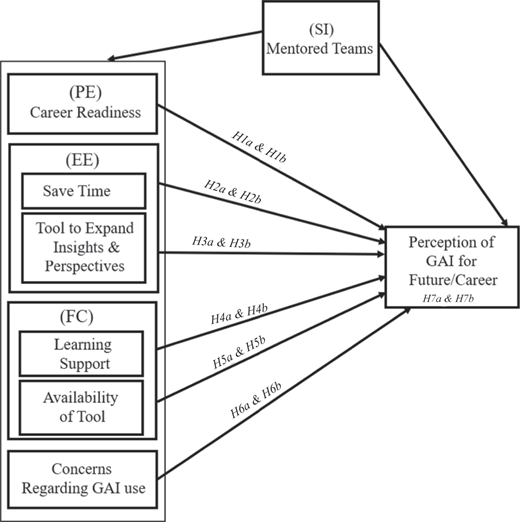
Grounded in social constructivism (Vygotsky and Cole, 1978) and social learning theory (Bandura, 1991), the framework posits that knowledge and confidence develop through interaction with peers and mentors. In this study, mentors provided evaluative feedback on GenAI-assisted work, linking student experimentation with professional expectations. This structure encouraged independent exploration within a socially supported environment.
Mentor-guided teamwork created facilitating conditions, access to feedback, expertise, and dialogue that reduced ethical uncertainty and supported responsible use. Collectively, these mechanisms explain how collaborative, mentored learning amplifies GenAI's perceived benefits, shaping students' behavioral intentions to integrate GenAI in future academic and professional contexts.
Mechanistic relationships between variables
Social influence and mentored team-based learning
Collaborative learning environments amplify social influence (SI) through peer modelling, shared prompting, and observational learning, mechanisms shown to enhance confidence and technology acceptance (Lehtinen, 2003; Falk and Ichino, 2006; Sarker and Valacich, 2010). Lehtinen (2003) emphasizes that collaboration fosters shared cognition and mutual scaffolding, enabling learners to co-construct understanding through interaction and feedback. Falk and Ichino (2006) similarly demonstrate that social proximity and cooperation heighten engagement and performance by leveraging social norms and accountability. Collectively, these frameworks suggest that team-based collaboration not only facilitates skill exchange but also shapes shared norms of competence, reinforcing both confidence and acceptance of emerging tools.
In team-based fashion projects, these dynamics are expected to emerge as students collaboratively explore GenAI, developing design concepts, refining visuals, and sharing prompt strategies. Such interactions are anticipated to foster vicarious learning (Bandura, 1991), where observing peers' successes increases perceived competence and normalizes GenAI as a legitimate tool for creative exploration. As Sarker and Valacich (2010) suggest, these exchanges are likely to establish shared beliefs about effective technology use, thereby strengthening both confidence and perceived utility.
Mentors are expected to play a complementary role by providing evaluative feedback rather than modeling GenAI use directly. Their critique mirrors professional practice, validating GenAI-assisted outcomes while maintaining student autonomy. In this way, mentors serve as contextual validators, bridging collaborative learning with industry standards and reinforcing the legitimacy of GenAI integration within fashion education.
Career readiness (performance expectancy)
In the UTAUT model, performance expectancy (PE) represents the belief that technology enhances task performance and achievement of valued goals (Venkatesh et al., 2003). In fashion education, this translates to career readiness, students' perception that GenAI use builds the digital fluency and competencies essential for success in a rapidly evolving industry.
Artificial intelligence and related technologies, such as augmented reality, robotics, and big data, are transforming fashion across design, production, and marketing (Harreis et al., 2023). This shift highlights the need for curricula that align with industry demands. Kohli (2025) found that current undergraduate fashion programs lack sufficient AI-related training, emphasizing the urgency of developing AI literacy and adaptability.
Team-based learning helps bridge this gap by allowing students to apply GenAI collaboratively in tasks that reflect real-world design and product development. Shared exploration fosters understanding of how AI enhances efficiency, innovation, and data-informed decision-making. Mentor feedback reinforces these insights by framing student work within professional standards, validating GenAI as a credible and valuable tool for career preparation (Jones et al., 2021; Kohli, 2025).
Effort expectancy: time-saving and data processing
Effort expectancy (EE) refers to the perceived ease of using a system (Venkatesh et al., 2003). In this study, it reflects how intuitive and efficient students find GenAI tools for design and product development. When these tools are easy to learn and time-saving, students are more likely to adopt them in future academic and professional contexts.
Team-based learning can lower individual effort by enabling students to share prompting strategies, observe peers, and troubleshoot collectively, making GenAI feel more accessible and manageable. Duong et al. (2024) found that perceptions of ease and usefulness reinforce one another, increasing intention to use tools like ChatGPT. Memmert et al. (2025) similarly observed that GenAI users reallocate effort toward refining outputs rather than reducing overall investment, suggesting that ease includes the ability to guide AI effectively.
Mentor feedback in this study emphasized outcome evaluation rather than technical skill, fostering confidence and exploration. Combined, collaboration and feedback are expected to strengthen perceptions of GenAI as approachable and efficient.
Effort expectancy: expanding insights and perspectives
GenAI broadens creative thinking by providing access to extensive information, visual inspiration, and trend data beyond traditional design methods. When used collaboratively, it encourages students to explore diverse ideas, share interpretations, and build on peers' insights, enhancing critical thinking and innovation within teams.
Team-based learning helps students see GenAI as a catalyst for creativity rather than a replacement for human imagination. Through shared experimentation and reflection, they learn to use GenAI for inspiration and problem-solving. Mentor feedback reinforces this process by guiding students to refine and assess AI-generated ideas through a professional lens, linking creativity with practical application in fashion contexts (Kanbach et al., 2023).
These experiences help students view GenAI as a source of expanded insight and creative opportunity that strengthens both individual and collective design capability.
Facilitating conditions: support and availability
Facilitating conditions (FC) refer to the environmental and institutional supports that enable effective technology use (Venkatesh et al., 2003). In this study, they encompass access to tools, feedback, and learning environments that help students engage confidently with GenAI. When supported through structured guidance and readily available resources, students are more likely to adopt and apply new technologies meaningfully.
Team-based learning creates an immediate support network for idea exchange, collective problem-solving, and shared approaches to GenAI use, helping to normalize technology adoption and lower learning barriers. Mentors strengthen these conditions by providing evaluative feedback and professional validation, demonstrating that experimentation with AI aligns with industry practice. Together, peer collaboration and expert guidance cultivate an encouraging environment that promotes both learning and sustained GenAI adoption.
Concerns regarding GenAI use
While GenAI offers creative and practical advantages, it also raises concerns about originality, authorship, and overreliance (Yau and Chan, 2023; Rudolph et al., 2023). Students may question whether using AI-generated outputs undermines creativity or academic integrity, particularly in fashion, where design identity is integral. Addressing these concerns is vital to fostering responsible AI literacy in the curriculum.
Collaborative learning environments create opportunities for discussion and reflection, enabling students to examine the ethical dimensions of GenAI use collectively. Through dialogue, they develop shared understandings of appropriate application. Mentors reinforce this process by providing feedback on AI-assisted outcomes, prompting students to consider issues of attribution, originality, and authenticity in their design work. This guided reflection helps position GenAI as a supportive tool rather than a shortcut, easing uncertainty and promoting ethical, reflective engagement.
Behavioral intention
In UTAUT, behavioral intention reflects an individual's motivation to engage with a technology based on its perceived value and applicability (Venkatesh et al., 2003). In this study, it represents students' perceptions of GenAI's relevance to their future careers rather than their intention to continue using it. Through mentor-guided, team-based projects, students experience GenAI as both a creative resource and a professional tool, allowing them to evaluate its role within real-world fashion industry practices.
The experiential, project-based structure enables students to connect classroom experimentation with professional expectations (Jones et al., 2021). Collaborative exploration and mentor feedback help students critically assess how GenAI supports design innovation, efficiency, and ethical practice which are key competencies for career readiness.
Methodology
This study was conducted in two undergraduate fashion courses: Product Development I (mentored teams) and Product Development II (individual use of GenAI), to explore the impact of GenAI tools on student perceptions. Both courses include semester-long product development projects, broken into smaller assignments. Students in Product Development I collaborated in teams with industry mentors, while those in Product Development II completed similar tasks independently, allowing for a comparison of mentored teams versus individual GenAI use.
Freely available GenAI tools, ChatGPT 3.5 for text generation and Bing Image Creator for visuals. were used to simulate easily available, real-world applications. Each course had 26 students (n = 52 total) with no students overlapping both courses, providing balanced cohorts for team and individual settings.
Data collection
A quasi-experimental, mixed-methods approach was used to examine students' perceptions of GenAI before and after engaging with text-based and image-based tools. This design enabled comparison between mentored team-based and individual learning groups while accounting for practical limitations in random assignment, as course enrollment could not be controlled by the researcher (Reichardt, 2019).
Quantitative data were collected through pre- and post-test surveys using a five-point Likert-type scale (1 = strongly disagree; 5 = strongly agree). The same instrument was administered before and after the GenAI-integrated assignments to assess changes in student perceptions. Survey items were adapted from Chan and Hu (2023), who examined student attitudes toward GenAI in educational contexts. The measures were aligned with UTAUT constructs, including performance expectancy, effort expectancy, social influence, facilitating conditions, and ethical concerns, to capture perceptions specific to GenAI use in fashion education rather than general technology acceptance.
Qualitative data were collected through end-of-semester written reflections, in which students described their experiences using GenAI tools, perceived benefits and challenges, and anticipated future use. These reflections provided context for interpreting quantitative findings and offered deeper insight into how students engaged with GenAI throughout their course.
Participation in surveys and reflections was part of the course requirements; however, inclusion in the study was voluntary. Responses from students who consented to participate were anonymized prior to analysis. Using both quantitative and qualitative methods provided a richer and more comprehensive understanding of how experiential, mentor-guided learning shaped students' perceptions of GenAI (Creswell, 2018).
Participants
Eligible participants were Sophomore, Junior, or Senior Fashion Merchandising majors enrolled in the selected courses at the participating institution. Freshmen, graduate students, and non-majors were excluded due to course prerequisites. A screening survey ensured all participants met eligibility criteria. The sample consisted entirely of female students between the ages of 20 and 22, creating a relatively homogeneous group.
Each group (mentored team and individual) included 26 students, meeting the recommended minimum of 20 participants per group for MANOVA analysis. Because the study was conducted within a single semester, no students overlapped between groups, yielding a total sample of 52 participants. This design enabled comparison of how collaborative versus individual learning contexts influenced the use of GenAI tools.
Ethical considerations
The study received IRB approval, and all procedures followed institutional guidelines for data privacy and security. Students were fully informed about the study's purpose, procedures, and voluntary participation. Data were anonymized to protect identities, and informed consent was obtained in accordance with IRB protocols.
Experience-based pedagogy and GenAI integration
This study employed an experiential learning approach grounded in social constructivist theory, which emphasizes that knowledge is actively constructed through interaction with tools, environments, and peers (Taber, 2011). By engaging students in semester-long product development projects that mirror real-world industry processes, the coursework encouraged applied learning, critical thinking, and collaboration.
Experience-based pedagogy is well established in fashion education, especially when introducing industry technologies such as VR, CAD, and 2D/3D design systems (Kazlacheva et al., 2018; Lee et al., 2021). Building on this foundation, freely available GenAI tools: ChatGPT 3.5 for text generation and Bing Image Creator for visual ideation, were integrated into assignments to simulate real-world design applications. Students used these tools to explore market trends, develop concepts, and refine visual presentations in both mentored team-based and individual learning environments. In this setting, GenAI served not only as a creative tool but also as a collaborative learning partner, facilitating dialogue, prompting inquiry, and supporting reflective design thinking (Zhou and Schofield, 2024). This pedagogical approach aligns with constructivist principles that view technology as a mediator of knowledge construction, supporting iterative cycles of ideation, critique, and innovation central to contemporary fashion practice.
To guide this integration and ensure ethical, pedagogically sound application, the study adopted the IDEE framework (Su and Yang, 2023), which provides a structured approach for aligning AI tools with learning outcomes, automation levels, ethical engagement, and evaluation processes.
Identify desired learning outcomes (e.g. AI literacy, creativity, career readiness),
Determine the level of automation appropriate for student learning,
Ensure ethical use and promote responsible engagement, and
Evaluate effectiveness through reflection and assessment.
By applying the IDEE framework, GenAI was positioned as a tool for exploration, critical inquiry, and ethical engagement rather than as a shortcut (Rudolph et al., 2023). This structure ensured that experiential, mentor-guided learning remained purposeful and reflective, providing a pedagogically sound foundation for integrating GenAI into fashion education.
Assignments
Three key assignments, Brand Profile, Customer Profile, and Trend & Concept Board, were selected to integrate GenAI tools into the product development curriculum. These tasks aligned with prior coursework, allowing students to refine familiar skills while exploring GenAI applications.
For the Brand and Customer Profile tasks, students used ChatGPT 3.5 to generate and refine text related to brand identity, target demographics, and consumer insights. They evaluated the accuracy and tone of AI-generated content, addressed ethical considerations such as bias or misinformation, and revised outputs to align with professional standards.
In the Trend & Concept Board project, students used Bing Image Creator to produce visual inspiration that reflected brand positioning and seasonal themes. The task emphasized both the creative potential and practical limitations of image-based AI, encouraging students to assess when and how AI-generated visuals could appropriately support design work.
Across all assignments, the IDEE framework (Su and Yang, 2023) guided learning by prompting students to identify goals, determine the appropriate role of AI, ensure ethical engagement, and evaluate effectiveness through reflection. These projects offered structured, low-risk opportunities for students to experiment with GenAI as a collaborative and ethical design resource.
Data analysis
Quantitative analysis
Quantitative data from pre- and post-test surveys were analyzed using analysis of covariance (ANCOVA) in SPSS, with pre-test scores entered as covariates to control for baseline differences between the mentored team-based and individual learning groups (Reichardt, 2019). This approach compared post-test means across constructs aligned with the revised UTAUT model (see Figure 1), including performance expectancy, effort expectancy, social influence, facilitating conditions, and ethical concerns.
Assumptions of linearity, homogeneity of regression slopes, and equality of variances were met. Minor deviations from normality detected by the Shapiro–Wilk test were considered acceptable given the ordinal nature of Likert-scale data and the robustness of ANCOVA to such violations (Mertler et al., 2021).
Qualitative analysis
The qualitative dataset included 52 student reflections, 26 from the mentored team-based cohort and 26 from the individual cohort, each averaging about 1,200 words. The reflections examined students' experiences using text- and image-based GenAI tools and their perspectives on future professional applications.
The qualitative analysis followed the thematic analysis approach outlined by Nowell et al. (2017), ensuring a systematic and transparent process for identifying and interpreting patterns within the data. The analysis involved iterative phases of familiarization, coding, theme development, review, and refinement. Initial coding was conducted manually in Microsoft Excel by the lead researcher to capture recurring ideas and language use, with a secondary coder reviewing the dataset to ensure consistency and credibility. A codebook was developed and refined throughout the process through memo writing and coder discussions, supporting a clear audit trail of analytic decisions. Reflexive notes were maintained to account for the researcher's dual role as instructor and analyst, enhancing transparency and trustworthiness.
This process generated three overarching themes: the efficacy of text-based GenAI, the limitations of image-based GenAI, and the anticipated future applications of GenAI in fashion contexts. These qualitative themes were then used to triangulate with the quantitative findings, providing deeper insight into how mentor-supported teamwork influenced students' perceptions across the constructs measured in the adapted UTAUT framework.
Results
Quantitative findings
A one-way analysis of covariance (ANCOVA) was conducted to compare post-test perceptions of GenAI between the mentored team-based and individual learning groups, controlling for pre-test scores (Reichardt, 2019). All assumptions were satisfied, and the ANCOVA was considered robust to minor non-normality in Likert-scale data (Mertler et al., 2021).
As shown in Table 1 below, students in the mentor-supported team-based group reported significantly higher post-test scores for career readiness (H1a) (p < 0.001), learning support (H4a) (p = 0.042), and tool availability (H5a) (p = 0.004) when using text-based GenAI tools. No significant group differences were found for effort expectancy (H2a), expanded insights (H3a), ethical concerns (H6a), or future use intentions (H7a). For image-based GenAI, no statistically significant differences were observed across constructs, though small positive trends emerged for career readiness (H1b) and lower ethical concerns (H6b) among team-based learners.
ANCOVA for perceptions of GenAI Tools: Team vs. Individual
| Control (Individual) | Treatment (Team) | SD | F | df | p | Partial Eta2 | |
|---|---|---|---|---|---|---|---|
| M | M | ||||||
| Text-based tools | |||||||
| Career Readiness | 3.931 | 4.292 | 0.4921 | 4.772 | 1 | <0.001* | 0.089 |
| Saves Time | 4.190 | 4.380 | 0.4570 | 1.053 | 1 | 0.310 | 0.021 |
| Expand Insights and Perspectives | 3.936 | 4.192 | 0.5564 | 2.213 | 1 | 0.143 | 0.043 |
| Learning Support | 3.942 | 4.269 | 0.5363 | 4.346 | 1 | 0.042* | 0.081 |
| Availability of Tool | 3.850 | 4.380 | 0.6760 | 9.150 | 1 | 0.004* | 0.157 |
| Concerns Regarding Text-based GenAI | 3.526 | 3.401 | 0.6572 | 2.411 | 1 | 0.127 | 0.047 |
| Perception for Future/Career | 3.769 | 3.654 | 1.0312 | 0.893 | 1 | 0.349 | 0.018 |
| Image-based tools | |||||||
| Career Readiness | 3.262 | 3.633 | 0.7716 | 1.081 | 1 | 0.304 | 0.022 |
| Saves Time | 3.380 | 3.520 | 1.045 | 0.017 | 1 | 0.896 | 0.000 |
| Expand Insights and Perspectives | 3.558 | 3.385 | 0.9257 | 0.450 | 1 | 0.506 | 0.009 |
| Learning Support | 3.192 | 3.380 | 1.001 | 0.162 | 1 | 0.689 | 0.003 |
| Availability of Tool | 3.580 | 3.760 | 0.8410 | 0.249 | 1 | 0.620 | 0.005 |
| Concerns Regarding Image-based GenAI | 3.484 | 3.322 | 0.5565 | 3.796 | 1 | 0.057 | 0.072 |
| Perception for Future/Career | 3.327 | 3.539 | 0.7782 | 0.002 | 1 | 0.968 | 0.000 |
Note(s): p < 0.05, Analyses were conducted using ANCOVA with pre-test scores entered as covariates to control for baseline differences between mentored team-based and individual learning conditions. Reported values include adjusted means, F statistics, p values, and partial η2 effect sizes
Overall, the findings provide partial support for the proposed hypotheses. Mentor-guided team-based learning was associated with significantly higher perceptions of text-based GenAI for career readiness, learning support, and tool availability, while no significant differences were observed for image-based GenAI or for perceptions of ease of use, expanded insights, responsible use concerns, or future career relevance. These results suggest that mentorship and collaboration enhance the perceived value and accessibility of text-based GenAI, whereas students' broader acceptance and future intentions may be more strongly shaped by direct experience with the tools themselves (Venkatesh et al., 2003; Lakhal et al., 2013).
Table 2 summarizes the results of each hypothesis test and indicates whether the hypothesis was supported based on the ANCOVA findings reported in Table 1.
Summary of hypothesis testing results for perceptions of GenAI tools
| Hypothesis | Outcome variable | GenAI type | Direction hypothesized | ANCOVA result (p) | Supported |
|---|---|---|---|---|---|
| H1a | Career Readiness | Text-based | Team > Individual | <0.001 | Yes |
| H1b | Career Readiness | Image-based | Team > Individual | 0.304 | No |
| H2a | Saves Time (Ease of Use for Creative Development) | Text-based | Team > Individual | 0.310 | No |
| H2b | Saves Time (Ease of Use for Creative Development) | Image-based | Team > Individual | 0.896 | No |
| H3a | Expand Insights and Perspectives | Text-based | Team > Individual | 0.143 | No |
| H3b | Expand Insights and Perspectives | Image-based | Team > Individual | 0.506 | No |
| H4a | Learning Support | Text-based | Team > Individual | 0.042 | Yes |
| H4b | Learning Support | Image-based | Team > Individual | 0.689 | No |
| H5a | Availability of Tool | Text-based | Team > Individual | 0.004 | Yes |
| H5b | Availability of Tool | Image-based | Team > Individual | 0.620 | No |
| H6a | Concerns Regarding Responsible Use | Text-based | Team < Individual | 0.127 | No |
| H6b | Concerns Regarding Responsible Use | Image-based | Team < Individual | 0.057 | No |
| H7a | Perception for Future/Career | Text-based | Team > Individual | 0.349 | No |
| H7b | Perception for Future/Career | Image-based | Team > Individual | 0.968 | No |
Note(s): Hypotheses were evaluated at α = 0.05. Supported hypotheses indicate statistically significant differences between team- and individual-based GenAI use after controlling for pre-test scores
Qualitative findings
Thematic analysis of student reflections provided context for interpreting the quantitative outcomes and further addressing the study's hypotheses. Three key themes emerged (see Table 3 below): (1) efficacy of text-based GenAI, (2) limitations of image-based GenAI, and (3) future applications of GenAI in fashion practice.
Summary of qualitative themes from student reflections
| Theme | Description | Linked hypotheses | Representative student perspectives |
|---|---|---|---|
| Efficacy of text-based GenAI | Students found ChatGPT valuable for developing brand and customer profiles, generating concepts, and clarifying ideas | H2a/H2b, H3a/H3b, H5a/H5b | Participant A: “GenAI is able to help create fresh ideas that I may not have thought of myself. Also, it can immediately create a professionally written, clear brand profile. This saves time and makes it easier to clearly identify the brand profile.” |
| Participant B: “I would use ChatGPT again because was a useful resource to create an accurate brand profile with our own information.” | |||
| Limitations of image-based GenAI | Students noted creative potential but low accuracy in AI-generated visuals, reducing usefulness for fashion-specific tasks | H3bH4b | Participant C: “I used it for our brand logo. It does not create words so it was not super helpful, but it did give me a good starting point and I used it for brainstorming. I would use it again for logo inspiration; but honestly, I would probably end up just skipping that step all together and starting from scratch on my own. It seems to require more input and effort than what I get out.” |
| Participant D: “I thought the photos looked faked and overly generated.” | |||
| Participant E: “Not necessarily, only because the images were not very accurate and they looked a bit distorted.” | |||
| Participant F: “No I would not because they often come out distorted and inaccurate. Unless I was looking for a relatively simple image with specific colors in it then maybe I would but I would not initially expect the image to meet what I am looking for.” | |||
| Future applications of GenAI | Students viewed GenAI as a valuable future tool for career development but stressed ethical awareness and creativity | H6a/H6b, H7a/H7b, H8a/H8b | Participant G: “In the future I imagine using this tool within my job in order to write email or help with presentations. It is also useful in daily life for simple questions or problem solving. As the technology become more advanced I think things like Bing Image creator will be more specific and realistic which could be used in the future to create a photo of target customers without the flaws.” |
| Participant H: “I really believe that it is very useful source as long as it is kept under control. It is reflection of ones idea but more detailed, however it is easy to get too caught up with it. My biggest concern is that it is very easy that the students might get too reliant on the GenAI tools.” |
Note(s): Themes derived from open and axial coding of 52 student reflections
Theme 1 – efficacy of text-based GenAI (supports H2a/H2b, H3a/H3b, and H5a/H5b)
Students reported that ChatGPT facilitated idea generation, writing tasks, and brand positioning, enhancing perceived usefulness (performance expectancy) and ease of use (effort expectancy). Many noted that GenAI reduced cognitive load and saved time, aligning with the quantitative finding that team-based learning increased perceptions of learning support.
Theme 2 – limitations of image-based GenAI (challenges H3b and H4b)
Students found Bing Image Creator engaging but inconsistent for fashion-specific outputs. They cited issues such as distorted visuals and lack of garment realism, tempering perceived usefulness and creativity benefits (performance expectancy and expanded insights). This supported the non-significant quantitative differences for image-based GenAI.
Theme 3 – future applications and ethical engagement (supports H6a/H6b, partially H7a/H7b, and H8a/H8b)
Students expressed optimism about GenAI's future relevance for fashion design and communication, emphasizing its constant availability and value as a creative collaborator (facilitating conditions). At the same time, they voiced concerns about originality and overreliance, offering partial support for hypotheses related to ethical considerations (H6) and perceived career applicability of GenAI (H7).
Discussion
This study examined how mentor-guided, team-based learning influences fashion students' perceptions of Generative AI (GenAI) tools within product development contexts. Drawing on the Unified Theory of Acceptance and Use of Technology (UTAUT), social constructivism, and the IDEE framework, the research explored how collaboration, mentorship, and experiential learning shape perceptions of GenAI's usefulness, accessibility, and responsible application in fashion education.
Findings suggest that students' perceptions of GenAI were shaped most strongly by performance expectancy and facilitating conditions, confirming that perceived usefulness and environmental support are central to technology acceptance (Venkatesh et al., 2003). Within mentor-supported teams, students viewed GenAI as a credible and accessible resource that enhanced their readiness for technology-driven fashion careers. Mentor feedback, provided in an evaluative rather than prescriptive manner, helped contextualize GenAI's relevance to professional standards, reinforcing its legitimacy as a learning and career development tool (Kohli, 2025).
Learning support, effort, and career relevance
Students' reflections highlighted that text-based GenAI effectively supported ideation, organization, and writing tasks, strengthening perceptions of both effort expectancy and career readiness. These findings align with Duong et al. (2024), who observed that efficiency and perceived utility jointly predict positive attitudes toward AI tools. In contrast, image-based GenAI elicited mixed perceptions as students recognized its potential for inspiration but expressed frustration with output quality and control, emphasizing that perceived usefulness depends on the tool's fit with creative tasks.
Facilitating conditions, particularly GenAI's 24-h accessibility and the structured support provided by mentors, emerged as critical in shaping positive perceptions. Students noted that immediate access to tools, paired with constructive feedback, increased confidence and reduced uncertainty. This emphasizes that human and institutional supports surrounding technology integration are as essential as the tools themselves.
Ethical engagement and professional awareness
Although ethical concerns persisted, mentor-guided collaboration fostered constructive reflection rather than avoidance. Students engaged in discussions around originality, attribution, and appropriate use, consistent with the IDEE framework's emphasis on balancing creativity with accountability (Su and Yang, 2023). Rather than diminishing ethical concern, the mentor-supported context reframed it as part of developing professional judgment, encouraging students to view GenAI as a creative partner rather than a shortcut.
Theoretical and pedagogical implications
By integrating UTAUT with experiential and social learning perspectives, this study extends technology adoption theory into creative education. The findings indicate that mentor-guided collaboration enhances key determinants of acceptance, not merely by improving ease of use or perceived utility, but by embedding those perceptions within reflective, relational learning environments.
Pedagogically, the results suggest that GenAI integration in fashion education should emphasize guided experimentation, feedback, and ethical reflection rather than unstructured tool use. The IDEE framework provides a practical foundation for designing such learning experiences, ensuring that GenAI serves as a scaffold for creativity, critical thinking, and professional readiness rather than a replacement for human ingenuity.
Conclusion
This study advances understanding of how mentor-guided, team-based learning shapes fashion students' perceptions of Generative AI (GenAI) within product development contexts. Integrating the Unified Theory of Acceptance and Use of Technology (UTAUT), social constructivism, and the IDEE framework, the research offers a theoretically grounded perspective on how collaboration, mentorship, and experiential learning influence perceptions of GenAI's usefulness, accessibility, and ethical application in fashion education.
Findings indicate that students' perceptions were most strongly influenced by performance expectancy and facilitating conditions, suggesting that perceived career relevance and accessible support systems are central to how learners evaluate GenAI's educational value. Mentor-supported teamwork fostered structured reflection and feedback, helping students view GenAI as a credible and professionally relevant learning resource. In contrast, mixed experiences with image-based tools highlight the need for more intentional integration strategies within creative disciplines, where visual accuracy, authorship, and originality remain central to design practice.
Theoretically, the study contributes to extending UTAUT within creative disciplines by contextualizing social influence and facilitating conditions through mentor-supported constructivist learning. Pedagogically, it underscores the importance of experiential, ethically guided learning environments that build AI literacy and professional readiness. Methodologically, it demonstrates a mixed-methods approach capable of capturing both measurable shifts in perception and the nuanced reflections underlying those changes. Collectively, these contributions position this study as a framework for integrating GenAI ethically and effectively not only in fashion education but across a wider range of creative and design-focused disciplines.
Limitations
This study has several limitations. The sample size was relatively small (n = 52) and demographically homogeneous, consisting of women aged 19–22 from a single institution, which limits the generalizability of the findings. The exclusive use of freely accessible GenAI tools, while reflecting availability and equity, may not represent the capabilities of professional-grade platforms. The short-term duration (one semester) limited the assessment of long-term adoption or skill retention. Additionally, demographic factors such as prior AI experience, learning preferences, and digital literacy were not analyzed, potentially influencing student perceptions and outcomes.
Future research
Future research should adopt longitudinal designs to examine how sustained engagement with GenAI influences students' creativity, design processes, and digital fluency over time. Comparative studies between free and commercial GenAI tools could reveal how access, cost, and technological sophistication affect learning outcomes and ethical decision-making. Investigations into prompt engineering pedagogy and assessment strategies could help formalize AI literacy within creative curricula. Including perspectives from industry professionals would also strengthen the alignment between academic preparation and evolving workforce expectations. Finally, exploring how variations in mentorship exposure, collaboration style, digital experience, and creativity orientation influence student engagement with GenAI would provide deeper insight into the contextual and individual factors shaping perceptions of GenAI in creative education.
