This study aims to examine how bank trust influences consumers’ adoption of robo-advisors through trust transfer and intangible value binding, highlighting the distinct roles of cognitive and emotional trust.
Grounded in trust transfer theory, this study develops an integrated model incorporating reputation, familiarity, intangible value binding, perceived entitativity and perceived business ties. The model was empirically validated through structural equation modeling using 412 valid survey responses.
The results indicate that both reputation and familiarity significantly enhance intangible value binding between banks and customers. Emotional trust (perceived business ties) has a strong mediating effect on adoption intention, while cognitive trust (perceived entitativity) shows no significant impact.
The findings suggest that building emotional trust is essential for promoting robo-advisor adoption. Financial institutions should strengthen customer familiarity through transparent communication and consistent service experiences and highlight the emotional security of business ties to enhance adoption willingness.
This study extends trust transfer theory to the Fintech context, emphasizing the superior influence of emotional trust over cognitive trust. It provides novel insights into how intangible value binding and trust dynamics affect the adoption of artificial intelligence-driven financial services.
1. Introduction
Driven by rapid technological advancements, the financial investment industry is undergoing a digital transformation, with services increasingly shifting toward intelligent solutions. Robo-advisors have emerged as a representative innovation, first introduced by Betterment in 2008 as a novel approach to investment management. According to Statista, the global robo-advisor market is projected to reach USD 5.9 trillion in assets under management by 2027, with an annual growth rate of 6.68%, and is expected to grow further to USD 2.3 trillion in user value and reach 34.13 million users by 2028, highlighting significant growth potential.
Despite the superior profitability of smart investment over traditional methods, only 18.6% of investors are willing to adopt it, reflecting a cautious attitude toward emerging FinTech services (Yeh et al., 2023). This low level of adoption may stem from investors’ heightened expectations for transparency and trust in financial institutions (Seiler and Fanenbruck, 2021). Trust is paramount in financial transactions. Traditional banks build trust through physical branches and established systems, but whether this trust transfers to robo-advisors, which lack interpersonal interaction, remains uncertain. Zhang and Li (2019) define trust transfer as a cognitive process where consumers shift trust from a familiar to an unfamiliar entity. Stewart (2003) pointed out that, in the trust transfer process, the familiar entity is identified as the trust source and the new entity as the trust target. Trust transfer occurs when consumers perceive a meaningful association between the source and the target. This study advances theoretical, empirical, and practical contributions. First, it examines how reputation and familiarity within bank trust foster intangible value binding and deepen understanding of cognitive trust and emotional trust. Second, using a large-scale survey, it empirically validates a dual-path model, showing how trust transfer via intangible value binding influences adoption intention toward robo-advisors. Finally, it offers practical strategies to enhance user experience and strengthen behavioral response to robo-advisor adoption.
2. Literature review
2.1 Robo-advisor services
Robo-advisors, or automated investment advisors, are platforms that employ artificial intelligence algorithms to deliver paid financial advisory services (Chou et al., 2023). They evaluate investors’ financial conditions and risk profiles and recommend portfolios of stocks, funds, and bonds based on market fluctuations. Their main advantage is reducing labor costs and providing more cost-effective wealth management solutions. While traditional banks are constrained in delivering timely, accessible financial advice, robo-advisors harness big data analytics and diversified instruments to provide efficient investment solutions and intangible value that optimize returns (Belanche et al., 2019).
2.2 Bank trust
Trust refers to an individual’s conviction that expected outcomes will be realized under specified conditions, accompanied by a willingness to accept the associated risks (Cheng et al., 2019; Mayer et al., 1995). Trust is central to financial transactions, fostering interdependence and reducing perceived risk (Su et al., 2021). Reputation—reflecting a firm’s competitive advantage and credibility—serves as a primary antecedent of customer trust (Kim et al., 2004; Asif and Thanh, 2023). Familiarity—built through repeated interactions—acts as a critical determinant of trust by lowering uncertainty and enhancing behavioral predictability (Gefen, 2000; Doney and Cannon, 1997; Abror et al., 2022).
Chou et al. (2023) conceptualize intangible value binding as a strategic practice in which firms deliver unique, high-value services to foster customer reliance and strengthen loyalty. Trust arises from customers’ willingness to depend on and assume risk with a provider: reputation reduces perceived transaction risk, familiarity enhances brand reliance, and intangible value binding amplifies that reliance. Recent FinTech research further shows that transparency and fairness shape cognitive trust, whereas personalized interaction, empathy, and psychological reassurance cultivate emotional trust—reinforcing adoption in high-uncertainty environments (Belanche et al., 2019; Komiak and Benbasat, 2006). In addition to traditional behavioral models such as TAM and UTAUT, trust-based mechanisms have become increasingly central in explaining adoption in FinTech services, particularly when financial risk and algorithmic opacity heighten user uncertainty (Hung et al., 2024; Santini et al., 2025; Wexler and Oberlander, 2021). Accordingly, this study positions reputation, familiarity, and intangible value binding as the central antecedents of bank-based trust, while acknowledging that both cognitive and emotional mechanisms jointly shape customers’ willingness to rely on AI-enabled financial services.
2.2.1 Reputation and familiarity
Reputation represents a vital form of intangible capital for banks, guaranteeing service or product quality (Walsh and Beatty, 2007). Su et al. (2021) further identify reputation as a key driver of trustworthiness and customer loyalty in mobile payment banking. Based on the above, this study defines reputation as the overall image and evaluation customers form through interactions with banks. Walsh and Beatty (2007) characterize reputation as a firm’s quality commitment, covering service satisfaction, customer relationships, and product performance.
Familiarity—defined as the depth of knowledge individuals acquire through repeated interactions and exposure over time (Gefen et al., 2003)—reduces perceived uncertainty, underpins trust in the service provider, and thereby elevates adoption intention. In e-commerce, familiarity precedes trust formation and drives purchase intentions in tandem with trust. Accordingly, this study defines familiarity as customers’ knowledge of a bank, operationalized through their accumulated experiences and understanding of its service processes.
2.2.2 Intangible value binding
Intangible value binding refers to banks providing customized investment solutions for customers’ specific assets, delivering exclusive, irreplaceable services (Chou et al., 2023). Chou et al. (2023) define intangible value binding as the extent of intangible asset connections between customers and banks. Switching to other platforms incurs costs such as learning effort, while psychological factors foster close, long-term relationships. Thus, offering irreplaceable intangible value enhances customer stickiness.
2.3 Trust transfer
Trust transfer theory describes a cognitive process where trust in one entity stems from trust in a related entity (Wang et al., 2013; Stewart, 2003). However, prior research has mainly focused on cognitive trust, overlooking the role of emotional trust in transfer (Gong et al., 2020). Accordingly, scholars now conceptualize trust as comprising cognitive and emotional dimensions (Komiak and Benbasat, 2004). Cognitive trust is formed through sufficient information and understanding, rooted in rationality and knowledge. In contrast, emotional trust arises from emotional connections and personal preferences toward others, relying on individual feelings and affective judgments.
Stewart (2003) proposed that trust transfer occurs through the relationship between the trust source and the trust target. According to relevant studies, perceived similarity, perceived business ties, and perceived entitativity serve as primary indicators for assessing the relationship between trust sources and transfer targets (Stewart, 2003, 2006; Wang et al., 2013; Gong et al., 2020). Perceived similarity refers to internal network relationships among mobile payment services—i.e. shared features such as user interface design—whereas perceived business ties denote external connections, such as affiliation with the same company, shared external cues, or hierarchical relationships between service providers (Wang et al., 2013; Stewart, 2003). As banks and robo-advisors are not fully identical, this study examines how perceived entitativity and perceived business tie facilitate the transfer of bank trust to robo-advisors.
Perceived entitativity reflects the degree to which a trust source and its transfer target are viewed as a single, unified entity with shared viewpoints and expectations (Cao et al., 2018). In mobile payment contexts, when users perceive high entitativity between online and mobile payment services, they emphasize their common features over any differences. This study defines perceived entitativity as the degree to which customers view banks and robo-advisors as part of the same category based on shared characteristics, which serve as a foundation for trust formation (Cao et al., 2018). Furthermore, cognitive trust reflects users’ rational assessment of a trustee’s trustworthy attributes—such as a bank’s reputation and the security of robo-advisory services—based on objective factors. Accordingly, this study positions perceived entitativity as a key variable for measuring customers’ rational trust transfer from source banks to target robo-advisory services.
In the context of trust transfer between online and mobile payments, perceived business ties refer to the connections established between two inherently distinct services through shared external cues (Stewart, 2003; Gong et al., 2020). Although perceived business ties are commonly regarded as an antecedent to emotional trust, empirical support for this relationship remains limited (Stewart, 2003; Gong et al., 2020). Emotional trust itself emerges from emotional reactions elicited through social interactions (Chai and Dibb, 2014). Perceived business tie is defined as the cognitive–emotional perception of the strengthened relationship between banks and robo-advisory platforms, built on shared resources, common goals, and emotional trust.
2.4 Adoption intention
Alipour et al. (2020) stated that behavioral response is determined by individuals’ perceptions and emotions, which shape their attitudes toward objects or situations. Prior studies have deconstructed adoption intention into multiple behavioral responses, including positive word-of-mouth (Alipour et al., 2020), reputation-driven purchase intention (Nguyen et al., 2022), and satisfaction derived from identification with corporate activities (Fatma et al., 2018; Srisutto, 2025). This study investigates how customer behavioral responses influence adoption intention when traditional banks implement emerging Fintech services. Adoption intention is conceptualized as customers’ intent to rely on and continuously engage with robo-advisory services. This study instead focuses on robo-advisors to comprehensively assess customers’ behavioral response toward adopting virtual investment services.
3. Research framework and hypothesis development
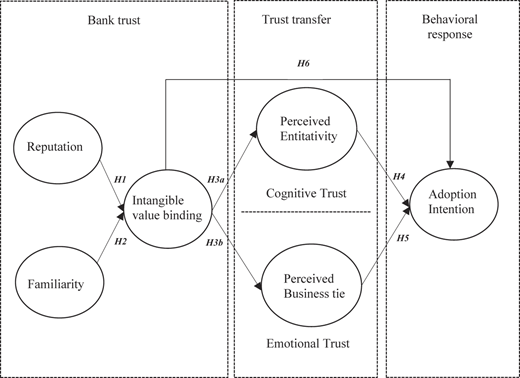
Informed by the preceding theories and literature, this study constructs the integrated research framework presented in Figure 1.
3.1 The relationship between bank trust and trust transfer
3.1.1 Bank trust
Trust is defined as customers’ willingness—grounded in their expectations—to believe that a bank will fulfill its duties (Mayer et al., 1995). This study identifies three core antecedents of trust: reputation, familiarity, and intangible value binding. Reputation denotes customers’ overall appraisal of a bank’s status and credibility derived from interactions; familiarity reflects their depth of knowledge about the bank’s services; and intangible value binding measures the strength of invisible asset linkages formed between customers and the bank.
Su et al. (2021) show that a strong corporate reputation gives banks a competitive edge by lowering perceived risk and boosting reliability, thereby reinforcing customer trust in their stability and integrity (Wu and Neill, 2021). Kim et al. (2008) contend that reputation stems from past consumer–provider interactions, enabling customers to gauge a bank’s commitment to fulfill promises and guiding their subsequent transactional decisions.
Familiarity constitutes an intangible asset derived from customers’ accumulated knowledge and experiences in prior interactions. Gefen (2000) emphasizes that, in e-commerce contexts, structured prior experiences that reduce uncertainty serve as a fundamental driver of trust formation. Kim et al. (2008) posit that repeated interactions allow consumers to form subjective experiences and perceptions of service providers, with positive encounters enhancing familiarity and shaping favorable expectations for future services.
Building on the above theoretical and empirical insights, this study proposes that customers’ reputation and familiarity with a given bank function as intangible assets that raise switching costs, strengthen trust, and foster deeper intangible asset linkages with the institution. Accordingly, we posit the following hypotheses:
Reputation exerts a significant positive influence on intangible value binding.
Familiarity exerts a significant positive influence on intangible value binding.
3.1.2 The relationship between intangible value binding and trust transfer
Intangible value binding measures the extent of the intangible asset connection established between customers and banks. Trust transfer describes how trust in one entity can be derived from trust in a related entity (Wang et al., 2013; Stewart, 2003). This study incorporates perceived entitativity and perceived business ties to explain the relationship with bank trust, addressing cognitive and emotional dimensions, respectively.
Perceived entitativity encompasses users’ rational judgment of a trustee’s trustworthiness and their perception of banks and robo-advisory services as a unified entity (Callahan and Ledgerwood, 2016; Gong et al., 2020). Trust transfer theory (Stewart, 2003, 2006) holds that such perceptions of source–target linkage directly inform trust in the target. This study suggests that, within the context of banking and robo-advisor services, intangible value binding may encourage customers to perceive the bank and robo-advisor as a unified entity, thereby building trust in the robo-advisor platform (Gong et al., 2020).
Perceived business ties reflect customers’ subjective perceptions and feelings regarding the business relationship between a bank and a robo-advisor platform (Sun, 2010). Gong et al. (2020) demonstrate that positive emotional experiences in similar service contexts can carry over and reinforce trust. Similarly, when customers invest substantial time and resources in a banking platform and forge a strong connection, intangible value binding deepens their bank trust and transfers these positive emotional experiences to robo-advisor services, fostering emotional trust in those services.
Drawing on the foregoing literature, this study posits that intangible value binding deepens customer–bank connections and drives the transfer of cognitive trust and emotional trust to robo-advisory services. Accordingly, we propose the following hypotheses:
Intangible value binding exerts a significant positive influence on perceived entitativity.
Intangible value binding exerts a significant positive influence on perceived business ties.
3.2 The relationship between trust transfer and adoption intention
The core of trust transfer is that trust in the source can promote trust in the target, with the strength of the source–target relationship influencing the effectiveness of this transfer (Stewart, 2006). This study adopts perceived entitativity and perceived business tie to measure the source–target linkage and defines adoption intention as customers’ intention to use robo-advisor services.
Perceived entitativity refers to the extent to which customers perceive banks and robo-advisor services as part of a unified whole (Cao et al., 2018; Song et al., 2009, 2011). Wang et al. (2013) suggest that when users recognize two services as being operated by the same company, they form consistent evaluations, perceived reliability, and risk perceptions, facilitating trust transfer from one service to the other.
Perceived business tie refers to customers’ subjective perception and emotional evaluation of the commercial relationship between banks and robo-advisor platforms, and is identified in this study as a critical factor influencing emotional trust (Sun, 2010). According to cognitive balance theory (Lee et al., 2014), when customers perceive a strong connection between the source and the target, they are motivated to maintain attitudinal consistency, thereby reducing cognitive dissonance and facilitating the transfer of emotional trust. Accordingly, this study posits that when customers experience a sense of dependence and security toward robo-advisor platforms, it facilitates the transfer of emotional trust, thereby enhancing their adoption intention.
Building on the aforementioned literature, this study suggests that trust transfer arises from the strong entitativity and business ties perceived between banks and robo-advisors, which subsequently impacts customers’ adoption intention. Based on this premise, the study proposes the following hypotheses:
Perceived entitativity significantly and positively influences the adoption intention of robo-advisors.
Perceived business ties significantly and positively influence the adoption intention of robo-advisors.
3.3 The relationship between intangible value binding and adoption intention
Intangible value binding represents the extent of the intangible asset connection between customers and banks. Previous studies have shown that the interplay of individuals’ self-assessed financial experience, efficacy, and personal values influences their willingness to adopt robo-advisors (Hohenberger et al., 2019).
A strong relationship creates value for customers and motivates them to remain with their original bank to sustain that relationship (Chou et al., 2023). Chou et al. (2023) further demonstrated that the intangible value binding and bank trust established between customers and banks positively influence customers’ adoption intention toward robo-advisors. Accordingly, this study proposes the following hypotheses.
Intangible value binding significantly and positively influences the adoption intention of robo-advisors.
4. Research design
4.1 Data collection and sample
This study utilized the online survey platform SurveyCake to distribute questionnaires, targeting respondents through financial research communities and digital financial platforms. A five-point Likert scale was adopted as the measurement instrument, where participants rated each item based on their level of agreement, ranging from “Strongly Agree” (5) to “Strongly Disagree” (1).
To minimize potential misunderstandings and ensure the validity of the questionnaire, a pretest was conducted with six masters and doctoral students from the graduate institute of business administration at a national university. Based on their feedback, the questionnaire items were subsequently revised and refined.
To minimize common method variance (CMV), this study adopted a two-wave survey design rather than collecting all measurement data at a single time point. The first phase of data collection took place from January 16, 2024, to February 1, 2024, while the second phase was conducted from February 17, 2024, to March 8, 2024. A total of 428 questionnaires were distributed across two phases, with 16 invalid responses removed, resulting in 412 valid responses (202 from the first phase and 210 from the second), yielding an effective response rate of 96.26%. This study adopts the Cross-Lagged Panel Design proposed by Kenny (2014), measuring each variable at two time points to analyze the relationships across time and to examine potential dynamic associations, thereby enhancing the explanatory power of the data.
4.2 Variable definitions
The questionnaire design and the conceptual definitions of the variables are grounded in prior research. Table 1 outlines the definitions of each construct, its sub-dimensions, and the corresponding literature sources.
4.3 Statistical analysis methods
This study employed SPSS 21.0 for statistical analysis, including descriptive statistics and tests for reliability and validity. AMOS 21.0 was used to conduct structural equation modeling (SEM) for hypothesis testing and empirical analysis of variable relationships. SEM, a key method for addressing multivariate relationships, is well-suited for analyzing the interactions among multiple variables in this study.
5. Data analysis and results
5.1 Data analysis
Table 2 provides the statistical details of the sample distribution.
This study employed Cronbach’s α coefficient to evaluate the internal consistency of each variable for reliability analysis. The Cronbach’s α values ranged from 0.844 to 0.922, all exceeding the threshold of 0.7, indicating high reliability of the scale. This demonstrates the rationality of the questionnaire design and the consistency and stability of respondents’ answers. Convergent validity was assessed using confirmatory factor analysis (CFA). The factor loadings exceeded 0.5, composite reliability (CR) was above 0.6, and the average variance extracted (AVE) surpassed the standard threshold of 0.5, meeting the criteria for measurement validity. These findings indicate that each item has strong convergence with its respective construct, demonstrating consistency and representativeness. Detailed results are provided in Table 3, which outlines the confirmatory factor analysis (CFA).
Although some items (F1, F2, and F5 under the familiarity construct; PE4 under perceived entitativity; PB1 and PB2 under perceived business ties) exhibited factor loadings slightly below 0.7, all remained above the acceptable threshold of 0.6. According to Bagozzi and Yi (1988) and Hair et al. (1998, 2019), factor loadings above 0.5 are considered acceptable when the construct demonstrates adequate reliability and theoretical relevance. In addition, Fornell and Larcker (1981) suggested that when the overall construct reliability is satisfactory (Cronbach’s α > 0.7, CR > 0.6, AVE >0.5), such items can be retained to ensure theoretical consistency and measurement validity. Therefore, all measurement items were retained in this study to preserve the conceptual integrity and overall model consistency.
For discriminant validity, the analysis showed that the square root of the average variance extracted (AVE) for each construct exceeded the correlation coefficients between all construct pairs. The full correlation matrix is presented in Table 4. The square roots of the AVE values (0.719–0.841) for all constructs are greater than the inter-construct correlations. For example, the correlation between perceived entitativity and perceived business ties is 0.707, which is lower than their respective AVE square roots (0.763 and 0.760), meeting the Fornell–Larcker criterion and indicating adequate discriminant validity among constructs. This confirms significant differences between variables. The constructs in this study effectively distinguish between different variables, satisfying the criteria for discriminant validity. These results indicate that the concepts measured by the questionnaire exhibit sufficient independence. Detailed results are provided in Table 4, which contains the discriminant validity analysis matrix.
5.2 Empirical discussion
The research hypotheses were tested using structural equation modeling (SEM) to analyze the relationships between bank trust, trust transfer, and adoption intention. The detailed results are provided in Table 5.
5.2.1 Reputation and familiarity influence intangible value binding
Within the framework of bank trust, hypothesis H1 posits that reputation in bank trust has a significant positive effect on intangible value binding. The analysis revealed an impact coefficient of β = 0.392 (p < 0.001), confirming hypothesis H1. Hypothesis H2 suggests that familiarity within bank trust has a significant positive impact on intangible value binding. The analysis showed an impact coefficient of β = 0.836 (p < 0.001), confirming hypothesis H2. Additionally, the results support hypothesis H1, indicating that reputation within bank trust also has a significant positive effect on intangible value binding. The results of this study align with those of Su et al. (2021) and Moysidou and Hausberg (2020). Su et al. (2021) further demonstrated that bank trust positively influences customer loyalty, supporting this study’s emphasis on the relationship between bank trust and intangible value binding. Customers with higher trust in banks possessing strong reputation are more likely to maintain long-term cooperative relationships. The empirical validation of hypothesis H2 demonstrates that familiarity within bank trust significantly enhances intangible value binding. As customers’ familiarity with the bank grows, their trust deepens, strengthening accumulated experiences and fostering greater dependence. This result aligns with the findings of Moysidou and Hausberg (2020), highlighting the pivotal role of familiarity in facilitating intangible value binding.
5.2.2 Intangible value binding influences perceived entitativity and perceived business ties
Within the framework of relationships influenced by bank trust, hypothesis H3a proposed that intangible value binding has a significant positive impact on perceived entitativity. The analysis yielded an impact coefficient of β = 0.398 (p < 0.001), confirming H3a. Likewise, hypothesis H3b posited that intangible value binding significantly and positively influences perceived business ties, with the results showing an impact coefficient of β = 0.401 (p < 0.001), supporting H3b. The findings demonstrate that intangible value binding has a significant impact on customers’ perceived entitativity. This study examines trust transfer through two dimensions: perceived entitativity and perceived business ties. The results are consistent with the concepts proposed by Chou et al. (2023) and Gong et al. (2020). Specifically, in the dimension of perceived entitativity, customers who invest substantial resources in a bank strengthen their connection with it, leading them to perceive the bank and robo-advisor services as part of the same service category. In the context of perceived business ties, a strong connection between customers and the bank enhances intangible value binding, which fosters greater emotional trust. This increased trust leads customers to view the bank’s services as more stable and reliable, thereby facilitating emotional trust transfer. Intangible value binding reflects customers’ long-term relational attachment and psychological dependence on banks formed through sustained interaction and trust. Perceived entitativity represents the cognitive dimension, reflecting rational judgments about whether banks and robo-advisors belong to the same service system, whereas perceived business ties capture the emotional dimension, emphasizing customers’ subjective perceptions of cooperation and security. Distinguishing these theoretical roles helps prevent conceptual overlap and strengthens the explanatory power of the trust transfer mechanism.
5.2.3 Perceived entitativity has no significant impact on adoption intention, whereas perceived business ties significantly influence adoption intention
Regarding behavioral responses, hypothesis H4 posited that perceived entitativity does not significantly influence adoption intention. The results indicated an impact coefficient of β = −0.017 (p > 0.05), showing that H4 is not supported. In contrast, hypothesis H5 proposed that perceived business ties have a significant positive effect on adoption intention, with the analysis yielding an impact coefficient of β = 0.765 (p < 0.001), thereby supporting H5. In the hypothesis testing, H4 indicates that perceived entitativity does not have a significant effect, whereas H5 demonstrates that perceived business ties have a significant positive impact on adoption intention. A plausible explanation for the non-significant effect of perceived entitativity is that cognitive recognition alone does not guarantee emotional assurance. Although customers may understand that robo-advisors and physical banks belong to the same service system, this structural perception does not necessarily alleviate concerns related to data privacy, algorithmic transparency, or technological unfamiliarity. As a result, cognitive similarity may not directly translate into perceived reliability or reduced adoption-related anxiety, thereby weakening the direct effect on adoption intention. This study demonstrates that intangible value binding significantly enhances perceived entitativity (H3a), thereby fostering trust formation. Nevertheless, although customers may perceive physical banks and robo-advisors as originating from the same service provider, differences in transparency and technological familiarity—particularly the distinctive attributes of virtual services—hinder the complete transfer of evaluations and perceived security from physical banks to robo-advisors, ultimately diminishing customers’ adoption intention. Hypothesis H5 was confirmed, highlighting that when customers perceive a strong business connection between the bank and the robo-advisor platform, they feel reassured and are more inclined to adopt the platform. This finding highlights that perceived business ties exert a significant positive effect on the adoption intention of robo-advisors, whereas perceived entitativity does not. These results are consistent with the findings of Gong et al. (2020).
5.2.4 Intangible value binding does not have a significant impact on adoption intention
In analyzing the influence of intangible value binding on adoption intention, hypothesis H6 posited that intangible value binding does not significantly affect adoption intention. The results revealed an impact coefficient of β = 0.025 (p > 0.05), indicating that H6 is not supported. This suggests that intangible value binding does not directly encourage customers to adopt robo-advisor services. This finding contrasts with Chou et al. (2023), which argued that strong customer relationships encourage customers to continue using related banking services. This study suggests that the technological complexity and uncertainty inherent in robo-advisor services may lead to hesitation in adopting new technologies, even for customers who trust and rely on the bank. Accordingly, trust transfer serves as a crucial mediator by extending customers’ trust in banks to robo-advisors, thereby alleviating uncertainties about new technologies. Overall, while intangible value binding reinforces customers’ dependence on banks, it does not directly boost their adoption intention toward emerging financial services. Although intangible value binding does not directly affect adoption intention, it promotes customers’ willingness to adopt robo-advisors through the sequential influence of perceived business tie and emotional trust.
6. Conclusion
6.1 Conclusion
This study investigates how bank trust factors influence customers’ adoption intention of robo-advisors and explores the impact of perceived entitativity and perceived business ties through the lens of trust transfer theory. Drawing upon a detailed literature review and empirical analysis, it examines the structure of customer trust by differentiating cognitive and emotional trust, and highlights the role of intangible value binding in shaping the bank–customer relationship. Through this integrated perspective, the study clarifies the mechanisms by which trust is transferred from banks to robo-advisory services. In conclusion, the findings collectively demonstrate how bank trust, trust transfer, and intangible value binding interact to form a concrete adoption pathway toward robo-advisors. This integrative framework not only deepens theoretical understanding of trust dynamics in digital financial services but also provides actionable insights for strengthening user acceptance in AI-driven investment contexts.
6.2 Managerial implications
6.2.1 Academic perspective
6.2.1.1 Integrated model analysis of adoption intention for robo-advisors
This study adopts an integrated model to analyze customers’ adoption intention toward robo-advisors, emphasizing two critical factors within bank trust: reputation and familiarity. Additionally, it highlights the roles of cognitive trust and emotional trust in facilitating the trust transfer process. Unlike previous studies that primarily addressed regulatory concerns related to robo-advisors (Fisch et al., 2019; Ji, 2017), this study leverages customers’ bank trust to examine how trust transfer and intangible value binding facilitate acceptance of emerging financial services. It further extends the application of trust transfer by introducing a new integrative framework.
6.2.1.2 Expanding trust transfer theory to include cognitive and emotional trust dimensions
Building on trust transfer theory, this study examines the effects of cognitive trust and emotional trust on customer behavioral response. Unlike traditional trust research that primarily emphasizes risk-based cognitive trust in financial products, this study integrates emotional trust into the trust transfer framework, highlighting the role of emotional factors. The findings demonstrate the critical importance of emotional trust in trust formation, offering a novel contribution to the development of trust transfer theory.
6.2.1.3 Intangible value binding enhances customer adoption intention through trust transfer
The findings indicate that the impact of intangible value binding on adoption intention occurs primarily through the trust transfer pathway. Specifically, customers’ psychological attachment and trust in banks enhance their perceived business ties and emotional trust in robo-advisors, thereby increasing their adoption intention. This result underscores the pivotal role of emotional trust reconstruction in transforming institutional trust into technological trust, deepening the understanding of the relationship between trust and adoption in AI-driven financial services.
This study confirms that intangible value binding influences customers’ adoption intention primarily through the mediation of trust transfer. While previous research has emphasized the positive impact of close customer relationships on behavioral response (Chou et al., 2023), this study extends the literature by systematically examining the relational pathway among intangible value binding, trust transfer, and adoption intention. The findings highlight that trust transfer serves as a key bridge strengthening the effect of intangible value binding on adoption intention, thereby addressing prior research gaps and offering a fresh perspective for future studies.
6.2.2 Practical perspective
6.2.2.1 The critical role of familiarity in intangible value binding
This study finds that if banks aim to strengthen customer loyalty, they should prioritize enhancing familiarity. While reputation remains essential for building bank trust, familiarity plays a more decisive role in fostering intangible value binding and reinforcing long-term customer relationships. Accordingly, banks are advised to optimize customer experience, streamline service processes, and strengthen financial literacy initiatives to deepen customers’ understanding and trust, thereby enhancing their willingness to maintain long-term cooperation.
6.2.2.2 The impact of familiarity, intangible value binding, and emotional trust on the adoption intention of robo-advisor services
To facilitate the adoption of robo-advisor services, it is crucial to clarify the pathway driving customer adoption intention. The empirical findings indicate that the optimal path begins with strengthening bank trust through enhanced familiarity, followed by reinforcing customer dependence via intangible value binding, and ultimately achieving trust transfer through emotional trust, manifested in perceived business tie. Familiarity emerges as the pivotal factor in the adoption pathway. Banks are advised to prioritize the enhancement of familiarity to establish a robust foundation of bank trust, which in turn strengthens emotional trust and fosters adoption intention toward robo-advisor services. This study offers a comprehensive explanation of the adoption mechanism for robo-advisor services and provides actionable recommendations to help banks develop targeted strategies for managing customer relationships and improving service adoption rates.
6.2.2.3 Emotional trust as the key driver for enhancing customer adoption intention
The findings underscore the critical role of emotional trust. To promote robo-advisor services, banks should prioritize strengthening customers’ emotional connections by offering seamless service experiences and tailoring solutions to individual needs, thereby enhancing satisfaction and driving adoption intention. This study confirms that perceived business ties strengthen customer trust, with emotional connection serving as the key mechanism. However, perceived entitativity alone exerts only limited influence, indicating that simply viewing banks and robo-advisors as part of the same system is insufficient to generate genuine trust or usage. Therefore, banks should position trust transfer as a core strategy and strengthen emotional assurance through experiential and affective design, such as empathetic voice assistants, conversational interfaces, and transparent communication of compliance information and risk disclosures to enhance psychological safety and perceived credibility. Although intangible value binding does not directly increase adoption intention, its indirect effect through trust transfer highlights the importance of continuous relationship maintenance and post-adoption engagement, helping customers perceive robo-advisors as an extension of trusted financial services. The pivotal role of emotional trust in shaping customer behavioral response offers valuable theoretical and practical implications.
6.2.3 Societal, policy, and educational perspective
Beyond managerial implications, the findings also carry societal and policy relevance. Because the sample is predominantly young and digitally experienced, the results highlight the importance of inclusive financial innovation that also protects older or less tech-savvy users. Future implementations of robo-advisors should therefore emphasize algorithmic transparency, plain-language suitability, and human-in-the-loop support to prevent digital financial exclusion. Policymakers and regulators may additionally consider promoting digital literacy programs or developing clearer requirements for transparent disclosure and customer consent when AI-driven advisory decisions are provided. The clarified constructs further have value in educational contexts, such as courses in fintech analytics, financial services management, and digital marketing, where the cognition-to-emotion trust pathway can serve as a conceptual basis for case discussion or service design projects. Finally, this study opens several avenues for future research, including validating trust transfer across different demographic groups, using longitudinal or panel data to observe trust formation over time, and testing possible moderators such as technological familiarity or financial literacy. These extensions would enhance the societal relevance and generalizability of trust transfer research in emerging financial technologies.
6.3 Research limitations and future directions
This study has several limitations. The sample mainly consisted of younger, highly educated respondents with relatively limited investment experience, which may restrict the generalizability of the findings to older or more experienced investors. Future research should therefore broaden sample heterogeneity and consider cross-age or subgroup analyses to examine how demographic differences influence trust formation and adoption intention. In addition, the effect of intangible value binding on adoption intention was not significant, suggesting that other factors may moderate this relationship. Variables such as investment amount, digital literacy, or prior platform experience could be incorporated to clarify the boundary conditions of intangible value binding. Furthermore, the study was conducted in a single market context, which may limit cultural applicability. Cross-cultural validation and the inclusion of additional behavioral or psychological constructs would help strengthen the model’s explanatory power.
This study also adopted a static validation of the trust transfer mechanism and did not capture how trust evolves across time. Longitudinal or staged research designs could illuminate how cognitive and emotional trusts accumulate during continuous platform engagement. Overall, future research should expand sampling diversity, include moderating and mediating factors, consider cross-cultural comparisons, and adopt dynamic or subgroup analyses to provide a more comprehensive understanding of robo-advisor adoption behavior.
CRediT author statement
Shiu-Wan Hung: Conceptualization, Methodology, Project administration. Yu-Hsien Cho: Writing-Review and Editing. Yu-Fang Lin: Writing-Original Draft, Investigation.
Ethical approval
This article does not contain any studies with human participants or animals performed by any of the authors.