

Chopsticks marketing: general theoretical framework, research agenda and articles in this issue
The Confucian ethic is omnipresent and relevant to every aspect of family life, social gatherings and business activities. In social gatherings, followers of this ethic would anticipate asymmetric (unequal) partnership, hierarchy-based roles and differentiated obligations. In business transactions, the Confucian ethic entails compromise and the need for flexibility, and harmony with the surrounding environment. With China becoming an important part of the global market, to build business relationships in this region, irrespective of their country of origin, all marketers will face a need to interact with the values of Confucianism.
Successful marketing practices in East Asia require skills that may not be easily mastered such as those involving eating rice with chopsticks (Fam et al., 2009). Not only local customs, traditions and values must be mastered but also ways of working with different stakeholders and networks such as government officials, religious bodies, suppliers, distributors and consumers. Like the two pieces of chopsticks coming together, marketing to East Asia requires understanding how Confucian values are combined in two dimensions: (1) customers and other relevant players (e.g. government or distributors) and (2) organisational effectiveness and performance. In the last 20 years, literature referring to chopsticks marketing considered Confucian values and marketing as separate dimensions, while only few the articles covered both aspects (Fam et al., 2009).
Several studies have confirmed that Confucian values guide the behaviour of a vast majority of the East Asian population (Wang and Lin, 2009; Yi, 1998). Confucian values are considered as a better way to understand East Asian customers' behaviour in contrast to using Western values (Gilbert and Tsao, 2000; Wong andAhuvia, 1998). A commercial success of a firm in this region may be due to its ability to embrace Confucian values, and instil these values into their organisation to build relationships with most actors of marketing ecosystems (Yu and Xu, 2018; Ho, 2011). It is known that a firm that focusses its marketing activities on the customer is likely to enhance its performance (Kopalle et al., 2019; Kohli and Jaworski, 1990). An essential step towards the market-orientation of an organisation is the development of market intelligence capabilities that take local socio-cultural specifics into account. In this way, firm scan process data from customers and other actors in market ecosystems, such as government and competitors, into insightful information for the organisation (Revilla-Camacho et al., 2019; Kohli and Jaworski, 1990).
The aim of this special issue is to identify and understand the values of Confucianism in each stage of a relationship building amongst international marketers/businesses. The guiding research questions related to chopsticks marketing are:
What is the general theoretical framework of chopstick marketing?
What priority should marketers place on Confucian values in developing business relationships?
Do Confucian practices transcend the borders of East Asia, involving new practices from non-East Asian marketers?
Which Confucian values are more prevalent in each stage of a business relationship?
What is evidence of successful market practices involving Confucian values in establishing/reinforcing business relationships?
Chopsticks marketing: general theoretical framework
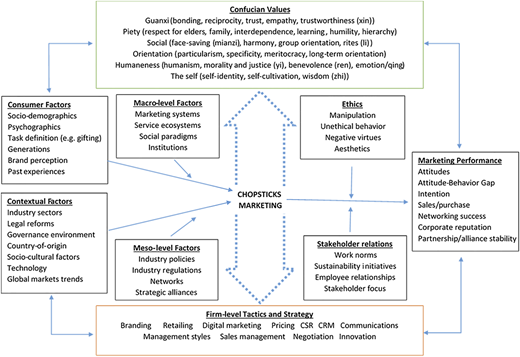
The general framework of chopsticks marketing includes a number of components (Figure 1). These components are: Confucian values, firm-level tactics and strategy, consumer factors, contextual factors and chopsticks marketing performance. The framework is based on the preposition that the success of chopsticks marketing depends on the skilful orchestration of firm-level tactics and strategies with Confucian values, consumer factors, contextual factors and moral foundations.
Confucian values
Confucian values influence the behaviour of consumers and are related to the adoption of products and services of socially responsible firms. Shaalan et al. (2013) developed a framework where guanxi was compared to relationship marketing, in four dimensions: bonding, reciprocity, trust and empathy. Shalan et al. (2013) suggested that the main difference between the two concepts was that guanxi started with a relationship that leads to a transaction, whereas relationship marketing started with a transaction in the expectation of a relationship. Mok and DeFranko (2000) developed a framework with six Confucian values (i.e. respect for authority, interdependence, group, orientation, face-saving and harmony) and found several examples in the literature showing the influence of those values on the decisions of consumers. Wang (1998) presented Confucian values into a four-dimension framework that included: universalism vs particularism, specificity vs diffuseness, reciprocity and long-term orientation. Additionally, some studies have developed scales to measure Confucian values. Fu et al. (2017) developed and tested a scale with nine dimensions: family togetherness, harmony with nature, relationship/guanxi, face/mianzi, self-development, material fulfilment, escape and retreat, children's learning, and exploration and discovery. Monkhouse et al. (2013) developed and tested a scale with five dimensions: face-saving, humility, group orientation, hierarchy and reciprocity. Some studies have identified specific values to be particularly important in influencing attitudes (Chung and Thorndike Pysarchik, 2000) such as morality (Yu and Xu, 2018), self-cultivation (Shao and Perkings, 2017), respect for authority (Ng and Lee, 2014), harmony (Kwek and Lee, 2010), bonding, reciprocity, empathy, and trust (Yau et al., 2000), and family (Yi, 1998).
Consumer factors
Consumer factors such as socio-demographics, psychographics, task definition (e.g. gifting), generations, brand preferences and perceptions, and past experiences determine the success of chopsticks marketing. A number of studies looked at how purchase reasons such as gift purchasing (Liu et al., 2010) or brand preferences (Yao et al., 2015) influence the impact of Confucian values on marketing performance. Some studies found that socio-demographics like age and generations moderate the influence of Confucian values on the decision-making process of customers. In the case of age and country of origin, youngsters and Hong Kong residents were found to be less likely to be influenced by Confucian values (Tai and Tam, 1997; Liu et al., 2009).
Contextual factors
Also, contextual factors (e.g. industry sectors, legal reforms, governance environment, country-of-origin effects, socio-cultural factors, technology, global markets trends) influence the success of chopsticks marketing. Wang and Lin (2009) note that China currently is experiencing cultural renaissance, that is going back to the roots of Chinese culture, while creatively resisting the Western influence. However, Choukroune's (2009) analysis showed that legal reforms did not truly reflect Confucian values, while the population and marketers were positively predisposed towards implementing these values. Li et al. (2009) show that governance regimes and choices influence how marketing channel behaviours (e.g. channel exclusivity, information access, trust and dispute resolution) determine the nature of chopsticks marketing. The country of origin perceptions are also likely to influence by Confucian values (Tai and Tam, 1997). Several empirical studies corroborated the impact of Confucian values in different sectors such as tourism (Shao and Perkins, 2017; Fu et al., 2015; Kwek and Lee, 2010) and sponsorships industry (Ho, 2011).
Firm-level tactics and strategy
Different marketing tactics such as branding, digital marketing, pricing and communications influence chopsticks marketing performance (Yao et al., 2015). In the case of retail store format, online shoppers were less affected by Confucian values in contrast to shoppers in physical stores (Zhou et al., 2017). Consumers with strong Confucian values were more likely to buy, even with a premium price, cause-linked brands (Subrahmanyan, 2004). Bouvain et al. (2013) found that Confucian customers that bought cause-linked or socially responsible brands were driven by the idea of a “greater good” for the community, in contrast to Western customers, who were found to be driven by the idea of protection to the environment. Wang and Juslin (2009) expanded the definition of corporate social responsibility (CSR) with a “harmony approach” guided by the respect of communities and the environment. Confucian values are antecedents of CSR support, as Confucian customers reported a low attitude-behaviour gap, or difference between thinking to buy a socially responsible brand and buying it (Ramasamy et al., 2013).
Digital marketing is on the rise. Chopsticks marketing requires a deep understanding of e-marketing, mobile marketing, online advertising and online consumer behaviour in culturally diverse Confucianism-driven local markets (Zhou et al., 2013; Chen et al., 2013; Gao et al., 2013; Liu et al., 2013; Frank et al., 2013; Ramasamy et al., 2013). Confucian values have also been studied in the realm of the organisation (Huang et al., 2013), as opposed to the Western framework of management (Lee and Trim, 2008), which is related to the war metaphor (Chen and Wells, 1998). Studies documented the influence of Confucian values on work ethics (Yoo and Donthu, 2002; Baumann et al., 2016). Additionally, research has found an impact on marketing processes such as new product development processes (Subramanian et al., 2019), marketing communications (Hsieh, 2010; Zhu, 2009), customer relationship management (Jia and Wang, 2013; Liu et al., 2009; Murphy and Wang, 2006), negotiation (Warden and Chen, 2009; Eng and Jin Kim, 2006) and sales management (Lee et al., 2009; Lu et al., 1999). During negotiations, Chinese managers are found to be more culturally sensitive to distant cultures whilst practicing self-interest sacrifice and face-saving to the benefit of the other party (Warden and Chen, 2009).
Moderating factors: ethics, stakeholders and macro/meso ecosystems
Confucian values combined with marketing strategies are subject to conventional ethics-related perceptions and practices. Unethical practices may inhibit the success of chopsticks marketing. A study by Lee et al. (2009) finds that Chinese salespeople are favourably disposed towards unethical selling practices. However, another study finds that people avoid unethical practices when they sense that such practices might endanger established relationships (Liu et al., 2009). In addition, aesthetics play a significant role in the Confucian framework (Zhang et al. (2011). There is a need to turn Confucian ethical concepts into aesthetic leadership involving mastery, sincerity and appropriateness to align chopsticks marketing with societal values (Zhang et al., 2011). In addition, macro-level factors such marketing systems, service ecosystems and social paradigms can influence how consumer factors are translated into chopsticks marketing (Kadirov, 2014, 2018; Kadirov and Varey, 2011; Kadirov et al., 2016). Furthermore, meso-level factors in marketing systems and service ecosystems would determine how contextual factors would drive the harmony between Confucian values and firm-level strategies (Layton, 2011).
Chopsticks marketing performance
The general framework of chopsticks marketing suggests that the success of chopsticks marketing depends on the skilful orchestration of firm-level tactics and strategies with Confucian values, consumer factors, contextual factors and moral foundations. Despite the extensive literature on Confucian marketing, few studies have studied the chopsticks effect, i.e. how imbuing Confucian values within the organisation yields better results in relationships with customers and other stakeholders. Sun et al. (2016) found that the extent a company adheres to Confucian virtues positively influences the perception of the brand sustainability efforts. Wang (2007) reported that the development of positive business relationships with Chinese firms was influenced by the ability to build relationships with the network of Chinese businesspersons. In addition, Wang (2008) argued that transnational managers must understand the logic of chopsticks when communicating with their counterparts. Specifically, the author suggests that managers must avoid the dividing logical contrasts such as “communism versus capitalism” or “public versus private”. Ackerman et al. (2009) indicate that Confucian values (e.g. meritocracy, loyalty to superior and separation of responsibilities) make consumers prefer government-involved firms in the Chinese automobile market. Hence, they suggest that firms skilfully use Confucian values and government-association to promote their products.
Research articles in this special issue
Individually, a chopstick is an essentially functionless stick. However, like the intricacy of eating with chopsticks, relationship building entails the parties involved to prioritise ethical issues in order to harmonise a relationship. Few studies have examined Confucian values in business relationship building. This special issue is meant to tease out the extent that this age-old value has influenced marketing relationship building internationally. This special issue examines intricacies of business relationships in Asia, and Asia with the rest of the world. As the theme suggests, we included articles that both theoretically and empirically examined the extent of the importance of applying Confucianism in business relationships. With the borderless world and the growing importance of Asia, one would expect that most business transactions would involve Asian partners. Hence, this special issue would assist the international business community to build effective partnerships with their Asian counterparts.
The first paper in this issue deals with the impact of Confucian philosophy. Focussing on the interaction of Confucian values, firm-level tactics and strategies and chopsticks marketing performance, Zhu Nibing, Zhilin Yang, Shaohan Alan Cai and Haohao Sun (2020) in their paper titled Understanding the Differences between Chinese and Western Business Practices: Insights into Confucian Philosophy offer a comprehensive review of the historical development of Confucianism in China, while offering an account of how this philosophy attained dominance in the Chinese culture. They focus on five key virtue cornerstones of Confucianism, namely, benevolence (ren), righteousness (yi), rites (li), wisdom (zhi) and trustworthiness (xin) to elucidate ways of building effective and durable business relationships between Chinese and foreign businesspeople. By illustrating how these values are applied in Tong Ren Kang, a pharmaceutical retail firm, the authors argue that the managerial knowledge and understanding of intercultural philosophical differences are critical enhancing firm performance.
The next four papers in this issue investigate how Confucian values structure consumer practices. Focussing on the consumer factors, Confucian values, and chopsticks marketing interface, Chuanhong Chen and Xueyan Li (2020) in their article titled Effects of Singles' Day atmosphere stimuli and Confucian values on consumer purchase intention explore the dynamics of the Alibaba generated aggregated mass promotion, the Singles Day. They show that the elements of online shopping festival atmosphere such as perceived economic temptation, perceived festival entertainment and perceived mass participation motivate purchase intention, while the Confucian values of “keeping face” and “listening to others” moderate the effect of the atmosphere on purchase intention. Phang Grace Ing, Ng Zheng Lin, Ming Xu and Ramayah Thurasamy (2019) in their article on Customer loyalty in Sabah full service restaurant investigate the relationship between transaction-specific characteristics (food quality, service quality, atmosphere, convenience and price perception) and customer satisfaction in the context of Sabah full-service restaurant. They find that the transaction specific characteristics are positively associated with customer satisfaction, while customer satisfaction had a stronger effect on behavioural loyalty compared to attitudinal loyalty. The article Dual path effects of self-worth on status consumption: evidence from Chinese consumers by Hongjing Cui, Taiyang Zhao, Slawomir Smyczek, Yajun Sheng, Ming Xu, Xiao Yang (2020) explores how different types of self-worth change impact status consumption. They find that both self-worth improvement and self-worth threat are positively associated with status consumption, while the self-enhancement motive and the self-compensation motive mediate the relationships, respectively. Most importantly, the authors discover that the Confucian value of power distance moderates the effect of a threat to self-worth on status goods consumption. It is shown that high power distance entails a stronger relationship between self-worth threat and status consumption. The article on Retirement village buying intention: A case study on the Muslim and non-Muslim Malaysian elderly by Siew Imm Ng, Fang Zhao, Xin-Jean Lim, Norazlyn Kamal Basha and Murali Sambasivan (2020) offer some insights into the elderly segment's perceptions about a retirement village in a society (Malaysia) influenced by Confucian values. In the spirit of chopsticks marketing, the authors examine a combined effect of psychological factors (attitude, subjective norms and perceived behavioural control) and contextual factors (social, environmental and economic sustainability) on acquiring a place in a retirement village. The intriguing findings in this research are the significant effect of sustainability on purchase intention as well as the significant moderating effect of religion (Islam and other). Ironically, the Confucian value of respect and care for the elderly appears to be strongly practiced amongst the Muslim population.
The article titled Does it matter where to run? Intention to participate in destination marathon by Kim Fam and others examine the likely impact of contextual and macro-level factors on chopsticks marketing decisions. Focussing on marathon enthusiasts' perceptions of a local marathon in the Sarawak region in Malaysia, the authors show that the intention to tour Sarawak significantly moderates the relationship between perceived value and intention to participate in the marathon. This suggests that the application of chopsticks marketing to destination tourism should be underscored by the systematic focus on the enhancement of destination image in addition to improvements in service quality. Improving destination image is a macro-level problem which would involve the quality of environmental, political, social, historical, infrastructural and local authenticity-based aspects of a touristic destination. This means that the chopsticks marketing approach requires concerted efforts of all stakeholders including event organisers, destination managers, communities and publics, local authorities, research institutions and visitors in order to make the event successful.
The following two articles in this issue explore the digital side of chopsticks marketing. Pedro Q. Brito, Sandra Torres and Jéssica Fernandes (2019) in their article titled What kind of emotions do emoticons communicate? investigate the chopsticks effect between communication content and emotions expressed via emoticons. Addressing the question of the extent to which emoticons can textually deliver specific emotions while being congruent with textual meaning, the authors undertook a longitudinal three-year observation of consumer online interactions. They found that positive valence emoticons are coupled with positive valence posts as well as negative valence posts. As they explain, the latter effect may have occurred when participants attempted to diffuse negative valence posts with some humour. Also, they find that most negative valence emoticons are associated with negative valence interactions. Jian Wei Cheong, Siva Muthaly, Mudiarasan Kuppusamy and Cheng Han (2020) in their article The study of online reviews and its relationship to online purchase intention for electronic products among the millennials in Malaysia explore the antecedents of online purchase intention. Studying the context of electronic products sold online, they find that online review characteristics such as review timeliness, review quantity and review valence have a positive impact on purchase intention amongst Malaysian millennials. They argue that Confucian values are infused in both online reviews and millennials' behaviour.
The final two articles in this issue address the impact of negative Confucian virtues. A research on impulsive/compulsive buying behaviour patterns highlights the dialectical countervailing dynamics of commercial contexts in opposition to Confucian values. Based on a study of 600 young consumers, the research on Compulsive buying of branded apparel, its antecedents and the mediating role of brand attachment by Xin-Jean Lim, Jun-Hwa Cheah, Tat Huei Cham, Hiram Ting and Mumtaz Ali Memon (2020) examines the antecedents of compulsive/impulsive buying. The study shows that materialism, utilitarian value and brand attachment are positively associated with impulsive buying, while materialism, hedonic value and brand attachment explain obsessive-compulsive buying. The authors find that brand attachment mediates the effect of materialism on both impulsive buying and compulsive buying. The research on Mobile shopping platform characteristics as consumer behavior determinants by Yang Liu, Qi Li, Tudor Edu, Laszlo Jozsa and Iliuta Costel Negricea (2019) examines mobile shopping platform characteristics (information, entertainment, personalization, visuality and economic benefits) and their effect on impulsive buying via the mediating effects of arousal and pleasure. Impulsive behaviour is a negative Confucian virtue. The study shows that this negative virtue is stimulated by consumer pleasure which is driven by the mobile shopping platform's entertainment and personalization features. Also, impulsive buying is stirred by consumer arousal driven by the antecedents such as information, entertainment, personalization, visuality and perceived economic benefits.
Shuo She is the corresponding author.

