


In spite of the reported importance of social legacies, research has yet to measure their individual impact on residents’ attitude towards hosting a sport event. This study sought to determine how a more inclusive list of social legacies influences residents’ overall attitude towards hosting a sport event and political legacy.
Using a survey as its method, this study sought to redress the research gap by measuring the influence of six social legacies on residents’ overall attitude towards a Formula One (F1) event.
The results indicated that residents’ overall attitude towards the event was influenced by perceptions of civic pride, entertainment, social inclusion and the event’s negative impacts. Secondly, the more positive the overall attitude towards the event, the greater the intention to vote for a political party that supports it.
An important academic contribution stemming from this study was the way in which it measured the social legacies. One limitation relates to differences between the sample and the population it was intended to represent.
The results suggested that by emphasising the benefit yielded by entertainment, civic pride and social integration and seeking to minimise the event’s negative impacts it is far more likely to garner the support of local residents.
The study found that the influence of residents’ overall attitude on their voting intentions is moderated by their level of event involvement. As event involvement increases, the propensity to vote in favour of a political party that supports the event.
1. Introduction
Sport event legacies refer to the broad and lasting effects that sport events have on host communities, encompassing positive and negative, intended and unintended, tangible and intangible impacts (Preuss, 2007). These legacies include economic, infrastructural, environmental and social outcomes, each has different influences. However, not all legacy dimensions receive equal research attention. Recent meta-analyses show that studies on sport events often focus narrowly on certain legacies, missing out on other significant impacts (Reis et al., 2023; Thomson et al., 2019, 2020). This study focuses specifically on social legacies, a subset of sport event legacies that refer to intangible effects such as community pride and entertainment from hosting a sport event (Thomson et al., 2020). It is this intangibility that sets social legacies from tangible legacies such as the economic impacts of an event (Thomson et al., 2020). Social legacies have gained increased importance, especially in light of the failure of many sport events to deliver tangible benefits (Inoue and Havard, 2014). Additionally, when tangible benefits do arise, they tend to be short-lived and confined to specific sectors like hospitality and tourism. In contrast, social legacies often have a more enduring impact on the broader community (Liu et al., 2014). Reflecting this, host communities generally value social legacies more highly than economic ones (i.e. Byers et al., 2020; Duan et al., 2020).
Unfortunately, the importance of social legacies has often been overlooked in measurement approaches. Prior research has typically grouped diverse social legacies into a single construct, making it difficult to analyse their individual influence (Li and McCabe, 2013). This oversimplification limits their potential as independent variables and constrains their role in empirical models, which ignores the potential for a social impact such as a political legacy to serve as a dependent variable (Thomson et al., 2020). Political legacy, for instance, refers to the influence of hosting a sport event on residents’ political preferences and voting behaviour (Preuss, 2018). A political legacy is important as it can influence public policy, foster civic engagement and shape the governance long after a sport event, affecting future decisions and community identity (Falla et al., 2022). Although enhanced voter appeal is often seen as the primary motivation for politicians to support sport events (Misener et al., 2013), research has yet to empirically confirm that such support influences constituents’ voting intention. By examining the impact of political legacy, the study intends to provide insight into the extent to which the event’s social legacies translate into political influences, offering a more comprehensive understanding of the event’s effects on community attitudes and support.
This study focuses on the Australian Grand Prix (AGP), one of the 23 races in the Formula One (F1) World Championship, which ranks among the world’s top three sport mega-events alongside FIFA World Cup and the Olympic Games (Kim et al., 2016). Unlike the FIFA World Cup or the Olympic Games, which often focus on large-scale infrastructural developments and global cultural exchange, the AGP emphasizes community engagement and sustainability within its host city. Initiatives such as the “We Race As One” campaign promote diversity and inclusion, fostering a sense of unity among local residents (Formula 1 Australian Grand Prix, n.d.). Additionally, the AGP’s “Green Prix” program focuses on environmental sustainability, implementing waste reduction and food donation initiatives to benefit the local community (Formula 1 Australian Grand Prix, 2022). These efforts enhance community cohesion and environmental awareness, setting the AGP apart from other global sport events.
Despite its prestige, the benefits of hosting F1 events are often questioned (Chen et al., 2021; Choe et al., 2017; Kim et al., 2017; Ramasamy et al., 2022). An F1 race provides an ideal context for assessing local community perceptions of hosting a mega-sport event. Residents are key stakeholders, as they are both the primary beneficiaries of its advantages (Preuss, 2015) and the group most likely to experience any negative impacts (Duan et al., 2020). The high economic cost of hosting an F1 event, coupled with noise and disruption, makes it a recurring event that not all residents may welcome. For instance, the AGP incurred a (AUD) $60 million loss annually from 2014 to 2019 and again in 2023 (the event was postponed in 2020 and 2021 due to COVID-19), with these losses covered by public funds (Australian Grand Prix Corporation, 2019, 2023). This controversy may influence the voting behaviour of Melbourne residents.
The goal of this research is twofold. Firstly, it seeks to determine how a more inclusive list of social legacies influences residents’ overall attitude towards the AGP. Secondly, it measures the relationship between residents’ overall attitude towards the AGP and political legacy, and the extent to which that relationship is moderated by event involvement. This study makes several key contributions. It advances research on sport event legacies by independently measuring social legacies rather than grouping them into a single construct, allowing a more precise understanding of their influence on residents’ attitudes. Further, it expands the scope of legacy research beyond mega-events like the Olympics and FIFA World Cup to an F1 event, addressing a notable gap in the literature. In addition, the findings of the study provide valuable insights for event organisers and policymakers, emphasizing the importance of social legacies such as entertainment, civic pride and social integration in public communication strategies. The paper is structured as follows: a literature review explores social legacies that may influence residents’ attitudes toward sport events like the AGP and in turn, their voting behaviour. Next, the methodology is explained, followed by a discussion of data analysis, results and implications.
2. Literature review
Social Exchange Theory (SET) posits that individuals assess social interactions by weighing the rewards and costs involved, ultimately deciding to engage or disengage based on whether they believe the benefits outweigh the disadvantages (Thomson et al., 2019). SET has been widely used to investigate residents’ attitude towards a sport event, suggesting these attitudes are based on a comparison of the benefits offered versus the costs incurred in hosting the event (Duan et al., 2020). This aligns with the notion that a sport event can simultaneously exert positive and negative influences, with the former representing its benefits and the latter its costs (Liu, 2016; Nelson et al., 2019). While numerous event legacies exist, these should be tailored to the fundamental aspects and the specific objectives of the study (Balduck et al., 2011). Given the study’s focus on social legacies, this study draws on Thomson et al.’s (2020) meta-analysis of 77 articles, identifying key legacies: enhanced knowledge, social inclusion, entertainment, civic pride, sport development, negative impacts and political legacy. Each is discussed in the next section, starting with knowledge legacy.
2.1 Knowledge legacy
Knowledge legacy reflects residents’ perception that hosting a sport event benefits the community through enhanced understanding, skills and experience (Thomson et al., 2020). Hosting a sport event benefits those in industries like sports, security, hospitality, accommodation and public transport by enhancing their knowledge and experience (Gratton and Preuss, 2008). Additionally, a successful hosting record can attract future events (Solberg and Preuss, 2007). This legacy is especially valuable for annual events like the AGP, as it enables continual refinement and improvement based on accumulated experience (McCartney, 2005).
It is surprising that previous research has largely overlooked measuring the specific impact of knowledge legacy on residents’ attitudes toward an event. Instead, it has often been combined with tangible legacies like urban and sporting infrastructure (Liu et al., 2014) or other social legacies such as sport development (Duan et al., 2020). Using a univariate approach, Cheng and Jarvis (2010) found that 90% of residents agreed that the success of the Singapore F1 event demonstrated Singapore’s ability to host an international event. Based on this, we propose the following hypothesis:
The perception of a knowledge legacy positively affects the overall attitude towards the AGP.
2.2 Social inclusion legacy
Social inclusion refers to a sport event’s ability to foster an environment that engages and involves all individuals (Thomson et al., 2020). This legacy is increasingly vital in today’s multicultural world (Schulenkorf and Edward, 2012), and Australia, with 30.7% of its population born overseas as of 2023, reflects this diversity (ABS, 2023). Despite its importance, social inclusion is rarely treated as an independent construct, often grouped with other social legacies like civic pride (Al-Emadi et al., 2017; Duan et al., 2020) and cultural exchange (Al-Emadi et al., 2017; Prayag et al., 2013). Swart et al. (2011) indicated that 83% of respondents in South Africa felt that hosting the 2010 World Cup had helped promote social integration. Based on this, we propose the following hypothesis:
The perception of a social inclusion legacy positively affects the overall attitude towards the AGP.
2.3 Entertainment legacy
Sport events are believed to improve the host community’s lifestyle and quality of life by providing additional forms of entertainment, creating a sense of diversion from daily routines (Masterman, 2009). To enhance and diversify their appeal to a wider audience, many sport events also provide augmented offerings. For residents, the excitement and entertainment are often seen as key benefits of hosting an event (Martin and Barth, 2013). Unfortunately, confirming such a notion via empirical research is problematic. Duan et al. (2020) found that a construct including memorable experiences positively influenced residents’ overall attitude toward the event but was measured alongside other social legacies like sport development and knowledge. Similarly, Prayag et al. (2013) combined entertainment with civic pride and social integration in their construct.
Bull and Lovell (2007), in a study of the Tour de France, found that whereas an interest in cycling served as motivation for just 9% of respondents to attend the event, fun (31%), music (26%) and free entertainment (16%) all were far more popular motives. Hiller and Wanner (2011) also found that a major influence on residents’ attitudes towards the Vancouver 2010 Winter Olympics was attending its augmented offerings. Therefore, the hypothesis is as follows:
The perception towards the entertainment provided positively affects the overall attitude towards the AGP.
2.4 Civic pride legacy
Civic pride legacy refers to an improved sense of importance and self-respect that residents feel from hosting a major sport event (Gratton and Preuss, 2008). This sense of pride stems from successfully staging the event, its associated prestige (Cheng and Jarvis, 2010) and the “bragging rights” over rival cities (Supovitz and Goldwater, 2014). This legacy is relatively important to this study as one of the AGP goals is to “strengthen Melbourne’s and Victoria’s civic pride” (Australian Grand Prix Corporation, 2019). However, measuring this effect has been challenging, as prior research often combines civic pride with other social legacies such as social inclusion (i.e. Duan et al., 2020; Prayag et al., 2013). Univariate studies, however, have suggested that F1 Grand Prix events in Singapore (Cheng and Jarvis, 2010; Henderson et al., 2010) and Macau (Zhou, 2010) have fostered pride among residents. Thus, we propose the following hypothesis:
The perception of enhanced civic pride positively affects the overall attitude towards the AGP.
2.5 Sports development
This study defines sports development as residents’ perceptions of improved health and increased sport participation resulting from hosting a sport mega event (Thomson et al., 2020). The theory behind the sports development legacy is that hosting elite sport events creates a demonstration or trickle-down effect whereby residents of the host community are inspired to become more active and/or take up sports (Ramchandani et al., 2015). Its importance is highlighted by growing concerns over physical inactivity and related health issues (Taks et al., 2014). While increased sport participation may seem less relevant to an F1 event, the AGP states that one of its goals is to “provide aspiration and inspiration for Australian men, women, and children” (Australian Grand Prix Corporation, 2019).
While research has offered only limited evidence of an actual trickle-down effect (Ramchandani et al., 2015; Taks et al., 2014), studies indicate that residents believe sport participation can increase through hosting sport events. For example, Swart et al. (2011) reported that 77% of respondents believed that hosting the 2010 FIFA World Cup in South Africa had improved health and well-being. Other studies, comprising a factor that included sport development alongside other social legacies, have found that such a factor influenced residents’ attitudes toward the event (i.e. Al-Emadi et al., 2017; Duan et al., 2020). As a result, the following hypothesis is proposed:
The perception of a sports development legacy positively affects the overall attitude towards the AGP.
2.6 Negative legacy
Hosting a major sport event can also negatively impact residents of the host community, with issues such as traffic congestion, noise, litter and disruption (Kaplanidou and Karadakis, 2010). Cheng and Jarvis (2010) found that 72% of respondents felt the F1 Grand Prix in Singapore caused traffic congestion, 70% noted difficulty accessing the city and 67% cited crowding. Similarly, Henderson et al. (2010) reported that 64% felt the event disrupted their lives. In the Macao F1 Grand Prix, Zhou (2010) found that 69% of respondents noted increased traffic congestion, 66% overcrowding of public facilities and 57% annoying noise levels. These findings lead to the following hypothesis:
The perception that the AGP negatively affects the overall attitude towards the event.
2.7 Political legacy
Political legacy is typically defined in three ways: improving the host’s image (Heere et al., 2012), using a sport event to achieve a political goal such as urban regeneration (Grix, 2012) and gaining political advantage. This study focuses on the third category, where politicians may leverage a sport event to advance their political goals, expecting that sport’s popularity could translate into voter support (Supovitz and Goldwater, 2014). Political legacy provides insight into how hosting a major sport event shapes residents’ political preference and voting behaviour, making it distinct from other legacies, which primarily reflect the event’s impact on the community rather than the political system itself (Falla et al., 2022). This study positions political legacy as a dependent variable because it is an outcome shaped by residents’ attitudes toward the event rather than an intrinsic characteristic of the event itself. This contrasts it with other legacies such as economic or social legacies, which refer to tangible or intangible benefits that a sport event generates. Political legacy reflects how these perceived impacts influence political decision-making and voting behaviour.
Politicians are key stakeholders in sport events, as these events often rely on government support through financial subsidies, regulatory backing and infrastructure investment (Schnitzer et al., 2017). Although politicians may benefit politically from supporting such events, this area of research has been largely overlooked. According to empirical democracy theories and voting behaviour theories, voters evaluate political parties based on their stance on personally important issues (Ansolabehere et al., 2008). Issue voting occurs when voters vote for the political party they perceive as holding a position on a particular issue that is closest to their own policy preference (Guntermann and Persson, 2023). Research shows that issue voting significantly impacts electoral outcomes (Walgrave et al., 2020) and that voters base their decisions on a limited set of key issues (Moral and Zhirnov, 2018).
Sport events often become politicized issues. For example, the successful hosting of the 1998 World Cup in France is credited with the improved approval ratings of French President Jacques Chirac (Heere et al., 2012). Similarly, George W. Bush’s political success in Texas and his presidential campaign benefited from his support for baseball and NASCAR (Matamala, 2014). These cases highlight how sport events can shape political preferences, reinforcing why political legacy is examined as a dependent variable rather than an independent one. Given these insights, we argue that individuals with a positive overall attitude toward a sport event are more likely to vote for a government that supports it; particularly when the event relies on ongoing government funding. Therefore, we propose the following hypothesis:
The overall attitude towards the AGP positively affects residents’ intention to vote for a political party that supports it.
2.8 Event involvement
Event involvement refers to an individual’s subjective perception of the personal relevance of a sport event (Hallmann and Zehrer, 2017). It serves as a key determinant of an individual’s attitude toward the event, with residents often segmented based on their level of involvement (Beaton et al., 2011; Chen et al., 2018). High involvement is often associated with a greater tendency to support the event (Hallmann and Zehrer, 2017). For example, Johnston et al. (2021) found that as event involvement increased, so did the likelihood of voting in favour of hosting the event. Research also shows that event involvement can moderate the relationship between event perceptions and outcomes. For instance, Karagoz and Ramkissoon (2023) found that involvement moderates the relationship between festival personality and satisfaction, while Lin et al. (2023) demonstrated that sport involvement moderates the effects of online video sport spectatorship on subjective well-being. We propose the following hypothesis:
Event involvement moderates the relationship between overall attitude towards the AGP and political legacy.
The relationship between the afore-mentioned constructs in the conceptual framework visually depicted in Figure 1.
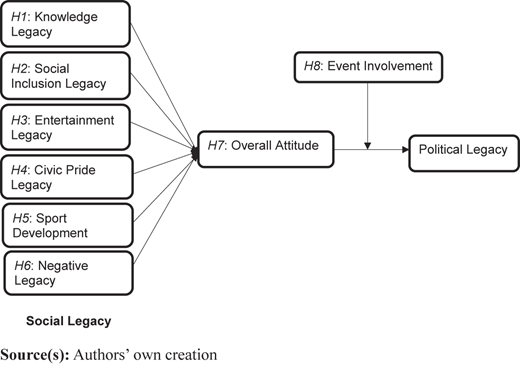
Conceptual framework for the influence of social legacies on overall attitude towards the AGP and its flow on effects
Conceptual framework for the influence of social legacies on overall attitude towards the AGP and its flow on effects
3. Methodology
3.1 Sample
The objective of this study was to measure host residents’ attitudes towards the AGP and the population was defined as comprising Melbourne residents aged 18 or older who were familiar with the event. A convenience sampling method was first used to distribute an online survey via social media. To this end, the researchers recruited university student volunteers and academic partners from the Greater Melbourne area. These students and partners then used social media to administer the questionnaire in their local areas. Administering surveys via social media can be a concern in countries where certain elements of the population are at risk of being excluded due to non-use of this medium. However, 79.9% of Australians are active social media users, averaging 1 hour and 46 minutes per day. Other than only watching television, social media is considered the second most favoured media activity in Australia (We are Social, 2021).
A total of 338 useable surveys were collected. To gain insight into how well the sample represented its intended population, the sample’s gender and age were compared with the corresponding figures for the Greater Melbourne area. This comparison revealed that males (58%) in the sample are slightly over-represented compared to the corresponding statistic of 49% for the Greater Melbourne area (www.abs.gov.au). In terms of age, those aged 18–34 and 35–49 are over-represented. Respondents aged 50–64 and 65+ are under-represented (Table 1). This should be considered as a limitation in this study.
Age and gender comparison for sample vs. population
| Age | Sample % | Population % |
|---|---|---|
| 18–34 | 42.0% | 25.9% |
| 35–49 | 36.1% | 21.2% |
| 50–64 | 13.9% | 16.8% |
| 65+ | 8.0% | 14.1% |
| Total | 100.0% | 78.0%* |
| Gender | Sample % | Population |
|---|---|---|
| Male | 58.0% | 49.0% |
| Female | 42.0% | 29.0% |
| Total | 100.0% | 78.0%* |
Note(s): *Children aged 0–17 were excluded from the sample of the study. The remaining 22% of the population is represented by those aged 0–17 years of age
Source(s): Authors’ own creation
3.2 Measurement scales
All attitudinal variables were assessed using seven-point scales (1 = strongly disagree; 7 = strongly agree). Adapted existing scales were used for this study, the origins of which are outlined in Table 2:
Measurement scales
| Scale | Items | Source |
|---|---|---|
| Knowledge legacy |
| AI-Emadi et al. (2017) |
| Social inclusion |
| AI-Emadi et al. (2017), Duan et al. (2020) |
| Entertainment |
| Fredline et al. (2003) |
| Civic pride |
| Fredline et al. (2003) |
| Sport development |
| AI-Emadi et al. (2017), Duan et al. (2020) |
| Negative legacy |
| Lee and Krohn (2013) |
| Event involvement |
| Beaton et al. (2011) |
Source(s): Authors’ own creation
A new scale was developed for political legacy, following the process set out by Churchill (1979). It began with conceptualising the construct as the impact that hosting a sport event can have on residents’ political preferences and voting behaviour. This conceptualisation was then used to guide item generation, resulting in the following three-item scale.
I am more likely to vote for a political party that supports the AGP.
I am more likely to vote for a government that provides funding for the AGP.
I would change who I vote for if my current preferred political party withdrew its support for the AGP.
The extent of this newly developed scale and the content validity of its initial items were then assessed by an expert panel comprising five academics with expertise in either sports marketing or political science. The survey instrument was then pre-tested (N = 54). To test the validity of the scale, the resulting data was subjected to Exploratory Factor Analysis (EFA) following the guidelines set by de Winter et al. (2009) for using EFA with small samples. This analysis revealed that all three scale items loaded on a single factor. Reliability was assessed via Cronbach’s Alpha, with the resulting coefficient value of 0.95 indicating that the scale can be considered reliable.
4. Results
4.1 Measurements
Exploratory and confirmatory factor analyses were employed to investigate all scales. The exploratory factor analysis results suggested that all measurements employed in the study are unidimensional. Moreover, we used AMOS v24 to examine the measurement model. The reliability results ranged from 0.90 to 0.94. It also demonstrated good internal consistency (Table 3). Convergent validity was then assessed by the average variance extracted (AVE), with all AVE values exceeding 0.50, indicating that convergent validity is acceptable. Further, the AVE values for each construct were higher than the correlations with other constructs. In summary, the results suggest that all constructs function as distinct measurements and demonstrate discriminant validity. In terms of assessing common method bias, we applied both Harman’s Single-factor test and the common latent method. The results produced values of 9% and 17.5%, suggesting that common method bias was not a significant concern.
Internal consistency, square root of average variance extracted
| Measurements | Internal consistency | Validity | |||||||
|---|---|---|---|---|---|---|---|---|---|
| 1 | 2 | 3 | 4 | 5 | 6 | 7 | 8 | ||
| 1. Enhanced knowledge | 0.94 | 0.92 | |||||||
| 2. Social inclusion | 0.94 | 0.41 | 0.93 | ||||||
| 3. Entertainment | 0.93 | 0.45 | 0.50 | 0.90 | |||||
| 4. Civic pride | 0.91 | 0.48 | 0.47 | 0.48 | 0.84 | ||||
| 5. Sports development | 0.90 | 0.39 | 0.47 | 0.49 | 0.40 | 0.95 | |||
| 6. Negative legacy | 0.90 | 0.38 | 0.45 | 0.45 | 0.43 | 0.30 | 0.84 | ||
| 7. Overall attitude | 0.93 | 0.43 | 0.44 | 0.61 | 0.60 | 0.40 | 0.49 | 0.90 | |
| 8. Political legacy | 0.92 | 0.33 | 0.37 | 0.45 | 0.36 | 0.31 | 0.30 | 0.43 | 0.89 |
Source(s): Authors’ own creation
4.2 Data analysis
We applied structural equation modelling to examine the conceptual framework. The model fit shown in Table 4 revealed a chi-square of 510.926 (df = 225, p ≤. 000, GFI of 0.90, RMSEA of 0.05 and NFI of 0.95) thereby indicating that all measures reflect an adequate fit.
Goodness of fit analysis
| Goodness of fit measure | Result | Goodness of fit measure | Result |
|---|---|---|---|
| Model fit | Model comparison | ||
| Chi-squared | 510.926 | Tucker-Lewis index (TLI) | 0.96 |
| Degrees of freedom | 225 | Normed fit index (NFI) | 0.95 |
| p-value | 0.000 | Comparative fit index (CFI) | 0.97 |
| Cmin/df | 2.271 | ||
| Goodness of fit index | 0.90 | ||
| Adjusted goodness of fit | 0.90 | ||
| RMSEA | 0.05 | ||
Source(s): Authors’ own creation
The beta coefficients for the relationships between various social legacies and residents’ overall attitude toward the AGP are presented in Table 5. It also provides the beta coefficients for the relationships between residents’ overall attitude toward the AGP and political legacy. The table also indicates t-values and respective levels of significance.
Direct effect on the conceptual model
| Hypothesis | Regression coefficient (t-value) |
|---|---|
| H1: Knowledge legacy → overall attitude | 0.01 (0.03) |
| H2: Social inclusion legacy → overall attitude | 0.15** (2.35) |
| H3: Entertainment legacy → overall attitude | 0.44*** (5.35) |
| H4: Civic pride legacy → overall attitude | 0.36*** (4.55) |
| H5: Sports development → overall attitude | −0.03 (−0.58) |
| H6: Negative legacy → overall attitude | −0.16* (−2.01) |
| H7: Overall attitude → political legacy | 0.76*** (17.17) |
Note(s): * = p < 0.05, ** = p < 0.01, *** = p < 0.001
Source(s): Authors’ own creation
Of the six hypotheses relating to social legacies’ impact on residents’ overall attitude towards the AGP, analysis revealed that four were supported (Table 5). More specifically, H2 (β = 0.15, t = 2.35, p < 0.001), H3 (β = 0.44, t = 5.35, p < 0.001), H4 (β = 0.36, t = 4.55, p < 0.001) and H6 (β = −0.16, t = −2.01, p < 0.05) were supported. The findings also suggest that when residents have a more positive overall attitude towards the AGP, they tend to have a higher intention to vote for a political party that supports the AGP (H7: β = 0.76, t = 17.71, p < 0.001).
Hypothesis 8 relates to whether event involvement moderates the relationship between overall attitude and political legacy. We used SPSS and MODPROBE to analyse the moderation effect. Overall attitude was treated as the focal predictor variable, and the moderator variable was event involvement. The variables were divided into three subcategories namely, “One s.e. below”, “Mean” and “One s.e. above” values. Because they are continuous variables, mean and plus/minus one standard deviation was applied to generate the three conditions required to assess the impact of the focal predictor variable at specific values of the moderator (Aiken and West, 1991).
Table 6 presents the beta coefficients, t-values and respective significance levels from the moderation effect of event involvement on the relationship between overall attitude and political legacy are presented. Figure 2 illustrates the moderation effect of event involvement. The results show that the degree of moderation effect of event involvement on the relationship between overall attitude and political legacy is significant (H8: β = 0.08, t = 3.53, p < 0.001), thereby supporting hypothesis 8.
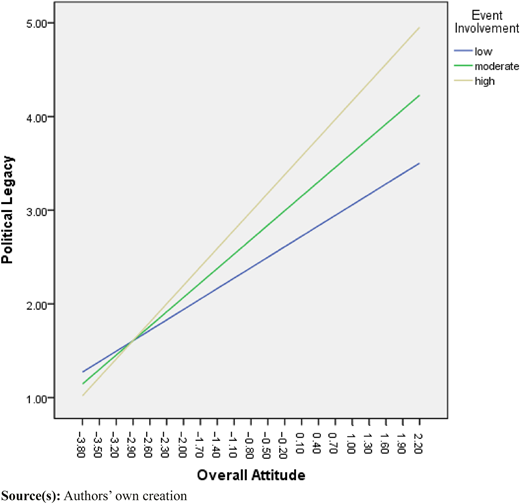
Moderating effect of event involvement on the relationship of overall attitude and political legacy
Moderating effect of event involvement on the relationship of overall attitude and political legacy
Moderating effects
| H3: Event involvement as moderator | ||||
|---|---|---|---|---|
| Co-eff | SE | t-value | Interpretation | |
| Constant | 3.10*** | 0.08 | 37.23 | Quasi Moderator |
| Overall attitude (F) | 0.51*** | 0.05 | 11.10 | |
| Event involvement (M) | 0.22*** | 0.05 | 4.75 | |
| Interact (F×M) | 0.08*** | 0.02 | 3.53 | |
| R2 | 0.48 | |||
| F-ratio | 106.38 | |||
Source(s): Authors’ own creation
5. Conclusion and recommendations
Drawing from the literature review, it was hypothesized that residents’ overall attitude towards an F1 event would be influenced by six social legacies. However, previous research typically combined multiple legacies into a single construct, thereby making it challenging to isolate their individual impacts. This study addressed this issue and found that residents’ overall attitude towards the AGP was influenced by their perceptions of civic pride, entertainment, social inclusion and the event’s negative impacts. In contrast, the study found that the knowledge and sport development legacies had no impact on residents’ overall attitude toward AGP.
There is some logic to the finding that sport development, when measured in the context of F1, does not influence overall attitude towards an event. Previous studies that have reported this relationship did so in the sports such as marathons (Duan et al., 2020) and soccer/football (Al-Emadi et al., 2017). When viewed in this relative light, it may explain why a construct operationalised in terms of living a healthier lifestyle and participating in more sports, loses its salience when applied in the unique context of an elite motorsport events like F1.
The finding that knowledge legacy does not influence residents’ attitudes is a little more surprising. There are three possible explanations for this. The first is that with Melbourne having hosted the AGP since 1996, residents’ attitudes may be based on some form of diminishing returns in that they perceive there are no further knowledge benefits to be gained from hosting the event. The second explanation is similar to that of the first: with Melbourne hosting other major events such as the Melbourne Cup and the Australian Open, this finding may reflect the belief that there is no additional knowledge benefit to be gleaned from hosting the AGP. The third explanation stems from the finding that the four social legacies that were significant – entertainment, pride, social inclusion and negative legacies – all represent personal impacts, whereas enhanced knowledge and sports development are public impacts. Hence, it may be the case that only those legacies that residents experience firsthand (e.g. entertainment, pride, a sense of inclusion and disruption) serve as key determinants of their attitude towards a sport event. The significant negative effect of negative legacy on residents’ overall attitude toward sport events suggests that perceived downsides such as traffic, noise, crowding or disruption play a substantial role in shaping community attitudes. This result indicates that as the perceived negative impacts increase, residents’ overall attitude toward the event becomes less favourable. Such findings underscore the importance for event organizers to address and mitigate these drawbacks proactively, as these negative perceptions can weaken local support and potentially impact long-term community acceptance and political backing for major sport events. The findings of this study also support one of the key propositions of SET: that residents’ attitudes towards a sport event is determined by both its positive and negative legacies (Liu, 2016).
Empirical studies investigating the political impacts of hosting sport events has been relatively limited. Moreover, the research that has been undertaken in this field often presents a confusing and conflicting picture. One view holds that governments primarily fund sport events for the wider benefits they provide to the general public (e.g. boost the economy, encourage healthier lifestyles etc.), while another suggests that political support for hosting sport events may be motivated by political gain (Misener et al., 2013). To further complicate matters, there is another view highlighting the political risk involved in supporting sport events. To this purpose, Kellison and Mondello (2014) observed that elected officials often justify financially subsidising sport on the basis that their decision is made in the best interests of their constituency. However, they also noted that doing so can have election-based repercussions if such a decision does not reflect voter sentiment. In support of such a notion, Hutchinson et al. (2018) found that the political careers of several American officials had suffered as a result of using public funds to build sport stadiums. Therefore, it is significant that this study found that as residents’ overall attitude towards the AGP become more positive, so too do their attitudes towards politicians and political parties that support the event. In doing so, it portrays political support for a sport event in a more positive light.
The study also found that the influence of residents’ overall attitude on their voting intentions is moderated by their level of event involvement. More specifically, as event involvement increases, so too does the propensity to vote for a political party that supports the event. With the findings from this study indicating that politicians are not just event benefactors, but also potential event beneficiaries, this suggests that they stand to benefit by increasing residents’ level of event involvement. A key means by which to do this is by appealing to residents’ salient motives surrounding the event (Wong and Tang, 2016). According to the findings from this study, those motives revolve around civic pride, entertainment and social inclusion. It is these event legacies, thus, that both the Victorian State Government and the Australian Grand Prix Corporation (AGPC) should be emphasising when promoting the AGP to the general public.
5.1 Academic contribution
One of the significant academic contributions of this study was the way in which it measured the social legacies. Rather than operationalise individual social legacies within a broader construct, they were measured independently. Moreover, the number of social legacies utilised within this study helped address one of the shortcomings highlighted in the research literature: the tendency to limit analysis to a restricted set of legacies (Thomson et al., 2019), thereby failing to provide insight into their relative influence on overall attitude towards an event.
Another key contribution arising out of this study relates to its sporting context – an F1 event. A key feature of previous legacy-based studies has been their focus on the Olympic Games and the FIFA World Cup. In contrast, limited research has attempted to measure the influence of legacies on residents’ attitudes in the context of an F1 event. Instead, F1-based research has focused on the determinants of fan engagement (Jones et al., 2019), event attendance (Kim et al., 2013), spectator satisfaction (Kim et al., 2016) and attendee loyalty toward the event (Zhang et al., 2019). When research has sought to measure residents’ attitudes towards an F1 event it has typically employed univariate analysis (e.g. Cheng and Jarvis, 2010; Henderson et al., 2010). While such analysis provides insight into the extent to which residents recognise the existence of certain event legacies, it fails to identify their actual influence on residents’ overall attitude towards an event.
5.2 Practitioner contribution
Bull and Lovell (2007) emphasize the importance of garnering broad resident support when taxpayer money is used to subsidize sport events. Without widespread approval, individuals with little interest in the AGP may oppose the use of their taxes for such an event. Findings from this study indicate that by highlighting benefits related to entertainment, civic pride and social integration while minimizing the event’s negative impacts, the Australian Grand Prix Corporation (AGPC) could better align its communications with the factors that directly influence residents’ attitudes toward the AGP. Currently, the AGPC’s public relations efforts focus primarily on gaining public support for the AGP. However, the finding that residents’ attitudes towards the event impact their voting intentions suggests that the AGPC should also consider state politicians as a target audience in its marketing communications. Public relations and marketing teams should consider broadening their communications strategy to appeal not only to residents but also to policymakers. Event organizers and city planners should emphasize social legacies such as entertainment, civic pride and social inclusion in public messaging. AGPC policy advocates and lobbyists should leverage the finding that residents’ attitudes can impact voting behaviour, AGPC should work closely with state politicians and engage them in public discussions about the event’s broader social and economic impacts.
5.3 Limitations and future research
Several limitations need to be taken into consideration. First, sample representativeness remains a concern. The demographic distribution in this study differs from the general population, with females and individuals aged 50 and over underrepresented. This may limit the generalizability of the findings. Future studies should aim to achieve a more representative sample to better capture the diversity of perspectives within the host community. Second, this study primarily focuses on a single event – AGP. While this provides an in-depth understanding of sport event legacies in a well-established F1-hosting city, the findings may not be directly transferable to other major sport event contexts. Future studies should determine whether the relationship between residents’ attitudes toward an event and their political voting behaviour across other major sport events. Third, the study does not account for long-term attitudinal shifts. Residents’ attitudes toward sport events and their subsequent influence on political voting intentions may evolve over time. A longitudinal study would be beneficial in providing deeper insights into the lasting effects of sport event legacies.
Despite these limitations, this study is among the first empirical efforts to measure the impact of residents’ overall attitude towards an event on their political voting intentions. Due to the controversial nature of the AGP, it is important for future research to determine whether other major sporting events have the same impact. Additionally, further studies are necessary to investigate whether the results for other social legacies still hold true when examined using other F1 Grand Prix events and different sporting contexts. Such research, for example, may reveal that knowledge legacy only serves as a non-significant influence when examined using a “sports event capital” like Melbourne. Similarly, the role of sport development legacy may vary. Expanding the scope of research to include multiple event types, host cities and longitudinal analyses will provide a more comprehensive understanding of how sport event legacies influence political and social outcomes.

