This study examines how students construct meaning around research and inquiry in an upper-level architectural design studio and how these processes support or hinder inquiry-oriented learning.
Focus-group interviews were conducted with 28 students who had completed Architectural Design 4. Data were interpreted through a three-layer meaning-making framework – contextual (studio ecology), cognitive (epistemic work of inquiry) and reflective (reflection-in/on-action) – and analyzed using reflexive thematic analysis.
The findings show that the studio can move students from imitative, product-driven work toward research-informed and self-directed inquiry. However, students often struggle to translate research, precedent analysis and theory into design decisions under time, assessment and representational pressures.
The study is limited to one institutional context and one studio level; therefore, the findings are not statistically generalizable. However, the three-layer framework offers a transferable lens for examining inquiry-oriented studio learning in comparable settings.
Studio teaching should scaffold source reading, precedent analysis, research-question formation and research-to-design translation. Critique, tutor guidance, timelines, assessment and representational expectations should be aligned to sustain inquiry and student authorship.
Making inquiry processes explicit may support more reflective, context-sensitive and socially responsible architectural decision-making.
The study links meaning-making theory with inquiry-oriented studio pedagogy and foregrounds students’ accounts to explain how research, theory, critique and reflection interact in architectural design education.
1. Introduction
In architectural education, design studios are primary spaces where students construct, test and transform ideas through iterative design processes. Within these environments, research and inquiry shape reflective and independent learning. Yet, while architectural curricula increasingly emphasize the value of research-informed design, limited attention has been paid to how students themselves perceive and practice inquiry, interpret it as a learning process and connect research to design reasoning within the studio (Bridges, 2006; Ersine Masatlıoğlu and Balaban, 2024; Salama and Holgate, 2025). Understanding these perceptions is essential for clarifying how studio-based inquiry supports students’ capacity to “learn about learning” and connect design practice with knowledge construction.
Inquiry-based learning (IBL) provides a conceptual framework for understanding design education as a process of inquiry, exploration and meaning-making. According to Lee (2012), inquiry is not a fixed set of methods but rather a stance toward learning – an orientation that encourages students to ask questions, examine evidence and reach reasoned conclusions. Similarly, Levy et al. (2010) and Branch and Solowan (2003) emphasize that inquiry enables learners to move beyond passive information acquisition toward active knowledge construction. At the higher education level, IBL is recognized for strengthening the research–teaching nexus by linking students’ curiosity-driven investigations to disciplinary research practices (Healey and Jenkins, 2009).
Empirical studies consistently report that such pedagogies foster self-directed learning, collaboration and integrative thinking (Spronken-Smith et al., 2012). These pedagogical principles resonate strongly with the epistemology of design. Architectural learning is inherently inquiry-oriented: each design iteration involves questioning assumptions, testing alternatives and generating new insights through acts of making. Schön’s (1983) reflective practitioner frames this as a dialog between thought and action. However, this reflective model should not be treated as a complete or unproblematic explanation of studio learning. As Webster (2008) argues, architectural education also involves institutional boundaries, tacit norms and pedagogical ambiguities that shape how reflection and inquiry are experienced. The design studio can therefore be understood as a space of reflexive inquiry where learners continuously move between exploration and synthesis. Yet empirical work suggests that inquiry-oriented and process-based studio models remain the exception rather than the norm (Albrecht, 2019; Salama, 2021). From the perspective of constructive alignment, such pedagogical fragmentation may weaken the relationship between learning objectives, teaching–learning activities and assessment practices (Biggs, 1996). SDG-centered debates in architectural education similarly call for pedagogies that move beyond adding new content and instead support students’ critical engagement with complex social, environmental and spatial questions (Burton and Salama, 2023). Accordingly, conventional pedagogical formats that separate lecture-based teaching from studio practice may limit deep inquiry, whereas more integrative models seek to merge research, making and meaning-making (Ezennia and Agbonome, 2025; Hettithanthri and Hansen, 2022; Murray et al., 2023; Xhambazi and Aliu, 2026).
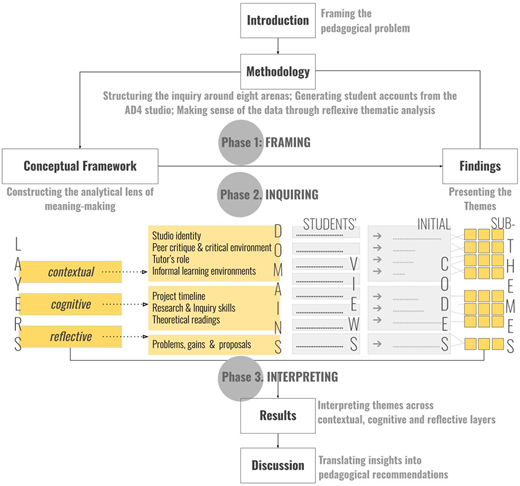
Positioned at the intersection of IBL and reflective studio pedagogy, this study examines how students make sense of research and inquiry within Architectural Design 4 (AD4), a third-year, first-semester design studio in a four-year undergraduate architecture program. The study investigates not only how students define inquiry conceptually but also how they interpret, internalize and operationalize inquiry practices during the design process. By tracing how students construct understanding, negotiate challenges and connect research to design reasoning, the study illuminates conditions that foster or constrain inquiry in studio education. Situated within debates on inquiry-based and research-informed design education, the study asks how students conceptualize research and inquiry in project-based settings, under what studio conditions inquiry becomes meaningful and where it becomes fragmented or procedural. Drawing on reflexive thematic analysis (RTA), the article aims to generate pedagogical insights that can inform more intentional, inquiry-rich studio models and support curricula that treat inquiry as a core graduate capability in architectural education (Figure 1).
2. Conceptual framework: a three-layer model of meaning-making
Meaning-making in architectural studio education refers to the process through which students interpret and connect diverse forms of information – such as site evidence, conceptual readings, precedents and design experiments – into coherent understandings that inform design reasoning. Rather than a linear accumulation of data, meaning-making is relational and iterative: it emerges through interaction, inquiry and reflection, as students negotiate between what they encounter in the studio and what they already know (Oxman, 2004; Schön, 1983).
Learning in the architectural design studio is therefore understood not simply as the production of outcomes, but as the construction of meaning through situated engagement with people, tools and ideas. Jones et al.’s (2025) account of studio properties is relevant here because it makes visible conditions such as critique, feedback, identity formation, reflection, dialog, uncertainty and ambiguity. Grounded in situated learning (Lave and Wenger, 1991), design cognition (Dorst, 2011; Oxman, 2004) and reflective practice (Boud et al., 2013; Schön, 1983), this study adopts a three-layered conceptual model – contextual, cognitive and reflective – as a flexible interpretive lens rather than a fixed coding scheme. These layers are defined as follows:
Contextual layer: Studio as a social-pedagogical ecology. Meaning in architectural learning is always situated. Studio culture, critique practices, tutor–student relations, peer dynamics and the broader social dynamics of studio teaching shape what counts as legitimate inquiry and how it is voiced (Salama and Patil, 2025). Classic ethnographies of architectural education reveal how studio rituals, hierarchies, informal norms and the hidden curriculum regulate participation and shape the formation of professional identity (Cuff, 1995; Dutton, 1987, 1991). Later studies show how critique formats and peer interaction configure opportunities for dialogic learning versus one-way evaluation (Oh et al., 2013; Webster, 2008). When design reviews are reduced to deliverable-checking “checkpoints”, dialogic exploration – and thus meaning-making – contracts (Webster, 2008). In short, the contextual layer highlights that learning and inquiry are socially and spatially scaffolded, with studio conditions enabling or constraining participation.
Cognitive layer: Inquiry as epistemic work linking research and design. Meaning is also constructed through epistemic action. IBL frames knowledge not as transmission but as a process of question-posing, evidence-seeking and reason-giving (Lee, 2012; Levy et al., 2010). In architectural education, this involves connecting conceptual and theoretical readings, precedent studies, site evidence and iterative making into a coherent structure of design reasoning. Design cognition research elaborates these cycles – problem framing, exploration, iteration and synthesis – as fundamental to designerly thinking (Cross, 2023; Goldschmidt, 2014). The term “epistemic work” is used here to describe the transformation of research, precedent knowledge, site evidence and theoretical concepts into design-relevant knowledge. Architectural inquiry is therefore abductive and productive: students work with incomplete evidence, emerging intentions and speculative propositions to formulate design responses. Within this domain, Albrecht (2019) advocates guided inquiry, where structured pedagogical support helps students translate research into design actions without turning inquiry into formulaic problem solving. Levy and Petrulis’s (2012) inquiry continuum further frames this movement as a shift from gathering and organizing external sources toward generating interpretive design reasoning.
Reflective layer: Reflection-in/on-action and learner independence. Meaning is consolidated and transformed through reflection. Schön’s (1983) notion of the reflective practitioner captures the micro-temporal dialog of thinking-through-doing, while broader reflective learning research explains how articulation, critique reception and re-framing consolidate understanding (Moon, 2013). Recent architectural education research similarly links reflective thinking and self-assessment to students’ capacity to examine, internalize and reframe their design learning (Ersine Masatlıoğlu and Balaban, 2024). In studio pedagogy, the reflective layer makes visible how students link inquiry to design decisions and how their designerly judgment matures. This process is also central to the development of learner independence, as students gradually move from tutor-dependent responses toward more self-directed inquiry and design judgment (McClean, 2009).
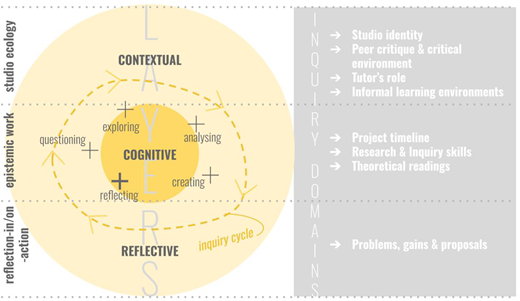
Figure 2 illustrates the three-layer analytical framework. The contextual, cognitive and reflective layers correspond respectively to studio ecology, the epistemic work of inquiry and reflection-in/on-action. The eight studio inquiry domains were derived from these layers and indicate how the conceptual framework was operationalized for examining students’ accounts of inquiry, research and learning. The five-stage inquiry cycle – questioning, exploring, analyzing, creating and reflecting – draws on IBL literature (Branch and Solowan, 2003; Lee, 2012) and is positioned within the cognitive layer as the processual backbone of students’ research-design activity. Together, the domains connect studio ecology, epistemic work and retrospective reflection to the analysis of students’ meaning-making.
3. Methodology
3.1 Context and data collection
The study is situated within the undergraduate architecture program at Yildiz Technical University, a long-established institution in Turkiye’s modern architectural education. The Department of Architecture regularly reviews its curriculum through national and international accreditation efforts, student and alumni feedback, employer surveys and internal educational workshops. This context aligns with international frameworks that position inquiry, research and pedagogical reflection as part of architectural learning and professional formation. The United Nations Educational, Scientific and Cultural Organization–International Union of Architects (UNESCO-UIA) Charter for Architectural Education, for example, identifies the understanding of “research and pedagogical methodologies”, including “transdisciplinary knowledge action and knowledge transferability”, as an inherent part of architectural learning for students and teachers (UNESCO-UIA, 2023). Similarly, Architects Registration Board (ARB)’s accreditation competency outcomes explicitly include “Research and Evaluation” as a core competency area for architects (ARB, 2023), while Royal Institute of British Architects (RIBA) validation procedures frame curriculum review, learning outcomes and educational quality within an international accreditation process (RIBA, 2022). Together, these frameworks justify examining how research and inquiry are understood and pedagogically embedded within the design studio. The 2019 Architectural Education Workshop raised related concerns, including research-based studios, theoretical debate, the adaptation of research methods to undergraduate education and the need to support students in questioning briefs and forming their own positions.
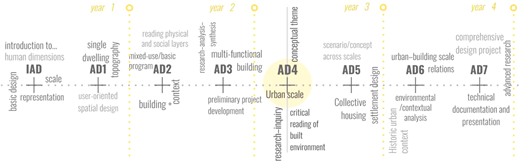
Within this institutional context, the study examines how students experience research and inquiry in the AD4 studio (AD4) and how their meaning-making can inform pedagogical development. Figure 3 situates AD4 within the sequence of architectural design studios in the four-year undergraduate program. As a third-year, first-semester studio, AD4 follows foundational and intermediate studios that introduce basic design principles, housing, contextual reading and research–analysis–synthesis skills. It marks a curricular shift toward urban-scale relations, urban analysis and the identification of problems and potentials within the city as a basis for conceptual design development. This makes AD4 a relevant case for examining how research, inquiry and urban interpretation connect to design reasoning. To explore how students perceive and experience research and inquiry in the studio, data were collected through focus-group interviews. Four focus-group sessions were held on 7, 8, 9 and 10 November 2023, with a total of 28 participants. Participants were recruited from students who had completed AD4 and could reflect retrospectively on this shared studio experience in relation to earlier and later studios. Invitations were distributed via an existing smartphone messaging group used by the cohort. The researcher was familiar with the studio as one of the department’s core design studios and had taught in related theoretical and practice-based courses within the program. However, the focus-group participants were not students from the researcher’s own studio group, and the researcher did not have a direct assessment role in relation to the participants at the time of data collection. Participation was voluntary, no incentives were offered, and students were informed that their responses would be anonymized and would not affect any course evaluation or academic standing. Participants were in the later stages of their architectural education: 7 students had more than three years of study and 21 had more than four years of study in the program. Each focus group consisted of approximately 5–6 students, enabling multi-voiced discussion while keeping the group size manageable.
3.2 Analytic approach
In this study, RTA, as articulated by Braun and Clarke (2019), was adopted. RTA was appropriate because it treats themes as analytic constructions developed through active engagement with the data rather than as pre-existing categories. Accordingly, the analysis prioritized qualitative depth and pedagogical meaning over numerical frequency.
3.2.1 Data analysis process
Focus-group data were analyzed using Braun and Clarke’s six phases of RTA: familiarizing oneself with the data, generating initial codes, constructing themes, reviewing themes, defining and naming themes and producing the report. All interviews were transcribed verbatim, and the researcher conducted repeated readings of the dataset. Students’ statements were then condensed into short units of meaning and coded, with relationships among codes examined through an interpretive lens.
Following the coding stage, clustered units of meaning were reviewed and refined through reflexive engagement with the full dataset. The focus-group schedule was organized around inquiry domains derived from the three-layer conceptual framework: studio identity, peer and self-assessment, the role of the studio tutor, informal learning activities, project timeline, research–inquiry skills, theoretical readings and architectural discourse, and perceived problems and gains. These domains functioned as sensitizing concepts rather than predetermined analytical categories. They structured the focus-group discussions across contextual, cognitive/epistemic and reflective dimensions, while the final thematic structure was developed through iterative interpretation of relationships, convergences and tensions in students’ accounts.
To maintain analytical consistency, the developing thematic structure was repeatedly checked against the full dataset rather than against isolated quotations. Coding decisions were guided by the conceptual relevance of coded extracts, contrasts across participant accounts and their relation to the research questions and framework. Themes and sub-themes were refined, merged or renamed where necessary to improve conceptual clarity. Students’ original expressions were retained where analytically relevant, and representative excerpts are presented in the Findings section to make the analytic process transparent.
Participation validation was then conducted to assess the recognizability of the synthesized findings. The eight synthesized findings were shared with the original focus-group participants through a short online form using a five-point Likert scale and optional comments. Twenty of the 28 participants responded. These responses supported interpretive credibility and informed minor refinements to the discussion.
3.2.2 Focus group protocol and question design
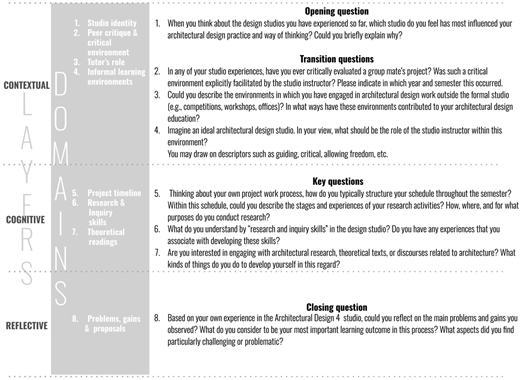
The focus-group interviews were conducted using a semi-structured protocol. The question design was informed by Krueger and Casey’s (2001) guidelines for moderating focus-group discussions. The schedule moved from opening questions on influential studio experiences to transition questions on peer critique, informal learning and the tutor’s role, then to key questions on research and inquiry practices in AD4 and a closing reflection on problems, gains and suggestions.
The guiding questions were organized around the three-layer framework: studio identity, peer/self-assessment, tutor role and informal learning addressed the contextual layer; project timeline, research–inquiry skills and theoretical readings addressed the cognitive layer; and problems, gains and suggestions addressed the reflective layer. Questions were used flexibly as prompts rather than as a rigid script, allowing participants to elaborate on their experiences, introduce additional concerns and respond to one another’s comments. Figure 4 shows how the question types were distributed across the inquiry domains.
4. Findings
The findings are presented through eight analytical themes developed through RTA. Each theme includes representative excerpts and interpretive commentary linking students’ accounts to the conceptual framework. Tables 1–8 present selected excerpts and initial codes.
The opening question asked students to identify the studios they felt had most shaped their architectural practice and way of thinking (Table 1). Responses clustered around courses – particularly AD3, AD4 and Introduction to Architectural Design (IAD) – which were described as turning points in how students understood themselves as designers. Three sub-themes emerged: design-oriented studios as formative spaces, AD4 as a turning point for analysis and research and a shift from passive absorption to self-directed learning.
4.1 Studio identity and pivotal learning moments
Design-oriented studios as formative spaces (sub-theme 1A)
Several students located the beginnings of their architectural identity in studios that foregrounded conceptual exploration and design freedom. Early studios such as AD1 were described as providing “the basic foundations”, where conceptual studies and model-making “started to build something” for the student (S3). Similarly, IAD was described as a transformative experience that changed an initial belief that “architecture was not for me”, as the student realized that “this work can be done with enjoyment” and that design-oriented studios “stimulate my imagination and are not confined to fixed rules” (S5). First-year and intermediate studios thus appear as formative environments where enjoyment, imagination, experimentation and representation become tied to students’ architectural identity.
AD4 as a turning point for analysis and research (sub-theme 1B)
Across the groups, AD4 was repeatedly framed as a pivotal or consolidating studio that shifted students’ understanding of analysis and research. One student described AD4 as “a turning-point project”, contrasting it with earlier experiences where analysis was reduced to rapidly “doing the analysis, looking at sample boards” and imitating existing examples without understanding “what we were trying to learn” (S10). In AD4, by contrast, the extended analysis phase was perceived as enabling deeper engagement and increased confidence. Similar views were expressed by students who described AD4 as “a project that pushed us to research and encouraged us to explore” (S14) or as the studio that brought them closest to “conceptual thinking” and to progressing in “a more research-oriented way” (S20). AD4 thus appears as a pedagogical hinge where analysis shifts from a procedural requirement to a vehicle for inquiry, concept development and design thinking.
From passive absorption to self-directed learning (sub-theme 1C)
Students also narrated a gradual movement from tutor-led, doctrine-based instruction toward greater autonomy and self-directed learning. One participant contrasted earlier experiences of analysis – completed with the instructor but without understanding the rationale – with AD4, where the tutor’s persistent “why?” questions required them to search for their own answers and “also understand why I was doing” the analyses (S11). Another explained that with AD4 “things started to fall into place”: while previous projects followed a fixed program led by the instructor, AD4 involved “much more urban dialogue”, a heavier analysis component and greater freedom in determining the concept and outcome (S16). A different student explicitly criticized earlier studios as “absorbing information like a sponge”, where “information is given, there is a doctrine, and you are expected to internalize it”, contrasting this with IAD’s “different ways of thinking” and with AD4, where “things emerge when a person starts to learn on their own” (S28). Overall, these accounts frame pivotal studios as situated environments in which students move from passive reception toward learner independence and architectural identity (Cuff, 1995; Dutton, 1991; Lave and Wenger, 1991; McClean, 2009).
4.2 Peer critique and critical environment
Students describe peer critique as both a valuable learning resource and a fragile practice that depends on studio culture and tutor mediation (Table 2). Their accounts reveal three interrelated sub-themes:
Peer critique as collaborative enrichment (2A)
Several students describe peer critique as a key site of collective learning in the studio. Having multiple perspectives converge on the same project is seen as enriching both students’ own work and that of their peers, sometimes making visible issues that may not emerge in tutor-led critique alone (S3, S16). Peer learning therefore extends beyond formal critique moments: students learn by observing others’ outputs, techniques and design processes and by discussing projects informally. Peer critique thus operates as a socially situated practice through which students revisit research and design decisions within a shared practice environment (Lave and Wenger, 1991; Vygotsky, 1978).
The emotional fragility of peer critique (2B)
For other students, peer critique is experienced as emotionally fragile despite its potential benefits. Concerns about hurtful comments, students’ limited confidence in their own competence, the risk of misdirecting peers and the possibility of demotivation come to the fore, particularly in formal peer critique settings (S13, S25). While recent work suggests that self- and peer-assessment in architectural design studios can support metacognition, reflective learning and student-centered accountability (Doheim, 2025), these findings show that such benefits are not automatic; they depend on trust, moderation and the affective conditions of the studio environment.
Constraints of hierarchical studio cultures (2C)
Some students emphasize that peer assessment often remains a formal or limited exercise that struggles to generate genuine reciprocity (S10). In studios where a mentor–apprentice model is prominent, the authority to critique is perceived as concentrated in the tutor, with student comments positioned as secondary. Under these conditions, peer critique is experienced less as an open process of inquiry and more as a practice operating under the shadow of hierarchical critique cultures, suggesting that the educational value of critique depends not only on its presence but on how dialogic and participatory the studio environment allows it to become (Oh et al., 2013; Webster, 2008).
4.3 The role of the studio instructor: balancing guidance, collaboration and autonomy
When asked to imagine an ideal architectural design studio, students were invited to describe how the role of the studio instructor should be configured (Table 3).
Guided freedom rather than prescriptive control (3A)
Students’ accounts of the “ideal” studio tutor consistently foreground a desire for guided freedom rather than prescriptive control. The instructor is expected to provide direction, resources and critical feedback, yet without imposing a singular design style or mode of working. Several students emphasize that tutors should recognize different ways of thinking and representing and avoid imposing their own method as the only valid design path (S7, S14). Some students also valued tutors who directed them toward sources, encouraged critique and contributed to the process without taking over the project (S3). Guidance is therefore valued when it opens research paths and questions without closing alternatives or taking authorship away from the student.
Tutor as collaborative partner in a safe studio climate (3B)
A second pattern concerns the relational and collaborative dimension of the tutor’s role. Students describe feeling more able to express ideas and take risks in studios where they can follow a shared path with the instructor and do not fear harsh or dismissive reactions (S7). Such fear is described as inhibiting experimentation and inquiry. Understanding students’ interests and acknowledging different learning tempos – rather than expecting everyone to progress in lockstep – is highlighted as a key aspect of such a supportive studio ecology (S9). This emphasis on shared exploration and psychological safety resonates with experiential learning perspectives, where learning develops through cycles of action, feedback, reflection and renewed experimentation rather than through one-way transmission (Kolb, 2014).
Threshold-sensitive guidance and calibrated support (3C)
Finally, students’ accounts outline a threshold-sensitive pedagogy, in which the tutor calibrates their level of intervention to the student’s stage of autonomy (S28). One student describes a “threshold” at which learners become able to research independently, trust their decisions and maintain internal coherence; beyond this point, the tutor should prevent major mistakes without imposing a viewpoint, while students below the threshold require more explicit guidance on “proper research” (S28). Others similarly valued tutors who prompted them to question decisions and find their own solutions rather than prescribing changes (S24). The tutor’s role is therefore not simply to correct outcomes but to support questioning, reframing and informed design judgment. This relates to transformative learning perspectives, where critical reflection enables learners to revise assumptions and take more autonomous positions (Mezirow, 1991). Together, these accounts position the studio instructor as a mediator of meaning-making who structures inquiry, supports exploration and adjusts guidance as students move toward self-directed research and design.
4.4 Informal and extra-curricular learning environments beyond the studio
When students were asked about the environments in which they engaged with architectural design work outside the studio, they referred mainly to design competitions, workshops, artistic practices and office experiences (Table 4). These environments appear as sites of self-directed learning where students test interests, extend research habits and encounter alternative modes of architectural production.
Competitions and workshops as research-intensive exploratory spaces (4A)
Students frequently characterize workshops and design competitions as spaces where they can explore ideas more freely than in graded studio settings. In these environments, peers with different perspectives broaden one another’s horizons, while observing others’ projects, taking notes and following up with independent research becomes a routine way of generating new insights (S4, S20). Competitions and workshops are therefore described as research-rich settings that extend studio learning by activating independent inquiry.
Artistic, interdisciplinary and practice-based contexts expanding design understanding (4B)
Informal learning environments also include artistic, interdisciplinary and practice-based activities that deepen students’ understanding of design. Artistic work such as color studies and collage is seen as important for grasping design principles and for experimenting with visual composition outside the constraints of studio assessment (S6). Similarly, office experience – such as participating in the design of a real museum project – is described as an experimental process involving material research and massing studies that closely parallels studio work while adding the motivation of a potentially built outcome (S14).
Structural constraints and ambivalence about extra-studio engagement (4C)
At the same time, students point to institutional and temporal constraints that limit their engagement with such environments. Workshops are perceived as infrequent, while concerns about grades, deadlines and the possibility of extending their studies can make extra-studio activities feel like a risk rather than an opportunity (S2, S6). Competitions are therefore approached ambivalently: while acknowledged as beneficial, they are often postponed to an undefined “when there is time” (S6, S20). This tension suggests that self-directed learning beyond the studio also requires strategic regulation: goal setting, planning and assessing how extra-studio activities relate to ongoing studio work (Bachman and Palmer, 1996).
4.5 Navigating the research–design timeline
Students’ accounts of project timelines show how research becomes valued, yet difficult to sustain within the rhythm of studio production (Table 5). The issue is not simply whether students conduct research but whether it informs design reasoning rather than remaining accumulated but unused information.
Enthusiastic but overloaded research (5A)
Students describe the research phase as motivating yet difficult to channel into design within limited time. Curiosity often leads to “too many tabs” and extended reading, while students simultaneously express a desire to keep this phase short and translate what they learn into design decisions (S5, S8). Research is valued but can become excessive when its relation to design action remains unclear.
Rushed transition from inquiry to production (5B)
Another pattern concerns the perceived rush of the studio calendar. Students note that the early weeks are rich in analysis and exploration, but that after the first jury the process quickly shifts to physical production, leaving initial investigations only partially digested. Research is framed as a way to “do something different”, yet the pace of the studio leaves insufficient time to translate this intention into design work (S8, S9). The problem is weak alignment between research time, design development and production deadlines.
Fragmented and non-operationalized research (5C)
Finally, students problematize the difficulty of operationalizing research within their design workflow. Analytic work is described as “never-ending”, with new information constantly emerging, but much of this material remains “set aside” rather than systematically informing design decisions. When new problems appear later in the process, students find themselves re-searching the same issues, revealing a gap between gathering information and integrating it into a coherent design logic (S10). This raises a central pedagogical question: what makes research relevant to design? Earlier ARB criteria linked relevant inquiry to the critical review of precedents in relation to function, organization and technological strategy (ARB, 2017), while recent ARB outcomes retain research and evaluation as core to architectural competence (ARB, 2023). These accounts portray research in AD4 as valued but only partially aligned with studio timing and design development.
4.6 Conceptualizing and practicing research–inquiry skills
The responses show that students do not experience research–inquiry skills simply as the ability to collect information, but as the capacity to organize, interpret and translate knowledge into a systematic design process (Table 6).
Distinguishing research from inquiry (6A)
A first pattern concerns how students distinguish between research as information gathering and inquiry as interpretation and questioning. Several students (e.g. S1, S5, S11) described research primarily as reading and understanding “raw information”, while framing inquiry as the process of articulating a design concept. This distinction echoes IBL literature, where inquiry is understood not as information acquisition alone, but as a process of questioning, interpreting evidence and forming reasoned positions (Lee, 2012; Levy et al., 2010).
Learning how to research and read sources (6B)
A second sub-theme highlights the need to “learn how to research” and to be guided in reading and using sources. Some students (S7, S11) explicitly stated that the studio should help them learn how to do research, not only ask them to “go and research.” They reported difficulties in knowing how to read precedent projects or theoretical texts, which parts of a source to focus on and how to extract what is relevant for their own design. These accounts suggest a need for methodological scaffolding: clearer procedures for selecting, reading, evaluating and mobilizing sources within the design process.
Struggling to translate research into design (6C)
A third sub-theme concerns the challenge of translating research into design under conditions of time pressure and cognitive overload. Several students (S15, S18) described feeling lost in the volume of material they collected: research phases were perceived as “going well”, yet the findings often remained “on paper” and were not fully internalized or anchored in a clear design idea. Time pressure and representational demands intensified this difficulty, sometimes leading students to avoid more demanding formal or conceptual explorations (S15, S18). From a design cognition perspective, research becomes pedagogically productive when it supports problem framing, iteration, synthesis and decision-making rather than remaining as disconnected background material (Cross, 2023; Goldschmidt, 2014). Taken together, these sub-themes suggest that students value research and inquiry but experience them as a partly underdeveloped capability. The issue is therefore how to help students move from curiosity and data gathering toward concept formation, design judgment and architectural production.
4.7 Engaging with architectural theory and discourse
Students’ accounts of architectural theory and discourse show how theoretical knowledge becomes activated, redirected or disconnected within design reasoning (Table 7).
Struggling to translate theory into design practice (7A)
Several students describe a clear gap between theoretical discourse and design action. One student framed themselves as “more realistic”, feeling that in the end the task is “to resolve it with a column”, and that theory “just stays there” and is difficult to turn into a building (S1). Others echo this by reporting that they get lost in architectural books (S7) or cannot convert what they have researched into a coherent design idea (S27). Theory is recognized as valuable but often remains abstract rather than operative in design reasoning.
Selective and instrumental engagement with theory under time pressure (7B)
Students also point to the studio timetable and project culture as limiting sustained engagement with discourse. One student noted that earlier they enjoyed reading books, researching cinemas and visiting museums, but that project deadlines had disrupted these habits and turned their time almost entirely toward “the project” (S3). Others express a conditional interest in theory–it is “interesting up to a point” but should not dominate their mental space in a problem-solving process (S15) or is mainly pursued when it directly serves the project’s concepts or helps to “understand the place” (S21). Theory engagement is therefore present but unevenly sustained and often subordinated to workload, assessment and studio production.
Theory as a resource for broadening perspective and critical awareness (7C)
At the same time, some students articulate a more expansive understanding of theoretical and discursive work. One student explicitly chose the research-based studio to develop this capacity further, arguing that theoretical readings enable them to look at phenomena “from different angles” and challenge the idea of a single correct answer (S20). Another emphasizes that “you can only draw what you know”, pointing both to the enabling and limiting effects of one’s conceptual and experiential repertoire (S27). Across these accounts, theory expands the horizons through which students interpret design problems, even when translating this perspective into form remains difficult.
4.8 Perceived problems, gains and suggestions
The closing question invited students to reflect on the AD4 studio as a whole and to identify its main gains, shortcomings and possible improvements (Table 8).
Strengthening the use of information and understanding of place (8A)
Several students described AD4 as a studio that helped them deepen their understanding of context and make better use of information in design. One student highlighted “using information better, to use it for the project” as a key gain, while also noting the multiple stages involved in finding, interpreting and drawing as distinct forms of labor (S6). Another student contrasted earlier studios, where work felt “up in the air”, with AD4, which foregrounded analysis and evaluation of the site and thus supported a stronger grasp of the urban fabric and “the feeling of the place” (S13). Together, these accounts point to AD4’s pedagogical value in translating contextual information into design understanding.
Experiencing assessment and output requirements as constraining (8B)
Students also problematized how formal outputs and assessment criteria structured design decisions. Fixed numerical requirements for plans, sections and elevations, together with technical demands such as 1:50 details, were critiqued as rigid constraints that limited project-specific representational priorities (S13, S20). These constraints were also linked to risk-avoidance. One student noted that repeated reminders to “resolve the detail” led them to abandon more ambitious massing moves (S27). Formal assessment structures were therefore perceived as workload intensifiers that could narrow exploration and push students toward “safe” solutions. This tension resonates with recent global accounts of architectural education, which suggest that transformative agendas may remain limited when conventional studio structures and assessment cultures continue to shape how learning is organized, evidenced and evaluated (Salama et al., 2026). The issue is therefore not a simple conflict between creativity and constraint, but how to balance professional realism with space for speculative, critical and student-authored inquiry, since authentic tasks should connect learning to practice while supporting reflection, experimentation and critical agency (Kreber, 2013; Strobel et al., 2013).
Seeking clearer methodological scaffolding and dialogic guidance (8C)
A third sub-theme concerns students’ desire for more explicit methodological scaffolding and a different quality of tutor–student relationship. For some, the AD4 process felt “very open-ended”, particularly in the early stages of topic-finding and analysis, prompting the suggestion that a course could focus on a single approach and its practice and that similar methodological exercises could be collectively undertaken across studios (S3). The need for sustained pedagogical guidance was also articulated through a navigation metaphor. One student argued that the studio requires not a “compass” that directly points north but an “astrolabe” that helps students orient themselves, match their own “stars” and chart their own route (S28). Here, the tutor provides strategic orientation at critical moments without prescribing solutions or undermining student authorship.
Overall, AD4 is valued for strengthening contextual understanding and information use, yet it remains constrained by product-focused assessment and the need for clearer, dialogic methodological support. This points to a central dilemma: inquiry-oriented studio learning requires both authentic engagement with architectural production and openness for conceptual exploration, critical positioning and student authorship.
5. Synthesis across the three layers of meaning-making
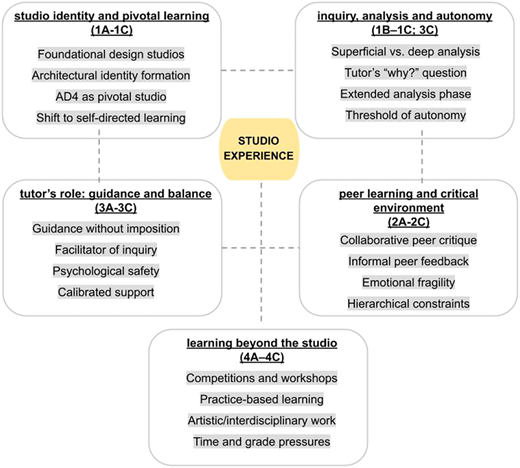
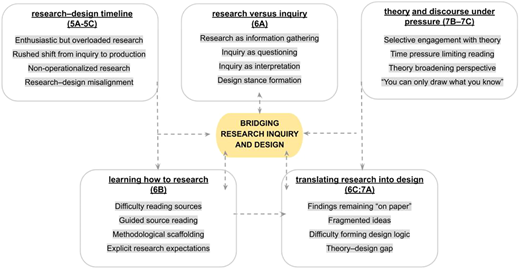
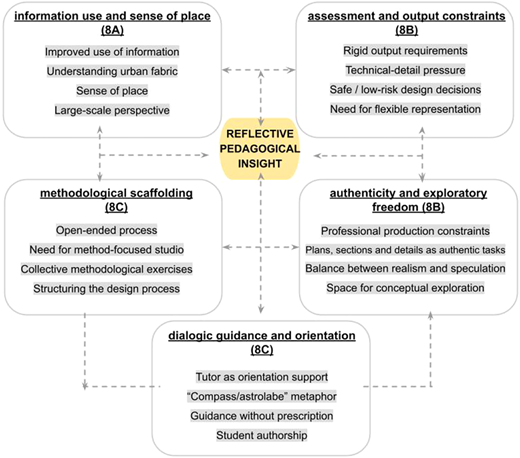
Across the eight themes, students’ experiences of research and inquiry in AD4 emerge through contextual, cognitive and reflective meaning-making processes. Figures 5–7 synthesize these layers.
Students describe design-oriented studios as formative spaces for architectural identity, with AD4 positioned as pivotal for analysis and research (1A–1 C). Peer critique appears as both collaborative enrichment and an emotionally fragile practice shaped by hierarchical studio cultures (2A–2 C). Tutor roles structure inquiry through guided freedom and threshold-sensitive guidance (3A–3 C), while competitions, workshops and practice-based experiences extend learning despite time and assessment pressures (4A–4 C).
Cognitive meaning-making is concentrated in Sections 4.5–4.7 (Figure 6). Students approach inquiry with enthusiasm but experience overload and fragmentation when moving from research to design decisions under tight schedules (5A–5 C). They distinguish research as information gathering from inquiry as questioning, interpretation and the formation of a design stance (6A), yet often lack support in reading sources and translating findings into operative design moves (6B-6 C). Similar difficulties appear in relation to theory: abstract concepts are valued but often engaged selectively under time pressure and remain difficult to translate into form (7A–7 C). Cognitive meaning-making therefore appears as a partly developed capability requiring clearer scaffolding.
Reflective meaning-making is foregrounded in Section 4.8 (Figure 7). Students value AD4 for strengthening information use and urban-context understanding, while also questioning how assessment and output requirements limit exploration (8A–8 B). Their suggestions call for clearer methodological scaffolding and more dialogic guidance (8C), captured in the “compass/astrolabe” metaphor of orientation without prescription. Students thus evaluate their learning while formulating implicit pedagogical propositions for embedding inquiry more sustainably in studio structures. Together, the three layers show that context conditions inquiry, cognition transforms research into design reasoning, and reflection consolidates these processes into pedagogical insight. AD4 is therefore experienced as a studio where contextual supports are strong, cognitive scaffolding remains insufficient and reflective awareness of research-based pedagogy begins to emerge.
6. Discussion
This study explored how students experience research and inquiry within the AD4 studio, interpreting their accounts through contextual, cognitive and reflective layers of meaning-making. The findings suggest that AD4 can be read as a threshold studio where students begin to move from passive absorption of information toward more self-directed, inquiry-oriented learning. Rather than presenting AD4 as a universal model, the study treats it as a situated case of inquiry-oriented learning. At the same time, students’ narratives expose persistent disconnections between the curricular emphasis on research-informed design and the everyday practices through which research, theory and design are linked in studio.
Across the three layers, students value exploratory studio cultures, peer dialog and tutor guidance but also identify hierarchical critique cultures, rigid output expectations, time pressure and limited methodological scaffolding as constraints. They also point to learning thresholds in students’ movement from tutor-dependent research toward self-directed inquiry, although the study cannot determine whether these are shaped primarily by curiosity, tutor–student relations, project complexity or assessment pressures.
These patterns suggest that inquiry-oriented studio learning requires more than adding research tasks; it calls for reconfiguring the studio’s pedagogical infrastructure in three ways:
Dialogic critique and peer-learning ecology: Critique sessions can be reframed as spaces for shared questioning, peer learning and collaborative exploration rather than one-way judgment, provided that emotional and hierarchical conditions are carefully moderated.
Explicit research–inquiry scaffolding: Inquiry-oriented studio learning requires structured support for reading precedents, theoretical texts and site evidence, extracting relevant concepts and translating them into design decisions. Short in-studio exercises can help make the epistemic work of inquiry visible and learnable.
Balanced alignment of inquiry, assessment and production: Studio timelines and assessment requirements could be better aligned with iterative research-based design through flexible outputs, phased research–design cycles and methodological checkpoints.
Participation validation supported the analytical structure: responses to the eight synthesized findings were concentrated mainly in the upper range of the five-point scale, indicating that participants generally recognized them as reflective of their studio experience. Although the single-case design limits statistical generalization, the three-layer framework offers a transferable lens for examining inquiry in other design studios. Future research could compare studio levels, include tutor perspectives and trace how inquiry skills develop across architectural education. Overall, students appear willing to engage in inquiry-oriented learning when contextual, cognitive and reflective dimensions are intentionally aligned.
The author gratefully acknowledges the students who participated in the study and generously shared their experiences, reflections and insights.