The circular economy (CE) model can help the construction sector to meet the UN’s sustainable development goals (SDGs). Although artificial intelligence (AI) has enhanced CE practices in various construction contexts, its integration within timber reuse and recycling remains underexplored. This study proposes a theoretical model of an AI-powered CE system to improve sustainability in timber projects and asset management.
A mixed-methods approach was adopted. Ten AI experts from Australian construction firms were interviewed using semi-structured questions to gain qualitative insights into how AI could optimize timber reuse. Of these participants, seven had extensive experience in AI applications for CE purposes in construction, while three were moderately familiar. Subsequently, an online survey collected quantitative data on system requirements from 102 industry professionals. These professionals included project managers, civil engineers and architects, providing broader perspectives on feasibility and adoption factors for AI in timber construction.
Analysis revealed 23 AI-driven functions that would facilitate circular design optimization, material management and real-time monitoring of building performance. These functions underscore AI’s potential to reduce timber waste, prolong asset lifespans and streamline project workflows.
This study advances current knowledge by providing empirical evidence (qualitative and quantitative) on AI-driven circularity in timber construction. The study demonstrates how AI can improve project execution, asset reuse and overall sustainability in the built environment. Practical recommendations are offered to guide the development and implementation of AI-powered CE systems for timber projects.
1. Introduction
The construction sector significantly impacts the environment, accounting for a significant share of global resource extraction, energy consumption and waste generation (Norouzi et al., 2021). As urbanization accelerates and demands on and for new infrastructure grow, traditional construction practices, particularly those employing high-waste and high-emissions materials such as concrete and steel, are placing greater demands on natural resources. In response to these stressors, timber has gained attention as an alternative material due to its renewable nature and capacity for carbon storage (Ghobadi and Sepasgozar, 2023; Heräjärvi, 2019). However, timber waste management poses challenges, including deforestation, degradation and increased landfill use (Browne et al., 2022).
The CE model—where resources are kept at their highest utility and value for as long as possible—offers a valuable approach to minimize the environmental impact of timber construction and maximize timber’s potential as a sustainable construction solution (Hennemann Hilario da Silva and Sehnem, 2022). The CE model aims to promote the long-term use of products and materials and to create a system that limits waste and pollution by dissociating economic growth from the consumption of finite resources such as timber (Hennemann Hilario da Silva and Sehnem, 2022). According to the CE model, timber materials and products should be maintained at their highest value for as long as possible. To accomplish this, there is a need to explore innovative approaches aimed at reducing timber waste and enhancing the reuse of timber-made assets (Kirchherr et al., 2017). By adopting circular strategies along the product lifecycle, the CE paradigm contributes to the achievement of SDGs. However, achieving sustainable construction can be further improved by using advanced digital technologies (Silvestre and Ţîrcă, 2019). A rapid increase in technological capability has become evident in the construction industry in recent years due to the adoption of digitization (Abioye et al., 2021). Recent digitization trends in architecture, engineering and construction (AEC) have spurred the adoption of advanced technologies such as AI, building information modeling (BIM) and digital twins (DT) (Baduge et al., 2022; Asif et al., 2024). AI, in particular, can process large volumes of data, recognize patterns and optimize processes (Baduge et al., 2022). This potential extends to waste reduction, material management and performance monitoring in timber construction. Yet, there is limited research on how AI specifically enhances CE-driven timber reuse and recycling (Young et al., 2021).
Despite AI’s potential in CE and construction, the sector remains among the least digitized globally (Young et al., 2021). This digital inertia is particularly pronounced in timber construction, where complex material properties and processes introduce additional challenges, including quality assessment of reclaimed timber, automated classification for reuse and predictive analytics for structural integrity. A substantial research gap thus persists concerning AI’s role in CE-focused timber construction. In response, the aim of this study is to examine the implications of AI integration into CE by developing a theoretical model of an AI-powered CE system tailored for timber construction in the Australian context. Specifically, the objectives of this study are to evaluate AI’s contributions to CE purposes in timber construction and address the opportunities associated with its implementation. By leveraging AI’s capabilities in data analysis, pattern recognition and automation, timber construction can transition toward a more efficient and sustainable circular model, mitigating environmental impact while enhancing economic viability. The remainder of this paper is structured as follows: Section 2 provides a comprehensive review of the relevant literature, outlining existing research on AI applications in CE-driven construction. Section 3 details the research methodology, including the data collection process and analytical approach. Section 4 presents the results, categorizing AI functionalities that support CE principles in timber construction. Section 5 discusses the implications of these findings, particularly in the context of proposing a theoretical model of an AI-powered CE system to improve sustainability in timber projects and asset management. Finally, Section 6 concludes the study by summarizing key insights, highlighting contributions and suggesting directions for future research.
2. Literature review
The integration of AI in the built environment is increasingly recognized as a catalyst for sustainable innovation. AI refers to intelligent computational systems capable of perceiving, planning, learning, communicating and manipulating objects (Darko et al., 2020). A defining attribute of AI is its ability to iteratively improve its functions and feedback through data collection and analysis, enabling more adaptive, predictive and optimized processes. In the context of sustainability, AI has emerged as a transformative enabler of CE systems, particularly in the construction sector (Nishant et al., 2020; Chauhan et al., 2022).
AI-powered CE systems combine data-driven decision-making with circular design and lifecycle optimization. These systems can support predictive maintenance, circular material selection, waste reduction and aggregate prediction for reuse and recycling at end-of-use (EOU) (Oluleye et al., 2023). By enabling the identification, tracking and repurposing of building materials, AI can promote closed-loop material and reduce the environmental footprint of construction activities.
Recent studies have explored the applications of AI across various stages of the building lifecycle. For example, AI-driven design tools generate eco-friendly and reusable products by considering alternatives based on environmental parameters optimizing material use, reducing emissions from transportation through localized sourcing and enhancing construction efficiency (Acerbi et al., 2021). AI has also been integrated with BIM to optimize off-site construction, waste procurement and material selection (Abioye et al., 2021). These applications improve material efficiency, reduce transport emissions and align with CE principles by extending the utility of resources.
Despite the potential shown for CE employing AI, explicit applications of AI in promoting CE within construction remain underdeveloped. For example, Momade et al. (2021) classified AI applications within AEC, identifying their relevance in structural engineering, construction materials, hydrology, energy, project management and geotechnical engineering. While this represents a valuable contribution, direct analyses of AI’s integration with CE principles remain wanting. Likewise, Alonso et al. (2021) developed and validated an AI-powered waste management system utilizing convolutional neural networks for the automated recycling of materials such as glass, plastic and paper, while Rane et al. (2023) deployed AI and Internet of Things (IoT) sensors for real-time monitoring of environmental conditions, energy consumption and structural health.
While these studies highlight AI’s sustainability applications, they do not elucidate AI’s specific role in CE for timber construction, a sector characterized by material variability, degradation and reusability constraints. Moreover, in comparison to timber, AI applications in steel and concrete construction have received relatively more attention. For instance, Duong et al. (2022) used AI to automate steel shear connection designs, and Dinesh and Prasad (2024) reviewed AI-based predictive models for strength and life cycle assessment of concrete structures. While, these studies demonstrate how AI enhances structural performance monitoring, fault detection and material optimization for approaching a building’s lifecycle, their focus is limited to uniform and durable materials such as steel and concrete. Compared with materials like steel and concrete, timber has received relatively little attention in literature on AI applications to construction, and the findings of studies such as those above are not directly transferrable to timber due to its organic nature, underscoring the need for material-specific AI strategies.
Despite these advancements, AI’s specific role in timber-based CE applications remains underexamined. Sustainable timber projects emphasize renewable material sourcing, low embodied energy and EOU reuse. These projects align strongly with CE principles, but present unique challenges such as material variability, degradation risks and connection complexity. Targeted applications of AI in this domain—for instance, in optimizing prefabricated timber design, predicting reuse potential and assessing environmental impacts—are crucial for realizing full circularity.
Baduge et al. (2022) investigated AI applications across multiple construction domains, including smart operation and health monitoring, progress tracking, construction management, off-site manufacturing, automation, structural analysis, material optimization, architectural visualization and sustainability. However, a focused discussion on AI’s contributions to CE remains limited. Within the domain of quality control, Perez et al. (2019) applied deep learning methodologies to detect construction defects through image-based convolutional neural networks. Duong et al. (2022) leveraged AI for the automation and optimization of steel shear connection designs, while Płoszaj-Mazurek and Ryńska (2024) employed AI and BIM to assess carbon footprints during the design phase and recommend architectural optimizations. Although these studies underscore AI’s capacity for design and material optimization, they primarily focus on materials like steel and concrete, which benefit from consistent mechanical properties and standardized components. In contrast, timber demands more adaptive AI approaches to accommodate its biological diversity and degradation behavior within a CE framework.
In this context, asset management refers to the process of tracking and optimizing the use of materials and components throughout their lifecycle. Asset management enables the identification of reusable elements at EOU and supports the planning of deconstruction strategies. AI-driven asset management tools can help catalog and evaluate component conditions, enabling more informed decisions on reuse and circular planning.
AI applications have also extended to energy-efficient building design. Mehmood et al. (2019) explored AI-driven optimization for residential and commercial buildings, while Namlı et al. (2019) and Farzaneh et al. (2021) investigated AI-based energy consumption forecasting. Ji et al. (2021) examined AI’s utility in lifecycle assessment and cost prediction, and D'Amico et al. (2019) assessed AI-driven energy and environmental performance optimization. While these studies address sustainability and environmental efficiency, AI’s role in CE implementation within construction, particularly in timber-based systems, remains an underexplored domain. Given timber’s status as a natural and biodegradable material, AI-driven innovations are necessary to enhance reuse, minimize waste and extend its lifecycle within the built environment.
In summary, AI-powered CE systems can substantially benefit sustainable timber projects by enabling more intelligent and adaptive asset management strategies. Nevertheless, as demonstrated in prior studies, the implementation of AI in CE frameworks for steel and concrete has progressed more substantially, suggesting that timber-based systems require similarly robust investigations. However, there is a lack of integrated research that conceptually connects these domains and explores their synergies. This study seeks to address this gap by investigating the role of AI technologies in enhancing circularity in timber construction through improved asset management, design optimization and EOU reuse planning.
3. Methodology
This study employs a mixed-method approach, involving interviews and an online survey. This approach allowed quantitative and qualitative data to be collected. Interviews to gather qualitative information and gain a deeper understanding of participants’ perspectives preceded an online survey (quantitative data). First, the identified examples of AI functions in different contexts from the literature were used for the interview process. Second, semi-structured interviews were conducted to address research objectives. Finally, an online survey was used to obtain quantitative data. Ethics approval was granted by the university research ethics committee.
3.1 Interviews
Participants were recruited via an online platform as a part of the semi-structured interview approach. Ten AI experts in Australian construction companies were interviewed. Interview sessions were conducted to gain insight into the perspectives and experiences of AI experts. Participants were selected based on a purposive method by identifying potential participants who have information about AI and CE, with further recruitment based on a chain strategy (Mason et al., 2014). This strategy identified experts in the field with relevant experience to answer questions and enhanced the richness of data. Each participant was given a unique identification code to ensure anonymity and confidentiality. Semi-structured interviews were conducted, where detailed questions concerning the AI functions in the design stage of timber construction projects and exploring their potential advantages were asked. This approach ensured that the data collected directly contributed to addressing the study’s key research objectives. Qualitative and narrative responses were collected from participants using a non-probabilistic approach (Gentles et al., 2015). Interviews were recorded and notes were taken during interviews to ensure data reliability and minimize bias. Manual and semantic data analysis were used with thematic coding to interpret the interview transcripts. All data were categorized using a thematic analysis approach (Braun and Clarke, 2006). Table 1 shows anonymous information about interviewees based on their answers to background questions. The term “Somewhat familiar” in the table refers to participants who had a general awareness of the CE concept but lacked in-depth knowledge of its specific applications in timber construction. To ensure the reliability of responses, interviewees who were not fully familiar with CE were provided with a brief explanation of its principles at the beginning of the interview. This ensured that their insights were informed and aligned with the study’s objectives.
3.2 Survey
Participants completed an online survey in Qualtrics after the interview process. The survey was designed based on insights obtained from the qualitative interviews and aimed to validate and quantify the identified AI functions in timber construction. Survey results provided statistical insights into the perceived impact of AI on CE principles by capturing expert opinions from a broader sample on the research objectives. To recruit participants for the survey, the same strategies (criterion-based and chain strategies) as the interview section were applied. LinkedIn was used to identify participants, and websites of relevant construction companies in Australia were searched to identify those interested in participating in the survey. 102 professionals from a range of Australian construction companies were selected by snowball sampling. Participants represented a diverse range of professional roles in the construction industry, including project managers, civil engineers and architects. Participants’ years of professional experience varied, with the majority having more than 10 years. Familiarity with the concept of CE also differed, with most participants being either “familiar” or “somewhat familiar”. Most participants worked in either medium or large construction companies. Medium-sized construction companies typically have between 20 and 199 employees, while large construction companies have 200 or more employees, based on common industry classifications.
Surveys consisted of closed-ended and multiple-choice questions under four main sections: demographic information, expertise assessment, core questions and future directions. Core questions focused on participants’ opinions about the contribution of AI to achieving CE in construction. The data analyzed in this study, collected through the survey method, was both primary and quantitative. Through the Qualtrics survey platform, participants were assured of the security and anonymity of their data. Descriptive statistical analyses were conducted using SPSS software, including frequency distributions to explore patterns in participants’ responses. These analyses helped identify trends in professionals’ perceptions regarding the role of AI in supporting CE practices within timber construction. Findings were synthesized with qualitative insights from interviews to ensure a comprehensive understanding of AI functionalities in this domain.
4. Results
Interview and survey analysis identified several codes related to AI applications in CE-driven timber construction. These codes were categorized into three key AI functionalities (1) optimization of design (refer to Table 2), (2) construction and material management (refer to Table 3) and (3) real-time monitoring and assessment of building performance (refer to Table 4).
Table 2 presents interviewees’ quotes supporting seven codes associated with AI functions for optimizing design scenarios in timber construction. These codes include optimizing design elements, enhancing energy efficiency, modifying building designs, optimizing costs, optimizing structural designs, simplifying modeling processes and simulating loading conditions. The first code, optimizing design elements, was mentioned by five interviewees, highlighting the importance of AI in generating new design scenarios, or predicting an optimized design scenario by suggesting spatial rearrangements for timber buildings. Energy efficiency, another critical aspect, was discussed by one expert, emphasizing AI’s role in providing energy-efficient design suggestions for timber buildings. Modifying building designs, as mentioned by eight interviewees, showcases AI’s capability to assist in generating timber building designs such as building layouts and floor plans. One expert highlighted the optimization of building costs, with AI helping to calculate the cost based on the available timber materials. One expert highlighted structural design optimization, which involves improving the efficiency of the structural engineering calculation process by utilizing AI. One expert also noted that simplifying modeling processes is a function that improves modeling capabilities. Finally, simulating loading conditions, crucial for ensuring structural integrity under various design scenarios, was another function recognized by one interviewee.
Table 3 presents interviewees’ quotes supporting six codes associated with AI functions for construction and material management. The management of timber materials covers various aspects of building materials such as material selection, facilitating the deconstruction process, optimizing resource use, minimizing waste, tracking building materials and manufacturing low-energy materials. The first code, material selection, was mentioned by two interviewees, underscoring AI’s role in testing and predicting the performance of timber materials at the design stage. Two interviewees discussed facilitating the deconstruction process as another critical aspect, highlighting AI’s capability to facilitate the deconstruction of timber buildings for future reuse. Optimizing resource use was another focus for one interviewee, pointing out AI’s potential to enhance the accuracy of material needs during construction. Minimizing waste, another code identified by one interviewee, showcases the role of AI in reducing timber material wastage by finding a construction process that uses fewer materials and produces less waste, such as prefabricated timber construction. Tracking building materials, which involves tracking timber building materials, was recognized as another AI function by one interviewee, ensuring better management of EOU and future deconstruction possibilities. Lastly, manufacturing low-energy materials, discussed by one interviewee, emphasizes AI’s role in discovering a different process to manufacture existing building materials.
Table 4 presents interviewees’ quotes supporting ten codes associated with AI functions for real-time monitoring and assessment of building performance. These codes include material defects, components’ features, real-time monitoring of building performance, embodied carbon, energy rating of buildings, energy efficiency, predicting maintenance needs, recording real-time building and elemental performance, predicting lifecycle assessments and environmental impacts. The first code, material defects, was mentioned by two interviewees, highlighting the importance of AI in detecting defects in timber materials and components after their use. Another aspect of detecting components’ features was discussed by one expert, emphasizing AI’s role in detecting timber components’ features to facilitate future deconstruction possibilities. Real-time monitoring of building performance was another aspect discussed by one interviewee, showcasing AI’s capability to track and monitor timber building elements. As mentioned by two interviewees, calculating embodied carbon underscores the importance of AI in calculating the carbon footprint of timber buildings throughout the design stage. One expert recognized the energy rating of timber buildings, which involves estimating the energy performance of timber structures, as another AI function. Energy efficiency, which is closely related, was another AI function mentioned by two interviewees, pointing out AI’s potential to optimize energy use in timber buildings. Predicting maintenance needs, highlighted by one interviewee, showcases AI’s ability to maintain safety standards and reduce maintenance costs by predicting potential issues before they arise. Recording real-time building and elemental performance was recognized by two interviewees for AI’s role in creating an immutable database for timber buildings. Predicting lifecycle assessments of timber buildings, another AI function discussed by two interviewees, involves using AI to predict the life cycle of a timber building and the future possibility of its EOU scenarios. Lastly, environmental impacts, another aspect mentioned by one expert, illustrate AI’s role in analyzing the environmental impacts of timber buildings to suggest different methods of reducing those impacts.
A survey was conducted to obtain additional information regarding the three AI functionalities among construction professionals. The survey analysis provided a comprehensive picture of the contribution of AI across different functions based on the quantitative analysis of the survey data. The survey results highlight the key AI functions valued in construction for achieving CE goals. Optimizing building designs was identified as the most critical function, with 69% of participants prioritizing it. The survey respondents chose AI assistance in generating initial building layouts and floor plans and analyzing energy-efficient design strategies as the most impacted design tasks by the AI. Within construction and material management, optimizing resource use (64%) and minimizing waste (59%) were considered highly significant. Real-time monitoring functions, such as analyzing environmental impacts and predicting maintenance needs, were moderately valued, each selected by 39% of participants. Less emphasis was placed on functions like facilitating the deconstruction process and predicting lifecycle assessments of buildings, which were each prioritized by only 20% of respondents.
5. Discussion
5.1 Contributions of AI to achieving CE in timber construction
The objective of this study was to examine how AI contributes to achieving CE in timber construction. The findings identified 23 practical AI functions in timber construction for CE purposes in three functionality categories, including optimization of design, construction and material management, and real-time monitoring and assessment of building performance, with direct implications for improving project delivery and long-term asset management strategies (Section 4).
The percentage related to each AI function (despite seven functions), reflected the confirmatory results. These AI functions have been identified in other studies (Oluleye et al., 2023). In contrast, the percentages related to new AI functions including optimizing resource usage, optimizing structural engineering calculation, simulating loading conditions, facilitating the deconstruction process, tracking building materials, detecting components’ features, and recording the real-time building and elemental performance, reflected the exploratory results. These 23 AI functions, specific to CE applications in the timber construction industry, have not been extensively examined in previous studies. This research therefore offers an original and nuanced contribution by providing a functional categorization of AI applications that is largely absent from the existing literature. Furthermore, this study bridges a critical gap in understanding the alignment between construction workflows and asset management objectives. While Abioye et al. (2021) examined the applications and opportunities of using AI in the construction sector without addressing the CE, the current study provides targeted insights and practical implications for CE initiatives related to AI in timber construction. Similarly, while Oluleye et al. (2023) conducted a systematic review identifying AI applications in areas such as circular materials selection, prediction of material circularity and circular business operations, the functions identified in our study build on and modify those existing classifications. Importantly, whereas their review lacked empirical engagement with industry professionals, our findings are grounded in the perspectives of construction practitioners, offering a more comprehensive and practice-oriented understanding of AI’s role in supporting CE in timber construction.
A comparative analysis of AI functions in concrete and steel construction underscores the uniqueness of AI integration in circular timber systems. In concrete structures, AI functions primarily focus on predicting mechanical properties (e.g. flexural strength, tensile and compressive) and supporting structural health monitoring through image-based degradation analysis (Dinesh and Prasad, 2024). Similarly, AI in steel construction emphasize optimizing connection designs using parametric modeling, evolutionary algorithms and automated design tools to improve fabrication efficiency (Duong et al., 2022). These AI functions are largely centered on structural performance, maintenance and fabrication, enabled by standardized datasets and design protocols. In contrast, this study identified a wider range of AI functions across three integrated categories in timber construction including optimization of design, construction and material management, and real-time monitoring and assessment of building performance. Notably, AI in timber plays a pivotal role in facilitating CE strategies, including tracking material reuse, enabling deconstruction and assessing embodied carbon—functions that are minimally addressed in steel and concrete research. Thus, AI in timber construction demonstrates distinct CE-oriented capabilities, complementing and extending the more mature structural optimization focus found in other materials.
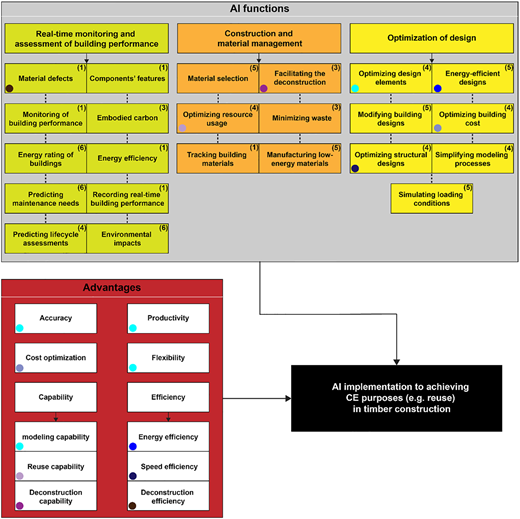
Based on the AI functions outlined in Section 4, Figure 1 illustrates the contributions of AI to achieving CE purposes in timber construction. The numbers in parentheses within each function in Figure 1 correspond to the specific layer in Figure 2 to which the function is mapped. For instance, (1) within the material defects function’s box corresponds to layer one in the AI-powered CE system. In Figure 1, the AI advantages related to AI functions are provided (based on Section 4). Colored circles in each box indicate the advantages derived from AI-related functions. For instance, optimizing design elements as an AI function provides the advantages of accuracy, productivity, flexibility and modeling capability in timber construction. This visual representation demonstrates the contributions of AI to achieve CE purposes by deconstructing timber buildings after their EOU. Data from interviews and surveys (refer to Section 4) confirm the significance of these AI functions in achieving CE goals while simultaneously supporting enhanced project management practices and optimizing the lifecycle performance of timber assets. The integration of AI functions into CE strategies also strengthens project and asset management by enabling better resource allocation, predictive maintenance and decision-making based on lifecycle performance data. This alignment ensures that sustainability objectives are met without compromising project efficiency or the long-term value of timber assets.
Interview results (refer to Table 2 and Table 3) confirm that optimization of resource use, including the required resources such as timber materials, considering the reduction of waste, can be significantly achieved by deploying AI algorithms. Unlike other sources that discussed AI applications for optimization of design scenarios based on the dimensions of tiles or steel (Wu et al., 2021; Nguyen and Vu, 2022), our investigation shows vast opportunities in the timber industry.
The result (Table 2) expressed the role of AI algorithms in generating different design options for timber-structured buildings. The proposed design options are tested using genetic algorithms and metaheuristics to identify the optimized one (refer to Interviewee 6). The genetic algorithms combine and mutate design solutions to find the optimal design for timber-structured buildings through iterative evolution. Metaheuristics such as simulated annealing refine these designs further by identifying the best designs (refer to Interviewee 7). Another identified way to optimize the design options is to use computational design by training a machine learning (ML) model (based on Table 2). By leveraging ML models, computational design predicts and generates high-performance design options based on datasets of previous design options (refer to Interviewee 7).
The interview results (Table 3 and Section 4) show AI’s ability to streamline the deconstruction of timber buildings, which not only facilitates material reuse but also informs project managers about the condition and value of deconstructed components, aiding in asset lifecycle planning. Firstly, at the design stage of the construction, AI provides an optimized design option for facilitating the deconstruction of timber buildings after their EOU. This is supported by interviewee 9 who mentioned that “set up constraints as input variables and then run through optimization for generative design for deconstruction”. Secondly, after the end of the use of timber buildings, interviewee 2 mentioned that the “ML approach shows that building is ready for deconstruction or getting close to the end of life”. At this stage, there is a need to assess the quality of the timber materials and components and identify the timber material defects. The quality assessment process is supported by interviewee 4 who mentioned that “assessment can be conducted through cameras and some sensors that could measure some previous samples statistically to record the real measurements, and then you can evaluate those or evaluate their endurance and quality assessment”. Moreover, the defects detecting is supported by another interviewee (Interviewee 7) who mentioned that “using a camera to collect the data and using a computer vision model [which is trained by showing lots of images] to detect particular things such as defects”. As a result, the process of deconstructing timber structures and buildings will be facilitated. In this process, timber materials and components are evaluated for reuse in other construction projects.
It is worth mentioning that SDG 12, which revolves around responsible consumption and production, is achieved directly by the results of this study which emphasizes the reuse capability of timber buildings and timber materials and components after their use. Also, SDG 11 which is about sustainable cities and communities is achieved indirectly by the results of this study which focuses on sustainable building practices (such as reuse and deconstruction) and reducing construction waste.
The study’s contributions extend beyond CE goals by offering insights into how project managers and asset owners can leverage AI-powered systems to optimize construction workflows, track asset performance and ensure the reusability of materials in future projects. This dual focus on operational efficiency and lifecycle management provides a robust framework for integrating CE principles into construction asset management.
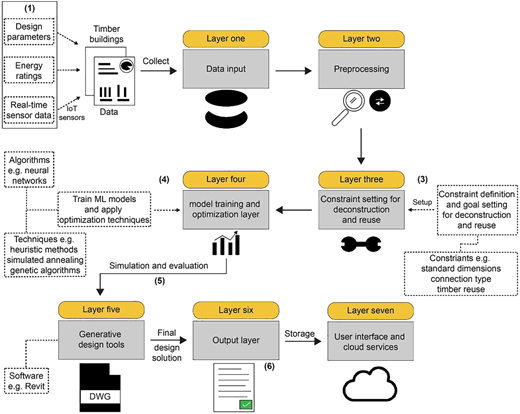
Based on the interview results (Section 4) and the above discussion related to the role of AI in facilitating the deconstruction of timber buildings and reusing timber materials and components after their use (Figure 1), a diagrammatic theoretical model of an AI-powered CE system diagram is created. This diagram (Figure 2) illustrates the integration of AI and optimization techniques specifically designed for deconstruction and reuse in timber construction. The CE goals are achieved through several layers of this system including the data input layer, preprocessing layer, constraint setting for deconstruction and reuse, model training and optimization layer, generative design tools, output layer, and user interface and cloud services. The names of the layers in this theoretical model of an AI-powered CE system have been derived from modifying and updating AI systems and models described in other existing studies such as (As et al., 2018; Jeong, 2023). Each layer of the system is supported by interviewees’ responses discussed below. The numbers in parentheses within each layer indicate the corresponding AI functions (refer to Figure 1) that are utilized within that specific layer. For instance, all AI functions labeled with (1) in Figure 1 are utilized in layer one of Figure 2, called Data input.
The theoretical model of an AI-powered CE system starts with the data input layer, which plays a pivotal role in project monitoring and asset tracking by integrating real-time data inputs and collating those, as supported by interviewee 9 who mentioned “getting the real-time data inputs and collating those. There are good streaming processes that assist with that”. In this layer, various data types including energy ratings, real-time sensor data and design parameters are collected. The AI functions including material defects, components’ features, monitoring of building performance, energy efficiency, recording real-time building performance and tracking building materials are used in this layer. Then, the data is processed in the preprocessing layer, which is supported by interviewee 9 who mentioned that “you can reduce the error from measurement by deploying more sensors. And if there’s too much data, you can quantize data and compress it” to ensure their consistency and quality. The next layer is about setting the constraints as input variables regarding future deconstruction and reuse possibilities for the optimization process supported by interviewee 9 who mentioned “[…] to include constraints or goals for modularity, deconstruction/disassembly and reuse”.
AI functions including embodied carbon, facilitation of deconstruction and waste minimization are used in this layer. In the next layer, optimization techniques and trained ML models were used to find the best design solutions that meet the specified constraints. The optimization techniques include heuristic methods, simulated annealing and genetic algorithms. This layer is supported by interviewee 10 who mentioned that “you need to give it a whole bunch of designs. And then you need to give it a whole bunch of outcomes”. The AI functions including predicting lifecycle assessments, optimizing resource usage, optimizing design elements, optimizing building cost, optimizing structural designs and simplifying modeling processes are used in this layer. Then, with the help of generative design tools such as Autodesk Revit, multiple design solutions are generated and evaluated by using mathematical programming. This is supported by interviewee 9 who mentioned “generative design is already well established in computer-aided design (CAD) tools like Autodesk, and it is more about setting up vectors or ranges of constraints in graphs and for things like human interaction, weather, earthquakes and physics for load-bearing or longevity”. AI functions including material selection, low-energy materials manufacturing, energy-efficient designs, building design modification and loading conditions simulation are used in this layer.
Interviewee 8 highlighted the output layer. In this layer, the optimal design solutions are generated along with actionable insights that maximize the ease of deconstruction and reuse of timber buildings after their use. AI functions such as rating building energy, predicting maintenance needs and environmental impacts are used in this layer. Finally, in the user interface and cloud services, users are allowed to interact with the system, and the system is supported by cloud services to handle complex calculations and large datasets. Moreover, the user interface facilitates interaction between project managers and the AI-powered system, enabling real-time adjustments during construction and post-use phases, this ensures that asset performance data collected through cloud services can be seamlessly integrated into decision-making processes for ongoing and future projects.
To enhance the prospects of AI in circular timber construction, it is essential to acknowledge key barriers to its adoption. As discussed in Ghobadi and Sepasgozar (2025), the key barriers include limited availability of high-quality data from the building’s lifecycle and a lack of skilled personnel for AI integration. Resistance to technological change within the industry and requiring a significant initial investment in AI infrastructure by companies further constrain AI integration in timber construction for CE purposes. Addressing these issues requires policy support for data standardization, financial incentives for innovation and targeted training programs, particularly in Australia (Ghobadi and Sepasgozar, 2025).
5.2 Limitations and future directions
The primary limitation of this study is related to the sample size and specific sample country. This study was conducted in Australia only, and this sample size may not fully reflect the entire construction industry. Future studies should include a more diverse sample to ensure the robustness and applicability of the results. Additionally, this study primarily explored AI functions from a conceptual perspective without focusing on specific AI techniques. Future research could investigate and compare particular subsets of AI—such as ML, Natural Language Processing (NLP) or Computer Vision—and their specific roles in enabling CE outcomes in timber construction. Developing and validating AI models tailored to different construction materials and processes, not specifically timber construction, should be explored based on the results of this study. Moreover, longitudinal studies would benefit the construction industry by helping them better understand how AI integration influences CE outcomes. Further research is needed to analyze AI’s environmental and economic impacts in developing countries with significantly different markets and resource constraints than developed countries.
The preliminary nature of this study also highlights the need for further empirical studies to validate the proposed theoretical model of an AI-powered CE system in timber construction. Future research should involve pilot studies and prototyping efforts of the AI-powered CE system to demonstrate its practical applicability in real-world timber construction projects. These practical validations would build on the conceptual framework provided by this study. Creating standardized data protocols and best practices for AI implementation will be facilitated by collaborative research involving government agencies, industry and academia.
6. Conclusion
This study aimed to examine the implications of integrating AI into the CE by providing a diagrammatic theoretical model of an AI-powered CE system, specifically in the timber construction sector. Twenty-three AI functions in timber construction for CE purposes were obtained and categorized into three functionalities to support the overall idea of the practicality and usefulness of AI technology in timber construction for CE purposes. These functionality categories, which are the key routes for the growth in timber construction when incorporating AI, also highlight its pivotal role in enhancing project and asset management through the optimization of design, effective construction and material management strategies, and real-time monitoring of building performance.
By identifying the practical functions of AI in timber construction, this study makes a significant and original contribution to understandings of AI’s role within the timber construction industry. Despite being in its preliminary stages, this study provides significant insights into the untapped potential of AI to address timber material reuse. Its findings indicate that AI has the potential to improve operational efficiency, sustainability and the lifecycle performance of projects and assets in the timber construction industry. By integrating AI into project and asset management practices, timber construction stakeholders can gain enhanced capabilities to track material use, predict maintenance needs and facilitate the reuse of materials, ultimately optimizing the long-term value and sustainability of their assets. As a result, the study is able to offer initial practical recommendations to timber construction practitioners, such as implementing AI functions, which can lead to circularity in timber construction, and as such, the findings should be considered preliminary.
Theoretical advancements of this study include the AI-powered CE system for future deconstruction and reuse in timber construction, expanding existing frameworks and offering a new perspective on implementing AI in timber construction. Ultimately, this study emphasizes how AI can take on a transformative role in driving CE initiatives. Future research should involve prototyping and piloting efforts of the AI-powered CE system in real-world timber construction projects to evaluate its practical applicability, operational feasibility and impact on the deconstruction and reuse of timber buildings after their EOU. Timber construction stakeholders must remain committed, adaptive and vigilant in leveraging AI and CE to balance economic growth with the effective management of projects and assets, fostering long-term environmental stewardship and operational efficiency.