


The construction industry faces chronic workforce challenges, including shortages, high turnover and aging demographics, prompting the adoption of workforce sustainability strategies. However, current approaches employ universal solutions without considering how diverse demographic groups perceive their effectiveness. This gap limits organizations' ability to design targeted interventions, necessitating demographic-specific insights for inclusive practice. This study examines how demographic characteristics (age, gender, marital status and ethnicity) and occupational experience systematically influence construction workers' perceptions of the effectiveness of workforce sustainability strategies within a validated eight-dimensional framework.
A quantitative survey of 412 construction professionals was conducted across the United States through a national online survey and on-site administration in Texas, US Participants rated eight workforce sustainability dimensions on a 5-point Likert scale. Kruskal–Wallis tests examined group differences.
Results revealed substantial demographic variations in perceived strategy effectiveness. Health and Wellbeing strategies showed consistent differentiation, with older, experienced and Caucasian workers rating them more effective than younger, early-career and Hispanic counterparts. Unmarried employees perceived higher effectiveness than married participants across most strategies, while equity strategies showed universal recognition across all groups.
This research provides empirical evidence of demographic variations in workforce sustainability perceptions. The findings establish a demographic-strategy perception nexus, extending existing workforce sustainability models. Practically, construction firms should adopt demographically differentiated strategies, including bilingual health and wellbeing programs for Hispanic workers, age-specific safety messaging and flexible formats for workers with caregiving responsibilities, moving beyond one-size-fits-all approaches.
1. Introduction
The construction industry faces an unprecedented workforce crisis that threatens its fundamental viability and growth potential. With 40% of the current workforce expected to retire by 2031, and only one new worker entering for every five who leave (Center for Construction Research and Training (CPWR), 2025), the industry confronts a sustainability challenge that extends beyond simple recruitment (Karakhan et al., 2023). This demographic shift coincides with evolving workforce expectations, where younger generations prioritize wellbeing, inclusion and purpose-driven work over traditional compensation packages (Durdyev et al., 2018). Despite substantial investments in workforce sustainability initiatives, construction companies continue to struggle with retention, with turnover rates in the industry at 4.6% compared to 3.4% across all nonfarm employment (US Department of Labor, Bureau of Labor Statistics, 2024). This enduring gap suggests a fundamental misalignment between how organizations structure workforce strategies and how diverse employee segments perceive their effectiveness.
The industry's workforce has become increasingly diverse in the United States, with Hispanic workers now comprising 30% of construction laborers, women representing 11% of the workforce (up from 9% in 2018), and age distributions spanning from 18 to over 65 (CPWR, 2025). Each demographic segment brings distinct values, priorities and expectations shaped by cultural backgrounds, life stages, and professional experiences. Bello and Nasiru (2021) found that demographic characteristics influence workers’ attitudes toward productivity, engagement and commitment, as well as their intentions to turn over. Yet, most workforce sustainability strategies continue to employ universal, one-size-fits-all approaches that assume homogeneous worker preferences (Tunji-Olayeni et al., 2021).
This study examines how demographic and occupational characteristics systematically influence perceptions of workforce strategies. Although previous research links demographics to workplace attitudes (Shurrab et al., 2019), no study systematically maps how segments perceive specific dimensions within a validated theoretical framework. Without this knowledge, organizations risk investing in workforce strategies that do not resonate with (and may even be disregarded by) the very demographic groups they intend to serve. The absence of a structured framework, assessing perceptions across these diverse population segments remains inconsistent. A framework-based approach ensures rigorous, actionable insights for inclusive data-informed workforce interventions. Despite growing attention, most strategies remain generalized, overlooking diverse workforce needs. Effectiveness perception varies widely. Demographic characteristics, such as age, gender, ethnicity and marital status, as well as occupational characteristics, including years of experience, significantly influence how strategies are received and prioritized. This variability underscore the need to move beyond one-size-fits-all solutions toward strategies reflecting demographic and occupational realities of the construction workforce.
1.1 Research gap
Despite extensive research, significant theoretical and empirical gaps remain in understanding how demographic heterogeneity influences perceptions of workforce sustainability strategies. Three key limitations constrain theory and practice. The first limitation is the lack of methodological coherence: existing studies offer isolated insights without an integrative framework, preventing the identification of patterns across demographic groups.
Second limitation is the disconnect between metrics and perceptions: research emphasizes quantitative outcomes (attrition rates and productivity metrics) while neglecting how workers' interpretations, despite evidence that perceptions mediate the relationship between organizational practices and behavioral outcomes (Nishii et al., 2008). Without investigating these perceptual mechanisms, the field lacks insight into why objectively similar strategies yield disparate outcomes across different workforce segments.
The third limitation is the assumption of demographic invariance: frameworks presume uniform perceptions despite evidence that needs vary (e.g. younger workers prioritize growth, older ones prioritize health and retirement, and women face work-life balance challenges) (Owusu-Boadi et al., 2025; Azhar and Griffin, 2014). This blind spot limits inclusive interventions. This study addresses these gaps through two research questions:
How do construction workers perceive the effectiveness of workforce sustainability strategies within a multidimensional framework?
To what extent do demographic characteristics (age, gender, marital status, ethnicity) and occupational experience moderate perceived effectiveness?
The findings will clarify how demographic heterogeneity shapes perceptions. The findings could extend existing conceptual models by revealing which workforce sustainability dimensions demonstrate universal appeal versus those requiring demographic-specific adaptation. This study offers useful guidance to construction industry leaders, helping them craft workforce initiatives that promote inclusivity. It also supports better resource allocation and the creation of communication strategies tailored to various groups within their teams. Ultimately, this study could serve as a foundation for transitioning from one-size-fits-all approaches toward demographically responsive practices capable of addressing the industry's persistent workforce challenges, especially in the United States. While empirical data are nationally focused, the demographic–strategy perception framework developed here has broader applicability to construction industries worldwide that face similar workforce diversity challenges.
2. Literature review
Construction workforce sustainability models integrate economic, environmental and social dimensions, emphasizing long-term employability through training and skill development (Gurmu et al., 2022). Social sustainability enhances life quality by supporting self-determination, cultural diversity, skill development for disadvantaged groups, intergenerational equity, and fair distribution of cost and benefit (Hill and Bowen, 1997). Workforce sustainability builds on these foundations, referring to an organization’s ability to maintain a stable, productive labor force while supporting wellbeing. Gambatese et al. (2019) define this as how well a workforce is able to carry out its intended role for a specified duration. A sustainable workforce thrives in an environment that is nurturing, inclusive, equitable and safe (Karakhan et al., 2020a, b). This construct aligns with Conservation of Resources theory (Halbesleben et al., 2014), which suggests that engagement relies on individual resources and identifies marital status and family responsibilities as important moderating factors. In construction specifically, it informs tools that assess safety, inclusion, training and job security (Durdyev et al., 2018).
Several frameworks have been proposed to conceptualize workforce sustainability. Kossek et al. (2014) developed a general organizational framework emphasizing work-life balance and wellbeing, while Gurmu et al. (2022) focused on social sustainability indicators in construction. However, these frameworks either lack construction-industry specificity or fail to provide measurable dimensions for empirical assessment. Among these frameworks, Karakhan et al.'s (2020a, b) eight-dimensional model is the most comprehensive and construction-specific because it was developed through a multi-round Delphi process with construction industry experts and practitioners specifically within the construction industry context in the United States, and provides operationalized dimensions suitable for quantitative measurement, making it directly applicable to the present study's US-based sample. It integrates organizational theories, including Social Exchange Theory (Zhang et al., 2015) and Diversity and Wellbeing Theory (Nielsen et al., 2017). Its theoretical rigor enables systematic analysis of demographic moderation in strategy effectiveness, addressing calls for nuanced workforce research (Yan et al., 2024b). This study builds on the workforce sustainability frameworks originally developed by Gambatese et al. (2019) and subsequently operationalized by Karakhan et al. (2020a, b). Gambatese et al. (2019) first conceptualized workforce sustainability in the construction industry and employed a rigorous qualitative methodology, involving a literature review, content analysis and thematic analysis, to identify essential characteristics and eight foundational attributes of workforce sustainability. Their work introduced these attributes as essential characteristics of a sustainable construction workforce. Karakhan et al. (2020a, b) then developed these attributes into a validated assessment tool, defining nurturing, diversity, equity, health and wellbeing, connectivity, value, community and maturity as measurable dimensions supported by indicators and metrics using a multi-round Delphi process. As defined by Karakhan et al. (2020a, b), these dimensions capture the extent to which employees feel supported and trained (Nurturing), welcomed and accepted (Diversity), treated fairly (Equity), healthy and safe (Health and Wellbeing), connected to peers and management (Connectivity), respected and appreciated (Value), part of a cohesive team (Community) and competent and mutually accountable (Maturity). This enabled empirical assessment of workforce sustainability in construction organizations. This study further extends the framework by analyzing construction professionals’ perceptions of the effectiveness of workforce sustainability dimensions across demographic and occupational categories.
However, workforce sustainability strategies must reflect demographic diversity, age, experience and cultural background strongly influence engagement. Tailored strategies are necessary rather than one-size-fits-all approaches. The aging workforce is a pressing challenge as the average age rises amid a limited influx of younger workers (CPWR, 2025). Studies show that wellness programs, ongoing education, a positive safety climate, better physical environments and age-friendly policies help sustain workability and lower injury risk (Yang et al., 2018).
Cultural diversity, alongside age, significantly shapes workforce sustainability strategies. A recent US study found that Hispanic construction workers show stronger links between workplace diversity, community, job satisfaction and reduced turnover intent (Bonilla et al., 2024). Similarly, Al Kailani et al. (2025) also found a strong positive link between belonging and retention among Hispanic workers, underscoring the need for inclusive environments.
Worker wellbeing is crucial to the sustainability of the construction workforce, where demanding conditions lead to high injury rates and attrition. Equity and inclusion are also critical, with organizations known for fairness and inclusion better able to attract and retain talent (Gutu et al., 2023).
Few studies assess demographic variation in perceptions or alignment. Characteristics such as age, gender, marital status, ethnicity and experience shape how strategies are understood, valued and applied. Table 1 summarizes key studies linking demographics to sustainability dimensions, highlighting the fragmented research and underscoring the need for integrated approaches. Yang et al. (2018) found that older workers value Health and Wellbeing, Maturity and Value strategies. Maurer et al. (2021) reported gender-based differences in perceptions of Diversity and Maturity. Gbiengu et al. (2024) linked Community and Connectivity to job satisfaction among Hispanic workers. Despite these insights, research lacks theoretical integration and a comprehensive analysis of demographic and occupational influences on perceptions of workforce sustainability strategies.
Literature findings on workforce sustainability
| Papers | Focus area/Location | Theoretical framework attribute | Demographics | Methodology and sample size | Findings and limitations |
|---|---|---|---|---|---|
| Maurer et al. (2021) | Retention of women in civil engineering/US | Nurture, Diversity, Equity, Maturity | Age, Gender, Marital Status | Quantitative logistic regression analysis on 12 case studies | The public sector was identified as having lower turnover, although female supervisors showed higher attrition rates. The study is not construction-specific, which may limit direct applicability to the construction sector |
| Yang et al. (2018) | Aging workforce safety concerns/US | Health and Wellbeing, Maturity, Value | Age | Narrative literature review | The proposed three interventions (ergonomics, wellness, safety climate) are promising, though their effectiveness is theorized rather than empirically tested |
| Sokas et al. (2019) | Worker protection disparities among temp workers/US | Health and Wellbeing, Equity, Maturity | Gender, Age | Mixed-methods approach (interviews and surveys) involving 285 participants | Demonstrated policy-relevant disparities in health and safety outcomes. While the sample was localized and nonrandom, the findings remain valuable for addressing equity gaps |
| Jiaying and Muda (2023) | Career Development, Goal Alignment, Retention/Malaysia | Maturity | Experience | Qualitative study using semi-structured interviews with 10 participants | Strategies were effective for experienced professionals in large firms. However, the small sample and national context (Malaysia) limit broader generalizability |
| Gbiengu et al. (2024) | Health and safety of Latino construction workers/US | Health and Wellbeing, Community, Connectivity | Ethnicity | Quantitative survey of 95 participants | Reported positive effects of targeted strategies on job satisfaction. Regional scope and lack of longitudinal follow-up were noted as limitations |
3. Methodology
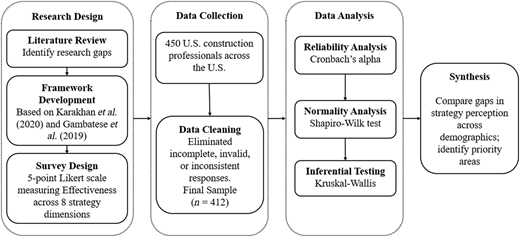
This study employed a quantitative survey to assess the perceived effectiveness of workforce sustainability strategies in construction. The approach enabled structured analysis of strategy dimensions across demographic segments, identifying industry priorities and challenges. Figure 1 illustrates the methodological steps explained in the following subsections.
3.1 Research design
This research adopts a positivist philosophical stance, which holds that knowledge is derived from observable, measurable phenomena and objective reality (Takona, 2024). Within this paradigm, the study employs an exploratory cross-sectional survey design to examine how demographic characteristics influence workforce sustainability strategy perceptions in construction. Exploratory research seeks to investigate a specific phenomenon by identifying patterns and relationships between variables rather than testing predetermined hypotheses, making it appropriate when the nature of the study does not permit variable manipulation in a controlled environment (Singh, 2021). This approach is warranted as the study examines previously unexamined relationships across multiple demographic dimensions within a comprehensive framework (Stebbins, 2001).
The study employed a structured questionnaire to examine perceptions of eight key workforce sustainability dimensions, utilizing multiple indicators for each dimension. The survey instrument was developed through a systematic process, building upon established measures. The questionnaire items were adopted from the validated instrument developed by Gambatese et al. (2019) and the workforce sustainability framework by Karakhan et al. (2020a, b). These established instruments underwent rigorous development and validation in their original studies, ensuring robust psychometric properties. The instrument's content validity was further confirmed through review by a panel of five academic research experts specializing in construction workforce sustainability, who evaluated the clarity, relevance and comprehensiveness of each item. This validation process ensured that the survey adequately captured the multidimensional nature of workforce sustainability perceptions.
The questionnaire was structured to assess construction fieldworkers' perceptions of the effectiveness of eight workforce sustainability attributes using established scales. Each dimension was measured through multiple items rated on a 5-point Likert scale (1 = not effective at all, 5 = extremely effective). A 5-point scale was selected as research indicates that scales with five response categories yield higher data quality compared to 7 or 11-point alternatives, while also reducing respondent cognitive burden (Revilla et al., 2014). This scaling approach enables nuanced assessment while maintaining response simplicity for fieldworker participants. The survey design prioritized clarity and accessibility, recognizing the diverse educational and linguistic backgrounds within the construction workforce. Table 2 presents the complete measurement framework detailing constructs, variables and statement descriptions used in the study.
Survey tools used in the study
| Construct | Effectiveness of variables (code) | Statement description |
|---|---|---|
| Nurture | A-NUTR1 | Fair performance appraisals |
| A-NUTR2 | Technical training and professional development | |
| A-NUTR3 | Onboarding process | |
| Diversity | A-DIV1 | Diverse and inclusive leadership |
| A-DIV2 | Diverse and inclusive front-line management | |
| A-DIV3 | Diverse and inclusive workforce (front-line workers) | |
| A-DIV4 | Skilled workforce | |
| Equity | A-EQTY1 | Nondiscrimination policy |
| A-EQTY2 | Transparent, especially with respect to pay | |
| A-EQTY3 | Fair pay/compensation equitably | |
| A-EQTY4 | Merit-based recruitment and promotion process | |
| Health and wellbeing | A-HS1 | Zero-injury goal |
| A-HS2 | Safety and health program | |
| A-HS3 | Safety toolbox and meetings | |
| Connectivity | A-CONN1 | Involve workers in decision-making |
| A-CONN2 | Regular meetings between workers and supervisors | |
| A-CONN4 | Encourages social and fun activities within workdays | |
| A-CONN5 | Implement a teamwork approach | |
| Value | A-VAL1 | Health insurance and retirement plan |
| A-VAL3 | Encourage work/family life balance | |
| A-VAL4 | High retention rate (low employee turnover rate) | |
| A-VAL5 | Performance feedback and appreciation | |
| Community | A-COMM1 | Put on a social event |
| A-COMM4 | Workload trade-off between employees | |
| Maturity | A-MAT1 | Training opportunities to develop leadership and communication skills |
| A-MAT2 | Develop and attract multiskilled employees | |
| A-MAT3 | Policies set clear expectations for workers | |
| A-MAT5 | Sponsor opportunities for professional licensing/certification |
3.2 Sample size
The minimum sample size was determined using Cochran's equation (Taherdoost, 2017):
Where n is the required sample size, p is the percentage occurrence of a state or condition, E is the percentage maximum error required and z is the value corresponding to the level of confidence required. Using a 95% confidence level (z = 1.96), a 5% margin of error (E = 5) and maximum variability (p = 50), the calculation yielded a minimum required sample of 385 respondents. The study collected 450 responses initially, and after removing 38 incomplete cases during data screening, 412 valid responses remained for analysis, exceeding the minimum threshold and ensuring adequate statistical power.
3.3 Data collection
Data collection employed a purposive sampling to ensure that participants had relevant, first-hand experience with workforce sustainability strategies in construction. The survey was administered through a national online survey distributed to construction professionals across the United States, complemented by direct on-site administration at construction sites in Texas, USA, which accounted for approximately 20% of the final sample. This combined approach enabled broad geographic reach while maintaining contextual depth through direct fieldworker engagement (Etikan, 2016). The final sample consisted of 450 respondents. Participants used five-point Likert scales to rate the perceived effectiveness of eight workforce sustainability attributes: nurturing, diversity, equity, health and wellbeing, connectivity, value, community and maturity. Key variables analyzed included demographic characteristics (age, gender, marital status and ethnicity) and occupational context (experience level), enabling comparative analysis across diverse workforce segments. The demographic variables examined in this study (age, gender, marital status and ethnicity) were selected based on their established relevance in construction workforce research, as discussed in the literature review. These variables are stable, easily interpretable and appropriate for collection in field-based surveys. Other demographic factors, such as education level, income and socio-economic status, were excluded due to data sensitivity concerns and reliability challenges in on-site collection. Moreover, these factors often serve as proxies for occupational experience, which was explicitly captured through years of experience in this study. This focused selection enabled robust subgroup comparisons while minimizing respondent burden. Participation was voluntary with assured confidentiality and anonymity, and the study received Institutional Review Board (IRB) approval before data collection. Data screening followed established protocols for survey research (Hair, 2009), with cases exhibiting more than 20% missing data excluded from analysis. This criterion ensures data quality while maintaining adequate statistical power. After removing 38 incomplete responses, a final sample of 412 valid responses was used for subsequent analysis.
3.4 Data analysis
This study uses a quantitative, cross-sectional approach to assess perceived effectiveness of workforce sustainability strategies across demographic and occupational groups in construction. Data analysis included reliability assessment, normality testing, descriptive statistics and inferential testing. Analyses were conducted using IBM SPSS Statistics (v26).
3.5 Reliability analysis
The internal consistency of the measurement scales was evaluated using Cronbach’s alpha, a widely accepted reliability coefficient that indicates the degree to which items within a scale are interrelated and collectively measure the same underlying construct (Tavakol and Dennick, 2011). The reliability assessment was critical for ensuring that the measurement instrument yielded consistent results accurately reflecting respondents' perceptions of workforce strategies. This statistical approach used the conventional threshold of 0.70 as the minimum acceptable internal consistency value, as the literature recommended (Bhattacharjee et al., 2024).
3.6 Inferential statistics
Distribution characteristics of all variables were examined using the Shapiro–Wilk test, which was selected as the most appropriate normality test given the sample size (Razali and Wah, 2011). Given the results of normality testing, an appropriate nonparametric statistical approach was planned. Kruskal–Wallis tests were used as the primary omnibus tests to determine whether overall differences existed in perceived strategy effectiveness across demographic and occupational groups (Field, 2024). Where significant overall differences were observed, pairwise comparisons were examined to identify the subgroup patterns contributing to those differences. However, because the study was exploratory and intended to identify emerging patterns rather than make strict confirmatory subgroup claims, typical post-hoc pairwise corrections, the Bonferroni corrections were not used in this analysis. This decision was made because the correction decreases Type I errors (i.e. rejecting the null hypothesis when it is true) but increases Type II errors, thereby lowering statistical power (Bhattacharjee et al., 2024; Rothman, 1990).
Analyses were conducted using SPSS (v26) with a significance level of p < 0.05 (95% confidence). This methodical approach enabled clear and efficient identification of strategies in which demographic and occupational differences in perception were statistically meaningful. The final step combined all statistical results to identify consistent patterns and distinct subgroup effects in perceived effectiveness. Focus was on strategies that showed significant differences across multiple factors to identify overarching patterns. This integrative approach connected statistical findings into a coherent narrative, forming the basis for evidence-based recommendations to address gaps and leverage strengths.
4. Data analysis, results and discussion
This section analyzes workforce sustainability strategies in the construction industry, highlighting perceived effectiveness across demographic and occupational groups.
4.1 Reliability and normality test
The internal consistency of the measurement scales was evaluated using Cronbach’s alpha. The eight-item scale assessing the perceived effectiveness of workforce-related strategies demonstrated high reliability (Cronbach’s α = 0.959), exceeding the commonly accepted threshold of 0.70. Composite scores for each of the eight dimensions were calculated as the arithmetic mean of their items, using pairwise deletion for missing data and preserving the original 5-point scale.
Normality assessment using the Shapiro–Wilk test revealed that the Effectiveness variables did not follow a normal distribution. The Shapiro–Wilk test was selected as the appropriate normality test, given the sample size (Razali and Wah, 2011). All variables produced significance values (p-values =<0.05), indicating a statistically significant deviation from normality (Field, 2024). This finding necessitated nonparametric statistical tests in subsequent analyses to ensure valid conclusions from the data.
4.2 Demographic and occupational characteristics
The sample (N = 412) comprises mostly middle-aged, predominantly male, married and Caucasian. Nearly half were at early-career stages, and a similar proportion worked in small companies (<100 employees). Detailed demographic and occupational characteristics are in Table 3.
Demographic characteristics
| Category | Subgroup | Frequency | Percentage |
|---|---|---|---|
| Age | Young (18–30) years | 147 | 35.7% |
| Middle aged (31–50) years | 182 | 44.1% | |
| Old (Above 51) years | 83 | 20.1% | |
| Gender | Male | 328 | 79.6% |
| Female | 84 | 20.4% | |
| Marital status | Married | 243 | 59% |
| Unmarried | 162 | 39.3% | |
| Prefer not to say | 7 | 1.7% | |
| Ethnicity | Latino/Hispanic | 104 | 25.2% |
| Asian | 4 | 1.0% | |
| Black or African American | 32 | 7.8% | |
| Caucasian | 260 | 63.1% | |
| Native American | 2 | 0.5% | |
| Prefer not to say | 10 | 2.4% | |
| Experience | Early-career (1–10) years | 193 | 46.9% |
| Mid-career (11–20) years | 133 | 32.3% | |
| Experienced (20 years or more) | 86 | 20.9% |
4.3 Group differences in perceived effectiveness of workforce strategies
Table 4 presents the significance values (p-values) for each strategy category across five demographic and occupational variables, with asterisks indicating statistically significant differences (p < 0.05).
Strategies with statistically significant differences in perceived effectiveness
| Strategy | Age | Gender | Marital status | Ethnicity | Experience |
|---|---|---|---|---|---|
| Nurture | 0.070 | 0.561 | 0.015 * | 0.532 | 0.347 |
| Married < Unmarried | |||||
| Diversity | 0.703 | 0.117 | 0.040 * | 0.450 | 0.293 |
| Married < Unmarried | |||||
| Equity | 0.080 | 0.388 | 0.311 | 0.694 | 0.254 |
| Health and wellbeing | 0.005 * | 0.591 | 0.051 | 0.041 * | 0.010 * |
| Young < Old | Latino/Hispanic < Caucasian | Early Career < Mid-career | |||
| Early Career < Experienced | |||||
| Connectivity | 0.164 | 0.404 | 0.026 * | 0.135 | 0.952 |
| Married < Unmarried | |||||
| Value | 0.166 | 0.360 | 0.002 * | 0.204 | 0.346 |
| Married < Unmarried | |||||
| Community | 0.820 | 0.700 | 0.003 * | 0.018 * | 0.336 |
| Married < Unmarried | Latino/Hispanic < Caucasian | ||||
| Maturity | 0.994 | 0.273 | 0.005 * | 0.116 | 0.393 |
| Married < Unmarried |
Note(s): * Presents the significant differences at a 95% Confidence Interval. # Each of the eight dimensions represents a composite score calculated as the arithmetic mean of its constituent sub-items (28 total items; see Table 2 for complete item distribution)
The Kruskal–Wallis tests revealed overall group differences, and pairwise comparisons were used to interpret the direction of subgroup variation shown in Table 4. However, as discussed earlier, post hoc adjustment procedures were not applied, as the study aimed to retain sensitivity to emerging patterns in this exploratory analysis.
4.4 Synthesis of workforce sustainability attributes effectiveness findings across demographics and occupational groups
The analysis revealed overlapping and distinct patterns in perceptions across demographic and occupational groups. Health and Wellbeing showed the most significant variation, differing significantly by age, ethnicity and experience level. Similarly, Community, Maturity and Connectivity strategies also showed substantial variation, particularly between married and unmarried individuals. In contrast, Equity and Diversity were perceived uniformly across all groups, suggesting some strategies are valued uniformly across the construction workforce. Marital status consistently influenced perceived effectiveness, indicating relational factors shape strategy perception. Meanwhile, gender had a minimal influence, with similar perceptions among male and female participants.
4.4.1 Age
Age emerged as a significant factor influencing perceptions of workforce strategy, with systematic differences observed across generational cohorts. Analysis showed a notable difference in the perceived effectiveness of Health and Wellbeing strategies across age groups (p = 0.005). Pairwise comparisons indicated that younger participants viewed these strategies as less effective than older ones (p = 0.004). No statistically significant difference was observed between middle-aged and older participants, indicating that the disparity was most pronounced between the youngest and oldest segments of the workforce.
This pattern indicates that older workers may place greater value on organizational support related to safety, health and wellbeing, likely due to accumulated work experience and greater awareness of long-term occupational risks. This finding aligns with Yang et al. (2018), who emphasized that wellness programs, safety education and a positive safety climate are critical for mitigating age-related risks in the workplace.
In contrast, younger workers may prioritize more immediate career-related concerns during early career stages. Van Vianen et al. (2011) also discovered that age affects how employees engage with organizational development initiatives, with younger workers showing different participation patterns than older colleagues. These findings suggest that workforce sustainability efforts should be framed differently across age groups, with stronger emphasis on immediate relevance for younger workers and long-term health protection for older workers.
4.4.2 Gender
Gender analysis revealed consistency in perceptions of workforce strategy effectiveness, suggesting universal recognition of organizational priorities across male and female construction professionals. Male and female respondents’ perceptions of workforce strategy effectiveness did not differ significantly. This suggests that either the messaging regarding strategic importance has been effectively communicated, or there is a broad consensus that elements such as health and wellbeing, equity and leadership development are vital components of workforce sustainability.
However, this perceived alignment requires careful interpretation. While both genders value these strategies equally, this does not necessarily indicate equal access to or benefit from them. Prior literature has often highlighted structural and cultural barriers that affect women’s advancement in male-dominated fields such as construction (Husam et al., 2024; Yan et al., 2024a). On the contrary, Naoum et al. (2020), found that both male and female construction professionals prioritize similar workforce development solutions, such as transparent promotion criteria, return-to-work training and flexible scheduling. This indicates an essential distinction for industry leaders: equal perception does not guarantee equal experience, and continuous evaluation is necessary to ensure that shared values translate into equitable outcomes.
4.4.3 Marital status
Marital status consistently predicted perceptions of workforce strategy effectiveness, as unmarried employees reported higher ratings across several key dimensions. Across factors such as Nurture (p = 0.015), Diversity (p = 0.040), Connectivity (p = 0.026), Value (p = 0.002), Community (p = 0.003) and Maturity (p = 0.005), married participants consistently reported lower effectiveness ratings than their unmarried counterparts. In contrast, Equity strategies showed no differences by marital status, indicating shared priorities across relationship contexts.
Unmarried respondents consistently rated organizational initiatives as more effective across several key categories, including nurture, diversity, connectivity, value, community and maturity. This pattern suggests that unmarried employees may be more receptive to or attuned to development, inclusion and engagement-focused initiatives, possibly due to fewer external constraints or greater availability to participate in workplace programs.
These differences may reflect varying expectations around work-life balance, time availability or perceived relevance of such strategies to their circumstances. These findings align with the existing literature, which emphasizes the impact of family and marital roles on workplace engagement. Perry-Jenkins et al. (2000) highlighted how marital and family responsibilities shape employees’ access to and interaction with organizational resources. Song et al. (2018) demonstrated that organizational support is vital for alleviating work-family conflict, influencing job satisfaction and employee retention. These differences highlight the importance of tailoring communication and engagement efforts to reach employees across different life stages and relational contexts.
4.4.4 Ethnicities
Ethnic analysis revealed targeted disparities in perceptions of workforce strategy effectiveness, with significant differences concentrated in the Health and Wellbeing and Community dimensions. Caucasian respondents rated Health and Wellbeing (p = 0.006) and Community (p = 0.007) strategies as more effective than Hispanic respondents. All other strategies were perceived consistently, suggesting a general understanding of the core workforce. Lower effectiveness ratings from Hispanic participants may point to issues with cultural responsiveness, language accessibility or workplace visibility of these initiatives.
These findings echo CPWR (2023), which documents that Hispanic construction workers in the United States experience higher rates of injury and fatality, partly due to inadequate access to safety training tailored to their language and culture. CPWR (2024) further identified that Hispanic construction workers face systemic barriers, including language limitations, lack of bilingual training materials and reduced access to safety programs (particularly in small firms), which help explain why this group perceives health and wellbeing initiatives as less effective than their Caucasian counterparts.
4.4.5 Work experience
Experience level analysis revealed a notable perception gap in Health and Wellbeing strategies, with early-career professionals rating significantly lower. Early-career professionals rated these strategies as less effective than mid-career (p = 0.025) and experienced professionals (p = 0.007), while no significant difference was observed between mid-career and experienced professionals (p = 0.470).
This finding suggests that early-career workers may be less likely to recognize the immediate value of wellness-related initiatives, possibly because of lower risk awareness, limited exposure to programs or a weaker connection between these strategies and career development. Jiaying and Muda (2023) also noted that aligning career goals with wellness and development programs is critical for retention, especially among seasoned employees. Together, this study reinforces the need for career-stage-sensitive communication and engagement approaches, particularly for workers entering the industry.
4.5 Contributions
Findings reveal previously unexplored relationships between demographic and strategy perceptions, creating opportunities for theory development and evidence-based practice.
4.5.1 Theoretical contribution
This study offers theoretical contributions to workforce sustainability by considering new relationships and raising critical questions for future research. First, it uncovers a demographic–strategy perception nexus that challenges universal workforce sustainability models, revealing systematic patterns in how demographic segments perceive strategy effectiveness. Health and Wellbeing strategies vary most across demographics, whereas Equity is valued almost universally. This establishes a theoretical foundation for viewing workforce sustainability as a multi-layered construct with universal and demographic-specific dimensions. These findings can be theoretically situated within several complementary frameworks. Social Identity Theory posits that individuals' demographic group memberships shape how they interpret and respond to organizational initiatives, thereby explaining why age, ethnicity and marital status systematically influence perceptions of strategy (Hogg et al., 2012). The Similarity-Attraction Paradigm further suggests that workers are more receptive to strategies that reflect their own cultural values and lived experiences (Froehlich et al., 2021), consistent with the lower effectiveness ratings observed among Hispanic and early-career workers. From an organizational sustainability perspective, these results extend the social dimension of the Triple Bottom Line by demonstrating that workforce strategy effectiveness is contingent on demographics rather than uniform (Rogers and Hudson, 2011). Importantly, whether these demographic perception differences ultimately moderate actual strategy outcomes, such as retention rates, productivity and wellbeing, rather than perceptions alone, remains a critical direction for future confirmatory research.
Future research should explore: What psychological or social mechanisms explain why specific workforce strategies transcend demographic boundaries? What role do cultural values, life experiences and career stages play in creating these systematic perception patterns?
Second, it confirms Karakhan et al. (2020a, b) framework by providing the first empirical evidence of how its eight dimensions are differentially perceived across demographic groups. This study shows it can predict workforce perception differences, shifting the framework from descriptive to predictive.
Third, it reveals an unexpected “career stage perception” for early-career professionals, who need the most support, perceive Health and Wellbeing strategies as least effective. This challenges HR development theory assumptions that perceived need aligns with perceived value. Future research should explore why those needing support see less value and how career stage, risk perception and socialization influence strategy evaluations. These insights indicate that workforce sustainability theory should shift from universal models to frameworks responsive to demographic differences in perception.
4.5.2 Practical contribution
The study's practical contributions focus on providing actionable insights for construction industry leaders seeking to enhance workforce sustainability effectiveness. Age-responsive strategy implementation is essential. The finding that older workers consistently rate Health and Wellbeing strategies as more effective than younger workers suggests that health and wellbeing messaging may need age-specific framing. Organizations should develop multi-generational communication approaches that emphasize both immediate career benefits for younger workers and long-term health and security benefits for older employees. For instance, health and wellbeing training for younger workers could be framed with explicit connections to certifications and career advancement, while communications for older workers might emphasize long-term health protection and retirement security. Gender-neutral strategies are generally effective, but ongoing oversight is needed. Although perceptions of effectiveness show little gender difference, this does not ensure equal experiences. Organizations should maintain gender-neutral strategy designs while continuously monitoring implementation of disparities.
Marital status considerations should inform programs design. The consistent pattern of unmarried employees rating most strategies as more effective suggests that family responsibilities may influence strategy engagement. Organizations should consider flexible program designs that accommodate different life circumstances, offering both individual-focused and family-inclusive options. Practical implementations could improve the managerial implications section with targeted intervention strategies for each demographic segment, such as providing recorded versions of training for asynchronous completion, offering dependent care support during mandatory sessions and establishing flexible participation formats that accommodate caregiving responsibilities.
Culturally responsive strategies are crucial for engaging the Hispanic workforce. The observation that Hispanic workers consistently rated Health and Wellbeing and Community strategies as less effective than Caucasian workers suggests the existence of cultural, linguistic or access-related barriers. To address these challenges, organizations should implement workforce sustainability strategies that are both culturally relevant and accessible. This may include providing bilingual program delivery, integrating cultural values into safety communications, engaging community leaders from underrepresented groups as program advocates and tailoring communication approaches to reflect cultural preferences. Specific cultural adaptations for Community strategy effectiveness should include family-oriented social events, culturally relevant team-building activities and recognition programs that honor cultural traditions and values. For example, safety messages that focus on shared values, such as keeping families safe, may be especially effective for workers from cultures that value community.
Organizations should develop career-stage-appropriate engagement strategies that demonstrate immediate relevance and connect wellness to career advancement opportunities, linking health and wellbeing participation to skill certifications and showcasing how healthy workers progress more quickly in their careers. Mentorship and peer support systems should pair early-career workers with experienced professionals who can demonstrate the career benefits of wellness engagement. Programs such as OSHA's Susan Harwood Training Grant have demonstrated the feasibility of bilingual, demographically targeted safety training for construction workers, providing a replicable model for the tiered approach recommended here (OSHA, 2024).
4.5.3 Societal and policy implications
Beyond organizational applications, this research carries broader societal and policy implications. First, the findings can inform industry-wide workforce development policies by demonstrating that standardized approaches to workforce sustainability may inadvertently exclude or underserve specific demographic groups, particularly Hispanic workers and early-career professionals. Policymakers and industry associations could leverage these insights to develop more inclusive guidelines and standards for workforce development programs.
Second, the study has implications for occupational health and safety policy. The fact that younger and early-career workers find Health and well-being strategies less effective highlights the need for age-specific safety communication, which could shape OSHA training or industry certification standards.
Third, the research contributes to societal-level workforce diversity and inclusion initiatives. Highlighting perception gaps among ethnic groups can help shape public policy to boost retention and job satisfaction for underrepresented workers in construction, advancing industry equity.
Although this study is exploratory and does not directly evaluate policy design or implementation, the findings suggest potential relevance for workforce development agencies, inclusion-oriented industry standards and construction education or apprenticeship programs. In particular, the demographic differences observed in perceived strategy effectiveness suggest that workforce sustainability efforts may be more effective when they are designed and communicated with greater responsiveness to workers' backgrounds, career stages and lived contexts. These implications remain preliminary and should be examined more explicitly in future policy-oriented research.
5. Conclusion
This study contributes to the growing body of research on workforce sustainability by examining how diverse demographic and occupational groups perceive the effectiveness of key workforce strategies. Using a validated framework and a large-scale survey of 412 construction professionals, the findings reveal that while many workforce strategies are broadly valued, significant disparities exist in how their effectiveness is perceived across age groups, marital statuses, ethnicities and experience levels among the cohort surveyed in Texas, US
Older, experienced, and Caucasian workers rated Health and Wellbeing strategies as more effective than younger, early-career and Hispanic participants. Equity strategies were consistently effective across demographics, indicating fairness is widely valued in the workforce. Similarly, unmarried employees consistently perceive higher effectiveness across most strategies compared to married participants, suggesting that life circumstances significantly influence how organizational initiatives are valued. These demographic-specific perception patterns underscore the critical need for organizations to move beyond universal approaches toward demographically responsive strategies that account for the diverse perspectives and priorities within their workforce.
The study’s theoretical contributions extend workforce sustainability literature by revealing systematic demographic-strategy perception relationships and identifying new research directions. Practically, the findings provide actionable guidance for construction industry leaders to design more inclusive and effective workforce sustainability initiatives that resonate across their diverse employee populations.
5.1 Limitations and future research direction
While this investigation provides valuable insights into demographic and occupational variations in perceptions of workforce sustainability strategy effectiveness, several limitations warrant acknowledgment, alongside ameliorative measures implemented and prospective research trajectories.
First, the reliance on self-reported perceptions introduces potential response bias and variability in subjective interpretation. Although methodological rigor was enhanced through the use of validated instrumentation and demonstrated high internal consistency (Cronbach's α = 0.959), future investigations should employ triangulated methodologies that incorporate objective performance indicators to corroborate perceptual findings. It is also important to note that this study captures perceived effectiveness rather than actual organizational outcomes such as retention rates, productivity or injury incidence. While perceptions are recognized as mediators between organizational practices and behavioral outcomes (Nishii et al., 2008), the extent to which higher perceived effectiveness translates into measurable workforce improvements remains an avenue for future investigation. Second, although the study achieved the minimum sample size requirements, certain demographic segments exhibited limited representation. The sample’s gender distribution (79.6% male, 20.4% female), while reflective of the construction industry’s composition, limits generalizability of findings to female workers. Similarly, some ethnic groups, particularly Asian (1.0%) and Native American (0.5%) respondents, were underrepresented, constraining the ability to draw robust conclusions for these populations. Additionally, while data collection spanned construction professionals across the United States, the on-site component was geographically concentrated in Texas, and findings should be interpreted with this context in mind. However, the findings are potentially transferable to construction labor markets sharing similar workforce characteristics, particularly a high proportion of Hispanic workers, a predominantly male workforce, a large share of early-career professionals and small-to-medium firm structures. Beyond the US context, the framework developed in this study offers a transferable analytical approach applicable to diverse workforce settings, though local demographic factors should be validated and adjusted accordingly in replication studies. Future research should pursue enhanced demographic stratification, multi-regional sampling protocols and cross-cultural validation studies to examine whether these findings generalize across different national and cultural contexts. While also examining how perception differences may inform workforce development policy, public-sector inclusion standards and construction education or apprenticeship program design across different regional and institutional contexts.

