This study investigates the moderating effects of consumers’ occupations on their purchase intentions (PIs) for food takeout services using a modified unified theory of acceptance and use of technology model. It evaluates how different occupations influence the relationships between social influence (SI), expectation confirmation (EC), facilitating conditions (FC) and PI.
The study collected data from individuals in various occupations, including technical/associate professionals, executives/professionals, administrative/service workers and manual/operative workers. The data were analyzed using structural equation modeling, while hierarchical analysis assessed how occupation moderated the relationships between latent variables (SI, EC and FC) and PI.
Different occupations have a certain moderating effect on the relationships between SI/EC/FC and PI. For the technical and associate professionals and manual and operative occupations, the moderating effect of FC on PI is stronger than that of EC and SI. For executives and professionals and administrative and service occupations, the moderating effect of EC on PI is stronger than that of SI and FC.
This study provides new insights into how occupational differences influence consumer behavior in the context of online food ordering services. The results expand the application of the unified theory of acceptance and use of technology model and the understanding of the influence of occupation on consumer’ behavior.
1. Introduction
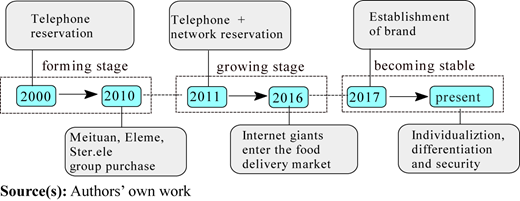
With the rapid development of the Internet and related technologies, various selling modes of the products have emerged owing to new consumer demand. Online takeout—a food consumption pattern—is a door-to-door service provided on a food delivery platform, from caterers to end consumers. Consumers can order their favorite foods from their homes or offices via takeout websites or apps; the courier then delivers these orders to the customers. This mode is considered highly convenient for consumers (Prashar and Maity, 2024). Figure 1 illustrates the three stages in the development of food takeout platforms: the embryonic stage, wherein food was primarily ordered via telephone (2000–2010); the rapid development stage, wherein online ordering via the Internet and telephone ordering coexisted (2011–2016); and the becoming stable (2017–present), wherein ordering was conducted mostly through smartphone/computer (Iresearch, 2016).
Online-to-offline (O2O) e-commerce provides a free transaction platform for merchants and consumers (Yongrok et al., 2021). The high-profit margins have attracted many investors to this field, such as Lewaimai, Maituan, Elma, Fenniao, Koubai, Renren, Dada, UU, Dazhong, and Didi. China represents one of the world’s largest market size and growing consumer spending power. China’s online takeout food transaction volume has grown rapidly, from 727.4 billion yuan in 2019 to 941.7 billion yuan in 2022 (Iresearch, 2016), an increase of 29.5% in three years. Consequently, the transaction volume on food delivery platforms will show a growing trend in the future. The market size of China’s food takeout industry is estimated to reach 1331.9 billion yuan by 2024 (Iresearch, 2020).
Consumers who choose food takeout either tend to be busy at work or are unwilling to cook due to the tediousness of cooking or weather-related inconveniences such as rain and snow. Another reason could be the availability of more preferential pricing policies in online food delivery compared to offline stores. The fast pace of work among the technical and associate professions increases their tendency to choose takeout options for lunch or dinner (Kumar et al., 2021). Moreover, with the continuous improvements in living standards and the thought of enjoying the moment, food consumers have more detailed preferences, such as shape, color, taste, health care, and other demands (Grygorczyk et al., 2016; Schwartz et al., 2022). Thus, personalization of food ordering is becoming increasingly prominent. On one the hand, consumers now have more choices when ordering online. On the other hand, competition among delivery platforms is becoming fiercer. In this case, it is necessary to elucidate the following research questions (RQs):
What strategies should the platform use to increase consumer purchase intention (PI), enhance user experience, and foster long-term engagement?
How do consumers perceive and respond to personalized food ordering experiences compared to traditional ordering methods?
Addressing these gaps will provide valuable insights for academia and industry in optimizing the personalization of food ordering services for sustainable growth and enhanced customer satisfaction. To secure the sustainable development of these platforms, it is crucial to deeply understand the fundamental factors that drive consumers’ PIs and behaviors while engaging with the platform. This deep understanding forms the foundation for achieving a competitive advantage in operational strategies and facilitates informed decision-making and strategic planning.
2. Literature review and hypotheses development
2.1 Literature review
Present research indicates that factors influencing consumer purchasing behaviors can be divided into two main categories: external and internal factors. External factors include corporate marketing strategies and social environments. For instance, a takeout platform may encourage a subsidiary corporation to optimize its marketing strategies to attract consumers (Zhang et al., 2019). The social environment impacts product pricing, delivery times, and promotional methods, influencing consumers’ purchasing intentions (Chen et al., 2020). For example, enhancing logistics efficiency can shorten delivery times, thus increasing customer satisfaction (Chakraborty, 2021), while community support can help build brand trust and loyalty (Sun et al., 2022). In contrast, internal factors such as perceived value, satisfaction, and trust positively influence consumers’ repurchase intentions (Chen et al., 2015). These factors impact different aspects of individual, corporate, and product dimensions (Jin and Jaewon, 2019). Therefore, analyzing consumer behavior requires considering external influences, internal perceptual factors, and the complex interactions among these factors. In other words, purchasing decisions result from a combination of these influences. For example, effective marketing can enhance perceived value, increasing consumer trust and the willingness to repurchase.
Zeng and Wang (2015) confirmed, through their study on O2O online food delivery for consumer satisfaction, that food characteristics (e.g. taste, appearance, freshness, temperature), price, service, and convenience influence consumers’ online purchasing behavior, highlighting the importance of food characteristics and service convenience. Verhagen and Dolen (2011) suggested that psychological factors can promote impulse buying, emphasizing that psychological influences can affect purchasing intentions. Studies by Lee et al. (2019) and Ray and Bala (2021) also demonstrated a significant correlation between the convenience of the purchase process, the willingness to consume, and social pressure. Furthermore, online shopping experiences (Khalifa and Liu, 2007) and perceived risks (Yang et al., 2015) also impact shopping and consumption behavior on platforms.
Food takeout platforms must improve operational efficiency and food quality and understand how consumer attributes influence purchasing behavior (Kim, 2020). By offering personalized services, food takeout platforms can meet the diverse and personalized needs of consumers, enhancing satisfaction and solidifying and broadening market share. As Gunawan and Novendra (2017) pointed out, consumer characteristics such as age, educational background, occupation, and gender have different sensitivities, acceptances, and perceptions regarding service types, thereby influencing their purchasing intentions. Shiu and Dawson (2002) compared consumer behavior in Taiwan and the UK from multiple angles, including demographic structure, Internet usage, and online consumers’ age, gender, occupation, income, family size, and regional characteristics. The results showed that the online consumption ratios in the UK and Taiwan were 1.8 and 1.0%, respectively. Among online consumers in both countries, males, young people, managers, full-time workers, and family members exhibited higher online consumption rates compared to manual and operational professions. Urban residents are more inclined to shop online than rural residents.
Despite many researchers revealing some factors that influence online purchasing behavior among food delivery users and providing valuable insights, their studies primarily focus on general consumer segments without addressing how occupational backgrounds affect purchasing intentions. However, consumers with different occupations have varying influences on purchasing intentions. Additionally, existing literature has not sufficiently explored the differences in expectation confirmation (EC) related to online food delivery across different professions, nor has it considered the impacts of industry-related occupations and peer influences. For instance, in tightly knit residential communities, residents may be more easily influenced by peer recommendations or reputations when choosing food delivery options. Understanding these subtle differences can lead to more targeted marketing strategies and services. Exploring the role of occupation in the consumption process can provide food delivery platforms with more comprehensive guidance and strategies to meet the diverse needs of their customer base. Therefore, this research is significant for improving the takeout platform’s service quality and increasing the number of repeat purchases by consumers.
2.2 Unified theory of acceptance and use of technology model
The unified theory of acceptance and use of technology (UTAUT) model is widely used to analyze business behaviors. Using the UTAUT model, researchers can obtain a clear and reasonable understanding of social acceptance and explain purchasing behaviors. Venkatesh et al. (2003) first proposed the UTAUT model to explain consumer behavior. This model investigated four core dimensions: performance expectation, effort expectancy, social influence (SI), and facilitating conditions (FC), which are believed to affect the acceptance and use of new technology. Moderating variables such as gender, age, experience, and willingness significantly affected the above four core variables, in which the interaction of more than two variables played a more significant role. In a later study, Venkatesh et al. (2012) employed the improved UTAUT2 model that introduced three new latent variables, namely, habit, hedonic motivation, and price value, into the UTAUT model to analyze the degree of acceptance among consumers of mobile Internet in the United States and Hong Kong, concluding that there was no correlation between hedonic motivation and PI.
By adding the perceived risk variable in the UTAUT model and retaining age and gender as moderating variables, Joye et al. (2021) empirically analyzed the effects of cryptocurrency as a medium of exchange on consumers’ behavioral intention and concluded that performance expectation, effort expectation, and FC were significant factors; moreover, perceived risk was not significant, and social impact became notable only after the moderating factor of age was added. Chakraborty (2021) utilized an integrated model of the diffusion of innovation (Shao et al., 2019), the technology acceptance model (Nakisa et al., 2022), and UTAUT2 to explore the moderating role of visibility in the meteoric rise of online food ordering apps and demonstrated that factors like compatibility, perceived usefulness, and hedonic motivation were significant predictors of PI. Khechine et al. (2014) showed that male and female groups had different regulatory effects on shopping intention, concluding that male shoppers were highly task-oriented, whereas emotional expression and SI were more evident among female shoppers in the context of information technology acceptance. Faqih (2016) retained gender as a moderating variable in the original UTAUT model and empirically examined the importance of gender with respect to online shopping intention. Jadil et al. (2021) argued that culture significantly moderated the linkages between FC and usage intention, effort expectancy and usage intention, and usage intention and use behavior. Pawlik (2022) investigated the moderating impact of gendered anthropomorphic design cues on the key determinants of behavioral intention defined by the UTAUT, verifying that gendered anthropomorphic chatbot design cues yielded a positively significant impact on performance expectancy toward the behavioral intention to use chatbots. Hence, UTAUT can provide a comprehensive analytical framework for understanding consumers’ PIs and behaviors regarding food delivery platforms because it includes moderating variables. Consequently, examining factors after considering the moderating effect based on UTAUT can enhance the credibility and reliability of research findings.
Although the existing literature uses the UTAUT model to study consumers’ PI and behavior by using age and gender as moderating variables, however, consumer behaviors are affected by many factors, such as occupation affecting income levels, time availability, and lifestyle choices (Alif et al., 2019), psychological factors including attitudes, beliefs, and motivations (Chao and Kwon, 2022), and social factors being a core component of the UTAUT model (Zhou et al., 2010). Therefore, these factors, especially occupation, should be considered to better capture consumers’ PIs. Choosing occupation as a moderating variable may further elucidate the mechanism of consumers’ PI and improve the model’s predictive ability.
In this context, our study adapts the original UTAUT model to address the specific research question: “How does consumer occupation moderate the impact of SI, EC and FC on PI in the context of online food delivery services?” To align the model more closely with this question, we made two key adjustments: First, we merged performance expectancy and effort expectancy into a single construct called expectancy confirmation, which captures users’ overall expectations more comprehensively (Roberto, 2014). This simplifies the model and makes it more relevant to the specific behaviors being examined. Second, we introduced consumer occupation as a new moderating variable, excluding traditional moderators like gender, age, experience, and voluntariness. This adjustment allows us to explore how different occupational groups may exhibit distinct behavioral patterns and purchase intentions, especially in their interaction with takeout services (Sánchez-Franco et al., 2021).
2.3 Hypotheses
Mafé et al. (2010) constructed a model of the influence of perception on PI. They found that the perceived product quality and online service positively impacted PI, and perceived risk negatively affected PI. They proposed that consumers’ PI measured the intensity and motivation of consumption behavior. Ajzen and Madden (1986) and Samala et al. (2021) posited that consumers’ PI can capture the motivational factors that influence behaviors; further, it indicates the extent to which consumers are willing to make a purchase and the level of effort they are planning to exert and perform the behavior. In this study, the PI of the consumer is defined as the willingness of consumers to purchase food and services on takeout platforms after obtaining relevant information. It is measured based on three dimensions: SI, EC, and FC.
2.3.1 Social influence
SI is a phenomenon in which purchase behavior is influenced by family, friends, relatives, or the media while consumers complete a task or use a system (Milaković, 2021). SI plays a significant role in shaping consumer behavior on food delivery platforms. When consumers decide to order food online, their choices are often swayed by various external factors. For example, the external environment influences consumers to order food on delivery platforms. Media reports often provide extensive coverage of the latest trends, service quality, and consumer experiences with food delivery platforms and generate awareness and benefits, thereby shaping consumer perceptions and potential interest in using these platforms (Ahmanideen and Iner, 2024). Expert suggestions validate the quality and reliability of a food delivery service and encourage consumers to try out recommended options (Senecal and Nantel, 2004). Additionally, recommendations from friends and colleagues can create a sense of trust and reliability, as these are often perceived as personal endorsements based on real experiences (Kim et al., 2018; Moon and Hwang, 2018; Cheung and Thadani, 2012). These external influences can alter consumers’ perceptions and attitudes toward food delivery platforms, potentially impacting their decision-making process. These influences shape consumers’ attitudes and behaviors, but the relationship between SI and PI is complex and multifaceted. Therefore, the variable SI is defined as the influence of the external environment on consumers’ willingness to order food on takeout platforms. The hypothesis regarding evaluating SI as a predictor of PI is as follows:
SI positively influences consumers’ PI with regard to using takeout platforms to order food.
2.3.2 Expectation confirmation
EC refers to the confirmation process in which consumers place orders on food takeout platforms, evaluate their expectations on the platform before obtaining food and service, and compare their experience after obtaining the food and service with their previous expectations (Wang et al., 2021). The difference between before and after ordering on takeout platforms is the degree of confirmation. EC is an important factor that influences consumers to form judgments regarding a product or service. Previous studies demonstrate that EC can positively influence consumption behavior (Alalwan et al., 2017; Kishore and Sequeira, 2016). In this study, EC is considered an important driver of consumer willingness to order food using delivery platforms. Given the importance of consumers’ EC for platform sustainability, the following hypothesis is proposed based on the mainstream research results. Thus, the hypothesis for EC is formulated as follows:
EC positively affects consumers’ PI with regard to using takeout platforms to order food.
2.3.3 Facilitating conditions
FC can be viewed as an enabler in using a platform or system in the environment (Ambarwati et al., 2020; Venkatesh et al., 2003). Arias-Oliva et al. (2019) considered convenience a key factor affecting consumers’ intention or behavior to use a platform or system. The popularity of smartphones or computers has greatly facilitated consumers’ online consumption. These gadgets save considerable time and help them buy the right food compared to offline purchases. In particular, their convenient retrieval function may help consumers quickly identify the food they want, eliminating the hassle and effort involved in searching in physical stores. The ease of ordering food on a platform severely impacts consumers’ PI (Lee et al., 2011; Erkan and Evans, 2016).
From this perspective, the platform creates convenient conditions for consumers to buy takeout foods by improving technical services. If takeout platforms provide personalized recommendations or services to customers, this may attract more customers and enhance their PI. Therefore, FC is defined as the promotional effect of technological means on ordering food on a takeout platform. Previous research offered mixed findings regarding the influence of FC on consumers’ PI in various contexts. For instance, Zhang et al. (2023) studied consumers’ PIs on online community group buying platforms during the pandemic. Their findings indicated that FC did not significantly influence the PI of consumers engaged in community group buying. Conversely, Wu and Gong (2023) found that FC positively impacted PI. Moreover, Andijani and Kang (2022) examined the acceptance of social commerce among Saudi women customers following the post-COVID-19 pandemic period. They demonstrated that the effects of FC, price value, and habit on PI and usage behavior varied depending on the age profiles of customers. These studies suggest that the influence of FC on PI varies across different contexts and consumer segments. Therefore, it is crucial to consider contextual factors and demographic characteristics when examining the relationship between FC and PI.
Here, we propose the following hypothesis:
FC positively influences consumers’ PI with regard to using takeout platforms to order food.
2.3.4 Moderating relationships
The convenience and variety associated with takeout ordering for food online have improved consumers’ choices in their daily lives. Consumers have different occupations and varying consumption habits and patterns. This affects their purchasing behavior through various mechanisms, such as income level, lifestyle and preferences, time constraints, and perceived value (Chen and Teng, 2013; Curreri et al., 2022). Due to differences in job roles, responsibilities, skills, and market demand for their profession, their consuming disparity can significantly impact their purchasing behavior in several ways, such as budget allocation, financial security, and socioeconomic status (Mittal and Kamakura, 2001; Chang and Lu, 2009; Ur Rashid et al., 2021). By unveiling the intensity of purchasing intentions among consumers of different occupations, consumers can assist food delivery platforms in formulating targeted marketing strategies, prioritizing marketing efforts, and resonating better with specific occupations of consumers.
According to UK Standard Occupational Classification system 2000 (Elias et al., 2000), occupations were categorized into nine classes: (Ⅰ) Managers and Senior Officials; (Ⅱ) Professional Occupations; (Ⅲ) Associate Professional and Technical Occupations; (IV) Administrative and Secretarial Occupations; (V) Skilled Trades Occupations; (VI) Personal Service Occupations; (VII) Sales and Customer Service Occupations; (VIII) Process, Plant and Machine Operatives; and (IX) Elementary Occupations (including housewives). For the convenience of research, the aforementioned occupational categories were organized into four types of occupations based on the level of responsibility, skill, income, and the nature of work: (1) technical and associate professional occupations (Categories Ⅲ and V), (2) executive and professional occupations (Categories Ⅰ and Ⅱ), (3) administrative and service occupations (Categories IV, VI, and VII), and (4) manual and operative occupations (Categories VIII and IX).
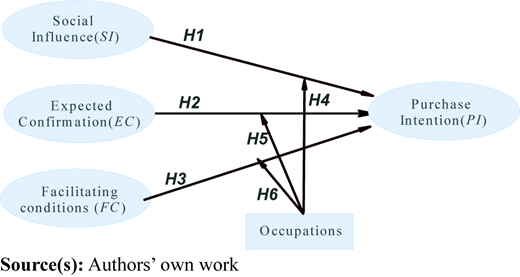
This study added different occupations to the model as a moderating variable (Figure 2). The hypothesis linking SI, EC, and FC is as follows:
Occupations play an important moderating effect between SI and consumers’ PI.
Occupations play an important moderating effect between EC and consumers’ PI.
Occupations play an important moderating effect between FC and consumers’ PI.
3. Methodology
3.1 Survey and sampling
This study used the online survey method. The questionnaires were designed based on the rating scales and were distributed and collected using the QuestionStar: https://www.questionstar.com/. The inhabitants, with over 10,000 members who engage in different occupations from Tiantong Garden Residential District of Haidian in Beijing, China, were chosen as the study participants. The survey link was distributed to the Tiantong Garden Residential community’s WeChat group, QQ group, and personal email addresses. The survey incentivized participants through monetary transfers, with a reward of 5 Yuan RMB after completing a questionnaire.
A pilot study was conducted before the formal data collection to verify the questionnaire items. Fifty-six questionnaires were distributed in the Tiantong Garden Residential District to test if there is any ambiguity in the expression of items and the setting rationality. The feedback from the pilot study greatly assisted in shaping the content and structure of the questionnaire (Zhuang et al., 2021). Questionnaires with response times less than 100 s and those showing identical responses for five or more consecutive questions were excluded. Ultimately, 45 valid questionnaires were obtained, resulting in an 80.36% effective rate. Upon computation, all variables exhibited Cronbach’s coefficient greater than 0.8, indicating strong internal consistency of the data. Consequently, all measurement items in the questionnaire were retained. To further ensure the validity of the questionnaire design, factor analysis was conducted. An additional 94 questionnaires were distributed, and the total samples were 150. The Kaiser-Meyer-Olkin (KMO) measure was 0.615 (within the range of 0.6–0.7). Bartlett’s test of sphericity yielded a Chi-square distribution with a value of 2384.1, degrees of freedom of 861, and p-value of 0.000 (less than 0.05), indicating significant correlation among measurement items and thus confirming the reasonableness of the questionnaire item settings for subsequent factor analysis.
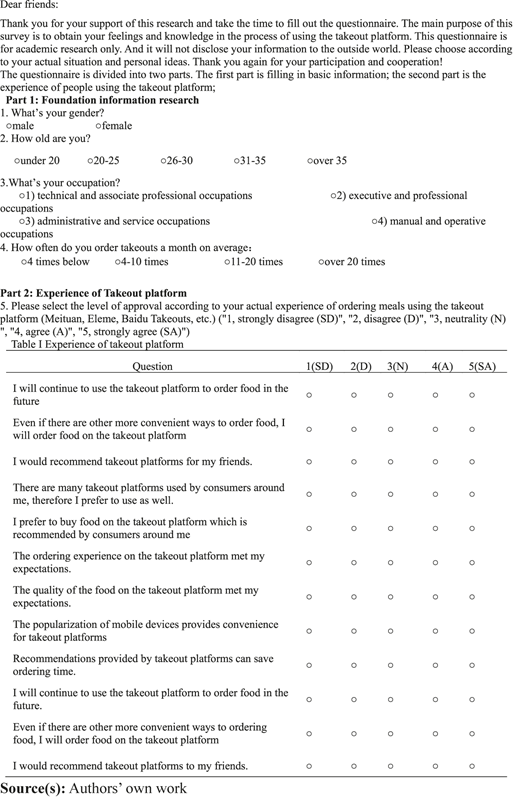
The questionnaire consisted of two sections: the first section collected participants’ demographic information, such as occupation, income level, and educational background, and the second section collected information about the measurement items (Wang and Scrimgeour, 2022). The respondents were asked to rate their responses on a five-point Likert-type scale as follows: (1) “strongly disagree,” (2) “disagree,” (3) “neutral,” (4) “agree,” and (5) “strongly agree.” Appendix 1 presents the questionnaire.
The sample of 560 respondents from China was obtained on the QuestionStar. To ensure the data validity, the responses were removed in cases where the time taken to answer was less than 100 s and if the option chosen was the same for five consecutive questions (or more). After screening for invalid questionnaires, 537 (95.9%) were found valid. Data collection occurred from X to Y.
All valid data were inputted to SPSS version 26.0 for descriptive and parametric statistical analyses. After testing the reliability and normalization of the data, the item’s discriminant validity, composite reliability (CR), and factor loading were examined.
3.2 Structural equation model
The structural equation model (SEM) is a powerful tool for examining causal relations among multiple variables of different levels (Martinez-Gonzalez et al., 2022; Mark et al., 2022). Kaveh et al. (2021) explored the influence of customer participation on PI in promotional activities using the Partial Least Squares SEM method. The survey results showed that customers were more likely to choose promotional discounts by providing possibilities suitable for their personal preferences and that demand was positively correlated with PI. This study constructed the SEM using four variables, that is, the three items related to the degree of cognition (SI, EC, and FC) were the independent variables, and PI was the dependent variable. Occupation is a mediator because it is affected by the degree of cognition variables and PI.
SEM was constructed based on the theoretical framework, and the analysis was performed using AMOS version 26.0. Hierarchical analyses were performed to examine and validate the moderating relationships. To explore the moderation effects, the moderate variable was assessed together with independent variables as interaction terms.
4. Results
4.1 Description of data
In 537 valid questionnaires, technical and associate professional occupations had 121 responses; executive and professional occupations having 321 responses accounted for 22.5 and 59.8%, respectively. Administrative and service occupations, with 40 responses, and manual and operative occupations, with 55 responses, accounted for 7.5 and 10.2%, respectively. Table 1 shows the descriptive statistics of participants’ responses.
Table 1 shows that item FC1 (4.42 ± 0.7174) had the highest mean, meaning the food delivery platform can enhance user convenience and increase PI by facilitating orders, providing personalized services, and optimizing delivery networks. It also helps consolidate the platform’s position in the market and increase customer stickiness. For the variable SI, the means of items SI1 and SI2 were close to 4, indicating that PI is susceptible to influence through consumers and the social environment when ordering food on takeout platforms. Hence, the food delivery platform can, on the one hand, encourage users to share positive consumption experiences by providing high-quality services and products, thus promoting word-of-mouth dissemination. On the other hand, the platform can enhance its influence by increasing promotional efforts and continuously adjusting and improving marketing strategies according to market demands.
The mean of EC1 (4.42 ± 0.7174) was greater than that of EC2 (3.95 ± 0.8926), indicating that using food delivery platforms may meet customers’ expectations. However, food quality and service may not. This reveals that food delivery platform service quality meets customers’ expectations, but there is a certain gap between the food quality and customers’ expectations. Therefore, while maintaining the platform’s service quality, it is necessary to improve the product quality, which can increase the PI of customers. These findings offer practical insights for addressing consumer demand, enhancing platform service quality, and boosting market competitiveness.
4.2 Reliability and validity
Reliability and validity tests were conducted to check whether the collected data correctly reflected practical issues and achieved the research objective. Reliability tests are an indicator of measurement consistency and stability. This is an important criterion for evaluating the quality of measurement. Discriminant validity was evaluated by comparing the square root of the average variance extracted (AVE) value of each variable with the correlation coefficients between the variables. Li and Zhao (2021) suggested that Cronbach’s alpha (α), CR, and AVE should be above 0.7, 0.7, and 0.5, respectively. AVE, Cronbach’s α, CR, and loading coefficients were analyzed using SPSS. Table 1 presents these results. The square root of AVE values and correlation coefficients between the variables are presented in Table 2. Appendix 2 presents the statistical results and covariance matrix.
Table 1 shows that Cronbach’s α of SI, EC, FC, and PI are higher than the threshold value of 0.7 at 0.797, 0.795, 0.710, and 0.723, respectively. The corresponding AVE values of SI, EC, FC, and PI were greater than 0.5 at 0.500, 0.5581, 0.804, and 0.787, respectively. The factor loadings and CR were higher than 0.7; thus, both were within acceptable ranges (Christensen and Golino, 2021), indicating that each item’s factor loading was eligible for further examination. Since all measurement values for reliability (α and CR) are within the acceptable range, convergent validity of the measurement model is achieved.
Table 2 shows that the square root of each AVE value (numbers in italic on the diagonal) is larger than the correlation coefficients between that construct and other constructs. This implies that the discriminant validity for all measures is acceptable. Additionally, the mean value of KMO (0.848) was greater than 0.8, showing that these variables can be used for factor analysis and the Bartlett spheroidal test. The Chi-square value (degrees of freedom = 36) was 876.1, and the significance level is 0.00 (p < 0.05), which further indicates that the data can be used to analyze the structural model.
4.3 Assessment of the structural equation model
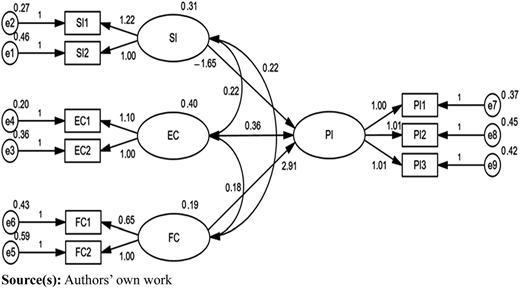
Figure 3 depicts the relationships among the variables and their paths without the moderating effects in the structural model, along with the path coefficients. Table 3 lists the fit indices for the model. Table 3 shows that the absolute fit indices, such as minimum discrepancy (CMIN)/DF, root mean square error of approximation (RMSEA), root mean square residual (RMR), and goodness of fit index (GFI), were within the scope of recommended thresholds. The parsimony fit indices also met the corresponding requirements, indicating a good model fit with the data.
As seen from the path analysis in Figure 3, SI negatively affects PI with a coefficient of −1.65, indicating that the external environment has little influence on consumers’ willingness to order food through the takeout platform. EC positively impacts PI with a loading coefficient of 0.22, indicating that consumers’ EC influences PI to a certain extent when ordering food on the platform. FC positively influences PI and has the highest loading coefficient of 2.94. It is the main factor influencing PI. Therefore, our results confirm that customers prefer to save time on takeout platforms. This aligns with the findings of Ajzen and Madden (1986), who demonstrated that FC can serve as a proxy for actual behavioral control and can directly influence behavior. Therefore, takeout platforms must design personalized schemes according to consumers’ needs and expectations. In line with the findings of Venkatesh et al. (2003), the effect of SI on PI was non-significant when the data were analyzed without moderators.
4.4 Moderating effects
The effects of occupation as a moderating variable (MO) on the two models were examined, and the hypotheses were tested. The independent variables (SI, FC, and EC) and moderating variable MO were entered in the first model. The second model included the interaction variables between occupation and the independent variables, expressed as the multiplication of the moderator, and each independent variable as follows: MO × SI, MO × EC, and MO × FC. The two models were analyzed separately, and the results are shown in Table 4.
The R2 criterion was used to assess the predictive ability of the structural model (Joye et al., 2021). Table 4 shows that the variances can be explained using the first model, with a direct effect of 38.7%. After including occupation as a moderator, the explanation increased to 47.3% for the corresponding variances. This indicates that occupation had a moderating effect on SI, EC, and FC. Table 5 presents the results of hypothesis testing.
Without moderating variable, SI (p = 0.24) did not significantly affect PI at the 0.05 level, thus rejecting H1, indicating that SI did not positively affect consumers’ PI to order food on takeout platforms. EC (p = 0.047) and FC (p = 0.007) significantly affected PI at the 0.05 and 0.01 levels, thus supporting H2 and H3. The reason is that EC and FC positively influence consumers’ PI with regard to using takeout platforms to order food regardless of their occupation. A similar conclusion was obtained by Savitha et al. (2022).
With occupation as a moderator, the p = 0.01078 of MO × SI significantly affects PI at the 0.01 level, thus supporting H4, indicating that the moderating effect of occupations on SI is the strongest for PI. The p = 0.0768 of MO × EC and the p = 0.080 of MO × FC are significant at the 0.05 level, meaning that the moderating effect of occupations on EC and FC significantly affected PI, thus supporting H5 and H6. This may be because administrative and service occupations are influenced by SI due to constant social media usage and pay more attention to other people’s recommendations; executive and professional occupations pay more attention to the stability of service and food quality; technical and associate professional occupations value the convenience of orders; and manual and operative occupations may focus more on price concessions and flexibility.
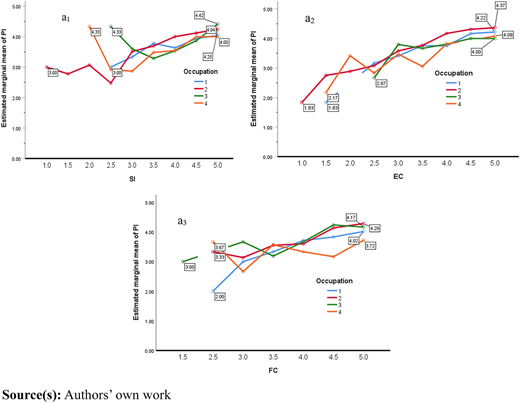
Further analysis is needed to verify the interaction between occupations and the independent variables SI, EC, and FC on PI. The interaction effect was tested using Dawson’s approach (Kishore and Sequeira, 2016), and the results are shown in Figure 4 (a1-a3).
Different occupations, combined with SI, EC, and FC, had different interactive effects on PI. From Figure 4a1–4a3, the PI of consumers in different occupations significantly increases when SI, EC, and FC reach their maximum. This shows that the platform should continuously optimize the sales environment according to consumer demand, such as price, convenience, and safety. Moreover, artificial intelligence technologies can help takeout platforms offer personalized service information to each consumer according to their characteristics. Thus, there exists a huge potential to improve the platform’s competitiveness in the market if the platform continues to improve personalized services for every consumer.
As depicted in Figure 4a1, technical and associate professionals (curve 1) and executives and professionals (curve 2) showed weaker PI scores (4.0 and 4.04) with higher SI. Conversely, administrative and service occupations, along with manual and operative workers (curves 3 and 4), exhibited stronger PI (4.33) with lower SI. This indicates that although technical and associate professionals, as well as executives and professionals, moderated the SI-PI relationship, they were not the strongest influencers. This finding is also supported by Venkatesh et al. (2003), Iqbal (2015), and Alalwan et al. (2017).
As depicted in Figure 4a2, different occupations showed similar PI in their use of delivery platforms except for the manual and operative occupations (curve 4), which increased with the increase in EC. Among them, the PI of the technical and associate professional occupations (curve 1) reached 4.22, and PI of administrative and service occupations (curve 3) was 4.00, indicating that it played a moderating role in the relationship between EC and consumers’ PI; however, it was not the strongest. PI (4.37) of the executive and professional occupations (curve 2) was strongest. This finding is consistent with that of Lyu et al. (2018) and Zheng et al. (2022).
The influence of different occupations on the interaction between FC and consumers’ PI is shown in Figure 4a3. As FC increased, the PI of technical and associate professional occupations (curve 1) for using the takeout platform increased linearly and had the most significant influence compared to the other three occupation types. The other three types of occupations all displayed a moderating role between FC and PI. For them, the manual and operative occupations (curve 4) had a stronger influence because PI was higher (3.67) in the case of a lower SI. The executive and professional occupations (curve 2) and the administrative and service occupations (curve 3) followed afterward in case of a higher FC, where PI was 4.29 and 4.17, respectively. This was also consistent with the results reported by Ibrahim et al. (2009) and Yousafzai and Yani-de-Soriano (2012). The moderating role of occupation had more robust results.
5. Discussion and conclusions
The rise of the Internet, higher living standards, faster-paced lifestyles, and the convenience of takeout services have led to an increasing number of consumers willing to purchase food through takeout platforms. Therefore, it was crucial to reveal the factors influencing consumers’ PIs on food delivery platforms and the moderating effects of their occupations on them. This study also elucidated the complex relationships between the influencing factors. Our study significantly enhances platform management services and decision-making as it helps understand and meet consumers’ personalized needs and improve consumption levels. The study employed an improved UTAUT model to clarify how SI, FC, and EC variables affected consumers’ PI and systematically explored the moderating role of consumers’ occupations on PI. The main conclusions are as follows:
The UTAUT model analysis showed that SI, FC, and EC impacted consumers’ PI. Among them, SI negatively affected consumers’ PI, indicating that consumers made choices based on their preferences and needs and showed reluctance to be swayed by social factors. This finding aligns with the conclusion reported by Venkatesh et al. (2003) that consumer behavior was undergoing a potential transformation where personal preferences outweighed SI. FC and EC positively influenced PI, indicating that consumers favored the speed and convenience of services provided by food delivery platforms, which in turn enhanced their PI. Consumers often develop expectations regarding service quality and delivery speed when using food delivery services. Consumers feel satisfied when these expectations are confirmed (i.e. when services meet or exceed expectations), promoting future PI. Meeting expectations could enhance consumer loyalty and increase the likelihood of repeat purchases. This conclusion supports the findings of Oktaviani et al. (2024).
When occupation acted as a moderating variable, the interaction of SI, EC, and FC influenced the consumer’s PI. Among them, FC had a more significant effect on PI, indicating that consumers prioritize the convenience and efficiency of the consumption process when selecting food delivery services. To enhance consumers’ PI, food delivery platforms must design personalized marketing strategies based on consumer characteristics and offer more choices. This finding is consistent with the conclusions of Yousafzai and Yani-de-Soriano (2012), suggesting that food delivery platforms should consider FC as a key factor for achieving sustainability and market success.
Different occupations exhibited different sensitivities to SI, FC, and EC due to their work nature and lifestyle, further implying the moderating effects of occupation on the relationships between these factors and PI. Specifically, technical and associate professional occupations showed a weak moderating effect between SI and PI, a moderate effect between EC and PI, and a strong effect between FC and PI. The consumers from such occupations fully utilized the diverse and convenient service models offered by the platforms to fulfill their PI because their technical, engineering or IT fields tended to have fast-paced work lives and prioritized efficiency. Executive and professional occupations exhibited a strong moderating effect between EC and PI and displayed certain moderating effects between SI and FC with PI. Their PIs were often based on social recognition and peer evaluation. Administrative and service occupations showed a moderating effect between SI and EC with PI and a significant effect between FC and PI. Due to the busy nature of their work, which involves frequent interactions with others, these consumers preferred that the services of food delivery platforms met their expectations to enhance their consumption experience. Manual and operative occupations displayed relatively weak effects of SI and EC on PI, possibly because they tended to focus more on the price of delivered food. However, they had a strong moderating effect on FC and PI. These findings addressed the gaps in the literature regarding the influence of occupational characteristics on consumer behavior, enriching the understanding of how different types of consumers’ occupations affected their PI while using food delivery platforms. This research assists food delivery platforms in emphasizing the development of personalized marketing service strategies.
Based on the results of the studies, some marketing strategies are recommended. (1) Developing personalized marketing strategies for different occupations. For example, consumers from manual and operative occupations may prioritize price discounts, while executive and professional occupations may be more concerned about product quality and service standards; (2) Enhancing the level of consumer EC, which may involve improving product and service quality, increasing delivery efficiency, and enhancing the convenience of consumer’ experience to attract more consumers and enhance their PIs. This could be achieved through technological innovation or process improvement; (3) Encouraging word-of-mouth dissemination among consumers and implementing marketing strategies that promote sharing consumer experiences. The marketing strategies may focus on establishing brand image, enhancing brand awareness and loyalty among consumers, and continually reinforcing advertisements for the product and service quality.
6. Implications and future research directions
6.1 Theoretical implications
The study employs a modified UTAUT model to examine the influences of three factors (SI, EC, and FC) on consumers’ PI on food delivery platforms and the moderating effect of occupation among them. The research confirms the significance of two core concepts, EC and FC, in the UTAUT theory on consumers’ PI. It aligns with the assumptions of the UTAUT theory, thereby reinforcing its reliability. While considering consumers’ occupation as a moderating factor in UTAUT models, the moderating effect of different occupations on PI is not the same. The moderating effect of the technical and associate professionals and the manual and operative occupations on FC for PI was stronger than that on EC and SI. In contrast, the moderating effect of the executives and professionals and the administrative and service occupations on EC was stronger than that of SI and FC. The key effect of personal characteristics on consumers’ PI is clarified, which suggests that takeout platforms should optimize the pricing for different segments of consumers based on their occupations to maximize profit. This study helps scholars recognize and understand the factors that influence consumers' PI from a new perspective.
6.2 Practical implications
Discerning moderating effects across diverse consumer occupations presents an underpinning for refining marketing and promotional strategies. Specifically, the platform should provide convenient services and diversified purchasing options for technical and associate professional occupations. The platform should increase user evaluation and peer recommendation for the executives and professionals. For administrative and service workers, improving service quality and responsiveness to ensure service meets expectations and enhances interactive experiences is crucial. For manual and operative workers who value price discounts and convenience services, a small fee can be added to some items, and price displays can be adjusted on the takeout platform. This psychological pricing strategy can increase PI, encouraging repeat purchases. With this knowledge, takeout platforms can adapt their approaches and effective marketing strategies, thereby better capturing the attention and engagement of the consumers for different occupations, consequently augmenting their competitiveness within the marketplace. According to diverse needs and preferences of different occupations, for instance, recognizing the impact of EC and FC on PI can guide platform developers in improving user interfaces, features, and overall user experience. For example, the takeout platform or practitioners themselves can send personalized recommendations to different types of consumers based on their occupation and according to their preferences and habits. These findings offer a foundation for tailoring strategies to cater to the specific needs of diverse consumer groups within food delivery platforms.
6.3 Future research directions
This study addresses how consumer occupations moderate PI on food delivery platforms. However, several limitations warrant further consideration and exploration in future research.
First, the model developed in this study incorporates only three psychological variables: SI, EC, and FC. Future research should extend this model to include additional psychological variables, such as social norms (Schaumberg and Skowronek, 2022) and perceived behavioral control (Keller et al., 2021). Researchers can align the model more closely with real-world scenarios by introducing other control variables, such as income level and purchase frequency, thereby enhancing its explanatory power. Second, the current occupation is only confined to four types; that is, technical and associate professional occupations, executive and professional occupations, administrative and service occupations, and manual and operative occupations. Future research should increase the occupational types for more detailed and accurate evaluation. Third, the study’s scope is confined to China. Therefore, the generalizability of its findings to other regions or countries may be limited due to cultural, economic, and other differences. It is imperative to conduct in-depth research in various cultural and economic environments to enhance the generalizability of the research findings and mitigate potential biases in the assessment process. Last, this study did not capture the temporal fluctuations in consumer behavior and perception variables, exploring their dynamic trends and identifying potential causal relationships. This would provide more nuanced insights into the moderating effects of consumer occupation on PI on food delivery platforms across different temporal contexts.
We are very grateful to the National Natural Science Foundation of China (Grant No.72171008) for the support of this research.
Author contribution statement: All authors equally contribute to the Manuscript.
Declaration of competing interest: The authors declare that they have no known competing financial interests or personal relationships that could have appeared to influence the work reported in this paper.
Data availability: Data will be made available on request.