This study aims to provide a comprehensive understanding of the factors and contexts that influence food anti-consumption behavior. This study develops a deeper understanding of theoretical, contextual and methodological nuances that shape such behaviors and guide future research in this area.
A systematic literature review was conducted based on an in-depth analysis of 71 carefully selected articles from the Scopus and Web of Science databases. The PRISMA was used to ensure a structured and rigorous review process. This analysis followed the theories-contexts-methods (TCM) and antecedents-decisions-outcomes (ADO) frameworks.
The study presents a comprehensive theoretical framework (TCM-ADO) of food anti-consumption behavior. The review uncovers critical insights into existing theories, contexts and methods while also identifying future research directions. Implications for consumer well-being are discussed, providing a robust foundation for advancing this area of research.
The study is subject to the usual limitations of systematic literature reviews, such as criteria related to time, language and the selection of specific databases. Future research could benefit from using alternative criteria or databases to capture more studies on food anti-consumption behavior.
This systematic literature review (SLR) is the first to apply both the TCM and ADO frameworks to food anti-consumption behavior. The findings provide valuable contributions to the theoretical and practical understanding of food anti-consumption, offering a well-structured agenda for future research.
1. Introduction
Globally, food waste and loss have significantly increased over time across the entire food supply chain, from production to consumption. A study by the United Nations found that 13% of food is lost in the processing phase, 19% of it is lost in consumption at the consumer’s end (United Nations, 2022) and 1.3 billion tons of edible food wasted every year across the entire supply chain (Gustavsson et al., 2011). As a result, 735 million people around the world sleep hungry (United Nations, 2022). This massive waste has severe social, environmental, and economic consequences, including malnutrition (Cattaneo et al., 2021), greenhouse gas emissions, resource depletion (Shafiee-Jood and Cai, 2016), and economic losses in the billions (de Gorter et al., 2021). These issues underscore the urgent need to investigate root causes and bridge the food supply-demand gap.
Several factors contribute to food loss and waste in food supply chains, including poor management of consumable food items, agreement between supplier and buyer, stakeholder attitudes (Chauhan et al., 2021), and irresponsible consumption (Kör et al., 2021). For the suppression of irresponsible food consumption, the United Nations has raised this concern by putting “Responsible Consumption and Production (SGD 12)” on its key agendas list (UNDP, 2022) to create an awareness campaign. In the same vein, irresponsible purchasing also plays a critical pre-crises factor role with several factors such as purchasing excessive quantities without planning for consumption, and discarding food after passing the safe consumption dates (Kör et al., 2021).
To address irresponsible food consumption, it is necessary to understand the broader context of food consumption behavior, which is influenced by many psychological, social, and economic factors. Food consumption behavior is a complex phenomenon (König and Araújo-Soares, 2023) influenced by various factors (Chu et al., 2023) such as cultural norms, socioeconomic status, personal preferences, and health considerations (Higgs, 2015; Wang and Worsley, 2014). While much research has focused on understanding the drivers behind food consumption (Anastasiou et al., 2023; Janssen et al., 2017; Li et al., 2023), there is a growing interest in exploring the opposite phenomenon, food anti-consumption behavior (Arslan et al., 2018; Bonder et al., 2018; Lowe et al., 2015; Portwood-Stacer, 2012).
Although efforts like the UN’s SDG 12 aim to minimize wasteful practices, developing more effective interventions requires a deeper understanding of food consumption patterns, including food anti-consumption behavior, which has emerged in recent years. Food anti-consumption behavior, a subset of the broader field of consumer behavior, has garnered increasing academic attention over the past decades due to its implications for health, societal well-being, and sustainability (Black and Cherrier, 2010). Food anti-consumption behavior refers to the deliberate reduction, avoidance, restriction, or rejection of any type of food consumption (Chatzidakis and Lee, 2013; Farah and Shahzad, 2020; Kashif, 2019; Lee et al., 2011; Lučić and Uzelac, 2024; Makri et al., 2020). At micro level, consumers opt for food anti-consumption, driven by a range of motivations, including ethical concerns, environmental sustainability, health consciousness, religiosity or personal values (García-de-Frutos et al., 2018; Shahzad et al., 2022; Attiq et al., 2022).
As anti-consumption behavior focuses on “phenomena that are against the acquisition, use, and dispossession of certain goods” (Chatizdakis and Lee, 2013, p. 1681), it incites people to change their beliefs and point of view, to have a critical view of consumption, and to adopt behaviors that ensure their well-being. For instance, anti-consumption is one key to keeping happiness and satisfaction in the consumer’s life, and excessive consumption negatively affects the consumer’s well-being (Lee and Ahn, 2016). Anti-consumption behavior is driven by different factors (Garima et al., 2025). Likewise, when instances of anti-consumption occur, researchers should look at the possible causes from the consumers’ points of view (Hoffmann and Lee, 2016).
Previous literature reviews on anti-consumption behavior have dealt with different focuses on anti-consumption, such as environmental sustainability (García-de-Frutos et al., 2018), voluntary simplicity with lifestyle anti-consumption behavior (Rebouças and Soares, 2021), and sustainable anti-consumption of clothing (Vesterinen and Syrjälä, 2022). Given the multidisciplinary focus on food anti-consumption in general and food anti-consumption behavior in particular, this literature stream is fragmented across public health, sociological, and sustainability studies. There has been limited focus on food anti-consumption from marketing studies to synthesize the extant literature on food anti-consumption behavior (Xie et al., 2022) to formulate a comprehensive framework on food anti-consumption behavior, following theoretical, contextual, and methodological choices of this literature stream.
Accordingly, this systematic literature review on food anti-consumption behavior literature seeks to synthesize existing knowledge, identify critical gaps, and propose avenues for future research. In addition to identifying factors, this study aims to illustrate the complexity of food anti-consumption behavior by illustrating patterns in food anti-consumption behavior, its theoretical underpinnings, methodologies, antecedents, decisions, and results. By providing a comprehensive framework, this review aims to contribute to the ongoing debate and offer implications for practitioners to advance more sustainable and health-conscious food consumption behaviors. More precisely, we address the following research questions (RQs):
What are the (a) theoretical foundations, (b) related contexts, and (c) methodologies used to study food anti-consumption behavior?
What are the (a) antecedents, (b) decisions, and (c) outcomes of food anti-consumption behavior?
This study employs a systematic literature review methodology to examine food anti-consumption behavior, using Theories-Contexts-Methods (TCM) and Antecedents-Decisions-Outcomes (ADO) frameworks (Paul et al., 2017; Paul and Benito, 2018). Our review makes three key contributions. First, it addresses the need for a consolidated understanding of the factors driving food anti-consumption behavior. Second, it provides insights for policymakers, practitioners, and educators by synthesizing the antecedents, decisions, and outcomes related to food anti-consumption behavior. Third, it develops a comprehensive framework building on TCM-ADO and proposes future research directions to further explore food anti-consumption behavior.
The remainder of the paper is structured into four sections, where the first section presents the research methodology for our review. The second section details the discussion of our findings based on TCM and ADO frameworks. Based on our findings, the third section formulates future avenues of research. Finally, we concluded the paper by presenting conclusions, implications and limitations.
2. Research methodology
We conducted a systematic review of the literature on food anti-consumption behavior by adhering to established systematic literature review method. Specifically, we followed SLR frameworks to develop a comprehensive analytical framework (Paul et al., 2017; Paul and Benito, 2018). Notably, we employed the Theories-Contexts-Methods (TCM) framework and the Antecedent-Decision-Outcome (ADO) framework, both introduced by Paul et al. (2017) and Paul and Benito (2018), respectively, which are designed to enhance the rigor and structure of literature synthesis within a given field.
TCM allows for a comprehensive evaluation of the theoretical foundations, research contexts, and methodological approaches used in a particular domain. Meanwhile, ADO enables a structured categorization of the key drivers (antecedents), decisions (dependent variables), and outcomes in a given field of study. By integrating these frameworks, this review provides a multi-dimensional analysis of food anti-consumption behavior, allowing for a deeper exploration of research gaps and more actionable insights for researchers, practitioners and policymakers.
In line with previous SLRs utilizing the ADO and TCM frameworks (e.g. Lim et al., 2021; Koi-Akrofi et al., 2023; Pushparaj and Kushwaha, 2024), our study identified key performance indicators, such as the annual growth of publications and leading publication outlets in this domain. This comprehensive analysis enabled us to pinpoint research gaps and propose directions for future investigations.
2.1 Data extraction process
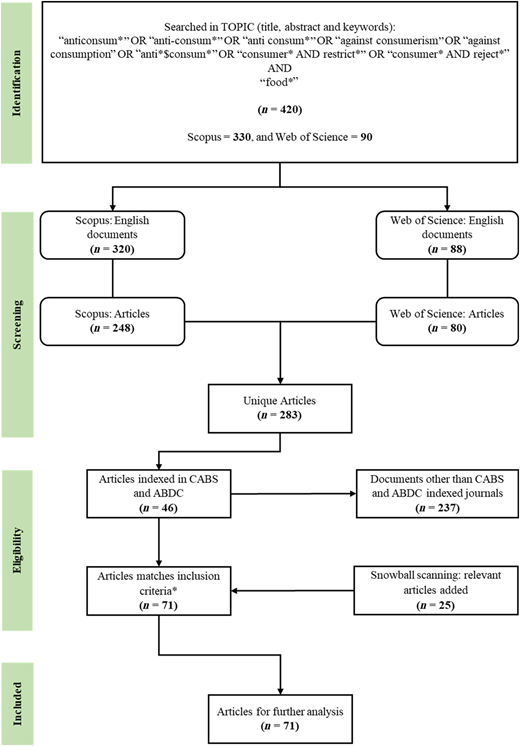
We used the PRISMA (Preferred Reporting Items for Systematic Reviews and Meta-Analyses) flow chart (Moher et al., 2015) to extract metadata and full articles from Scopus and Web of Science (WoS) databases (Chabowski et al., 2018). Reviewing related literature (e.g. Makri et al., 2020), we refined the search terms. Figure 1 illustrates the process with four stages: identification, screening, eligibility, and inclusion. In the identification stage, we searched for keywords such as “anticonsum*” and “anti consum*” to retrieve 420 documents (Scopus: 330; WoS: 90). At the screening stage, we applied three criteria: 1) English language, 2) journal articles, and 3) removal of duplicates, yielding 283 articles.
At the eligibility stage, we further screened for quality using CABS and ABDC indexing and applied inclusion and exclusion criteria, narrowing the results to 46 articles. Given the multidisciplinary nature of food anti-consumption, we focused on consumer behavior and business perspectives. We employed the snowballing technique (Gupta and Joshi, 2023) to include 25 additional relevant articles, resulting in 71 articles for further analysis (Appendix A). The inclusion criteria include Available in WoS and Scopus databases, Published in the English language, Publication type is the article, and Articles focused on consumer anti-consumption behavior in the food context. Alternatively, exclusion criteria include Published outside these databases, Non-English publications, conferences, Books, Book chapters, and Health/Medicine related publications.
2.2 Data analysis process
For in-depth analysis, we applied TCM and ADO frameworks to all 71 articles, developing a comprehensive framework of food anti-consumption behavior. To ensure coding reliability, two coders independently applied content analysis to the TCM and ADO frameworks, achieving over 85% agreement. We employed thematic analysis (Braun and Clarke, 2006) following six steps: familiarization with the articles, creating initial codes, identifying themes, refining themes, categorizing themes, and presenting findings to form a comprehensive food anti-consumption framework and propose future research directions.
3. Discussion based on TCM and ADO frameworks
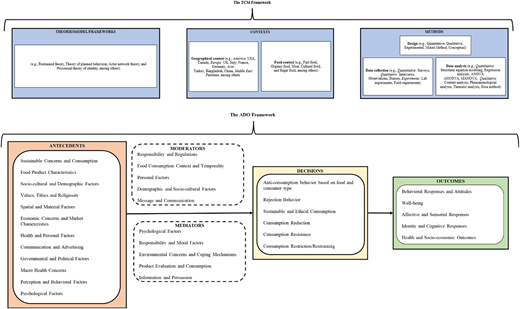
In what follows, the paper will discuss the results of adopting TCM and ADO frameworks, refer Figure 2. Hence, results are discussed in terms of theory, context, and methods on the one hand, and antecedents, decisions and outcomes as well as moderators/mediators on the other hand.
3.1 Theories
This review, based on ADO and TCM frameworks (Paul et al., 2017; Paul and Benito, 2018), highlights the theoretical richness of food anti-consumption studies, drawing on 31 theories (Appendix B). The most cited include “Restrained Theory” (5 times) “Theory of Planned Behavior” (4 times), “Attribution theory”, and “Self-determination Theory” (2 times) with some studies using multiple theories (2 or 3) (e.g. Dumitrescu et al., 2016; LaPorte et al., 2020). Restrained Theory, rooted in the psychosocial domain, links food restriction to negative emotions like social isolation/loneliness (Smart and Pontes, 2023) or feelings of shame and guilt after unhealthy food consumption for restrained eaters (Aydin et al., 2018), and is associated with the self-image concept (Shahzad et al., 2022). The restrained theory is well coupled with the negative feelings and emotions caused via two ways: (1) the restraining decision of eating leads to a social isolation feeling, or the (2) the creation of an internal conflict develops a dissonance cognitive after junk/vice food consumption and addiction leading to regret and shame which will encourage the restraining eating to maintain a positive body self-image and subsequently a psychological well-being.
The Theory of Planned Behavior (TPB, Ajzen, 1991) is used to outline the prevalence of attitudes toward purchase subjective norms, and perceived behavioral control. All of them monitor the engagement in a specific behavior, such as examining nonconventional (i.e. organic) food purchase behavior (Ashraf et al., 2019).
In addition, Cheah et al. (2020) investigate the consumer’s attitudes and intentions to reduce meat consumption. These intentions towards anti-consumption behavior permit more control and are linked with health and sustainable objectives (Yaringlu et al., 2019). It highlights the need to expand TPB beyond intentions to include actual behaviors (Yarimoglu et al., 2019). The restraint theory employed solely may not comprehensively represent the complexity of food anti-consumption behavior, as it neglects the broader environmental and social factors.
Further investigation should examine the convergence of restraint theory (RT), theory of planning behavior (TPB), and social identity theory to gain a deeper comprehension of how individual and social elements interact. Furthermore, the introduction of specific theories into food anti-consumption, such as the social foraging theory (Wells, 2012), needs to be further developed to explore its potential to encourage sustainable consumption patterns and reduce food intake, thereby minimizing the negative environmental effects.
Furthermore, several theories are directly tied to a specific food type, such as the relationship between guilt and justification theory and hedonic food (nutritionally deficient functional food). Following hedonic consumption, consumers feel guilty and seek functional, nutrient-dense foods to compensate for their poor eating behavior (Cornish, 2012). Hence, we propose combining guilt and justification, nutritionism, and restraint theories. Furthermore, the database is revealing a set of concepts/theoretical frameworks connected to sustainable consumption (20 times), such as Responsible mindfulness of Klug and Niemad (2021), the sustainable business model of De Bernardi and Tiraben (2018), Mindful consumption of Brunder and Dholakia (2018), Sustainable responsible consumption of Shalini et al. (2021), Dumpster diving of Gollnhofer (2017), and Fernandez et al. (2011). Moreover, there are recurring concepts in the database, such as ethical consumption (Sebastiani et al., 2013), boycott (Muhamad et al., 2018), food waste behavior (Minton et al., 2020), and consumer social responsibility (CSR, Manning, 2013), highlighting the close relationship between anti-consumption and sustainable practices.
Six studies used models as background theory such as Alternative food networks (De Bernardi and Tirabini, 2018), CSR models (Manning, 2013), and stimulus organism response model (Gianni et al., 2023). Similalry, four studies highlighted theoretical approaches, such as the Material Semiotic Approach (Bettany and Kerrane, 2011) and the Hedonic and Eudaimonic approaches (Bodunrin and Stone, 2019). Moreover, mainly three movements have been used (cultural movement, social movement of food, and slow food and move). Despite the database’s large theoretical roots, certain concepts have been overlooked, such as restraining eating, which is deeply embedded in restraint theory. Additional empirical research is needed on restraining eating patterns and anti-consumption.
3.2 Contexts
Contexts are crucial in understanding food anti-consumption, especially geographic and food-type contexts (Paul et al., 2017). This review of 71 articles reveals geographic distribution (Appendix C): 19 studies in the American continent (such as Pozarliev et al., 2023). The majority of the evidence came from North America with 17 studies, (U.S., e.g. Allen et al., 2018), one in South America (Dalma et al., 2020), 24 in Europe (notably UK, Italy, and Germany, e.g. Bodunrin and Stone, 2019), six in the Middle East (mainly Turkey, e.g. Yarimoglu et al., 2019), and five each in Asia and Australia, with no studies in Africa, showing a gap. Multi-country studies compare different regions, like Asia and the U.S. (Khalid et al., 2019).
In food type variation, Americans focus on fast food, organic and alternative food, genetically modified foods, and meat (e.g. Soule and Sekhon, 2019). Most studies in Europe have focused on meat, organic, and alternative food (e.g. Hallström et al., 2014), while in Turkey fast food and meat are more popular food types. In Australia, meat and organic are the most widely studied food types (e.g. Rolfe et al., 2022).
American consumers face greater challenges due to cultural preferences for convenience, economic disparities, and heavy marketing by fast food chains (Khalid et al., 2019). In China, health issues like obesity and chronic disease have increased, and awareness of the negative health impacts of fast food is growing (Shahzad et al., 2022). As Chinese consumers become more health-conscious and culturally aware, the demand for healthier and more traditional food options will likely continue to grow. This will further challenge the fast food industry in China. In addition, European consumers show a growing interest in environmental sustainability (Sossidou and Elson, 2009). They are very conscious of the impact they have on the environment and have a strong preference for local and sustainable food options.
Eight articles on anti-consumption behavior related to organic food demonstrate a substantial interest in this topic (such as Fernandes and Saraiva, 2022; Parker et al., 2021). While Europe and the USA share a growing interest in organic and alternative foods, their markets differ in regulatory stringency, consumer preferences, market structure, and trends. Environmental concerns seem to be more important in European countries. In Europe, the focus is on local, sustainable, and high-quality food, supported by strict regulations and government policies, such as the alternative food network in Italy that refers to emerging networks of producers, consumers, and other actors that are emerging as alternatives to the more standardized industrial way of supplying food (De Bernardi and Tiraben, 2018).
In contrast, the United States prioritizes health, convenience, and innovation, heavily influenced by prominent brands and dietary patterns. For instance, hybrid meat analogs (Smart and Pontes, 2023) have been introduced as an alternative to conventional animal meat. According to Hofstede’s cultural dimensions theory (Hofstede, 1980; Sun et al., 2004) in an individualistic society, consumers prefer to prioritize a convenient and comfortable lifestyle.
As a result, the notion of sustainability varies across Europe and the United States. Six articles discuss meat anti-consumption. In this regard, health, environmental, and ethical issues motivate anti-meat eating in many countries worldwide. However, these motivations differ in terms of their intensity and context. In addition to health concerns, Europeans are highly aware of the environmental impact of meat production, particularly greenhouse gas emissions and water use (Hallström et al., 2014). In Australia, meat anti-consumption is widely associated with high meat prices, personal health concerns, age, and household income (Malek et al., 2019). Animal welfare is also considered one of the most important reasons Australians avoid eating red meat.
Genetically modified (GM) food (Huffman et al., 2004; Cerjak et al., 2011) is controversial worldwide. Some disparities in regulation and consumers’ acceptance of GM food have been identified between regions. Europeans strongly favor traditional agricultural processes, which may explain why they resist GM food. This technique is supported by environmental organizations such as Friends of the Earth and Greenpeace, who have helped to raise awareness about the dangers of genetically modified foods. This contrasts with the United States, where there is a greater tolerance for genetically modified foods due to a lack of information dissemination. Also, China is one of the world’s major producers and consumers of GM foods, and this tolerance of GM foods is due to a lack of information and consumer awareness of the dangers to the environment and health (Ho et al., 2006). The type of food can be treated differently depending on the geographical context. This disparity is due to several factors, including behavioral and cultural factors and environmental and health priorities. Indeed, the level of consumer awareness of health and environmental issues and the importance and priority given to environmental and sustainability issues by the government explain these differences reflect how sustainability is conceptualized differently across regions.
3.3 Methods
This review of 71 articles focuses on research design, data collection, and analysis methods (Appendix D). Five research design categories were identified: quantitative (26 articles), qualitative (21 articles), experimental (15 articles), mixed methods (6 articles), and conceptual (4 articles). Quantitative studies, predominantly using surveys (e.g. Gianni et al., 2023; Ben Hassen et al., 2022), often employed Structural Equation Modeling (SEM, 1st used analytical technique) (e.g. Jaud and Lunardo, 2022; Lasarov et al., 2019) and regression analysis as the second most common analytical technique (e.g. Irmak et al., 2020). Qualitative studies, primarily using interviews (e.g. Fernandes and Saraiva, 2022) and observations (e.g. Saraiva et al., 2020), applied thematic analysis (e.g. Arslan et al., 2018), phenomenological analysis (Gollnhofer, 2017), and content analysis (Leipämaa-Leskinen, 2021).
Experimental research was common, with 15 articles using analytical approaches like ANOVA (e.g. Pozharliev et al., 2023), ANCOVA (e.g, Tal et al., 2017) MANOVA (e.g. Dumitrescu et al., 2016).
Future research could benefit from phenomenological studies, particularly Interpretative Phenomenological Analysis (IPA), which offers deep insights into consumer experiences (Smith and Nizza, 2021). Longitudinal studies could also help explore the long-term outcomes of food anti-consumption behavior (like the examination of the impact of being restrained from consuming a particular food). These methodological choices could advance our understanding of food anti-consumption behavior and its outcomes.
3.4 Antecedents
Antecedents shape decision-making directly and indirectly (Paul and Benito, 2018). This study identifies 12 antecedent clusters from 71 articles (Appendix E), grouped into four major cluster families: (I) Internal/individual factors composed of clusters (7), (11) and (12), (II) External factors, composed of clusters (2), (3), (5), (6), (8), (9) and (10); (III) Sustainability concerns (cluster 1), and (IV) Values, ethics, and religiosity (cluster 4).
Internal factors include personal health concerns and physical factors such as Body Mass Index, BMI (Goldenberg et al., 2005; Soule and Sekhon, 2019; Gianni et al., 2023; Allen et al., 2018), and perception and behavioral factors such as body perception and perceived risk (Gianni et al., 2023). Psychological factors like negative emotions and attitudes toward food also drive anti-consumption (Allen et al., 2018).
External factors cover food product attributes (e.g. quality, production, and origin) (Pozharliev et al., 2023), micro factors of communication characteristics and advertising practices emphasizing the critical role of messaging and promotional tactics in initiating food anti-consumption decisions (Farah and Shahzad, 2020), and macro factors “social factors” as social stigma, cultural factors, such as ethnocentrism, “economic concerns” as price, governmental factors and political ideology, and macro health concerns such as obesity, pandemic effect, and child sensitivity, influencing food avoidance.
Sustainable concerns (e.g. mindful consumption and sustainable practices and lifestyles as voluntary simplicity) and values like ethics and religiosity further impact food anti-consumption. Interrelations among these clusters reveal insights, such as perceived risk is associated with regret and anxiety (Yarimoglu et al., 2019) and weight stigma for example, is a form of social stigma that refers to discrimination and prejudices directed at persons because of their weight and is linking with anxiety and depression (Wu and Berry, 2018).
Pro-environmental motives also connect psychological factors to sustainable habits (Gilg et al., 2005). These antecedent clusters play a pivotal role in food literature by providing a structured framework to comprehend and analyze the multifaceted influences on food anti-consumption behaviors. By categorizing these themes and highlighting the interrelationships between some antecedent clusters, researchers gain a more organized and comprehensive approach to exploring the diverse factors shaping consumer decisions in food consumption avoidance.
3.5 Decisions
Food anti-consumption behavior is grouped into 6 different clusters (Appendix F), including Cluster 1 – Anti-consumption behavior based on food and consumer type, Cluster 2 – Rejection Behavior, Cluster 3 – Sustainable and Ethical Consumption, Cluster 4 – Consumption Reduction, Cluster 5 – Consumption Resistance, and Cluster 6 – Consumption Restriction/Restraining. These six clusters could be approached from three different perspectives. . The first perspective is connected to cluster (1) anti-consumption behavior based on specific food types, like animal by-products (Soule and Sekhon, 2019), dairy (Allen et al., 2018), and meat anti-consumption (Tosun and Gurce, 2018; Malek et al., 2019), and among particular consumer groups, such as materially deprived individuals (Cherrier and Hill, 2018).
The second perspective is related to cluster 3 which emphasizes sustainable and ethical consumption, including sustainable practices (Gollnhofer, 2017), and green identity formation process (Saraiva et al., 2020) and alternative foods consumption like slow and organic food (Brunneder and Dholakia, 2018; Dalmoro et al., 2020). Moreover, sub-themes of consumer responsibilization, mindful, and ethical consumption are part of cluster 3 (Shalini et al., 2021; Brunneder and Dholakia, 2018; Sebastiani et al., 2013).
The third perspective is revealing the food anti-consumption levels. In this regard, clusters 2, 4, 5, and 6 dealt with rejection (Tal et al., 2017; Bryson and Atwal, 2019), consumption reduction (Goldenberg et al., 2005; Hallström et al., 2014; Malek et al., 2019; Apostolidis and McLeay, 2019; Seegebarth et al., 2016), resistance (Boycotting and Avoidance) (Irmak et al., 2020; Huffman et al., 2004; Leipämaa-Leskinen, 2021; Gollnhofer, 2017; Herrmann, 1993; Khan et al., 2019; Malek et al., 2019) consumption restriction/restraining (Kiryakova-Dineva et al., 2019; Mooney et al., 1994; Woolley et al., 2020; Schneider-Kamp, 2021), respectively.
As a result, the decision processes regarding food anti-consumption levels align on an ascending intensity scale. Hence, consumers are shifting from reducing consumption, consumption restriction/restraining (Hallström et al., 2014; Goldenberg et al., 2005; Malloy et al., 1997), and resistance practices such as avoiding and boycotting behavior (Abosag and Farah, 2014; Muhamad et al., 2018), to food rejection consumption (brand rejection, Tal et al., 2017).
Food consumption reduction often involves eco-consciousness and voluntary simplicity (Iyer and Muncy, 2009), merging with sustainable and ethical values as in Cluster 3. Restriction may be for health, social, or religious reasons (Woolley et al., 2020; Kiryakova-Dineva et al., 2019), while rejection arises mainly from moral disgust, such as animal cruelty (Tal et al., 2017), and from adopting a voluntary lifestyle (Black and Cherrier, 2010).
3.6 Mediators/moderators
This study categorizes mediators from 71 research articles on food anti-consumption into five clusters (Appendix G), each representing factors that shape food avoidance. The first cluster examines psychological factors like perceptions, emotions, attitudes, and beliefs (Ashraf et al., 2019). The second focuses on moral considerations, emphasizing how ethics and accountability affect food choices (Aydin et al., 2018). The third cluster addresses environmental concerns and sustainability, exploring how awareness of these issues drives food avoidance. Cluster four involves product evaluation, where quality and safety influence consumption. The fifth cluster examines communication, assessing how advertising shapes anti-consumption decisions.
Moderators, which influence the strength of relationships, are also divided into five groups. The first explores social responsibility and regulatory impacts, including government policies. The second examines contextual and temporal factors, such as dining settings and portion sizes (Hagen et al., 2017). Clusters three and four focus on individual and demographic influences like egocentrism, mindfulness, food neophobia (Pozharliev et al., 2023), and socio-cultural factors. The fifth cluster covers communication aspects, focusing on how message sources and framing affect food restriction decisions (Irmak et al., 2020).
3.7 Outcomes
This review identifies five outcome clusters (Appendix H). The first cluster examines how food attitudes shape behaviors, like reducing food waste (Gollnhofer, 2017; Rasool et al., 2021) and boycotting (Muhamad et al., 2018), with a focus on behaviors tied to fast food, organic, and sustainable foods (Singh et al., 2022). The second cluster explores well-being outcomes, addressing how food anti-consumption impacts individual and societal well-being (Armstrong and Sekhon, 2019; Nepomuceno and Laroche, 2017). The third group considers affective responses, such as loneliness, moral disgust, taste, and happiness in food choices (Woolley et al., 2020; Tal et al., 2017).
The fourth cluster focuses on informed choices, purchase decisions, and sustainable identity (Fernandes and Saraiva, 2022), revealing how food choices influence identity and cognitive evaluations. The fifth cluster addresses health and socio-economic impacts, covering public health (Hallström et al., 2014) and societal effects (Griffith et al., 2020). The study also highlights communication’s role in shaping perceptions, with deceptive ads fueling addiction (Farah and Shahzad, 2020). Consumer social responsibility fosters anti-consumption and enhances well-being (Sirgy and Lee, 2006), while ecological awareness and personal health factors drive ethical food choices (Dimitrova et al., 2022; Goldenberg et al., 2005).
4. Future research agenda
Theories must be integrated in future studies. Other than applying one theory, such as restraint theory or theory of planned behavior, we suggest combining multiple theories to explain food anti-consumption behavior. In this line, we propose integrating theories like guilt and justification × nutritionism theory × restraint theory to enhance the comprehensiveness of food anti-consumption behavior. Furthermore, interesting theories, such as the social foraging theory, could be used to link sustainable consumption behaviors to food consumption minimization (Table 1). Furthermore, emerging theories such as those focused on digital consumption behavior or socio-environmental dynamics in food systems could represent a relevant theoretical basis for treating the food-related anti-consumption behavior. Respectively, we propose the study of food anti consumption based on digital literacy (Gilster, 1997) and on socio-ecological system framework (as the case of Agri food system).
Contextual variables are crucial in interpreting the findings concerning food-related anti-consumption behavior. The geographic context and the food type context are the two primary contextual categories that the database displays. South America, Scandinavia, and Asia regions are underrepresented, as was covered in the context section of the paper; as a result, further research is necessary. Furthermore, there is a dearth of food anti-consumption research in Africa. Thus, while considering the food crisis in East Africa as a result of climate change, it will be interesting to expand its understanding in northern Africa as well as other African regions (such as central, southern, eastern, and western Africa). Future research is required to develop comprehension of the studied food type contexts, such as artificial meat (cultured meat and meat analogs), frozen food, and seafood. Other specific food contexts, such as street food and vegan food, are lacking in research and necessitate a keen interest on the part of researchers.
The greatest number of studies is quantitative. The qualitative approach comes in second. There is a scarcity of studies employing the mixed method. The latter may provide an expanded perspective of examining food anti-consumption decisions. In mixed methods, integrating surveys or experiments with comprehensive interviews or focus groups would enable a more profound investigation into the reasons, beliefs, and societal factors influencing food anti-consumption. From the experiment method approach, conducting controlled experiments in realistic or simulated settings can be useful for evaluating the effects of interventions, marketing techniques, or policy adjustments on reducing consumption. These experiments could create scenarios to assess the efficiency of different interventions. Furthermore, longitudinal studies are lacking despite their significant role in the food setting. For example, it will be instructive to track the evolution of the boycott movement over time. Based on the food anti-consumption behavior, the nature of lived experiences should be explored using phenomenological approaches, Interpretative Phenomenological Analysis (IPA) is one of the contemporary phenomenological approaches that build on a double hermeneutic approach to offer deeper insights into lived experiences (Smith and Nizza, 2021), where future researchers could explore about the customer subjectivity rooted in lived food anti-consumption experience.
Although prior literature has discussed various antecedents in predicting food anti-consumption behavior from different angles and contexts. However, future studies need to consider some other potential areas as antecedents. Social and environmental factors are discussed separately in most of the studies. Their combined socio-environmental strata, e.g. rural, urban, and other economic strata, can exhibit distinct anti-consumption behaviors shaped by their unique socio-environmental contexts. Similarly, examining how a person’s temporal orientation, whether future- or present-focused, influences their anti-food consuming habits. It can be a novel contribution to see which demonstrates unique food anti-consumption habits.
Additionally, it would be interesting to study the effect of personality traits on food anti-consumption behavior (Big Five theory of personality, Fiske (1949), such as extraversion and neuroticism). Finally, there is a significant gap in existing literature in measuring the effect of emotional factors as antecedents. Only negative emotions are studied in prior literature. So, investigating how emotional intelligence influences behaviors that discourage food eating. This might look at how people with different emotional intelligence levels make food decisions and whether it affects their propensity to be anti-consumptive.
Research on food anti-consumption behavior has shown different outcomes, such as food behavioral intentions, sustainable actions, affective and cognitive responses, etc. However, the consumer-brand relationship has not received much attention in the area of food anti-consumption behavior. It would be interesting for future studies to examine the effect of food anti-consumption behavior on loyalty and brand image or brand-switching concepts. Moreover, in food anti-consumption behavior, awareness of the environmental and social impacts of consumption and the ability to understand and evaluate product information can create empowerment. Also, when communities are built around shared values expressed, for instance, by mindful consumption, it leads to collective empowerment. Hence, individuals are empowered to collectively support others to make informed food choices and voice concerns.
The outcomes related to empowerment are not mentioned in the literature. It would be interesting for future research to explore the potential effect of food anti-consumption behavior on consumer empowerment and the evolution from individual to collective empowerment. Previous research on food anti-consumption has been dispersed in terms of the chosen type of consumer well-being (subjective, individual, societal, physical, or health-well-being..). In future research, we propose combining the different types of well-being, for example, individual and collective well-being. Lastly, we suggest conceptualizing the “consumer well-being-based food anti-consumption” construct and developing a new measure of scale.
5. Conclusion
This study provides a novel and comprehensive synthesis of food anti-consumption behavior by employing the ADO and TCM frameworks. By systematically analyzing 71 peer-reviewed journal articles, we critically examined the theoretical foundations, research contexts, methodological approaches, antecedents, decision-making processes, and outcomes in this domain (Paul et al., 2017; Paul and Benito, 2018). Our study not only identifies existing research gaps but also establishes a structured framework that advances scholarly understanding and sets a clear agenda for future research.
Beyond addressing the research questions outlined in the introduction, this study makes a significant contribution by integrating the ADO and TCM frameworks to generate fresh insights into the evolution and structure of food anti-consumption research. To our knowledge, this is the first systematic review in this field that maps theoretical, contextual and methodological approaches and critically assesses the key drivers and consequences of food anti-consumption behavior.
For scholars, our findings offer a robust theoretical foundation and a roadmap for future studies, emphasizing underexplored areas and methodological advancements. For practitioners and policymakers, this research highlights the broader implications of food anti-consumption, particularly its impact on consumer behavior, sustainability, and public well-being. By consolidating existing knowledge and proposing new research directions, this study serves as a valuable resource for advancing both academic inquiry and practical applications in the field of food consumption and sustainability.
5.1 Theoretical implications
This study employed the TCM framework to examine the theoretical foundations, empirical contexts, and research methodologies used in food anti-consumption behavior research. Our systematic and critical analysis reveals a diverse range of theories, geographical contexts, and food categories, highlighting key areas for future research development. While quantitative methodologies remain dominant, there is considerable potential for advanced qualitative and mixed-method approaches to yield deeper insights into underlying consumer motivations and decision-making processes. Integrating theoretical, contextual, and methodological elements, our review formulates specific research questions to advance this field.
The ADO framework further enables the systematic mapping of associations between focal variables in food anti-consumption research. Our analysis identifies food anti-consumption behavior as the central variable, with over 100 antecedents categorized into 12 clusters, including sustainability concerns, health motivations, communication and advertising influences, socio-cultural norms, religious and ethical values, economic conditions, and psychological drivers. Among these, psychological and personal factors emerge as dominant determinants. Notably, religious and ethical considerations play a critical role in food rejection patterns, emphasizing the need for further exploration of culturally driven consumption choices.
Future researchers are encouraged to refine and expand ADO elements to explore longitudinal trends in consumer resistance to novel food products and adaptive strategies businesses can employ to address emerging consumer concerns. By integrating TCM and ADO frameworks, scholars can develop targeted, data-driven approaches to understanding and influencing food anti-consumption behavior in both academic research and market applications.
5.2 Implications for practice and public policy
Understanding food anti-consumption behavior offers valuable insights for businesses and policymakers seeking to promote sustainable consumption and responsible food choices. Given the strong influence of psychological, ethical, and health concerns, businesses should develop targeted marketing strategies that address these motivations. For example, sustainability-focused branding for plant-based alternatives can attract environmentally conscious consumers, while transparent ingredient sourcing, health certifications, and ethical production practices can enhance trust among health-conscious and ethically driven buyers.
Product innovation and adaptation should also incorporate religious and cultural values to increase market acceptance. Offering Halal, Kosher, organic, and ethically certified food options can help businesses appeal to diverse consumer segments and mitigate resistance to alternative food products, such as lab-grown meat or insect-based proteins. Addressing consumer skepticism through educational campaigns and informative packaging can further aid adoption.
From a policy perspective, governments should support these efforts by implementing food labeling regulations, sustainability certifications, and consumer education initiatives. Mandatory eco-labeling, carbon footprint disclosures, and standardized sustainability claims would enable consumers to make more informed choices, fostering greater trust in alternative food markets. Additionally, policymakers should support public health campaigns that provide evidence-based nutrition education, helping to counter misinformation and guide informed consumer decision-making about novel and alternative foods.
Beyond product offerings, businesses should align their pricing strategies, distribution models, and branding efforts with consumer attitudes toward sustainability, ethical consumption, and food waste reduction. Policies that provide incentives for sustainable practices, such as tax benefits for food waste reduction programs or subsidies for sustainable food production, can further reinforce these efforts.
By integrating business strategies with supportive public policies, companies and governments can work together to promote responsible food consumption, drive sustainable innovation, and foster consumer trust in alternative food solutions.
5.3 Limitations
While this study provides a comprehensive synthesis of food anti-consumption behavior, several limitations present opportunities for future research. Our systematic review assessed the convergence and divergence of existing literature using a framework-based approach (Lim et al., 2021; Koi-Akrofi et al., 2023; Pushparaj and Kushwaha, 2024). However, future studies could explore emerging topics such as artificial meats, insect-based foods, and digital food ecosystems to understand consumer perceptions and rejection patterns.
Methodologically, while we employed content and thematic analysis with high inter-coder reliability, advanced natural language processing techniques (e.g. Leximancer, topic modeling) could further refine insights. Additionally, our study lacks depth in longitudinal analyses—future research could examine decadal shifts in consumer attitudes, regulatory impacts, and industry responses to provide a richer historical perspective. Likewise, we encourage the use of interpretive approaches as the adoption of interpretive phenomenological analysis (IPA) method to explore the deep meaning of food anti-consumption for those who have experienced it.
Finally, while we relied on Scopus and Web of Science, expanding to EBSCO, ProQuest, or Google Scholar could integrate insights from nutrition, psychology, and sustainability studies, offering a more multidisciplinary view. By addressing these gaps, we encourage scholars to advance the field and explore the evolving nature of food anti-consumption behavior amid societal and technological changes.
Funding: Open access funding is provided by the University of Trento.
References
Further reading
The supplementary material for this article can be found online.