This study examines the dominant consumer attitudes limiting the sustained and frequent consumption of plant-based meat alternatives (PBMAs), specifically plant-based burger patties, among South African consumers. While prior research has focused on reducing barriers to initial trial, persistent psychological factors continue to constrain mainstream dietary integration. The study aims to identify these attitudinal barriers and assess their relative influence on regular consumption behaviour.
The study employs principal component analysis to identify and evaluate the dominant consumer attitudes, and regression analysis was used to determine their influence on PBMA consumption. Survey data from South African consumers were analysed to determine the extent to which specific psychological constructs predict reduced frequency of plant-based burger consumption. Demographic patterns associated with these attitudes were also examined.
Food technology neophobia and the belief that government, rather than individuals, should drive progressiveness in the food system emerged as the dominant psychological barriers to regular PBMA consumption. Consistent with global sustainable consumption trends, these attitudes significantly reduced mainstream adoption. These barriers were less pronounced among younger consumers, females, vegans/vegetarians and individuals with higher education levels. In contrast to the mixed findings reported in previous studies, this study found that higher-income consumers exhibited stronger psychological barriers to frequent PBMA consumption, highlighting the need to better understand the income effect on PBMA consumption.
The study advances existing literature by shifting focus from trial behaviour to sustained consumption, highlighting the role of responsibility attribution and technology-related scepticism in shaping dietary transitions. It provides actionable insights for policymakers and industry stakeholders seeking to accelerate the mainstreaming of PBMAs through consumer education and targeted market strategies.
1. Introduction
Increased adoption of plant-based alternative proteins (food products made from plant-based ingredients designed to mimic the taste, texture and appearance of meat) could help keep consumption within planetary boundaries, meet global climate targets, improve health and address animal welfare concerns (Rubio et al., 2020; Springmann et al., 2018; Zandstra et al., 2024). While alternative proteins are widely recognised as “better for you” and “better for the planet” for these reasons (Xavier et al., 2025), plant-based meat analogues (PBMAs) face notable challenges in gaining consumer acceptance. One significant barrier lies in consumers’ psychological connection with meat. Previous research (Zandstra et al., 2024; Kim and Zailani, 2024) reveals that many consumers hold a deep attachment to meat, which hinders the adoption of meat alternatives as viable substitutes. Additionally, psychological factors such as food neophobia (Weerawarna et al., 2024; Kim and Zailani, 2024; Szenderak et al., 2022; Nevalainen et al., 2023), lack of familiarity with PBMAs (Tuorila and Hartmann, 2020) and identity-related conflicts (Donato et al., 2024; Siegrist et al., 2024) further hinder acceptance.
This study aims to identify the dominant food attitudes held by South African consumers and investigates the extent to which these attitudes constrain the consumption of plant-based burger patties. This study advances the literature on PBMA consumption by extending the focus beyond initial adoption to the attitudinal factors that underpin frequency of consumption of plant-based hamburger patties. Specifically, it identifies the interplay between responsibility attribution and technology-related scepticism as critical drivers of continued plant-based hamburger patty consumption. It focuses on this psychological indicator because attitudes are a critical psychological foundation that guides individuals in deciding whether they should accept novel food products (Wilks et al., 2019). The study utilises data on consumer acceptance of plant-based burger patties collected in South Africa, as it presents an interesting case study given the growth in consumption of veggie burger patties (Gbejewoh et al., 2022; Mkhize et al., 2025; Kerr, 2022). This growth has been facilitated by partnerships of multinational companies such as the Big Fry range from Fry Family Food Co (Link to the website). and Gudness products from Feinschmecker Deli Meats (Link to the website) with restaurants, fast-food franchises and global food companies (Kerr, 2022; Gbejewoh et al., 2022). Furthermore, the competitive price point on veggie burgers and the quality improvements in the products on the local market suggest that factors beyond technical or product-related attributes, such as psychological drivers, may play a significant role in shaping consumption patterns.
The conflict between South African consumers’ established attachment to meat and the country’s high proportion of plant-based diets (Mkhize et al., 2025) further underscores the need to investigate non-financial, non-quality and non-product-related factors that influence meat alternative consumption. Understanding how attitudes are formed will help overcome psychological barriers and inform the development of targeted marketing strategies that reduce friction and promote greater adoption of plant-based alternatives. By exploring the psychological mechanisms shaping attitudes towards PBMAs, this study aims to uncover the barriers and pathways influencing consumer acceptance.
The remainder of this article is organised as follows. Section 2 presents the conceptual framework underpinning the study. Section 3 reviews the relevant literature, while Section 4 outlines the research methods and materials. The results are presented in Section 5 and discussed in Section 6. Section 7 discusses the implications of study’s findings and the article is concluded in Section 8.
2. Conceptual framework
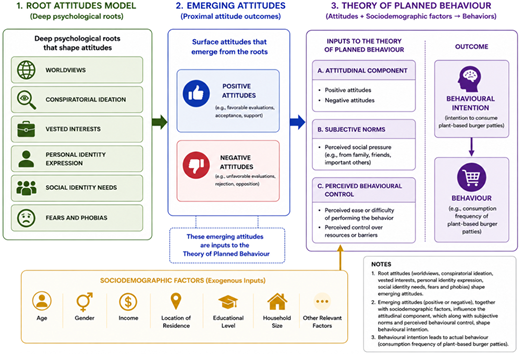
This study is primarily guided by the Attitude Roots Model (Hornsey and Fielding, 2017), with the Theory of Planned Behaviour (Ajzen, 1991) providing a complementary perspective. The Attitude Roots Model explains how underlying beliefs and dispositions shape consumer attitudes towards novel foods, whereas the Theory of Planned Behaviour provides a broader framework for understanding how attitudes and individual characteristics influence behavioural outcomes. Because this study does not directly measure behavioural intentions, subjective norms or perceived behavioural control, it is not intended as a full empirical test of the Theory of Planned Behaviour.
The conceptual framework is primarily based on the Attitude Roots Model, which posits that the observable “surface attitudes” individuals express, such as accepting or rejecting a product, are shaped by underlying “attitude roots” the deeper motivational structures that generate and sustain these attitudes. These attitude roots predispose individuals to reject food innovations, such as PBMAs, and influence how they process information. Rather than evaluating evidence objectively, individuals tend to seek out and interpret information in ways that reinforce their pre-existing attitudes, a process referred to as motivated reasoning (Hornsey and Fielding, 2017).
The explanatory value of the Attitude Roots Model is particularly relevant in the context of novel foods. Wilks et al. (2019) argue that attitudes exert a stronger influence on consumer behaviour when products are unfamiliar and reliable information is limited, as is often the case for PBMAs. Under these conditions, consumers rely more heavily on intuitive judgments and pre-existing beliefs to simplify risk assessment and evaluate potential benefits. Consequently, uncertainty and scepticism surrounding food innovations increase consumers’ reliance on psychological heuristics rather than systematic evaluation of evidence.
Within this motivated reasoning process, individuals act as “cognitive lawyers” rather than impartial scientists, selectively searching for, interpreting and evaluating information to defend their existing attitudes (Hornsey and Fielding, 2017). Counter-attitudinal evidence is more likely to be dismissed or scrutinised critically, whereas evidence that supports existing beliefs is accepted with relatively little scrutiny. Hornsey and Fielding (2017) identify six primary attitude roots that underpin this process: worldviews, conspiratorial ideation, vested interests, personal identity expression, social identity needs, and fears and phobias. These underlying motivations shape and sustain the surface attitudes that ultimately influence consumers’ acceptance or rejection of food innovations such as PBMAs.
While the Attitude Roots Model explains the psychological origins of consumer attitudes, the Theory of Planned Behaviour complements this perspective by recognising that attitudes alone do not determine behaviour. Instead, behavioural intentions and consumption decisions are also influenced by socio-economic and contextual factors that either enable or constrain individuals from acting on their attitudes. Integrating these two theories (as shown in Figure 1) therefore provides a comprehensive framework for understanding both the psychological drivers of PBMA acceptance and the demographic factors that moderate their influence on consumption behaviour. Based on the conceptual framework presented in Figure 1, this study hypothesises that consumers’ attitudes and socio-economic characteristics are significantly associated with the frequency of plant-based meat alternative (PBMA) consumption.
3. Literature review
Several studies investigating consumer acceptance of PBMAs have adopted a similar conceptual approach by examining the psychological factors that shape consumers’ acceptance and rejection of PBMAs. Social norms have consistently emerged as important determinants of PBMA consumption. For example, Sharps et al. (2024) reported that descriptive norms regarding peers’ and friends’ consumption, as well as injunctive norms from friends, were positively associated with self-reported PBMA intake. Similarly, Rizzo et al. (2023) found that positive perceptions of the health benefits of PBMAs were associated with higher consumption frequency, highlighting the role of favourable beliefs in driving consumption behaviour.
Previous studies have also demonstrated the importance of personal values and motivations. Lehto et al. (2023) found that lower PBMA consumption was associated with food value systems that prioritised traditional and hedonic values while placing less importance on universalism. In contrast, Davitt et al. (2021) reported that consumers who had previously tried PBMAs held more positive perceptions of their environmental and nutritional benefits and were motivated by food curiosity, suggesting that openness to novel foods and sustainability-related beliefs facilitate adoption.
Emotional responses have likewise been identified as significant predictors of PBMA consumption. Both Zandstra et al. (2024) and Motoki and Qin (2025) found that positive emotions were positively associated with PBMA consumption, indicating that favourable affective responses can encourage product uptake. In addition, product-related perceptions play a crucial role in shaping consumer behaviour. Chia et al. (2024) found that perceptions of unnaturalness were negatively associated with PBMA consumption intentions, whereas perceptions of food safety were positively associated with consumption. Collectively, findings from these international studies suggest that psychological determinants including social norms, personal values, emotions, curiosity and product perceptions are consistently associated with consumers’ acceptance and consumption of PBMAs across different populations.
Evidence from South Africa similarly demonstrates that psychological factors play a significant role in shaping consumers’ acceptance and rejection of PBMAs. Existing studies have examined a range of cognitive and perceptual determinants that influence consumer decision-making. For example, Moonaisur et al. (2024) found that consumer acceptance of PBMAs is influenced by pre-existing attitudes towards the food category into which plant-based proteins are incorporated, suggesting that acceptance extends beyond the product itself to the familiarity and perceptions of the host food. Similarly, Tsvakirai and Zulu (2022) reported that consumers’ perceptions of the social positioning of PBMAs significantly influenced their consumption behaviour, highlighting the importance of social meaning and identity in dietary choices. Studies examining perceived product benefits have produced mixed findings. Szejda et al. (2021) and Tsvakirai et al. (2023) found that consumers with more favourable perceptions of the benefits of PBMAs exhibited greater openness towards these products. In contrast, Tobias-Mamina et al. (2025) reported that perceived benefits did not significantly influence preferences for PBMAs when they were evaluated alongside other alternative proteins, such as cultivated meat and insect-based meat. This suggests that the relative importance of perceived benefits may depend on the context in which alternative protein sources are compared. Product-related perceptions have also been shown to influence acceptance. Mkhize et al. (2025) found that farmers’ evaluations of intrinsic product attributes, including appearance, aroma, texture, taste and flavour, significantly influenced their perceived acceptance of PBMAs.
Collectively, these studies indicate that South African consumers rely on a range of psychological heuristics, including attitudes, perceived benefits, social perceptions and product evaluations, to make decisions about PBMAs, particularly when knowledge and experience with these products are limited. Such findings support the broader proposition that consumers simplify complex food choices by relying on readily accessible perceptions and beliefs when assessing the risks and benefits of emerging food technologies.
Despite these important contributions, the existing literature has predominantly focused on individual-level psychological determinants of PBMA acceptance, with comparatively little attention paid to the institutional context, specifically, consumers’ perceptions of the role of government and public institutions in enabling dietary shifts towards more sustainable protein sources. How consumers attribute responsibility for promoting PBMAs to the state, and how such perceptions intersect with technology-related scepticism, remains underexplored. Furthermore, previous studies have largely examined strategies for encouraging initial trial of meat alternatives, leaving the transition from trial to sustained consumption behaviour insufficiently addressed.
Our study advances the field by refocusing attention from temporary adoption to lasting dietary change, foregrounding the interplay between responsibility attribution and technology-related scepticism as key factors in this process. To address the identified gap, the present research investigates the association of individual agency, government responsibility attribution and technology-related scepticism on the frequency of PBMA consumption. In doing so, it broadens the analytical scope of consumer adoption research by integrating institutional and governance-related psychological dimensions, thereby offering a more comprehensive framework for understanding the complexities of PBMA acceptance.
4. Methods and materials
4.1 Study participants and research ethics
Data for this study were collected in South Africa through an online survey conducted in May 2022. The survey was administered with the assistance of Dynata, a company specialising in recruiting and maintaining nationally representative consumer panels for online research. Participants were required to be at least 18 years old and provided informed consent by selecting a checkbox at the beginning of the survey, thereby confirming their voluntary participation. The study ensured anonymity, and participants were informed of their right to withdraw from the survey at any time without consequences. Given these measures, the study was classified as low risk and ethical clearance was obtained from the University of Arkansas Institutional Review Board (IRB approval protocol #2202386371, 17 March 2022). The analytical plan for this research was pre-specified as the study did not take an exploratory approach.
4.2 Data collection
The online survey was managed using Qualtrics, a web-based survey software. Initially, 956 individuals participated in the study. However, after applying quality checks to exclude incomplete responses and those failing an attention-check question, 658 observations were retained for analysis. This sample size was adequately large and representative as it yields an acceptable marginal error of ±3.2% when calculated in Eq. (1) below.
where Z′ is the Z*-value at a confidence level of 95%, p is the sample proportion and n is the sample size. The sample proportion was calculated as by dividing the number of individuals in the population who have the characteristic of interest by South Africa’s population size (59.29 million).
The survey questionnaire was divided into three sections, each comprising close-ended questions. In Section 1, the survey contained questions on the socio-economic attributes (gender, household composition, race, education, income, marital status and age) of the study participants. Section 2 solicited information on the participants’ protein consumption and purchasing patterns. A combination of scale and categorical variables was collected from the questions in these two sections. The last section assessed participants’ attitudes towards food using opinion statements related to: (1) consumers’ food technology neophobia, (2) beliefs about the individual’s and government’s role in promoting progressiveness and (3) consumers’ food curiosity. These statements were adapted from the Food Neophobia Scale developed by Pliner and Hobden (1992) and the Food Technology Neophobia Scale developed by Cox and Evans (2008). Selection of these two scales was guided by the Attitude Roots Model, which indicated that these underlying attitudes form the basis for novel food acceptance or rejection. The opinion statements in the consumer attitude constructs were measured using categorical variables on a 5-point Likert scale, with responses ranging from: “strongly disagree” = 1, “disagree” = 2, “neither agree nor disagree” = 3, “somewhat agree” = 4 and “strongly agree” = 5.
4.3 Data analysis
Principal component analysis (PCA) was conducted to address the study’s first objective of identifying the dominant attitudes shaping South African consumers’ acceptance of PBMAs using the opinion statements presented in Table 3. PCA is a multivariate dimension-reduction technique that transforms a set of correlated variables into a smaller number of uncorrelated, orthogonal principal components while retaining most of the variation in the original data (Abdi and Williams, 2010; Hair et al., 2013; Vyas and Kumaranayake, 2006). By identifying the underlying latent structure among interrelated variables, PCA simplifies complex datasets and reveals the key attitudinal dimensions that explain patterns in consumers’ perceptions of PBMAs. As illustrated in Eq. (2) below, PCs 1 to m were generated from a set of variables X1 through to Xn and weights amn were assigned to the mth principal component (PCm) and the nth variable.
The first PC accounts for much of the variability in the data, and each succeeding component accounts for as much of the remaining variability as possible. The weights for each PC are given by the eigenvectors of the correlation matrix or co-variance matrix. The variance for each PC is given by the eigenvalue of the corresponding eigenvector, and the sum of the eigenvalues equals the number of variables in the initial data set (Vyas and Kumaranayake, 2006). The proportion of the total variation in the original data set accounted for by each principal component is given by dividing each PC’s eigenvalue by the number of original variables used to generate it. The weights of indicators within a component are used to interpret the meaning of each component. Hence, in this study, the consumers’ root attitudes represented in each PC are interpreted as a reflection of the combination of the underlying indicators that contributed to its construction.
The analysis was performed using the Statistical Package for Social Sciences (SPSS). Five tests were conducted to assess the validity and suitability of applying PCA to the data. The first of these procedures was the use of varimax rotation, which ensured that the derived components were uncorrelated. The extraction considered only items with factor loadings above 0.5. Third, the Kaiser criterion (Kaiser, 1970) of retaining factors with eigenvalues above 1 was utilised during the extraction of the principal components (PCs). Cronbach’s alpha was also used to assess the internal consistency of the complete set of opinion statements. The study aimed to acquire a score above 0.7, following Hair et al. (2013). Furthermore, the Kaiser–Meyer–Olkin (KMO) value was used to measure the sampling adequacy for the overall set of opinion statements. Following Hair et al. (2013), the acceptance threshold was set at 0.5. Lastly, Bartlett’s test of sphericity was performed to assess the variance in the analysed questions. Here, a p-value lower than 0.05 was considered acceptable.
Regression analysis was conducted to address the study’s second objective of determining the association between consumer attitudes on consumers’ acceptance of PBMAs in South Africa. A categorical variable was used to measure the frequency of meat alternative consumption, with consumption at least once a week indicating a high level of acceptance and mainstreaming of meat alternatives in the consumer’s diet. A binary logistic regression model was employed, with the frequency of meat alternative consumption as the dependent variable. The consumption of at least one veggie burger a week was adopted as a threshold in our study because a review by Szenderak et al. (2022) discusses weekly consumption and above as evidence of regular acceptance and purchase behaviour. The PCs extracted from the PCA served as the main explanatory variables, while socio-economic variables were included as control variables. The model is expressed in Eq. (3).
Where Yi is a binary variable coded as 1 = High frequency of meat alternative consumption (at least once a week) or 0 = Low frequency of meat alternative consumption (less than once a week) and Xi is a vector of explanatory variables, β′ is a vector of parameters to be estimated and F is a known function (logistic function for binary regression).
5. Results
5.1 Sample description
The average survey respondent was 35 years old, lived in a household of four, had one child and was either pursuing or had completed a tertiary education course. As shown in Table 1, most of the participants were female (55.69%) and resided in the most developed provinces (Gauteng (44.31%), KwaZulu Natal (13.51%) and Western Cape (11.08%)). The majority (63.43%) of the respondents were of African descent, 19.88% were white, 4.25% were coloured and 0.30% were Indian. Most sample respondents fell under the middle-income bracket (R54 345–R863 906), where 20.82%, 29.48%, 16.10% and 6.99% were classified as low emerging-, realised- and upper-middle-income, respectively. Just 7.9% were classified as affluent, while 18.69% were classified as poor.
When the survey respondents were asked about their meat alternative consumption, just 12 (1.82%) indicated that they ate plant-based burger patties daily, 45 (6.84%) ate them once every 2 or 3 days and 56 (8.51%) had them at least once a week. As shown in Table 2, most respondents (44.53%) reported that they had never eaten veggie burgers. In comparison, 17.63% reported having plant-based burger patties about once a month. Of the sample, only 9.87% were vegan or vegetarian. When asked about their choice of protein diets, the majority of the respondents indicated that they were flexitarians (54.69%), while 39.06% and 6.25% were pesco-vegetarian and lacto-ovo-vegetarian, respectively. The study included consumers with different types of meat consumption preferences to ensure a holistic representation of the South African market. Vegetarians and vegans were specifically included as these consumers have, in a social setting, the option of eating different unprocessed plant protein sources rather than just veggie burgers. From the whole sample, most of the respondents (54.71%) reported no intention to change their current meat consumption patterns, while 20.67% said they wanted to increase their consumption. Almost a quarter (24.62%) of respondents planned to reduce their meat consumption in the next 12 months.
Table 3 presents the categories and statements posed to survey respondents and emerged as providing a significant influence on the consumer behaviour studied in this study. This statement assessed consumers’ perspectives on three key areas: (1) food technology neophobia, (2) individual/government’s role in progressiveness and (3) food curiosity. These three extracted constructs food technology neophobia, food curiosity and beliefs about government responsibility reflect deeper attitudinal foundations because they capture consumers’ underlying orientations towards innovation, uncertainty and institutional trust, which shape how they evaluate and respond to PBMAs. Food curiosity emerged as an empirically derived attitudinal component that reflects consumers’ openness to exploring novel foods, consistent with the broader psychological mechanisms described by the Attitude Roots Model. Although also empirically derived from the study’s data, the food technology construct is a dimension that stems directly from the Attitude Roots Model. Beliefs regarding government responsibility emerged as an empirically derived attitudinal component reflecting consumers’ attribution of responsibility for food-system change. Within the Attitude Roots framework, this component represents underlying beliefs about institutional responsibility rather than a distinct attitude root.
First, food technology neophobia was considered as a construct that can reduce the frequency of PBMA consumption because, as reported by consumers, these products are often perceived as highly processed, unnatural or potentially unsafe. These perceptions create psychological resistance and distrust, making neophobic individuals less willing to try PBMAs repeatedly and incorporate them into their regular diets (Sharps et al., 2024). Second, food neophobia can also reduce the frequency of PBMA consumption because these products are often perceived as novel and different from traditional meat products (Lehto et al., 2023). Neophobic consumers are therefore less willing to experiment with PBMAs (Zandstra et al., 2024) and, even after trying them, may be less likely to incorporate them regularly into their diets. Food curiosity can increase the frequency of PBMA consumption because curious consumers are more open to exploring novel foods and experimenting with new eating experiences. Their willingness to try unfamiliar products makes them more likely to sample different PBMAs and incorporate them more regularly into their diets if the products meet their expectations. Together, these psychological dispositions influence whether consumers perceive PBMAs as acceptable, safe and worthwhile, thereby affecting their willingness to incorporate them into their diets.
The results reported in Table 3 show that participants had a mean score of 3.53 (out of 5) on the food technology neophobia scale. This finding suggests that respondents were, on average, more sceptical of food technology than they were confident in its ability to help address long-term environmental and food security challenges. When analysing the mean item scores statement-by-statement, the strongest scepticism is the over-reliance on food technology to solve the food problem. This was in comparison to slightly lower scepticism about the long term environmental benefits of using new food technologies. This finding could be explained by the fact that the food problem is complex, comprising not only environmental issues but also health issues, for which food technologies fare poorly due to the high fat and salt content that is often added to PBMAs to ensure their marketability.
Regarding consumers’ beliefs about the respective roles of individuals and government in driving progressiveness within the food system, the results indicate that respondents assign greater responsibility to government than to individual consumers. This is evidenced, first, by stronger agreement with the statement expressing willingness to adjust consumption decisions for the betterment of society, provided such a change were nationally mandated. Second, respondents strongly agreed that consumers should not bear the financial burden of adopting environmentally friendly products and that public funds should be used to support the transition to more sustainable dietary patterns. These responses may be attributable to the demographic composition of the sample, which was predominantly drawn from urban areas. Urban contexts are often shaped by individualistic and market-oriented norms, in which responsibility for collective welfare is often perceived as residing with formal institutions rather than with individual actors. Consequently, expectations for systemic change may be directed more strongly towards government intervention than towards voluntary individual action.
Table 3 further indicates that respondents exhibited relatively high levels of food curiosity, with an overall mean score of 3.62. In particular, participants reported a strong willingness to try new foods (mean = 3.96) and indicated that their cultural contexts were generally supportive of experimenting with meat alternatives (mean = 3.21). These results may be explained by the sample’s demographic profile, which was predominantly composed of younger consumers. Younger individuals are typically more open to novel experiences and more inclined to engage with emerging food trends. In addition, they are less likely to face age-related dietary restrictions due to health concerns, which may further increase their willingness to experiment with alternative food products.
Taken together, the results show the presence of a mix of divergent attitudes, some encouraging the consumption of PBMAs and others discouraging it.
5.2 Empirical results
5.2.1 Principal component analysis results
The results in Table 4 show that the survey respondents’ attitudes were captured in two PCs. The first and dominant PC included statements that indicated consumers’ food technology neophobia and a belief that government, rather than individuals, should assume a central role in driving progressiveness within the food system. The statements captured indicated consumers’ negative perceptions of the potential role of food technology in solving food and environmental problems, as well as indications of consumers’ belief in the need for rules, enforcement and incentives from the government for consumption patterns to change. This first PC had significant loadings that ranged from 0.533 to 0.681, had an eigenvalue of 2.286 and accounted for the majority (28.58%) of the variation in the data collected about consumers’ attitudes. The second PC captured a significantly different attitude, which indicated an embrace of a progressive dietary orientation characterised by openness to trying new foods and no cultural restrictions on consuming PBMAs. The statement loaded on PC2, which had an eigenvalue of 1.121 and accounted for 14.02% of the variation in data collected.
The analysis demonstrated strong reliability and robustness. The eigenvalues for the two extracted principal components were 2.286 and 1.121, both exceeding the recommended threshold of 1.0. All retained items exhibited factor loadings between 0.5 and 0.9, comfortably above the 0.5 minimum criterion. The scale’s internal consistency was high, with a Cronbach’s alpha of 0.805, well above the acceptable benchmark of 0.7. Furthermore, the sampling adequacy was confirmed by a KMO value of 0.769 (exceeding the 0.5 threshold). At the same time, Bartlett’s test of sphericity was significant (p < 0.001), further supporting the appropriateness and reliability of the PCA.
5.2.2 Regression analysis results
Regression analysis results in Table 5 demonstrate that consumer attitudes were significantly associated with the consumption frequency of plant-based burger patties. As shown, the composite indices measuring consumers’ food technology neophobia and belief in the government’s responsibility for driving progressiveness within the food system were negatively associated with frequent consumption of plant-based burger patties (β = −0.362; p-value = 0.004). This implies that consumers were more likely to have a high consumption frequency of PBMAs if they had lower food technology neophobia and stronger belief in consumer-driven food system progressiveness. The results further indicate that for every one-unit increase in food technology neophobia and belief that the government should drive food system progressiveness, the odds of being a high-frequency PBMA consumer decrease by 30.4% (1–0.696 = 0.304). Szenderak et al. (2022) explain that consumers who exhibit food technology neophobia tend to distrust novel food production methods, such as those used to create plant-based burger patties, thereby making them less likely to accept and avoid frequent consumption of these products. This implies that the observed neophobia towards food technology is an attitude root related to fear of unanticipated consequences or risks associated with the consumption of PBMAs. Additionally, a strong belief that the government should drive progressiveness in the food system may imply a preference for top-down and regulatory-driven change rather than market-led innovations. The result can also be interpreted as an expression of trust in the government and perceived responsibility for systemic change.
The analysis revealed a significant positive association between the food curiosity attitude and the frequency of consumption of plant-based burger patties (β = 0.300, p = 0.015), consistent with theoretical expectations. This relationship likely emerges because food curiosity, characterised by openness to diversity and novelty, facilitates acceptance of innovative food products. As shown in the results, a one-unit increase in food curiosity, the odds of being a high-frequency PBMA consumer increased by 34.9%, highlighting the importance of consumers’ willingness to explore novel foods in facilitating repeated consumption. Food curiosity reflects an individual’s openness to trying new and unfamiliar foods, including meat alternatives, thereby encouraging experimentation with plant-based burger patties (Szenderak et al., 2022). This attitude reduces resistance to novel food technologies and ingredients, making consumers more willing to purchase and repeatedly consume such products. Over time, positive sensory experiences and satisfaction from trying these burgers reinforce habitual consumption, leading to frequent use (Kadir et al., 2025). Thus, rather than avoiding innovation, food-curious consumers actively seek it out, driving higher consumption frequency of plant-based burger patties.
The regression results in Table 5 for control variables aligned with established patterns in alternative protein consumption. Being male (β = −0.773, p = 0.002), non-vegan/non-vegetarian (β = −1.626, p < 0.001) and receiving a high income (β = −0.178, p = 0.047) demonstrated significant negative associations with frequent PBMA consumption, indicating these products primarily appeal to women, vegetarians/vegans and lower-income consumers. These findings have been explained in the literature. First, the negative association between being male and PBMA consumption suggests that men in this sample are significantly less likely to eat plant-based burger patties frequently. This may stem from traditional gender norms linking meat consumption with masculinity, where plant-based options are perceived as less socially appropriate for men (Michel et al., 2021; Alae-Carew et al., 2021). Consequently, these cultural and psychological factors lead to lower acceptance and lower consumption frequency among males than among females. Second, non-vegan or non-vegetarian consumers typically rely on animal-based proteins as dietary staples, making them less likely to seek out or regularly consume PBMAs (Szenderak et al., 2022; Michel et al., 2021). As a result, the lack of dietary alignment and lower perceived value compared to conventional meat led to significantly lower PBMA consumption among this group (Fechner et al., 2026; Dube et al., 2023). Lastly, high-income consumers may have greater access to and preference for premium animal-based proteins, which may better suit their status. Consequently, greater financial resources can reduce the perceived need or desire to substitute traditional meat with plant-based options, thereby lowering consumption frequency.
The regression analysis (Table 5) revealed that both higher education levels (β = 0.729, p < 0.001) and a greater number of children in a household (β = 0.331, p = 0.004) were positively associated with frequent consumption of plant-based burger patties, suggesting that more educated consumers and those with larger families show greater adoption of meat alternatives. The former result can be explained by the fact that higher education correlates with greater exposure to diverse food cultures, nutritional knowledge and health-conscious behaviours, all of which encourage experimentation with and acceptance of novel protein sources. As a result, these individuals are more willing to incorporate PBMAs into their regular diet, driving more frequent consumption compared to those with lower educational attainment. The latter result can be explained by the fact that having more children often forces parents to seek affordable and healthy meal options. In addition, children may be less committed to traditional meat-based meals than adults, making plant-based burgers a more appealing substitute that appeals to diverse tastes while reducing meat costs for larger households (Sharps et al., 2024).
6. Discussion
This study set out to identify these attitudinal barriers and assess their relative influence on regular consumption behaviour. Using the Attitude Roots Model (Hornsey and Fielding, 2017) and the Theory of Planned Behaviour (Ajzen, 1991) to support the investigation, the study found that the negative attitude towards high consumption frequency of PBMAs was associated with underlying negative attitudes. This attitude was found to be dominant and centred on food technology neophobia and a belief in greater government responsibility in driving progressiveness within the food system. These findings align with past research (Van der Meer et al., 2025; Sharps et al., 2024; Pandey et al., 2025), which reported that food technology neophobia is a significant deterrent to the consumption of PBMAs. Rombach et al. (2022) suggest, that such negative perceptions towards PBMAs often stem from observed or perceived negative externalities resulting from food technological solutions, representing a self-preservation instinct rather than mere resistance to change. The results also agree with findings by Lehto et al. (2023) and Davitt et al. (2021), which report that PBMAs empower, in part, an increase in consumer agency with regard to food system transformation. Hence, if consumers view the government as more effective at bringing about societal change, they may be less inclined to purchase and consume PBMAs.
The study’s results also reiterated existing research’s findings, which established that psychological factors such as worldviews, perceptions, emotions and attitudes, can also contribute positively to consumer decision-making regarding novel foods. The finding particularly highlighted the role of food curiosity. The finding aligns with established literature (Michel et al., 2021; Sharps et al., 2024; Kadir et al., 2025), which demonstrates that openness to trying new food is positively related to the adoption and, subsequently, the long-term consumption of new foods. Fechner et al. (2026) investigated different ways to spark curiosity among consumers, as this emerged as a key factor in promoting the acceptance of meat alternatives among consumers. In so doing, the evidence strongly supports the theoretical framework provided by the Attitude Roots Model.
The observed associations between socio-economic characteristics and PBMA consumption are broadly consistent with the Theory of Planned Behaviour, which recognises that behaviour is shaped by both individual attitudes and contextual factors. Although this study did not directly measure the full set of Theory of Planned Behaviour constructs, the demographic patterns observed here align with the theory’s broader conceptual expectations. These results were aligned with existing literature. As explained in past studies, educated individuals tend to be more aware of the health and environmental benefits of plant-based diets (Nevalainen et al., 2023; Gomez-Luciano et al., 2019) and are more likely to reduce meat consumption (Alae-Carew et al., 2021), while families with children may utilise plant-based options for diet diversity due to young people’s lower meat attachment, and greater dietary flexibility (De Gavelle et al., 2019). Non-vegetarians, non-vegans and male consumers were less likely to have high PBMA consumption frequencies due to limited alignment of the product with their protein staples and gender norms. Also in agreement with results shared by Lehto et al. (2023), younger and more educated consumers are more inclined towards vegetarian or plant-exclusive diets, further supporting the observed demographic patterns in PBMA consumption.
Our results reveal a negative relationship between high income and PBMA consumption frequency, adding new evidence to an unresolved debate in the literature. As Szenderak et al. (2022) note, prior studies have yielded inconclusive findings regarding the nature and direction of income effects in this market. Viewed collectively, these mixed signals suggest a core positioning dilemma: consumers diverge on whether PBMAs should be marketed as premium or value-oriented products, and whether they appeal more to higher- or lower-income groups. For the South African market, this highlights the urgency of context-specific research to determine optimal positioning across diverse consumer segments. Practically, such insights would enable more targeted product design, pricing and promotional strategies, key drivers of sustained adoption and mainstream integration.
7. Study implications
The study’s findings underscore the role of consumer attitudes in food choices. These results highlight the key role that consumers’ attitude to government involvement in food system transformation plays, as this has been found to provide the motivation that could result in high frequency in PBMA consumption. As neophobia was found to be a hindrance to PBMA frequent consumption, efforts to reduce the novelty and increase familiarity of PBMAs would be necessary for increased adoption. Past studies (Li et al., 2022; Rini et al., 2024; Kapoor et al., 2023; Steils and Obaidalahe, 2020) have investigated the use of different types of messaging techniques and platform tools that can be used to perform this function effectively. This is particularly crucial given that lack of awareness, product unfamiliarity and unmet information needs often serve as barriers to adoption (Kim and Zailani, 2024; Vainio et al., 2018). As our results also support targeting specific market segments for increased PBMA consumption, such advertising and messaging should be directed to these segments.
8. Conclusion
The transition to sustainable food systems through PBMA faces significant challenges, as it requires consumers to break from conventional dietary habits and meat-centric norms. This study examined how attitudes (as fundamental psychological frameworks) influence the consumption of plant-based burger patties in South Africa. Data from South African consumers provide an interesting case on the influence of psychological factors on alternative meat consumption because there are conflicting trends in a high meat attachment, a high proportion of plant-based diets and a growing market for competitively priced veggie burger patties. The findings reveal that consumers’ food technology neophobia and a belief in a greater responsibility for the government’s role in driving progressiveness within the food system are key barriers to high consumption frequency of PBMAs. These results underscore the need for government’s active participation in encouraging sustainable transformations in food systems. They also indicate the role that researchers can play in empirically demonstrating how plant-based diets and food technologies contribute to environmental and food security goals, providing evidence that could mitigate consumer scepticism.
While the study’s findings are constrained by its geographic focus on South Africa, they provide a foundation for future research to first, examine these relationships across diverse cultural and demographic contexts (e.g. other countries or subpopulations), secondly, explore additional dimensions of the worldview theory not addressed here and third explore the use of cluster analysis in identifying segments in society that may hold certain attitudes. Fourth, future research could also conduct a comparative study to determine how differences in measuring the dependent variable and subsequently taking statistics such as odds ratios and marginal effects could yield additional insights. Literature would also benefit from studies that investigate different measures of consumption frequency. For example, adopting ordinal and scale variables to measure this variable. In addition future investigations, future studies could exclude (from the broad national market) or target the vegan and vegetarian markets and determine the factors that are influencing PBMA consumption patterns in these specific market segments. These investigations are likely to bring additional valuable information to academia, policymakers and industry stakeholders. Because this study relies on cross-sectional data, the results should be interpreted as associations rather than evidence of causality. Future longitudinal or experimental studies would help clarify the direction of these relationships and determine whether the observed associations reflect causal effects. Despite these limitations, the study advances understanding of how consumer attitudes translate into dietary behaviours, highlighting actionable levers and critical barriers for industry stakeholders to address in promoting PBMAs.
Author contributions
CZT was responsible for conceptualisation, data curation, methodology, formal analysis and writing – original draft.
LLN was responsible for conceptualisation, data curation, resources, project administration and writing – review and editing.
Data availability
Data will be made available upon request.