This study aims to examine how university students’ eating habits are formed and negotiated at the intersection of health perceptions, sustainability concerns, cultural values, and structural constraints. It seeks to identify the main factors influencing students’ food choices, the role of health and environmental considerations, and the presence of intercultural differences in consumption patterns.
The study adopts a qualitative, inductive research design, using semi-structured interviews with 14 university students aged 18–26 from diverse cultural and socioeconomic backgrounds across seven countries. Data were analysed using the Gioia methodology, enabling the development of first-order concepts, second-order themes, and aggregate dimensions to build a conceptual model of eating habit formation.
The findings show that students’ food choices are not driven by isolated individual preferences but emerge from dynamic interactions between structural determinants (e.g. affordability, availability, time constraints), culturally embedded food values, and selective engagement with health and environmental responsibility. While participants demonstrate growing awareness of healthy and sustainable eating, economic constraints, information asymmetries, and social dynamics often limit the translation of values into practice. Environmental concerns are widely acknowledged but inconsistently enacted, partly due to scepticism toward sustainability labels and greenwashing. Significant intercultural differences were observed in food norms, priorities, and constraints.
This study contributes to the literature by proposing an integrative model that explains how university students’ eating habits are shaped through the interaction of structural conditions and cultural values, moderated by selective engagement with health and sustainability. By moving beyond attitude–behaviour explanations, the paper offers a nuanced understanding of young consumers as active agents navigating competing constraints and provides relevant insights for policy, education, and institutional food strategies.
1. Introduction
Growing awareness of health, sustainability, and ethical concerns has increasingly shaped food choices, particularly among younger generations, as consumption is embedded in cultural, economic, and environmental contexts (Brom, 2000; Ghvanidze et al., 2016; De Boer and Aiking, 2021). For university students, eating habits are formed during a critical transitional phase marked by increased independence, changing social environments, and financial constraints, which together influence long-term consumption patterns (Nemeth et al., 2019; Almoraie et al., 2024). Although students are often open to experimenting with new dietary practices, their choices remain strongly conditioned by cultural norms, material constraints, and unequal access to sustainable options (Holotová et al., 2021; Potter et al., 2021).
Despite unprecedented access to nutrition information, university students are frequently exposed to incomplete or outdated dietary messages—particularly through social media—limiting access to clear, evidence-based guidance on healthy eating (Denniss et al., 2023; Chau et al., 2018). This is especially concerning given robust evidence linking excessive intake of refined carbohydrates to metabolic dysfunction and type 2 diabetes (Gross et al., 2004; Maki and Phillips, 2015; Mahzari and Mamun, 2020). Persistent misconceptions about dietary fats, sodium, and other nutritional components further contribute to confusion, while emerging scientific evidence on intermittent fasting and metabolic health remains largely absent from youth-oriented nutrition education (Landry et al., 2020; Cappuccio et al., 2022; De Cabo and Mattson, 2019; Longo et al., 2021; Shabkhizan et al., 2023).
Sustainability and ethical considerations have also gained prominence in food-related decision-making, including interest in plant-based diets and eco-labelled products (De Boer and Aiking, 2021; Costa et al., 2022). However, economic constraints frequently limit students’ ability to adopt such options, despite growing awareness and positive attitudes (Aprile and Punzo, 2022; Cavallo et al., 2020). These barriers are reinforced by widespread scepticism toward sustainability and organic labels, driven by greenwashing and weak verification systems, which undermine trust and reduce the effectiveness of labels as market signals (Delmas and Burbano, 2011; European Commission, 2023a, b; Kovač et al., 2025; Moroşan et al., 2025).
Although previous studies have examined health and sustainability in students’ food consumption, limited attention has been paid to how these factors interact during the university period and how students navigate tensions among values, constraints, and everyday practices (Rodrigues et al., 2019). To address this gap, this paper examines the nutritional and sustainable food consumption patterns of university students using a qualitative approach based on semi-structured interviews with participants from diverse cultural and socioeconomic backgrounds. Qualitative methods are particularly well suited to capturing the complexity of food-related decision-making and the interplay between individual intentions, cultural norms, and structural constraints (Niva et al., 2014).
Accordingly, this study addresses the following research questions.
What are the main factors influencing the eating intentions and habits of university students?
How do perceptions of health and environmental impacts influence their choices?
What are the intercultural differences in food consumption habits?
By proposing a model that explains the formation of eating habits in university students, this study contributes to the literature on young consumers and provides relevant insights for policymakers, educators, and practitioners seeking to promote food systems that better align health, sustainability, and everyday feasibility.
2. Literature review
Even if today's youth have unprecedented access to nutrition information, much of what they encounter—especially on social media—is incomplete, inaccurate, or outdated, which leaves them without clear, science-based guidance on fundamental aspects of healthy eating (Denniss et al., 2023; Chau et al., 2018). This is problematic given that excessive intake of refined carbohydrates is now well established as a contributor to metabolic dysfunction and a significant risk factor for type 2 diabetes, as demonstrated in ecological analyses, prospective cohorts, and systematic reviews (Gross et al., 2004; Maki and Phillips, 2015; Mahzari and Mamun, 2020).
At the same time, misconceptions about dietary fats persist among university students, who often favour “low-fat” products and misunderstand the importance of prioritising healthy fats rather than eliminating fat altogether (Landry et al., 2020). Public nutrition messaging around sodium and hydration is similarly inconsistent, oscillating between fear-based warnings and oversimplified advice, despite evidence that adequate—though not excessive—sodium intake remains essential for electrolyte balance and physiological function (Cappuccio et al., 2022).
Additionally, although a growing body of research demonstrates that intermittent fasting can induce beneficial cellular processes such as autophagy, improve glucose metabolism, alleviate inflammatory responses, and support cardiometabolic health (De Cabo and Mattson, 2019; Longo et al., 2021; Shabkhizan et al., 2023), these mechanisms are rarely communicated in youth-oriented nutrition education and are frequently overshadowed by reductive, weight-centric narratives on social media. Together, these examples illustrate the extent to which young people navigate a nutritional landscape marked not only by misinformation but also by the absence of up-to-date, evidence-based guidance on healthy eating choices.
Moreover, sustainability and ethical food consumption have become central themes in consumer behaviour research (De Boer and Aiking, 2021). Ethical concerns, such as greenhouse gas emissions, mass culling, and pesticide use, are increasingly driving the adoption of plant-based diets and eco-labelled foods (Benson and Rollin, 2008; Costa et al., 2022). However, university students often face economic constraints that limit their ability to adopt sustainable options, such as organic or locally sourced foods (Aprile and Punzo, 2022; Bauerné Gáthy et al., 2022; Cavallo et al., 2020; Hill, 2009). In addition, cultural and social influences play a significant role in shaping food preferences as students move through different environments with varying degrees of awareness of and access to sustainable practices (Potter et al., 2021).
Likewise, young consumers increasingly express distrust toward sustainability claims, a trend closely linked to the growing visibility of greenwashing, defined as environmental messaging unsupported by real environmental performance (Delmas and Burbano, 2011). EU assessments report that more than half of environmental claims are vague or unverified, and that many eco-labels lack robust certification systems (European Commission, 2023a, b), fostering a climate of green scepticism (Kreczmańska-Gigol and Gigol, 2022).
Recent findings show that perceived greenwashing significantly reduces trust in eco-labels, particularly among younger, highly informed consumers who question whether certifications genuinely reflect environmental benefits (Kovač et al., 2025). Similar patterns appear in the organic food sector, where doubts persist about whether “organic” products truly meet stricter production standards (Moroşan et al., 2025). Qualitative studies further indicate that Generation Z frequently views eco-labels as marketing tools rather than reliable indicators of sustainability (Aerdts, 2025), reinforcing broader scepticism toward environmental claims.
Economic research consistently shows that students prioritise affordability over nutritional quality (Rodrigues et al., 2019), although behavioural economics suggests that incentives such as subsidised healthy meals or standardised nutritious options can improve choices (Thaler and Sunstein, 2009). Educational interventions that frame healthy eating as a long-term economic benefit may further shift consumption towards healthier and more sustainable options (Almoraie et al., 2024).
From an economic standpoint, sustainability labels serve as signalling mechanisms that reduce information asymmetry in food markets (Akerlof, 1970). When labels are credible and clearly communicated, they enhance consumer trust and willingness to pay, particularly among environmentally conscious individuals (Potter et al., 2021). Yet their effectiveness varies across cultural and demographic contexts, indicating the need for tailored pricing and marketing approaches (Holotová et al., 2021).
Cultural and social contexts further influence students’ priorities around health and sustainability. Social norms, peer dynamics, and traditions shape food choices (Nemeth et al., 2019), underscoring the importance of recognising heterogeneous consumer preferences when developing segmentation strategies (Kotler and Keller, 2012). Cross-cultural evidence shows that Mediterranean students often prioritise fresh and organic foods, whereas those in more religious contexts may emphasise certifications such as halal (Holotová et al., 2021). Such findings point to opportunities for culturally aligned marketing and educational strategies.
Overall, healthy and sustainable food consumption among university students is strongly shaped by economic constraints, information asymmetries, and cultural influences. A multidimensional approach that integrates education, public policy, and management interventions is therefore essential to promote both health and environmental sustainability in student food choices.
3. Methodology
3.1 Research design and epistemological position
This study adopts a qualitative, exploratory, and inductive design to investigate how university students construct meanings surrounding food purchasing, eating practices, and notions of health and sustainability. The research is grounded in an interpretivist and social constructionist epistemology, which assumes that cultural, social, and economic contexts shape eating practices. Consistent with the Gioia methodology (Gioia et al., 2013), participants are treated as knowledgeable agents capable of explaining their decisions, beliefs, and routines in their own terms. This orientation does not seek positivist generalisation from samples but aims to generate transferable, conceptually grounded insights relevant to similar educational and cultural contexts. Therefore, the goal is generalisation to theory rather than to populations.
3.2 Participants and sampling strategy
Participants were 14 university students aged 18–26 years, recruited from seven different countries (Italy, North Macedonia, Pakistan, Peru, South Africa, Turkey, and the United States of America) using targeted sampling through university networks and social media. Inclusion criteria ensured diversity in gender, socioeconomic background, and field of study, as well as variation in living circumstances (with parents, alone, with roommates, or with partners). This strategic heterogeneity was not designed for representativeness but to capture variability in meaning construction around food practices, consistent with inductive theory-building rather than statistical inference (Gioia et al., 2013). Table 1 shows the demographic characteristics of the participants.
Saturation was evaluated progressively throughout coding, not on numerical benchmarks. After approximately 10 interviews, recurring patterns emerged regarding affordability, cultural norms, and health considerations. Four additional interviews were conducted to verify whether new perspectives would arise. No substantially new insights appeared, indicating thematic saturation, as recommended in qualitative research (Saunders et al., 2018).
3.3 Data collection procedure
Data were collected through semi-structured interviews lasting 60–90 min, conducted online or face-to-face depending on participants’ availability and location. Interviews were conducted in English or in the participant's preferred language, then translated and verified for accuracy. The interview guide comprised 73 open-ended questions that explored food purchasing, eating routines, cultural and social influences, perceptions of health, sustainability awareness, religious or ethical constraints, and living contexts.
Following Gioia et al. (2013), the interview protocol evolved iteratively to accommodate new concepts emerging from initial transcripts, allowing the researcher to explore emerging leads without imposing a priori theoretical categories. Participants’ wording was prioritised in early data collection to preserve informant-centric terminology, which later informed coding.
Immediately after each interview, reflective notes were produced to capture contextual elements and initial analytical impressions, offering a first layer of reflexive engagement. Participation was voluntary, informed consent was obtained, and anonymity was guaranteed. Audio recordings were stored securely and deleted after transcription. Ethical procedures followed university requirements and respected participants' cultural sensitivities regarding food practices.
3.4 Data analysis
Data analysis followed the Gioia Methodology (Gioia et al., 2013), a systematic approach to inductive concept development that enhances qualitative rigor and transparency.
The process involved multiple iterative stages.
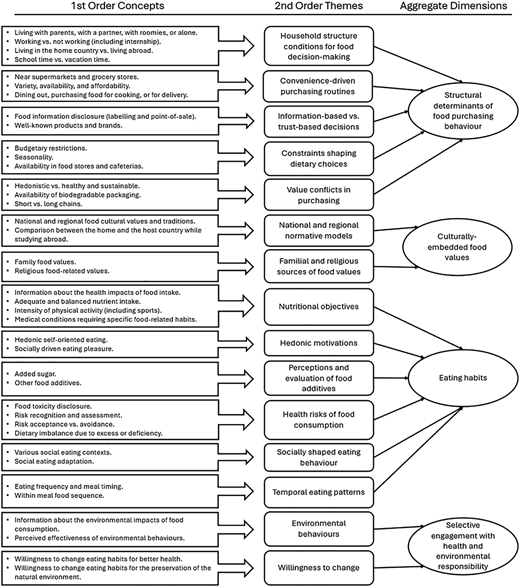
First-order coding preserved participants' own language, identifying descriptive categories without theoretical imposition. This stage generated an extensive set of informant-centric codes, categorised into 39 first-order constructs.
Second-order coding compared and reorganised emerging similarities and distinctions into researcher-centric themes that explain underlying patterns and meanings. Fifteen second-order themes were identified.
Aggregate dimensions were developed by clustering second-order themes into higher-order conceptual categories that capture processes influencing food choices: structural determinants of food purchasing behaviour, culturally-embedded food values, eating habits, and selective engagement with health and environmental responsibility.
The analysis progresses from raw quotes to first-order concepts, second-order themes, and aggregate dimensions. Table 2 shows theoretical propositions for the second-order constructs along with selected illustrative quotations from the interviews.
4. Results
Our results reveal that young consumers’ food choices are not formed individually but are socially and structurally shaped across everyday practices. The analysis identifies 15 second-order themes structured in four aggregate dimensions that explain how students make food choices: (1) structural determinants of food purchasing behaviour, (2) culturally-embedded food values, (3) eating habits, and (4) selective engagement with health and environmental responsibility. Together, these constructs and dimensions show how meanings around food are negotiated through the interaction of household structures, logistical and economic constraints, perceived risks, personal priorities, and social expectations. The complete data structure is shown in Figure 1.
4.1 Aggregate dimension: structural determinants of food purchasing behaviour
4.1.1 Household structure conditions for food decision-making
This theme concerns how daily food purchasing practices depend on the interviewee's living arrangements. When students live with their parents, food is typically chosen and purchased by the parents, although the interviewees may propose complementary products based on their preferences. Living with a partner implies shared decision-making. In contrast, living alone or with roommates leads to independent food purchases, except for occasional shared shopping agreements. Also, whether a student works or not significantly affects the time and resources they can devote to both purchasing food and consuming it. These differences illustrate how household structure and working arrangements affect who decides what to buy, where to buy it, and how often groceries are purchased.
4.1.2 Convenience-driven purchasing routines
Purchasing practices are strongly shaped by geographical proximity and ease of access to food outlets. Interviewees generally shop at the nearest supermarket or local grocery store, with some relying on school cafeterias, school food distribution centres, or mobile markets. Frequency depends on available time and responsibility for household shopping, ranging from daily purchases to weekly trips when living with family. Ease of access to fast food and delivery services also facilitates eating out or ordering in, often replacing home cooking and influencing routine purchasing decisions.
4.1.3 Information-based vs. trust-based decisions
Interviewees vary widely in their attention to food information when choosing products. Some examine labels to check ingredients, nutritional composition, origin, allergens, additives, religion-related rules, or whether products are organic. Others state that they do not check labels because they trust familiar products or rely on the person who buys the food, mostly parents. When food is purchased at restaurants or cafeterias, some students ask about ingredients or environmental and health practices, while others rely on perceived reputation or brand familiarity.
4.1.4 Constraints shaping dietary choices
Students' food choices are significantly constrained by contextual factors such as price, seasonality, and store and cafeteria availability. Budgetary restrictions often lead them to prioritise cheaper options, take advantage of discounts, or reduce purchases of products perceived as expensive, such as red meat or dairy. Seasonal products are preferred when available because they offer better quality at a lower cost, whereas out-of-season items are avoided for being overpriced or of inferior quality. In school cafeterias, restricted menus leave students with little flexibility, requiring them to eat whatever is offered, regardless of preference or nutritional intentions.
4.1.5 Value conflicts in purchasing
Purchasing choices reveal tensions between health, sensory pleasure, environmental considerations, and price. Some students seek organic or local products for their presumed quality or sustainability, while others doubt their authenticity or consider them overpriced. Others prioritise taste or affordability, opting for fast food or high-energy foods. Preferences may shift depending on medical advice, dietary goals, budget, seasonality, or cultural food practices. These contrasts highlight how competing values coexist and are negotiated during the purchasing process.
4.2 Culturally embedded food values
4.2.1 National and regional normative models
Students' eating practices reflect food norms rooted in their national and regional traditions, which define what is considered “normal”, “healthy”, or “authentic” food. They value locally produced products and typical dishes from their home regions, perceiving them as fresher, safer, and more flavourful than imported alternatives. When studying abroad, many experience uncertainty about food origins, distrust highly processed products, or struggle to identify seasonal foods. Comparing the host country with home reinforces these embedded cultural models, causing students to prefer familiar ingredients and maintain traditional dishes whenever possible, even when availability or cost complicates these choices.
4.2.2 Familial and religious sources of values
Students’ eating habits are strongly influenced by food values learned within their families, where traditional dishes, rules of politeness, and the authority of the household determine what and how they eat. Many describe growing up eating whatever a parent—often the mother—cooked, reinforcing obedience, familiarity, and emotional attachment to customary meals. Religious norms further regulate food choices by prohibiting certain ingredients, requiring careful selection of ingredients, or prescribing practices associated with fasting or celebrations. These familial and religious frameworks shape students' notions of what is appropriate, acceptable, or respectful to eat, guiding their decisions even when they live independently or abroad.
4.3 Aggregate dimension: eating habits
4.3.1 Nutritional objectives
Students define healthy eating as a balance of nutrients, variety, and adequate calorie intake without excess. Their understanding of nutritional adequacy comes from family influence, national food culture, religion, school education, online information, and social references. They associate a healthy diet with proteins, vegetables, vitamins, and avoidance of allergens, excessive sugars, alcohol, ultra-processed products, and toxic ingredients. For some, dietary choices are shaped by specific medical conditions that require restrictions or avoidance of certain products. Also, participating in sports affects dietary choices.
4.3.2 Hedonic motivations
Students often eat for pleasure, not only to satisfy hunger or nutritional needs. They express interest in foods that provide sensory gratification, sweetness, flavour, or emotional comfort. Snacks and fast food are common, especially when routines are disrupted or when seeking indulgence, convenience, or social enjoyment. Food choices can also reflect nostalgia, emotional states, or personal preferences for taste above other criteria.
4.3.3 Perceptions and evaluation of food additives
Most interviewees consider additives, preservatives, pesticides, artificial ingredients, and added sugars as toxic to varying degrees. Some distinguish between harmful and acceptable additives; others view certain additives as dangerous or even carcinogenic. There is concern about sweeteners, with some seeing them as worse than sugar and others accepting them as alternatives. Suspicion extends to restaurant food due to unknown preparation conditions and potential low standards. These perceptions drive students to seek “natural” foods, homemade meals, or organic products when possible.
4.3.4 Health risks of food consumption
Interviewees demonstrate awareness of the health risks associated with both overeating and undereating. They acknowledge the dangers of high caloric intake, excessive sugar, fast food, alcohol, and toxic ingredients, as well as the health impacts of not meeting nutritional needs due to restrictions, lifestyle constraints, or medical situations. Some students adjust their diets to control glucose, cholesterol, or digestion, while others show little concern or awareness. Their choices reflect varying degrees of risk recognition, acceptance, or avoidance.
4.3.5 Socially shaped eating behaviour
Students' eating practices change notably in shared contexts such as meals with family, partners, roommates, or friends in cafeterias and restaurants. Social meals tend to last longer and encourage more indulgent choices, such as fast food, snacks, desserts, and alcohol. In these situations, students often adapt to the group by accepting foods they would not choose on their own, relaxing dietary rules, or adjusting quantities to avoid inconvenience or disrespect. Eating thus becomes a negotiated act shaped by social norms, courtesy, and the desire for belonging rather than individual preference.
4.3.6 Temporal eating patterns
The number of meals per day, time dedicated to eating, and meal schedule depend on school routines, workload, cultural customs, fasting practices, and household arrangements. Students usually eat two or three meals per day with one to three snacks, but may skip meals or replace them with snacks when busy. Eating times adjust during vacations, school days, or when living abroad, showing that eating rhythms are shaped by situational and institutional contexts. None of the interviewees reported following a specific order in the intake of foods, such as eating fiber first, then proteins, and finally carbohydrates.
4.4 Aggregate dimension: selective engagement with health and environmental responsibility
4.4.1 Environmental behaviours
Some interviewees express environmental concern through their food purchases, such as choosing biodegradable packaging, local products, or short food chains. However, these behaviours are inconsistent and often secondary to taste, price, availability, and convenience. Students may express awareness of environmental impacts, but do not consistently translate beliefs into action, reflecting a gap between environmental ideals and daily practices.
4.4.2 Willingness to change
Interviewees show a higher willingness to change eating habits for personal health than for environmental protection. They modify consumption when it improves well-being, prevents disease, or follows medical recommendations. However, many of them express limited motivation to change for ecological reasons because the topic is not considered relevant, because they doubt the effectiveness of individual actions, because they do not trust the environmental claims of food producers, or because environmental criteria conflict with taste, price, convenience, or cultural values.
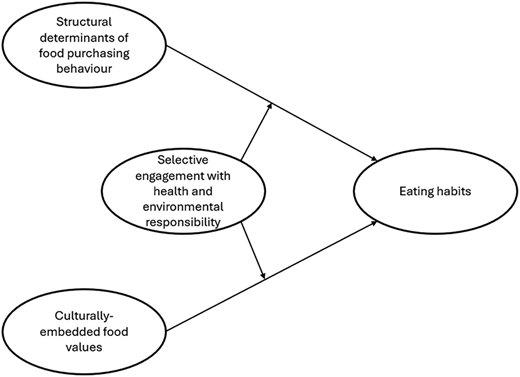
In an attempt to propose a generalisable model explaining the eating habits of university students, we present the model shown in Figure 2. In this model, eating habits are shaped by structural determinants of food purchasing behaviour and culturally-embedded food values. Both relationships are moderated by selective engagement with health and environmental responsibility. Each of these variables comprises the second-order themes identified in Figure 1. This model may serve as a foundation for future research exploring the role of health and environmental responsibility in the formation of eating habits from the perspective of university students.
5. Discussion
This study contributes to the literature by showing that university students’ eating habits emerge from interactions between structural constraints, culturally embedded food values, and selective engagement with health and environmental responsibility. The findings confirm young adulthood as a critical period in which food routines evolve with increased independence and economic constraints, while also highlighting students' active negotiation of these conditions rather than passive conformity (Nemeth et al., 2019; Almoraie et al., 2024).
Consistent with the literature, affordability and accessibility emerged as the strongest determinants of food purchasing behaviour (Rodrigues et al., 2019; Cavallo et al., 2020; Bauerné Gáthy et al., 2022). Although participants expressed awareness of healthy and sustainable eating principles, their intentions were frequently constrained by price sensitivity, time scarcity, and limited availability, reinforcing the persistent attitude–behaviour gap identified among students with limited financial autonomy (Aprile and Punzo, 2022; Hill, 2009). Rather than indicating indifference, these gaps reflect adaptive strategies in which students prioritise feasible, “good enough” options within narrow structural boundaries.
Cultural and familial food values strongly shaped perceptions of what constitutes “good,” “safe,” or “appropriate” food. Students relied on national, familial, and religious reference models when evaluating food quality, confirming that eating practices remain deeply socialised and resistant to change despite increased autonomy (Brom, 2000; Niva et al., 2014; Potter et al., 2021). Observed cross-cultural differences—such as preferences for freshness and local products in Mediterranean contexts or religious compliance in Muslim-majority contexts—align with prior research on cultural heterogeneity in health and sustainability priorities, indicating that food choices abroad also help preserve culturally meaningful eating models (Holotová et al., 2021).
Health-related concerns were prominent in participants’ narratives, particularly regarding ultra-processed foods, added sugars, and artificial additives, consistent with evidence of growing health consciousness among young consumers (Rodrigues et al., 2019). However, the findings nuance this literature by showing that health-oriented behaviour is often driven by perceived risk and lay interpretations rather than formal nutritional knowledge, with some students relying on labels and organic products while others trust familiar brands or family routines. This uneven access to reliable information reinforces concerns that fragmented or contradictory nutrition messaging—especially via social media—contributes to inconsistent dietary practices (Chau et al., 2018; Denniss et al., 2023; Cappuccio et al., 2022).
Environmental responsibility was widely acknowledged but selectively enacted in practice. Participants expressed concern for packaging waste, local sourcing, and supply-chain length, confirming the growing salience of sustainability in food values. Yet, these considerations were often overridden by cost, convenience, or limited infrastructure (De Boer and Aiking, 2021). This selective engagement reflects the well-documented attitude–behaviour gap in sustainable consumption and is reinforced by widespread scepticism toward eco-labels and organic claims, which are linked to greenwashing and weak certification systems (Delmas and Burbano, 2011; European Commission, 2023a, b; Kovač et al., 2025). As noted in the literature, such distrust undermines the signalling function of sustainability labels and limits their ability to reduce information asymmetry (Akerlof, 1970; Moroşan et al., 2025).
Persistent tensions between values, intentions, and practices mark food purchasing decisions. Although participants expressed pro-environmental and health-oriented aspirations, these were often constrained by price, availability, and social dynamics, with dietary principles frequently relaxed in group settings to avoid discomfort or exclusion (Nemeth et al., 2019; Potter et al., 2021). Likewise, the prioritisation of pleasure and convenience—despite awareness of additives or health risks—shows how immediate gratification can override abstract health or ethical concerns under conditions of stress or limited choice (Rodrigues et al., 2019; Brom, 2000).
Although gender and regional differences were not the primary focus of this study, several indicative patterns emerged. Female participants more frequently expressed health-related concerns, particularly regarding ingredients, additives, and ultra-processed foods, and were more likely to read labels or avoid certain products. They also appeared more attentive yet more sceptical toward sustainability labels, reflecting informed distrust. Male participants, by contrast, framed food choices more pragmatically, emphasising satiety, price, and convenience.
Regional background also shaped how sustainability was perceived and enacted: participants from Mediterranean contexts emphasised freshness, local sourcing, and traditional food practices, whereas those from lower-income or less infrastructurally developed contexts expressed environmental concern but highlighted affordability and availability as primary constraints. Together, these patterns suggest that both gender and regional food systems mediate how health and sustainability values are translated into everyday practices, reinforcing the need for context-sensitive interventions rather than uniform policy approaches.
Overall, these findings challenge earlier portrayals of university diets as dominated by ultra-processed and ready-to-eat foods (Brom, 2000; Ghvanidze et al., 2016). Instead, they reveal a more nuanced landscape in which students increasingly value fresh, local, and healthy foods but face economic, informational, distrust, and structural barriers that limit full adoption. The proposed model frames students as active agents navigating competing constraints and information environments through selective engagement, extending existing research and informing future studies and interventions on healthier and more sustainable food practices.
5.1 Practical implications
The results of this study provide important insights for policymakers, educators, and practitioners seeking to promote healthier, more sustainable food practices among university students. By integrating up-to-date nutrition science into formal education and strengthening students’ critical appraisal skills, policymakers can support informed dietary choices that align with long-term health and sustainability goals (Vermeir and Verbeke, 2008).
Policy interventions promoting healthy eating should prioritise integrating evidence-based nutrition education into school and university curricula, strengthening students’ capacity to engage selectively with health-related food choices amid structural constraints. Educational content should address, for example, understanding on-pack and point-of-sale nutrition information, metabolic health, the role of refined carbohydrates in chronic disease, dietary fat quality, electrolyte balance, and emerging evidence on fasting, metabolic flexibility, and cellular autophagy (Cappuccio et al., 2022; Landry et al., 2020; De Cabo and Mattson, 2019; Longo et al., 2021; Shabkhizan et al., 2023). Regular curriculum updates are necessary to prevent the persistence of outdated or misleading nutrition narratives, particularly those amplified through social media.
Policies supporting environmentally responsible diets should promote awareness of the environmental impacts of dietary choices—such as greenhouse gas emissions, resource use, and packaging waste—while clarifying the role and limitations of sustainability labels. Educational institutions should combine sustainability education with media literacy to improve critical engagement with environmental food claims. Enhancing students' ability to evaluate environmental and nutrition information on social media is particularly important given widespread misinformation and greenwashing (Denniss et al., 2023; Chau et al., 2018).
Governments and international institutions should also consider financial incentives, such as subsidies for organic and locally sourced foods, to improve accessibility for young adults, particularly in developing regions (Costa et al., 2022). Measures encouraging biodegradable packaging—through regulatory standards and incentives—could further align food systems with students' growing environmental awareness (Johnston et al., 2011). At the institutional level, university canteens and cafeterias can support healthier diets by offering affordable, balanced meals that prioritise local and organic sourcing, supported by partnerships with local producers (Throsby, 2001).
Effective policies must remain sensitive to cultural differences in food preferences and regional constraints. Strategies such as student discounts, food vouchers, or pilot subsidy programmes may help bridge the gap between awareness and practice in diverse contexts. Finally, stronger regulatory frameworks are needed to ensure that foods support long-term metabolic health, including restrictions on ultra-processed products high in refined carbohydrates, controversial sweeteners, and avoidable contaminants (Popkin et al., 2021; Sievenpiper et al., 2025). Transparent disclosure of health and environmental risks—supported by recent EU regulations and toxicological evidence—is essential to empower informed consumer choice (European Commission, 2023a, b).
In sum, promoting healthier and more sustainable diets among university students requires coordinated policies that combine science-based education, economic incentives, regulatory transparency, and support for local food systems, enabling awareness to translate into everyday practice.
5.2 Study limitations
This study, while offering valuable information on sustainable eating habits among university students, has some limitations. In fact, the study is based on 14 interviews with participants from seven countries. Although the sample is culturally diverse, its limited size may not be sufficient to represent the global diversity of eating habits, as some cultural backgrounds are overrepresented and others are not at all (Guest et al., 2013).
The use of self-reported data could introduce bias, as participants may underestimate unhealthy eating behaviours or overestimate sustainable practices, influenced by a desire to provide socially desirable responses (Johnston et al., 2011). Although thematic analysis offers a deep and nuanced understanding, the qualitative approach limits the ability to quantify the incidence or statistical significance of observed phenomena (Braun and Clarke, 2006). The interviews provide a snapshot of eating habits without considering changes related to seasonal factors, personal transitions, or socioeconomic developments (Niva et al., 2014).
5.3 Recommendations for future research
Based on the insights and limitations of this study, future research should consider the following recommendations to improve understanding and applicability: Including a larger, more diverse group of participants to capture a broader spectrum of eating habits across regions. Combining qualitative interviews with quantitative approaches, such as surveys or food registers, could provide a more complete picture and allow statistical analysis of trends and patterns. In addition, conducting longitudinal studies would help track changes in eating habits over time, accounting for factors such as transitions in life stages, economic changes, and evolving cultural norms. Future research could evaluate the impact of specific policy measures, such as subsidies for organic foods or educational campaigns, on students’ eating behaviours. Including participants from underrepresented regions and cultures would provide a more comprehensive understanding of global food practices and highlight unique challenges and opportunities.
6. Conclusions
This study investigates the sustainable eating habits of university students aged 18–26 years, to identify the main factors influencing food choices, understand how perceptions of health and environmental impact affect these choices, and explore cross-cultural differences in consumption patterns. Through semi-structured interviews, key elements emerged that underscore the complexity of students’ food choices.
Specifically, we emphasise.
Cultural, familial, and social practices, as well as important economic constraints, heavily influence eating habits.
Growing awareness of health and environmental issues creates compromises in the face of limited availability and higher costs of organic and sustainable food choices.
Cross-cultural differences cause consumption patterns vary widely across regions.
In response to the first research question regarding the main factors influencing university students’ food intentions and habits, the key factors include structural conditions, food cost and availability, cultural traditions, and awareness of health and environmental impacts. Eating habits evolve with constant tensions among influencing factors.
In relation to the second research question, regarding health and environmental impacts on food selection, it can be said that although many students are aware of the importance of a healthy and sustainable diet, practical constraints, such as limited availability, high costs, and lack of trust in organic brands, hold back the adoption of such habits.
Finally, regarding cross-cultural differences in eating habits, it has been shown that they reflect cultural and socioeconomic influences: Italian students, for instance, emphasise the importance of shared meals and traditional diets, whereas in other regions with less resources, the focus on more accessible staple foods prevails. These findings underscore the need for targeted strategies that account for structural, cultural, and socioeconomic differences to promote healthy and sustainable eating practices among young adults.
Appendix
Summary of the results university students’ food consumption habits
| Dimension | Details |
|---|---|
| First-order constructs | |
|
|
|
|
|
|
| Second-order constructs | |
|
|
|
|
|
|
| Consumption habits | |
| |
|
|
|
|
| Processed and sugary foods |
|
| |
|
|
|
|
| |
| Ingredient awareness |
|
| Organic food preferences |
|
| Common dietary patterns |
|
| |
| Sustainability and packaging |
|
| Local vs. imported products |
|
| |
| Economic constraints |
|
| Family traditions and social dynamics |
|