


The transition towards sustainable diets requires profound changes in the food system and the involvement of various actors, including citizens. This calls for the development of processes for citizen participation.
This article explores the role of design-driven approaches in leveraging citizens’ knowledge and enhancing their capacities to contribute to policy processes. Through a series of workshops, citizens collaborated to ideate and evaluate food policies and retail-related measures to promote sustainable diets.
According to the results, citizens can draw on their everyday experiences as consumers and leverage broader political thinking to address public issues. However, citizens also appear to self-select towards issues of private consumption and away from the realm of public policy.
The data are collected from a relatively homogeneous group of people. The voices of marginalised groups are limited due to the methodology of open participation. The study highlights that citizens expect diversity when participating in collaborative design processes and confirms the tendency of open participation to reproduce existing social biases.
Organisers and facilitators of processes of open participation should develop means to counter the inherent biases in citizen participation. Available means include hybrid forms of participation, diversity in the means of recruitment, and workshop design that utilises the diversity among participating citizens.
According to the results, citizens can draw on their everyday experiences as consumers and leverage broader political thinking to address public issues. However, citizens also appear to self-select towards issues of private consumption and away from the realm of public policy.
1. Introduction
Sustainability transitions towards planetary diets require significant changes in the food systems and contributions from various actors. Individual consumers can participate in such changes through their purchasing decisions, but such a role is regarded as narrow concerning the needed changes (Barnett et al., 2005; Huttunen et al., 2022). Hence, citizen participation through processes in which they interact, participate and discuss alternative courses of broader action can provide important input for sustainability transitions. Moreover, citizens possess experiential knowledge from everyday life that could be harnessed to support sustainable lifestyles and enable transitions (Pickering et al., 2022).
Citizen participation and deliberative democracy is an end as such. However, the pressing needs for societal transformation and the high hopes placed on the contributions of citizens also raise questions about outcomes. To facilitate this, governments should provide opportunities for citizens to be informed, consulted, and actively participate in different policy cycle stages (OECD, 2022). There is a gap in the systemic documentation of the outcome space from citizen participation processes compared to numerous studies advocating their importance (Gaventa and Barrett, 2012). Specifically in food-related processes, there is limited understanding of co-production in food policy, with many lacking concreteness in the outcomes and limited stakeholder involvement (Vara-Sánchez et al., 2021).
In food system transitions, three key areas of citizen participation are noted: alternative food networks (AFNs), food sovereignty movements (FSMs), and food-policy councils (FPCs) (Huttunen et al., 2022). While AFNs promote local food practices, they often exclude marginalised groups and lack formal policy influence (Candel, 2022; Grauerholz and Owens, 2015; Kennedy et al., 2016). FSMs empower citizens politically, focusing on knowledge exchange (Huttunen et al., 2022). FPCs organise citizen engagement to shape policy agendas but may restrict access for certain voices (Huttunen et al., 2022). The establishment of FPCs, like the one in Oldenburg, Germany, serves as a collaborative platform for civil society and institutions, influencing policymaking by advocating for local food practices and school catering improvements (Sieveking, 2019). AFNs, including community-supported agriculture (CSA), focus on building trust between farmers and consumers and promoting decentralised governance (van Oers et al., 2018). FSMs, notably represented by La Vía Campesina, amplify the voices of marginalised actors like farmers, advocating for alternative policies while maintaining local grounding and global influence (Desmarais, 2002). Despite their differing methods, these participatory frameworks share goals of inclusivity, knowledge exchange, community engagement, and systemic transformation.
This paper proposes a design-driven approach for citizen engagement, reporting on a process aimed at supporting food system transformations. This approach empowers citizens to collaboratively generate context-specific solutions (Ballantyne-Brodie and Telalbasic, 2017; Fung, 2015; Kaljonen et al., 2019), engaging them in meaningful discussions rather than pre-selected options (Beck et al., 2021).
Drawing on references to planetary diets (Huan-Niemi et al., 2020; Willett et al., 2019) and 1.5-degree lifestyles (Lewis Akenji et al., 2021), we invited citizens to ideate and evaluate proposals for effective food policies and retail measures. Methodologically, we followed the principles of open participation (Bobbio, 2019), conducting three workshops over six months in Finland. Participants engaged with policy examples from various sectors, with input from policymakers and retail companies. Design students supported citizen ideas and provided illustrative posters for the workshops.
Recognising the need for diverse inputs in citizen participation, we pose two research questions: (1) How do citizens operationalise policy options for low-carbon diets? and (2) How do design-driven processes enhance deliberation in food governance? The outcomes are significant. Concerning the first question, participants leveraged their consumer experiences to propose changes in food retail environments that support planetary diets, along with broader views on food justice and strategies for promoting industry transformations towards plant-based products. Concerning the second question, we argue that the benefits of citizen participation are far from obvious, but it requires proper workshop design, facilitation, and interpretation, which recognises and draws from the capacities of citizen participants.
The structure of the paper includes: Section 2 on citizen participation and a design-driven approach; Section 3 detailing the case, data, and methods; Section 4 presenting workshop outcomes on policy measures and learning experiences; Section 5 examining citizens' views on food policy options and the impacts of design processes; and Section 6 concluding with a call for further research on citizen contributions to sustainability transitions.
2. Design-driven citizen participation in food system change
Citizen participation is vital for fostering sustainability transitions by addressing complex social issues. Integrating diverse public perspectives into policy enhances democratic values such as effectiveness, legitimacy, and social justice (Fung, 2015; Ubertino et al., 2024). Engaging affected individuals in problem-solving improves outcomes and deepens their understanding of food through lived experiences (Fung, 2015; Huttunen et al., 2022). Inclusive dialogue advances environmental progress toward both short and long term goals (Pickering et al., 2020) by fostering social learning (Glucker et al., 2013) and generating new knowledge (Pickering et al., 2022). Such dialogues frame problems, address trade-offs, and co-produce solutions, recognising individuals' capabilities in interpreting and resolving their issues (Fung, 2015; Mulgan, 2006). Effective citizen participation can also maintain the richness of debates (Beck et al., 2021) and counterbalance the technical emphasis in climate change discussions, highlighting its social, moral, and political dimensions (Cherry et al., 2021). Therefore, citizen participation serves as both a democratic necessity and a strategic approach to sustainable, inclusive governance.
Participation in social movements and alternative food networks is daunting for ordinary citizens, who, as Perrin (2006) claims, nevertheless frequently engage in political thinking in more mundane terms. Hence, citizens, broadly, can be expected to have latent abilities to contribute to food system transitions aside from and beyond explicit political engagement. To realise this potential, citizens need support and facilitation, including access to platforms, resources, tools and opportunities to collaborate (Bobbio, 2019; OECD, 2022). We address this gap with the concept of design-driven citizen participation.
Design research contains a rich tradition of designing participation. Participatory design addresses the conflict between tradition and transcendence, seeking to bridge the gap between what is and what might be (Bannon and Ehn, 2013; Ehn, 1988; Reich et al., 1996). Co-design, a collaborative approach that integrates designers' expertise with the creativity of non-specialists (Sanders and Stappers, 2008; Steen, 2013; Zamenopoulos and Alexiou, 2018), such as citizens and consumers, has emerged as one such method, fostering “new domains of collective creativity” (Zamenopoulos and Alexiou, 2018, p. 16). It has been used in both private and public innovation projects, including actors such as SMEs, corporations, governments, universities and trade unions (Albinsson et al., 2007), with an emphasis on user involvement as equal and active contributors (Trischler et al., 2019).
For sustainability transitions, co-design approaches have expanded to formulating new policies (Lähteenoja, 2024). Collaborative processes can offer transformative spaces for citizens to engage in informed discussions, challenge assumptions, and deepen their understanding of policy implications (Doherty et al., 2023; Fung, 2015; Michels and De Graaf, 2010; Saarikoski et al., 2023; Vara-Sánchez et al., 2021). Co-producing knowledge with diverse stakeholders is essential for generating transformative insights for social change (Marin et al., 2016). However, it is crucial to critically evaluate existing knowledge types in policy processes to justify the inclusion of diverse actors in developing solutions (Vara-Sánchez et al., 2021). Recognising the value of local and lay knowledge of citizens alongside scientific expertise can enrich policy-making (Machin, 2021).
The selection of participants in design-driven processes can broadly rely on two categories, as defined by Bobbio (2019): open-door arenas and mini-publics (Bobbio, 2019). Open-door participation refers to spaces open to everyone, as in this study. While such processes are ideally designed to promote inclusivity, diversity, and open participation, they often fall short in practice. Bobbio (2019) highlights several biases that are inherent in self-selection processes. These include social biases, which result in well-educated individuals being more likely to participate; time availability biases, which disproportionately enable retired individuals or those with flexible schedules to engage; and preference intensity biases, where those with a strong personal interest are overrepresented. In the context of sustainability transitions, these limitations become particularly significant as they perpetuate cycles of participation among already motivated individuals while continuously excluding those who do not align with sustainable lifestyles.
Design-driven structures and organisations are claimed to be particularly beneficial for addressing ill-structured problems like sustainable consumption, which involve diverse actors and goals and do not have clear-cut solutions (Tasaki et al., 2021). These processes support citizens to acquire domain-specific knowledge and make informed decisions, even without policymaking expertise (Fung, 2015). However, facilitating such approaches is challenging due to the need for constructive deliberation on multifaceted issues (Marin et al., 2016) and the difficulty of processing new information during short participatory sessions (Saarikoski et al., 2023). Poorly planned designs can lead to conflict, disappointment, distrust in the process (Yang and Pandey, 2011) and disengagement (Botero et al., 2020).
Collaborative processes also contribute to social learning, enhancing knowledge at both individual and collective levels and becoming situated within broader social contexts (Blackmore, 2010; Ernst, 2019; Reed et al., 2010). These processes not only give citizens a voice but also shape their identities and understanding of their roles within the community, and their relationships with the state and stakeholders (Turnhout et al., 2010). However, as Arnstein (1969) highlights through the Ladder of Citizen Participation, not all participatory processes are equal; many fall into tokenistic forms of participation, offering citizens an illusion of influence. Such superficial forms of collaboration hinder genuine dialogue, fail to align with the objectives of environmental issues (Kiss et al., 2022) and meaningfully engage citizens in deliberative processes, or may reinforce existing power inequalities (Pickering et al., 2020). Despite such challenges, well-designed participation can engage citizens meaningfully: (Coupe et al., 2020; Marin et al., 2016) emphasise the importance of involving diverse stakeholders in co-designing for food-related challenges, while (Carins and Bogomolova, 2021) highlight including consumers with lived experience.
According to existing evidence, most food-related initiatives have limited influence on policy decisions. Still, they can play a crucial role in agenda setting and have some influence on implementation (Candel, 2022; Samuels-Ballantyne and Vodeb, 2023). In top-down approaches, citizens are likely to provide policy-relevant proposals; however, their capacity to bring their own ideas may be restricted (Saarikoski et al., 2023). Conversely, processes that allow citizens to set the agenda themselves (bottom-up) enable more creative and citizen-led deliberation but can also lead to generic outcomes (Saarikoski et al., 2023). Participatory policymaking may have a greater impact on policy outcomes than deliberative forums, though the latter encourages stronger argument exchange (Michels, 2011).
In conclusion, we restate the need for citizen engagement in food system changes and the particular expectations placed on design-driven approaches to harness citizens' everyday knowledge. Citizens, obviously, make decisions as consumers – they vote with their fork and with their credit cards. Design-driven approaches aim to leverage explicit support to broaden the contribution of citizen participation through collective creativity and shared spaces. Citizens draw on consumption-based experiences when participating, addressing value changes, education systems, and individuals' cultural makeup (Lammi et al., 2013). This can potentially be amplified through design-driven spaces. (Doherty et al., 2023) suggest that citizen participation in sustainability transitions should extend beyond mere involvement in policy processes. It necessitates active engagement, knowledge co-creation and fostering relationships between actors to drive policy outcomes through structures, practices and processes that facilitate these interactions.
3. Process and data
3.1 Outline of the workshop process
This paper draws on data from a series of workshops held between August 2022 and January 2023 in three Finnish cities. The primary objective was to engage citizens in ideating and devising “acceptable and effective” means and policy options to reduce carbon emissions from their daily food consumption. Participation included 37 citizens, and involved workshops, interviews, and peer-to-peer exchanges via WhatsApp. While the overall sequence is shown in Figure 1, this paper focuses on reporting results from Workshops 2 and 3.
 The figure shows a horizontal arrow pointing right, representing a timeline. From left to right, the timeline includes four big and several small points, and vertical lines connecting the points to the text above. The first small point is labeled: “Recruitment and registration.” The second small point is labeled: “Calculation of personal lifestyle footprints.” The first large point is labeled “Workshop 1” - with the text “Knowledge transfer on climate policy and food consumption,” with small points on the right: one pointing up labeled “Interviews,” and another also pointing up labeled “Experiments with footprint calculator of a retailer.” The second large point is labeled “Workshop 2” with the text “Deliberation and idea generation as a group,” with two small points on the right: one pointing up labeled “Interviews,” and another also pointing up labeled “Concepts and illustrations of ideas from workshop 2.” The third large point is labeled “Workshop 3 - Evaluation of concepts,” with one small point labeled “Interviews.” The fourth large and final point is labeled “Final Event” with the text “Dissemination among food-system actors.”
Events in the citizen workshop series. Source: Authors’ work
The figure shows a horizontal arrow pointing right, representing a timeline. From left to right, the timeline includes four big and several small points, and vertical lines connecting the points to the text above. The first small point is labeled: “Recruitment and registration.” The second small point is labeled: “Calculation of personal lifestyle footprints.” The first large point is labeled “Workshop 1” - with the text “Knowledge transfer on climate policy and food consumption,” with small points on the right: one pointing up labeled “Interviews,” and another also pointing up labeled “Experiments with footprint calculator of a retailer.” The second large point is labeled “Workshop 2” with the text “Deliberation and idea generation as a group,” with two small points on the right: one pointing up labeled “Interviews,” and another also pointing up labeled “Concepts and illustrations of ideas from workshop 2.” The third large point is labeled “Workshop 3 - Evaluation of concepts,” with one small point labeled “Interviews.” The fourth large and final point is labeled “Final Event” with the text “Dissemination among food-system actors.”Events in the citizen workshop series. Source: Authors’ work
Participants were recruited through multiple channels, including targeted Facebook ads, newspaper advertisements, outreach to local groups, word-of-mouth, and face-to-face encounters in food retail spaces. All interested citizens were invited to join. The three cities included Mikkeli, with 55,000 inhabitants, an employment rate of 68% among the working-age population, and a 3.2% share of jobs in primary production; Seinäjoki, another mid-size city, with respective figures of 62,000, 73%, and 2.3%; and the capital Helsinki, with the figures 635,000, 71%, 0.1%. These three cities were selected to develop a critical case (Ruddin, 2006) with sufficient differences between them, including both economic activity and the significance of primary production.
Despite efforts to encourage diverse participation, the group was predominantly female, with 34 of 37 participants identifying as such. The median age was over 54, and only five participants were aged 24–34 years old. Most had high levels of education, with only six lacking a university degree. Many had professional or educational backgrounds in sustainability-related fields like environmental science or sustainable food chains. This resulted in a high overall knowledge level and a strong pre-existing interest in environmental issues. To illustrate the variation in participants' prior understanding of the topic, we provide two examples.
Johanna, a software engineer with A-levels, states rather bluntly that for her, sustainable diets imply that “you chose such foodstuff at the store that do not burden the environment. That have low climate impacts. Or that are somehow compensated, you know. And this is also, I guess, a thing that is easier for some than others.” (L.O. Helsinki). Being much more elaborate, Maria (UP, Mikkeli) states that, “sustainable diets would have small carbon footprint, and in all ways, stay within the planetary boundaries and carrying capacity of the earth. Add that they would be socially sustainable and not include foodstuff that has been produced so that producers do not get sufficient compensation and human rights and all that.”
The participation series combined various design methodologies. Workshop 1 focused on sharing information about sustainable diets and personal CO2 emissions, linked to the 1.5-degree global warming target (seeLewis Akenji et al., 2021), and addressed fairness in food transitions. Workshop 2 facilitated open-ended ideation of potential policy measures. Workshop 3 assumed a consultation approach through which citizens selected and voted on the results of Workshop 2. The series concluded with a dissemination event. Table 1 summarises the content and the design principles of each of the stages.
Overview of the workshop series
| Workshop 1 | Workshop 2 | Workshop 3 | Final event | |
|---|---|---|---|---|
| Workshop content Designed spaces for citizen participation | Knowledge transfer on climate policy and food consumption Reflective space for citizens to learn, challenge pre-conceived notions, consider climate policy implications in their private lives and share existing practices with each other | Deliberation and idea generation as a group Creative, facilitated space to imagine and trial with policy options in use, and integrate everyday knowledge, perspectives and values with ideas of governance | Evaluation of concepts A space for social learning in which options are weighted from a public vantage point and evaluated based on impact and assumed stakeholder interests | Public dissemination among food-system actors Transfer space in which results are opened to non-participants and the ownership of ideas is transferred to key actors with resources and capacities |
The two stages, workshops 2 and 3, that are the focus of this paper, unfolded as follows. Workshop 2 opened with an overview of participants’ carbon footprinting experiences and discussions on barriers to reducing food-related footprints. The focus then shifted to generating policy ideas and other measures for reducing the carbon footprint of food. Participants ideated in small groups, aided by a design toolkit, which had three components: (1) Policy types, (2) Context for everyday life, and (3) Means for reducing emissions. These categories were presented on an ideation board, supported by cards and cubes.
The policy types—Financial incentives, Regulation, Choice Architecture, Market transformations, and Information guidance (c.f. Salo et al., 2023)—were simplified and introduced using images and examples on physical cubes. These cubes acted as prompts, with examples including sectors other than food. Contexts for everyday life were introduced via location cards, which participants could pair with policy types (see Figure 2). The “means for reducing emissions” were listed on the board with three key strategies: 1) Improving production efficiency, 2) Substituting to lower-emission alternatives (e.g. plant-based proteins), and 3) Reducing overall consumption levels (c.f. Akenji et al., 2019).
 The diagram shows labeled blocks with icons representing various elements of a design toolkit. At the top center is the title “Means of Control.” On the top left, a block labeled “Rules” shows an icon of a scroll with a currency symbol. Next to it is a block labeled “Workplace” with an icon of a desk and chair. On the top right, a block labeled “Money” contains an icon of a hand holding a coin. Beside it, the block labeled “Public Institutions” has an icon of a building with a flag. Below this row, on the far left, is a block labeled “Places and Situation (means for making change).” To its right, in the center, a block labeled “Selection” shows a bar graph with a gear, and next to it is a block labeled “Restaurant” with a chef’s hat icon. To the right of center, a block labeled “Home” includes an icon of a house. Below that on the bottom left, a block labeled “Nudging” contains an icon of a person walking past a signpost, and beside it, the block labeled “Shop” shows an icon of a storefront. To its right, a block labeled “Information” shows an icon of a brochure or flyer. It is placed next to a blank block. On the top right side of the diagram is a section titled “Means for reducing emissions,” which lists three items, each with icons: “Improving efficiency in production” with a factory gear icon. “Swapping and substituting (such as switching from meat to vegetable protein)” with a plate and cutlery icon. “Reducing waste and overall consumption” with a composting or food waste icon. Below that section is another titled “Notes,” which contains two blocks: “E-commerce” with a delivery truck icon. “Event” with a calendar icon.
Different elements of the design toolkit. Source: Authors’ work
The diagram shows labeled blocks with icons representing various elements of a design toolkit. At the top center is the title “Means of Control.” On the top left, a block labeled “Rules” shows an icon of a scroll with a currency symbol. Next to it is a block labeled “Workplace” with an icon of a desk and chair. On the top right, a block labeled “Money” contains an icon of a hand holding a coin. Beside it, the block labeled “Public Institutions” has an icon of a building with a flag. Below this row, on the far left, is a block labeled “Places and Situation (means for making change).” To its right, in the center, a block labeled “Selection” shows a bar graph with a gear, and next to it is a block labeled “Restaurant” with a chef’s hat icon. To the right of center, a block labeled “Home” includes an icon of a house. Below that on the bottom left, a block labeled “Nudging” contains an icon of a person walking past a signpost, and beside it, the block labeled “Shop” shows an icon of a storefront. To its right, a block labeled “Information” shows an icon of a brochure or flyer. It is placed next to a blank block. On the top right side of the diagram is a section titled “Means for reducing emissions,” which lists three items, each with icons: “Improving efficiency in production” with a factory gear icon. “Swapping and substituting (such as switching from meat to vegetable protein)” with a plate and cutlery icon. “Reducing waste and overall consumption” with a composting or food waste icon. Below that section is another titled “Notes,” which contains two blocks: “E-commerce” with a delivery truck icon. “Event” with a calendar icon.Different elements of the design toolkit. Source: Authors’ work
The participants worked in groups of two to four, first generating individual ideas organised by policy type and using context cards. They then discussed and refined these ideas, debating their effectiveness and selecting three to advance based on feasibility, fairness, and acceptability. After Workshop 2, researchers compiled 28 measures from these ideas, which were further developed by Master’s students in sustainability design, who created illustrative posters.
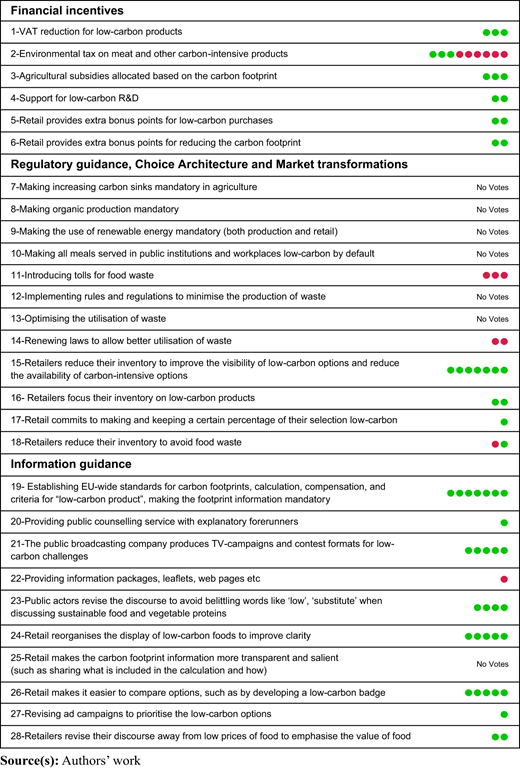
Workshop 3 involved the entire group at each location, beginning with a summary of the 28 ideas and expert feedback. Participants evaluated the ideas through rating it (see Table 2), and were introduced to the design students' illustrative posters after a lunch break. Finally, participants from the three cities connected online to collectively review the outcomes.
3.2 Methodology and data
Our methodology is based on co-design principles, where participants collaboratively reason situations and develop alternative courses of action through facilitation. The data encompasses both the documented phases and outcomes of the workshops, including conceived policy options and the ongoing interactions about these options. To capture these dynamics, we took field notes, recorded video and audio of the processes, as well as conducted participant interviews after each workshop.
The first round of interviews (n = 33) ranged from 33 to 82 min, while the second round (n = 21) lasted 27–88 min. These interviews aimed to gain insights into participants' experiences with low-carbon food actions and identify enablers and barriers to change. Although not centred on workshop experiences, they provided valuable data on interactions and participants' perspectives on food policy options. All interview materials were transcribed, and for this paper, we analysed transcripts related to two key questions: 1) the composition of workshop participants (Interview 1), and 2) reflections on the workshop structure and methods (Interview 2). We also included facilitators' personal experiences and post-workshop reflections. Four of the five authors facilitated all workshops across the three locations.
4. Results
This section presents workshop outcomes. In 4.1, we introduce the citizens’ ideas. These ideas represent tangible solutions and actionable proposals generated through the participatory process. Section 4.2 considers the experiences of citizens. It emphasises the importance of acknowledging non-visible outcomes, such as empowerment, shifts in attitudes or perspectives and learning new information (c.f. Yang and Pandey, 2011).
4.1 Citizen ideas as outcomes
Citizens proposed various ideas to promote sustainable food choices and reduce carbon footprints. These were documented on Post-it notes or elaborated in the recorded discussions. Suggestions included financial incentives like VAT reductions for low-carbon foods and taxes on carbon-intensive products, regulatory measures such as mandatory carbon sinks in agriculture, and banning meat advertisements. Retail-related ideas involved bonus systems for low-carbon purchases, reducing inventory, and increasing transparency about product footprints. Informational initiatives included standardising carbon footprint labels, launching TV campaigns to support attitude shifts, and providing in-store sustainability experts. Vegan options were also proposed to be reframed in other, more positive ways, rather than being the “alternative-to-meat.”
Table 2 includes participants' votes on 28 proposed measures using green dots (for support) and red dots (for opposition). Each participant was given two green and one red dot to use. The votes comprise all citizens from all three sites. The results suggest at least that the participants 1) were rather united, as there are only two ideas (2, 18) with both green and red dots; 2) recognised the role, but also the limits of their individual consumption choices, as they request both better information on (19, 24, 25, 26) and display (15,16,24) of low-carbon alternatives, while also suggesting that the retailers lower the inventories available for them to choose from (15,16,18); 3) self-censored some of the stringent ideas of regulation (2, 7–14), and; 4) recognised the aspects of language and the need of leadership by example.
The items in Table 2 result from prioritisation in small groups and represent strategic choices deemed feasible by citizens. The selection also reflects announcements around retailers' interest in the results and their role as an audience for the process. To consider the broader potential of citizens to ideate and engage in policies and political processes towards 1.5-degree lifestyles, it is important to consider the ideas that did not make it to Table 2. For example, ideas related to advertising were frequently present in the workshops, although only mentioned in one measure in Table 2 (27). Nevertheless, the results in Table 2 show that citizens recognise the role of cultural norms and social pressure as catalysts for change. Summing up, the preferred policy options aim to increase the visibility of more sustainable products, change the social norms to support low-carbon diets and attempt to alter the discourse around what is a default diet.
Our data are relatively silent on why participants selected measures proximate to their consumption practices. We suspect that the ways in which selection and ranking processes were performed with little reference to structural determinants of consumption contributed to the dominance of everyday food logistics, including the retail spaces and waste management. A strong consensus emerged on reducing retail inventory (15, 16, 18) to promote sustainable food choices. Other strategic proposals included implementing an earmarked meat tax (not selected for Table 2) and R&D support for the meat industry (4). Beyond the results of Table 2, citizens called for standard requirements for shops to create fair, competitive rules for industry players. These ideas reflect citizens' recognition of broader systemic changes needed to promote sustainability transitions in the food industry.
Demonstrating broader political agency, participants also suggested means for supporting democratic engagement, including food councils, citizen assemblies, public demonstrations and schooling of children. They also desired to alter the agendas of top-level politicians in the national parliament elections. Hence, it is evident that while citizens pay attention to everyday and practical aspects influencing their food consumption, they also consider broader societal impacts. These ideas were nevertheless not prioritised as the most important policy avenues.
4.2 Experiences and learnings of citizen participants
The workshops provided citizens with knowledge on low-carbon consumption and sustainable diets. The interview data indicates that participants learned about just transitions and actions aligned with 1.5-degree lifestyle targets. Activities like the climate puzzle helped them distinguish between high and low-impact food choices, and discussions with facilitators supported their learning.
The groups felt that they were relatively homogeneous in each location, but also recognised particular biases in each of the sites. In Helsinki, there was a broad consensus that participants were knowledgeable and committed practitioners of sustainable diets. A participant notes that “men are completely absent … it was a pity that we did not have stereotypical masculine meat-eaters” (Helsinki), whereas Mikkeli participants wished for the presence of more radical people and “some top-grade full-vegans” (Mikkeli) to challenge them. Reflecting on the process, we did not utilise this diversity between the groups as the parallel workshops ran independently of each other. Beyond these differences in the presence of transformative thinking, participants broadly recognised the bias towards the presence of middle-aged women. In individual interview responses, they also noted the absence of marginalised groups such as ethnic minorities, single-parent households, and disadvantaged actors in the food supply chain, such as farmers.
Despite such grievances, participants later reflected positively on these discussions, expressing surprise at the insights gained and their ability to collaborate despite differing views, pointing to their willingness to overcome disagreements in facilitated processes. A Helsinki participant states, “It’s a good thing to put different people to talk together about things. Like without it becoming a fight” (Helsinki). The Mikkeli group jointly summarised their experience at the end of workshop 2 by proudly stating that “If all the ideas were to be realised, things would be, like, really good” and reflects how the process might represent consensus even beyond the groups as “Since we had so many similar thoughts and though in similar ways, these ideas should be possible for Finns to realise in Finland” (Mikkeli Table 1 5:04).
The process was designed to support collective creativity and deliberation. Based on our field notes, there was little need for facilitators to guide the discussions, as participants were committed and had relevant knowledge to contribute, but nevertheless they clearly benefited from facts at points of uncertainty or disagreement. Interviewees noted that the group structure fostered cooperation, and discussions led to novel and fresh ideas, and indeed felt that they “were left with a feeling of inspiration” (Seinäjoki). In contrast to this, facilitators, however, observed that discussions often leaned towards reaching consensus rather than challenging or expanding ideas. Learning, reflection and collective sharing were more evident in participants' ability to conceive new practices that can support them in adapting their lifestyles to meet low-carbon transitions.
Participants appreciated having their voices heard, with their ideas being presented to policymakers, food producers, and retailers. However, they desired more direct and active interaction with food retailers to better understand their perspectives. Overall, participants were largely content with the process, interactions and learning.
Peer-to-peer learning was crucial for engagement, as it helped participants understand each other’s lifestyles, cultures, and challenges in making sustainable food choices. They actively shared tips and best practices in a WhatsApp group outside the workshops. Interviews revealed that this interaction fostered empathy and broadened their perspectives on diverse lifestyles and unsustainable food choices. We suggest that ongoing peer-to-peer interaction, both during and outside the workshops, provided personally relevant insights, maintained a commitment to the process, and facilitated finding common ground despite differing political views.
5. Discussion
Citizen participation is an end in itself, but it is also legitimate to ask whether and how such participation contributes to policy-making and, specifically, how to organise participation towards sustainability transitions. In the following, we discuss the findings in relation to the two research questions 1) How do citizens operationalise policy options for low-carbon diets? and 2) How do design-driven processes enhance deliberation in food governance?
5.1 Citizen perspective on food policy
Deliberation and organised participation aim to enhance citizens' capacities to participate in public decision-making (Cherry et al., 2021; Fung, 2015; Saarikoski et al., 2023). Citizens, as lay participants, draw from their everyday contexts and experiences (Lammi et al., 2013). They can, therefore, be expected to formulate food policies around concerns about retail practices, food waste, and consumption habits. These concerns often arise from issues directly impacting their everyday lives, making them relevant for citizens to address. However, deep-reaching social changes are likely to be more legitimate if citizens can recognise the systemic interdependencies within the food system and everyday practices.
This study confirms citizens' tendency to ideate within the proximate spaces of daily encounters, suggesting practical options that can be implemented in everyday life. Proposals included increasing the availability of low-carbon products, changing the narrative around these items, and addressing the lack of information on the carbon footprint of products. On the other hand, citizens' views extended into social structures, such as the choice architecture that guides their own behaviour in retail environments and advertising, and even into thinking about the schooling of children and the language as a common resource. Hence, citizen participation holds promise in maintaining the dimensionality of policy debates (Beck et al., 2021).
Figure 3 sums up the results of the studied workshops as the dimensions of ideation. The preferred policy options are directed to supporting innovation towards low-carbon diets in the supply chain, from agriculture to food processing and retail. More specifically, they entail changes in retail space and presentation of low-carbon options. Citizens also suggest policy measures directed to themselves, as economic agents, moved by financial incentives, or as decision-makers who require simple and clear information about low-carbon options. Relating to all actors and operations, they highlight the omnipresence of, and scrutiny toward, waste as a low-hanging fruit for improvement. Finally, as a fourth dimension of ideation, citizens recognise themselves and other societal actors sharing a common culture and language, which frames questions of proper diet, and impacts how low-carbon options are viewed collectively. Such broadness in the scope of issues and the available political means also signals that citizen participation may be critical to pursuing planetary diets rather than reducing the challenge to single parameters or policy options for sustainable diets.
 The Venn diagram shows a large circle labeled “Culture and Language” written along the top left edge. This circle includes two overlapping shaded circles; the top circle is labeled “Economic Agents” and the bottom circle is labeled “Waste.” The top circle contains two circles labeled “Financial Incentives” on the left and “Information” on the right. In the overlapping region of the two shaded circles, “Economic Agents” and “Waste,” a dark circle is present labeled “Citizen Ideation.” An anti-clockwise arrow emerges from “Citizen Ideation” and curves around “Financial Incentives” and “Information” above. From “Citizen Ideation,” two downward arrows point to two circles labeled “Supply Chain” on the left and “Retail Spaces” on the right, in the “Waste” shaded circle. Two lines extend from “Supply Chain” and connect to smaller circles below it labeled “Agriculture” on the left and “Food Processing” on the right.
Dimensions of citizen ideation. Source: Authors’ work
The Venn diagram shows a large circle labeled “Culture and Language” written along the top left edge. This circle includes two overlapping shaded circles; the top circle is labeled “Economic Agents” and the bottom circle is labeled “Waste.” The top circle contains two circles labeled “Financial Incentives” on the left and “Information” on the right. In the overlapping region of the two shaded circles, “Economic Agents” and “Waste,” a dark circle is present labeled “Citizen Ideation.” An anti-clockwise arrow emerges from “Citizen Ideation” and curves around “Financial Incentives” and “Information” above. From “Citizen Ideation,” two downward arrows point to two circles labeled “Supply Chain” on the left and “Retail Spaces” on the right, in the “Waste” shaded circle. Two lines extend from “Supply Chain” and connect to smaller circles below it labeled “Agriculture” on the left and “Food Processing” on the right.Dimensions of citizen ideation. Source: Authors’ work
Despite these broader views, the capacities of citizens do not always translate into ideas and lack concreteness, highlighting the need for further support and refinement to facilitate these translations. We also observed self-selection limiting the ideation space, likely due to the expected audience, such as food retailers in our case. However, in practice, participation needs a purpose and audience, and these choices will unavoidably direct the outcomes.
The workshop design used a typology of policies as a foundational structure. Even though these weren’t enforced, participants generated ideas in each category, from financial means to strict rules and nudging (c.f. Salo et al., 2023), demonstrating that citizens can relate to and conceive a broad range of policy options when supported. The outcomes also reflect citizens' inexperience in policy-making. For example, participants suggested outcomes such as the availability of seasonal food rather than means for such an end, thus by-passing an essential role of interaction in participation processes whereby the desired ends and the potential means can be connected. Inexperience is, nevertheless, also an asset for ideation and can help uncover structural barriers to sustainable diets: Novel ideas, such as the need to reduce food inventory in retail, may emerge because of being fresh in policy-making and speaking through less-invested positions. Another related policy-relevant outcome is that while information guidance and food labels are desired, their efficacy greatly depends on the design of retail spaces.
The workshops included only citizens as participants. Representatives from the ministry, retail, and food producers were listed as audiences but were only involved in the closing event. This differs from some basic premises of co-design as a collective process among different stakeholders (Marin et al., 2016), and was indeed one aspect that received negative feedback from participants. Hence, citizens appear to expect the presence of and interaction with key stakeholders when they enter a co-design or collaboration space. Conversely, participants also endorsed the ability to discuss and learn from peers. This aspect of trust and having equal terms in the discussions is easily compromised by the expert presence (Deetz, 2007). The relatively friendly atmosphere of the workshops distinguished the reported process from typical citizen engagement or consultation processes, which are often dominated by organised interests.
Integrating different forms of knowledge and combining citizens' lay knowledge with expert insights is suggested to support crafting inclusive policies (Fung, 2015; Pickering et al., 2022). A focus solely on citizens, as in this setup, raises questions about how to design processes that better integrate and bridge gaps between different forms of knowledge. Participatory processes should attempt to include and empower citizens to collaborate with other stakeholders and recognise citizens as experts in their own lives (Fung, 2015; Mulgan, 2006). For such purposes, the design of participation should draw on complementary strategies in collaborating with aligned and non-aligned stakeholders (Marin et al., 2016).
We conclude that, with relevant information and support, citizens have the capacity to participate in deliberation and policy ideation, reflect on their viewpoints, and adopt new knowledge. They resonate with and draw from a wide range of policy options. However, citizens cannot be expected to act alone, and stakeholder presence may better maintain citizen commitment. Moreover, workshop outcomes need development and call for governance structures to translate citizen ideas to influence policy directly and indirectly.
5.2 Contributions of design-driven approaches to citizen participation
This paper argues that design-driven approaches to citizen participation complement more established forms of participation, providing alternative spaces for citizens to engage. Concerning traditional modes of participation, design-driven workshops settle on a middle ground. They often draw from practice, and participants are allowed and expected to enter with their particular local and everyday contexts, impediments and motives for actions. However, they lack the practical toll of alternative food networks as participants are only required to elaborate on potential courses of action. On the other hand, they are distinct from social movements devising political programmes. Design-driven processes, which tend to be less formal, can thus balance the need for goal-oriented outcomes for public policy with the flexibility and creativity required to understand sustainability challenges (Lähteenoja, 2024).
The results from the workshops highlight the ability of citizens to discuss a wide range of challenges and generate ideas based on their everyday knowledge and experiences. An apparent challenge is that such a process produces unexpected outcomes that organisers might regard as off-track and irrelevant, particularly if the organisers enter the process with fixed aims and limited scope for action (c.f Beck et al., 2021). Hence, while an underlying policy process, predefined forms of output, or even expected specific outputs enhance the potential for impacts of citizen participation, the same aspects are likely to decrease the opportunities for open-ended participation of citizens.
Proper designs for citizen participation can extend the scope of such processes by engaging actors to make sense of ill-structured problems (Opazo et al., 2017) through a combination of knowledge exchange, deliberation, collective ideation and reflection (Sanders and Stappers, 2008). Such processes facilitate interactions by providing a structured framework while embracing open-ended objectives, freer contributions from citizens and the pursuit of collective benefits (Botero and Hyysalo, 2013). However, the open-endedness of the design approaches presents challenges in formal settings, especially for individuals unfamiliar with such methodologies or who might find it difficult to be spontaneous (Boon et al., 2018).
Our findings suggest that to engage citizens in a meaningful manner, it is crucial to design the logic of participation to foster learning and enhance participants' abilities to contribute. The significance of each can vary depending on the aim of the process and the actors involved. Furthermore, we contend that tolerance for and benefits from the differences in political discourse, modes of participation, and nature of output should be used as principles. Such tolerance starts from thinking of how participants are recruited and selected, includes ways in which different prompts and facilitation make room for different discourses, and extends to reporting outcomes in ways that fit the audiences.
Previous literature on citizen participation concentrates on democratic outcomes, with relatively little attention on tangible outcomes (Gaventa and Barrett, 2012). In contrast, design-driven approaches prioritise obtaining relevant input from citizens in advancing sustainability transitions, whether through technology development (Hyysalo et al., 2016) or local learning in peer-to-peer networks (Heiskanen et al., 2017). This shift acknowledges the differences in the reasons for citizen involvement, their contributions, and ways of learning rather than assuming predefined motives for citizen involvement, which solely rely on democratic justification. Following this logic, the ability to retain participants throughout the process can be regarded as a relevant outcome, providing insights into the priorities and motivations of citizens for their involvement and learning. Moreover, ensuring that citizens feel valued and trust such processes is crucial to their willingness to invest time in contributing to policy-making and, ultimately, to the democratic governance of sustainability transitions.
Our results align with the previous findings on the participation bias in open-ended citizen participation (Bobbio, 2019): those who are interested, who already possess knowledge and who have the resources to participate will do so. This sheds serious doubts on the sincere aims of design-driven approaches in delivering processes that support broad, constructive, emancipatory and creative processes of problem-solving. However, our results also show that participants are self-aware of this problem, potentially supporting attempts to represent divergent interests. Additionally, our results show very clearly that a workshop design with multiple locations can yield significant internal divergence in both prior knowledge and interests of the participants. We thus commend with Bobbio’s (2019) call for hybridised participatory efforts that involve participatory and deliberative settings, instead of viewing them as separate and alternative paths. We also add that participation should be designed to make use of the internal diversity of each process.
6. Conclusions
In this article, we have suggested reasons and demonstrated means for bringing citizens to actively participate in developing governance that would steer them towards low-carbon diets. Recruiting the participants proved challenging, raising the question of whether it is reasonable to expect citizens to participate in deliberations over such grand problems. While some, and in our case many, do join, it is reasonable to assume more interest in and facilitate discussions that are based on perceived local problems. The outcomes of the documented process nevertheless also include articulation of remote problems. Hence, citizens also relate to the ideas of sustainability transitions that extend from private local issues to public and future-oriented concerns.
We endorse the ability of informed citizens to cut across and combine different realms of policy-making and polity. Our workshops demonstrate a willingness among participants to learn and adopt new knowledge applicable to their everyday lives towards low-carbon transitions, and the ability to devise policies on a broad spectrum. Citizens can also articulate relevant challenges based on their tactic knowledge. However, their capacity to translate this knowledge into tangible policy ideas remains limited. Design-driven approaches promise to expand the scope of citizen involvement in the food system when properly supported through opportunities, structures, processes, and resources. With their flexibility, openness and creativity, these approaches enable broader inputs from citizens by tapping into the “unknowns” that may be influenced by cultural contexts, individual behaviours and everyday challenges.
Our research underscores the importance of documenting outcomes of citizen participation processes to further understand citizen contributions in policy-making processes. This includes the examination of the rationale, scope of participation of different actors, collaboration strategies, and integration of knowledge forms in relation to the specific contexts and the urgency of sustainability transitions.

