


Growing concern about sustainability has made green perceived value a key factor in food purchase decisions. This study aims to examine how consumers interpret extrinsic cues (packaging, certification, origin and price) to construct green perceived value. It compares the United States of America and Japan to explore how sociocultural contexts shape this decoding.
An exploratory, qualitative study was conducted through six focus groups in the United States of America and Japan. A choice task involving extra virgin olive oil elicited spontaneous evaluations. Data were analysed using inductive content analysis to identify key themes and cross-cultural patterns.
All four extrinsic attributes influenced sustainability perception, with packaging emerging as the most salient cue. Sustainability cues were multidimensional, simultaneously shaping perceptions of quality, safety and health alongside green value. Cultural differences influenced interpretation. Japanese consumers linked these cues to safety and risk avoidance, whereas USA consumers prioritised individual health benefits and expressed greater scepticism towards sustainability claims. Green perceived value is not a direct response to objective information but a complex construction in which environmental and functional values are interwoven. Marketing strategies should manage these cues holistically, aligning them with local sociocultural expectations.
This study integrates the stimulus–organism–response paradigm with cue utilisation theory to explain how inferential processes transform signals into green perceived value. By adopting a cross-cultural perspective, it advances understanding of the mechanisms shaping green perceived value and reconceptualises the role of attributes such as price in sustainability evaluations.
1. Introduction
Meeting global demand for agri-food products places considerable pressure on natural resources and leads to significant environmental impacts (Eldesouky et al., 2019; Bock and Meyerding, 2023; Groth et al., 2023). At the same time, rising consumer interest in sustainable consumption has the potential to drive meaningful transformations in the agri-food system (Bock and Meyerding, 2023; Valdelomar-Muñoz and Murgado-Armenteros, 2024). According to recent data, 63% of consumers have adopted modest to significant lifestyle changes to reduce their environmental impact (Simon-Kucher & Partners, 2021).
As Groth et al. (2023) note, consumers play a fundamental role in incentivising production shifts through their purchasing decisions, which can shape the sustainable characteristics of food products introduced to the market (Woo and Kim, 2019). Consequently, companies increasingly seek to differentiate their products by delivering added value. However, this requires a thorough understanding of consumer preferences and motivations to support informed decision making (Bukhari et al., 2023). In this context, growing attention has been paid to green perceived value as a determinant of purchase behaviour (Chen and Chang, 2012; Woo and Kim, 2019; Li and Li, 2024). Prior research shows that consumer attitudes are influenced by perceived individual value (Chen and Chang, 2012), suggesting that the perception of green attributes in food products may serve as a key incentive for environmentally concerned consumers.
In highly saturated agri-food markets, sustainability serves as a critical differentiator influencing product evaluation and purchase decisions, particularly among environmentally concerned consumer segments (Hoffmann et al., 2020; Woo and Kim, 2019). Drawing on behavioural frameworks such as the stimulus-organism-response (S-O-R) paradigm (Mehrabian and Russell, 1974), external stimuli, including sustainability cues, can activate internal cognitive evaluations at the organism level, such as green perceived value, which may in turn prompt behavioural responses. Recent evidence further indicates that specific product attributes—particularly those related to packaging—significantly shape consumer attitudes toward food products (Bukhari et al., 2023).
However, for agri-food products, sustainability is not directly observable and must be inferred from signals that consumers perceive on the product (Hallez et al., 2024; Mancini et al., 2017). According to cue utilisation theory (CUT) (Olson and Jacoby, 1972), when direct information is unavailable, consumers rely on external cues to infer latent attributes like sustainability. Extrinsic attributes—those unrelated to the product's physical composition but to surrounding information and presentation—therefore play a decisive role in shaping sustainability perceptions (Mancini et al., 2017; Hallez et al., 2024).
Although sustainability has become a strategic factor in food markets, limited understanding remains of how consumers cognitively construct sustainability from external cues present in products. In this regard, further research is needed to examine how inferential processes transform these signals into green perceived value, particularly from a cross-cultural perspective. This study responds to this need by proposing an integrative approach that combines a process-based framework with a cue-based inference theory, aiming to explain not only whether extrinsic attributes influence sustainability perception, but how they do so across different cultural contexts.
The influence of extrinsic attributes—particularly packaging, certification, origin and price—has been widely examined in relation to purchase intentions and consumer behaviour (Hoffmann et al., 2020). However, limited attention had been paid to the cognitive processes through which consumers decode these attributes as reliable sustainability signals. Greater understanding is needed of how such cues are interpreted, where knowledge gaps may arise, and how pre-existing cultural frameworks shape the construction of green perceived value (Groth et al., 2023; Meyerding and Trinh, 2025).
Furthermore, sustainability is a multidimensional construct encompassing environmental, social and economic dimensions (Groth et al., 2023). Yet research has predominantly focused on the environmental dimension, leaving underexplored how conventional extrinsic attributes signal social and economic aspects. For instance, price has largely been examined as a barrier to purchase rather than as a potential indicator of sustainability when interpreted through the lens of price fairness (Samoggia et al., 2021). Moreover, few studies have analysed these four attributes together to compare their relative influence and interrelationships (Samoggia et al., 2021; Groth et al., 2023; Dlamini et al., 2024; Meyerding and Trinh, 2025), and even fewer have adopted a cross-cultural approach (Meyerding and Trinh, 2025).
Crucially, food consumption is deeply embedded in sociocultural contexts, meaning that the interpretation of sustainability cues is culturally conditioned. The distinction between individualism and collectivism has been identified as a key driver of food-related decisions (Meyerding and Trinh, 2025). To address the limited research on how this cultural dimension moderates the formation of green perceived value in food choices, this study adopts a cross-cultural approach. Two distinct markets are examined: the United States of America and Japan, selected as representative contexts of Western individualism and Eastern collectivism, respectively.
Accordingly, the objective of this study is to analyse how consumers cognitively interpret four key extrinsic attributes—packaging, certification, origin and price—as sustainability cues, and how these interpretations influence sustainability perceptions and the formation of green perceived value. These cues operate as visual and cognitive signals that may shape how consumers evaluate the environmental, economic and social impact of food products, thereby encouraging or discouraging purchase decisions. To examine these dynamics, an exploratory and comparative study was conducted from the consumer perspective, taking into account sociocultural differences.
The remainder of the paper is organised as follows. Section 2 reviews the relevant literature and outlines the theoretical framework. Section 3 describes the methodology, including the research design and data collection and analysis procedures. Section 4 presents and discusses the results. Section 5 examines the theoretical and practical implications and outlines the study's limitations and avenues for future research. Section 6 concludes.
2. Literature review
This study is grounded in the stimulus–organism–response (S–O–R) paradigm (Mehrabian and Russell, 1974), which explains how marketing stimuli (S) trigger internal cognitive and affective processes (O), ultimately leading to evaluative and behavioural responses (R). Within this framework, CUT serves as the core mechanism for information processing, offering a robust theoretical basis for examining how consumers interpret and evaluate product-related cues.
2.1 The formation of green perceived value: an S-O-R and CUT framework
Perceived value has been defined as “the consumer's overall assessment of the utility of a product based on perceptions of what is received and what is given” (Zeithaml, 1988, p. 14). Building on this concept, and in response to increasing concern for environmental and ethical issues, the notion of green perceived value was introduced (Chen and Chang, 2012; Woo and Kim, 2019; Li and Li, 2024). It refers to the consumer's evaluation of the trade-off between the benefits obtained and the effort expended when purchasing a product, taking into account environmental concerns, sustainability expectations, and ecological commitment (Chen and Chang, 2012).
To assess green perceived value, consumers must first form a perception of the product's sustainability (Li and Li, 2024). However, sustainability is a latent attribute that cannot be directly observed, creating a perceptual gap that often leads to discrepancies between actual and perceived sustainability (Hallez et al., 2024). CUT (Olson and Jacoby, 1972) directly addresses this gap by proposing that when consumers lack direct information about hidden product attributes, they rely on external cues to infer their presence and meaning. This process unfolds in two stages: cue perception, whereby consumers interpret available signals, followed by cue evaluation, where these signals are assessed in relation to purchase decisions (Hallez et al., 2024). Extrinsic attributes therefore function as essential indicators through which consumers infer sustainability.
In this context, the S-O-R paradigm provides a useful conceptual framework for understanding how the external signals postulated by CUT serve as cues through which consumers infer product sustainability, thereby shaping green perceived value. The S-O-R paradigm offers the overarching processual structure of the model, while CUT specifies the inferential mechanism through which the stimulus (S) is interpreted. In this sense, extrinsic attributes operate as sustainability cues that activate consumers' interpretative processes. Specifically, S-O-R posits that the organism's internal evaluations and impressions, in this case green perceived value, are triggered by external stimuli, namely the product's extrinsic sustainability cues. These stimuli influence consumers' cognitive and affective assessments, which ultimately drive behavioural responses such as purchase decisions (Jacoby, 2002; Konuk, 2021). While Konuk (2021) successfully integrated S-O-R and CUT to examine the effect of intrinsic cues, such as taste, on perceived quality, the application of this integrated framework to sustainability perception and green perceived value within the food sector remains largely unexplored.
2.2 Extrinsic attributes as indicators of sustainability
Extrinsic attributes are those that can be modified without altering a product's physical composition (Hoffmann et al., 2020). In food products, cues conveyed through packaging—such as material, certification, origin and price—play a decisive role in signalling sustainability (Magnier et al., 2016). This influence stems both from the material's environmental implications and from visual and verbal elements (e.g. colours, labels, typography) that communicate sustainability claims.
In the context of food products, numerous studies have shown that extrinsic cues, particularly those conveyed through packaging, significantly shape consumers' perceptions of sustainability and overall product evaluation. These cues can communicate information about all three dimensions of sustainability: environmental, social, and economic.
Packaging material is often the most immediate environmental cue. Glass, metal and paper are typically perceived as more sustainable, whereas plastic is viewed as less sustainable (Bock and Meyerding, 2023; Groth et al., 2023; Hallez et al., 2024). However, these perceptions do not always correspond to a product's actual environmental impact. Because consumers seldom have access to detailed information, such as life cycle assessments or transport-related emissions, they often rely on intuitive judgements, which may not align with objective measures of sustainability.
Origin also serves as a highly influential cue, operating across both environmental and social dimensions. Environmentally, domestic origin is often associated with greater seasonality and a lower carbon footprint due to reduced transport distances and shorter supply chains, all of which contribute to a stronger perception of sustainability (Eldesouky et al., 2019; Groth et al., 2023). Socially, it serves as an indicator of support for national economies, further enhancing perceived sustainability (Erraach et al., 2021).
Sustainability certifications help to improve sustainability perceptions, functioning as explicit signals of ethical and social responsibility. However, their effectiveness is sometimes limited when consumers lack the time, knowledge, or trust to pay attention to them (Eldesouky et al., 2019; Groth et al., 2023). In this regard, Torres-Peña et al. (2025) argue that certifications can operate as heuristics that simplify consumer information processing, concluding that the number of certification logos and their recognisability tend to strengthen overall perceptions of a product's sustainability.
Price is an extrinsic cue associated with the economic and value dimensions of sustainability. It plays a dual role in sustainable food consumption. On one hand, price can act as a barrier to purchase, sometimes exerting greater influence on consumer decisions than sustainability-related attributes (Aschemann-Witzel and Zielke, 2017; Dlamini et al., 2024; Hallez et al., 2024). On the other hand, price does not always appear in the literature as a decisive factor (Bock and Meyerding, 2023). These inconsistencies can be explained by the notion of price fairness, meaning the extent to which consumers perceive a product's price as appropriate and justified (Samoggia et al., 2021). When consumers believe that a price premium reflects a company's sustainability efforts and higher production costs, and that it offers good value and added benefits in return (Nguyen and Klaus, 2013), they may be more willing to purchase the product. Thus, price can function as a positive signal of superior quality and ethical commitment, thereby enhancing the product's green perceived value (Del Prete and Samoggia, 2023).
2.3 Influence of individual and sociocultural factors
Both contextual and individual variables play a key role in shaping consumers' perceptions, attitudes, and intentions. In their study on food choices, Chen and Antonelli (2020) observed that, alongside product-related factors such as extrinsic attributes, it is also essential to examine the influence of individual factors—both personal and cognitive—as well as sociocultural factors. These variables can function as mediators or moderators in the evaluation of cues. Therefore, analysing their influence is crucial to understanding the variability in how consumers assess extrinsic attributes.
At the individual level, sociodemographic variables such as age, family situation, and income have been shown to influence how consumers perceive and prioritise extrinsic attributes (Blanco-Penedo et al., 2021; Majer et al., 2022). Cognitive factors, including environmental knowledge and concern, also affect the degree to which consumers value sustainability-related cues (Eldesouky et al., 2019; Bock and Meyerding, 2023; De Marchi et al., 2024; Meyerding and Trinh, 2025).
Sociocultural dimensions—such as ethnocentrism, collectivism and culinary tradition—further shape sustainability perceptions. Nonetheless, cross-cultural research remains limited (Lizcano-Prada et al., 2024; Meyerding and Trinh, 2025), underscoring the need for comparative analyses in diverse cultural contexts.
2.4 Exploratory conceptual model
This study examines how four key extrinsic attributes—packaging material, certification, origin, and price—shape consumers' perceptions of food sustainability and green perceived value. Special attention is paid to the dual role of price, both as a potential barrier and as an indicator of sustainability when perceived as fair. The study also examines the potential influence on the formation of green perceived value of sociocultural factors and individual factors—within the latter, both cognitive variables (particularly environmental concern) and sociodemographic characteristics (notably age and family situation). The proposed exploratory conceptual model (Figure 1) draws upon the S–O–R paradigm and CUT as its theoretical foundations.
 The conceptual model consists of three large rectangular boxes arranged horizontally from left to right, labeled “STIMULUS (S)”, “ORGANISM (O)”, and “RESPONSE (R)”. The first box labeled “STIMULUS (S)” on the left, under the header “Extrinsic cues”, contains four rectangular text boxes vertically stacked and arranged from top to bottom, labeled “Packaging”, “Certification”, “Origin”, and “Price”. A dashed arrow labeled “CUT” points from this box to the middle box. Below the “CUT” label, two vertical dashed lines descend to two rectangular boxes at the bottom: the one on the left is labeled “Individual”, and the one on the right is labeled “Sociocultural”. The middle box, labeled “ORGANISM (O)”, under the header “Internal evaluation”, contains a single rectangular text box labeled “Green perceived value”. A dashed arrow labeled “Decision” points from this box to the third box on the right. The third box, labeled “RESPONSE (R)”, under the header “Behavioural”, contains a single rectangular text box labeled “Sustainable purchase”.
Exploratory conceptual model. Source: Authors’ own work
The conceptual model consists of three large rectangular boxes arranged horizontally from left to right, labeled “STIMULUS (S)”, “ORGANISM (O)”, and “RESPONSE (R)”. The first box labeled “STIMULUS (S)” on the left, under the header “Extrinsic cues”, contains four rectangular text boxes vertically stacked and arranged from top to bottom, labeled “Packaging”, “Certification”, “Origin”, and “Price”. A dashed arrow labeled “CUT” points from this box to the middle box. Below the “CUT” label, two vertical dashed lines descend to two rectangular boxes at the bottom: the one on the left is labeled “Individual”, and the one on the right is labeled “Sociocultural”. The middle box, labeled “ORGANISM (O)”, under the header “Internal evaluation”, contains a single rectangular text box labeled “Green perceived value”. A dashed arrow labeled “Decision” points from this box to the third box on the right. The third box, labeled “RESPONSE (R)”, under the header “Behavioural”, contains a single rectangular text box labeled “Sustainable purchase”.Exploratory conceptual model. Source: Authors’ own work
3. Methodology
3.1 Research design
Given the exploratory nature of this research, a qualitative approach was adopted. This methodology is particularly suited to inductive, exploratory, and interpretive research questions (Murgado-Armenteros et al., 2012), as it enables an in-depth understanding of how and why individuals think in certain ways. Specifically, focus groups were employed, consistent with previous studies in this field (Oloyede and Lignou, 2021; Groth et al., 2023), as they are effective for identifying shared meanings and discourses. During each session, a choice task was incorporated in which participants were presented with different alternatives of the same product to explore the perceived influence of extrinsic attributes on sustainability perceptions.
Extra virgin olive oil (EVOO) was chosen as the case study. This decision was based on the product's strong symbolic, cultural and experiential dimensions, as well as the fact that its quality and sustainability cannot be directly assessed at the point of sale, thereby reinforcing the relevance of extrinsic cues in the purchase decision process (Delgado et al., 2013). Moreover, the increasing market presence of environmentally differentiated olive oils and the association of EVOO with environmental stewardship and traditional production methods (Ilak Peršurić and Težak Damijanic, 2021) make it an appropriate context for examining how consumers recognise, evaluate, and integrate these cues into their sustainability perceptions.
3.2 Study context and country selection
To analyse the influence of extrinsic attributes across distinct cultural frameworks, this study selected the United States of America (USA) and Japan. This selection is justified by their contrasting positions across key cultural dimensions that affect consumer behaviour and information processing.
When analysing sociocultural differences, one of the most widely used frameworks is Hofstede's model of cultural dimensions (Hofstede and Bond, 1984). While the distinction between individualism and collectivism is central, contrasting the USA focus on personal autonomy and egoistic values with the Japanese emphasis on group harmony and social norms, the cultural distance between these two nations extends to other critical dimensions (Huang et al., 2022).
Specifically, Japan and the USA exhibit significant differences in uncertainty avoidance. Japan's high uncertainty avoidance score reflects a strong societal preference for structure, strict standards, and risk avoidance, which in the food sector translates into a high demand for safety guarantees and trusted certifications. This pattern is consistent with recent findings in other high-avoidance and collectivistic cultures (Anwar et al., 2024), where food safety considerably impacted consumer engagement. In contrast, the lower uncertainty avoidance in the USA suggests a higher tolerance for ambiguity and openness to new product claims, though often accompanied by scepticism towards unverified corporate narratives (Liu et al., 2025). Furthermore, differences in long-term orientation influence how sustainability is framed: as a pragmatic investment in future generations (Japan) versus an immediate value proposition (USA). These cultural differences may shape how consumers interpret extrinsic product attributes as signals of sustainability.
Against this cultural backdrop, both countries represent emerging markets for olive oil, with the USA being the largest market outside the European Union (Roselli et al., 2016), and Japan the leading consumer in Asia (Capogna and Gómez, 2016). Selecting these emerging markets allows a clearer observation of how extrinsic attributes are evaluated, as it minimises the confounding influence of longstanding traditions and emotional attachments. In low-familiarity contexts, consumers are more likely to rely more heavily on extrinsic cues to form product perceptions, unlike those in traditional, high-familiarity markets (Bruwer and Buller, 2012; Rao and Monroe, 1988), where intrinsic cues tend to play a more prominent role. This choice also mitigates the powerful bias associated with consumer ethnocentrism and domestic product preferences typically found in traditional producing countries (Balabanis and Diamantopoulos, 2004), thereby helping to isolate the influence of the cues under investigation.
3.3 Participants
A total of six focus groups were conducted. To account for the potential influence of individual sociodemographic and cognitive factors, particularly the level of environmental involvement, three groups were organised in each country. One group consisted of participants with high environmental involvement (regardless of age or family status), while the remaining two groups included participants with medium-to-low involvement.
These latter groups were segmented based on the family life cycle to examine how purchasing motivations evolve from individual to family-oriented consumption at different life stages. Consequently, specific profiles were recruited: (1) young adults (25–35 years) without children, selected to represent independent consumption habits where purchasing decisions are primarily self-oriented; and (2) adults (30–55 years) living with a partner and children, selected to analyse the behaviour of consumers whose food choices are influenced by the health, well-being and budget of the family unit. The establishment of these profiles aimed to capture relevant differences in how sustainability cues are interpreted and evaluated at different stages of the family life cycle. Each focus group included six to seven participants, with balanced gender representation.
Participants were initially screened through a recruitment questionnaire that collected sociodemographic information and data on consumption habits, including olive oil consumption. The questionnaire also included a specific set of items designed to assess participants' level of environmental involvement. Based on their responses to questions regarding environmental concern and engagement in responsible practices, participants were classified according to their level of environmental involvement.
Participants were recruited from a consumer panel provided by a market research agency. Eligibility criteria required that participants were consumers of olive oil, had not taken part in previous focus groups, and did not know one another, in order to encourage spontaneous interaction and enhance the rigour and validity of the findings (Murgado-Armenteros et al., 2012). All participants provided written consent to participate in the sessions and to allow their responses to be recorded for later analysis. The data collection process was managed by a professional market research firm affiliated with ESOMAR (European Society for Opinion and Marketing Research), following its ethical guidelines. Participation was voluntary, and all focus group data were recorded, transcribed, and analysed in fully anonymised form.
3.4 Procedure and data collection
The focus group sessions were conducted between November and December 2024. To ensure linguistic accuracy and cultural sensitivity, sessions were held in the native language of each country (English in the USA and Japanese in Japan) and led by professional native moderators. This approach helped create a familiar environment for participants and enabled the moderators to capture implicit meanings, cultural references and idiomatic expressions that might otherwise have been lost, thereby facilitating spontaneous interaction.
Following an introductory briefing, each participant received a sheet displaying five different EVOO alternatives (Table 1). Participants were informed that the options were fictitious and not associated with any real brand, in order to avoid brand-related bias (Magnier et al., 2016). They were also told that all the oils were of the same variety (extra virgin) and container size (500 ml).
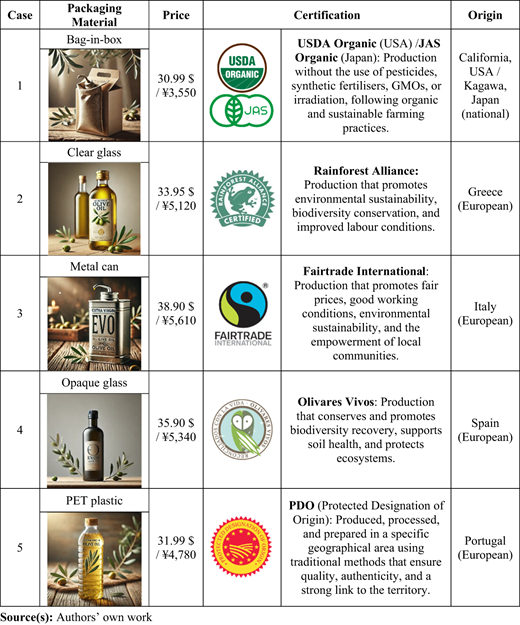
Packaging formats were designed to reflect materials commonly associated with sustainability in comparable products (Groth et al., 2023; Dlamini et al., 2024). Price ranges were established based on preliminary market research in each country, enabling analysis of consumers' willingness to pay and perceptions of price fairness. With regard to the origin attribute, and despite olive oil production being largely concentrated in Europe, a domestically produced EVOO option was included in both national samples to examine potential differences in perceptions relative to imported oils.
For the certification attribute, labels representing varying levels of national and international recognition were selected, each covering different dimensions of sustainability and environmental responsibility (Eldesouky et al., 2019; Groth et al., 2023). These included market-specific organic certifications (USDA Organic in the USA and JAS Organic in Japan), as well as Rainforest Alliance and Fairtrade International—two globally recognised certifications encompassing multiple sustainability dimensions such as environmental protection and fair trade. The Olivares Vivos label, specific to EVOO, certifies biodiversity restoration in olive groves; however, it is still relatively unknown in both markets due to its European origin. Finally, the PDO (Protected Designation of Origin) label certifies both geographical provenance and adherence to traditional production methods.
Participants were first given time to review the five options and individually select their preferred alternatives before beginning the group discussion, in order to minimise influence from early group opinion exchanges during the initial evaluation phase. Subsequently, participants shared and discussed their choices collectively, encouraging interaction and debate.
3.5 Data analysis
Each focus group lasted approximately 90 min and was audio-recorded, transcribed, and subsequently translated for analysis, using a qualitative content analysis following the multi-stage procedure outlined by Creswell (2009) and adapted by Nguyen et al. (2020), as illustrated in Figure 2.
 The flowchart consists of six rectangular boxes arranged in two rows, connected by thin arrows to show a sequential process. In the top row, the first box on the left is labeled “Raw data - transcripts”. An arrow points from this box to the middle box, which is labeled “Organising and preparing data for analysis”. An arrow from this box points to the third box on the right, labeled “Reading through all data”. An arrow extends from the bottom of this third box, drops down, and points back to the left to the first box of the second row. In the second row, the first box on the left is labeled “Coding the data (themes and descriptions)”. An arrow points from this box to the middle box, labeled “Interpreting themes and descriptions”. A final arrow from this box points to the third box on the right, labeled “Interpreting the meaning of themes and descriptions”.
Stages of the qualitative analysis. Source: Authors’ own work, adapted from Nguyen et al. (2020).
The flowchart consists of six rectangular boxes arranged in two rows, connected by thin arrows to show a sequential process. In the top row, the first box on the left is labeled “Raw data - transcripts”. An arrow points from this box to the middle box, which is labeled “Organising and preparing data for analysis”. An arrow from this box points to the third box on the right, labeled “Reading through all data”. An arrow extends from the bottom of this third box, drops down, and points back to the left to the first box of the second row. In the second row, the first box on the left is labeled “Coding the data (themes and descriptions)”. An arrow points from this box to the middle box, labeled “Interpreting themes and descriptions”. A final arrow from this box points to the third box on the right, labeled “Interpreting the meaning of themes and descriptions”.Stages of the qualitative analysis. Source: Authors’ own work, adapted from Nguyen et al. (2020).
A hybrid analytical approach was employed, combining both deductive and inductive reasoning (Hsieh and Shannon, 2005). Initially, a structured deductive framework was used, with the four extrinsic attributes from the choice task serving as the main organisational categories. This allowed for a systematic analysis of participant discussion surrounding each specific cue. Following this, a conventional inductive content analysis was applied within each main category to identify emergent themes and sub-themes reflecting participants' underlying perceptions, including sustainability and other themes associated with each attribute.
To ensure trustworthiness and rigour, two researchers independently coded the data. This process involved initial familiarisation with the transcripts, followed by open coding and the grouping of codes into potential themes (Braun and Clarke, 2006). The researchers then convened to compare findings, discuss discrepancies, and refine the final coding framework through consensus. This iterative process was repeated for both the USA and Japanese datasets, facilitating the identification of cross-cultural patterns. Coding and analysis continued until theoretical saturation was reached, at which point no new significant themes or perceptual nuances were emerging from the data (Saunders et al., 2018).
In line with the study's comparative approach, verbatim statements were coded and thematically organised according to each extrinsic attribute analysed. This process enabled the identification of discursive patterns and cross-country differences, as the objective of the analysis was to explore how interpretations of sustainability are collectively constructed within each cultural context. However, when relevant differences between the defined participant profiles were identified, these were analysed explicitly in the results section, thereby maintaining coherence with the methodological design while ensuring participant confidentiality.
4. Results
4.1 Packaging materials
After being presented with the five EVOO alternatives, packaging material consistently emerged as the most salient and influential indicator of sustainability across all focus groups. It was also the primary factor guiding product choice, although the underlying motivations and justifications varied across countries and participant profiles.
In both the USA and Japan, most participants selected one of the two glass bottle options as their preferred choice, as glass was widely perceived as the highest-quality and most sustainable material. However, sustainability was not the sole driver of this preference. Many participants—especially culinary enthusiasts—associated glass, particularly opaque or dark glass, with preserving flavour, freshness, and product integrity.
Among adults with children, especially in the USA, health-related concerns reinforced the preference for glass. Several participants referred to avoiding “nanoplastics” and expressed greater trust in glass packaging because it allowed them to see the contents, especially transparent glass. For these consumers, who demonstrate high concern for their family's healthy eating, packaging functioned not only as an environmental cue but also as a marker of health and safety.
Perceptions of other materials differed significantly between countries, illustrating how national traditions and cultural practices shape consumer judgements. Although metal cans are not as popular as glass, since they do not allow consumers to see the contents and can alter the flavour, in the USA they were considered sustainable, recyclable, reusable, and even traditional. In contrast, Japanese participants almost unanimously rejected them, arguing that they were not a sustainable option and that metal could compromise product quality and prevented visual inspection of the contents.
The bag-in-box format also revealed cross-cultural contrasts. In the USA, it was generally dismissed as impractical and environmentally harmful due to the presumed presence of plastic lining to prevent leaks. However, in Japan it was regarded as recyclable and therefore sustainable, comparable to common soy sauce containers. Consumers seem to be more familiar with these types of packaging, which they also consider beneficial to health as it better prevents “oxidation”.
Perceptions of PET plastic also varied across markets. In the USA, it was almost unanimously rejected. Participants deemed it the least environmentally friendly, not genuinely recyclable, and potentially damaging to product quality due to concerns about “nanoplastics”. Once again, perceptions of health and quality intersected with sustainability in preference formation. In Japan, however, attitudes toward PET plastic were less negative. Some participants, particularly adults with children, argued that plastic could be a better option, not only due to its practicality and durability but also for environmental reasons. This suggests a more established culture of plastic recycling and reuse in Japan. For some participants—especially those with children, who are more price-sensitive—plastic was considered a sustainable, affordable, and convenient alternative.
To summarise, Table 2 presents the main findings regarding the perceptions associated with the different packaging materials, organized by theme and country.
Perceptions associated with packaging material
| Material | Theme | Perceptions | |
|---|---|---|---|
| USA | Japan | ||
| Glass | Sustainability | Recycling/reusability potential | Recycling/reusability potential |
| “(…) for recycling, I tend to buy glass containers” | “(…) the fact that it’s glass makes it recyclable.” | ||
| Environmental impact | Environmental impact | ||
| “It's better for the environment.” | “In terms of sustainability (…), glass seems like a better option to me.” | ||
| Food safety and quality | Quality preservation | Quality preservation | |
| “It helps to preserve the oil and the nutrients in it.” | “Glass doesn't dissolve in oil, so I chose 4 as the best.” | ||
| Storage (opaque glass) | Storage (opaque glass) | ||
| “(…) sunlight can affect the oil, so I don't want anything to get into it.” | “The main reason is that the container blocks sunlight, which prevents degradation.” | ||
| Ability to see the product (clear glass) | |||
| “I like to see what I'm buying.” | |||
| Aspect | Premium (opaque glass) | ||
| “I think it has a more premium feel.” | |||
| Familiar (clear glass) | |||
| “(…) it's simply familiar” | |||
| Bag-in-box | Sustainability | Environmental impact | Recycling/reusability potential |
| “It would be like a paper bag that just absorbs the oil. It needs a really thick plastic layer inside.” | “(…) it would be easy to dispose of and is probably the best option.” | ||
| Food safety and quality | Quality preservation | ||
| “I think it could shrink as the content decreases, protecting the product from oxidation.” | |||
| Aspect | Familiar | ||
| “(…) it's like a soy sauce container” | |||
| Metal can | Sustainability | Recycling/reusability potential | Environmental impact |
| “I think it's easier to recycle so they can fix it, repair any dents, and then bring it back and refill it.” | “I just couldn't picture how that would work [for the environment] if it was made of metal, so I ruled it out.” | ||
| Food safety and quality | Quality preservation | Quality preservation | |
| “I would be concerned that, if it was in metal, the metal would transfer.” | “I was worried that substances might leach from the metal.” | ||
| Ability to see the product | Ability to see the product | ||
| “(…) the fact that you can't see how much you have left in the can. So, for me, that would not work.” | “(…), if the content changes colour, you might not notice it, as its not transparent.” | ||
| Aspect | Traditional | ||
| “It's ‘old school’. I think it's how olive oil was bought in the olden days.” | |||
| PET plastic | Sustainability | Environmental impact | Recycling/reusability potential |
| “(…) I also think about nanoplastics, and I want to reduce my consumption of them.” | “(…) plastic and bag containers (whether paper or otherwise) can be recycled later.” | ||
| Food safety and quality | Quality preservation | Quality preservation | |
| “(…) plastic leaks all those pesticides and stuff into the oil.” | “There's also the problem of microplastic leaching.” | ||
| Ability to see the product | |||
| “I like that I can see inside [numbers] 2 [clear glass] and 5 [PET plastic], which are transparent.” | |||
| Aspect | Durable | ||
| “I prefer plastic containers. With glass, there is a risk of it falling, which is dangerous.” | |||
4.2 Certifications
Certifications were identified as the second most influential attribute in shaping sustainability perceptions and product preferences. They were viewed as a guarantee of a company's ethical and sustainable practices—particularly among participants with high environmental concern, and to a lesser extent among younger consumers.
Two key themes emerged from the discussions. First, knowledge of a certification plays a decisive role. Certifications attracted attention primarily because their meanings were described in the choice task. Many reported that if they did not recognise or understand a label, they would disregard it in purchasing decisions, limiting its influence as a sustainability cue: “If I understand what it means, I'm more likely to choose it. I usually base my choices on symbols I recognise. Knowing the meaning helps me to consider it as part of my selection criteria.”
Second, trust in the certification system was essential. Even when recognised, a label only affected sustainability perceptions or choices if participants believed in the credibility of the certifying body and its monitoring practices.
Although the organic certification (USDA in the USA and JAS in Japan) was the most widely recognised, its effects on sustainability perception and product preference differed sharply across countries. In Japan, the JAS label was one of the most highly valued. It was seen to certify “additive-free ingredients”, absence of “pesticides and genetically modified ingredients”, and no “chemical fertilisers”—attributes appreciated both for health and environmental benefits. Strong trust in the label was also expressed, based on perceptions of Japan's “strict” and “thorough” standards.
By contrast, perceptions of the USDA label in the USA were overwhelmingly negative. Participants described it as “questionable”, “kind of a scam”, “for sale” or “a fake label in this country”, referring to reported cases of misuse and perceived weak enforcement standards. Some also questioned the assumption that “organic” necessarily implies health or environmental benefits.
The Rainforest Alliance and Fairtrade labels attracted attention from several participants, particularly in the USA, where they are more widely known and influential. Their dual focus on sustainability and fair trade was especially appealing, suggesting that participants valued social dimensions such as local community empowerment. Trust in these labels was relatively high in both countries, as they were associated with credible international institutions.
Although the Olivares Vivos label was unfamiliar in both countries, it was one of the certifications that most captured participants' attention and influenced preferences after they read its description. This finding underscores the importance of consumers' knowledge of certifications in shaping their decisions. Several participants highlighted that its specific focus on a single aspect of environmental care—biodiversity restoration—distinguished it from other certifications, which were perceived as broader or more general in scope.
Finally, the PDO certification was more relevant among well-informed USA participants who often sought products from specific regions or countries. However, it had very limited recognition in Japan. Moreover, its emphasis on provenance and traditional production was not associated with sustainability. Participants also noted that its design failed to visually communicate a link with nature, unlike other logos whose shapes and colours evoked environmental care, suggesting that graphic elements also influence sustainability perceptions.
Table 3 presents participants' key perceptions concerning the various certifications, highlighting the emergent themes and the differences observed between countries.
Perceptions associated with certifications
| Certification | Theme | Perceptions | |
|---|---|---|---|
| USA | Japan | ||
| Organic | Sustainability | Environmental (medium) | Environmental (high) |
| “(…) it just means they use natural pesticides instead of synthetic ones, and in many ways synthetic pesticides work better.” | “It focuses on sustainability by avoiding dependence on chemical fertilisers and preserving the natural environment.” | ||
| Credibility | Low credibility | High credibility | |
| “(…) USDA Organic failed us two years ago when they approved products without really defining who can use the label.” | “I usually check for JAS standards when I look at Japanese products.” | ||
| Rainforest | Sustainability | Environmental (high) | Environmental (high) |
| “I appreciate the fact that this company highlights that it’s going to promote biodiversity in those areas.” | “(…) they give the impression of being environmentally friendly” | ||
| Social (high) | Social (high) | ||
| “I like what it represents when it talks about better working conditions.” | “I feel better using products that are made properly and pay fair wages.” | ||
| Credibility | High credibility | High credibility | |
| “I think Rainforest Alliance is a legitimate company.” | “I think it's a reliable and good brand.” | ||
| Fairtrade | Sustainability | Social (high) | Social (high) |
| “(…) it's really important to support farmers, or at least the community.” | “Ensuring adequate remuneration for producers means they can continue their farming activities properly.” | ||
| Credibility | High credibility | High credibility | |
| “(…) with the UN, fair trade is a really important issue for them, so it's not something you can use unless there really is fair trade behind it..” | “I think the Fairtrade seal in the middle looks reliable. The text is clear and the icon is simple.” | ||
| Olivares Vivos | Sustainability | Environmental (high) | Environmental (high) |
| “I actually like what it says more than any of the others, like promoting and conserving biodiversity, improving soil health and conserving the ecosystem.” | “The idea of preserving ecosystems also seemed very attractive to me.” | ||
| Credibility | High credibility | High credibility | |
| “(…) I really like it because it's not as broad as the others, which are good for promoting fair prices or environmental sustainability, but they're too general for me.” | “(…) it gave me the impression that it is made in a proper environment with safe materials.” | ||
| PDO | Sustainability | Environmental (low) | Environmental (low) |
| “(…) the company just … seems to be saying, we care more about the product and the product quality itself; we don't care about anything else.” | “(…) the colours are really striking. At first glance, it doesn't make me think it's environmentally friendly.” | ||
| Credibility | High credibility | ||
| “(…) unless I see this stamp, I'm not sure if it is actually from there or if it's something made up.” | |||
4.3 Price
Price analysis revealed an interesting duality. While a higher price could act as a barrier, particularly among less environmentally aware participants, it also functioned as a strong indicator of sustainability and quality, aligning with the concept of a fair price. However, differences were observed between countries.
In the USA, the barrier effect of price was relatively limited. Within a reasonable range, most participants were willing to pay more if the product offered added value, prioritising attributes such as packaging, quality, nutritional value, and even environmental impact. Thus, price acted as a signal not only of quality but also of sustainability, particularly among younger and more environmentally committed consumers.
In Japan, some participants—especially younger ones and those with high environmental concern—also prioritised attributes such as packaging, origin, or production methods over price. However, for adults with children, price was a decisive factor, suggesting it can be a barrier for certain consumer segments. Additionally, although Japanese participants considered price an indicator of quality and “safety,” it did not appear to serve as a cue for sustainability.
Table 4 presents participants' core perceptions regarding price levels, providing a comparative overview that highlights convergences and divergences in their interpretations.
Perceptions associated with price
| Price | Theme | Perceptions | |
|---|---|---|---|
| USA | Japan | ||
| High | Sustainability | Price fairness | |
| “(…) I don't think I'd mind paying a bit more if I know they're supporting the environment and have good working conditions.” | |||
| Quality | High quality | High quality | |
| “It's a good price for Italian olive oil (…) there are things I can buy cheaply, but there are others I can't. And if it's good, it's good, and I pay what I have to pay.” | “(…) if you get good value for what you pay, then example 3 is worthwhile.” | ||
| Barrier | Low barrier | High barrier | |
| “I'm not rich, but when I'm shopping, when I'm buying olive oils, $30, $35, $38, these aren't huge differences. (…). So I don't care about the price at all.” | “It has the most reasonable price [Option 1], but even so, it seems out of reach for everyday shopping.” | ||
| Low | Price sensitivity | Saving money | |
| “If the quantity is the same across these five options, I'd probably choose the cheapest.” | |||
4.4 Origin
Country of origin primarily influenced perceptions of quality and, to a lesser extent, sustainability. In the USA, many participants across groups stated that knowing where the EVOO came from was important to them, particularly valuing oils from Mediterranean countries due to their higher perceived quality. None expressed a preference for EVOO produced in the USA.
This contrasted sharply with Japan. Although Japanese participants recognised the high quality of European EVOO, most preferred domestic products. Two key reasons emerged. First, there was a strong intention to support domestic production, reflecting a commitment to the economic and social dimensions of sustainability. Second, many participants, particularly those in the group of adults with children, preferred national products because they associated them with higher levels of trust and food safety compared with foreign products.
Table 5 summarises participants' main perceptions regarding product origin, presenting a comparative synthesis of the findings by theme and country.
Perceptions associated with origin
| Origin | Theme | Perceptions | |
|---|---|---|---|
| USA | Japan | ||
| Domestic | Sustainability | Social | |
| “I feel the same way: I want to buy and support products made in Japan.” | |||
| Quality | Low quality | High quality | |
| “I'd feel more comfortable buying it from a brand that gets its olives from these [European] countries, rather than from a country where they're not originally grown.” | “I believe that nationally produced ones are preferable.” | ||
| Food safety | |||
| “(…) there are certain hygiene standards that Japanese products exceed compared to foreign ones.” | |||
| Foreign (European) | Quality | High quality | High quality |
| “First of all, it's Italian. (…) When I choose my olive oils, I prefer where they come from because of the flavour.” | “(…) in places like Spain or Italy, olive oil is widely used. So, in that sense, I considered those countries [as a sign of quality].” | ||
5. Discussion
This study aimed to examine whether extrinsic food attributes displayed on product packaging—namely packaging material, origin, certification, and price—influence consumers' perception of sustainability, and whether this perception translates into a perceived green value that, in turn, shapes purchase intentions. To this end, an exploratory cross-cultural study was conducted in two countries with distinct sociocultural profiles: the USA and Japan.
Overall, participants' discourse revealed that all four attributes affected perceptions of product sustainability, although the strength and direction of these effects varied between countries, particularly in the case of origin and price. In addition, perceived green value—alongside other perceived values such as quality, nutritional content, and food safety—emerged as a key factor influencing consumer preferences and purchase intentions.
5.1 Packaging as the most salient sustainability cue
Packaging material emerged as the most influential attribute shaping perceptions of product sustainability, which aligns with previous research highlighting the strong visual salience of packaging at the point of purchase (El Oraiby and Kiygi-Calli, 2024). Consistent with earlier studies (Bock and Meyerding, 2023; Groth et al., 2023; Dlamini et al., 2024; Hallez et al., 2024), glass—whether transparent or opaque—was perceived as the most sustainable option and was the material that most strongly influenced consumer preference. While this preference was largely driven by perceptions of environmental friendliness, other determinants were also evident, such as higher levels of food safety, nutritional preservation, and overall quality (in the case of opaque glass) or greater trust due to product visibility (in the case of transparent glass). Thus, the same cues that serve as sustainability indicators can simultaneously operate as signals of quality and healthfulness, reinforcing findings from previous research (Hallez et al., 2024). In particular, consumers with children tended to place greater emphasis on nutritional value and food safety, showing slightly lower sensitivity to sustainability cues than younger and more environmentally engaged consumers—an observation consistent with Blanco-Penedo et al. (2021).
Other packaging formats, such as metal cans and bag-in-box systems, were also perceived as sustainable in some cases; however, these perceptions varied notably between the two countries. As highlighted by Lizcano-Prada et al. (2024) and Meyerding and Trinh (2025), sustainability perceptions are strongly shaped by cultural differences, consumer experience, and market traditions.
However, as noted by Bock and Meyerding (2023), Groth et al. (2023), and Dlamini et al. (2024), a general lack of knowledge leads many consumers to underestimate the environmental impact of glass relative to plastic. Numerous studies emphasise that the sustainability of packaging materials must be assessed across the entire product life cycle, including factors such as transport weight, an aspect that virtually none of the participants considered when forming their evaluations. As De Marchi et al. (2024) also observed, consumer knowledge must be carefully taken into account when designing strategies to promote sustainable food consumption, as these strategies are likely to be less effective if consumers are unable to recognise and accurately assess companies' sustainability efforts.
5.2 Certifications: the role of knowledge and trust
Product certifications also proved to be highly relevant in evaluating sustainability. Participants expressed particular interest in certifications that addressed specific, tangible environmental issues, such as biodiversity restoration, rather than those perceived as more generic, echoing findings by Meyerding and Trinh (2025). Labels that integrated social dimensions of sustainability alongside environmental ones also tended to have a stronger impact, consistent with prior evidence of consumers' growing concern for corporate social ethics (Blanco-Penedo et al., 2021; Eldesouky et al., 2019).
However, participants acknowledged that, in real purchasing situations, they would rarely stop to read certification labels unless they were already familiar with them. As shown in previous research (Eldesouky et al., 2019; Groth et al., 2023), prior knowledge and familiarity are decisive in determining how consumers evaluate certifications as sustainability indicators. Yet even when a certification is recognised, it may still fail to enhance perceived sustainability if it lacks credibility or consumer trust (Majer et al., 2022; Cao and Zhang, 2024). Therefore, as Torres-Peña et al. (2025) suggest, for certifications to function effectively as heuristics that allow consumers to infer product sustainability quickly and reliably, both awareness of and confidence in the label must be established.
5.3 The importance of domestic origin
Consistent with previous studies (Bock and Meyerding, 2023; Groth et al., 2023; Dlamini et al., 2024), product origin was perceived as a sustainability attribute only when the product was domestically produced.
This pattern was particularly evident in Japan. Although Japan is still an emerging producer of olive oil, consumers strongly associate domestic oils with quality, trust, and sustainability. In their discussions, they referenced growing regions such as Kagawa, where production has expanded markedly in recent years, as well as their interest in supporting domestic producers. This tendency may be partly explained by the higher levels of collectivism in Japanese culture, an element shown to be important in preferences for domestic products from a sustainability perspective (e.g. Johnston et al., 2023). Furthermore, as Onozaka et al. (2023) point out, domestic origin is associated not only with greater product sustainability but also with other quality-related perceptions, such as freshness and food safety. In this sense, the strong importance placed by Japanese consumers on food safety and national production standards may also influence their preference for domestic EVOO beyond perceptions of sustainability. In this context—where national food production is culturally salient and consumption patterns are tightly linked to identity—domestic origin can operate as a multidimensional sustainability and quality cue, encompassing social (support for domestic producers) and symbolic (authenticity, quality, and safety) dimensions.
In the USA, however, origin functioned only as a cue for quality rather than sustainability. In contrast to collectivistic contexts, individualistic cultures tend to prioritise functional product attributes over considerations of collective well-being. Accordingly, USA consumers associated foreign origin, especially from Mediterranean countries, with higher quality. The relatively weak presence of domestic olive oil production in the USA market may also play a role, limiting the symbolic or sustainability-related meaning attached to domestic products. This is consistent with Erraach et al. (2021), who argue that in countries with limited domestic production, foreign origin tends to signal quality, whereas domestic origin serves as a sustainability cue only where production is well established.
5.4 Price as indicator and barrier
Price was examined in this study as a dual construct: on the one hand, as an indicator of sustainability when perceived as fair, and on the other, as a barrier when consumers are unwilling to pay a premium. Participant narratives reflected both roles. In the USA, particularly among younger consumers and those more engaged with sustainability, price was sometimes interpreted as a signal of a company's sustainability efforts and higher product quality, which in turn increased willingness to pay. In contrast, in Japan, price was predominantly viewed as a barrier. Although sustainability attributes were valued, many participants opted for the lower-priced option as long as it met acceptable quality standards. While higher environmental concern generally increases willingness to pay, as reported in previous studies (Blanco-Penedo et al., 2021), household circumstances—especially among participants with children—reinforced the constraining effect of price, in line with Aschemann-Witzel and Zielke's (2017) observations.
6. Implications
6.1 Theoretical implications
This study offers three key contributions to the agri-food marketing literature. First, it advances the theoretical integration of the stimulus-organism-response (S-O-R) paradigm with cue utilisation theory (CUT) in the context of sustainability in food choices. By positioning CUT as the decoding mechanism connecting the “stimulus” and “organism” phases of the S-O-R framework, this research elucidates the intermediate cognitive process through which extrinsic attributes (stimuli) are interpreted to build green perceived value (organism) before the purchase decision (response) is made. While previous research has largely focused on how extrinsic attributes influence purchase intention directly, this work highlights how sustainability cues enhance the product's value proposition through the formation of green perceived value. The findings confirm that extrinsic product attributes serve as meaningful cues that shape how consumers evaluate food products, reinforcing perceptions of sustainability and guiding choice preferences.
Crucially, the results reveal that sustainability is not evaluated in isolation. Rather, extrinsic attributes operate as multifunctional cues: the decoding process extends beyond environmental assessment and occurs concurrently with the evaluation of quality, safety and health. Consequently, green perceived value is not formed independently but is interwoven with other perceived values. This suggests that, in this context, the “organism” phase involves a holistic integration in which sustainability contributes to the overall value proposition rather than competing with functional benefits.
Second, the study challenges the traditional view of price solely as a monetary sacrifice. By integrating the perspective of price fairness, the findings demonstrate that price can function as a positive indicator of sustainability, signalling ethical labour practices and fair compensation. This expands the theoretical understanding of price as a multidimensional cue that contributes simultaneously to the economic and ethical evaluation of the product. However, whether this role translates into a positive evaluation largely depends on consumers' willingness to pay a premium for this attribute.
Third, the research contributes to the limited body of cross-cultural studies (Meyerding and Trinh, 2025) by demonstrating that the interpretation of extrinsic cues is not universal but culturally moderated. The contrast between the USA and Japan highlights how sociocultural factors, such as collectivism versus individualism, uncertainty avoidance and long-term orientation, act as interpretative filters that shape the meaning attributed to standard cues (e.g. the perception of paper versus metal packaging or the credibility of organic labels).
6.2 Practical implications
The results offer several managerial insights for the food industry, highlighting the importance of integrating communication strategies and packaging design elements that make firms' sustainability commitments visible, and emphasising the need to manage product cues holistically.
First, the marked influence of packaging material on sustainability perceptions demonstrates that packaging must be understood as a multidimensional communication tool. Managers should not view sustainability as a separate attribute to be “added on”, but as a characteristic embedded within cues that also signal quality and safety. For instance, when choosing glass packaging, a brand simultaneously signals premium quality, chemical safety, and environmental care.
Second, the clear need to educate consumers suggests that companies should adopt a more proactive approach in communicating the environmental impact of their packaging systems, going beyond recyclability or biodegradability to include life-cycle aspects such as transportation and storage, doing so would enable consumers to better recognise and accurately evaluate the most sustainable options, and to fairly assess firms' sustainability efforts.
Additionally, the cultural differences observed in this study indicate that such communication strategies should be adapted to national contexts rather than generalised across global markets. In the Japanese market, communication strategies should emphasise the intersection of sustainability, food safety and domestic support, aligning with the culture's high uncertainty avoidance and collectivism. Given the high level of trust in national standards, the use of recognised local certifications (such as JAS) and the highlighting of safety attributes are likely to enhance green perceived value. In the USA market, by contrast, strategies should focus on transparency and storytelling. Since generic labels such as USDA Organic may face scepticism, brands should emphasise specific and credible third-party certifications that communicate a clear ethical narrative.
Furthermore, packaging materials should be adapted to each market context to leverage their influence as sustainability and quality cues. For instance, metal packaging may be less effective in Japan due to its association with hidden content, which conflicts with the preference for visual verification typical of high uncertainty avoidance contexts. Conversely, opaque glass packaging may be particularly effective in signalling premium status in the USA, where higher prices can be justified if framed within a narrative of superior quality, fairness and community support.
Finally, findings related to certifications have important implications for both public authorities and private certification bodies. The effectiveness of certification labels as sustainability cues depends fundamentally on consumers' prior knowledge and trust. This underscores the need for continued collaborative efforts to increase their visibility and credibility through clear and transparent communication of their criteria and value. In this way, certifications can become reliable heuristics—mental shortcuts that consumers can confidently use in purchasing decisions—reinforcing their role as meaningful indicators of sustainability.
6.3 Limitations and future research
Although this study provides meaningful insights into how extrinsic food attributes shape sustainability perceptions and consumer preferences, several limitations must be acknowledged. First, its qualitative design implies that the findings should be interpreted as exploratory rather than generalisable. Future research could build upon these results by employing quantitative methods to test the proposed conceptual model and to identify consumer segments based on the value they assign to extrinsic attributes as sustainability cues. Such evidence would support the design of more targeted and effective strategies for promoting sustainable food consumption.
Second, the exploratory analysis revealed significant differences across countries and consumer groups, underscoring the influence of sociocultural and individual factors. To advance understanding in this area, future studies should widen the geographical scope to include more countries with diverse cultural traditions and consumption values. Additionally, it would be useful to explore the influence of other individual variables—such as gender, income level, or sustainability knowledge—to better understand how these factors contribute to the formation of sustainability perceptions.
Finally, this research focused on a single product category. While the findings contribute to broader debates on food sustainability perception, participants' responses were also shaped by product-specific characteristics. Future research should therefore examine other food categories to determine the extent to which product type affects how extrinsic attributes are interpreted as indicators of sustainability.
7. Conclusions
Overall, the findings advance understanding of sustainable food consumption by extending the application of the stimulus-organism-response (S-O-R) paradigm and cue utilisation theory (CUT) to explain how consumers perceive sustainability through extrinsic cues presented on food product packaging. The study shows that the formation of green perceived value is not a direct response to objective sustainability information, but a complex cognitive process in which extrinsic attributes (stimuli) are decoded through personal and cultural filters. Specifically, the findings suggest that sustainability cues are inherently multidimensional. Consumers do not evaluate sustainability in isolation; rather, extrinsic attributes simultaneously operate as signals of health, food safety and superior quality. This implies that the perception of a product's greenness is closely linked to its perceived functional and personal benefits.
Furthermore, the study highlights a notable dissonance between technical sustainability knowledge (e.g. life cycle assessment) and perceived sustainability. Consumers appear to rely heavily on intuitive heuristics, such as existing associations with glass packaging or the visual appeal of certification logos, which may lead to misconceptions about the environmental impact of different packaging materials. This gap suggests that, without greater consumer awareness, green purchasing behaviour may be influenced as much by symbolic or aesthetic cues as by objective environmental considerations.
Ultimately, the transition towards more sustainable food consumption depends, in part, on how consumers interpret the signals conveyed by products. The findings indicate that although extrinsic attributes can function as important determinants of sustainability perception, their interpretation remains subjective and culturally conditioned. Rather than reflecting a universal prototype of a sustainable product, sustainability perceptions appear to be constructed through the lens of local values, trust systems and individual needs. Consequently, for a product to be perceived as having high green value, managers must ensure that extrinsic cues communicate environmental benefits while aligning with consumer expectations regarding health, quality and safety within specific cultural contexts.

