The purpose of this paper is to assess the effect of co-worker support on horizontal knowledge withholding and voluntary turnover intention among IT specialists. The study also explores the mediating role of affective organizational commitment.
The data are drawn from 118 IT specialists from a Polish software company. The model is tested through partial least squares path modeling.
The results revealed that the negative effect of co-worker support on voluntary turnover intention is fully mediated by organizational affective commitment. Contrary to expectations, co-worker support is not significantly negatively related to horizontal knowledge withholding.
The cross-sectional data, self-reports and small sample size are limitations of this study. The respondents were a relatively homogenous group of employees, so the generalizability of results to other employees and industries is limited.
To increase affective organizational commitment and reduce voluntary turnover intention among IT specialists, managers should create the conditions to enhance co-worker support.
This research clarifies the role of affective organizational commitment, which has proven to be a bridge linking co-worker support and voluntary turnover intention. Moreover, this research investigates the previously unexplored effect of co-worker support on horizontal knowledge withholding.
1. Introduction
Working for a software company has unique characteristics that can be challenging for its IT specialists. This work is usually related to the implementation of complex projects (Sang Long et al., 2017) and close cooperation with clients (Segelod and Jordan, 2004). Working to tight schedules and deadlines, pressure to release software in faster cycles and, consequently, long working hours and working on holidays are typical of working in a software company and might be a source of stress for employees (Sahni, 2016). Moreover, the implementation of complex IT projects requires highly specialized knowledge. A number of professionals, including business analysts, project managers, developers and quality assurance engineers, are usually involved in software development (Sahni, 2016). Therefore, the success of software development depends heavily on collaboration and knowledge sharing among team members (Vasanthapriyan et al., 2017). In such working conditions, it is important that employees can count on support from co-workers, which will facilitate their functioning and coping with job demands. This study investigates whether co-worker support might decrease withdrawal behaviors at workplaces among IT specialists. Withdrawal behaviors are defined as “a set of negative behaviors that employees enact to avoid work tasks under dissatisfying organizational situations” (Qian et al., 2020, p. 3). In particular, this study focused on two withdrawal behaviors that are highly important for projects implementation by a software company: knowledge withholding and employees' turnover intention.
Perceived co-worker support (PCS) is defined as employees' beliefs about the extent to which co-workers provide emotional and instrumental assistance (Ng and Sorensen, 2008). As previous research has shown, co-worker support might have a meaningful impact on employees' behaviors in the workplace, including knowledge sharing and withholding behaviors (Lee et al., 2015). Knowledge withholding (KW) has been defined as “intentional concealment and unintentional hoarding of knowledge for personal gain or contributing less knowledge than is needed” (Serenko and Bontis, 2016, p. 1,201). Because KW is not the simple opposite of sharing knowledge (see Connelly et al., 2012), other streams of research have investigated the relationship between support and KW or hiding (Alnaimi and Rjoub, 2021; Onderwater, 2017; Tsay et al., 2014). However, those studies focused on organizational support, omitting the issue of co-worker support and its impact on KW from co-workers. Therefore, the question remains whether withholding knowledge from co-workers may be due to a lack of support from these co-workers.
The lack of co-worker support may also have an impact on voluntary turnover intention. Voluntary turnover intention is defined as “employees' willingness or attempts to leave the current workplace voluntarily” (Takase, 2010, p. 4). Voluntary turnover is usually dysfunctional for the organization and the organization should eliminate or at least diminish it (Wells and Peachey, 2011) hence the great interest of researchers in the causes of voluntary turnover intention. In general, empirical studies show a negative relationship between co-worker support and voluntary turnover intention (Ducharme et al., 2007; Karatepe, 2012; Park and Min, 2020), although some studies do not confirm a significant direct relationship (Akgunduz and Eryilmaz, 2018; Self et al., 2020). Because previous studies have provided ambiguous results on this matter, the researchers are looking for factors that may mediate the relationship between these constructs (e.g. De Clercq et al., 2020). Some studies indicate that organizational commitment can mediate the relationship between organizational or supervisor support and turnover intention (Alkhateri et al., 2018; Fazio et al., 2017; Newman et al., 2012). However, it has not been sufficiently investigated whether this effect is also true for co-worker support.
Taking the above discussion into account, the main questions of this study are: what impact does the co-worker support have on KW and turnover intention? What is the role of affective organizational commitment in the relationship between co-worker support and KW or turnover intention? Consequently, the purpose of this study is to investigate the relationships among co-worker support, horizontal KW, affective organizational commitment and voluntary turnover intention among IT specialists. The study aims to identify direct relationships between these construct and the mediating role of affective organizational commitment.
The main contribution of this research to the literature is twofold. First, it investigates a direct and indirect effect of co-worker support on horizontal KW. The relation between these constructs was supported by conservation of resources theory. To the best of the author's knowledge, no previous studies have examined whether co-worker support is negatively related to KW from co-workers, both directly as well as indirectly, via organizational commitment. Second, this study explains the mechanism by which co-worker support affects turnover intention. Although previous studies have suggested that support can predict voluntary turnover intention, they have focused mainly on organizational or supervisor support, largely ignoring the role of co-worker support, with a few exceptions (Ducharme et al., 2007; Karatepe, 2012; Park and Min, 2020; Self et al., 2020). Moreover, studies on the relation between co-worker support and turnover intention have provided mixed results (see Tews et al., 2019). A literature review has not identified studies that have explicitly explored the mediating role of affective organizational commitment in the relationship between co-worker support and turnover intention. The present study attempts to fulfill this research gap. Using the organizational support theory, conservation of resources theory and social identity perspective, the paper analyses a direct and indirect relationships between these constructs.
The results of this study can help researchers and managers better understand the consequences of perceived co-worker support and the social mechanism that contributes to voluntary turnover intention and KW among IT specialists. This paper presents the concepts of the constructs and introduces the hypotheses, referring to the social exchange theory, the norm of reciprocity, conservation of resources theory and social identity perspective. It then presents the methodology for the empirical research, followed by results and discussion.
2. Background and hypotheses
2.1 Perceived co-worker support
Co-worker support, both formal and informal, is a valuable resource in the organization (Ng and Sorensen, 2008) that supplements formal support received from supervisors (Susskind et al., 2003) and facilitates the proper functioning of employees in the organization (Ng and Sorensen, 2008). The support of colleagues creates positive feelings that increase the ability of employees to cope with organizational challenges (Singh et al., 2019). Perceived co-worker support may take forms of emotional and instrumental support. Emotional support can take the form of empathy, love, care, compassion, comfort and encouragement (Ng and Sorensen, 2008). In turn, instrumental support consists of providing work-related information by co-workers and assistance in the performance of tasks and duties assigned to the employee (Susskind et al., 2003). This research focuses on the instrumental support.
2.2 Psychological withdrawal behaviors
Withdrawal behaviors are “actions intended to place physical or psychological remoteness between employees and their workplace” (Carmeli, 2005, p. 179). In line with this definition, withdrawal behaviors can be physical (such as absenteeism and lateness) and psychological (such as employee silence, showing minimal effort at work and thoughts about leaving current job) (see Erdemli, 2015). The present study is concerned with two psychological withdrawal behaviors, namely KW and turnover intention.
KW is a sign of withdrawal from knowledge sharing behavior. Generally, in the context of knowledge management in an organization, it is seen as counterproductive behavior that is not conducive to building good relationships between employees and the development of the organization. Therefore, it should be limited or even eliminated (see Serenko and Bontis, 2016). A distinction can be made between vertical and horizontal KW. Vertical KW means withholding knowledge from supervisors, while horizontal knowledge withholding (HKW) is withholding knowledge from co-workers. The present paper focuses on the latter.
Voluntary turnover intention and, consequently, actual turnover is a major challenge for an organization that may have severe negative consequences for its functionality (Wells and Peachey, 2011). High turnover may result in production and order delays, as well as other financial costs. This is due to the fact that, with the departure of valuable employees, the organization often loses its knowledge, experience and contacts (Abbasi and Hollman, 2000). The organization is forced to incur costs related to the employment and training of new employees (Koys, 2001). Relationships with clients, the organization's reputation, employee morale, relationships and communication between other employees can also deteriorate (Abbasi and Hollman, 2000; Akgunduz and Eryilmaz, 2018; Koys, 2001).
2.3 Co-worker support and horizontal knowledge withholding
In line with the norm of reciprocity (Gouldner, 1960), employees who receive support from colleagues should behave in the same way, due to a sense of obligation that tells employees to reciprocate the positive behavior they experience in the workplace. Therefore, if employees receive support from colleagues in the form of transferred knowledge, they feel obligated to offer their knowledge as well (Lee et al., 2015). In contrast, when co-workers are not supportive, employees' motivation to share knowledge may deteriorate. As Bordia et al. (2006) noted that evaluation apprehension and criticism from colleagues act as hindrances to knowledge sharing. Previous studies have indicated a negative (Onderwater, 2017; Tsay et al., 2014) or insignificant (Alnaimi and Rjoub, 2021) relationship between perceived organizational support and KW or hiding. However, no studies have analyzed this relationship at the level of relations between co-workers by addressing whether co-worker support is significantly related to HKW.
A negative relation between co-worker support and HKW may be explained by conservation of resources theory. According to this theory, people strive to protect their resources and “when people's resources are outstretched or exhausted, they enter a defensive mode to preserve the self which is often defensive, aggressive, and may become irrational” (Hobfoll et al., 2018, p. 106). Resources are viewed very broadly and include knowledge and social resources; for example, co-worker support (Hobfoll, 2001). A lack of co-worker support means resource deficiencies, in the face of which an employee may seek to conserve his/her other valuable resources, including knowledge, and avoid knowledge sharing, which is perceived as resource expenditure. On the other hand, when an employee receives a lot of support from co-workers, he/she might not feel the need to take action to preserve other resources. Taking the above discussions into account, the present paper assumes that the greater the co-worker support, the less willing employees are to withhold knowledge from co-workers. Hence:
Co-worker support is negatively related to horizontal knowledge withholding.
2.4 Co-worker support and voluntary turnover intention
Co-worker support may influence an employee's decisions regarding further employment in the organization. An employee who receives co-worker support perceives his/her colleagues as kind and cooperative people, and thus gets positive energy from relations with them. Co-worker support can improve the well-being of an employee by reducing stress, role conflict and role overload (Chiaburu and Harrison, 2008). It also improves the work climate and triggers positive feelings and self-esteem, thanks to which the employee has more strength and energy to cope with challenges at work (Singh et al., 2019). Consequently, the employee is more satisfied with his/her job and less likely to search for alternative employment (De Clercq et al., 2020). Conversely, the experience of a lack of co-worker support implies that employees must expend much more energy and effort in order to perform their tasks. Energy is a valuable resource, and according to conservation of resources theory, employees undertake actions to reduce excessive and unjustified energy-draining activities (De Clercq et al., 2020). Hence, excessive preoccupation with job tasks as a result of a lack of co-worker support and desire to reduce energy spent at current workplace may stimulate turnover intention. However, empirical studies have provided mixed results for the impact of co-worker support on turnover (see Tews et al., 2019). Some studies have found a negative relationship between co-worker support and turnover intention (Ducharme et al., 2007; Karatepe, 2012; Park and Min, 2020), while others have not confirmed the significance of the relationship between these constructs (Akgunduz and Eryilmaz, 2018; Self et al., 2020). To explain that ambiguity, Tews et al. (2019) suggested that employees who receive a lot of instrumental support from co-workers might feel that they have a lack of competence to perform their job well, do not fit the job and, consequently, are more likely to voluntarily leave the organization. Koseuglu et al. (2020) suggested that job demands might have an impact on the relationships between co-worker support and intention to quit. An employee who has a position with high requirements in terms of knowledge and complexity may require an appropriate work environment, including more co-worker support. Hence, in other words, if an employee holds a knowledge-intensive position and experiences co-worker support, he/she will have lower intention to leave. Based on the above discussion, the present paper assumes that co-worker support has a positive impact on the IT specialists' commitment to the organization and decrease turnover intention. Hence, the following hypothesis is stated:
Co-worker support is negatively related to voluntary turnover intention.
2.5 Affective organizational commitment
Organizational commitment is a multidimensional construct and reflects the degree to which an individual identifies with the organization, participates in, and is involved in the affairs of the organization (Allen and Meyer, 1990; Steers, 1977). Organizational commitment may be manifested in a strong acceptance of the organization's goals, readiness to work hard for the organization and a desire to remain a member of the organization (Steers, 1977). This link between an employee and organization may have a different nature, so a distinction is made among affective, continuance and normative organizational commitment (Allen and Meyer, 1990). Previous studies have suggested that affective organizational commitment is more reliable predictor of turnover than continuance or normative commitment (Labatmedienė et al., 2007; Somers, 1995). Therefore, taking the aim of this research into account, this paper has focused only on affective organizational commitment.
2.6 Co-worker support and affective organizational commitment
The organizational support theory (OST) assumes that employees personify the organization – they attribute human characteristics to it and perceive the organization as an entity capable of action (Rhoades and Eisenberger, 2002). According to OST, supervisors are agents of the organization who are responsible for directing, evaluating and supporting employees (Yang et al., 2020). In turn, the norm of reciprocity holds that a person treats well and helps people who reciprocate in the same manner (Gouldner, 1960). In line with OST and the norm of reciprocity, the supervisor support translates into an employee having greater attachment to the organization. Empirical research has confirmed a positive relationship between perceived organizational or supervisor support and affective organizational commitment (Çakmak-Otluoğlu, 2012; Newman et al., 2012; Orgambídez and Almeida, 2020).
Perceived co-worker support may be viewed as the equivalent of perceived organizational support at the team level (Limpanitgul et al., 2014). Co-workers create a workplace environment and affect employee attitudes at work and their well-being (De Clercq et al., 2020). This influence of co-workers may be greater than the influence of the supervisor, which results from more frequent, more intense and easier contacts among co-workers than between the supervisor and the subordinate (Chiaburu and Harrison, 2008), especially in large organizations. Moreover, co-worker support is likely to be more discretionary and based more on reciprocation and turn-taking than supervisor support (Chiaburu and Harrison, 2008). These social interactions between co-workers shape employees' work experiences, and positive and emotionally satisfying work experience can transfer into an emotional attachment to the organization (Rousseau and Aubé, 2010). Previous empirical research has confirmed the positive relationship between co-worker support and affective organizational commitment (Limpanitgul et al., 2014; Nazir et al., 2016; Rousseau and Aubé, 2010). It is assumed that such relationship also exists among IT specialists, which leads to the following hypothesis:
Co-worker support is positively related to affective organizational commitment.
2.7 Affective organizational commitment and voluntary turnover intention
The social identity perspective on the psychological relationship between the individual and the organization (see Hogg and Terry, 2000) may be used to explain a link between affective organizational commitment and turnover intention. This perspective assumes that individuals define themselves in terms of membership in the organization, which is reflected in the concept of organizational identification (Knippenberg et al., 2007). The more an individual identifies with the organization, the more the interests of the organization are included in the self-concept and the more the individual acts in the best interests of the organization (Knippenberg et al., 2007). This perspective has implications for employee turnover. First, turnover is an action that violates an individual's self-concept. Second, turnover is usually viewed as a behavior against the organization's interests, meaning it is contrary to the concepts of organizational identification and commitment, which require an individual to look after the interests of the organization. Hence, the social identity perspective suggests that affective organizational commitment has a negative impact on turnover intention.
In line with this view, affectively committed employees are likely to show dedication and loyalty toward the organization, as well as willingness to achieve the goals of the organization (Rhoades et al., 2001). Moreover, Allen and Meyer (1990) suggested that strong commitment to an organization decreases the likelihood of employee turnover. The more employees are emotionally connected with the organization, feel part of it and accept its goals, the less likely they are to voluntarily leave the organization.
Previous studies have confirmed a negative relationship between affective organizational commitment and intention to leave (Labatmedienė et al., 2007; Nazir et al., 2016; Torre-Ruiz et al., 2019), and a positive relationship between affective organizational commitment and intention to stay (Redditt et al., 2019). Moreover, some scholars have found that affective organizational commitment is the strongest predictor of turnover and absenteeism, compared with normative and continuance commitment (Somers, 1995). Based on theoretical and empirical evidences, the following hypothesis is stated:
Affective organizational commitment is negatively related to voluntary turnover intention.
2.8 Mediating role of affective organizational commitment
As the research on the direct relationship between co-worker support and turnover intention yielded mixed results, it is necessary to analyze the indirect effect. Previous studies have found that organizational and supervisor support indirectly influences turnover intention or behavior via organizational commitment (Alkhateri et al., 2018; Fazio et al., 2017; Newman et al., 2012). This relationship is explained by the social exchange theory and the norm of reciprocity. If employees receive adequate support from the organization and perceive that the organization cares for them, then they develop a sense of identification with the organization, belonging, obligation and emotional attachment. Consequently, their turnover intention is reduced (Torre-Ruiz et al., 2019). However, scholars are not consistent in terms of whether this mediation effect of organizational commitment is partial (Fazio et al., 2017) or full (Rhoades et al., 2001). Moreover, it has not been sufficiently studied whether co-worker support, like organizational or supervisor support, has an indirect effect on turnover intention through affective commitment. Nevertheless, previous findings suggest that such relationship might be true. As co-worker support increases affective commitment (Limpanitgul et al., 2014; Nazir et al., 2016) and affective commitment reduces turnover intention (Nazir et al., 2016; Torre-Ruiz et al., 2019), it is natural to conclude that affective commitment might be a bridge linking co-worker support and voluntary turnover intention. Self et al. (2020) claimed that, among restaurant managers, co-worker support does not have a significant direct impact on turnover, but organizational embeddedness mediates the relationship between co-worker support and turnover intention. Based on a survey of high-tech personnel, Lin (2020) found that support obtained from co-workers relates negatively to turnover intention through the full mediation of career commitment. Taken together, these findings lead to the following hypothesis:
Affective organizational commitment mediates the relationship between co-worker support and voluntary turnover intention.
Similar arguments can be provided for the relationship between co-worker support, affective organizational commitment and horizontal knowledge withholding. An employee who has a strong emotional connection with the organization willingly acts for its development and success. A manifestation of this may be the willingness to share knowledge with colleagues for the benefit of the organization. Previous empirical research confirms the relationship between affective organizational commitment and knowledge sharing (Luo et al., 2021). On the other hand, employees who do not feel emotionally attached to the organization and its members may be reluctant to undertake an extra-role activity such as knowledge sharing. Moreover, these employees may be more likely to hide or withhold knowledge, as suggested by Chawla and Gupta (2018) research in the IT sector. Thus, in addition to the direct negative relationship between co-worker support and HKW posited in H1, the impact of co-worker support on HKW might also be indirect via affective organizational commitment. Hence, the following hypothesis is stated:
Affective organizational commitment mediates the relationship between co-worker support and horizontal knowledge withholding.
3. Research method
3.1 Data collection and sample
The job of an IT specialist in a software company is usually project-based and requires specialist knowledge (Vasanthapriyan et al., 2017). In such conditions, the ability to work in a group, sharing knowledge and support from colleagues, is important. Therefore, IT specialists working at a software company were found to be suitable respondents for this research.
The study was conducted in November 2019 among IT specialists from a large Polish software company. This company was chosen because it is a large company employing mainly IT specialists, which gave the opportunity to provide a sufficiently large sample size. In addition, the management of this company agreed to conduct the study within the company. A link to the anonymous questionnaire was sent to 788 employees. A reminder to complete the questionnaire was sent out two weeks later. The questionnaire included a question about whether the respondent works as IT specialists (programmer, IT analyst, etc.). This question ensured that the questionnaire was completed by the respondent from the target group. In total, 118 IT specialists returned the completed questionnaire. The response rate was 15%. Based on the returned questionnaires, 73.7% of the respondents were male and 26.3% were female; 40.7% were below 30 years of age, 51.7% were aged 30–39 and 7.6% were 39 of above. Furthermore, 28.0% of the respondents had been working in the present company for less than two years, 33.1% for 2–5 years, 36.4% for 6–10 years and 2.5% for more than 15 years and 82.2% of respondents held a bachelor's degree or higher.
3.2 Measures
All of the variables were measured on a seven-point Likert scale, ranging from 1 (strongly disagree) to 7 (strongly agree). All items from original scales were used to measure affective organizational commitment, co-worker support and voluntary turnover intention. The back-translation procedure (Brislin, 1986) was used to translate these items into Polish. Affective organizational commitment was measured with six items taken from Rhoades et al. (2001). For perceived co-worker support, three items were used from Smith et al. (2013). For voluntary turnover intention, three measurement items from Kim's et al. (2017) study were used.
For HKW, four items were created based on scales for KW from Peng (2012) and Stenius et al. (2016). In each item for HKW, it was clearly indicated that this item refers to behavior towards co-workers. Measurement items used in this study are shown in Table 1.
3.3 Statistical analyses
Evaluation of the relationships among variables was conducted with partial least squares path modeling (PLS-PM). PLS-SEM is a multivariate analysis method that can be applied in both exploratory and confirmatory research (Chin, 2010). Moreover, PLS-SEM may be particularly used when the sample is relatively small and data are non-normally distributed (Sanchez, 2013). The sample in the present study is relatively small (n = 118), and analysis of skewness and kurtosis for the variables suggests that data are non-normally distributed, indicating that PLS-SEM is suitable for this study. The analyses of PLS-SEM were performed using SmartPLS 3.2.9 (Ringle et al., 2015).
4. Empirical results and analysis
4.1 Measurement model
Within the frame of this study, all constructs are reflective. The reliability and validity of these constructs were examined. For affective organizational commitment, Cronbach's alpha = 0.905, rho_A = 0.927, composite reliability (CR) = 0.928, average variance extracted (AVE) = 0.686. For perceived co-worker support, Cronbach's alpha = 0.831, rho_A = 0.838, CR = 0.898, AVE = 0.747. For voluntary turnover intention, Cronbach's alpha = 0.879, rho_A = 0.901, CR = 0.919, AVE = 0.740. For HKW, Cronbach's alpha = 0.828, rho_A = 0.841, CR = 0.897, AVE = 0.744. Cronbach's alpha, rho_A and CR are above the required value of 0.7 (Dijkstra and Henseler, 2015). Moreover, AVE is above the required value of 0.5 (Hair et al., 2011), establishing convergent validity. The results of cross-loading analysis indicate that all items are loaded higher on their respective construct than on other constructs. Furthermore, in accordance with Fornell–Larcker criterion, the correlation coefficients between variables are less than the square root of the AVE for each variable (Table 2). The HTMT (the Hetrotrait–Monotrait ratio of correlations) values are less than 0.85 (Henseler et al., 2015), confirming discriminant validity. Thus, the measurement model has good quality as both reliability and validity measures were satisfactory.
4.2 Structural model
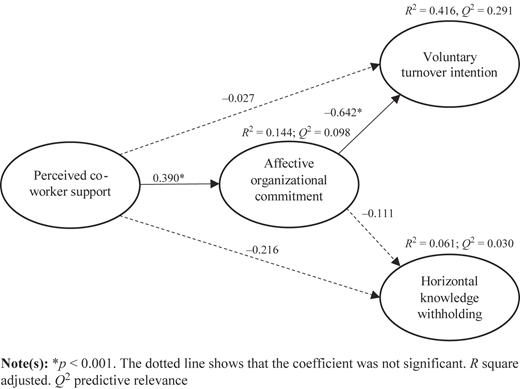
In order to test the statistical significance of the path coefficients, a bootstrapping procedure was performed and t-statistics, p-values and bias corrected confidence intervals were determined. Table 3 indicates that contrary to expectation, perceived co-worker support is not significantly related to neither HKW (β = −0.216; t = 1.254; p = 0.210) nor voluntary turnover intention (β = −0.027; t = 0.334; p = 0.738). Therefore, H1 and H2 are not supported. The influence of perceived co-worker support on affective organizational commitment is significantly positive (β = 0.390; t = 4.265; p < 0.001). In turn, the influence of affective organizational commitment on voluntary turnover intention is significantly negative (β = −0.642; t = 8.850; p < 0.001). Consequently, H3 and H4 are supported.
To evaluate the mediating role of affective organizational commitment, a PLS analysis was conducted for a model without link between affective organizational commitment and voluntary turnover intention. In this model, the direct effect of perceived co-worker support on voluntary turnover intention was reduced (−0.027 → −0.282) and became significant (p < 0.01). This result suggests a full mediation of affective organizational commitment. Moreover, Table 3 shows that, in the mediation model, the direct effect of perceived co-worker support on voluntary turnover intention is insignificant, while the indirect and total effects of perceived co-worker support on voluntary turnover intention are statistically significant. In addition, to determine the size of the indirect effect in relation to the total effect, the variance accounted for (VAF) value was analyzed (Carrión et al., 2017). The value of VAF is 90%, which indicates a full mediation (Nitzl et al., 2016). This result confirms that the relationship between perceived co-worker support and voluntary turnover intention is fully mediated by affective organizational commitment. Thus, H5 is supported.
To test whether affective organizational commitment mediates the effect of perceived co-worker support on HKW, a model without link between affective organizational commitment and HKW was tested. In this model, the direct effect of perceived co-worker support on HKW was reduced (−0.216 → −0.261), but it was still insignificant (p = 0.051). In the mediation model, the direct, indirect and total effects of perceived co-worker support on HKW are insignificant. This result indicates that affective organizational commitment does not mediates the relationship between perceived co-worker support and HKW. Thus, H6 is not supported (see Figure 1).
5. Discussion
5.1 Theoretical contributions
This study is probably the first to explicitly explore the mediating role of affective organizational commitment in the relationship between co-worker support and turnover intention. The study shows how co-worker support serves as a protective factor toward voluntary turnover intention in an IT specialist perspective. The results of this study do not confirm that co-worker support is directly related to turnover intention, which is contrary to some previous findings (Ducharme et al., 2007; Karatepe, 2012; Park and Min, 2020). However, this study indicates that the effect of co-worker support on voluntary turnover intention is fully mediated by affective organizational commitment. It is partly in line with previous studies, which have suggested that organizational support via organizational commitment reduces employees' willingness to look for alternative employment (Alkhateri et al., 2018; Fazio et al., 2017; Newman et al., 2012). The findings of the present study indicate that employees who experience help from co-workers might maintain positive energy and bond with their organization. Hence, loyalty and attachment to the organization is created not only by supervisors, who are perceived as agents of the organization, but also by co-workers. This finding is consistent with previous empirical studies on the link between co-worker support and affective commitment (Limpanitgul et al., 2014). Furthermore, some scholars have claimed that the impact of co-workers on attachment to the organization may be stronger than the impact of supervisors (Chiaburu and Harrison, 2008). It can be assumed that such an effect may be observed particularly in large organizations where contacts between supervisors and subordinates are weaker than in small organizations.
Moreover, this study used a social identity perspective to theoretically justify the relationship between affective organization commitment and turnover intention. Previous studies have not used an underlying theory to support this relationship, possibly assuming that the relationship is logical. This study also confirmed empirically that IT specialists who are emotionally connected to the organization, feel they are part of it and identify with its goals are less likely to leave the organization. This is consistent with previous studies conducted among non-IT specialists (Labatmedienė et al., 2007; Torre-Ruiz et al., 2019). Hence, affective commitment is an important factor to consider in order to retain IT specialists.
Research on the antecedents of knowledge withholding is scarce, and scholars have called for further research in this area (Alnaimi and Rjoub, 2021; Tsay et al., 2014). In response to these calls, the present paper explored the impact of co-worker support on HKW among IT specialists. It turned out that co-worker support did not show a significant negative relationship with HKW. Moreover, affective organizational commitment does not mediate the relationship between co-worker support and HKW. These results are contrary to hypotheses H1 and H6. However, it is worth noting that the p-value for the path coefficient between perceived co-worker support and HKW was very close to the significance limit (p = 0.051 in the model without affective organizational commitment as a mediator; p = 0.069 for the total effect in the mediation model). This is, to my knowledge, the first study to examine this effect. Nevertheless, previous research on relationships between perceived organizational support and KW or hiding also provided ambiguous results, indicating a negative (Onderwater, 2017; Tsay et al., 2014) or insignificant (Alnaimi and Rjoub, 2021) relationship between these constructs. On one hand, in line with the norm of reciprocity (Gouldner, 1960), employees may be not willing to share knowledge with co-workers who are unwilling to provide instrumental support. On the other hand, employees who deny their co-workers the necessary knowledge may act to their own disadvantage and jeopardize success. The implementation of complex projects in software companies forces IT specialists to emphasize teamwork and provide information that is key to completing the project and meeting deadlines (Vasanthapriyan et al., 2017). Thus, these two mechanisms may partially balance each other and mean that the relationship between co-worker support and HKW is not clearly negative. Another explanation for the lack of clear and significant negative relationships between co-worker support and HKW may come from work conditions. The company in which the research was conducted places great emphasis on a friendly atmosphere in the workplace, and ensures high earnings and non-wage benefits. Employee turnover in this company in 2020 was almost half the industry average, which may indicate that employees are satisfied with the working conditions. As previous research has shown, job satisfaction and positive affect at work are positively related to knowledge sharing among project members (Sang et al., 2019). Moreover, employees who are satisfied with their jobs are less likely to engage in undesirable knowledge behaviors, including knowledge hiding. Hence, if the employer creates very favorable working conditions, less co-worker support may not be such a strong stimulus for HKW.
5.2 Implication for practice
This study has significant implications for managerial practices as it illustrates the importance of co-worker support among IT specialists. The findings indicate that a software company can increase affective organizational commitment and reduce voluntary turnover intention of IT specialists by increasing co-worker support. By providing instrumental support, co-workers create an environment in which employees are emotionally attached to the organization and want to remain in it. Therefore, the organization should make efforts and create the conditions to enhance co-worker support. Various means can be used to achieve this. First, the importance of co-worker support should be clearly communicating across organizations. Organizational leaders should actively promote co-workers as a key source of support in the organization. They can foster a supportive and collaborative organizational culture by recognizing and rewarding supportive behaviors (Singh et al., 2019). Improving co-worker support in order to retain employee might be less expensive than other activities such as increasing employees' wages.
In knowledge-intensive companies, technical knowledge is enormously valuable to employees and to the company (Bryant and Terborg, 2008). Peer mentoring is a useful method for triggering co-worker support and reducing knowledge withholding. Peer mentoring is a relationship between co-workers in which a mentor provides new knowledge and skills to a protégé (Bryant and Terborg, 2008). A peer mentor, who holds a comparable position to the protégé, can provide both emotional and career support (Ensher et al., 2001). Peer mentoring plays an important role in the process of employee socialization and the transfer of tacit knowledge (Bryant, 2005). One of the varieties of mentoring is intermentoring (Michna et al., 2018). Intermentoring assumes that a mentor and a protégé swap their roles, which may have a positive effect on mutual trust and the tendency to share knowledge. Therefore, managers in a software company should promote effective peer mentoring through, for example, mentor training and an incentive system.
5.3 Limitations and future directions
This study has some potential limitations. First, the study was conducted among only 118 IT specialists of one software house. IT specialists in this software company are likely to have a lot in common with IT specialists at other software companies. However, the generalizability of results to other employees and industries is limited. Future researchers may address this limitation by collecting data from different industries. Second, self-report data were used in this study. This is an appropriate approach when the nature of the studied variables is subjective or interpersonal, as in this study. However, a single source might have contributed to common method bias (CMB), although tests indicated that a significant CMB is absent in this study. Future research may include multiple sources and archival measures, such as actual turnover. Third, this study is cross-sectional, which may put the causal relationship into question. Using a longitudinal study could prove whether co-worker support decreases voluntary turnover intention and actual turnover.
Future research needs to further investigate the relationship between co-worker support and KW. In this study, this relationship was very close to the significance limit (the direct effect is −0.261, p = 0.05 in the model without affective organizational commitment as a mediator; the total effect is −0.259, p = 0.069 in the mediation model). It is recommended that this relationship be tested on a larger research sample. Moreover, moderation variables may be included in this relationship; for example, agreeableness, which was found to moderate the relationship between perceived organizational support and knowledge hiding (Onderwater, 2017). It is also worth investigating whether job satisfaction and workplace well-being weaken the negative relationship between co-worker support and KW.