This study examines the institutional demand for mispriced stocks with incongruent expectations implied by the book-to-market (BM) ratio and financial strength.
Institutional trading (or institutional demand) is calculated by both changes in institutional ownership (percentage of shares held) and the number of institutional investors from the previous to the current quarter. Market mispricing and expectation errors in value/glamour stocks can be identified by analysing firms’ recent financial strength (measured by FSCORE). Firms are sorted into value stocks (top 30%), middle stocks (between 30% and 70%) and glamour stocks (bottom 30%) by distribution of BM ratios at the end of the previous fiscal year. Firms in the sample are then double sorted by FSCORE and BM: in each BM portfolio, firms are further classified into high-, mid- and low-FSCORE groups.
Consistent with the argument of expectation errors in value/glamour stocks (Piotroski and So, 2012), institutional investors buy value stocks with strong fundamentals (underpriced) and sell glamour stocks with weak fundamentals (overpriced). Independent institutions are more likely to take advantage of the mispricing in value/glamour firms than passive institutions. Institutional trading on expectation errors could reduce the abnormal returns to mispriced stocks. Institutional trading patterns on mispriced value/glamour stocks are also documented in global markets.
Our research provides new evidence that the institutional investors do exploit the BM anomalies if the mispricing can be identified by both the BM and the recent financial strength. Our study differs from Caglayan, Celiker and Sonaer (2018) as we emphasise that financial institutions, in addition to relying on only the BM values, process information from financial statements to infer firms’ financial strength. This study is also the first to document that institutional demand on mispricing could attenuate the BM anomaly.
1. Introduction
This study explores whether institutional investors, which are considered as sophisticated investors, explore the book-to-market (BM) anomaly based on their ability to timely to process information from financial statements. Although several papers (Collins, Gong, & Hribar, 2003; Ke & Ramalingegowda, 2005; Lev & Nissim, 2006) have shown that institutional investors exploit the anomalies of accruals and post-earnings announcement drift, it is still debatable on whether institutional investors take advantage of investment opportunities involving the BM anomaly, which is one of the most robust anomalies. Edelen, Ince, and Kadlec (2016) find that the institutions generally trade contrary to the prescriptions of most well-known anomalies, including the BM anomaly and while other studies such as Caglayan, Celiker and Sonaer (2018) and Calluzzo, Moneta, and Topaloglu (2019) show that hedge funds, mutual funds and other actively managed institutions do trade on the BM anomaly. This research develops this stream of literature by examining the institutional demand for mispriced (but not all) value/glamour stocks, especially those identified through financial strength signals.
Our framework follows the expectation-error argument in Piotroski and So (2012), [1], in which market mispricing can be identified by comparing expectations implied by the BM signal (i.e. regarding future market performance) and the financial strength signal (i.e. regarding future fundamentals performance). Mispricing is likely to appear in stocks that market expectations are incongruent with firms’ recent financial strength, as measured by FSCORE constructed from financial statements (Piotroski, 2000). We examine whether institutional investors exploit these mispricing/expectation errors in value/glamour stocks, given that institutional investors have an advantage in processing information from financial statements [2] and are probably more informed in trades than are naive investors (Piotroski & Roulstone, 2004; Ke & Ramalingegowda, 2005; Sias, Starks, & Titman, 2006; Bushee & Goodman, 2007; Baker, Litov, Wachter, & Wurgler, 2010; Berk & Van Binsbergen, 2015; Sias, Turtle, & Zykaj, 2016; Giannetti & Kahraman, 2017; Cheung, Fung, Raman, & Shen, 2025). We tested the following predictions in this research. First, if mispricing in value/glamour stocks exists and can be identified, we expect that institutional investors would tend to buy high BM stocks with a signal of strong fundamentals (high-FSCORE; underpriced) and sell (or buy less) low BM stocks with a weak fundamentals signal (low-FSCORE; overpriced), but not the stocks with congruent expectations in value/glamour portfolios (which appear to be fairly priced). Second, we expect that institutional trading on expectation errors is smaller in passively managed institutions than actively managed institutions because institutions guided by prudent-person rules, e.g. bank and insurance company are less likely to shift money from glamour to value stocks, even if the latter are more profitable and no riskier than the former [3]. In contrast, actively managed institutions like mutual fund and hedge fund are informed and can take advantage of mispricing opportunities (e.g. Kacperczyk, Sialm, & Zheng, 2005; Bushee & Goodman, 2007; Berk & Van Binsbergen, 2015; Kokkonen & Suominen, 2015; Sias et al., 2016; Giannetti & Kahraman, 2017). Lastly, we expect that the trading on expectation errors in the value/glamour stocks should yield profits to institutional investors.
We used a sample of 430,110 firm-quarter observations (and 1,294,688 firm-month observations) from 1982 to 2015 in this research. The results of this study can be summarised as follows. First, institutional investors trade on mispricing in value/glamour stocks. The patterns of exploiting expectation errors are most significant in two portfolios with incongruent expectations by BM and FSCORE signals, i.e. buying value stocks with strong fundamentals and selling (or buying less) glamour stocks with weak fundamentals. Institutional investors trade according to the BM anomaly in undervalued/overvalued stocks. In the stocks that appear more fairly priced, more institutional buying takes place in glamour stocks (with strong fundamentals) and less in value stocks (with weak fundamentals), which is consistent with the results in Edelen et al. (2016). The differences in institutional demand for high- and low-FSCORE firms are significant in value/glamour portfolios. This result is consistent with Piotroski and So (2012), who show that expectation errors in value/glamour stocks can be identified by analysis of financial strength.
Second, the behaviour of exploiting pricing errors is concentrated among independent institutions, including mutual funds, investment advisors and hedge funds. The results are consistent with the literature that active managed institutions are informed and trade on stock anomalies (e.g. Kacperczyk et al., 2005; Chordia, Subrahmanyam, & Tong, 2014; Berk & Van Binsbergen, 2015; Kokkonen & Suominen, 2015; Sias et al., 2016; Caglayan et al., 2018; Calluzzo et al., 2019). On the other hand, institutions such as banks and insurance companies do not trade on expectation errors in the aggregate. This result is consistent with the observation that, due to prudent-person regulations, these institutions stick to glamour stocks, even if expected returns are low and they avoid value stocks, even though they are fundamentally strong (Lakonishok, Shleifer, & Vishny, 1994). The passively managed institutions are not the counterparties to the independent institutions in exploiting the market mispricing. We conjecture that the individual investors, which are less informed and sophisticated, are exploited by the independent institutions (Lev & Nissim, 2006; Choi & Sias, 2012).
Third, we find that the institutional trading on mispricing occurs as early as one quarter before the fiscal year-end. The trading concentrates on the quarter of fiscal year-end and the quarter of the release of financial statements. The findings are consistent with Caglayan et al. (2018) that financial institutions indeed trade on the BM anomaly when the BM value is publicly updated from most recent financial statements. Abnormal returns to mispriced stocks in subsequent periods are significantly lower when institutional trading on pricing errors is more pronounced. Specifically, high-FSCORE (underpriced) stocks experiencing strong institutional buying generate significantly lower abnormal returns than those with weak institutional buying. Similarly, the abnormal returns from shorting low-FSCORE (overpriced) stocks with strong institutional selling are also lower compared with shorting low-FSCORE stocks with weak institutional selling.
In sum, our results indicate that institutional investors (especially actively managed institutions), as sophisticated professionals, can recognise expectation errors in value/glamour stocks and conduct trades on the overpriced/underpriced firms. The results are still robust if: (1) we examine institutional demand for mispriced value/glamour stocks in global markets by a sample of 34 international markets; (2) we use alternative measures of fundamentals or of pricing signals to identify potential expectation errors and (3) we identify mispricing in the BM based on a valuation model that estimates fundamental values for firms (Rhodes–Kropf, Robinson, & Viswanathan, 2005).
This research mainly contributes to the literature in institutional trading on the stock anomalies. Although several papers (Collins et al., 2003; Ke & Ramalingegowda, 2005; Lev & Nissim, 2006) show that institutional investors exploit the accounting related anomalies such as post-earnings announcement drift and the accruals, recent studies find that institutional portfolios are similar to market portfolio (Lewellen, 2011) and instead of exploiting the capital market anomalies, the institutional investors may even induce market mispricing by trading against the popular anomaly prescriptions (Akbas, Armstrong, Sorescu, & Subrahmanyam, 2015; Edelen et al., 2016). Our research provides new evidence that the institutional investors do exploit the BM anomalies if the mispricing can be identified by both the BM and the recent financial strength. Our study differs from Caglayan et al. (2018) in that we emphasise that financial institutions, in addition to relying only on BM values, process information from financial statements to infer firms' financial strength. This study is also the first to document that institutional demand for mispricing could attenuate the BM anomaly.
2. Empirical predictions and data
2.1 Empirical predictions
The BM anomaly is one of the most robust anomalies in the capital market. Fama and French (1992) show that abnormal returns earned by value stocks may be due to higher systematic risks in these stocks. Lakonishok et al. (1994) state that abnormal returns earned by value stocks may be due to mispricing because of their poor past performance, which may cause investors to overlook them, even if some have made improvements in fundamentals. Golubov and Konstantinidi (2019) find that value premium is driven by the component in the market-to-book ratio that reflects the stock price deviations from fundamental value. Piotroski and So (2012) suggest that market mispricing and expectation errors in value/glamour stocks can be identified by analysing firms' recent financial strength (measured by FSCORE). The expectation errors are related to an under-reaction to new financial-statement information, i.e. signals of improvement or deterioration in fundamentals. Mispriced stocks are firms in which fundamentals and price signals are contradictory, i.e. the value stocks are underpriced if they show strong fundamentals from recent financial information and the glamour stocks are overpriced if their recent financial condition is weak.
We follow the framework of Piotroski (2000) and Piotroski and So (2012), but focus instead on institutional trading. The key assumption is that institutional investors are more sophisticated than are naive investors (Coval & Moskowitz, 2001; Kacperczyk et al., 2005; Bushee & Goodman, 2007; Berk & Van Binsbergen, 2015; Kokkonen & Suominen, 2015) and can use financial-statement information to identify mispriced stocks (if they exist). Institutional trading (changes in institutional ownership) is substantial among firms with expectation errors in value/glamour portfolios and the directions of the trading are opposite to those value/glamour stocks that price signals are congruent with fundamentals. Institutional ownership should increase in undervalued stocks and decrease in overvalued stocks. Predictions regarding institutional trading in the portfolios sorted by BM and FSCORE can be summarised as follows [4] (See Table 1):
The mispriced firms are concentrated in the tail of the BM distributions. We expect that institutional investors would exploit expectation errors in value/glamour stocks by buying the underpriced value stocks and selling (or buying less) the overpriced glamour stocks. The fundamental strength conditional on BM, can distinguish mispriced from more fairly priced stocks. We also expect that more institutional buying occurs in fundamentally strong value stocks than in fundamentally weak value stocks and more institutional selling (or less institutional buying) occurs in fundamentally weak glamour stocks than in fundamentally strong glamour stocks. In other words, institutional demand between stocks with strong fundamentals and those with weak fundamentals should be significantly different in both value and glamour portfolios.
Having established our central predictions, we tested several other predictions related to the behaviours of exploiting expectation errors in value/glamour stocks. We first tested the impact of institution types on the exploitative behaviours. Lakonishok et al. (1994) argue that institutions constrained by prudent-person rules are likely to suffer systematic errors in value/glamour stocks due to their preference for glamour stocks and avoidance of value stocks. Banks and insurance companies are more restricted by prudent-person regulations than are independent institutions such as hedge funds, mutual funds and investment advisors (Del Guercio, 1996; Gompers & Metrick, 2001). In addition, these actively managed institutions are more informed (Daniel, Grinblatt, Titman, & Wermers, 1997; Ke & Ramalingegowda, 2005; Berk & Van Binsbergen, 2015; Kokkonen & Suominen, 2015; Sias et al., 2016) and have a stronger incentive to deviate from benchmarks and exploit the mispricing opportunities. We expect that independent institutions are more likely to exploit expectation errors in value/glamour portfolios than are institutions governed by prudent-person rules.
We examine the timing and consequences of institutional trading on expectation. Edelen et al. (2016) find that institutional investors buy short-leg (overvalued) stocks, e.g. glamour stocks. Institutional trading on the “wrong” side contributes to anomalies' abnormal returns. If the framework of expectation errors is valid, we expect that the BM anomaly could be attenuated in the stocks that institutional investors correctly exploit the mispricing, e.g. buying underpriced value stocks and selling overpriced glamour stocks immediately after recent financial statements are available.
2.2 Data and sample
The data on institutional ownership in the USA are obtained from the Thomson Reuters Institutional Managers (13f) Holdings database from 1982 to 2015. Thomson Reuters [5] collects institutional holdings of US exchange-traded stocks on a quarterly basis from 13F filing mandated by the Securities and Exchange Commission. Institutional investment managers must report their positions in US exchange-traded stocks within 45 days after each quarter-end. The database also provides the information on manager types; however, the classifications are not reliable after 1998. We classify the institutions based on the institutional investor classification data from Brian Bushee's website (e.g. Cremers, Pareek, & Sautner, 2020, 2021) [6]. The institutions are divided into five categories: bank, insurance company, investment company, independent investment advisor and pension fund, endowment and others. Following previous studies (e.g. Ferreira & Matos, 2008), we define investment company and independent investment advisor as independent institutions and bank, insurance company, pension fund and others as passive institutions.
Financial-statement and stock-price data were obtained from Compustat and CRSP between 1981 and 2015. These data are used to calculate FSCORE, BM and firm-characteristic variables. We construct a data sample from all available US firms with share codes 10 or 11in CRSP. Following Fama and French (2006), we apply the following sample-selection criteria: (1) firms should have Compustat data and non-missing FSCOREs between 1981 and 2015; (2) financial firms are excluded from the sample and (3) firms should have institutional ownership data after merging with the Thomson Reuters database. In the final sample, we have 11,856 firms and 430,110 firm-quarter observations [7]. The sample selection process is detailed in Appendix 1.
2.3 Variables and portfolio formation
We calculate institutional trading (or institutional demand) by both changes in institutional ownership (percentage of shares held) and the number of institutional investors from the previous to the current quarter, following studies on institutional investor demands (e.g. Gompers & Metrick, 2001; Choi & Sias, 2012; Edelen et al., 2016). To remove the size effect, we compute the size-adjusted change in institutional ownership (institutional investors) as the change in institutional ownership (institutional investors) in a stock minus the average change in institutional ownership (the number of institutional investors) within the stock's market capitalization decile, scaled by the average institutional ownership (the number of institutional investors) in the decile in each quarter (Chen, Hong, & Stein, 2002; Choi & Sias, 2012; Edelen et al., 2016). The size-adjusted measures are as follows:
For stock i in the quarter q, ΔIO and ΔNUM are the changes in institutional ownership and the numbers of institutional investors. The stock is in the capitalization decile d. and are the average changes of institutional ownership and the number of institutional investors in the decile d in quarter q; and are the average level of institutional ownership and the numbers of institutional investors in the decile d in quarter q. The size-adjusted changes in independent/passive institutional ownership are defined similarly: changes in independent/passive institutional ownership minus the average changes of independent/passive institutional ownership in the decile, scaled by the average level of institutional ownership.
Panel A of Table 2 reports descriptive statistics for the measure of institutional investor demand. The average institutional ownership of a stock is 38.04% in each quarter. The average number of institutional investors in a stock is 83.86. The average changes in institutional ownership and institutional investors were 0.19% and 1.06, respectively, in each quarter. We also report changes in institutional ownership in different types of institutions and the size-adjusted changes in institutional ownership and in institutional investors.
Financial strength is measured by FSCORE (Piotroski, 2000; Zhu, Sun, & Yung, 2020), which is the sum of nine binary signals on fundamentals. The indicator signal equals 1 if there is improvement in the firm's fundamentals, including positive return on assets, positive cash flow from operations, increase in return on assets, cash flow from operations greater than net income, decrease in debt ratio, increase in liquid ratio, no equity issuance, increase in gross margin and increase in asset turnover ratio. The FSCORE is an aggregate measure of these signals for a firm, ranging from 0 to 9. We compute the FSCORE annually based on financial statement information, following the method of Fama and French (2006) and Choi and Sias (2012), [8]. We further classify the firms into high-FSCORE (FSCORE>6), mid-FSCORE (FSCORE = 4, 5 or 6) and low-FSCORE (FSCORE<4) groups, following the definitions in Piotroski and So (2012). Panel B of Table 2 indicates that, in our sample, the percentages of firms in high-, mid- and low-FSCORE groups are 18.94%, 56.71% and 24.36% of total firm-quarter observations, respectively.
We calculate the BM ratio as the ratio of the book value of equity over the market value of equity at the end of the fiscal year for each firm [9]. The firms are sorted into value stocks (top 30%), middle stocks (between 30% and 70%) and glamour stocks (bottom 30%) by distribution of BM ratios at the end of the previous fiscal year [10]. Firms in the sample are then double sorted by FSCORE and BM: in each BM portfolio, firms are further classified into high-, mid- and low-FSCORE groups. Panel B also reports the percentages of firms in each BM portfolio and the portfolios by both BM ratio and FSCORE in the total observations.
Panel C of Table 2 presents descriptive statistics of firm-level characteristic variables. Following prior studies (Gompers & Metrick, 2001; Ferreira & Matos, 2008), we construct several variables at the firm level that may affect the investment decisions of institutional investors. These control variables include firm size, sales growth, asset growth, stock return momentum, stock turnover, ROE, dividend yield, idiosyncratic volatility, leverage, cash ratios, earnings surprise and change in constituent status of a firm in the S&P500 index. Appendix 2 contains the variable definitions.
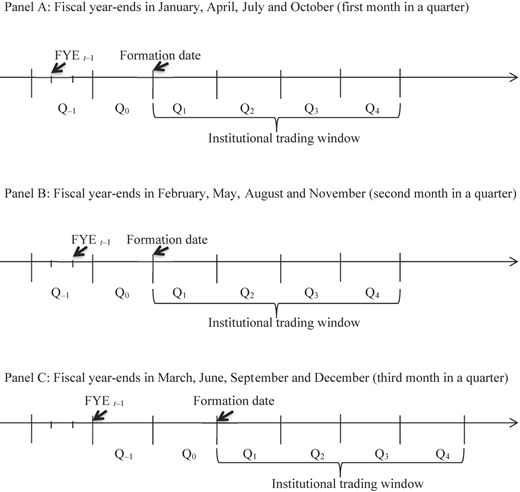
Institutional investors should have all available information from recent financial statements to form portfolios. We face a choice in determining the portfolio-formation date, since institutional ownership data are only available at the end of each quarter, while the fiscal year-ends of firms can be any month in a quarter. In our sample, we allow at least a four-month lag between the fiscal year-end and the portfolio formation date (Piotroski & So, 2012; Choi & Sias, 2012). Figure 1 shows the time lines for portfolio formation for the scenarios in which the fiscal year-ends are in the first, second and third months of a quarter. The gaps between fiscal year-end and portfolio formation date are five months, four months and six months in the three scenarios, respectively [11]. Portfolios are rebalanced once a year. The institutional trading window (and also anomaly return realization period) is four quarters (Q1–Q4) after portfolio formation. Institutional investors may have traded based on financial-statement information in the quarter of portfolio formation (Q0) (Caglayan et al., 2018) and the quarter of fiscal year-end or after fiscal year-end (Q-1), because the statements are made public during these quarters, e.g. within 60 days after fiscal year-end according to SEC regulations after 2002 [12]. We will examine the changes in institutional ownership in the quarters from fiscal year-end in some sections.
3. Empirical results
This section presents empirical results of institutional trading on expectation errors and the consequences of institutional trading. We argue that institutions are sophisticated investors and can trade on expectation errors in the value/glamour stocks. The assumption is that the trading on the mispricing can generate superior returns to investors (Mazouz & Wu, 2022). Following Piotroski and So (2012), we investigate the returns to value/glamour strategies conditional on financial strengths and report the results in Appendix 3. It gives equally weighted monthly returns and alphas for portfolios by BM, FSCORE or both. The alphas are calculated from a model of the Fama-French three factors plus the momentum factor. Value stocks earn significantly higher returns than glamour stocks. Returns to value/glamour stocks are largest in the stocks with expectation errors, i.e. high-FSCORE value stocks and low-FSCORE glamour stocks. The alphas are insignificant in the portfolios where price signals are congruent with fundamentals, i.e. low-FSCORE value stocks, mid-FSCORE middle stocks and high-FSCORE glamour stocks [13]. The findings are consistent with Piotroski and So (2012) that the BM effect concentrates in firms with expectation errors. The results from regression analysis remain similar.
3.1 Institutional trading on expectation errors: the portfolio approach
Table 3 presents changes in institutional ownership in the trading periods on a quarterly basis. The trading window encompasses four quarters after portfolio formation. We report the time-series average of the cross-sectional mean (across 136 quarters) of the changes in institutional ownership for firms sorted by BM, FSCORE or both. We examine the differences in institutional trading across the high- and low-FSCORE portfolios in value/glamour stocks. The t-statistics calculated using Newey and West (1987) standard errors are reported in parentheses.
Panel A shows the results of the quarterly changes in institutional ownership. In the overall market, institutional investors increase their ownership of glamour stocks by 0.1820% of shares outstanding in each quarter, while the increase in value stocks is 0.1120%. The difference in institutional trading between value and glamour stocks is negative, which is consistent with the findings in Edelen et al. (2016) that institutional investors generally trade contrary to the BM anomaly prescriptions. In the FSCORE portfolios, low-FSCORE firms experience a slight increase in institutional ownership by 0.0333% of the outstanding shares and high-FSCORE firms experience an increase of 0.2768% in institutional ownership. The difference between the changes in institutional ownership across high- and low-FSCORE portfolios is positive and highly significant. This finding is consistent with the results in Choi and Sias (2012), which confirm that sophisticated investors trade on fundamentals when financial-statement information is available.
Our primary interest is to examine variations in institutional trading patterns in value/glamour stocks conditional on financial strength. The results shown in Panel A indicate that institutional buying significantly increases in high-FSCORE value stocks by 0.2504% each quarter, supporting our prediction that institutional investors buy underpriced stocks with incongruent fundamentals and price signals. The institutional buying on the high-FSCORE value stocks is also economically significant; the 0.2504% increases correspond to roughly $0.62 billion per quarter or $2.48 billion per year in the changes in market value of the high-FSCORE value stock portfolio during 1982–2015 [14]. The change in institutional ownership in overpriced stocks, i.e. low-FSCORE glamour stocks, is positive but not significant, suggesting that institutional investors do not buy glamour stocks if their fundamentals are weak. In glamour stocks, changes in institutional ownership are much fewer in firms with a low FSCORE than in those with a high FSCORE, indicating that institutional investors do consider financial strengths when they buy glamour stocks. Similarly, the difference in institutional demand between high- and low-FSCORE firms is significantly positive in value stocks; and meanwhile, the directions of the trading are opposite in the two groups of value stocks. These findings confirm that institutional investors use financial statement information to exploit expectation errors in value and glamour stocks, respectively. Consistent with our central prediction and Piotroski and So (2012), the differences in the changes in institutional ownership are more substantial in value and glamour portfolios than in middle portfolios because mispricing is more likely to occur in the tails of the BM distributions.
When exploring mispricing and expectation errors, the institutional trading pattern is more obvious in the results with size-adjusted changes in institutional ownership. Panel B of Table 3 shows that sophisticated investors significantly sell the overpriced low-FSCORE glamour stocks −0.5646%; t = −2.17) and buy the underpriced high-FSCORE value stocks (0.9117%; t = 4.46). The changes indicate that institutional investors buy less 0.2148% (or $0.79 billion) in low-FSCORE glamour stocks and buy more 0.3469% (or $0.86 billion) in high-FSCORE value stocks in each quarter, compared to the stocks in the same deciles of market capitalization [15]. Similar to Panel A, the difference in the changes in institutional ownership between high- and low-FSCORE firms is positive and significant in all value/glamour portfolios and the difference is larger in the tails than in the middle of value/glamour distribution. The directions of institutional trading between high- and low-FSCORE firms in both value and glamour portfolios are opposite. Our results indicate that institutional investors do trade according to the BM anomaly, but they only concentrate on mispriced stocks in the value/glamour portfolios, i.e. buying underpriced value stocks and selling overpriced glamour stocks. In the portfolios with congruent fundamental and price signals, however, institutional investors buy glamour stocks (with strong fundamentals) and sell value stocks (with weak fundamentals), which is consistent with the findings in Edelen et al. (2016).
Table 4 reports changes in the number of institutional investors in the trading window in Panel A and changes in the size-adjusted number of institutional investors in Panel B. Panel A reveals that high-FSCORE firms experience more significant increases in institutional investors than do low-FSCORE firms in glamour and value portfolios (1.5163 and 0.6231, respectively). The patterns are similar in Panel B. The results indicate that the size-adjusted number of institutional investors decreases for low-FSCORE glamour firms, since they are overpriced and are sold when the expectation errors are identified. High-FSCORE value stocks see a significant increase in institutional investors when sophisticated investors realise the mispricing and buy the underpriced stocks. In contrast, changes in institutional holdings have opposite signs in the portfolios with congruent expectations, i.e. buying high-FSCORE glamour stocks and selling low-FSCORE value stocks.
Evidence from the portfolio analysis supports our central prediction that institutional investors exploit expectation errors when financial-statement information is available and can be used to identify mispricing in value/glamour stocks. We observe greater institutional buying in the underpriced stocks and less institutional buying (or more relative institutional selling) in the overpriced stocks. The results also confirm that differences in institutional demand between fundamentally strong and fundamentally weak stocks are significant in both value and glamour portfolios and the institutions have opposite trading decisions in high- and low-FSCORE firms in the value/glamour portfolios, consistent with Choi and Sias (2012).
3.2 Institutional trading on expectation errors: regression analysis
We further examine our central predictions by conducting a multivariate analysis of institutional trading. Following previous studies (Gompers & Metrick, 2001; Ferreira & Matos, 2008; Piotroski & So, 2012), we include several control variables that might influence changes in institutional ownership, including firm size (log of market capitalization), investment opportunities (average sales growth in the past two years), asset growth, stock return momentum in the six-month period before portfolio formation, stock turnover in the quarter prior to portfolio formation, ROE, dividend yield, monthly idiosyncratic volatility in the past 36 months before portfolio formation, leverage ratio, cash ratio, earnings surprise and change of constituent status of S&P500 index. The regression model is given as follows (Lev & Nissim, 2006; Choi & Sias, 2012; Piotroski & So, 2012):
In the regression model, the dependent variable is change in institutional ownership or in the number of institutional investors (raw or size-adjusted). The variables Glamour, Middle and Value are indicator variables that equal 1 if the firms are in the groups of glamour, middle and value stocks, respectively. The variables LowFSCORE, MidFSCORE and HighFSCORE are dummy variables that equal 1 if the firms have an FSCORE less than four, between four and six and greater than six, respectively. The coefficients on Glamour, Middle and Value measure the institutional trading of firms with congruent signals, i.e. glamour stocks with high FSCOREs, middle stocks with mid FSCOREs and value stocks with low FSCOREs. The interaction terms capture the differences in institutional trading between the mispriced firms and those with congruent signals in the value/glamour portfolios. The variable X represents a series of control variables. The constant is compressed in the model (Piotroski & So, 2012). We run Fama-MacBeth cross-sectional regressions in each quarter and calculate the t-statistics with Newey and West (1987) robust standard errors. The estimates are the time-series average coefficients from 136 quarterly regressions.
Table 5 reports the coefficient estimates of the regression model (3). The dependent variables are change in institutional ownership and change in the number of institutional investors in columns (1)-(4). In column (1), the coefficient of Glamour*LowFSCORE is negative and significant at the 1% level, indicating that, compared with glamour stocks with strong fundamentals, the glamour firms with weak fundamentals experience a 0.22% lower increase in institutional ownership in each quarter. The coefficient of Value*HighFSCORE is positive and significant at the 1% level, suggesting that more institutional buying occurs in the value stocks with high financial strength than in those with poor financial strength. In addition to trading on the two portfolios that are most likely to be mispriced, the results indicate that institutional investors buy fewer low-FSCORE firms in middle BM stocks (Middle*LowFSCORE) and more mid-FSCORE firms in value stocks (Value*MidFSCORE), but the magnitude of the coefficients is smaller. These findings are consistent with the portfolio analysis results in Panel A of Table 3 and confirm our prediction that institutional investors exploit expectation errors and mispricing in value/glamour portfolios, especially in the tails of the value/glamour distribution. The results are similar to column (2), where the dependent variable is the change in the number of institutional investors.
The findings are still robust in columns (3) – (4), which include firm characteristic variables. In column (3), the coefficients on the interaction terms Glamour*LowFSCORE, Middle*LowFSCORE, Value*MidFSCORE and Value*HighFSCORE are all significant and their signs are consistent with the predictions. The coefficients for the interaction terms Glamour*LowFSCORE in column (4) have consistent signs and significance. When the size-adjusted measures of institutional trading are used as dependent variables in columns (5) and (6), all interaction terms have significant coefficients with predicted signs.
Similar to the findings in Falkenstein (1996), Gompers and Metrick (2001) and Ferreira and Matos (2008), the results in column (3) show that institutional investors prefer stocks more investment opportunities (INVOP), stronger profitability (ROE) and higher idiosyncratic volatility (IVOL). These investors also tend to buy stocks with strong past performance (MOM), low turnover (TURN) and earnings surprise (SUE) and stocks that are included in the S&P500 index (ΔSPINDEX; or sell stocks that are deleted from the index). The firm characteristic variables such as asset growth ratio, dividend yield and leverage ratio, do not significantly affect changes in institutional ownership.
In sum, our evidence suggests that institutional investors can take advantage of mispricing in value/glamour stocks by analysing their financial strength. The findings are consistent when using changes in institutional ownership or changes in size-adjusted institutional ownership, different measures of institutional trading (percentage of shares held or number of institutional investors [16]) and portfolio or regression analysis. In the following sections, we mainly present the results of changes in size-adjusted institutional ownership. The results are consistent if changes in institutional ownership are used.
3.3 Institutional trading on expectation errors: institution types
In this section, we examine the impact of institutional investor types regarding their institutional trading on expectation errors. Behavioural finance argues that naive investors and institutions with prudent-person regulations avoid “apparently” risky value stocks and prefer safer glamour stocks (Lakonishok et al., 1994). Independent institutions also have superior abilities to process information from financial statements and to trade on private information (Collins et al., 2003; Piotroski & Roulstone, 2004; Kacperczyk et al., 2005; Bushee & Goodman, 2007; Berk & Van Binsbergen, 2015; Kokkonen & Suominen, 2015; Caglayan et al., 2018) and thus are more likely to identify expectation errors by analysing financial strength in value/glamour stocks. We expect that independent institutions, such as investment companies and independent investment advisors, are more likely to trade on market mispricing than are passive institutions such as banks and insurance companies.
We report the time-series average of the cross-sectional mean, size-adjusted changes in institutional ownership for aggregate independent institutions, aggregate passive institutions and each institution type in Table 6 [17]. Panel A reports the results for aggregate independent and passive institutions and the differences between them in institutional trading. Independent institutions significantly sell overpriced glamour stocks and buy underpriced value stocks. Differences in the changes in institutional holdings between high- and low-FSCORE firms are positive and statistically significant at the 1% level for both value and glamour stocks. In contrast, passive institutional investors do not substantially trade on mispriced stocks, in which the coefficients are small and insignificant. They increase their ownership of high-FSCORE glamour stocks and decrease their ownership of low-FSCORE value stocks, which is consistent with their preference for safe, high-quality stocks. The differences in the changes in institutional ownership between high- and low-FSCORE firms are also positive and significant in the passive institutions; however, the differences are mainly attributed to the trading on fairly priced stocks. Comparisons across institution types indicate that, unlike passive institutional investors, independent institutional investors are more likely to sell more low-FSCORE glamour stocks, buy more high-FSCORE value stocks and exploit expectation errors in both value and glamour stocks.
Panels B and C of Table 6 report the results for each type of independent and passive institution, respectively. Investment strategies to exploit market mispricing vary among the different types of independent institutional investors. Both investment companies and investment advisors significantly buy the underpriced value stocks and trade on the expectation error in value stocks (shown in the difference between high- and low-FSCORE firms); and only investment advisors exploit the expectation error in glamour stocks [18]. Panel C shows that banks, insurance companies and pension funds do not significantly change ownership in value/glamour stocks with expectation errors, which is consistent with Lakonishok et al. (1994), who show that these institutions are less likely to exploit market mispricing. Although the magnitudes are small, the directions of the trading on the mispriced stocks in passive institutions are generally the same as independent institutions except the pension fund in low-FSCORE glamour stocks. The results indicate that passive institutions are not major counterparties to independent institutions in the trading on market mispricing; thus, we conjecture that independent institutional investors exploit the individual investors in correcting the market mispricing (Lev & Nissim, 2006; Choi & Sias, 2012).
Overall, our evidence is consistent with behavioural arguments that expectation errors and mispricing exist in value and glamour stocks. Also, because of regulations, restrictions and preferences, passive institutions are less likely to use arbitrage on mispriced stocks. In contrast, independent institutions can identify expectation errors through knowledge of the recent financial strength of a firm and can trade according to the incongruent information implied by price and fundamentals. In the untabulated analysis, we run the regression model (3) using change of institutional ownership by institution type and compare the coefficients on the two key interaction terms Glamour*LowFSCORE and Value*HighFSCORE across institution types. We observe the same results that independent institutions are more likely to exploit expectation errors in both value and glamour stocks than are passive institutions. The results are consistent with Caglayan et al. (2018), which shows that hedge funds are likely to trade on the BM anomaly because they do not suffer from regulations from government bodies.
3.4 Institutional trading on expectation errors: the investment timing
We examine the timing of institutional trading on expectation errors in value/glamour portfolios in this section. The fundamental signal from recent financial statements is the key to identifying expectation errors in our framework (Piotroski & So, 2012). Institutional investors could have an advantage in processing financial statement information; however, the capital market may dissipate the information advantage quickly (Chordia, Roll, & Subrahmanyam, 2005; Boehmer & Kelley, 2009). In order to reap abnormal returns, the sophisticated investors should respond fast to the mispricing opportunities. We are interested in the following questions: (1) would the institutional trading on mispricing concentrate in the early periods after fiscal year-end and the release of financial statement (2) do some institutions (i.e. independent institutions)? trade earlier than others (i.e. passive institutions)? (3) is the pattern of institutional trading on short position (i.e. sell overpriced stocks) different from the trading on long position (i.e. buy underpriced stocks)? We examine the change in institutional ownership in each quarter in a six-quarter period starting from fiscal year-end quarter (Q-1) because the information from fiscal year-end financial statements may be captured by institutional investors even before it is released (Choi & Sias, 2012). Table 7 reports changes in the size-adjusted institutional ownership in each quarter from Q-1 to Q4 with t-statistics calculated using Newey and West (1987) standard errors.
Panels A and B report the institutional trading on mispriced stocks. Panel A shows that institutions in aggregate sell the low-FSCORE glamour (in relative to stocks with similar size) gradually in the six quarters after fiscal-year end. Most of the institutional selling comes from independent institutions. The largest decreases in the independent institutional ownership lie in the second quarter (Q0) and fourth quarter (Q2) after the fiscal-year end. Passive institutions do not significantly sell the overpriced glamour stocks and in some quarters, e.g. the quarter after fiscal year-end (Q-1), they even buy glamour stocks with weak fundamentals.
Panel B shows that institutional investors significantly buy high-FSCORE value stocks in each of the first four quarters after the fiscal-year end. Independent institutions substantially trade on the underpricing opportunities from the first quarter after the fiscal year-end (Q-1) and the largest buying occurs in the second quarter (Q0) probably because they have comprehensive information on financial strength in the quarter with the release of financial statements (Caglayan et al., 2018). Trading from passive institutions is not significant in each quarter, although we can also see a large buying in the second quarter after the fiscal year-end (Q0). Consistent with the results above, we find that only independent institutions exploit the expectation errors in value/glamour stocks. The mispricing is gradually corrected by the institutional trading in the quarters after fiscal-year end and institutional investment is strongest in the announcement quarter of the financial statement (Lev & Nissim, 2006). Independent institutions implement the long strategy for undervalued stocks more quickly and substantially than the short strategy for overvalued stocks (Stambaugh, Yu, & Yuan, 2012).
Panels C and D present the institutional trading on the high-FSCORE glamour stocks and low-FSCORE value stocks in which the stocks are less likely to be mispriced. Panel C indicates that institutional investors buy the high-FSCORE glamour stocks mainly in the first three quarters after the fiscal year-end. Afterward, the trading is small and even negative. Both independent and passive institutions increase ownership of stocks in the early period after fiscal year-end. The trades conducted by independent institutions concentrate in the first two quarters, while the passive institutions significantly modify their equity positions in the first three quarters. Panel D shows that the institutions sell low-FSCORE value stocks gradually in the six quarters after fiscal year-end, although the major selling trades are conducted in the first three quarters. Independent institutions trade substantially in the quarter after fiscal year-end (Q-1) and the quarter after the release of financial statements (Q1). Passive institutions spread the selling trades more evenly in the six quarters after fiscal year-end. We can conclude that independent institutions lead passive institutions in the trading of fairly priced value/glamour stocks and institutional buying based on positive signals from recent financial statements is conducted faster than the institutional selling from negative fundamental signals.
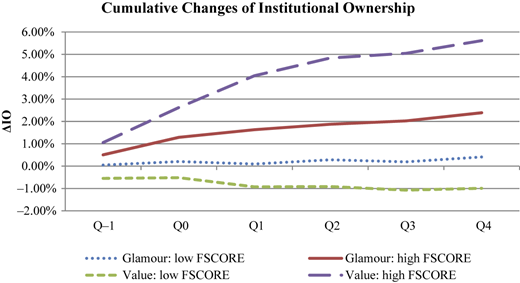
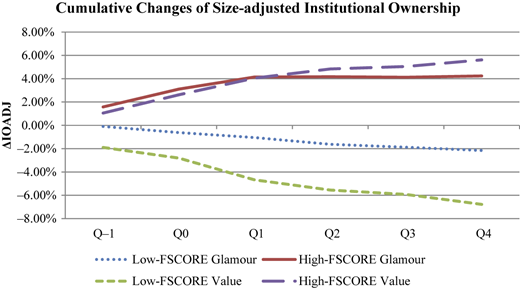
Figure 2 presents the cumulative changes in institutional ownership from the fiscal year-end quarter (or after fiscal year-end; Q-1) to the end of the institutional trading window (six quarters in total). Consistent with the results in Table 8, institutional investors buy high-FSCORE value stocks over the six quarters, starting from the fiscal-year end quarter and the major trading occurs in the quarter that financial statement information is released (Q0) and one quarter after (Q-1). The results also indicate that institutional investors do not trade significantly on low-FSCORE glamour stocks. Among value/glamour stocks without mispricing, institutional investors buy high-FSCORE glamour stocks and sell low-FSCORE value stocks, mainly in the first half period of the six-quarter window. Figure 3 presents the cumulative changes in size-adjusted institutional ownership in the six-quarter window. The patterns are similar to those in Figure 2. Institutional investors sell low-FSCORE glamour stocks over the trading window in relative to stocks in the same size decile. These results confirm again that institutional investors do use financial strengths to screen firms in value/glamour stocks and significantly trade on the mispricing signals when financial statement information is released, especially in the underpriced high-FSCORE value stocks.
3.5 Abnormal returns to mispriced stocks conditional on prior institutional trading
In this section, we examine whether the abnormal returns to mispriced value/glamour stocks differ when institutional investors trade substantially in accordance with the BM anomaly (Piotroski & So, 2012). We focus on the analysis of institutional trading in the pre-anomaly return realization quarter Q0. If institutional investors buy underpriced value stocks when the financial statement information is available, stock prices may be pushed up quickly and the positive abnormal returns to these stocks in the subsequent return realization period could be reduced. Similarly, if institutional investors sell overpriced glamour stocks, the negative abnormal returns to the stocks in the subsequent return realization period could be attenuated. We compare the abnormal returns to the portfolios of value stocks conditional on institutional buying and the portfolios of glamour stocks conditional on institutional selling in Q0. On the portfolio formation date (at the end of Q0), conditional on institutional buy (ΔIO >0), we sort value stocks and potentially underpriced value stocks into top buying and bottom buying groups based on the median value of positive change in institutional ownership respectively and condition on institutional selling (ΔIO <0), we sort glamour stocks and potentially overpriced glamour stocks into top selling and bottom selling groups based on the median value of negative change in institutional ownership respectively. Table 8 reports the alphas from a Fama-French four-factor model to value/glamour portfolios conditional on institutional buying/selling.
Panel A shows that in the return realization period (Q1-Q4), abnormal returns to the portfolios of top institutional buying are 18 basis points, 24 basis points and 27 basis points per month in overall value stocks, mid-FSCORE value stocks and high-FSCORE value stocks and abnormal returns to the portfolios of bottom institutional buying are 38 basis points, 46 basis points and 62 basis points in the three groups. The differences in abnormal returns between top institutional buying and bottom institutional buying groups are significant, indicating that greater institutional buying is associated with reduced abnormal returns to underpriced value stocks.
Panel B gives the abnormal returns to glamour stocks conditional on institutional selling. Abnormal returns to overall glamour stocks, mid-FSCORE glamour stocks and low-FSCORE glamour stocks are all significantly higher in the top selling groups than in the bottom selling groups, indicating that increased institutional selling of overpriced glamour stocks is associated with attenuated negative abnormal returns in these stocks. In the unreported results, we also examine whether the institutional trading in the anomaly return realization period (Q1-Q4) is associated with a reduction in the BM anomaly and find some similar results. It is important to note that our tests only document reduced abnormal returns to mispriced stocks following more substantial institutional trading on mispricing in the quarter of the most recent financial statement release. The extent to which institutional trading may attenuate the BM anomaly remains an important question for future research.
4. Robustness tests
4.1 Institutional trading on expectation errors: international evidence
The literature has shown that the value effect is not a unique phenomenon in the US stock market, but is a global phenomenon (Fama & French, 1998; Hou, Karolyi, & Kho, 2011; Asness, Moskowitz, & Pedersen, 2013). Previous studies (Walkshausl, 2017; Ng & Shen, 2016; Hyde, 2018) also confirm that FSCORE can effectively measure a stock's financial strength in international markets. If global value premia are due to market mispricing, we expect that institutional investors outside the US market can also identify expectation errors and mispricing in value/glamour stocks through analysis of fundamentals and price signals.
We obtain institutional ownership data for international markets from FactSet and firm characteristic data, such as BM ratios, from Worldscope. The dataset Stock Ownership Summary from FactSet provides the number of institutional investors, aggregate institutional ownership (institutional holdings as a percentage of market capitalization), the level of institutional ownership by institutional investor type [19] and the aggregate institutional ownership of independent and passive institutions [20], respectively. The sample period is from 2000 to 2013. We apply the same sample-selection process and portfolio-formation approach introduced in Section 2 to each market. We exclude countries with less than 100 stocks, to ensure that the portfolios sorted by BM and FSCORE in each market are meaningful (Watanabe, Xu, Yao, & Yu, 2013). In the final example, we have 34 international countries/markets, including 19 developed markets (excluding the USA) and 15 emerging markets [21].
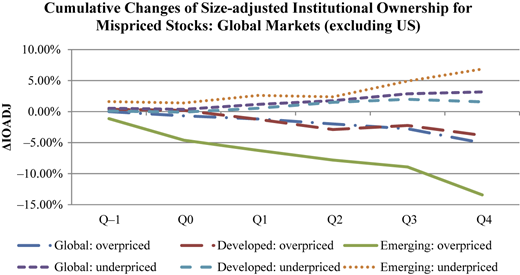
Figure 3 presents the cross-country averages of the cumulative changes in size-adjusted institutional ownership from the fiscal year-end quarter to the end of the institutional trading window in global markets (six quarters in total). On average, the institutional holdings of low-FSCORE glamour stocks decrease in the overall global markets (excluding the USA), developed markets (excluding the USA) and emerging markets throughout the trading window. On the other hand, institutional investors gradually increase their ownership of high-FSCORE value stocks in these markets. We observe similar institutional trading patterns on mispriced stocks in the USA and international markets and the patterns are more substantial in emerging markets than in developed markets (see Figure 4).
Table 9 reports the differences in institutional trading between high- and low-FSCORE firms in value/glamour portfolios in global markets by multivariate analysis through Equation (3). We apply the Fama and MacBeth (1973) procedure with country dummy variables (Titman, Wei, & Xie, 2013). The estimated coefficients on the interaction term Glamour*LowFSCORE are all negative and significant in the regressions for the overall global, developed and emerging markets. The coefficients on Value*HighFSCORE are all positive and significant. The findings are robust if we use size-adjusted changes in institutional ownership as a dependent variable. In sum, similar to institutional investors in the US market, global institutional investors exploit mispricing in value and glamour portfolios through analysis of the financial strength of the stocks. [22]
In the unreported results, we find that independent institutions are more likely to exploit the mispricing in the value/glamour stocks than passive institutions in the global markets. The findings are consistent with the results in the US market. International institutions (foreign investors in a market) also play a significant role in the trades on mispriced value and glamour stocks. The results are available upon the request.
4.2 Institutional trading on expectation errors: alternative fundamental signals
Our study builds upon the framework of expectation errors that mispricing of stocks can be identified by the expectations implied in fundamentals and price signals. We use the FSCORE to measure the fundamental strength, following Piotroski (2000), Piotroski and So (2012) and Choi and Sias (2012). If the framework is valid, the alternative measures of financial strength can also screen mispriced from more fairly priced stocks in value and glamour portfolios. We use five alternative measures [23]: ROA, ROE, gross profitability (Novy-Marx, 2013), operating profitability (Fama & French, 2015) and cash-based operating profitability (Ball, Gerakos, Linnainmma, & Nikolaev, 2016). These ratios are calculated from the most recent financial statements. Firms are sorted into fundamentally strong stocks (top 30%), fundamentally medium stocks (between 30% and 70%) and fundamentally weak stocks (bottom 30%) by the distributions of each measure at the fiscal year-end. These fundamental signals are combined with BM ratios to identify potential expectation errors.
Table 10 shows the changes in size-adjusted institutional ownership in US markets for the mispriced stocks identified by BM and the alternative fundamental measures. The overpriced stocks are glamour firms with weak profitability and the underpriced stocks are value firms with strong profitability. Institutional investors buy significantly underpriced value stocks identified by different profitability signals, except for operating profitability. The institutions significantly sell glamour stocks with low ROE or gross profitability. These results confirm that institutional investors conduct trades on mispriced stocks if the price signal is not congruent with the fundamental signal given by FSCORE or other profitability ratios. In an unreported multivariate analysis by Equation (3), we find that the coefficients of the key interaction terms between the dummy variable of value/glamour stock and the dummy variable of strong/weak fundamentals are significant and with consistent signs. The results support our prediction that institutional investors exploit expectation errors in value and glamour stocks by analysing firm fundamentals.
4.3 Institutional trading on expectation errors: alternative valuation signals
In this study, we use the BM ratio as a price signal to measure market expectation on stocks. We also use alternative valuation signals to classify the stocks into glamour, middle and value portfolios, including earnings-to-price ratio and cash flow-to-price ratio. The results are quantitatively similar to those presented in Section 3.
4.4 Institutional trading on expectation errors: an alternative method to identify mispricing in the BM
Golubov and Konstantinidi (2019) decompose market-to-book (the inverse of BM ratio) into market-to-value and value-to-book components, following Rhodes–Kropf, Robinson, and Viswanathan (2005). The market-to-value component, which represents the mispricing (total error), includes firm-specific error (the stock price deviation from the valuation implied by peer firms) and sector error (the deviation from the long-run industry trend). They find that market-to-value components drive the value premium, value-to-book does not have explanatory power and market-to-book is associated with expectation errors in the glamour and value stocks. Following this argument, we explore the institutional trading on market-to-book and its components and examine again whether the trading concentrates on the error component in the market-to-book. Similar to Golubov and Konstantinidi (2019), we employ the market-to-book decomposition given by Rhodes–Kropf et al. (2005) and estimate fundamental value from a valuation model based on market value of equity, book value of equity, net income and leverage (Model 3 in Rhodes-Kropf et al., 2005). The valuation model is estimated as of June 30 in each year and requires a lag of four months at least for the availability of financial statement information. Portfolios are formed from July of year t to June of year t+1 based on market-to-book and its components in June of year t.
Table 11 reports the results for change in size-adjusted institutional ownership and change in size-adjusted number of institutional investors. It shows that institutional investors significantly buy stocks with low market-to-value (underpriced stocks) and sell stocks with high market-to-value (overpriced stocks). The trading pattern is opposite for value-to-book. In addition, we also find that institutional investors exploit the firm-specific error instead of sector error. Overall, the results from market-to-book decomposition are consistent with our findings above.
5. Conclusions
This study examines the behaviours of institutional investors in exploiting the mispricing opportunities in value/glamour stocks. We argue that some firms in value/glamour portfolios are mispriced if they have incongruent signals for BM and current financial strength, following the framework of Piotroski and So (2012). We test whether institutional investors exploit these expectation errors, given that they are informed and sophisticated in analysing financial statements. We find that institutional investors buy fundamentally strong firms in value stocks and sell fundamentally weak firms in glamour stocks and they exploit expectation errors in value/glamour stocks by fundamental signals, reflected in significant differences in the change in institutional ownership between high- and low-FSCORE firms. To the contrary, institutional investors have an incentive to increase ownership in glamour stocks and decrease ownership in value stocks if the expectations implied by fundamentals and price are congruent.
We provide further evidence that the expectation errors in value/glamour stocks are mainly exploited by independent institutions. Passive institutions, such as banks and insurance companies, do not revise their portfolios to take advantage of the mispricing opportunities, probably due to the prudent-person regulations (Lakonishok et al., 1994). We find that institutional investors trade on value/glamour stock mispricing beginning in the quarter following fiscal year-end. In contrast to Edelen, Ince, and Kadlec's (2016) findings, our results show that more intensive trading on this mispricing during the financial statement release quarter is associated with reduced abnormal returns to mispriced stocks.
Institutional trading patterns regarding expectation errors in value/glamour stocks can also be documented in global markets outside the USA. Similar to institutional investors in the US market, global institutional investors buy underpriced value stocks and sell overpriced glamour stocks. The findings are also robust when we employ a market-to-book decomposition to identify pricing errors in the value and glamour stocks (Rhodes-Kropf et al., 2005). In sum, this study supports the argument that institutional investors are indeed sophisticated. Institutional investors, especially in independent institutions, are likely to explore the investment opportunities presented by mispriced stocks.
Notes
The focus of this study, however, is institutional trading rather than the return effect on value/glamour stocks in Piotroski and So (2012). Choi & Sias (2012) focus on the institutional demand on stocks with financial strength, instead of expectation error conditional on BM and financial strength. Caglayan et al. (2018) explore relationship between hedge fund institutional demand and the BM effect.
Sophisticated investors have long employed securities analysis to identify the intrinsic value of stock and exploit the systematic pricing errors (Graham & Dodd, 1934). The literature on fundamental analysis research also confirms that the past financial information can be used to predict future stock returns (See Holthausen & Larcker, 1992; Lev & Thiagarajan, 1993; Abarbanell & Bushee, 1997 and others).
Cao, Han, and Wang (2017) find that the constraints on institutional investors, such as the diversification requirements and tracking-error restrictions, limit their ability to incorporate valuable information into portfolio position. Our study yet focuses on the restriction by prudent-person rule. Caglayan et al. (2018) argue that unlike institutions such banks that are heavily regulated by governments, actively managed institutions like hedge funds have more flexibility in formulating their investment strategies.
The arguments are based on the table in Piotroski and So (2012, p. 2847). In the robustness tests, we also identify the pricing errors in the BM based on the market-to-book decomposition given by Rhodes–Kropf et al. (2005).
FactSet also provides institutional ownership data, collected from 13F and other forms from 2000. The data coverage is similar in FactSet and Thomson Reuters in US market after 2000. One advantage of the FactSet data is that it provides data for global institutional ownership (see the introduction of the database in Ferreira and Matos (2008)). We use the FactSet data for the analysis in international markets.
The website is: http://acct.wharton.upenn.edu/faculty/bushee/IIclass.html. The classifications do not distinguish the institutions between investment company and independent investment advisor. Calluzzo et al. (2019) find that largest mutual funds may be classified as investment company or independent investment advisor.
Fama and French (2006) also drop small firms with total assets below $25 million or book equity below $12.5 million. We do not include this condition in the sample selection because small firms are screened out after merging with institutional ownership data. Our results remain robust if the condition is imposed.
A description of the method can be found in the Appendix in Fama and French (2006, page 516) and the Appendix in Choi and Sias (2012, page 1584).
The results in this paper are essentially the same if the BM in each quarter is calculated by the book value of equity in the previous fiscal year divided by the market value of equity at the beginning of the quarter.
We also sort firms by the distribution of BM ratios (from the prior fiscal year-end) in each calendar quarter. The results remain unchanged.
Choi and Sias (2012) restrict their sample to firms with fiscal year-ends in the third month of each calendar quarter. In our sample, the percentages of firm-year observations with fiscal year-ends in the first, second and third months of a calendar quarter are 11.47%, 7.75% and 80.78%, respectively. Results are quantitatively similar if the sample is limited to firms with fiscal year-ends in the third month of a quarter.
The institutional trading periods in this study are different from Edelen et al. (2016), in which the institutional trading window is a six-quarter period from the beginning of year t−1 to June of year t for the accounting-based anomalies constructed from financial statement with fiscal year-end in year t−1. It is possible that some trades in year t−1 are based the accounting information from year t−2. Calluzzo et al. (2019) examine the institutional trading in a three-quarter period from the end of year t−1 to the end of September in year t. The institutional trading window in our study is largely overlapped with the three-quarter period if a firm has fiscal year-end in the first three quarter of a calendar year. If the fiscal year-end is on December 31 in a year, the three-quarter window is corresponding to Q−1, Q0 and Q1 in our time line. Lev and Nissim (2006) explore the change in institutional ownership from the last two quarters of year t−1 and first three quarters of year t.
The results are similar if the alphas are calculated based on the model of market factor, size factor and momentum factor (excluding the BM factor).
The average market value of the aggregate institutional holdings in our sample is $4,368.92 billion during 1982 to 2015. From Table 1, the average portion of high-FSCORE value stocks in the sample is 5.68%. The corresponding change in market value for 0.2504% increase in high-FSCORE value stocks is approximately equal to: $4,368.92 * 5.68% * 0.2504% = $0.62 billion. We calculate the market value of the institutional trading on other portfolios in the same approach.
The size-adjusted changes in the institutional ownership are the change in institutional ownership on a stock minus the average change in institutional ownership in the same decile of market capitalization, scaled by the average institutional ownership in the decile. Assume that the average institutional ownership in the decile is the mean of institutional ownership 38.04% in the sample. In comparison with the stocks in the same decile, the low-FSCORE glamour stocks have less institutional buying 38.04% * 0.5646% = 0.2148%, and the high-FSCORE value stocks have more institutional buying 38.04% * 0.9117% = 0.3469%. The corresponding changes in market value can be calculated by the approach given in Footnote 15.
The results are essentially similar for the two measures. To save space, we mainly report the results using institutional ownership as the measure of institutional trading in the following sections.
The results remain similar for changes in institutional ownership.
The institution types of investment company and independent investment advisor are not well distinguished in the sample. Using FactSet data in US market, we find that mutual funds, hedge funds and investment advisors all buy underpriced value stocks, and hedge funds are more likely to sell overpriced glamour stocks among the different types of independent institutions.
Investor types include: (1) banks, (2) insurance companies, (3) investment companies (or mutual funds), (4) investment advisors, (5) pension funds and endowments, (6) hedge funds and venture capital and (7) government. The institutional ownership by government is quite small and is excluded in the analysis.
Institutional ownership statistics are derived based on Ferreira and Matos (2008). The institutions are classified as independent institutions or grey (passive) institutions. Independent institutions are hedge funds, mutual funds and investment advisors, which are more likely to process financial condition information and suffer less from prudent-person regulations. Passive institutions include bank trusts, insurance companies, pension funds and endowments.
The developed markets include Australia, Belgium, Canada, Denmark, Finland, France, Germany, Greece, Hong Kong, Italy, Japan, Netherlands, New Zealand, Norway, Singapore, Spain, Sweden, Switzerland and the UK. The emerging markets include Brazil, Chile, China, India, Indonesia, Israel, Korea, Malaysia, Philippines, Poland, Russian Federation, South Africa, Taiwan Thailand and Turkey.
The results are similar if the control variables of firm characteristics are included in the regressions.
Fama and French (2006) show that FSCORE can effectively predict future profitability. Thus, we choose the popular profitability ratios from the literature to replace FSCORE. It is worthy of note that FSCORE measures financial strength in different dimensions including profitability, liquidity and operating efficiency. However, both FSCORE and these alternative measures provide signals for future firm performance.
The supplementary material for this article can be found online.