Research on MNE subsidiaries has recently started to examine the risk-taking behavior at the subsidiary level, leveraging insights from the Behavioral Theory of the Firm (BTOF). While prior studies have demonstrated that as performance falls below the aspiration, subsidiaries will take more risks, this study focuses on when subsidiary performance surpasses the aspiration by unveiling the mechanisms guiding subsidiaries' risk-taking behavior. In doing so, it proposes that subsidiaries' decision-making autonomy and self-assurance are contingent on contextual factors such as the headquarter influence and the cultural conditions of the host country.
This study draws on panel data from foreign subsidiaries operating in five European countries (the UK, Germany, France, Italy, and Spain) between 2013 and 2022, sourced from the Orbis database. Fixed effects regression models were used to test the hypotheses.
Findings suggest that as performance exceeds the aspiration level, decision-makers within subsidiaries become inclined to take more risks. Moreover, our study reveals that the increase in risk-taking is not uniform across all subsidiaries. In particular, those situated in countries characterized by high power distance and uncertainty avoidance exhibit a weaker inclination towards risk-taking in response to performance exceeding aspirations. Conversely, subsidiaries in individualistic countries demonstrate a stronger propensity for risk-taking under similar circumstances.
This is an original study contributing to the literature on subsidiary risk behavior and the BTOF by elucidating the underlying conditions shaping such behavior.
1. Introduction
Building on the notion that MNEs' subsidiaries hold a certain degree of autonomy from the headquarters (Birkinshaw, 1997; Geleilate et al., 2020; Verbeke and Yuan, 2005; Meyer et al., 2020), International Business (IB) scholars have increasingly come to examine entrepreneurial initiatives and risk-taking by subsidiary units (Ambos et al., 2010, 2023; Luo and Bu, 2018). To this aim, prior studies utilized a number of theoretical perspectives, such as the network-based perspective (Mu et al., 2007), the institutional perspective (Davis and Meyer, 2004), the resource-based view (Verbeke and Yuan, 2005), and the attention-based view (Bouquet and Birkinshaw, 2008). More recently, scholars have begun to explore subsidiary risk-taking (Deng et al., 2022; Zhang and You, 2021) through the lens of the Behavioral Theory of the Firm (BTOF) (Cyert and March, 1963), which explains how boundedly rational decision makers “use simple decision heuristics to adapt behaviors in response to performance feedback” (Iyer and Miller, 2008, p. 809). In this view, subsidiary managers may adjust their risk-taking depending on whether performance falls below or exceeds their aspiration level.
Despite these advances, the extant literature suffers from two main limitations. First, while much of the existing literature has examined how underperforming subsidiaries respond to negative performance feedback, typically through problemistic search and increased risk-taking (Deng et al., 2022; Iyer and Miller, 2008), far less is known about the behavioral implications of positive performance feedback. In fact, exceeding aspiration levels represents a theoretically distinct and more ambiguous condition: Some scholars argue that success leads to strategic conservatism, as firms seek to protect established routines (Joseph and Gaba, 2015; Lucas et al., 2018), whereas others contend that strong performance enables risk-taking (Bromiley and Washburn, 2011; Lounsbury and Beckman, 2015). This tension is especially salient in MNE contexts, where subsidiaries operate under the dual influence of headquarters governance and local institutional conditions. When subsidiaries perform above aspirations, these mechanisms may interact to shape their risk orientation in ways not captured by models of underperformance. Thus, insights drawn from studies of struggling subsidiaries may not generalize to high-performing units.
Second, recent IB scholarship (see recent meta-analysis, Geleilate et al., 2020) underscores the under-contextualized nature of IB research on subsidiaries' autonomy and investing behaviors (Geleilate et al., 2020). In this regard, both BTOF and IB studies point to culture as a relevant contextual influence that shapes firm decision-making. Specifically, recent BTOF advancements recognize that cultural influences shape executives' perceptions and modify their responses to performance feedback (Kotiloglu et al., 2023; Smulowitz et al., 2020; Xue et al., 2023) and that such cultural influences are salient under the greater latitude of action (discretion) (Crossland and Hambrick, 2011), or positive performance feedback (Lewellyn and Bao, 2015). In contrast to struggling subsidiaries that face tighter headquarters control and diminished confidence (Sengul and Obloj, 2017; Park, 2007), high-performing units often gain discretion and self-assurance, amplifying the role of cultural norms in shaping their strategic behavior. Overall, it can be expected that managerial risk-taking is likely shaped by cultural influences in successful units experiencing positive performance feedback.
To address these limitations, we pose two key research questions: Do subsidiaries take greater risks as their performance exceeds the aspiration level? And does the subsidiary's host country culture shape the risk-taking behaviors of these subsidiaries, as performance rises above the aspiration level?
To respond to these inquiries, we combine BTOF on positive performance feedback (Cyert and March, 1963) with IB research examining subsidiaries' risky investments, with specific regard to the expanding subsidiary's investment autonomy implied by rising performance (Sengul and Obloj, 2017; Park, 2007; Shou et al., 2020). Thus, we conjecture that positive performance feedback will lead to greater risk-taking by the subsidiary's managers, hence, higher levels of relative performance will increase a subsidiary's risk-taking. Additionally, we contextualize our core insight by examining the degree to which the influence of positive performance feedback is modified by the host country culture. In this regard, while recognizing that national culture is a multifaceted construct (Hofstede, 2001), we follow Dimitratos et al. (2011) and focus on three key cultural dimensions that already have robust theoretical foundations and empirical support in relation to decision-making processes. Thus, we study power distance, individualism, and uncertainty avoidance as these have been found to have direct relevance to how an individual's perception is shaped and how it can eventually translate to different strategic decisions (see Dimitratos et al., 2011 for a review).
An empirical analysis conducted on foreign subsidiaries situated in the UK, Germany, Italy, Spain, and France provides support for our hypothesized effects. Our study shows that when performance exceeds aspiration levels, decision-makers in subsidiaries are more likely to engage in risk-taking. However, this behavior varies among subsidiaries. Those in cultures with high power distance and strong uncertainty avoidance are less inclined to take additional risks when performance surpasses aspiration. In contrast, subsidiaries in individualistic cultures display a greater willingness to take risks under the same circumstances.
This study makes three key contributions to the IB literature. First, it extends the application of the BTOF by shifting attention from the commonly examined scenario of negative performance feedback to a relatively underexplored yet theoretically distinct context, subsidiary performance exceeding aspiration levels. In doing so, it illuminates how positive performance feedback can trigger risk-taking behavior within MNE subsidiaries, offering a richer understanding of when and why subsidiaries undertake risky initiatives (Cyert and March, 1963). Second, the study deepens our understanding of subsidiary autonomy and its evolving relationship with the headquarters. While prior research has highlighted the subsidiary's capabilities to absorb external knowledge (e.g. Crespo et al., 2020; Davis and Meyer, 2004; Almeida and Phene, 2004; Phene and Almeida, 2008; Zhang et al., 2015), to leverage local embeddedness (Delany, 2000; Dörrenbächer and Gammelgaard, 2016; Clark and Ramachandran, 2019; Ambos et al., 2023; Yang et al., 2021), or to operate within headquarters-imposed constraints (Chatzopoulou et al., 2021; Ambos et al., 2010; Raziq, 2023; Cavanagh et al., 2017), this study contributes by showing that high relative performance may itself serve as a condition that facilitates greater subsidiary autonomy and strategic discretion to take risks. Third, the study addresses the growing call to contextualize IB research (Geleilate et al., 2020) by examining how national cultural dimensions, specifically power distance, individualism, and uncertainty avoidance, influence the extent to which subsidiaries respond to positive performance feedback with risk-taking. Integrating cultural context into the BTOF framework provides new insights into how local norms and values shape strategic subsidiary behavior within MNEs.
The remainder of this paper is structured as follows: We first review the literature to provide the theoretical background. We then present the rationale and develop the hypotheses. Next, in the methods section, we describe our sample and variables and test our hypotheses. Finally, we report the results and discuss the findings. Limitations and future directions are addressed.
2. Theoretical background
2.1 The BTOF: a general theory of firm performance and risk-taking behaviors
According to the BTOF, rationally bounded decision makers employ performance relative to aspiration levels, such as the aspired performance of the firm's peers, as a lens for interpreting and assigning meaning to their firm's performance (Cyert and March, 1963). These interpretations shape decision-makers' cognition, giving rise to variations in risk behavior (Greve, 2003; Sengul and Obloj, 2017; Zhang et al., 2024; Lewellyn and Bao, 2015): performance deviating below or above-aspired levels defines failure or success, thereby streamlining the interpretation process and hence the managerial, risk-taking behaviors.
Specifically, when a firm's performance falls below the aspiration levels, organizational decision-makers perceive a problem. Thus, they proactively scan their environment to identify solutions, surmount challenges, and elevate their performance to meet aspiration levels (Cyert and March, 1963; Greve, 2008; Rhee et al., 2020; Ref et al., 2024). This search for a problem-solving process, called problemistic search, usually involves an increase in risk-taking behavior with the anticipation of reversing the unfavorable trend (Cyert and March, 1963; Posen et al., 2018). Differently from problemistic search – which has received common validation in many studies (Gavetti et al., 2012), studies investigating risk when performance rises above aspirations yield conflicting findings (Kotiloglu et al., 2023). Some posit that performance rising above aspirations reduces risks, as firms are content with their existing strategies, and are hesitant to disrupt the status quo (Joseph and Gaba, 2015; Lucas et al., 2018). Conversely, others argue that rising performance fosters risk (Bromiley and Washburn, 2011; Lounsbury and Beckman, 2015). A few studies (e.g. Hu et al., 2011) propose that the firm's response above aspirations, whether involving more or less risk, depends on the magnitude of positive performance relative to aspirations, shaping decision-makers' interpretation of the environment.
2.2 Toward an understanding of the subsidiary's risk: a BTOF perspective
In IB literature, scholars have extensively applied the BTOF to study phenomena within MNEs, including the MNEs' risk-taking behaviors (e.g. Hui et al., 2022; Lin, 2014; Zhang et al., 2023; Li et al., 2018; Xiao and Tina, 2023; Yang and Zhou, 2023). Recently Deng et al. (2022) have challenged the predominant headquarters-centric focus of these studies, calling for the need to deepen the understanding of risk at the subsidiary level. Thus, by adopting the BTOF lens, they report that when a subsidiary's performance falls below aspirations, decision-makers at the subsidiary level become more inclined to take risks, particularly in the pursuit of potential returns in outward foreign direct investment as a strategic move to address their underperformance. Another study by Zhang and You (2021), utilizing a sample of foreign subsidiaries in 30 subnational regions of China, shows how subsidiaries failing to meet aspiration levels of performance exhibit an increased willingness to take risks by engaging in efficiency-related activities, representing a proactive approach to problemistic search for effective solutions. Overall, building on the principles of the BTOF, existing studies have reached a consensus and asserted the importance of examining risk behavior at the subsidiary level. These studies also show that when subsidiary performance falls below the aspiration level, there is a propensity for increased risk-taking.
Despite these insightful efforts, these studies suffer from two core limitations. First, while acknowledging and highlighting the risk-taking behavior of subsidiaries in response to deviations from the aspiration level, prior studies predominantly concentrate on scenarios where the performance falls below the aspiration level, failing to pay needed attention to how subsidiaries behave when their performance surpasses the aspiration level. This poses an important pitfall in our understanding as exceeding performance aspirations can greatly affect the relationship between subsidiaries and their headquarters. High performance often strengthens the headquarters' trust in the subsidiary, granting it more autonomy and freedom in decision-making, enabling subsidiary decision makers to explore strategies that may involve different levels of risk (Cavanagh et al., 2017). Second, while the BTOF emphasizes that decision-makers’ cognitive interpretations of performance feedback shape organizational behavior, particularly risk-taking, much of the existing IB research has applied this lens across geographically dispersed subsidiaries without fully accounting for the broader environments in which those decision-makers are embedded. Yet, these cognitive processes are not formed in isolation. Rather, they are deeply influenced by the institutional and cultural settings that surround the decision-makers. Among these, national culture stands out as a critical contextual force. In this regard, a growing body of research shows that the values, norms, and expectations embedded in a subsidiary's host country culture shape how local managers perceive strategic challenges and respond to performance cues (Drogendijk and Holm, 2012; Minbaeva et al., 2018). A key mechanism through which culture shapes subsidiary behavior is by influencing the cognitive processes of its decision-makers (Nam et al., 2014; Lewellyn and Bao, 2015). As Lewellyn and Bao (2015) note, national culture can shape cognitive styles and the hierarchy of preferences that guide how managers interpret the competitive context and decide on appropriate actions. Similarly, Drogendijk and Slangen (2006) argue that managerial perceptions are culturally contingent, playing a pivotal role in shaping strategic behavior. Empirical research has further shown that cultural differences impact knowledge transfer (Vlajcic et al., 2018), patterns of subsidiary control (Wilkinson et al., 2008), and even subsidiary performance (Qin et al., 2011). In sum, national culture not only influences managerial preferences and heuristics but also frames how performance feedback is evaluated and whether it ultimately triggers risk-taking behaviors.
A widely accepted framework by Hofstede (2001, p. 25) defines culture as “the collective programming of the mind which distinguishes the members of one category of people from another.” The term “collective programming” suggests that group members are shaped by shared characteristics in how they perceive norms and values, leading to distinct perspectives, perceptions, and interpretations of similar occurrences (de Jong et al., 2015; Kirkman et al., 2017). In particular, Hofstede identifies distinct dimensions characterizing a national culture: power distance, individualism/collectivism, and uncertainty avoidance which are especially related to the key dimensions of BTOF, that is, comparative performance and risk.
Thus, to the extent that in the BTOF corporate managers take risks based on how they frame relative performance, and that MNE subsidiaries are located in various countries and are thus shaped by differing cultural dimensions, it can be expected that responses to performance feedback at the subsidiary level will be different, depending on the cultural dimensions envisaged above, such as power distance, individualism, and uncertainty avoidance. And this phenomenon will be particularly true for firms performing above aspirations (i.e. subsidiary's performance rising above the aspiration level), because – while negative performance more likely triggers efficient recovery responses and risk-taking behaviors due to pressures from the headquarters – it is under positive performance that subsidiaries' managers have greater discretion to allocate resources to take risk and/or appease inside coalitions (see Gavetti et al., 2012).
Based on the arguments above, in the following section, we develop hypotheses concerning subsidiary risk as performance rises above their aspirations (i.e. above the level of their peers), and predict that such risk-taking behaviors – as responses to relative performance – will be different, based on the national culture of the subsidiary's host country.
3. Hypotheses development
3.1 Subsidiary performance above the aspiration level
We predict that when a subsidiary's performance exceeds the aspiration level, it will engage in higher levels of risk-taking. A fundamental principle of the BTOF is that exceeding aspiration levels provides the firm with slack resources (Kuusela et al., 2017). Slack refers to the surplus resources within an organization that exceed the minimum required to maintain its current operations (Nohria and Gulati, 1996, p. 1246; Mount et al., 2024). These resources act as both a buffer and a resource pool, enabling organizations to allocate attention to risky and innovative initiatives with the potential for high rewards (Nohria and Gulati, 1996; Lin, 2014). These rationales have been developed for (and apply to) individual, stand-alone organizations. A question arises about successful, subsidiary units performing within an MNE's context. Combining BTOF and IB insights, we argue below that – with the due refinements – the fundamental BTOF logic also applies to the MNE subsidiary units.
First, the BTOF notion that executives take comparable firms to make sense of reality and make decisions aligns with the central proposition of Bouquet and Birkinshaw (2008), according to which subsidiaries strive to demonstrate their value and strategic importance relative to their peers to secure attention from headquarters. A focal unit does act by taking other subsidiaries' outcomes into consideration: in accord with the BTOF, subsidiary units do compare their own position and performance relative to other subsidiary units (Ambos et al., 2023). For subsidiaries operating in foreign countries, rising performance relative to peer units acts as a catalyst, encouraging the undertaking of riskier decisions with the goal of fostering superior payoffs and strengthening their position within the MNE system.
Yet, being subject to the overarching oversight of headquarters, subsidiaries are exposed to control and oversight over their strategic decision-making freedom, which may restrict their latitude of action (discretion) (see Geleilate et al., 2020, for an overview), and hence the risk-taking behaviors. In this regard, however, IB scholars point out that a subsidiary's relative performance influences how headquarters implement internal governance mechanisms (Sengul and Obloj, 2017): specifically, headquarters tend to exercise stricter oversight when a subsidiary unit's performance decreases and relax it when it improves. Indeed, as the subsidiary outcome rises, its performance signals to headquarters that it is capable of delivering superior results and that its strategies have proven effective over time. Success fosters trust in the subsidiary's strategic direction, prompting headquarters to reduce its control. As a result, subsidiary decision-makers gain increased autonomy in their choices. This enhanced freedom creates opportunities for subsidiary managers to pursue riskier decisions, leveraging their independence to explore potentially high-reward strategies (Cavanagh et al., 2017).
Not only do success outcomes relax the headquarter's control; but they also foster the local subsidiary units' confidence vis-à-vis external actors and the headquarter itself (Andersson et al., 2007). Positive performance feedback fosters managerial confidence in their abilities. Indeed, managers tend to ascribe good performance to internal factors, particularly to their own abilities and expertise (Park, 2007; Shou et al., 2020). Surpassing aspiration levels reinforces their belief in their competence, making them more inclined to pursue riskier choices (Ref et al., 2024). Similarly, as subsidiary decision-makers get assured in their abilities, believing in their adeptness to effectively manage risky decisions, they are more likely to take risks by the prospect of securing greater rewards and strengthening their position within the MNE.
Overall, we argue that these mechanisms, reduced headquarters control, increased autonomy, availability of slack resources, and enhanced managerial confidence, are interconnected elements of a unified behavioral response to positive performance feedback. As subsidiary performance exceeds aspiration levels, headquarters tend to relax monitoring, thereby granting more decision-making latitude. This increased autonomy enables managers to act on their growing confidence, which is itself reinforced by success. Simultaneously, improved performance expands slack resources, further encouraging risk-oriented behavior. Prior research supports this integrative perspective, emphasizing how success can simultaneously trigger institutional trust, psychological empowerment, and strategic discretion (George, 2005; Zhang et al., 2023). Thus, we contend that these mechanisms operate in concert, amplifying the subsidiary's propensity to take risks. Accordingly, we formulate the following hypothesis:
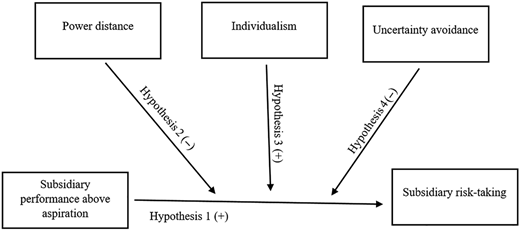
As the subsidiary's performance exceeds the aspiration level, the subsidiary takes more risks.
3.2 The moderating effect of the cultural dimensions: power distance
In Hypothesis 1, we predict that rising performance above aspirations fosters risk-taking, because it entails less control/oversight and more autonomy by headquarter, and greater self-confidence and trust in the subsidiary's own ability. We now contend that the positive relationship between a positive performance rising above aspirations and the subsidiary risk-taking is attenuated in countries where the culture is relatively high in power distance.
Power refers to the capacity to influence others (French and Raven, 1959), measuring the ability to shape others' attitudes, values, and behaviors. Power distance, as a key cultural dimension, refers to the extent to which power is unequally distributed within a society and the degree to which this inequality is accepted by its members (Hofstede, 2011). Although power is unequally distributed in social entities (Blau, 2017), individuals differ in their reactions vis-à-vis power asymmetries (Kirkman et al., 2006). As a cultural value, power distance captures how these reactions differ across regions, generating a continuum where high power distance and low power distance represent opposite poles (Hofstede, 2001).
In high power distance cultures, individuals do little to reduce power inequalities, whereas in low power distance cultures, individuals tend to challenge the status quo. In other words, when a “perceived” power distance is relatively large, individuals exert little effort to reduce the “actual” power differentials. Consequently, in settings of high power distance, individuals hold a static vision of vertical mobility, regardless of performance (Triandis, 1995). By contrast, when the perceived power distance is small, individuals make the greatest effort to challenge the status quo.
These dynamics apply to vertical relationships in organizations. In high power distance cultures – where managers are less likely to challenge the established hierarchical authority of the headquarter –, the beneficial effects of rising positive performance are less likely to translate into challenging and uncertain risk-taking behaviors. This notion is consistent with studies outlining that, in countries of high power distance, decision-makers often perceive the subsidiary as highly dependent on headquarters, more strongly believing that decisions require approval from the superior authority (Muller et al., 2005; Chiu et al., 2018). Additionally, when it comes to control mechanisms, high power distance cultures prefer strong authority as they help preserve the existing social order and its related distribution of power (Dorfman et al., 2012). In these cultures, MNEs tend to be centralized with power concentrated in the hands of the headquarter as a result of the national culture and regardless of the others' behaviors or aptitudes and the realized outcomes. Thus, stemming from a cultural mindset, the subsidiaries will receive more equal attention and control independently of their relative performance (Meyer et al., 2020). Consequently, in high power distance cultures, a positive relative performance does less in terms of reducing the headquarters' control experienced by the subsidiaries. By contrast, in low power distance cultures, interactions across vertical units are more intense, and subsidiaries more likely receive control based on their relative performance (Varela et al., 2010). Overall, when above performance aspirations, subsidiaries' decision-makers may be less inclined to exercise the autonomy afforded to them. Instead, they prioritize maintaining the accepted hierarchical structure within the MNE, thereby avoiding independent, risky decisions.
Furthermore, in societies characterized by high power distance, trust between individuals of different statuses and roles tends to be limited (Mihet, 2013; Lewellyn and Bao, 2015). Research highlights the significant influence of trust on the decision-making process, particularly when it comes to risky decisions (Das and Teng, 2004). While surpassing aspiration levels provides both the motivation and resources for subsidiary decision-makers to engage in greater risk-taking, the absence of trust, a critical factor in risky decision-making (Earle, 2010), can deter decision-makers from pursuing such behaviors. This constraint is not merely psychological but also relational: managers in high-power distance contexts are more likely to anticipate disapproval or even punishment for taking initiative, even when results justify such actions (Tetteh et al., 2023). Therefore, performance success alone may be insufficient to trigger risk-taking in settings where the cultural script encourages caution and vertical deference.
Taken together, these mechanisms suggest that power distance attenuates the behavioral response to success. Thus, taking into account these considerations, we formulate the following hypothesis:
The host country's power distance negatively moderates the relationship between the performance above aspiration levels and the subsequent increase in the subsidiary risk-taking.
3.3 The moderating effect of the cultural dimensions: individualism
In Hypothesis 1, we contend that rising performance above aspirations fosters the unit's risk-taking behaviors. We now contend that such an effect is stronger under individualistic cultures (weaker in collectivistic settings).
Individualism can be broadly characterized as the tendency to value the individual over the group and give priority to personal goals (Shin et al., 2023). Individualism entails egocentric behaviors (e.g. competition) and lack of interest in others (Varela et al., 2010). It centers around the concept of selfhood, where individuals prioritize their freedom, autonomy, rewards, and/or responsibilities (Hofstede, 2001; Medcof and Wang, 2017; Rhee et al., 2020). Individualism emphasizes self-reliance and freedom of choice (Shin et al., 2023). In highly individualistic societies, people see themselves as independent and self-reliant (Markus and Kitayama, 1991), and their decisions are guided by personal initiative, freedom of choice, and self-enhancement motives (Rhee et al., 2020). Such cultures reward distinctiveness and encourage decision-makers to act on their own judgment rather than conform to collective norms. In contrast, collectivism emphasizes the goals of the group over personal goals, stresses conformity and in-group harmony, and defines the self in relation to the group (Triandis, 1995; Shin et al., 2023). “Collectivism addresses the individuals' degree of concern for their surrounding collectives. A consciousness of collectivity implies that the interest and well-being of group members prevail over individuals' goals” (Varela et al., 2010, p. 412). It triggers cooperative actions (e.g. collaboration) and social integration in the spirit of benefiting social entities (House et al., 2004). Differently from individualistic settings, collectivistic cultures foster social interdependence and benevolence (Westjohn et al., 2022), where individuals helping others with a sense of in-role contribution to the whole organization.
Based on the above, the rationale identified in Hypothesis 1 is influenced by whether the country's culture is higher or lower in individualism vs collectivism.
First, in Hypothesis 1, we reasoned that exceeding performance aspirations tends to loosen headquarters' control and expand a subsidiary's decision-making autonomy (Sengul and Obloj, 2017). Indeed, it has been acknowledged that, being provided with the needed autonomy to act, such as when performance rises, subsidiary managers may utilize the available resources and take risky initiatives as a means to increase their prominent role within the MNE (Dörrenbächer and Geppert, 2016). This phenomenon is more likely to occur in individualistic than collectivistic cultures. Additionally, in Hypothesis 1 we also argue that subsidiary risk-taking increases with positive performance because good outcomes attenuate the headquarters' overarching influence and control, liberating the actualization of cultural traits: as individualism more likely translates into greater risk-taking (Ahmed, 1998), individualistic cultures are more likely to promote risky innovation as successful subsidiaries benefit from relaxed headquarter control (Gorodnichenko and Roland, 2011, 2017; Boubakri et al., 2021). In particular, it has been noted that individualism fosters breakthrough innovation, representing greater risk-taking (Morris et al., 1994). Communities with individualistic orientations tend to attract creative and risk-loving individuals, as firms provide a more tolerant and incentivizing environment for creativity (Florida, 2002; Espig et al., 2022). Thus, as a subsidiary's performance rises above aspirations and the headquarter's control relaxes, the differences in collectivistic vs individualistic cultural influences will materialize, with individualistic culture fostering subsidiary risk-taking to a greater extent.
Second, in Hypothesis 1, we argued that strong performance enhances the confidence of a subsidiary's decision-makers, increasing their trust in their abilities and capabilities, which leads to riskier decisions (Park, 2007; Shou et al., 2020). This mechanism is intensified for subsidiaries located in individualistic societies, where managers are socialized to value and trust their own abilities. Studies show that individualism is positively linked to overconfidence (Chui et al., 2010; Pan and Statman, 2012; Illiashenko, 2019), which in turn increases the likelihood of risk-taking. Subsidiary managers operating in such environments may interpret good performance as evidence of superior judgment and use it to justify further strategic risk (Li et al., 2013). They may also seek to distinguish themselves within the MNE by pursuing ambitious initiatives, reinforcing a cycle of boldness driven by culturally reinforced self-belief.
Both the confidence stemming from performance exceeding aspiration levels and the confidence derived from the individualistic nature of the society where the subsidiary operates (Sedikides et al., 2003) drive subsidiary decision-makers to perceive themselves as possessing strong judgment, encouraging them to engage in riskier behaviors. This effect may be further amplified by their strong belief in their abilities, which can potentially blind them to the threats and uncertainties associated with risky decisions. As a result, they may underestimate the potential risks and uncertainties (Li et al., 2013), further motivating them to pursue even riskier strategies.
Overall, these dynamics suggest that the cultural context of individualism intensifies the psychological and structural mechanisms that link positive performance feedback to risk-taking. Accordingly, we hypothesize the following:
The host country's individualism positively moderates the relationship between the performance above aspiration levels and the subsequent increase in the subsidiary risk-taking.
3.4 The moderating effect of the cultural dimensions: uncertainty avoidance
In Hypothesis 1, we predicted that when a subsidiary surpasses its performance aspirations, it tends to take more risks. We further refine this hypothesis by proposing that this effect is attenuated in national contexts characterized by high uncertainty avoidance. Uncertainty avoidance is defined as the extent to which a culture programs its members to feel comfortable or uncomfortable in ambiguous situations that are new, unfamiliar, or unexpected (Hofstede, 2001).
Given that risk-taking is often intertwined with uncertain outcomes for a firm (Palmer and Wiseman, 1999), decision-makers within subsidiaries are inclined to exercise caution when deliberating risky decisions. While performance above aspiration provides extra slack and resources available to the subsidiary serving as a buffer for risky decisions, decision-makers in societies with high uncertainty avoidance exhibit a preference for consistency and structure over change and risk (House et al., 2004).
In cultures that are low in uncertainty avoidance, individuals tend to take higher risks, find unpredictability less threatening, have higher tolerance for ambiguity and less stress and anxiety about the unknown (Kirkman et al., 2006). In cultures that are high in uncertainty avoidance, individuals take fewer risks, have more rules and regulations, desire consensus, and show little tolerance for individual behavior deviation. In these cultures, uncertainty and ambiguity create stress and raise anxiety, so behavior is more predictable (Shin et al., 2023).
Indeed, numerous prior studies employs uncertainty avoidance as a proxy for risk tolerance, with greater uncertainty avoidance aligning with lower risk tolerance (e.g. Frijns et al., 2013; Ladbury and Hinsz, 2009). In these environments, the preference for maintaining the status quo is reinforced by the fear of unknown outcomes, particularly when existing strategies have proven successful. Managers may interpret good performance not as a license to experiment but as validation of the current trajectory, thereby reducing their motivation to deviate from established practices. In this way, uncertainty avoidance acts as a psychological brake on exploration, even when performance-based incentives to take risks are present.
Additionally, in high uncertainty avoidance cultures, overconfidence may be tempered by a cultural preference for structured and cautious decision-making. While subsidiary decision-makers may interpret performance above aspiration and less headquarter's control as confidence in their abilities, their propensity for risk-taking may remain constrained. This is because individuals in such cultures are inherently less inclined to engage in actions where the outcomes are uncertain. Although some risky initiatives might still be pursued, their scope and frequency are likely to be more limited due to a deep-seated preference for minimizing uncertainty, which inherently restricts risk-taking behavior. Hence, we advance the following hypothesis:
The host country's uncertainty avoidance negatively moderates the relationship between the performance above aspiration levels and the subsequent increase in the subsidiary risk-taking.
Figure 1 shows a summary of hypotheses.
4. Method
4.1 Data
To test the formulated hypotheses, our study centers on a dataset comprising foreign subsidiaries situated in five host countries: the UK, Germany, Italy, France, and Spain. This sample is particularly interesting as, despite consisting of European countries, it includes countries with substantial differences in terms of contextual characteristics such as cultural dimensions (Kaasa et al., 2014). The data spans a nine-year period, from 2013 to 2022, and is sourced from the Orbis database provided by Bureau Van Dijk (Bajgar et al., 2020; Castaldi et al., 2019). This extended time frame allows for a deeper understanding of these complexities and supports more robust and reliable predictions (Wooldridge, 2010). Orbis serves as a repository of information related to financial accounts and corporate structures, encompassing a diverse array of firms on a global scale. These entities represent a broad spectrum, including state-owned enterprises, multinational subsidiaries, affiliates within business groups, and financial institutions (Andrews et al., 2025). Our analysis is centered specifically on foreign subsidiaries. To identify them, we used Orbis records on the Global Ultimate Owner (GUO) of each company, selecting subsidiaries with foreign ownership (Phillips et al., 2021). We examined subsidiaries whose GUO is located in any country worldwide, excluding the host country of the focal subsidiary. Also, our focus was on subsidiaries whose GUO is a corporate entity with at least one employee. We further refined the dataset to include subsidiaries with at least one employee in 2022 and whose most recent financial statements were from 2022 or later. The final sample covers GUOs from 95 different home countries. The largest shares originate from Western Europe (42%), North America (23%), and Asia-Pacific (19%), with the remainder distributed across Latin America, the Middle East, and Africa. In total, our dataset comprises 51,775 foreign subsidiaries that align with our specified inclusion criteria. The distribution of subsidiaries is as follows: 18,877 in the UK, 18631 in Germany, 6,884 in Italy, 1,253 in France, and 6,120 in Spain.
4.2 Dependent variable
To measure subsidiary risk, we employ the standard deviation of the return on assets (ROA) over a three-year period, with the risk for each year determined using that year's ROA along with the ROA from the subsequent two years. This is a commonly used risk metric in academic literature (e.g. Martin et al., 2015; Zona et al., 2024; Miller and Chen, 2003). For example, Miller and Chen (2003) used this metric to investigate risk preferences across industry performance levels of US public firms, while Cirillo et al. (2021) apply the same measure to analyze risk in privately held Italian firms over a specific three-year period.
4.3 Independent variables
We measure subsidiary performance by considering the subsidiary's ROA (Xiao and Tian, 2023; Castaldi et al., 2019). To define the aspiration level, we use the average performance of subsidiaries within the same MNE, situated in the same host country each year. Performance above aspiration is when the subsidiary's performance surpasses the aspiration level which receives the value equal to its ROA and 0 otherwise (Xiao and Tian, 2023; Greve, 2003). Consequently, all other subsidiaries with performance equal to or below the aspiration level are assigned a value of 0. In cases where no other subsidiaries from the same MNE are present in the host country (a standalone subsidiary), the value is also coded as 0.
The Hofstede indices for power distance, individualism, and uncertainty avoidance serve as representations of national cultural constructs in the host countries. We follow Lewellyn and Bao (2015) and adopt the “as is” measures. These Hofstede variables have a well-established history of utilization in IB, as evidenced by their widespread use among scholars (see Beugelsdijk et al., 2017 for a review). In Hofstede's (2001) framework, the power distance variable pertains to the degree to which less powerful individuals in institutions and organizations within a country anticipate and embrace unequal power distribution. The individualism variable revolves around whether a society's self-image is shaped by an “I” or “We” orientation. In individualist societies, there is an expectation for individuals to independently care for themselves. Additionally, uncertainty avoidance relates to the extent to which members of a culture feel uneasy in the face of ambiguous or unknown situations, leading to the establishment of beliefs and institutions aimed at avoiding such uncertainties, as indicated by the uncertainty avoidance score.
4.4 Control variables
To address potential biases in our results, we integrate a set of control variables, aligning with established practices in previous literature. To address industry-specific dynamics, we introduce a control, industry average performance, by incorporating the average performance of foreign subsidiaries within the same industry and host country for each year; this is crucial, as various industries exhibit diverse average performance levels among competitors, providing a nuanced understanding of success signals, a consideration often emphasized by behavioral scholars investigating risk (e.g. Zona et al., 2024). Additionally, we incorporate a control for subsidiary performance by including each subsidiary's ROA. We account for subsidiary age, recognizing that older subsidiaries may display distinct risk behaviors compared to their younger counterparts. Controlling for the impact of size on risk, we include subsidiary size, measured by the number of employees, which is particularly relevant given the variance in risk levels among smaller firms. Organizational slack is frequently considered a factor affecting firm performance because managers can use surplus resources to invest, which is essential for improving performance (Daniel et al., 2004). To control for the subsidiary's slack, we use the current ratio, a commonly applied proxy. Furthermore, we address financial health considerations by including shareholder funds, which reflect available funds and act as a buffer against unforeseen events (Iyer and Miller, 2008). To capture the subsidiary's position in the MNE hierarchy, we include a dummy variable indicating whether the subsidiary is a first-level subsidiary.
Country-level characteristics are accounted for through several controls. For the host country, we include host market size (measured by the logarithm of GDP) and host country wealth (measured by GDP per capita). Similarly, we control for the headquarters (GUO) country characteristics by including the logarithm of GDP to capture GUO market size and GDP per capita to reflect GUO country wealth. In addition, we control for cultural influences originating from the headquarters country by including three variables based on Hofstede's framework: GUO power distance, GUO individualism, and GUO uncertainty avoidance, each corresponding to the cultural scores of the headquarters' home country. Recognizing the distinct roles of subsidiaries within the MNE structure, we introduce industry dummies represented by 2-digit NACE codes, reflecting the economic activity of each subsidiary and allowing for the capture of variations arising from different functions.
4.5 Analysis
In our analysis, we conducted fixed-effects regression. The primary reason for choosing a fixed effects approach is its ability to mitigate omitted-variable bias in models that are not fully specified. Fixed effects methods address this bias even when the exact structure of a fully specified model is unknown (Firebaugh et al., 2013). Our models are dynamic in nature because we lag all independent variables by one year relative to firm risk, addressing potential endogeneity issues. The estimation encompasses five main models. Model 1 serves as the baseline, incorporating controls, while Model 2 introduces subsidiary performance above the aspiration level. Models 3 to 5 show the interaction effects of performance above the aspiration level with cultural dimensions, specifically power distance, individualism, and uncertainty avoidance, respectively. A correlation analysis was conducted on all dependent, independent, and control variables to assess multicollinearity. The results suggest that multicollinearity is not a significant concern in our analysis.
5. Results
Table 1 displays correlation coefficients for variables, showing that multicollinearity is not a significant issue. Although cultural dimensions exhibit high correlations, their separate inclusion in the models effectively addresses potential multicollinearity concerns. The descriptive statistics highlight that subsidiary risk is positively related to performance above the aspiration level.
Table 2 presents regression results for the models. Hypothesis 1 predicts that as the subsidiary's performance surpasses the aspiration level, the subsidiary will exhibit a higher propensity for risk-taking. The regression result in Table 2, Model 2, validates this hypothesis. Notably, the positive and statistically significant effect of subsidiary performance above the aspiration on risk () provides empirical support for Hypothesis 1.
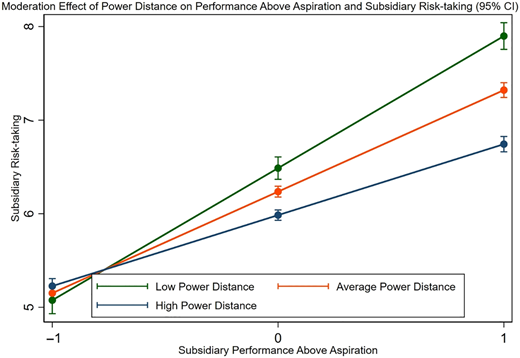
Hypothesis 2 predicts a negative moderating effect of the power distance cultural dimension in the host country on the relationship between subsidiary performance above aspiration and increased risk-taking. The analysis in Table 2, Model 3, indicates that the interaction effect is negative and statistically significant (). This implies that the inclination to take risks for subsidiaries with a higher power distance cultural dimension is weaker compared to subsidiaries located in low power distance environments. Hypothesis 2 is thus supported. To further understand the size and meaning of this interaction, we examine the marginal effects at different levels of power distance. When power distance is one standard deviation below the mean (i.e. in low power distance societies), the marginal effect of exceeding aspiration on risk-taking is 1.757. At the mean level, it is 1.625, and at one standard deviation above the mean (i.e. in high power distance contexts), it drops to 1.493. This indicates that while performance above aspiration generally increases risk-taking, this effect is weaker in hierarchical, high-power-distance cultures.
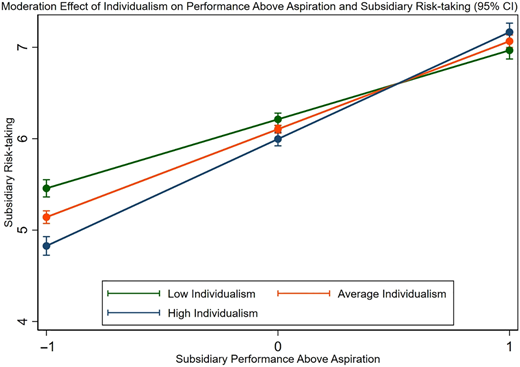
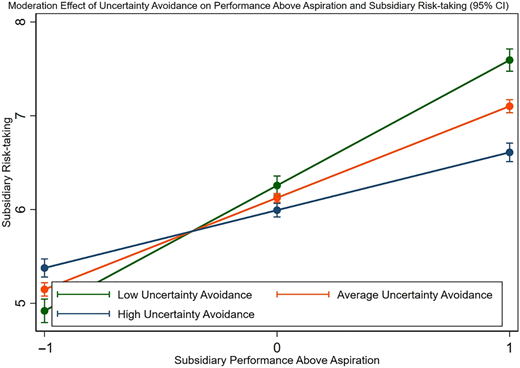
In Table 2, Model 4, the results concerning the interaction effect with individualism are presented. Hypothesis 3 posits that the impact of subsidiary performance above the aspiration on increased risk-taking is particularly stronger in individualistic societies. The analysis reveals a significant and positive coefficient for this interaction effect (), providing empirical support for Hypothesis 3. The marginal effect analysis further shows that the effect of performance above aspiration on risk-taking is 1.425 for subsidiaries in low individualism contexts (−1 SD), 1.613 at average levels (0 SD), and increases to 1.801 for those in high individualism contexts (+1 SD). This pattern indicates that individualism amplifies the effect of success on subsidiary risk-taking, consistent with Hypothesis 3. Hypothesis 4 also predicts that uncertainty avoidance negatively moderates the relationship between performance above the aspiration and subsidiary increased risk-taking. The interaction result, with a statistically significant and negative coefficient () substantiates Hypothesis 4. We also calculated the marginal effects of subsidiary performance above aspiration at different levels of the uncertainty avoidance index. When uncertainty avoidance is low (−1 SD), the marginal effect of performance above aspiration on subsidiary risk-taking is 1.922, compared to 1.606 at the mean level. This effect decreases to 1.290 when uncertainty avoidance is high (+1 SD). These findings demonstrate that the positive influence of exceeding aspiration levels on subsidiary risk-taking weakens as uncertainty avoidance increases. This supports our theoretical expectation that in cultures more averse to uncertainty, even high-performing subsidiaries are less inclined to leverage their success to pursue riskier initiatives.
The moderating effects of host country power distance, individualism, and uncertainty avoidance on the relationship between subsidiary performance above the aspiration and its increased risk-taking behavior are visually illustrated in Figures 2–4, respectively. These graphical representations demonstrate that subsidiaries not only exhibit increased risk-taking when performance exceeds the aspiration but also highlight the significant influence of national culture. Power distance and uncertainty avoidance exhibit negative moderating effects, while individualism shows a positive moderating effect on such risk behavior.
The control variables also yield interesting insights. Industry average performance is negative and significant in all models. Subsidiary performance, age, and slack resources also have negative correlations with subsidiary risk behavior. The status of being a first-level subsidiary (directly owned by the headquarters) is associated with reduced risk-taking behavior in Model 1. Additionally, the country-level control variables exhibit significant coefficients. Both the market size of the host country and the GUO country are negatively correlated with subsidiary risk-taking, whereas the wealth of the host country positively influences subsidiary risk-taking. Lastly, some industry dummy variables are found to be statistically significant, adding further nuance to the overall analysis.
5.1 Robustness test
To assess the stability and reliability of our findings, we conducted several robustness checks using alternative specifications, data treatments, and samples. First, we clustered standard errors at the subsidiary level to account for potential autocorrelation and heteroskedasticity within firms over time (Conley and Kelly, 2025; Dieleman and Templin, 2014; Abadie et al., 2023). This approach provides more conservative inferences by relaxing the assumption of independence across repeated observations within each subsidiary. Second, we examined the sensitivity of our results to the timing of effects by testing alternative lag structures (Wilkins, 2018). While our main specification uses a one-year lag to establish temporal ordering between subsidiary performance and subsequent risk-taking, we also tested a two-year lag. The results remained robust across these different time windows. Third, we addressed the potential influence of outliers by winsorizing both the dependent variable (subsidiary risk) and the main independent variable (performance above aspiration) at the 1st and 99th percentiles (Brownen-Trinh, 2019). Under this specification, the results remained largely consistent; the key effects, including the main performance–risk relationship and the moderating roles of individualism and uncertainty avoidance, retained their significance. However, the moderating effect of power distance lost statistical significance in the winsorized models, suggesting this particular interaction may be more sensitive to distributional assumptions. Finally, we addressed the cases where no other subsidiaries from the same MNE are present in the host country. In our main specification, these subsidiaries are coded as 0, consistent with the treatment of subsidiaries that perform at or below the aspiration level. To assess whether this coding decision drives our results, we reran all regressions after excluding these cases from the analysis. The results remain the same, with the direction, magnitude, and significance of the coefficients unchanged. These findings reinforce confidence in the robustness and generalizability of our results.
6. Discussion
Based on the BTOF, this study explores how risk-taking behavior in MNE subsidiaries is shaped under conditions of positive performance feedback. Drawing on a large panel of foreign subsidiaries across five European countries, our findings reveal that subsidiaries experiencing above-aspiration performance are more likely to engage in risk-taking activities. Importantly, this relationship is not uniform across contexts: national culture plays a significant moderating role. Subsidiaries located in countries characterized by high power distance and strong uncertainty avoidance exhibit a weaker inclination toward increased risk-taking, whereas those in more individualistic societies show a stronger propensity to take risks in response to positive performance feedback.
This finding contributes to an ongoing theoretical debate about how firms respond to rising performance. Some scholars argue that when firms exceed their aspirations, they become risk-averse, preferring to preserve successful routines and avoid disrupting the status quo (Joseph and Gaba, 2015; Lucas et al., 2018). In contrast, others suggest that high performance provides firms with the confidence and slack to pursue bolder strategies (Bromiley and Washburn, 2011; Lounsbury and Beckman, 2015). Our results support the latter view in the context of MNE subsidiaries, showing that rising performance does not lead to complacency but rather enables risk-taking, particularly when the cultural environment encourages it. By empirically engaging with this theoretical tension, our study provides clarity on how positive performance feedback operates within subsidiary units and underlines the importance of considering context-specific conditions in resolving this debate.
This study contributes to the IB literature by extending the BTOF into the underexplored context of positive performance feedback within MNE subsidiaries. While BTOF-based research has typically examined risk-taking under conditions of underperformance (e.g. Greve, 2003; Chen and Miller, 2007), our study shifts the lens to subsidiary behavior when performance exceeds aspiration levels. By doing so, we introduce rising relative performance as a key condition that enables subsidiaries to engage in risk-taking actions. By integrating the BTOF into these perspectives, our study identifies positive performance feedback as a bridging mechanism: from the headquarters' view, strong performance can relax centralized monitoring and enable local initiative; from the subsidiary's perspective, it boosts confidence and reinforces trust in its own abilities, both vis-à-vis the headquarters and local peers. Thus, we propose that rising performance connects previously distinct views on subsidiary risk-taking, headquarters' control and trust, and subsidiary's capability, into a unified behavioral framework. In doing so, we respond to recent calls for applying BTOF more systematically within IB (Surdu et al., 2021).
Second, this study advances the understanding of subsidiary-level strategic behavior by re-centering attention on the subsidiary as an independent and proactive decision-making unit. Much of the existing IB literature has traditionally prioritized the headquarters as the primary locus of strategic control, portraying subsidiaries as largely reactive to top-down governance structures (Sengul and Obloj, 2017; Cavanagh et al., 2017). Building on the BTOF's emphasis on bounded rationality and aspiration-based learning (Cyert and March, 1963), we shift the analytical focus to subsidiary-level cognition and autonomy, particularly in response to performance success. Our study demonstrates that when a subsidiary exceeds its aspiration level, it is more likely to adopt a risk-taking posture, suggesting that positive performance not only facilitates strategic latitude but also activates confidence among subsidiary decision-makers. This complements recent insights from Deng et al. (2022), who emphasize the strategic distinctiveness of subsidiary behavior compared to headquarters logic. We also respond to Lewellyn and Bao's (2015) call to consider the role of managers' cognitive processes and psychological states, such as self-assurance, in shaping firm-level outcomes. In doing so, we show that rising performance acts as more than a trigger for action; it also serves as a psychological enabler that increases subsidiary managers' willingness to take initiative. This enriched understanding of subsidiary behavior highlights the importance of performance-induced discretion, where subsidiary actors are not only permitted but internally motivated to act strategically on behalf of their unit.
Third, this study contributes to the contextualization of subsidiary behavior by incorporating the moderating influence of national culture into the analysis of performance-based risk-taking. While the cross-cultural nature of IB has long been recognized (Hofstede, 2001; Miao et al., 2016), many studies have tended to treat cultural context as a control variable or an aggregate measure (Hutzschenreuter and Voll, 2008). Our study extends this literature by examining individual cultural dimensions, specifically, individualism, power distance, and uncertainty avoidance, and how each distinctly shapes the cognitive framing of positive performance feedback by subsidiary decision-makers. Recent BTOF advancements have highlighted the role of context in shaping behavioral responses to performance signals, showing that cultural values influence how managers perceive, interpret, and act upon these cues (Kotiloglu et al., 2023; Smulowitz et al., 2020; Xue et al., 2023). As Crossland and Hambrick (2011) and Lewellyn and Bao (2015) argue, cultural influences are particularly salient when decision-makers operate with greater discretion, such as under positive feedback conditions. In line with these insights, our findings show that subsidiaries located in high power distance and high uncertainty avoidance cultures tend to be more cautious in increasing risk despite strong performance, while those in individualistic cultures show a significantly stronger inclination to risk-taking. This aligns with and extends the review by Geleilate et al. (2020), which highlights the limited theorization of subsidiary context and the need for more contingent perspectives. By integrating national culture as a moderator, we reveal that performance feedback does not operate uniformly across global subsidiaries. Instead, its behavioral consequences are filtered through local cultural lenses, which shape how subsidiary managers evaluate risk and decide whether or not to act. This culturally grounded perspective not only clarifies inconsistencies in prior findings but also opens new directions for exploring how contextual forces constrain or enable subsidiary-level strategic behavior across different institutional environments.
Fourth, this study provides insightful implications for the BTOF. Unlike many BTOF studies that primarily concentrate on single-country samples (e.g. Zhang and You, 2021; Sengul and Obloj, 2017), our research spans foreign subsidiaries situated in five distinct host countries. By revealing that surpassing performance aspirations leads to increased risk-taking behavior across these diverse settings, we show that this foundational management theory holds universal relevance within the context of MNEs and, more specifically, foreign subsidiaries. Our findings underscore the adaptability and applicability of the BTOF beyond singular national contexts, reinforcing its significance in understanding the dynamics of decision-making and risk behavior.
Finally, our study carries managerial implications by showing the nuanced ways in which subsidiary decision-makers derive meaning from their performance, continually benchmarking themselves against aspirational levels. It underscores the pivotal role of peer comparison in shaping strategic decisions, particularly in risk-taking. Notably, our findings reveal that subsidiaries surpassing performance aspiration level exert extra effort to garner recognition within the MNE system by embracing riskier decisions. This study accentuates the idea that exceeding performance aspirations provides subsidiaries with a degree of autonomy, allowing them to independently pursue strategies, even those diverging from the headquarters' perspective. As such, it offers valuable insights for decision-makers seeking to understand why subsidiaries in different countries, albeit within the same MNEs, exhibit distinct behaviors. Our research highlights the influence of cultural dimensions in shaping how subsidiary decision-makers perceive and interpret situations, ultimately impacting their risk behavior.
7. Limitations and future research directions
While our study offers valuable insights into the dynamics of subsidiary risk behavior, it is imperative to acknowledge certain limitations that pave the way for future research exploration. First, future research could further investigate the specific types of behaviors firms engage in, moving beyond aggregated measures such as the standard deviation of ROA (Castaldi et al., 2019; Scott et al., 2010). By identifying and categorizing distinct behavioral responses, scholars could explore how these behaviors differ depending on whether firms are performing above or below their aspiration levels. This would offer more granular insights into the mechanisms underlying performance feedback and strategic decision-making (Deng et al., 2022). Second, our examination has primarily focused on the cultural dimensions of five European countries, providing insightful findings. However, we recommend the inclusion of a more diverse range of countries in future studies, especially those with pronounced cultural discrepancies, such as Japan, as they hold the potential to offer unique and enriching insights (Mihet, 2013). Third, our study has focused on three cultural dimensions, power distance, individualism, and uncertainty avoidance, using established frameworks like Hofstede. Recognizing the wealth of alternative indices within Hofstede, Globe, and other sources (Tung and Verbeke, 2010), researchers could explore different cultural dimensions to further expand the understanding of how cultural factors shape risk behavior in multinational contexts. Fourth, considering the varied functions of subsidiaries within the MNE system (Meyer et al., 2020), it is reasonable to expect that each may exhibit distinct levels of risk behavior. Although we implemented controls such as the 2-digit NACE classification to account for the economic activities of subsidiaries, future research could delve deeper into the nuanced roles of subsidiaries, providing a more detailed exploration of how each specific function may influence their propensity for more or less risk. This deeper understanding could contribute significantly to the refinement of risk strategies. Finally, while our study focuses on the role of national culture in shaping subsidiary executives' responses to above-aspiration performance, we acknowledge that culture may also influence how performance itself is perceived and interpreted. That is, cultural values could shape not only the behavioral reactions to performance feedback but also the subjective construction of success and failure (Bailey et al., 1997). Although our analysis is based on objective performance comparisons among peer subsidiaries, we do not directly account for potential cultural variation in the interpretation of these outcomes. Future research could explore this “double influence” of national culture, on both perception and response, as a fruitful extension of our findings.