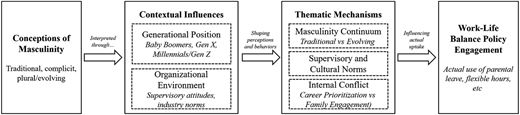
This study explores how different conceptions of masculinity – ranging from traditional breadwinner models to more egalitarian frameworks – influence men’s engagement with work–life balance policies. It examines how generational differences intersect with supervisory attitudes and organizational culture in shaping men’s decisions to use family friendly policies.
A qualitative research design was adopted, involving semi-structured interviews with 45 men from three generational cohorts: Baby Boomers, Generation X and Millennials/Generation Z. The study applied an iterative, inductive analysis to explore how masculinities are expressed and negotiated in relation to work–life practices.
The analysis identifies three core themes: (1) masculinity continuum (traditional vs evolving), (2) supervisory and cultural norms and (3) internal conflict (career prioritization vs family engagement). Older participants tended to align with hegemonic masculinity and avoid policy use, while younger men embraced more egalitarian models. Leadership and workplace norms played a central role in reinforcing or challenging gendered expectations around work–life engagement.
Organizations should move beyond policy availability and foster inclusive cultures where men feel supported in reconciling work and family roles. Supervisors play a crucial role in modeling alternative masculinities and legitimizing the use of family friendly policies, particularly in contexts where traditional norms persist.
This study contributes to work–family literature by integrating Connell’s theory of multiple masculinities with empirical insights on generational dynamics and organizational influence. It highlights how identity, leadership and culture interact to shape men’s engagement with work–life practices – an area often overlooked in both gender and organizational research.
Introduction
In today’s fast-paced world, balancing career ambitions and family responsibilities has become one of the most complex challenges faced by modern workers. This struggle is poignantly portrayed in popular culture—for instance, in the film The Pursuit of Happyness (2006)—where the protagonist embodies the traditional image of masculinity: a man who must relentlessly pursue professional success to secure his family’s future, even at the cost of personal sacrifice. Such portrayals reflect deeply ingrained societal expectations of men as primary breadwinners, where professional success is not merely desired but required (Barnett and Hyde, 2001; Ranson, 2001). Yet, as societal views on gender evolve, an important question emerges: how are men navigating these shifting expectations (e.g. Hjálmsdóttir and Bjarnadóttir, 2021; Tanquerel and Grau-Grau, 2020)? More importantly, how do evolving views of masculinity impact their ability to achieve meaningful work-life balance (e.g. Balan et al., 2023; Hytti et al., 2024)?
Although gender is one of the most extensively studied variables in work-family research (Shockley et al., 2017), scholarly attention has traditionally focused on women, who have historically shouldered the majority of caregiving responsibilities (de Gennaro et al., 2022; Emslie and Hunt, 2009). The notion that work-life balance is not exclusively a women’s issue is now well-established (Leslie and Manchester, 2011). However, men’s experiences remain comparatively underexplored—particularly in relation to the unique pressures created by traditional masculinity norms. For instance, men are often expected to conform to the breadwinner ideal, prioritizing their careers over family life, which can discourage them from engaging with family-friendly policies such as parental leave or flexible working arrangements (Berdahl et al., 2018; McGill, 2014). At the same time, alternative forms of masculinity are gaining visibility, with more men embracing caregiving roles and seeking egalitarian dynamics within the family (Connell, 2020; Kossek et al., 2021).
This tension between traditional and evolving masculinities is further shaped by organizational and cultural dynamics (Stanaland et al., 2023). Many workplaces continue to uphold the “ideal worker” norm (Acker, 2006), which equates professional success with uninterrupted dedication to work. This model often discourages men from prioritizing family responsibilities, reinforcing a masculinity contest culture (Berdahl et al., 2018; Nieto-Aleman et al., 2025), where performance, availability, and ambition are seen as indicators of masculine success. However, alternative models of masculinity—those that embrace flexibility, emotional engagement, vulnerability, and shared caregiving—are gaining momentum (Connor et al., 2021; Regina and Allen, 2023). Supervisory attitudes and organizational culture play a pivotal role in either reinforcing or challenging these norms, directly shaping whether and how men engage in work-life balance practices (Maheshwari et al., 2022; Thomas et al., 2024).
Generational differences add an additional layer of complexity. While Baby Boomers and Generation X often maintain traditional breadwinner ideals, Millennials and Generation Z are increasingly challenging these norms in favor of more egalitarian conceptions of success, where work-life balance plays a central role (Gatrell et al., 2022; Reid et al., 2018). Yet workplaces are not uniformly supportive of these shifts, and men continue to encounter both internal and external barriers that influence their decisions to engage with family-friendly policies (Balan et al., 2023).
This study employs a qualitative research design to explore how men’s conceptions of masculinity influence their engagement with work-life balance policies, with a particular focus on generational differences and organizational factors. Drawing on Connell’s (2020) concept of multiple masculinities, we examine how men navigate the tension between traditional and evolving masculine norms, and how their experiences are shaped by workplace expectations and cultural contexts. This approach allows us to address two key gaps in the literature: (1) understanding how conceptions of masculinity influence men’s willingness to utilize family-friendly work policies; and (2) exploring the role of organizational culture and supervisory attitudes in shaping these decisions. Within this framework, we investigate how generational differences affect men’s attitudes and behaviors, and what internal and external barriers they face in balancing professional success with family responsibilities.
This study contributes to both scholarship and practice by showing how masculinity influences men’s engagement with family-friendly policies across generations and organizational settings. It clarifies the role of supervisory attitudes and workplace culture in shaping gendered expectations around work-life balance. The integration of Connell’s theory of multiple masculinities allows for a deeper interpretation of how men experience, negotiate, or resist evolving norms. The findings also inform practical strategies for organizations aiming to support diverse expressions of masculinity and promote more inclusive approaches to work-life integration.
Theoretical background
Masculinity as a social construct
Masculinity, as a socially constructed concept, has been extensively studied across disciplines such as sociology, psychology, and organizational studies (Connell, 2020; Ranson, 2001; Roy and Allen, 2022). Traditionally, masculinity has been associated with attributes like competitiveness, assertiveness, and career dedication—traits often tied to the “breadwinner” role within family structures (Cobb et al., 2024). These norms are reinforced by organizational cultures that prioritize behaviors aligned with constant availability and professional dominance, often at the expense of personal or family life. Such expectations are deeply embedded in the “ideal worker” model (Acker, 2006), which equates professional success with uninterrupted career progression.
The “ideal worker” prototype, historically aligned with male norms, perpetuates the expectation that men must prioritize their careers above all else (Davies and Frink, 2014). In organizational contexts, this has led to environments where work-life balance is perceived as incompatible with professional ambition. Berdahl et al. (2018) describe such settings as masculinity contest cultures, where men compete to embody traditional masculine ideals such as dominance and power. Within these cultures, men who engage in caregiving or utilize family-friendly policies may face stigma or be perceived as less committed to their professional roles (Hennekam et al., 2023; Thébaud and Pedulla, 2022).
Evolving masculinities and generational differences
While traditional masculinity continues to influence workplace expectations, societal and cultural shifts have led to the emergence of “multiple masculinities” (Connell, 2020). Connell’s framework highlights that masculinity is not a fixed or universal construct, but a set of socially constructed identities that vary across individuals, generations, and contexts. This theory distinguishes between several forms of masculinity, including: (1) Hegemonic masculinity, representing the dominant cultural ideal associated with authority, independence, competitiveness, and the breadwinner role; (2) Complicit masculinity, which does not embody hegemonic traits but still benefits from the privileges they confer; (3) Subordinate masculinity, often associated with men who do not conform to traditional norms, including gay men; and (4) Marginalized masculinity, which intersects with other axes of inequality, such as race or class, and lacks access to hegemonic status. This pluralistic view opens possibilities for men to reject hegemonic ideals and embrace caregiving roles, emotional openness, and shared family responsibilities alongside their careers (Lewington et al., 2021).
Generational differences further underscore the evolving nature of masculinity (Pfaffendorf and Hill, 2025). Millennials and Generation Z increasingly challenge hegemonic masculinity and instead adopt more egalitarian and flexible forms. These younger cohorts are more likely to take advantage of family-friendly policies, prioritize work-life balance, and seek workplace cultures that support inclusivity and personal well-being (Febriana and Mujib, 2024; Gatrell et al., 2022; Reid et al., 2018).
In contrast, older generations such as Baby Boomers and Generation X tend to uphold hegemonic ideals, viewing professional identity as intrinsically tied to their ability to provide for their families through uninterrupted career dedication (Thébaud and Pedulla, 2022). Their approach often aligns with the traditional breadwinner model, reinforcing the dominance of hegemonic masculinity in organizational cultures, particularly in certain sectors.
Barriers to work-life balance
Despite evolving norms, significant barriers persist that prevent men from fully engaging with work-life balance policies. Connell’s theory of masculinity as a performance shaped by social structures provides a compelling lens for understanding these dynamics (Connell, 2020). In particular, workplace institutions and organizational hierarchies often function as key sites where hegemonic masculinity is reproduced and reinforced. These structures prioritize norms such as uninterrupted career commitment, emotional restraint, and competitiveness—traits traditionally associated with the ideal male worker.
Supervisory attitudes play a critical role in shaping men’s decisions. Thomas et al. (2024) found that supervisors with traditional views on masculinity often discourage the use of family-friendly policies, either explicitly or implicitly. In contrast, supervisors who promote more egalitarian ideals can help normalize these practices and encourage broader acceptance among male employees (Hennekam et al., 2023). These dynamics highlight the critical influence of organizational culture as a structural force, where expectations about ideal worker behavior are deeply gendered and closely tied to hegemonic masculinity.
Barriers are not solely structural; internalized norms of masculinity can also deter men from prioritizing family responsibilities. Connell’s framework suggests that men often feel compelled to align their behavior with dominant masculine ideals to gain or maintain status within workplace contexts. Iztayeva (2024) highlights the challenges faced by single fathers, who often experience heightened work-family conflict due to societal expectations that men should prioritize work. Similarly, Gatrell (2024) and Kelland et al. (2024) show that fathers in competitive or hierarchical industries are less likely to utilize family-friendly policies, fearing that doing so may undermine their professional standing and distance them from the hegemonic model of success.
Research questions and theoretical framework
To better understand the dynamics explored in this study, we draw on Connell’s (2020) theory of gender, which conceptualizes masculinity as socially constructed, dynamic, and shaped by context. This perspective offers useful insights for examining how different forms of masculinity interact with workplace expectations, generational identities, and institutional structures. By adopting a framework that recognizes masculinity as plural and context-dependent, the study is able to explore how individual beliefs, cultural norms, and organizational dynamics intersect in shaping men’s experiences.
Guided by this framework, the study addresses the following research questions:
How do traditional and evolving conceptions of masculinity influence men’s willingness to use family-friendly work policies, such as parental leave and flexible working hours?
In what ways do generational differences shape men’s attitudes and behaviors toward achieving work-life balance?
How do organizational cultures and supervisory attitudes toward gender roles affect men’s decisions to engage with work-life balance policies?
What internal and external barriers do men face in reconciling career ambitions with family responsibilities?
These questions are designed to connect the theoretical framework to the empirical focus of the study. In particular, they help capture the complexity of how masculinity is performed and negotiated within specific workplace contexts, and how this, in turn, influences men’s engagement with work-life balance policies.
Method
Context
This study is situated in Italy, where traditional gender roles have long positioned men as primary breadwinners and women as primary caregivers (see de Gennaro et al., 2022; de Gennaro and Piscopo, 2023). Historically, Italy has been a deeply patriarchal society, with family structures and cultural norms reinforcing male authority in both domestic and professional spheres. In recent years, however, societal norms have begun to shift, supported by policies such as parental leave and flexible working arrangements that offer new opportunities for men to engage more fully in caregiving roles. Nonetheless, these changes remain uneven across sectors, with many workplaces still adhering to the “ideal worker” norm, which prioritizes professional availability and career dedication over family responsibilities (Acker, 2006).
Generational differences further complicate this landscape. While Baby Boomers and Generation X often conform to traditional masculinity norms, Millennials and Generation Z increasingly adopt more egalitarian values, challenging established conventions and creating tension between long-standing expectations and emerging priorities. Grounded in this cultural and organizational context, this study explores how these dynamics shape men’s engagement with family-friendly work policies.
Research design
This research employs a qualitative design to investigate how conceptions of masculinity influence men’s engagement with work-life balance policies. Given the complex and socially constructed nature of masculinity, qualitative methods offer the depth and flexibility needed to explore nuanced individual experiences that may be overlooked by quantitative approaches (Hennink et al., 2020; Murphy et al., 2017).
Semi-structured interviews were used as the primary method of data collection, allowing participants to articulate their perspectives in their own words while giving the researcher the ability to probe deeper into relevant areas. This approach aligns with the study’s exploratory goals, facilitating the identification of emergent themes and patterns not captured by predefined quantitative frameworks.
The study is informed by grounded theory principles, allowing patterns and themes to emerge organically from the data while maintaining a close connection to participants’ narratives (Pratt et al., 2022). This iterative approach helped ensure that the research design remained aligned with the study’s focus on generational differences and organizational influences on masculinity.
Participants
Participants were selected using purposive and snowball sampling techniques to ensure a diverse and comprehensive range of perspectives. The initial group of participants was recruited through professional networks, with additional individuals identified via referrals (snowball technique, Parker et al., 2019). This approach allowed for the inclusion of men from various industries, ensuring broad representation in terms of professional roles and organizational settings.
Data collection continued until thematic saturation was reached—that is, when no new insights were emerging from additional interviews (Fusch and Ness, 2015).
The final sample included 45 men, aged between 25 and 55, all employed in organizations offering family-friendly work policies, such as parental leave and flexible working arrangements. These participants were distributed across three generational cohorts: Baby Boomers, Generation X, and Millennials/Generation Z. Detailed demographic data were collected for each participant, including marital status, number of children, job sector, and working arrangements (see Table 1).
Although 42% of participants did not have children, we believe this does not compromise the relevance or rigor of our findings. Work-life balance challenges are not limited to parents; employees without children may also face competing demands, caregiving responsibilities (e.g. eldercare), or social expectations tied to workplace presence and performance. Furthermore, Connell’s theory treats masculinity as a broader social construct, shaping men’s attitudes and behaviors in the workplace regardless of parental status.
We also observed that non-parent participants were more prevalent among younger generational cohorts, which may help explain certain generational differences in attitudes toward work-life balance. While this distribution is noteworthy, we believe the patterns identified offer meaningful insights into evolving masculinity norms and their influence on policy engagement.
Data collection
Interviews were conducted between January and April 2024, either in person or via video conferencing, depending on participants’ preferences and geographic location. Each interview lasted between 45 and 90 min and was audio-recorded with the participant’s consent.
The semi-structured interview guide included open-ended questions aimed at exploring participants’ perceptions of masculinity, career success, and work-life balance. Example questions included: How do you perceive your role as a man in balancing work and family responsibilities? What factors influenced your decision to use—or not use—family-friendly work policies? How does your workplace culture shape your attitudes toward work-life balance?
Data analysis
The data analysis followed a flexible and iterative approach inspired by the bricolage framework proposed by Pratt et al. (2022). This method emphasizes adaptability and creativity in the analytical process, encouraging researchers to combine diverse strategies to reflect the complexity of the research context. By adopting this approach, we integrated both inductive and deductive strategies to ensure the analysis captured the richness of participants’ narratives as well as the broader cultural and organizational forces shaping their experiences.
The analysis began with an inductive coding phase, during which interview transcripts were closely examined to identify first-order concepts rooted in participants’ language. These concepts—reflecting specific lived experiences—were then iteratively refined and grouped into second-order themes that highlighted broader patterns and relationships, such as generational shifts in attitudes toward work-life balance or the influence of organizational culture on masculinity norms.
To ensure clear differentiation between themes, we made a deliberate effort to distinguish between perceptions, motivations, and behaviors during coding. For example, “Importance of work-life balance” and “Desire for work-family balance” were treated as distinct: the former reflects a general recognition of balance as a value, while the latter captures participants’ proactive efforts to achieve it in daily life. Likewise, “Career comes at the expense of family” reflects retrospective regret, whereas “Family prioritized over career” describes intentional, forward-looking decisions. These distinctions were refined through multiple coding discussions within the research team to ensure each theme reflected a unique and meaningful dimension of participants’ experiences. This process aligns with the bricolage framework, which emphasizes reflexivity and the integration of multiple analytical strategies (Pratt et al., 2022).
Building on these themes, we synthesized the findings into aggregate dimensions, which capture the overarching dynamics influencing men’s engagement with family-friendly policies. For example, the dimension “Masculinity Continuum (Traditional vs Evolving)” reflects the tension between breadwinner norms and egalitarian models of masculinity, while “Supervisory and Cultural Norms” emphasizes the institutional role of the workplace in shaping men’s decisions around work-life balance.
To ensure transparency and rigor, the research team engaged in iterative discussions throughout the process, refining codes, themes, and dimensions based on both theoretical insights and contextual considerations. Software tools such as Dedoose were used to support data organization and systematic coding. Narrative reflections at each stage of the process helped us stay grounded in participants’ voices while constructing a theoretical framework that is both robust and context-sensitive.
The outcomes of this analysis are presented in Table 2, which outlines the full analytical framework—from first-order concepts to second-order themes and aggregate dimensions. A column for emergent narratives is also included to illustrate the iterative nature of the process and the context-specific insights that inform the findings.
Findings
The findings from this study are organized around three interrelated themes: (1) Masculinity Continuum (Traditional vs Evolving), (2) Supervisory and Cultural Norms, and (3) Internal Conflict (Career Prioritization vs Family Engagement).
These themes reflect how men across different generational cohorts and organizational contexts navigate the tension between professional ambition and family responsibilities. They also illustrate how broader conceptions of masculinity—rooted in Connell’s (2020) framework of multiple masculinities—intersect with structural and cultural factors to influence engagement with work-life balance policies. Taken together, the themes respond to the four research questions posed in this study, offering a deeper understanding of how masculine identities are constructed and enacted in contemporary workplaces.
Figure 1 presents a visual representation of the findings, illustrating how the three thematic mechanisms interact to shape men’s engagement with family-friendly work policies.
Masculinity continuum (traditional vs evolving)
A central finding concerns the tension between traditional and evolving conceptions of masculinity. For many participants, especially those from older generations, masculinity remained closely linked to professional success and financial provision—key traits of hegemonic masculinity (Connell, 2020). This alignment often discouraged engagement with family-friendly policies, which were seen as incompatible with the ideal of the uninterrupted, career-focused male worker.
Participant 17 (aged 48): I’ve always felt that my role as a man is to provide for my family. […] Taking parental leave? That’s something I’ve never even considered.
These participants often described a traditional division of labor within their households, reinforcing the belief that caregiving was not part of their domain and that using such policies might signal diminished ambition or commitment.
In contrast, participants from younger cohorts drew on more pluralistic and egalitarian forms of masculinity, seeing caregiving not as a threat to their identity but as an essential part of it. Many emphasized the importance of emotional presence and described their caregiving roles as integral to how they defined success as men.
Participant 28 (aged 32): For me, being successful means being present for my family.
Participant 30 (aged 34): I want to be different—I want to be there for my kids.
These generational patterns reflect how conceptions of masculinity evolve over time and across social contexts. They directly relate to the study’s first two research questions, which explore the influence of masculinity norms on policy engagement (RQ1) and the role of generational differences in shaping attitudes and behaviors (RQ2).
Supervisory and cultural norms
Another prominent theme concerns how organizational culture and leadership shape the conditions under which men engage with family-friendly policies. In many cases, participants reported that even when policies existed, their use was implicitly discouraged—either through subtle cues or overt expectations—reflecting broader norms of hegemonic masculinity embedded in institutional practices.
Participant 12 (aged 45): I’ve seen guys get passed over for promotions after taking time off for family.
Participant 22 (aged 42): We have flexible hours on paper, but no one really uses them.
These examples highlight how workplace structures and supervisory attitudes function as gatekeepers, either reinforcing traditional gender roles or allowing for more inclusive practices. In cultures where leadership upheld rigid expectations of constant availability and competitiveness, men often internalized the idea that family engagement was incompatible with success.
By contrast, participants working under more supportive supervisors felt empowered to use family-friendly policies without fear of stigma or career loss. These leaders often modeled alternative masculinities themselves, contributing to a shift in organizational norms.
Participant 34 (aged 30): My manager actually encouraged me to take paternity leave. […] I never felt like I had to choose between my career and my family.
As one participant noted:
Participant 37 (aged 38): I moved companies because I saw how leadership treated family time as legitimate. […] Here, it’s just part of being human.
These findings underscore how organizational culture and supervisory behavior—the focus of RQ3—serve as critical levers in either reinforcing or challenging dominant masculinity norms.
Internal conflict (career prioritization vs family engagement)
The final theme captures the internal conflicts many men face when attempting to balance professional aspirations with family responsibilities. For some, particularly among older participants, the pursuit of career success came at a personal cost.
Participant 5 (aged 58): There are times I regret not being more present for my kids. The job always came first, and now I’m realizing that I missed a lot.
These reflections highlight the long-term consequences of conforming to rigid gender expectations and demonstrate how internalized masculinity norms shape men’s decisions even in the absence of explicit barriers.
In contrast, younger participants described greater willingness to prioritize family life, even when doing so meant slowing their careers or declining advancement opportunities. Their narratives reflect a broader shift toward redefining success through balance and presence.
Participant 41 (aged 27): I’ve turned down promotions that would have required me to work longer hours.
Participant 39 (aged 29): Work-life balance isn’t just an ideal; it’s how I measure success.
Participant 26 (aged 35): My father taught me to work hard. But he also taught me that if you’re never around, what’s the point? That stuck with me.
These experiences illustrate how the negotiation between career identity and caregiving remains central to men’s work-life experiences and speaks to RQ4, which addresses the internal and external barriers men face in balancing work and family responsibilities.
Discussion
Key findings and contributions
This study explored how men from different generations engage with work-life balance policies in light of evolving conceptions of masculinity and organizational influences. Our findings illustrate how generational position, leadership behavior, and organizational culture shape men’s willingness to use family-friendly policies. While younger participants showed a growing embrace of caregiving and egalitarian ideals, older participants often adhered to traditional breadwinner roles, reinforcing the cultural persistence of hegemonic masculinity in many organizational settings.
One key contribution lies in showing how generational cohorts express distinct masculinities—aligned respectively with hegemonic, complicit, or plural forms (Connell, 2020)—in their approach to work-life balance. Baby Boomers and Generation X participants, for example, often internalized the “ideal worker” norm (Acker, 2006), equating career dedication with masculine identity and avoiding policies perceived as undermining professional standing. Millennials and Generation Z, in contrast, increasingly redefined success through emotional presence and relational engagement, echoing emerging models of masculinity that challenge traditional norms (Gatrell et al., 2022; Kossek et al., 2021).
Importantly, these patterns are not merely individual preferences but are shaped by organizational culture. In line with prior research (Berdahl et al., 2018; Hennekam et al., 2023), we found that when leadership reflected hegemonic ideals, men reported fear of stigma and career penalties for engaging with caregiving. In contrast, when supervisors modeled or endorsed plural masculinities, policies were more readily embraced. This reinforces the role of leadership as a critical mechanism in either reproducing or disrupting masculinity contest cultures.
While generational differences emerged clearly in our data, we recognize the growing debate in the literature questioning the empirical validity and usefulness of generational categories (Ravid et al., 2025; Rudolph et al., 2021). We do not treat generations as fixed psychological types, but as socially situated cohorts shaped by specific historical, economic, and organizational conditions. Our results may thus reflect cohort effects, workplace tenure, or shifting social norms over time. We encourage future work to further interrogate these dynamics using longitudinal or cross-national designs.
Contextually, this study adds to emerging research situated in Southern European settings, particularly Italy, where strong family structures and enduring gender norms continue to shape work-life practices (de Gennaro and Piscopo, 2023). In a country where policy provision is often inconsistent and organizational cultures remain deeply gendered, the resistance or uptake of work-life policies cannot be detached from broader institutional and cultural forces. While many organizations in Italy now offer flexible arrangements, the persistence of traditional gender expectations—especially among male managers—may limit their perceived legitimacy for men.
Theoretical implications
This study makes four key theoretical contributions. First, it foregrounds masculinity as a critical construct in work-life balance research, challenging the assumption that such issues are gender-neutral (Shockley et al., 2017). Our findings support existing literature suggesting that internalized masculine norms—particularly the breadwinner ideal—create psychological and structural barriers to policy engagement for men (Berdahl et al., 2018; McGill, 2014). This extends prior work that has emphasized women’s experiences, by showing how men, too, are constrained by normative expectations of gender.
Second, the study provides empirical grounding for Connell’s (2020) theory of multiple masculinities within the organizational sphere. While hegemonic masculinity remains dominant—especially among older men and in hierarchical industries—we also identified expressions of complicit masculinity (men who support more egalitarian roles but benefit from traditional structures), and plural/alternative masculinities, particularly among younger participants. These findings add nuance to Connell’s model by illustrating how specific organizational settings and leadership styles influence the performance of different masculinities at work. Moreover, leadership roles themselves were often associated with reinforcing hegemonic norms, yet some managers modeled more inclusive practices—suggesting a potential shift toward what Connell might describe as reconfigured hegemonic or hybrid masculinities.
Third, we build on and extend the literature on masculinity contest cultures (Berdahl et al., 2018) by showing that such cultures are not uniform across or within organizations. Our findings indicate that leadership plays a pivotal role in either sustaining or disrupting these dynamics. This aligns with recent work by Maheshwari et al. (2022), but adds specificity by linking leadership behavior to generational identity, cultural context, and the types of masculinity that are legitimized or marginalized in daily practice.
Fourth, we contribute to the theorization of antecedents of men’s engagement with work-life policies by identifying three interrelated drivers: (1) generational cohort, (2) leadership orientation, and (3) organizational culture. While prior research has focused on structural access to policies (e.g. meta-analyses by Kossek et al., 2021), our findings emphasize how perceptions of legitimacy, career cost, and masculine identity mediate actual use. These antecedents are dynamic and context-dependent. We encourage future scholars to expand models of work-life engagement to include these identity-based and cultural dimensions.
Practical and managerial implications
The findings offer several important insights for organizations aiming to foster more inclusive and effective work-life cultures. First, policies alone are insufficient: organizational leaders must actively promote their use and model alternative masculinities that integrate caregiving, emotional availability, and balance. Supervisors who embrace these values send a powerful signal that policy use is compatible with ambition, not evidence of diminished commitment (Thomas et al., 2024).
Second, training programs and organizational messaging should address both structural and cultural barriers. This includes not only equipping managers to support family-friendly practices, but also helping male employees confront internalized beliefs about what it means to be a “successful man” at work (Berdahl et al., 2018; Emslie and Hunt, 2009).
Third, organizations should consider generational expectations when designing and promoting work-life initiatives. Millennials and Gen Z workers are more likely to value flexibility, presence, and holistic well-being—factors increasingly tied to retention, satisfaction, and employer brand (Balan et al., 2023; Gatrell et al., 2022).
Finally, interventions such as peer support groups, storytelling campaigns, and mentoring by senior male leaders who model alternative masculinities may help normalize new behavioral scripts and reduce stigma associated with policy use. These actions can be particularly powerful in sectors or regions where traditional norms are most entrenched.
Limitations and future research agenda
This study is not without limitations. First, our sample focused on men in organizations that already provide family-friendly policies. Future research should explore contexts where such policies are absent or inaccessible, to better understand how men navigate work-life challenges without institutional support.
Second, our reliance on self-reported data may be subject to social desirability bias. While many participants acknowledged ambivalence, further research using longitudinal or ethnographic methods could provide deeper insights into how attitudes and behaviors evolve over time and in context.
Third, we did not collect data on sexual orientation. Given Connell’s distinctions between marginalized and subordinate masculinities, future studies could examine how sexual identity intersects with workplace norms and policy use—offering a more intersectional account of masculine identities.
Fourth, while we discussed generational differences, we acknowledge recent critiques of this construct (Ravid et al., 2025; Rudolph et al., 2021). Future research might adopt a life-course or sociohistorical perspective to better distinguish between cohort, age, and period effects.
Lastly, more cross-national comparative work is needed. The Italian context—marked by persistent gender norms, strong family ties, and evolving policy frameworks—offers a unique case. Comparative studies across national or regional cultures could illuminate how institutional context mediates the relationship between masculinity, work, and family.
Conclusion
This study sheds light on how masculinity influences men’s engagement with work-life balance policies, showing that identity, culture, and generational position play a decisive role in shaping behavior. The analysis reveals that traditional masculine ideals, such as the breadwinner model, continue to influence attitudes toward family-friendly policies, particularly among older cohorts. At the same time, younger generations and progressive leadership practices are gradually opening space for more egalitarian and relational models of masculinity.
The findings emphasize that access to work-life policies is insufficient if not accompanied by cultural legitimacy. Men are more likely to engage with these policies in workplaces where leadership promotes flexibility and inclusivity, and where organizational norms allow for alternative expressions of masculinity. These insights are particularly relevant within the Italian context, where enduring gender norms and hierarchical organizational cultures may limit the practical uptake of family-friendly practices.
Recognizing the diverse ways in which men experience and perform masculinity at work is essential to advancing both employee well-being and organizational change. Encouraging this shift requires deliberate action by organizations, from leadership development to inclusive communication strategies. Acknowledging and reshaping masculine norms is essential for organizations seeking to foster meaningful and sustainable work-life integration.
Funding: This research did not receive any specific grant from funding agencies in the public, commercial, or not-for-profit sectors.