The article discusses the relationships between sustainable HRM and organizational identification, conceptualized at the individual level, and the moderating role of cultural dimensions conceptualized at the country level (described in GLOBE’s framework). The study’s theoretical model based on social exchange theory proposes that sustainable HRM practice increases organizational identification. However, the strength of this identification depends on the dimensions of national culture. Thus, we assumed national culture functions as a second-level moderator in the relationship between sustainable HRM and organizational identification.
We conducted the study with data from 10,421 employees across 35 countries. We used a multilevel modeling approach for data analysis.
The study revealed the cross-level interaction effects of national culture on the relationship between sustainable HRM practice and organizational identification. Specifically, the results indicate that sustainable HRM strengthens employees’ organizational identification more in cultures with higher levels of gender egalitarianism and lower levels of humane orientation.
This study demonstrates that the relationship between sustainable HRM practices and employees’ organizational identification is culturally sensitive. It highlights the need to consider cultural context when assessing the impact of sustainable HRM practices on employee outcomes. Furthermore, it shows that certain cultural dimensions can enhance the effect of sustainable HRM practices.
Introduction
Scholars define organizational identification as “the perception of oneness with or belongingness to an organization” (Mael & Ashforth, 1992, p. 104). It is salient to contemporary human resource management (HRM) research (e.g. Ashforth, Harrison, & Corley, 2008). As organizational identification constitutes one of the key factors explaining the dynamic willingness of individuals to make sacrifices for the organization (Ashforth & Schinoff, 2016), it predicts a range of employee outcomes, including turnover, commitment, involvement, satisfaction as well as task and extra-role performance (Riketta, 2005; Lee, Park, & Koo, 2015; Greco, Porck, Walter, Scrimpshire, & Zabinski, 2022). Existing research convincingly demonstrates that HRM practices are significant predictors and can strengthen employees’ organizational identification (Weisman, Wu, Yoshikawa, & Lee, 2023).
Globally, increased awareness of sustainability concerns (Ehnert et al., 2009) has driven significant growth in sustainable HRM (e.g. Stahl, Brewster, Collings, & Hajro, 2020; Ren, Cooke, Stahl, Fan, & Timming, 2023). The sustainable aspects of HRM have become increasingly important for organizations, as they reflect a concern for achieving both external (e.g. environmental protection) and internal (e.g. employee health) outcomes (Ehnert et al., 2009). Literature defines sustainable HRM as managing human resources in environmentally, socially, and economically sustainable ways (Ehnert et al., 2009). This involves integrating sustainability principles into HRM activities, such as hiring and training programs, employee engagement initiatives, and flexible work arrangements, to improve organizational efficiency, performance, and well-being while reducing negative environmental impacts (Aust, Matthews, & Muller-Camen, 2020). Sustainable HRM thus contributes to a work environment that keeps current and potential employees engaged and motivated to work effectively for the organization (Aust et al., 2020). A systematic review of the literature on the relationship between sustainable HRM and employee outcomes suggests that these practices can enhance well-being, organizational commitment, work engagement, productivity, innovative work behaviors, and job performance (e.g. Gomes, Coelho, & Ribeiro, 2024; Ramgolam, Ramphul, & Chittoo, 2024). Some studies have also shown that sustainable HRM can strengthen organizational identification (Newman, Qing, Hofman, & Zhu, 2016; Chaudhary, 2019; Jerónimo, Lacerda, & Henriques, 2020; Wang, Xu, & Wang, 2020; Liao, Cheng, & Chen, 2022; Garrido-Ruso & Aibar-Guzmán, 2022).
Previous research on the relationship between HRM practices (including sustainable HRM) and organizational identification identifies various mechanisms and conditions under which such relationships occur. However, these studies have not accounted for contextual and cultural differences between countries. For example, Mayrhofer, Gooderham, and Brewster (2019) claim that HRM researchers have paid insufficient attention to the impacts of context. Other authors (e.g. Paauwe & Boselie, 2007; Kaufman, 2014) indicated that many factors shaping HRM practices are external to the organization, and thus, macro-level theorizing and analysis are necessary to understand how and why HRM practices respond to the external environment and how and when its impact outcomes. In this vein, while referring to system theory, Jackson, Schuler, and Jiang (2014) indicate that we cannot fully understand HRM practices and systems without considering their interrelationships with other elements of an organization to which they are inextricably bound. Likewise, interdependencies bind HRM systems to the external environment in which they function.
Thus, we aimed to conceptualize and empirically test the relationship between sustainable HRM practices and organizational identification across 35 countries. Based on Social Exchange Theory (SET) (Blau, 1964), we assume that when organizations engage in practices that meet employees’ needs, employees are likely to strengthen their attachment to the organization and, as a result, reciprocate by increasing their psychological identification. Specifically, employees are more likely to identify with the organization when it maintains sustainable HRM policies and practices that demonstrate concern for employee well-being, communicates effectively with employees, treats them fairly, and fulfills its promises (Weisman et al., 2023). Moreover, environmentally oriented practices (green HRM) can help employees realize their personal values and satisfy higher-level needs, including a sense of meaning and purpose (Pratt, 1998).
Furthermore, cultural aspects related to specific values, beliefs, and practices in one country (House, Hanges, Javidan, Dorfman, & Vipin, 2004; Hofstede, Hofstede, & Minkov, 2010) could moderate the relationship between sustainable HRM practice and organizational identification. Therefore, apart from the main link between sustainable HRM and organizational identification, we conceptualized and tested the moderation effect of the cultural dimensions based on Global Leadership and Organizational Behavior Effectiveness (GLOBE) research program framework (House et al., 2004) (i.e. performance orientation, assertiveness, future orientation, humane orientation, institutional collectivism, in-group collectivism, gender egalitarianism, power distance, and uncertainty avoidance), which is an established approach to characterize cultural influences on organizational behavior (Dorfman, Javidan, Hanges, Dastmalchian, & House, 2012).
This study contributes to the literature in two major ways. First, it explores the relationship between sustainable HRM and organizational identification within a cultural context. Rather than focusing on isolated dimensions of culture, as is common in cross-cultural studies (e.g. Jang, Shen, Allen, & Zhang, 2018; Peretz, 2024), we considered all nine dimensions according to the GLOBE framework. This approach enabled us to address important questions about the universal mechanisms versus context-specific modifications of sustainable HRM’s effects on employees’ organizational identification. Therefore, we sought to clarify how sustainable HRM practices and employee organizational identification depend on national culture and how culture can strengthen or weaken the impact of sustainable HRM on employee bonds with the organization.
Second, our research extends the knowledge base on sustainable HRM by expanding the investigation to 35 countries. This comprehensive approach aligns with Anlesinya and Susomrith’s (2020) call for a contextualized approach to sustainable HRM and addresses an important issue, as they have shown that cross-cultural comparative studies on the effects of sustainable HRM remain insufficient (Faisal, 2023; Gomes et al., 2024; Qamar, Afshan, & Rana, 2024; Ramgolam et al., 2024).
Theoretical framework and hypothesis development
Sustainable HRM practices and organizational identification
Sustainable HRM is a relatively new and, consequently, not yet fully developed approach to HRM that integrates HRM functions with corporate sustainability to achieve organizational and environmental objectives (Ehnert et al., 2009). Many authors link sustainable HRM to strategic HRM (e.g. Kramar, 2014; Ren et al., 2023) because, despite some differences, the goals of both approaches are essentially the same: to enable organizations to achieve their strategic objectives. In the case of sustainable HRM, these objectives relate to the triple bottom line (Ren et al., 2023). However, the sustainable approach to HRM goes beyond optimizing human resources for immediate business objectives, as seen in high-performance work practices (HPWP) or high-commitment work practices (HCWP). Instead, it ensures that these practices contribute to the sustainability and resilience of the organization in the long run (Kramar, 2014).
Despite its importance, sustainable literature does not define HRM well (Ren et al., 2023). Instead, it serves as an umbrella under which various detailed constructs are included, such as “socially responsible HRM” and “green HRM” (Aust et al., 2020). Green HRM refers to strategies businesses use to hire environmentally conscious staff, provide them with green training, evaluate their performance against the organization’s green standards, and reward them for achieving green goals (Paulet, Holland, & Morgan, 2021). Such practices can influence employee motivation, especially when they align with employees’ values (Renwick, Redman, & Maguire, 2013). A socially responsible approach to HRM includes HRM policies linked to corporate social responsibility (CSR), aiming to fulfill employees’ social expectations regarding fair career opportunities and work–family integration (Shen & Benson, 2016).
Many researchers have indicated that sustainable HRM not only contributes to achieving an organization’s sustainable goals but also helps attract and retain talented employees through competency mapping, employee involvement, knowledge management, health and safety measures, organizational justice, and the adoption of CSR initiatives (Ehnert et al., 2009; Kramar, 2014; Lopez-Cabrales & Valle-Cabrera, 2020; Lu, Zhang, Yang, & Wang, 2023). Specifically, sustainable HRM fosters a climate where highly skilled employees increase their organizational commitment (Genari and Macke, 2022), work engagement, and job performance (e.g. Lu et al., 2023) through fulfilling their needs and reciprocity. An essential aspect of this process regards the development of organizational identification (Newman et al., 2016; Liao et al., 2022).
In our approach, we focused on sustainable HRM perception, which plays a key role in influencing the effectiveness of these practices (e.g. Wang, Kim, Rafferty, & Sanders, 2020). Moreover, as opposed to management-based ones, HR practice perceptions are a more precise approach since there can be a discrepancy between what an employee believes is being implemented by an organization and what the employee experiences (e.g. Jiang, Hu, Liu, & Lepak, 2017). For these reasons, scholars emphasize that the perception of sustainable HRM, rather than the existence of these practices, constitutes a key factor that strengthens employee identification with the organization (e.g. Vu, 2022).
The literature has described organizational identification as a “powerful theoretical framework” (van Dick et al., 2004) for understanding employee attitudes and behaviors. It reflects the overlap between an individual’s and the organization’s identities (Van Knippenberg & Sleebos, 2006). The more individuals identify with an organization, the more the organization’s values, goals, and norms become part of their self-concept. In other words, organizational identification represents the psychological bond between employees and their organization.
Many authors distinguish between “situated identification” and “deep identification” (e.g. Ashforth et al., 2008). Situated identification refers to a sense of belonging to collective actions triggered by situational cues (e.g. HRM practices), and scholars consider it malleable, changing over time (Bednar, Galvin, Ashforth, & Hafermalz, 2020). Deep identification, which often results from the first, involves a more fundamental connection between the individual and the collective, including altered self-schemas and a sense of “congruence between self-at-work and one’s broader self-concept” (Ashforth et al., 2008).
Scholars typically explain employees’ identification with an organization driven by organizational practices and policies within the framework of social exchange theory (Weisman et al., 2023). Social exchange involves interdependent relationships with unspecified two-way transactions based on the normative reciprocity principles (Blau, 1964). The organization provides “value” to the employee, who responds by offering something in return. When both parties benefit, subsequent cycles of mutually beneficial exchanges are likely to follow. Investments in sustainable HRM practices signal the organization’s willingness to engage employees in social exchanges and build trusting long-term relationships. In turn, employees are likely to respond by increasing their identification with the organization (Weisman et al., 2023).
Sustainable HRM practices, which focus on fairness, justice, respect for human rights, work-life balance (Caza & Wrzesniewski, 2013), self-development needs (Kramar, 2014), and employee empowerment (Prince, Vihari, & Rao, 2022), can enhance organizational identification as employees recognize that the organization meets their needs. Stronger identification occurs when employees perceive that their organization supports their environmental initiatives (Lamm, Tosti-Kharas, & King, 2015). Moreover, the perception of corporate sustainable action can increase congruence with employees’ environmental and ethical values, further strengthening identification (Cheema et al., 2020). Implementing practices caring for employees, communities, and the environment can also enhance organizational identification by increasing prestige and reputation (Glavas & Godwin, 2013). Research shows that when employees perceive their organization as implementing sustainable HRM practices and integrating them into a coherent sustainability strategy, they are more likely to identify with their organization (Chaudhary, 2019; Jerónimo et al., 2020; Wang, Xu, & Wang, 2020; Liao et al., 2022; Garrido-Ruso & Aibar-Guzmán, 2022).
Based on these arguments and previous research, we hypothesize that,
Perceived sustainable HRM is positively related to organizational identification.
The moderating role of cultural dimensions between perceived sustainable HRM and organizational identification
Although many studies explain the overall relationship between sustainable HRM practices and organizational identification, scholars often overlook the potential role of the cultural context in this relationship (Anlesinya & Susomrith, 2020; Faisal, 2023; Qamar et al., 2024). However, employees working in different cultural contexts may respond to sustainable HRM practices slightly differently (Gelfand, Aycan, Erez, & Leung, 2017). This is because cultural values, beliefs, and practices shape the cognitions and behaviors of individuals within specific cultural and organizational contexts (e.g. House et al., 2004; Hofstede et al., 2010). Consequently, these cultural factors can influence how sustainable HRM practices impact organizational identification.
We refer to the cultural dimensions as introduced by the GLOBE study (House et al., 2004). This framework provides a differentiated approach to culture, including nine dimensions for societal practices (see Table 1 for an overview), uses more recent data than comparable typologies (e.g. Hofstede et al., 2010), and is well validated given its widespread use in the fields of HRM and organizational behavior (Dorfman et al., 2012).
If national culture influences how individuals perceive and behave (e.g. House et al., 2004; Hofstede et al., 2010) and shapes how HRM practices affect employees (e.g. Gelfand et al., 2017; Diaz-Carrion, Lopez-Fernandez, & Romero-Fernandez, 2021; Peretz, 2024), this raises the question of the mechanisms behind this phenomenon. The contingency fit perspective argues that the effectiveness of HRM practices and/or systems depends on their alignment with external factors, such as national culture, technological development, and industry characteristics (Lepak & Shaw, 2008). Ostroff and Bowen (2000) propose that this cross-level alignment between the environment and the organization represents a compilation form, which can moderate how organizational practices lead to expected outcomes (Newman & Nollen, 1996). In this sense, HRM systems and national culture can have a supplementary, complementary, or vertical fit (Gerhart, 2007), with these elements reinforcing or complementing each other. Scholars believe that this alignment enhances HRM’s ability to achieve desired outcomes, such as reducing organizational friction (Fitzsimmons & Stamper, 2014), increasing perceived procedural justice (Wu & Chaturvedi, 2009), improving job satisfaction (Hui, Au, & Fock, 2004), or enhancing performance (Dastmalchian et al., 2020; Peretz, 2024). Conversely, an HRM system designed in contrast to the elements of national culture could weaken its effectiveness (e.g. Debroux, 2014), thus increasing employee dissatisfaction and reducing productivity (Jiang, Colakoglu, Lepak, Blasi, & Kruse, 2015).
Many studies have explored cultural dimensions as moderators in the relationship between HRM practices and employee outcomes (e.g. Andreassi, Lawter, & Brockerhoff, 2014; Hauff, Richter, & Tressin, 2015; Jang et al., 2018; Gu et al., 2022; Peretz, 2024; Wojtczuk-Turek, Turek, Edgar, et al., 2024), as well as between CSR and employee outcomes (Wang, Xu, & Wang, 2020; Garrido-Ruso & Aibar-Guzmán, 2022). Despite some differences in results, most studies highlight the interaction between cultural context and HRM practices in terms of their impact on employee attitudes and behaviors, including organizational identification.
For example, Peretz (2024) demonstrates that cultural tightness-looseness moderates the effectiveness of sustainable HRM practices. Cultural tightness refers to societies with strict social norms and high conformity, while looseness characterizes cultures with more relaxed norms and higher tolerance for diverse behaviors. Peretz indicates that HRM practices are more effective in promoting work engagement and employee performance in flexible and adaptive cultural environments (loose cultures). Loose cultures tend to be more individualistic and have lower power distance (Gelfand, Nishii, & Raver, 2006), which may foster more transactional attitudes among employees and potentially lead to stronger organizational identification. This is because sustainable HRM signals to employees that the organization cares about them and provides a place for development without emphasizing hierarchical power. These values are particularly salient for employees from cultures with high individualism and low power distance, as these employees prioritize personal interests and goal attainment (Moorman & Blakely, 1995). Consequently, they may be more sensitive to personal status and fulfillment of individual needs (Fuller et al., 2006), centralizing these factors to their identification (Wojtczuk-Turek, Turek, Tan, & Gao, 2024). Farooq, Rupp, and Farooq (2017) confirmed this, showing that cultural individualism positively moderates the relationship between internal sustainable HRM and organizational identification.
The power distance dimension assumes that power and resources concentrate in the hands of a few individuals (House et al., 2004). As a result, practices emphasizing environmental care, equality, fairness, and social responsibility may not have as strong an effect on employee attachment to the organization in high power distance cultures. Mueller, Hattrup, Spiess, and Lin-Hi (2012) support it with their findings that CSR influences employees in lower power distance cultures more strongly than those in higher power distance cultures. Therefore, we hypothesized:
The relationship between perceived sustainable HRM and organizational identification is more positive in lower in-group collectivism cultures.
The relationship between perceived sustainable HRM and organizational identification is more positive in lower power distance cultures.
As existing research shows, the link between sustainable HRM and organizational identification may also be stronger in cultures characterized by higher levels of uncertainty avoidance (Garrido-Ruso & Aibar-Guzmán, 2022) and institutional collectivism (Mueller et al., 2012). Uncertainty avoidance refers to how much people seek order, consistency, structure, formalized procedures, and laws to manage uncertainty in their daily lives (House et al., 2004). Sustainable HRM practices often include transparent procedures and clearly defined rules (e.g. recruitment, development, promotion, or environmental care) (Stahl et al., 2020). They can more strongly trigger organizational identification in countries with high uncertainty avoidance. For example, Adler and Gundersen (2008) note that high uncertainty-avoidance countries place greater emphasis on providing employees with career stability, which may translate into higher levels of organizational identification.
Institutional collectivism emphasizes incentives and rewards for collective behavior and norms rather than individual autonomy and freedom (House et al., 2004). Employees in cultures high in institutional collectivism are likely to feel greater identification with organizations that implement sustainable HRM practices benefiting broader collectives (various stakeholder groups) rather than just the organization’s interests (Mueller et al., 2012). Therefore, we hypothesize:
The relationship between perceived sustainable HRM and organizational identification is more positive in higher institutional collectivism cultures.
The relationship between perceived sustainable HRM and organizational identification is more positive in higher uncertainty avoidance cultures.
Sustainable HRM reflects a human-centered approach to HRM (Cooke, Dickmann, & Parry, 2022), so in cultures with higher levels of humane orientation (concerned with improving the human condition) and gender egalitarianism (concerned with minimizing gender inequality), its impact on organizational identification may also be more significant. Employees in cultures with high humane orientation may identify more strongly with organizational sustainable practices because they place a higher value on the well-being of others and feel a responsibility to promote it (Mueller et al., 2012).
In cultures with high gender egalitarianism, jobs are seen as opportunities for mutual support and social connection (Hofstede et al., 2010, p. 169). In such cultures, qualities like caring and nurturing are valued over assertiveness or ambition, and incentives promoting work-life balance are essential for overall well-being. Moreover, societies with high gender egalitarianism emphasize relationships, caring, and altruism, making individuals in such cultures more sensitive to sustainability initiatives (Garrido-Ruso & Aibar-Guzmán, 2022). Therefore, this cultural dimension likely influences the effect of sustainable HRM on organizational identification. Thus, we hypothesized:
The relationship between perceived sustainable HRM and organizational identification is more positive in cultures with higher human orientation.
The relationship between perceived sustainable HRM and organizational identification is more positive in cultures with higher gender egalitarianism.
Finally, the last three dimensions of culture in the GLOBE model – future orientation, performance orientation, and assertiveness – do not appear to influence how sustainable HRM affects organizational identification. However, this does not exclude that some of these dimensions (e.g. assertiveness) may explain a weaker bond with the organization (e.g. Minbaeva, Rabbiosi, & Stahl, 2018; Peretz, Fried, & Levi, 2017). Nevertheless, as characterized by House et al. (2004), these dimensions focus more on individual performance and the pursuit of excellence rather than group cohesion and organizational identity. Meta-analyses by individual authors (e.g. Meyer et al., 2012; Lee et al., 2015; Garrido-Ruso & Aibar-Guzmán, 2022) support this conclusion. Thus, we hypothesize:
The relationship between perceived sustainable HRM and organizational identification is unrelated to future orientation cultures.
The relationship between sustainable HRM and organizational identification is unrelated to assertiveness cultures.
The relationship between perceived sustainable HRM and organizational identification is not related to the performance orientation of cultures.
Method
Sampling and research procedure
Due to the cross-cultural nature of the research, we tried to ensure that the number of countries in the research sample was as large as possible. Our main selection criterion was the available data on the GLOBE model’s cultural characteristics (currently, data is available for 61 countries). The greater the number of countries included in the study, the greater the chance to explain more precisely the role of cultural dimensions in the relationship between perceived sustainable HRM and organizational identification. Mainly because the enormous number of countries included in the study (substantial number of samples) increases the population heterogeneity and makes the explanatory models more stable and better explains the tested relationships (Gelman & Hill, 2006).
Guided by a list of countries with available data, we invited academic institutions and individual researchers working on sustainability, HRM, and organizational behavior. We received responses to the invitation from 35 country teams (see Appendix 1 for full details). Different teams collected data using printed questionnaires and cloud-based surveys (e.g. MS Forms, Google, etc.). Individuals for the survey were recruited only from small, medium, and large organizations where HR management practices are developed and implemented. In the data collection procedure, we made efforts to maintain gender proportions.
In this study (10,421 working adults), our sample was 58% women, 45% worked at large companies (251–1,000 employees), 29% worked at medium-size firms (51–250 employees), and 23% worked at small-size firms (10–49 employees). University-educated individuals comprised most of the sample (79%). Most of the sample comprised those ages 25–34 (36%), followed by the 25–34 years age group (25%). All participants worked full-time for at least six months in their current position, and most had 1–5 years (36%), 6–10 years (20%), or over 10 years of seniority in their position (34%). Finally, 39% of respondents held a managerial position.
Measures
The study used questionnaires originally designed and validated in English. These questionnaires are theoretically well-developed and scholars have used them in many different studies so far. Researchers used original versions in English-speaking countries and utilized the same adaptation procedure in other countries. Following the recommendations of the International Test Commission Guidelines for Translating and Adapting Tests (International Test Commission, 2017), English-language versions were translated into national languages, and then the back-translation procedure was applied.
All measures used 5-point response scales, where 1 = strongly disagree/never and 5 = strongly agree/always. All scale reliabilities (Cronbach’s α values) exceeded 0.7 and were thus acceptable (see Appendix 2 for full details).
We measured perceived sustainable HRM practices with the 15-item tool diagnosing various practices relating to green, sustainable, and socially responsible company activity. The 12 items drawn from Diaz-Carrion, López-Fernández, and Romero-Fernandez (2018) addressed specific practice areas, including staffing, training, performance evaluation and career management, compensation, work-family balance and diversity promotion, occupational health, and safety. We drew three items from Dumont, Shen, and Deng (2017) and addressed green human resources management practices.
In our approach, we focused on the perception of sustainable HRM (how employees perceive existing practices in the organization), which plays a key role in influencing the effectiveness of these practices (e.g. Jiang et al., 2017). We used observation-based HR measures which capture employees’ perception of HR availability by placing respondents as third-person observers (Wang, Kim, et al., 2020).
We assessed organizational identification with a 6-item scale developed by Mael and Ashforth (1992).
We assessed cultural dimension using the GLOBE model (House et al., 2004) dimensions, i.e. performance orientation, assertiveness, future orientation, humane orientation, institutional collectivism, in-group collectivism, gender egalitarianism, power distance, and uncertainty avoidance. The GLOBE project provides country-level societal practices and societal values scores (GLOBE, 2020). We used societal practices scores, because societal cultural practices (as a culture “is”) mirror individuals’ reality of “how things are” in a society and how a societal culture is practiced in everyday life (Frese, 2015). This is why practices are more likely to drive behavior than societal values (i.e. how a society’s culture “should be”).
Control variables. Given the multilevel nature of the study, we used controls at both the employee and country levels. At the country level, we controlled for economic strength by Gross National Income (GNI), which comprises the total value of goods and services produced in a country, together with its income received from other countries minus payments made to other countries. We took the per capita GNI data in US$ for 2021 for each country from the World Bank database (2021). Previous studies have found that GNI relates to employee outcomes (Fischer and Mansell, 2009).
At the employee level, we controlled for years of education, age, and seniority. Previous studies guided the selection of these control variables (e.g. Riketta, 2005).
Analytical strategy
In the first step, we assessed the factor structure of the scales using confirmatory factor analysis (CFA) and AMOS ver. 28. Then, we used multi-group CFA (MG-CFA) to assess measurement invariance across all samples (Davidov, Muthén, & Schmidt, 2018). We analyzed three levels determining different outcomes, i.e. configural (which refers to the accuracy of the measurement model across samples and informs that the analyzed structure is the same across compared groups), metric (discerning whether factor loadings are equivalent across groups and whether each group understands the latent construct in the same way), and scalar (which allows for meaningful comparison of latent mean scores between the analyzed samples).
In the second step, following the recommendations of Aguinis, Gottfredson, and Culpepper (2013), we built the model including four steps of analyses, including a null model (step 1), a random intercept and fixed slope model (step 2), random intercept and random slope model (step 3), and cross-level interaction model (step 4). We utilized Jamovi ver. 2.3. to test interactions in the multilevel modeling.
When centering the variables, we used the cluster-mean centering recommended in multilevel interaction analyses (e.g. Enders & Tofighi, 2007).
Results
Psychometric properties of the used scales
First, we conducted CFA to estimate the fit indexes for each focal construct in the whole sample (χ2 – chi-square test, RMSEA – Root Mean Square Error of Approximation, CFI – Comparative Fit Index, TLI – Tucker-Lewis Index, SRMR – Standardized Root Mean Square Residual) (Kline, 2016). We adopted the following criteria for adequate model fit: CFI and TLI >0.95 and SRMR and RMSEA <0.08 (Kline, 2016). We used the maximum likelihood estimation methods, and the input for each analysis was the covariance matrix of the items or the scale scores.
Second, we examined whether measurement invariance held across all 35 samples and whether the same factor structure held in all samples (i.e. equal form or configural invariance) (Vandenberg & Lance, 2000). We found that it held in both cases (Table 2).
Next, we constrained the loadings to be equal across samples (i.e. equal factor loadings or metric invariance), which resulted in a slight decrease in fit both for sustainable HRM and organizational identification but an acceptable solution, nonetheless. Finally, we constrained the item intercepts across samples (i.e. equal intercepts or scalar invariance), which resulted in a substantially worse fit of this measurement invariance model concerning the data. In particular, and against the recommended cut-offs for this stage (i.e. ΔCFI ≤0.01 and ΔRMSEA ≤0.015) (Vandenberg & Lance, 2000), we cannot assume scalar invariance for sustainable HRM and organizational identification. This is a common finding for studies investigating measurement invariance, particularly in a cross-cultural setting (e.g. Davidov et al., 2018).
Descriptive statistics
Table 3 presents the results from the inter-correlations and descriptive statistics.
Hypotheses testing
Results included in Table 4 indicate that ICC = 0.137 (step 1), which means that differences across countries accounted for 13.7% of the variability in individuals’ organizational identification levels. As shown in Table 4, the across-countries variance in organizational identification was τ00 = 0.110, and the within-sample variance was 0.693. In short, results provide evidence for a nested data structure that requires multilevel modeling rather than a single-level data analytic approach.
Next, in step 2, results indicate that the predicted slope regressing sustainable HRM practices on organizational identification is γ40 = 0.430; p < 0.001. Moreover, after controlling gross national income (GNI) at the country level, only institutional collectivism (γ06 = −0.317; p < 0.05) predicted organizational identification. Results also show that countries with higher institutional collectivism levels had lower organizational identification levels. At the same time, the absence of GNI control in the model indicates that the in-group collectivism (γ07 = 0.313; p < 0.001) positively predicted the dependent variable.
In short, the results support a direct single-level effect of sustainable HRM practices on individual organizational identification. Thus, we found support for H1.
In step 3, our analysis showed that the variance in slopes across groups was τ11 = 0.012, and results based on the bootstrap confidence interval, the −2 log-likelihood ratio model with a random slope component and model without a random slope component, suggest that step 3 fitted the data better than in step 2. In general, results support country-level differences like the relationship between sustainable HRM practices and individual organizational identification, which suggest the need to understand what variable(s) explain such variability.
Finally, in step 4, we tested the cross-level interaction effect. Table 4 shows the relationship between sustainable HRM practices. The individual organizational identification did not depend on in-group collectivism (γ47 = −0.026; n.s.) and power distance (γ49 = 0.086; n.s.). Therefore, we did not find empirical confirmation for H2.1 and H2.2. Furthermore, following culture dimensions such as uncertainty avoidance (γ410 = 0.054; n.s.) and institutional collectivism (γ46 = 0.027; n.s.) also did not prove to differentiate the tested relationships. Therefore, we found no confirmation for H2.3 and H.2.4 either.
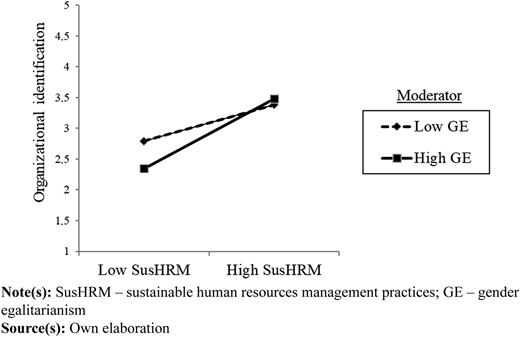
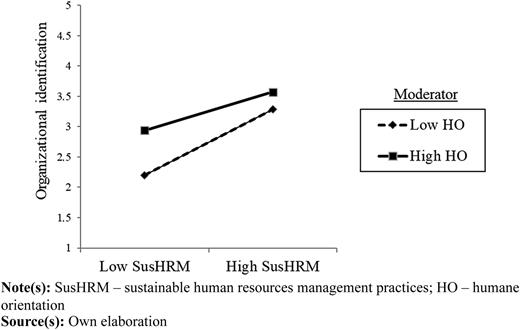
In the case of H2.5 and H.2.6, the predictions of significance proved to be valid. Nevertheless, the direction of the relationships was inconsistent with the predictions. The relationship of sustainable HRM with organizational identification was stronger γ48 = 0.137; p < 0.05 in countries with higher levels of gender egalitarianism (H2.5). However, contrary to prediction (H2.6), we found lower levels of humane orientation culture γ45 = −0.112; p < 0.01. Figures 1 and 2 graphically represent the two-way interaction between the tested variables with regards to gender egalitarianism and humane orientation dimension of culture.
Figure 1 shows a steeper regression slope in cultures with higher gender egalitarianism, indicating a more substantial enhancing effect of sustainable HRM on organizational identification in these cultures relative to cultures with lower gender egalitarianism orientation.
Figure 2 depicts a steeper regression slope in lower humane orientation as opposed to higher humane orientation countries, indicating that sustainable HRM seems to enhance organizational identification more strongly in lower humane orientation cultures. However, higher levels of sustainable HRM and employee organizational identification also characterize countries with higher levels of humane orientation. Therefore, we found empirical support for H2.5 and did not confirm H2.6.
Discussion
Enhancing employees’ organizational identification is crucial for organizations because it translates into many desirable attitudes and behaviors that directly and indirectly relate to job roles (Riketta, 2005; Lee et al., 2015; Greco et al., 2022). Therefore, strengthening employee identification should be a management priority. Identification creates a foundation for building stable human capital in any organization and among the organizational strategies aimed at strengthening identification, HRM practices stand out (Ma, Ma, Liu, & Lassleben, 2020; Weisman et al., 2023). We focused on sustainable HRM due to its strong emphasis on employees and concern for their environment and well-being (Ehnert et al., 2009). We argue that at the core of sustainable HRM’s influence on identification, contextual aspects, particularly national culture, require consideration. Our analysis of how cultural differences impact sustainable HRM practices provides valuable insights.
This research provides important contributions to existing knowledge in this field. First, we confirmed the strong effect of sustainable HRM practices on organizational identification. This is consistent with previous research (e.g. Jerónimo et al., 2020; Wang, Xu, & Wang, 2020; Liao et al., 2022; Garrido-Ruso & Aibar-Guzmán, 2022). Adopting the social exchange theory perspective (Blau, 1964), which posits that social behavior results from an exchange process, we found that sustainable HRM activities meet employees’ needs and enhance organizational identification. This conclusion aligns with prior findings in this area (e.g. Weisman et al., 2023). Indeed, socially responsible practices that address employees’ needs likely generate reciprocity in the form of organizational identification. Moreover, the organization’s commitment to environmental issues (as reflected by green HRM practices) further strengthens employees’ belief that their organization is doing the right thing, enhancing their willingness to engage with it (Chaudhary, 2019).
Second, we examined the conditions under which the relationship between sustainable HRM practices and organizational identification is stronger or weaker. Despite using many cultural dimensions described in the GLOBE framework and previous research in this area, we identified only two cultural dimensions – humane orientation and gender egalitarianism – that moderated the relationship we tested. This partially supports assumptions regarding the unimportance of cultural differences in international management (Gerhart & Fang, 2005), including the impact of high-performance work systems on performance (Rabl, Jayasinghe, Gerhart, & Kühlmann, 2014) and CSR (Wang, Xu, & Wang, 2020; Garrido-Ruso & Aibar-Guzmán, 2022), where it is suggested that the effects of HRM systems on employees’ outcomes are primarily universal. Nonetheless, our results indicate that cultural differences – specifically cultural values and practices – require consideration within a broader context in management science (Peretz, 2024).
In our study, we expected in-group and institutional collectivism, power distance, or uncertainty avoidance to moderate the tested relationship. However, this was not the case, as humane orientation and gender egalitarianism emerged as significant dimensions. Humane orientation refers to the degree to which members of a society are fair, altruistic, friendly, generous, caring, and kind to others (House et al., 2004). Unsurprisingly, previous studies have demonstrated a positive relationship between this dimension and various forms of employees’ attachment to the organization (e.g. Schlösser et al., 2013; Mueller et al., 2012; Beham et al., 2023). Our study also finds a positive effect between humane orientation and organizational identification. Our finding that humane orientation moderates the relationship between sustainable HRM and organizational identification suggests that individuals from cultures with low levels of humane orientation benefit more from the effects of sustainable practices. We may explain it by the more transactional mindset of individuals from such cultures, where self-interest, external motivation, and the expectation that the state’s institutions should provide social and economic support dominate (House et al., 2004, p. 570). These individuals expect their organization to provide resources, allowing them to engage in its operations. Therefore, their identification may be more situational than deep (Ashforth et al., 2008) and fluctuate based on organizational practices and perceived benefits. We may perceive it as a manifestation of complementary fit, where sustainable practices complement and compensate for certain aspects of national culture. Employees respond more positively to sustainable HRM practices because they reflect values that are important to them but generally lacking in cultures with low humane orientation. Specifically, socially responsible practices may address concerns for care and fairness, while green HRM practices may promote altruism and generosity (e.g. contributions to environmental and collective well-being).
The second cultural dimension that influenced the results was gender egalitarianism. This dimension reflects societal beliefs about whether gender should determine individuals’ roles in their organizations and communities. In cultures with high gender egalitarianism, characteristics include more women in positions of authority, less occupational sex segregation, and a greater decision-making role for women in community affairs (House et al., 2004). In such cultures, sustainable HRM is more likely to shape employee attitudes and, through sense-making processes, strengthen the identification of all employees (Srivastava, Madan, & Dhawan, 2020). This is an example of supplementary fit, where HRM practices and cultural norms reinforce each other.
Surprisingly, other cultural dimensions, such as institutional and in-group collectivism, did not moderate the relationship we tested. This may be because sustainable HRM fulfills employees’ needs in individualism (personal achievement and independence) and collectivism (harmony and cohesion) dimensions. Previous research has shown that while employee attachment to organizations differs between individualistic and collectivist countries (e.g. Lee et al., 2015), HRM practices may compensate for these differences. This interpretation aligns with previous studies, which suggest that only certain aspects of job practices (e.g. job interest) differentiate employee outcomes in individualistic versus collectivistic countries (Hauff et al., 2015), as well as CSR research demonstrating the universality of CSR’s impact on employee outcomes across cultural contexts (Wang, Xu, & Wang, 2020; Garrido-Ruso & Aibar-Guzmán, 2022). Moreover, as Steel and Taras (2010) note, individualism at the national level is largely influenced by a country’s wealth, which may partly explain why, after controlling Gross National Income (GNI), the results for institutional and in-group collectivism were statistically insignificant.
Practical implications
Based on the findings of this research, we may formulate several practical implications for managers and employers, particularly those in multinational companies. The results show that sustainable HRM increases the level of organizational identification more in cultures with low humane orientation and high gender egalitarianism. However, this does not mean that only employees from these countries should be targets of sustainable HRM activities. As our study indicates, the impact is largely universal and mostly context-independent. As Aycan et al. (2000) discussed, what differs is the adaptation of certain practices to specific socio-cultural environments and the differentiation of practices based on cultural dimensions. Therefore, the moderating effect of these cultural dimensions suggests that a one-size-fits-all approach to sustainable HRM may not be effective. Organizations operating in different cultural contexts should tailor their sustainable HRM practices to align with local cultural norms and values (Peretz, 2024).
Managers must adjust their activities to the individuals, considering the diversity of cultural practices, which influence patterns of behavior and responses in the workplace. This poses a significant challenge, especially given the increasing demands of a globalized business environment (Aycan et al., 2000). Strengthening organizational identification will ultimately lead to other positive outcomes, such as improved task and contextual performance (Riketta, 2005; Lee et al., 2015; Greco et al., 2022).
Considering the social aspect of building organizational identification, it is also worth leveraging social relationships. In this context, the crucial element might be cultural aspects, as expressed through social and identity values, along with a corporate culture that shapes relationship patterns and fosters strong connections with colleagues. In cultural contexts where sustainable HRM has a weaker impact on employee identification, an identity leadership style targeted at building group identity will be useful (Haslam, Gaffney, Hogg, Rast III, & Steffens, 2022).
Limitations and future research
Despite its intriguing findings, this study has several limitations. First, the research is based solely on employee opinions. We did not directly examine the actual sustainable HRM practices in organizations, but rather employees’ perceptions of them, alongside their reported organizational identification. This makes the results susceptible to single-source bias (Podsakoff, Podsakoff, Williams, Huang, & Yang, 2024). Second, there is a methodological issue regarding the data source for the cultural dimensions. Our analysis combines country-level data (level 2) from the GLOBE Project with individual responses (level 1) on sustainable HRM and organizational identification. This raises questions about the validity of these data, as the country-specific measurements of cultural values do not come from the same group of individual respondents who answered questions related to the independent variable, moderator, and dependent variable. Some critics question treating each country as a single case (e.g. Oyserman, Coon, & Kemmelmeier, 2002), arguing that such aggregation overlooks important differences at the individual and subcultural levels, including distinctions based on ethnicity and organizational context.
Capturing individual cultural beliefs or values in a country’s aggregate population and relating them to organizational identification could provide a more nuanced view. Future studies should include an additional level of analysis and consider other organization-specific contextual elements, such as leadership, organizational culture, and organizational climate.
Lastly, we only measured the environmental and social dimensions of HRM practices in this study. Future research should also account for the economic aspects to assess the specific impacts of sustainable HRM holistically.
The work in Chile was supported by the National Research and Development Agency (refs. ANID/FONDAP/15130009; ANID/Milenio NCS2024_021; and ANID/Anillos ATE230065). We would like to express our sincere personal acknowledgement to Güldem Karamustafa-Köse for her contribution to the study.