Organizations are embracing lean manufacturing (LM) to enhance their operational performance. Extant research recommends that manufacturing organizations align hard lean practices (HLP) with soft lean practices (SLP), such as human dimensions. We analyzed the impact of HLP on the association between SLP and operational performance with lean duration as a moderator.
We utilized data collected from 211 manufacturing organizations in Zimbabwe. We used structural equation modeling (SEM) to test the proposed hypotheses.
The study results showed that HLP practices mediate the relationship between SLP and operational performance. Moreover, lean duration moderated the association between HLP practices and operational performance and between SLP and operational performance.
Although LM utilizes HLP and SLP, the literature does not fully explore the effect of SLP on operational performance. Furthermore, the mediatory role of HLP needs to be investigated so that organizations are guided accordingly on how to integrate them with SLP. Examining the perceived moderating role of lean duration on the association between LM and operational performance and between human dimensions and operational performance equips organizations with a better understanding of the success of lean implementation.
Introduction
Many manufacturing organizations have begun to implement lean manufacturing (LM) to improve their market share, competitiveness, and productivity. Although scholars recognize LM as an improvement philosophy that enhances operational performance (Maware & Adetunji, 2019) many organizations have failed to successfully implement it (Costa et al., 2019; Sakthi Nagaraj & Jeyapaul, 2021). Some organizations fail to produce satisfactory results because they regard LM only as a set of hard lean practices (HLP) and do not consider the role of employees during lean implementation (Alefari, Almanei, & Salonitis, 2020). Success is inevitable when workers perceive the benefits that come with the LM philosophy. Therefore, organizations should consider both HLP and soft lean practices (SLP) when adopting the LM philosophy (Sakthi Nagaraj & Jeyapaul, 2021). Organizations that fail to recognize the need for aligning SLP with HLP risk unsuccessful implementation (Machingura, Muyavu, & Adetunji, 2024c). HLP refer to technical techniques that organizations use to reduce waste such as just-in-time (JIT) (Larteb et al., 2015) while SLP refer to the socio-cultural beliefs imparted to the workers to perform efficiently during lean implementation (Tortorella & Fogliatto, 2014).
Workers are responsible for applying LM principles to improve operational performance, thus, they are the backbone of any manufacturing organization. Adopting LM does not guarantee that the organization will succeed because workers must understand the philosophy. According to Raja Sreedharan, Balagopalan, Murale, and Arunprasad (2020), the application of HLP alone does not assure the success of an organization since they are the workers who do the work and have to know the system. Employees are the drivers of any transformation that occurs in the manufacturing environment. Operational performance achievement lies in the implementation of LM by the workers, not only by adopting diverse philosophies, strategies, and practices. The employees’ role is to initiate, apply, and sustain the LM philosophy. For example, the Toyota Motor Company has successfully maintained LM benefits because they do not take LM as a philosophy, but as a lifestyle.
Literature provides inconclusive results on the effect of human dimensions on LM. Researchers such as Bonavia and Marin-Garcia (2011) and Minh, Zailani, Iranmanesh, and Heidari (2019) revealed that the integration of human dimension and LM does not impact operational performance measures such as quality, lead time, and delivery. Another school of thought believes that LM provides steps that help employees to do their work. For example, De Treville and Antonakis (2006) revealed that employees who work in LM environments could participate in problem-solving initiatives, making them more pleased and engaged daily to continuously improve their processes.
The hyperinflation economic environment that Zimbabwe is facing has affected many manufacturing organizations. Consequently, many manufacturing organizations have struggled to improve their operational performance. Poor performance has also been exacerbated by low productivity, poor political environment, low product demand due to higher prices, liquidity crunch, inadequate power supplies, low capacity utilization, outdated machinery, increased imports, and higher wages (The World Bank, 2022). As a result, the government of Zimbabwe has been promoting the resuscitation of industries by introducing export incentives where organizations can retain 80% of their foreign currency earned through exports (Freight News, 2022). This incentive has caused many manufacturing firms to adopt LM to reduce production costs and improve productivity. Furthermore, the adoption of LM also enables them to enhance product quality, which allows their products to compete globally.
This study evaluates the impact of SLP on the relationship between HLP and operational performance. We focused on the human dimensions of SLP, hence, we used human dimensions to represent SLP while JIT, Jidoka, and stability and standardization represent the HLP. This is important so that organizations can have a clear picture if SLP are necessary or not. As organizations focus more on HLP, such a study will help them understand the possible need for SLP. It is also important for other scholars to understand the interrelationships between SLP, HLP, and operational performance. They can further understand the individual impacts of SLP and TLP compared to their joint impact. Without such an understanding, organizations may miss some performance improvement as they might not be aware of how SLP and HLP synergize.
Uhrin, Bruque-Cámara, and Moyano-Fuentes (2017) studied the impact of human dimensions on the connection between LM and concluded that they have an impact on operational performance. Machingura et al. (2024c) found out that SLP can improve business performance in the service sector. Arumugam, Kannabiran, and Vinodh (2022) found that one can improve organizational performance by adopting both social lean practices and technical lean practices. However, Arumugam et al. (2022) did not study the moderating effect of lean duration on the association between SLP, HLP, and operational performance. To the best of our knowledge, no study has examined the moderation role of lean duration on the relationship between HLP, SLP, and operational performance. Moreover, these studies did not investigate the mediation role of HLP on the relationship between SLP and operational performance. Therefore, this study fills this gap by examining the perceived moderating role of lean duration on the association between HLP and operational performance and between SLP and operational performance. Moreover, this study explores the mediation effect of HLP on the relationship between SLP and operational performance. Furthermore, Uhrin et al. (2017) conducted a study in the Spanish automotive industry, and according to Machingura, Adetunji, and Maware (2024a), the results from other countries and industries require further investigations before one can adopt the theme. Consequently, we sought to answer the following research questions:
To what extent does HLP mediate the relationship between SLP and operational performance?
Does lean duration moderate the relationship between SLP and HLP with operational performance?
Such a study is important to Zimbabwe and other developing countries who might be hesitant to adopt lean practices as they are not sure what they can benefit from it (Machingura, Adetunji, Muyavu, & Maware, 2024d). Most organizations in developing countries are more focused on increasing their profit and adopting lean practices may be viewed as a resource consumption process without any benefits to them (Machingura et al., 2024a). Thus, it is important to elucidate the benefits of lean adoption as in this research.
This article is organized as follows. The next section will present the literature review. Then, we will describe the methodology utilized in conducting the survey. The next section will illustrate the study results. Finally, we will present the discussion, conclusions, and areas for further research.
Literature review
Lean employed by manufacturing organizations
Extant research has shown that manufacturing organizations employ various Lean practices to improve performance. Larger enterprises implement more lean practices than small and medium-sized enterprises (SMEs) due to the SMEs’ lack of resources required when adopting LM (Abolhassani, Layfield, & Gopalakrishnan, 2016). Belekoukias, Garza-Reyes, and Kumar (2014) assessed how lean impacted operational performance and concluded that JIT contributed the highest improvement level compared to the other lean practices. Rahman, Laosirihongthong, and Sohal (2010) established that JIT had a greater influence on operational performance than waste minimization and flow management. Chavez, Gimenez, Fynes, Wiengarten, and Yu (2013) also revealed that JIT had a strong correlation to performance measures such as delivery, quality, cost, and flexibility.
After analyzing the influence of social and technical lean practices on organizational performance, Arumugam et al. (2022) revealed that JIT had a moderate relationship with performance. On the other hand, the study in a flour factory concluded that Jidoka is a crucial practice that can improve the performance of an organization by reducing defects and time losses (Tekin, Arslandere, Etlioğlu, Koyuncuoğlu, & Tekin, 2019). Moreover, the literature identified JIT and human dimensions as some of the best lean practices used to improve operational performance in manufacturing organizations (Bevilacqua, Ciarapica, & De Sanctis, 2017). The study assessing the performance of lean practices in manufacturing organizations in India revealed that JIT and standardization are the two most important practices (Singh, Singh, & Singh, 2018). Loyd, Harris, Gholston, and Berkowitz (2020) noted that stability and standardization, JIT, and quality are the backbone of HLP. The study in the Zimbabwean manufacturing industry reported that the commonly used LM practices when implementing Lean are JIT, people integration, Jidoka, stability and standardization (Maware & Adetunji, 2019). Thus, this motivated us to consider JIT, stability and standardization, and Jidoka in this research.
Perception of the impact of employee participation in LM in the manufacturing organizations in the developing world
Alefari et al. (2020) examined how leadership style and employee performance affected LM adoption for SMEs in the United Arab Emirates (UAE). The study revealed that most managers used the “telling” leadership style to lead the lean implementation journey. This style involves a manager instructing a subordinate what to do (Alefari, Barahona, & Salonitis, 2018). The manager can use the telling leadership style when employees lack confidence, training, and desire to do a task (Bjugstad, Thach, Thompson, & Morris, 2006). The employees cited financial incentives, leadership style, and the environment as factors influencing their performance. Furthermore, most micro and medium manufacturing firms had implemented LM for less than a year. Thus, they had a basic level of understanding of this philosophy. On the other hand, larger enterprises had more than three years of experience in lean and, thus, had a deeper understanding of this philosophy.
Sakthi Nagaraj and Jeyapaul (2021) studied the effect of human factors and ergonomics, such as cognitive abilities, work design, psychosocial, managerial, and physical aspects, on performance. The study revealed that human factors and ergonomics positively impacted LM performance. Tortorella and Fogliatto (2014) investigated the effect of organizational learning factors and human dimensions in Brazilian automotive manufacturing companies implementing LM. The study used the maturity level concept to determine the human dimensions practices, and the goals attained at each contextualization level. The study revealed that entities used dimensions practices such as participative activities, coaching, information sharing, communication, and employee skills development at each company’s contextualization level. Wickramasinghe and Wickramasinghe (2020) stated that human dimensions acted as the root upon which one could apply LM successfully, implying that human dimensions allowed LM institutionalization, maintenance, and construction.
The study on the impact of lean social practices and HLP on operational performance in Indian automotive SMEs revealed that lean social practices and HLP positively impacted operational performance (Arumugam et al., 2022). Moreover, HLP indirectly affected organizational performance through the mediating effect of lean social practices. Finally, Wickramasinghe and Wickramasinghe (2012) evaluated the moderating impact of organizational support on the association between worker commitment and participation in decision-making and job satisfaction and involvement in Sri Lanka. The study found that organizational support moderated the association between worker commitment and participation in decision-making and job satisfaction. Moreover, the involvement in decision-making was positive and significant.
Hypothesis development
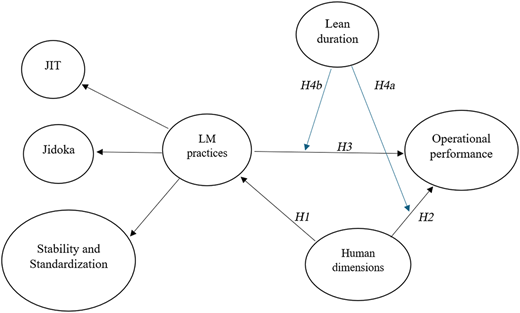
This section presents a structural model (Figure 1) developed to explore the impact of SLP and HLP on operational performance. It consists of a higher-order latent variable that is LM practices whose lower-order latent variables are JIT, Jidoka, and stability and standardization. These practices constitute the HLP. Human dimensions represent the SLP.
Human resources are the drivers of a successful lean implementation process. Lean focuses on the flexibility of cross-functional teams, teamwork, team management, training programs, and job rotation programs (Möldner, Garza-Reyes, & Kumar, 2020). Basu, Ghosh, and Dan (2018) also found that human dimensions are positively associated with LM. Marodin, Frank, Tortorella, and Fetterman (2019) concluded that there was a need for employee involvement to implement lean methods such as TPM successfully. Therefore, the human dimension is significant in implementing LM, and companies need to pay attention to it rather than consider only HLP (Möldner et al., 2020). Therefore, we hypothesized:
The human dimension positively relates to hard lean manufacturing practices.
The cross-functional teams positively reduce costs, improve productivity, and reduce defects (Panwar, Jain, Rathore, Nepal, & Lyons, 2018). Research in Brazilian manufacturing firms revealed that employee involvement positively impacts operational performance (Godinho Filho, Ganga, & Gunasekaran, 2016). Uhrin et al. (2017) ascertained that workforce development is vital for performance improvement. Hence, employees need advanced training and skills development. A study in Singapore noted that employee empowerment, top management support, employee training, and employee involvement play a significant role in operational performance (Brah, Li Wong, & Madhu Rao, 2000). Taj and Morosan (2011) studied the association between human dimensions and operational performance in 65 Chinese organizations. The results indicated that human dimensions had a strong positive association with flow and flexibility. Job rotation, employee satisfaction, participation in continuous improvement, and Kaizen events improve employee commitment, leading to the success of Lean implementation (Hong, Ga, Yang, & Dobrzykowski, 2014). Worker involvement positively impacts quality, productivity, and morale, and moderately affects the cost (Kumar & Kumar, 2016). Thus, organizations trying to improve their performance should focus on HLP as well as SLP (Uhrin et al., 2017). Hence, we hypothesized that:
Human dimension positively affects operational performance.
Belekoukias et al. (2014) revealed that operational performance was improved by using lean techniques such as JIT, autonomation, VSM, TPM, and kaizen. The results revealed that lean significantly improved quality, flexibility, dependability, speed, and cost. Similarly, Arumugam et al. (2022) indicated that lean positively impacted operational performance. Nawanir, Kong Teong, and Norezam Othman (2013) corroborated that lean practices increase operational performance. Rahman et al. (2010) concluded that JIT, waste minimization, and flow management affect the operational performances of SMEs and large enterprises in Thailand. Panwar et al. (2018) also indicated that lean methods such as JIT purchasing, work standardization, cross-functional teams, and quality management strongly correlate with operational performance by reducing defects, cost, waste, and improving demand and productivity.
Research in the Republic of Ireland showed that setup time reduction and JIT positively correlated with quality, cost, delivery, and flexibility performance measures (Chavez et al., 2013). A study in Jordan reported that lean positively influenced inventory level, productivity, cost reduction, quality, and delivery performance measures (Shrafat & Ismail, 2019). China’s manufacturing industry results indicated that human dimensions and supply chain management positively affected flexibility and flow (Taj & Morosan, 2011). A study in India discovered that productivity, quality, and delivery time improved upon implementing lean (Kumar & Kumar, 2016). Brah et al. (2000) reported evidence of improved operational performance through the implementation of TQM in Singapore. Kaynak (2003) also stated that TQM practices such as training, leadership commitment, and employee relationships positively correlate to organizational performance. Extant research also shows that lean strongly correlates with operational performance (Negrão, Godinho Filho, & Marodin, 2017; Uhrin et al., 2017; Yadav et al., 2020). Thus, the researchers hypothesized the following:
LM has a direct and positive association with operational performance.
The impact of LM on operational performance may be observable after a substantial period (Anand & Kodali, 2010). Womack and Jones (1996) stated that organizations that implement lean should not expect LM to achieve results in a short period. Thus, we should not treat LM as a panacea to improve competitiveness. Instead, organizations should adopt new work methods and routines, enforce company culture change, and change workers’ behavior (Wickramasinghe & Wickramasinghe, 2017). Furthermore, the adoption of LM succeeds when organizations use human dimensions, which may require time since workers need to be trained to change their work methods (Bortolotti, Boscari, & Danese, 2015). The change in work methods makes it difficult for positive LM results to be attained overnight since the management and employees have to adapt to the new working environment. Thus, it is crucial to consider the length of time required before getting positive results when implementing management philosophies such as LM. Research revealed that the results from LM implementation depend on lean duration (Callen, Fader, & Krinsky, 2000; Wickramasinghe & Wickramasinghe, 2012, 2017). Thus, it is crucial to explore how lean duration affects the relationship between human dimensions and operational performance and between LM and operational performance. Therefore, we hypothesized:
Lean duration moderates the association between LM and operational performance and between human dimensions and operational performance.
Research methodology
We developed a questionnaire for data collection. The questionnaire had two sections, namely demographic questions and measurement items for each construct. We also adopted items from Cua, McKone, and Schroeder (2001) and Khanchanapong et al. (2014) to improve the validity. We measured the items with a seven-point Likert scale, whereby: 1 = strongly disagree; 2 = disagree; 3 = disagree somewhat; 4 = undecided; 5 = agree somewhat; 6 = agree and 7 = strongly agree. Moreover, we used items adapted from Belekoukias et al. (2014) and Shah and Ward (2003) to assess the operational performance of manufacturing organizations. We measured the performance measurement by: 1 = reduced more than 20%; 2 = reduced by 1–20%; 3 = remained the same; 4 = improved 1–20% and 5 = improved more than 20%.
The manufacturing organizations used for this study emerged between 1980 and 2010. These organizations were multinationals and local companies that had implemented LM between 2002 and 2016. Thus, the total number of years for which the LM has been implemented was 19 years if the organization implemented lean in 2002 and 4 years if the organization adopted Lean in 2016. We used the natural logarithmic transformation of the number of years that LM had been adopted to determine the LM duration. Wickramasinghe and Wickramasinghe (2016) also used the natural logarithmic to determine Lean duration. The authors coded lean duration as a binary code with 0 representing a lean duration of less than 9 years and 1 representing a Lean duration of more than 9 years considering the distribution of lean adoption of the manufacturing organizations. The responses indicated that 64% of the manufacturing organizations had implemented LM less than 9 years ago, while 36% implemented LM over 9 years ago. Wickramasinghe and Wickramasinghe (2020) stated that organizations could achieve 90% improvement in efficiency, 85% delivery performance, and 91% quality improvement after 35% of implementing LM.
Data collection process
We contacted 553 manufacturing organizations registered by the Confederation of Zimbabwean Industries (CZI). We distributed the questionnaires to plant managers, quality assurance managers, and supervisors via a Google form link. We shared questionnaires with managers and supervisors because research has shown that organizational managers provide valuable and consistent information (Uhrin et al., 2017). We also invited between two to three people from the same organization to respond to the questionnaire to minimize personal bias as recommended by Machingura et al. (2024a). We obtained 211 useful responses, and using the 10 times rule by Hair, Hult, Ringle, & Sarstedt (2017), this sample size is much greater than the minimum recommended. We listed the manufacturing organizations under textile and ginning, pharmaceutical, plastics, chemical and petroleum products, wood and furniture, clothing and footwear, beverages, metal and metal products, and foodstuffs industries. Table 1 shows the industry type and its frequency.
Non-response bias
We used the t-test and Levene’s test to assess the equality of means and variances between early and late responses (Armstrong & Overton, 1977; Tortorella & Fogliatto, 2014). We used the first five questions in Section 2 of the questionnaire to compare the early response and late response groups using the χ2 test. The study findings for the two groups indicated no significant differences between late and early responses, meaning there was no non-response bias.
Results
Construct validity and reliability
We performed exploratory factor analysis (EFA) using SPSS version 26. Bartlett’s test of sphericity χ2(211) = 2065.45 was significant. We also obtained a p-value of <0.001 (Mohd Fuzi, Habidin, Hibadullah, & Ong, 2017; Randhawa & Ahuja, 2017). The latent variables had a total variance of 60.1%. We used SmartPLS version 3 for assessing the structural and measurement models. The construct reliability for each factor was greater than 0.7, indicating that each question measured the same construct (Dubey & Gunasekaran, 2015; Maware & Adetunji, 2020). Furthermore, we obtained values greater than 0.5 for the average variance extracted (AVE) of each factor, showing that convergent validity was strong for the model (Inman & Green, 2018; Sing & Saudi, 2018). Moreover, the heterotrait-monotrait (HTMT) ratio confidence interval values did not include 1, showing that all the factors demonstrated discriminant validity (Hair et al., 2017). Table 2 gives the values for composite reliability, Cronbach’s alpha, AVE, and the HTMT ratio.
Results for the inner model
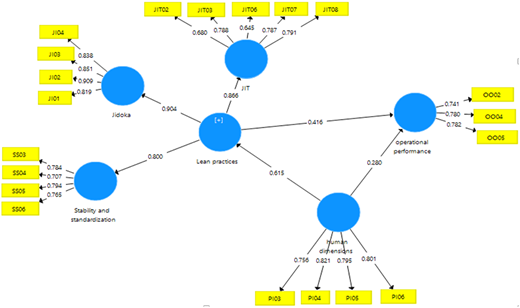
The model detected no collinearity because all the variance inflation factor (VIF) values were between 0.2 and 5 (Hair et al., 2017). Table 3 gives path coefficients for the inner model. The path coefficient from human dimensions to LM practices was 0.615 showing a strong relationship. Moreover, LM had the strongest effect on Jidoka, showing that built-in quality was a prerequisite to successful LM implementation. The path coefficient for the relationship between LM practices and stability and standardization was 0.80. This indicated that a stable and standardized production process is required for an organization implementing LM. The path coefficient for the impact of LM practices on JIT was also high, indicating that flow is a prerequisite for successful LM implementation. Figure 2 shows the structural model results.
We also investigated the mediating effect of LM practices on the association between human dimensions and operational performance. A mediation effect exists if the path weight between human dimensions and operational performance decreases when LM practices mediate this relationship. The mediation test model results indicated that the size of the direct effect between human dimensions and operational performance decreased from 0.521 to 0.103 when the LM was not included as a mediating variable. Moreover, the association between human dimensions and operational performance was not significant (p-value = 0.30). Thus, this result indicated that LM mediated the association between human dimensions and operational performance. Finally, lean duration moderated both the association between LM and operational performance and between human dimensions and operational performance. Furthermore, the p-values for all the relationships were 0.001 or less, showing that all the path coefficients were significant.
Please note that R2 gives the predictive power of a model (Cattin, 1980). It also indicates variance quantity in the predicted variable explained by the independent variable (Fairchild, MacKinnon, Taborga, & Taylor, 2009; Plonsky & Ghanbar, 2018; Rights & Sterba, 2019). The R2 values of 0.26, 0.13, and 0.02 predicted variables indicate the independent variable’s high, medium, and low effects, respectively (Maware & Adetunji, 2019). The R2 value for the LM construct was 0.378, indicating a high effect of human dimensions on LM. Furthermore, the R2 value of operational performance was 0.198, indicating a medium effect of human dimensions and LM on operational performance.
We used Cohen f2 formula shown in equation 1 to calculate the effect size of each predictor variable. The f2 value stipulates how the R2 values for the dependent variable change when we omit the predictor variable (Ramayah, Cheah, Chuah, Ting, & Memon, 2018; Purwanto & Sudargini, 2021). For example, the values of 0.02, 0.15, and 0.35 indicate small, medium, and high effects, respectively (Purwanto & Sudargini, 2021). Excluding human dimensions from the model yielded a large effect on the LM variable. Moreover, excluding lean duration from the model for the predicted variable, such as operational performance, also yielded a high effect. We used the following formula:
in which and represented the values of R2 for the dependent variable when the moderation interaction component is excluded and included, respectively. Table 4 shows the f2 results.
The Stone–Geisser Q2 value gives the predictive relevance power of a model. Values greater than 0 are desired (Cruciani et al., 1992). Table 5 presents the values for Q2 and R2 for the predicted variables in the model.
Multigroup analysis
We tested lean duration, which moderated the association between LM practices and operational performance and between human dimensions and LM practices using multigroup analysis. There were two groups: Group 1 – low lean duration; and Group 2 – high lean duration. Table 6 gives the multigroup analysis results for the two groups (low and high lean adopters). We noted no significant difference in the moderating effect of lean duration on the association between LM practices and operational performance and human dimensions and operational performance. This signified that lean duration moderated both low and high lean duration. Moreover, H4a and H4b were supported since the model for LM practices, human dimensions, operational performance, and lean duration did not differ significantly between low and high lean adopters.
We calculated the effect size, f2, for the interaction effect by analyzing how the R2 changed due to the moderation effect using the Cohen f2 formula. We obtained a value of 0.013. Noteworthy, the threshold for interpreting the critical values of for the interaction effect of moderators is different from those of the normal model factors; hence, this value indicates a medium moderation effect on the dependent variable.
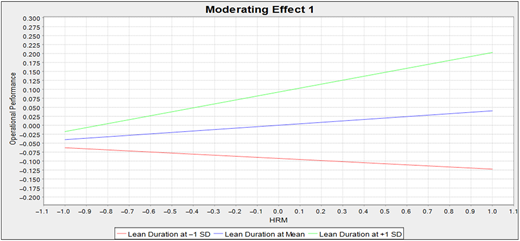
Figure 3 highlights the moderating effect of lean duration on the relationship between human dimensions and operational performance. The graph shows that the association between human dimensions and operational performance has a positive slope. This indicated that organizations’ adoption of human dimensions improves operational performance. Doing so over a long period even further improves performance. The research supports the findings of several researchers who revealed that human dimensions positively impact operational performance (Uhrin et al., 2017; Wickramasinghe & Wickramasinghe, 2020; Arumugam et al., 2022).
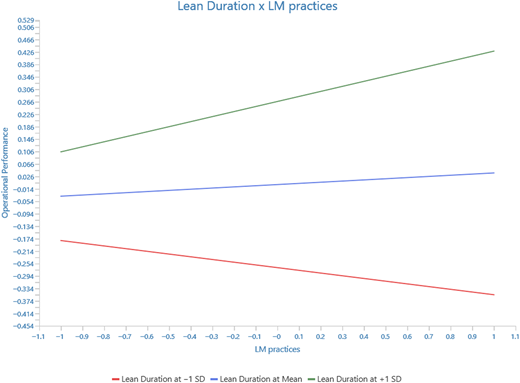
Figure 4 highlights the moderating effect of lean duration on the relationship between LM practices and operational performance. The interaction term had a positive impact, while the simple effect of LM practices on operational performance was positive. Furthermore, the result revealed a positive slope, indicating that the effects of the lean duration moderator on operational performance also increased as organizations adopted LM practices over a longer time. Thus, the results supported that lean duration positively affected the correlation between LM practices and operational performance.
Discussions
The study evaluated the structural associations between SLP, HLP, lean duration, and operational performance for Zimbabwean manufacturing organizations. The results indicated that SLP had a positive relationship with HLP and both SLP and HLP had a positive relationship with operational performance. This agrees with Sahoo (2020) who noted that the relationship between SLP and HLP is positive and they both impact the performance of organizations. Thus, for organizations to realize positive results due to HLP implementation, they need to consider SLP as well. Sorooshian and Ali (2017) provided further support for this as they noted that organizations should consider implementing SLP and HLP simultaneously for enhanced performance improvement. Moreover, lean duration moderated the relationship between HLP and SLP with operational performance. Furthermore, lean duration had a moderating effect for the two groups, i.e. low and high lean durations. For instance, we can see from the steeper slope of the green line (at +1SD) that a longer lean implementation duration leads to a corresponding increase in the expected performance.
The results indicated that human dimensions could enhance operational performance. This agrees with Jalil, Shaikh, and Alam (2014), Waseem, Rehman, and Haq (2021), and Machingura et al. (2024d) who noted that human-related activities are critical for organizations willing to attain performance improvements. Although this contradicts the results by Machingura et al. (2024c), who found the relationship to be indirect, it is the human dimensions that can allow for achieving the intended goal. However, the direct relationship between human dimensions and operational performance decreases when HLP does not mediate this relationship. This shows that human dimensions indirectly affect operational performance through the mediating effect of HLP. This result also aligns with Sahoo (2020), who indicated a positive relationship between lean social practices and business performance through the mediating role of lean technical practices.
An organization sustains lean when workers understand how their roles add value during manufacturing. Workers should require training to perform standardized work and continuously remove operational barriers. To do that, they should be able to find and remove all non-value-adding activities within their operations. Moreover, employees should persistently seek ways to improve their operations through the continuous problem-solving process. Organizations that intend to adopt LM should know that they will be able to sustain lean when the top management leads by example, workers trust the organization, and good customer and supplier relationships exist.
Conclusion
Competition among manufacturing organizations has forced companies to adopt LM initiatives to minimize production costs and improve product quality. Existing research has shown that competition is now occurring among supply chains instead of individual organizations (Kleindorfer, Singhal, & Van Wassenhove, 2005; Hülsmann, Grapp, & Li, 2008; Kouvelis, Dong, Boyabatli, & Li, 2011; Schonberger, 2019; Vanichchinchai, 2020). Although LM has been widely adopted, some organizations have failed to get satisfactory results due to the negligence of human dimensions during lean implementation (Arumugam et al., 2022). We showed that human dimensions directly and positively impact HLP. Moreover, human dimensions had a positive indirect relationship with operational performance through the mediating effect of the LM practice. Other studies have also shown that human dimensions positively impact operational performance (Arumugam et al., 2022).
This research adds to the extant lean philosophy literature by investigating the impact of human dimensions and HLP on operational performance. Moreover, our study contributes to the field by evaluating the moderating role of lean duration on the two relationships (1) human dimensions and operational performance and (2) HLP and operational performance. According to our knowledge, this is the first study that shows how lean duration moderates these two relationships. This area has also not received much attention, especially in developing countries.
Managerial implications
This study revealed that human dimensions directly and positively affect HLP. This indicates that employees impact the organization’s success or failure. Thus, organizations should introduce human dimensions practices earlier as they begin the lean journey. There is also a need for managers to develop open communication so that workers believe and trust them. Furthermore, open communication will make employees feel free to communicate abnormal conditions within their processes, which leads to constant problem-solving. Organizations can improve their operational performance when the top management continuously creates a safe working environment that promotes teamwork. Managers are now aware that without employees’ involvement, it is challenging to successfully implement lean and improve operational performance. This study has shown that human dimensions act as a backbone of LM implementation.
Limitations and areas of further research
We utilized data collected from manufacturing organizations in Zimbabwe. However, one could also verify these hypotheses using data from diverse manufacturing organizations worldwide. The study focused only on manufacturing organizations. However, several studies report the benefits of implementing LM in other industries, such as services and mining. Thus, scholars could extend such research to these industries, and compare the results with those from this study. An area of further study may be assessing how human dimensions affect operational performance for a specific manufacturing industrial sector rather than diverse industrial sectors. Future research may analyze data using different samples to generalize the results. Moreover, company data and interviews could also serve to cross-validate the proposed relationships. This study used LM constructs such as stability and standardization, JIT, Jidoka, and human dimensions. However, scholars could add other LM constructs to these bundles and analyze them in future research.
This research is funded by the UP Post-Doctoral Fellowship (UP Ph.D.) Programme (grant source: DRI - Cost Centre: A0X816).