The article aims to investigate the relationship between the three types of employee participation in (individual, HR and strategic) decision-making and psychological contract breach, where perceived organizational support conditions the established relationship (weakening negative relationships). Moreover, we investigated the impact of perceived organizational support as a potential moderator in the negative association between employee participation and psychological contract breach. The research focused on the specific context of a public organization’s functioning.
We surveyed a total of 6,751 employees from a prominent public organization in Poland to gather data. We collected the data collection via the CAWI technique. We analyzed the data using partial least squares SEM.
The findings contribute to the understanding of the complex relationship between employee participation and psychological contract breach. Specifically, they have highlighted the role of perceived organizational support in moderating this relationship. Our research shows that employees have a significant role in making decisions that impact their professional responsibilities. They are also actively involved in a wide range of organizational decisions, including those that directly affect employees as well as those that indirectly relate to the organization’s overall functioning in the strategic domain.
The study uses the concept of perceived organizational support as a moderator conditioning the negative relationship between employee participation and psychological contract breach in the specific context of public organization functioning.
Introduction
Employee participation is of utmost importance in management research. The ongoing changes make it increasingly important, especially in the economic and social context (Wagner, 1994; Markey & Townsend, 2013; Valverde-Moreno, Torres-Jimenez, & Lucia-Casademunt, 2021; Mumtaz, Selvarajah, & Meyer, 2024). This appears to be a particularly important issue in public organizations seeking ways to intensify organizational citizenship behavior (Sukresna, Laksana, & Shaferi, 2021). Participation can take different forms and vary in intensity (Abildgaard et al., 2020). It can involve both the employee’s influence on the work process of their position – occupational role participation (Boxall & Winterton, 2018), as well as go beyond the employee’s occupational role and involve deciding on situations related to functioning in the organization and designing work practices not necessarily directly related to the work of a specific position – human resource and strategic participation (Wikhamn, Wikhamn, & Fasth, 2022). This form of employee involvement can be the subject of official or unofficial contracts between employees and the organization, including the psychological contract (Hartmann & Rutherford, 2015). The psychological contract encompasses many elements of the employee interactions inside the organization (Guest, 2004) and the outcomes that arise from the acceptance and fulfillment of reciprocal obligations to achieve organizational objectives (Rousseau, 2004). Simultaneously, the ever-changing environment poses challenges for organizations in meeting the psychological agreements they establish with their personnel (Robinson & Morrison, 2000; Zagenczyk, Gibney, Few, & Scott, 2011). To date, several researchers have examined the positive influence of meeting the psychological contract on employees and organizational performance (Turnley, Bolino, Lester, & Bloodgood, 2003; Shafqat & Mushtaq, 2020; Sandhya & Sulphey, 2021). Simultaneously, the subject of psychological contract breach and its impact on employees has received limited attention (Balabanova, Ehrnrooth, Koveshnikov, & Efendiev, 2022). Meanwhile, studying breaches of the psychological contract is crucial for gaining a deeper understanding of how it impacts employee attitudes and behavior in the workplace, as well as how organizations can adjust their procedures to promote employee engagement and performance. Thus, it is imperative to investigate the impact of employee involvement in shaping contractual relationships and consider the significance of contextual circumstances, such as the unique characteristics of public organizations. After all, on the one hand, public institutions are subject to high public scrutiny and citizens’ demands for performance. On the other hand, they struggle to maintain service levels in the face of reduced funding (Vigoda-Gadot & Golembiewski, 2001; Hassan, 2015). They cannot always draw on the same diverse sources of support as private organizations (Rosenbloom, 2013). In addition, as Amah (2017) notes, they tend to have a formal structure and therefore a bureaucracy, often experiencing poor leadership and administrative authority, which can potentially have a detrimental effect on staff attitudes and behavior. Hence, there is a need to encourage employees to surpass the official expectations of their roles (de Geus, Ingrams, Tummers, & Pandey, 2020), and this often requires support from the organization (Sridhar & Thiruvenkadam, 2014). Perceived organizational support (POS) allows for meeting social-emotional needs, leading employees to integrate organizational membership and role status into their social identity (Demir, 2015). Moreover, scholars associate POS and its implications with social exchange theory, which posits that employees reciprocate with other positive behaviors or attitudes in return for support (Rhoades & Eisenberger, 2002). The study by de Geus et al. (2020) indicates that there is a lack of coherence and clarity in the understanding of organizational behavior and attitudes among employees in public institutions. Therefore, we aimed to fill this gap.
Based on the above studies and motivations, we wanted to address the inquiry, what is the influence of employee participation on the perceived psychological contract breach of employees of public organizations and what role does perceived organizational support play in this relationship?
Aiming to address the existing research need in this particular field, we designed a research investigation in which, first, we analyzed the direct and indirect mechanism linking the three forms of employee participation and psychological contract breach. As far as we know, this study is the first of its kind to use the concept of perceived organizational support as a moderator conditioning the negative relationship between employee participation and psychological contract breach. Second, we considered employee participation from the perspective of three levels (individual, HR, and strategic). Therefore, this study expands the comprehension of the concept of employee participation by identifying three key strands involving employees in narrower and broader organizational decision-making. Third, our analyses examined the relationship between the three forms of employee participation and employees’ perceived psychological contract breach. Consequently, this study not only enhances the existing research on various forms of employee participation but also highlights the importance of the psychological contract in determining the quality of the employee-employer relationship. Finally, we tested our model within the unique framework of a public organization – a leading Polish representative of the public sector, thus enriching the existing knowledge base on employee participation in this type of institution.
Consequently, we present the links between the three forms of employee participation in decision-making and psychological contract breach, where perceived organizational support conditions the relationship that is established (weakening negative relationships). We also offer formulas on how best to reduce the perception of psychological contract breaches. To achieve this objective, we thoroughly examined several bodies of literature to gain insight into the reciprocal responsibilities that exist between employers and employees, specifically within the context of public organizations. The findings have expanded our comprehension of the connection between employee participation and psychological contract breach, highlighting the influence of perceived organizational support. This has contributed to the existing body of knowledge in this field. Noteworthy, our study also addresses the recent demand to incorporate the viewpoints of employees (Nolan & Garavan, 2016). It considers employee perceptions and, given the research subject – a public sector organization – it extends knowledge regarding public organizations.
Literature review and hypotheses development
Employee participation and psychological contract breach
Employee participation refers to the active engagement of employees in tasks like information processing, decision-making, and problem-solving (Locke & Schweiger, 1979; Zhu, Xie, Warner, & Guo, 2015; Wagner, 1994), or the sharing of influence/authority in organizations (Wang & Yang, 2015). Thus, employee participation is a complex concept that refers to the degree to which an employee is involved, either formally or informally, in making decisions that pertain to many aspects of their job and the organization as a whole (organizational settings) (Wikhamn et al., 2022). There exist numerous opportunities for employees to engage in decision-making. Employee participation is referred to as an umbrella concept that encompasses many concepts such as workers’ say or voice, co-decision, industrial democracy, employee involvement, and employee voice, depending on the context (Busck, Knudsen, & Lind, 2010; Litwin & Eaton, 2018; Wilkinson & Mowbray, 2019). The fundamental aim of employee participation is to improve job performance (Cotton, Vollrath, Froggatt, Lengnick-Hall, & Jennings, 1988), organizational effectiveness (Markey & Townsend, 2013), and employee satisfaction (Zhu et al., 2015). A review of past research findings confirms that employee participation positively affects employee satisfaction and performance (Wagner, 1994), as well as fostering learning (Inanc, Zhou, Gallie, Felstead, & Green, 2015), reducing resistance to change (Inanc et al., 2015), and stimulating organizational innovation (e.g. Kesting, Song, Qin, & Krol, 2016) by facilitating creative ideas (Zhou, Fan, & Son, 2019). We may classify employee participation based on its intensity, which depends on the amount of power employees have in their engagement and the range of decisions they participate in (Knudsen, 1995). This can take the form of shared decision-making, decision-making based on employee consultation, or decision-making by employees themselves (Busck et al., 2010). The literature outlines multiple strategies for engaging employees in decision-making (Gonzalez, 2009), including self-managing leadership teams, job design, consultative groups, delegation of decision-making authority, autonomous teams, formal participation in decision-making mechanisms, and collective and individual voice or empowerment (Looise, Torka, & Wigboldus, 2011; Zhu et al., 2015; Sandhya & Sulphey, 2021). Classifications of participation also vary. For example, Cotton et al. (1988) identified various forms of engagement in work decisions, including consultative participation, short-term participation, informal participation, employee ownership, and representative participation. Meanwhile, Benson, Young, and Lawler (2006) identified a division indicating compensation systems, information sharing, knowledge development, and power sharing. These classifications indicate that participation pertains to the involvement and impact of employees in making decisions that affect the entire firm (Busck et al., 2010). This means that, on the one hand, participation can refer to an employee’s influence on the work process of their job, e.g. a high level of control over tasks’ performance (Boxall & Winterton, 2018), and, on the other hand, it can surpass the boundaries of the employee’s assigned job responsibilities (Wikhamn et al., 2022). It then has a broader meaning and refers to employees’ ability to decide and use their competencies in a variety of situations related to functioning in the organization and designing work practices, not necessarily directly related to working in a specific position. Wikhamn et al. (2022) considered such differentiation in their classification, which depicts three key decision-making domains in which employees are involved, i.e. the employee’s professional position, participation in HR functions, and the organization as a whole (strategic participation). The lack of a clear distinction between the various types of participation can conceal their impacts and result in contradictory research findings (Smylie, Lazarus, & Brownlee-Conyers, 1996). Moreover, due to the limited number of studies, we still do not have a full understanding of the variables that may moderate the effects of such participation. Furthermore, the extent, scale, and frequency of participation may relate to the organization type. In public organizations, employee participation faces particular challenges, especially institutional ones, as well as those related to organizational culture (Wang & Yang, 2015). The rigid hierarchical structure, the insistence on compliance with rules and regulations and the associated tight control characteristic of this type of organization foster a bureaucratic culture of “over conformity” (Merton, 1940; Claver, Llopis, Gascó, Molina, & Conca, 1999), and this fosters adherence to directives and regulations rather than active participation in the decision-making process. Meanwhile, few studies to date indicate that employee participation in public organizations can contribute to improved job satisfaction (Wright & Kim, 2004), employee retention (Grissom, 2012), innovation (Fernandez & Moldogaziev, 2013), and higher employee engagement (Cheung & Wu, 2011). On the other hand, e.g. the findings of Harrison and Freeman (2004) indicate that there is a danger that employee participation has the potential to disturb the hierarchical structure of authority, leading to an elevated chance of conflicts between employees and supervisors, ultimately resulting in decreased efficiency. Based on the above, we introduce three forms of employee participation because they allow us to comprehensively capture the diversity of employee influence on organizational performance, especially in the context of the public sector. Participation at the individual level refers to the employee’s professional role and its influence on direct aspects of work, such as the organization of time, the way tasks are carried out, or the ability to voice opinions (Abildgaard et al., 2020). In the public sector, where formal procedures can dominate, incorporating this form of participation makes it possible to strengthen individuals’ sense of autonomy and influence over their daily work (Kiss et al., 2022). Participation at the HR level includes involvement in human resource decisions such as recruitment, promotions, and employment restructuring (Philip & Arrowsmith, 2021). In the public sector, incorporating this form of participation allows for a more democratic and inclusive approach, fostering a culture of cooperation and inclusion (Rogozińska‐Pawełczyk & Sudolska, 2024). Participation at the strategic level includes influencing decisions of a long-term nature, such as development directions, organizational goals, or investments. In the public sector, where management is often based on complex decision-making structures, employee involvement in strategic decisions can lead to a better understanding of the organization’s needs, as well as strengthen identification with its mission (Sagaris, 2016). This division captures the different levels of employee decision-making involvement, from day-to-day responsibilities to areas related to personnel management to key decisions of strategic importance. This framing reflects the diverse needs of a public sector organization and the potential of employees to co-create its success.
We may attribute employee participation in diverse organizational activities, including decision-making processes, and the generation of innovative ideas that aim to create positive change inside the organization (Maynes & Podsakoff, 2014) to the fulfillment of the psychological contract (Shafqat & Mushtaq, 2020; Asante, Gyensare, El Bouzidi, & Twumasi, 2024). Previous research has indicated that the fulfillment of the psychological contract has a positive relationship with the constructive voice behavior of the organizational workforce (Hu et al., 2018), as well as the relationship between the psychological contract and counterproductive work behavior (Protsiuk, 2019). Nevertheless, due to the subjective and unique characteristics of the psychological contract, along with a constantly evolving environment, it is common, if not unavoidable, for modern organizations to breach the psychological contract (PCB) (Kiewitz, Restubog, Zagenczyk, & Hochwarter, 2009; Lv & Xu, 2018). Scholars define PCB as employees’ perception of the extent to which the employer has failed to deliver on their commitments or promises (Robinson, 1996). This can carry a variety of consequences. Previous research has shown that psychological contract breach has significant negative effects on employee attitudes and work behaviors (Guo, 2017), including reduced job satisfaction and job commitment (Sunarta, Tjahjono, Muafi, & Prajogo, 2024), reduced organizational identification (Epitropaki, 2013) and organizational citizenship behaviors (Robinson, 1996; Liu, Huang, Huang, & Chen, 2013). Moreover, PCB carries such detrimental effects as higher turnover intentions (Malik & Khalid, 2016), burnout, and deviant behavior (Costa & Neves, 2017). The few studies conducted on these issues in public organizations have shown that in this type of organization, PCB also affects employee commitment and dedication (Arunachalam, 2021). Although the negative consequences of PCB have been relatively well understood (Robinson & Morrison, 2000), the mechanism linking employee participation in decision-making and the breaching of the psychological contract has not yet been sufficiently explored. Meanwhile, it may be of significant importance, considering, the different decision-making domains in which employees engage, i.e. individual, HR function-related, and strategic. Yu and Zhao’s (2013) research on employee voice suggested that a deeper understanding of these relationships is worthwhile. Since employee voice is a type of organizational citizenship behavior, a breach of the psychological contract can affect it. The same may be true for employee participation. Based on the social exchange theory (SET), scholars see relationships as a transaction of resources between two parties. According to this idea, when one party gives a benefit, the other party feels obligated to reciprocate (Rhoades & Eisenberger, 2002). This also applies when parties do not keep promises or commitments. In this case, the assumptions of SET theory are binding. Research indicates that employees tend to retaliate against perceived psychological contract breach (PCB) by reducing their commitment level to the organization and developing negative sentiments towards it (Zagenczyk et al., 2011), increasing turnover intentions as well as decreasing productivity, organizational commitment, and constructive voice (Ng, Feldman, & Butts, 2014). Thus, when one party breaches trust, it results in the other side developing unfavorable views and engaging in undesirable behaviors (Cropanzano & Mitchell, 2005). Therefore, among others, when organizations breach psychological contracts, employees respond with less vocal behavior (Ng et al., 2014). As highlighted by Lv and Xu (2018), employees may react differently to PCB, which may depend, among other things, on their individual characteristics, but also on organizational factors, which influence researchers have not yet sufficiently investigated (Wang & Hsieh, 2014).
This led us to the following hypotheses:
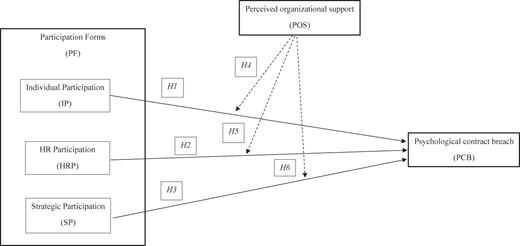
Individual-level participation is negatively related to psychological contract breach.
HR-level participation is negatively related to psychological contract breach.
Strategy-level participation is negatively related to psychological contract breach.
The moderating role of perceived organizational support
Perceived organizational support (POS) refers to the perception held by employees that their employer values their well-being and offers tools to assist them in managing workplace demands (Rhoades & Eisenberger, 2002). It includes fair treatment, support from superiors, recognition of employees’ contributions, as well as rewards and favorable working conditions (Osman, Othman, Rana, Solaiman, & Lal, 2015). It also refers to a kind of reassurance that, when needed, the employee will receive help from the organization to do the job effectively and cope with stressful situations (Rhoades & Eisenberger, 2002). This leads to employees who experience high levels of organizational support developing a strong sense of affiliation with the organization. As a result, they actively contribute to the organization’s growth and performance (Meiske, 2018). In this case, social exchange theory emerges as a useful basis for analysis. Given the key principles of this theory, each party must contribute something of value to the relationship, and the exchange must be fair to both parties (Wang & Cheng, 2010). Previous research findings confirm that high levels of POS might induce a feeling of duty among employees to reciprocate their employer’s dedication by participating in behaviors that promote organizational objectives (Singh, Singh, Kumar, & Gupta, 2015). It also positively influences personal resources such as self-efficacy, optimism, and self-esteem (Wang, Zhang, Thomas, Yu, & Spitzmueller, 2017), as well as job satisfaction, a pleasant emotional state, a strong inclination to remain affiliated with the organization, loyalty (Rhoades & Eisenberger, 2002), and organizational citizenship behavior (Cardona, Lawrence, & Bentler, 2004). Findings from previous research on perceived organizational support indicate that it often plays a moderating role. For example, Stamper and Johlke (2003) showed that POS moderated the negative relationships between perceived work role stressors and attitudes towards work (job satisfaction and organizational commitment) and job performance. In contrast, Pathak’s (2012) research confirmed that perceived organizational support is a strong moderator that reduces the amount of stress experienced and thus leads to higher job satisfaction in managers. Thus, the concept of POS plays a significant role in shaping employees’ behavior and their perception of the organization, particularly in the fulfillment of their psychological contract. Given that POS is a significant factor in shaping employees’ positive attitudes and behaviors, it can be inferred that employees will view an organization with high POS as more open, caring, and engaging. In such an organization, employee participation in decision-making is likely to have a beneficial effect on their psychological contract.
Based on the research conducted on organizational support theory, it has been suggested that there is a connection between employee participation at all three levels, i.e. individual, HR, and strategic. Moreover, psychological contract breach will vary according to the level of perceived organizational support, such that at high POS levels the negative relationship does not occur. This is because employees are likely to be less affected by a breach of the psychological contract and to participate more actively in decision-making processes in a highly supportive organizational environment, where there is less room left to feel the effects of a breach of the psychological contract. Conversely, in a less nurturing organization where employees lack opportunities to participate in organizational decisions (at the three levels), the subjective feeling of psychological contract breach will be higher.
This led us to the following hypotheses:
Perceived organizational moderates the relationship between individual-level participation and psychological contract breach. We expect that with a high POS level, the negative relationship between individual-level participation and psychological contract breach does not exist.
Perceived organizational moderates the relationship between HR-level participation and psychological contract breach. We expect that with a high POS level, the negative relationship between HR-level participation and psychological contract breach does not exist.
Perceived organizational moderates the relationship between strategic-level participation and psychological contract breach. We expect that with a high POS level, the negative relationship between strategic-level participation and psychological contract breach does not exist.
Figure 1 presents the research model including the proposed hypotheses.
Research methodology
Data
We conducted this study in a public institution performing crucial insurance functions in the field of social life and providing benefits established based on universally binding legal regulations. The surveyed population consisted of two organizational units of the surveyed institution, i.e. the headquarters and 43 sections located throughout Poland. In the third quarter of 2022, the total employment in the investigated institution amounted to over 43.000 employees.
Although the management of a public sector institution has limited methods of financially influencing employees and we may perceive their HRM practices as rigid and bureaucratic, they can, without formal obstacles, recognize the contribution and effort put into the exemplary performance of their employees by offering them organizational support. Furthermore, the employees of the surveyed institution have a wide range of competences and perform an important social role in shaping the public interactions governed by the regulations (Rogozińska-Pawełczyk, 2020). In this context, it is important to understand how employees are involved in decision-making regarding different aspects of job role performance and organizational improvements that shape the quality of the employee-employer relationship. It is also important to understand to what extent perceived organizational support conditions this relationship.
Sample and testing procedure
We implemented the survey using the computer-assisted web interview (CAWI) technique in 2022. We selected the sample randomly, reflecting the structure of the entire population of employees working in the surveyed institution. We invited a randomly selected representative group of 20,000 employees to complete the questionnaires (the core sample was 10,000 employees, with an equally large reserve sample). The response rate was 67% of the 10,000 email addresses drawn. As a result, 6,751 respondents participated in the survey. The group of respondents participating in the survey was considered in terms of such characteristics as gender, age, education, length of service in the organization, type of job, and the unit in which the respondent is employed. Table 1 includes a description presenting the sample structure.
Measures
The study utilized a set of questions adapted from existing research instruments, selected based on a literature review (Robinson & Morrison, 2000; Rhoades & Eisenberger, 2002; Kundu & Gahlawat, 2016; Wikhamn et al., 2022). We employed translation and back-translation from Polish to English to accurately convey the utilized research methods (Gjersing, Caplehorn, & Clausen, 2010). Four independent experts from various fields evaluated the translated questionnaires and the adaptation procedure concluded with checking for consistency across different criteria (Sousa & Rojjanasrirat, 2011). The questionnaire included 29 items measuring basic constructs such as psychological breach of contract, three forms of employee participation, perceived organizational support, and respondents’ demographic features (indicated in Table 1). The survey questionnaire consisted of four sections formatively measuring the constructs under study.
We examined psychological contract breach (PCB) using an adapted tool by Robinson and Morrison (2000). The PCB measurement included five items rated on a five-point Likert scale, with (1) representing “strongly disagree” and (5) representing “strongly agree.” Examples of the items used to test the level of perceived PCB were: “I have not received everything I was promised in return for my effort and commitment to the company; ” “Most of the promises made by the employer when hiring me for the organization have not been kept so far.”
We assessed perceived organizational support (POS) using the eight-item scale by Rhoades and Eisenberger (2002), developed for Polish conditions. Participants responded on a seven-point Likert scale, with options ranging from (1) “strongly disagree” to (7) “strongly agree.” Sample questionnaire items were: “The organization where I am employed values my contribution,” “My company cares about my well-being and mental health”.
We measured the three forms of participation (PF) using 16 items created from existing tools by Kundu and Gahlawat (2016) and Wikhamn et al. (2022). The construct consisted of three subscales measuring: (1) participation at the individual level (4 items); (2) participation at the HR level (4 items); (3) participation at the strategic level (8 items). Individual-level participation was delineated as enriched work design pertaining to the employee’s role within the organization, whereas HR and strategic-level forms of participation denote employee involvement in organizational decision-making processes. When measuring the occurrence of individual manifestations of participation, we used a five-point Likert scale response system, where (1) meant “never” and (5) “always.”
Individual participation (IP) encompasses the authority employees wield over decisions directly impacting them and decisions concerning their professional responsibilities. Sample statements include: “I have the autonomy to determine my work approach”; “I voice my perspective when I disagree with decisions affecting me.”
HR participation (HRP) entails employee involvement in organizational decisions regarding hiring, downsizing, and staffing. Example items include: “I participate in recruitment decisions; ” “I participate in the identification of new leaders.”
Strategic participation (SP) denotes employee engagement in strategic business decisions such as collaboration, goal establishment, investment, and the formulation of business strategies, products, services, processes, and work methodologies. Sample statements regarding SP involvement are: “I contribute to decisions regarding the company’s short-term objectives; ” and “I contribute to decisions regarding process and work method development.”
Statistical analysis
We employed structural equation modeling using the partial least squares (PLS) method to analyze the proposed model (Figure 1) (Vinzi, Chin, & Henseler, 2010). We conducted calculations in PS IMAGO 27 - IBM SPSS Statistics 27.0. The structural equation analysis proceeded in two stages.
The first step of the research process involved statistical analysis using descriptive statistics and Pearson’s linear correlation coefficient (with a test of its significance). The variables showed low variability (SD) in their distribution. The median indicated a relatively high level of the variables examined. For total participation and participation at the individual, HR, and strategic levels, the level ranged from 3.07 to 3.91, and the level of PCB and POS ranged from 3.78 and 5.98 respectively (Table 2).
Correlations between the different constructs confirm that, for each pair of variables, the relationship was statistically significant and positive (higher scores for one variable are accompanied by higher scores for another). The exception was all the correlations related to psychological contract breaches. In this case, the relationship became negative – Table 4. In the majority of variables pairs, the strength of the relationship was rather moderate (correlation coefficients r ranging from 0.3 to 0.5), although in some cases it was even strong (r > 0.5).
Reliability and validity analysis
The assessment of the metric properties of the utilized tool in the study affirms its favorable attributes. Evaluations of psychological contract breach, perceived organizational support, and overall employee participation (variable PF), along with their individual subscales (IP, HRP, SP), demonstrate high reliability, each exhibiting a Cronbach’s alpha coefficient exceeding 0.7 (Cronbach, 1951). Notably, the removal of any item did not enhance scale reliability. Instead, Cronbach’s alpha coefficient decreases. Moreover, both the total scales and the three participation subscales surpass the threshold value of 0.5 for the Kaiser-Meyer-Olkin (KMO) adequacy measure, and the Bartlett sphericity test yields significant results. Furthermore, all loadings exceed 0.600, most research variables possess eigenvalues above 2.000, and explained variances surpassed 0.600, confirming that the data met the requisite criteria (Table 3).
The chosen research method required us to use a structured survey questionnaire, which necessitated checking the data for bias. Following the recommendations of Podsakoff, MacKenzie, Lee, and Podsakoff (2003), we performed a one-factor Harman test, grouping all items into a common trend for the method. The analysis results were satisfactory, as the overall factor variance was less than 38.1% or less than 50%. Moreover, we compared the variance percentages for any two factors with the square of the estimated correlation between them (Spector, 1987), confirming the low bias probability.
We then conducted confirmatory factor analysis (CFA) using maximum likelihood estimation (De Vaus, 2002), in which the model tested included the measurement of all analyzed variables. The diagnostic results of the measurement and structural model showed a very good data fit to the measurement model and satisfactory statistical properties (Table 4).
The chi-square statistic was significant, but we included an adjustment by dividing by the number of degrees of freedom, resulting in a coefficient of χ2/df = 3.893, falling within the acceptable range of 2 to 5. The model achieved an RMSEA of 0.059, with a 90% confidence interval (0.052–0.063), indicating a good fit to the covariance matrix (Brown, 2006). Model fit indices, such as GFI, AGFI, and CFI, reached values above 0.9, suggesting model acceptance (Hu & Bentler, 1999).
Results
Table 5 shows the results of the regression analyses that tested the research hypotheses regarding the negative relationship between the three forms of employee participation and violation of the psychological contract. To test the hypotheses, we estimated three models where violation of the psychological contract was the dependent variable and participation at the individual, HR, and strategic levels was the independent variable. In all models, participation at the individual, HR, and strategic level had a negative and statistically significant association with psychological contract violation (p < 0.001). We found the strongest negative associations for participation at the individual and HR level (β = −0.36; β = −0.28), while participation at the strategic level also had a negative and significant association (β = −0.15) with psychological contract violation (p < 0.05). Thus, we confirmed Hypotheses 1, 2, and 3.
Model 4 (Table 4) included an aggregated construct of employee participation containing three participation forms (PF). We found that the association between FP and PCB persisted at a negative, statistically significant level. This means that as the level of participation decreased overall, as well as the individual level of the three forms of participation (at individual, HR, and strategic levels), the respondents’ sense of psychological contract breach increased.
Hypotheses 4, 5, and 6 predicted that POS moderates, i.e. weakens, the negative relationships between the three forms of participation and PCB. Comparing the strength of the relationship between the variables, we used the structural equation model (SEM) to assess the moderating effect of POS (Table 6). To allocate the scores obtained with low and high levels of perceived organizational support under study, a division was made according to the median (Rodríguez-Entrena, Schuberth, & Gelhard, 2018). A score below the median (Me = 4.00) indicated a low intensity of POS (a) and a score above the median indicated a high intensity (b). We observed a high POS level of 5.98 (compare Table 4). According to Hypotheses 4–6, a high POS should provide information about a well-functioning employer-employee relationship and the mutual fulfillment of obligations and expectations, thus bridging the negative relationship of the three forms of participation with a PCB. The results indicated that perceived organizational support (POS) attenuates the negative association between the three forms of participation and psychological contract violation. In the high POS group, participation at the individual, HR, and strategic levels led to lower feelings of contract violation (β = −0.19; β = −0.35 and β = −0.16). In contrast, in the low POS group, participation in these forms resulted in an increased sense of contract violation (β = 0.26; β = 0.21 and β = 0.37), confirming hypotheses 4, 5, and 6.
Moreover, we used an aggregated construct of employee participation containing three participation forms (PF) to analyze the moderating effect of POS. As with the three specific forms of participation, in the group of respondents with high POS, PF led to a lower sense of psychological contract breach (β = −0.22). In contrast, reversing the nature of the relationship observed in the low POS group of respondents, PF resulted in an enhanced sense of psychological contract breach (β = 0.26).
Discussion
According to our findings, perceived organizational support has a twofold effect on the relationship between the three forms of participation and the aggregate construct of participation and psychological contract breach. When employees are convinced that organizational support not only exists but that they have the opportunity to benefit from it, then high levels of POS become a buffer and lead to lower feelings of psychological contract breach. When the perceived organizational support is not linked to the possibility of benefiting from it by not being able to participate in organizational decisions (at the three levels), then a low level of POS reinforces the subjective feeling of breach of the psychological contract. Such a moderating mechanism has far-reaching consequences for how employees may perceive themselves and their behavior in the context of the behavior of others in the organization (Lian, Ferris, & Brown, 2012). If an employee perceives that there are real opportunities in the organization to fulfill the promises and commitments made by the organization (supervisor), while at the same time experiencing a lack of opportunities to participate in organizational decision-making (at various levels) themselves, the sense of breach of the psychological contract may be subjectively much stronger. It fits in the direction of Mmamel et al.’s (2021) considerations.
Our findings indicate that employees are involved in decisions affecting their professional role and in a broad spectrum of organizational decisions, those directly affecting employees (HR area) as well as those indirectly related to organizational functioning (strategic area). The indicated negative relationship between employee participation, particularly between participation at the individual and HR level, and the breach of the psychological contract provides a strong case for companies, especially public sector organizations, to use measures that involve employees in wider organizational issues (Elsaied, 2020). It also points to new perspectives to analyze how different levels of employee participation can affect their subjective sense of breach of contract, particularly in the context of public sector organizations.
As a result of the research, we extended and concretized important aspects of employee participation, giving it the context of public sector organizations. The findings made in this aspect coincide with the results by Mayrhofer, Gooderham, and Brewster (2019) confirming that context is important in making sense of what happens in specific organizations, particularly due to their institutionalism. Cotton et al. (1988) and Gilman, Raby, and Pyman (2015) noted that contextual factors can influence the effectiveness of different forms of employee participation. Pekkala, Auvinen, Sajasalo, and Valentini (2022) also highlighted the role of context and meanings associated with the content of the psychological contract in different contexts. The proposed conceptualization clearly distinguishes between three forms of employee participation and includes perceived organizational support as a factor on which the level of individual feelings of the psychological contract breach depends. Individual, personal, and strategic employee participation with perceived organizational support influences the quality of the relationship between employees and the organization, reducing or increasing the sense of breach of the established psychological contract. The results of our study indicate that allowing employees to be involved in organizational decision-making has a negative impact on their sense of breach of the psychological contract. Given this, the three forms of employee participation affect the quality of the employer-employee relationship by reducing the sense of breach of psychological contract expectations and obligations. The three forms of employee participation introduced in the analyses further signal to employees the importance of their contribution to the organization from an individual, personal, and strategic level. This corresponds with the findings of Kiss et al. (2022) on the impact of participation on daily work, as well as Sagaris (2016) indicating an impact on identification with the mission. Employee participation is one aspect that public sector institutions can use to attract and retain employees who cannot count on attractive financial remuneration in this type of institution. As our study shows, perceived organizational support may additionally constitute a conditioning context in which employee participation in decisions related to the employee’s professional role and organizational decisions is negatively associated with a breach of the psychological contract.
Theoretical implications
The present study has several theoretical implications. First, we are extending the existing knowledge on the relationship between three forms of employee participation in decision-making – individual, HR, and strategic – and psychological contract breach. A key aspect of the study was to consider the role of perceived organizational support, which acts as a moderator, weakening the negative relationship between employee participation and psychological contract breach. We examined both the direct and indirect mechanisms linking these phenomena, allowing for a more complete understanding of the relationship between them.
Second, the study enriched the knowledge of employee participation. The study of the three types of employee participation – individual, HR, and strategic – allows for a more detailed analysis and interpretation of how different forms of participation affect employees’ behavior and relationship with the organization. It shows that employee participation increases employees’ sense of contribution to the organization, which can be important in terms of non-financial motivation.
Finally, we drew attention to the specific context of a public organization, representing a leading entity in the Polish public sector. Our research confirmed that the institutional context has a significant impact on how employees interpret their engagement and breach of the psychological contract. The specifics of the public sector, in particular the limited financial opportunities and the need for non-financial forms of motivation, confirm the importance of activities such as employee participation. Indeed, the study confirmed that public sector organizations can use employee participation to build stronger employee-organizational relationships, which is particularly important when it is difficult to attract and retain qualified staff.
Practical implications
The study on the relationship between the three forms of employee participation, breach of psychological contract, and perceived organizational support may prove useful for organizational practice in public organizations that, like the research subject, are seeking solutions to involve employees in decision-making processes. For managers of the public sector, the study’s findings point to the need to strengthen a culture of organizational support and create mechanisms for employees to actively participate in decision-making. Employee participation at different levels – individual, HR, and strategic – can reduce the sense of violation of the psychological contract. Supportive measures, such as building organizational trust (Restubog, Hornsey, Bordia, & Esposo, 2008) and improving communication (Robinson & Morrison, 2000) can positively affect employee engagement and perceptions in the organization. Moreover, involving employees in decision-making processes is particularly important in organizations that have limited capacity to offer competitive financial compensation. For managers of public sector institutions, this means that involving employees in decision-making when the company emphasizes supportive measures may account for a reduced sense of breach of the psychological contract by employees. Therefore, managers of public institutions should pay particular attention to initiating decision-making activities, especially when it comes to employee self- and personnel-related issues, and signaling to employees the importance of their contribution to the organization in order to maintain positive contractual relationships. Hence, it is useful to encourage employee feedback, and to take measures to reduce employee perceptions of psychological breach of contract, such as enhancing communication with employees (Robinson & Morrison, 2000) and building organizational trust (Restubog et al., 2008). Both direct supervisors and HR staff, as well as top management, play an important role in this process.
Limitations and future research directions
While providing valuable findings, the study has several limitations that one must consider when interpreting the results. First, we collected the data exclusively from employees using survey methods, which carries the risk of one-sidedness in evaluation and may limit the objectivity of the results obtained. The use of a single data source may affect the occurrence of a common method effect, suggesting the need for additional data collection techniques, such as interviews or analysis of organizational documents.
Second, we surveyed one public organization in Poland, which limits the possibility of generalizing the results to other institutions or sectors of the economy. The specificity of the Polish cultural and organizational context also affects the limited universality of the conclusions and underscores the need for comparative research that considers diverse cultures and organizational systems. Extending the scope of the research by conducting cross-cultural comparative studies would identify the impact of local contexts on the relationship between participation and psychological contract.
A limitation of our study is also the lack of application of longitudinal methods, which could enable a better understanding of the dynamics of the relationship between variables over time. The use of cross-sectional studies, while valuable, does not allow for the identification of causality in the relationships between participation, organizational support, and the psychological contract breach. The implementation of longitudinal studies will better show the dynamics of these relationships over time.
Limitations also apply to the statistical analysis tools used. Although we considered the nested nature of the data, the methods used did not allow the full development of multilevel moderation and mediation analyses. Future research, using advanced statistical techniques, may provide more detailed information on potential mechanisms of dependency.
Emerging directions for further research also include sectoral comparisons, especially in the context of different budgetary constraints, which will allow scholars to assess the effectiveness of interventions in different settings. Finally, considering the perspectives of different demographic groups may help to clarify how life experiences influence perceptions of the psychological contract. Developing research in these directions will allow scholars to analyze the phenomena of employee participation and the psychological contract in a broader context and consequently a better understanding of them.
Ethical statement: The Institute of Labor and Social Studies confirms that the data used in the analysis contained in the scientific paper by Dr Anna Rogozińska-Pawełczyk, Prof. UŁ, and Dr Katarzyna Gadomska-Lila, Prof. US, were obtained as part of the annual nationwide Employee Motivation Level Survey conducted on behalf of an external institution, in accordance with applicable research reliability standards and in compliance with high ethical standards consistent with the values and principles of the Institute of Labor and Social Studies.
The survey was conducted by a team of Institute employees, one of whom was Dr Anna Rogozińska-Pawełczyk, Prof. UŁ. The data collection process was conducted in accordance with good research practices and the principles of confidentiality and anonymity of respondents. Participation in the study was voluntary, and respondents were informed in advance about the purpose of the study and how their responses would be used for analytical purposes.
The Institute of Labor and Social Studies does not have a separate research ethics committee. Nevertheless, all activities carried out as part of the study were in accordance with the principles of social research ethics and did not violate the rights of participants.
Institute consent to the use of the data obtained for scientific analysis in this publication.