Skip to Main Content
Purpose

We explored the effect of the interplay between dysfunctional cognition (DC) and social support (SS) on conflict and psychological safety as antecedents of teachers' counterproductive work behaviors (CWB).

Design/methodology/approach

We used multilevel analysis to test in a sample of 3,689 teachers nested at 331 Romanian schools the association between DC and work climate described by conflict and psychological safety and the extent to which these dimensions drive engagement in counterproductive work behaviors CWB.

Findings

Social support alleviates the positive association between DC and conflict and attenuates the deleterious consequences of DC for psychological safety. Social support also alleviates the association between DC and CWB, and perceptions of a conflictual work climate lacking psychological safety explain the association between DC and CWB.

Research limitations/implications

The results have important implications for educational administrators and managers, emphasizing anew the critical importance of social support at work for preventing the deleterious consequences of DC.

Originality/value

Our results highlight the aggregated, school-level effects of dysfunctional cognition and open venues for future research on the impact of dysfunctional cognition within schools.

Early maladaptive cognitive schemas develop from altered relationships with significant others (parents or close family members) during early development and persist throughout life, shaping how individuals interpret social cues and make sense of their interpersonal relationships at work and in their daily life (Baldwin, 1992; Young, 1998). Extensive research supported the positive associations between early maladaptive schemas (EMS) and personality pathology (e.g. Blissett et al., 2006; Bach, Lee, Mortensen, & Simonsen, 2016; Jovev & Jackson, 2004) with dysfunctional cognitions (DC) mediating the complex relationship between childhood adversities and the development of personality disorders (Carr & Franbaldwcis, 2010; Thimm, 2010). Meanwhile, the literature devotes comparatively little attention to understanding the role of dysfunctional cognition in organizations, in particular, within schools. Few studies to date have explored the impact of maladaptive cognitive schemas on career choices, work outcomes, occupational stress, and dysfunctional interpersonal relations at work (Bamber, 2006; Ragins & Verbos, 2017; Scholtes, Trif, & Curseu, 2024). Moreover, various authors have reported on the effectiveness of schema-focused intervention approaches to address work dysfunctions and alleviate the role of maladaptive schemas on perpetuating patterns of behavior leading to conflict, stress, and compromised well-being (Young, Klosko, & Weishaar, 2003; Bamber, 2006; Bach et al., 2016). Such intervention approaches show the critical role of dysfunctional cognition as an antecedent of maladaptive behaviors and outcomes at work. At the same time, they emphasize the role of social support as a buffering mechanism that could alleviate such deleterious implications of dysfunctional cognitive schema at work.

Understanding how teachers’ maladaptive schemas shape their experience of work conflict and psychological safety is thus crucial for promoting a healthy and productive school environment since a positive environment improves student performance (Freiberg, 1998), reduces students’ maladaptive behaviors (McEvoy & Welker, 2000), and cultivates student engagement (Roorda, Koomen, Spilt, & Oort, 2011). Thus, we built on the argument that teachers’ DC acts as a filter for incoming social information (Rumelhart, 1984; Baldwin, 1992) and leads to biased perceptions of their relational climate at work (intragroup conflict or psychological safety). Moreover, DC amplifies attributions of ill intent in interpersonal interactions, triggers distressing emotions, and drives dysfunctional behaviors that lead to difficulties in interpersonal relationships (Jacob & Arntz, 2013) and maladaptive coping (Lazarus & Folkman, 1984). Thus, we argue DC will trigger counterproductive work behaviors (CWB). Past research has shown the strong link between interpersonal conflict and CWB (Berry, Carpenter, & Barrat, 2012) and the impact of the work climate on employee behaviors (Schminke, Arnaud, & Kuenzi, 2007), especially the role of psychological safety as an antecedent of ethical organizational cultures (Blom & Curseu, 2024).

Furthermore, according to the job demand-resources model (Bakker, Demerouti, & Sanz–Vergel, 2014), social support is a job resource negatively associated with task conflict, relationship conflict, and CWB but positively associated with psychological safety. In line with the results showing that social support fosters social and psychological well-being at work (Telecan, Curseu, & Rus, 2024), we argue that social support is a positive buffer against work demands (Jolly, Kong, & Kim, 2021). We aimed to explore the extent to which social support at work mitigates the adverse effects of dysfunctional cognition by reducing its positive association with (1) task conflict, (2) relationship conflict, and (3) counterproductive work behaviors. Moreover, we aimed to test if social support alleviates the negative association between dysfunctional cognition and psychological safety. Our article presents one of the first empirical attempts to test the important role of teachers’ dysfunctional cognition within schools, providing new insights and practical implications.

General knowledge is represented in the human cognitive system as cognitive schemas, generic structures that integrate information, scenarios, and affective evaluations about ourselves, others, and events in the world around us (Rumelhart, 1984). Such cognitive schemas form early in life and shape human perception and experiences, as well as how incoming information is decoded, stored, and processed (Young et al., 2003). Interpersonal relations with the immediate family shape the emergence of social cognitive schema during early childhood, and DC emerges when basic safety and support needs are not met. Consequently, the healthy development of the individual alters, and the individual maintains these schemas throughout life, which generates distorted interpretations of new experiences and events (Young et al., 2003). Such dysfunctional cognitive schema impacts interactions at work, particularly the emergence of interpersonal conflict.

How teachers make sense of work-related events, including social interaction, heavily relies on their cognitive schemas. Meanwhile, humans also process and organize novel incoming information to be congruent with existing cognitive schema (Baldwin, 1992). Furthermore, DC acts as a cognitive filter, biasing interpretations of events and fostering misinterpretations in interpersonal interactions, often resulting in distorted attitudes towards colleagues and unrealistic expectations in work relations (Akhtarinejad, Keshavarz, Moradianvand, & Namjoo, 2023). Dysfunctional cognition also filters incoming information at work and employees holding such schema often make biased interpretations of the intentions and actions of their colleagues (Hodgkinson & Healey, 2008). Thus, we argue that dysfunctional cognitive schemas shape the processing of task-related as well as relational information at work.

While performing their tasks, teachers can engage in disagreements related to the task (when they express different viewpoints regarding the task to be completed or the procedures to be followed, Jehn, 1995). They can also experience interpersonal incompatibilities that emerge during conversations and interpersonal interactions at work. Such tasks and relationship conflicts are an inherent part of the job (Pondy, 1992), and one can experience them in all work settings, which has a clear impact on performance and other work-related outcomes (De Dreu & Weingart, 2003). Interpersonal conflicts are threatening interpersonal events (Pluut & Curşeu, 2013), and teachers can interpret disagreements as personal attacks. Moreover, DC is likely to amplify the threatening nature of such disagreements, and we expect that teachers holding dysfunctional cognitive schemas are more suspicious of the incoming information, tend to assign malevolent intentions to the actions of their colleagues, and due to such biased interpretations, they are likely to perceive more conflictual relations at work. For example, a dysfunctional schema rooted in distrust might lead a teacher to perceive a colleague’s differing opinion as a sign of betrayal or lack of support rather than a valid perspective that is worthy of consideration (Mayo, 2019). Such mistrust-driven interpretations distort perceptions of interpersonal relations, amplify conflict when colleagues’ intentions may not be conflictual, and ultimately impede constructive dialogue and collaboration. We expect that teachers with dysfunctional cognitions will also perceive more conflict in both task-oriented discussions and interpersonal dynamics among teachers.

H1.

Dysfunctional cognition has a positive association with task and relationship conflict.

Psychological safety represents a shared belief among individuals regarding the safety of engaging in interpersonal risk-taking (Edmondson, 1999; Edmondson, Dillon, & Roloff, 2007; Edmondson & Lei, 2014). A climate of psychological safety enables employees to exhibit behaviors such as open communication, voice their work-related and relational concerns, and seek feedback and interpersonal actions that involve various degrees of relational risks as they expose teachers to being evaluated by their peers (Pearsall & Ellis, 2011). We expect that dysfunctional cognition would lead to distorted perceptions of interpersonal risk related to such work events. Consequently, we expect that dysfunctional cognition would reduce the perception of psychological safety at work.

Teachers high in dysfunctional cognition might perceive the workplace as more threatening and may hesitate to engage in open communication or take interpersonal risks, fearing potential negative consequences (Young et al., 2003). Individuals holding schemas tied to rejection tend to experience elevated social marginalization in their adult interactions, especially in situations where environmental cues lack clarity or are ambiguous (Baldwin & Meunier, 1999; Koch, 2002). Newman, Donohue, and Eva (2017) outline important antecedents of psychological safety, such as harmonious prior interaction, team familiarity, and trust. However, the literature to date has not explicitly investigated the role of dysfunctional cognition as an antecedent of psychological safety. As we have argued before, dysfunctional cognition can bias interpersonal perceptions and accentuate the perception of the work climate as unsafe and potentially threatening. Once distrust schemas are activated, even neutral social stimuli might be perceived and interpreted with excessive scrutiny, inhibiting peer interaction and constructive feedback seeking and ultimately leading to unsafe evaluations in relation to the work environment. Therefore, we hypothesized:

H2.

Dysfunctional cognition has a negative association with psychological safety.

Counterproductive work behaviors (CWB; Berry, Ones, & Sackett, 2007) are characterized as any deliberate action realized by an organizational member that goes against the legitimate interests and goals of the organization (Levine, 2010). These behaviors that sabotage or contradict organizational norms are harmful to organizations and weaken both individual and collective performance (Bennett & Robinson, 2000; Cohen, 2016). Research highlights the crucial role of employees’ formal behaviors (Barksdale & Werner, 2001) and shows that CWBs jeopardize organizational viability through misusing organizational resources, engaging in destructive behaviors that work against organizational goals, and often contributing to an unethical climate at work (Spector & Fox, 2002; Dunlop & Lee, 2004; Kidwell & Kochanowski, 2005).

Researchers have considered CWB to be a retaliatory response or a maladaptive way of coping with workplace stress (Lazarus & Folkman, 1984; Bowling & Eschleman, 2010). Dysfunctional cognition may lead to biased perceptions of the work environment as malevolent (Kumschick, Torchetti, Gasser, & Tettenborn, 2023) and could trigger retaliatory actions against such an environment. For example, teachers can intentionally steal, threaten students, act disrespectfully towards colleagues, or engage in sabotage as retaliation for perceived maltreatment and abuse, using such dysfunctional behaviors as an emotion-focus coping strategy, ultimately harming the organization (Kumschick et al., 2023).

Studies show that negative affectivity and the lack of self-control are positively related to CWB (Mount, Ilies, & Johnson, 2006; Berry et al., 2007; Hershcovis et al., 2007). Given that dysfunctional schema triggers distressing emotions and drives dysfunctional behaviors that lead to difficulties in interpersonal relationships (Jacob & Arntz, 2013), we expected that dysfunctional cognition would trigger CWB. Dysfunctional cognition encompasses cognitive distortions that can bias interpretations and perceptions of workplace scenarios and interactions, leading to behavioral tendencies aimed at retaliating against the perceived misuse and maltreatment. These cognitive distortions amplify negative emotions, such as anger, frustration, or hopelessness that could prompt actions like rule-bending, sabotaging, or displaying aggression toward colleagues or students (Fox & Spector, 1999; Hershcovis et al., 2007).

Moreover, dysfunctional cognition distorts teachers’ comprehension of organizational norms and expectations, potentially legitimizing certain counterproductive behaviors based on inaccurate interpretations of work circumstances (Dodge, 1993; Barriga, Hawkins, & Camelia, 2008; Kumschick et al., 2023). Such distorted perceptions bias decision-making, thus prompting choices that undermine organizational goals and contribute to CWB. For example, teachers with a dysfunctional schema linked with entitlement might assume that some of the work rules do not apply to them, and those with a distrust schema might be reluctant to share essential information about personal errors that affect organizational performance (Young, 1998; Young et al., 2003):

H3.

Dysfunctional cognition has a positive association with counterproductive work behaviors.

Research to date highlights the substantial impact of an ethical work climate on dysfunctional employee behaviors and outcomes, emphasizing its influence beyond unethical conduct to encompass various forms of dysfunctional behavior, including theft and corruption (Schminke et al., 2007; MacKenzie, Garavan, & Carbery, 2011). Psychological safety describes a relational climate intertwined with the ethical organizational culture (Blom & Curseu, 2024) as an integral aspect of the work environment that could alleviate engagement in counterproductive work behaviors. In other words, we expected dysfunctional cognitions to shape the team perception and organizational climate (intragroup conflict or psychological safety) and thus have an indirect association with CWB.

Previous research showed that psychological safety is positively associated with ethical organizational culture (Blom & Curseu, 2024). Therefore, psychological safety is a buffer against unethical behaviors at work. A climate characterized by high psychological safety is expected to reduce the likelihood of engaging in CWB as employees feel safe and appreciated at work. On the other hand, in the context of a low psychological safety team, tensions between members could escalate or be poorly addressed, leading to interpersonal conflicts and perturbing the harmony of the work climate. A meta-analysis by Berry et al. (2012) reported a mean correlation of 0.48 between interpersonal conflict and CWB; thus the likelihood of diverse counterproductive work behaviors as a response to interpersonal conflicts is high. Thus, we expected that psychological safety and perceived conflict would be mechanisms that explain the association between dysfunctional cognition and CWB.

Dysfunctional cognition leads to biased perceptions of the relational climate at work, which leads to retaliatory behavioral intentions against the organization (Van Fleet & Griffin, 2006). Thus, both conflict arising from biased interpretations and reduced psychological safety stemming from dysfunctional cognition serve as pathways through which dysfunctional cognition impacts counterproductive work behaviors. Therefore, we hypothesized:

H4.

Task conflict, relationship conflict, and psychological safety mediate the association between dysfunctional cognition and counterproductive work behaviors.

The job demand-resources model (Bakker et al., 2014) posits that job resources can act as a buffer against the deleterious effects of job demands on work-related outcomes. Among these resources, social support emerges as a significant factor in alleviating stress and enhancing motivation (Viswesvaran, Sanchez, & Fisher, 1999). Sakurai and Jex (2012) show that supervisor-provided emotional or instrumental support buffers against incivility and emphasizes the role of social support in attenuating negative workplace experiences. Moreover, social support directly influences affect and well-being, providing a sense of self-worth and increasing the effectiveness of coping strategies that reduce the detrimental impact of work stressors (Grzesiak & Ulrych, 2024; Viswesvaran et al., 1999; Telecan et al., 2024). Recent studies showed that teachers enacting high levels of organizational citizenship behaviors (OCB) report lower levels of stress and burnout because of the protective role of accumulated social capital (Muntean, Curşeu, & Tucaliuc, 2022). We argue that instrumental, emotional, and relational support are key factors in mitigating the deleterious influence of dysfunctional thoughts on teachers’ work-related behaviors (Avanzi et al., 2018). Instrumental support involves providing tangible resources to directly address job demands or indirectly tackle the negative emotions triggered by negative work events. For teachers grappling with dysfunctional thoughts, instrumental support may help with lesson planning, resource allocation, or workload management (Viswesvaran et al., 1999; Muntean et al., 2022). Teachers experiencing dysfunctional cognition struggle with negative emotions and interpersonal challenges, experiencing occupational burnout (Huk, Terjesen, & Cherkasova, 2019). Emotional support reduces the negative interpretative tendencies associated with DC and creates a positive atmosphere as teachers feel valued and acknowledged, ultimately reducing their dysfunctional interpretation of the immediate work environment. Informational support, involving providing general information to address specific demands, can buffer dysfunctional cognition as well. Workplace challenges are easier for teachers to tackle when they have relevant information and instrumental support to help them in problem-solving and decision-making. Such a supportive work environment fosters a sense of security and psychological safety, encouraging open communication, and collaboration.

Whether offered by supervisors, coworkers, family members, or community ties (French, Dumani, Allen, & Shockley, 2018; Telecan et al., 2024; Grzesiak & Ulrych, 2024), we argue that social support replenishes social capital and creates a safe work environment, mitigates conflict, and is instrumental in reducing the tendency to engage in counterproductive work behaviors. Positive relationships cultivated through social support mechanisms can instill a sense of belonging and commitment to shared organizational goals (Avanzi et al., 2018; Grzesiak & Ulrych, 2024) and thus reduce the likelihood of actions undermining such organizational objectives. Relational support can also enforce responsibility and organizational loyalty, thereby reducing the tendency of counterproductive work behaviors. A supportive organizational environment, nurtured through relationships with supervisors, peers (Telecan et al., 2024; Grzesiak & Ulrych, 2024), or even administration (Russell, Williams, & Gleason-Gomez, 2010) establishes a culture of trust and psychological safety, creating a workplace that serves as a buffer against conflicts through the promotion of mutual understanding and collaboration.

H5.

Social support has a negative association with task conflict, relationship conflict, and counterproductive work behaviors as well as a positive association with psychological safety.

Social support is a safeguard against various work demands (Jolly et al., 2021; Telecan et al., 2024; Grzesiak & Ulrych, 2024). We expected that it would create a work climate incongruent with the dysfunctional cognitions. Such incongruence can alleviate the dysfunctional interpretations of perceived work climate and CWB. When teachers receive support to address job demands and manage work-related challenges, the impact of dysfunctional thoughts on conflict is lessened due to the buffering roles of social support as a job resource (Bakker & Demerouti, 2007, 2014). Social support counteracts the harmful effects of dysfunctional cognition, alleviating its role as an antecedent to perceived conflict in task-related situations. Moreover, we expected that emotional and relational support from supervisors and peers would alter the positive association between dysfunctional cognition and relationship conflict. By fostering positive interpersonal relationships and a sense of belonging, social support acts as a buffer against conflicts that may arise due to misinterpreted interpersonal intentions. Teachers who feel emotionally supported and connected are better equipped to handle relationship challenges (Bakker & Demerouti, 2007; Bakker et al., 2014), thus minimizing the deleterious effects of dysfunctional cognition as an antecedent of relationship conflicts.

We expect that social support (instrumental, emotional, and relational) would attenuate the positive link between dysfunctional cognition and counterproductive work behaviors by alleviating job stressors, which are an important factor in the emergence of counterproductive work behaviors (Spector & Fox, 2002). The provision of necessary resources, emotional understanding, and positive relational support decreases the likelihood of teachers engaging in counterproductive behaviors. Social support can create a positive work environment that, on the one hand, discourages actions undermining organizational objectives, and, on the other, fosters the development of a sense of commitment to the organization (Schaufeli & Bakker, 2004). In a supportive school environment, teachers will be less inclined to behave in a way that disrupts organizational functioning because teachers who experience support in various forms, including emotional understanding and relational connections, might perceive the climate as less threatening despite their dysfunctional thoughts.

H6.

Social support at work buffers the detrimental effects of dysfunctional cognition, such that it attenuates the positive association between dysfunctional cognition on the one hand and (1) task conflict, (2) relationship conflict, and (3) counterproductive work behaviors on the other. Moreover, (4) social support attenuates the negative association between dysfunctional cognition and psychological safety.

We conducted an online survey targeting Romanian school teachers from various regions of the country. The sample included 3,689 teachers (3,328 women) with an average age of 42.99 years old (SD = 9.64) distributed across 331 Romanian schools that participated in a broad program focused on well-being at work and education quality. We asked the teachers to fill in a survey that included items on social support, counterproductive work behaviors, dysfunctional cognition, task and relationship conflict, and psychological safety. The vast majority of our respondents are women and, this gender distribution mirrors the broader representation of female teachers in the Romanian educational system, as reported by the National Institute of Statistics (The Educational System in Romania, National Institute of Statistics, 2020; Muntean et al., 2022; Tucaliuc, Curşeu, Muntean, & Buzea, 2024). All participants were affiliated with the public state school system, also dominantly representative of the Romanian educational system. Our study used a cross-sectional design with an online survey distributed among Romanian schools during the first four weeks at the beginning of the school year. Participation was voluntary, responses were anonymous, participants could withdraw at any point during the survey completion, and there were no incentives for survey completion. We conducted the study in accordance with the Declaration of Helsinki, and the research protocol received the approval of the Scientific Council of Babeş-Bolyai University, Cluj-Napoca, Romania.

We evaluated dysfunctional cognition with a selection of 25 items from the Romanian adaptation of the Schema Questionnaire (Young, 1998; Curseu, Codoban, Sava, & Sima, 2000). Items covered five types of dysfunctional schema, namely mistrust (“I am quite suspicious of other people’s motives”), hypercriticism (“I can never apologize for my mistakes”), fear of failure (“I am incompetent when it comes to work achievements”), self-discipline (“I have a very difficult time sacrificing immediate gratification or pleasure to achieve a long-range goal”), and dependence (“My judgment cannot be counted on in everyday situations”); (1 = “Completely disagree” to 5 = “Completely agree”). Similarly to previous studies that evaluated irrational cognition in the general population (participants with no psychopathology) (Lindner, Kirkby, Wertheim, & Birch, 1999; Scholtes et al., 2024), we have aggregated the scores across the five dimensions to obtain a unique indicator of dysfunctional cognition. We recorded answers on a five-point Likert scale (1 to 5), and Cronbach’s alpha for the combined scale was 0.83, which stands for a good reliability of the overall dysfunctional cognition scale.

We evaluated social support using six items that captured peer and supervisor support in three domains, namely instrumental, emotional, and relational (conflict management) support. We developed the items based on types of social support at work (instrumental, emotional, relational) and integrated the source of social support (peers and supervisors) as presented in Jolly et al. (2021). The six resulting items that combined the source and type of social support were: “If I encounter tasks/emotional/conflict-related problems at work, I get support from my colleagues/my supervisor” (1 = “Not at all” 7 = “Completely”). We recorded answers on a seven-point Likert scale (1 to 7), and Cronbach’s alpha for this scale was 0.92 showing a very good scale reliability.

We evaluated psychological safety with four items selected and adapted to the school context from the psychological safety scale validated by Edmondson (1999) and extensively used in the literature to evaluate the extent to which the work environment is safe for interpersonal risk-taking. To assess psychological safety at the organizational level, we used the words “co-workers” rather than the word “team” originally used by Edmondson. We recorded answers on a five-point Likert scale (1 = “strongly disagree” to 5 = “strongly agree”), and Cronbach’s alpha for this scale was 0.74 showing an acceptable scale reliability.

We evaluated task and relationship conflict with two items formulated to capture the disagreements related to the task and the interpersonal frictions experienced at work. The item for task conflict was: “During work, teachers can engage in disagreements related to the tasks they have to accomplish (ex. who does what). Please estimate the extent to which you experienced such task-related disagreements at work in the past three weeks.” (1 = “not at all; ” 5 = “every day”). The item for relationship conflict was: “During work, teachers can experience interpersonal frictions, misunderstandings, and personality clashes with other colleagues. Please, estimate the extent to which you experienced such relationship conflicts at work in the past three weeks.” (1 = “not at all;” 5 = “every day”). We used the individual scores for each item as task and relationship conflict indices.

We evaluated counterproductive work behaviors with the ten items of the counterproductive work behavior checklist (CWB-C; Spector et al., 2006; Spector, Bauer, & Fox, 2010). Item examples included “I came to work late without permission,” and we recorded the answers on a five-point Likert scale (1 = “never;” to 5 = “every day”). Cronbach’s alpha for this scale was 0.71 showing a sufficient scale reliability.

Table 1 presents the means, standard deviations, and correlations.

We collected data from teachers employed by different schools. Therefore, the data was nested, and the assumption of independence of observation was not met, especially because teachers in the same school may report similar perceptions of conflict, psychological safety, and social support. Therefore, we analyzed the data using multilevel modeling, and because one of the hypotheses concerned a mediation relation, we used the MLMed procedure and the multilevel mediation macro (Beta 2 version) for SPSS developed by Rockwood (2017). This procedure is a versatile tool that allows for the estimation of mediation and moderation effects simultaneously and, at the same time, distinguishes the within-school effects from the between-school effects. Table 2 presents the results of the multilevel analyses with the separate effects within and between schools.

Gender had a negative within-school association with task conflict (B = −0.11, SE = 0.04, p = 0.006) and with relationship conflict (B = −0.09, SE = 0.03, p = 006) such that women teachers reported lower levels of both task and relationship conflict. As shown in Table 2, we found full support for the overall detrimental role of dysfunctional cognition as shown by the significant within-schools as well as between-school effects. Dysfunctional cognition had a positive and significant within schools association with task conflict (B = 0.27, SE-0.02, p < 0.001), with relationship conflict (B = 0.22, SE = 0.02, p < 0.001), counterproductive work behaviors (B = 0.09, SE = 0.008, p < 0.001), as well as a negative within schools association with psychological safety (B = −0.29, SE = 0.02, p < 0.001). Moreover, all between-schools effects of dysfunctional cognition were also significant, such that dysfunctional cognition had a positive and significant between-schools association with task conflict (B = 0.39, SE = 0.06, p < 0.001), with relationship conflict (B = 0.24, SE = 0.05, p < 0.001), and counterproductive work behavior (B = 0.18, SE = 0.03, p < 0.001) as well as a negative and significant between schools association with psychological safety (B = −0.51, SE = 0.06, p < 0.001). Therefore, we concluded that the data fully supported H1, H2, and H3. We found support for the indirect associations specified in H4 only within schools as none of these indirect included zero in the 95% confidence intervals. The indirect association between dysfunctional cognition and CWB mediated by task conflict was significant (B = 0.01, SE = 0.002, p < 0.001, 95%CI [0.007; 0.02]), the indirect effect mediated by relationship conflict was also significant (B = 0.02, SE = 0.003, p < 0.001, 95%CI [0.01; 0.02]) as well as by psychological safety (B = 0.02, SE = 0.002, p < 0.001, 95%CI [0.01; 0.02]). From the between-schools indirect effects, only the mediation via relationship conflict was significant (B = 0.02, SE = 0.009, p = 0.03, 95%CI [0.003; 0.04]) as all the other indirect effects included zero in the 95% confidence intervals. Therefore, we can conclude that we found support for H4, which was only supported for the within-school effects.

As predicted by H5, social support had an overall beneficial role in the relational climate within schools. Concerning the within-school effects, social support had a negative and significant association with task conflict (B = −0.08, SE = ,009, p < 0.001), with relationship conflict (B = −0.07, SE = 008, p < 0.001), and with counterproductive work behaviors (B = −0.02, SE = 0.004, p < 0.001), as well as a positive within schools association with psychological safety (B = 0.18, SE = 0.008, p < 0.001). Moreover, social support had a negative and significant between school association with task conflict (B = −0.16, SE = 0.02, p < 0.001), relationship conflict (B = −0.11, SE = 0.02, p < 0.001) and counterproductive work behaviors (B = .-0.05, SE = 0.01, p < 0.001) as well as a significant and positive between-schools association with psychological safety (B = 0.24, SE = ,02, p < 0.001). Thus, H5 was fully supported.

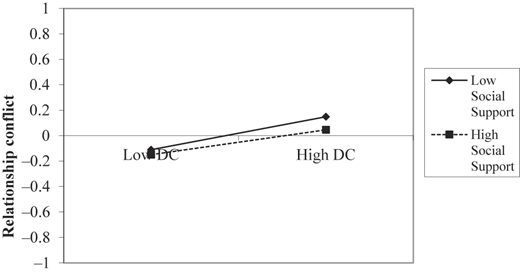
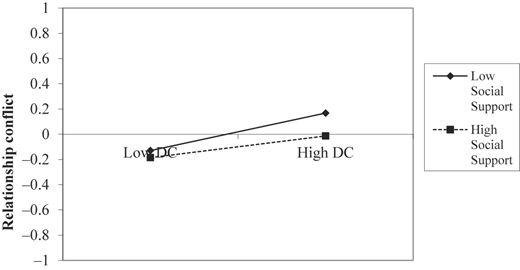
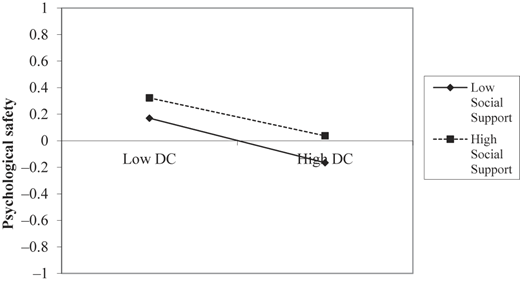
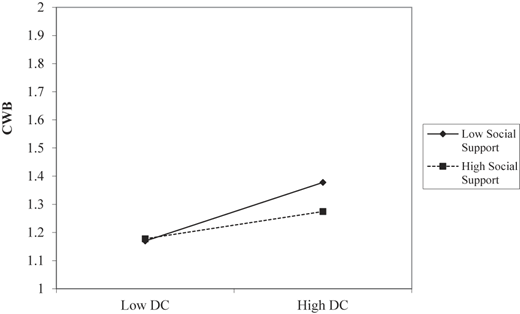
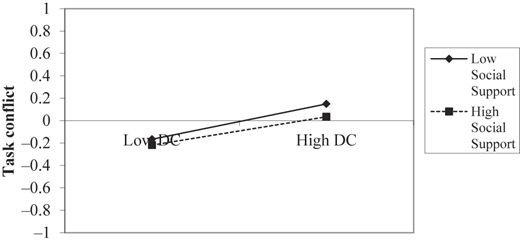
Concerning the hypothesized interaction effects, the data generally supported the buffering role of social support as a protective mechanism against the detrimental role of dysfunctional cognition. The interaction effect between social support and dysfunctional cognition is significant within schools for task conflict (B = −0.05, SE = 0.01, p < 0.001), for relationship conflict (B = −0.05, SE = 0.01, p < 0.001), and for psychological safety (B = 0.04, SE = 0.04, p < 0.001). As depicted in Figures 1, 2, 3, and 4, these interaction effects fully support the buffering role of social support in reducing the positive association between dysfunctional cognition and conflict as well as reducing the negative association between dysfunctional cognition and psychological safety. Moreover, the between-schools interaction effect of social support and dysfunctional cognition was significant for relationship conflict (B = −0.11, SE = 0.03, p < 0.001) as well as for counterproductive work behaviors (B = −0.10, SE = 0.02, p < 0.001). Figures 3 and 5 present these significant between-schools effects showing that in groups in which social support is higher on average, the strength of the association between dysfunctional cognition and relationship conflict, on the one hand, and counterproductive work behavior, on the other hand (school level), is attenuated. These results provide substantial support for H6.

Our study explored the deleterious influence of dysfunctional cognitions on work climate and CWB in a large sample of Romanian teachers. We built on the perspective that maladaptive cognitive schemas, developed as a response to neglected core emotional needs early in life, act as filters in which information is selected and processed, shaping individual perceptions and behaviors in adulthood (Young, 1998; Baldwin, 1992). We showed that such dysfunctional cognitive schemas have a positive association with teacher CWB.

First, drawing on the cognitive schema theory (Rumelhart, 1984), we showed that dysfunctional cognition was positively associated with perceptions of task and relationship conflict at work. Researchers have long theorized that schema negatively impacts the perception and evaluation of interpersonal relationships (Drapeau & Perry, 2004). Moreover, recent studies have shown that early maladaptive schemas are associated with poorer communication skills (Rezvani et al., 2021). Our results showed that dysfunctional cognition amplifies the perception of task and relationship conflicts at work, and these effects are significant within and between schools. Our results point out an aggregate effect of dysfunctional cognition and open venues for future research that explores perceptions of work climate as shared dysfunctional cognition within schools. Teachers exposed to abusive supervision or an uncertain or unsafe work environment may end up sharing the same negative evaluative tendencies marked by mistrust and suspicion (Huang & Yin, 2024). Literature to date has not explored such aggregated effects of cognition at work, and we believe that such effects are directly related to work attitudes and outcomes.

In line with research showing that maladaptive schemas distort the individual’s capacity to trust, express emotions and build connections (Yoo, Park, & Jun, 2014), our results show that dysfunctional cognition is associated with reduced psychological safety at work. Psychological safety often implies vulnerability, and we believe teachers high in maladaptive cognitive schemas struggle to behave in a manner that consolidates psychological safety. They can even perceive a positive team climate as threatening, inhibiting behaviors that elicit social connection. Similar to conflicts, our results revealed significant within as well as between-school effects indicating that shared evaluative tendencies lead to shared perceptions of psychological safety at work. These results open new venues for research that explore the relational mechanisms that explain such aggregated, school-level effects.

Further, our data confirmed the positive association between dysfunctional cognition and counterproductive work behaviors. Negative affectivity is one factor closely related to CWB (Berry et al., 2007), and past work already points to the role of dysfunctional cognitions in negative emotions (Cane, Olinger, Gotlib, & Kuiper, 1986). Teachers who feel high levels of anger, frustration, or hopelessness because of dysfunctional cognition might act in ways that are damaging to the school’s performance and well-being. We argue that the motives behind such behaviors could stem from biased interpretations of organizational norms and rules in the light of dysfunctional schema. We consider that both “externalizing” (hostility towards colleagues or pupils) or “internalizing” counterproductive behaviors (being intentionally late for a school meeting) might be behavioral enactments of dysfunctional cognitions. A key result reported in our article concerns the significant association between dysfunctional cognitions and work-related climate and CWB both within schools as well as between schools. Such results point to the possibility of aggregated effects of dysfunctional cognition within schools and open ways to explore how such aggregated effects occur. A plausible explanation is toxic leadership, as such leadership behaviors impact the evaluations of organizational members (Fodor, Curşeu, & Meslec, 2021). We did not explore such toxic leadership in our study, and our explanation is rather speculative. However, we call for future research that could explore more systematically how toxic leadership shapes the between-school differences in dysfunctional cognition and CWB.

Our results also show that social support is positively associated with psychological safety and negatively associated with task conflict, relational conflict, and counterproductive work behaviors relationship. We captured these relationships both within and between schools. They are consistent with prior research emphasizing the protecting role of social support against work-related adversities (Jolly et al., 2021; Viswesvaran et al., 1999; French et al., 2018) that have an overall beneficial role for the relational climate within schools. We hypothesized the buffering role of social support building on individual-level theories. However, the aggregated school-level effects indicate that shared perceptions of supporting relations within schools generate synergetic effects that transcend individual employees. Future research could explore how (sources of) social support impact conflict and CWB at the school level, probably through behavioral entrainment (the tendency to mimic each other’s actions and behaviors) or norm signaling, as they are indicative of what is considered typical and desirable in terms of work behaviors. In schools that are riddled with relational frictions, CWB could be the collective behavioral strategy that reflects teachers’ discontent with the work environment, thus, in a sense, CWB becomes the implicit social norm of reacting to the deleterious effects of relationship conflict.

In terms of indirect associations, all mediators play an important role, as illustrated by the indirect within-school effects. This pattern of results indicates significant differences in perceptions of school climate that vary as a function of dysfunctional cognition. Teachers vary in their perceptions of conflict and psychological safety, and such differences are explained by the detrimental role of dysfunctional cognition. The only significant mediation between schools was reported for relationship conflict. We may explain the indirect effect of relationship conflict at the school level by contagion as dysfunctional or negative relations tend to generally perturb the overall climate at work, and sometimes the presence of a single negative or conflictual social tie in a team decreases overall social cohesion and harmony (de Jong, Curşeu, & Leenders, 2014).

Moreover, social support reduced the positive association between dysfunctional cognition and conflict as well as the negative association between dysfunctional cognition and psychological safety. Moreover, at schools in which social support is higher on average, the strength of the association between dysfunctional cognition and relationship conflict on the one hand and counterproductive work behavior on the other hand (school level) is attenuated. A plausible explanation is that incoming social information is preferentially processed to match previous experiences encapsulated in cognitive schema (Rumelhart, 1984) and filters impact work-related outcomes and behaviors such as interpersonal interaction and behaviors, but this effect is possible to alleviate in the presence of social support (Jolly et al., 2021). These results align with our hypotheses since social support is a strong resource that can act as a buffer against job demands (Bakker et al., 2014). Teachers who endorse more irrational beliefs report a higher stress level (Bernard, 2016), and schema-lenses depicting work climate as threatening are mitigated by peer or leader support, leading to less negative interpretation. This will ultimately reduce the tendency of deviant behaviors since negative affectivity is one factor closely related to CWB (Berry et al., 2007).

Next to its contributions, we point to several important limitations. First, common method bias is likely to have influenced our results since we collected data from a single source. However, common method bias is less likely to lead to the overestimation of interaction effects (Siemsen, Roth, & Oliveira, 2010). Thus, we are confident that the interaction effects reported here were not substantially biased. Second, due to the nature of our cross-sectional design, we cannot draw causal claims concerning the variables included in our study. It is difficult to design experimental studies to manipulate dysfunctional cognition. However, we could explore the extent to which systemic training or group therapy sessions reduce the salience of dysfunctional cognition. In such contexts, we could draw clear causal claims to document dysfunctional cognition as an antecedent of conflict and psychological safety within schools. Third, our sample was women-dominated. Thus, we cannot draw definite conclusions about the workings of dysfunctional cognition in the general population or in organizational settings that have a more gender-balanced workforce. Fourth, although our sample of teachers was substantial, we cannot claim that it is a representative sample for the whole population of teachers in Romania. Future research could attempt to replicate our findings in other samples and contexts.

Finally, we assessed the two types of conflict using single items, and although we followed the recommendations concerning the clear and unambiguous wording of single-item measures (Allen, Iliescu, & Greiff, 2022), the reliability of the conflict estimates was likely affected by our assessment choice. Future research could replicate our findings by using multi-item scales and also focusing on different sources of conflict within schools. Task and relationship conflicts may emerge at various relational interfaces (among teachers, between teachers and principals, between teachers and students, etc.). Therefore, it is important to further explore the role of dysfunctional cognition as an antecedent of conflict at various relational interfaces within schools.

Our findings have practical implications for teachers, school administrators, and policymakers, emphasizing the need for supportive structures that can counteract the negative effects of dysfunctional cognition at multiple levels.

First, research shows that early maladaptive schemas are antecedents of depression and anxiety (Hawke & Provencher, 2011), conditions that remain heavily stigmatized in Romania due to negative portrayals in mass media of these conditions as debilitating (Manescu, Henderson, Paroiu, & Mihai, 2023). Teachers scoring high on DC could have negative help-seeking attitudes and behaviors to avoid stigmatization at work and, as such, avoid seeking social support even when they need it. We call for systematic approaches such as coaching and psychological counseling that help teachers deal with dysfunctional schema and understand how the activation of such interpretative tendencies perturbs their perceptions of their work environment. For example, by emphasizing the protective role of rational beliefs, such psychological support interventions could alleviate the detrimental effects of DC (Hyland, Shevlin, Adamson, & Boduszek, 2014; Balkıs & Duru, 2019).

Second, we believe that schools can bring hope and positive change in teachers’ lives indirectly through emotional and instrumental support from their leaders and peers as, according to our results, social support buffers against the detrimental effects of dysfunctional cognition. We do not argue that receiving emotional and instrumental support resolves the root cause of dysfunctional cognition problems (Young et al., 2003). However, it can help teachers co-regulate their negative emotions whenever difficult work situations occur, and our results present encouraging prospects for the well-being of Romanian teachers struggling with dysfunctional cognition. Educational managers must consider the fundamental role of social support in the workplace. Past studies have focused on the need for support as a buffer for negative work outcomes (Huber & Muijs, 2010; Sun & Leithwood, 2015; Muntean et al., 2022) and our results show that support can alleviate even the effects of dysfunctional cognitive schemas. By highlighting the importance of psychological safety and social support, our study paves the way for more effective strategies to enhance the well-being and performance of educators and, by extension, their students.

Our article contributes to the literature on teacher education by empirically examining the complex interplay between dysfunctional cognition and its effects in educational settings. Our research shed light on how early developed cognitive schemas can distort teachers’ perceptions of their work environment, thus leading to heightened perceptions of conflict, reduced psychological safety, and increased engagement in CWB. By exploring these dynamics, our study contributes to the understanding of how cognition influences the overall organizational climate and effectiveness. We offer insights into the mediating role of the relational climate and the mitigating effects of social support, providing a comprehensive view of how individual cognition interacts with environmental factors in educational contexts.

Authors would like to thank Şcoala Încrederii, Cluj-Napoca, Romania, for the financial and logistical support in collecting the data for this research.

Funding: This work was supported by Şcoala Încrederii, Cluj-Napoca, Romania.
Akhtarinejad
,
M.
,
Keshavarz
,
S.
,
Moradianvand
,
S.
, &
Namjoo
,
M.
(
2023
).
The relationship between teachers’ personality traits and job involvement: Mediation of early maladaptive schemas
.
International Journal of Innovation Management and Organizational Behavior
,
3
(
2
),
14
20
. doi: .
Allen
,
M. S.
,
Iliescu
,
D.
, &
Greiff
,
S.
(
2022
).
Single item measures in psychological science
.
European Journal of Psychological Assessment
,
38
(
1
),
1
5
. doi: .
Avanzi
,
L.
,
Fraccaroli
,
F.
,
Castelli
,
L.
,
Marcionetti
,
J.
,
Crescentini
,
A.
,
Balducci
,
C.
, &
van Dick
,
R.
(
2018
).
How to mobilize social support against workload and burnout: The role of organizational identification
.
Teaching and Teacher Education
,
69
,
154
167
. doi: .
Bach
,
B.
,
Lee
,
C.
,
Mortensen
,
E. L.
, &
Simonsen
,
E.
(
2016
).
How do DSM–5 personality traits align with schema therapy constructs?
.
Journal of Personality Disorders
,
30
(
4
),
502
529
. doi: .
Bakker
,
A. B.
, &
Demerouti
,
E.
(
2007
).
The job demands‐resources model: State of the art
.
Journal of Managerial Psychology
,
22
(
3
),
309
328
.
Bakker
,
A. B.
,
Demerouti
,
E.
, &
Sanz–Vergel
,
A. I.
(
2014
).
Burnout and work engagement: The JD–R approach
.
Annual Review of Organizational Psychology and Organizational Behavior
,
1
(
1
),
389
411
. doi: .
Baldwin
,
M. W.
(
1992
).
Relational schemas and the processing of social information
.
Psychological Bulletin
,
112
(
3
),
461
484
. doi: .
Baldwin
,
M. W.
, &
Meunier
,
J.
(
1999
).
The cued activation of attachment relational schemas
.
Social Cognition
,
17
(
2
),
209
227
. doi: .
Balkıs
,
M.
, &
Duru
,
E.
(
2019
).
The protective role of rational beliefs on the relationship between irrational beliefs, emotional states of stress, depression and anxiety
.
Journal of Rational-Emotive and Cognitive-Behavior Therapy
,
37
(
1
),
96
112
. doi: .
Bamber
,
M.
(
2006
).
CBT for occupational stress in health professionals: Introducing a schema–focused approach
.
Routledge
,
London
. doi: .
Barksdale
,
K.
, &
Werner
,
J. M.
(
2001
).
Managerial ratings of in–role behaviors, organizational citizenship behaviors, and overall performance: Testing different models of their relationship
.
Journal of Business Research
,
51
(
2
),
145
155
. doi: .
Barriga
,
A. Q.
,
Hawkins
,
M. A.
, &
Camelia
,
C. R.
(
2008
).
Specificity of cognitive distortions to antisocial behaviours
.
Criminal Behaviour and Mental Health
,
18
(
2
),
104
116
. doi: .
Bennett
,
R. J.
, &
Robinson
,
S. L.
(
2000
).
Development of a measure of workplace deviance
.
Journal of Applied Psychology
,
85
(
3
),
349
360
. doi: .
Bernard
,
M. E.
(
2016
).
Teacher beliefs and stress
.
Journal of Rational-Emotive and Cognitive-Behavior Therapy
,
34
,
209
224
. doi: .
Berry
,
C. M.
,
Carpenter
,
N. C.
, &
Barratt
,
C. L.
(
2012
).
Do other-reports of counterproductive work behavior provide an incremental contribution over self-reports? A meta-analytic comparison
.
Journal of Applied Psychology
,
97
(
3
),
613
636
.
Berry
,
C. M.
,
Ones
,
D. S.
, &
Sackett
,
P. R.
(
2007
).
Interpersonal deviance, organizational deviance, and their common correlates: A review and meta–analysis
.
Journal of Applied Psychology
,
92
(
2
),
410
424
. doi: .
Blissett
,
J.
,
Walsh
,
J.
,
Harris
,
G.
,
Jones
,
C.
,
Leung
,
N.
, &
Meyer
,
C.
(
2006
).
Different core beliefs predict paternal and maternal attachment representations in young women
.
Clinical Psychology and Psychotherapy
,
13
(
3
),
163
171
. doi: .
Blom
,
A. B.
, &
Curseu
,
P. L.
(
2024
).
A multilevel investigation of the relationship between the strength of ethical organizational culture and psychological safety: Do simple organizational interventions work?
.
Journal of Organizational Change Management
,
38
(
2
),
378
392
. doi: .
Bowling
,
N. A.
, &
Eschleman
,
K. J.
(
2010
).
Employee personality as a moderator of the relationships between work stressors and counterproductive work behavior
.
Journal of Occupational Health Psychology
,
15
(
1
),
91
103
. doi: .
Cane
,
D. B.
,
Olinger
,
L. J.
,
Gotlib
,
I. H.
, &
Kuiper
,
N. A.
(
1986
).
Factor structure of the Dysfunctional Attitude Scale in a student population
.
Journal of Clinical Psychology
,
42
(
2
),
307
309
.
Carr
,
S. N.
, &
Francis
,
A. J. P.
(
2010
).
Do early maladaptive schemas mediate the relationship between childhood experiences and avoidant personality disorder features? A preliminary investigation in a non–clinical sample
.
Cognitive Therapy and Research
,
34
(
4
),
343
358
. doi: .
Cohen
,
A.
(
2016
).
Are they among us? A conceptual framework of the relationship between the dark triad personality and counterproductive work behaviors (CWBs)
.
Human Resource Management Review
,
26
(
1
),
69
85
. doi: .
Curseu
,
P. L.
,
Codoban
,
I. A.
,
Sava
,
R. N.
, &
Sima
,
C.
(
2000
).
Adaptarea si validarea preliminara a chestionarului schemelor cognitive (the preliminary adaptation and validation of young schema questionnaire for Romanian population)
.
Cognition, Brain, Behavior
,
4
(
2-3
),
245
269
. doi: .
De Dreu
,
C. K.
, &
Weingart
,
L. R.
(
2003
).
Task versus relationship conflict, team performance, and team member satisfaction: A meta-analysis
.
Journal of Applied Psychology
,
88
(
4
),
741
149
. doi: .
de Jong
,
J. P.
,
Curşeu
,
P. L.
, &
Leenders
,
R. T. A.
(
2014
).
When do bad apples not spoil the barrel? Negative relationships in teams, team performance, and buffering mechanisms
.
Journal of Applied Psychology
,
99
(
3
),
514
522
. doi: .
Dodge
,
K. A.
(
1993
).
Social–cognitive mechanisms in the development of conduct disorder and depression
.
Annual Review of Psychology
,
44
(
1
),
559
584
. doi: .
Drapeau
,
M.
, &
Perry
,
J. C.
(
2004
).
Childhood trauma and adult interpersonal functioning: A study using the core conflictual relationship theme method (CCRT)
.
Child Abuse and Neglect
,
28
(
10
),
1049
1066
. doi: .
Dunlop
,
P. D.
, &
Lee
,
K.
(
2004
).
Workplace deviance, organizational citizenship behavior, and business unit performance: The bad apples do spoil the whole barrel
.
Journal of Organizational Behavior
,
25
(
1
),
67
80
. doi:.
Edmondson
,
A. C.
(
1999
).
Psychological safety and learning behavior in work teams
.
Administrative Science Quarterly
,
44
(
2
),
350
383
. doi: .
Edmondson
,
A. C.
, &
Lei
,
Z.
(
2014
).
Psychological safety: The history, renaissance, and future of an interpersonal construct
.
Annual Review of Organizational Psychology and Organizational Behavior
,
1
(
1
),
23
43
. doi: .
Edmondson
,
A. C.
,
Dillon
,
J. R.
, &
Roloff
,
K. S.
(
2007
).
Three perspectives on team learning
.
The Academy of Management Annals
,
1
(
1
),
269
314
. doi: .
Fodor
,
O. C.
,
Curşeu
,
P. L.
, &
Meslec
,
N.
(
2021
).
In leaders we trust, or should we? Supervisors’ dark triad personality traits and ratings of team performance and innovation
.
Frontiers in Psychology
,
12
, 650172. doi: .
Fox
,
S.
, &
Spector
,
P. E.
(
1999
).
A model of work frustration–aggression
.
Journal of Organizational Behavior
,
20
(
6
),
915
931
. doi: .
Freiberg
,
H. J.
(
1998
).
Measuring school climate: Let me count the ways
.
Educational Leadership
,
56
(
1
),
22
26
. doi: .
French
,
K. A.
,
Dumani
,
S.
,
Allen
,
T. D.
, &
Shockley
,
K. M.
(
2018
).
A meta-analysis of work–family conflict and social support
.
Psychological Bulletin
,
144
(
3
),
284
314
. doi: .
Grzesiak
,
L.
, &
Ulrych
,
W.
(
2024
).
How management support and diversity factors affect employee performance within the digital workplace
.
Central European Management Journal
,
33
(
1
),
20
39
. doi: .
Hawke
,
L. D.
, &
Provencher
,
M. D.
(
2011
).
Schema theory and schema therapy in mood and anxiety disorders: A review
.
Journal of Cognitive Psychotherapy
,
25
(
4
),
257
276
. doi: .
Hershcovis
,
M. S.
,
Turner
,
N.
,
Barling
,
J.
,
Arnold
,
K. A.
,
Dupré
,
K. E.
,
Inness
,
M.
, …
Sivanathan
,
N.
(
2007
).
Predicting workplace aggression: A meta–analysis
.
Journal of Applied Psychology
,
92
(
1
),
228
238
. doi: .
Hodgkinson
,
G. P.
, &
Healey
,
M. P.
(
2008
).
Cognition in organizations
.
Annual Review of Psychology
,
59
(
1
),
387
417
. doi: .
Huang
,
S.
, &
Yin
,
H.
(
2024
).
The relationships between paternalistic leadership, teachers’ emotional labor, engagement, and turnover intention: A multilevel SEM analysis
.
Teaching and Teacher Education
,
143
, 104552. doi: .
Huber
,
S. G.
, &
Muijs
,
D.
(
2010
). School leadership effectiveness: The growing insight in the importance of school leadership for the quality and development of schools and their pupils. in
S.
 
Huber
(Ed.).
School Leadership – International Perspectives. Studies in Educational Leadership
(Vol. 
10
, pp. 
57
77
).
Springer
,
Dordrecht
. doi: .
Huk
,
O.
,
Terjesen
,
M. D.
, &
Cherkasova
,
L.
(
2019
).
Predicting teacher burnout as a function of school characteristics and irrational beliefs
.
Psychology in the Schools
,
56
(
5
),
792
808
. doi: .
Hyland
,
P.
,
Shevlin
,
M.
,
Adamson
,
G.
, &
Boduszek
,
D.
(
2014
).
The moderating role of rational beliefs in the relationship between irrational beliefs and posttraumatic stress symptomology
.
Behavioural and Cognitive Psychotherapy
,
42
(
3
),
312
326
. doi: .
Jacob
,
G. A.
, &
Arntz
,
A.
(
2013
).
Schema therapy for personality disorders—a review
.
International Journal of Cognitive Therapy
,
6
(
2
),
171
185
. doi: .
Jehn
,
K. A.
(
1995
).
A multimethod examination of the benefits and detriments of intragroup conflict
.
Administrative Science Quarterly
,
40
(
2
),
256
282
.
Jolly
,
P. M.
,
Kong
,
D. T.
, &
Kim
,
K. Y.
(
2021
).
Social support at work: An integrative review
.
Journal of Organizational Behavior
,
42
(
2
),
229
251
. doi: .
Jovev
,
M.
, &
Jackson
,
H. J.
(
2004
).
Early maladaptive schemas in personality disordered individuals
.
Journal of Personality Disorders
,
18
(
5
),
467
478
. doi: .
Kidwell
,
R. E.
, &
Kochanowski
,
S. M.
(
2005
).
The morality of employee theft: Teaching about ethics and deviant behavior in the workplace
.
Journal of Management Education
,
29
(
1
),
135
152
. doi: .
Koch
,
E. J.
(
2002
).
Relational schemas, self–esteem, and the processing of social stimuli
.
Self and Identity
,
1
(
3
),
271
279
. doi: .
Kumschick
,
I. R.
,
Torchetti
,
L.
,
Gasser
,
L.
, &
Tettenborn
,
A.
(
2023
).
How controllable versus uncontrollable cognitions affect emotion processing during classroom disruptions: A video study with preservice teachers
.
Teaching and Teacher Education
,
135
, 104317. doi: .
Lazarus
,
R. S.
, &
Folkman
,
S.
(
1984
).
Stress, appraisal, and coping
.
New York
:
Springer
. doi: .
Levine
,
E. L.
(
2010
).
Emotion and power (as social influence): Their impact on organizational citizenship and counterproductive individual and organizational behavior
.
Human Resource Management Review
,
20
(
1
),
4
17
. doi: .
Lindner
,
H.
,
Kirkby
,
R.
,
Wertheim
,
E.
, &
Birch
,
P.
(
1999
).
A brief assessment of irrational thinking: The shortened general attitude and belief scale
.
Cognitive Therapy and Research
,
23
(
6
),
651
663
. doi: .
MacKenzie
,
C.
,
Garavan
,
T. N.
, &
Carbery
,
R.
(
2011
).
Understanding and preventing dysfunctional behavior in organizations: Conceptualizing the contribution of human resource development
.
Human Resource Development Review
,
10
(
4
),
346
380
. doi: .
Manescu
,
E. A.
,
Henderson
,
C.
,
Paroiu
,
C. R.
, &
Mihai
,
A.
(
2023
).
Mental health related stigma in Romania: Systematic review and narrative synthesis
.
BMC Psychiatry
,
23
(
1
),
662
. doi: .
Mayo
,
R.
(
2019
).
Knowledge and distrust may go a long way in the battle with disinformation: Mental processes of spontaneous disbelief
.
Current Directions in Psychological Science
,
28
(
4
),
409
414
. doi: .
McEvoy
,
A.
, &
Welker
,
R.
(
2000
).
Antisocial behavior, academic failure, and school climate: A critical review
.
Journal of Emotional and Behavioral Disorders
,
8
(
3
),
130
140
. doi: .
Mount
,
M.
,
Ilies
,
R.
, &
Johnson
,
E.
(
2006
).
Relationship of personality traits and counterproductive work behaviors: The mediating effects of job satisfaction
.
Personnel Psychology
,
59
(
3
),
591
622
. doi: .
Muntean
,
A. F.
,
Curşeu
,
P. L.
, &
Tucaliuc
,
M.
(
2022
).
A social support and resource drain exploration of the bright and dark sides of teachers’ organizational citizenship behaviors
.
Education Sciences
,
12
(
12
),
895
. doi: .
Newman
,
A.
,
Donohue
,
R.
, &
Eva
,
N.
(
2017
).
Psychological safety: A systematic review of the literature
.
Human Resource Management Review
,
27
(
3
),
521
535
. doi: .
Pearsall
,
M. J.
, &
Ellis
,
A. P. J.
(
2011
).
Thick as thieves: The effects of ethical orientation and psychological safety on unethical team behavior
.
Journal of Applied Psychology
,
96
(
2
),
401
411
. doi: .
Pluut
,
H.
, &
Curşeu
,
P. L.
(
2013
).
Perceptions of intragroup conflict: The effect of coping strategies on conflict transformation and escalation
.
Group Processes and Intergroup Relations
,
16
(
4
),
412
425
. doi: .
Pondy
,
L. R.
(
1992
).
Reflections on organizational conflict
.
Journal of Organizational Behavior
,
13
(
3
),
257
261
. doi: .
Ragins
,
B. R.
, &
Verbos
,
A. K.
(
2017
). Positive relationships in action: Relational mentoring and mentoring schemas in the workplace. In
Exploring positive relationships at work
(pp. 
91
116
).
Psychology Press
. doi: .
Rezvani Nejad
,
K. S.
,
Mirpour
,
Z. S.
,
Azizi
,
A.
,
Sheikholeslami
,
F.
, &
Rahmati
,
F.
(
2021
).
The relationship between communication skills and early maladaptive schemas in university students
.
Journal of Fundamentals of Mental Health
, (
Sept-Oct
),
323
329
. doi:.
Rockwood
,
N. J.
, &
Hayes
,
A. F.
(
2017
).
MLmed: An SPSS macro for multilevel mediation and conditional process analysis
. In
Poster presented at the annual meeting of the Association of Psychological Science (APS)
,
Boston, MA
. doi: .
Roorda
,
D. L.
,
Koomen
,
H. M.
,
Spilt
,
J. L.
, &
Oort
,
F. J.
(
2011
).
The influence of affective teacher–student relationships on students’ school engagement and achievement: A meta-analytic approach
.
Review of Educational Research
,
81
(
4
),
493
529
. doi: .
Rumelhart
,
D. E.
(
1984
). Schemata and the cognitive system. in
R. S.
 
Wyer, Jr.
, &
T. K.
 
Srull
(Eds),
Handbook of social cognition
(Vol. 
1
, pp. 
161
188
).
Lawrence Erlbaum Associates
. doi: .
Russell
,
E. M.
,
Williams
,
S. W.
, &
Gleason-Gomez
,
C.
(
2010
).
Teachers’ perceptions of administrative support and antecedents of turnover
.
Journal of Research in Childhood Education
,
24
(
3
),
195
208
. doi: .
Sakurai
,
K.
, &
Jex
,
S. M.
(
2012
).
Coworker incivility and incivility targets’ work effort and counterproductive work behavior: The moderating role of supervisor social support
.
Journal of Occupational Health Psychology
,
17
(
2
),
150
161
. doi: .
Schaufeli
,
W. B.
, &
Bakker
,
A. B.
(
2004
).
Job demands, job resources, and their relationship with burnout and engagement: A multi‐sample study
.
Journal of Organizational Behavior: The International Journal of Industrial, Occupational and Organizational Psychology and Behavior
,
25
(
3
),
293
315
. doi: .
Schminke
,
M.
,
Arnaud
,
A.
, &
Kuenzi
,
M.
(
2007
).
The power of ethical work climates
.
Organizational Dynamics
,
36
(
2
),
171
186
. doi: .
Scholtes
,
C.
,
Trif
,
S.
, &
Curseu
,
P. L.
(
2024
).
Managerial rationality, dysfunctional cognition and organizational decision comprehensiveness
.
Journal of Organizational Change Management
,
37
(
3
),
490
503
. doi: .
Siemsen
,
E.
,
Roth
,
A.
, &
Oliveira
,
P.
(
2010
).
Common method bias in regression models with linear, quadratic, and interaction effects
.
Organizational Research Methods
,
13
(
3
),
456
476
. doi: .
Spector
,
P. E.
, &
Fox
,
S.
(
2002
).
An emotion-centered model of voluntary work behavior
.
Human Resource Management Review
,
12
(
2
),
269
292
. doi: .
Spector
,
P. E.
,
Fox
,
S.
,
Penney
,
L. M.
,
Bruursema
,
K.
,
Goh
,
A.
, &
Kessler
,
S.
(
2006
).
The dimensionality of counterproductivity: Are all counterproductive behaviors created equal?
.
Journal of Vocational Behavior
,
68
(
3
),
446
460
. doi: .
Spector
,
P. E.
,
Bauer
,
J. A.
, &
Fox
,
S.
(
2010
).
Measurement artifacts in the assessment of counterproductive work behavior and organizational citizenship behavior: Do we know what we think we know?
.
Journal of Applied Psychology
,
95
(
4
),
781
790
. doi: .
Sun
,
J.
, &
Leithwood
,
K.
(
2015
).
Direction-setting school leadership practices: A meta-analytical review of evidence about their influence
.
School Effectiveness and School Improvement
,
26
(
4
),
499
523
. doi: .
Telecan
,
M. I.
,
Curseu
,
P. L.
, &
Rus
,
C. L.
(
2024
).
How many friends at work are too many? The nonlinear association between the number of friends, social support and mental well-being
.
Central European Management Journal
,
32
(
4
),
604
617
. doi: .
The Educational System in Romania, National Institute of Statistics
(
2020
).
Sistemul Educational in Romania, Indici Sintetici 2019–2020
.
Available from:
 https://insse.ro/cms/sites/default/files/field/publicatii/sistemul_educational_in_romania_2019_2020.pdf
Thimm
,
J. C.
(
2010
).
Mediation of early maladaptive schemas between perceptions of parental rearing style and personality disorder symptoms
.
Journal of Behavior Therapy and Experimental Psychiatry
,
41
(
1
),
52
59
. doi: .
Tucaliuc
,
M.
,
Curşeu
,
P. L.
,
Muntean
,
A. F.
, &
Buzea
,
I. M.
(
2024
).
Too complex to follow! Principals’ strategic cognitive complexity, teachers’ organizational identification and school outcomes
.
Educational Management Administration and Leadership
. doi: .
Van Fleet
,
D. D.
, &
Griffin
,
R. W.
(
2006
).
Dysfunctional organization culture
.
Journal of Managerial Psychology
,
21
(
8
),
698
708
. doi: .
Viswesvaran
,
C.
,
Sanchez
,
J. I.
, &
Fisher
,
J.
(
1999
).
The role of social support in the process of work stress: A meta-analysis
.
Journal of Vocational Behavior
,
54
(
2
),
314
334
. doi: .
Yoo
,
G.
,
Park
,
J. H.
, &
Jun
,
H. J.
(
2014
).
Early maladaptive schemas as predictors of interpersonal orientation and peer connectedness in university students
.
Social Behavior and Personality: an International Journal
,
42
(
8
),
1377
1394
. doi: .
Young
,
J. E.
(
1998
).
The young schema Questionnaire: Short form
,
Cognitive Therapy Center
.
New York, NY
. doi: .
Young
,
J. E.
,
Klosko
,
J. S.
, &
Weishaar
,
M. E.
(
2003
).
Schema therapy: A practitioner’s guide
.
Guilford Press
,
New York
. doi: .
Published in Central European Management Journal. Published by Emerald Publishing Limited. This article is published under the Creative Commons Attribution (CC BY 4.0) license. Anyone may reproduce, distribute, translate and create derivative works of this article (for both commercial and non-commercial purposes), subject to full attribution to the original publication and authors. The full terms of this license may be seen at http://creativecommons.org/licences/by/4.0/legalcode

Data & Figures

Figure 1
A line graph shows task conflict by decision control and social support.The line graph is drawn on a coordinate plane. The horizontal axis has 2 categories from left to right: “Low D C” and “High D C”. The vertical axis is labeled “Task conflict” and ranges from negative 1 to 1 in increments of 0.2. A horizontal reference line is drawn at 0. Two lines compare “Low Social Support” and “High Social Support”. A legend is positioned on the right side of the graph. The solid line with diamond markers represents “Low Social Support”. The dashed line with square markers represents “High Social Support”. For “Low Social Support”, the value increases from negative 0.17 at “Low D C” to 0.15 at “High D C”. For “High Social Support”, the value increases from negative 0.22 at “Low D C” to 0.03 at “High D C”. Note: All numerical data values are approximated.

The interaction effect between dysfunctional cognition and social support on counterproductive task conflict (within groups). Notes: The graph represents a significant within-group interaction effect; DC – dysfunctional cognition. Source: Authors’ own elaboration

Figure 1
A line graph shows task conflict by decision control and social support.The line graph is drawn on a coordinate plane. The horizontal axis has 2 categories from left to right: “Low D C” and “High D C”. The vertical axis is labeled “Task conflict” and ranges from negative 1 to 1 in increments of 0.2. A horizontal reference line is drawn at 0. Two lines compare “Low Social Support” and “High Social Support”. A legend is positioned on the right side of the graph. The solid line with diamond markers represents “Low Social Support”. The dashed line with square markers represents “High Social Support”. For “Low Social Support”, the value increases from negative 0.17 at “Low D C” to 0.15 at “High D C”. For “High Social Support”, the value increases from negative 0.22 at “Low D C” to 0.03 at “High D C”. Note: All numerical data values are approximated.

The interaction effect between dysfunctional cognition and social support on counterproductive task conflict (within groups). Notes: The graph represents a significant within-group interaction effect; DC – dysfunctional cognition. Source: Authors’ own elaboration

Close modal
Figure 2
A line graph shows relationship conflict by decision control and social support.The line graph is drawn on a coordinate plane. The horizontal axis has 2 categories from left to right: “Low D C” and “High D C”. The vertical axis is labeled “Relationship conflict” and ranges from negative 1 to 1 in increments of 0.2. A horizontal reference line is drawn at 0. Two lines compare “Low Social Support” and “High Social Support”. A legend is positioned on the right side of the graph. The solid line with diamond markers represents “Low Social Support”. The dashed line with square markers represents “High Social Support”. For “Low Social Support”, the value increases from negative 0.11 at “Low D C” to 0.15 at “High D C”. For “High Social Support”, the value increases from negative 0.15 at “Low D C” to 0.04 at “High D C”. Note: All numerical data values are approximated.

The interaction effect between dysfunctional cognition and social support on relationship conflict (within groups). Notes: The graph represents a significant within-group interaction effect; DC – dysfunctional cognition. Source: Authors’ own elaboration

Figure 2
A line graph shows relationship conflict by decision control and social support.The line graph is drawn on a coordinate plane. The horizontal axis has 2 categories from left to right: “Low D C” and “High D C”. The vertical axis is labeled “Relationship conflict” and ranges from negative 1 to 1 in increments of 0.2. A horizontal reference line is drawn at 0. Two lines compare “Low Social Support” and “High Social Support”. A legend is positioned on the right side of the graph. The solid line with diamond markers represents “Low Social Support”. The dashed line with square markers represents “High Social Support”. For “Low Social Support”, the value increases from negative 0.11 at “Low D C” to 0.15 at “High D C”. For “High Social Support”, the value increases from negative 0.15 at “Low D C” to 0.04 at “High D C”. Note: All numerical data values are approximated.

The interaction effect between dysfunctional cognition and social support on relationship conflict (within groups). Notes: The graph represents a significant within-group interaction effect; DC – dysfunctional cognition. Source: Authors’ own elaboration

Close modal
Figure 3
A line graph shows relationship conflict by decision control and social support.The line graph is drawn on a coordinate plane. The horizontal axis has 2 categories from left to right: “Low D C” and “High D C”. The vertical axis is labeled “Relationship conflict” and ranges from negative 1 to 1 in increments of 0.2. A horizontal reference line is drawn at 0. Two lines compare “Low Social Support” and “High Social Support”. A legend is positioned on the right side of the graph. The solid line with diamond markers represents “Low Social Support”. The dashed line with square markers represents “High Social Support”. For “Low Social Support”, the value increases from negative 0.13 at “Low D C” to 0.17 at “High D C”. For “High Social Support”, the value increases from negative 0.19 at “Low D C” to negative 0.01 at “High D C”. Note: All numerical data values are approximated.

The interaction effect between dysfunctional cognition and social support on relationship conflict (between groups). Notes: The graph represents a significant between groups interaction effect; DC – dysfunctional cognition. Source: Authors’ own elaboration

Figure 3
A line graph shows relationship conflict by decision control and social support.The line graph is drawn on a coordinate plane. The horizontal axis has 2 categories from left to right: “Low D C” and “High D C”. The vertical axis is labeled “Relationship conflict” and ranges from negative 1 to 1 in increments of 0.2. A horizontal reference line is drawn at 0. Two lines compare “Low Social Support” and “High Social Support”. A legend is positioned on the right side of the graph. The solid line with diamond markers represents “Low Social Support”. The dashed line with square markers represents “High Social Support”. For “Low Social Support”, the value increases from negative 0.13 at “Low D C” to 0.17 at “High D C”. For “High Social Support”, the value increases from negative 0.19 at “Low D C” to negative 0.01 at “High D C”. Note: All numerical data values are approximated.

The interaction effect between dysfunctional cognition and social support on relationship conflict (between groups). Notes: The graph represents a significant between groups interaction effect; DC – dysfunctional cognition. Source: Authors’ own elaboration

Close modal
Figure 4
A line graph shows psychological safety by decision control and social support.The line graph is drawn on a coordinate plane. The horizontal axis has 2 categories from left to right: “Low D C” and “High D C”. The vertical axis is labeled “Psychological safety” and ranges from negative 1 to 1 in increments of 0.2. A horizontal reference line is drawn at 0. Two lines compare “Low Social Support” and “High Social Support”. A legend is positioned on the right side of the graph. The solid line with diamond markers represents “Low Social Support”. The dashed line with square markers represents “High Social Support”. For “Low Social Support”, the value decreases from 0.17 at “Low D C” to negative 0.17 at “High D C”. For “High Social Support”, the value decreases from 0.32 at “Low D C” to 0.04 at “High D C”. Note: All numerical data values are approximated.

The interaction effect between dysfunctional cognition and social support on psychological safety (within groups). Notes: The graph represents a significant within-groups interaction effect; DC – dysfunctional cognition. Source: Authors’ own elaboration

Figure 4
A line graph shows psychological safety by decision control and social support.The line graph is drawn on a coordinate plane. The horizontal axis has 2 categories from left to right: “Low D C” and “High D C”. The vertical axis is labeled “Psychological safety” and ranges from negative 1 to 1 in increments of 0.2. A horizontal reference line is drawn at 0. Two lines compare “Low Social Support” and “High Social Support”. A legend is positioned on the right side of the graph. The solid line with diamond markers represents “Low Social Support”. The dashed line with square markers represents “High Social Support”. For “Low Social Support”, the value decreases from 0.17 at “Low D C” to negative 0.17 at “High D C”. For “High Social Support”, the value decreases from 0.32 at “Low D C” to 0.04 at “High D C”. Note: All numerical data values are approximated.

The interaction effect between dysfunctional cognition and social support on psychological safety (within groups). Notes: The graph represents a significant within-groups interaction effect; DC – dysfunctional cognition. Source: Authors’ own elaboration

Close modal
Figure 5
A line graph shows C W B by decision control and social support.The line graph is drawn on a coordinate plane. The horizontal axis has 2 categories from left to right: “Low D C” and “High D C”. The vertical axis is labeled “C W B” and ranges from 1 to 2 in increments of 0.1. Two lines compare “Low Social Support” and “High Social Support”. A legend is positioned on the right side of the graph. The solid line with diamond markers represents “Low Social Support”. The dashed line with square markers represents “High Social Support”. For “Low Social Support”, the value increases from 1.17 at “Low D C” to 1.38 at “High D C”. For “High Social Support”, the value increases from 1.18 at “Low D C” to 1.27 at “High D C”. Note: All numerical data values are approximated.

The interaction effect between dysfunctional cognition and social support on counterproductive work behaviors (between groups). Notes: The graph represents a significant between groups interaction effect; DC – dysfunctional cognition; CWB – counterproductive work behaviors. Source: Authors’ own elaboration

Figure 5
A line graph shows C W B by decision control and social support.The line graph is drawn on a coordinate plane. The horizontal axis has 2 categories from left to right: “Low D C” and “High D C”. The vertical axis is labeled “C W B” and ranges from 1 to 2 in increments of 0.1. Two lines compare “Low Social Support” and “High Social Support”. A legend is positioned on the right side of the graph. The solid line with diamond markers represents “Low Social Support”. The dashed line with square markers represents “High Social Support”. For “Low Social Support”, the value increases from 1.17 at “Low D C” to 1.38 at “High D C”. For “High Social Support”, the value increases from 1.18 at “Low D C” to 1.27 at “High D C”. Note: All numerical data values are approximated.

The interaction effect between dysfunctional cognition and social support on counterproductive work behaviors (between groups). Notes: The graph represents a significant between groups interaction effect; DC – dysfunctional cognition; CWB – counterproductive work behaviors. Source: Authors’ own elaboration

Close modal
Table 1

Means, standard deviations, and correlations

MeanSD123456
1. Gender0.900.301     
2. Dysfunctional cognition2.19400.57891−0.0091    
3. Social support5.61291.403100.005−0.160**1   
4. Task conflict1.450.726−0.038*0.262**−0.233**1  
5. Relationship conflict1.260.601−0.047*0.252**−0.228**0.645**1 
6. Psychological safety3.94460.66507−0.014−0.310**0.411**−0.376**−0.349**1
7. Counterproductive work behaviors1.29420.29667−0.0110.330**−0.270**0.348**0.365**−0.323**

Note(s): Gender is coded as a dummy variable 1 = women, 0 = men; p < 0.10; *p < 0.05; **p < 0.01; ***p < 0.001

Source(s): Authors’ own elaboration

Table 2

Results of the within-between multilevel analysis

VariableTask conflictRelationship conflictPsychological safetyCWB
WithinBetweenWithinBetweenWithinBetweenWithinBetween
Constant−0.11 (0.10)0.03 (0.09)0.11 (0.10)1.34*** (0.04)
Gender−0.11** (0.04)0.11 (0.11)−0.09** (0.03)−0.04 (0.10)−0.07 (0.04)−0.10 (0.11)0.01 (0.02)−0.06 (0.05)
Dysfunctional cognition (DC)0.27*** (0.02)0.39*** (0.06)0.22*** (0.02)0.25*** (0.05)−0.29*** (0.02)−0.51*** (0.06)0.09*** (0.008)0.18*** (0.03)
Social support (SS)−0.08*** (0.009)−0.16*** (0.02)−0.07*** (0.007)−0.11*** (0.02)0.18*** (0.008)0.24*** (0.02)−0.02*** (0.003)−0.05*** (0.01)
Task conflict      0.04*** (0.008)0.04 (0.03)
Relationship conflict      0.08*** (0.01)0.08* (0.03)
Psychological safety      −0.05*** (0.07)−0.02 (0.02)
DC × SS−0.05** (0.01)−0.07 (0.04)−0.05*** (0.01)−0.11*** (0.03)0.04*** (0.04)0.04 (0.04)−0.001 (0.005)−0.10*** (0.02)

Note(s): Unstandardized coefficients are presented in the table with SE in parentheses; gender is coded as a dummy variable 1 = women, 0 = men; CWB – counterproductive work behaviors

p < 0.10; *p < 0.05; **p < 0.01; ***p < 0.001

Source(s): Authors’ own elaboration

Supplements

References

Akhtarinejad
,
M.
,
Keshavarz
,
S.
,
Moradianvand
,
S.
, &
Namjoo
,
M.
(
2023
).
The relationship between teachers’ personality traits and job involvement: Mediation of early maladaptive schemas
.
International Journal of Innovation Management and Organizational Behavior
,
3
(
2
),
14
20
. doi: .
Allen
,
M. S.
,
Iliescu
,
D.
, &
Greiff
,
S.
(
2022
).
Single item measures in psychological science
.
European Journal of Psychological Assessment
,
38
(
1
),
1
5
. doi: .
Avanzi
,
L.
,
Fraccaroli
,
F.
,
Castelli
,
L.
,
Marcionetti
,
J.
,
Crescentini
,
A.
,
Balducci
,
C.
, &
van Dick
,
R.
(
2018
).
How to mobilize social support against workload and burnout: The role of organizational identification
.
Teaching and Teacher Education
,
69
,
154
167
. doi: .
Bach
,
B.
,
Lee
,
C.
,
Mortensen
,
E. L.
, &
Simonsen
,
E.
(
2016
).
How do DSM–5 personality traits align with schema therapy constructs?
.
Journal of Personality Disorders
,
30
(
4
),
502
529
. doi: .
Bakker
,
A. B.
, &
Demerouti
,
E.
(
2007
).
The job demands‐resources model: State of the art
.
Journal of Managerial Psychology
,
22
(
3
),
309
328
.
Bakker
,
A. B.
,
Demerouti
,
E.
, &
Sanz–Vergel
,
A. I.
(
2014
).
Burnout and work engagement: The JD–R approach
.
Annual Review of Organizational Psychology and Organizational Behavior
,
1
(
1
),
389
411
. doi: .
Baldwin
,
M. W.
(
1992
).
Relational schemas and the processing of social information
.
Psychological Bulletin
,
112
(
3
),
461
484
. doi: .
Baldwin
,
M. W.
, &
Meunier
,
J.
(
1999
).
The cued activation of attachment relational schemas
.
Social Cognition
,
17
(
2
),
209
227
. doi: .
Balkıs
,
M.
, &
Duru
,
E.
(
2019
).
The protective role of rational beliefs on the relationship between irrational beliefs, emotional states of stress, depression and anxiety
.
Journal of Rational-Emotive and Cognitive-Behavior Therapy
,
37
(
1
),
96
112
. doi: .
Bamber
,
M.
(
2006
).
CBT for occupational stress in health professionals: Introducing a schema–focused approach
.
Routledge
,
London
. doi: .
Barksdale
,
K.
, &
Werner
,
J. M.
(
2001
).
Managerial ratings of in–role behaviors, organizational citizenship behaviors, and overall performance: Testing different models of their relationship
.
Journal of Business Research
,
51
(
2
),
145
155
. doi: .
Barriga
,
A. Q.
,
Hawkins
,
M. A.
, &
Camelia
,
C. R.
(
2008
).
Specificity of cognitive distortions to antisocial behaviours
.
Criminal Behaviour and Mental Health
,
18
(
2
),
104
116
. doi: .
Bennett
,
R. J.
, &
Robinson
,
S. L.
(
2000
).
Development of a measure of workplace deviance
.
Journal of Applied Psychology
,
85
(
3
),
349
360
. doi: .
Bernard
,
M. E.
(
2016
).
Teacher beliefs and stress
.
Journal of Rational-Emotive and Cognitive-Behavior Therapy
,
34
,
209
224
. doi: .
Berry
,
C. M.
,
Carpenter
,
N. C.
, &
Barratt
,
C. L.
(
2012
).
Do other-reports of counterproductive work behavior provide an incremental contribution over self-reports? A meta-analytic comparison
.
Journal of Applied Psychology
,
97
(
3
),
613
636
.
Berry
,
C. M.
,
Ones
,
D. S.
, &
Sackett
,
P. R.
(
2007
).
Interpersonal deviance, organizational deviance, and their common correlates: A review and meta–analysis
.
Journal of Applied Psychology
,
92
(
2
),
410
424
. doi: .
Blissett
,
J.
,
Walsh
,
J.
,
Harris
,
G.
,
Jones
,
C.
,
Leung
,
N.
, &
Meyer
,
C.
(
2006
).
Different core beliefs predict paternal and maternal attachment representations in young women
.
Clinical Psychology and Psychotherapy
,
13
(
3
),
163
171
. doi: .
Blom
,
A. B.
, &
Curseu
,
P. L.
(
2024
).
A multilevel investigation of the relationship between the strength of ethical organizational culture and psychological safety: Do simple organizational interventions work?
.
Journal of Organizational Change Management
,
38
(
2
),
378
392
. doi: .
Bowling
,
N. A.
, &
Eschleman
,
K. J.
(
2010
).
Employee personality as a moderator of the relationships between work stressors and counterproductive work behavior
.
Journal of Occupational Health Psychology
,
15
(
1
),
91
103
. doi: .
Cane
,
D. B.
,
Olinger
,
L. J.
,
Gotlib
,
I. H.
, &
Kuiper
,
N. A.
(
1986
).
Factor structure of the Dysfunctional Attitude Scale in a student population
.
Journal of Clinical Psychology
,
42
(
2
),
307
309
.
Carr
,
S. N.
, &
Francis
,
A. J. P.
(
2010
).
Do early maladaptive schemas mediate the relationship between childhood experiences and avoidant personality disorder features? A preliminary investigation in a non–clinical sample
.
Cognitive Therapy and Research
,
34
(
4
),
343
358
. doi: .
Cohen
,
A.
(
2016
).
Are they among us? A conceptual framework of the relationship between the dark triad personality and counterproductive work behaviors (CWBs)
.
Human Resource Management Review
,
26
(
1
),
69
85
. doi: .
Curseu
,
P. L.
,
Codoban
,
I. A.
,
Sava
,
R. N.
, &
Sima
,
C.
(
2000
).
Adaptarea si validarea preliminara a chestionarului schemelor cognitive (the preliminary adaptation and validation of young schema questionnaire for Romanian population)
.
Cognition, Brain, Behavior
,
4
(
2-3
),
245
269
. doi: .
De Dreu
,
C. K.
, &
Weingart
,
L. R.
(
2003
).
Task versus relationship conflict, team performance, and team member satisfaction: A meta-analysis
.
Journal of Applied Psychology
,
88
(
4
),
741
149
. doi: .
de Jong
,
J. P.
,
Curşeu
,
P. L.
, &
Leenders
,
R. T. A.
(
2014
).
When do bad apples not spoil the barrel? Negative relationships in teams, team performance, and buffering mechanisms
.
Journal of Applied Psychology
,
99
(
3
),
514
522
. doi: .
Dodge
,
K. A.
(
1993
).
Social–cognitive mechanisms in the development of conduct disorder and depression
.
Annual Review of Psychology
,
44
(
1
),
559
584
. doi: .
Drapeau
,
M.
, &
Perry
,
J. C.
(
2004
).
Childhood trauma and adult interpersonal functioning: A study using the core conflictual relationship theme method (CCRT)
.
Child Abuse and Neglect
,
28
(
10
),
1049
1066
. doi: .
Dunlop
,
P. D.
, &
Lee
,
K.
(
2004
).
Workplace deviance, organizational citizenship behavior, and business unit performance: The bad apples do spoil the whole barrel
.
Journal of Organizational Behavior
,
25
(
1
),
67
80
. doi:.
Edmondson
,
A. C.
(
1999
).
Psychological safety and learning behavior in work teams
.
Administrative Science Quarterly
,
44
(
2
),
350
383
. doi: .
Edmondson
,
A. C.
, &
Lei
,
Z.
(
2014
).
Psychological safety: The history, renaissance, and future of an interpersonal construct
.
Annual Review of Organizational Psychology and Organizational Behavior
,
1
(
1
),
23
43
. doi: .
Edmondson
,
A. C.
,
Dillon
,
J. R.
, &
Roloff
,
K. S.
(
2007
).
Three perspectives on team learning
.
The Academy of Management Annals
,
1
(
1
),
269
314
. doi: .
Fodor
,
O. C.
,
Curşeu
,
P. L.
, &
Meslec
,
N.
(
2021
).
In leaders we trust, or should we? Supervisors’ dark triad personality traits and ratings of team performance and innovation
.
Frontiers in Psychology
,
12
, 650172. doi: .
Fox
,
S.
, &
Spector
,
P. E.
(
1999
).
A model of work frustration–aggression
.
Journal of Organizational Behavior
,
20
(
6
),
915
931
. doi: .
Freiberg
,
H. J.
(
1998
).
Measuring school climate: Let me count the ways
.
Educational Leadership
,
56
(
1
),
22
26
. doi: .
French
,
K. A.
,
Dumani
,
S.
,
Allen
,
T. D.
, &
Shockley
,
K. M.
(
2018
).
A meta-analysis of work–family conflict and social support
.
Psychological Bulletin
,
144
(
3
),
284
314
. doi: .
Grzesiak
,
L.
, &
Ulrych
,
W.
(
2024
).
How management support and diversity factors affect employee performance within the digital workplace
.
Central European Management Journal
,
33
(
1
),
20
39
. doi: .
Hawke
,
L. D.
, &
Provencher
,
M. D.
(
2011
).
Schema theory and schema therapy in mood and anxiety disorders: A review
.
Journal of Cognitive Psychotherapy
,
25
(
4
),
257
276
. doi: .
Hershcovis
,
M. S.
,
Turner
,
N.
,
Barling
,
J.
,
Arnold
,
K. A.
,
Dupré
,
K. E.
,
Inness
,
M.
, …
Sivanathan
,
N.
(
2007
).
Predicting workplace aggression: A meta–analysis
.
Journal of Applied Psychology
,
92
(
1
),
228
238
. doi: .
Hodgkinson
,
G. P.
, &
Healey
,
M. P.
(
2008
).
Cognition in organizations
.
Annual Review of Psychology
,
59
(
1
),
387
417
. doi: .
Huang
,
S.
, &
Yin
,
H.
(
2024
).
The relationships between paternalistic leadership, teachers’ emotional labor, engagement, and turnover intention: A multilevel SEM analysis
.
Teaching and Teacher Education
,
143
, 104552. doi: .
Huber
,
S. G.
, &
Muijs
,
D.
(
2010
). School leadership effectiveness: The growing insight in the importance of school leadership for the quality and development of schools and their pupils. in
S.
 
Huber
(Ed.).
School Leadership – International Perspectives. Studies in Educational Leadership
(Vol. 
10
, pp. 
57
77
).
Springer
,
Dordrecht
. doi: .
Huk
,
O.
,
Terjesen
,
M. D.
, &
Cherkasova
,
L.
(
2019
).
Predicting teacher burnout as a function of school characteristics and irrational beliefs
.
Psychology in the Schools
,
56
(
5
),
792
808
. doi: .
Hyland
,
P.
,
Shevlin
,
M.
,
Adamson
,
G.
, &
Boduszek
,
D.
(
2014
).
The moderating role of rational beliefs in the relationship between irrational beliefs and posttraumatic stress symptomology
.
Behavioural and Cognitive Psychotherapy
,
42
(
3
),
312
326
. doi: .
Jacob
,
G. A.
, &
Arntz
,
A.
(
2013
).
Schema therapy for personality disorders—a review
.
International Journal of Cognitive Therapy
,
6
(
2
),
171
185
. doi: .
Jehn
,
K. A.
(
1995
).
A multimethod examination of the benefits and detriments of intragroup conflict
.
Administrative Science Quarterly
,
40
(
2
),
256
282
.
Jolly
,
P. M.
,
Kong
,
D. T.
, &
Kim
,
K. Y.
(
2021
).
Social support at work: An integrative review
.
Journal of Organizational Behavior
,
42
(
2
),
229
251
. doi: .
Jovev
,
M.
, &
Jackson
,
H. J.
(
2004
).
Early maladaptive schemas in personality disordered individuals
.
Journal of Personality Disorders
,
18
(
5
),
467
478
. doi: .
Kidwell
,
R. E.
, &
Kochanowski
,
S. M.
(
2005
).
The morality of employee theft: Teaching about ethics and deviant behavior in the workplace
.
Journal of Management Education
,
29
(
1
),
135
152
. doi: .
Koch
,
E. J.
(
2002
).
Relational schemas, self–esteem, and the processing of social stimuli
.
Self and Identity
,
1
(
3
),
271
279
. doi: .
Kumschick
,
I. R.
,
Torchetti
,
L.
,
Gasser
,
L.
, &
Tettenborn
,
A.
(
2023
).
How controllable versus uncontrollable cognitions affect emotion processing during classroom disruptions: A video study with preservice teachers
.
Teaching and Teacher Education
,
135
, 104317. doi: .
Lazarus
,
R. S.
, &
Folkman
,
S.
(
1984
).
Stress, appraisal, and coping
.
New York
:
Springer
. doi: .
Levine
,
E. L.
(
2010
).
Emotion and power (as social influence): Their impact on organizational citizenship and counterproductive individual and organizational behavior
.
Human Resource Management Review
,
20
(
1
),
4
17
. doi: .
Lindner
,
H.
,
Kirkby
,
R.
,
Wertheim
,
E.
, &
Birch
,
P.
(
1999
).
A brief assessment of irrational thinking: The shortened general attitude and belief scale
.
Cognitive Therapy and Research
,
23
(
6
),
651
663
. doi: .
MacKenzie
,
C.
,
Garavan
,
T. N.
, &
Carbery
,
R.
(
2011
).
Understanding and preventing dysfunctional behavior in organizations: Conceptualizing the contribution of human resource development
.
Human Resource Development Review
,
10
(
4
),
346
380
. doi: .
Manescu
,
E. A.
,
Henderson
,
C.
,
Paroiu
,
C. R.
, &
Mihai
,
A.
(
2023
).
Mental health related stigma in Romania: Systematic review and narrative synthesis
.
BMC Psychiatry
,
23
(
1
),
662
. doi: .
Mayo
,
R.
(
2019
).
Knowledge and distrust may go a long way in the battle with disinformation: Mental processes of spontaneous disbelief
.
Current Directions in Psychological Science
,
28
(
4
),
409
414
. doi: .
McEvoy
,
A.
, &
Welker
,
R.
(
2000
).
Antisocial behavior, academic failure, and school climate: A critical review
.
Journal of Emotional and Behavioral Disorders
,
8
(
3
),
130
140
. doi: .
Mount
,
M.
,
Ilies
,
R.
, &
Johnson
,
E.
(
2006
).
Relationship of personality traits and counterproductive work behaviors: The mediating effects of job satisfaction
.
Personnel Psychology
,
59
(
3
),
591
622
. doi: .
Muntean
,
A. F.
,
Curşeu
,
P. L.
, &
Tucaliuc
,
M.
(
2022
).
A social support and resource drain exploration of the bright and dark sides of teachers’ organizational citizenship behaviors
.
Education Sciences
,
12
(
12
),
895
. doi: .
Newman
,
A.
,
Donohue
,
R.
, &
Eva
,
N.
(
2017
).
Psychological safety: A systematic review of the literature
.
Human Resource Management Review
,
27
(
3
),
521
535
. doi: .
Pearsall
,
M. J.
, &
Ellis
,
A. P. J.
(
2011
).
Thick as thieves: The effects of ethical orientation and psychological safety on unethical team behavior
.
Journal of Applied Psychology
,
96
(
2
),
401
411
. doi: .
Pluut
,
H.
, &
Curşeu
,
P. L.
(
2013
).
Perceptions of intragroup conflict: The effect of coping strategies on conflict transformation and escalation
.
Group Processes and Intergroup Relations
,
16
(
4
),
412
425
. doi: .
Pondy
,
L. R.
(
1992
).
Reflections on organizational conflict
.
Journal of Organizational Behavior
,
13
(
3
),
257
261
. doi: .
Ragins
,
B. R.
, &
Verbos
,
A. K.
(
2017
). Positive relationships in action: Relational mentoring and mentoring schemas in the workplace. In
Exploring positive relationships at work
(pp. 
91
116
).
Psychology Press
. doi: .
Rezvani Nejad
,
K. S.
,
Mirpour
,
Z. S.
,
Azizi
,
A.
,
Sheikholeslami
,
F.
, &
Rahmati
,
F.
(
2021
).
The relationship between communication skills and early maladaptive schemas in university students
.
Journal of Fundamentals of Mental Health
, (
Sept-Oct
),
323
329
. doi:.
Rockwood
,
N. J.
, &
Hayes
,
A. F.
(
2017
).
MLmed: An SPSS macro for multilevel mediation and conditional process analysis
. In
Poster presented at the annual meeting of the Association of Psychological Science (APS)
,
Boston, MA
. doi: .
Roorda
,
D. L.
,
Koomen
,
H. M.
,
Spilt
,
J. L.
, &
Oort
,
F. J.
(
2011
).
The influence of affective teacher–student relationships on students’ school engagement and achievement: A meta-analytic approach
.
Review of Educational Research
,
81
(
4
),
493
529
. doi: .
Rumelhart
,
D. E.
(
1984
). Schemata and the cognitive system. in
R. S.
 
Wyer, Jr.
, &
T. K.
 
Srull
(Eds),
Handbook of social cognition
(Vol. 
1
, pp. 
161
188
).
Lawrence Erlbaum Associates
. doi: .
Russell
,
E. M.
,
Williams
,
S. W.
, &
Gleason-Gomez
,
C.
(
2010
).
Teachers’ perceptions of administrative support and antecedents of turnover
.
Journal of Research in Childhood Education
,
24
(
3
),
195
208
. doi: .
Sakurai
,
K.
, &
Jex
,
S. M.
(
2012
).
Coworker incivility and incivility targets’ work effort and counterproductive work behavior: The moderating role of supervisor social support
.
Journal of Occupational Health Psychology
,
17
(
2
),
150
161
. doi: .
Schaufeli
,
W. B.
, &
Bakker
,
A. B.
(
2004
).
Job demands, job resources, and their relationship with burnout and engagement: A multi‐sample study
.
Journal of Organizational Behavior: The International Journal of Industrial, Occupational and Organizational Psychology and Behavior
,
25
(
3
),
293
315
. doi: .
Schminke
,
M.
,
Arnaud
,
A.
, &
Kuenzi
,
M.
(
2007
).
The power of ethical work climates
.
Organizational Dynamics
,
36
(
2
),
171
186
. doi: .
Scholtes
,
C.
,
Trif
,
S.
, &
Curseu
,
P. L.
(
2024
).
Managerial rationality, dysfunctional cognition and organizational decision comprehensiveness
.
Journal of Organizational Change Management
,
37
(
3
),
490
503
. doi: .
Siemsen
,
E.
,
Roth
,
A.
, &
Oliveira
,
P.
(
2010
).
Common method bias in regression models with linear, quadratic, and interaction effects
.
Organizational Research Methods
,
13
(
3
),
456
476
. doi: .
Spector
,
P. E.
, &
Fox
,
S.
(
2002
).
An emotion-centered model of voluntary work behavior
.
Human Resource Management Review
,
12
(
2
),
269
292
. doi: .
Spector
,
P. E.
,
Fox
,
S.
,
Penney
,
L. M.
,
Bruursema
,
K.
,
Goh
,
A.
, &
Kessler
,
S.
(
2006
).
The dimensionality of counterproductivity: Are all counterproductive behaviors created equal?
.
Journal of Vocational Behavior
,
68
(
3
),
446
460
. doi: .
Spector
,
P. E.
,
Bauer
,
J. A.
, &
Fox
,
S.
(
2010
).
Measurement artifacts in the assessment of counterproductive work behavior and organizational citizenship behavior: Do we know what we think we know?
.
Journal of Applied Psychology
,
95
(
4
),
781
790
. doi: .
Sun
,
J.
, &
Leithwood
,
K.
(
2015
).
Direction-setting school leadership practices: A meta-analytical review of evidence about their influence
.
School Effectiveness and School Improvement
,
26
(
4
),
499
523
. doi: .
Telecan
,
M. I.
,
Curseu
,
P. L.
, &
Rus
,
C. L.
(
2024
).
How many friends at work are too many? The nonlinear association between the number of friends, social support and mental well-being
.
Central European Management Journal
,
32
(
4
),
604
617
. doi: .
The Educational System in Romania, National Institute of Statistics
(
2020
).
Sistemul Educational in Romania, Indici Sintetici 2019–2020
.
Available from:
 https://insse.ro/cms/sites/default/files/field/publicatii/sistemul_educational_in_romania_2019_2020.pdf
Thimm
,
J. C.
(
2010
).
Mediation of early maladaptive schemas between perceptions of parental rearing style and personality disorder symptoms
.
Journal of Behavior Therapy and Experimental Psychiatry
,
41
(
1
),
52
59
. doi: .
Tucaliuc
,
M.
,
Curşeu
,
P. L.
,
Muntean
,
A. F.
, &
Buzea
,
I. M.
(
2024
).
Too complex to follow! Principals’ strategic cognitive complexity, teachers’ organizational identification and school outcomes
.
Educational Management Administration and Leadership
. doi: .
Van Fleet
,
D. D.
, &
Griffin
,
R. W.
(
2006
).
Dysfunctional organization culture
.
Journal of Managerial Psychology
,
21
(
8
),
698
708
. doi: .
Viswesvaran
,
C.
,
Sanchez
,
J. I.
, &
Fisher
,
J.
(
1999
).
The role of social support in the process of work stress: A meta-analysis
.
Journal of Vocational Behavior
,
54
(
2
),
314
334
. doi: .
Yoo
,
G.
,
Park
,
J. H.
, &
Jun
,
H. J.
(
2014
).
Early maladaptive schemas as predictors of interpersonal orientation and peer connectedness in university students
.
Social Behavior and Personality: an International Journal
,
42
(
8
),
1377
1394
. doi: .
Young
,
J. E.
(
1998
).
The young schema Questionnaire: Short form
,
Cognitive Therapy Center
.
New York, NY
. doi: .
Young
,
J. E.
,
Klosko
,
J. S.
, &
Weishaar
,
M. E.
(
2003
).
Schema therapy: A practitioner’s guide
.
Guilford Press
,
New York
. doi: .

Languages

or Create an Account

Close Modal
Close Modal