


The purpose of this study is to explore how cognitive heterogeneity between managers and entrepreneurs-owners of exporting firms and firm size affect internationalization decisions in terms of resource commitment under competitive threat in the home market.
This study applies experimental vignette methodology (EVM) to test the research hypotheses on a sample of 200 participants (100 entrepreneurs and 100 managers). Mann-Whitney U-tests were used to analyze the data.
This study finds that the condition of competitive threat in the home market increases entrepreneurs’ (but decreases managers’) willingness to decrease commitment in foreign markets (de-internationalize) and decreases their (but increases managers’) intention to increase international commitment.
As with all experimental studies, the vignette methodology suffers from limited external validity, although it ensures a high level of causal relationship. The relatively simple experimental scenario did not account for other potential factors and their combinations, limiting the reality of the considered situation (the effect of high competitive pressure on decision-making). However, this limited reality opens paths for future research, which could consider additional boundary conditions affecting decision-making in international business.
The findings indicate the importance and nature of decision-making in internationalization, driven by cognitive, firm-level and industry factors. How a given event is perceived by a decision-maker depends on the interplay between cognitive factors and the firm’s resources. Our results reveal that organizational design and corporate governance of large diversified firms should account for the alignment of risk preferences between owners and appointed executive managers.
This study’s findings raise attention to owners–managers relationships in terms of hiring processes in terms of alignment of the owners’ and appointed managers’ risk attitudes. Furthermore, in the case of small firms led by an entrepreneur-owner (CEO), this study raises awareness of his/her potential internationalization choices and associated team building and overall orientation towards foreign vs. home market.
This study demonstrates how behavioral theory predictions contribute to the strategy tripod perspective in explaining determinants of resource commitments in foreign markets. It sheds new light on internationalization choices, by demonstrating how differences between the cognitive processes of entrepreneurs and managers and firm size affect their decisions about resource commitment in foreign vs. home market.
Introduction
Research on internationalization has long assumed firms’ expansion trajectory as linear, characterized by progressing entry into foreign markets in both gradual (Johanson & Vahlne, 1977, 2009) and accelerated models (Cavusgil & Knight, 2015; Knight & Liesch, 2016). However, recent empirical studies show that firms’ foreign expansion is not linear; instead, their internationalization paths involve both progressive and reverse international commitment (de-internationalization), accelerated and gradual growth and shifts in value chain operations (Vissak & Francioni, 2013; Trąpczyński, 2016; Dominguez & Mayrhofer, 2017). In response to this conundrum, some authors have proposed looking beyond institutional, industry and firm-level determinants of firms’ expansion trajectory and highlighted individual cognition as a potential explanans of internationalization’s linearity (Schweizer & Vahlne, 2022; Santangelo, Phene, Coviello, Tung, & Felin, 2024).
Although the internationalization process (IP) school has developed on the assumption of bounded rationality (Johanson & Vahlne, 1977; Calof & Beamish, 1995; Santangelo & Meyer, 2011), it has rarely specified how cognitive processes drive individual choices (Maitland & Sammartino, 2015; Vahlne & Schweizer, 2022). Only recently scholars have begun to clearly articulate the importance of individuals’ cognition and micro foundational processes as important drivers of firms’ international behavior (e.g. Santangelo et al., 2024; Schweizer & Vahlne, 2022; Vahlne & Schweizer, 2022). However, this work is still in statu nascendi and mostly conceptual. Consequently, in this study, we follow recent calls for further research on frames that could help predict individual-level antecedents of non-linear behavior in foreign expansion (e.g. Santangelo & Meyer, 2017; Santangelo & Stucchi, 2018; Vahlne & Schweizer, 2022). In this article, we considered a specific aspect of non-linear internationalization, namely forward and backward international commitment.
Research on cognitive antecedents of individual internationalization choices has been relatively well documented for entrepreneurs-owners of small firms (e.g. Vuorio, Faroque, & Kuivalainen, 2022). However, we still lack a full understanding of the antecedents of managerial decision-making (Contractor, Foss, Kundu, & Lahiri, 2019; Vahlne & Schweizer, 2022). Existing limited research focuses on the relationship between individual cognitive processes and mode and location choices (see Guercini & Milanesi, 2022). Nevertheless, it has remained underspecified in the context of differences between different types of decision-makers (entrepreneurs vs. managers) and their impact on foreign market commitments. Exploring the cognitive antecedents of internationalization choices in the mentioned area made by entrepreneurs and managers and the potential differences between them is relevant to the development of the international business field. Specifically, the identification of these antecedents may provide a better understanding of how cognitive heterogeneity shapes differences in foreign expansion trajectories. In this regard, a limited number of studies suggest that entrepreneurs and managers may perceive differently the same environmental context shaping differences between their foreign market commitments (e.g. Wójcik & Ciszewska-Mlinarič, 2020). However, more research is needed concerning this aspect. Moreover, there is still limited research about the role of the perceived level of competition in the home market on resource allocation between home and foreign markets (Wiersema & Bowen, 2008). Samples of firms from developed (Hutzschenreuter, Kleindienst, Groene, & Verbeke, 2014) and large emerging economies (China and India) (Sengupta, Kleindienst, & Hutzschenreuter, 2023) have dominated works in this area. However, empirical studies seem to not adequately account for the diversity of the decision-making home market context for international choices. We argue that international commitment choices may vary not only between firms originating from developed and emerging economies, but also between firms originating from different emerging economies, due to their different institutional evolutionary paths, but also due to varying competition and industry structure in these markets, as well as distinct these firms’ resource bases (Sengupta et al., 2023). Since scholars studied the effect of the mentioned factors on international commitment choices mostly separately, we aim to fill this gap and adopt a more integrated perspective in the context of firms originating from the post-transitional Polish economy.
Consequently, we ask, how cognitive heterogeneity between managers and entrepreneurs shape their decisions in terms of international commitment under competitive threat in the home market? We also consider the firm’s size and its resource endowments as additional factors affecting the individual decision-making process. The reason that behavioral theory predicts that different types of decision-makers may face different competing pressures between their risk attitudes and the resource constraints associated with firm size (Greve, 2010).
We drew on behavioral theory, which argues that cognitive differences between firms’ decision-makers are a source of heterogeneity in these firms’ behavior and performance (Kaplan, 2011; Gavetti, 2012; Gavetti, Greve, Levinthal, & Ocasio, 2012). Consistent with the literature on individual cognition in international business, we argued that entrepreneurs and managers vary in how they assess the home market context relative to foreign markets deciding on international commitment (Bowen & Wiersema, 2005; Hutzschenreuter, Pedersen, & Volberda, 2007). Extending previous studies, we additionally considered the potential influence of the home-country context of the post-transformational economy of Poland. To empirically verify these theoretical premises, we formulated a set of hypotheses based on prospect theory (Tversky & Kahneman, 1981) and threat rigidity theory (Staw, Sandelands, & Dutton, 1981) and tested them empirically in an experiment using vignettes in a two (2×2) factorial design on a sample of 200 decision-makers involved in internationalization decisions. We found that differences in internationalization decisions between entrepreneurs and managers stem from individual-level (cognition) and firm-level (firm size and resource availability at hand) heterogeneity.
Our study contributes to the internationalization literature by showcasing how cognitive heterogeneity and firm size, which reflects resource availability at hand, impact individual choices shaping the international commitment and ultimately the linearity of internationalization. Moreover, this study contributes by testing behavioral arguments coined originally in developed economies.
This article is structured as follows. First, we present the three broad groups of factors (institutional, industry and resource-based) determining international commitment, with a special focus on de-internationalization and accentuate links between behavioral theory and strategy tripod perspective (Peng, Wang, & Jiang, 2008). We then outline our experimental methodology with a description of data collection and a method of analysis and then – present the results of data analysis. Next, we discuss our findings and specify our theoretical contributions. Finally, we conclude by specifying the main contributions, identifying limitations and delineating future research directions.
Theoretical background: antecedents of international commitments
Internationalization reflects a firm’s sales expansion strategy into different geographical locations or markets (Hitt, Hoskisson, & Kim, 1997). This process involves a sequence of major decisions from whether and why to how (in terms of resource commitment, location and timing) (Johanson & Vahlne, 1977, 1990; Welch & Luostarinen, 1988; Calof & Beamish, 1995). These choices display a high level of complexity and are often made under uncertainty (Nielsen & Nielsen, 2011). In short, decision-makers shape these choices by assessing interrelated factors on the macro, meso and micro levels, and the strategy tripod framework best explains this process (Peng et al., 2008, 2009). It holds that to understand the ultimate internationalization decisions one needs to consider a combination of three theoretical perspectives, namely the institution-based, industry-based and resource-based views (Yamakawa, Peng, & Deeds, 2008). The first – institutional theory – explains the interaction between the institutional environment and market commitment in terms of resource commitments, such as adaptation level and entry mode choice (Hernández & Nieto, 2015; Pattnaik, Choe, & Singh, 2015; Trąpczyński & Banalieva, 2016). In this vein, much of the research conducted in the tradition of institutional economics, and on foreign affiliates of large multinational enterprises suggests that the larger the institutional distance between home and host market, the higher the uncertainty and the expected firm performance (e.g. Chari & Shaikh, 2017). However, in contrast, other research argues that large distance leads to increased firm performance because it motivates firms to apply aggressive competitive strategies (e.g. Dikova, 2009). The second – industry-based view (positional school) (Porter, 1980) – considers competitive forces as the main antecedents of market commitment decisions. In line with this, high market competition may motivate some firms to explore market opportunities in search of increasing their market shares (Porter, 1980; Chen & Miller, 2012). In less competitive markets, firms use rather exploitative strategies and focus on defending their market positions, hence existing market shares using well-known and less risky approaches (Porter, 1980). Consequently, the level (magnitude) of competitive intensity affects how firms respond to it. The third – resource-based view – assumes that a firm’s competitive advantage stems from the quantity and quality of available resources, namely valuable, rare and hard-to-imitate resources (Barney, 2001). For instance, Hitt et al. (1997) argue that internationalizing firms are motivated to invest in resource development to enhance their international competitiveness. The eclectic theory explains how ownership of unique resources and capabilities (firm-specific advantages), combined with country-specific and internalization advantages, motivates multinational enterprises to increase resource commitment, by conducting foreign direct investments (Dunning, 2001).
Although existing research findings have provided empirical support for the strategy tripod perspective (Lahiri, Mukherjee, & Peng, 2020), scholars have recently called for more explicit inclusion of individual-level factors in explaining international commitment and the non-linear trajectory of foreign expansion (Vahlne & Schweizer, 2022; Santangelo et al., 2024). Hence, we argue that it is imperative to account for the decision-makers cognitive and behavioral processes in explaining international choices, to present a more holistic picture of the internationalization trajectory.
Indeed, research shows that resource commitment may be progressive (increasing outward internationalization), or reversive, reflecting de-internationalization (Trąpczyński, 2016; Vissak & Francioni, 2013). Next to the speed of foreign expansion (accelerated and gradual), scholars consider both of these forms to be a central feature of non-linear internationalization. They also closely associate these forms with resource allocation decisions between home and foreign markets (Hadjikhani, Hadjikhani, & Thilenius, 2014; Schweizer & Vahlne, 2022; Domínguez Romero, Durst, & Navarro Garcia, 2024). Proactive or reactive motives drive the ultimate choice (Gorynia, Nowak, Howak, & Wolniak, 2007; Hollensen, 2007). We may associate the former with perceived opportunity and a desire to maximize earnings and acquire new clients, often by leveraging unique resources and capabilities to capture market opportunities. The latter refers to a perceived threat in domestic or foreign markets, such as underperformance or increasing competitive pressures (Trąpczyński, 2016) and a desire to safeguard earnings, markets, or maintain customer base. Reduced resource commitment in foreign markets (de-internationalization) can be voluntary or forced (Benito & Welch, 1997), complete or partial (Vissak, 2010). De-internationalization can have different forms, such as reduction of geographic diversification, foreign market mode downgrade, reduction of product portfolio, or changes in the location of value chain activities (Trąpczyński, 2016). Taken together, more recent findings suggest the complementarity between the strategy tripod and behavioral perspectives such that the ultimate decision about resource (re)allocation between home and foreign markets involves the interplay between factors occurring on multiple levels of analysis: macro/institutional, industry, firm and individual (Turcan, 2003; Trąpczyński, 2016; Wójcik & Ciszewska-Mlinarič, 2020).
Behavioral antecedents of resource commitments in international markets
We posit that behavioral theory offers a complementary view to the tripod perspective (Peng et al., 2008), as it links institutional-, industry- and resource-based views in internationalization. We focus explicitly on industry-level factors and the firm’s resources. The behavioral theory of the firm (BTF), underlying IP school (see Rugman, Verbeke, & Nguyen, 2011), sees organizations as goal-directed systems, whereas decision-makers apply decision rules that ultimately shape organizational behavior in response to performance feedback (Chen & Miller, 2007). One of its major arguments is that decision-makers compare actual organizational outcomes with aspiration levels (desired goals). When decision-makers perceive firm performance below the aspiration level, they are motivated to seek novel solutions, change and risk-taking in the form of increased resource commitment (Cyert & March, 1963). In contrast, when a firm’s performance exceeds the aspiration level, decision-makers are less willing to take risks and resist to introduce significant changes in organizational routines (Cyert & March, 1963). Furthermore, decision-makers are subject to the “framing effect” (Kahneman & Tversky, 1979; Tversky & Kahneman, 1981), whereas preferences towards risk depend on context, such that individuals are risk-averse in the domain of (prospective) gains (when perceiving an opportunity) and risk-seeking in the domain of (prospective) losses (when perceiving a threat). Individuals focus more on certain results compared to probable results, even when a potential result offers a greater anticipated outcome (Kahneman & Tversky, 1979). Thus, the psychological impact of experiencing a loss is more significant than that of gaining something of the same magnitude. This phenomenon is referred to as loss aversion (“losses loom larger than gains”) (Kahneman & Tversky, 1979), resulting in risk-taking behavior to “escape” from prospective loss as a consequence of perceived threat (negative frame).
Although prospect theory and framing effect have found support in empirical studies (e.g. Chen & Miller, 2007), it faced a challenge in the evidence of threat rigidity – a phenomenon of risk-averse behavior (threat rigidity) (instead of risk-taking) in response to a perceived threat (Staw et al., 1981; Chattopadhyay, Glick, & Huber, 2001). Scholars have later explained these conflicting empirical findings by the perception of a threat in terms of a crisis (critical threat) associated with firm size. Small firms have limited resources and are more prone to experience a survival threat (risk of bankruptcy) following a crisis or a shock, such as foreign or home market hostility (Audia & Greve, 2006). As Greve (2010) explains: “When performance is below the aspiration level, the managers of small firms are more likely to shift the focus of attention to the possibility of failure, leading to reduced risk-taking. Managers of large firms instead focus on the aspiration level for performance and hence take greater risk when the performance declines” (p. 105). In the context of international commitment, perceived internationalization risk is based on the individual’s attitude toward the uncertainty and the trade-off between the expected outcomes associated with a comparison of potential opportunities stemming from internationalization and alternative opportunities from not expanding abroad (thus focusing on the domestic market) (Wiedersheim-Paul, Olson, & Welch, 1978).
Indeed, another BTF’s argument relates to organizational slack (slack resources), defined as the difference between total resources and the minimum resources needed to produce a given output (Cyert & March, 1963). Slack facilitates a firm’s internationalization by creating a buffer to challenges in international markets, such as increased entry barriers to host markets, the liability of foreignness and local competition. In the context of internationalization, Lin, Liu, and Cheng (2011) found that the availability of resource slack enhanced a positive relationship between Taiwanese high-tech firms’ internationalization and their performance. In a similar vein, Palmer and Wiseman (1999) found a negative relationship between reduced slack and managers’ risk-taking, as they tended to seek existing (rather than novel) solutions to experienced perceived threats.
Only a very limited number of studies highlighted implicitly the links between behavioral theory and industry-based view by revealing that competitive pressure influences how organizations allocate resources between home and foreign markets (Hutzschenreuter et al., 2007). In this context, scholars found that domestic firms respond to increased competition in foreign markets by strengthening the focus on the domestic market while simultaneously lowering the resource commitment in foreign markets (e.g. Driffield & Munday, 2000). In a related manner, Bowen and Wiersema (2005) found that increased foreign competition in the domestic market (competitive threat) negatively relates to international diversification. This is because the increased number of foreign competitors increases competitive pressures (Wiersema & Bowen, 2008), reducing market shares (Dunning, 2001), profit margins and organizational slack (Porter, 1980).
Taken together, we posit that behavioral theory contributes to a better explanation of the resource commitment choices in internationalization, hence binding the industry- and resource-based views of the strategy tripod perspective. Consequently, the allocation of resources between home and international markets would depend on: (1) the home country context which influences the firms’ position in international markets, (2) the relative importance of foreign vs. home market together with a competitive threat in the home market, (3) firm size, (4) resource slack and (5) decision-maker’s role (entrepreneur vs. manager) and their perception (sensemaking) of the competitive intensity in the home market. In summary, we argue that the combined effect of the above-mentioned factors on international commitment choices of decision-makers of Polish firms at the time of the study (i.e. 2018) would differ from international choices in the same respect made by decision-makers in firms from developed economies.
International commitment choices and the role of home market context
We argued that the tripod perspective (Peng et al., 2008) should also account for the home market context. Specifically, competitive intensity in the home market requires further attention in analyzing the ultimate firm’s choice. A small number of studies have explored how home market situation shapes managerial internationalization choices and have shown that competition in a firm’s domestic market increases the perceived level of uncertainty and the level of risk-taking associated with foreign operations (Bowen & Wiersema, 2005; Hutzschenreuter et al., 2014). Empirical evidence suggests that the level of domestic market competition will affect a firm’s international commitment. What matters is the competitors’ origin in the domestic markets. Scholars argue that foreign-based competitors intensify competitive pressures and reduce average profit margins in the local market (Driffield & Munday, 2000). This is because they either introduce novel solutions and products, by leveraging their country and firm-specific advantages or use cost arbitrage, forcing local firms to increase productivity to remain competitive (Ghoshal, 2002; Bernard, Jensen, & Schott, 2006). An additional consideration of the competitive situation in the home market is firm size, such that the effect of competitive threat in the home market is more pronounced for small and medium-sized enterprises (SMEs) than for large firms because CEOs of smaller firms tend to have more influence on final decisions and due to relative resource scarcity of SMEs compared to large firms (see Lawrence, 1997). A study conducted in the U.S. market revealed that an increased level of foreign-based competition in the home market led to a greater degree and scope of international diversification of U.S. large firms (Wiersema & Bowen, 2008). Moreover, when considering the form of entry mode of foreign-based competitors, the incumbents’ choices vary. Another study found that U.S. large incumbents reduced their geographic diversification (reflecting risk-averse behavior) when faced an increased import penetration, but when faced with foreign competition in the form of FDI, their response was the opposite (reflecting risk-seeking behavior) (Hutzschenreuter et al., 2014). As for the emerging market context, existing studies suggest that the weak institutional environment of the emerging market decreases competition in the home market (due to low foreign-based competitors), decreasing this way intentions to internationalize for large emerging market companies (Sengupta et al., 2023). Regarding SMEs, prior studies suggest that the type of motivation to internationalize can take either a reactive or proactive stance. Firms led by entrepreneurs who adopt a reactive stance tend to respond to a stimulus (pull factor), such as a decline in domestic sales or saturation of the home market by increasing foreign commitment (Fernhaber & Li, 2010). In a U.S.-based study, reactive entrepreneurs reduced their expansion efforts, while proactive entrepreneurs tended to seek multiple opportunities in different foreign markets rather than increasing the amount of resources committed (Kiss, Williams, & Houghton, 2013). Moreover, scholars found that in a developing economy context (Ghana), increased competition in the home market weakened CEOs of SMEs with both low and high prevention focus to increase the internationalization degree (Adomako, Opoku, & Frimpong, 2017).
At the time of this study (2018) Poland was classified as an emerging and/or developing economy (International Monetary Fund, 2018; MSCI, 2018). On the one hand, Poland’s unique features differentiated it from developed economies in terms of historically limited ownership advantages, resource scarcity and weaker institutional support (Caputo, Matteo Pellegrini, Dabic, & Paul Dana, 2016). On the other hand, compared to other emerging economies, such as China or India, Central and Eastern European (CEE) economies have experienced faster economic growth and institutional transformation, resulting in a more volatile and dynamic institutional landscape for firms pursuing international expansion (Kostova & Hult, 2016). Moreover, considering CEE economies, Poland has made relatively greater strides in institutional development. However, it has been lagging in terms of factor conditions and infrastructure (Hoskisson, Wright, Filatotchev, & Peng, 2013). These initial conditions influenced the international trajectory of Polish firms in terms of the sequence of key geographical locations, use of foreign market servicing modes (Ciszewska-Mlinarič, Obloj, & Wasowska, 2018) as well as relatively high participation in global value chains (GVCs) and their position in the middle of GVCs (Hagemejer & Mućk, 2019).
The mentioned characteristics of Poland’s economy in 2018, which shaped the overall position of Polish companies in the international markets, create a unique setting to study the choices regarding international commitment. Polish-owned firms have experienced dynamic institutional change and suffered from disadvantages such as limited resources and lack of brand/recognition compared to their peers from developed economies. Studies suggest that due to these “institutional voids” (Khanna & Palepu, 1997), internationalizing emerging market firms (EMFs) tend to expand to and invest in more developed markets (Cuervo-Cazurra & Ramamurti, 2014). However, they suffer from liability of origin, facing challenges related to legitimacy in the eyes of customers, governments and investors in more developed markets (Cuervo-Cazurra, Luo, Ramamurti, & Ang, 2018). These two phenomena – institutional escapism and fostering – tend to occur in different internationalization stages, such that the former applies to early expansion, while the latter, in the later stages of international growth (Sengupta et al., 2023). Therefore, these findings relate to the firm’s size, age and experience. Consequently, the position of a considerable share of Polish exporters in the midstream of GVCs is reflected in their relatively low value added per unit of output and export markups (Hagemejer & Mućk, 2019), lowering their bargaining power in more developed (mostly EU) markets. Taken together, we argued that the context of the Polish economy had shaped decision-makers sensemaking of their firms’ competitive position relative to their foreign competitors both in the domestic and foreign markets, ultimately affecting their international commitment choices.
Hypotheses development
Individual cognition reflects how individuals think, make sense of the context and make decisions (Maitland & Sammartino, 2015). Experience gained over time and learning shape cognition, giving rise to mental models that serve a dual purpose: as a repository of knowledge and a mechanism for processing incoming information. Mental models help to make timely decisions under uncertainty (Vlačić, Almeida Santos, Silva, & González-Loureiro, 2022). The perception of a particular situation as an opportunity or a threat illustrates the crucial significance of cognitive framing (Greve, 2008, 2010). In turn, this defines how organizations respond, when it comes to the allocation of resources and attempting to deviate from established procedures and rigidity. Especially in crises, the decision-makers cognition is framed by the significance, urgency and predictability of a perceived issue (Osiyevskyy & Dewald, 2018). Significance refers to the perceived severity of negative consequences that the organization may face if no response is undertaken. Urgency refers to the time pressure decision-makers feel when choosing a response to a perceived threat or opportunity. Predictability refers to the subjective assessment of the probability of occurrence of a given outcome, as most likely (Osiyevskyy & Dewald, 2018).
Existing research shows that decision-making heterogeneity stems from differences in mental models, which develop upon different career and lifetime experiences (Bingham & Eisenhardt, 2011; Maitland & Sammartino, 2015; Niittymies & Pajunen, 2020; Vlačić et al., 2022). Following this line of argumentation, one should expect different cognition and mental models between entrepreneurs-owners of small firms and managers of large firms. Indeed, entrepreneurship literature provides evidence that entrepreneurs show greater risk-taking (Stewart & Roth, 2001) and overconfidence (Simon & Shrader, 2012) than managers. For instance, research shows that entrepreneurs perceive less risk in international activities than managers of internationalized (Kiss et al., 2013) and domestic firms (Acedo & Jones, 2007), making them more prone to take risks (Chittoor, Aulakh, & Ray, 2019; Alam, Masroor, & Nabi, 2020). In other words, unlike managers entrepreneurs tend to perceive internationalization more often in terms of opportunities than threats (Vaillant & Lafuente, 2019; Quintillán & Peña-Legazkue, 2020). In turn, research findings in strategy suggest that managers have a systematic aversion to risk (Zahra, 1996). Taken together, following Kahneman and Tversky (1979), who note that entrepreneurs are “likely to accept gambles that would be unacceptable otherwise” (pp. 286–287), in the context of international resource commitment, entrepreneurs will likely systematically exhibit a more risk-seeking behavior than managers, through an increased willingness to commit resources abroad, at the expense of the home market. This claim finds empirical support in previous studies (e.g. Acedo & Jones, 2007; Vaillant & Lafuente, 2019; Alam et al., 2020; Quintillán & Peña-Legazkue, 2020).
Previous research findings about the systematic risk-taking behavior of entrepreneurs (Acedo & Jones, 2007; Chittoor et al., 2019; Alam et al., 2020) and systematic risk-averse behavior of managers (Zahra, 1996) in international resource commitment brings attention to resource endowments in explaining resource commitment in international markets. Specifically, the perception of resource slack stimulates experimentation and risk-taking, while resource constraints – lower it (Dolmans, van Burg, Reymen, & Romme, 2014). Due to a relative resource scarcity, entrepreneurs – owners of small exporting firms – when faced with a competitive threat in the home market (Bowen & Wiersema, 2005; Porter, 1980; Wiersema & Bowen, 2008), unlike managers of larger firms, will focus on the likely failure of their firms, leading to a reduced risk-taking (Audia & Greve, 2006), by reducing foreign market commitment to defend their home market. In such a case, organizations may perceive increasing resource commitment abroad as a threat of not surviving the competition at home due to reduced or lack of resource slack (Santangelo & Meyer, 2017). Therefore, we argue that perceived competitive threat in the home market (prospective reduced performance level), combined with resource scarcity would lead to less risk-taking by entrepreneurs of small exporting firms operating in the context of increased competitive pressure than by entrepreneurs who do not face it. Consequently, this would lead to decreased intention to internationalize and increased intention to de-internationalize. Accordingly, we expect to observe the opposite effect for managers of larger exporting firms having more slack resources at their firms’ disposal. Hence:
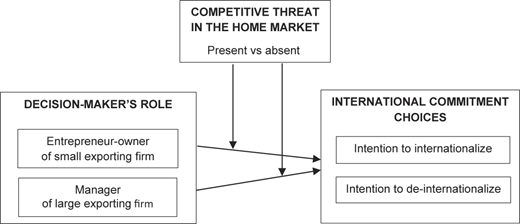
Entrepreneurs-owners of small exporting firms facing competitive threats in the home market will show lower intentions to internationalize compared to those without competitive threats.
Entrepreneurs-owners of small exporting firms facing competitive threats in the home market will show higher intentions to de-internationalize compared to those without competitive threats.
Managers of larger exporting firms facing competitive threats in the home market will demonstrate higher intentions to internationalize compared to those without competitive threats.
Managers of larger exporting firms facing competitive threats in the home market will demonstrate lower intentions to de-internationalize compared to those without competitive threats.
Following the previously mentioned arguments regarding cognitive differences in risk attitudes, firm size and resource slack, we contended that in case of a perceived competitive threat, entrepreneurs-owners of small exporting firms would exhibit more risk-averse behavior than managers of larger exporting firms operating under the same conditions. Research in behavioral strategy linking perceived market situations with firms’ behavior indicates that small and large firms respond differently to perceived threats and thus prospective performance downturns. Managers of larger exporting firms will respond in a more risky way to a high level of competition in the home market (perceived competitive threat) than entrepreneurs-owners of small exporting firms under the same conditions (Audia & Greve, 2006). Another significant factor influencing the decision-making process is the length and diversity of both individual’s and firm’s international experience (several foreign markets entered and served) and their industry experience (Acedo & Jones, 2007; Maitland & Sammartino, 2015), whose likelihood is likely lower for both entrepreneurs-owners and their small exporting firms than for managers and larger exporting firms they manage. In this context, Swoboda, Olejnik, and Morschett (2011) note that entrepreneurs and managers differ in their perception of external (positive and negative) stimuli, ultimately affecting their internationalization choices in terms of location and entry mode choice. Therefore, we argue that under the condition of the high level of competition in the home market, inducing the perception of competitive threat and prospective reduced performance, entrepreneurs and their exporting firms with relative resource scarcity and modest international experience would be less risk-taking than managers in terms of foreign resource commitment:
Entrepreneurs-owners of small firms facing competitive threats in the home market will exhibit lower internationalization intentions compared to managers of larger exporting firms under similar conditions.
Entrepreneurs-owners of small firms facing competitive threats in the home market will exhibit higher de-internationalization intentions compared to managers of larger exporting firms under similar conditions.
Figure 1 summarizes our hypothesized relationships.
Methods
To test our hypotheses, we employed an experimental method. Experimental studies enable researchers to understand the direction and nature of causal relationships rather than to ensure the external validity of the observed relationships (Hsu, Simmons, & Wieland, 2017). The usage of experimental studies has remained relatively less popular in management studies than in other disciplines (e.g. psychology, medical and natural sciences), but it has increased recently, especially in the field of entrepreneurship and organizational behavior (Aguinis & Bradley, 2014; Hsu et al., 2017). Thus far, experimental design has been relatively rare in international business (Zellmer-Bruhn, Caligiuri, & Thomas, 2016; Aguinis, Ramani, & Cascio, 2020). Our study considers two types of decision-makers: entrepreneurs-managing (co-)owners of small exporting firms and managers of larger firms. Because we were interested in testing the causality of whether and how entrepreneurs’ and managers’ choices differ regarding international commitment in response to increased competitive intensity, we used experimental vignette methodology (EVM) in a two (2x2) factorial design. EMVs allow researchers to manipulate and control independent variables (in our case level of competitive intensity in the home market: reference and increased) using vignettes – short descriptions representing objects or situations (Aguinis & Bradley, 2014). We assigned randomly two groups of entrepreneurs and managers (2 x n = 50) to the control scenario and two groups of entrepreneurs and managers to the experimental scenario (2 x n = 50). Figure 2 presents the experimental scenario.
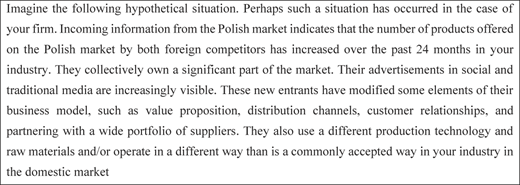
Experimental scenario. Respondents in the control group did not receive any scenario but were asked to assess the extent to which they agreed or disagreed with statements related to the intention to internationalize and the intention to de-internationalize. Source: Own elaboration
Experimental scenario. Respondents in the control group did not receive any scenario but were asked to assess the extent to which they agreed or disagreed with statements related to the intention to internationalize and the intention to de-internationalize. Source: Own elaboration
Such an approach allowed us to assess dependent variables: our respondents’ intentions to internationalize and de-internationalize (increased and decreased international commitment respectively). While the respondents assigned to the control scenario were asked to assess the characteristics of the industry in which their firms operate, the experimental scenario described the situation in the home market as highly competitive, with several new entrants, using a variety of aggressive strategies, offering innovative products as well as new distribution and marketing methods. Our goal was to elicit a sense of competitive threat among study participants. Each scenario was followed by a set of statements asking respondents to share their intentions about commitment in foreign markets vs. the home market.
Sample and data collection
The data for this study comes from a research task financed by the National Science Center. The data was collected by a hired research agency in 2018 using the computer-assisted interviewing (CATI) method. We applied purposive sampling and focused on exporting companies with the majority of Polish capital (at least 51%; subsidiaries of MNCs were excluded), with at least 10% of their total revenues from foreign sales, operating in all types of industries according to NACE classification, but majority (116 out of 200; 58%) in low-tech manufacturing industries with level of presence of foreign-based competition in the local market assessed by respondents as moderate (mean = 4 on a scale 1–7). The declared direction of internationalization in the majority of cases (i.e. 190/95%) was the European Union, mostly “old” EU countries (153 cases/76.5%). The data were collected using the Bisnode database (Dun and Bradstreet) of randomly selected firms registered in Poland including 100 entrepreneurs/managing owners of small firms (employing 49 employees or less) and 100 managers of medium-sized (50–249 employees) and large enterprises (250 and more employees). The characteristics of the sample are presented in Table 1. We used a 3-item measure of ex-post check for respondent competency to ensure the reliability of our data (Morgan, Katsikeas, & Vorhies, 2012). The number of women in managerial positions (36%) was higher than the number of women entrepreneurs (19%). Compared to entrepreneurs, managers exhibited a greater level of international experience (studies and employment abroad). We checked for non-response bias by comparing the characteristics of respondents and non-responders using the sampling register from which the subjects were recruited. These were basic sociodemographic information such as their international experience, gender and their firms’ characteristics such as size, age, industrial sector, international experience and degree of internationalization (foreign sales to total sales). The differences between respondents and non-respondents were not statistically significant.
Sample characteristics
| Firm age | RIE1 (years) | FIE2 (years) | Firm size3 | FSTS4 | ID5 | TI6 | |
|---|---|---|---|---|---|---|---|
| Mean | Mean | Mean | Mean | Mean | Mean | Freq. | |
| Entrepreneurs (Control group) N = 50 | 12.4 | 0.56 | 9.4 | 13.1 | 19.2 | 6.2 | 1 = 80% 2 = 16% 3 = 4% |
| Entrepreneurs (Experimental group) N = 50 | 12.8 | 0.22 | 9.8 | 11.1 | 19.6 | 6 | 1 = 86% 2 = 8% 3 = 6% |
| Managers (Control group) N = 50 | 37.3 | 0.42 | 27.4 | 532.6 | 42.2 | 21.2 | 1 = 76% 2 = 20% 3 = 4% |
| Managers (Experimental group) N = 50 | 32.5 | 0.62 | 24.3 | 643.2 | 36.9 | 21.5 | 1 = 72% 2 = 24% 3 = 4% |
Note(s): 1Respondent’s international experience (years)
2Firm’s international experience (years)
3Firm size (number of employees)
4FSTS = Foreign sales to total sales (%). We recorded data into numerical values that represent the midpoints of each range to compare it by mean values: (0–24%), (25–50%), (51–75%), (76–100%)
5International diversification (number of foreign markets)
6Industry’s technological intensity (Low and medium-low = 1; Medium-high = 2; High = 3)
Source(s): Own elaboration
Measures
The two levels of competitive pressure (actual and increased) formed the categories of the independent variable. Dependent variables (intention to internationalize and intention to de-internationalize) were ordinal and were measured using three items on a seven-point Likert scale. The validity of the variables was enhanced with a pre-test on 10 managers and 10 entrepreneurs. We used a scale developed by Liu, Li, and Xue (2011) measuring the internationalization of a firm to capture the intention to internationalize (II) (outward foreign market commitment) with three items evaluating the extent of the firms’ actual outward activities along a seven-point Likert scale (1 = very small extent, 7 = very large extent). We developed a scale of intention to de-internationalize (DI) (reduced foreign market commitment), modifying the original scale of Liu et al.’s (2011), by reformulating items into opposite meanings (see Table 2). The modified scale includes three items: overall involvement abroad vs. in the home market, the scope of the market offer and resource commitment in foreign markets vs. domestic market, along a seven-point Likert scale (1 = to a very small extent, 7 = to a very large extent). The exploratory factor analysis indicated that the items’ loadings were between 0.747 and 0.921. The construct reliability of both dependent variables does not raise concerns, as indicated by Cronbach’s alpha (0.69 for II and 0.92 for DI). The results showed acceptable values, which allowed us to combine the scores into mean values for both dependent variables (Suárez‐Ortega & Álamo‐Vera, 2005; Nunnally, 1978).
Constructs’ operationalization and internal reliability
| Intention to internationalize (Liu et al., 2011) | Loading | AVE | α |
|---|---|---|---|
| Assuming that your influence on the final decision is significant, in the current [presented hypothetical] situation of your company in the domestic market, to what extent you are to [would] | 0.57 | 0.69 | |
| 1. Aggressively seek new foreign markets | 0.766 | ||
| 2. Sell product/services in new foreign market/Diversify product portfolio in existing foreign markets | 0.747 | ||
| 3. Enter into overseas locations by outward FDI | 0.747 |
| Intention to de-internationalize | Loading | AVE | α |
|---|---|---|---|
| Assuming that your influence on the final decision is significant, in the current [presented hypothetical] situation of your company in the domestic market, to what extent you are to [would] | 0.82 | 0.92 | |
| 1. Concentrate on the domestic market, while simultaneously decreasing involvement in currently served foreign markets | 0.894 | ||
| 2. Diversify domestic market offer (introduce new products/services), while simultaneously limiting market offer on foreign markets | 0.905 | ||
| 3. Limit resource commitment on foreign markets and allocate freed-up resources domestically | 0.921 |
Source(s): Own elaboration
Data analysis
According to the results of Shapiro-Wilk and Kolmogorov-Smirnov tests, the normality assumption for parametric tests assumption was violated (p-value <0.001). A non-parametric test (Mann Whitney U-test) was chosen as an alternative (Dodge, 2008; Corder & Foreman, 2014) to the test for the differences between the dependent variables for two independent samples. The fundamental assumptions of the Mann-Whitney U-test include a random selection of each sample from their respective populations, independence within each sample and independence between samples as well as ordinal or continuous scale of measurement (Dodge, 2008; Corder & Foreman, 2014; Sheskin, 2003).
Results
To evaluate the proposed hypotheses, we conducted a statistical analysis using SPSS 25.0, with a significance level of 0.05. Table 3 presents the descriptive statistics.
Descriptive statistics
| N | Control scenario | Experimental scenario | ||
|---|---|---|---|---|
| Mean | Mean | |||
| Intention to internationalize | Entrepreneurs | 50 | 4.28 | 2.78 |
| Managers | 50 | 4.08 | 4.68 | |
| Intention to de-internationalize | Entrepreneurs | 50 | 3.01 | 5.07 |
| Managers | 50 | 2.30 | 2.96 | |
Source(s): Own elaboration
To test hypotheses H1a and H1b, we ran two Mann-Whitney U tests to examine the scores for intention to internationalize and de-internationalize between control and experimental groups of entrepreneurs. The findings demonstrated that distributions of the intention to internationalize scores for the control and experimental groups of entrepreneurs were dissimilar (Figure 3). Consequently, the control group of entrepreneurs (mean rank = 73.38) showed statistically significantly higher intention to internationalize scores than the experimental group of entrepreneurs (mean rank = 27.62), U = 2,394, z = 7.943, p < 0.001. Hence, hypothesis H1a is supported.
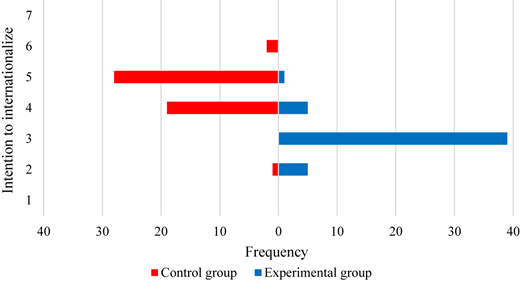
Distribution of the intention to internationalize scores between control and experimental groups of entrepreneurs (H1a). Source: Own elaboration
Distribution of the intention to internationalize scores between control and experimental groups of entrepreneurs (H1a). Source: Own elaboration
Distinct distributions of intention to de-internationalize scores for the control and experimental group of entrepreneurs (Figure 4) under high competitive intensity in the home market revealed statistically significantly lower intention to de-internationalize scores for the control group of entrepreneurs (mean rank = 27.70) compared to experimental group of entrepreneurs (mean rank = 73.30), U = 110, z = −7.983, p < 0.001. These results support hypothesis H1b.
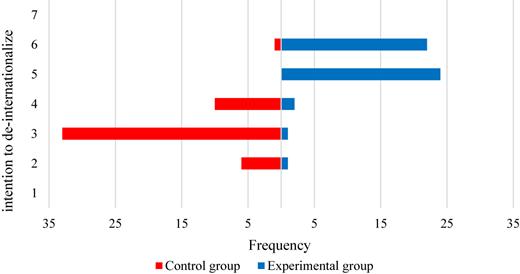
Distribution of the intention to de-internationalize scores between control and experimental groups of entrepreneurs (H1b). Source: Own elaboration
Distribution of the intention to de-internationalize scores between control and experimental groups of entrepreneurs (H1b). Source: Own elaboration
We found further support for different distributions of the intention to internationalize scores between the control and experimental groups of managers (Figure 5) in the findings of the Mann-Whitney U test. The intention to internationalize scores for the control group (mean rank = 40.97) were statistically significantly lower than those for the experimental group (mean rank = 60.03), U = 773.500, z = −3.315, p < 0.001. These results support hypothesis H2a.
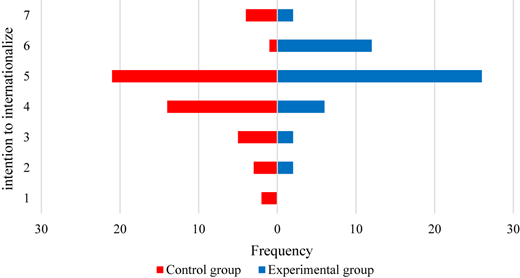
Distribution of the intention to internationalize scores between control and experimental groups of managers (H2a). Source: Own elaboration
Distribution of the intention to internationalize scores between control and experimental groups of managers (H2a). Source: Own elaboration
As assessed by visual evaluation, the control and experimental group of managers’ intentions varied (Figure 6). The intention to de-internationalize scores for the control group of managers (mean rank = 40.15) were statistically significantly lower than for the experimental group of managers (mean rank = 60.85), U = 732.500, z = −3.607, p < 0.001. Hence, we did not confirm hypothesis H2b.
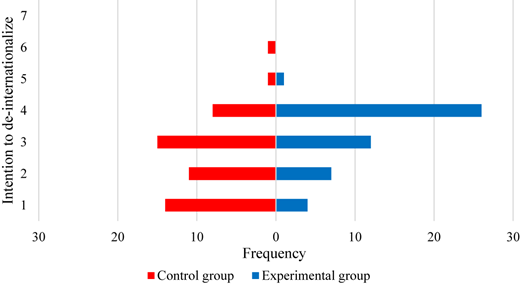
Distribution of the intention to de-internationalize scores between control and experimental groups of managers (H2b). Source: Own elaboration
Distribution of the intention to de-internationalize scores between control and experimental groups of managers (H2b). Source: Own elaboration
The statistical analysis indicated a divergent distribution of the intention to internationalize scores between the experimental group of entrepreneurs and the experimental group of managers (Figure 7). Entrepreneurs of the experimental group exhibited statistically significantly lower intention to internationalize (mean rank = 28.88) relative to the experimental group of managers (mean rank = 72.12), U = 169, z = −7.503, p < 0.001. Hence, hypothesis H3a is supported.
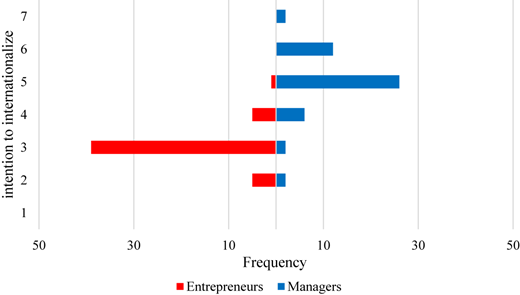
Distribution of the intention to internationalize scores between the experimental group of entrepreneurs and the experimental group of managers (H3a). Source: Own elaboration
Distribution of the intention to internationalize scores between the experimental group of entrepreneurs and the experimental group of managers (H3a). Source: Own elaboration
The Mann-Whitney U test revealed different distributions of the intention to de-internationalize scores between experimental groups of entrepreneurs and managers (Figure 8). The analysis indicated a statistically significantly higher intention to de-internationalize scores among the experimental group of entrepreneurs (mean rank = 73.27) as opposed to the experimental group of managers (mean rank = 27.73), U = 2388.500, z = 7.896, p < 0.001. Hence, hypothesis H3b is supported (Table 4).
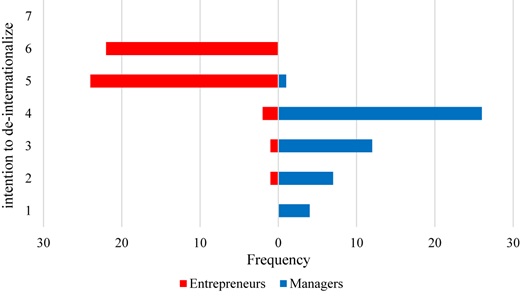
Distribution of the intention to de-internationalize scores between the experimental group of entrepreneurs and the experimental group of managers (H3b). Source: Own elaboration
Distribution of the intention to de-internationalize scores between the experimental group of entrepreneurs and the experimental group of managers (H3b). Source: Own elaboration
Summary of hypotheses testing
| H1a | H1b | H2a | H2b | H3a | H3b | |
|---|---|---|---|---|---|---|
| Hypothesis verification | + | + | + | – | + | + |
| Mann-Whitney U test statistics | U = 2,394 z = 7.943 | U = 110 z = −7.983 | U = 773.5 z = −3.315 | U = 732.500 z = −3.607 | U = 169 z = −7.503 | U = 2388.5 z = 7.896 |
| p-value | <0.001 | <0.001 | <0.001 | <0.001 | <0.001 | <0.001 |
| Statistical difference | + | + | + | + | + | + |
| Test alternative | Mean ranks | Mean ranks | Mean ranks | Mean ranks | Mean ranks | Mean ranks |
| Results | E = 73.4 M = 27.6 | E = 27.7 M = 73.3 | E= 40.1 M = 60 | E = 40.15 M = 60.85 | E= 28.9 M = 72.1 | E = 73.27 M = 27.7 |
Source(s): Own elaboration
Discussion
This study was motivated by the insufficient focus in the IB literature on behavioral antecedents of international commitment and responds to calls for more research in this area (Schweizer & Vahlne, 2022; Domínguez Romero et al., 2024; Santangelo et al., 2024) using experimental methods (Zellmer-Bruhn et al., 2016). Although previous studies explored extensively institutional, industry- and resource-based factors as determinants of foreign expansion trajectory (Lahiri et al., 2020; Vissak, Francioni, & Freeman, 2020), it remains unclear what drives non-linear internationalization (Domínguez Romero et al., 2024). Consequently, in this study, we followed recent calls for further research on predicting individual-level antecedents of non-linear behavior in foreign expansion (e.g. Santangelo & Meyer, 2017; Santangelo & Stucchi, 2018; Vahlne & Schweizer, 2022). In doing so, we considered a specific aspect of non-linear internationalization: forward and backward international commitment.
While research in international entrepreneurship has demonstrated systemic risk-taking behavior of entrepreneurs in internationalization as compared to managers (Acedo & Jones, 2007; Alam et al., 2020; Chittoor et al., 2019; Kiss et al., 2013; Vaillant & Lafuente, 2019; Quintillán & Peña-Legazkue, 2020), understanding of managerial cognition remains less understood (Maitland & Sammartino, 2015; Schweizer & Vahlne, 2022; Vahlne & Schweizer, 2022). Moreover, it remains unclear how cognitive heterogeneity between entrepreneurs and managers interacts with the perception of competitive threats in the home market in shaping international commitment choices. In addressing this gap, we adopted a behavioral perspective, drawing from the framing effect and threat rigidity hypothesis to understand the non-linear nature of international expansion.
To test the proposed set of hypotheses, we performed six comparisons, using Mann-Whitney U non-parametric tests using SPSS 25.0. We found support for existing conceptualizations, except hypothesis H2b. Generally, the data demonstrated a heterogeneity between entrepreneurs and managers of Polish exporting firms, shedding light on the importance of cognitive factors and resources at hand. We found support for the predictions of behavioral theory and presented a nuanced view, by considering resource availability (treating firm size as a proxy), that entrepreneurs exhibit reduced risk-taking behavior in terms of international commitment in response to competitive threats in the home market. Our study suggests that the limited resources and significantly lower international exposure of exporting firms managed by entrepreneurs-owners than that managed by managers, play a boundary condition for the latter systematic risk-taking behavior as compared to managers, as suggested in previous studies.
Theoretical contributions
This study highlights cognitive heterogeneity between entrepreneurs and managers as a critical factor in shaping internationalization decisions. Relative risk-averse behavior of entrepreneurs contrasts with managers’ risk-taking, shaped by firm size and resource constraints. Our findings align with behavioral theory and expand the strategy tripod framework by incorporating individual-level cognition. This article contributes to IB literature by demonstrating how cognitive differences and resource availability affect internationalization trajectories. In line with behavioral theory predictions, our study found that the level of international commitment depends on cognitive processes and resource availability (Audia & Greve, 2006; Greve, 2010), contributing to a better understanding of the individual antecedents of non-linear internationalization (Schweizer & Vahlne, 2022). Specifically, when considering competitive pressures in the home market, both cognition and resources play a role in resource allocation between home and foreign markets, thus shaping the international trajectory (see Bowen & Wiersema, 2005; Hutzschenreuter et al., 2014; Wiersema & Bowen, 2008).
This study contributes to the literature in two ways. The first contribution relates to internationalization process (IP) research and the linearity of foreign expansion. The results show that scholars should consider the interplay between the context, decision-maker’s role, firm’s resource slack and firm’s size in studying the firm’s foreign expansion trajectory and therefore, the degree of internationalization linearity. Our findings related to entrepreneurs align with previous studies (e.g. Kiss et al., 2013) in that increased competitive intensity in the home market reduces entrepreneurial intention to internationalize and increases intention to withdraw from foreign markets, suggesting three possible explanations. According to the first one, firm size, age and international experience may have a more significant effect on international commitment than entrepreneur-related factors. Second, entrepreneurs do not see many international opportunities or they perceive them as relatively small compared to their domestic market. We may also associate the third reason with a relatively low degree of internationalization (foreign sales to total sales ratio) to perceive foreign markets sufficiently attractive.
Moreover, our findings shed light on how multiple-embeddedness, that is, presence in various local contexts (home and foreign markets), affects the internationalization trajectory. The results of this study suggest that the larger firms operating in multiple markets are exposed to more frequent and simultaneous changes in their competitive positions in given markets (home vs. foreign), which shapes the relative importance of these markets, ultimately contributing to international commitment choices and thus – internationalization trajectory. Therefore, decision-makers of firms with higher degrees and scope of internationalization tend to perceive differently increased foreign-based competition in their home markets than decision-makers of less internationalized firms. Because the decision-makers role is associated with firm size and firm’s resource availability in hand, one may expect different interpretations (in terms of opportunity vs. threat) and associated responses to competition level in the home market (internationalization vs. de-internationalization/forward vs. backward foreign expansion). In this sense, the current degree and scope of international diversification shape the level of perceived uncertainty in home and international markets and ultimately the choices regarding international resource commitment. For instance, larger, more experienced firms with firm- and country-specific advantages tend to respond in a less risk-averse manner than smaller entrepreneurial ventures. Due to the mentioned reasons, emerging-market firms (EMFs) are expected to experience less linear (more dynamic) internationalization trajectories in their early years of expansion – in contrast to firms originating from developed economies. This is a potential explanation of the expansion path of entrepreneurial ventures from Poland, using: (1) effectuation and bricolage in response to perceived competitive threats to adapt effectively to the home and foreign markets’ competitive situation (Nowiński & Rialp, 2013) and (2) social networking which changes perceptions of international markets relative to domestic one – from being challenging into offering opportunities (Nowiński & Rialp, 2016). Our findings also bring attention to the role of heuristics and bricolage in foreign expansion for less internationalized firms (firms in their early stages of internationalization), especially the ones originating from emerging markets (Guercini & Milanesi, 2022). Given that emerging-market firms (EMFs) experience more challenges, associated with their disadvantages in international markets, are expected to experience less linear (dynamic) internationalization trajectories.
Previous studies conducted predominantly in the context of developed markets considering behavioral effects associated with the firm decision-makers have failed to account for the institutional context of the country of origin. In contrast to common expectations that entrepreneurs in both emerging and developed economies reveal a systemic acceptance of higher risk than managers of larger firms in the context of internationalization (e.g. Chittoor et al., 2019; Alam et al., 2020), our study revealed the equally or even more important effect of other factors, related to firm’s size, international experience and international exposure. We argue that these factors are associated with the home market context. Similarly, our findings remain in contrast to the findings of prior studies on managers’ reactions to increased home market competition conducted in developed markets (Hutzschenreuter et al., 2014). In sum, the results of this study suggest that the home market context, not only the competitive threat but also institutional (revealed by a weaker position of Polish SMEs in developed markets compared to local competitors and competitors from other developed markets) is equally valid for international commitment choices. Second, this study contributes to the IP literature by providing a nuanced perspective of the Polish home market context in how it shapes behavioral antecedents of non-linear internationalization. Our study bears both differences and similarities with previous studies, indicating the uniqueness of the Polish economy context for exporting firms in 2018. For instance, our findings disclosed a similar (negative) effect of intense foreign-based competition in the home market on intention to internationalize for entrepreneurs-owners of exporting SMEs, compared to a small emerging economy context (see Adomako et al., 2017). We argue that this is because of systematically weaker competitive position in foreign (mostly developed EU markets) due to their liability of origin, smallness and resource scarcity, associated with the economic heritage of their home market (Poland) characterized historically with institutional voids and less efficient markets (Buckley & Casson, 2020). These findings also align with the phenomenon of institutional escapism, typical for the initial stages of EMFs’ internationalization (Sengupta et al., 2023), thus applicable mostly to SMEs rather than large enterprises. Our findings remain consistent with research on managers of large enterprises in other emerging markets. Similarly to other studies, we found that they tended to increase internationalization as a result of increased foreign-based competition in the home market (see Sengupta et al., 2023). In summary, our findings highlight that the differences between historical legacy and institutional contexts of emerging and between emerging and developed markets influence internationalization path heterogeneity in terms of sequence of foreign entries, exists and re-entries, shaping cognitive mechanisms to sense opportunities and threats in home vs. foreign markets (Guo & Wang, 2021). From a broader perspective, non-linear internationalization is thought to involve the interplay of time, context and foreign expansion, with the decision-making process as the central unit of analysis (Domínguez Romero et al., 2024). Consequently, we may see the degree of linearity in two aspects: the degree of exiting from foreign markets (de-internationalization) (complete or partial) and the type of decision driver (voluntary or forced) (Domínguez Romero et al., 2024). Therefore, we may describe non-linear internationalization in terms of foreign involvement fluctuations consisting of multiple market entries, exits and re-entries (Vissak et al., 2020; Guercini & Milanesi, 2022). These complexities of international commitment choices call for increased scholars’ attention in the face of rising protectionism, the disintegration of trade blocs and technological developments, substantially reshaping the hitherto global economic landscape (Cuervo-Cazurra et al., 2018; Kafouros, Cavusgil, Devinney, Ganotakis, & Fainshmidt, 2022; Witt, Lewin, Li, & Gaur, 2023).
Practical implications
The results of our study have practical value for managers and corporate governance. First, the findings indicate the importance and nature of decision-making in internationalization, driven by cognitive, firm-level and industry factors. How a decision-maker perceives a given event depends on the interplay between cognitive factors and the firm’s resources. Given that internationalization is generally speaking a risky activity (Calof & Beamish, 1995), the owners should consider carefully the agents’ characteristics when acting on their behalf. We suggest that adopting appropriate organizational design and internal procedures in internationalized firms becomes a necessity to secure firms’ long-term growth potential on the one hand and survival chances. Specifically, our results reveal that organizational design and corporate governance of large diversified firms should account for the alignment of risk preferences between owners and appointed executive managers. Although it has been argued that decision-making is strongly influenced by the “psychological contract” between managers and firm owners which specifies the reward systems in their organizations (Cameron & Quinn, 1988), international business studies have rarely considered the cognitive differences between different types of decision-makers (entrepreneurs vs. managers). In this sense, our findings resonate with the effect of a manager’s personality on internationalization decision-making. For instance, the stable personality of a decision-maker reduces the dynamism of resource commitments, while narcissistic, proactive and risk-taking managers increase it (Schweizer & Vahlne, 2022).
Limitations and future research
This study has several limitations. First, it included the context-specific sample and relied on experimental methods, which may come at the expense of external validity (Aguinis & Bradley, 2014; Aguinis et al., 2020). Future research should test the findings of this study on a larger sample in different settings to seek greater external validity. Specifically, we recommend further investigation into comparative approaches between the emerging versus developed countries to further elucidate the nuances of the interplay between the country setting and behavioral factors. It would be especially valuable to distinguish between specific emerging markets, such as BRICs, MINTs and CEE. Second, this study focused on a single experimental factor – competitive pressure in the home market and its cognition by two types of decision-makers. Therefore, it simplified the decision complexity. In this context, Maitland and Sammartino (2015) showed in their qualitative study that actual managerial internationalization decision depends on an individual’s ability to identify different elements and interdependencies within and between location-specific information, firm-specific advantages and disadvantages, preferred governance structures as well as knowledge structures developed in the course of past managerial experiences. The actual choice is based on the depth and breadth of international experience (number of elements, domains and locations) and connectedness between them (number of interconnections between and within domains) (Maitland & Sammartino, 2015). For obvious reasons, we were not able to include all of the potential factors. Therefore, we suggest that future studies incorporate more, to increase the complexity and reality of the decision-making process in internationalization. The third limitation refers to the construct of de-internationalization used in this study. We considered only exporting firms and increased/reduced commitment. Therefore, to enhance our understanding of individual antecedents of non-linear foreign expansion, future studies should include more dimensions of internationalization trajectory: speed and location (Trąpczyński, 2016; Dominguez & Mayrhofer, 2017). Similarly, our considerations of competitive intensity in the home market did not specify the entry mode of foreign-based competitors (export vs. foreign direct investments) (see Hutzschenreuter et al., 2014). Therefore future studies could account for this distinction. On a separate note, resource commitment decisions depend not only on managers’ cognitive processes but also on personality, situational emotions and mood, affecting international trajectory (Schweizer & Vahlne, 2022). For instance, when context swiftly changes from certain to uncertain and returns to certain, the decision-making process might change significantly, between System 1 (fast thinking) and System 2 (slow thinking) (Kahneman, 2011). This phenomenon opens attractive avenues for other scholars. Taken together, it is worth noting that this study serves as an indication of possible research directions and as an invitation to future research on the cognitive antecedents of international choices, rather than an ultimate answer for the complex phenomenon of non-linear internationalization.
The research was financed by the Polish National Science Center (grant no. 2017/01/X/HS4/01015).
Ethics statement: This study was performed in line with the principles of the Declaration of Helsinki. Approval was granted by the Ethics Committee of the Kozminski University prior to conducting the study.

