Skip to article sections
Purpose

In recent years, research in construction robotics has significantly advanced within the construction sector. However, many collaborative robotic systems have yet to be effectively integrated into large-scale construction settings due to limitations such as restricted workspace, deployment complexity and insufficient adaptability to dynamic on-site conditions. To address this issue, this paper aims to establish an augmented reality (AR)-assisted human-robot collaboration (HRC) workflow that uses low-fidelity visual markers to spatially register a modular robotic unit with a digital wall model, while enabling human-guided robot relocation supported by real-time feasibility visualisation.

Design/methodology/approach

The authors evaluate the complete cyber-physical workflow by constructing two large-scale masonry-like walls, each spanning 3 m, exceeding the operational range of the collaborative robotic arm and requiring repeated manual relocation of the modular robotic unit. After assembly, both structures were 3D-scanned and compared with their 3D digital models using cloud-to-cloud (C2C) deviation analysis. Segment-level deviation was used to assess the reliability of robotic pick-and-place execution, while global deviation quantified spatial drift introduced by the AR-based registration during repeated relocation cycles.

Findings

Cluster deviation analysis confirms consistent robotic pick-and-place accuracy across repeated assembly cycles, demonstrating reliable task-level execution. However, global deviation results reveal accumulated spatial drift caused by AR-based registration, indicating that the proposed workflow is most suitable for construction scenarios requiring moderate accuracy (˜ ±5 mm tolerance) rather than high-precision industrial fabrication.

Research limitations/implications

The study’s accuracy was limited by the use of only two visual markers, increasing susceptibility to AR spatial drift during repeated registration. The geometric simplicity of the dry-stacked walls restricted evaluation of more complex construction scenarios, and the controlled laboratory lighting conditions did not reflect the variability of real construction environments. In addition, the robotic arm’s operational range was constrained by the geometry of the mobile platform. Future work should investigate the use of additional markers or sensor-fusion methods, evaluate performance in real on-site conditions, and explore improved mobile platform designs to extend reachability and robustness.

Practical implications

The study demonstrates that AR-assisted spatial anchoring can improve the accessibility of robotic bricklaying in construction by reducing reliance on complex simultaneous localisation and mapping-based localisation and costly autonomous platforms. The proposed workflow allows operators to manually reposition modular robotic units using intuitive AR feedback, enabling reliable assembly without advanced robotics expertise. This approach lowers implementation complexity, reduces training requirements and supports wider adoption of collaborative robotic systems in small-to-medium construction projects.

Social implications

The study supports a more human-centred model of construction automation by positioning robots as collaborative tools rather than replacements for labour. By simplifying robot operation through AR guidance, the proposed workflow can reduce workforce resistance often associated with job displacement and technological complexity. The system allows operators to retain users' agency through manual robot repositioning while benefiting from robotic precision during execution. This approach may facilitate workforce upskilling, reduce physical strain and improve safety, while broadening access to robotic technologies across diverse construction teams, thereby supporting more inclusive and socially sustainable adoption of automation in the construction sector.

Originality/value

This study contributes (1) a validated human-in-the-loop workflow for large-scale robotic bricklaying that combines human-guided robot relocation with robot-executed geometric placement, (2) an AR-based spatial anchoring method using low-fidelity visual markers to support repeated robot re-registration during large-scale assembly, and (3) an AR-supported inverse-kinematics feasibility visualisation that enables informed relocation decisions across repeated construction cycles.

The construction industry has historically lagged in adopting automation and digital technologies, particularly in labour-intensive tasks such as bricklaying (Demirkesen and Tezel, 2021). The continued reliance on manual labour has contributed to persistent operational inefficiencies. The growing skilled labour shortages and exposure to intense weather conditions compound these inefficiencies (Dong et al., 2025).

In recent years, several automated robotic solutions for on-site bricklaying have been proposed to improve productivity and construction quality. Despite significant advancements in robotic technologies, these systems often face implementation barriers, such as Han et al. (2021), Liang et al. (2021), Ruttico et al. (2024) pointed out that the limited success of such systems can be attributed to logistical constraints in system setup and implementation complexity, particularly in small-to-medium construction sites where rapid deployment and flexibility are prioritised over full automation. Furthermore, high initial investment costs have long been recognised as a major barrier to the adoption of construction robotics (Bock, 2015; Pan et al., 2018, pp. 88, 90), and recent studies indicate that this challenge remains largely unresolved (Mishra, 2025, p. 889; Onososen and Musonda, 2023, p. 520), particularly for small-to-medium construction firms.

As highlighted in Franze et al. (2025), Liang et al. (2024), and Ruttico et al. (2024), workforce resistance also remains a significant barrier to the adoption of robotic technologies, as fully automated robotic systems are often perceived by workers as a threat to job security, rather than supportive tools. This perception highlights the need for a more human-centric technological approach consistent with Construction 5.0 paradigm. While Construction 4.0 focused on full automation and efficiency, Construction 5.0 advocates for collaborative environments in which humans and robots operate as complementary partners (Garcés, 2025; Marinelli, 2023). In this context, human–robot collaboration (HRC) refers to systems that use a human-in-the-loop (HITL) approach, enabling workers to supervise, guide or directly coordinate robotic functions. Such configurations encourage users to perceive robotic systems as tools that augment professional capabilities rather than displace them. In this study, the Construction 5.0 framework is strictly used as a contextual foundation to frame the human-centred and collaborative nature of the robotic practices discussed.

Building on this motivation, this research explores a low-fidelity HRC system that integrates users into large-scale robotic fabrication workflows, particularly during the relocation and manoeuvring of modular robotic units. The proposed workflow assigns global spatial decision-making to the human operator, while maintaining fine-grained geometric accuracy through robot-executed pick-and-place operations. This division of labour supports operator agency in managing the spatial progression of the assembly process while maintaining consistent placement precision. However, incorporating manual relocation introduces new challenges, including the need for accurate positioning, optimal placement relative to the work area and reliable spatial registration of the robotic unit on site.

To address this, the proposed system uses an augmented reality (AR) head-mounted device (HMD) and low-fidelity visual markers to support users in relocating the robotic bricklaying system throughout the brick wall assembly process. Although AR-assisted robotic applications have previously been explored in the context of bricklaying, existing implementations primarily emphasise exploratory and design-oriented workflows. For instance, some systems enable users to design masonry-like wall structures through AR interfaces (Song et al., 2021b), or facilitate interactive, user-driven fabrication processes in which brick selection and placement are determined manually (Zhang and Ruttico, 2025). While effective for design-centric fabrication workflows, these systems do not accurately reflect the procedures of real-world construction. In contrast, our research focuses on assembly-scale automation, combining robotic pick-and-place execution with AR-supported computational workflow to enable the operator to visualise robotic reachability and block-placement feasibility. The AR system superimposes these parameters and limitations in real time to help the operator determine optimal robot repositioning strategies, thus streamlining human–robot collaboration during continuous wall construction.

Our paper contributes a validated, construction-oriented HRC workflow for large-scale robotic bricklaying that intentionally combines human-guided robot relocation with robot-executed geometric placement. The proposed approach focuses on an AR-based spatial anchoring workflow in which the anchored robot’s position is used to drive real-time inverse kinematics (IK) feasibility visualisation during repeated human-guided robot relocation. The workflow is empirically validated through full-scale wall construction experiments, demonstrating that consistent, construction-grade spatial accuracy can be maintained across multiple relocation and re-registration cycles using low-fidelity visual markers. The findings provide empirical evidence on the viability of AR-supported HITL approaches as an alternative operational model for construction robotics in scenarios prioritising deployment accessibility over high-precision automation.

The remainder of this paper explains this research and is organised as follows. Section 2 explores existing robotic bricklaying and AR-supported HRC systems for architectural design. Section 3 details the proposed AR-enabled HRC study approach and describes the experimental setup. Section 4 presents the findings, focusing on the usability of AR-HMD for large-scale robotic pick-and-place procedures. Section 5 concludes with key findings, limitations and future research directions.

The following section builds on previous research by examining existing robotic bricklaying systems, identifying their limitations and assessing how they address the challenges associated with large-scale bricklaying tasks, such as robot localisation and adaptability. Our study extends these approaches by investigating how AR can support a HITL approach in large-scale pick-and-place procedures with a modular robotic unit. Specifically, we use AR to enhance the spatial alignment of the robotic system through real-time visual feedback.

The concept of automating in situ masonry construction has existed for more than a century, beginning with a 1904 patent for an automated bricklaying machine (Thomson, 1904). The first documented on-site prototype of an automated linear bricklaying machine appeared in the 1960s. However, advances in automation did not accelerate until the late 1980s (Altobelli et al., 1993). Innovations ranged from balancer and handling assistance machines, to advanced robotic systems, including the Robotic Construction System for Computer Aided Construction (ROCCO) (Gambao et al., 2000), and the Blockbot (A. H. Slocum and Schena, 1988).

More recently, automation in masonry has seen some commercial success with systems like the Semi-Automated Mason (SAM), Automated Brick Laying Robot (ABLR) and Hadrian X, which build on previous articulated robotic arm designs. Both SAM100 (Madsen, 2019) and ABLR (ABLR, 2024) consist of a robotic manipulator mounted on a track. Although effective in controlled environments, the system’s high cost and lengthy setup time have significantly hindered its widespread adoption in the industry (Dörfler et al., 2016; Madsen, 2019). Furthermore, their reliance on track-based navigation limits their adaptability in unstructured settings. To address this issue, Hadrian X opts for a telescopic robotic boom mounted with an integrated brick conveyor on a mobile truck (Oliver, 2020), which gives the robotic system the flexibility to manoeuvre in an unstructured environment. However, Hadrian X requires significant space for truck manoeuvring, which limits its applicability on compact construction sites.

2.3.1 Multi-Robot coordination for bricklaying.

In addition to these commercial systems, researchers have explored alternative robotic bricklaying methods for constructing large-scale in situ masonry structures. One such approach involves a multi-robot system in which multiple robots are distributed across a large construction site, each performing specific tasks while collaborating in real time. Researchers such as Asani et al. (2024) and Bruun et al. (2021) have investigated how multiple robotic arms can operate in synchronisation, even with overlapping workspaces. However, the investigation focuses exclusively on stationary robotic arms. Xu et al. (2019) also applied a similar concept to construct three undulated brick walls. The robotic arms were repositioned multiple times during the assembly process (Xu et al., 2019, p. 90), but the study did not provide a detailed explanation of the relocation procedure.

2.3.2 Mobile robotic system and simultaneous localisation and mapping for construction.

In recent years, mobile construction robots have emerged as a viable solution for large-scale construction due to their versatility, modularity and adaptability (Zeng et al., 2024). As modular systems, mobile construction robots typically include a mechanical robotic arm mounted on a mobile robot chassis. This configuration allows the end effector to reach the desired position through coordinated movements of both the chassis and the robotic arm (Klingensmith et al., 2016). These modular systems often incorporate simultaneous localisation and mapping (SLAM) algorithm for site mapping and navigation. Scholars such as Dörfler et al. (2016), Helm et al. (2014), and Kirgis et al. (2016) demonstrated how point cloud data generated by LiDAR sensors can be used in tandem with SLAM algorithms for robot relocalisation. As outlined in Dörfler et al., 2016 (pp. 212–213), the robot localisation process begins with 3D scans of the robot environment, and the point cloud data is then used to determine the relative transformation from the initial robot position to the reference robot position. Similar to Dörfler et al. (2016), BRIX also incorporates LiDAR sensors into the robotic system to map its environment. In addition, BRIX used sensor fusion tools to facilitate autonomous navigation, thereby offering robotic technologies greater adaptability and flexibility for navigating the construction site (Ruttico et al., 2024). Although these mobile construction robots have the potential for robotic construction procedures on-site, such solutions typically involve higher system complexity and operator training requirements (Diginsa et al., 2023; Yarovoi and Cho, 2024). Therefore, our work does not argue that SLAM-based autonomy is infeasible; instead, it explores a complementary deployment strategy that prioritises rapid setup, operator agency and reduced system complexity.

With the maturation of AR technology, there has been growing interest in exploring its role in facilitating human-robot interaction (HRI), especially in construction (Aivaliotis et al., 2024). Scholars such as Loy et al. (2025), Zhang (2024), Mitterberger, Ercan Jenny et al. (2022), Peng et al. (2018) have demonstrated AR’s capabilities to support fluid, intuitive HRI, allowing users to directly engage with the robotic fabrication process through gestural input. This growing interest in AR-supported robot interaction is driven by intuitive, fluid user interfaces that allow novice users to communicate seamlessly with robotic systems that previously required domain-specific expertise.

In terms of robotic bricklaying procedures, Song et al. (2021a, 2023) investigated how AR environment can enhance user awareness by assisting novice users in visualising robot movements, spatial constraints and assembly sequences. To facilitate human-robot collaboration (HRC), they also deployed visual markers throughout the shared workspace, providing spatially anchored AR guidance for users applying adhesive to blockwork before the robotic arm places a subsequent block (Song et al., 2023, p. 720). Although sufficient to facilitate HRC, the study found that spatial drift occurred throughout the assembly process (Song et al., 2023, p. 722). C. Slocum et al. (2021) describe spatial drift as a gradual, unintended misalignment between virtual elements and their corresponding physical locations. Similarly, Zhang and Ruttico (2025) explored the use of these visual markers to facilitate large-scale interactive robotic assembly. The authors used its spatial anchoring capabilities to position robotic systems throughout the construction site, allowing users to manually select brick placements and assembly sequences. Their study demonstrated that visual markers are effective in spatially registering robotic systems within a cyber-physical environment. While their proposed HRI system is well-suited for design-oriented tasks, it also introduces additional interactional burdens and complexities into HRI workflows. To simplify the user experience, our workflow integrates AR with a computational pipeline to automate robotic pick-and-place procedures while using the AR interface primarily to visualise critical spatial information, as articulated in Section 3. This visual information guides users during the relocation of robotic units during large-scale robotic assembly.

The following sections provide an overview of the design setup, task distribution between the robotic system and the user, the system architecture and the programming logic embedded in the computational pipeline.

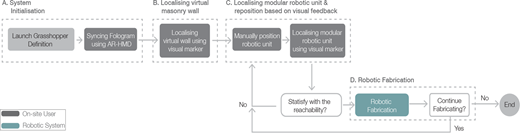
As indicated by Ang et al. (2024), a fully automated robotic application for on-site construction can pose challenges due to its limited adaptability in unstructured construction environments. To address this, our assembly workflow adopts a turn-taking approach that leverages the complementary skills of a human operator and a collaborative robotic arm (as illustrated in Figure 1), where global spatial decisions are intentionally assigned to the human operator, while placement execution and geometric accuracy are handled by the robotic system.

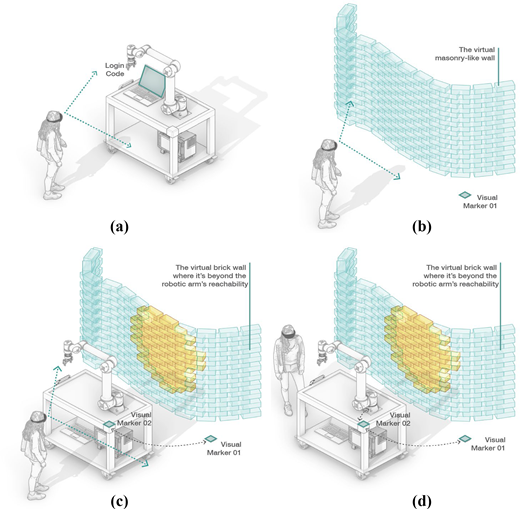
The developed AR-assisted HRI system consists of four turn-taking steps as indicated in Figure 2: (A) The users launch the Grasshopper definition on their workstation, which contains a predefined CAD model of the masonry-like wall structure. On the other hand, the user also activates the Fologram application (Jahn et al., 2018) on the AR-HMD and joins the AR session using a login code generated within the Grasshopper environment. (B) Once the Grasshopper and AR-HMD are synchronised, the user registers the digital masonry-like wall to the physical environment using a pre-established visual marker. A similar registration process is used to locate the modular robotic arm within the shared digital-physical workspace. The spatial coordinates and orientation of the robotic arm unit allow the computational pipeline to compute the positional feasibility of wooden blocks relative to the robotic arm. This information is then presented visually in the AR environment in real time to help users make more informed decisions. (C) Based on this visual feedback, the user can either manually reposition the robotic arm unit and update its coordinates using the visual marker or transmit the robotic command to the physical robot. (D) Once the assembly process is completed, a virtual notification appears on the user’s mobile device, signalling the end of the current cycle. The workflow can then progress to the subsequent assembly phase by relocating the robotic arm.

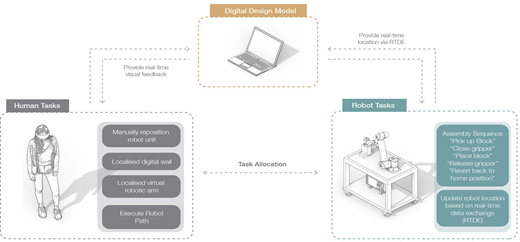
Task distribution plays a crucial role in establishing the dynamic within a human-robot team, as it leverages the complementary skill sets of humans and collaborative robotic arm (Kunic et al., 2025; Mitterberger, Ercan Jenny et al., 2022), preserves human agency within an HRC scenario (Han, 2023) and improves system predictability (Hopko et al., 2022). The task allocation for our developed system is illustrated in Figure 3.

Throughout the assembly process, the operator is responsible for intuitive and cognitively demanding tasks, including (i) registering both the digital representation of the masonry-like wall and the robotic unit in the shared cyber-physical workspace, and (ii) physically repositioning the robotic arm during successive assembly stages using AR guidance. These actions allow the operator to manage large-scale spatial progression of the assembly process and respond flexibly to workspace constraints.

On the other hand, fine-grained geometric placement is fully managed by the robotic system. Feasible block placements are computed via inverse-kinematics-based reachability analysis within the computational pipeline, and all pick-and-place motions are executed autonomously by the robotic arm based on the digital model’s location. Therefore, placement accuracy is determined by robot kinematics, motion planning and the quality of spatial registration, rather than by manual dexterity. While operator experience may influence task efficiency and relocation strategy, it does not directly control continuous motion execution or block placement precision.

The overall hardware setup consists of a six-degree-of-freedom robotic arm, UR16e, with a 16 kg payload, equipped with an industrial-grade gripper, Robotiq 2F-85. To extend the operational range of the collaborative robotic arm, it is mounted on a mobile platform, allowing users to manually reposition it throughout the assembly process. In addition, this mobile platform functions as a pick-up station for the wooden blocks. For AR integration, we use the Microsoft HoloLens 2, and communication between all hardware components is managed via a modem and a Windows 11 PC.

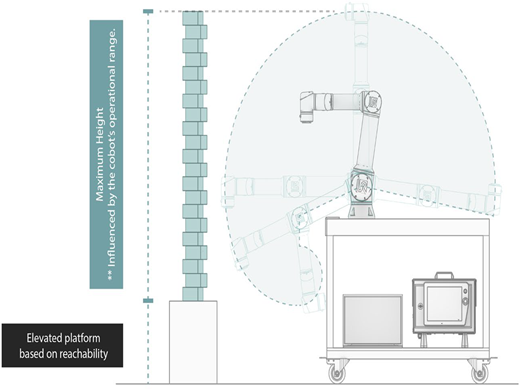
Despite being mounted on a modular unit, the UR16e has a designated operational range of 900 mm (Universal Robots, 2024), which directly defines the spatial boundary within which the robotic arm can operate effectively. This operational range is further restricted by the geometry of the modular platform, as illustrated in Figure 4. These factors influence the maximum height of the masonry-like walls in this study.

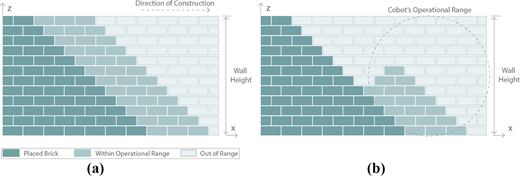
Apart from spatial considerations, assembly sequences heavily influence the feasibility of the robotic assembly procedure. Our system adopts a similar assembly approach, as first proposed by Slocum and Schena (1988, p. 113), to mitigate potential collision risk with previously placed wooden blocks and to avoid overhanging blocks that could obstruct subsequent robotic operation (refer to Figure 5). Our presented assembly logic ensures the assembly process remains adaptable to large-scale construction tasks while highlighting the unique spatial challenges inherent to the modular robotic system.

To evaluate the usability of the proposed AR-assisted robotic system, the research team conducted internal tests to assess the robotic assembly’s accuracy and the robustness of AR spatial registration. The evaluation focused specifically on technical feasibility, repeatability and spatial accuracy of the proposed workflow, rather than on user performance or skill acquisition. The experimental setup involved constructing two masonry-like wall structures, designated Wall 01 and Wall 02. The wall designs were preconfigured in the digital environment, and the structural integrity of both walls was validated using Phyx.gh plugin (Kao and Nguyen, 2019) in Grasshopper, ensuring that any assembly errors were not due to design flaws. Instead, the inconsistencies likely stemmed from the limitations inherent in the AR spatial localisation method.

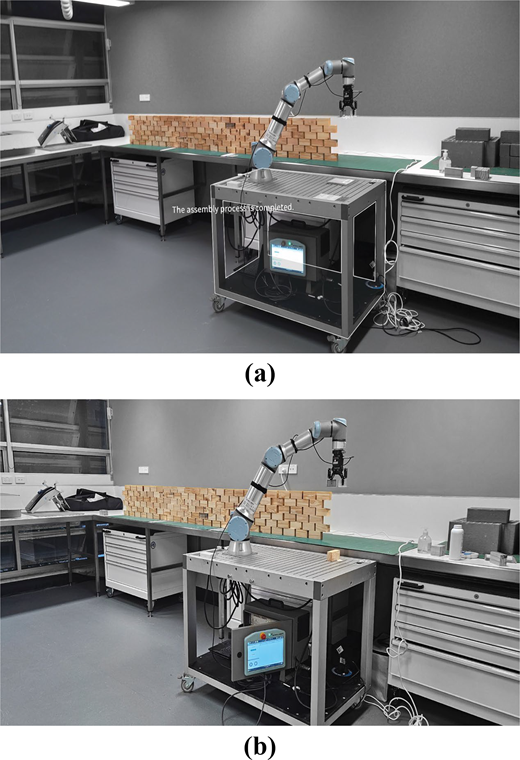
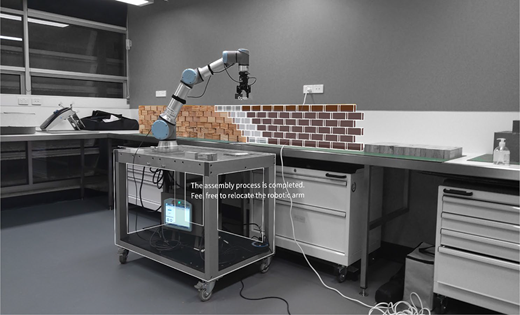
Each wall configuration was assembled under identical environmental conditions to assess the accuracy of the robotic placement and the robustness of AR spatial registration. Each dry-stacked wall covered approximately 0.1 × 3.0 meters and consisted of 138 wooden blocks (shown in Figure 6). The robotic arm unit was repositioned 7 times during Wall 01 assembly and 9 times during Wall 02 assembly using the AR-based spatial anchoring technique. The total assembly duration, including the repositioning intervals, was approximately 1 h 15 min for Wall 01 and 1 h 20 min for Wall 02. The robotic arm was deliberately operated at a maximum speed of 120 mm/s to ensure safe and reliable HRC. Multiple robotic repositionings were required to complete each wall due to the robotic arm’s limited reach.

After the wall construction was completed, each wall was 3D scanned twice using an Intel RealSense D415 depth camera. The resulting point clouds were post-processed using CloudCompare (CloudCompare, 2003), an open-source software. To improve data quality, both Statistical Outlier Removal filter and the noise filter were used to eliminate outliers and any noise (Kong et al., 2019).

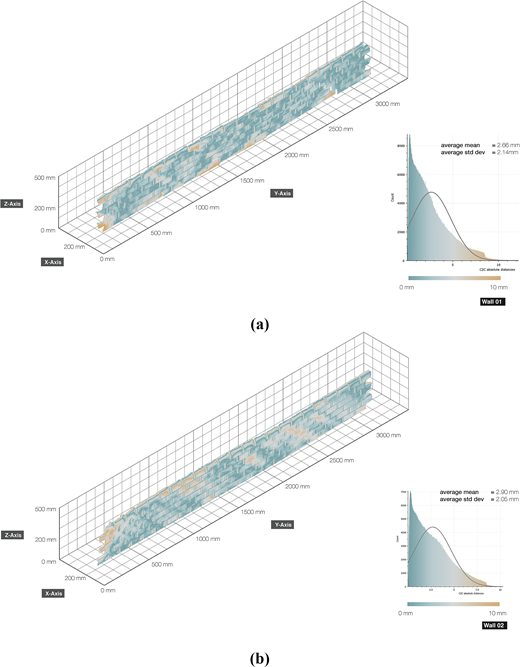
Subsequently, the filtered point clouds were registered to their respective 3D digital model using manual alignment followed by iterative closest point refinement. Cloud-to-cloud distance between each 3D scan and its corresponding 3D digital model was then calculated to evaluate the global deviation. The global deviation serves as a proxy metric for the quality of the AR spatial registration, as it captures positional errors introduced during assembly.

As illustrated in Figure 7, our proposed approach demonstrated consistent spatial accuracy, with global deviations of approximately 2.66 mm ± 2.14 mm for Wall 01 and 2.90 mm ± 2.05 mm for Wall 02, despite multiple manual relocations and re-registration of the modular robotic unit throughout the assembly process. While the measured deviations do not meet high-precision industrial fabrication tolerances, they are well within acceptable limits for many construction scenarios. The consistency across the walls also demonstrates the potential of AR-assisted robotic assembly for tasks requiring moderate spatial accuracy.

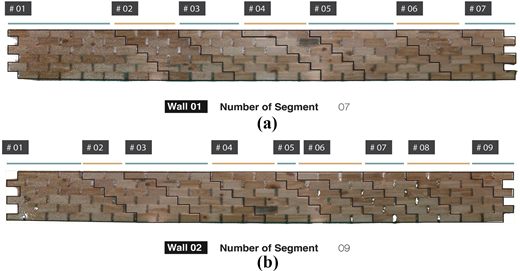
In addition, the scanned point clouds were segmented into clusters corresponding to each assembly cycle (as illustrated in Figure 8). Each segment was independently realigned to its corresponding region in the digital model to assess the accuracy of local placement and the repeatability of the robotic system. The mean deviation and deviation for each wall segment in both walls are reported in Tables 1 and 2. The results indicate that the mean deviations are consistently low, suggesting that the robotic arm reliably placed wooden blocks close to their intended location in each cycle. The similarity of the deviation values between segments further confirms the system’s consistent performance throughout the assembly process, indicating that robotic execution performance remained relatively stable across repeated human-guided relocation cycles.

In summary, these findings validate the feasibility of using AR-based spatial anchoring for large-scale robotic assembly procedures with a ± 5.0 mm tolerance. Although this approach might not meet the stringent demands of high-precision industrial fabrication, they are well within acceptable limits for many construction scenarios, including non-load-bearing masonry walls. For example, the Queensland Standards and Tolerances Guide specify a maximum allowable deviation of ± 5 mm from a plane surface for masonry walls (p 19), which applies to block construction in typical building practice. Accordingly, the ± 5 mm tolerance achieved in this study aligns with established construction standards and regulatory expectations, supporting the practical applicability of the proposed workflow in real-world construction contexts.

The results demonstrate that the proposed AR-assisted spatial anchoring approach provides a viable low-fidelity localisation strategy for construction robotic assembly. The measured global deviations indicate sufficient positional accuracy for practical applications where moderate tolerance levels are acceptable, such as non-structural operations. These findings are in line with previous studies such as Dörfler et al. (2016) and Kyaw et al. (2023), which similarly reported spatial drift as an inherent limitation when relying on AR-based visual markers for asset registration. Despite this global drift, the segment-level deviations reported in Tables 1 and 2 demonstrate consistent accuracy during localised pick-and-place operations, confirming the reliability of the robotic manipulation process at a granular scale.

Building on the interaction paradigms proposed by Zhang and Ruttico (2025), which emphasised continuous user-driven selection and placement interactions in AR environments, this study contributes to an alternative interaction by integrating IK within the computational platform to provide real-time visual feedback on block reachability relative to the robotic arm’s pose. As illustrated in Figure 9, this feedback enables robotic operator(s) to immediately distinguish feasible from infeasible placements, thereby reducing the need for continuous manual selection and decision-making during assembly. Such feasibility checks can improve workflow efficiency and can be particularly attractive for labour-intensive construction scenarios where cognitive load and task repetition are significant concerns.

The deliberate choice of using visual markers was to support rapid setup, transparency and ease of use for non-specialist operators, rather than maximal autonomy. This design decision aligns closely with the research by Song et al. (2021a) and Alexi et al. (2024), who highlighted the importance of operator confidence and system legibility in HRC for construction. By prioritising ease of deployment and HITL interaction, the proposed approach supports wider adoption of robotic assembly systems, particularly in scenarios where the overhead of fully autonomous navigation may outweigh its benefits.

While this study does not include direct benchmarking against SLAM-based localisation or fully autonomous navigation systems, the intent is not to position the AR spatial anchoring technique as a replacement for mature autonomous methods. As summarised in Table 3, the contribution instead addresses a different problem space, in which the proposed workflow complements existing robotic infrastructure by offering a lower-barrier solution for potential technology adoption. The AR-assisted and computational workflow demonstrates how HRC can support global spatial coordination while maintaining reliable robotic execution at the task level. Prior studies have shown that limited adoption of fully autonomous construction robotics is often driven not by technical infeasibility, but by implementation complexity, high initial investment costs and logistical setup demands (Han et al., 2021; Liang et al., 2021; Ruttico et al., 2024). In this context, the proposed approach demonstrates how HITL coordination, combined with lightweight AR infrastructure, can reduce system complexity while enabling repeatable, construction-grade robotic assembly.

Several limitations related to the experimental setup and system design should be considered when interpreting the study results. Firstly, the system relied on only two visual markers: one for spatially anchoring the digital wall structure and another for registering the modular robotic unit. Although this approach simplified system setup and enabled rapid deployment, it likely contributed to the observed positional inaccuracies caused by marker drift. Prior studies by Kyaw et al. (2023) and Zhang and Ruttico (2025) suggest that increasing the number of visual markers or combining them with additional sensing modalities, such as sensor fusion or SLAM-based localisation, could improve localisation robustness by providing richer spatial reference information.

Secondly, limitations are associated with the sensing hardware used for accuracy evaluation. The Intel RealSense D415 depth camera used in this study exhibits an absolute depth error of approximately ± 2 mm at close range (100–500 mm) and a relative depth error of approximately 2% at distances of up to 1.5 m, based on ISO 10360–13 evaluation procedures (RealSense Help Center, 2026). Considering that the measured global deviations in this study ranged from approximately 2.6  to 2.9 mm, the scanning device’s uncertainty is comparable in magnitude to the reported errors. Therefore, the deviation results should be interpreted as indicative of construction-level spatial accuracy rather than exact metrological measurements. While the results indicate that visual-marker-based spatial anchoring is suitable for moderate-precision tasks, future studies using higher-accuracy scanning equipment could enable a more rigorous assessment of positional deviations.

Thirdly, the geometric complexity was constrained by the dry-stacking approach, which required relatively stable and straightforward wall configurations. Although this simplified experimental validation, it limited the exploration of more expressive or structurally demanding assemblies. Future research could extend the system to bonded or adhesive-based construction methods, enabling more complex geometries and structural behaviours.

Fourthly, all experiments were conducted under consistent laboratory lighting. Real-world construction environments often involve uneven illumination and surface variability. Evaluating the proposed system under such conditions will be essential to assess its robustness and practical applicability in on-site settings.

Fifthly, the current mobile platform design constrained the robotic arm’s effective operational range (as depicted in Figure 4). Future platform iterations could integrate compact hydraulic lifting mechanisms or adjustable bases, similar to those proposed in Mitterberger et al. (2022) and Ruttico et al. (2024), to enhance reachability and flexibility during large-scale assembly tasks.

Finally, the present validation focused on technical feasibility and system robustness, with experimental trials conducted by the research team. Future work will extend this evaluation through broader user studies to investigate socio-technical aspects such as cognitive load, interface intuitiveness and user trust in human–robot collaborative construction workflows. Section 6: Conclusion.

This paper presented an AR-assisted HRC system that uses HMD to support large-scale assembly tasks. The study contributes to AR-assisted robotic applications in architecture and construction by integrating real-time IK-based feasibility analyses within a HITL workflow that prioritises deployment accessibility and reduces technological barriers to mobile collaborative robotic adoption. Through full-scale experimental validation in a controlled laboratory environment, the results demonstrate that consistent spatial accuracy can be maintained across repeated human-guided relocation cycles.

Rather than pursuing maximal autonomy, this work highlights how construction-oriented deployment considerations can be addressed through a human–robot collaborative approach. By allocating global spatial decision-making to the human operator while preserving reliable robotic execution at the task level, the proposed workflow reflects a pragmatic operational model aligned with Construction 5.0 principles.

Overall, our findings establish a foundation for AR-supported HITL workflows in construction robotics, particularly in scenarios where flexibility, usability and adoption feasibility are prioritised over full automation. This work positions AR-assisted spatial anchoring not as a replacement for autonomous systems, but as a complementary strategy that broadens the applicability of robotic assembly in real-world construction contexts.

The authors would like to express sincere gratitude to the School of Architecture and Built Environment for providing the facilities, tools, and support necessary to conduct this research. The authors would also like to thank the School of Design for generously loaning the 3D scanning equipment, which was instrumental in supporting the research process.

Original contributions presented in the study are included in the article and are also openly available at Link to a PDF of the cited article. under a GPL V3 license. In particular, they include (1) scanned point cloud data from assembled walls, (2) a full version of this paper, (3) the Grasshopper definitions developed throughout this study, and (4) a full resolution of the illustrations.
ABLR
(
2024
), “
The automated brick laying robot (ABLR). the automated brick laying robot
”,
(ABLR)
,
available at:
The automated brick laying robot (ABLR). the automated brick laying robotLink to the cited article.
Aivaliotis
,
S.
,
Papavasileiou
,
A.
,
Konstantinou
,
C.
,
Anastasiou
,
T.
,
Gkournelos
,
C.
,
Koukas
,
S.
and
Makris
,
S.
(
2024
), “
An interactive augmented reality based framework assisting operators in human-robot collaborative assembly operations
”,
Procedia CIRP
, Vol.
126
, pp.
170
-
175
, doi: .
Alexi
,
E.V.
,
Kenny
,
J.C.
,
Atanasova
,
L.
,
Casas
,
G.
,
Dörfler
,
K.
and
Mitterberger
,
D.
(
2024
), “
Cooperative augmented assembly (CAA): augmented reality for on-site cooperative robotic fabrication
”,
Construction Robotics
, Vol.
8
No.
2
, p.
28
, doi: .
Altobelli
,
F.
,
Taylor
,
H.F.
and
Bernold
,
L.E.
(
1993
), “
Prototype robotic masonry system
”,
Journal of Aerospace Engineering
, Vol.
6
No.
1
, pp.
19
-
33
, doi: .
Ang
,
K.C.S.
,
Sankaran
,
S.
and
Liu
,
D.
(
2024
), “
Sociotechnical considerations on developing human robot teaming solutions for construction: a case study
”,
Construction Robotics
, Vol.
8
No.
2
, p.
23
, doi: .
Asani
,
Z.
,
Ambrosino
,
M.
,
Munteanu
,
A.
,
Vanderborght
,
B.
and
Garone
,
E.
3rd
(
2024
), “
Towards safer and more efficient construction—the development of a Multi-Robotic system for heavy block assembly
”,
Proceedings of the Future of Construction Workshop at the International Conference on Robotics and Automation (ICRA 2024). 3rd ICRA 2024 Future of Construction Workshop
, doi:
Bock
,
T.
(
2015
), “
The future of construction automation: technological disruption and the upcoming ubiquity of robotics
”,
Automation in Construction
, Vol.
59
, pp.
113
-
121
, doi: .
Bruun
,
E.P.G.
,
Pastrana
,
R.
,
Paris
,
V.
,
Beghini
,
A.
,
Pizzigoni
,
A.
,
Parascho
,
S.
and
Adriaenssens
,
S.
(
2021
), “
Three cooperative robotic fabrication methods for the scaffold-free construction of a masonry arch
”,
Automation in Construction
, Vol.
129
, p.
103803
, doi: .
CloudCompare
(
2003
),
available at:
www.cloudcompare.org/
Demirkesen
,
S.
and
Tezel
,
A.
(
2021
), “
Investigating major challenges for industry 4.0 adoption among construction companies
”,
Engineering, Construction and Architectural Management
, doi: .
Diginsa
,
M.U.
,
Shafie
,
N.
,
Yusuf
,
N.
and
Suleiman
,
S.U.
(
2023
), “
Review: issues and challenges of simultaneous localization and mapping (SLAM) technology in autonomous robot
”,
International Journal of Innovative Computing
, Vol.
13
No.
2
, pp.
59
-
63
, doi: .
Dong
,
R.
,
Muhammad
,
A.
and
Nauman
,
U.
(
2025
), “
The influence of weather conditions on time, cost, and quality in successful construction project delivery
”,
Buildings
, Vol.
15
No.
3
, p.
474
, doi: .
Dörfler
,
K.
,
Sandy
,
T.
,
Giftthaler
,
M.
,
Gramazio
,
F.
,
Kohler
,
M.
and
Buchli
,
J.
(
2016
), “Mobile robotic brickwork”, In
Reinhardt
,
D.
,
Saunders
,
R.
and
Burry
,
J.
(Eds),
Robotic Fabrication in Architecture, Art and Design 2016
,
Springer International Publishing
, pp.
204
-
217
, doi: .
Franze
,
A.
,
Belek Fialho Teixeira
,
M.
,
Caldwell
,
C.
,
Dawson
,
J.
,
Isabel Valdez Mena
,
G.
,
Reza Rafizadeh
,
H.
,
Schork
,
T.
,
Gainey
,
L.
,
Caballero
,
M.
and
Zahra
,
T.
(
2025
), “
Bricklayers’ perspectives on human-robot collaboration (HRC) in on-site masonry construction: Opportunities, challenges, and considerations
”,
Construction Innovation
, Vol.
25
No.
7
, doi: .
Gambao
,
E.
,
Balaguer
,
C.
and
Gebhart
,
F.
(
2000
), “
Robot assembly system for computer-integrated construction
”,
Automation in Construction
, Vol.
9
Nos
5-6
, pp.
479
-
487
, doi: .
Garcés
,
G.
(
2025
), “
Human-robot synergy in building construction: advances, challenges, and future horizons for construction 5.0
”,
Discover Civil Engineering
, Vol.
2
No.
1
, p.
135
, doi: .
Han
,
I.X.
(
2023
), “
[DC] humans and robots improvise to Design-Fabricate in virtual reality
”,
2023 IEEE Conference on Virtual Reality and 3D User Interfaces Abstracts and Workshops (VRW)
, pp.
969
-
970
, doi: .
Han
,
I.X.
,
Meggers
,
F.
and
Parascho
,
S.
(
2021
), “
Bridging the collectives: a review of collective human–robot construction
”,
International Journal of Architectural Computing
, Vol.
19
No.
4
, pp.
512
-
531
, doi: .
Helm
,
V.
,
Willmann
,
J.
,
Gramazio
,
F.
and
Kohler
,
M.
(
2014
), “In-Situ robotic fabrication: advanced digital manufacturing beyond the laboratory”, In
Röhrbein
,
F.
,
Veiga
,
G.
and
Natale
,
C.
(Eds),
Gearing up and Accelerating Cross‐Fertilization between Academic and Industrial Robotics Research in Europe
,
Springer International Publishing
, Vol.
94
, pp.
63
-
83
, doi: .
Hopko
,
S.
,
Wang
,
J.
and
Mehta
,
R.
(
2022
), “
Human factors considerations and metrics in shared space Human-Robot collaboration: a systematic review
”,
Frontiers in Robotics and AI
, Vol.
9
, pp.
799522
, doi: .
Jahn
,
G.
,
Newnham
,
C.
and
van den Berg
,
N.
(
2018
), “
Fologram
”,
available at:
Fologramhttps://fologram.com/
Kao
,
G.T.-C.
and
Nguyen
,
L.
(
2019
), “
PhysX.GH: Rigid body simulation tool for Grasshopper
”,
available at:
PhysX.GH: Rigid body simulation tool for GrasshopperLink to the cited article.
Kirgis
,
F.-P.
,
Katsos
,
P.
and
Kohlmaier
,
M.
(
2016
), “Collaborative robotics”, In
Reinhardt
,
D.
Saunders
,
R.
and
Burry
,
J.
(Eds),
Robotic Fabrication in Architecture, Art and Design 2016
,
Springer International Publishing
, pp.
448
-
453
, doi: .
Klingensmith
,
M.
,
Sirinivasa
,
S.S.
and
Kaess
,
M.
(
2016
), “
Articulated robot motion for simultaneous localization and mapping (ARM-SLAM)
”,
IEEE Robotics and Automation Letters
, Vol.
1
No.
2
, pp.
1156
-
1163
, doi: .
Kong
,
L.
,
Qi
,
C.
and
Qi
,
H.-D.
(
2019
), “
Classical multidimensional scaling: a subspace perspective, over-denoising, and outlier detection
”,
IEEE Transactions on Signal Processing
, Vol.
67
No.
14
, pp.
3842
-
3857
, doi: .
Kunic
,
A.
,
Talaei
,
A.
and
Naboni
,
R.
(
2025
), “
Cyber–physical infrastructure for material and construction data tracking in reconfigurable timber light-frame structures
”,
Construction Robotics
, Vol.
9
No.
1
, p.
11
, doi: .
Kyaw
,
A.H.
,
Xu
,
A.H.
,
Jahn
,
G.
,
Van Den Berg
,
N.
,
Newnham
,
C.
and
Zivkovic
,
S.
(
2023
), “
Augmented reality for high precision fabrication of glued laminated timber beams
”,
Automation in Construction
, Vol.
152
, p.
104912
, doi: .
Liang
,
C.-J.
,
Le
,
T.-H.
,
Ham
,
Y.
,
Mantha
,
B.R.K.
,
Cheng
,
M.H.
and
Lin
,
J.J.
(
2024
), “
Ethics of artificial intelligence and robotics in the architecture, engineering, and construction industry
”,
Automation in Construction
, Vol.
162
, p.
105369
, doi: .
Liang
,
C.-J.
,
Wang
,
X.
,
Kamat
,
V.R.
and
Menassa
,
C.C.
(
2021
), “
Human–robot collaboration in construction: Classification and research trends
”,
Journal of Construction Engineering and Management
, Vol.
147
No.
10
, p.
03121006
, doi: .
Loy
,
W.W.
,
Donovan
,
J.
,
Rittenbruch
,
M.
and
Belek Fialho Teixeira
,
M.
(
2025
), “
Exploring AR-enabled human–robot collaboration (HRC) system for exploratory collaborative assembly tasks
”,
Construction Robotics
, Vol.
9
No.
2
, p.
19
, doi: .
Madsen
,
A.J.
(
2019
), “
The SAM100: Analyzing labor productivity
”.
Marinelli
,
M.
(
2023
), “
From industry 4.0 to construction 5.0: exploring the path towards human–robot collaboration in construction
”,
Systems
, Vol.
11
No.
3
, p.
152
, doi: .
Mishra
,
D.
(
2025
), “Integration of robotics and automation in construction”, In
Bajaj
,
D.
(Ed.),
Handbook of Construction Project Management
,
Springer Nature Singapore
, pp.
875
-
904
, doi: .
Mitterberger
,
D.
,
Atanasova
,
L.
,
Dörfler
,
K.
,
Gramazio
,
F.
and
Kohler
,
M.
(
2022
), “
Tie a knot: Human–robot cooperative workflow for assembling wooden structures using rope joints
”,
Construction Robotics
, Vol.
6
Nos
3-4
, pp.
277
-
292
, doi: .
Mitterberger
,
D.
,
Ercan Jenny
,
S.
,
Vasey
,
L.
,
Lloret-Fritschi
,
E.
,
Aejmelaeus-Lindström
,
P.
,
Gramazio
,
F.
and
Kohler
,
M.
(
2022
), “
Interactive robotic plastering: augmented interactive design and fabrication for on-site robotic plastering
”,
CHI Conference on Human Factors in Computing Systems
, pp.
1
-
18
, doi: .
Oliver
,
D.
(
2020
), “
Bricklaying robot, Hadrian X, builds display home in Perth after 15 years of development this is construction
”,
available at:
Bricklaying robot, Hadrian X, builds display home in Perth after 15 years of development this is constructionLink to the cited article.
Onososen
,
A.O.
and
Musonda
,
I.
(
2023
), “
Research focus for construction robotics and human-robot teams towards resilience in construction: Scientometric review
”,
Journal of Engineering, Design and Technology
, Vol.
21
No.
2
, pp.
502
-
526
, doi: .
Pan
,
M.
,
Linner
,
T.
,
Pan
,
W.
,
Cheng
,
H.
and
Bock
,
T.
(
2018
), “
A framework of indicators for assessing construction automation and robotics in the sustainability context
”,
Journal of Cleaner Production
, Vol.
182
, pp.
82
-
95
, doi: .
Peng
,
H.
,
Briggs
,
J.
,
Wang
,
C.-Y.
,
Guo
,
K.
,
Kider
,
J.
,
Mueller
,
S.
,
Baudisch
,
P.
and
Guimbretière
,
F.
(
2018
), “
RoMA: Interactive fabrication with augmented reality and a robotic 3D printer
”,
Proceedings of the 2018 CHI Conference on Human Factors in Computing Systems
,
ACM Digital Library
, pp.
1
-
12
, doi: .
RealSense Help Center
(
2026
),
available at:
https://support.realsenseai.com/hc/en-us (accesed on July 30 2025)
Ruttico
,
P.
,
Pacini
,
M.
and
Beltracchi
,
C.
(
2024
), “
BRIX: an autonomous system for brick wall construction
”,
Construction Robotics
, Vol.
8
No.
2
, p.
10
, doi: .
Slocum
,
A.H.
and
Schena
,
B.
(
1988
), “
Blockbot: a robot to automate construction of cement block walls
”,
Robotics and Autonomous Systems
, Vol.
4
No.
2
, pp.
111
-
129
, doi: .
Slocum
,
C.
,
Ran
,
X.
and
Chen
,
J.
(
2021
), “
RealityCheck: a tool to evaluate spatial inconsistency in augmented reality
”,
2021 IEEE International Symposium on Multimedia (ISM)
, pp.
58
-
65
, doi:
Song
,
Y.
,
Agkathidis
,
A.
and
Koeck
,
R.
(
2023
), “Augmented bricks an onsite AR immersive design to fabrication framework for masonry structures”, In
P. F.
Yuan
,
H.
Chai, C. Yan
,
K.
Li
and
T.
Sun
(Eds.),
Hybrid Intelligence
,
Springer Nature Singapore
, pp.
385
-
395
, doi: .
Song
,
Y.
,
Koeck
,
R.
and
Luo
,
S.
(
2021a
), “
AR Digi-Component—AR-assisted, real-time, immersive design and robotic fabrication workflow for parametric architectural structures
”,
Computer Aided Architectural Design Research in Asia
, pp.
253
-
262
, doi: .
Song
,
Y.
,
Koeck
,
R.
and
Luo
,
S.
(
2021b
), “
[AR]OBOT: the AR-Assisted robotic fabrication system for parametric architectural structures
”,
Blucher Design Proceedings
, pp.
1115
-
1126
, doi:
Thomson
,
J.
(
1904
), “
Brick-laying machine US patent US772191A granted October 11
”,
available at:
Brick-laying machine US patent US772191A granted October 11Link to a pdf of the cited article.
Universal Robots
(
2024
),
Universal Robots—UR16e—Product Fact Sheet
.
Universal Robot
,
available at:
Universal Robots—UR16e—Product Fact SheetLink to a pdf of the cited article.
Xu
,
W.
,
Luo
,
D.
and
Gao
,
Y.
(
2019
), “
Automatic brick masonry system and its application in on-site construction
”, pp.
83
-
92
, doi: .
Yarovoi
,
A.
and
Cho
,
Y.K.
(
2024
), “
Review of simultaneous localization and mapping (SLAM) for construction robotics applications
”,
Automation in Construction
, Vol.
162
, p.
105344
, doi: .
Zeng
,
L.
,
Guo
,
S.
,
Wu
,
J.
and
Markert
,
B.
(
2024
), “
Autonomous mobile construction robots in built environment: a comprehensive review
”,
Developments in the Built Environment
, Vol.
19
, p.
100484
, doi: .
Zhang
,
W.
(
2024
), “Interactive robotic grinding: Interactive building metal surface design and fabrication for robotic grinding”, In
Stephanidis
,
C.
,
Antona
,
M.
,
Ntoa
,
S.
and
Salvendy
,
G.
(Eds),
HCI International 2024 Posters
,
Springer Nature Switzerland
, pp.
427
-
437
, doi: .
Zhang
,
W.
and
Ruttico
,
P.
(
2025
), “
Enhanced interactive AR bricklaying: elevating human–robot collaboration in augmented reality assisted masonry design and construction
”,
Architectural Intelligence
, Vol.
4
No.
1
, p.
6
, doi: .
Published by Emerald Publishing Limited. This article is published under the Creative Commons Attribution (CC BY 4.0) licence. Anyone may reproduce, distribute, translate and create derivative works of this article (for both commercial and non-commercial purposes), subject to full attribution to the original publication and authors. The full terms of this licence maybe seen at Link to the terms of the CC BY 4.0 licenceLink to the terms of the CC BY 4.0 licence.

Data & Figures

Figure 1.
A flowchart outlines system initialisation, virtual wall localisation, robotic unit positioning, reachability check, and iterative robotic fabrication process ending when fabrication stops.The flowchart is divided into four sections labelled A, B, C, and D. Section A shows system initialisation with two steps connected by an arrow: launch Grasshopper definition and syncing Fologram using A R H M D. Section B shows localising a virtual masonry wall using a visual marker. Section C shows manually positioning a modular robotic unit followed by localising the robotic unit using a visual marker. A decision box asks satisfy with the reachability, with a no arrow looping back to repositioning and a yes arrow leading forward. Section D shows robotic fabrication followed by a decision continue fabricating, with a yes arrow looping back and a no arrow leading to end. A legend indicates the on-site user and robotic system.

System walkthrough for the proposed large-scale robotic pick-and-place task

Figure 1.
A flowchart outlines system initialisation, virtual wall localisation, robotic unit positioning, reachability check, and iterative robotic fabrication process ending when fabrication stops.The flowchart is divided into four sections labelled A, B, C, and D. Section A shows system initialisation with two steps connected by an arrow: launch Grasshopper definition and syncing Fologram using A R H M D. Section B shows localising a virtual masonry wall using a visual marker. Section C shows manually positioning a modular robotic unit followed by localising the robotic unit using a visual marker. A decision box asks satisfy with the reachability, with a no arrow looping back to repositioning and a yes arrow leading forward. Section D shows robotic fabrication followed by a decision continue fabricating, with a yes arrow looping back and a no arrow leading to end. A legend indicates the on-site user and robotic system.

System walkthrough for the proposed large-scale robotic pick-and-place task

Close modal
Figure 2.
Four panels illustrate user interaction with a robotic system, virtual wall localisation, reachability limits, and repositioning using visual markers to align fabrication tasks.The four panels are labelled a, b, c, and d. In panel a, a person stands near a robotic arm mounted on a wheeled table with a laptop, and a login code is indicated between the user and the system. In panel b, the person faces a virtual masonry-like wall with a marker labelled visual marker 01 positioned on the ground. In panel c, a robotic arm and table appear aligned with a virtual brick wall, and a central region of the wall indicates an area beyond the robotic arm reachability. Two markers labelled visual marker 01 and visual marker 02 appear near the system and the wall. In panel d, the robotic unit is repositioned closer to the wall, with the same markers visible, and the highlighted region indicating limited reachability remains within the wall structure.

AR-assisted HRI consists of four turn-taking steps

Figure 2.
Four panels illustrate user interaction with a robotic system, virtual wall localisation, reachability limits, and repositioning using visual markers to align fabrication tasks.The four panels are labelled a, b, c, and d. In panel a, a person stands near a robotic arm mounted on a wheeled table with a laptop, and a login code is indicated between the user and the system. In panel b, the person faces a virtual masonry-like wall with a marker labelled visual marker 01 positioned on the ground. In panel c, a robotic arm and table appear aligned with a virtual brick wall, and a central region of the wall indicates an area beyond the robotic arm reachability. Two markers labelled visual marker 01 and visual marker 02 appear near the system and the wall. In panel d, the robotic unit is repositioned closer to the wall, with the same markers visible, and the highlighted region indicating limited reachability remains within the wall structure.

AR-assisted HRI consists of four turn-taking steps

Close modal
Figure 3.
A diagram presents human and robot task allocation with a digital design model, showing real-time feedback, robot control steps, and coordinated data exchange.The diagram is divided into three main sections titled human tasks, digital design model, and robot tasks. At the top centre, a digital design model is represented by a laptop, with arrows indicating provide real-time visual feedback and provide real-time location via R T D E. On the left, a person represents human tasks, with a list of actions including manually reposition robot unit, localised digital wall, localised virtual robotic arm, and execute robot path. In the centre, a bidirectional arrow labelled task allocation connects human tasks and robot tasks. On the right, robot tasks are shown with a robotic arm on a wheeled table. A sequence box lists steps: pick up block, close gripper, place block, release gripper, and revert back to home position. Another box states update robot location based on real-time data exchange R T D E.

Task allocation between users and collaborative robotic arm

Figure 3.
A diagram presents human and robot task allocation with a digital design model, showing real-time feedback, robot control steps, and coordinated data exchange.The diagram is divided into three main sections titled human tasks, digital design model, and robot tasks. At the top centre, a digital design model is represented by a laptop, with arrows indicating provide real-time visual feedback and provide real-time location via R T D E. On the left, a person represents human tasks, with a list of actions including manually reposition robot unit, localised digital wall, localised virtual robotic arm, and execute robot path. In the centre, a bidirectional arrow labelled task allocation connects human tasks and robot tasks. On the right, robot tasks are shown with a robotic arm on a wheeled table. A sequence box lists steps: pick up block, close gripper, place block, release gripper, and revert back to home position. Another box states update robot location based on real-time data exchange R T D E.

Task allocation between users and collaborative robotic arm

Close modal
Figure 4.
A diagram shows a robotic arm reach envelope and a vertical brick stack, indicating maximum achievable height and the use of an elevated platform to extend reachability.The diagram presents a robotic arm mounted on a wheeled table with multiple arm positions illustrated within a dashed circular boundary representing the operational range. To the left, a vertical stack of bricks rises from a rectangular base. A vertical dashed line with markers indicates the maximum height influenced by the cobot operational range. Text states maximum height influenced by the cobot operational range. At the bottom left, a label indicates elevated platform based on reachability. The robotic system includes a control unit within the table structure, and the arm is oriented towards the brick stack.

Spatial restriction influences the wall design

Figure 4.
A diagram shows a robotic arm reach envelope and a vertical brick stack, indicating maximum achievable height and the use of an elevated platform to extend reachability.The diagram presents a robotic arm mounted on a wheeled table with multiple arm positions illustrated within a dashed circular boundary representing the operational range. To the left, a vertical stack of bricks rises from a rectangular base. A vertical dashed line with markers indicates the maximum height influenced by the cobot operational range. Text states maximum height influenced by the cobot operational range. At the bottom left, a label indicates elevated platform based on reachability. The robotic system includes a control unit within the table structure, and the arm is oriented towards the brick stack.

Spatial restriction influences the wall design

Close modal
Figure 5.
Two diagrams compare brick placement across a wall height, indicating construction direction and a cobot operational range that limits accessible brick positions.The two side-by-side diagrams are labelled a and b, each representing a brick wall with horizontal rows aligned along an x axis and vertical direction marked as z. In diagram a, bricks are arranged progressively across the wall in the direction of construction indicated by a right-pointing arrow, with a vertical double-headed arrow marking wall height. A legend below identifies categories as placed brick, within operational range, and out of range. In diagram b, a circular dashed boundary marks the cobot operational range over part of the wall. Bricks inside this boundary differ from those outside, indicating accessible and inaccessible regions relative to the cobot. The same x axis and wall height indicators appear on the right side.

Pick and Place assembly logic. (a) Proposed assembly logic by Blockbot. (b) Revised assembly logic given the robot’s operational range

Figure 5.
Two diagrams compare brick placement across a wall height, indicating construction direction and a cobot operational range that limits accessible brick positions.The two side-by-side diagrams are labelled a and b, each representing a brick wall with horizontal rows aligned along an x axis and vertical direction marked as z. In diagram a, bricks are arranged progressively across the wall in the direction of construction indicated by a right-pointing arrow, with a vertical double-headed arrow marking wall height. A legend below identifies categories as placed brick, within operational range, and out of range. In diagram b, a circular dashed boundary marks the cobot operational range over part of the wall. Bricks inside this boundary differ from those outside, indicating accessible and inaccessible regions relative to the cobot. The same x axis and wall height indicators appear on the right side.

Pick and Place assembly logic. (a) Proposed assembly logic by Blockbot. (b) Revised assembly logic given the robot’s operational range

Close modal
Figure 6.
Two panels display a robotic arm assembling a brick wall on a workbench, with the first indicating completion and the second showing a brick placed on the table.The two stacked panels are labelled A and B, each depicting a laboratory workspace with a robotic arm mounted on a wheeled metal table. In panel A, the robotic arm extends over a long workbench where a wall of small rectangular bricks is arranged in horizontal rows. Text across the centre states that the assembly process is completed. Cabinets, tools, and a window appear in the background. In panel B, the same setup appears with the robotic arm positioned above the table, and a single brick rests on the tabletop in front of the arm. The brick wall continues along the back workbench, and cables and equipment are visible beneath and around the table.

Assembled masonry-like wall structures. (a) Wall 01. (b) Wall 02

Figure 6.
Two panels display a robotic arm assembling a brick wall on a workbench, with the first indicating completion and the second showing a brick placed on the table.The two stacked panels are labelled A and B, each depicting a laboratory workspace with a robotic arm mounted on a wheeled metal table. In panel A, the robotic arm extends over a long workbench where a wall of small rectangular bricks is arranged in horizontal rows. Text across the centre states that the assembly process is completed. Cabinets, tools, and a window appear in the background. In panel B, the same setup appears with the robotic arm positioned above the table, and a single brick rests on the tabletop in front of the arm. The brick wall continues along the back workbench, and cables and equipment are visible beneath and around the table.

Assembled masonry-like wall structures. (a) Wall 01. (b) Wall 02

Close modal
Figure 7.
Two panels present 3d scanned of the brick wall models with axis scales and accompanying distributions, indicating depth variation along the wall length with summary statistics for two wall cases.The two panels are labelled a and b, each showing a three-dimensional representation of a brick wall aligned along x, y, and z axes with grid lines and measurements in millimetres. The y axis extends from 0 to 3000 millimetres, the z axis from 0 to 500 millimetres, and the x axis from 0 to 200 millimetres. In panel a, the wall model displays variations across its surface, and to the right, a distribution plot presents counts against c c absolute distances with a smooth curve overlay. Text indicates an average mean of 2.66 millimetres and an average standard deviation of 2.14 millimetres, with a scale from 0 millimetres to 10 millimetres. In panel b, a similar wall model appears with comparable axis ranges and surface variation, accompanied by a second distribution plot. Text indicates an average mean of 2.90 millimetres and an average standard deviation of 2.05 millimetres, with the same distance scale from 0 millimetres to 10 millimetres.

Global deviation heatmap comparing the full 3D scan of the constructed walls, both Wall 01 (a) and Wall 02 (b) to their 3D digital model. Color scale represents spatial deviation in millimeters

Figure 7.
Two panels present 3d scanned of the brick wall models with axis scales and accompanying distributions, indicating depth variation along the wall length with summary statistics for two wall cases.The two panels are labelled a and b, each showing a three-dimensional representation of a brick wall aligned along x, y, and z axes with grid lines and measurements in millimetres. The y axis extends from 0 to 3000 millimetres, the z axis from 0 to 500 millimetres, and the x axis from 0 to 200 millimetres. In panel a, the wall model displays variations across its surface, and to the right, a distribution plot presents counts against c c absolute distances with a smooth curve overlay. Text indicates an average mean of 2.66 millimetres and an average standard deviation of 2.14 millimetres, with a scale from 0 millimetres to 10 millimetres. In panel b, a similar wall model appears with comparable axis ranges and surface variation, accompanied by a second distribution plot. Text indicates an average mean of 2.90 millimetres and an average standard deviation of 2.05 millimetres, with the same distance scale from 0 millimetres to 10 millimetres.

Global deviation heatmap comparing the full 3D scan of the constructed walls, both Wall 01 (a) and Wall 02 (b) to their 3D digital model. Color scale represents spatial deviation in millimeters

Close modal
Figure 8.
Two wall images display segmented brick patterns labelled sequentially, with the first containing seven segments and the second containing nine segments arranged along the wall length.The two horizontal wall images are labelled a and b. In the upper image, the wall is labelled Wall 01 with Number of Segment 07. The wall is divided into seven sections marked as number 01 to number 07 above the wall. Each section is separated by a stepped boundary line that follows the brick pattern. In the lower image, the wall is labelled Wall 02 with Number of Segment 09. The wall is divided into nine sections marked as number 01 to number 09 above the wall. Each section is separated by a similar stepped boundary line aligned with the brick arrangement.

Segmented 3D scan data showing clustered construction phases for each wall. The robotic arm was manually repositioned and localised using visual markers before each build cycle. (a) Wall 01 was assembled in 7 segments; (b) Wall 02 was constructed in 9 segments

Figure 8.
Two wall images display segmented brick patterns labelled sequentially, with the first containing seven segments and the second containing nine segments arranged along the wall length.The two horizontal wall images are labelled a and b. In the upper image, the wall is labelled Wall 01 with Number of Segment 07. The wall is divided into seven sections marked as number 01 to number 07 above the wall. Each section is separated by a stepped boundary line that follows the brick pattern. In the lower image, the wall is labelled Wall 02 with Number of Segment 09. The wall is divided into nine sections marked as number 01 to number 09 above the wall. Each section is separated by a similar stepped boundary line aligned with the brick arrangement.

Segmented 3D scan data showing clustered construction phases for each wall. The robotic arm was manually repositioned and localised using visual markers before each build cycle. (a) Wall 01 was assembled in 7 segments; (b) Wall 02 was constructed in 9 segments

Close modal
Figure 9.
A robotic arm beside a brick wall displays a digital overlay of a wall segment, with on-screen text indicating the assembly process is completed and relocation is possible.The laboratory workspace with a robotic arm mounted on a wheeled metal table is positioned in front of a brick wall on a workbench. A digital overlay of a brick pattern appears aligned on part of the wall surface. Text in the centre reads the assembly process is completed and feel free to relocate the robotic arm. Cabinets, a window, tools, and cables are visible around the workspace, with a control unit housed beneath the table.

The user visualised the positional feasibility of wooden blocks within the AR environment. White-coloured blocks indicate reachable positions based on the robotic arm’s real-time location, whereas red-coloured blocks represent unreachable positions

Figure 9.
A robotic arm beside a brick wall displays a digital overlay of a wall segment, with on-screen text indicating the assembly process is completed and relocation is possible.The laboratory workspace with a robotic arm mounted on a wheeled metal table is positioned in front of a brick wall on a workbench. A digital overlay of a brick pattern appears aligned on part of the wall surface. Text in the centre reads the assembly process is completed and feel free to relocate the robotic arm. Cabinets, a window, tools, and cables are visible around the workspace, with a control unit housed beneath the table.

The user visualised the positional feasibility of wooden blocks within the AR environment. White-coloured blocks indicate reachable positions based on the robotic arm’s real-time location, whereas red-coloured blocks represent unreachable positions

Close modal
Table 1.

Segment-level deviation for wall 01 (mean ± standard deviation in mm)

SegmentScan 43Scan 09
Segment 13.44 ± 2.373.24 ± 2.14
Segment 23.17 ± 2.113.27 ± 2.24
Segment 33.39 ± 2.053.17 ± 2.04
Segment 42.20 ± 1.522.20 ± 1.47
Segment 53.11 ± 1.682.90 ± 2.00
Segment 62.47 ± 1.992.40 ± 1.60
Segment 72.43 ± 1.492.10 ± 1.51
Table 2.

Segment-level deviation for wall 02 (mean ± standard deviation in mm)

SegmentScan 48Scan 22
Segment 11.57 ± 1.471.85 ± 1.70
Segment 21.57 ± 1.481.69 ± 1.54
Segment 31.83 ± 1.591.76 ± 1.55
Segment 41.84 ± 1.661.95 ± 1.68
Segment 51.73 ± 1.481.67 ± 1.62
Segment 61.80 ± 1.521.71 ± 1.68
Segment 71.94 ± 1.531.78 ± 1.69
Segment 81.46 ± 1.451.43 ± 1.55
Segment 91.28 ± 1.221.59 ± 1.44
Table 3.

Conceptual comparison between the presented AR-assisted HRC workflow and SLAM-based autonomous systems in bricklaying tasks

DimensionAR-Assisted HRC workflow (this study)SLAM-Based/fully autonomous system
Primary objectiveSupport human-guided spatial coordination and task-level robotic executionEnable autonomous navigation and localisation
Level of autonomyLow–moderate (human-in-the-loop)High (fully or semi-autonomous)
Localisation approachAR-based spatial anchoring using low-fidelity visual markersSensor fusion (LiDAR, vision) with SLAM
Setup complexityLow; rapid deployment with minimal calibrationHigh; requires environment mapping and calibration
Hardware requirementsAR-HMD, visual markers, standard cobotLiDAR, high-precision sensors, mobile base
Initial investment costRelatively lowHigh
Operator expertise requiredSuitable for non-specialist operatorsRequires trained personnel
Typical application focusModular assembly, relocation-heavy workflowsContinuous autonomous navigation
Intended role in construction workflowsComplementary to existing infrastructureOften aims to replace manual processes

Supplements

References

ABLR
(
2024
), “
The automated brick laying robot (ABLR). the automated brick laying robot
”,
(ABLR)
,
available at:
The automated brick laying robot (ABLR). the automated brick laying robotLink to the cited article.
Aivaliotis
,
S.
,
Papavasileiou
,
A.
,
Konstantinou
,
C.
,
Anastasiou
,
T.
,
Gkournelos
,
C.
,
Koukas
,
S.
and
Makris
,
S.
(
2024
), “
An interactive augmented reality based framework assisting operators in human-robot collaborative assembly operations
”,
Procedia CIRP
, Vol.
126
, pp.
170
-
175
, doi: .
Alexi
,
E.V.
,
Kenny
,
J.C.
,
Atanasova
,
L.
,
Casas
,
G.
,
Dörfler
,
K.
and
Mitterberger
,
D.
(
2024
), “
Cooperative augmented assembly (CAA): augmented reality for on-site cooperative robotic fabrication
”,
Construction Robotics
, Vol.
8
No.
2
, p.
28
, doi: .
Altobelli
,
F.
,
Taylor
,
H.F.
and
Bernold
,
L.E.
(
1993
), “
Prototype robotic masonry system
”,
Journal of Aerospace Engineering
, Vol.
6
No.
1
, pp.
19
-
33
, doi: .
Ang
,
K.C.S.
,
Sankaran
,
S.
and
Liu
,
D.
(
2024
), “
Sociotechnical considerations on developing human robot teaming solutions for construction: a case study
”,
Construction Robotics
, Vol.
8
No.
2
, p.
23
, doi: .
Asani
,
Z.
,
Ambrosino
,
M.
,
Munteanu
,
A.
,
Vanderborght
,
B.
and
Garone
,
E.
3rd
(
2024
), “
Towards safer and more efficient construction—the development of a Multi-Robotic system for heavy block assembly
”,
Proceedings of the Future of Construction Workshop at the International Conference on Robotics and Automation (ICRA 2024). 3rd ICRA 2024 Future of Construction Workshop
, doi:
Bock
,
T.
(
2015
), “
The future of construction automation: technological disruption and the upcoming ubiquity of robotics
”,
Automation in Construction
, Vol.
59
, pp.
113
-
121
, doi: .
Bruun
,
E.P.G.
,
Pastrana
,
R.
,
Paris
,
V.
,
Beghini
,
A.
,
Pizzigoni
,
A.
,
Parascho
,
S.
and
Adriaenssens
,
S.
(
2021
), “
Three cooperative robotic fabrication methods for the scaffold-free construction of a masonry arch
”,
Automation in Construction
, Vol.
129
, p.
103803
, doi: .
CloudCompare
(
2003
),
available at:
www.cloudcompare.org/
Demirkesen
,
S.
and
Tezel
,
A.
(
2021
), “
Investigating major challenges for industry 4.0 adoption among construction companies
”,
Engineering, Construction and Architectural Management
, doi: .
Diginsa
,
M.U.
,
Shafie
,
N.
,
Yusuf
,
N.
and
Suleiman
,
S.U.
(
2023
), “
Review: issues and challenges of simultaneous localization and mapping (SLAM) technology in autonomous robot
”,
International Journal of Innovative Computing
, Vol.
13
No.
2
, pp.
59
-
63
, doi: .
Dong
,
R.
,
Muhammad
,
A.
and
Nauman
,
U.
(
2025
), “
The influence of weather conditions on time, cost, and quality in successful construction project delivery
”,
Buildings
, Vol.
15
No.
3
, p.
474
, doi: .
Dörfler
,
K.
,
Sandy
,
T.
,
Giftthaler
,
M.
,
Gramazio
,
F.
,
Kohler
,
M.
and
Buchli
,
J.
(
2016
), “Mobile robotic brickwork”, In
Reinhardt
,
D.
,
Saunders
,
R.
and
Burry
,
J.
(Eds),
Robotic Fabrication in Architecture, Art and Design 2016
,
Springer International Publishing
, pp.
204
-
217
, doi: .
Franze
,
A.
,
Belek Fialho Teixeira
,
M.
,
Caldwell
,
C.
,
Dawson
,
J.
,
Isabel Valdez Mena
,
G.
,
Reza Rafizadeh
,
H.
,
Schork
,
T.
,
Gainey
,
L.
,
Caballero
,
M.
and
Zahra
,
T.
(
2025
), “
Bricklayers’ perspectives on human-robot collaboration (HRC) in on-site masonry construction: Opportunities, challenges, and considerations
”,
Construction Innovation
, Vol.
25
No.
7
, doi: .
Gambao
,
E.
,
Balaguer
,
C.
and
Gebhart
,
F.
(
2000
), “
Robot assembly system for computer-integrated construction
”,
Automation in Construction
, Vol.
9
Nos
5-6
, pp.
479
-
487
, doi: .
Garcés
,
G.
(
2025
), “
Human-robot synergy in building construction: advances, challenges, and future horizons for construction 5.0
”,
Discover Civil Engineering
, Vol.
2
No.
1
, p.
135
, doi: .
Han
,
I.X.
(
2023
), “
[DC] humans and robots improvise to Design-Fabricate in virtual reality
”,
2023 IEEE Conference on Virtual Reality and 3D User Interfaces Abstracts and Workshops (VRW)
, pp.
969
-
970
, doi: .
Han
,
I.X.
,
Meggers
,
F.
and
Parascho
,
S.
(
2021
), “
Bridging the collectives: a review of collective human–robot construction
”,
International Journal of Architectural Computing
, Vol.
19
No.
4
, pp.
512
-
531
, doi: .
Helm
,
V.
,
Willmann
,
J.
,
Gramazio
,
F.
and
Kohler
,
M.
(
2014
), “In-Situ robotic fabrication: advanced digital manufacturing beyond the laboratory”, In
Röhrbein
,
F.
,
Veiga
,
G.
and
Natale
,
C.
(Eds),
Gearing up and Accelerating Cross‐Fertilization between Academic and Industrial Robotics Research in Europe
,
Springer International Publishing
, Vol.
94
, pp.
63
-
83
, doi: .
Hopko
,
S.
,
Wang
,
J.
and
Mehta
,
R.
(
2022
), “
Human factors considerations and metrics in shared space Human-Robot collaboration: a systematic review
”,
Frontiers in Robotics and AI
, Vol.
9
, pp.
799522
, doi: .
Jahn
,
G.
,
Newnham
,
C.
and
van den Berg
,
N.
(
2018
), “
Fologram
”,
available at:
Fologramhttps://fologram.com/
Kao
,
G.T.-C.
and
Nguyen
,
L.
(
2019
), “
PhysX.GH: Rigid body simulation tool for Grasshopper
”,
available at:
PhysX.GH: Rigid body simulation tool for GrasshopperLink to the cited article.
Kirgis
,
F.-P.
,
Katsos
,
P.
and
Kohlmaier
,
M.
(
2016
), “Collaborative robotics”, In
Reinhardt
,
D.
Saunders
,
R.
and
Burry
,
J.
(Eds),
Robotic Fabrication in Architecture, Art and Design 2016
,
Springer International Publishing
, pp.
448
-
453
, doi: .
Klingensmith
,
M.
,
Sirinivasa
,
S.S.
and
Kaess
,
M.
(
2016
), “
Articulated robot motion for simultaneous localization and mapping (ARM-SLAM)
”,
IEEE Robotics and Automation Letters
, Vol.
1
No.
2
, pp.
1156
-
1163
, doi: .
Kong
,
L.
,
Qi
,
C.
and
Qi
,
H.-D.
(
2019
), “
Classical multidimensional scaling: a subspace perspective, over-denoising, and outlier detection
”,
IEEE Transactions on Signal Processing
, Vol.
67
No.
14
, pp.
3842
-
3857
, doi: .
Kunic
,
A.
,
Talaei
,
A.
and
Naboni
,
R.
(
2025
), “
Cyber–physical infrastructure for material and construction data tracking in reconfigurable timber light-frame structures
”,
Construction Robotics
, Vol.
9
No.
1
, p.
11
, doi: .
Kyaw
,
A.H.
,
Xu
,
A.H.
,
Jahn
,
G.
,
Van Den Berg
,
N.
,
Newnham
,
C.
and
Zivkovic
,
S.
(
2023
), “
Augmented reality for high precision fabrication of glued laminated timber beams
”,
Automation in Construction
, Vol.
152
, p.
104912
, doi: .
Liang
,
C.-J.
,
Le
,
T.-H.
,
Ham
,
Y.
,
Mantha
,
B.R.K.
,
Cheng
,
M.H.
and
Lin
,
J.J.
(
2024
), “
Ethics of artificial intelligence and robotics in the architecture, engineering, and construction industry
”,
Automation in Construction
, Vol.
162
, p.
105369
, doi: .
Liang
,
C.-J.
,
Wang
,
X.
,
Kamat
,
V.R.
and
Menassa
,
C.C.
(
2021
), “
Human–robot collaboration in construction: Classification and research trends
”,
Journal of Construction Engineering and Management
, Vol.
147
No.
10
, p.
03121006
, doi: .
Loy
,
W.W.
,
Donovan
,
J.
,
Rittenbruch
,
M.
and
Belek Fialho Teixeira
,
M.
(
2025
), “
Exploring AR-enabled human–robot collaboration (HRC) system for exploratory collaborative assembly tasks
”,
Construction Robotics
, Vol.
9
No.
2
, p.
19
, doi: .
Madsen
,
A.J.
(
2019
), “
The SAM100: Analyzing labor productivity
”.
Marinelli
,
M.
(
2023
), “
From industry 4.0 to construction 5.0: exploring the path towards human–robot collaboration in construction
”,
Systems
, Vol.
11
No.
3
, p.
152
, doi: .
Mishra
,
D.
(
2025
), “Integration of robotics and automation in construction”, In
Bajaj
,
D.
(Ed.),
Handbook of Construction Project Management
,
Springer Nature Singapore
, pp.
875
-
904
, doi: .
Mitterberger
,
D.
,
Atanasova
,
L.
,
Dörfler
,
K.
,
Gramazio
,
F.
and
Kohler
,
M.
(
2022
), “
Tie a knot: Human–robot cooperative workflow for assembling wooden structures using rope joints
”,
Construction Robotics
, Vol.
6
Nos
3-4
, pp.
277
-
292
, doi: .
Mitterberger
,
D.
,
Ercan Jenny
,
S.
,
Vasey
,
L.
,
Lloret-Fritschi
,
E.
,
Aejmelaeus-Lindström
,
P.
,
Gramazio
,
F.
and
Kohler
,
M.
(
2022
), “
Interactive robotic plastering: augmented interactive design and fabrication for on-site robotic plastering
”,
CHI Conference on Human Factors in Computing Systems
, pp.
1
-
18
, doi: .
Oliver
,
D.
(
2020
), “
Bricklaying robot, Hadrian X, builds display home in Perth after 15 years of development this is construction
”,
available at:
Bricklaying robot, Hadrian X, builds display home in Perth after 15 years of development this is constructionLink to the cited article.
Onososen
,
A.O.
and
Musonda
,
I.
(
2023
), “
Research focus for construction robotics and human-robot teams towards resilience in construction: Scientometric review
”,
Journal of Engineering, Design and Technology
, Vol.
21
No.
2
, pp.
502
-
526
, doi: .
Pan
,
M.
,
Linner
,
T.
,
Pan
,
W.
,
Cheng
,
H.
and
Bock
,
T.
(
2018
), “
A framework of indicators for assessing construction automation and robotics in the sustainability context
”,
Journal of Cleaner Production
, Vol.
182
, pp.
82
-
95
, doi: .
Peng
,
H.
,
Briggs
,
J.
,
Wang
,
C.-Y.
,
Guo
,
K.
,
Kider
,
J.
,
Mueller
,
S.
,
Baudisch
,
P.
and
Guimbretière
,
F.
(
2018
), “
RoMA: Interactive fabrication with augmented reality and a robotic 3D printer
”,
Proceedings of the 2018 CHI Conference on Human Factors in Computing Systems
,
ACM Digital Library
, pp.
1
-
12
, doi: .
RealSense Help Center
(
2026
),
available at:
https://support.realsenseai.com/hc/en-us (accesed on July 30 2025)
Ruttico
,
P.
,
Pacini
,
M.
and
Beltracchi
,
C.
(
2024
), “
BRIX: an autonomous system for brick wall construction
”,
Construction Robotics
, Vol.
8
No.
2
, p.
10
, doi: .
Slocum
,
A.H.
and
Schena
,
B.
(
1988
), “
Blockbot: a robot to automate construction of cement block walls
”,
Robotics and Autonomous Systems
, Vol.
4
No.
2
, pp.
111
-
129
, doi: .
Slocum
,
C.
,
Ran
,
X.
and
Chen
,
J.
(
2021
), “
RealityCheck: a tool to evaluate spatial inconsistency in augmented reality
”,
2021 IEEE International Symposium on Multimedia (ISM)
, pp.
58
-
65
, doi:
Song
,
Y.
,
Agkathidis
,
A.
and
Koeck
,
R.
(
2023
), “Augmented bricks an onsite AR immersive design to fabrication framework for masonry structures”, In
P. F.
Yuan
,
H.
Chai, C. Yan
,
K.
Li
and
T.
Sun
(Eds.),
Hybrid Intelligence
,
Springer Nature Singapore
, pp.
385
-
395
, doi: .
Song
,
Y.
,
Koeck
,
R.
and
Luo
,
S.
(
2021a
), “
AR Digi-Component—AR-assisted, real-time, immersive design and robotic fabrication workflow for parametric architectural structures
”,
Computer Aided Architectural Design Research in Asia
, pp.
253
-
262
, doi: .
Song
,
Y.
,
Koeck
,
R.
and
Luo
,
S.
(
2021b
), “
[AR]OBOT: the AR-Assisted robotic fabrication system for parametric architectural structures
”,
Blucher Design Proceedings
, pp.
1115
-
1126
, doi:
Thomson
,
J.
(
1904
), “
Brick-laying machine US patent US772191A granted October 11
”,
available at:
Brick-laying machine US patent US772191A granted October 11Link to a pdf of the cited article.
Universal Robots
(
2024
),
Universal Robots—UR16e—Product Fact Sheet
.
Universal Robot
,
available at:
Universal Robots—UR16e—Product Fact SheetLink to a pdf of the cited article.
Xu
,
W.
,
Luo
,
D.
and
Gao
,
Y.
(
2019
), “
Automatic brick masonry system and its application in on-site construction
”, pp.
83
-
92
, doi: .
Yarovoi
,
A.
and
Cho
,
Y.K.
(
2024
), “
Review of simultaneous localization and mapping (SLAM) for construction robotics applications
”,
Automation in Construction
, Vol.
162
, p.
105344
, doi: .
Zeng
,
L.
,
Guo
,
S.
,
Wu
,
J.
and
Markert
,
B.
(
2024
), “
Autonomous mobile construction robots in built environment: a comprehensive review
”,
Developments in the Built Environment
, Vol.
19
, p.
100484
, doi: .
Zhang
,
W.
(
2024
), “Interactive robotic grinding: Interactive building metal surface design and fabrication for robotic grinding”, In
Stephanidis
,
C.
,
Antona
,
M.
,
Ntoa
,
S.
and
Salvendy
,
G.
(Eds),
HCI International 2024 Posters
,
Springer Nature Switzerland
, pp.
427
-
437
, doi: .
Zhang
,
W.
and
Ruttico
,
P.
(
2025
), “
Enhanced interactive AR bricklaying: elevating human–robot collaboration in augmented reality assisted masonry design and construction
”,
Architectural Intelligence
, Vol.
4
No.
1
, p.
6
, doi: .

Languages

or Create an Account

Close Modal
Close Modal