This paper aims to examine the challenges of implementing effective sustainability practices in emerging market multinationals (EM-MNEs) operating in high-risk, globally integrated production networks. The research question guiding this study is: How does home-country institutional fragility shape sustainability governance and accountability in mining EM-MNEs embedded in global value chains?
This study uses a longitudinal archival case study, focusing on the Brazilian EM-MNE Vale S.A. and the Brumadinho dam collapse that killed 272 people. Drawing on extensive secondary data collected from 2019 to 2025, the analysis follows an abductive approach, integrating insights from global value chain (GVC) theory, research on home-country institutional environments, and sustainable governance.
The findings reveal that weak institutional enforcement in the home-country context, combined with misalignments between corporate environmental, social and governance (ESG) commitments and GVC governance mechanisms, contributed to governance failures. These failures generated cascading effects across the GVC, disrupting operations, investor relations and stakeholder trust both locally and internationally. The disaster also triggered stricter regulations and changes in governance practices at the industry level.
This study is based on a single case and relies on secondary data, which limits generalisability. Despite its limitations, the study provides new insights into sustainability governance failures in high-risk, globally integrated industries by showing that global ESG compliance does not neutralise home-country effects but instead produces asymmetric accountability (i.e. weak ex ante prevention and strong ex post discipline).
For managers, the findings highlight that even if global standards exist (e.g. those promoted by investors, international buyers or non-governmental organisations), EM-MNEs can fail to implement ESG commitments if home-country enforcement and infrastructure are weak.
Formal ESG commitments are insufficient without strong local enforcement. Policymakers should strengthen monitoring, enforcement capacity and coordination between domestic regulators and global actors to ensure that ESG standards translate into effective practice.
The findings presented in this paper will be of significant interest to critical international business scholars, international marketing scholars and sustainability governance scholars.
1. Introduction
In extractive industries such as mining, Latin America occupies an upstream position in global value chain (GVC) by supplying critical raw materials, such as – but not limited to – iron ore, copper, lithium, necessary for downstream sectors, including steelmaking, automotive, manufacturing, construction, energy infrastructure, electronics and renewable technologies, thereby embedding the region’s extractive activities into global production networks (Pietrobelli et al., 2018). Despite this strategic importance, many Latin American economies are characterised by persistent structural and institutional constraints, including inefficient transportation and communication infrastructures, limited availability of skilled labour and weak institutions that support market coordination and business activity. Such conditions are commonly conceptualised in the international business (IB) literature as “institutional voids”, referring to the absence of regulatory frameworks that facilitate efficient market functioning (Khanna and Palepu, 1997).
Within the context of GVCs, these institutional voids have important implications for how production is organised, governed and monitored across borders. GVCs are characterised by the geographic fragmentation of production, interdependence among partners, and governance structures that allocate value, risks and responsibilities among firms operating at different stages of the chain (Gereffi et al., 2005). GVCs also reflect the power asymmetries between lead firms, also known as hub firms, suppliers and local actors, which have important implications for sustainability, corporate governance and regulatory control (Gereffi, 2018). When lead firms buy from or operate in environments marked by institutional fragility, governance mechanisms – such as voluntary standards, audits and contractual controls – often become substitutes for weak public regulation (Marano et al., 2017). However, this reliance on private governance can result in uneven enforcement of environmental and social standards, particularly in extractive sectors where operations are location-bound and associated with significant socio-environmental risks.
These governance structures play a central role in sustainability outcomes, as they determine how environmental, social and labour standards are implemented across the value chain. Multinational enterprises (MNEs) embedded in GVCs are expected to comply with environmental, social and governance (ESG) requirements set by investors and international regulatory bodies; however, when these global expectations confront weak local enforcement, compliance can be partial or uneven (Marano et al., 2017). Despite growing attention to sustainability and ESG compliance in IB (see e.g. Tatoglu et al., 2020; Ghauri et al., 2021), there is limited understanding of how institutional fragility, specifically in Latin American contexts, interacts with GVC governance to shape corporate accountability and operational outcomes. In such contexts, sustainability governance is not only a matter of voluntary corporate policy but also a mechanism through which global standards are translated, often imperfectly, into local institutional settings. Thus, the alignment of ESG global standards, regardless of local institutional capacities, is intended to reduce environmental risks and ensure accountability to affected communities (Marano et al., 2017), although prior research indicates limitations in how such mechanisms operate in practice, especially in fragile institutional contexts (Sinkovics et al., 2016).
Although studies on the emerging market multinationals (EM-MNEs) have shown that firms originating from institutionally weak environments develop non-market capabilities to cope with regulatory uncertainty (Cuervo-Cazurra, 2012), this literature has primarily emphasised internationalisation strategies, technological catch-up or upgrading, innovation and competitiveness. Sustainability governance, ESG alignment and accountability failure have received comparatively limited attention. This paper aims to address this gap by shifting the focus from EM-MNE’s competitive behaviour to link sustainability and GVC- by exploring the challenges of implementing sustainability commitments into effective practices in EM-MNEs operating in high-risk sectors of global production networks. The focus is on extractive industries such as mining – an ideal context to study sustainability and ESG misalignment in a setting where institutional fragility has direct, tangible consequences on GVCs. The research guiding this study is:
How does home-country institutional fragility shape sustainability governance and accountability in mining EM-MNEs embedded in global value chains?
To answer the research question, we centre on the EM-MNE Vale S.A. case, a company that has publicly committed to ESG standards and other sustainability initiatives, while also being implicated in one of the worst social-ecological disasters in recent history – a dam collapse that killed 272 people, including both workers and residents, and caused severe environmental destruction, contaminating rivers and ecosystems with toxic mining waste. This exemplary case illustrates a situation in which misalignments between domestic enforcement, corporate governance and transnational ESG expectations increase risks in globally integrated production networks. Although the socio-ecological disaster occurred in Vale S.A.’s home-country context, the case is analytically relevant to IB because the firm is embedded in GVCs and subject to international sustainability and governance pressures. Findings indicate that the dam collapse generated disruptions in the GVC, provoking a strong pushback against Vale S.A. from international investors, increased scrutiny from international media, and undermined the firm’s legitimacy and reputation. Furthermore, the disaster generated improvements in risk management and tighter regulations in mining to prevent new tragedies.
The study advances IB literature by explaining how home-country institutional fragility shapes sustainability practices in EM-MNEs embedded in GVC governance. It shows that formal governance mechanisms – such as ESG policies, risk management systems, audits, to name a few – may secure global legitimacy but remain dissociated from operational practices when domestic enforcement is weak. By investigating the Vale S.A. dam collapse, the study demonstrates how failures in organisational, regulatory and governance mechanisms at one node of a GVC can generate cascading socio-environmental and operational effects across international production networks, affecting investors, downstream buyers and other global stakeholders. From a critical perspective on IB, this study centres on GVC embeddedness as a channel of not only business opportunities but also risk transmission. It demonstrates that global ESG compliance does not neutralise home-country effects, but instead produces asymmetric accountability – i.e. weak ex ante prevention and strong ex post discipline – thus, providing new insights into sustainability governance failures in high-risk, globally integrated industries. In doing so, the study provides actionable insights for managers seeking to strengthen sustainability practices in globally embedded production networks.
2. Theory
2.1 EM-MNE and home-country institutions
Institutions contain “regulative, normative, and cultural-cognitive elements that, together with associated activities and resources, provide stability and meaning to social life” (Scott, 2013, p. 56). These elements – rules, norms and cultural-cognitive beliefs – are the building blocks of the institutional structure. The institutional pillars are the regulative, which encompasses rules and regulations where rewards or punishments influence future behaviour. The normative pillar represents the values and norms within society, and the cultural-cognitive pillar refers to the social reality and the framings through which meaning is made and is therefore linked to beliefs (DiMaggio, 1997; Scott, 1995).
These three pillars are also interconnected with the concept of legitimacy – a general perception or assumption that the action of an entity is proper, appropriate and therefore socially acceptable, and credible (Suchman 1995: 574). From an institutional perspective, legitimacy reflects a perceived conformity with rules or normative values, or alignment with cultural-cognitive frameworks (Scott, 2013). However, the strength of these pillars varies across contexts. In globally integrated industries, firms may pursue legitimacy through voluntary corporate social responsibility (CSR) aligned with international standards, even when substantive compliance at the operational level remains weak due to limited domestic enforcement capacity (Jamali and Neville, 2011; Kostova and Zaheer, 1999).
In emerging economies, institutional pillars are often weakened or inconsistently enforced, creating what Khanna and Palepu (2010) termed “institutional voids” – referring to the absence or underdevelopment of market-supporting institutions necessary for doing business. Such voids create information asymmetries between firms, hinder efficient market transactions, and therefore increase the cost of doing business (Santangelo and Meyer, 2017). Previous research indicates that in the emerging world, the market is highly complex in terms of the socio-political system and unpredictable, mainly because the rules are unclear and the mechanisms for securing property rights are uncertain (Hadjikhani et al., 2019).
Institutions can be categorised as formal or informal. Formal institutions are designed by government and regulators through a system of laws in a community, society or country (Hirsch and Lounsbury, 1997). Those formal rules and regulations shape human behaviour and actions and therefore organise social life (North, 1990). Informal institutions refer to shared understandings, expectations and beliefs (Scott, 2013). Previous research in IB underlines that, due to a lack of solid institutions in emerging economies, a network-based growth strategy, mainly developing relationships with socio-political actors, might be relevant to overcome uncertainty, instability and strengthen legitimacy in such markets (Hadjikhani et al., 2019). It is also argued that developing relationships with a business purpose is used in emerging economies as a good substitute for formal institutional infrastructure (Peng and Luo, 2000) and also as a mechanism to enhance corporate legitimacy (Chen et al., 2018). Particularly, EM-MNEs may struggle to enhance their reputation abroad when foreign legitimating actors form unfavourable perceptions of these firms due to overall negative views shaped by stereotypes associated with their home-country institutions (Kostova and Zaheer, 1999).
Home-country institutions are constituted by the country’s legal and regulatory system, as well as political, safety and stability. When institutions are absent or deficient, they can make the country’s institutional quality fragile (North, 1990). Examples of institutional fragility include ineffective enforcement of contracts, corruption, high judiciary costs and delays, loose property rights, uneven treatment by the government and political instability (Scott, 1995; Luo and Tung, 2007).
From an IB perspective, home-country institutions do not merely constrain firms domestically but also shape organisational routines, managerial cognition and governance practices that EM-MNEs carry into their international operations (Cuervo-Cazurra et al., 2019). Prior research shows that firms originating from institutionally fragile environments, such as Latin America, may develop relational capabilities to cope with uncertainty and regulatory gaps (Khanna and Palepu, 2010; Cuervo-Cazurra, 2012; Chen et al., 2018); nevertheless, these capabilities are uneven across domains and may privilege market access and growth over risk prevention and accountability. As a result, EM-MNEs embedded in GVCs may formally adopt global standards such as ESG and other types of sustainability certifications and quality control systems to secure international legitimacy and acceptance (Kostova and Zaheer, 1999). However, when the home-country institutional environment tolerates weak enforcement, these standards may remain detached from operational practices, reflecting symbolic compliance rather than substantive governance change. Consequently, EM-MNEs may continue to rely on home-country institutional logics characterised by reactive governance and limited accountability, despite high transactional sustainability expectations (Marano et al., 2017). This does not necessarily mean that CSR requires strong institutions. Amaeshi et al.’s (2016) study indicates that even in contexts characterised by institutional voids, firms can still engage in responsible business practices through “adaptive mechanisms – referring to firms’ internal strategic processes to sustain corporate practices”. These mechanisms act like an institutional buffer, allowing firms to implement responsible practices despite the absence of strong enabling institutions. This dynamic has important implications for sustainability governance, particularly in high-risk industries such as mining, where operational failures generate severe social and environmental consequences.
It is important to note that economic and institutional development are not homogeneous within a country; significant institutional differences exist across regions. Despite this, much of the literature treats countries as uniformly characterised by institutional voids, overlooking these cross-regional variations in institutional strength and governance (Santangelo and Meyer, 2017; Cuervo-Cazurra, 2012; Khanna and Palepu, 2010). Bothello et al. (2019) argue that the term has undergone an ethnocentric bias, treating Western market-based institutional arrangements as the ideal standard. The authors criticise the term “institutional voids”, i.e. arguing that “void” implies absence. They call for an “epistemological rupture” by moving business research beyond the institutional voids label and adopting contextually grounded theorising that recognises alternative institutional orders rather than making them conceptually non-existent. In this study, we adopt the term “institutional fragility” instead because, following Bothello et al. (2019), we agree that countries from emerging markets are not absent of institutions, but their effectiveness and enforcement may be limited or uneven.
2.2 GVC and ESG governance
GVCs are described as globally distributed networks of interdependent value-adding enterprises, focusing on specific products or services within the global economy and including firms of all sizes (Gereffi et al., 2005; Kaplinsky and Morris, 2000). The interesting aspect of the concept of GVCs is its use in analysing the entire industry structure from production to consumption. Thus, the main assumption is that value creation depends on a set of interdependent actors, activities, and resources (Kano et al., 2020; Leite and Bengtson, 2018). The governance of these structures has often been linked to “institutional and regulatory arrangements” shaping interactions between the lead and non-lead firms and the external business environment (cf. Coe and Yeung, 2015).
GVCs have become a prominent analytical approach in IB with studies ranging from MNEs’ role in the governance of global industries (De Marchi et al., 2020), the relevance of institutional context (home versus host countries), opportunities and challenges associated with the internationalisation of MNEs and EM-MNEs in particular (Ghauri et al., 2021), the sustainability of global production activities (Leite et al., 2024) and resilience (Suder et al., 2024). Sustainable development, commonly classified into economic, social and environmental interdependent pillars, has become well recognised for the survival of future generations (Brundtland Report, 1987).
At the same time, it has gained formal regulatory significance: in July 2024, the European Union introduced the Corporate Sustainability Due Diligence Directive, which mandates companies to systematically address environmental and human rights impacts across their value chains (Leite et al., 2024). This development underscores that sustainability is not only a moral or strategic imperative but also a legal necessity for firms operating in global markets. This extends beyond and above the lead firms to include their suppliers as active participants in the GVC.
Recent research on mining and mineral supply chains shows that environmental and social risks are increasingly being addressed through a combination of regulatory frameworks and voluntary industry initiatives that extend responsibility beyond mining firms, downstream actors such as manufacturers, investors and civil society organisations (Franken and Schütte, 2022). These governance mechanisms include supply chain due diligence regulations, sustainability standards and certification schemes designed to improve transparency and accountability. However, many of these mechanisms remain primarily focused on risk management and compliance, rather than addressing deep structural sustainability challenges in the producing regions (Franken and Schütte, 2022).
GVC research has given more attention to the lead or hub firm orchestrating the chain; however, production is fragmented and located in dispersed geographic locations (De Marchi et al., 2018). This poses challenges to value chain actors seeking to reduce environmental and social risk exposure (Tatoglu et al., 2020). Coordinating sustainability practices across multiple actors is difficult because it requires aligning standards, monitoring compliance and managing accountability across national boundaries, which often involves contexts with varying regulatory frameworks (Gereffi, 2018). However, lead firms often adopt an audit-based governance strategy, which imposes unilateral top-down pressures on suppliers to implement sustainability policies in their daily working routines through regular factory audits (see also Locke et al., 2009; Lund-Thomsen and Lindgreen, 2014). Nevertheless, recent research indicates the potential negative consequences of this cascading compliance approach. Soundararajan (2023) argues that when MNEs enforce compliance obligations downstream without sufficient support, lower-tier suppliers may experience superficial auditing, which can undermine actual compliance. This “dark side” can perpetuate inequalities, reduce transparency and limit improvements in social and environmental practices. These findings suggest that cascading compliance is contingent on relational and structural factors, and that ESG governance requires shared responsibility involving lead firms, suppliers and other stakeholders rather than top-down enforcement.
As globalisation continues to reshape production systems, firms are also part of a shared set of expectations about environmental responsibility (reducing pollution, emissions and resource usage), social inclusion (fair labour, human rights, community engagement) and the importance of implementing good governance (transparency, ethical decision-making). Karam et al., (2025) explain that there is a bidirectional link between GVC participation and a firm’s ESG outcomes. In other words, participating in GVCs exposes firms to international buyers, investors and non-governmental organisations (NGOs) that demand high ESG standards. These pressures can push firms to improve their environmental, social and governance practices. Conversely, a firm’s ESG performance affects its ability to participate in GVCs. Hence, ESG is both an outcome and a strategic-level decision in GVC participation. Consequently, ESG practices have become a strategic tool to enhance corporate reputation, legitimacy and access to finance and markets (Krueger et al. 2020; Tatoglu et al., 2020).
Similarly, in the mining sector, rising demand for minerals and metals creates pressure to innovate, encouraging new solutions and services from firms within the mining ecosystem. Pietrobelli et al. (2018) show, however, that hierarchical governance structures, dominated by large firms, often limit the diffusion of innovation and constrain the development of local suppliers, as large mining companies tend to rely on established suppliers and maintain weak collaborative linkages with local innovators. In this study, GVC theory combined with the institutional context provides a structural lens to understand expectations of sustainability, responsibility and governance. For EM-MNEs originating from institutionally weaker contexts, these dynamics are especially relevant, as they must balance pressures from global sustainability with constraints imposed by their home-country institutional environment.
3. Method
A longitudinal archival case study method is applied to understand how home-country institutional fragility shapes sustainability governance and accountability in mining EM-MNEs embedded in global value chains. A case study is particularly well-suited for investigating complex phenomena in IB (Eisenhardt, 2021), such as sustainability governance and ESG implementation within GVCs. Furthermore, a longitudinal archival case study is valuable for reconstructing governance developments over time using temporally ordered secondary data (Leite and Johnstone, 2023). To this end, we focus on the case study of the Brazilian EM-MNE Vale S.A., and its mining operations as well as its integration into GVCs. This approach enables a detailed analysis of sustainability governance, ESG alignment and the interactions between corporate practices, GVC governance structures and the home-country institutional environment. Vale represents a theoretically significant case due to its position at the intersection of global ESG expectations and high-risk extractive operations, exemplified by the 2019 Brumadinho tailings dam disaster. The case provides insights into the consequences of misalignments between ESG commitments, operational practices, and institutional enforcement. The study is longitudinal, covering the period from 2019 to 2025, enabling governance responses over time. At the same time, it is also process-oriented and multi-actor in perspective, examining the response of different actors – partners and suppliers – to shape governance dynamics following the disaster.
3.1 Data gathering and case selection
Vale S.A. was chosen based on three criteria. First, it is one of the world’s largest iron ore producers and a key supplier in global steel, automotive and construction value chains, making the firm strategically significant in global production networks. Second, its operations are deeply embedded in these networks, making it an ideal case to examine how GVC governance interacts with home-country institutional environments. Finally, although Vale has publicly committed to ESG initiatives and sustainability programmes, the EM-MNE is implicated in one of the worst social-ecological disasters in recent Latin American history. This contrast provides a unique opportunity to investigate misalignments between corporate ESG commitments, operational practices and GVC governance mechanisms.
Concerning data gathering, the ongoing lawsuit related to this case limited access to firsthand information through interviews or internal company sources. As a result, this study is based on secondary sources, which is appropriate for examining the corporate profile and response to the socio-ecological event, characterised by extensive international media coverage, generating a rich body of publicly available materials, including investigative journalism, corporate disclosures, regulatory reports, court documents, NGOs’ publications and financial and ESG reports. Following Leite and Hasche’s (2026) argument that secondary sources are highly valuable for triangulating information and enabling multiple perspectives of the same phenomenon, these sources provide a solid empirical basis for reconstructing the evolution of sustainability governance, ESG commitments and accountability mechanisms over time.
Data were collected from 25 January 2019 – the day of the incident – to December 2025, and they involve 774 pages of documents. These documents were selected based on their relevance to the Brumadinho disaster and Vale’s governance responses, as well as their ability to capture perspectives from multiple stakeholders. This longitudinal data set allows for an analysis of changes in corporate practices, governance responses and regulatory development in the aftermath of the disaster. Table 1 displays the secondary data collection.
3.2 Data analysis
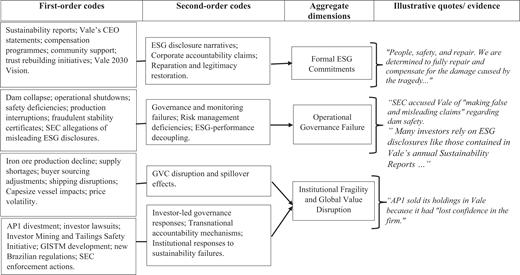
We analysed data abductively by moving back and forth between the empirical material and existing theories, particularly research on GVC, home-country institutional environments and sustainability in GVC governance. All documents were imported into NVivo and analysed through an iterative coding process (Gioia et al., 2013). Initially, we clustered the data into first-order codes based on Vale’s responses, stakeholder reactions, regulatory developments and governance dynamics following the disaster. This process revealed recurring terms in the analysed material, such as trust rebuilding, compensation and repair efforts, production interruptions, supply-chain disruptions, investor divestment and misleading ESG disclosure. As the analysis progressed, the emerging first-order codes were clustered into second-order codes, allowing us to interpret patterns through the study’s theoretical lens, particularly with regard to the GVC and institutional fragility. Themes included ESG disclosure narratives, risk management deficiencies, GVC disruption and spillover effects, alongside additional themes related to corporate accountability and investor responses. Finally, these themes were consolidated into aggregate dimensions: formal ESG commitments, operational governance failure, and institutional fragility and GVC disruption. These dimensions capture the central mechanisms through which the Brumadinho disaster revealed tensions between sustainability commitments and operational practices, generated disruptions across the iron ore GVC, and triggered governance responses from investors, regulators and other international stakeholders.
We organised the empirical material into three analytical phases that capture the temporal evolution of governance dynamics. While these phases provide the chronological structure of the case, the aggregate dimensions emerged inductively from the coding process and cut across the phases. Phase 1 (2019–2022) examines Vale’s immediate corporate responses following the socio-ecological disaster, together with public reactions and stakeholder perceptions. Phase 2 (2019–2022) focuses on the external reactions within the GVC, including responses from downstream firms, investors and international partners. Phase 3 (2022–2025) examines long-term governance adjustments, including investors’ pushback, governance and organisational responses over time. This phase allows us to assess how institutional fragility, GVC governance mechanisms and corporate practices interact in shaping sustainability outcomes and accountability. Together, these phases provide the empirical context through which the three aggregate dimensions were developed and represent the basis for the study’s conceptual framework. Figure 1 summarises the data coding structure.
3.3 Research context
Brazil is the world’s second-largest iron ore-producing country behind Australia. 70% of its exports go to East Asia, and 15% of its exports have Europe as their destination. Vale S.A. accounts for close to 90% of the country’s iron ore production. Minerals and metals are essential raw materials for the energy transition. Vale S.A. is also the world’s largest pellet producer, and most of its pellet feed production and pellet plants are in or around Minas Gerais (Vale homepage). In total, Vale has 198 mining dams around the world, with 131 in Brazil (Vale Integration Report, 2024). Vale S.A. uses tailing storage facilities (TSF) in its mining operations. TSF contains waste and manages water and poses significant environmental and safety risks. Tailings are the waste materials left over after extracting valuable minerals or metals from ore, often containing toxic substances (World Bank Technical Note, 2021).
4. Case description
Vale S.A., headquartered in Rio de Janeiro, is one of the world’s largest mining companies, operating in over 30 countries. Founded in 1940 as a state-owned enterprise and privatised in the 1990s, Vale has grown rapidly, reporting revenues of approximately US$40bn in 2023 and employing nearly 67,000 workers worldwide (Vale Performance Report, 2024). The company produces iron ore, nickel, iron ore pellets, copper, manganese ore, metallurgical and thermal coal, gold, silver and cobalt (Vale Integration Report, 2024). Its Iron Ore Solutions segment supplies raw materials to steel, automotive and infrastructure industries globally, with China representing a key market (Statista, 2024). Vale has publicly committed to sustainability initiatives and ESG compliance, reflecting the expectations of international investors and downstream clients (BBC, 2019). The company has been a member of voluntary sustainability initiatives such as ICMM (International Council of Mining and Metals) and TSM (Toward Sustainable Mining) (Franken and Schütte, 2022)
Despite these commitments, Vale has experienced operational failures, illustrating misalignment with its ESG commitments and corporate governance. The 2019 Brumadinho tailings dam collapse at the Córrego do Feijão mine, located in the state of Minas Gerais, released over 11 million cubic metres of mining waste, resulting in nearly 272 deaths, extensive environmental contamination, and disruption to local communities reliant on the Paraopeba River [Companhia de Pesquisa de Recursos Minerais (CPRM), 2019; do Carmo et al., 2017]. The dam was built in 1976, and Vale had an office and a restaurant just 1 km downstream from the dam. The tailing hit the building in just a minute, making evacuation impossible (Milanez et al., 2021). Despite Vale’s claims of having provided training to community members, residents reported insufficient information about the procedures to follow in the event of a dam failure (Freitas and Silva, 2019). This is not the first time that the firm was implicated in a dam failure. In November 2015, the Fundão tailing dam in the city of Mariana suffered a failure and killed 19 people. More than three years after the Mariana disaster, the company had not improved the level of safety in Córrego do Feijão to acceptable levels, nor had it implemented a proper emergency plan (Freitas and Silva, 2019).
Investigators in Brumadinho city highlighted that the dam’s structural stability had been certified by TÜV Süd, a German inspection company, just months before the disaster, exposing shortcomings in monitoring, regulatory enforcement and corporate risk management [OECD, 2022; European Centre for Constitutional and Human Rights (ECCHR), 2025 Homepage]. Notably, in June 2018 – seven months prior to the collapse – TÜV Süd issued a “Declaration of Stability Condition”, despite knowing that the dam did not meet minimum safety thresholds. Although the company recommended mitigation measures, these were designed to be quicker and less costly than alternative, safer options, illustrating a trade-off between operational efficiency and risk management.
The Minas Gerais Public Prosecutor’s Office, in January 2021, charged 16 executives, including the former Vale S.A. CEO and five individuals from TÜV Süd, with aggravated murder. Both companies also face charges for environmental crimes. Two years later, the case escalated to the federal level (Criminal Charge, 2026). Beyond facing environmental crime charges in Brazil, TÜV Süd is also on trial in Germany, where 183 surviving workers and parents of deceased victims have filed a lawsuit against the company.
Vale was the main source of income for the 37,000 people living in the city of Brumadinho, but as the death toll increased, public anger increased towards the company. The disaster had far-reaching consequences beyond Vale’s home-country operations. Downstream firms, investors and global supply chains experienced disruptions, financial losses and reputational risks, illustrating the cross-border impact of ESG failures in GVCs (The Wall Street Journal, 2019; DatamarNews, 2020; Saes and Muradian, 2021). The Brumadinho case exemplifies the tension between global ESG expectations and local institutional capacities, where corporate sustainability commitments embedded in GVCs meet regulatory fragility and governance gaps.
5. Case findings
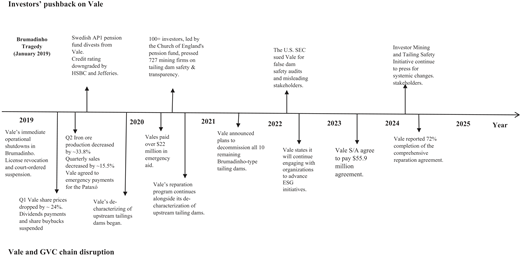
To examine how home-country institutional fragility shapes sustainability governance and accountability in mining EM-MNEs embedded in GVCs, we structured the analysis into three analytical phases. Phase 1 focuses on Vale’s corporate communications and public sustainability disclosures, examined in relation to international ESG expectations and global stakeholder narratives. This phase captures how the firm framed its sustainability commitments and accountability in the immediate aftermath of the disaster. Phase 2 builds on this analysis by incorporating evidence on the impacts of the Brumadinho disaster on GVCs, including supply disruptions. Phase 3 examines reactions from investors and international partners, including regulatory, governance and organisational responses over time, allowing us to assess how institutional fragility, GVC governance mechanisms and corporate practices interact in shaping sustainability outcomes and accountability. Figure 2 displays a timeline of the events across the three analytical phases.
5.1 Phase 1: Vale’s corporate communications (Vale narrative)
In the first Sustainability Report (2019) after the tragedy, Vale S.A. reported the implementation of operational safety enhancements, and the establishment of offices dedicated to reparation and regional development. The company also highlighted the dismissal of senior executives as part of its post-disaster accountability measures. Vale’s integrated report began in 2020 with the new CEO’s statement:
Since I took over the leadership of Vale, a few months after the tragedy of the dam rupture in Brumadinho, I have emphasised as priorities of the company: people, safety, and repair. We are determined to fully repair and compensate for the damage caused by the tragedy, and I will never get tired of saying that we will never forget Brumadinho.
The company’s Reparation Report (2019) documents extensive financial compensation efforts, indicating that more than 48,000 families received monetary support during 2019, covering more than 106,000 people. In the report, the company claims:
2019 was marked by mourning and the concern to establish emergency actions to deal with the adversities caused by the rupture.
Another statement found in the report is linked to Vale’s agreement with the Association of Mining Municipalities of Minas Gerais and Brazil to provide financial contributions to support municipalities affected by the disaster. The agreement included approximately US$20.3m for the city of Brumadinho, compensating for interrupted productive activities, to be transferred over two years; US$3.7m to the Brumadinho Tourism Association to fund a tourism promotion campaign; and US$0.66m to the city for emergency equipment and the hiring of health and psychosocial professionals.
The firm also claimed to have allocated US$7.6m for social assistance and health programmes for those affected by the dam rupture, US$1.27m to the Civil Defence of Minas Gerais, and US$1.02m to the Military Police for equipment, structural improvements and professional training (Vale Reparation Report, 2019–2021). Vale also contributed US$5.08m to the Military Fire Brigade for equipment, infrastructure upgrades, and training, as well as US$17.78m to acquire 77 operational vehicles distributed among the Military Police, Fire Department, Civil Police, and Civil Defence (Vale Reparation Report 2019–2021). Furthermore, the firm affirmed that water distribution for the population was implemented in August 2019, and more than 250 million litres of water for human and animal consumption, as well as agricultural irrigation, were distributed to 19 municipalities. Since the disaster, Vale states that it has invested over $2.1bn in the dam decharacterisation programme, with the goal of achieving the decharacterisation of 10 dams by 2025.
In the report, the statement “Vale is focused on regaining the trust of communities and stakeholders in general” (Vale CSR report, 2019, p. 39), and its reparation report communicates that after the rupture, the company’s management has changed not only in terms of reviewing its governance, ESG standards and safety, but also in its engagement with society as a whole. The company is also assuming a commitment to actions to ensure the non-repetition of such events.
In 2024, Vale appointed a new CEO, and its integrated report begins with the following statement from the new executive:
I am extremely confident and optimistic about our future. At the end of 2024, we launched our Vale 2030 Vision, which aims to position the Company as a trusted partner with a superior portfolio and a results-oriented approach. Together, we will strive to ensure that Vale achieves the best performance in our industry (Vale Integrated Report, 2024).
In the report, Vale affirms that the company has decharacterised four more upstream structures, bringing the total number of upstream dams in Brazil that have been decommissioned since 2019–57%. Furthermore, improvements in the safety categories of five dams have been highlighted.
5.2 Phase 2: mining disaster and its spillover effect on the GVC
In the second quarter of 2019, iron ore production at Vale S.A. declined by 33.8% and quarterly sales dropped by 15.5% due to the suspension of operations following the Brumadinho dam collapse (Nasdaq, 2019), including the revocation of licences and court-oriented orders at key facilities. During the year, Vale’s iron output fell by approximately 21.5% in 2019 compared to the previous year (DatamarNews, 2020), as production interruptions and enhanced safety reviews significantly constrained the company’s ability to meet previous delivery targets and stabilise production levels.
The production declines had immediate implications for upstream supply in the iron-steel GVC, given that iron ore is the fundamental raw material for steelmaking and Vale was one of the largest seaborne cargo suppliers of iron ore – to be shipped to other countries (Wikipedia) – of the commodity. While other producers and regions filled some of the supply gap over time, the initial shock contributed to short-term volatility in iron ore availability and prices, as buyers and traders adjusted expectations about Brazilian supply capacity (Reuters, 2019).
The dam collapse affected both the iron ore market and maritime logistics, particularly Capesize vessels – large ships used to transport major commodities like iron ore. Large steel mills in Europe and Asia faced challenges in finding alternative, stable sources of iron ore with the necessary quality specifications. Buyers tried to reduce dependence on Brazilian grade fines iron ore products, which benefited other suppliers such as South African Kumba fines (OffshoreEnergy, 2019).
Shipping consultancies estimated that the reduction in Brazilian iron ore production in 2019 could remove the equivalent of 35–40 Capesize vessels, assuming that roughly 40 million tonnes of lost Vale production would have been shipped on these vessels (OffshoreEnergy, 2019). A lead analyst for dry bulk shipping mentioned that South Africa, Canada and Australia could partially compensate for the shortfall. A lead shipping analyst stated:
As these three major exporters of iron ore are unlikely to be able to compensate for Vale’s loss of production, Australia will most probably gain from Vale’s loss of exports. However, due to voyage distances, a sharp decline in Capesize tonne miles is on the cards.
Another disruption was observed among downstream buyers, including steel producers in Asia and Europe, which faced pressure to secure consistent volumes of iron ore fines with the required quality specifications, leading to shifts in purchasing strategies and inventory management practices. (CRU Group, 2019). Although iron ore flows ultimately continued, these adjustments illustrate how operational failures at a major upstream node can spread through interconnected supply networks, generating cascading effects across the GVC.
Over the medium term, while the market eventually found a balance and prices stabilised, the Vale S.A. mining disaster highlighted the vulnerability of the global iron ore supply chain to single-point failures and reinforced the need for enhanced ESG practices in mining operations.
5.3 Phase 3: Vale’s international investors’ pushback and long-term adjustments
In the aftermath of the tragedy, the market reacted strongly, with Vale S.A. shares decreasing by 24% in market value (Reuters, 2019). Ferrous metals in futures markets reduced by 5% to $78.29 a tonne. The incident caused analysts and investors to expect lower production of iron ore. As a result of the incident, the company suspended dividend payments and share buybacks, while freezing executive bonuses (Wall Street Journal, 2019). HSBC and Jefferies – two investment banks – downgraded their ratings and stopped recommending Vale to investors. Meanwhile, a law firm filed a class-action lawsuit against Vale and its top executives in a New York court. A fund manager and partner at Galt Capital in Rio de Janeiro mentioned the following:
The reaction of the government and other public agencies has been quite a bit stronger than in the previous accident, referring to a 2015 mining dam burst involving a Vale joint venture (Reuters, 2019).
In February 2019, the Swedish state pension (AP1) began selling SEK 407m ($41.9m) worth of equities and bonds of Vale, after the AP Funds’ Council on Ethics recommended the exclusion of the company from the AP funds’ portfolios. The council affirmed that it had lost confidence in the firm (IPE, 2019).
In response to the dam failure and to Vale S.A., the Church of England Pensions Board and the Swedish Council on Ethics for their public pension funds launched the Investor Mining and Tailings Safety Initiative (The Church of England Pensions Board Homepage). Within months of Brumadinho, the initiative engaged with mining companies to require public disclosure about their dam facility globally. In addition, the IMTSI established a global mining portal in cooperation with the United Nations (UN), giving investors, regulators and communities more visibility into mining facilities worldwide. Together with the UN and the International Council on Mining and Metals, the initiative led the investors’ contribution to the development of the Global Industry Standard on Tailing Management (GISTM), which was launched in 2020. Part of the new standard system requires annual audits of tailing dams and verification that these companies are employing top safety standards. Over 300 companies were engaged to commit to the new standards. Brazilian prosecutors and legislators also successfully promoted and passed new laws phasing out the use of upstream tailings dams (The Church of England Pensions Board Homepage).
In April 2022, the U.S. Securities and Exchange Commission (SEC) charged Vale S.A. with making false and misleading claims about the safety of its dam in Brumadinho before it collapsed. The SEC accused Vale of fraudulent stability certificates, misleading local government, communities and investors through its ESG disclosures. For the SEC, Vale’s sustainability reports always assured investors that the company follows the strictest international practices. The director of the SEC’s division of enforcement stated that:
Many investors rely on ESG disclosures like those contained in Vale’s annual Sustainability Reports and other public filings to make informed investment decisions (SEC, 2022).
In March 2023, Vale S.A. agreed to pay $55.9m for misleading disclosures prior to the dam collapse to the SEC. The associate director of the SEC affirmed that the action against Vale illustrates the interplay between the company’s sustainability reports and its obligations under the U.S. federal securities laws (SEC Press Release, 2023). Table 2 summarises the empirical structure of the case findings.
5.4 Analysis findings: EM-MNEs’ home institutional environment and GVC
How does home-country institutional fragility shape sustainability governance and accountability in mining EM-MNEs embedded in global value chains? Our case of Vale S.A. from a country of origin whose context is characterised by a weak institutional environment, shows that mining EM-MNEs apply internal controls, corporate policies, voluntary ESG standards, audits and monitoring mechanisms to comply with GVC sustainability expectations, as indicated in the literature (see Locke et al., 2009; Lund-Thomsen and Lindgreen, 2014). Contrarily, the Brumadinho dam had structural deficiencies certified as “stable” by an external German auditor company, illustrating that even with formal ESG commitments, limited local enforcement and regulatory policy and governance allowed unsafe practices to persist. Examples include the Vale disaster in the city of Mariana in 2015 and the city of Brumadinho in 2019. The company has publicly committed to ESG measures, showing that Vale S.A. was aware of global ESG expectations, particularly as it is integrated into GVCs with international buyers and investors demanding compliance.
EM-MNEs use ESG standards to increase legitimacy and symbolic ESG compliance. The firm publicly commits to sustainability while day-to-day operations fail to meet these standards, because local institutional structures do not provide incentives, monitoring or strong penalties for non-compliance. At the same time, as claimed by Karam et al., (2025), GVC participation and ESG outcomes have a bidirectional link and expose firms to ESG pressures from international investors and civil society actors. In the Vale S.A. case, this link was negative and caused several pushbacks from international actors (see Section 5.3, phase 3), showing the misalignment between corporate discourse and practices, therefore affecting the firm’s reputation. Most of the literature on GVCs tends to focus on the business opportunities associated with participation. The case here clearly shows that GVC participation increases exposure to failure, not just business opportunities. The Brumadinho disaster not only caused local socio-environmental harm but also disrupted iron ore supply chains globally, impacting steel production in multiple countries and triggering scrutiny from international investors. When a mining EM-MNE fails to manage ESG risks locally, downstream partners in the steel, automotive and infrastructure sectors are affected through supply disruptions. This implies that home-country institutional voids may thus widen the gap between global ESG expectations and local operational realities and practices.
The Vale S.A. case illustrates how institutional fragility undermines effective sustainability governance by shifting responsibility to private and GVC-level mechanisms. These mechanisms lack enforcement power at the operational level, producing misalignment, symbolic compliance and cascading effects and thus, leading accountability to become reactive, ex post and externally imposed, as indicated by Jamali and Neville (2011). In other words, while GVC-level governance and private sustainability standards have emerged as key responses to institutional fragility, the case shows that these mechanisms alone are insufficient in high-risk extractive contexts. Effective sustainability governance under institutional fragility requires complementary layers of control, including internalised risk governance within EM-MNEs, tighter industry standards and regulation, stronger buyer responsibility within GVCs and financial governance mechanisms that do not rely solely on disclosure. The absence or weakness of these complementary mechanisms helps explain why sustainability governance remained largely symbolic, and accountability emerged only after catastrophic failure, as in the disaster in Brumadinho.
The case also shows that GVC integration and ESG performance measures do not neutralise home-country effects. EM-MNEs can be globally legitimate yet locally unsafe. As a result, voluntary ESG has structural limitations in high-risk sectors such as mining, and Vale S.A. exemplifies symbolic compliance, weak operational control, reactive accountability, and global spillovers through GVCs. The main problem is that in institutionally fragile contexts, regulatory enforcement is inconsistent, delayed or absent, reducing the expected costs of non-compliance (North, 1990; Scott, 2013). As a result, EM-MNEs can adopt ESG standards at the policy level without facing sanctions for operational deviations. This creates a dissociation between sustainability discourse and practices. Thus, ESG, for example, is codified in corporate documents and audits, while unsafe routines persist at the operational level. This leads us to propose the following:
In EM-MNEs from institutionally fragile home countries, formal ESG commitments may be decoupled from operational practices, increasing the likelihood that accountability is reactive rather than preventive.
In the Vale S.A. case, accountability unfolded asymmetrically across institutional levels. Prior to the Brumadinho disaster, domestic regulatory authorities and certification bodies failed to impose effective ex ante accountability, despite the structural vulnerabilities in the dam. Notably, no effective sanctions or preventive interventions occurred before the Brumadinho disaster despite the Mariana dam collapse in 2015. This indicates persistent weakness in domestic enforcement. This asymmetry is noticed before (ex ante: weak, domestic, ineffective enforcement) and after the disaster (ex post: strong, global punishment). Vale’s embeddedness in GVCs exposed its misconduct to global stakeholders. While these actors lacked the capacity to enforce safety locally, they were able to discipline the firm after the failure, through market sanctions and investor pressure. Secondary sources indicate that, until now, no one has been imprisoned or held accountable for the 272 lives lost in the incident. This reflects home-country institutional fragility, where enforcement mechanisms exist formally but lack deterrent capacity in practice.
Following the collapse, Vale S.A. faced intense ex post accountability imposed by global stakeholders embedded in its GVCs, including international investors, NGOs and downstream buyers. These actors exerted reputational and financial discipline only after catastrophic failure became visible, illustrating how GVC embeddedness shifts accountability from preventive domestic enforcement to reactive cross-border pressure. These dynamics reflect structural fragility across the institutional pillars: regulative (weak enforcement ex ante), normative (acceptance of minimal compliance) and cognitive (risk normalised as routine) (Scott, 1995; DiMaggio, 1997).
Hence, GVC governance does not replace domestic institutions; ESG mechanisms alone cannot prevent failures under conditions of institutional fragility. EM-MNEs may therefore become globally legitimate yet locally unsafe, as global governance mechanisms reward disclosure and formal compliance, while operational risk prevention remains anchored in weak home-country institutional environments. The Vale S.A. case demonstrates that effective sustainability governance in GVCs requires more than voluntary ESG and private monitoring. It demands the internalisation of operational risk governance within firms, shared responsibility across value chain actors, and complementary regulatory and financial mechanisms that strengthen accountability ex ante, rather than through ex post sanctions. This leads us to propose the following:
Institutional fragility in EM-MNEs’ home countries produces asymmetric accountability, shifting enforcement from domestic institutions ex ante to global stakeholders ex post.
When examining the impact of the Vale S.A. mining disaster on the GVC, the case shows that operational failures occurred despite the firm’s declared voluntary ESG standards, internal controls, audits and corporate policies as disclosed in its CSR reports. The inability to prevent the incident generated immediate disruptions across the iron-steel GVC, revealing a gap between formal sustainability commitments and operational risk management.
The incident constrained Vale S.A.’s production capacity, directly affecting global iron ore supply and commodity prices. The 33.8% drop in production in the second quarter of 2019 and the 21.5% decline in annual iron output clearly show how local operational failure propagates both upstream and downstream within the GVC. Steel producers in Europe and Asia faced sourcing challenges, while the maritime logistics impact, especially on the Capesize vessels, demonstrates how governance failure at Vale resonated across multiple tiers in the GVC. Notably, Vale’s home-country institutional fragility allowed unsafe practices to persist ex ante yet generated significant consequences ex post.
As a result, steelmakers experienced supply volatility, demand for Capesize vessels declined, and international buyers were forced to adjust their operations and planning. This illustrates that local institutional fragilities are amplified globally when EM-MNEs are embedded in GVCs. This embeddedness exposes firm-level failures to international markets and stakeholders, even when domestic enforcement mechanisms remain weak.
The Vale S.A. case, therefore, indicates a cascade effect driven by the interaction between operational governance failures and institutional fragility, showing that such shocks are not merely operational but also can influence the strategic decisions of firms across the value chain. In other words, the mining disaster represents a clear example where operational governance failures in an EM-MNE, exacerbated by weak home-country institutions, generated cascading effects and GVC disruptions across multiple tiers of the global iron-steel value chain, affecting upstream shipping, downstream steel producers, and the broader logistics and trade ecosystem. This confirms that local institutional fragility can transform operational failures into GVC shocks, even when these shocks are temporary rather than permanent. Accordingly, we propose:
Operational governance failures in EM-MNEs can cascade across GVCs, disrupting downstream firms and investors, thereby turning local institutional weakness into global value chain shocks.
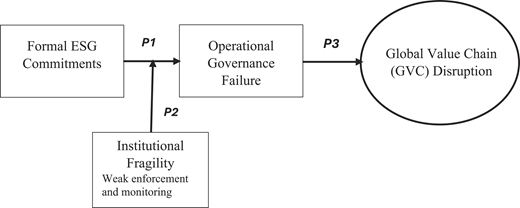
Synthesising the evidence, we propose a conceptual framework (see Figure 3). It illustrates that formal ESG commitments (P1) may exist on paper, but operational practices often fail under weak domestic enforcement. Institutional fragility (P2) shifts accountability from ineffective local enforcement (ex ante) to reactive global stakeholder pressures (ex post). Consequently, operational governance failures cascade across the GVC (P3), affecting downstream firms, investors, and supply chain stability. The Vale case shows that global ESG legitimacy does not guarantee local safety. Weak home-country institutions allow operational failures that create cascading effects, suggesting that sustainable governance requires both strong domestic enforcement and a coordinated GVC governance mechanism.
6. Discussion
6.1 Theoretical contribution
The study contributes to IB literature and GVCs in three ways. First, it advances institutional theory in IB by showing that home-country institutional fragility does not inhibit the formal adoption of global sustainability standards but systematically undermines the internalisation of their operations. Consistent with prior research (e.g. Locke et al., 2009; Lund-Thomsen and Lindgreen, 2014; Marano et al., 2017; Karam et al., 2025), EM-MNEs respond to international pressure by adopting ESG policies, audits and reporting practices to secure legitimacy within GVCs. However, the Vale case demonstrates that when these governance mechanisms fail or are misaligned, they may create a cascade effect, where disruptions at one node propagate across the value chain.
Second, the study contributes to the GVC governance literature by showing the limits of private and GVC-based sustainability governance in high-risk extractive industries such as mining. While buyer-driven standards, third-party audits and voluntary ESG frameworks have been widely viewed as substitutes for weak domestic institutions, the Vale case shows that these mechanisms lack enforcement power at the operational level when not complemented by effective state regulation. Consequently, responsibility for sustainability governance is displaced upward to private and transnational actors, producing symbolic compliance. These findings are in line with Soundararajan (2023), who highlights the limitations of compliance-based governance systems within GVCs. Even when an MNE like Vale formally adopts ESG standards, it may fail to fully internalise them across its operations. The main issue is that firms often adopt formal standards and auditing mechanisms to satisfy external stakeholders rather than to transform operational practices.
Finally, the study discusses asymmetric accountability as a structural outcome of the interaction between home-country institutional fragility and GVC embeddedness. In the Vale case, domestic institutions failed to impose effective preventive accountability despite known risks and prior disasters, while global stakeholders, such as investors, downstream buyers and regulators, exerted strong reputational and financial discipline only after catastrophic failure became visible. This asymmetry illustrates how EM-MNEs operating in institutionally fragile environments face weak ex ante accountability domestically but intense ex post accountability internationally.
Beyond these contributions, the findings also suggest that corporate sustainability practices and governance innovations may influence local governance dynamics and shape developmental pathways in resource-rich producing countries. These findings build on Pietrobelli et al. (2018), who show that local suppliers’ innovation potential is shaped by value chain governance and the extent of collaboration with large firms. Our study extends this perspective by demonstrating that corporate sustainability and ESG practices can either strengthen or weaken local governance. When ESG mechanisms are effectively implemented, they enhance corporate risk management systems, monitoring mechanisms and stakeholder engagement processes that allow local communities, suppliers and regulators to actively participate in shaping operational standards and governance practices, gradually improving local institutions. However, the Vale case illustrates that when these mechanisms remain symbolic or weakly enforced, they can reinforce existing weaknesses and limit institutional improvement at the local level or impede the adoption of more sustainable practices.
Taken together, these contributions emphasise that GVC governance does not replace domestic institutions and that voluntary ESG mechanisms alone are insufficient to prevent failures in institutionally fragile contexts, such as Latin America.
6.2 Managerial implications
The propositions developed in this study generate several managerial implications for firms operating in institutionally fragile contexts and for actors embedded in GVCs.
Proposition 1 suggests that formal ESG commitments may become decoupled from operational practices when sustainability governance relies primarily on disclosure, certification, and reporting mechanisms. Managers should therefore treat ESG reporting as only one component of sustainability governance and ensure that ESG commitments are integrated into operational processes, including safety management systems, maintenance routines, audit findings and day-to-day operational decision-making. The Vale case demonstrates that formal compliance and external certification can create a false sense of assurance when operational risks are not adequately addressed.
Proposition 2 highlights that weak domestic enforcement may shift accountability from ex ante domestic accountability to ex post pressure from global stakeholders in the aftermath of a crisis. Consequently, managers cannot rely solely on regulatory compliance or external monitoring mechanisms. Instead, firms should strengthen internal governance and accountability structures through independent risk management, board-level monitoring of critical assets, clear managerial responsibility for operational safety and systematic follow-up of audit findings. Such mechanisms can help identify and address operational risks before they escalate into environmental and social disasters.
Proposition 3 indicates that operational governance failures in EM-MNEs can generate cascading effects throughout GVCs. Managers, buyers, investors and other value chain actors should therefore recognise that local operational failures may have significant cross-border consequences for supply continuity, business performance and corporate reputation. This implies that due diligence processes should move beyond evaluating ESG disclosures and incorporate assessments of operational governance capabilities, particularly in high-risk sectors and institutionally fragile environments.
Altogether, the findings suggest that effective sustainability governance requires the alignment of ESG commitments, operational controls and accountability mechanisms. Firms may achieve legitimacy through sustainability reporting and certification; however, the Vale case demonstrates that legitimacy does not necessarily reflect operational safety. Without strong operational governance and internal accountability, formal ESG commitments may function primarily as symbolic compliance mechanisms rather than effective safeguards against environmental and social harm.
6.3 Policy implications
For policymakers, the findings highlight the importance of strengthening internal governance and monitoring systems beyond formal ESG commitments. Even when global standards exist (from investors, international buyers or NGOs), EM-MNEs can still fail to implement ESG commitments. The study’s findings suggest that stronger coordination between domestic regulators, global investors and industry actors is necessary to ensure that ESG commitments translate into effective operational safety and accountability. National and local governments play a major role in this process as they set the legal and fiscal framework. Practical lessons include designing governance systems that embed continuous feedback loops between local regulators and global actors, prioritise transparency and operational enforcement, and adapt dynamically to evolving local and international pressures.
These dynamics are clearly illustrated by regulatory responses following the Brumadinho disaster. In Minas Gerais, the State Policy for Dam Safety was established under Law No. 23.291/2019. The policy applies to dams designed to contain mining tailings, residues, water or other liquids associated with mining activities. At the federal level, the Brazilian National Mining Agency (ANM Agência Brasileira de Mineração, 2026) introduced stricter federal monitoring and dam decharacterisation through Resolution No. 13/2019, as well as enhanced real-time monitoring obligations for mining dams.
At the global level, the Brumadinho disaster contributed to the development of the GISTM. Drawing on lessons from recent tailings dam failures and established good practices, the standard introduced comprehensive global guidelines aimed at improving the safety, governance and accountability of tailings facilities across the mining industry (Hopkins and Kemp, 2021).
6.4 Limitations and future research directions
This study has several limitations that also point to opportunities for future research. First, it is based on a single case study in the mining sector. While the case provides rich and contextually grounded insights, it limits the generalisability of the findings to other firms, industries and institutional contexts. Building on these limitations, future research could adopt comparative or multi-case studies across different extractive industries or geographical contexts to assess whether the observed misalignment between global ESG expectations and local enforcement conditions is generalisable.
Second, the study relies on secondary sources. Although these sources enable longitudinal reconstruction of events and capture global reactions in the aftermath of a major disaster, this may constrain the ability to fully capture the internal decision-making processes and organisational dynamics. Thus, future studies could incorporate primary data to get deeper insights into the micro-level processes through which sustainability governance failures emerged. Such approaches would also enable the development of more fine-grained typologies of sustainability misalignment and accountability breakdowns in GVCs.
Furthermore, most of the IB literature on GVCs tends to focus on business opportunities for firms engaged in the GVC; however, this study shows that GVC participation increases exposure to failure, not just opportunity. Future studies could focus on this insight by examining the conditions under which GVC participation magnifies risk rather than mitigates it, particularly for EM-MNEs operating in high-risk industries and institutionally fragile contexts. In addition, it will be interesting to understand whether repeated shocks lead to more substantive changes in sustainability governance at the industry level.
7. Conclusion
This study integrates institutional theory, GVC governance and ESG research and provides a more nuanced understanding of how sustainability governance operates and fails when emerging-market firms are embedded in globally integrated production networks. While sustainability and ESG compliance have received attention in IB, there is limited understanding of how home-country institutional fragility in Latin American contexts interacts with GVC governance to shape corporate accountability and operational outcomes. It is hoped that this study provides an important basis for future conceptual and empirical research on such a timely topic.