This research aims to explore the moderating effects of three conflict resolution strategies (CRSs), such as problem-solving, compromising and enforcing on the conflict–performance relation in international joint ventures (IJVs). The authors draw from social exchange and transaction cost theories to reconcile the contradictory empirical findings and explore the relationships among conflict, IJV performance and CRSs.
This study uses Web-based survey and collects data from 89 IJVs of Nordic firms operating across Europe, Asia and America. The collected empirical data is analyzed using multiple regression analysis to test the proposed model.
The key argument is that the impact of conflict on the performance of IJVs depends on how IJV partners resolve their conflicts. The authors find that conflict enhances IJV performance while using a problem-solving strategy, neither enhances nor reduces IJV performance while using a compromising strategy and reduces IJV performance while using a forcing strategy.
The authors offer several important practical insights in this research; for instance, it is insufficient to consider the extent of conflicts in isolation when examining how these conflicts impact the IJV performance. Furthermore, IJV partners should not unilaterally impose their solutions on the other partner if they want IJV to benefit from the conflicts.
This study contributes to the stream of literature dealing with issues such as conflicts and the dark side of inter-partner relationships in IJVs. The authors reconcile the contradictory empirical findings about the conflict–performance relationship resided in prior research.
1. Introduction
International joint ventures (IJVs) continue to be a popular entry mode for firms to enter foreign markets, ensure survival and boost competitiveness (Gehrisch et al., 2025). They enable participating firms to pool intermediate resources (e.g. industry knowledge, market information and obtaining channels of distribution or components) that cannot be obtained through market transactions and acquiring or replicating them entails high costs (Hennart, 1988; Puck et al., 2009; Tetteh et al., 2023a, 2023b). Despite their potential benefits, research reports that about 50%–60% of IJVs fail to realize their objectives (Pedada et al., 2021; Steensma et al., 2008). Therefore, scholars have focused on identifying factors that hinder or improve their performance (see, Batra et al., 2021; Ren et al., 2009; Tetteh et al., 2023a, 2023b). In particular, several researchers have proposed that inter-partner conflicts, i.e. disagreements between IJV partners, also play a key role in determining the performance of IJVs (Abosag et al., 2016; Batra et al., 2021; Yan and Zeng, 1999; Aib, 2024). IJVs are, by definition, equity-based organizations established and co-managed by two or more companies originating from different countries (Kim et al., 2024). These distinctive characteristics of an IJV, i.e. shared ownership and multinationality, together with inter-partner dependence and inherent differences in strategic objectives of partners create inter-partner conflicts (Boersma et al., 2003; Ding, 1997; Hennart and Zeng, 2002; Luo, 2009; Westman and Thorgren, 2016). Therefore, inter-partner conflicts are common and inevitable in IJVs (Fey and Beamish, 1999; Nguyen et al., 2016; Song, 2022).
Numerous scholars have investigated the impact of conflict on IJV performance, however, empirical findings on the role of conflict on IJV performance are inconclusive, with Cullen et al. (1995), Demirbag and Mirza (2000), Ding (1997), Fey and Beamish (2000), Kauser and Shaw (2004), Steensma and Lyles (2000), Westman and Thorgren (2016) and Tetteh et al. (2023a, 2023b) findings that inter-partner conflict negatively affects the performance of IJVs, Kemp and Ghauri (2001), Lyles and Baird (1994) and Pak et al. (2009) no impact and Fey and Beamish (1999) a positive one (see Table 1). Such discordant empirical findings suggest that the conflict–performance relation in IJV is far from established and provides contradictory advice to IJV managers, and therefore there is a need to explore the contingency factors that can reconcile these different empirical findings. To explore the contingency factors, we take the critical viewpoint of Ren et al. (2009) who argue that a comprehensive understanding of conflict’s effect on IJV performance is not possible without knowing how partners resolve those conflicts. However, extant research has not examined how the conflict–performance relationship in IJVs is contingent on the conflict resolution strategies (CRSs). We stipulate that conflict can affect IJV performance differently depending on how partners resolve those conflicts. Thus, to offer additional insights, we aim to explore the moderating effects of three CRSs, such as problem-solving, compromising and enforcing on the conflict–performance relation in IJVs. Accordingly, this study addresses the following research question:
How do problem-solving, compromising and enforcing CRSs moderate the conflict–performance relation in IJVs?
Answering this research question is expected to advance the theory and provide a clear advice to managers by portraying a comprehensive picture of when conflict has positive, negative or no effect on the performance of IJVs. We draw from social exchange theory (SET) and transaction cost theory (TCT) to investigate the moderating roles of these three CRSs on the relationship between conflict and the performance of IJVs. Particularly, we argue that conflict only benefits IJV performance if a problem-solving approach is used to solve the conflict because this strategy produces an integrative and productive solution to the conflict that strengthens partners’ trust and confidence in each other and ultimately leads to enhanced IJV performance. However, conflict offsets the impact of conflict on IJV performance when using a compromising strategy because this strategy although does not lead to a productive solution to the conflict, but produces a partially satisfying solution that promotes a moderate level of trust between IJV partners which ultimately blocks any impact of conflict on IJV performance. On the other hand, using a forcing strategy to resolve conflict consequently leads conflict to harm IJV performance because this strategy ignores the counterpart’s interests, concerns and diverse ideas for addressing these concerns, and therefore not only produces a low-quality solution to the conflict but also destroys the inter-partner trust which ultimately leads to reduced IJV performance. We selected Nordic firms’ IJVs as the empirical context of this study because Nordic firms are not only highly internationalized (Wang and Larimo, 2020) but their unique culture of acknowledging tradition, values and relationships (Ali et al., 2021) makes a compelling context to examine conflict–performance dynamics in IJVs.
Our empirical evidence, based on an investigation of 89 IJVs of Nordic firms, strongly supports this line of reasoning. We contribute to the literature on conflict and dark side of inter-partner relationships in IJVs by suggesting that inter-partner conflict in IJVs is beneficial while using a problem-solving strategy, neither beneficial nor detrimental while using a compromising strategy and determinantal while using a forcing strategy. Our findings reconcile the contradictory empirical findings that resided in prior research, advance the theory and provide a clear advice to managers by portraying a comprehensive picture of when conflict has positive, negative or no effect on the performance of IJVs. In particular, we advance TCT and SET by demonstrating that forcing strategy proposed by TCT, and collaborative and compromising strategies proposed by SET serve as important boundary conditions that determine the varying impact of conflict on IJV performance. While the need of resolving inconclusive findings on conflict–performance relationship in IJVs has been mentioned by some researchers, the moderating role of CRSs on conflict–performance relationship in IJVs has not been empirically analyzed. We illustrate our research contribution relative to the prior related research in Table 1.
2. Theoretical background and hypotheses development
2.1 Inter-partner conflict and performance of IJV
IJVs are equity-based organizations being formed and operated collaboratively by partner companies from various countries (Kim et al., 2024; Liu et al., Liu et al., 2024). Having more than one partner firm from different countries makes the management of IJV more challenging as compared to wholly-owned subsidiaries because partner organizations need to align on shared objectives and develop collaborative working relationships. These distinctive characteristics of an IJV, i.e. shared ownership and multinationality, together with inter-partner dependence and inherent differences in strategic objectives of partners create inter-partner conflicts (Boersma et al., 2003; Ding, 1997; Hennart and Zeng, 2002; Luo, 2009; Westman and Thorgren, 2016; Shahzad et al., 2018; Thilakarathne et al., Thilakarathne et al., 2022). Therefore, inter-partner conflicts are common and inevitable in IJVs (Fey and Beamish, 1999; Nguyen et al., 2016; Che et al., 2024). Conflict in IJVs is defined as disagreement between partners in IJV over issues or matters (Reus and Rottig, 2009: p. 611), such as “management appointments, payment of dividends, reinvestment of earnings, IJV expansion, new financing, salaries and benefits, pricing policies, advertising and promotion, brand management, expansion of product lines, modernization of plant, purchase of raw material, intermediate and component costs, quality controls, distribution channels for products, and export development” (Dymsza, 2002, p. 414; Zhao and Stiles, 2024).
Prior literature presents two opposing views of conflict in IJVs: the negative view and the positive view (see Gehrisch and Sub, 2023; Liu et al., Liu et al., 2024; Ren et al., 2009). The negative view posits that conflict is determinantal for the performance of IJV as it erodes mutual trust, cooperation, commitment, information and knowledge sharing; enhances opportunism; and hampers IJV evolution and growth by distracting partners from attaining joint objectives and effectively dealing with external market changes (Cullen et al., 1995; Kemp and Ghauri, 2001; Reus and Rottig, 2009; Steensma and Lyles, 2000). In contrast, the positive view suggests that conflict is beneficial for IJV performance because it often triggers diversity of new ideas and mutual understanding, fosters creativity and innovation and strengthens the inter-partner relationship (Demirbag et al., 2003; Fey and Beamish, 1999; Ghauri et al., 2020; Oliveira and Lumineau, 2019; Ren et al., 2009). Although both views have strong arguments, they do not guide managers when conflict is beneficial or detrimental to IJV performance. We stipulate that conflict can affect IJV performance differently depending on how partners resolve those conflicts (Ren et al., 2009). In the following, we discuss the contingency role of CRSs in explaining the different effects of conflict on IJV performance.
2.2 Conflict resolution strategies
When conflict has emerged between the IJV partners, a particularly important task for the partners is to resolve the conflict. Conflict resolution refers to “strategies that firms can apply to handle conflicts in IJVs” (Nguyen et al., 2016, p. 560). Research on conflict resolution is largely built on the dual-concern model developed by Thomas (1976) and Rahim (1983). Considering the emphasis on personal outcomes (assertiveness) and the outcomes of the other party (cooperativeness), five CRSs were identified: problem-solving (high concern for both self and others), forcing (high concern for self and low concern for others), compromising (moderate concern for both self and others), avoiding (low concern for both self and others) and accommodating (low concern for self and high concern for others). The seminal work has conceptualized CRSs in IJVs into four primary strategies: problem-solving, compromising, forcing and legalistic (Lin and Germain, 1998; Lu, 2006). The legalistic strategy was beyond those identified by earlier work of Thomas (1976) and Rahim (1983) and is the one that relies on written contracts to solve conflict. For the purpose of this study, we focus on the problem-solving, compromising and forcing strategies because of their common usage in IJVs. We drop out of legalistic strategy because there is ample literature on IJVs suggesting that contractual safeguard is an important component of nonequity alliances rather than equity IJVs because complete contracts cannot be developed in IJVs (Lui and Ngo, 2004; Reuer and Arino, 2002; Hennart and Zeng, 2005). Therefore, we think that they do not help in managing conflicts in IJVs.
2.3 Own concerns versus mutual concerns for managing conflict
Resolving conflict in IJVs through forcing, problem-solving, or compromising depends fundamentally on choosing between pursuing own concerns versus mutual concerns (Ghauri et al., 2020; Nguyen et al., 2016; Rahim, 1983; Thomas, 1976). The pursuit of personal interests is fundamentally rooted in TCT (Williamson, 1985), which posits that parties involved in an economic transaction act in their own self-interest through opportunism (i.e. convert behavior) and conflict (overt behavior). Accordingly, the core proposition of this theoretical approach is that to limit both overt and covert behaviors, transacting parties in IJVs need to exercise formal control (Ghauri et al., 2020). Therefore, partners with the greatest investment in IJV should get a higher ownership stake and hence higher level of formal control in IJV. This would allow them to curb the covert and overt behavior of minority partners who, having the smaller equity share, have the greater incentive to indulge in such behaviors (Hennart and Zeng, 2005; Westman and Thorgren, 2016). Thus, transaction cost theory suggests that the IJV partner should exercise its equity position to force the other partner to accept its solution to the conflict. Empirical studies concluded that the majority of partners in IJV use a forcing strategy to solve their conflict (e.g. Lin and Germain, 1998: Nguyen et al., 2016; Westman and Thorgren, 2016).
However, TCT alone is insufficient to understand the conflict resolution behavior of IJV partners because IJV is a long-term economic exchange where partners gradually become embedded in social relationships with each other (Ali et al., 2021; Liu et al., 2009; Westman and Thorgren, 2016). With a strong fabric of social relationships, IJV partners pursue mutual concern (i.e. concern for their own and others) while resolving the conflicts between each other. Pursuing mutual concern while resolving the conflict is based on social exchange theory (Luo, 2007). The theory postulates that in long-term social exchanges like IJVs, parties socially interact with each other to identify each other’s needs and then parties exchange resources with each other to partially or fully satisfy each other’s needs (Blau, 1964; Ghauri et al., 2020; Khakhar and Rammal, 2013). Hence, conflict resolution behavior of firms in long-term socially embedded exchanges like IJVs is guided through mutual concern such as problem-solving and compromising which in turn promotes high and moderate levels of trust between IJV partners respectively. In the following, we explore the moderating roles of these three CRSs in explaining the conflict–performance relationship of IJVs.
2.3.1 Problem-solving strategy as moderator.
SET suggests that IJVs are long-term social exchange arrangements where partners are socially embedded with each other and share key complementary resources with each other (Das and Teng, 2002). Because of the mutual need for each other for complementary resources along with social embeddedness, partners become genuinely concerned about each other’s needs and therefore tend to resolve their conflicts through problem problem-solving strategy (Lin and Germain, 1998). Problem-solving involves the open discussion of concerns, priorities, ideas and issues and seeking an integrated solution that fully satisfies the needs of both partners (Lin and Germain, 1998; Westman and Thorgren, 2016; Thilakarathne et al., Thilakarathne et al., 2022). Although this way of settling conflict demands a lot of time, effort and resources from both partners (Pfajfar et al., 2019), it allows partners to escape from deadlock and yields both partners’ satisfaction with the solution to the conflict (Lin and Germain, 1998).
Drawing from social exchange theory, we suggest that conflict is beneficial for IJV performance when problem-solving strategy is used for two reasons. First, because the problem-solving strategy fully satisfies both partners with the solution to the conflict, it strengthens the partner’s trust in each other (Ghauri et al., 2020; Saner, 2003). Consequently, partners freely exchange information, knowledge and resources without concerns of appropriation, thereby improving the performance of IJV (Nielsen and Nielsen, 2009; Robson et al., 2008). The importance of problem-solving strategy in developing trust in exchange relationships has long been argued by distinguished researchers of the supply chain (Bobot, 2011; Ndubisi, 2011; Shahzad et al., 2020). The rationale behind the trust development due to a problem-solving strategy is that using a problem-solving strategy serves as a signal of goodwill and commitment because it suggests that the partners are genuinely concerned about each other’s well-being. Empirically, several scholars have found that a problem-solving strategy promotes inter-partner trust in IJVs that enhances IJV performance (e.g. Lin and Germain, 1998: Nguyen et al., 2015).
Second, a problem-solving strategy implies that partners openly exchange information (i.e. openly discuss their concerns, priorities, ideas and issues) during conflict to find an integrative and fully satisfying solution (Lin and Germain, 1998; Westman and Thorgren, 2016). Focusing on multiple views and ideas with an integrative mindset may lead partners not only to an integrative solution but to a productive solution to the problem (Saner, 2003), that can enhance the performance of IJV. Empirically, Wong et al. (2018) found that problem-solving strategy is a source of generating innovative solutions that promote IJV performance. Therefore, we posit that when the problem-solving approach is practiced, the conflict will contribute to enhancing the performance of IJV because of increased inter-partner trust and productive solutions to conflict. Based on this, we formulate the following hypothesis:
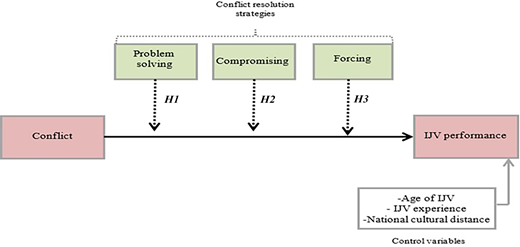
Conflict has a positive effect on IJV performance when a problem-solving strategy is used to solve the conflict.
2.3.2 Compromising strategy as moderator.
SET suggests that another method of resolving conflicts among socially embedded exchange partners is using a compromising strategy when the relationship is important but partners are unable to find a fully satisfying solution (Nguyen et al., Nguyen et al., 2015; Saner, 2003). Compromising refers to a CRS in which both partners give up something for finding a middle ground that is tolerably acceptable to both partners (Thilakarathne et al., Thilakarathne et al., 2022; Wang et al., 2005). It may be the best strategy in situations when both partners are equally powerful, but unable to find a fully acceptable solution to the conflict (Saner, 2003). Wang et al. (2005) suggested that striking a balance between the needs and concerns of both partners is far better than if the conflict remains unresolved or ends in a win-lose situation. Such a solution resolves the inter-partner conflict very quickly, preserves the inter-partner relationship and hence business as usual starts between the IJV partners (Nguyen et al., 2015).
Based on SET, we suggest that a compromising strategy blocks the effect of conflict on IJV’s performance because of two reasons. First, because partners using the compromising strategy do not go far in exploring each other’s diverse ideas for finding a productive solution to the conflict (Saner, 2003; Wang et al., 2005), this strategy does not lead the conflict to enhanced IJV performance. However, this strategy also does not lead conflict to the reduced IJV performance because partners find an integrative solution to the conflict that partly satisfies the interests of both partners. Thus, a compromising strategy suppresses both the positive and negative effects of conflict on the performance of IJV. Empirically, the supply chain researchers (Lam et al., 2007) found that a compromising strategy has no significant impact on performance because it merely promotes partially satisfying solutions instead of productive solutions. Second, a compromising strategy merely promotes a moderate level of trust between IJV partners because it defuses conflict by no win–no lose outcome for both partners. This moderate level of trust neither enhances nor destroys the IJV performance. Thus, the effect of conflict on the IJV performance is blocked. Empirically, Lin and Germain (1998) found that a compromising strategy has no significant impact on inter-partner relationships and IJV performance. Therefore, we posit that when a compromising strategy is used, the conflict will neither enhance nor reduce the IJV performance because it promotes a partially satisfying solution instead of a productive solution, and develops a moderate level of trust among IJV partners. Based on this discussion, we propose:
Conflict has no effect on IJV performance when a compromising strategy is used to solve the conflict.
2.3.3 Forcing strategy as moderator.
A central tenet of TCT is that firms should use a forcing strategy to resolve their conflicts (Hennart and Zeng, 2005; Westman and Thorgren, 2016). It refers to using power to force the other partner to accept the solution to the conflict (Ghauri et al., 2020; Thilakarathne et al., Thilakarathne et al., 2022; Wang et al., 2005). An IJV partner might leverage its equity stake or technical expertise to force the other partner to accept its proposed resolution to the conflict (Lin and Germain, 1998). TCT suggests that the IJV partner using this strategy avoids the coordination cost of sharing information and shared decision-making with the other partner for solving the conflict (Saner, 2003), and therefore this strategy is quickly implemented and helps the IJVs to resume daily operations (Nguyen et al., 2015). Despite these promising benefits, we suggest that conflict is detrimental to IJV performance when forcing strategy is used because of the following two reasons:
First, the partner obsessed with using force to solve the conflict uses one-way communication to impose its decision on the other partner and therefore misses the diverse ideas of the other partner. Ignoring the diverse views and ideas of the other partner often leads to low-quality solutions to the conflict that ultimately reduces the IJV performance (Saner, 2003). Empirically, Wong et al. (2018) found that forcing strategy is a source of generating low-quality solutions to the conflict problems that ultimately destroy the IJV performance. Second, the forcing strategy fosters distrust between IJV partners because the partner exerting the force aims to achieve only its own objectives without heeding the other partner’s objectives (Wang et al., 2005). This distrust destroys the IJV performance. Empirically, Nguyen et al. (2015) and Westman and Thorgren (2016) found that forcing strategy has a significant negative impact on inter-partner trust and IJV performance. Therefore, we posit that when forcing strategy is used, the conflict will reduce the IJV performance because it produces low-quality solutions to conflict because of not using the diverse ideas of other partners, and fosters distrust among IJV partners because of ignoring the interest and needs of the other partner. Based on the discussion, we propose the following hypothesis:
Conflict has a negative effect on IJV performance when a forcing strategy is used to solve the conflict.
In summary, the developed model considers that conflict enhances IJV performance while using a problem-solving strategy, neither enhances nor reduces IJV performance while using a compromising strategy and reduces IJV performance while using a forcing strategy (see Figure 1).
3. Methodology
3.1 Data collection
Our study focuses on Nordic firms (Denmark, Finland, Sweden and Norway) and their IJVs operating across Europe, Asia and America. To collect primary data regarding the main constructs, a sample of 464 manufacturing IJVs formed between 2000 and 2011 was drawn from the “internal FDI database.” The database was assembled from a diverse array of secondary sources, including stock market announcements, media publications, corporate webpages, Thompson One Banker and Orbis databases and annual corporate documents, and has been consistently updated for over 30 years. In addition, the credibility of database is further demonstrated by its use in several articles published in reputable journals (Nguyen et al., 2024; Wang and Larimo, 2020; Hennart and Larimo, 1998).
We opted to collect primary data via a web-based survey to easily, quickly and affordably reach a large pool of scattered respondents and obtain real-time numerical data (Dillman et al., 2009). To conduct the survey, we gathered the names and email addresses of key Nordic executives managing these IJVs from company websites, annual reports, press releases and direct consultations with HR directors of Nordic firms. Most potential respondents held significant positions such as regional directors, country and product-specific directors, vice presidents and CEOs. Before launching the survey, we conducted preliminary testing with our research team to ensure the survey’s flow, clarity and length. Feedback resulted in minor adjustments to the sequence and wording of certain questions. To increase the response rate, we collaborated with Nordic universities and used their institutional email system to reach target firms. Subsequently, we sent customized emails containing a survey link and a brief description of the study to the respondents in Spring 2012. These emails assured anonymity and confidentiality and offered a summary of the findings. This was followed by a second email to nonrespondents three weeks later. In total, we received 89 completed surveys related to 89 IJVs, resulting in a response rate of 19.11% (89 out of 464 IJVs).
We further tested nonresponse bias by running an independent samples t-test (Armstrong and Overton, 1977). No significant differences were observed between early (n = 48) and late respondents (n = 41) regarding industry (p = 0.55) and firm size (p = 0.71), suggesting the absence of nonresponse bias. In addition, we adhered to guidelines in the ex ante research design to minimize common method bias and conducted a statistical analysis in the ex post stage to assess it (Robson et al., 2008). During the ex ante stage, we assured respondents’ anonymity and confidentiality and further kept the order of questions in the questionnaire so that a logical connection among the variables was not obvious, as we mixed items operationalizing the key constructs under general topic categories (e.g. inter-partner aspects and outcome aspects). After collecting the data, we performed Harman’s one-factor test (Podsakoff et al., 2003) as an ex post method to evaluate the degree to which the data was negatively impacted by common method bias. The test outcomes did not identify a single factor that accounted for the majority of the data’s variability, indicating that common method bias was not an issue in our analysis. The study therefore uses the old survey data of 89 IJVs collected during 2012 to address the persistent inconsistency in findings on the conflict–performance relationship in IJVs. This data is relevant for present analysis because the social and structural characteristics in IJVs that give rise to conflict and the choice of conflict-resolution strategies largely remain unchanged (see, e.g. Lin and Germain, 1998; Nguyen et al., 2016).
3.2 The sample characteristics
The 89 IJVs of Nordic companies (44 from Finland, 23 from Sweden, 13 from Denmark and 9 from Norway) formed between 2000 and 2011 were distributed across three continents: 49 in Asia, 27 in Europe and 13 in the USA. The equity stake of Nordic parent companies was dominant in 46 IJVs (51.68%), equal in 19 IJVs (21.36%) and minority in 24 IJVs (26.96%). The IJVs were formed between years 2000 and 2011, with 24 being formed between 2000 and 2003, 40 between 2004 and 2007 and 25 between 2008 and 2011. Out of 89 IJVs, 45 (50.6%) were greenfield IJVs and 44 (49.4%) were partial acquisition IJVs. Furthermore, Nordic parent companies had less than 500 personnel in 13 cases, from 500 to 5,000 personnel in 23 cases and more than 5,000 personnel in 53 cases.
3.3 Measures
The items measuring the study constructs were developed from earlier research (see AppendixTable A1). We measured the performance of IJV using four items (Cronbach’s alpha 0.88) taken from previous empirical studies on IJV performance (e.g. Geringer and Hebert, 1991; Lane et al., 2001; Krishnan et al., 2006). Conflict was operationalized by using two items (Cronbach’s alpha 0.92) derived from a review of the earlier empirical literature on the inter-partner conflict in IJVs (e.g. Demirbag and Mirza, 2000; Hsieh et al., 2010; Kemp and Ghauri, 2001; Yavas et al., 1994). Our three CRSs (i.e. problem-solving, compromising and forcing) were measured from the empirical research of Lu (2006) and Lin and Germain (1998). The Cronbach’s alpha value for each multi-item CRS is reported in AppendixTable A1. In addition, we included “IJV age,” “prior IJV experience” and national cultural distance as control variables. All three variables have frequently been regarded as crucial for the IJV performance. The “IJV age” was determined by counting the years since the IJV was established and the “prior IJV experience” was determined by counting the number of IJVs the company participated in before the present IJV was established (Mohr and Puck, 2005). Further, the measure of national culture distance was adapted from Bener and Glaister (2010) and measured on five-point scale (1 = strongly disagree to 5 = strongly agree).
4. Test methods and results
We conducted correlations between all variables to test for individual relationships (see Table 2). The correlations between all independent variables were below the threshold value of 0.7 recommended by Götz et al. (2009). In addition, the variance inflation factors (VIFs) for our model variables were all below 2, significantly lower than the threshold value of 10 recommended by Hair et al. (1998), suggesting no issues with multicollinearity. We also performed multiple regression analyses to examine our model. The results are summarized in Table 3. Model 1 is the baseline model with control variables and the construct of conflict, while Model 2 is the complete model that includes interaction effects along with control variables and the construct of conflict. R2 values indicate that our Model 2 (R2 = 0.532) better explains the IJV performance than Model 1 (R2 = 0.253). Furthermore, an F-test also shows that adding the interaction effects in Model 2 better explains the IJV performance (F = 13.174, p < 0.01) than Model 1 (F = 7.117, p < 0.01).
In terms of control variables and construct of conflict, as reported in Model 1, we find that only the construct of conflict has a negative and significant impact on IJV performance (β = −0.459; p < 0.01). None of the control variables are significant in the Model 1. Although we find a negative and significant impact of conflict on IJV performance, it is not yet clear whether this impact remains the same while using different CRSs. Therefore, Model 2 adds the interaction effect of conflict and the CRSs (i.e. problem-solving, compromising and forcing). But, to avoid multicollinearity problems, we first mean-centered the conflict and the three CRSs and then multiplied them to produce interaction effects as Chin et al. (2003) suggested.
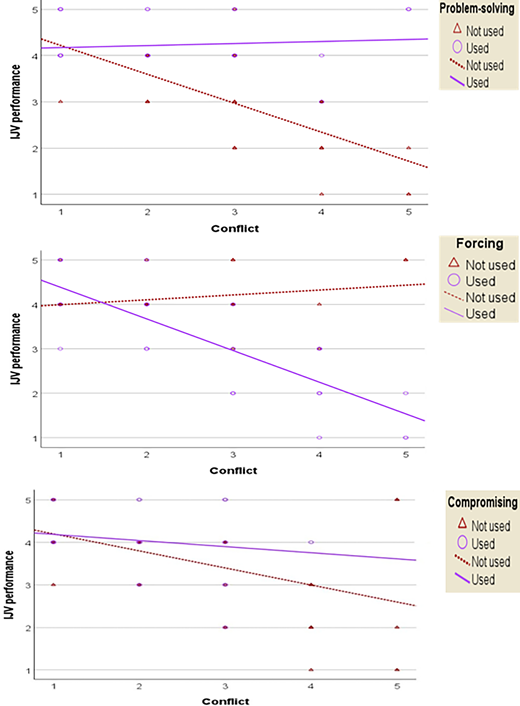
Consistent with H1, results in Model 2 demonstrate that the interaction effect of problem-solving and conflict (b = 0.217; p < 0.05) on IJV performance is significant and positive. This suggests that the impact of conflict on the performance of IJV varies with the chosen CRS, with conflict enhancing IJV performance when a problem-solving strategy is used to solve the conflict. Figure 2 illustrates the results following the guidelines suggested by Aiken and West (1991). Consistent with the prediction, the figure demonstrates that in both low and high-conflict scenarios, a problem-solving strategy results in higher IJV performance. Moreover, the positive impact of the problem-solving strategy on the performance of IJV is more significant when conflict levels are high compared to when they are low. This suggests that IJV partners in our sample use problem-solving strategies to find an integrative and productive solution to the conflict which ultimately contributes to enhanced IJV performance.
In addition, the results highlight that the interaction effect of compromising strategy and conflict (b = −0.008; p > 0.1) on IJV performance is negative but nonsignificant. This supports the H2, and further endorses our view that the effect of conflict on the performance of IJV varies with the chosen CRS, with conflict having no significant effect on IJV performance when a compromising strategy is used to solve the conflict. This finding implies that compromising is an important CRS in blocking any effects of conflict on IJV performance. Their interaction effect is illustrated in Figure 2, which demonstrates that under both moderate and high-conflict conditions, compromising strategy slightly reduces the performance of IJV. However, the negative impact of compromising strategy on performance of IJV is not large enough under both conditions of medium and high conflict. Thus, if companies use the compromising strategy to solve their conflicts in IJVs, then conflict neither enhances nor reduces the IJV performance. Finally, the results support H3 showing that the interaction effect of forcing and conflict (b = −0.393; p < 0.01) on IJV performance is significant and negative. This suggests that the effect of conflict on the performance of IJV varies with the chosen CRS, with conflict reducing IJV performance to a large extent when a forcing strategy is used to solve the conflict. Their interaction effect is illustrated in Figure 2, which demonstrates that under both moderate and high-conflict conditions, forcing strategy leads to a lower degree of the performance of IJV, and the impact of forcing strategy on the performance of IJV is larger when conflict is high than when it is moderate.
5. Discussion and implications
Prior empirical studies dealing with the effects of conflict on the performance of IJV have found support for all forms – negative, positive and no relation (see Table 1), making it difficult to draw a definitive conclusion. To reconcile these contradictory empirical findings, we used SET and TCT to investigate how three CRSs moderate the relationship between conflict and performance in IJVs. Our central argument was that the effect of conflict on IJV performance depends on the specific CRS used. Based on the analysis of 89 IJVs of Nordic firms, our results fully support this proposition.
More specifically our results have established that conflict enhances IJV performance when a problem-solving strategy is used to solve the conflict. IJV partners using the problem-solving strategy view the conflict positively and therefore find an integrative and productive solution to the conflict that not only preserves and strengthens their trust and confidence in each other (Lin and Germain, 1998; Nguyen et al., 2015) but also ultimately leads to enhanced IJV performance (Wong et al., 2018). Overall, this finding is in line with the logic of SET and extends the previous research on IJVs (e.g. Fey and Beamish, 1999; Wong et al., 2018) - which has argued and found that conflict is beneficial for IJV performance – by adding that conflict enhances IJV performance only when problem-solving strategy is used to solve the conflicts. Our findings further confirm that a compromising strategy offsets any effect of conflict on IJV performance. Fighting conflict with a middle ground by making fair concessions from both IJV partners produces a rather quick but partially satisfying solution which develops a moderate level of trust between IJV partners and hence enhances IJV resilience against the negative effect of conflict on IJV performance. However, since partners using a compromising strategy do not go far in exploring each other’s diverse ideas for finding a productive solution to the conflict (Saner, 2003; Wang et al., 2005), this strategy does not lead the conflict to enhanced IJV performance. Overall, this finding is in line with the logic of SET and adds to previous research (Kemp and Ghauri, 2001; Lyles and Baird, 1994; Pak et al., 2009) – which has argued and found that conflict is neither beneficial nor detrimental for IJV performance – by adding that conflict has no significant impact on IJV performance only when compromising strategy is used to solve the conflict. Furthermore, we hypothesized and empirically demonstrated that conflict reduces IJV performance severely when a forcing strategy is used to solve the conflict. IJV partner using force produces a low-quality solution to the conflict (Saner, 2003) and destroys the inter-partner trust (Wang et al., 2005) by ignoring the other partner’s interests, concerns and diverse ideas for addressing these concerns which makes the other partner frustrated, rigid and reactive that ultimately leads to reduced IJV performance (Nguyen et al., Nguyen et al., 2015; Wong et al., 2018). Overall, this finding is in line with the logic of TCT and extends the previous research on IJVs (e.g. Cullen et al., 1995; Demirbag and Mirza, 2000; Ding, 1997; Fey and Beamish, 2000; Steensma and Lyles, 2000; Westman and Thorgren, 2016; Tetteh et al., 2023a, 2023b) – which has argued and found that conflict is detrimental for IJV performance – by adding that conflict reduces IJV performance only when forcing strategy is used to solve the conflicts.
Our study contributes to the stream of literature dealing with issues such as conflicts and the dark side of inter-partner relationships in IJVs. We reconcile the contradictory empirical findings about the conflict–performance relationship resided in prior research by demonstrating that conflict in IJVs is beneficial while using a problem-solving strategy, neither beneficial nor detrimental while using a compromising strategy, and determinantal while using a forcing strategy.
5.1 Implications
Our study draws attention to an important and mostly misunderstood relationship between conflict and IJV performance and draws the following two scientific implications. First, it is insufficient to consider the extent of conflicts in isolation when examining how these conflicts impact the IJV performance. To accurately assess or predict this effect, scholars need to simultaneously consider the chosen CRS to resolve the conflict. Second, conflicts are not necessarily detrimental to IJV performance, as has often been argued in the IJV literature, but can also be harmless and even beneficial. However, IJV partners can only make the conflicts harmless and even beneficial for IJV performance if they use compromising and problem-solving strategies respectively.
The main managerial implication of our study is that IJV partners should not unilaterally impose their solutions on the other partner if they want IJV to benefit from the conflicts. Imposing decisions ignores the counterpart’s interests, concerns and diverse ideas for addressing these concerns and therefore not only produces a low-quality solution to conflict but also destroys the inter-partner trust which ultimately leads to reduced IJV performance. IJV partners should rather solve the conflicts by using a problem-solving strategy where partners find an integrative and productive solution to the conflict that not only preserves and strengthens their trust and confidence in each other but also ultimately leads to enhanced IJV performance. If problem problem-solving strategy is not a viable option, however, for example, because another partner is not in favor of this strategy, the IJV partners should try to neutralize the impact of conflict by using a compromising strategy. This strategy although does not lead to a productive solution, produces a rather quick and partially satisfying solution that promotes a moderate level of trust between IJV partners and ultimately blocks any impact of conflict on IJV performance.
5.2 Limitations and further research
Despite these promising results, our study has a few limitations. First, our study used data from Nordic parents of IJVs, so it is uncertain whether the study’s findings apply to IJVs from other countries. Adapting our research design to different settings is needed to obtain more generalizable results. Second, we focused only on task conflict and did not address the relational conflict. We deliberately narrowed our focus because numerous authors have addressed and produced inconclusive results about the impact of task conflict on IJV performance. Yet, as previous research (see Ren et al., 2009) has shown, it is important to be aware that in addition to task conflict there also exists relational conflict. Exploring “how CRSs affect the effect of task and relationship conflict on IJV performance” can help us learn when these two types of conflicts trigger negative or positive IJV performance. Third, prior research (see Nguyen et al., 2016) has found that culture of parent firm drives the choice of CRSs in IJVs. Therefore, we encourage future research to investigate the relative roles of culture, power asymmetry and interdependence between IJV partners in explaining the choice of CRSs. Finally, we encourage future research to use a longitudinal design to investigate the contingent role of CRSs on conflict–performance relationship in IJVs.