Skip to Main Content
Purpose

This paper aims to systematically reviews and synthesises post-COVID-19 research on consumer payment behaviour, examining how the accelerated diffusion of digital and contactless payment solutions intersects with sustainable marketing concerns, including responsible consumption, trust, transparency and digital choice architectures. The review does not treat digital payment adoption as inherently sustainable; rather, it shows that sustainability-related implications depend on how payment systems are embedded within consumption journeys, governed through transparent practices and interpreted by consumers across contexts.

Design/methodology/approach

A systematic literature review was conducted on peer-reviewed journal articles published between 2022 and 2025. Studies were retrieved from Scopus and Google Scholar using a predefined search strategy and eligibility criteria, and analysed through descriptive mapping and thematic synthesis across marketing, information systems and sustainability-related streams.

Findings

Based on 57 journal articles, the review highlights a rapidly expanding multidisciplinary body of research on post-COVID-19 consumer payment behaviour. Adoption, continuance and switching are shaped by mechanisms such as perceived convenience and value, trust and security/privacy, perceived risk, habit formation and contextual factors including channel setting and platform integration. Importantly, payment practices are not value-neutral: their sustainability implications depend on how systems are embedded in consumption processes, communicated through marketing and aligned with consumer responsibility. The paper proposes an integrative framework linking payment infrastructures, consumer psychology, marketing and corporate social responsibility (CSR) processes and sustainability-related behavioural outcomes.

Originality/value

This study provides one of the first systematic syntheses focused on post-COVID-19 consumer payment behaviour from a sustainable marketing perspective, offering a framework that contributes to theory and informs practitioners and policymakers designing responsible digital payment ecosystems.

Over the past decade, smartphones and digital infrastructures have reshaped how consumers search, purchase and pay (Verhoef et al., 2017). Beyond convenience, these technologies are increasingly discussed as having the potential to support more transparent, responsible and resource-efficient consumption (Świecka et al., 2021; Prabhu and Kumar, 2024). The COVID-19 pandemic further accelerated these dynamics, reinforcing e-commerce, omnichannel journeys and contactless payment solutions (Graziano et al., 2025;Petroccione et al., 2025; Baidoun and Salem, 2024). Many of these changes have persisted post-pandemic, with consumers maintaining familiarity with and reliance on digital and contactless options (Graziano et al., 2023). Post-pandemic payment behaviour therefore reflects a broader reconfiguration of routines and transaction architectures, rather than temporary crisis-driven adaptations.

From a sustainable marketing perspective, the rise of digital payments raises critical questions. Although frequently associated with sustainability goals, their actual effects depend on adoption patterns, their embedding within consumption journeys and consumers’ perceptions of usefulness, trust, risk and control (Doan et al., 2025; Ansari et al., 2025; Albastaki et al., 2024). These factors ultimately determine whether digital payment pathways support responsible decision-making or reinforce convenience-driven and potentially unsustainable routines (Golchha and Nagariya, 2025).

Technology adoption research provides a well-established foundation for analysing these dynamics, highlighting drivers such as perceived usefulness, ease of use, satisfaction and expectation confirmation (Venkatesh et al., 2003). Recent post-COVID-19 studies further emphasise the role of trust, privacy and perceived control, which are increasingly central to stabilising consumption practices and underpinning credible sustainability and responsibility claims (Trianto et al., 2025; Vrontis et al., 2020; Zaidan et al., 2025; Alam and Al Mubarak, 2025).

Against this background, two questions are particularly salient. First, which behavioural changes reflect temporary crisis responses, and which indicate persistent habit formation capable of shaping sustainable – or unsustainable – consumption routines? Second, how do payment determinants vary across instruments and contexts, and how does this variation affect consumers’ capacity for responsible choice? Post-pandemic trajectories are heterogeneous, influenced by digital literacy, age, income, prior experience and institutional environments, with important implications for inclusion and sustainability-oriented marketing strategies (Wauk et al., 2025).

Motivated by these considerations, this paper presents a systematic review of research published between 2022 and 2025 on post-COVID-19 consumer behaviour and digital payments, interpreted through a sustainable marketing lens. Specifically, the review aims to (a) map recent research on post-pandemic payment behaviour, (b) develop an integrative framework linking digital payment infrastructures, consumer psychology, marketing and communication processes and sustainability-related outcomes and (c) identify theoretical gaps and future research avenues related to sustainable marketing, authenticity, transparency and generational differences. This review does not assume that digital payment adoption is inherently sustainable or that post-COVID-19 shifts were primarily driven by environmental concerns. Rather, it examines the conditions under which evolving payment practices may align with, complicate or undermine sustainable and responsible consumption.

This study adopts a systematic literature review to map and synthesise post-COVID-19 research on consumer payment behaviour through a sustainable marketing lens. Beyond documenting changes in payment adoption, the review examines how post-pandemic payment practices intersect with sustainability concerns such as responsible consumption, trust, transparency, inclusion and digital choice architectures. The review follows a transparent four-stage process:

  1. formulation of research questions;

  2. development of a review protocol defining databases, search strategy and eligibility criteria;

  3. descriptive mapping of selected studies; and

  4. thematic synthesis focused on sustainability-relevant mechanisms and outcomes.

The review is guided by one overarching question:

RQ1.

How has consumer payment behaviour evolved post-COVID-19, and what are the implications for sustainable and responsible consumption?

Two subordinate questions structure the synthesis:

RQ2.

Which technological, psychological and contextual mechanisms shape adoption, continuance and switching of payment instruments, and how do they enable or constrain responsible consumer choice?

RQ3.

How do marketing, communication and institutional factors, such as trust, transparency and perceived control, mediate the link between digital payment ecosystems and sustainability outcomes?

Following established SLR guidelines (Christofi et al., 2017; Vrontis and Christofi, 2019), Scopus was the primary database, complemented by Google Scholar. Searches were conducted in titles, abstracts and keywords using Boolean operators. Scopus was selected as the primary database because of its broad multidisciplinary coverage, strong indexing of peer-reviewed journals and frequent use in systematic review studies within business and management research. Google Scholar was used as a complementary search source to widen retrieval and reduce the risk of omitting relevant articles that may not have been captured through a single indexed database. This combination was intended to balance comprehensiveness, transparency and feasibility within a focused review design. While other databases, such as Web of Science or discipline-specific sources, may also have yielded additional records, the present review prioritised a manageable and replicable search strategy aligned with its conceptual objectives.

A representative search string was:

(“payment behavior” OR “payment behaviour” OR “consumer behavior” OR “consumer behaviour”)AND(“post COVID-19 pandemic” OR “post COVID 19 pandemic” OR “post COVID 2019 pandemic”).

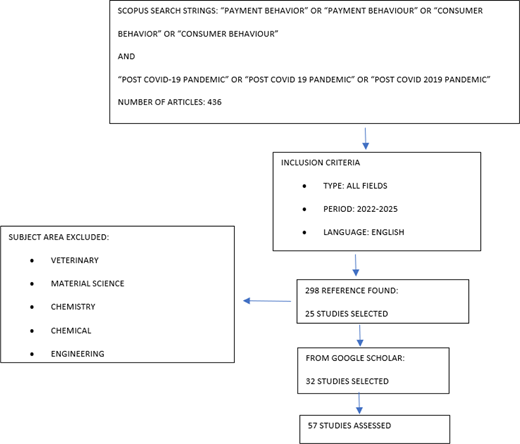
The scope was limited to peer-reviewed articles in English published between 2022 and 2025. The initial search yielded 436 records. After removing duplicates, non-English publications, non-eligible document types and papers without full text, 298 records remained.

Screening involved two stages: first, titles and abstracts were assessed for relevance; second, full texts were reviewed. Only studies explicitly examining post-COVID-19 consumer behaviour regarding digital, mobile, contactless payments, e-wallets, or payment apps were retained; supply-side or indirect studies were excluded. The final sample consists of 57 peer-reviewed articles, listed in the reference section (Figure 1).

A manual content analysis was conducted using a structured extraction form. Each study was coded for bibliographic information, country/context, payment instrument, theoretical framing, methodology, focal constructs and principal findings. In addition, sustainability-related dimensions, including trust, transparency, perceived control, inclusion, responsibility and consumer autonomy, were coded to support the thematic synthesis. The coding process combined deductive categories derived from the research questions with inductive refinement during repeated reading of the articles. To enhance consistency, the coding framework was iteratively reviewed and category definitions were refined throughout the analysis. Based on this data set, the following sections present (i) a descriptive overview, (ii) a thematic synthesis through a sustainable marketing lens and (iii) an integrative framework linking antecedents, mechanisms and sustainability-related outcomes of post-COVID-19 consumer payment behaviour. A subset of articles was independently reviewed by both authors, and discrepancies were discussed until agreement was reached.

Reviewing the post-COVID-19 literature reveals several distinctive patterns in research on consumer behaviour and digital payments when interpreted through a sustainable marketing perspective. This section provides a descriptive map of the selected publications to outline the evolution of the field, highlight the main publication outlets and offer an initial understanding of how research has addressed post-pandemic changes in payment behaviour in relation to broader consumption systems. In line with the objectives of this study, the descriptive analysis focuses on:

  • the temporal evolution of publications and journal outlets;

  • methodological approaches and paper types; and

  • the main payment instruments and consumption contexts investigated, with particular attention to how these dimensions intersect with issues of trust, transparency, inclusion and responsible consumption. This descriptive overview provides the foundation for the thematic synthesis developed in the subsequent section.

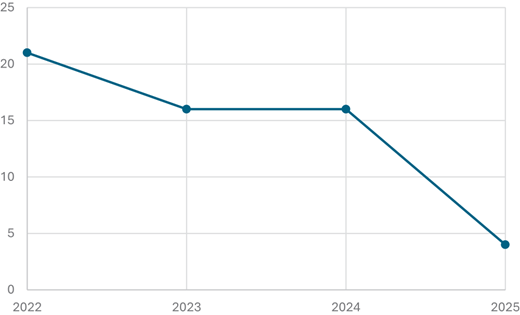
Focusing on the post-COVID-19 period (2022–2025), the volume of studies on consumer behaviour and digital payments reflects sustained scholarly attention, with publication activity increasing over the review window and concentrating in the most recent years. This pattern suggests that research interest has moved beyond the phase of “emergency adoption” triggered by pandemic-related constraints and increasingly addresses post-pandemic stabilisation processes. As shown in Figure 2, the annual distribution of publications on digital payments and consumer behaviour in the post-COVID context indicates that research output remained relatively high between 2022 and 2024, with 21 articles published in 2022, followed by a slight decrease to 16 in 2023 and a modest increase to 16 in 2024. A sharp decline is observed in 2025, with only 4 publications, which likely reflects incomplete indexing and the ongoing publication cycle rather than a genuine reduction in scholarly interest.

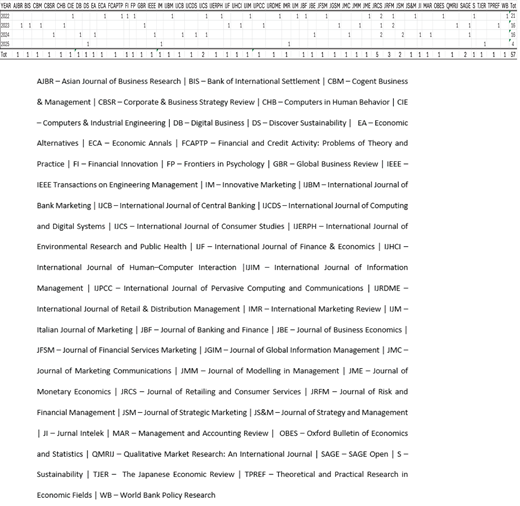
With respect to publication outlets, the corpus is widely dispersed across a large number of journals rather than concentrated within a single disciplinary domain, reinforcing the inherently multidisciplinary nature of post-COVID-19 research on consumer payment behaviour. The reviewed studies span retailing and consumer research, marketing, information systems, finance and ethics/CSR-oriented outlets, reflecting the fact that payment practices sit at the intersection of technological infrastructures, market processes and societal concerns. As shown in Figure 3, the Journal of Retailing and Consumer Services emerges as the most recurrent outlet (n = 5).

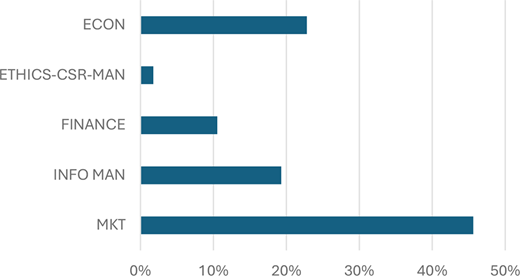
To further clarify the intellectual positioning of the literature, journals were classified by primary field of focus. As reported in Figure 4, research on consumer behaviour in the payments market is predominantly published in Marketing journals (46%, n = 26), followed by Economics (23%, n = 13), Information Management (19%, n = 11) and Finance (11%, n = 6), with only a marginal presence in Ethics–CSR–Management journals (2%, n = 1). From a sustainable marketing perspective, this distribution is particularly revealing. While a substantial share of the literature is published in marketing and ethics/CSR outlets, contributions remain scattered and rarely integrated within a coherent sustainability-oriented framework. This pattern underscores both the growing relevance of sustainability-related concerns, such as trust, responsibility and social impact, in payment research and the absence of cumulative theorisation that explicitly links digital payment ecosystems to sustainable marketing strategies and consumer behaviour.

Building on common literature review classifications, the selected studies were categorised by paper type and methodology. Post-COVID-19 research on consumer payment behaviour is predominantly empirical, reflecting a focus on adoption, continuance, trust, security and digitally mediated consumption systems. From a sustainable marketing perspective, this dominance highlights attention to observable behaviours while revealing a scarcity of theory-driven work addressing sustainability implications. A smaller set of conceptual and review papers complements the empirical core but remains limited.

Research designs span quantitative, qualitative and mixed methods. Quantitative studies, mostly survey-based, examine links between consumer perceptions (e.g. perceived usefulness, ease of use, trust, security, perceived risk) and behaviours such as adoption, loyalty or engagement. Sustainability-related constructs are often operationalised indirectly rather than explicitly. Qualitative studies provide rich contextual insights into motives, barriers and situational drivers, showing how consumers interpret digital payment choices in everyday routines. Mixed-method designs, combining perceptual measures with behavioural indicators (e.g. app engagement, channel use), are particularly suited to capturing complex digital consumption ecosystems but remain scarce.

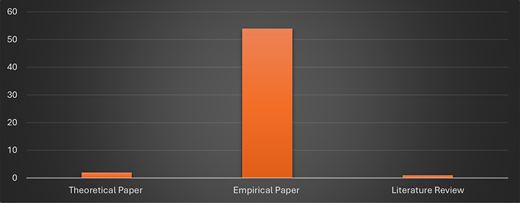
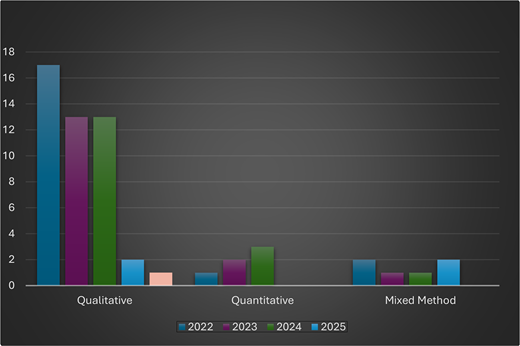
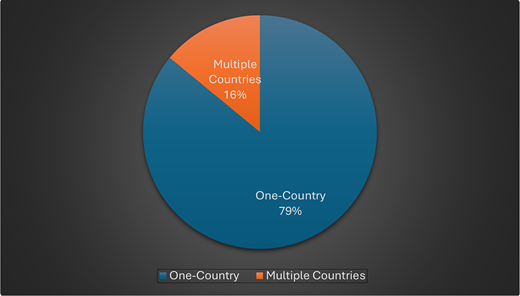
This methodological diversity enriches the field but increases heterogeneity in constructs, measures and levels of analysis, complicating cumulative theory building. As shown in Figure 5, 95% of studies (54 of 57) are empirical, 4% theoretical and 2% reviews, highlighting the need for more theory-driven and interpretive research linking digital payment behaviour to sustainable marketing and responsible consumption. Figure 6 shows qualitative studies dominate (45 articles), while quantitative and mixed-method studies are limited (6 each). Figure 7 indicates a strong prevalence of single-country studies (79%), with cross-country research representing only 16%, revealing limited comparative or international perspectives.

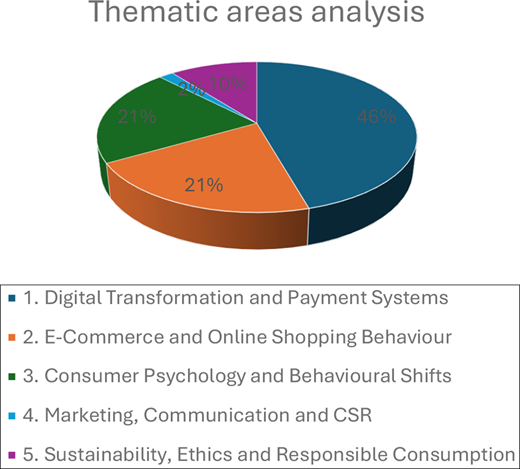
This review adopts a multidisciplinary perspective to explain how consumers reconfigured payment and shopping practices post-COVID-19. As illustrated in Figure 8, the thematic analysis organises the evidence into five macro-areas:

  1. digital transformation and payment systems;

  2. e-commerce and online shopping behaviour;

  3. consumer psychology and behavioural shift;

  4. marketing, communication and CSR; and

  5. sustainability, ethics and responsible consumption.

These themes were identified to capture the technological, behavioural, strategic and normative dimensions through which post-pandemic changes have emerged, as well as their interconnections. Together, they reflect the recomposition of payment and consumption practices within digital ecosystems rather than isolated or purely instrumental changes. Each thematic area is discussed in detail in the following subsections.

Post-COVID-19 research on digital payment adoption (mobile payments, e-wallets, fintech) identifies perceived usefulness, ease of use, trust and security as core predictors (Upadhyay et al., 2022; Kapoor et al., 2022). However, pandemic-induced adoption only persists if service performance and satisfaction remain stable (Jena, 2022;Petroccione et al., 2025). This suggests that while the health crisis acted as a catalyst for initial trial, the long-term integration of these tools into daily routines depends on their ability to outperform traditional methods in terms of functional reliability and user experience. Consequently, the “forced” nature of adoption during lockdowns is gradually being replaced by a value-driven evaluation of digital service quality.

Significant segmentation exists: younger consumers rapidly normalise digital payments, while older cohorts face barriers related to habit and technology readiness (Ardiansah et al., 2024; Jena, 2023). Macro-level analyses show that this acceleration depends on pre-existing financial inclusion and digital infrastructure (Demirgüç-Kunt et al., 2022). These findings highlight a persistent “digital divide” where socio-demographic factors and regional technological maturity dictate the pace of the cashless transition. From a sustainable marketing perspective, such disparities necessitate inclusive design strategies that address the specific cognitive and structural constraints of vulnerable or less tech-savvy populations.

Overall, post-pandemic behaviour reflects an ecosystem process shaped by individual perceptions and structural conditions, leading to hybridisation or partial reversion rather than a linear replacement of cash (Wisniewski et al., 2024). This complexity implies that cash remains a resilient psychological and functional anchor for many consumers, particularly in informal or local economies. Rather than a total shift, the current landscape is characterised by “payment multi-homing”, where users select instruments based on the specific context, transaction size and perceived situational risk.

This area examines how pandemic-era online habits evolve post-crisis. Key determinants of continuance include perceived behavioural control and consumer commitment (Al Hamli and Sobaih, 2023). Within the digital customer journey, payment choice is a critical touchpoint that can either reduce friction or amplify perceived risk, directly influencing conversion (Bhatti et al., 2022). The seamlessness of the checkout process has therefore become a primary competitive advantage in the digital retail space, as any perceived technical hurdle can trigger cart abandonment. Modern consumers increasingly expect a “one-click” experience that balances high-speed processing with transparent security protocols.

Channel choice remains dynamic: while some shifts persist, others revert based on convenience and situational constraints (Kao, 2024; Tran et al., 2023). In sectors like food services, persistence relies on service experience rather than lingering crisis effects (Singh et al., 2024). This transition from “necessity-based” to “convenience-based” shopping indicates that the post-pandemic market has entered a mature phase where digital channels must compete directly with the sensory and social benefits of physical stores. Success in this environment is increasingly tied to omnichannel strategies that allow for a fluid movement between online discovery and offline fulfilment.

Ultimately, post-pandemic online shopping is highly segmented, with the acceptance of contactless alternatives (e.g. facial recognition vs QR codes) hinging on the balance between convenience and safety (Zhong and Moon, 2022). Emerging evidence suggests that consumer typologies are no longer defined solely by demographics, but by their specific “technological temperament” and privacy concerns. Retailers must therefore navigate a fragmented landscape where some segments embrace high-tech biometric solutions while others retreat toward more traditional, privacy-preserving digital interfaces.

The third macro-area integrates evidence on post-COVID-19 psychological and behavioural changes, such as fear, anxiety and shifts in spending habits, linking these mechanisms to the stabilisation of consumption routines (Das et al., 2022; Georgarakos and Kenny, 2022). This psychological reconfiguration suggests that the pandemic acted as a “habit-breaking” event, forcing consumers to renegotiate the balance between emotional impulses and rational planning. Consequently, post-pandemic behaviour is increasingly viewed through the lens of cognitive resilience, where the ability to adapt to digital environments is mediated by the individual’s psychological capacity to manage persistent uncertainty.

A first line of research examines crisis-reactive behaviours, such as panic or compulsive buying, showing how anxiety and perceived scarcity trigger reduced self-control (Huang and Guo, 2023; Yuen et al., 2022). In the context of payments, these dysfunctional patterns often lead to a preference for frictionless “one-touch” transactions that minimise the “pain of paying” during stressful periods. This highlights a critical tension between the convenience of digital payment ecosystems and the need for consumer self-regulation to prevent financial over-extension in volatile economic climates.

A second line focuses on the reconfiguration of offline routines, where safety, comfort and trust have become embedded in the retail experience (Mortimer et al., 2024; Gupta and Mukherjee, 2024). The return to physical stores is thus not a simple reversion to 2019 patterns, but a hybridised experience where hygiene-related expectations and digital integration coexist. This shift implies that brick-and-mortar retailers must now offer “psychological safety” alongside traditional value propositions to maintain footfall and customer loyalty.

Finally, macro-level evidence shows that COVID-19 reshaped household saving and spending, influenced by fiscal policy and unequal digital capabilities (Georgarakos and Kenny, 2022; Šostar and Hak, 2025). These findings underscore that post-pandemic recovery is deeply uneven, with “technological temperament” and health-related constraints creating fragmented consumption trajectories. From a sustainability perspective, this heterogeneity requires more nuanced marketing interventions that account for the differing levels of consumer vulnerability and financial literacy across socio-economic segments.

The fourth macro-area examines how marketing and CSR narratives shape post-pandemic environments, framing communication as “soft infrastructure” that facilitates trust and stabilises new practices. Beyond mere product promotion, post-pandemic communication serves a pedagogical function, guiding consumers through the complexities of new digital interfaces and contactless protocols. In this context, the perceived transparency of institutional messaging becomes a fundamental driver of systemic trust, reducing the cognitive friction associated with adopting unfamiliar financial technologies.

A key contribution frames recovery as a process of consumption reorientation guided by social marketing and CSR (Rrustemi et al., 2024). By aligning corporate goals with collective well-being and long-term societal resilience, brands can legitimise the transition to digital-first consumption as a responsible choice rather than a forced necessity. This strategic alignment suggests that CSR is no longer a peripheral activity but a central behavioural steering mechanism that reinforces the perceived appropriateness of evolving market routines.

This area also incorporates a macro-perspective on economic instability, where heightened uncertainty affects consumer sentiment and risk sensitivity (Belaid et al., 2023). The effectiveness of marketing initiatives in this volatile landscape depends heavily on the coherence between corporate rhetoric and actual practice. Consequently, organisations that demonstrate genuine institutional reliability and ethical consistency are better positioned to foster the long-term commitment required to sustain digital consumption patterns amidst ongoing global shocks.

The fifth macro-area interprets post-COVID-19 consumer change through a sustainability and ethics lens. Importantly, the reviewed literature does not demonstrate that the pandemic-driven shift toward digital payments was itself motivated by environmental concerns or that digital payment adoption directly produces sustainable consumption outcomes. Rather, the evidence suggests that post-pandemic payment practices may have sustainability-related implications when they affect transparency, perceived control, inclusion, traceability and the design of consumer choice environments. Beyond accelerating digital routines, the pandemic intensified value-based evaluations of what constitutes “responsible” consumption and how consumers reconcile convenience with ethical concerns (Rrustemi et al., 2024; Wong et al., 2023). This shift indicates that the post-pandemic consumer is no longer merely a passive adopter of technology, but an active agent seeking alignment between their digital footprint and personal moral compass. Consequently, the long-term viability of payment infrastructures is increasingly tied to their perceived contribution to social equity and environmental transparency.

A key theoretical contribution is the transition from viewing behavioural change as simple technology adoption toward a broader reorientation of consumption systems. Rrustemi et al. (2024) argued that post-COVID reorientation is not linear, requiring ecosystem-level interventions to stabilise responsible routines under persistent uncertainty. This highlights the necessity for a “purpose-driven” digital economy where social marketing and corporate transparency work in tandem to mitigate the psychological stresses of the crisis. Without such coordinated efforts, the adoption of digital consumption practices remains vulnerable to sudden reversals if consumers perceive a conflict between corporate efficiency and societal well-being.

Complementing this, Wong et al. (2023) linked environmental concern to sustainable consumption through cognitive and affective pathways, identifying COVID-related fear as a contextual amplifier. By distinguishing egoistic, altruistic and biospheric motivations, they explain why sustainable behaviour remains unstable for segments where trade-offs between convenience and responsibility persist. These findings suggest that “green” digital transitions are heavily dependent on the consumer’s emotional state and their ability to rationalise the higher costs often associated with ethical choices. Therefore, for sustainable practices to become permanent, digital ecosystems must lower the “ethical entry barrier” by making responsible options the default and most convenient choice.

Finally, additional studies interpret post-pandemic responsibility through well-being, restraint and control, showing how mental-health vulnerabilities can constrain responsible consumption (Huang and Guo, 2023). Institutional dimensions, such as the transparency and traceability of spending, further highlight the ethical implications of the transition to a cashless society (Šostar and Hak, 2025). This suggests that “financial mindfulness” is a critical component of post-pandemic responsibility, where the traceability of digital payments serves as a double-edged sword for consumer autonomy. Ultimately, the ethical consolidation of these practices requires a regulatory framework that protects vulnerable users while leveraging data to promote more conscious and restrained consumption patterns.

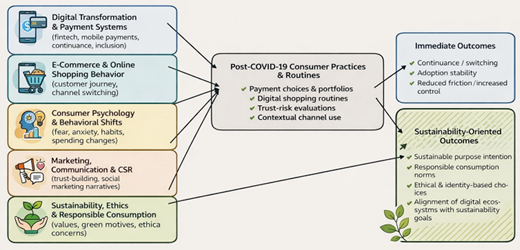
The proposed framework (Figure 9) conceptualises post-pandemic consumption and payment practices as a socio-technical adjustment process rather than a mere choice between instruments. It aligns systematic review findings with sustainable marketing pillars: value creation, authenticity, technology-enabled marketing and generational heterogeneity. This perspective shifts the focus from individual transactions to the broader ecosystem, where the durability of new habits is contingent upon the alignment of digital tools with social values. By framing the transition as a multi-layered process, the framework allows for a more granular analysis of how external shocks are internalised into permanent market structures.

The framework operates through five overlapping layers. At the infrastructural level, digital payment systems (e-wallets, fintech) act as enabling architectures that condition financial inclusion and consumer control. These systems are inherently normative, as their design can either empower users through transparent information or create new forms of digital exclusion. The reliability of these infrastructures is thus the primary determinant of whether pandemic-induced digital adoption evolves into a stable, long-term consumption routine.

Payment practices are further embedded within omnichannel routines, where the design of the digital customer journey can promote responsible decision-making or reinforce convenience-led overconsumption. This suggests that the “architecture of choice” in e-commerce is a critical lever for sustainability, where friction-reduced checkouts must be balanced with ethical prompts. Consequently, marketers must navigate the tension between maximising conversion rates and fostering a deliberative shopping environment that discourages impulsive, unsustainable purchasing.

At the psychological and communicative levels, crisis-shaped drivers like risk perception and anxiety interact with CSR narratives to determine the legitimacy of new practices. The transition to sustainable routines is often hindered by the “intention-behaviour gap,” where emotional stress leads consumers to prioritise immediate convenience over long-term ethical goals. Authentic and transparent communication serves as the “soft infrastructure” necessary to bridge this gap, transforming digital consumption from a necessity into a socially accepted and responsible habit.

Ultimately, the framework identifies three patterns: the partial stabilisation of digital routines, the rise of context-dependent switching and the emergence of value-based trajectories. These patterns indicate that post-COVID-19 behaviour is not a linear progression but a complex portfolio of practices that vary by situational risk and generational maturity. For sustainability to prevail, market ecosystems must ensure that digital transparency and perceived control are the defaults, rather than optional features, thereby aligning technological efficiency with the normative core of responsible consumption.

This analysis consolidates the 2022–2025 literature into a coherent multidisciplinary framework encompassing digital infrastructures, e-commerce, consumer psychology, CSR and ethics. By integrating fragmented insights from marketing, information systems and finance, the study supports cumulative theory building in a highly heterogeneous field. The synthesis shows that the pandemic did not merely accelerate pre-existing trends but redefined the theoretical boundaries of consumer agency in digital market environments. As a result, future research should move beyond isolated constructs and adopt a systemic perspective on how payment technologies interact with evolving social norms, market design and sustainability-oriented expectations.

Addressing RQ1, post-COVID-19 payment behaviour emerges as hybrid and portfolio-based rather than a linear transition from cash to digital instruments. Consumers increasingly engage in situational switching, with implications for sustainable consumption that depend on how payment options are embedded within consumption journeys. In response to RQ2, the review identifies a recurring set of technological, psychological and contextual mechanisms jointly shaping adoption, continuance and switching behaviours. These mechanisms influence not only usage, but also consumers’ capacity for deliberation and responsible choice by amplifying or mitigating the “pain of paying”. Regarding RQ3, marketing, communication and institutional arrangements function as mediating “soft infrastructures” that shape the legitimacy of digital payments through trust, transparency and perceived control.

From a sustainable marketing perspective, responsible outcomes depend less on the payment instrument itself and more on how payment options are framed, governed and embedded in digital journeys. Future research should therefore focus on post-adoption dynamics, such as habit persistence and switching, while accounting for regulatory and cross-country institutional differences.

From a managerial standpoint, banks, fintech firms and retailers should prioritise trust management and journey design over the promotion of a single dominant payment method. Supporting payment multi-homing through reliable, transparent and user-centric ecosystems can enhance engagement and legitimacy beyond the pandemic context. Communication and CSR emerge as critical soft infrastructures when embedded in data governance, interface design and choice architecture. Transparency and perceived control thus become central to credible value propositions in digital markets, where consumers increasingly assess offerings in terms of both efficiency and ethical compatibility.

Despite the robustness of this analysis, certain limitations suggest avenues for further investigation. The synthesis focuses on peer-reviewed literature from 2022 to 2025, which captures the immediate post-pandemic shift but may not yet reflect long-term structural changes in global financial regulation. Future studies should therefore adopt longitudinal designs to track how the “new normal” evolves over time, distinguishing temporary crisis-driven adaptations from permanent shifts in consumer psychology. Expanding the scope to include grey literature and industry reports could also provide more granular insights into emerging technological deployments.

A further limitation concerns database selection. The review relied on Scopus as the primary database and Google Scholar as a complementary source, which ensured broad coverage but may still have excluded relevant studies indexed elsewhere, including Web of Science or more specialised journal databases. Accordingly, the findings should be interpreted as a focused synthesis of the immediate post-pandemic literature rather than an exhaustive census of all publications on digital payments and consumer behaviour.

Theoretical development should move beyond technology adoption models to address post-adoption dynamics such as switching behaviour and habit persistence. Evidence suggests that payment decisions are increasingly context-dependent, highlighting the need to examine how regulatory environments and ecosystem maturity act as boundary conditions. Multidisciplinary frameworks combining behavioural economics and socio-technical systems theory may help explain why certain digital habits fail to stabilise across cultural contexts. Investigating the interaction between institutional trust and individual risk tolerance will also be critical for understanding the resilience of cashless infrastructures during future economic shocks.

From a practical perspective, the findings indicate that banks and retailers should move away from promoting single payment methods toward supporting interoperable and trustworthy ecosystems. Future research should examine how embedding payments within data-intensive platforms affects consumer autonomy and perceived control, as well as how different digital “choice architectures” balance frictionless experiences with ethical transparency. Finally, sustainability remains an emerging frontier: future work should explore how responsible consumption motives and ethical self-concepts are mediated by payment transparency and journey design. Features such as carbon footprint tracking or ethical micro-donations warrant further investigation to assess their impact on long-term loyalty and alignment with broader environmental and social responsibility goals.

Building on the present review, future research should develop a more explicit agenda around the conditions under which digital payment systems shape post-pandemic consumption practices. First, scholars should move beyond initial adoption models and examine post-adoption dynamics such as habit persistence, switching behaviour and payment multi-homing across different retail and service contexts. Second, greater attention should be paid to digital choice architectures, particularly how checkout design, interface friction, default options and transparency tools influence impulse buying, spending awareness, and perceived consumer control. Third, cross-country and institutional comparisons are needed to clarify how regulatory protections, digital infrastructure, financial inclusion and trust in institutions condition the legitimacy and durability of cashless ecosystems. Finally, the relationship between digital payments and sustainability should be investigated more directly. Rather than assuming that digital payment adoption is inherently aligned with responsible consumption, future studies should test whether specific features, such as transaction traceability, budgeting prompts, carbon footprint feedback, or ethical micro-donation options, affect responsible consumption outcomes through mechanisms such as trust, transparency and perceived control.
Al Hamli
,
S.S.
and
Sobaih
,
A.E.E.
(
2023
), “
Factors influencing consumer behavior towards online shopping in Saudi Arabia amid COVID-19: implications for e-businesses post pandemic
”,
Journal of Risk and Financial Management
, Vol.
16
No.
1
, p.
36
, doi: .
Albastaki
,
T.
,
Hamdan
,
A.
,
Albastaki
,
Y.
and
Bakir
,
A.
(
2024
), “
Factors affecting e-payment acceptance by customers: an empirical study in the kingdom of Bahrain
”,
Competitiveness Review: An International Business Journal
, Vol.
34
No.
1
, pp.
107
-
124
.
Aldhi
,
I.F.
,
Suhariadi
,
F.
,
Supriharyanti
,
E.
,
Rahmawati
,
E.
and
Hardaningtyas
,
D.
(
2024
), “
Financial technology in recovery: behavioral usage of payment systems by Indonesian MSMEs in the post-pandemic era
”,
International Journal of Computing and Digital Systems
, Vol.
16
No.
1
, pp.
1329
-
1341
, doi: .
Alam
,
S.M.
and
Al Mubarak
,
M.
(
2025
), “
The relationship between digital marketing and consumer brand perception
”,
Competitiveness Review: An International Business Journal
, Vol.
35
No.
4
, p. ahead-of-print.
Ansari
,
I.
,
Azim
,
K.S.
,
Bhujel
,
K.
,
Panchal
,
S.S.
and
Ahirrao
,
Y.S.
(
2025
), “
Fintech innovation and IT infrastructure: business implications for financial inclusion and digital payment systems
”,
Emerging Frontiers Library for the American Journal of Engineering and Technology
, Vol.
7
No.
09
, pp.
49
-
73
.
Ardiansah
,
M.N.
,
Azmi
,
N.N.
and
Anisykulillah
,
I.
(
2024
), “
Understanding determinants of use behavior of e-payment: an analysis of the success of the system during a pandemic
”,
Management and Accounting Review
, Vol.
23
No.
1
, pp.
413
-
436
.
Baidoun
,
S.D.
and
Salem
,
M.Z.
(
2024
), “
Factors affecting consumer post COVID-19 online shopping behavior: the moderating role of commitment—evidence from Palestine
”,
Journal of Strategic Marketing
, Advance online publication, Vol.
32
No.
3
, doi: .
Baidoun
,
S.D.
and
Salem
,
M.Z.
(
2024
), “
The moderating role of perceived trust and perceived value on online shopping behavioral intention of Palestinian millennials during COVID-19
”,
Competitiveness Review: An International Business Journal
, Vol.
34
No.
1
, pp.
125
-
143
.
Belaid
,
F.
,
Ben Amar
,
A.
,
Goutte
,
S.
and
Guesmi
,
K.
(
2023
), “
Emerging and advanced economies markets behaviour during the COVID-19 crisis era
”,
International Journal of Finance and Economics
, Vol.
28
No.
2
, pp.
1563
-
1581
, doi: .
Bhatti
,
H.Y.
,
Riaz
,
M.B.E.
,
Nauman
,
S.
and
Ashfaq
,
M.
(
2022
), “
Browsing or buying: a serial mediation analysis of consumer’s online purchase intentions in times of COVID-19 pandemic
”,
Frontiers in Psychology
, Vol.
13
, p.
1008983
, doi: .
Christofi
,
M.
,
Leonidou
,
E.
and
Vrontis
,
D.
(
2017
), “
Marketing research on mergers and acquisitions: a systematic review and future directions
”,
International Marketing Review
, Vol.
34
No.
5
, pp.
629
-
651
.
Das
,
D.
,
Sarkar
,
A.
and
Debroy
,
A.
(
2022
), “
Impact of COVID-19 on changing consumer behaviour: Lessons from an emerging economy
”,
International Journal of Consumer Studies
, Vol.
46
No.
3
, pp.
692
-
715
, doi: .
Demirgüç-Kunt
,
A.
,
Klapper
,
L.
,
Singer
,
D.
and
Ansar
,
S.
(
2022
),
The Global Findex Database 2021: Financial Inclusion, Digital Payments, and Resilience in the Age of COVID-19
,
World Bank
,
Washington, DC
, doi: .
Doan
,
L.T.
,
Rahman
,
M.
and
Vo
,
X.V.
(
2025
), “
Mitigating overconsumption through mindfulness: the role of cashless payments in impulsive buying and sustainable consumer behaviour
”,
Journal of Chinese Economic and Business Studies
, Vol.
23
No.
2
, pp.
209
-
232
.
Gupta
,
A.S.
and
Mukherjee
,
J.
(
2024
), “
Reviving Unorganized retail stores post-COVID-19
”,
Journal of Strategic Marketing
, Vol.
32
No.
2
, pp.
230
-
250
.
Georgarakos
,
D.
and
Kenny
,
G.
(
2022
), “
Household spending and fiscal support during the COVID-19 pandemic: Insights from a new consumer survey
”,
Journal of Monetary Economics
, Vol.
129
No.
S
, pp.
S1
-
S14
, doi: .
Golchha
,
C.
, and
Nagariya
,
R.J.
(
2025
), “Exploring consumer choices and shopping patterns: Examining influences on consumer choices”, In
Cultural Sensitivity, Cross-Border Logistics, and E-Commerce in Global Marketing
,
IGI Global Scientific Publishing
,
Hershey, PA
, pp.
181
-
214
.
Graziano
,
E.A.
,
Leonelli
,
L.
,
Petroccione
,
G.
and
Stella
,
G.P.
(
2023
), “
Cash or m-payment? The dilemma of payment behaviour during the COVID-19 pandemic
”,
Global Business Review.
Graziano
,
E.A.
,
Musella
,
F.
and
Petroccione
,
G.
(
2025
), “
Cashless payment: behavior changes and gender dynamics during the COVID-19 pandemic
”,
EuroMed Journal of Business
, Vol.
20
No.
5
, pp.
54
-
74
.
Huang
,
F.
and
Guo
,
W.
(
2023
), “
Rise of mental Sub-Health consumers: examining the compulsive buying behavior in the Post-COVID-19 era
”,
Sage Open
, Vol.
13
No.
4
.
Jena
,
R.
(
2023
), “
Factors impacting senior citizens’ adoption of e-banking post COVID-19 pandemic: an empirical study from India
”,
Journal of Risk and Financial Management
, Vol.
16
No.
9
, p.
380
, doi: .
Jena
,
R.K.
(
2022
), “
Investigating and predicting intentions to continue using mobile payment platforms after the COVID-19 pandemic: an empirical study among retailers in India
”,
Journal of Risk and Financial Management
, Vol.
15
No.
7
, p.
314
, doi: .
Kao
,
W.-K.
(
2024
), “
What has changed us? Investigating consumers’ behaviors for m-commerce: Comparing the pre- and post-pandemic eras
”,
Journal of Marketing Communications
,
Advance online publication
, Vol.
32
No.
3
, doi: .
Kapetanios
,
G.
,
Neuteboom
,
N.
,
Ritsema
,
F.
and
Ventouri
,
A.
(
2022
), “
How did consumers react to the COVID-19 pandemic over time?
”,
Oxford Bulletin of Economics and Statistics
, Vol.
84
No.
5
, pp.
961
-
993
, doi: .
Kapoor
,
A.
,
Sindwani
,
R.
,
Goel
,
M.
and
Shankar
,
A.
(
2022
), “
Mobile wallet adoption intention amid COVID-19 pandemic outbreak: a novel conceptual framework
”,
Computers and Industrial Engineering
, Vol.
172
, p.
108646
, doi: .
Mohd Reza
,
M.D.S.B.
,
Tan
,
S.-H.
,
Chong
,
L.-L.
and
Ong
,
H.-B.
(
2024
), “
Continuance usage intention of e-wallets: Insights from merchants
”,
International Journal of Information Management Data Insights
, Vol.
4
No.
2
, p.
100254
, doi: .
Mortimer
,
G.
,
Andrade
,
M.L.O.
and
Fazal-e-Hasan
,
S.M.
(
2024
), “
From traditional to transformed: Examining the pre-and post-COVID consumers’ shopping mall experiences
”,
Journal of Retailing and Consumer Services
, Vol.
76
, p.
103583
.
Petroccione
,
G.
,
Graziano
,
E.A.
,
Musella
,
F.
and
Hadjielias
,
E.
(
2025
), “
Digital payment behaviour and financial well-being: implications for international marketing
”,
International Marketing Review
, Vol.
42
No.
6
, pp.
1305
-
1329
.
Prabhu
,
S.
and
Kumar
,
V.
(
2024
), “
Consumer behaviour towards adopting sustainable alternative electronic payment methods
”,
World Review of Entrepreneurship, Management and Sustainable Development
, Vol.
20
No.
5
, pp.
582
-
605
.
Rrustemi
,
V.
,
Kajtazi
,
S.
and
Jashari
,
F.
(
2024
), “
Post-COVID-19 social marketing strategy: reorienting production, consumption, and consumer behaviour
”,
Corporate and Business Strategy Review
, Vol.
5
No.
4
, pp.
104
-
111
, doi: .
Singh
,
N.
,
Alcántara‐Pilar
,
J.M.
,
Liébana‐Cabanillas
,
F.J.
and
Pavluković
,
V.
(
2024
), “
Does the pandemic effect still exist? A comparative analysis of online food services in India and Spain
”,
International Journal of Consumer Studies
, Vol.
48
No.
1
, p.
e12986
.
Šostar
,
M.
and
Hak
,
M.
(
2025
), “
The cash consumer: how COVID-19 reshaped spending and fiscalized transactions in Croatia
”,
Discover Sustainability
, Vol.
6
No.
1
, Article 1753, doi: .
Świecka
,
B.
,
Terefenko
,
P.
,
Wiśniewski
,
T.
and
Xiao
,
J.
(
2021
), “
Consumer financial knowledge and cashless payment behavior for sustainable development in Poland
”,
Sustainability
, Vol.
13
No.
11
, p.
6401
.
Tran
,
A.T.N.
,
Nguyen
,
U.H.D.
,
Ngo
,
V.M.
and
Nguyen
,
H.H.
(
2023
), “
Explaining consumers’ channel-switching behavior in the post-COVID-19 pandemic era
”,
Cogent Business and Management
, Vol.
10
No.
1
, p.
2198068
, doi: .
Trianto
,
B.
,
Munthe
,
M.
,
Firdaus
,
N.
and
Syahrial
,
M.
(
2025
), “
The role of marketing innovation, market orientation, competitive business advantage and government support on micro-business survival during the COVID-19
”,
Competitiveness Review
, Vol. ahead-of-print No. ahead-of-print, doi: .
Upadhyay
,
N.
,
Upadhyay
,
S.
,
Abed
,
S.S.
and
Dwivedi
,
Y.K.
(
2022
), “
Consumer adoption of mobile payment services during COVID-19: Extending meta-UTAUT with perceived severity and self-efficacy
”,
International Journal of Bank Marketing
, Vol.
40
No.
5
, pp.
960
-
991
, doi: .
Venkatesh
,
V.
,
Morris
,
M.G.
,
Davis
,
G.B.
and
Davis
,
F.D.
(
2003
), “
User acceptance of information technology: toward a unified view1
”,
MIS Quarterly
, Vol.
27
No.
3
, pp.
425
-
478
.
Verhoef
,
P.C.
,
Stephen
,
A.T.
,
Kannan
,
P.K.
,
Luo
,
X.
,
Abhishek
,
V.
,
Andrews
,
M.
and
Zhang
,
Y.
(
2017
), “
Consumer connectivity in a complex, technology-enabled, and mobile-oriented world with smart products
”,
Journal of Interactive Marketing
, Vol.
40
No.
1
, pp.
1
-
8
.
Vrontis
,
D.
and
Christofi
,
M.
(
2019
), “
R&D internationalization and innovation: a systematic review, integrative framework, and future research directions
”,
Journal of Business Research
, Vol.
128
, pp.
812
-
823
, doi: .
Vrontis
,
D.
,
Christofi
,
M.
and
Katsikeas
,
C.S.
(
2020
), “
An assessment of the literature on cause-related marketing: implications for international competitiveness and marketing research
”,
International Marketing Review
, Vol.
37
No.
5
, pp.
977
-
1012
.
Wauk
,
G.
,
Chai
,
J.
,
Adjorlolo
,
G.
,
Amouzou
,
E.K.
,
Bonney
,
B.
and
N-Yanyi
,
B.
(
2025
), “
Antecedents of sustainable usage behaviors through mobile payment technology for digital financial inclusion in Ghana
”,
Systems
, Vol.
13
No.
6
, p.
456
.
Wisniewski
,
T.P.
,
Polasik
,
M.
,
Kotkowski
,
R.
and
Moro
,
A.
(
2024
), “
Switching from cash to cashless payments during the COVID-19 pandemic and beyond
”,
available at:
Link to Switching from cash to cashless payments during the COVID-19 pandemic and beyondLink to the cited article (
accessed
12 May 2026).
Wong
,
W.M.
,
Qu
,
M.
,
Nunualvuttiwong
,
C.
and
Ngamcharoenmongkhon
,
K.
(
2023
), “
Environmental concerns, sustainable consumption, and COVID-19 fear in online consumers: a research exploration
”,
Theoretical and Practical Research in Economic Fields
, Vol.
14
No.
2
, pp.
246
-
257
, doi: .
Yuen
,
K.F.
,
Tan
,
L.S.
,
Wong
,
Y.D.
and
Wang
,
X.
(
2022
), “
Social determinants of panic buying behaviour amidst COVID-19 pandemic: the role of perceived scarcity and anticipated regret
”,
Journal of Retailing and Consumer Services
, Vol.
66
, p.
102948
, doi: .
Zaidan
,
H.
,
Shishan
,
F.
,
Al-Hasan
,
M.
,
Al-Mawali
,
H.
,
Mowafi
,
O.
and
Dahiyat
,
S.E.
(
2025
), “
Cash or cash-less? Exploring the determinants of continuous intention to use e-wallets: the moderating role of environmental knowledge
”,
Competitiveness Review: An International Business Journal
, Vol.
35
No.
2
, pp.
319
-
346
.
Zhong
,
Y.
and
Moon
,
H.-C.
(
2022
), “
Investigating customer behavior of using contactless payment in China: a comparative study of facial recognition payment and mobile QR-code payment
”,
Sustainability
, Vol.
14
No.
12
, p.
7150
, doi: .
Angelovska
,
N.
and
Angelovska
,
J.
(
2024
), “
Predictors of the likelihood of continuous usage of online shopping post-COVID-19
”,
Economic Annals
, Vol.
30
No.
4
, pp.
846
-
876
.
Anirvinna
,
C.
,
Jha
,
D.
,
Goodwin
,
R.D.
and
Pokhriyal
,
D.
(
2025
), “
Consumer willingness to adopt digital coupons in post-demonetization and COVID-19 in India
”,
Innovative Marketing
, Vol.
21
No.
1
, p.
157
.
Arora
,
S.
,
Kaur
,
M.
and
Jain
,
E.
(
2023
), “
E-wallet adoption amidst COVID era: an empirical intervention with extended UTAUT2
”,
Asian Journal of Business Research
, Vol.
13
No.
1
, pp.
121
-
142
, doi: .
Auer
,
R.
,
Cornelli
,
G.
and
Frost
,
J.
(
2022
),
The Pandemic, Cash and Retail Payment Behaviour: Insights from the Future of Payments Database (BIS Working Papers No. 1055)
,
Bank for International Settlements
,
Basel
.
Bauer
,
F.
,
Friesl
,
M.
and
Dao
,
M.A.
(
2022
), “
Run or hide: changes in acquisition behaviour during the COVID-19 pandemic
”,
Journal of Strategy and Management
, Vol.
15
No.
1
, pp.
38
-
53
, doi: .
Bhatia
,
S.
,
Singh
,
N.
and
Liébana-Cabanillas
,
F.
(
2023
), “
Intermittent continued adoption of digital payment services during the COVID-19 induced pandemic
”,
International Journal of Human–Computer Interaction
, Vol.
39
No.
14
, pp.
2905
-
2919
, doi: .
Blanco-Gonzalez
,
A.
,
Cachón-Rodríguez
,
G.
,
Del-Castillo-Feito
,
C.
and
Cruz-Suarez
,
A.
(
2022
), “
Is purchase behavior different for consumers with long COVID?
”,
International Journal of Environmental Research and Public Health
, Vol.
19
No.
24
, p.
16658
, doi: .
Chakraborty
,
D.
,
Mehta
,
P.
,
Dash
,
G.
,
Khan
,
N.
,
Jain
,
R.K.
and
Biswas
,
D.
(
2023
), “
What drives consumers to adopt mobile payment apps in the post-COVID-19 scenario: the role of openness to change and user involvement
”,
Journal of Global Information Management
, Vol.
31
No.
1
, pp.
1
-
24
, doi: .
Cull
,
R.
,
Foster
,
V.
,
Jolliffe
,
D.M.
,
Lederman
,
D.
,
Mare
,
D.S.
and
Veerappan
,
M.
(
2023
),
Digital Payments and the COVID-19 Shock: The Role of Preexisting Conditions in Banking, Infrastructure, Human Capabilities, and Digital Regulation, Policy Research Working Paper No. 10603
,
World Bank
,
Washington, DC
.
Elshaer
,
I.A.
,
Alrawad
,
M.
,
Lutfi
,
A.
and
Azazz
,
A.M.
(
2024
), “
Social commerce and buying intention post COVID-19: evidence from a hybrid approach based on SEM–fsQCA
”,
Journal of Retailing and Consumer Services
, Vol.
76
, p.
103548
.
Fujiki
,
H.
(
2025
), “
Cashless payment methods and COVID-19: evidence from Japanese consumer panel data
”,
The Japanese Economic Review
, Vol.
76
No.
1
, pp.
121
-
162
, doi: .
Gupta
,
A.S.
and
Mukherjee
,
J.
(
2022
), “
Long-term changes in consumers’ shopping behavior post-pandemic: an exploratory study
”,
International Journal of Retail and Distribution Management
, Vol.
50
No.
12
, pp.
1518
-
1534
.
Harri
,
A.
(
2022
), “
The effect of the COVID-19 pandemic on consumer savings and retail sales: evidence from a postcommunist transition economy
”,
Economic Annals
, Vol.
67
No.
233
, pp.
39
-
60
.
Ho
,
H.R.
,
Mohd Johan
,
M.R.
and
Muttu
,
T.
(
2024
), “
Driving e-wallet continuance usage intention: a survey among generation alpha in Malaysia during COVID-19 pandemic
”,
Jurnal Intelek
, Vol.
19
No.
1
, pp.
57
-
78
.
Hussain
,
S.
,
Gupta
,
S.
and
Bhardwaj
,
S.
(
2025
), “
Determinants inhibiting digital payment system adoption: an Indian perspective
”,
Qualitative Research in Financial Markets
, Vol.
17
No.
4
, pp.
716
-
748
.
Imschloss
,
M.
and
Schwemmle
,
M.
(
2024
), “
Value creation in post-pandemic retailing: a conceptual framework and implications
”,
Journal of Business Economics
, Vol.
94
No.
6
, doi: .
Jegerson
,
D.
and
Hussain
,
M.
(
2023
), “
A framework for measuring the adoption factors in digital mobile payments in the COVID-19 era
”,
International Journal of Pervasive Computing and Communications
, Vol.
19
No.
4
, pp.
596
-
623
, doi: .
Jonker
,
N.
,
van der Cruijsen
,
C.
,
Bijlsma
,
M.
and
Bolt
,
W.
(
2022
), “
Pandemic payment patterns
”,
Journal of Banking and Finance
, Vol.
143
, p.
106593
, doi: .
Liébana-Cabanillas
,
F.
,
Muñoz-Leiva
,
F.
,
Molinillo
,
S.
and
Higueras-Castillo
,
E.
(
2022
), “
Do biometric payment systems work during the COVID-19 pandemic? Insights from the Spanish users’ viewpoint
”,
Financial Innovation
, Vol.
8
No.
1
, p.
22
, doi: .
Lu
,
M.-P.
and
Kosim
,
Z.
(
2024
), “
An empirical study to explore the influence of the COVID-19 crisis on consumers’ behaviour towards cashless payment in Malaysia
”,
Journal of Financial Services Marketing
, Vol.
29
No.
1
, pp.
33
-
44
, doi: .
Petroccione
,
G.
and
Graziano
,
E.
,
A.
, (
2026
), “
Trust by design: behavioural insights on financial literacy and fraud mitigation in the digital euro framework
”,
EuroMed Journal of Business
, Vol.
21
No.
5
.
Raman
,
P.
and
Aashish
,
K.
(
2023
), “
Influence of COVID-19 pandemic on the intention to adopt mobile payment systems in India
”,
Qualitative Market Research: An International Journal
, Vol.
26
No.
4
, pp.
368
-
394
, doi: .
Rahman
,
M.
,
Yee
,
H.P.
,
Masud
,
M.A.K.
and
Uzir
,
M.U.H.
(
2024
), “
Examining the dynamics of mobile banking app adoption during the COVID-19 pandemic: a digital shift in the crisis
”,
Digital Business
, Vol.
4
No.
2
, p.
100088
, doi: .
Sheng
,
M.L.
and
Fauzi
,
A.A.
(
2023
), “
Institutional behavior mechanism: exploring the impacts of macro-environmental stimuli on continued digital payment adoption behavior
”,
Computers in Human Behavior
, Vol.
149
, p.
107923
, doi: .
Singh
,
A.K.
and
Sharma
,
P.
(
2023
), “
A study of Indian gen X and millennials consumers’ intention to use FinTech payment services during COVID-19 pandemic
”,
Journal of Modelling in Management
, Vol.
18
No.
4
, pp.
1177
-
1203
, doi: .
Sorrentino
,
A.
,
Leone
,
D.
and
Caporuscio
,
A.
(
2022
), “
Changes in the post-COVID-19 consumers’ behaviors and lifestyle in Italy: a disaster management perspective
”,
Italian Journal of Marketing
, Vol.
2022
No.
1
, pp.
87
-
106
, doi: .
Stanca
,
L.
,
Dabija
,
D.-C.
and
Câmpian
,
V.
(
2023
), “
Qualitative analysis of customer behavior in the retail industry during the COVID-19 pandemic: a word-cloud and sentiment analysis approach
”,
Journal of Retailing and Consumer Services
, Vol.
75
, p.
103543
, doi: .
Starostina
,
A.O.
,
Kravchenko
,
V.
,
Zhurylo
,
V.
,
Tepliuk
,
M.
and
Domina
,
O.
(
2022
), “
Online shopping perceived risks during the COVID-19 pandemic: on the student’s case for the apparel and footwear
”,
Financial and Credit Activity Problems of Theory and Practice
, Vol.
3
No.
44
, p.
100
, doi: .
Wang
,
S.
,
Cheah
,
J.-H.
,
Lim
,
X.-J.
,
Leong
,
Y.C.
and
Choo
,
W.C.
(
2022
), “
Thanks COVID-19, I’ll reconsider my purchase: can fear appeal reduce online shopping cart abandonment?
”,
Journal of Retailing and Consumer Services
, Vol.
64
, p.
102843
, doi: .
Wang
,
Y.
,
Xu
,
X.
and
Zhu
,
Q.
(
2024
), “
Investigating the signaling mechanism of consumer reviews toward online grocery shopping
”,
IEEE Transactions on Engineering Management
, Vol.
71
, pp.
10727
-
10739
, doi: .
Yang
,
Z.
,
Li
,
X.
and
Wang
,
Q.
(
2024
), “
Analysis of online consumer purchasing behavior typology after the COVID-19 pandemic
”,
Sage Open
, Vol.
14
No.
3
, doi: .
Published by Emerald Publishing Limited. This article is published under the Creative Commons Attribution (CC BY 4.0) licence. Anyone may reproduce, distribute, translate and create derivative works of this article (for both commercial and non-commercial purposes), subject to full attribution to the original publication and authors. The full terms of this licence may be seen at Link to the terms of the CC BY 4.0 licenceLink to the terms of the CC BY 4.0 licence.

Data & Figures

Figure 1.
Flowchart showing literature search, inclusion criteria, excluded subject areas, and study selection process for post-pandemic consumer behaviour research.The flowchart summarises the literature selection process for studies on payment behaviour and consumer behaviour after the coronavirus disease 2019 pandemic. The top section lists Scopus search strings including payment behavior, payment behaviour, consumer behavior, consumer behaviour, and post coronavirus disease 2019 pandemic terms, resulting in 436 articles. Inclusion criteria specify all fields, publication period from 2022 to 2025, and English language studies. Excluded subject areas include Veterinary, Material Science, Chemistry, Chemical, and Engineering. The process narrows the results to 298 references found, 25 studies selected, 32 additional studies selected from Google Scholar, and a final total of 57 studies assessed. Arrows connect each stage of the selection workflow.

Search strategy

Source: Author’s elaborations

Figure 1.
Flowchart showing literature search, inclusion criteria, excluded subject areas, and study selection process for post-pandemic consumer behaviour research.The flowchart summarises the literature selection process for studies on payment behaviour and consumer behaviour after the coronavirus disease 2019 pandemic. The top section lists Scopus search strings including payment behavior, payment behaviour, consumer behavior, consumer behaviour, and post coronavirus disease 2019 pandemic terms, resulting in 436 articles. Inclusion criteria specify all fields, publication period from 2022 to 2025, and English language studies. Excluded subject areas include Veterinary, Material Science, Chemistry, Chemical, and Engineering. The process narrows the results to 298 references found, 25 studies selected, 32 additional studies selected from Google Scholar, and a final total of 57 studies assessed. Arrows connect each stage of the selection workflow.

Search strategy

Source: Author’s elaborations

Close modal
Figure 2.
Line chart showing yearly distribution of studies from 2022 to 2025 with declining publication counts in 2025.The line chart displays the yearly distribution of studies from 2022 to 2025. The x-axis represents years, and the y-axis ranges from 0 to 25 studies. Data points show 21 studies in 2022, 16 studies in 2023, 16 studies in 2024, and 4 studies in 2025. The connected line indicates a decline in publication count over time, with a sharp decrease in 2025.

Article frequency by year

Source: Author’s elaborations

Figure 2.
Line chart showing yearly distribution of studies from 2022 to 2025 with declining publication counts in 2025.The line chart displays the yearly distribution of studies from 2022 to 2025. The x-axis represents years, and the y-axis ranges from 0 to 25 studies. Data points show 21 studies in 2022, 16 studies in 2023, 16 studies in 2024, and 4 studies in 2025. The connected line indicates a decline in publication count over time, with a sharp decrease in 2025.

Article frequency by year

Source: Author’s elaborations

Close modal
Figure 3.
Table showing yearly distribution of journal publications and total study counts across multiple journals from 2022 to 2025.The table presents the yearly distribution of publications across multiple academic journals from 2022 to 2025. Columns list abbreviated journal titles, while rows represent publication years and total counts. Numerical entries indicate the number of studies published in each journal during each year. Totals at the right side show 21 studies in 2022, 16 studies in 2023, 16 studies in 2024, and 4 studies in 2025, with an overall total of 57 studies. The bottom row summarises the cumulative number of studies for each journal.

Evolutionary development of international marketing studies in banking and finance

Source: Author’s elaborations

Figure 3.
Table showing yearly distribution of journal publications and total study counts across multiple journals from 2022 to 2025.The table presents the yearly distribution of publications across multiple academic journals from 2022 to 2025. Columns list abbreviated journal titles, while rows represent publication years and total counts. Numerical entries indicate the number of studies published in each journal during each year. Totals at the right side show 21 studies in 2022, 16 studies in 2023, 16 studies in 2024, and 4 studies in 2025, with an overall total of 57 studies. The bottom row summarises the cumulative number of studies for each journal.

Evolutionary development of international marketing studies in banking and finance

Source: Author’s elaborations

Close modal
Figure 4.
Horizontal bar chart showing percentage distribution of studies across Economics, Marketing, Information Management, Finance, and Ethics disciplines.The horizontal bar chart compares the percentage distribution of studies across academic disciplines. The x-axis ranges from 0 percent to 50 percent, while the y-axis lists Economics, Ethics-C S R-Management, Finance, Information Management, and Marketing. Marketing has the highest proportion at approximately 46 percent, followed by Economics at approximately 23 percent and Information Management at approximately 19 percent. Finance represents approximately 11 percent, and Ethics-C S R-Management has the smallest share at approximately 2 percent.

Field of journal outlets

Source: Author’s elaborations

Figure 4.
Horizontal bar chart showing percentage distribution of studies across Economics, Marketing, Information Management, Finance, and Ethics disciplines.The horizontal bar chart compares the percentage distribution of studies across academic disciplines. The x-axis ranges from 0 percent to 50 percent, while the y-axis lists Economics, Ethics-C S R-Management, Finance, Information Management, and Marketing. Marketing has the highest proportion at approximately 46 percent, followed by Economics at approximately 23 percent and Information Management at approximately 19 percent. Finance represents approximately 11 percent, and Ethics-C S R-Management has the smallest share at approximately 2 percent.

Field of journal outlets

Source: Author’s elaborations

Close modal
Figure 5.
Bar chart comparing counts of theoretical papers, empirical papers, and literature reviews in the selected studies.The bar chart compares the number of theoretical papers, empirical papers, and literature reviews included in the selected studies. The x-axis lists the 3 publication categories, and the y-axis ranges from 0 to 60. Empirical papers have the highest count at approximately 54 studies, while theoretical papers and literature reviews each contribute approximately 2 and 1 studies, respectively.

Distribution of paper types

Source: Author’s elaborations

Figure 5.
Bar chart comparing counts of theoretical papers, empirical papers, and literature reviews in the selected studies.The bar chart compares the number of theoretical papers, empirical papers, and literature reviews included in the selected studies. The x-axis lists the 3 publication categories, and the y-axis ranges from 0 to 60. Empirical papers have the highest count at approximately 54 studies, while theoretical papers and literature reviews each contribute approximately 2 and 1 studies, respectively.

Distribution of paper types

Source: Author’s elaborations

Close modal
Figure 6.
Grouped bar chart showing qualitative, quantitative, and mixed method studies across publication years from 2022 to 2025.The grouped bar chart compares qualitative, quantitative, and mixed method studies across the years 2022 to 2025. The x-axis lists the research methods, and the y-axis ranges from 0 to 20 studies. Qualitative studies dominate across all years, with approximately 17 studies in 2022 and 13 studies each in 2023 and 2024. Quantitative studies remain lower, ranging from approximately 1 to 3 studies annually, while mixed method studies range from approximately 1 to 2 studies across the years. A legend identifies the yearly distributions from 2022 to 2025.

Distribution of methodological approaches

Source: Author’s elaborations

Figure 6.
Grouped bar chart showing qualitative, quantitative, and mixed method studies across publication years from 2022 to 2025.The grouped bar chart compares qualitative, quantitative, and mixed method studies across the years 2022 to 2025. The x-axis lists the research methods, and the y-axis ranges from 0 to 20 studies. Qualitative studies dominate across all years, with approximately 17 studies in 2022 and 13 studies each in 2023 and 2024. Quantitative studies remain lower, ranging from approximately 1 to 3 studies annually, while mixed method studies range from approximately 1 to 2 studies across the years. A legend identifies the yearly distributions from 2022 to 2025.

Distribution of methodological approaches

Source: Author’s elaborations

Close modal
Figure 7.
Pie chart showing distribution of one-country and multiple-country studies in the reviewed literature.The pie chart compares the distribution of one-country and multiple-country studies in the reviewed literature. One-country studies account for 79 percent of the total, while multiple-country studies account for 16 percent. Labels are placed directly within the chart segments, and a legend below identifies the 2 study categories.

Country focus analysis

Source: Author’s elaborations

Figure 7.
Pie chart showing distribution of one-country and multiple-country studies in the reviewed literature.The pie chart compares the distribution of one-country and multiple-country studies in the reviewed literature. One-country studies account for 79 percent of the total, while multiple-country studies account for 16 percent. Labels are placed directly within the chart segments, and a legend below identifies the 2 study categories.

Country focus analysis

Source: Author’s elaborations

Close modal
Figure 8.
Pie chart showing thematic area distribution across digital transformation, e-commerce, consumer psychology, marketing, and sustainability studies.The pie chart presents the distribution of thematic research areas in the reviewed studies. Digital Transformation and Payment Systems represent 46 percent of the studies. E-Commerce and Online Shopping Behaviour account for 21 percent, and Consumer Psychology and Behavioural Shifts also account for 21 percent. Sustainability, Ethics, and Responsible Consumption contribute 10 percent, while Marketing, Communication, and C S R account for 2 percent. A legend below the chart lists all thematic categories with their corresponding labels.

Thematic areas analysis

Source: Author’s elaborations

Figure 8.
Pie chart showing thematic area distribution across digital transformation, e-commerce, consumer psychology, marketing, and sustainability studies.The pie chart presents the distribution of thematic research areas in the reviewed studies. Digital Transformation and Payment Systems represent 46 percent of the studies. E-Commerce and Online Shopping Behaviour account for 21 percent, and Consumer Psychology and Behavioural Shifts also account for 21 percent. Sustainability, Ethics, and Responsible Consumption contribute 10 percent, while Marketing, Communication, and C S R account for 2 percent. A legend below the chart lists all thematic categories with their corresponding labels.

Thematic areas analysis

Source: Author’s elaborations

Close modal
Figure 9.
Conceptual framework linking digital transformation, consumer behaviour, marketing, and sustainability themes to post-coronavirus disease 2019 consumer practices and outcomes.The conceptual framework illustrates relationships between thematic research areas, post-coronavirus disease 2019 consumer practices, and resulting behavioural outcomes. Five thematic domains appear on the left side: Digital Transformation and Payment Systems, E-Commerce and Online Shopping Behaviour, Consumer Psychology and Behavioural Shifts, Marketing, Communication and C S R, and Sustainability, Ethics and Responsible Consumption. Arrows connect these domains to a central section labelled post-coronavirus disease 2019 consumer practices and routines, including payment choices and portfolios, digital shopping routines, trust-risk evaluations, and contextual channel use. Additional arrows extend toward 2 outcome categories on the right side. Immediate outcomes include continuance or switching behaviour, adoption stability, and reduced friction with increased control. Sustainability-oriented outcomes include sustainable purpose intention, responsible consumption norms, ethical and identity-based choices, and alignment of digital ecosystems with sustainability goals.

Integrative framework of post-COVID-19 consumption and payment practices

Source: Author’s elaborations

Figure 9.
Conceptual framework linking digital transformation, consumer behaviour, marketing, and sustainability themes to post-coronavirus disease 2019 consumer practices and outcomes.The conceptual framework illustrates relationships between thematic research areas, post-coronavirus disease 2019 consumer practices, and resulting behavioural outcomes. Five thematic domains appear on the left side: Digital Transformation and Payment Systems, E-Commerce and Online Shopping Behaviour, Consumer Psychology and Behavioural Shifts, Marketing, Communication and C S R, and Sustainability, Ethics and Responsible Consumption. Arrows connect these domains to a central section labelled post-coronavirus disease 2019 consumer practices and routines, including payment choices and portfolios, digital shopping routines, trust-risk evaluations, and contextual channel use. Additional arrows extend toward 2 outcome categories on the right side. Immediate outcomes include continuance or switching behaviour, adoption stability, and reduced friction with increased control. Sustainability-oriented outcomes include sustainable purpose intention, responsible consumption norms, ethical and identity-based choices, and alignment of digital ecosystems with sustainability goals.

Integrative framework of post-COVID-19 consumption and payment practices

Source: Author’s elaborations

Close modal

Supplements

References

Al Hamli
,
S.S.
and
Sobaih
,
A.E.E.
(
2023
), “
Factors influencing consumer behavior towards online shopping in Saudi Arabia amid COVID-19: implications for e-businesses post pandemic
”,
Journal of Risk and Financial Management
, Vol.
16
No.
1
, p.
36
, doi: .
Albastaki
,
T.
,
Hamdan
,
A.
,
Albastaki
,
Y.
and
Bakir
,
A.
(
2024
), “
Factors affecting e-payment acceptance by customers: an empirical study in the kingdom of Bahrain
”,
Competitiveness Review: An International Business Journal
, Vol.
34
No.
1
, pp.
107
-
124
.
Aldhi
,
I.F.
,
Suhariadi
,
F.
,
Supriharyanti
,
E.
,
Rahmawati
,
E.
and
Hardaningtyas
,
D.
(
2024
), “
Financial technology in recovery: behavioral usage of payment systems by Indonesian MSMEs in the post-pandemic era
”,
International Journal of Computing and Digital Systems
, Vol.
16
No.
1
, pp.
1329
-
1341
, doi: .
Alam
,
S.M.
and
Al Mubarak
,
M.
(
2025
), “
The relationship between digital marketing and consumer brand perception
”,
Competitiveness Review: An International Business Journal
, Vol.
35
No.
4
, p. ahead-of-print.
Ansari
,
I.
,
Azim
,
K.S.
,
Bhujel
,
K.
,
Panchal
,
S.S.
and
Ahirrao
,
Y.S.
(
2025
), “
Fintech innovation and IT infrastructure: business implications for financial inclusion and digital payment systems
”,
Emerging Frontiers Library for the American Journal of Engineering and Technology
, Vol.
7
No.
09
, pp.
49
-
73
.
Ardiansah
,
M.N.
,
Azmi
,
N.N.
and
Anisykulillah
,
I.
(
2024
), “
Understanding determinants of use behavior of e-payment: an analysis of the success of the system during a pandemic
”,
Management and Accounting Review
, Vol.
23
No.
1
, pp.
413
-
436
.
Baidoun
,
S.D.
and
Salem
,
M.Z.
(
2024
), “
Factors affecting consumer post COVID-19 online shopping behavior: the moderating role of commitment—evidence from Palestine
”,
Journal of Strategic Marketing
, Advance online publication, Vol.
32
No.
3
, doi: .
Baidoun
,
S.D.
and
Salem
,
M.Z.
(
2024
), “
The moderating role of perceived trust and perceived value on online shopping behavioral intention of Palestinian millennials during COVID-19
”,
Competitiveness Review: An International Business Journal
, Vol.
34
No.
1
, pp.
125
-
143
.
Belaid
,
F.
,
Ben Amar
,
A.
,
Goutte
,
S.
and
Guesmi
,
K.
(
2023
), “
Emerging and advanced economies markets behaviour during the COVID-19 crisis era
”,
International Journal of Finance and Economics
, Vol.
28
No.
2
, pp.
1563
-
1581
, doi: .
Bhatti
,
H.Y.
,
Riaz
,
M.B.E.
,
Nauman
,
S.
and
Ashfaq
,
M.
(
2022
), “
Browsing or buying: a serial mediation analysis of consumer’s online purchase intentions in times of COVID-19 pandemic
”,
Frontiers in Psychology
, Vol.
13
, p.
1008983
, doi: .
Christofi
,
M.
,
Leonidou
,
E.
and
Vrontis
,
D.
(
2017
), “
Marketing research on mergers and acquisitions: a systematic review and future directions
”,
International Marketing Review
, Vol.
34
No.
5
, pp.
629
-
651
.
Das
,
D.
,
Sarkar
,
A.
and
Debroy
,
A.
(
2022
), “
Impact of COVID-19 on changing consumer behaviour: Lessons from an emerging economy
”,
International Journal of Consumer Studies
, Vol.
46
No.
3
, pp.
692
-
715
, doi: .
Demirgüç-Kunt
,
A.
,
Klapper
,
L.
,
Singer
,
D.
and
Ansar
,
S.
(
2022
),
The Global Findex Database 2021: Financial Inclusion, Digital Payments, and Resilience in the Age of COVID-19
,
World Bank
,
Washington, DC
, doi: .
Doan
,
L.T.
,
Rahman
,
M.
and
Vo
,
X.V.
(
2025
), “
Mitigating overconsumption through mindfulness: the role of cashless payments in impulsive buying and sustainable consumer behaviour
”,
Journal of Chinese Economic and Business Studies
, Vol.
23
No.
2
, pp.
209
-
232
.
Gupta
,
A.S.
and
Mukherjee
,
J.
(
2024
), “
Reviving Unorganized retail stores post-COVID-19
”,
Journal of Strategic Marketing
, Vol.
32
No.
2
, pp.
230
-
250
.
Georgarakos
,
D.
and
Kenny
,
G.
(
2022
), “
Household spending and fiscal support during the COVID-19 pandemic: Insights from a new consumer survey
”,
Journal of Monetary Economics
, Vol.
129
No.
S
, pp.
S1
-
S14
, doi: .
Golchha
,
C.
, and
Nagariya
,
R.J.
(
2025
), “Exploring consumer choices and shopping patterns: Examining influences on consumer choices”, In
Cultural Sensitivity, Cross-Border Logistics, and E-Commerce in Global Marketing
,
IGI Global Scientific Publishing
,
Hershey, PA
, pp.
181
-
214
.
Graziano
,
E.A.
,
Leonelli
,
L.
,
Petroccione
,
G.
and
Stella
,
G.P.
(
2023
), “
Cash or m-payment? The dilemma of payment behaviour during the COVID-19 pandemic
”,
Global Business Review.
Graziano
,
E.A.
,
Musella
,
F.
and
Petroccione
,
G.
(
2025
), “
Cashless payment: behavior changes and gender dynamics during the COVID-19 pandemic
”,
EuroMed Journal of Business
, Vol.
20
No.
5
, pp.
54
-
74
.
Huang
,
F.
and
Guo
,
W.
(
2023
), “
Rise of mental Sub-Health consumers: examining the compulsive buying behavior in the Post-COVID-19 era
”,
Sage Open
, Vol.
13
No.
4
.
Jena
,
R.
(
2023
), “
Factors impacting senior citizens’ adoption of e-banking post COVID-19 pandemic: an empirical study from India
”,
Journal of Risk and Financial Management
, Vol.
16
No.
9
, p.
380
, doi: .
Jena
,
R.K.
(
2022
), “
Investigating and predicting intentions to continue using mobile payment platforms after the COVID-19 pandemic: an empirical study among retailers in India
”,
Journal of Risk and Financial Management
, Vol.
15
No.
7
, p.
314
, doi: .
Kao
,
W.-K.
(
2024
), “
What has changed us? Investigating consumers’ behaviors for m-commerce: Comparing the pre- and post-pandemic eras
”,
Journal of Marketing Communications
,
Advance online publication
, Vol.
32
No.
3
, doi: .
Kapetanios
,
G.
,
Neuteboom
,
N.
,
Ritsema
,
F.
and
Ventouri
,
A.
(
2022
), “
How did consumers react to the COVID-19 pandemic over time?
”,
Oxford Bulletin of Economics and Statistics
, Vol.
84
No.
5
, pp.
961
-
993
, doi: .
Kapoor
,
A.
,
Sindwani
,
R.
,
Goel
,
M.
and
Shankar
,
A.
(
2022
), “
Mobile wallet adoption intention amid COVID-19 pandemic outbreak: a novel conceptual framework
”,
Computers and Industrial Engineering
, Vol.
172
, p.
108646
, doi: .
Mohd Reza
,
M.D.S.B.
,
Tan
,
S.-H.
,
Chong
,
L.-L.
and
Ong
,
H.-B.
(
2024
), “
Continuance usage intention of e-wallets: Insights from merchants
”,
International Journal of Information Management Data Insights
, Vol.
4
No.
2
, p.
100254
, doi: .
Mortimer
,
G.
,
Andrade
,
M.L.O.
and
Fazal-e-Hasan
,
S.M.
(
2024
), “
From traditional to transformed: Examining the pre-and post-COVID consumers’ shopping mall experiences
”,
Journal of Retailing and Consumer Services
, Vol.
76
, p.
103583
.
Petroccione
,
G.
,
Graziano
,
E.A.
,
Musella
,
F.
and
Hadjielias
,
E.
(
2025
), “
Digital payment behaviour and financial well-being: implications for international marketing
”,
International Marketing Review
, Vol.
42
No.
6
, pp.
1305
-
1329
.
Prabhu
,
S.
and
Kumar
,
V.
(
2024
), “
Consumer behaviour towards adopting sustainable alternative electronic payment methods
”,
World Review of Entrepreneurship, Management and Sustainable Development
, Vol.
20
No.
5
, pp.
582
-
605
.
Rrustemi
,
V.
,
Kajtazi
,
S.
and
Jashari
,
F.
(
2024
), “
Post-COVID-19 social marketing strategy: reorienting production, consumption, and consumer behaviour
”,
Corporate and Business Strategy Review
, Vol.
5
No.
4
, pp.
104
-
111
, doi: .
Singh
,
N.
,
Alcántara‐Pilar
,
J.M.
,
Liébana‐Cabanillas
,
F.J.
and
Pavluković
,
V.
(
2024
), “
Does the pandemic effect still exist? A comparative analysis of online food services in India and Spain
”,
International Journal of Consumer Studies
, Vol.
48
No.
1
, p.
e12986
.
Šostar
,
M.
and
Hak
,
M.
(
2025
), “
The cash consumer: how COVID-19 reshaped spending and fiscalized transactions in Croatia
”,
Discover Sustainability
, Vol.
6
No.
1
, Article 1753, doi: .
Świecka
,
B.
,
Terefenko
,
P.
,
Wiśniewski
,
T.
and
Xiao
,
J.
(
2021
), “
Consumer financial knowledge and cashless payment behavior for sustainable development in Poland
”,
Sustainability
, Vol.
13
No.
11
, p.
6401
.
Tran
,
A.T.N.
,
Nguyen
,
U.H.D.
,
Ngo
,
V.M.
and
Nguyen
,
H.H.
(
2023
), “
Explaining consumers’ channel-switching behavior in the post-COVID-19 pandemic era
”,
Cogent Business and Management
, Vol.
10
No.
1
, p.
2198068
, doi: .
Trianto
,
B.
,
Munthe
,
M.
,
Firdaus
,
N.
and
Syahrial
,
M.
(
2025
), “
The role of marketing innovation, market orientation, competitive business advantage and government support on micro-business survival during the COVID-19
”,
Competitiveness Review
, Vol. ahead-of-print No. ahead-of-print, doi: .
Upadhyay
,
N.
,
Upadhyay
,
S.
,
Abed
,
S.S.
and
Dwivedi
,
Y.K.
(
2022
), “
Consumer adoption of mobile payment services during COVID-19: Extending meta-UTAUT with perceived severity and self-efficacy
”,
International Journal of Bank Marketing
, Vol.
40
No.
5
, pp.
960
-
991
, doi: .
Venkatesh
,
V.
,
Morris
,
M.G.
,
Davis
,
G.B.
and
Davis
,
F.D.
(
2003
), “
User acceptance of information technology: toward a unified view1
”,
MIS Quarterly
, Vol.
27
No.
3
, pp.
425
-
478
.
Verhoef
,
P.C.
,
Stephen
,
A.T.
,
Kannan
,
P.K.
,
Luo
,
X.
,
Abhishek
,
V.
,
Andrews
,
M.
and
Zhang
,
Y.
(
2017
), “
Consumer connectivity in a complex, technology-enabled, and mobile-oriented world with smart products
”,
Journal of Interactive Marketing
, Vol.
40
No.
1
, pp.
1
-
8
.
Vrontis
,
D.
and
Christofi
,
M.
(
2019
), “
R&D internationalization and innovation: a systematic review, integrative framework, and future research directions
”,
Journal of Business Research
, Vol.
128
, pp.
812
-
823
, doi: .
Vrontis
,
D.
,
Christofi
,
M.
and
Katsikeas
,
C.S.
(
2020
), “
An assessment of the literature on cause-related marketing: implications for international competitiveness and marketing research
”,
International Marketing Review
, Vol.
37
No.
5
, pp.
977
-
1012
.
Wauk
,
G.
,
Chai
,
J.
,
Adjorlolo
,
G.
,
Amouzou
,
E.K.
,
Bonney
,
B.
and
N-Yanyi
,
B.
(
2025
), “
Antecedents of sustainable usage behaviors through mobile payment technology for digital financial inclusion in Ghana
”,
Systems
, Vol.
13
No.
6
, p.
456
.
Wisniewski
,
T.P.
,
Polasik
,
M.
,
Kotkowski
,
R.
and
Moro
,
A.
(
2024
), “
Switching from cash to cashless payments during the COVID-19 pandemic and beyond
”,
available at:
Link to Switching from cash to cashless payments during the COVID-19 pandemic and beyondLink to the cited article (
accessed
12 May 2026).
Wong
,
W.M.
,
Qu
,
M.
,
Nunualvuttiwong
,
C.
and
Ngamcharoenmongkhon
,
K.
(
2023
), “
Environmental concerns, sustainable consumption, and COVID-19 fear in online consumers: a research exploration
”,
Theoretical and Practical Research in Economic Fields
, Vol.
14
No.
2
, pp.
246
-
257
, doi: .
Yuen
,
K.F.
,
Tan
,
L.S.
,
Wong
,
Y.D.
and
Wang
,
X.
(
2022
), “
Social determinants of panic buying behaviour amidst COVID-19 pandemic: the role of perceived scarcity and anticipated regret
”,
Journal of Retailing and Consumer Services
, Vol.
66
, p.
102948
, doi: .
Zaidan
,
H.
,
Shishan
,
F.
,
Al-Hasan
,
M.
,
Al-Mawali
,
H.
,
Mowafi
,
O.
and
Dahiyat
,
S.E.
(
2025
), “
Cash or cash-less? Exploring the determinants of continuous intention to use e-wallets: the moderating role of environmental knowledge
”,
Competitiveness Review: An International Business Journal
, Vol.
35
No.
2
, pp.
319
-
346
.
Zhong
,
Y.
and
Moon
,
H.-C.
(
2022
), “
Investigating customer behavior of using contactless payment in China: a comparative study of facial recognition payment and mobile QR-code payment
”,
Sustainability
, Vol.
14
No.
12
, p.
7150
, doi: .
Angelovska
,
N.
and
Angelovska
,
J.
(
2024
), “
Predictors of the likelihood of continuous usage of online shopping post-COVID-19
”,
Economic Annals
, Vol.
30
No.
4
, pp.
846
-
876
.
Anirvinna
,
C.
,
Jha
,
D.
,
Goodwin
,
R.D.
and
Pokhriyal
,
D.
(
2025
), “
Consumer willingness to adopt digital coupons in post-demonetization and COVID-19 in India
”,
Innovative Marketing
, Vol.
21
No.
1
, p.
157
.
Arora
,
S.
,
Kaur
,
M.
and
Jain
,
E.
(
2023
), “
E-wallet adoption amidst COVID era: an empirical intervention with extended UTAUT2
”,
Asian Journal of Business Research
, Vol.
13
No.
1
, pp.
121
-
142
, doi: .
Auer
,
R.
,
Cornelli
,
G.
and
Frost
,
J.
(
2022
),
The Pandemic, Cash and Retail Payment Behaviour: Insights from the Future of Payments Database (BIS Working Papers No. 1055)
,
Bank for International Settlements
,
Basel
.
Bauer
,
F.
,
Friesl
,
M.
and
Dao
,
M.A.
(
2022
), “
Run or hide: changes in acquisition behaviour during the COVID-19 pandemic
”,
Journal of Strategy and Management
, Vol.
15
No.
1
, pp.
38
-
53
, doi: .
Bhatia
,
S.
,
Singh
,
N.
and
Liébana-Cabanillas
,
F.
(
2023
), “
Intermittent continued adoption of digital payment services during the COVID-19 induced pandemic
”,
International Journal of Human–Computer Interaction
, Vol.
39
No.
14
, pp.
2905
-
2919
, doi: .
Blanco-Gonzalez
,
A.
,
Cachón-Rodríguez
,
G.
,
Del-Castillo-Feito
,
C.
and
Cruz-Suarez
,
A.
(
2022
), “
Is purchase behavior different for consumers with long COVID?
”,
International Journal of Environmental Research and Public Health
, Vol.
19
No.
24
, p.
16658
, doi: .
Chakraborty
,
D.
,
Mehta
,
P.
,
Dash
,
G.
,
Khan
,
N.
,
Jain
,
R.K.
and
Biswas
,
D.
(
2023
), “
What drives consumers to adopt mobile payment apps in the post-COVID-19 scenario: the role of openness to change and user involvement
”,
Journal of Global Information Management
, Vol.
31
No.
1
, pp.
1
-
24
, doi: .
Cull
,
R.
,
Foster
,
V.
,
Jolliffe
,
D.M.
,
Lederman
,
D.
,
Mare
,
D.S.
and
Veerappan
,
M.
(
2023
),
Digital Payments and the COVID-19 Shock: The Role of Preexisting Conditions in Banking, Infrastructure, Human Capabilities, and Digital Regulation, Policy Research Working Paper No. 10603
,
World Bank
,
Washington, DC
.
Elshaer
,
I.A.
,
Alrawad
,
M.
,
Lutfi
,
A.
and
Azazz
,
A.M.
(
2024
), “
Social commerce and buying intention post COVID-19: evidence from a hybrid approach based on SEM–fsQCA
”,
Journal of Retailing and Consumer Services
, Vol.
76
, p.
103548
.
Fujiki
,
H.
(
2025
), “
Cashless payment methods and COVID-19: evidence from Japanese consumer panel data
”,
The Japanese Economic Review
, Vol.
76
No.
1
, pp.
121
-
162
, doi: .
Gupta
,
A.S.
and
Mukherjee
,
J.
(
2022
), “
Long-term changes in consumers’ shopping behavior post-pandemic: an exploratory study
”,
International Journal of Retail and Distribution Management
, Vol.
50
No.
12
, pp.
1518
-
1534
.
Harri
,
A.
(
2022
), “
The effect of the COVID-19 pandemic on consumer savings and retail sales: evidence from a postcommunist transition economy
”,
Economic Annals
, Vol.
67
No.
233
, pp.
39
-
60
.
Ho
,
H.R.
,
Mohd Johan
,
M.R.
and
Muttu
,
T.
(
2024
), “
Driving e-wallet continuance usage intention: a survey among generation alpha in Malaysia during COVID-19 pandemic
”,
Jurnal Intelek
, Vol.
19
No.
1
, pp.
57
-
78
.
Hussain
,
S.
,
Gupta
,
S.
and
Bhardwaj
,
S.
(
2025
), “
Determinants inhibiting digital payment system adoption: an Indian perspective
”,
Qualitative Research in Financial Markets
, Vol.
17
No.
4
, pp.
716
-
748
.
Imschloss
,
M.
and
Schwemmle
,
M.
(
2024
), “
Value creation in post-pandemic retailing: a conceptual framework and implications
”,
Journal of Business Economics
, Vol.
94
No.
6
, doi: .
Jegerson
,
D.
and
Hussain
,
M.
(
2023
), “
A framework for measuring the adoption factors in digital mobile payments in the COVID-19 era
”,
International Journal of Pervasive Computing and Communications
, Vol.
19
No.
4
, pp.
596
-
623
, doi: .
Jonker
,
N.
,
van der Cruijsen
,
C.
,
Bijlsma
,
M.
and
Bolt
,
W.
(
2022
), “
Pandemic payment patterns
”,
Journal of Banking and Finance
, Vol.
143
, p.
106593
, doi: .
Liébana-Cabanillas
,
F.
,
Muñoz-Leiva
,
F.
,
Molinillo
,
S.
and
Higueras-Castillo
,
E.
(
2022
), “
Do biometric payment systems work during the COVID-19 pandemic? Insights from the Spanish users’ viewpoint
”,
Financial Innovation
, Vol.
8
No.
1
, p.
22
, doi: .
Lu
,
M.-P.
and
Kosim
,
Z.
(
2024
), “
An empirical study to explore the influence of the COVID-19 crisis on consumers’ behaviour towards cashless payment in Malaysia
”,
Journal of Financial Services Marketing
, Vol.
29
No.
1
, pp.
33
-
44
, doi: .
Petroccione
,
G.
and
Graziano
,
E.
,
A.
, (
2026
), “
Trust by design: behavioural insights on financial literacy and fraud mitigation in the digital euro framework
”,
EuroMed Journal of Business
, Vol.
21
No.
5
.
Raman
,
P.
and
Aashish
,
K.
(
2023
), “
Influence of COVID-19 pandemic on the intention to adopt mobile payment systems in India
”,
Qualitative Market Research: An International Journal
, Vol.
26
No.
4
, pp.
368
-
394
, doi: .
Rahman
,
M.
,
Yee
,
H.P.
,
Masud
,
M.A.K.
and
Uzir
,
M.U.H.
(
2024
), “
Examining the dynamics of mobile banking app adoption during the COVID-19 pandemic: a digital shift in the crisis
”,
Digital Business
, Vol.
4
No.
2
, p.
100088
, doi: .
Sheng
,
M.L.
and
Fauzi
,
A.A.
(
2023
), “
Institutional behavior mechanism: exploring the impacts of macro-environmental stimuli on continued digital payment adoption behavior
”,
Computers in Human Behavior
, Vol.
149
, p.
107923
, doi: .
Singh
,
A.K.
and
Sharma
,
P.
(
2023
), “
A study of Indian gen X and millennials consumers’ intention to use FinTech payment services during COVID-19 pandemic
”,
Journal of Modelling in Management
, Vol.
18
No.
4
, pp.
1177
-
1203
, doi: .
Sorrentino
,
A.
,
Leone
,
D.
and
Caporuscio
,
A.
(
2022
), “
Changes in the post-COVID-19 consumers’ behaviors and lifestyle in Italy: a disaster management perspective
”,
Italian Journal of Marketing
, Vol.
2022
No.
1
, pp.
87
-
106
, doi: .
Stanca
,
L.
,
Dabija
,
D.-C.
and
Câmpian
,
V.
(
2023
), “
Qualitative analysis of customer behavior in the retail industry during the COVID-19 pandemic: a word-cloud and sentiment analysis approach
”,
Journal of Retailing and Consumer Services
, Vol.
75
, p.
103543
, doi: .
Starostina
,
A.O.
,
Kravchenko
,
V.
,
Zhurylo
,
V.
,
Tepliuk
,
M.
and
Domina
,
O.
(
2022
), “
Online shopping perceived risks during the COVID-19 pandemic: on the student’s case for the apparel and footwear
”,
Financial and Credit Activity Problems of Theory and Practice
, Vol.
3
No.
44
, p.
100
, doi: .
Wang
,
S.
,
Cheah
,
J.-H.
,
Lim
,
X.-J.
,
Leong
,
Y.C.
and
Choo
,
W.C.
(
2022
), “
Thanks COVID-19, I’ll reconsider my purchase: can fear appeal reduce online shopping cart abandonment?
”,
Journal of Retailing and Consumer Services
, Vol.
64
, p.
102843
, doi: .
Wang
,
Y.
,
Xu
,
X.
and
Zhu
,
Q.
(
2024
), “
Investigating the signaling mechanism of consumer reviews toward online grocery shopping
”,
IEEE Transactions on Engineering Management
, Vol.
71
, pp.
10727
-
10739
, doi: .
Yang
,
Z.
,
Li
,
X.
and
Wang
,
Q.
(
2024
), “
Analysis of online consumer purchasing behavior typology after the COVID-19 pandemic
”,
Sage Open
, Vol.
14
No.
3
, doi: .

Languages

or Create an Account

Close Modal
Close Modal

Gift article access

As a benefit of your subscription, you can share temporary access to restricted articles.

Each link will stop working after 30 days or 10 uses. You may create up to 10 links in a 30 day period.

Please sign in to your personal account to gift article access.

Register

Gift article access

As a benefit of your subscription, you can share temporary access to restricted articles.

Each link will stop working after 30 days or 10 uses. You may create up to 10 links in a 30 day period.

Gift articles remaining: --

Gift article access

Each link will stop working after 30 days or 10 uses. You may create up to 10 links in a 30 day period.

Gift articles remaining: --

Gift article access

As a benefit of your subscription, you can share temporary access to restricted articles.

Each link will stop working after 30 days or 10 uses.

You have reached the limit of 10 links within a 30 day period.